 Or is the need to cut the federal debt just a Common Myth?
Economics is filled with Common Myths that have no basis in data. For example:
Common Myth: The federal government should handle its finances like you and me.
Reality: In the beginning of the U.S., the federal government created laws from thin air, and some of those laws created the U.S. dollar from thin air.
There was, and remains, no limit to the number of laws the government can create, just as there was, and remains, no limit to the number of dollars the government can create.
This fact is known as “Monetary Sovereignty.“
Unlike state and local governments, unlike businesses, and unlike you, and me, the federal government cannot unintentionally run short of its own sovereign currency, the U.S. dollar. The U.S. federal government has available to it, infinite dollars.
The government creates dollars ad hoc, by paying its bills. The more bills the government pays, the more dollars it creates.
To pay a creditor, the government sends instructions, in the form of checks or wires (“Pay to the order of”), to each creditor’s bank, instructing the bank to increase the balance in the creditor’s checking account.
The instant the creditor’s bank obeys those instructions, new dollars are created and added to the M1 money-supply measure.
Common Myth: The federal debt should be reduced.
Reality: The federal “debt” is not a debt of the federal government or of taxpayers. It is not even a debt. It is the total of deposits into Treasury security accounts.
These accounts resemble safe-deposit accounts, the contents of which our government, being Monetarily Sovereign and having the infinite ability to create its own sovereign currency, never needs or touches.
Just as the contents of your bank safe deposit box are not your bank’s debt, the contents of T-security accounts are not the government’s debts. They are dollars you own in your T-security account that eventually you will transfer to your checking account.
The notion of the government struggling to reduce the debt is ludicrous. Not only does the federal government have absolute control over the amount of deposits in T-security accounts, but there is no reason to reduce these deposits.
They are not a burden on the government or on future taxpayers.
Common Myth: Taxpayers or your grandchildren will be liable for paying off the debt.
Reality: When you invest in a T-bill, T-note, or T-bond, you take dollars from your checking account and deposit them into your Treasury Security account. There your dollars remain, accumulating interest until account maturity, at which time your dollars are returned to you.
The federal government does not remove those dollars for any purposes.
Returning your dollars is no burden on the government or on future taxpayers. No tax dollars are involved. Your grandchildren will not pay for the federal “debt.”
To pay off the “debt,” (which isn’t a debt) the dollars in your T-security accounts simply are returned to you. It is a simple money transfer from your T-security account to your checking account.
Common Myth: When federal taxes are not sufficient to pay for things, the federal government borrows dollars via T-bills, T-notes, and T-bonds.
Reality: The federal government never borrows. The purpose of T-securities is not to provide spending money. Rather, the sole purposes of T-security accounts are to:
1. Provide a safe, interest-paying place to store unused dollars. This helps stabilize the dollar.
2. Help the Fed control interest rates by setting the rates of interest the government pays into T-security accounts.
Common Myth: Reducing the debt would be fiscally prudent.
Reality: By law, the federal “debt” matches the net total of federal deficit spending. Because federal deficits add dollars to the economy, they are economically stimulative.
Or is the need to cut the federal debt just a Common Myth?
Economics is filled with Common Myths that have no basis in data. For example:
Common Myth: The federal government should handle its finances like you and me.
Reality: In the beginning of the U.S., the federal government created laws from thin air, and some of those laws created the U.S. dollar from thin air.
There was, and remains, no limit to the number of laws the government can create, just as there was, and remains, no limit to the number of dollars the government can create.
This fact is known as “Monetary Sovereignty.“
Unlike state and local governments, unlike businesses, and unlike you, and me, the federal government cannot unintentionally run short of its own sovereign currency, the U.S. dollar. The U.S. federal government has available to it, infinite dollars.
The government creates dollars ad hoc, by paying its bills. The more bills the government pays, the more dollars it creates.
To pay a creditor, the government sends instructions, in the form of checks or wires (“Pay to the order of”), to each creditor’s bank, instructing the bank to increase the balance in the creditor’s checking account.
The instant the creditor’s bank obeys those instructions, new dollars are created and added to the M1 money-supply measure.
Common Myth: The federal debt should be reduced.
Reality: The federal “debt” is not a debt of the federal government or of taxpayers. It is not even a debt. It is the total of deposits into Treasury security accounts.
These accounts resemble safe-deposit accounts, the contents of which our government, being Monetarily Sovereign and having the infinite ability to create its own sovereign currency, never needs or touches.
Just as the contents of your bank safe deposit box are not your bank’s debt, the contents of T-security accounts are not the government’s debts. They are dollars you own in your T-security account that eventually you will transfer to your checking account.
The notion of the government struggling to reduce the debt is ludicrous. Not only does the federal government have absolute control over the amount of deposits in T-security accounts, but there is no reason to reduce these deposits.
They are not a burden on the government or on future taxpayers.
Common Myth: Taxpayers or your grandchildren will be liable for paying off the debt.
Reality: When you invest in a T-bill, T-note, or T-bond, you take dollars from your checking account and deposit them into your Treasury Security account. There your dollars remain, accumulating interest until account maturity, at which time your dollars are returned to you.
The federal government does not remove those dollars for any purposes.
Returning your dollars is no burden on the government or on future taxpayers. No tax dollars are involved. Your grandchildren will not pay for the federal “debt.”
To pay off the “debt,” (which isn’t a debt) the dollars in your T-security accounts simply are returned to you. It is a simple money transfer from your T-security account to your checking account.
Common Myth: When federal taxes are not sufficient to pay for things, the federal government borrows dollars via T-bills, T-notes, and T-bonds.
Reality: The federal government never borrows. The purpose of T-securities is not to provide spending money. Rather, the sole purposes of T-security accounts are to:
1. Provide a safe, interest-paying place to store unused dollars. This helps stabilize the dollar.
2. Help the Fed control interest rates by setting the rates of interest the government pays into T-security accounts.
Common Myth: Reducing the debt would be fiscally prudent.
Reality: By law, the federal “debt” matches the net total of federal deficit spending. Because federal deficits add dollars to the economy, they are economically stimulative.
Every time the debt has been reduced, we have a depression or recession. 1804-1812: U. S. Federal Debt reduced 48%. Depression began 1807. 1817-1821: U. S. Federal Debt reduced 29%. Depression began 1819. 1823-1836: U. S. Federal Debt reduced 99%. Depression began 1837. 1852-1857: U. S. Federal Debt reduced 59%. Depression began 1857. 1867-1873: U. S. Federal Debt reduced 27%. Depression began 1873. 1880-1893: U. S. Federal Debt reduced 57%. Depression began 1893. 1920-1930: U. S. Federal Debt reduced 36%. Depression began 1929. 1997-2001: U. S. Federal Debt reduced 15%. Recession began 2001.
Even when the debt growth rate declines, we have recessions. Recessions are cured by increased deficit spending, i.e. debt growth increases.

- He is afraid to tell the truth because he feels the American public will not believe the truth, or
- He is lying to protect rich donors who do not want the public to know the government has the unlimited ability to provide Gap-narrowing benefits.
……………………………………………………………………..
THE SOLE PURPOSE OF GOVERNMENT IS TO IMPROVE AND PROTECT THE LIVES OF THE PEOPLE.
The most important problems in economics involve:- Monetary Sovereignty describes money creation and destruction.
- Gap Psychology describes the common desire to distance oneself from those “below” in any socio-economic ranking, and to come nearer those “above.” The socio-economic distance is referred to as “The Gap.”
- Eliminate FICA
- Federally funded Medicare — parts A, B & D, plus long-term care — for everyone
- Social Security for all
- Free education (including post-grad) for everyone
- Salary for attending school
- Eliminate federal taxes on business
- Increase the standard income tax deduction, annually.
- Tax the very rich (the “.1%”) more, with higher progressive tax rates on all forms of income.
- Federal ownership of all banks
- Increase federal spending on the myriad initiatives that benefit America’s 99.9%
MONETARY SOVEREIGNTY


It’s all political theater. Biden knows Republicans are blaming inflation on Democratic “spending”, so he throws in the “I am going to reduce deficit and debt” canard to cut off the argument. Inflation will eventually come down once pandemic induced supply chain issues normalize, and reducing the deficit and debt in Washington pol-speak typically means reduction in the rate of growth, not actual reduction (which, BTW, will happen regardless as the pandemic spending winds down). Of course if the Ukraine-Russia conflict widens, the defense spending spigots will open, and no one will remember the deficit reduction promise.
LikeLike
Even just the reduction in the rate of deficit growth leads to recessions. https://fred.stlouisfed.org/graph/fredgraph.png?g=nz3t
LikeLike
Sundowning Joe… better than Trump, but not much better in terms of being hopelessly dense.
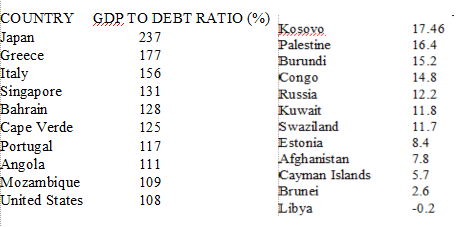
“Today, Japan’s ratio is above 200%.” More like 90% following two decades of QE asset swaps. BOJ owns more than half of that big scary debt. They just haven’t gotten around to canceling it out yet. Shit the US could the same at any time.
2016 article: https://asia.nikkei.com/NAR/Articles/Bank-of-Japan-holds-more-than-a-third-of-all-JGBs
You ever read the book ‘Princes of the Yen’?
LikeLike
Are you sure Biden knows? Also which of three theories of banking [1,2, or 3] https://www.sciencedirect.com/science/article/pii/S1057521915001477?via%3Dihub does he believe to be true? DELAWARE as an acronym stands for Dollars & Euros Laundered & Washed At Reasonable Expense so one would think he would know something about banking and where credit comes from.
LikeLike
Re: the debt to GDP ratio. This ratio doesn’t make any sense for the reasons you mention, but also because the “debt” is a stock of money and GDP is a flow of money.
You simply cannot compare the two. It’s worse than apples to oranges because those two things are at least both round fruits.
Flows can feed into stocks, the annual deficit flow from the government feeds into the stock of the “debt”. But, any analysis that isn’t stock-flow consistent is garbage.
LikeLike
Right
LikeLike
Why haven’t all the ivory tower eggheads yet been able to see and acknowledge this?
As RMM says: No nation can tax itself into prosperity, nor grow without money growth. Monetary Sovereignty: Cutting federal deficits to grow the economy is like applying leeches to cure anemia.
Two key equations in economics:
1. Federal Deficits – Net Imports = Net Private Savings
2. Gross Domestic Product = Federal Spending + Private Investment and Consumption – Net Imports
Was earlier asking someone I know in Ottawa how tightwad Canada is going to manage to feed, cloth, educate, and house an “unlimited” number of Ukrainian refugees for at least two years without a serious amount of deficit spending.
Even the far left NDP party up there led by a Sikh guy with a pink turban is firmly in the we need high taxes on everything to fund spending camp:
“On 16 June 2019, Singh and the NDP announced A New Deal for People, the party’s campaign platform for the October federal election. One of its key policies was a national pharmacare program. The platform also addressed climate change, vowing to end subsidies to gas and oil companies and increase emissions targets. The party also promised to expand cell coverage and broadband Internet and set caps on Internet and cell phone bills. In addition, the NDP platform emphasized affordable housing and confirmed its commitment to reconciliation and Indigenous rights. It also promised better housing, clean water and education for First Nations, Inuit and Métis communities. To help pay for these plans, the NDP proposed increasing the corporate tax rate and highest income tax rate, as well as imposing a new one per cent wealth tax on fortunes worth over $20 million.”
LikeLike