Is poverty harmful, harmless, or a benefit?

Liberals think the purpose of government is to protect the poor and powerless from the rich and powerful. Conservatives think the purpose of government is to protect the rich and powerful from the poor and powerless.
================================================================================================================================================

Evolution requires that for any physical feature to last a long time it either must be harmless or a benefit. Over the eons, harmful features tend to disappear.

Consider toenails. Once we came down from the trees, toenails were of no imaginable use, but they require so little energy to grow, they have not been an evolutionary inhibition. So we still have them.

Poverty too, has been with our species for thousands of years. But one is reluctant to say it is harmless. So that leaves the possibility that poverty is a benefit.

Or, because it is a social feature, rather than a physical feature, rather than a physical benefit, might it only be a perceived benefit?

Regarding perception, the Democrats are about to pass what can be one of the most meaningful bills in many years — meaningful because that one bill can change common economics perceptions.

Child tax credit expansion sets up showdown with GOP
By ALEXANDRA JAFFE and JOSH BOAK
March 8, 2021

WASHINGTON (AP) — The massive ($1.9 trillion) coronavirus relief plan making its way to President Joe Biden’s desk includes a plan to temporarily raise the child tax credit that could end up permanently changing the way the country deals with child poverty.

The American Rescue Plan, expected to receive final approval this week, temporarily raises the child tax credit, now at a maximum of $2,000, to as much as $3,600 per child annually.

The plan also expands the credit so it’s fully available to the poorest families, instead of restricting it based on the parents’ tax liability. And it will be paid out in monthly installments, to offer families struggling during the pandemic a more consistent lifeline.

If the Democrats are smart (big “if”), they will resist the calls to raise taxes to “pay for” the bill. The Democrats simply should allow the federal debt to rise significantly. Let debt fear-mongers wring their hands, and offer up dire predictions, none of which will occur.

The legislation gives families up to $3,600 annually for each child under age 6 and as much as $3,000 for those up to 17. 

The benefit is aimed at providing support to millions of families affected by the coronavirus pandemic. Democrats have embraced an analysis that found the proposal would cut child poverty 45%.

Republicans charge the move amounts to an expansion of the welfare state that will disincentivize parents from seeking work.

But Democrats hold out the proposal as a fundamental rethinking of the way the country approaches child poverty and an opportunity to address the income inequality that’s been exacerbated by the pandemic.

The old “disincentivize” myth simply means: “Give poor people some money, and they won’t work.” 

Thus poverty is wrongly portrayed as a benefit to the economy in that it supposedly stimulates labor. That false belief provides a ready excuse to widen the Gap between the rich and the rest.

It’s utter nonsense of course, as demonstrated by all the middle, upper-middle, and even rich people who have plenty of money yet still work. It’s the common “laziness” slur on the poor, most of whom actually labor much harder than do most of the rich.,

Connecticut Rep. Rosa DeLauro, a Democrat who has been advocating for an expansion of the credit since 2003, said in a statement that “this legislation forever changes the way that our nation supports both middle-class families and children in poverty.”

DeLauro and other Democrats on Capitol Hill see the current legislation as laying the groundwork for a permanent expansion of the credit.

Indeed, Biden himself told House Democrats during a private call last week that he supports legislation that would permanently increase the child tax credit to $3,000 per child.

While Republicans broadly support the idea of expanding benefits for children, some have opposed the Biden plan for its price tag, and others have criticized it for divorcing the benefit from any work requirement.

“Price tag” is an argument that takes several forms, among which are the false notions that:

1. Federal taxes fund federal spending. FALSE

The Federal government uniquely is Monetarily Sovereign. It never can run short of its own sovereign currency. Even if it collected $0 taxes, it could continue spending, forever.

Rather than using tax dollars, the federal government creates new dollars, ad hoc, each time it pays a creditor.

While state and local governments (which are monetarily non-sovereign) do use state and local taxes to fund spending, the federal government actually destroys federal taxes upon receipt.

That is why no one can answer the question, “How much money does the federal government have?” The best answer is, “Infinite.”

Tax dollars never become part of any money measure (i.e. M1, M2, M3, et al). They simply are destroyed

2. Federal deficit spending causes inflation. FALSE

All inflations are caused by scarcity, usually a shortage of food and/or energy.

Federal deficit spending actually can cure inflation, if the spending is directed toward reducing the scarcity (for instance, by buying overseas and distributing the scarce goods, or by supporting the manufacture of the scarce goods).

3. Federal deficit spending slows the economy. FALSE

The most common measure of the economy is Gross Domestic Product (GDP), the formula for which is:

GDP = Federal Spending + Non-federal Spending + Net Exports

Increases in federal deficit spending increase all three terms in the GDP formula.

4. Federal borrowing competes with private borrowing. FALSE

Though state and local governments do borrow, the U.S. federal government does not borrow. Federal financing is nothing like state and local government financing.

Banks and credit card companies, which do the vast majority of lending in America, do not lend to the federal government.

5. Future taxpayers will have to pay for the federal debt. FALSE

Because the federal government has the unlimited ability to create dollars, it does not borrow. Instead, it allows for deposits into T-security (T-bill, T-note, T-bond) accounts.

When you buy a T-security, you are not lending money to the federal government. You are making a deposit into your own T-security account, held at the Federal Reserve Bank. There your dollars remain, collecting interest until maturity, at which time the government returns your dollars.

The federal government does not use those dollars to pay its creditors or for any other purpose.

No borrowing or taxpayer money ever is involved in T-security transactions. All taxpayer dollars are destroyed upon receipt.

6. Federal interest payments crowd out other federal spending. FALSE

The federal government has the unlimited power to create dollars. It can pay an infinite amount of interest.

Scott Winship, director of poverty studies at the conservative American Enterprise Institute, said his concern is that a permanent child allowance might make parents less likely to work and reduce the number of two-parent households, since there would be a stream of income from the government.

He wants to reduce child poverty but is concerned that doing so this way might worsen factors such as unemployment and single-parenthood that contribute to policy.

“The feeling is we win the battle against child poverty but we lose the war in the long run because we’ve created incentives that make it tougher to reduce poverty,” Winship said.

The conservatives want you to believe that giving the impoverished money increases poverty. Remember that bit of nonsense, every time to make a contribution to charity. According to the conservatives, when you drop a dollar into the bell-ringer-Santa’s pail, you are worsening poverty!

“If pulling families out of poverty were as simple as handing moms and dads a check, we would have solved poverty a long time ago,” Sen. Marco Rubio wrote.

Pulling families out of poverty is as simple as handing moms and dads checks, but ignorant and/or dishonest politicians won’t admit it.

But the expanded benefits included in the coronavirus relief plan set up a precedent that could put Republicans on defense on the issue. Because the benefit currently expires after a year, the Biden plan essentially creates a potential fiscal cliff for child poverty.

This could set up a political showdown during an election year on whether voters believe it’s acceptable for millions of children to lose the added aid and become impoverished once again.

“When it’s up for renewal, Republicans will be in the awkward position of opposing payments to families delivered through a credit that they pioneered, and championed as recently as 2017,” said Samuel Hammond, director of poverty and welfare policy at the Niskanen Center. 

“No Republican wants to run on taking money away from families of any income,” Hammond said.

The Republicans never have expressed sympathy for the less-than-rich families. They tend to blame the impoverished for their own poverty, rather than to admit that good or bad fortune are the primary determinants of wealth.

Looking toward the midterm elections, the attack ads aimed at Republicans would simply highlight the party’s votes for tax cuts during the Trump administration in contrast with their votes against the Biden plan.

“It’s as simple as, when it was a vote on tax cuts for billionaires, Republicans voted yes, and when it was a check for you, they voted no,” he said.

If the Democrats avoid the pressure from the economics-ignorant, unnecessarily to raise taxes, the results might at long last demonstrate the facts of Monetary Sovereignty, and maybe, just maybe, we wouldn’t be subjected to the following Big Lies from such as the Committee For A Responsible Federal Budget (CFRB):

How High Are Federal Interest Payments?
Mar 10, 2021

This year, the federal government will spend $300 billion on interest payments on the national debt. This is the equivalent of nearly 9 percent of all federal revenue collection and over $2,400 per household.

Households don’t pay for federal interest payments.

The federal government spends more on interest than on transportation, education, and research and development combined.

The above statement is irrelevant. It only demonstrates that the government could spend more on transportation, education, and research and development.

The household share of federal interest is larger than average household spending on many typical expenditures, including gas, clothing, education, or personal care.

Again, irrelevant. Households do not pay for federal interest.

Growing debt levels add to the cost and risk associated with them.

The federal government has the unlimited ability to fund interest payments, which actually stimulate economic growth. There is no risk associated with federal spending.

Even with exceptionally low interest rates, the federal government is projected to spend just over $300 billion on net interest payments in fiscal year 2021. This amount is more than it will spend on food stamps and Social Security Disability Insurance combined.

It is nearly twice what the federal government will spend on transportation infrastructure, over four times as much as it will spend on K-12 education, almost four times what it will spend on housing, and over eight times what it will spend on research and development.

All the above demonstrates is the that government could, and should, spend more on food stamps, Social Security, infrastructure, education, housing, and research and development.

Interest payments effectively consume more than half of the worker-side payroll tax paid by households and are almost twice as large as total payments received through federal excise taxes and customs duties.

Interest payments do not “consume” any taxes. Federal taxes do not fund federal spending.

If interest rates were one percent higher than projected for all of 2021, interest costs would total $530 billion — more than the cost of Medicaid.

If rates were two percent higher, interest costs would total $750 billion, which is more than the federal governments spends on defense or Medicare. And at three percent higher, interest costs would total $975 billion — almost as much as is spent on Social Security benefits.

On a per-household basis, a one percent increase in the interest rate would increase costs by $1,805, to $4,210.

The CRFB keeps repeating the same lie, that federal taxes fund federal spending. They learned from Hitler that if you repeat a lie often enough, people will begin to believe it.

Trump used the same strategy with his repeat of the lie that the election was stolen. Millions of people believe that lie, too.

The higher the federal debt, the more exposed the federal government is to interest rate risk. 

There is no risk to the federal government or to taxpayers. The government has the unlimited ability to pay its bills. There also is no risk of inflation, which is not caused by government deficit spending, but rather by shortages, usually of food and/or energy.

And now, here is the CRFB’s Big Lie in all its glory:

Once the U.S. recovers from the COVID-19 pandemic, policymakers should work to adopt a combination of entitlement reforms, smart spending reductions, and revenue increases that will ultimately put debt and deficits on a more sustainable path.

“Entitlement reforms” and “spending reductions” mean “cut Social Security, cut Medicare, cut all social benefits for the poor and middle-income.”

“Revenue increases” means “increase FICA and other taxes on the poor and middle-income.”

“Sustainable” is the CRFB’s favorite word, that actually has no meaning at all, but it sounds oh, so prudent, doesn’t it?

SUMMARY

The Big Lie in economics is: The Monetarily Sovereign U.S. government uses tax dollars to pay its bills. This lie prevents the government from supplying benefits to those who are not rich.

A corollary to the Big Lie is the notion that spending for social benefits discourages people from working.

The Big Lie and its corollary are disseminated by the media, the politicians, and the economists who are bribed by the rich so as to widen the Gap between the rich and the rest.

Rodger Malcolm Mitchell

Monetary Sovereignty Twitter: @rodgermitchell Search #monetarysovereignty Facebook: Rodger Malcolm Mitchell …………………………………………………………………………………………………………………………………………………………………………………………………………………………………………………………………………………………..

THE SOLE PURPOSE OF GOVERNMENT IS TO IMPROVE AND PROTECT THE LIVES OF THE PEOPLE.

The most important problems in economics involve:

  1. Monetary Sovereignty describes money creation and destruction.
  2. Gap Psychology describes the common desire to distance oneself from those “below” in any socio-economic ranking, and to come nearer those “above.” The socio-economic distance is referred to as “The Gap.”

Wide Gaps negatively affect poverty, health and longevity, education, housing, law and crime, war, leadership, ownership, bigotry, supply and demand, taxation, GDP, international relations, scientific advancement, the environment, human motivation and well-being, and virtually every other issue in economics. Implementation of Monetary Sovereignty and The Ten Steps To Prosperity can grow the economy and narrow the Gaps:

Ten Steps To Prosperity:

  1. Eliminate FICA
  2. Federally funded Medicare — parts A, B & D, plus long-term care — for everyone
  3. Social Security for all or a reverse income tax
  4. Free education (including post-grad) for everyone
  5. Salary for attending school
  6. Eliminate federal taxes on business
  7. Increase the standard income tax deduction, annually. 
  8. Tax the very rich (the “.1%”) more, with higher progressive tax rates on all forms of income.
  9. Federal ownership of all banks
  10. Increase federal spending on the myriad initiatives that benefit America’s 99.9% 

The Ten Steps will grow the economy and narrow the income/wealth/power Gap between the rich and the rest.

MONETARY SOVEREIGNTY

Joe Biden’s big mistake

  1. Monetary Sovereignty: This term describes the unlimited ability to issue and control a currency.  Even without collecting taxes, a Monetarily Sovereign can spend forever.
  2. Gap Psychology: This term refers to the desire to distance oneself from those below, in any social ranking, and to come nearer to those above.
  3. The Big Lie: This term describes the false claim that a Monetarily Sovereign entity needs or uses income.

Joe Biden made a big mistake. He revealed, in an interview with ABC’s David Muir, that he doesn’t understand federal financing.

Joe Biden releases plan to reopen schools amid coronavirus ...
“Everyone should pay their fair share” of a useless and regressiv tax.

Here are some excerpts:

Biden to ABC’s David Muir on raising taxes: ‘No new taxes’ for anyone making less than $400,000
Everybody should pay “their fair share,” Biden said.
By Arielle Mitropoulos, August 23, 2020, 7:09 PM

Joe Biden and his running mate Sen. Kamala Harris, the former vice president (said) everybody should pay “their fair share.”

“I will raise taxes for anybody making over $400,000,” Biden told Muir, adding, “no new taxes” would be raised for anyone making under $400,000.

Presumably, Biden and Harris believe that making “soak-the-rich” statements will endear them to the working populace, who gleefully enjoy any punishment of the rich.

They may be right about those emotions, but they are at least partly wrong about the economics.

They are right that raising taxes on the rich would narrow the Gap between the rich and the rest, which would benefit the economy in myriad ways.

Wide Gaps negatively affect poverty, health and longevity, education, housing, law and crime, war, leadership, ownership, bigotry, supply and demand, taxation, GDP, international relations, scientific advancement, the environment, human motivation and well-being, and virtually every other issue in economics.

But, the federal government neither needs nor uses tax income. The federal tax dollars you send to the U.S. Treasury leave the economy and cease to exist. So, rather than holding taxes steady, the Democrats should cut taxes for everyone who is not rich.

Tax policy is taking on additional significance for the 2020 presidential election, with the economic crisis inextricably tied to the pandemic, and more than 30 million Americans currently on unemployment.

Although Biden has been leading in the polls, polls also have shown that voters have greater confidence in President Donald Trump when it comes to the economy.

Voters may have greater confidence in Trump regarding the economy, because Trump has taken credit for the ongoing effect of President Obama’s increased deficit spending.

Trump, with his tax cuts for the rich and his increased import duties — which effectively are tax increases on the “not-rich,” has widened the Gap between the rich and the rest.

“Is it smart to tax businesses while you’re trying to recover?” Muir asked.

“It’s smart to tax businesses that are in fact making excessive amounts of money and paying no taxes,” Biden told Muir.

“It’s how we did it last time,” he said, in reference to the 2008 recession, adding that his work, at the time, with then-President Barack Obama, led to economic recovery, “with the largest, the most consecutive number of months of growth in jobs of any time in history. We did it the right way.”

No, it is not smart to tax business when you’re trying to recover, or any other time. What they actually did was pump money into the economy with increased federal deficit spending:

Federal debt growth declines in advance of recessions (vertical gray bars). Then, to cure recessions, the federal government increases deficit spending.

A growing economy requires a growing supply of money. Increased federal deficit spending (which increases the federal debt) grows the economy. When federal deficit spending does not increase sufficiently, recessions result. These recessions are cure by increases in federal deficit spending.

Increased taxation reduces federal debt growth and therefore is recessionary. 

Taxing the rich more, while holding taxes level for the “not-rich” would be recessionary. While taxing the rich would help narrow the Gap, the recessionary effect must be overcome by taxing the not-rich less.

“Look [at] what he’s doing,” Biden continued, criticizing the president. “The money was supposed to go to help small businesses. You have one in six small businesses that have already closed. You’re finding a situation that over 60% of the money — only 40% of money for small businesses went to small businesses.”

When Muir pressed him on whether taxes would be raised on small businesses, Biden emphatically said, “No.”

“There will be no raising taxes” on the “90% of the businesses out there are mom and pop businesses — that employ less than 50 people,” Biden responded.

“We have to provide them with the ability to reopen. We have to provide more help for them, not less help,” he said.

Biden is correct that small businesses need help, but this will not be accomplished by taxing large businesses, however one defines “large” and “small.”

That a business employing more than 50 people should be considered “large” and taxed more, is ludicrous. The number of employees is not relevant to “making excessive amounts of money and paying no taxes.” What is relevant? Profits and taxes.

Why penalize businesses for hiring? It makes no sense to penalize businesses at all, because businesses provide goods, services, and money to the economy.

To narrow the Gap between the rich and the rest, the highest personal incomes should be taxed, not businesses.

In Summary, Biden doesn’t understand Monetary Sovereignty, Gap Psychology, and this misunderstanding leads him to tell The Big Lie.

Assuming he wishes to help the underclasses, narrow the Gap, and stimulate the economy he should begin by eliminating FICA, while leaving the funding of Medicare and Social Security to the federal government.

Contrary to popular wisdom, FICA does not fund Social Security or Medicare. Like all federal taxes (but unlike state/local taxes) FICA funds nothing. The federal government could fund unlimited spending with no taxes.

FICA is the most regressive tax in America. Eliminating FICA would benefit workers and businesses. It would decrease unemployment by making employment cheaper. It has been suggested seriously by just one politician, none other than Donald J.Trump. But, in perhaps the only time the GOP toadies have stood up to Trump, they said “No.”

Ironically, this may have been the only good idea Trump has had during his term.

Rodger Malcolm Mitchell Monetary Sovereignty Twitter: @rodgermitchell Search #Facebook: Rodger Malcolm Mitchell …………………………………………………………………………………………………………………………………………………………………………………………………………………………………………………………………………………………..

THE SOLE PURPOSE OF GOVERNMENT IS TO IMPROVE AND PROTECT THE LIVES OF THE PEOPLE.

The most important problems in economics involve:

  1. Monetary Sovereignty describes money creation and destruction.
  2. Gap Psychology describes the common desire to distance oneself from those “below” in any socio-economic ranking, and to come nearer those “above.” The socio-economic distance is referred to as “The Gap.”

Wide Gaps negatively affect poverty, health and longevity, education, housing, law and crime, war, leadership, ownership, bigotry, supply and demand, taxation, GDP, international relations, scientific advancement, the environment, human motivation and well-being, and virtually every other issue in economics. Implementation of Monetary Sovereignty and The Ten Steps To Prosperity can grow the economy and narrow the Gaps:

Ten Steps To Prosperity:
1. Eliminate FICA
2. Federally funded Medicare — parts A, B & D, plus long-term care — for everyone
3. Social Security for all or a reverse income tax
4. Free education (including post-grad) for everyone
5. Salary for attending school
6. Eliminate federal taxes on business
7. Increase the standard income tax deduction, annually. 
8. Tax the very rich (the “.1%”) more, with higher progressive tax rates on all forms of income.
9. Federal ownership of all banks
10.Increase federal spending on the myriad initiatives that benefit America’s 99.9% 

The Ten Steps will grow the economy and narrow the income/wealth/power Gap between the rich and the rest. MONETARY SOVEREIGNTY

11 experts try to trick you about the U.S. economy

Uncle Sam broke.png
100% impossible.

The following will give you a treasured opportunity to read the words of 11 experts, each demonstrating his lack of knowledge or lack of honesty about federal finances and economics.

Their hope or effect is to make you ignorant about the economy, during this time of crisis.

If your hope is to become ignorant about federal finances or economic, then do believe what they say. You will be able to cross that item off your bucket list.

But if you wish to understand the facts, and perhaps even be able to contact your political leaders with the facts, read on.

As you read, please remember that federal finances are nothing at all like your personal finances, nothing like business finances, and nothing like state/local government finances.

The federal government uniquely is Monetarily Sovereign. It never, NEVER can run short of its own sovereign currency, the U.S. dollar.

And the government, being sovereign over the dollar, has absolute control over its value.

When it comes to the U.S. dollar, the federal government is God. So don’t use your own personal financial experience as a template about federal finances.

Here are excerpts from an article written by Mike Bebernes, of Yahoo News, followed by my comments.

Coronavirus aid: Is the U.S. taking on too much debt?
Mike Bebernes, Editor,Yahoo News 360•August 4, 2020

Negotiations in Congress about the next stimulus bill aimed at countering the economic effect of the coronavirus have ground to a crawl amid debate over how big the rescue package should be.

Not only is there the expected sparring between Democrats and Republicans, the issue is also reportedly causing a rift within the GOP itself.

A vocal group of Republicans have begun to raise concerns about adding how much the next stimulus will add to the federal deficit, “We have to be careful about not piling on enormous amounts of debt,” Treasury Secretary Steve Mnuchin said.

Kentucky Sen. Rand Paul said some of his GOP colleagues are “no different than socialist Democrats when it comes to debt.”

Right off the bat, you see Mnuchin’s ignorance. The economic effect of the coronavirus is quite simple: Businesses are running short of paying customers and people are running short of income with which to pay businesses.

The effect is that businesses and people are running short of money. This lack of money causes a recession.

The solution to a recession also is quite simple: Give businesses and people money.

As for Rand Paul’s concern, deficit spending is not “socialist.” Socialism is government ownership and control of businesses. Handing out money and/or providing benefits (healthcare, education, etc.) is not socialism.

Fakers love to toss around the word “socialist,” because they know Americans will react negatively to it. Any time you hear someone accuse some federal spending as “socialist,” know you are being conned.

House Democrats passed a $3.4 trillion stimulus bill in May. The proposal under consideration by Senate Republicans carries a $1.1 trillion price tag.

Even if a significantly smaller package ends up being passed, the national debt will still be at historic levels.

The $2.2 trillion CARES Act passed in March pushed the deficit over $26 trillion and has the country on pace for the largest annual ratio of debt as a share of the economy since World War II.

Although it commonly is termed, “debt,” it isn’t the same thing as personal debt or business debt. That thing called “debt” actually is the total of deposits into Treasury Security accounts (T-Bills, T-Notes, T-Bonds) held at the Federal Reserve (The Fed).

These deposits are not a burden on anyone — not on the government, not on taxpayers, and not on future generations. If the government wished, it could pay off the deposits today, merely by returning the dollars currently residing in those T-Security accounts.

If you own a T-bill, and that T-bill matures, the government will send back to you your dollars that reside in your T-bill account.

It would just be a transfer of your dollars similar to a transfer from your savings account to your checking account.

No tax dollars involved in the repayment of federal “debt.”.

The coronavirus isn’t the only reason the U.S. has so much debt. After running a surplus in the late 1990s, the deficit has ballooned over the past two decades.

Despite promising to eliminate the federal debt — which stood at $19 trillion when he took office — President Trump is on pace to have the largest deficit of any president.

The virus is taking dollars from the private sector, which has caused a recession.

Eliminating the so-called “debt” (deposits into T-Security Accounts) would take even more dollars from the economy, causing the deepest depression in U.S. history (and world history).

For example:

1804-1812: U. S. Federal Debt reduced 48%. Depression began 1807.
1817-1821: U. S. Federal Debt reduced 29%. Depression began 1819.
1823-1836: U. S. Federal Debt reduced 99%. Depression began 1837.
1852-1857: U. S. Federal Debt reduced 59%. Depression began 1857.
1867-1873: U. S. Federal Debt reduced 27%. Depression began 1873.
1880-1893: U. S. Federal Debt reduced 57%. Depression began 1893.
1920-1930: U. S. Federal Debt reduced 36%. Depression began 1929.
1997-2001: U. S. Federal Debt reduced 15%. Recession began 2001.

You can thank your god that Trump didn’t live up to his promise, for had he somehow managed to eliminate U.S. debt, you would be living naked in a cave, eating cave bats.

To many fiscal conservatives, large deficits pose a major risk to the economic stability of the country.

Taking on debt may be a quick way to solve problems in the short term, but it only pushes the burden onto future generations, they argue.

The weight of trillions of dollars in debt, plus the interest accrued, will stifle the country’s ability to recover from the recession and hinder growth once the economy improves.

Federal deficit spending adds growth dollars to the economy, which is exactly why they “solve problems in the short term.” Deficit spending also solves problems in the mid-term and the long term.

Think of all the things for which the federal government spends money. Then ask yourself, “Which of these, if eliminated, would grow the economy?”

Being Monetarily Sovereign, the federal government creates new dollars by spending. That is the government’s method of dollar-creation.

To pay a creditor, the federal government sends instructions (not dollars) to the creditor’s bank, instructing the bank to increase the balance in the creditor’s checking account.

The instant the creditor’s bank does as instructed, new dollars are created and added to the nation’s M1 money supply.

Deficit spending is no burden whatsoever on future generations. In fact, federal deficit spending benefits future generations by providing them not only with dollars, but also with roads, bridges, health care, education, military protection, safe food, legal protections, and the myriad other things the government pays for.

As for “interest accrued,” those dollars go into the private sector, stimulating economic growth. Interest is no burden on the federal government, which being Monetarily Sovereign has infinite dollars.

(That is why there is no way to answer the question, “How much money does the federal government have?” The real answer is, “Infinite.”)

America’s ability to keep borrowing enormous amounts of money, at least in theory, could run out if oversized deficits reduce confidence in the U.S. economy.

If that happens sometime in the future, it could cause a major spike in interest rates, severe inflation or even an economic collapse that dwarfs the impact of the pandemic, deficit hawks fear.

The U.S. federal government does not borrow. Being Monetarily Sovereign, it never can run short of U.S. dollars. It has no need to borrow.

Bernanke quote
Truth from the Chairman

What wrongly is termed “borrowing” actually is the acceptance of deposits into T-security accounts.

The purpose of T-security accounts (“debt”) is not to provide spending money for the U.S. government, the one entity that has infinite dollars.

The primary purposes of T-security accounts are:

  1. to provide a safe parking place for unused dollars, which stabilizes the dollar and
  2. to assist the Fed in setting interest rates.

The federal government could stop accepting deposits into T-security accounts today if it wished. And in the event that people stopped depositing into T-security accounts, the U.S. Federal Reserve has the unlimited ability to make those deposits.

As for a “major spike in interest rates,” the Fed, not depositors, controls interest rates. The rates are exactly what the Fed wants them to be. Only if the Fed wants a “major spike,” will there be one. Otherwise, no major spike.

Greenspan II.png
Truth from another Chairman

As for “severe inflation,” it never is caused by federal debt or by federal deficit spending. In fact, deficit spending can cure inflations.

All inflations are caused by shortages of key goods and/or services, usually food or energy (oil).

Inflations are cured when the government deficit-spends to obtain the scarce goods and/or services and then distributes them to the private sector.

Consider the infamous Zimbabwe hyperinflation. The Zimbabwe government took farmland from farmers and gave it to people who didn’t know how to farm.

The predictable result: A massive food shortage that led to inflation. The Zimbabwe government could have ended the inflation by importing and distributing food (or better, by not stealing the farmland in the first place).

Instead, it merely devalued its currency, again, again, and again.

By contrast, Germany cured its infamous hyperinflation by employing businesses and people to build the greatest war machine the world had ever known. That allowed people and businesses to thrive, and eliminated shortages. (War preparation was not the best use for German money, but it did cure the hyperinflation.)

Others argue that these potential future issues pale in comparison to the very real catastrophe that will happen without a large rescue package.

Research suggests that the $600 weekly bonus added to unemployment has kept the economy from collapsing even further over the past few months.

Now that it’s expired, millions of Americans are at risk of losing their homes and countless businesses could close permanently.

True. The $3 trillion rescue package helped avoid the catastrophe that is certain unless at least $7 trillion is pumped into the private sector.

Oh, that won’t happen? Congress won’t do it?  Then assume we will have an economic catastrophe with massive unemployment, starvation, and more death — all unnecessarily.

The only way to truly save the economy, some argue, is to get the pandemic under control.

Spending money to improve testing, help people stay home and prop up struggling state budgets in the short term could prevent the need for an even bigger stimulus down the road.

Some Democrats believe that concerns about debt are insincere and motivated by politics, since the GOP enthusiastically supported tax cuts in 2017 that are expected to add trillions to the deficit.

Getting the pandemic “under control” is not the only way to save the economy, though it’s a good thing to do.

The faster way is to pump trillions of dollars into the private sector so that businesses can do business and consumers can consume.

And now what you nervously have been waiting to see: More truly ignorant comments by a few of America’s opinion leaders:

The stimulus should be limited to the most essential remedies
“Senate Republicans are right to be worried about rising federal debt. But they are wrong to artificially limit the level of spending in the latest coronavirus relief package.” — Henry Olsen, Washington Post

There are zero reasons to limit the stimulus. Note how Olsen takes both sides of the issue. That way, in retrospect, he always can lay claim to having been right. That is how one gets to be an “expert.”

At a certain point, U.S. credit may run out
“America’s borrowing capacity is large, but we may discover that it is not unlimited.” — Brian Riedel, National Review

The U.S. doesn’t borrow, so it doesn’t need “credit” and doesn’t have a “borrowing capacity. Being Monetarily Sovereign, it has absolute control over the value of its money and its credit, and never can run short.

Spend money now, but aggressively tackle the deficit once the pandemic ends
“When the pandemic passes, authorities need to shift out of rescue mode and start weaning capitalism off easy money and bailouts.” — Ruchir Sharma, Wall Street Journal

Sharma’s formula is to “spend money now ” to feed our starving economy, but when the pandemic ends, begin to starve the economy? Wow! Great idea, Ruchir: Starve future generations.

Better to spend money now, and spend money later, to continue to grow the economy.

The previous stimulus proved you can’t spend your way out of a crisis
“Having wasted the opportunity to cool off the spending binge and put the country in a better position to deal with a crisis, Congress now appears ready to do the only thing it knows how: spend even more.” — Eric Boehm, Reason

Remember that Boehm is a Libertarian for whom any amount of federal spending is too much.

Let me correct Boehm’s comment: “The previous stimulus proved that when the economy is in full starvation mode, insufficient stimulus will help some, but way, way more is needed.”

Way back in April I wrote that at least $7 trillion was needed. But, Congress voted for $3 trillion.

Of course, it wasn’t enough, so we now are in a serious recession. Yet, Boehm wants to cut back on all spending.

Future generations will suffer from reckless spending today
“Long after an effective vaccination has been discovered, the events of 2020 could figure in another disaster: a forced reduction in Medicare and Social Security benefits, as well as unprecedented tax hikes, to deal with massive national debt.” — Chris Reed, San Diego Union-Tribune

Apparently, Reed is clueless about Monetary Sovereignty. The federal government cannot ever run short of dollars.

So why would there have to be “a forced reduction in Medicare and Social Security benefits, as well as unprecedented tax hikes”? There is nothing that could force the federal government to do anything it doesn’t want to do.

And again, taxes do not fund the federal “debt.” The government could pay for Medicare and Social Security, and pay off the entire debt, without collecting a single penny in taxes.

Don’t worry about the deficit
Risk of large deficits pales in comparison to the harm insufficient stimulus will cause
“Deficits do matter in a sense, but not in the apocalyptic, over-the-cliff and straight-to-hell manner Republicans like to invoke when they’re feeling stingy.

‘A high-enough deficit under the right circumstances could theoretically bring about inflation. But inflation is not some mystical, unsolvable force.

The government has all kinds of tools at its disposal to deal with inflation.” — Zach Carter, HuffPost

Close, Zach, but no cigar. Deficits do matter because they are absolutely necessary for economic growth. A growing economy requires a growing supply of money, and deficits increase the supply of money.

But you are correct when you wrote this: “The government has all kinds of tools at its disposal to deal with inflation.”

More accurately, the federal government has absolute control over inflation.

Republican concerns about debt are purely political
“If there’s one thing we’ve learned over the past decade, it is that there are no Republican deficit hawks — only poseurs who claim to care about deficits in order to block spending they don’t like.” — New York Times columnist Paul Krugman

Right you are, Paul. Now if only you could unequivocally state: “The Federal Government is Monetarily Sovereign. It never can run short of dollars. No one should worry about deficits or “debt.”

Just do it, Paul.

A large rescue package can jump-start the economy’s recovery
“Congress should use this opportunity to support the American people and the American economy. If we get the economy growing, we will be able to pay off the debt.” — Minneapolis Federal Reserve Bank president Neel Kashkari to “Face the Nation”

Neel, you’re a Fed bank president, so you, of all people, should know that getting the economy “going” has absolutely nothing to do with the government’s ability to pay off the debt.

C’mon, man.

It’s better to overspend now and avoid a collapse
“We should be trying different things: stimulus payments, unemployment benefits, aid to state and local governments, aid to small businesses. Some of these things will be more effective than others, but it’s much better to err on the side of excess.” — Economist Gus Faucher to the Washington Post

Of all the “expert” comments, the comment by Gus Faucher comes closest to the truth.

My only quibble is with his use of the word, “excess.” We are so far from “excess” (whatever “excess” success may be), that even to mention it is misleading.

Historically low interest rates make borrowing money a smart strategy
“Interest rates on federal debt are currently lower than the expected rate of inflation, so there’s no good reason for restraint in the total size of the package.” — Vox correspondent Matthew Yglesias

Oh, Matthew, you know full well that interest rates are set by the government. The government has the unlimited power to pay as much or as little interest as it wishes.

You are correct that “there’s no good reason for restraint in the total size of the package,” but not because of interest rates. It’s because there never is a good reason to restrain federal deficit spending. Never.

So there it is folks, all those experts giving you contradictory advice, and not one of them demonstrates any understanding of federal financing.

Latest on the Spread of the Coronavirus Around the World | World ...
Foodbank line. Broke in America.

Feel free to contact them, tell them to learn Monetary Sovereignty, and say I said so.

Meanwhile, be ready for more poverty, starvation, homelessness, sickness, and death, thanks to Congress, the President, and the people who preach The Big Lie.

Rodger Malcolm Mitchell

Monetary Sovereignty Twitter: @rodgermitchell Search #monetarysovereignty Facebook: Rodger Malcolm Mitchell …………………………………………………………………………………………………………………………………………………………………………………………………………………………………………………………………………………………..

THE SOLE PURPOSE OF GOVERNMENT IS TO IMPROVE AND PROTECT THE LIVES OF THE PEOPLE.

The most important problems in economics involve:

  1. Monetary Sovereignty describes money creation and destruction.
  2. Gap Psychology describes the common desire to distance oneself from those “below” in any socio-economic ranking, and to come nearer those “above.” The socio-economic distance is referred to as “The Gap.”

Wide Gaps negatively affect poverty, health and longevity, education, housing, law and crime, war, leadership, ownership, bigotry, supply and demand, taxation, GDP, international relations, scientific advancement, the environment, human motivation and well-being, and virtually every other issue in economics. Implementation of Monetary Sovereignty and The Ten Steps To Prosperity can grow the economy and narrow the Gaps:

Ten Steps To Prosperity:

1. Eliminate FICA

2. Federally funded Medicare — parts A, B & D, plus long-term care — for everyone

3. Social Security for all or a reverse income tax

4. Free education (including post-grad) for everyone

5. Salary for attending school

6. Eliminate federal taxes on business

7. Increase the standard income tax deduction, annually. 

8. Tax the very rich (the “.1%”) more, with higher progressive tax rates on all forms of income.

9. Federal ownership of all banks

10.Increase federal spending on the myriad initiatives that benefit America’s 99.9% 

The Ten Steps will grow the economy and narrow the income/wealth/power Gap between the rich and the rest.

MONETARY SOVEREIGNTY
Would you like free healthcare for life? Don’t accept the Big Lie

This is a message for all Americans: Free healthcare for life truly can be yours, unless you accept the Big Lie.Image result for big lie

Unfortunately, you are treated to the Big Lie almost everywhere. Case in point: Here are excerpts from a typical, Big Lie article that appeared in the 11/25/2019 issue of Reason.com.

More Americans Want Bigger Government—If It’s Free
A more active government wins growing approval, but only so long as it doesn’t raise taxes, require tradeoffs, or interfere with private enterprise.
J.D. Tuccille | 11.25.2019 7:30 AM

Good news for control freaks and nanny-staters across the U.S.: Americans’ support for a bigger, more active government is edging up, potentially creating an opening for politicians and activists who want their countrymen to snuggle in the warm bosom of a nurturing state that provides an ever-greater variety of goods, services, and rules for people’s lives.

There’s just one catch: Americans don’t want to pay for it.

Support for a big, muscular government falls off a cliff if it comes with a price tag.

Consider that the article was published by the “any-government-is-too-much-government” Reason.com, don’t be surprised at the sarcasm delivered by such phrasing as “control-freaks,” “nanny-staters,” “warm bosom of a nurturing state,” and “ever variety of . . . rules for people’s lives.”

If one is blessed with the notion that good people need or want no help, and that only the lazy and indolent ask for it, one can sneer smugly, as J.D. Tuccille does, at those less fortunate.

And when one also is blessed with the abject ignorance of the federal government’s Monetary Sovereignty, one can declare, “Americans don’t want to pay for it” without disclosing that Americans do not pay for any federal spending.

That is why net federal deficits now total more than $20 trillion, and neither the government, nor the economy, nor the federal taxpayers have suffered any ill effects.

On the contrary, the economy has been booming since 2008 because the federal government has pumped trillions of dollars into consumers’ pockets (aka “running trillions of dollars in deficits”).

The article continues:

“Since 2010, the percentage of Americans saying government should do more to solve the country’s problems has increased 11 percentage points, to 47%, and the percentage wanting government to take active steps to improve people’s lives is up eight points, to 42%,” Gallup reported last week.

Forty-nine percent think the government is doing too much, and 29 percent prefer a government that provides just basic services.

It gets back to the question, “What is the purpose of our government?”

The answer is:

“The purpose of our government is to protect us and to improve our lives.”

Why else would we, and people all over the world, create governments?

Yes, bad government can be burdensome, but bad anything is burdensome: Bad police, bad roads, bad banks,  and bad phones, etc. But we don’t suggest doing without police, roads, banks, and phones. Similarly, it is foolish to suggest doing without government.

Can there be “too much” government? Yes, if the government interferes with the economy, negatively. But even then, it’s not a matter of “too much,” but rather “bad.”

A tiny government can be bad and a huge government can be good. Or vice versa. It’s not quantity; it’s quality that matters.

Here’s the opportunity politicians—especially Democrats—have been looking for as they promise “Medicare for All,” student loan forgiveness, universal basic income, government-supported housing, subsidized child care, and more.

And what is wrong with that? Are we to believe that Americans must suffer in order to be “good”? Must life be difficult so that we may “earn” a decent life?

If so, why then do the rich seem to avoid the miseries we foist upon ourselves?

Why do we allow ourselves to accept the myth that there is no such thing as a free lunch, and so we must sweat and hurt, and strain, while the rich glide through life blissfully?

Though the rich do not want you to know this, our government really does have the ability to provide a “free lunch.” You simply need to understand the facts of Monetary Sovereignty.

The Reason.com article continues:

Progressive standard-bearers Sen. Elizabeth Warren (D-Mass.) and Sen. Bernie Sanders (I-Vt.) have made particular waves with their plans for government largesse, but Pete Buttigieg and others have their own schemes for turning the federal government into Santa Claus with a bottomless bag of gifts.

To continue the sarcastic analogy, I don’t hear anyone asking Santa for fewer gifts. The author doesn’t believe the government should provide anything that benefits the poor and middle classes.

Apparently, he believes Medicare should be ended, and students should be burdened with loans. And as for the poor, why give them any help, because it’s their own fault. Right?

But tax cuts for big business and for the very rich are just fine. Isn’t that correct, Mr. Tuccile?

But a government that provides everything to everybody is going to run up some bills.

Oh, you can cut some existing programs and transfer the funds to other programs, but that’s hardly going to satisfy the demands of “Americans saying government should do more.”

Or, you simply can provide programs without cutting anything. The federal government, being Monetarily Sovereign, is perfectly capable of doing that.

More programs and spending will require more resources that have to come from somewhere.

And since bake sales usually fall a bit short when you’re talking about funding government takeovers of large segments of the economy and extensive new programs, that’s going to mean turning tax collectors into busy beavers.

Whoops.

VA Hospital: Socialist

“Whoops,” indeed. Clearly, J.D. Tuccille, the author, is ignorant of the difference between state/local governments’ finances, vs. the federal government’s finances.

If he had even a modicum of understanding about federal finances, he would know that not only does the government not need bake sales, it doesn’t need tax collectors.

And as a further demonstration of his economic ignorance, Medicare for All does not involve a government “takeover of a large segment of the economy,” or a takeover of any segment of the economy.

Like the current Medicare, which Tuccille clearly hates, Medicare for All simply would pay for medical care, not take it over.

“A more active government would almost certainly result in higher taxes,” Gallup adds.

“However, relatively few Americans favor that approach… In the latest poll, 25% would opt for increased taxes and services, 32% want no change and 42% prefer smaller government.”

Support for higher taxes to pay for expanded government is up a bit in the survey from years past, but it remains a distinctly minority taste.

Private hospital: Not socialist

And here is the crux of the problem: The very rich, who control the government, want you to believe that the only way you can have the same benefits the rich and the politicians have (paid-for healthcare, no need for college loans, plenty of money for retirement, etc.) is for you to pay more taxes — and that idea is a gigantic, smelly pile of bull poop.

Keeping you down is the easiest way for the rich to lift themselves up (See: Gap Psychology), and the easiest way to keep you down is to indoctrinate you with the false belief that your taxes are necessary to fund federal spending.

That means Americans are growing increasingly enthusiastic about placing orders for health care, higher education, housing, and more from the government—for free.

But when they see prices on the menu, they balk, big time.

And balk they should, for the “prices on the menu” are a lie. Federal taxes do not fund federal spending. Period.

You, as a federal taxpayer, do not pay for anything. Not only are your tax dollars not used by the federal government, but they are destroyed upon receipt.

Once your tax dollars are received by the U.S. Treasury, they cease to exists in any money supply measure. To pay it’ s bills, the federal government creates brand new dollars. That is how the federal government can continue to deficit spend without ever running short of money.

Medicare for All gains overwhelming support—as high as 71 percent in a Kaiser Family Foundation survey—from Americans so long as they think it’s entirely cost-free and devoid of tradeoffs.

But throw in some real-world qualifiers, and that support erodes.

Unfortunately, those “real-world qualifiers” are as “real-world” as the bogey man meets the tooth fairy.

But this does demonstrate the strong desire for free medical availability. It’s want Americans want, and it is what Americans should receive from an infinitely wealthy government.

“Net favorability drops as low as -44 percentage points when people hear the argument that this would lead to delays in some people getting some medical tests and treatments,” the Kaiser survey adds.

The notion that there would be “delays in some people getting some medical tests and treatments” is based on one truth and one fiction.

The truth is that more people would get medical tests and treatment, which is a wonderful thing. Every year, literally millions of poor and middle-income Americans stay sick too long and die too early for lack of funds.

“Net favorability is also negative if people hear it would threaten the current Medicare program (-28 percentage points), require most Americans to pay more in taxes (-23 percentage points), or eliminate private health insurance companies (-21 percentage points).”

Those so-called “real-world qualifiers” are about as “real-world” as the bogey-man meets the tooth fairy.

The argument about “delays in some people getting some medical tests and treatments,” is based on one implied truth and one implied fiction.

The implied truth is that more people would get medical tests and treatments, which is a wonderful thing.

Today, millions of Americans stay sick too long and die too early because they can’t afford medical tests and treatments. Apparently, some (i.e. rich) Americans think this is a good idea, so that doctors and hospitals will be freed up to treat the rich.

So yes, when medical tests and treatments are free, more Americans would use them and live better, longer lives. Isn’t this what we should want?

The implied fiction is that there is a fixed number of doctors, nurses, hospitals, etc. to go around, so if the poor start to make use of them, that will cause a shortage, and there won’t be enough for wealthier patients.

Utter nonsense. The creation of today’s Medicare made it possible for millions of the elderly, who formerly could not afford medical care, now to enjoy it. That has not caused a shortage of medical tests and treatment.

On the contrary, the additional money that Medicare has pumped into the medical field has caused a massive expansion of medical resources.

And the expansion would be even greater if Medicare stopped cutting doctors’ fees so much, didn’t require deductibles, and fully funded pharmaceuticals.

Availability follows money. The more money, the more availability. Medicare for all, properly done, would increase the availability of medical tests and treatment.

Costs for these plans are unavoidable.

Warren’s spending schemes would run to at least $26 trillion in new taxes, although she likes to pretend that her scheme would be paid for by a wealth tax that would simultaneously extract funds from successful people while punishing them for their success.

Sanders himself concedes that his plan for government-run health care would cost between $30-$40 trillion over ten years. He honestly admits that it would be the middle class that constitutes the majority of the population—not just some rich people somewhere—who would foot the bill.

Tens of trillions of dollars in new taxes are likely to prove a bit of a hurdle for Americans who want lots of new goodies from the government only if they’re entirely free.

Anyone who understands Monetary Sovereignty knows the above is “The Big Lie,” that federal taxes are necessary to fund federal spending.

It should be obvious, even to the ill-informed, that the federal government continually deficits spends and never seems to have any trouble paying its bills.

You can’t do that. Your state, county, and city can’t do that. Your business can’t do that. But the federal government uniquely can.

Why? It is Monetarily Sovereign. It created the very first dollars simply by creating laws from thin air. And those laws allowed the federal government to continue creating dollars from thin air.

The federal government simply cannot run short of its own sovereign currency.

It has no need for tax dollars. It has no need to borrow. Even if all federal taxes and all issuance of Treasury Certificates totaled $0, the federal government could continue spending, forever.

Despite Elizabeth Warren’s and Bernie Sanders’s ridiculous and ironic statements that Medicare for All would require an increase in federal taxes, it simply is not true.

The U.S. government easily could provide a no-deductible, comprehensive Medicare for All, that covered 100% of all hospital, doctor, drug, and equipment costs, along with long-term care, without collecting a single penny in taxes.

If you’re looking for more evidence that people are a little confused about what they want, try asking Americans about the widely reported growing enthusiasm for socialism.

Capitalism—the free market—remains the preferred choice of 60 percent of respondents, with 39 percent having a positive view of socialism, according to Gallup.

As with everything in this country, the division is increasingly partisan: Positive views of socialism have risen to 65 percent among Democrats and declined to 9 percent among Republicans. Fifty-two percent of Democrats have a positive view of capitalism vs. 78 percent of Republicans.

No, if you’re looking for more evidence that people are a little confused about what they want, try asking Americans, “What is socialism?”

Contrary to popular wisdom,  Medicare is not socialism. Neither is Social Security. Neither are food stamps and other poverty aids.

The word “socialism” is the handy pejorative the rich like to use whenever federal spending for benefits are discussed. So if anything helps the middle or the poor, the rich shout “socialism.” (Of course, benefits to the rich, like special tax breaks, never are called “socialism.”)

Socialism is government ownership and administration of production and distribution.

The Veterans Administration hospitals, which are owned and administered by the federal government, are socialist. The military is socialist. The federal highway system is socialist. In many communities, the water system is socialist. Most dams are socialist. NASA, the U.S. Treasury, and the Lincoln Memorial are socialist. Your street probably is socialist.

But Medicare is not. Medicare does not own anything. It merely pays for things. The same with Social Security and food stamps and other poverty aids. Paying for things is what all governments do, socialist or not.

Why does the article’s author introduce the word, “socialism”? Either he truly is ignorant of what “socialism” means, which seems impossible considering that he is a former managing editor of Reason.com and current contributing editor. Or, knowing that the word “socialism” has negative connotations to most Americans, he is trying to con you into believing Medicare for All is a bad idea, and that only the rich deserve the best possible medical care.

Don’t fall for the con. Don’t fall for the Big Lie. Medicare for All could be a free blessing upon you and this nation if you understand the truth: The federal government has unlimited control over its own sovereign currency, the U.S. dollar. That means it can control both the supply and the value of the dollar.

It never can run short of dollars; it can pay for anything, even without collecting taxes; it can prevent and cure inflation.

If you don’t believe me, believe them:

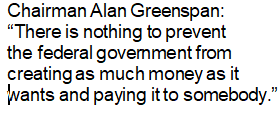
Alan Greenspan: “A government cannot become insolvent with respect to obligations in its own currency.”

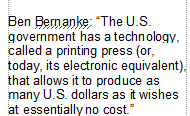
Ben Bernanke: “The U.S. government has a technology, called a printing press (or, today, its electronic equivalent), that allows it to produce as many U.S. dollars as it wishes at essentially no cost.”

St. Louis Federal Reserve: “As the sole manufacturer of dollars, whose debt is denominated in dollars, the U.S. government can never become insolvent, i.e., unable to pay its bills. In this sense, the government is not dependent on credit markets to remain operational.

Yes, America, free healthcare for life can be yours . . .  unless you accept the Big Lie.

Rodger Malcolm Mitchell
Monetary Sovereignty
Twitter: @rodgermitchell
Search #monetarysovereignty Facebook: Rodger Malcolm Mitchell

…………………………………………………………………………………………………………………………………………………………………………………………………………………………………………………………………………………………..

The most important problems in economics involve:

  1. Monetary Sovereignty describes money creation and destruction.
  2. Gap Psychology describes the common desire to distance oneself from those “below” in any socio-economic ranking, and to come nearer those “above.” The socio-economic distance is referred to as “The Gap.”

Wide Gaps negatively affect poverty, health and longevity, education, housing, law and crime, war, leadership, ownership, bigotry, supply and demand, taxation, GDP, international relations, scientific advancement, the environment, human motivation and well-being, and virtually every other issue in economics.

Implementation of Monetary Sovereignty and The Ten Steps To Prosperity can grow the economy and narrow the Gaps:

Ten Steps To Prosperity:

1. Eliminate FICA

2. Federally funded Medicare — parts A, B & D, plus long-term care — for everyone

3. Provide a monthly economic bonus to every man, woman and child in America (similar to social security for all)

4. Free education (including post-grad) for everyone

5. Salary for attending school

6. Eliminate federal taxes on business

7. Increase the standard income tax deduction, annually. 

8. Tax the very rich (the “.1%”) more, with higher progressive tax rates on all forms of income.

9. Federal ownership of all banks

10. Increase federal spending on the myriad initiatives that benefit America’s 99.9% 

The Ten Steps will grow the economy and narrow the income/wealth/power Gap between the rich and the rest.

MONETARY SOVEREIGNTY