Every month, millions of people are told the earth is flat

The Balance, according to their website:

“The Balance makes personal finance easy to understand. It is home to experts who provide clear, practical advice on managing your money.

“With more than 24 million monthly visitors, The Balance is among the top-10 largest finance properties. Our more than 50 expert writers have extensive qualifications and expertise in their topics, including MBAs, PhDs, CFPs, other advanced degrees and professional certifications.

“The Balance family of sites have been honored by multiple awards in the last year, including The Telly Awards, The Communicator Awards, and Eppy Awards.”

That is truly impressive — 24 million people every month, 50 expert writers, multiple awards, college degrees. They are a major source of information for the public.

Specifically, let us consider their U.S. economy expert, Kimberly Amadeo:

KIMBERLY AMADEO
US Economy Expert
Kimberly is the author of The Obamacare Handbook and Beyond the Great Recession, and has been quoted as an economic expert by Fox Business, US News and World Report, and The Huffington Post.

She has authored hundreds of articles on economic topics ranging from health care reform to monetary policy to global trade. Kimberly has been the U.S. Economy Expert for The Balance, and prior to that, About.com, since 2006.

In addition, Kimberly has more than 20 years of senior-level corporate experience in economic analysis and business strategy, and received an M.S. in Management from the Sloan School of Business at M.I.T.

With that introduction, let us see what Ms. Amadeo has to say. Here are a few excerpts from one of this year’s articles:

US Federal Government Tax Revenue
Who Really Pays Uncle Sam’s Bills?
BY KIMBERLY AMADEO Updated May 18, 2019
The U.S. government’s total revenue is estimated to be $3.643 trillion for Fiscal Year 2020.

That’s the most recent budget forecast from the Office of Management and Budget for October 1, 2019, through September 30, 2020.

We pause to remind you that the federal government, which uniquely being Monetarily Sovereign and having the unlimited ability to create U.S. dollars, neither needs nor uses your tax dollars.

The federal government, unlike state and local governments, never unintentionally can run short of dollars.Related image

Taking more than $3.6 trillion from the economy every year represents a giant economic loss.

Visualize the effect of dumping more than $3.6 trillion down the toilet, every year.  That is what your federal taxes accomplish.

Continuing with excerpts from Ms. Amadeo’s article, I’ll comment directly to her:

So where does the federal government’s revenue come from? Individual taxpayers like you provide most of it. Income taxes contribute $1.822 trillion, over half of the total. Another third, $1.295 trillion, comes from your payroll taxes.

Corporate taxes add $256 billion, only 7%. The Tax Cut and Jobs Act cut taxes for corporations much more than it did for individuals. In 2015, corporations paid 11% and income taxpayers paid 47%.

The best way to reduce the individual tax burden is to reduce government spending, not shift the burden to corporations.

No, Ms. Amadeo, the best way to reduce the federal individual tax burden is to reduce federal individual taxes. 

Recessions (vertical gray bars) begin with declines in federal deficit growth (red line) and are cured by increases in federal deficit spending. 

Federal spending benefits Americans. Reducing federal spending would reduce those benefits, and lead to recessions and depressions.

The government’s annual income only pays for 77% of spending. It creates a $1.1 trillion billion budget deficit.

The $1.1 trillion budget deficit inserts $1.1 trillion growth dollars into the economy. It more properly should be called an economic surplus.

And, Ms. Amadeo, the federal government’s annual income pays for nothing. The government creates brand new dollars, ad hoc, every time it pays a creditor.

When the federal government pays a creditor, it sends instructions to the creditor’s bank, instruction the bank to increase the balance in the creditor’s checking account.

The instant the bank does as instructed, new dollars are created and added to the nation’s money supply. Deficit spending is the federal government’s primary method for creating economic growth dollars.

Shouldn’t Congress only spend what it earns, just like you and me?

Here, Ms. Amadeo, you had the perfect opportunity to explain the difference between a Monetarily Sovereign federal government’s finances,  and a monetarily non-sovereign individual’s finances.

While a Monetarily Sovereign entity never can run short of its own sovereign currency, I have no sovereign currency. So my income is less than my spending, I can run out of money. The federal government can’t.

Since the federal government neither needs nor uses income, and can create unlimited amounts of money, there is absolutely no reason for Congress to spend what it earns.

Pants on fire.png
Pants on fire

By failing to explain this difference, Ms. Amadeo, you help perpetuate the Big Lie of federal –  personal finance equivalence. Unfortunately, you expound upon the Big Lie, and write the single, most wrong-headed, completely false paragraphs in the entire article:

It depends on where the economy is in the business cycle. Congress should use deficit spending to boost economic growth in a recession. It uses stimulus spending to create jobs.

Once the recession is over, the government should live within its means and spend less. It should raise taxes, if needed, to reduce the deficit and the debt. That will keep the economy from overheating and forming dangerous bubbles. Congress should switch from expansionary to contractionary fiscal policy.

Think about it, Ms. Amadeo. Why would Congress want to “boost economic growth” only “in a recession”? It makes no sense at all. And later in your article, you contradict yourself on this point.

Today, as I write this comment, we are not in a recession. Why would I not want to “boost economic growth, today?

And stimulus spending creates jobs by growing the economy and by providing the goods and services the populace desires. Why is this a bad thing?

After missing the opportunity to educate, Ms. Amadeo, you execute a confused turnaround and write:

The revenue collected equals 16.3% of gross domestic product. That’s the nation’s measurement of economic output.

If that much production is going to the federal government, then you want to make sure it’s reinvested into the economy to support future growth.

Let’s examine that last phrase. “It” (federal tax revenue”) is not reinvested in anything. It is destroyed upon receipt.

Then, Ms. Amadeo, you admit that federal investment “into the economy to supports future growth,” but you previously opposed federal investment into the economy, unless there is a recession.

Revenues would be much higher without the Trump tax plan. It was also lowered by the extension of the Bush tax cuts and the Obama tax cuts. They were meant to fight the 2001 recession and the 2008 recession.

They were supposed to spur the consumer spending that drives almost 70% of economic growth.

But most people didn’t even realize this happened since the tax cut showed up as reduced withholding instead of a check.

Instead of spending the cuts, people used some of it to pay off debt. The recession scared people into saving more and using credit cards less. So, the budget didn’t expand enough to spur economic growth.

The above is mystifying. Do you, Ms. Amadeo, not realize that the deficit spending you decry — the deficit spending that began in 2008 — caused the recovery and 11-year massive growth that continues even today?

Now that the recession is over, those tax cuts should be reversed. Taxes should be increased, not cut.

An economic expansion is the time to pay off the debt, not add to it.

Uh, Ms. Amadeo, news flash: The recession has been “over” for 11 years. It ended because of federal deficit spending. Now you want to create another deficit by taking more dollars out of the economy?

And exactly why do you want to pay off the federal debt?

First, the federal government never can run short of dollars, so why does the “debt” trouble you?

Second, the so-called “debt” isn’t really debt in the classic sense. The federal debt is the total of deposits into Treasury Security (T-bill, T-note, T-bond) accounts, which are paid off every day, simply by returning the dollars in those accounts.

Thus, the so-called federal “debt” (unlike state and local government debts) is not a burden on the federal government, nor is it a burden on taxpayers.

What is a burden on taxpayers? Taxes.

IN SUMMARY
Kimberly Amadeo and THE BALANCE claim to reach more than 24 million readers each month. This platform would give them an excellent opportunity to educate the populace and to dismiss pernicious and damaging myths about the American economy.

Instead, out of ignorance or intent, they have chosen to perpetuate the Big Lie that federal finances are like personal finances, and that stimulative federal deficit spending should be reduced and limited to times of recession.

The Big Lie has led to many trillions of dollars unnecessarily being taken from the economy, a depletion that has resulted in repeated recessions and even depressions through the years.

Millions of people every month, rather than being enlightened, are told the world is flat.

Rodger Malcolm Mitchell
Monetary Sovereignty
Twitter: @rodgermitchell
Search #monetarysovereignty Facebook: Rodger Malcolm Mitchell

…………………………………………………………………………………………………………………………………………………………………………………………………………………………………………………………………………………………..

The most important problems in economics involve:

  1. Monetary Sovereignty describes money creation and destruction.
  2. Gap Psychology describes the common desire to distance oneself from those “below” in any socio-economic ranking, and to come nearer those “above.” The socio-economic distance is referred to as “The Gap.”

Wide Gaps negatively affect poverty, health and longevity, education, housing, law and crime, war, leadership, ownership, bigotry, supply and demand, taxation, GDP, international relations, scientific advancement, the environment, human motivation and well-being, and virtually every other issue in economics.

Implementation of Monetary Sovereignty and The Ten Steps To Prosperity can grow the economy and narrow the Gaps:

Ten Steps To Prosperity:

1. Eliminate FICA

2. Federally funded Medicare — parts a, b & d, plus long-term care — for everyone

3. Provide a monthly economic bonus to every man, woman and child in America (similar to social security for all)

4. Free education (including post-grad) for everyone

5. Salary for attending school

6. Eliminate federal taxes on business

7. Increase the standard income tax deduction, annually. 

8. Tax the very rich (the “.1%”) more, with higher progressive tax rates on all forms of income.

9. Federal ownership of all banks

10. Increase federal spending on the myriad initiatives that benefit America’s 99.9% 

The Ten Steps will grow the economy and narrow the income/wealth/power Gap between the rich and the rest.

MONETARY SOVEREIGNTY

How to prevent and cure inflation. (It’s not what the “experts” tell you.)

Two related philosophies about federal finances are MMT (Modern Monetary Theory) and MS (Monetary Sovereignty). You now are reading an MS blog.

MMT and MS agree on the following principle that was expressed by MMT’s L. Randall Wray in his paper “WHAT ARE TAXES FOR? THE MMT APPROACH” 

“Taxes are not needed to ‘pay for’ (federal) government spending. The logic is reversed: government must spend (or lend) the currency into the economy before taxpayers can pay taxes in the form of the currency. Spend first, tax later is the logical sequence.”

Image result for monetary sovereignty mitchell
The U.S. government cannot run short of dollars.

U.S. federal taxes are not needed. The U.S. government, being Monetarily Sovereign, has the unlimited ability to create its own sovereign currency, the U.S. dollar.

The U.S. government never unintentionally can run short of dollars. Even if all federal tax collections totaled $0, the federal government could continue spending, forever.

The articles you read about the “unsustainable” federal debt are, very simply, wrong. There is no level of U.S. dollar obligations the federal government cannot easily sustain.

Ben Bernanke: “The U.S. government has a technology, called a printing press (or, today, its electronic equivalent), that allows it to produce as many U.S. dollars as it wishes at essentially no cost.”

Alan Greenspan: “Central banks can issue currency, a non-interest-bearing claim on the government, effectively without limit. A government cannot become insolvent with respect to obligations in its own currency.”

St. Louis Federal Reserve: “As the sole manufacturer of dollars, whose debt is denominated in dollars, the U.S. government can never become insolvent, i.e., unable to pay its bills. In this sense, the government is not dependent on credit markets (borrowing) to remain operational.

Professor Wray’s paper continues:

Some who hear this for the first time jump to the question: “Well, why not just eliminate taxes altogether?” There are several reasons.

First, it is the tax that “drives” the currency. If we eliminated the tax, people probably would not immediately abandon use of the currency, but the main driver for its use would be gone.

We disagree with the “taxes drive the currency” notion. Contrary examples abound. Professor Wray’s own “Roobucks” are not “driven” by taxes. They are driven by the discounts they provide. Bitcoin is not “driven” by taxes.

However, the real point is contained in the following paragraphs from Wray’s paper:

Further, the second reason to have taxes is to reduce aggregate demand. If we look at the United States today, the federal government spending is somewhat over 20% of GDP, while tax revenue is somewhat less—say 17%.

The net injection coming from the federal government is thus about 3% of GDP. If we eliminated taxes (and held all else constant) the net injection might rise toward 20% of GDP.

That is a huge increase of aggregate demand, and could cause inflation.

Ideally, it is best if tax revenue moves countercyclically—increasing in expansion and falling in recession.

That helps to make the government’s net contribution to the economy countercyclical, which helps to stabilize aggregate demand.

The implicit assumption of the above paragraphs is that the private sector’s money supply drives inflation, and the way to control inflation is to reduce the private sector’s money supply.

In a similar vein:

A Wikipedia article says, “Low or moderate inflation may be attributed to fluctuations in the real demand for goods and services, or changes in available supplies such as during scarcities. However, the consensus view is that a long sustained period of inflation is caused by money supply growing faster than the rate of economic growth.”

We disagree with Wray and with the Wikipedia author. A “long sustained period” of money supply growth cannot exceed a “long sustained period” of economic growth.

The money supply cannot grow faster than economic growth. The two are interdependent in the formula for GDP:

Real GDP = Real Federal Spending + Real Non-federal Spending + Real Net Exports

A decrease in taxes would increase the “Non-federal Spending” factor and GDP by the same amount. By formula, tax decreases increase GDP.

Inflation usually is defined as a general increase in prices. Another way to say it is, “Inflation reduces the purchasing power of each unit of currency.”

There are two levels of inflation: Intentional and unintentional. The intentional form is the amount that the central bank believes is helpful for a growing economy. The U.S. Federal Reserve has as its target rate, 2% inflation.

When annual inflation drifts above or below the 2% target, the Fed quickly raises and lowers interest rates, i.e. raises to rates combat inflation; lowers rates to stimulate inflation.

(The Fed also lowers interest rates to stimulate economic growth, which follows the common myth that stimulating growth and stimulating inflation require the same actions.)

The Fed’s target rate of inflation is maintained by interest rate control, which controls the demand for, and purchasing power of, U.S. dollars. Increasing the demand for dollars reduces inflation; decreasing the demand for dollars encourages inflation.

But what about high inflation, say of 50% or 50,000% annually or more. Such hyperinflations always are caused by shortages of food and/or energy (oil).

The famous Zimbabwe hyperinflation is a typical example. The government took farmland from white farmers and gave it to blacks who did not know how to farm. The inevitable food shortage caused hyperinflation.

In response, rather than trying to cure the food shortage, the Zimbabwe government began printing more currency.

This provided the illusion that currency printing caused the hyperinflation, when in fact, the hyperinflation caused the currency printing.

Think of a typical scenario this way: The inflation-adjusted money supply goes up. Where does the additional real money go? The vast majority goes to spending, which by definition, increases real GDP.

One might argue that some is saved, but since saved dollars are not spent, they cannot contribute to aggregate demand.

All increases in the real money supply increase real GDP.

Further, and most importantly, all decreases in the real money supply (because of taxes) decrease real GDP. Thus taxes, rather than being effective moderators of inflation, actually are recessive.

Recession is not the opposite of inflation. The two can occur simultaneously. The opposite of inflation is deflation. Taxes do not cause deflation. Deflation, i.e. price decreases, is caused by excess supplies of goods and services.

Thus, removing currency (via taxes) from the economy would have done nothing to cure the inflation, though it would have reduced real (inflation-adjusted) GDP economic growth, while it impoverished the populace.

There are several ways to prevent or cure inflation, but taxation is not one of them. Taxation merely takes dollars from the private sector and delivers them to the federal government, where your tax dollars are destroyed.

Taxation does nothing to address the fundamental cause of inflation: Shortages.

Imagine an inflation caused by a food shortage, and the automatic response is an increase in taxes. How would leaving fewer inflation dollars in the pockets of the people eliminate the food shortage?

It wouldn’t, of course.

Consider again, Zimbabwe: Rather than taxing, designed to reduce the currency supply (while impoverishing the people), or printing currency to increase the currency supply (thereby reducing the already diminished value of Zimbabe’s money), the Zimbabwe government should have taken steps to increase the food supply.

This might have included paying to educate Zimbabwe’s farmers and/or paying experienced farmers to manage farms or paying to import food from other nations.

These steps would have required the Zimbabwean government to spend more money to correct inflation — a counterintuitive response, but the only one based on financial reality.

In Summary
Any time a nation experiences an unwanted level of inflation, the correct early step is to increase interest rates, thus increasing the demand for, and the value of, the nation’s currency.

If the inflation has grown beyond interest rate increases as a sole solution, additional steps are needed:

  1. Determine what exactly is causing the inflation
  2. If the cause is a shortage of food or energy the government must either import the needed food or energy, or fund ways to increase the domestic production of food or energy.
  3. If the government is monetarily non-sovereign (a euro nation, for instance), and cannot afford to fund imports or fund domestic production of the scarce commodities, it immediately should begin the process of issuing its own sovereign currency, i.e. it should make itself Monetarily Sovereign.

Raising taxes is exactly the wrong step since that will worsen the inflation problem, while adding recession to the burden.

Rodger Malcolm Mitchell
Monetary Sovereignty
Twitter: @rodgermitchell
Search #monetarysovereignty Facebook: Rodger Malcolm Mitchell

…………………………………………………………………………………………………………………………………………………………………………………………………………………………………………………………………………………………..

The most important problems in economics involve:

  1. Monetary Sovereignty describes money creation and destruction.
  2. Gap Psychology describes the common desire to distance oneself from those “below” in any socio-economic ranking, and to come nearer those “above.” The socio-economic distance is referred to as “The Gap.”

Wide Gaps negatively affect poverty, health and longevity, education, housing, law and crime, war, leadership, ownership, bigotry, supply and demand, taxation, GDP, international relations, scientific advancement, the environment, human motivation and well-being, and virtually every other issue in economics.

Implementation of Monetary Sovereignty and The Ten Steps To Prosperity can grow the economy and narrow the Gaps:

Ten Steps To Prosperity:

1. Eliminate FICA

2. Federally funded Medicare — parts a, b & d, plus long-term care — for everyone

3. Provide a monthly economic bonus to every man, woman and child in America (similar to social security for all)

4. Free education (including post-grad) for everyone

5. Salary for attending school

6. Eliminate federal taxes on business

7. Increase the standard income tax deduction, annually. 

8. Tax the very rich (the “.1%”) more, with higher progressive tax rates on all forms of income.

9. Federal ownership of all banks

10. Increase federal spending on the myriad initiatives that benefit America’s 99.9% 

The Ten Steps will grow the economy and narrow the income/wealth/power Gap between the rich and the rest.

MONETARY SOVEREIGNTY
The new weapon that now has changed the world

Every so seldom, a new weapon comes along, that changes the world. Weapons that change the world can be measured by ease of use, cost, killing power, and anonymity.

1. Gunpowder changed the world.
Gunpowder made guns and bombs possible, which made killing many people by individual people, easy.

Prior to the invention of gun powder, killing was a mano a mano battle, requiring close, individual combat between (usually) men.

Today, an individual gun nut can kill 20, 40, 50 or more innocent people, at a distance, in a matter of seconds, using a rapid-fire gun. Or toss a grenade into a crowd.

Drive-by shootings are much easier to accomplish than, say, drive-by stabbings or poisonings.

2. The atomic bomb changed the world.
It allowed many thousands of innocent people to be killed by one person — the person who pushes the button.

The atomic bomb, in a strange irony, has helped prevent major wars, because to any but the most evil, suicide-driven, madman (or woman), the notion of atomic war is unthinkable.

And atomic weapons are sophisticated and expensive, so are unlikely to be controlled by an individual.

Thus, another world war has become slightly less likely, though not impossible, considering the type of tyrants that now rule many nations.

(Donald Trump asked, “If we have nuclear weapons why can’t we use them?” but he’s Trump.)

3. The Internet changed the world.
It currently is a powerful weapon, though it wasn’t designed to be a weapon. But it has made it possible for one person to change the lives of millions of innocent people, easily, quickly, cheaply, and often even anonymously.

And now for the new weapon that has changed the world:

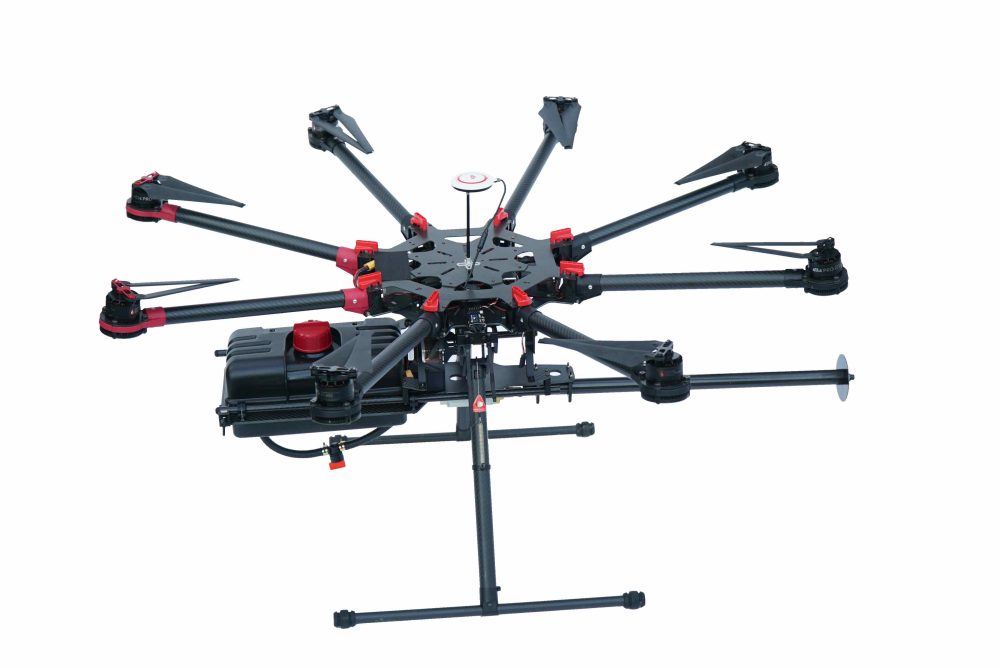
4. The drone makes it possible for an individual to deliver death to anyone on earth, and destruction to any infrastructure on earth, quickly, silently, and cheaply, and possibly anonymously.

And there is no practical way to stop drones.

Image result for drone
A real product: TF-19 WASP Flamethrower Drone Attachment. 25ft range, 1-gallon fuel capacity, 100 seconds of firing time

Bloomberg Opinion
Saudi Arabia Drone Attack Is a Strike at Oil’s Future
The audacious assault promises major disruption and sets the stage for a new and dangerous period for world oil markets.
By Liam Denning, September 14, 2019, 4:58 PM CDT

The oil market has shrugged off sanctions on Iran, exploding tankers and drones getting shot down over the Strait of Hormuz. But this weekend’s strike against Saudi Arabia’s Abqaiq processing facility – perhaps the single most important piece of oil infrastructure on the planet – is of a different order.

Saudi Arabia said the attack affected 5.7 million barrels a day of output, or roughly half their production.

It is unclear whether the strike involved drone-fired weapons or missiles or a combination of them.

The prevailing mood in the markets before Saturday was one of uncertainty weighing on prices, largely related to the swings of the trade war and – with the sudden absence of John Bolton from President Donald Trump’s ear – whether sanctioned Iranian barrels would find their way back to the market.

Now, with Iranian-sponsored Houthi fighters in Yemen claiming responsibility for a strike at the heart of the Saudi Arabian economy – and U.S. Secretary of State Michael Pompeo directly blaming Iran for the attack – a meaningful thaw that allows Iranian barrels to replace disrupted Saudi ones seems inconceivable.

What is clear is that the oil market has entered a new and dangerous period. Crown Prince Mohammed bin Salman, who spearheaded Saudi Arabia’s intervention in Yemen, will almost certainly have to respond, especially if the attack really has knocked out a lot of oil supply for an extended period.

This escalation could be interpreted as Iran’s response to Washington’s “maximum pressure” campaign – if Tehran can’t export, then neither should Saudi, may be the zero-sum thinking at play here. The chance of miscalculation and further escalation is very high.

Trump’s sensitivity to pump prices was established during 2018’s midterms, so a conflict-driven spike in the coming weeks and months could mean a flock of black swans for the oil market, ranging from releases of strategic reserves (Trump already called for this) to outright bans on oil exports.

There is a more existential issue to consider, too. One of the big themes being debated among Democrats ahead of Iowa is climate change. Yet, while polling suggests the issue resonates with an increasing proportion of Americans, history suggests it is pretty tough to get them to focus on energy issues unless, as in 2008, prices are high.

That could end up being the case in 2020, if it plays out against a backdrop of Middle Eastern conflict, high pump prices and consequent damage to economic growth.

You are not safe from a drone, not in your home, not in your car, not in a “good” neighborhood, nowhere.

If for whatever reason, or for no reason at all, someone wants to kill you or to damage your property, they simply could send a cheap drone over you and drop whatever — a bomb, a canister of poison gas, a toxic liquid, even political leaflets.  Anything, even a flamethrower.

Any day, any time, any place. And do it anonymously.

You have lost all security.

Oh, you say you moved to an expensive, safe suburb, with good schools and clean streets, and your house is equipped with the latest alarm systems, and plenty of police protection, and for years, there hasn’t been any violent crime within miles.

Sorry, but you no longer are safe. Any fool can buy a drone that will drop an incendiary on your roof, and burn your house to ashes — without his being seen anywhere near you.

Remember that waiter you undertipped five years ago? No, you don’t remember, but he does. And he’s been nursing the grievance ever since, and now he’s going to get even. You are about to be “droned.”

The drone is beyond even the AK-47, that turns cowards into killers. It essentially is invisible, remote, and accurate.

Don’t be surprised if the National Rifle Association tries to include “drone rights” as a Constitutional prerogative, and politicians begin to promise Texans that their drones never will be taken from their “cold dead hands.”

Don’t be surprised if a “drone magazine” (there already are a half dozen of them) promotes drones by their lethality (like the flamethrower drone.)

And there is nothing you can do about it. You can’t hide from it.

Image result for killer drones
The future?


That is the brave new world in which you live.

Enjoy.

Rodger Malcolm Mitchell
Monetary Sovereignty
Twitter: @rodgermitchell
Search #monetarysovereignty Facebook: Rodger Malcolm Mitchell

…………………………………………………………………………………………………………………………………………………………………………………………………………………………………………………………………………………………..

The most important problems in economics involve the excessive income/wealth/power Gaps between the richer and the poorer.

Wide Gaps negatively affect poverty, health and longevity, education, housing, law and crime, war, leadership, ownership, bigotry, supply and demand, taxation, GDP, international relations, scientific advancement, the environment, human motivation and well-being, and virtually every other issue in economics.

Implementation of The Ten Steps To Prosperity can narrow the Gaps:

Ten Steps To Prosperity:

1. Eliminate FICA

2. Federally funded Medicare — parts a, b & d, plus long-term care — for everyone

3. Provide a monthly economic bonus to every man, woman and child in America (similar to social security for all)

4. Free education (including post-grad) for everyone

5. Salary for attending school

6. Eliminate federal taxes on business

7. Increase the standard income tax deduction, annually. 

8. Tax the very rich (the “.1%”) more, with higher progressive tax rates on all forms of income.

9. Federal ownership of all banks

10. Increase federal spending on the myriad initiatives that benefit America’s 99.9% 

The Ten Steps will grow the economy, and narrow the income/wealth/power Gap between the rich and you.

MONETARY SOVEREIGNTY

A writer who thinks the federal government is short of money — but you aren’t.

While state taxes fund state spending and local taxes fund local spending, federal taxes do not fund federal spending. Even if all federal tax collections fell to $0, the federal government still continue to spend, forever.

The reason: The federal government uniquely is Monetarily Sovereign. It has the unlimited ability to create its own sovereign currency, the U.S. dollar. Unlike state and local governments, the federal government never unintentionally can run short of dollars.

……………………………………………………………………………………………………………………………………………………..

Economics is one of those sciences everyone has mastered — or at least, everyone thinks they have mastered — simply by reading an occasional newspaper or by watching the TV news.

In that vein, allow me to introduce you to Jeff Spross:

How Democrats can raise taxes without technically raising taxes
By Jeff Spross, September 16, 2019

Income tax brackets have been indexed to inflation since the 1980s (meaning that as incomes gradually rise due to inflation, taxpayers aren’t pushed into paying higher and higher tax rates), and the White House was considering extending that same benefit to people who pay capital gains taxes. It ultimately demurred.

But Democrats — or anyone, really — should take a hint from Trump’s decision. It’s not just that capital gains shouldn’t be indexed to inflation; income taxes shouldn’t be either.

Doing away with that indexing would raise plenty of new revenue for the government. But more fundamentally, it would fix a basic misunderstanding about good macroeconomic policy.

Mr. Spross is one of the many writers who strangely seems to think your Monetarily Sovereign federal government is running short of dollars, but you aren’t.

So he advocates you sending more of your hard-earned money to a government that never has, and never can, run short of dollars.

If you think that sounds nuts, you’re right.

The U.S. income tax has several brackets, each with its own tax rate. When you pay taxes in 2021, the rates will be the same, but the income thresholds — where each bracket ends and the next one begins — will have risen. That’s inflation indexing at work.

The Economic Recovery Tax Act of 1981, passed under President Reagan, was primarily a massive tax cut. But it also introduced inflation indexing into the tax code. Before that, the cutoff for each tax bracket would remain the same year after year until Congress explicitly changed it. Thanks to the Economic Recovery Tax Act, those brackets have automatically adjusted with inflation every year since 1985.

Had Congress not introduced income tax indexing, everyone in America now would pay at the highest tax rate.

Mr. Spross seems to think that would be just fine:

Congress should go back to the old, pre-1985 way of doing business. Doing so would have two advantages.

First off, it would bring in a lot of new tax revenue without having to do the politically unpopular thing of actually hiking rates.

President Trump and the Republicans didn’t end inflation indexing, but they did change the measure of inflation in the tax code to a new version that tends to rise more slowly — thus, the tax bracket thresholds will rise more slowly in the future as well.

According to one estimate, that change will net the government an extra $134 billion in tax revenue over the next 10 years.

Thus, while an exact figure is beyond my abilities to calculate, the revenue brought in over a decade by simply getting rid of inflation indexing entirely should be several times that $134 billion haul.

Mr. Spross opts for taking not just $134 billion from the economy, but “several times that $134 billion haul.”

But, taking “several times $134 billion” from the economy would cause a recession if we are lucky and a depression if we aren’t.

Federal surpluses take money from the economy. Here is what they do to the economy:

I. U.S. depressions are caused by federal surpluses.

1804-1812: U. S. Federal Debt reduced 48%. Depression began 1807.
1817-1821: U. S. Federal Debt reduced 29%. Depression began 1819.
1823-1836: U. S. Federal Debt reduced 99%. Depression began 1837.
1852-1857: U. S. Federal Debt reduced 59%. Depression began 1857.
1867-1873: U. S. Federal Debt reduced 27%. Depression began 1873.
1880-1893: U. S. Federal Debt reduced 57%. Depression began 1893.
1920-1930: U. S. Federal Debt reduced 36%. Depression began 1929.
1997-2001: U. S. Federal Debt reduced 15%. Recession began 2001.

II. U.S. recessions come on the heels of reductions in federal debt/money growth (See graph, below), while debt/money growth has cured recessions. Taxes reduce debt/money growth. That is why tax cuts stimulate economic growth.

Reductions in federal debt growth lead to inflation
Recessions show vertical gray bars. Blue line shows changes in federal debt.

No government can tax itself into prosperity, but many governments have taxed themselves into recessions. Tax increases (aka “austerity”), cause recessions and depressions.

Plenty of economists and experts argue bracket creep damages the economy: By shoving people into higher tax rates, even though their pay hasn’t increased, bracket creep discourages economic activity and slows down growth.

Here’s the problem with that logic: If your economy is experiencing high inflation, like what we went through in 1980, then it needs to slow down.

No, the economy does not need to “slow down.” Economic growth and inflation are completely different, having no relationship. It is most common to have one without the other.

Mainstream macroeconomics assumes that high inflation is evidence of an overheating economy: too much demand chasing too little supply. In which case, to cool inflation off, money needs to be taken out of the economy. And taxes are one tool for doing just that.

The above may be popular wisdom but is completely false. As shown in number I. above, every depression in U.S. history has been caused by taking money out of the economy.

Depression is not a cure for inflation. In fact, nearly all hyper-inflations have occurred simultaneously with a depressed economy.

The notion of cutting demand by impoverishing the populace is incredibly wrongheaded.

Inflations never are caused by federal deficit spending. Inflations are caused by shortages: Most often shortages of food, and sometimes shortages of energy (oil).

The illusion that inflations are caused by money “printing” comes when a government prints money in response to inflation. That is, the inflation causes the money-“printing,” and not the other way around.

In other words, a system of income tax brackets that isn’t indexed to inflation would act as a kind of natural thermostat for an overheating economy.

As inflation rates rise, bracket creep would shove more people into higher rates more quickly.

As a result, the same set of tax brackets and rates would take more money out of the economy than it did before, and help to cool the economy off and bring inflation back down. Bracket creep is a feature, not a bug.

I do not have the words to describe how incredibly wrong is the notion of impoverishing the economy to cure inflation.

The belief that an economy should be “cooled” (i.e. kept from growing) is utter nonsense. Inflation is not caused by a so-called “overheated” economy. Overall price increases (inflation) are caused by shortages of food and energy.

The problem is not that you are demanding too much food and energy; the problem is that these commodities have become in too-short supply, because of some exterior circumstance.

The notorious Zimbabwe hyperinflation came when its President Robert Mugabe stole farmland from white farmers and gave it to blacks, who did not know how to farm.

The inevitable food shortage caused hyperinflation.

The green line is federal deficit spending. The red line is inflation.

While federal deficit spending has increased massively, inflation has remained modest.

Do you see how the dramatic increase in deficit spending that began in 2008 did not change inflation, as Mr. Spross’s hypotheses demands?

Ironically, the shortages of food and energy, which cause inflation, can be cured by increased federal deficit spending to increase food and energy production.

Russel Long, a Democratic senator from Louisiana at the time, made this exact point, arguing indexing would “make inflation worse by pumping more money into circulation at a time inflation is at its worst.”

Clearly, Russel Long does not understand economics.

There are, of course, other ways to remove money from the economy when it overheats.

Over the last few decades, we’ve primarily relied on the Federal Reserve to do that, through interest rate hikes.

Wrong again: Interest rate hikes do not remove money from the economy. In fact, higher interest rates require the federal government to spend more on interest, which adds dollars to the economy.

Interest rate hikes combat inflation by increasing the demand for dollars.

But the social and human costs of interest rate hikes fall disproportionately on the poor, the uneducated, and minorities, through lower employment rates and lower wage growth.

Bracket creep hits people at all income levels, and thus its pain can be spread a lot more evenly across the whole population. This would be even more true if Congress went back to having 30 or so tax brackets, as opposed to the current seven.

Bracket creep does not “hit people at all income levels.” Bracket creep hits the lower-income groups hardest.

The very rich pay at the highest levels, whether or not there is bracket creep. The current highest level is 37%, which begins at an income of about $500,000 (depending on marital status).

For someone earning $1 million a year, bracket creep is pocket change. However, for someone earning $100 thousand a year, bracket creep can constitute a significant tax hit.

We’ll end with the article’s final bit of foolishness:

For the sake of the government’s coffers, for the sake of better macroeconomic management, and for the sake of economic justice, inflation indexing for the income tax should go.

  1. The federal government has no “coffers.” In fact, it destroys those tax dollars you send it, and it creates new dollars, ad hoc, every time it pays a bill.
  2. Reducing the economy’s money supply does not constitute “better macroeconomic management.” It is a formula for recessions and depressions.
  3. Economic justice” is not achieved by raising the tax rates for the non-rich to the tax rate the rich pay. Quite the opposite.

Aside from being wrong on every point, Mr. Spross’s article serves as a valuable lesson — in how economic ignorance could drive us to economic disaster.

Rodger Malcolm Mitchell
Monetary Sovereignty
Twitter: @rodgermitchell
Search #monetarysovereignty Facebook: Rodger Malcolm Mitchell

…………………………………………………………………………………………………………………………………………………………………………………………………………………………………………………………………………………………..

The most important problems in economics involve the excessive income/wealth/power Gaps between the richer and the poorer.

Wide Gaps negatively affect poverty, health and longevity, education, housing, law and crime, war, leadership, ownership, bigotry, supply and demand, taxation, GDP, international relations, scientific advancement, the environment, human motivation and well-being, and virtually every other issue in economics.

Implementation of The Ten Steps To Prosperity can narrow the Gaps:

Ten Steps To Prosperity:

1. Eliminate FICA

2. Federally funded Medicare — parts a, b & d, plus long-term care — for everyone

3. Provide a monthly economic bonus to every man, woman and child in America (similar to social security for all)

4. Free education (including post-grad) for everyone

5. Salary for attending school

6. Eliminate federal taxes on business

7. Increase the standard income tax deduction, annually. 

8. Tax the very rich (the “.1%”) more, with higher progressive tax rates on all forms of income.

9. Federal ownership of all banks

10. Increase federal spending on the myriad initiatives that benefit America’s 99.9% 

The Ten Steps will grow the economy, and narrow the income/wealth/power Gap between the rich and you.

MONETARY SOVEREIGNTY