The rising cost of education. Where have we heard that before?

Student debt is a barrier to American economic and scientific success.

An article in THE WEEK Magazine serves as the basis for this post. It decries the rising cost of college education, tries to assign blame, and offers solutions.

Today’s American economy relies on people who have attended college.

Nearly all, large companies are managed by college-educated people.

They are the ones creating jobs for Americans.

Today’s scientific advances come from those who have attended college. Our political leaders attended college.

Our information leaders have been college-educated. Our military leaders are college-educated.

College education is beneficial to all Americans, even to those who never attend college or even attend any school at all.

America without college would be a backwater, 3rd world country.

Yet today, millions of young Americans, potentially great leaders, either cannot afford college or have been punished financially for attending.

We are hamstringing our future.

THE WEEK Magazine
College: No easy fix as costs keep climbing
Columbia University: Headed toward six-figure costs

Prepare yourself for a $400,000 price tag for college, said Alia Wong in TheAtlantic.com.

A new analysis found that the sticker price to attend the University of Chicago will pass the $100,000-per-year mark by 2025, and “at least a handful of other U.S. colleges”—Harvey Mudd College, Columbia University, and Southern Methodist University—“will follow suit soon after.”

While only 42 percent of Chicago’s undergraduates paid the full tuition cost in the 2016-17 school year, those sticker prices keep growing.

Colleges have turned to “complex financial math” to balance high tuition with discounts and financial aid, said Pete D’Amato in The Hechinger Report.

College costs have rocketed up. Millions of people are unable to afford advanced education. Colleges are forced to give some people free or discounted education. The others languish.

And these discounts are financed by the people who don’t receive discounts, which sends regular tuition costs even higher.

If this cost of education story sounds eerily familiar, it’s because exactly the same story exists for the cost of medical care.

Hospital costs rocketed up. Millions of people are unable to afford proper health care. Hospitals are forced to give some people free or discounted care.

And these discounts are paid for by the people who don’t receive discounts, which makes regular hospitalization costs even higher.

Two situations — education and healthcare — both vital for all of America, and both becoming less and less affordable.

Out-of-control college costs have become a central issue in the Democratic campaign, said Danielle Kurtzleben in NPR.org. Last week, a rift opened up over how to fix them—and especially over “who should get to go to college for free?”

Bernie Sanders and Elizabeth Warren “have pitched plans making free public college available to all.”

By contrast, Pete Buttigieg launched an ad ripping plans that make college “free even for the kids of millionaires.” Buttigieg’s own proposal would offer tuition-free college to most students at public four-year colleges, but it would taper off those benefits for people from higher-earning families.

The weaknesses of Sanders’s, Warren’s and Buttigieg’s education proposals is the same as the weaknesses of their healthcare proposals:

All three candidates make the false assumption that any federal expenditures somehow must be “paid for” by taxes or by spending reductions.

Yet, a Monetarily Sovereign government neither needs nor uses tax dollars or any other form of income. The U.S. government creates brand new dollars, ad hoc, every time it pays a bill.

In fact, paying bills is the method by which the federal government creates dollars.

One proposal, from Warren, would wipe out up to $50,000 of college debt.

Good idea. There is absolutely not one reason why the federal government needs or should receive a payback from students.

The Department of Education may soon offer income-sharing agreements that would let students delay repayment until they get a job following graduation, with the borrower “on the hook for a certain percentage of income” after that.

Bad idea. There is no purpose for a “delay” in payment rather than simply eliminating the repayment. There is no reason to keep borrowers “on the hook.”

House members also want to reduce the number of federal repayment plans from 14 to two. Currently, it is “a complicated system critics say leads to needless defaults.”

It’s not the system that leads to defaults. It’s the entire repayment concept. Why fiddle with a bad concept, when it easily could be, and should be, eliminated?

Not every proposal has been well received, said Aarthi Swaminathan in Yahoo.com. Sen. Rand Paul last week unveiled “a plan to fix the student debt crisis” by letting borrowers withdraw up to $5,250 from their 401(k) or IRA account tax- and penalty-free for tuition or student loans.

Critics, however, say Rand just kicks the can down the road with a plan that’s “detrimental to Americans’ future security.”

The critics are right. Sadly, Rand Paul never has demonstrated any understanding of federal financial reality.

And then there are  excerpts from is this article:

While candidates posture, Midwestern universities take action on student debt
At Indiana University, nearly half of all bachelor’s degree graduates leave without student loan debt.
By Michael McRobbie, Chicago Tribune

At Indiana University, which awarded more than 21,000 degrees last year, nearly half of all bachelor’s degree graduates leave the institution with zero student loan debt, and 82% have less than $30,000.

Many public Midwestern institutions are hard at work implementing a variety of aggressive but sensible policy measures that are proving successful.

These include minimizing tuition increases; reducing operating costs; increasing student financial assistance; promoting on-time graduation; expanding online education; greatly reducing the costs of digital textbooks for students; and introducing comprehensive financial literacy and wellness programs.

Three of the “measures” — minimizing tuition increases, increasing student financial assistance, and greatly reducing the costs of digital textbooks — merely mean that some students will have to pay more, in order for other students to pay less.

Two of the “measures” — reducing operation costs, and promoting on-time graduation — leave one to wonder: Haven’t you been doing that all the time, and if not, why not.

One “measure” — introducing comprehensive financial literacy and wellness programs — seems to be something a distraction from the problem of school costs.

Regarding the latter, we are just one of a number of Midwestern institutions, including Ohio State University, the University of Oklahoma and the University of Wisconsin-Madison, that have recently launched innovative financial advising, money management and peer-coaching practices to help students make wise borrowing decisions.

Would a “wise borrowing decision be: Don’t borrow to attend college, or don’t attend college.”

Furthermore, bipartisan legislation in Congress would require colleges and universities that accept federal aid to send an annual “debt letter” to every student — a practice that we pioneered in 2012 — estimating their total loan debt and future monthly payments.

Issuing that letter to each loan recipient is now the law in Indiana and required of all colleges.

And upon receiving that letter, what is a student supposed to do? Leave college. Stop buying lunch?

On the policy front, a number of Midwestern and other institutions are deeply engaged at the national level in serious and thoughtful conversations among key stakeholders regarding the future of federal student financial aid.

These institutions are talking about ensuring greater accessibility to the high-quality education they provide, increasing the transparency of financial aid information and designing effective strategies to improve student success and help build the knowledgeable and well-trained workforce that our nation needs.

“Deeply engaged,” “thoughtful conversations, “effective strategies” — it sounds like a bunch of academic blah, blah, blah to me.

Obviously, there is still a lot of work to be done to prevent the specter of major debt from looming over our best and brightest graduates.

What we need to address the student debt issue — less posturing and more practical solutions.

Michael McRobbie is president of Indiana University and chair of the Association of American Universities Board of Directors.

There is one practical solution, and it is the same practical solution for healthcare: Single-payer.

The federal government is the one entity that, being Monetarily Sovereign, has the ability and the mandate to fund anything that benefits America and its people:

Federally funded Medicare — parts A, B & D, plus long-term care for everyone;
Free education (including post-grad) for everyone;
Salary for attending school.

In short, Steps #2, 4, and 5 of the “Ten Steps to Prosperity,” not only would accomplish the mission but stimulate the overall economy.

Rodger Malcolm Mitchell
Monetary Sovereignty
Twitter: @rodgermitchell
Search #monetarysovereignty Facebook: Rodger Malcolm Mitchell

…………………………………………………………………………………………………………………………………………………………………………………………………………………………………………………………………………………………..

The most important problems in economics involve:

  1. Monetary Sovereignty describes money creation and destruction.
  2. Gap Psychology describes the common desire to distance oneself from those “below” in any socio-economic ranking, and to come nearer those “above.” The socio-economic distance is referred to as “The Gap.”

Wide Gaps negatively affect poverty, health and longevity, education, housing, law and crime, war, leadership, ownership, bigotry, supply and demand, taxation, GDP, international relations, scientific advancement, the environment, human motivation and well-being, and virtually every other issue in economics.

Implementation of Monetary Sovereignty and The Ten Steps To Prosperity can grow the economy and narrow the Gaps:

Ten Steps To Prosperity:

1. Eliminate FICA

2. Federally funded Medicare — parts A, B & D, plus long-term care — for everyone

3. Provide a monthly economic bonus to every man, woman and child in America (similar to social security for all)

4. Free education (including post-grad) for everyone

5. Salary for attending school

6. Eliminate federal taxes on business

7. Increase the standard income tax deduction, annually. 

8. Tax the very rich (the “.1%”) more, with higher progressive tax rates on all forms of income.

9. Federal ownership of all banks

10. Increase federal spending on the myriad initiatives that benefit America’s 99.9% 

The Ten Steps will grow the economy and narrow the income/wealth/power Gap between the rich and the rest.

MONETARY SOVEREIGNTY

An update of the biggest con job in American history: Tick, tick, tick. 80 years and the federal debt “ticking time bomb” still is ticking.

An update of the biggest con job in American history, that still is running:

Once again, I am compelled by recent articles to remind you that in 1940, when the phony federal debt was described as a”ticking time bomb,” America had not yet entered World War II.

The most popular songs were: Tommy Dorsey’s “I’ll Never Smile Again,” Bing Crosby’s “Only Forever,” and Artie Shaw’s “Frenesi

 The median annual income for a man in 1940 was $956. 

A postage stamp cost $.03.

A new car cost about $800 and for 18 cents, you could buy a gallon of gas.

And yes, the federal debt was called a “ticking time bomb.”

In 1940, when the federal debt first became a “ticking time bomb,” it was only $40-50 Billion. Today it exceeds $22 Trillion.

Year after year, that “ticking time bomb” of federal debt has kept ticking, and here we are, in 2020, with a  healthy economy, and still that phony bomb hasn’t exploded.

Eighty years of warnings, eighty years of being wrong, eighty years and many people still believe the doomsday sayers.

As we dance down Memory Lane, here they are, again:

……………………………………………………………………………………………………………………………………………………..

Back in 1940, the federal budget was a “ticking time-bomb which can eventually destroy the American system,” said Robert M. Hanes, president of the American Bankers Association.

September 26, 1940, New York Times, Column 8

By 1960: the debt was “threatening the country’s fiscal future,” said Secretary of Commerce, Frederick H. Mueller. (“The enormous cost of various Federal programs is a time-bomb threatening the country’s fiscal future, Secretary of Commerce Frederick H. Mueller warned here yesterday.”)

By 1983: “The debt probably will explode in the third quarter of 1984,” said Fred Napolitano, former president of the National Association of Home Builders.

In 1984: AFL-CIO President Lane Kirkland said. “It’s a time bomb ticking away.”

In 1985: “The federal deficit is ‘a ticking time bomb, and it’s about to blow up,” U.S. Sen. Mitch McConnell. (Remember him?)

Later in 1985: Los Angeles Times: “We labeled the deficit a ‘ticking time bomb’ that threatens to permanently undermine the strength and vitality of the American economy.”

In 1987: Richmond Times–Dispatch – Richmond, VA: “100TH CONGRESS FACING U.S. DEFICIT ‘TIME BOMB’”

Later in 1987: The Dallas Morning News: “A fiscal time bomb is slowly ticking that, if not defused, could explode into a financial crisis within the next few years for the federal government.”

In 1989: FORTUNE Magazine: “A TIME BOMB FOR U.S. TAXPAYERS

In 1992: The Pantagraph – Bloomington, Illinois: “I have seen where politicians in Washington have expressed little or no concern about this ticking time bomb they have helped to create, that being the enormous federal budget deficit, approaching $4 trillion.

Later in 1992: Ross Perot: “Our great nation is sitting right on top of a ticking time bomb. We have a national debt of $4 trillion.”

In 1995: Kansas City Star: “Concerned citizens. . . regard the national debt as a ticking time bomb poised to explode with devastating consequences at some future date.”

In 2003: Porter Stansberry, for the Daily Reckoning: “Generation debt is a ticking time bomb . . . with about ten years left on the clock.”

In 2004: Bradenton Herald: “A NATION AT RISK: TWIN DEFICIT A TICKING TIME BOMB

In 2005: Providence Journal: “Some lawmakers see the Medicare drug benefit for what it is: a ticking time bomb.”

In 2006: NewsMax.com, “We have to worry about the deficit . . . when we combine it with the trade deficit we have a real ticking time bomb in our economy,” said Mrs. Clinton.

In 2007: USA Today: “Like a ticking time bomb, the national debt is an explosion waiting to happen.

In 2010: Reason Alert: “. . . the time bomb that’s ticking under the federal budget like a Guy Fawkes’ powder keg.”

In 2011: Washington Post, Lori Montgomery: ” . . . defuse the biggest budgetary time bombs that are set to explode.”

June 19, 2013: Chamber of Commerce: Safety net spending is a ‘time bomb’, By Jim Tankersley: The U.S. Chamber of Commerce is worried that not enough Americans are worried about social safety net spending. The nation’s largest business lobbying group launched a renewed effort Wednesday to reduce projected federal spending on safety-net programs, labeling them a “ticking time bomb” that, left unchanged, “will bankrupt this nation.”

In 2014: CBN News: “The United States of Debt: A Ticking Time Bomb

On Jun 18, 2015: The ticking economic time bomb that presidential candidates are ignoring: Fortune Magazine, Shawn Tully,

On February 10, 2016, The Daily Bell“Obama’s $4.1 Trillion Budget Is Latest Sign of America’s Looming Collapse”

On January 23, 2017: Trump’s ‘Debt Bomb’: Deficit May Grow, Defense Budget May Not, By Sydney J. Freedberg, Jr.

On January 27, 2017: America’s “debt bomb is going to explode.” That’s according to financial strategist Peter Schiff. Schiff said that while low interest rates had helped keep a lid on U.S. debt, it couldn’t be contained for much longer. Interest rates and inflation are rising, creditors will demand higher premiums, and the country is headed “off the edge of a cliff.”

On April 28, 2017: Debt in the U.S. Fuel for Growth or Ticking Time Bomb?, American Institute for Economic Research, by Max Gulker, PhD – Senior Research Fellow, Theodore Cangeros

Feb. 16, 2018  America’s Debt Bomb By Andrew Soergel, Senior Reporter: Conservatives and deficit hawks are hurling criticism at Washington for deepening America’s debt hole.

April 18, 2018 By Alan Greenspan and John R. Kasich: “Time is running short, and America’s debt time bomb continues to tick.”

January 10, 2019, Unfunded Govt. Liabilities — Our Ticking Time Bomb. By Myra Adams, Tick, tick, tick goes the time bomb of national doom.

January 18, 2019; 2019 Is Gold’s Year To Shine (And The Ticking US Debt Time-Bomb) By Gavin Wendt

[The following were added after the original publishing of this article]

April 10, 2019, The National Debt: America’s Ticking Time Bomb.  TIL Journal. Entire nations can go bankrupt. One prominent example was the *nation of Greece which was threatened with insolvency, a decade ago. Greece survived the economic crisis because the European Union and the IMF bailed the nation out.

July 11, 2019National debt is a ‘ticking time bomb‘: Sen. Mike Lee

SEP 12, 2019, Our national ticking time bomb, By BILL YEARGIN
SPECIAL TO THE SUN SENTINEL | At some point, investors will become concerned about lending to a debt-riddled U.S., which will result in having to offer higher interest rates to attract the money. Even with rates low today, interest expense is the federal government’s third-highest expenditure following the elderly and military. The U.S. already borrows all the money it uses to pay its interest expense, sort of like a Ponzi scheme. Lack of investor confidence will only make this problem worse.

JANUARY 06, 2020, JANUARY 06, 2020, National debt is a time bomb, BY MARK MANSPERGER, Tri City Herald | The increase in the U.S. deficit last year was about $1.1 trillion, bringing our total national debt to more than $23 trillion! This fiscal year, the deficit is forecasted to be even higher, and when the economy eventually slows down, our annual deficits could be pushing $2 trillion a year! This is financial madness.there’s not going to be a drastic cut in federal expenditures — that is, until we go broke — nor are we going to “grow our way” out of this predicament. Therefore, to gain control of this looming debt, we’re going to have to raise taxes.


In Summary
The U.S. government is Monetarily Sovereign. It has the unlimited ability to create its own sovereign currency, the U.S. dollar.

The government has absolute control over all aspects of the dollar, including its value. Unlike state and local governments, and unlike businesses, and unlike the euro nations, and unlike you and me, the federal government can service any size debt without collecting a penny of income.

Yet, tick, tick, tick, the fake debt time bomb of terror keeps on ticking. The only question, “How many years of proven-wrong fear-mongering will you, the public fall for before the debt charlatans are excised from the news?”

By now, after 80 years of false warnings, you should have learned that phony concerns about the federal debt constitute the biggest con job in American history — and it still is running. And you still are buying it.

The fundamental purpose of this con job is to keep you from asking for benefits from the federal government — benefits the rich already receive, but because of Gap Psychology, don’t want you to have.

Is it possible that the rich really can fool all the people all the time?

Rodger Malcolm Mitchell
Monetary Sovereignty
Twitter: @rodgermitchell
Search #monetarysovereignty Facebook: Rodger Malcolm Mitchell

…………………………………………………………………………………………………………………………………………………………………………………………………………………………………………………………………………………………..

The most important problems in economics involve:

  1. Monetary Sovereignty describes money creation and destruction.
  2. Gap Psychology describes the common desire to distance oneself from those “below” in any socio-economic ranking, and to come nearer those “above.” The socio-economic distance is referred to as “The Gap.”

Wide Gaps negatively affect poverty, health and longevity, education, housing, law and crime, war, leadership, ownership, bigotry, supply and demand, taxation, GDP, international relations, scientific advancement, the environment, human motivation and well-being, and virtually every other issue in economics.

Implementation of Monetary Sovereignty and The Ten Steps To Prosperity can grow the economy and narrow the Gaps:

Ten Steps To Prosperity:

1. Eliminate FICA

2. Federally funded Medicare — parts A, B & D, plus long-term care — for everyone

3. Provide a monthly economic bonus to every man, woman and child in America (similar to social security for all)

4. Free education (including post-grad) for everyone

5. Salary for attending school

6. Eliminate federal taxes on business

7. Increase the standard income tax deduction, annually. 

8. Tax the very rich (the “.1%”) more, with higher progressive tax rates on all forms of income.

9. Federal ownership of all banks

10. Increase federal spending on the myriad initiatives that benefit America’s 99.9% 

The Ten Steps will grow the economy and narrow the income/wealth/power Gap between the rich and the rest.

MONETARY SOVEREIGNTY

The latest nothing that has our thought leaders in a tizzy: Japan’s trade “deficit” –or is it a surplus?

I noticed a news item that ranks very high on my “So what, who cares?” meter.

Economists, politicians, and media folks, who either don’t understand, or don’t want you to understand economics, are all in a tizzy about this:

Japan has second straight year of red ink on trade last year

TOKYO (AP) — Japan logged a deficit for a second straight year last year as its exports were hurt by a slowdown of demand in China amid a tariff war with the U.S.

Government data released Thursday showed Japan’s exports fell 5.6% in 2019, to 76.9 trillion yen ($701.6 billion), while imports fell 5.0% to 78.6 trillion yen ($710 billion).

That left a deficit of 1.6 trillion yen ($14 billion).

Japan had a trade surplus of 6.6 trillion yen ($60 billion) with the U.S. last year, as exports fell 1.4% from 2018, and imports fell 4.4%.

Shipments of computers, construction and textiles equipment and power generating machines contributed to a 3.7% increase in exports of machinery to the U.S.

Vehicle exports, which account for nearly 40% of Japanese exports to the U.S., declined 5.5%, the data show.

Is all of this bad news or good news for Japan? The use of the words “deficit,” and “red ink,” which has pejorative insinuations, would lead one to believe this is terrible news.

If you are associated with vehicle manufacturing you may believe it’s bad news — unless exports to other nations and local consumption increased enough to offset the decline in shipments to the U.S. — and that is assuming exports of vehicles to the U.S. are profitable.

Or then again, if you’re associated with the manufacture of computers, construction and textiles equipment, and power generating machines, you might feel it’s good news.

But in reality, looked at from the whole Japanese nation’s standpoint, it’s no news at all.

A “trade deficit” merely means that Japan as a nation, sent fewer goods and services to the U.S. than the U.S. sent to Japan, and in return, Japan sent more money to the U.S. than the U.S. sent to Japan.

But is that a trade “deficit” or is it a trade surplus?

Trade is an even exchange. Goods and services sent one way, and an equivalent value in money sent the other way.

Since trade is an even exchange, is Japan better off sending more goods and services overseas or sending more money overseas?

Asked another way, which is more difficult for Japan to obtain, goods and services or money?

Japan is Monetarily Sovereign. It has the unlimited ability to create an infinite amount of Japanese yen, at no cost, and at the touch of a computer button. Money is free and easy for Japan to obtain.

By contrast, Japan is a geographically small, island nation, with limited natural resources. Goods and services are costly and hard-to-get.

So again, is it better to produce and send away something that is costly and hard-to-get and to receive something in return that is free and easy-to-get (aka a “trade surplus”) or is it better to receive costly and hard-to-get goods, and send away something that costs you nothing (aka a trade “deficit.”)?

I, for one, would prefer the so-called trade “deficit.”

But, you may ask this good question, “What about the individual industries, like vehicles, that rely on exports?”

They are in a different category from the Japanese government. While the government is Monetarily Sovereign, the private sector is monetarily non-sovereign.  Unlike the government, businesses cannot create yen at the touch of a computer key.

For the private sector, money is hard-to-get. So what’s to be done?

The obvious solution is for the government to fund businesses and their employees. In that way, the private sector would not suffer because of duties and trade deficits.

Yes, I know. International trading pacts frown on government support of business, but these rules are honored mostly in the breach. The vast number of government-owned and government-funded businesses speaks to this.

And yes, this solution would increase a government’s deficit and debt. But, of course, a deficit and debt is meaningless for an entity that can create its own sovereign currency at will.

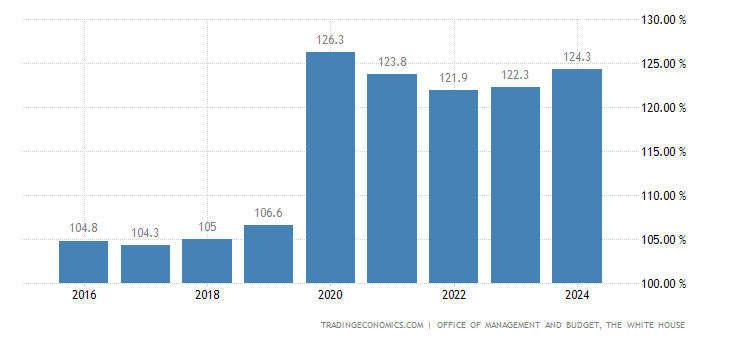
There was a time when the economically ignorant predicted that if ever the U.S. debt rose to 100% of the U.S. Gross Domestic Product, the stars would fall from the skies, and pestilence would ravage the earth.

Well, here we are:

United States Gross Federal Debt to GDP
U.S. Debt now at 106% of GDP

And as for Japan, it’s more than twice as “bad” (good).

Japan General Government Gross Debt to GDP
Japanese debt now at 238% of GDP

Not only is central government debt meaningless for a Monetarily Sovereign entity, but so is every fraction that includes central government debt, i.e. the ratio of Debt/GDP. It is much referenced and essentially meaningless.

Japan would not need to export one yen’s worth of goods and services, and it could survive very nicely, thank you, via government deficit spending.

“Looking ahead, we think the recovery in exports will be weaker than many expect. That reflects our view that GDP growth in Japan’s main trading partners will remain subdued this year,” Tom Learmouth of Capital Economics said in a report.

Although export growth and GDP growth in trading partners can be connected, the former is meaningless to Japan, and the latter is meaningful to the trading partners.

He noted that an increase in Japan’s sales tax, to 10% from 8%, as of Oct. 1 has also hurt consumer demand and private investment.

Why would Monetarily Sovereign Japan increase the sales tax its own citizens pay? No good reason at all. It’s foolishness at a high level. Japan has no need or use for tax money.

President Donald Trump has thrown out past trade deals, including that with China, that he said added to the U.S. trade deficit and cost the country manufacturing jobs.

In his typical ignorance, President Donald Trump “solves” the jobs problem by raising tariffs, an act which is guaranteed to cost the U.S. private-sector jobs.

A better approach would be to eliminate business taxes, not raise them, which would increase company competitiveness, sales, and employment.

The best approach would be to institute the Ten Steps to Prosperity, which would narrow the Gap between the rich and the rest, put more money into the private sector, and improve the lives of the people.

That, ultimately, is the purpose of government.

Nearly 50 years have passed since President Richard Nixon removed the handcuffs of a gold standard and freed the U.S. government to be a true Monetary Sovereign.

Yet still, we remain shackled by our own fears and ignorance, leaving us not much better than the euro nations, which gave away their Monetary Sovereignty many years ago.

Too many Americans suffer from inadequate health care, inadequate housing, inadequate nourishment, inadequate education, inadequate financial resources — and it all is so unnecessary.

Ignorance and fear. Ignorance and fear.

Rodger Malcolm Mitchell
Monetary Sovereignty
Twitter: @rodgermitchell
Search #monetarysovereignty Facebook: Rodger Malcolm Mitchell

…………………………………………………………………………………………………………………………………………………………………………………………………………………………………………………………………………………………..

The most important problems in economics involve:

  1. Monetary Sovereignty describes money creation and destruction.
  2. Gap Psychology describes the common desire to distance oneself from those “below” in any socio-economic ranking, and to come nearer those “above.” The socio-economic distance is referred to as “The Gap.”

Wide Gaps negatively affect poverty, health and longevity, education, housing, law and crime, war, leadership, ownership, bigotry, supply and demand, taxation, GDP, international relations, scientific advancement, the environment, human motivation and well-being, and virtually every other issue in economics.

Implementation of Monetary Sovereignty and The Ten Steps To Prosperity can grow the economy and narrow the Gaps:

Ten Steps To Prosperity:

1. Eliminate FICA

2. Federally funded Medicare — parts A, B & D, plus long-term care — for everyone

3. Provide a monthly economic bonus to every man, woman and child in America (similar to social security for all)

4. Free education (including post-grad) for everyone

5. Salary for attending school

6. Eliminate federal taxes on business

7. Increase the standard income tax deduction, annually. 

8. Tax the very rich (the “.1%”) more, with higher progressive tax rates on all forms of income.

9. Federal ownership of all banks

10. Increase federal spending on the myriad initiatives that benefit America’s 99.9% 

The Ten Steps will grow the economy and narrow the income/wealth/power Gap between the rich and the rest.

MONETARY SOVEREIGNTY
The text of a speech I never will give to my friends at our country club, because they probably won’t believe me, and who needs the aggravation?

Our country club invites speakers to give presentations about various, interesting subjects.

I could volunteer to present my friends and neighbors with information they don’t have, and should have, and would find interesting.

Sadly, I’ve found that most people want to hear what they already believe, and they tend to become angry at anyone who tells them otherwise.

What follows is the text of a speech I never will give to my friends at the club because they probably won’t believe me, and at my age, who needs the aggravation?

…………………………………………………………………………………………………………………………………………………….

TEN THINGS YOU ABSOLUTELY DON’T KNOW ABOUT OUR ECONOMY — BUT YOU SHOULD

I’m going to tell you some things about our economy, and specifically about money — a subject which you already understand quite well because you have lots of it. Image result for money sign

But I’m going to tell you ten things you didn’t know.

The vast majority of you own more than a million U.S. dollars, which used to be a much-respected sum, but no longer is.

Because you own so many dollars, let me ask you this: What does a U.S. dollar look like? For instance, what is the color of the U.S. dollar?

Green, right?

And what is a dollar made of? How big is it?

Paper and about 6 inches?Image result for dollars

And what is the purpose of dollars?

They are a medium of exchange and a measure of value or wealth. OK?

And, if the purpose of dollars is, for example, to act as a medium of exchange, that means you exchange dollars for the goods and services you want, right?

.

Image result for pallet of dollars

So, for instance, let’s say you walk into a car dealership to buy a car.

After proper negotiation, you give the dealer a giant stack, let’s say 75,000, of those green, 6-inch pieces of paper, and he gives you the car keys.

That’s the way it works, right? You schlep big stacks of paper around?

No?? It doesn’t work that way??

Actually, to buy that car, you sign some papers that probably are not green and don’t measure 6 inches.Image result for signing car dealer's documents

And in fact, I venture to guess, that while the vast majority of your life’s purchases do involve dollars, they do not involve green pieces of paper.

You gave that car dealer $75,000. So, let me ask you again, What did those dollars — the dollars you gave the dealer — look like?

The answer is: Those dollars didn’t look like anything. They are bookkeeping entries.

The U.S. dollar is not a physical entity. The dollar is a legal entity. It is a group of laws. You can’t see, smell, taste, feel, or hear a dollar any more than you can see, smell, taste, feel, or hear a law.

Image result for car, house titles
Titles

That green piece of paper is not a dollar; it is a dollar bill. It represents the ownership of a dollar. Just as a car title is not a car, and a house title is not a house, a dollar bill is not a dollar.

A dollar bill is a bearer title to a dollar.

A dollar is a legal entity that exists only in law books. And if there is one thing you know about governments and laws it’s this: A government can make as many laws as it wishes. A government cannot run short of laws.Image result for how many laws are there

Before the year 1780, there were no U.S. dollars. Then, as if by magic, the U.S government created from thin air, a bunch of laws, and among them were laws that created from thin air, millions of dollars.

And not only did the government laws and dollars from thin air, but it created other laws from thin air that gave those dollars a value relative to ounces of silver.

In 1792 the US Congress passed the Coinage Act, which states that the U.S. dollar coin must contain four hundred and sixteen grains of standard silver.Image result for 416 grains of silver

And ever since, the U.S. government has continued to create more and more laws, and more and more dollars from thin air, and has continued to pass laws changing the value of U.S. dollars.

All of this was arbitrary, and arbitrarily changed many times, and it demonstrated the unique sovereign power of the federal government over the U.S. dollar.

The American government proved what so many other governments had proved and continue to prove to this day:Image result for monetary sovereignty

The U.S. federal government has the unlimited ability to pass laws, which means it has the unlimited ability to create its sovereign currency, the U.S. dollar and the unlimited ability to give the dollar any value it wishes. 

The term for that is Monetary Sovereignty.

You now know more than 90% of the people — make that 99% of the people — in America.

You know more than most of the media. You know more than most of the politicians. You even know more than most of the economists.

Why do I say that? Because every day, the media, the politicians and the economists tell you the U.S. federal debt is too high. It’s “unsustainable.”Related image

What does “unsustainable” mean? It means the U.S. government will not have enough dollars to pay off its debt.

It even may mean the U.S. government won’t be able to make payments against its debt or even to cover the interest payments.

And it might mean that the government will have to raise taxes on you and your children to obtain dollars to pay its debt.

And as you now have learned, that is all nonsense.

Think about it, and answer for yourself these two questions:Image result for infinite dollars

  1. How can a government that has the unlimited ability to create dollars from thin air, run short of dollars to pay its debts? (It can’t.)
  2. Does a government having the unlimited dollars to pay its debts, need to ask you or your children for tax dollars? (No.)

What? The federal government doesn’t need your tax dollars?

That’s right folks, those tax dollars you sweat and strain to obtain, and then send to the government — the U.S. government does not need those tax dollars.Related image

In fact, the federal government destroys your tax dollars upon receipt.

Really.

Think of it this way. Have you ever played the board game, Monopoly?

It usually is played with four players, one of whom also serves as the Bank.

Think of the Bank as the federal government and the players as the U.S. economy.

Image result for monopoly dollars
Monopoly money

According to the game rules, or laws, the Bank starts the game by distributing a certain amount of Monopoly money to each player.

One time, my friends and I wished to play Monopoly, but when we opened the box we discover the board, some game tokens, and some instruction cards, but no Monopoly dollars inside.

What would you have done?

No problem. The Bank simply took a sheet of paper and drew four columns, one for each player.

Like the U.S. federal government, the Bank created dollars out of thin air, simply by writing numbers into each player’s column.Image result for four-columned sheet

The Bank has no source of dollars other than the rules or laws of the game.

Obviously, the Bank could have written any starting number at the top of each column.

Like the federal government, the Monopoly Bank has the unlimited power to create Monopoly dollars.

Then, as the game progressed, the Bank kept paying out and receiving dollars.

When the Bank paid out more dollars than it received, this was a deficit for the Bank and a surplus for the players — that is, a surplus for the economy — just like in the real world.

Now here comes the interesting part: At various points in the game, the rules require players to pay money to the Bank, either for properties, for fines, or for taxes.

Let’s say a player must pay a $100 tax to the Bank. In that case, 100 was deducted from that player’s column.

But where did the $100 go? The Bank had no column. The $100 simply disappeared. Those tax dollars were destroyed, just like in the real world.

That is why, if you ask someone, “How much money does the federal government have,” you will not get an answer.  The federal government has infinite money.

If the federal government doesn’t need or use tax dollars, why does it collect them? Two reasons:

  1. To control the economy. It taxes what it wishes to limit and it gives tax breaks to what and whom it wishes to reward.
  2. To control the middle- and lower-income groups. Taxes provide a handy excuse for limiting benefits and preventing the non-rich from asking for benefits.

Why does the federal government wish to limit benefits to the non-rich?

Image result for poor man with a cow
A rich man

The rich run America.

Indeed the rich run the world.

“Rich” is a comparative word. You are rich if you have $100 and everyone else has $1, but you are poor if you have $1 million and everyone else has $10 million.

The rich wish to be richer which requires widening the gap between them and the non-rich.

The gap can be widened not only by giving more to the rich, but also by giving less to the non-rich.Image result for boss, behind big desk, employee

The desire to widen the gap between those below, on any economic measure, and to narrow the gap above, is called Gap Psychology

The rich are motivated by Gap Psychology.

The rich want the gap between you and them to widen.

That is why you are told falsely that Medicare for All, and Social Security for All, and the growing debt all are unsustainable.

And as for that so-called “debt,” it isn’t even a debt — at least not in the way you usually think about debt.Image result for lending officer and poor borrower

Loans are made to those who need money.

But the federal government has no need to borrow money. The U.S. federal government already has infinite money.

Those so-called “loans” to the federal government actually are deposits into T-bill, T-note, and T-bond accounts held at the Federal Reserve Bank.

They are deposits, similar to your bank savings account deposit.

When China “lends” to the U.S government, it actually opens T-bill accounts and directs dollars from its checking account at the Federal Reserve Bank to be deposited into its T-bill accounts, also at the Federal Reserve Bank.

There China’s dollars stay, in its T-bill accounts, accumulating interest until the T-bills mature.

Then, how does the government pay off its Chinese loans? It merely sends the dollars that are sitting in China’s T-bill accounts, back to China’s checking account.

It’s a simple dollar transfer. It does this every day.

No tax dollars involved. No burden on the government or future generations.

If the government doesn’t use the dollars in Treasury accounts, why then does the government issue T-bills, notes, and bonds? Two primary reasons:

  1. To provide a safe parking place for unused dollars, which stabilizes the dollar, and
  2. To assist the Federal Reserve in controlling interest rates

In summary, and contrary to what you have been told, the federal debt is not a burden on anyone, not on you, not on your grandchildren and not on the government.

Why is this important?Related image

Well, for one thing, you repeatedly have been told that the Social Security Trust Fund is running out of money, and to save Social Security, we must either increase FICA taxes or reduce benefits.

In fact, benefits already have been reduced by increasing the qualifying ages.

But the U.S. government has the unlimited ability to create dollars. It cannot go broke, And because the U.S. government cannot go broke, no agency of the government can go broke, unless that is what the politicians want.

The Supreme Court, Congress, and the Presidency all are agencies of the government. Have you ever heard concerns about any of them going broke? No, and you never will.

The idea that Social Security can run short of dollars is false. Even if all FICA collections were zero, the federal government could continue paying benefits, forever.Image result for medicare for all

And then we come to the newly famous “Medicare-for-All.”

In its best case, Medicare for All would lower the entrance age to zero, eliminate deductibles, cover long-term care completely, and pay for all drugs.

Who wouldn’t want all health costs to be free? People want it. Companies — except for insurance companies — want it. The benefits to America would be enormous.Image result for federal government handing out money

And yet, Medicare-for-All  is controversial, primarily because of one question: Who would pay for it?”

And the answer, very simply is, the federal government could pay for the whole thing, without levying even a dollar in taxes. It simply would do what it always has done, to fund every federal expense: Create dollars from thin air.

Oh,” you say. “Sure the government can print money.

“But, remember what happened to Weimar Germany. Remember what happened to Zimbabwe. We’re talking about hyperinflation. People carrying wheelbarrows full of money.”Related image

I’ll let you in on a well-kept secret: Every hyperinflation and nearly every inflation in history has been caused not by deficit spending, but rather by shortages — usually shortages of food and/or energy.

Think of the Zimbabwe hyperinflation. The government took farmland from farmers and gave it to non-farmers.

Predictably, that caused a food shortage, which caused the hyperinflation.

Rather than importing more food, and training people to farm, which would have cured the shortage and the hyperinflation, the Zimbabwe government simply printed currency of higher denominations.

When you hear that the price of potatoes has gone up, do you immediately think it’s because the federal government is spending too much? No, the price of potatoes goes up when there is a shortage of potatoes.

In fact, the best way for a government to end an inflation is to increase deficit spending to cure the shortage.

Potato prices gone up? The solution: More deficit spending to import more potatoes, and/or to pay more farmers to grow more potatoes, and/or

That is the irony of inflations. They can be cured by deficit spending to eliminate the shortages.

The government has other means of ending inflations: It can raise interest rates which strengthen the dollar by creating more demand for dollars.

And it can simply revalue the dollar vs. other currencies, which it has done often in its 240-year history. Being sovereign over the dollar, the government can do anything it wishes with the dollar.

The U.S. government is Monetarily Sovereign.

Your city is not Monetarily Sovereign. Nor is your county. Nor is your state. Nor is your business. Nor are the euro nations. Nor are you, nor am I. But the federal government is. It has unlimited sovereign power over the U.S. dollar, which is nothing more than a creation of federal law.

And that makes all the difference.

And remember that statement at the beginning of this post: “The U.S. dollar is not a physical entity. The dollar is a legal entity. It is a group of laws. You can’t see, smell, taste, feel, or hear a dollar any more than you can see, smell, taste, feel, or hear a law.”

If you don’t believe it, the kindly describe the dollars we Monopoly players used when the game didn’t have any paper certificates. What color were those dollars? What did they smell and feel like?

In summary:

  1. The federal government created the very first dollar, and subsequent dollars, out of thin air, simply by writing federal laws, also out of thin air.
  2. Dollars are not physical entities; they are legal entities, and so to the federal government, they are in unlimited supply.
  3. Even if all federal tax collections fell to $0, the federal government easily could continue spending, and paying all its bills, forever.
  4. Unlike state and local governments, the federal government is Monetarily Sovereign, so it cannot run short of its own sovereign currency, the U.S. dollar.
  5. No agency of the federal government can run short of dollars unless Congress and the President want it to.
  6. Social Security and Medicare are federal agencies. They cannot run short of dollars unless Congress and the President want them to.
  7. Because the federal government is Monetarily Sovereign, it does not borrow its own sovereign currency. The primary purposes of federal debt are to stabilize the dollar and to help control interest rates.
  8. The federal government, being sovereign over the dollar, has absolute control over the value of the dollar, also known as inflation. The government can give the dollar any value it chooses.
  9. Inflations are caused by shortages, most often shortages of food or energy,  and seldom if ever,  by federal deficit spending, which actually can control inflation.
  10. Being Monetarily Sovereign, the federal government has absolute control over inflation, either by raising interest rates, and/or by using deficit spending to eliminate shortages.

…………………………………………………………………………………………………………………………………………………..

And that is the speech I’d like to give to my wealthy country-club friends.

But have you ever heard the biblical line, “A prophet is not without honor except in his own country, among his own relatives, and in his own house”?

This prophet doesn’t wish to duck thrown tomatoes, and anyway, who needs the aggravation?

Rodger Malcolm Mitchell
Monetary Sovereignty
Twitter: @rodgermitchell
Search #monetarysovereignty Facebook: Rodger Malcolm Mitchell

…………………………………………………………………………………………………………………………………………………………………………………………………………………………………………………………………………………………..

The most important problems in economics involve:

  1. Monetary Sovereignty describes money creation and destruction.
  2. Gap Psychology describes the common desire to distance oneself from those “below” in any socio-economic ranking, and to come nearer those “above.” The socio-economic distance is referred to as “The Gap.”

Wide Gaps negatively affect poverty, health and longevity, education, housing, law and crime, war, leadership, ownership, bigotry, supply and demand, taxation, GDP, international relations, scientific advancement, the environment, human motivation and well-being, and virtually every other issue in economics.

Implementation of Monetary Sovereignty and The Ten Steps To Prosperity can grow the economy and narrow the Gaps:

Ten Steps To Prosperity:

1. Eliminate FICA

2. Federally funded Medicare — parts A, B & D, plus long-term care — for everyone

3. Provide a monthly economic bonus to every man, woman and child in America (similar to social security for all)

4. Free education (including post-grad) for everyone

5. Salary for attending school

6. Eliminate federal taxes on business

7. Increase the standard income tax deduction, annually. 

8. Tax the very rich (the “.1%”) more, with higher progressive tax rates on all forms of income.

9. Federal ownership of all banks

10. Increase federal spending on the myriad initiatives that benefit America’s 99.9% 

The Ten Steps will grow the economy and narrow the income/wealth/power Gap between the rich and the rest.

MONETARY SOVEREIGNTY