Stephanie Kelton
Bernie Sanders is a “friend” to the extent that he wishes to expand Social Security (and Medicare).
He once had Modern Monetary Theory’s Stephanie Kelton as his chief economic adviser during his 2016 presidential campaign.
Kelton tried and seemingly failed to educate Sanders about the facts of federal economics, the key one being that a Monetarily Sovereign government cannot run short of its own sovereign currency.
It neither needs nor uses tax receipts, which are destroyed upon receipt.
(When you pay taxes to the federal government, money is removed from the private sector [aka “the economy”] and flows to the U.S. Treasury. Because the Treasury has infinite money, your tax dollars effectively are destroyed. (Infinity + any number = infinity. No change.)
Perhaps Sanders is playing politics because he continues to mouth the absurdity that the federal government and its agencies unintentionally can run short of U.S. dollars.
‘Time to Scrap the Cap’: Sanders, Warren Bill Targets Rich to Expand Social SecurityPosted on June 10, 2022 by Yves Smith, By Jake Johnson, a staff writer at Common Dreams. Originally published at Common Dreams
Yves here. It’s no secret that the assertions that Social Security is in dire financial straits are fabrications.
First, like so much of our Federal government funding, the device of having a trust fund is a convenient fiction.
So far, so good. Despite incessant allusions to the contrary, the so-called Medicare Trust Fund and Social Security Trust Fund are not trust funds. They merely are notations on a balance sheet.
Those numbers are completely controlled by the federal government. The federal government can change the numbers at will — quite different from a trust fund.
In reality, Social Security is a pay-as-you-go program.
She is correct if Susan Webber (aka Yves Smith) means that the federal government pays for Social Security by creating dollars, ad hoc.
Second, for those who nevertheless like the appearance that Social Security is paid for by payroll contributions, the most obvious fix has long been to raise or eliminate the cap on salaries subject to payroll taxes.
The fact that this problem has not been solved strongly suggests some influential parties don’t want it solved.
Those “influential parties” are the very rich, who wish to widen the Gap between them and those below them on any income/wealth/power scale. It’s known as “Gap Psychology.”
Unfortunately, most Americans believe the lie that Social Security is paid for by a trust fund. The solution to a lie is not to accept the lie, as Smith seems to advocate, but rather to tell the truth.
But, she doesn’t seem to advocate for the truth.
Sens. Bernie Sanders and Elizabeth Warren led a group of lawmakers Thursday in unveiling legislation that would expand Social Security’s modest annual benefits by $2,400 and ensure the program is fully funded for the next 75 years.
The benefit boost under the Social Security Expansion Act would be funded by lifting the cap on the maximum amount of income subject to the Social Security payroll tax.
This year the cap was $147,000—meaning millionaires stopped paying into the program in late February.
Lifting the cap would fund nothing because the Social Security payroll tax (FICA) funds nothing. The dollars are destroyed when they hit the Treasury.
President Roosevelt, the creator of Social Security, knew this, but he wanted the tax to make Social Security impossible to end.
He reportedly said, concerning FICA:
“I guess you’re right on the economics (that payroll taxes are unnecessary).
“They are politics all the way through. We put those payroll contributions there so as to give the contributors a legal, moral, and political right to collect their pensions and their unemployment benefits.
All federal programs can end, and many do when an opposing party comes into power.
But if the voters believe they have contributed to a program, the opposing party will find it politically challenging to end the program.
If passed, the expansion bill would apply the payroll tax to all income, including capital gains, above $250,000 a year, a change that would only raise taxes on around 7% of U.S. households.
“At a time when half of older Americans have no retirement savings and millions of senior citizens are living in poverty, our job is not to cut Social Security,” Sanders (I-Vt.), head of the Senate Budget Committee and a co-chair of the Expand Social Security Caucus, said in a statement.
“Our job must be to expand Social Security so that every senior citizen in America can retire with the dignity they deserve and every person with a disability can live with the security they need,” the senator continued.
“And we will do that by demanding that the wealthiest people in America finally pay their fair shareof taxes.
It is absurd that a billionaire in America today pays the same amount of Social Security taxes as someone making $147,000 a year.
It is time to scrap the cap, expand benefits, and fully fund Social Security.”
Does Sanders believe that? Does he think raising the $147,000 FICA salary cap will expand benefits and fully fund Social Security?
Or is his plan simply to make the rich pay so that it appears a Social Security increase will be fully funded? Is that his way of answering the question, “Who will pay for it?
Or does he have an even deeper plot?
The legislation comes a week after the annual Social Security trustees report showed that—contrary to Republicans’ claims that it is barreling toward insolvency—the program is positioned to fully fund benefits until 2035.
Thereafter, even if Congress takes no action, the program is projected to be 90% funded for the next 25 years and 81% funded for the next 75 years.
Social Security is fully funded, not by any fake trust fund but by the full faith and credit of the United States government. Neither the U.S. government nor any government agency can run short of dollars unless Congress and the President want it to.
What is their real plan assuming Sanders and Warren are intelligent and well-informed?
“Social Security is an economic lifeline for millions of Americans, but many seniors are struggling with rising costs,” said Warren (D-Mass.).
“As Republicans try to phase out Social Security and raise taxes on more than 70 million hardworking Americans, I’m working with Senator Sanders to expand Social Security and extend its solvency by making the wealthy pay their fair share, so everyone can retire with dignity.”
That “fair share” hints at the real purpose of Sanders’ plan.
Sanders announced the new bill Thursday during a Senate Budget Committee hearing, at which Republicans—including Sen. Mitt Romney (R-Utah), who has previously voiced support for privatizing Social Security—made clear they would oppose the legislation, which has been endorsed by more than 50 advocacy organizations and labor unions.
The Republicans’ ostensible purpose for privatizing Social Security is the claim that stock market investments will grow enough to safeguard Social Security growth. The claim is false for at least two reasons.
Social Security is funded by the federal government’s money creation, not taxes or any other outside mechanism.
The stock market is not a secure growth mechanism, and if somehow it were made to fund Social Security, the current S&P drop demonstrates the folly of relying on private markets.
The true purpose of Romney’s and other Republicans repeated drumbeat for privatization is simple: To provide another lucrative money-making opportunity for wealthy investment firms.
In addition to increasing annual benefits and lifting the tax cap, the Social Security Expansion Act would also boost the program’s cost-of-living adjustments by switching to a more accurate measure of inflation.
According to the Social Security Administration, the average monthly Social Security benefit payment was around $1,540 as of April 2022.
“With the cost of living at an all-time high, Social Security has never been more important, yet congressional Republicans continue to play games with its funding,” said Rep. Peter DeFazio (D-Ore.), the lead sponsor of a companion bill in the House.
An example of Gap Psychology at work. A wealthy person will spend $12.8 million to distance himself from those who have less, and to come closer to those who have more.
“This legislation would ensure that the Social Security Trust Fund remains solventfor another 75 years, increase monthly benefits for most recipients by $200, and alter the cost-of-living-adjustment formula to meet the everyday needs of our nation’s seniors,” DeFazio added.
Lifting the tax cap won’t accomplish any of those stated purposes. So, what may be the fundamental purpose? Could it be Sanders’ and Warren’s secret plan to narrow the income/wealth/power Gap between the rich and the rest? Is this their Gap Psychology plan?
(Gap Psychology describes the common desire to distance oneself from those below, on any socioeconomic scale, and to come closer to those above.)
The plan implies to those who believe FICA funds Social Security, a direct money transfer from the richer to the poorer, from those whose salary exceeds $147,000 to those whose salary is lower.
Since there are more voters in the latter position than in the former, it’s a pretty good Gap Psychology election ploy.
Because the plan would, though by a minimal amount, help narrow the Gap, I wish I could be in favor. But I simply can’t support the idea of ratifying the Big Lie that federal taxes fund federal spending.
So long as the populace believes the Big Lie, the myth that the U.S. is as financially hamstrung as the states, counties, cities, and euro nations.
We must free ourselves of that myth to have control over our economic future.
The honest plan would be to tell the world that the federal government can’t run short of dollars, federal taxes don’t fund federal spending, and federal spending doesn’t cause inflation.
(See: “First do no harm. How ‘Dr.’ Jerome Powell will worsen the inflation and cause a recession”)
The rich will continue to rule until those truths are exposed and understood.
(Every federal spending cut demanded by conservatives is designed to widen the income/wealth/power Gap between the rich and the rest, while the few federal spending increases backed by the conservatives are designed to reward and protect the rich.)
Rodger Malcolm Mitchell
Monetary SovereigntyTwitter: @rodgermitchellSearch #monetarysovereigntyFacebook: Rodger Malcolm Mitchell
……………………………………………………………………..
THE SOLE PURPOSE OF GOVERNMENT IS TO IMPROVE AND PROTECT THE LIVES OF THE PEOPLE.
Gap Psychology describes the common desire to distance oneself from those “below” in any socio-economic ranking, and to come nearer those “above.” The socio-economic distance is referred to as “The Gap.”
Wide Gaps negatively affect poverty, health and longevity, education, housing, law and crime, war, leadership, ownership, bigotry, supply and demand, taxation, GDP, international relations, scientific advancement, the environment, human motivation and well-being, and virtually every other issue in economics.Implementation of Monetary Sovereignty and The Ten Steps To Prosperity can grow the economy and narrow the Gaps:
Ten Steps To Prosperity:
Ben Bernanke: “The U.S. government has a technology, called a printing press (or, today, its electronic equivalent), that allows it to produce as many U.S. dollars as it wishes at essentially no cost.“
Alan Greenspan: “A government cannot become insolvent with respect to obligations in its own currency.
Money is not a physical object. It is not a dollar bill or a coin, both of which are titles to money, not money itself.
Money is nothing more than numbers on a balance sheet. The federal government has absolute control over its balance sheets. It can change numbers at will, merely by passing laws, which is how it created the first U.S. dollars. It simply passed laws.
The federal government can add money to your checking account by instructing your bank to increase the account’s balance. It sends your bank a “Pay to the order of” document. New dollars are created and added to your account when your bank obeys those instructions.
Federal checks don’t bounce because Congress passes laws to prevent bouncing. Example: Every time we reach a “debt ceiling,” Congress raises it so that federal checks are honored.
That is how the federal government pays bills and creates dollars.
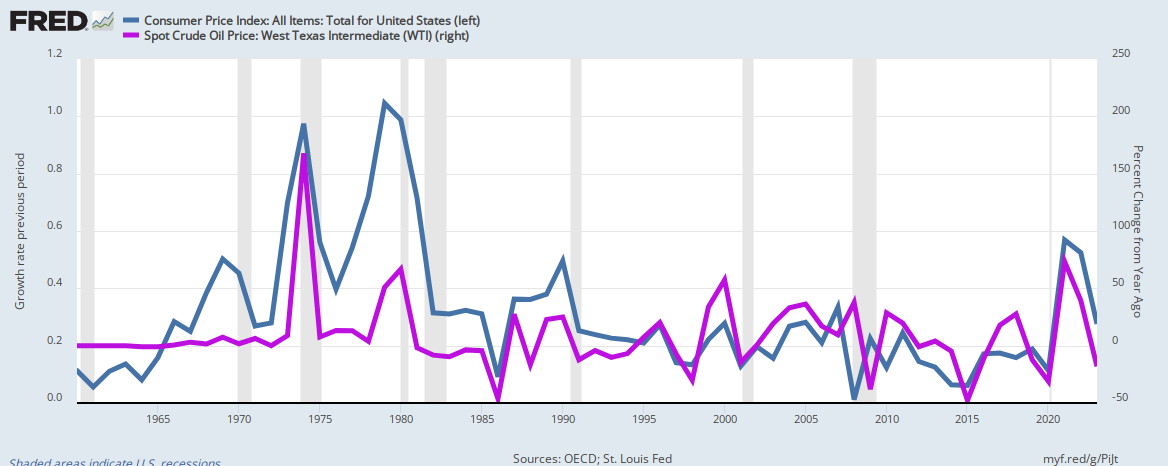
2. Federal spending never causes inflation. Shortages of critical goods and services cause inflation. The most common inflation-causing shortage is the shortage of oil.
The blue line is inflation. Purple is oil pricing. Vertical gray bars are recessions. Inflation tends to parallel oil pricing. The data show that oil shortages cause oil prices to rise, leading to inflation.
The best way to cure inflations is to remedy the shortages. Contrary to popular wisdom, federal spending does not cause the shortages that cause inflation.
Again, the blue line is inflation. The red line represents federal deficit spending. You’ll see no parallelism here. The data show that spending does not cause inflation.
The federal government cannot run short of dollars, and federal deficit spending does not cause inflation. Once you fix those two absolute truths in your mind, you will understand the rest of this post.
We cannot rely solely on a private sector, constrained by money supply and the profit motive, to finance what the world needs. The federal government is constrained neither by money supply nor profit motive.
Here is how I visualize paradise. No poverty. No hunger. No crime. No “bad” neighborhoods. Good healthcare for all. The Gaps between the richest and the rest are narrow. All who want a good education receive one. Children and the elderly receive good care.
There is plenty of good food, good water, suitable affordable housing, good air, and good weather.
How do youvisualize paradise?
Here are just a few of the things we could do:
1. Provide free, comprehensive, no-deductible healthcare and long-term care to everyone in America, regardless of age, income, or health history.
The government can pay for everything related to medical care: Doctors, nurses, hospitals, drugs, ambulances, equipment manufacturers, etc.
There would be no need for Medicare Part A, B, C, D, or Supplementary. The government would function as the insurance company.
It would not be “socialized medicine.” As with Medicare, the government only would pay, not administer. Doctors and nurses still would make all medical decisions.
2. Eliminate the Federal Insurance Contribution Act (FICA) tax on employees and employers. FICA is the ultimate regressive, anti-employment tax that is utterly useless.
Contrary to popular myth, FICA does not fund Social Security or Medicare. FICA dollars taken from employees and employers come from the economy. Those dollars are destroyed upon receipt by the U.S. Treasury.
3. Provide tax-free Social Security benefits to everyone in America. Each person would receive the same benefits. There would be no age, current employment, or previous employment history deductions.
This may be the most direct benefit to employ because it can be done at the stroke of a pen. President Obama did it temporarily in 2011. FICA should be cut permanently. Payroll-Tax Cut Measure Signed Into Law by Obama4. Provide free college for everyone who wants one. Education is so essential to America’s future that the founders of this nation made sure it was provided free to everyone — at least, for grades K-12, where monetarily non-sovereign (state & local) governments offer it.
Today, college is far more critical than it was back in the 1700s, so for the same reasons that grades k-12 generally are free, college should be free and accessible to all.
5. Pay a salary to all those attending school.Going to school is a job, like any other job. America needs an educated populace.
Many children, especially those of high school and college-age, don’t attend school because they and their families need income.
A school salary will help young people resist the temptation to quit school, commit crimes, or join gangs.
6. Federally funded school lunch for pre-school through grade 12. No means-testing, thus eliminating the stigma.
The National School Lunch Program (NSLP) is a federally assisted meal program operating in public and nonprofit private schools and residential child care institutions. It provides nutritionally balanced, low-cost lunches to children each school day.
About 7.1 million children participated in the NSLP in its first year. By 2016: 30.4 million children participated.
Like most federal programs, the NLSP is unnecessarily complex and means-tested.There is a lunch program (“high lunch” and “low lunch), a breakfast program (“severe-need” and “non-severe need), an after-school-snack program, a special milk program, a summer food service program, and a seamless summer program, each having various remuneration schedules.
Rather than having a government agency serve as America’s dietician, the entire breakfast/lunch program should be handled like Medicare, where the doctor makes the decisions and Medicare pays the bills.
For NLSP, the local dietician should schedule the meals and submit costs to the government. Not only would this be simpler, but it would encourage serving fuller, better, more nutritious meals.
7. Eliminate means-testing from all federal programs. Federal means-testing is complex and expensive. It arbitrarily defines who will receive benefits and eliminates the poor who almost, but not quite, are poor enough.
Means-testing stigmatizes those who receive benefits; it encourages cheating to qualify and discourages efforts to improve one’s means.
A classic means-testing example is the Supplemental Nutrition Assistance Program (SNAP, food stamps). It is a massively complex program with many requirements.
According to the Council on Aging:
*The Supplemental Nutrition Assistance Program, or SNAP, is the most extensive domestic hunger safety net program, helping low-income older adults achieve food security.
*Approximately three out of five seniors who qualify to receive SNAP are missing out on benefits—an estimated 5 million people.
*For older adults with low income, the $1,248 average annual benefits can mean the difference between having food and going without.
Federal means-testing has one purpose: To minimize the amount of money the federal government spends.
Yet, there is no reason the federal government ever needs to minimize spending. The federal government has infinite money; federal spending creates economic growth, and federal spending does not cause inflation.
Federal means-testing for benefit programs is all negatives with no positives. It is based on the false premise that the federal government’s finances are limited, like state and local government finances.
8. Financially support the research, development, and usage of renewable, low- or zero-carbon energy. We have begun to experience the terrible result of carbon-based fuels. Global warming is upon us, with even worse results coming.
The government must do much more to encourage zero-carbon energy: solar, wind, geothermal, hydrogen, hydro, and nuclear.
It must fund research on unknown or unproven energy sources, for instance, the massively expensive tokamak. Solar panel production should be supported, and installation should be free. Financial support should be given to companies offering existing forms of renewables and to people who use renewables.
That will help reduce climate change and take inflationary pressure off oil.
9. Financially support the research and development of low-carbon-fueled cars, trucks, buses, ships, trains, airplanes, homes, offices, andfactories. This includes funding research into more efficient batteries and electric infrastructure, transmission networks, superconductors, and charging stations.
10. Financially support the purchase and use of low-carbon-fueled cars, trucks, buses, ships, trains, airplanes, homes, offices, and factories. Often, the public is slow to adopt new technology, especially if it is not immediately and financially beneficial.
The federal government has the power to make adoption financially beneficial while R&D brings the technology into economic self-sufficiency.
11. Financially support water purification and desalination research, development, and distribution. The world is covered with water that isn’t good for drinking or growing crops. We need more efficient water purification, desalination, transportation, and usage.
America is losing its fresh water daily.
What is Water Scarcity?Water scarcity involves water crisis, water shortage, water deficit or water stress.
Water scarcity can be due to physical water scarcity and economic water scarcity. Physical water scarcity refers to a situation where natural water resources are unable to meet a region’s demand while economic water scarcity is a result of poor water management resources.
About 70% of the Earth’s surface is covered with water, and 3% of it is actually freshwater that is fit for human consumption. Around two-thirds of that is tucked in frozen glaciers and unavailable for our use.
“Water scarcity already affects every continent and around 2.8 billion people around the world. More than 1.2 billion people lack access to clean drinking water.””
Causes of Water Scarcity: Overuse, pollution, conflict, distance, drought, governmental access, global warming, illegal dumping, groundwater pollution, and natural disasters.
All of these can be moderated or eliminated by properly used government funding.12. Financially support farmers and advanced farming methods (for example, hydroponics, genetic engineering of more productive, healthful crops, reduced use of fertilizers, water, and pesticides).
The federal government financially should support the purchase of efficient farm equipment.
American farmers are nearing extinction. President Trump’s trade war hasn’t helped matters. After the United States slapped tariffs on Chinese goods, including steel and aluminum, last year, China retaliated with 25 percent tariffs on agricultural imports from the U.S.China then turned to other countries such as Brazil to replace American soybeans and corn.
Even large companies are facing unprecedented challenges; Dean Foods, a global dairy producer that buys milk from thousands of small farmers, filed for bankruptcy in 2019.
13. Give more financial support to pure scientific research. Unlike applied research, pure research is not designed to result in profits. Its purpose is to add to scientific knowledge. It is why we went to the moon and want to go to Mars, not for immediate gains but for learning.
Sometimes we learn much that is valuable today. Sometimes we find that much we may discover has value 100 years from now. We build a long-term knowledge base handed down through the generations. That is one of the qualities that differentiates humans from all other animals.
Even “failed” research has immediate value in showing what doesn’t or might work in the distant future. Failed research can be the beginning of serendipity.
The profit-motivated private sector cannot justify doing much pure research. For example, pharmaceutical companies are reluctant to spend money searching for the causes and cures of rare diseases. But that research is valuable, not only for curing rare diseases today, but it may lead to other purposes we hadn’t even imagined.
Consider such projects as weather prediction and control, meteor and comet protection, volcano prediction and control,
14. Support the states with a per-capita payment. Something like Social Security for the U.S. states.
State and local governments are monetarily non-sovereign.
Unlike the Monetarily Sovereign U.S. government, states generally run short of the dollars they need to take care of local problems: Schools, streets, infrastructure, parks, garbage/recycling/water, police, fire departments, etc.
Most states borrow, which means they later will need to spend less (provide less to their residents), tax more (take more from their residents), or both.
The federal government should take those burdens from local taxpayers’ shoulders.
15. Federal support for the postal service. The mail is as vital to America as any other government service. There is no public benefit to requiring the postal service to pay its own way.
Although COVID-19 has choked off the USPS revenue in recent months, factors that arose well before coronavirus have contributed to the unsustainability of the Postal Service’s financial situation for years.
While the USPS generates enough revenue to cover its operating costs, its pension and retiree health care liabilities push its bottom line into the red. The USPS has operated at a loss since 2007.
Because of the rise of email and digital communication, USPS has seen the volume of First-Class Mail decline from a peak of 103.5 billion pieces in 2000 to just shy of 55 billion pieces in 2019.
USPS has tried to increase the delivery of marketing mail and has tried to compete with UPS and FedEx in the parcel delivery sector, including by forging a delivery deal with Amazon.
This has provoked criticism from (past) President Trump (Because of his personal animosity with Jeff Bezos.)
Can there be life without beauty?16. Increase support for the arts. The arts are the difference between seeing the world in color vs. drab shades of gray.
Science provides pronouns, nouns, and verbs, but the arts offer adjectives, adverbs, and interjections.
To live as humans, we need music, painting, architecture, poetry, and literature.
If you have visited or seen photos of Soviet-era architecture, you understand the cold, functional, inhumanity of a joyless world.
17. Eliminate income taxes on all but the top 1%. The Gap is too wide, and it is widening. In that regard, here is what FOXwrote:
In 2018, the top 1% of taxpayers – defined as those with adjusted gross income (AGI) (AGI) above $540,009 – earned 20.9% of all AGI and paid 40.1% of all federal income taxes, according to data from the Tax Foundation.
The group paid more in income taxes (at about $615 billion) than the bottom 90% of taxpayers combined ($440 billion).
Do you see what’s wrong with what the mouthpiece for the rich wrote? That 20.9% figure is bogus. Much of the income the top 1% receives isn’t counted in AGI (Adjusted Gross Income.)
Think of the fully paid, comprehensive health insurance, travel, meals, vacations, apartments, stock options, entertainment, clothing, taxis, and other expenses that companies spend on behalf of key employees.
You pay for those things using your AGI dollars, but the upper 1% doesn’t. The richest among us may not remember what it’s like to write a personal check. Do you think Donald Trump even carries a wallet?
Then there is real estate depreciation, which is how billionaire Donald Trump pays fewer tax dollars than you did.
And remember, FICA and other taxes paid by the “lowly” 99% are not paid by the 1% who don’t take salaries.
GOVERNMENT WASTE
Waste is bad. The word “waste” is a pejorative. State and local government waste comes out of your pocket.
But federal waste is another matter. The dollars cost you nothing. In fact, wasted federal spending adds stimulus dollars to the economy.
Of course, it would be far better for those dollars to have produced something of value, but the mere spending benefits us all.
So, don’t worry so much about wasted federal spending. Of course, we want federal dollars to be functional, but even the most outrageously wasted dollars — bridges to nowhere — still add to the nation’s economic growth.
SUMMARY
There is so much the wealthiest entity on the planet — the U.S. government — could do to benefit Americans and the world.
But, the government is restricted by the widespread false belief that federal finances are like state and local government finances.
That false belief seems logical to the private sector, which is monetarily non-sovereign and limited in what it can spend.
I have listed several areas where the populace would benefit from federal money input. You probably can think of many others.
None of these suggestions involves socialism, which is ownership and control. All the federal government would be asked to do is provide money.
The federal government already has the power to bring us closer to paradise. You only need to understand the two essential truths and convey them to the world:
The federal government cannot unintentionally run short of dollars.
Federal deficit spending does not cause inflation and often can cure inflation.
Scott Pelley: Is that tax money that the Fed is spending?
Ben Bernanke: It’s not tax money… We simply use the computer to mark up the size of the account. (Quote from Ben Bernanke when, as Fed chief, he was on 60 Minutes:)
Statement from the St. Louis Fed:“As the sole manufacturer of dollars, whose debt is denominated in dollars, the U.S. government can never become insolvent, i.e., unable to pay its bills. In this sense, the government is not dependent on credit markets to remain operational.”
Press Conference: Mario Draghi, President of the ECB, 9 January 2014Question: I am wondering: can the ECB ever run out of money?Mario Draghi: Technically, no. We cannot run out of money
Gap Psychology describes the common desire to distance oneself from those “below” in any socioeconomic ranking and to come nearer those “above.” The socioeconomic distance is referred to as “The Gap.”
Wide Gaps negatively affect poverty, health and longevity, education, housing, law and crime, war, leadership, ownership, bigotry, supply and demand, taxation, GDP, international relations, scientific advancement, the environment, human motivation and well-being, and virtually every other issue in economics.Implementation of Monetary Sovereignty and The Ten Steps To Prosperity can grow the economy and narrow the Gaps:
Ten Steps To Prosperity:
Answer: All three are false narratives. The first two are meant to teach children valuable lessons. The third should teach adults a valuable lesson.
That lesson is: Don’t believe the Committee for a Responsible Federal Budget (CRFB) when it howls like a wolf, squawks like a chicken, and pontificates in solemn terms that Social Security and Medicare “trust funds” are running short of dollars.
The Trustees show that the Social Security and Medicare Hospital Insurance (HI) trust funds rapidly approach insolvency. Their funding imbalances need to be addressed sooner rather than later to prevent across-the-board benefit cuts or abrupt changes to tax or benefit levels.
In effect, the CRFB claims:
1. Social Security and Medicare benefits are paid for by trust funds.
2. These “trust funds” will run short of money.
3. The solution to Medicare or Social Security insolvency requires cutting benefits and/or increasing taxes.
All three are factually FALSE.
1. SOCIAL SECURITY AND MEDICARE BENEFITS ARE PAID FOR BY TRUST FUNDS
Federal trust funds bear little resemblance to their private-sector counterparts, and therefore the name can be misleading.
A private sector “trust fund” implies a secure source of funding.
(A federal trust fund merely tracks inflows and outflows for specific programs. There is no secure source of funding.)
In private-sector trust funds, receipts are deposited, and assets are held and invested by trustees on behalf of the stated beneficiaries.
In a federal trust fund, the receipts — as part of the M2 money supply measure — are destroyed upon receipt. They no longer are part of any money supply measure.
There are no stated beneficiaries, as the criteria for beneficiaries change daily.)
The federal government owns the accounts and can, by changing the law, unilaterally alter the purposes of the accounts and raise or lower collections and expenditures.
The federal government (Congress and the President) can do whatever they wish with the “trust funds”: Add to them, subtract from them, or change them to pay for anything or nothing.
At the click of a computer key or the passage of a law, the balance in any federal “trust fund” could be changed to $100 trillion or $0 or anywhere in between.
Alan Greenspan: “A government cannot become insolvent with respect to obligations in its own currency.”
If Congress and the President wished, the Medicare “trust fund” could be changed to pay for Las Vegas vacations, jewelry, Congressional vacations, etc. Almost every year, the federal government arbitrarily changes what Medicare will pay for and how much it will pay.
In fact, that is exactly what the CRFB suggests when it writes about “benefit cuts or abrupt changes to tax or benefit levels.”
In a real “trust fund,” the trustees would not have that control.
2. THESE TRUST FUNDS WILL RUN SHORT OF MONEY
Wrong.
The United States government is unlike state and local governments. It also is unlike euro governments, private businesses, you, and me. The U.S. government uniquely is Monetarily Sovereign. It is sovereign over the United States dollar.
In the 1780’s it created the original dollars from thin air and gave them an arbitrary value. Today, the government continues to create dollars from thin air and continues to provide them with an arbitrary value.
Ben Bernanke: “The U.S. government has a technology, called a printing press (or, today, its electronic equivalent), that allows it to produce as many U.S. dollars as it wishes at essentially no cost.”
The government never unintentionally can run short of its own sovereign currency, the dollar. Even if the federal government didn’t collect a penny in taxes, it could continue spending forever.
This absolute control over the U.S. dollar means no federal government agency can run out of dollars unless Congress and the President will it.
The only way Medicare or Social Security or any other federal agency can run short of dollars is if Congress and the President want them to run short of dollars.
3. THE SOLUTION TO SOCIAL SECURITY AND MEDICARE INSOLVENCY REQUIRES CUTTING BENEFITS OR INCREASING TAXES
Wrong.
Despite all the pretense about fake “trust funds,” Federal taxes (which include FICA) do not fund Medicare or Social Security. Those FICA dollars deducted from your paycheck (but tellingly, not deducted from other sources of income received by the wealthier among us) — those FICA dollars do not pay for anything.
They merely become part of the federal government’s infinite supply, and effectively are destroyed. (You mathematicians know that infinity plus any amount still = infinity. Thus, your tax dollars do not increase the federal government’s supply of dollars by even one cent.)
In fact, with regard to Medicare Part B, there is a wholly different pretense.
While Medicare Part A (pays for hospitals and doctors, Part B pays for clinical research, ambulance services, durable medical equipment, and some drugs. And Medicare recipients are charged extra, above FICA, ostensibly to pay for Part B.
But in reality, those charges, like all dollars coming into the federal government, are destroyed upon receipt.
The solution for Social Security and Medicare insolvencies is simply for the federal government to pay for them, which it could do the same way it pays for everything: By creating new dollars, ad hoc.
So group the warnings about Social Security and Medicare “trust fund” insolvency along with the boy who cried, “wolf” and Henny Penny’s “the sky is falling” as silly, little lies. There are no “trust funds.” Congress and the President have absolute control over all federal agency finances.
All your tax dollars are for naught. The federal government could and should provide free, comprehensive, no-deductible Social Security and Medicare for every man, woman, and child in America.
Continuing with the CRFB’s charade:
The Social Security Trustees estimate the Social Security Old-Age and Survivors Insurance (OASI) trust fund will deplete its reserves by 2034 and the Social Security Disability Insurance (SSDI) trust fund will not become depleted within the 75-year projection window for the first time since the 1983 Trustees’ report.
On a combined theoretical basis, assuming revenue is allocated between the trust funds in the years between OASI and SSDI insolvency, Social Security will become insolvent by 2035. Upon insolvency, all beneficiaries will face a 20 percent across-the-board benefit cut, which will grow to 26 percent by 2096.
The Trustees estimate a 75-year actuarial shortfall of 3.42 percent of taxable payroll for Social Security, which is slightly lower than the 2021 report’s estimate of 3.54 percent of payroll, but higher than any other year prior.
And blah, blah, blah. The CRFB substantiates the old saying, “Figures don’t lie, but liars figure,” by providing statistics to make their lies sound factual.
Ooh, it must be true. There even is a graph. Except the graph is phony. The “Trust Fund Exhaustion” is based on the lie that Social Security benefits are paid by the fake “trust fund.” It’s not a trust fund and it pays for nothing. It’s just a record of ins and outs.
And here is another graph of lies:
Same story. The “Trust Fund Exhaustion” is based on a lie. The phony “trust fund” pays for nothing.
Why does the CRFB tell such big lies?
I suppose it’s possible they don’t know they are lying, and that they are providing the misinformation out of economic ignorance.
Actually, I don’t think so. My belief, based on no data, is that they know it’s a lie. If I am correct, why are they lying?
It all comes down to Gap Psychology, the human desire to distance ourselves from lower income/wealth/power people, while coming closer to the higher income/wealth/power people.
Rich is a comparative word, not an absolute. You only can be rich if someone else is poorer. Without the Gaps, no one would be rich. We all would be the same. So, to become richer, you need the Gap below you to widen and/or the Gap above you to narrow.
And that even includes the rich, who want to be richer, which they can accomplish by making the rest of us poorer.
Because the rich control the politicians, it is no coincidence that FICA is deducted from salaries rather than from the investment income that is the major part of the income received by the rich.
And there even is a cap on the incomesubject to FICA.
And then there are all the tax loopholes available to the rich — you know, those loopholes that made it possible for billionaire Donald Trump to avoid paying any taxes at all in 8 of the past 10 years. (How does it feel to know you’ve paid more taxes than a billionaire?)
Part of the plan by the rich, to widen the Gap below them, is to make you pay unnecessarily for Social Security and Medicare, and not only to pay more, but to have your benefits cut and taxed.
So the CRFB, as a paid mouthpiece for the rich, does everything it can to “prove” you should pay more taxes and receive less in benefits, thereby widening the Gap between you and the rich.
And they have been quite successful. Now that you have seen their phony statistics, here are some real statistics: Inequality is rising. The rich are growing richer; the poor are becoming poorer.
The Gini coefficient measures inequality, where “0” represents perfect equality (Everyone has the same) and “1” represents perfect inequality (where one person has everything). The higher the line, the more unequal the measure is.
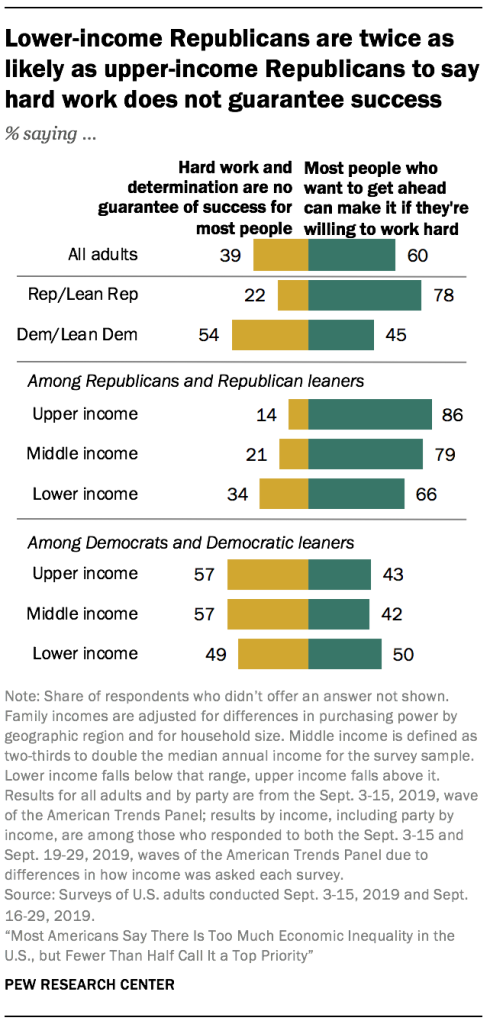
And finally, of the two major political parties, one, the Republicans, tend to believe the poor are poor because they are dumb and lazy, while the rich are rich because they are smart and work hard. Here is one example of that belief:
IN SUMMARY
The U.S. federal government is Monetarily Sovereign. It never unintentionally can run short of its own sovereign currency, the U.S. dollar. Even if $0 federal taxes were collected, the federal government could continue spending forever.
Medicare and Social Security, as agencies of the U.S. government, cannot run short of dollars unless that is what Congress and the President want. The federal government funds all its agencies’ pending by creating new dollars, ad hoc. All tax income is destroyed upon receipt.
The Medicare and Social Security “trust funds” are not trust funds. These fake trust funds do not pay for benefits, but only keep records of dollar inflow and federal spending. As mere record keepers, they neither can be solvent nor become insolvent.
There is no financial reason to cut Medicare or Social Security benefits or to increase taxes, or even to continue collecting taxes. The federal government funds benefits paid by both programs regardless of tax income.
“Rich” is a comparative, not an absolute. According to Gap Psychology, people generally wish to widen the income/wealth/power Gaps below and to narrow those Gaps above. The rich can become richer by acquiring more for themselves and/or by forcing those below to acquire less.
The rich run America by bribing politicians, the media, and economists. To make themselves richer, the rich widen the Gap below by backing false narratives and laws that reduce federal benefits to the poorer while increasing taxes on the poorer.
Gap Psychology describes the common desire to distance oneself from those “below” in any socio-economic ranking, and to come nearer those “above.” The socio-economic distance is referred to as “The Gap.”
Wide Gaps negatively affect poverty, health and longevity, education, housing, law and crime, war, leadership, ownership, bigotry, supply and demand, taxation, GDP, international relations, scientific advancement, the environment, human motivation and well-being, and virtually every other issue in economics.Implementation of Monetary Sovereignty and The Ten Steps To Prosperity can grow the economy and narrow the Gaps: Ten Steps To Prosperity:
The numbers come from a massive database maintained by the University of Washington’s Institute for Health Metrics and Evaluation, which tracks lives lost in every country, in every year, by every possible cause of death.
Source: Institute for Health Metrics and Evaluation Credit: Connie Hanzhang Jin/NPR
Limiting access to school buildings to a single locked door.
Expanding research into school violence.
Creating a federal task force to recommend how communities can make schools safe. Improving mental health care.
Republicans have offered up seemingly every potential solution to stop mass gun violence except restricting access to the weapons themselves.
Here’s a classic:
“What about getting a department that’s looking at young men that’s looking at women that’s looking at their social media?”
That brilliant comment came from the choice of Republican voters and Donald Trump to be a Senator from Georgia, Herschel Walker, in a Fox News interview.
Walker’s ex-wife said he had pointed a gun at her head, and “talked about having a shoot-out with police.” His own therapist said, “He threatened to kill her, myself, and himself. I called 911, and the police came.”
Texas Lieutenant Governor Dan Patrick touted his state’s existing program that allows teachers to be armed, which did not prevent the massacre and called for more security around schools.
Republicans are open to legislation that would “harden” school buildings to make them more difficult to attack, although Democrats have criticized the idea of making campuses into jail-like fortresses.
YOUR CHILDREN’S SCHOOL IF GOVERNOR DAN PATRICK RULES
The Republican “sensible” solution for mass school shootings: “Hardened” school buildings with armed police surrounding every elementary school, high school, college, and university in America. But no gun control laws. And all the other public buildings in America –surround them with police, too?
Why is the United States so unusual in the number of gun-related deaths, and why are Republicans making such strange, impossible suggestions to “cure” the problem?
The answer, which every honest person knows, is quite obvious: America is unique. It has way too many guns and way too many people carrying them. That is the problem.
The symptom of that problem is too many gun deaths. Mass murders, individual murders, suicides, crimes involving guns, woundings — way too many.
Attempts to solve a problem by addressing a symptom cannot work. To solve a problem we must address the problem.
The politicians and their voters who claim that “guns don’t kill; people kill” are liars; they know they are liars, and they’ll keep lying until enough voters stand up to them.
Guns are meant for shooting. When masses of people carry guns, masses of people will be shot. Period.
The problem begins with the Supreme Court Justices who claimed the 2nd Amendment really says, “Any damn fool can have a gun of any kind, and wave it around like the damn fool he is” — well those Justice were liars too.
The first 13 words of the 2nd Amendment are: “A well regulated Militia, being necessary to the security of a free State . . . The lying Justices, who claim they are “originalists” (people who obey how something would have been understood or was intended to be understood at the time it was written) — those right-wing Justices are damn liars, if they totally ignore those first 13 words.
Where is the Militia? Where is the “well-regulation”?
And then there’s, “. . . the right of the people to keep and bear Arms, shall not be infringed.”
If you truly are an originalist, this is what you mean by “arms.”
As for the “arms,” are they swords and flintlock pistols? Are they automatic rifles? Are they hand grenades, flame throwers? Or are “arms” something like this:
The AA12 can fire five 12-gauge shells per second and because the recoil is engineered at just 10 percent of a normal shotgun, it can be fired from the hip with only one hand. The Atchison also fires a high explosive or fragmentation grenade called a FRAG-12 round to 175 meters with equal efficiency. Designed for long-term combat use, tests have shown the AA12 can fire up to 9,000 rounds without being cleaned or jamming. All the user needs to do is hold the trigger down for four seconds to empty the 20 round drum at a target.
Question for the Supreme Court: Should every American be allowed to own and carry AA12s? If not, why not? They are today’s “arms.”
Then there is the question of which “people”? Two-year-olds are people. Criminals are people. All those in jails and prisons are people? Aliens are people. Witnesses testifying in court are people. Should they all be allowed to pack guns? If not, why not?
Back in the 1700s, anyone of any age could carry a gun. Is that what the phony “originalists” now want in the 2000s?
Or should we merely wait for the next shooting, then offer our “thoughts and prayers”?
If so, you don’t have long to wait. Mass shootings in the United States are far more common than you have imagined:
Since the Uvalde, Tex., elementary school tragedy, there have been at least 15 other shootings that had at least four victims By Annabelle Timsit Updated May 31, 2022
But mass shootings have already happened again — and again. At least 15 mass shootings have taken place across the United States since Tuesday, from California to Arizona to Tennessee.
This Memorial Day weekend alone — spanning Saturday, Sunday and the federal holiday on Monday — there have been at least 12 mass shootings.
The Gun Violence Archive, a nonprofit research organization, defines a mass shooting as one in which “four or more people are shot or killed, not including the shooter.”
So is the situation hopeless? Are we doomed to keep repeating the same mistake over and over again? Will children and adults keep dying, because we are not smart enough to make necessary changes?
Will we continue to insist that everyone should have the right to own and carry a killing machine, while we simultaneously pray the killing and wounding will stop?
So, the then-prime minister, a conservative politician and close friend of George W. Bush, pushed through sweeping gun control legislation just 12 days after the shooting.
“The hardest things to do in politics often involve taking away rights and privileges from your own supporters,” Howard said.
The tough new laws banned the sale and importation of all automatic and semi-automatic rifles and shotguns; forced people to present a legitimate reason, and wait 28 days, to buy a firearm; and – perhaps most significantly – called for a massive, mandatory gun-buyback.
Australia’s government confiscated and destroyed nearly 700,000 firearms, reducing the number of gun-owning households by half.
Howard told Doane, “People used to say to me, ‘You violated my human rights by taking away my gun.’ And I’d tell them, ‘I understand that. Will you please understand the argument, the greatest human right of all is to live a safe life without fear of random murder?'”
If we tally mass shootings that have killed four or more people, in the United States there have been well over 100 since the 1996 Port Arthur tragedy. But in Australia, there has been just one in the 26 years since their gun laws were passed. Plus, gun homicides have decreased by 60%.
Perhaps, Australians simply are smarter than we are.
Or is it just that their High Court is smarter and more honest than our Supreme Court?
Or is it that Australian media don’t include a “guns-for-everyone” medium like Fox News. (Murdoch’s news channel in Australia has celebrated the country’s gun control laws — and expressed hope that the U.S. would adopt similar ones.)
Or do Australians care more about life than we do?
The problem: America has more guns per capita than any first-world nation on earth.
The symptom: America has more gun-related deaths, woundings, and crimes than any first-world nation on earth.
To cure the symptom, we must cure the problem. Australia has shown us one way to begin.
Are we too stubborn or simply too stupid to learn?
Gap Psychology describes the common desire to distance oneself from those “below” in any socio-economic ranking, and to come nearer those “above.” The socio-economic distance is referred to as “The Gap.”
Wide Gaps negatively affect poverty, health and longevity, education, housing, law and crime, war, leadership, ownership, bigotry, supply and demand, taxation, GDP, international relations, scientific advancement, the environment, human motivation and well-being, and virtually every other issue in economics.Implementation of Monetary Sovereignty and The Ten Steps To Prosperity can grow the economy and narrow the Gaps: Ten Steps To Prosperity:


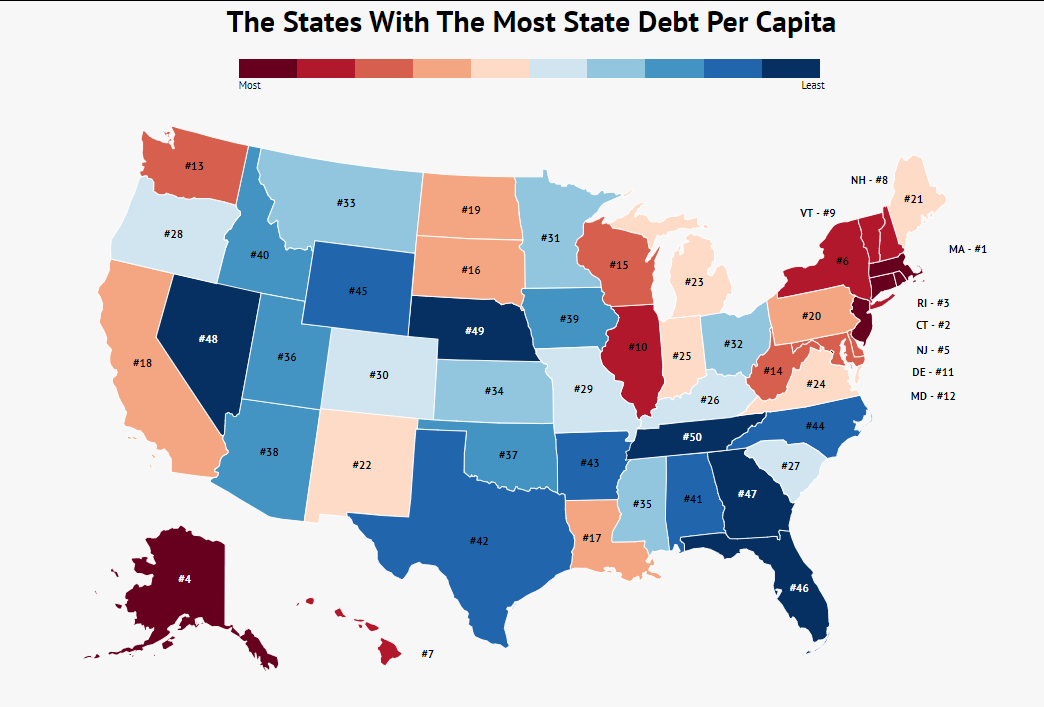 Unlike the Monetarily Sovereign U.S. government, states generally run short of the dollars they need to take care of local problems: Schools, streets, infrastructure, parks, garbage/recycling/water, police, fire departments, etc.
Most states borrow, which means they later will need to spend less (provide less to their residents), tax more (take more from their residents), or both.
The federal government should take those burdens from local taxpayers’ shoulders.
15. Federal support for the postal service. The mail is as vital to America as any other government service. There is no public benefit to requiring the postal service to pay its own way.
Unlike the Monetarily Sovereign U.S. government, states generally run short of the dollars they need to take care of local problems: Schools, streets, infrastructure, parks, garbage/recycling/water, police, fire departments, etc.
Most states borrow, which means they later will need to spend less (provide less to their residents), tax more (take more from their residents), or both.
The federal government should take those burdens from local taxpayers’ shoulders.
15. Federal support for the postal service. The mail is as vital to America as any other government service. There is no public benefit to requiring the postal service to pay its own way.





 #Monetary Sovereignty - Mitchell