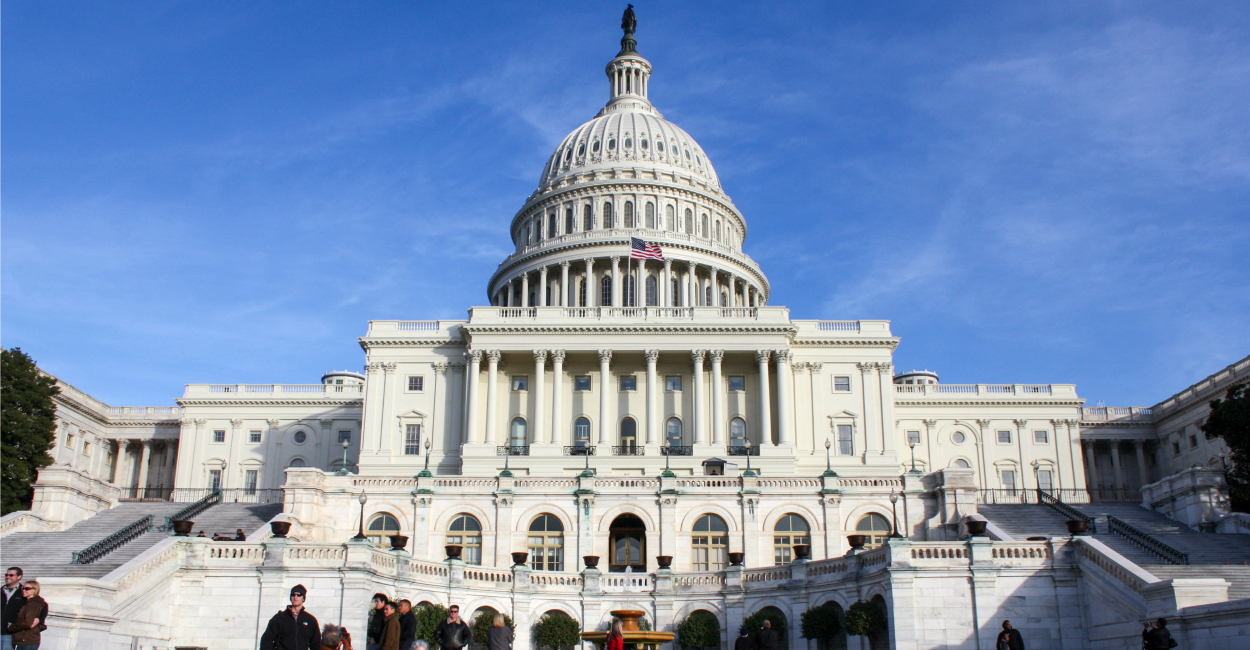
How the Big Lie in economics seriously impacts your life, today and will again, tomorrow.

The Big Lie in economics is: Federal taxes fund federal spending.
The Big Lie sometimes is stated, “Our children and grandchildren will have to pay for today’s federal deficits and debt.”

The Big Lie is told, and believed, for one simple reason: Most people do not understand the differences between federal government (Monetarily Sovereign) finances and all other (monetarily non-sovereign) finances.

You, your business, your state, county, and city all are monetarily non-sovereign.

When you want to spend, you need a source of money, which for local governments mostly is taxes and borrowing.

By contrast, the federal government is Monetarily Sovereign.

When it wants to spend, it neither needs nor uses any source of money.

It creates new money by paying creditors, exactly the opposite of what you personally are accustomed to.

Although the federal government collects tax dollars, it no longer needs to.

That change occurred in August, 1971, when President Richard Nixon, in the greatest act of his Presidency, took us off a gold standard.

The purpose of that change was to remove limits on the federal government’s ability to create money. Since that date, the federal government has not used tax dollars to pay for anything.

Contrary to popular wisdom, federal taxpayers are not “on the hook” for federal deficits (which in fact are private sector surpluses) or for federal debt (which is nothing more than deposits in accounts at the Federal Reserve Bank).

You or your grandchildren do not owe the federal deficit or debt, and you never will pay for them. Period.

The sole purpose of tax dollars has been to regulate the economy, by taxing what the government wants to limit and by giving tax breaks to what the government wants to encourage. The federal government could eliminate all federal tax collections, and still continue spending, forever.

That said, please read the following excerpts from an article that appeared in the March 18, 2021 edition of the Chicago Tribune:

We don’t need Biden’s infrastructure binge
Steve Chapman, a member of the Tribune Editorial Board

Donald Trump did many bad things as president, but he deserves a smidgen of credit for what he didn’t do: go on an infrastructure spending binge.

He vowed that under him, our roads, bridges and waterways would be “the envy of the world.” He said that in 2016 and was still saying it in 2020. But his main achievement was to make “infrastructure week” a source of hilarity.

Now President Joe Biden is hoping to do what Trump didn’t do, and he has support from such divergent groups as the AFL-CIO and the U.S. Chamber of Commerce.

During his campaign, he made gaudy promises to “transform” our transportation networks, “revolutionize” railroads and urban transit, and upgrade water systems, broadband, bike lanes, home weatherization and just about anything else you could think of. Biden could make the Pledge of Allegiance an infrastructure issue.

His price tag for all this? Two trillion dollars. His plan to pay for it? Unspecified.

The two trillion dollars would be created by the federal government, then distributed as growth dollars to the private sector.

Biden would pay for it exactly the same way the federal government pays for everything: It creates dollars, ad hoc.

Specifically, to pay any bill:

The federal government creates instructions from thin air, then sends those instructions (in the form of a check or wire transfer) to the creditor’s bank, instructing the bank to increase the creditor’s checking account balance by a specified amount (“Pay to the order of _______“)

When the bank clicks a computer key to increase the numbers in the creditor’s checking account, this instantly creates brand new dollars that are added to the nation’s money supply, in a segment known as “M1.”

The bank then balances its books by clearing the instructions through the Federal Reserve, which always approves federal instructions.

By formula, increases to the nation’s money supply increase economic growth (Gross Domestic Product = Federal Spending + Non-federal Spending + Net Exports). Federal government spending increases the nation’s money supply. State and local government spending does not.

No tax dollars are involved at any point in this transaction. The whole process is paid for by newly created dollars.

The White House has indicated a preference for tax increases on the wealthy and corporations. When asked recently how she and her fellow Republicans would react to that idea, Sen. Susan Collins reportedly “burst out laughing.”

Sadly, Biden and his minions disseminate the Big Lie that federal taxes fund federal spending.

Why? The real purpose of the Big Lie is to convince you, the public, that the federal government’s ability to provide benefits to you is limited. This is to keep you from asking for free Medicare for All, free College for All, support for local governments to cut local taxes — indeed for any benefit to the not-rich.

The very rich, who run America, are motivated by “Gap Psychology, the desire to get richer by distancing oneself from those who have less wealth. The rich pay politicians (via political contributions and promises of jobs afterward), university economists (via lucrative jobs and contributions to universities), and the media (via ownership and advertising dollars) to disseminate the Big Lie.

We are told that our highways and bridges are falling apart from lack of investment and that upgrading them will not only create jobs but boost our economic productivity.

But the Reason Foundation, which issues a detailed report each year on the nation’s highways, found that the percentage of urban interstates rated in poor condition was lower in 2018 than a decade earlier.

Likewise with rural interstates. For other major rural highways, just 1.23% were in bad shape in 2018.

The foundation’s most recent report found that “the general quality and safety of the nation’s highways has incrementally improved as spending on state-owned roads increased by 9%, up to $151.8 billion” compared with the previous year.

The Reason Foundation is a libertarian organization that opposes virtually all government spending. Their research results tend to be slanted in that  direction.

Nevertheless, even the possibility that our roads and highways may be in less bad condition, does not indicate the federal government should not improve them. Americans live longer today than they did years ago. So should the government not have paid for the CORONA virus vaccine?

And what about those jobs infrastructure work creates?

Bridges? Notes Brown University economist Matthew A. Turner in The Milken Institute Review, “There were more bridges in good condition and fewer crumbling bridges in 2017 than in 1992.” Mass transit? The average age of public transit buses has declined during that period. 

As always with the Big Lie, one simple point is missed. When the states fix roads and bridges, state taxpayers must take dollars from their pockets to pay for these repairs.

When the federal government pays, it puts new dollars into the private sector.

Then we come to the faux moral excuse for the Big Lie:

Even if the United States needs more investment in particular areas, that doesn’t mean the federal government should pick up the tab. The great majority of infrastructure assets are owned by state and local governments, and it’s their constituents who would gain the most from resurfacing roads or bolstering bridges.

If they are going to reap the economic benefits of such investments, shouldn’t they be willing to pay for them?

Yes, shame on you for wanting the federal government, which has infinite money, to pay, when you, who have limited money should want to pay, that is, if you are a good person. Right?

The purpose of that kind of reasoning is to pit one part of the public against the other with a “Why should I pay for his roads?” kind of reasoning.

In fact, they seem to be unwilling. The Center on Budget and Policy Priorities reports, “State and local infrastructure spending as a share of gross domestic product is at its lowest point since the early 1980s.”

Apparently, the author believes state and local taxes are too low. After all, the only place the state governments can find the money for infrastructure repair is via taxes, so when states are “unwilling,” it merely means their taxes are too low.

But the fact that these governments don’t want to use their own money doesn’t mean they won’t be happy to use cash that falls out of the sky.

That’s the political beauty of federal infrastructure packages: The benefits are obvious to people getting new projects, but the costs are invisible.

The author doesn’t realize it, but his “falls out of the sky” intended pejorative, actually comes close to the truth. The federal government, creates dollars from nothing, as it always has — just as it created the very first dollars, when America began.

Where does the author think the first dollars came from? In the late 1770s, there existed zero dollars. Ten years later, there were millions. Where did they come from if not from “out of the sky,” i.e. created from thin air by laws (which also are created from thin air) passed by the federal government?

The timing of this push is also awkward, because the COVID-19 catastrophe creates so much uncertainty about how we will live, work and travel going forward.

“I’m not sure that at this time we want to be pouring concrete or buying equipment until we see how much of this shakes out for a year or two,” University of Chicago economist Allen Sanderson told me.

“Shakes out”? Does Sanderson believe roads will not need to be fixed? Does he believe public transportation will become obsolete? And how long is this “shake-out” period? Will we know something more next year, so don’t fix roads for a year?

Or will we have to wait a decade to learn what our long-term needs will be?

Of course, the University of Chicago economists are notorious for not understanding the differences between Monetary Sovereignty and monetary non-sovereignty, so Sanderson’s remarks, though totally wrong, are not unexpected.

Under Trump, “infrastructure week” went nowhere, time after time. But it could be that one thing worse than an infrastructure push that fails is an infrastructure push that succeeds?

No, Mr. Chapman, the one thing worse than an infrastructure push that fails is a columnist who, knowing nothing about Monetary Sovereignty, always tells his readers, “Now is not the time to spend.”

But if not now, when? Ever?

Steve Chapman blogs at http://www.chicagotribune.com/chapman.
schapman@chicagotribune.com, Twitter: @SteveChapman13

Rodger Malcolm Mitchell

Monetary Sovereignty Twitter: @rodgermitchell Search #monetarysovereignty Facebook: Rodger Malcolm Mitchell …………………………………………………………………………………………………………………………………………………………………………………………………………………………………………………………………………………………..

THE SOLE PURPOSE OF GOVERNMENT IS TO IMPROVE AND PROTECT THE LIVES OF THE PEOPLE.

The most important problems in economics involve:

  1. Monetary Sovereignty describes money creation and destruction.
  2. Gap Psychology describes the common desire to distance oneself from those “below” in any socio-economic ranking, and to come nearer those “above.” The socio-economic distance is referred to as “The Gap.”

Wide Gaps negatively affect poverty, health and longevity, education, housing, law and crime, war, leadership, ownership, bigotry, supply and demand, taxation, GDP, international relations, scientific advancement, the environment, human motivation and well-being, and virtually every other issue in economics. Implementation of Monetary Sovereignty and The Ten Steps To Prosperity can grow the economy and narrow the Gaps:

Ten Steps To Prosperity:

  1. Eliminate FICA
  2. Federally funded Medicare — parts A, B & D, plus long-term care — for everyone
  3. Social Security for all
  4. Free education (including post-grad) for everyone
  5. Salary for attending school
  6. Eliminate federal taxes on business
  7. Increase the standard income tax deduction, annually. 
  8. Tax the very rich (the “.1%”) more, with higher progressive tax rates on all forms of income.
  9. Federal ownership of all banks
  10. Increase federal spending on the myriad initiatives that benefit America’s 99.9% 

The Ten Steps will grow the economy and narrow the income/wealth/power Gap between the rich and the rest.

MONETARY SOVEREIGNTY

Trading nothing for nothing. Revealed: The not-so-secret about money and value.

You may know this, although the vast majority of Americans — including the media writers, politicians and economists — don’t: Money does not exist in any material form.

Money is nothing more than an electronic notation in an electronic balance sheet. You cannot see, touch, taste, smell, or hear money.

That dollar bill in your wallet is a title to a dollar, telling the world that you own a dollar. Just as a car title is not a car, and a house title is not a house, a dollar bill is not a dollar.

The fact that a dollar has no physical existence is what makes Monetary Sovereignty possible.

Because the U.S. dollar has no physical existence, the U.S. government has the unlimited ability to create infinite dollars at the touch of a computer key.

Within the past twelve months, the government has demonstrated this infinite ability by creating, from thin air, something like SIX TRILLION stimulus dollars, without collecting a single extra dollar in taxes.

The fact that dollars are mere balance sheet numbers makes the following article seem somewhat less shocking than it otherwise would.

Why Would Anyone Buy Crypto Art – Let Alone Spend Millions on What’s Essentially a Link to a JPEG File?
Posted on March 16, 2021 by Yves Smith
By Aaron Hertzmann, Affiliate Faculty of Computer Science, University of Washington. Originally published at The Conversation

On March 11, Beeple, a computer science graduate whose real name is Mike Winkelmann, auctioned a piece of crypto art at Christie’s for US$69 million.

The winning bidder is now named in a digital record that confers ownership. This record, called a nonfungible token, or NFT, is stored in a shared global database.

This database is decentralized using blockchain, so that no single individual or company controls the database.

But “ownership” of crypto art confers no actual rights, other than being able to say that you own the work. You don’t own the copyright, you don’t get a physical print, and anyone can look at the image on the web.

There is merely a record in a public database saying that you own the work – really, it says you own the work at a specific URL.

So why would anyone buy crypto art – let alone spend millions on what’s essentially a link to a JPEG file?

It’s a difficult question, only for those who believe money is a physical thing.

But because money has no physical existence, might just as well ask, “Why would anyone give someone a beautiful, physical automobile, containing 10,000 physical parts, in exchange for numbers in a balance sheet?

Before we try to answer both questions, let’s look a bit further at the article:

Some people buy art for their homes, hoping to incorporate it into their living spaces for pleasure and inspiration.

But art also plays many important social roles. The art in your home communicates your interests and tastes. Artworks can spark conversation, whether they’re in museums or homes.

People form communities around their passion for the arts, whether it’s through museums and galleries, or magazines and websites. Buying work supports the artists and the arts.

Mona Lisa is moving - what does it take to keep her safe? - BBC News
“Seeing” the Mona Lisa

Let me tell you three short stories about money, value, and art.

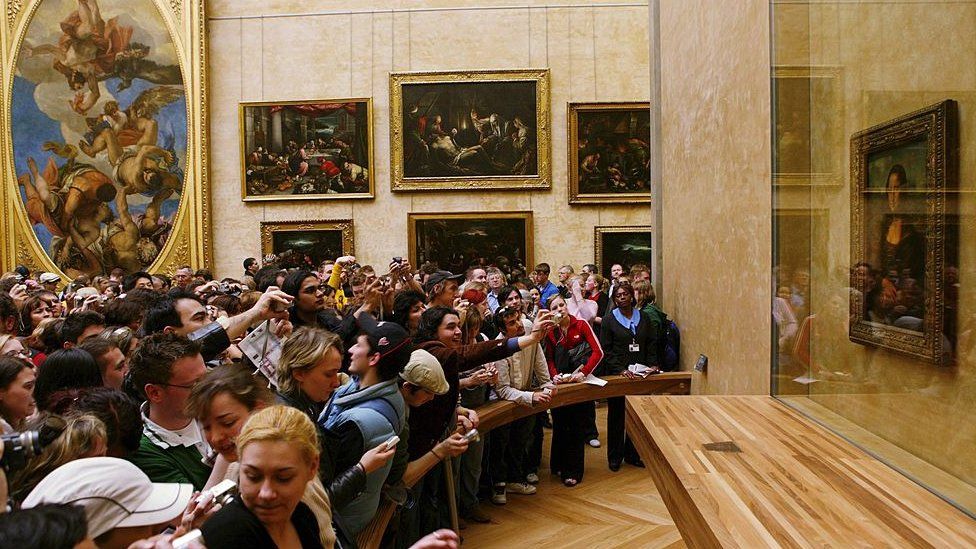
Story #1. Have you been to the Louvre and seen the famous Mona Lisa?

It’s a surprisingly small portrait, and your view is limited by the fact that a rail protects it from a close approach.

Further, most of the time, it is surrounded by a dense crowd of viewers, each of whom is able to spend only a few seconds to look at what arguably is the most famous painting in the world.Mona Lisa - Wikipedia

In the unlikely event this painting ever were sold, the cost would be in the trillions of euros.

Yet, you could purchase a very good lithographed copy for a few dollars, and you could hang it in your home, and enjoy it for hours on end.

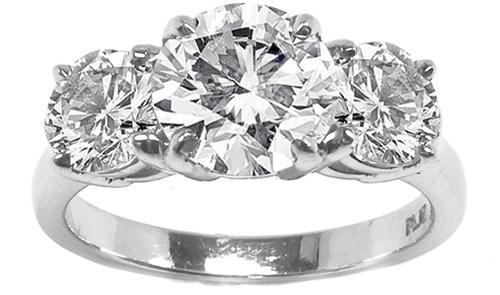
Center diamond: 3 carats. Each side diamond: 2 carats

So why would anyone spend millions, billions, or trillions of dollars to own something they could have for next to nothing?

Story #2. Years ago, I bought for my wife (now deceased) a ring, from a cousin (also now deceased) who was a wholesale diamond merchant. He sold to retailers, who sold to the public, so his own buying price was quite low.

The ring had a magnificent center diamond weighing 3 carats, with a diamond on both sides, each weighing 2 carats.

As I recall, the “family” price to me was about $7,000. I since have sold that ring for many times that amount.

But, I could have purchased an essentially identical piece of jewelry, made from cubic zirconia, for about $750, give or take.

Without a jeweler’s loop, no one (but my wife) would have been the wiser.

So why would a fool (me) spend so much on essentially nothing?

Perhaps the most visible form of art collecting today, and the one that drives so much public discussion about art, is the art purchased for millions of dollars – the pieces by Picasso and Damien Hirst traded by the ultrawealthy. 

Why were those pieces of are exchanged for so much money?

Finally, I think many people buy art strictly as an investment, hoping that it will appreciate in value.

If you look at the reasons people buy art, only one of them – buying art for your home – has to do with the physical work.

Every other reason for buying art that I listed could apply to crypto art.

You can build your own virtual gallery online and share it with other people online. You can convey your tastes and interests through your virtual gallery and support artists by buying their work.

You can participate in a community: Some crypto artists, who have felt excluded by the mainstream art world, say they have found more support in the crypto community and can now earn a living making art.

While Beeple’s big sale made headlines, most crypto art sales are much more affordable, in the tens or hundreds of dollars. This supports a much larger community than just a select few artists. And some resale values have gone up.

Aside from the visual pleasure of physical objects, nearly all the value art offers is, in some way, a social construct. This does not mean that art is interchangeable, or that the historical significance and technical skill of a Rembrandt is imaginary.

It means that the value we place on these attributes is a choice.

Story #3. It’s not really a story, but a common observation: Millionaires and billionaires love to see their names on things: Hospitals, schools, libraries, sports’ centers, etc. So they give away millions or billions of dollars, just to see what they could have seen for a few dollars or nothing: Their names.

What do they get for their money? Nothing physical.

They could have contributed without insisting that their name be engraved somewhere. They received the same benefit as did the person who bought the crypto art, and the same benefit I received for buying three transparent stones my wife could wear.

And that is the not-so-secret of the balance sheet notation we call “money.” Those arbitrary, non-physical, made-from-thin air dollars have enough value to be traded for  . . . traded for what? A couple of transparent stones? A picture?

They all are valuable because we social animals choose to deem them valuable.

You might respond that scarcity is what makes them valuable. But plenty of things are scarce and not valuable. I paint, but my paintings are not valuable, though they are just as scarce as the Mona Lisa.

You might say beauty or artistic talent makes them valuable. But before artists become famous, their paintings are just as beautiful and require just as much talent, but are valued much less.

When someone pays $90 million for a metal balloon animal made by Jeff Koons, it’s hard to believe that the work has that much “intrinsic” value.

Even if the materials and craftsmanship are quite good, surely some of those millions are simply buying the right to say “I bought a Koons. And I spent a lot of money on it.” If you just want an artfully made metal balloon animal, there are cheaper ways to get one.

Conversely, the conceptual art tradition has long separated the object itself from the value of the work. Maurizio Cattelan sold a banana taped to a wall for six figures, twice; the value of the work was not in the banana or in the duct tape, nor in the way that the two were attached, but in the story and drama around the work.

Again, the buyers weren’t really buying a banana, they were buying the right to say they “owned” this artwork.

Depending on your point of view, crypto art could be the ultimate manifestation of conceptual art’s separation of the work of art from any physical object. It is pure conceptual abstraction, applied to ownership.

On the other hand, crypto art could be seen as reducing art to the purest form of buying and selling for conspicuous consumption.

In Victor Pelevin’s satirical novel “Homo Zapiens,” the main character visits an art exhibition where only the names and sale prices of the works are shown. When he says he doesn’t understand – where are the paintings themselves? – it becomes clear that this isn’t the point. Buying and selling is more important than the art.

This story was satire. But crypto art takes this one step further. If the point of ownership is to be able to say you own the work, why bother with anything but a receipt?

The reason art, or anything else — cars, houses, jewelry, etc. — has value is not just its intrinsic value. For most of us, there are cheaper forms of transportation, cheaper forms of shelter, and cheaper stones than what we paid. A scratched and dented car has the same transportation value as does a shiny, untainted car.

We are social animals. These things have value because other people think they have value, and they are willing to exchange other things they think have value to get them.

And that is why money has value.

Money has value because the world thinks it has value. Remember, money has no physical existence. It is just a bookkeeping notation. And that same notation might appear in several places.

It might appear on your bank’s computer, on your computer, or on dozens of other computers. No matter how many computers it appears in, it still is the same money. It still has the same value.

It still seems hard to get used to the idea of spending money for nothing tangible.

Would anyone pay money for NFTs that say they “own” the Brooklyn Bridge or the whole of the Earth or the concept of love? People can create all the NFTs they want about anything, over and over again. I could make my own NFT claiming that I own the Mona Lisa, and record it to the blockchain, and no one could stop me.

But I think this misses the point.

In crypto art, there is an implicit contract that what you’re buying is unique. The artist makes only one of these tokens, and the one right you get when you buy crypto art is to say that you own that work.

Actually, the more important right is to say that you can afford to own the work.

As an investment, crypto-art just seems inconceivable to me that the higher prices reflect true value, in the sense of these works having higher resale value in the long term. As in the traditional art world, there are a lot more works being sold than could ever possibly be considered significant in a generation’s time.

And, in the crypto world, we’re seeing highly volatile prices, a sudden frenzy of interest, and huge sums being paid for things that seem, on the surface, not to have the slightest bit of value at all, such as the $2.5 million bid to “own” Jack Dorsey’s first tweetor even the $1,000 bid on a photo of a cease-and-desist letter about NFTs.

Much of this energy seems to be driven by price speculation. It’s also worth noting that the winner of the Beeple auction seems to be heavily invested in the success of crypto art. The cryptocurrencies that drive crypto art are often considered highly speculative.

Yes, there could be a tulip-bulb bubble at work here. And, where there is no intrinsic value, the possibility of a bubble increases.

But money itself has no intrinsic value. The value of the U.S. dollar is backed by the full faith and credit of the U.S. government. (See: Understanding Federal Debt. Full Faith and Credit.)

But what backs the full faith and credit of the U.S. government. No, not the “amber waves of grain,” or the “purple mountain majesties,” or the “enameled plain.” No creditor can acquire those.

The value of the Mona Lisa, the diamond ring, a mansion, a Rolls Royce car, the full faith and credit of the U.S. government, and the value of the U.S. dollar itself, all are backed by the same thing: Society’s belief that they have value.

Do you believe the dollar, that whispy, non-physical number in a bookkeeping record has value? If so, you are part of the billions of people who also think it has value.

Your dog doesn’t value a dollar. A fish doesn’t value a dollar. Tribes in the Amazon jungle don’t value the dollar.

But billions of people do, simply because other billions of people do. That is how value is determined.

When people claim that the federal government or some agency of the federal government (Social Security, Medicare et al) is in danger of running short of dollars, the ignorance is manifest. How can a government run short of something it creates by waving a magic wand (in the form of a computer key)?

Soon, President Biden will tell us he has to raise taxes in order to “pay for” the trillions being spent for COVID relief. It is utter nonsense. It is terrible, horrible, damaging Big Lie.

It is a lie that punishes America every day, by preventing us from having Medicare for All, Good Education for All, Good Housing for All, Good Food for All, Good Clothing for All, Good Transportation for All, and every other easily affordable (by the federal government) benefit.

The U.S. government not only has the unlimited ability to create dollars from thin air, but it can give those dollars any value it chooses (i.e. prevent or cure inflation.) The government neither borrows nor levies taxes to obtain dollars. It just waves that magic wand.

What is a dollar worth? Whatever its creator and society says it’s worth.

Hey, 69 million of them are worth the ability to claim you own a link to a JPEG file.

And it cost the federal government absolutely nothing to create those 69 million dollars.

In that same vein, if you send me a thousand dollars, I will send you (electronically, of course) a receipt saying you sent me $1,000. You can print it and hang it proudly in your home.

Giving you that receipt will cost me as much as providing free Medicare for All would cost the U.S. government. 

Exactly as much.

Rodger Malcolm Mitchell

Monetary Sovereignty Twitter: @rodgermitchell Search #monetarysovereignty Facebook: Rodger Malcolm Mitchell …………………………………………………………………………………………………………………………………………………………………………………………………………………………………………………………………………………………..

THE SOLE PURPOSE OF GOVERNMENT IS TO IMPROVE AND PROTECT THE LIVES OF THE PEOPLE.

The most important problems in economics involve:

  1. Monetary Sovereignty describes money creation and destruction.
  2. Gap Psychology describes the common desire to distance oneself from those “below” in any socio-economic ranking, and to come nearer those “above.” The socio-economic distance is referred to as “The Gap.”

Wide Gaps negatively affect poverty, health and longevity, education, housing, law and crime, war, leadership, ownership, bigotry, supply and demand, taxation, GDP, international relations, scientific advancement, the environment, human motivation and well-being, and virtually every other issue in economics. Implementation of Monetary Sovereignty and The Ten Steps To Prosperity can grow the economy and narrow the Gaps:

Ten Steps To Prosperity:

  1. Eliminate FICA
  2. Federally funded Medicare — parts A, B & D, plus long-term care — for everyone
  3. Social Security for all
  4. Free education (including post-grad) for everyone
  5. Salary for attending school
  6. Eliminate federal taxes on business
  7. Increase the standard income tax deduction, annually. 
  8. Tax the very rich (the “.1%”) more, with higher progressive tax rates on all forms of income.
  9. Federal ownership of all banks
  10. Increase federal spending on the myriad initiatives that benefit America’s 99.9% 

The Ten Steps will grow the economy and narrow the income/wealth/power Gap between the rich and the rest.

MONETARY SOVEREIGNTY

Well, there goes another excuse for not giving poor people money.

The sole purpose of government is to improve and protect the lives of the people.

Most people would like to have more money. This includes many of the rich, who already have more money than they can spend, but seem motivated to have even more.

How Florida Is Pushing Back Against Government Overreach
The sole purpose of government is to improve and protect the lives of the people.

Gap Psychology describes the human desire to distance oneself from those below, on any social scale, and to approach those above.

Thus, growing “richer” requires widening the Gap. This involves not only gaining more for oneself but also depressing others.

Either approach widens the Gap.

That is why the rich, and the Republican Party of the rich, seem so adamant that giving people money will disincentivize people to work.

Strangely, or perhaps not so strangely, the rich do not feel the “disincentive” applies to them, for they generally claim to work just a hard as always, no matter how much more money they own.

Their story is that the poor and middle-classes are congenitally lazy, who only will labor if whipped by hunger, homelessness, or other deprivations.

The fact that millions of people work at demanding, or even dangerous jobs, for low or moderately low pay, does not seem to occur to those who claim that if people are given money, they will refuse to work.

It is a lie, or if not a lie, then at least an ivory tower misunderstanding by academics.

Ask a police officer or a fire-fighter or a public school teacher why they work. It is in the nature of human beings that most of us like to work, and we feel such emotions as worthlessness and boredom when we are not working.

In fact, lack of “something to do” is a major problem for retirees.

All of the above is the hypothesis. Here is some fact:

When a California city gave people a guaranteed income, they worked more — not less
Stockton’s experiment shows what $500 per month in “free money” can do for employment, mental health, and more.
By Sigal Samuel Mar 6, 2021

The city of Stockton, California, embarked on a bold experiment two years ago: It decided to distribute $500 a month to 125 people for 24 months — with no strings attached and no work requirements.

The people were randomly chosen from neighborhoods at or below the city’s median household income, and they were free to spend the money any way they liked. Meanwhile, researchers studied what impact the cash had on their lives.

The results from the first year of the experiment, which spanned from February 2019 to February 2020, are now in. And they’re extremely encouraging for its participants, and for advocates who see unconditional cash transfers as an effective way to help people escape poverty.

The most eye-popping finding is that the people who received the cash managed to secure full-time jobs at more than twice the rate of people in a control group, who did not receive cash.

Within a year, the proportion of cash recipients who had full-time jobs jumped from 28 percent to 40 percent. The control group saw only a 5 percent jump over the same period.

When confronted with a non-intuitive result, you surely must wonder, “How can that be? How would giving people money increase their desire to work for money?”

The researchers wrote in their report that the money gave recipients the stability they needed to set goals, take risks, and find new jobs.

In other words, when you’re drowning, all you can think about is staying afloat in the moment. That focus on the now, occupies all your energy and resources.

But if you are given a boat, you now can begin to think about getting food, shelter from the elements, finding land, signaling potential rescuers, etc.

One man in his 30s had been eligible for a real estate license for over a year but hadn’t gotten it because he just couldn’t afford to take time off work. Thanks to the freedom offered by the extra $500 per month, he said, his life was “converted 360 degrees … because I have more time and net worth to study … to achieve my goals.”

That’s a short-term example, but it also works in the longer term. Many intelligent youngsters do not stay in school, because their families need money now. So they are forced to find whatever low-paying jobs they can.

Eventually, these low-level jobs are the first to disappear. During any period or hard times, the under-educated are the first to need unemployment compensation.

Given money, they can continue in school, and find even better jobs, and/or create their own companies. They will be less likely to need unemployment compensation, later.

In the research done to date, unconditional cash does not tend to disincentivize work. In several programs — from Alaska and North Carolina in the US, to Finland and Spain in Europe — it has had no effect on employment either way.

In some cases, it seems to embolden people with an entrepreneurial bent; for instance, in Japan, initial survey results have shown that recipients are 3.9 times more interested in launching a new business.

Employment aside, there are clear benefits to unconditional cash programs. The Stockton experiment shows that getting unconditional cash tends to boost happiness, health, school attendance, and trust in social institutions, while reducing crime.

At its basic level, giving people money reduces their poverty, and crime, especially street crime, is an outgrowth of poverty.

(In the Stockton experiment, money) recipients spent most on necessities like food (37 percent), home goods and clothes (22 percent), utilities (11 percent), and car costs (10 percent). They spent less than 1 percent on alcohol or cigarettes.

These numbers offer a counter to harmful stereotypes and faulty assumptions: that people who become poor get that way because they’re bad at rational decision-making and self-control, and that they’ll blow free money on frivolous things or addictive substances. The evidence does not support these beliefs.

As part of its obligation “to improve and protect the lives of the people” government should give people money. This notion has been criticized on moral grounds. It’s as though not helping a drowning person will force a sink-or-swim mentality, which somehow is morally better.

But, allowing someone to drown is the ultimate immorality.

Here are excerpts from an article describing results around the world.

Everywhere basic income has been tried
Which countries have experimented with basic income — and what were the results?
By Sigal Samuel Updated Oct 20, 2020.

The general idea — that the government should give every citizen a regular infusion of free money with no strings attached — has been around since the 16th century. But it’s recently experienced a remarkable resurgence: Advocates ranging from tech billionaire Mark Zuckerberg to libertarian economist Milton Friedman to former Democratic presidential candidate Andrew Yang have endorsed it.

Many people, who otherwise might favor such a plan, are reluctant to “give money to people who don’t need it.” This belief is founded on two concerns:

  1. The false belief that federal taxes fund federal spending, while in fact no one — not you, not me, not our grandchildren — ever pay for federal spending. The concern, “Why should my money go to rich people?” does not apply to Monetarily Sovereign federal spending. The government creates, from thin air, all the dollars it spends.
  2. The legitimate belief that federal spending should help narrow the Gap between the rich and the rest. I suggest that the simplicity of “Give the same amount to everyone” is far more actionable, and just a fair, as an income-based (or wealth-based?). The rich always find a way to game the system, and they would game this system, too.

Alaska: Since 1982, the state has given each citizen an annual check just for being alive, effectively wiping out extreme poverty. The money — which can range from around $2,000 per person when oil prices are high to $1,000 in cheaper gas years — comes from the Alaska Permanent Fund, a state-owned investment fund financed by oil revenues.

Economists investigated whether the payment was leading people to work less and found that “the dividend had no effect on employment” overall.

North Carolina: Since 1997, revenue from a casino on tribal land has been given to every tribal member, no strings attached. Each person gets on average somewhere between $4,000 and $6,000 per year. Economists found that it doesn’t make them work less. It does lead to improved education and mental health, and decreased addiction and crime.

Manitoba, Canada: Choosing one farming town, Dauphin, as a “saturation site” where every family was eligible to participate in a basic income experiment. The basic income seemed to benefit residents’ physical and mental health — there was a decline in doctor visits and an 8.5 percent reduction in the rate of hospitalization — and high school graduation rates improved, too.

Finland: The government chose 2,000 unemployed citizens at random and gave them a check of 560 euros ($635) every month for two years. Participants were assured they’d keep receiving the money if they got a job. The income didn’t help them get jobs, but it did make them feel happier and less stressed. The recipients also reported that they felt more trust toward other people and social institutions — from political parties to the police to the courts — than they did before getting a basic income.

Spain’s “B-MINCOME” experiment started offering a minimum guaranteed income to 1,000 households randomly selected from some of Barcelona’s poorest districts. Under the two-year randomized controlled trial, households could receive up to 1,675 euros ($1,968) per month. There was also a control group of 383 households. Preliminary results showed that the basic income boosted life satisfaction and mental health while making participants neither more likely nor less likely to find employment.

Iran rolled out a nationwide unconditional cash transfer program to compensate for the phase-out of subsidies on bread, water, electricity, heating, and fuel. The government gave out sizable monthly payments to each family: 29 percent of the median household income on average. Economists found that “the program did not affect labor supply in any appreciable way.” The program is still running, and it’s the only such program in the world to run nationwide.

Namibia: All residents below the age of 60 living in the Otjivero-Omitara region of Namibia received a basic income: 100 Namibian dollars ($6.75) per person per month, no strings attached, regardless of their socioeconomic status. As a result, child malnutrition dropped and school enrollment rates went up, while poverty-related crime (like theft) fell.

India: Between 2011 and 2012, a pilot project in the state of Madhya Pradesh gave a basic income to some 6,000 Indians. Every man, woman, and child in eight villages received a monthly payment: 200 rupees ($2.80) for adults and 100 rupees for each child. The results: Receiving a basic income led to improved sanitation, nutrition, and school attendance.

Japanese billionaire Yusaku Maezawa announced that he would give away 1 billion Japanese yen — about $9 million — to 1,000 random Twitter followers. Recipients of the cash benefit are now 3.9 times more interested in launching a new business. Recipients saw a decrease in divorce rates, from 1.5 percent to 0.6 percent. And more than 70 percent of recipients said they experienced a significant increase in happiness.

SUMMARY

Poverty is the lack of money, and the cure for poverty is to supply money to the impoverished.

We use the term “poverty” to describe merely being short of money. It does not need to be the abject, begging-in-the-street form of poverty, to have a negative effect on a family.

Just being unable to afford college or unable to live in a good home, are serious monetary and psychological negatives, not only for one family, but for that family’s economic surroundings.

Poverty does not indicate a moral lack. It is the result of bad fortune, whether at birth or at any time thereafter. Punishment does not cure poverty, because poverty itself is punishment.

Blaming the needy for their situation provides no benefit, moral or monetary, either for the impoverished or for the rest of humanity.

Withholding money from the impoverished is like withholding medicine from the sick.

The U.S. federal government, being Monetarily Sovereign, has the unlimited ability to create dollars. It is infinitely rich. The dollars it would give in the form of a basic income are not tax dollars. No one ever will pay for those dollars. They are created ad hoc, from thin air.

People receiving money are not less likely to work; the reverse is true. And they are more likely to be more productive members of society and less likely to commit crimes.

Giving “no strings” money to people has time and again proved to benefit the people themselves and the rest of the private sector. Everyone benefits.

See Step #3, Social Security for All (below).

There are no downsides.

Rodger Malcolm Mitchell

Monetary Sovereignty Twitter: @rodgermitchell Search #monetarysovereignty Facebook: Rodger Malcolm Mitchell …………………………………………………………………………………………………………………………………………………………………………………………………………………………………………………………………………………………..

THE SOLE PURPOSE OF GOVERNMENT IS TO IMPROVE AND PROTECT THE LIVES OF THE PEOPLE.

The most important problems in economics involve:

  1. Monetary Sovereignty describes money creation and destruction.
  2. Gap Psychology describes the common desire to distance oneself from those “below” in any socio-economic ranking, and to come nearer those “above.” The socio-economic distance is referred to as “The Gap.”

Wide Gaps negatively affect poverty, health and longevity, education, housing, law and crime, war, leadership, ownership, bigotry, supply and demand, taxation, GDP, international relations, scientific advancement, the environment, human motivation and well-being, and virtually every other issue in economics. Implementation of Monetary Sovereignty and The Ten Steps To Prosperity can grow the economy and narrow the Gaps:

Ten Steps To Prosperity:

  1. Eliminate FICA
  2. Federally funded Medicare — parts A, B & D, plus long-term care — for everyone
  3. Social Security for all
  4. Free education (including post-grad) for everyone
  5. Salary for attending school
  6. Eliminate federal taxes on business
  7. Increase the standard income tax deduction, annually. 
  8. Tax the very rich (the “.1%”) more, with higher progressive tax rates on all forms of income.
  9. Federal ownership of all banks
  10. Increase federal spending on the myriad initiatives that benefit America’s 99.9% 

The Ten Steps will grow the economy and narrow the income/wealth/power Gap between the rich and the rest.

MONETARY SOVEREIGNTY
Fear and hatred, the evil twins of human emotion

Fear begets hatred.

These two emotions are twins, with fear being the firstborn and hatred eventually becoming the larger, evil twin.

It is impossible for you to hate what you do not already fear. 

Fear is the shrinking emotion, manifested in cowering and retreat. Hatred is the aggressive emotion, manifested in anger and aggression. Evolution has given us these twin emotions — the most powerful emotions we own — as survival responses to danger.

Bigotry is hatred, and like all hatred, bigotry is caused by fear. If you hate blacks, browns, yellows, or reds, it is because you fear them. It is your fear that enables your bigotry.

When you hate, you wish to harm the thing you fear. You stomp on a spider, but not on a butterfly. You fear the spider; you don’t fear the butterfly.

Often, you yourself cannot stomp on that spider, so you enlist a proxy to do your stomping. The Ku Klux Klan was formed to provide harm to the feared and hated blacks. For millions of bigots, the KKK provided the proxy, doing the harm the bigots could not or would not do themselves.

Hitler promoted the “danger” of Jews and Gypsies being traitors who polluted the Arian gene pool. Germans were taught fear, which progressed to hatred, against which no amount of logic, reason, or facts could prevail.

The result was mindless hatred. No amount of “stomping,” even a horrifying death camp for innocent men, women, and children, could erase the fear. Only total eradication — the “final solution” — could ease the distress of the haters.

Hitler was the proxy, who claimed he was the “only” one who could save the fearful Germans.

Woman shot inside U.S. Capitol during pro-Trump mob riot has died – The Denver Post
HATRED IS COWARDICE

Bullying is another symptom of fear. The bully is afraid the world will see his/her shortcomings, so he seeks to express dominance. The bully tries to distance himself from those who are weaker, thinking that will make him look strong.

Bullying is encouraged by mobs of people doing what they don’t have the courage to do alone.

All those with a dictatorial bent — including the Donald Trumps of the world — are aware of the relationship between fear and hatred and the public’s wish to have a proxy do harm to those who are feared.

Trump told you Mexicans are dangerous criminals and rapists. He told you Muslims are terrorists. He told you Democrats would endanger you by taking away your guns and allowing vicious aliens to run wild.

And he told you he was the “only” one who could save you.

Trump manipulated your emotions first by making you afraid, then by stoking your hatred, then by offering himself as your proxy for harming those he has trained you to fear and hate.

Fear and hatred are such powerful emotions, they override logic and reason. Trump’s followers know he is a liar, a bully, a thief, and an incompetent. They know intellectually, he is one of the worst human beings ever to fall into the Presidency.

Those who are educated in psychology know Trump is a psychopath.

But his followers forgave him for everything because he promised them protection from what they fear and punishment to those they hate.

That fear-to-hatred path is what drives cults. Leaders of cults warn their followers about the dangers of the “outside” world, then claim that only they, the leaders, can protect the followers from those dangers, thereby generating absolute allegiance and obedience to the cult.

Breaking the hatred and unholy bond to the leader requires allaying the fear.  Simple facts won’t do it; they are dismissed as “lies” by outsiders, and often serve as reinforcement of the leader’s warnings.

The hater not only must be made to feel comfortable with the object of his fears, but also be comfortable with rejecting the notion of fear, itself.

In short, it is a two-path journey.

On one path, the hater must be taught to look inward and to say to himself, “I am better than this. I am stronger than this. I safely can give these people my compassion.”

On the other path, the hater must be taught to look outward, at the object(s) of his hatred and say, “I do not fear them. They are people, just like me, and like me, they have hopes and loves and fears. They want the same kinds of things I want, and if I can get to know them better, we will find common ground.”

The most common fear-modulating device is called “exposure therapy,” which means what it sounds like. Graduated increases in exposure to the objects of your fear will reduce the fear which will reduce the hatred.

Example: Afraid of spiders? First, get a toy spider to play with. Then observe a real spider in a bottle. Then observe the spider on a table but trapped in a mesh cage.

Then reach into the cage with a pencil and touch the spider. Then reach in with your finger to touch the spider. Finally, reach in with your hand and allow the spider to walk in your palm.

Exposure therapy is difficult with humans. Even if you put a dozen black-fearing whites into a room together with a dozen white-fearing blacks, the two groups will tend to separate into”us” vs. “them.” Quite possibly, their fear and hatred will grow.

You see that effect in high schools and in prison populations.

Government encouraging inter-racial marriage probably long-term would reduce inter-racial fear and hatred. Presumably, there is some far away tipping point at which there are enough biracial children to create a quasi “herd-immunity” to racial fear and hatred. We won’t live long enough to see it.

There isn’t one basic cause of hatred-inducing fear. Every group is feared for something(s) different. For instance, blacks probably are feared most for crime. So, perhaps, the best cure for anti-black bigotry is to eliminate the anti-black fear by eliminating poverty.

Poverty is the single best predictor of crime, and crime begets fear, so eliminating black poverty would reduce anti-black bigotry.

Ironically, one way to reduce fear is to follow the lead of the cult leaders and induce another fear, a more acceptable fear.

During crises, people have been known to come together for mutual protection. Wars, for instance, tend to unite citizens of a nation under the banner of patriotism. The entire nation becomes the “we,” with the enemy becoming the “they.”

Ultimately, there may be no better way to eliminate hatred than to recognize it for what it is: An admission of weakness.

Haters like to pose as strong and forceful, when in fact they mask vulnerability and impotence. It was the cowards who comprised the lynch mobs and wore the KKK robes. It was the cowards who invaded Congress, doing in a mob what they would not have the courage to do alone.

Expressions of hatred are admissions of fear and weakness.

Teach that until it becomes common knowledge, and hatred may become less socially acceptable.

And maybe, just maybe, our democracy can avoid falling under the thumb of a brutal (and cowardly) dictator.

Rodger Malcolm Mitchell

Monetary Sovereignty Twitter: @rodgermitchell Search #monetarysovereignty Facebook: Rodger Malcolm Mitchell …………………………………………………………………………………………………………………………………………………………………………………………………………………………………………………………………………………………..

THE SOLE PURPOSE OF GOVERNMENT IS TO IMPROVE AND PROTECT THE LIVES OF THE PEOPLE.

The most important problems in economics involve:

  1. Monetary Sovereignty describes money creation and destruction.
  2. Gap Psychology describes the common desire to distance oneself from those “below” in any socio-economic ranking, and to come nearer those “above.” The socio-economic distance is referred to as “The Gap.”

Wide Gaps negatively affect poverty, health and longevity, education, housing, law and crime, war, leadership, ownership, bigotry, supply and demand, taxation, GDP, international relations, scientific advancement, the environment, human motivation and well-being, and virtually every other issue in economics. Implementation of Monetary Sovereignty and The Ten Steps To Prosperity can grow the economy and narrow the Gaps:

Ten Steps To Prosperity:

  1. Eliminate FICA
  2. Federally funded Medicare — parts A, B & D, plus long-term care — for everyone
  3. Social Security for all or a reverse income tax
  4. Free education (including post-grad) for everyone
  5. Salary for attending school
  6. Eliminate federal taxes on business
  7. Increase the standard income tax deduction, annually. 
  8. Tax the very rich (the “.1%”) more, with higher progressive tax rates on all forms of income.
  9. Federal ownership of all banks
  10. Increase federal spending on the myriad initiatives that benefit America’s 99.9% 

The Ten Steps will grow the economy and narrow the income/wealth/power Gap between the rich and the rest.

MONETARY SOVEREIGNTY