Do you generally vote Republican, Democrat, or independent? The two main parties have changed during the past few decades. Republicans have moved to the right. Democrats have split.
Have you moved with them?
Here are some beliefs often expressed in the news. How many beliefs do you agree with? Be honest with yourself.
TRUE or FALSE
Donald Trump did much to make America great, again._____
Donald Trump did not attempt a coup._____
Trump was cheated out of the Presidency by fraudulent voting._____
It’s OK that Trump employed his family in the White House._____
Trump has not committed serious criminal acts._____
It doesn’t matter whether or not Trump cheated on three wives._____
It doesn’t matter whether or not Trump paid federal taxes._____
FOX News provides reliable news.____
Tucker Carlson provides reliable news._____
The COVID vaccination is dangerous or useless._____
COVID masks don’t work._____
Scientific studies about climate change and COVID often lie._____
God actually exists._____
Christianity is the only true religion._____
Atheists are a grave danger to America. _____
Abortion is murder._____
Gun control laws take away my 2nd Amendment rights._____
Easy access to guns makes Americans safer._____
School teachers should be armed_____
The 2nd Amendment does not say gun owners should be in a well-regulated Militia,_____
I favor open-carry of guns._____
There should be no restrictions on the size of gun magazines._____
Medicare for All is a bad idea._____
There should be no separation between church and state._____
Women generally are not as capable as men._____
Blacks tend to be lazy, criminal, and/or receive too many free benefits._____
Blacks receive unfair advantages._____
Mexicans and other Latins tend to be lazy, criminal, and/or receive too many free benefits._____
Undocumented immigrants are a danger to America._____
Orientals are taking over America._____
Jews are trying to take over the world._____
Native Americans are not civilized._____
The poor tend to be takers, not producers._____
Global warming is not man-made._____
White supremacists are correct in much of what they say._____
QAnon is right about a lot of things.
We are being replaced by non-white, non-Christians_____
The Supreme Court was wrong not to have declared Obamacare unconstitutional._____
Food stamps and most other poverty aids are a bad idea._____
Building affordable housing for the poor in my area is a bad idea_____
We need increased military spending_____
There should be no immigration path to citizenship_____
Gay marriage is morally wrong._____
Gays are grooming young children to be gay._____
Muslims are a danger to America._____
There are some crimes for which I favor the death penalty._____
Being born in America should not guarantee citizenship._____
DACA children (“Dreamers”) should be sent home._____
Most illegal drugs come into America via undocumented immigrants._____
Children should not be allowed to have gender-affirming treatment._____
A history of slavery and bigotry in America should not be taught.____
Parents know better than teachers what their children should be taught._____
The burning of books is appropriate in some cases._____
If you answered “False” to almost all of the above you probably are a Democrat or an independent depending on the number of False’s.
If you answered “True” to about half, you probably are a Republican or a RINO. You could slide either way.
If you answered “True” to more than half of the above, you are a Trump Republican.
Nice to discover who you really are, isn’t it? Proud of it?
Rodger Malcolm Mitchell
Monetary SovereigntyTwitter: @rodgermitchellSearch #monetarysovereigntyFacebook: Rodger Malcolm Mitchell
……………………………………………………………………..
THE SOLE PURPOSE OF GOVERNMENT IS TO IMPROVE AND PROTECT THE LIVES OF THE PEOPLE.
Gap Psychology describes the common desire to distance oneself from those “below” in any socio-economic ranking, and to come nearer those “above.” The socio-economic distance is referred to as “The Gap.”
Wide Gaps negatively affect poverty, health and longevity, education, housing, law and crime, war, leadership, ownership, bigotry, supply and demand, taxation, GDP, international relations, scientific advancement, the environment, human motivation and well-being, and virtually every other issue in economics.Implementation of Monetary Sovereignty and The Ten Steps To Prosperity can grow the economy and narrow the Gaps: Ten Steps To Prosperity:
This is the masthead for the online Libertarian magazine, Reason.
These folks boast about having “free minds,” which one might assume means they are open to learning and not locked into a rigid belief.
Sure, they are.
I find it ironic that perhaps the most stone-headed political-economics group in America could claim freedom of mind.
These are anarchists in thin disguise who have no idea how federal financing works, and day after day, they publish proofs of their determined ignorance.
Here is just one of a seemingly endless supply of misinformation and disinformation from the “free minds.”
Right off the top, we encounter ignorance. Rand Paul is a hopeless purveyor of nonsense, while Boehm and his fellow Libertarians are clueless about the differencesbetween federal financing vs. state & local government financing, business financing, and personal financing.
The federal government is the creator of the dollar, which is why knowledgeable people say things like this:
Alan Greenspan: “A government cannot become insolvent with respect to obligations in its own currency.”
Ben Bernanke: “The U.S. government has a technology, called a printing press (or, today, its electronic equivalent), that allows it to produce as many U.S. dollars as it wishes at essentially no cost.”
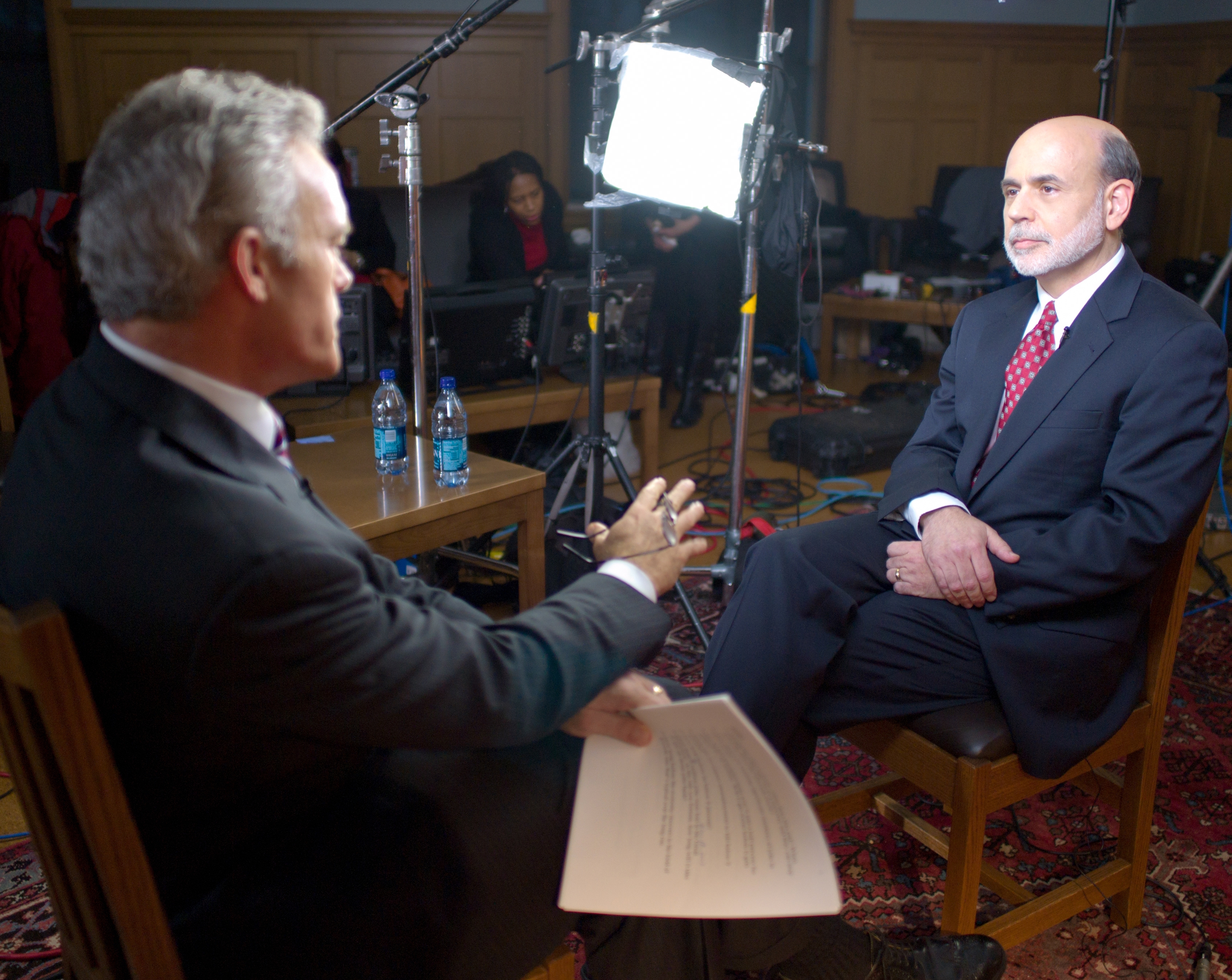
Former Fed Chairman Ben Bernanke when he was on 60 Minutes: Scott Pelley: Is that tax money that the Fed is spending? Ben Bernanke: It’s not tax money… We simply use the computer to mark up the size of the account.
Statement from the St. Louis Fed: “As the sole manufacturer of dollars, whose debt is denominated in dollars, the U.S. government can never become insolvent, i.e., unable to pay its bills. In this sense, the government is not dependent on credit markets to remain operational.”
The federal government “cannot become insolvent,” can “produce as many U.S. dollars as it wishes,” does not spend tax money or any other form of income, and does not borrow (i.e., “depend on credit markets”).
In short, the federal government uniquely is Monetarily Sovereign. All the others mentioned above are monetarily non-sovereign.You and I can become insolvent. You and I cannot produce dollars at will. We do rely on income. And we do borrow. Vast difference that Paul, Boehm and the Libertarians don’t seem to get.
The Libertarians essentially think the sun and the moon are the same because, hey, they both are in the sky, aren’t they.
Boehm’s mind seemingly is closed to the fundamental difference between Monetary Sovereignty and monetary non-sovereignty. So he wants to balance the budget as though the federal government was just like you and me.
Here is what happens when the government simply reduces deficit spending growth (not even going so far as to balance the budget; just reduce the growth).
The Red line shows the annual increases and decreases in federal deficit spending. Vertical gray bars are recessions.
We have recessions when the federal deficits increase less than the previous year. Those recessions are cured when federal deficits increase more than the previous year.
The graph shows deficits increase almost yearly, but we have recessions when they don’t grow enough. Now let’s take a closer look at what happens during those rare times when the federal government runs a surplus.
In the 3rd quarter of 1955, the government began to run a surplus, which led to a recession in 1957. The recession was cured when we started to run a deficit in 1958.Deficit growth declined until the middle of 1969 we fell into a surplus, which led to a recession. The recession was cured after deficits returned in 1970.Deficit growth declined until the 3rd quarter of 1998 until we fell into a surplus, which led to the recession of 2001. That recession was cured when we climbed back into deficit growth.
Here are more historical data showing what happens when the federal government runs surpluses:
1804-1812: U. S. Federal Debt reduced 48%. Depression began 1807.
1817-1821: U. S. Federal Debt reduced 29%. Depression began 1819.
1823-1836: U. S. Federal Debt reduced 99%. Depression began 1837.
1852-1857: U. S. Federal Debt reduced 59%. Depression began 1857.
1867-1873: U. S. Federal Debt reduced 27%. Depression began 1873.
1880-1893: U. S. Federal Debt reduced 57%. Depression began 1893.
1920-1930: U. S. Federal Debt reduced 36%. Depression began 1929.
Paul Rand, Eric Boehm, all the Libertarians, and many others do not understand a simple mathematical truth: A growing economy requires a growing supply of money.
A standard measure of the economy is Gross Domestic Product (GDP) which consists of Federal Spending + Non-federal Spending – Net Imports.
GDP can increase only if the net total of those three money measures increases. That’s arithmetic. Further, because Net Exports usually decrease, the burden is on Federal Spending to increase enough to overcome that money loss.
Thus, simple arithmetic demonstrates that for real GDP to grow, the money supply must grow and that money supply growth relies on federal deficits to exceed Imports and inflation.
That is why a balanced budget or a surplus invariably leads to recessions and depressions.
Continuing with the Reason article:
As he pitched his Senate colleagues on a plan to balance the federal budget in 2018, Sen. Rand Paul (R–Ky.) warned that rising inflation would be one of the consequences of a failure to bring deficit spending under control.
Wrong. There is no relationship between deficit spending and inflation.
Changes in federal debt (blue) do not parallel changes in inflation (red).
But, changes in oil prices (green) do parallel inflation (red). Inflation is caused by critical goods and services shortages, generally energy and specifically oil.
The graphs are clear. Oil prices, not federal spending, determine inflation.
Oil price changes are closely related to changes in oil supply, which is determined by changes in oil production.
Here is a graph of total world energy production:Here is the data in millions of barrels:
Oil production in 2020 and 2021 was lower than in 2014, the purpose being to work off inventories that had become too high during the COVID years.As the world’s economies began to recover from COVID-19’s reduced oil usage, renewed oil production did not keep pace. This lack of oil production, not low-interest rates or “excessive spending,” caused today’s inflation.
Today’s critical shortages are food, housing, computer chips, shipping, baby formula, lumber, labor, and other goods. Today’s shortages are not caused by increased demand.Mothers did not suddenly begin to demand more baby formula. The number of people needing shelter did not mysteriously increase.
As with most ailments, you must fix the cause to cure the symptom. Shortages are the cause; inflation is the symptom.
To cure inflation, we must cure the shortages.
Reduced availability of goods and services primarily was due to COVID, global warming, and the Russia – Ukraine war. That is what caused the shortages.
Starving the economy of money, which Paul, Boehm, and the rest of the Libertarians wish to do, does not reduce shortages of oil and other vital goods. Neither does increasing interest rates.
Shortage-caused inflations can be cured only by treating the shortages.
This can be accomplished counterintuitively by increased government spending to improve the cost-availability of scarce goods and services.
At the time, Paul was pushing a bill that would have required a spending cut equal to one penny out of every dollar in the federal budget.
The so-called “Penny Plan” would have balanced the federal budget by 2023, Paul claimed at the time, without requiring serious cuts to any specific programs.
Paul exerted senatorial privilege to force a vote on the package; it failed 21–76.
Taking dollars out of the private sector accomplishes only one thing: Recession if we are lucky, depression if we are not.
Had Paul succeeded, we would have experienced a deep recession or a depression, together with inflation which would have been exacerbated by the Fed’s interest rate cuts.
That was before the federal government borrowed trillions of dollars in the name of combatting the COVID-19 pandemic.
Here again, Boehm reveals his ignorance of federal finance. The U.S. federal government never borrows dollars.
Think, Mr. Boehm: Why would an entity having the unlimited ability to create dollars ever borrow them? It wouldn’t, and it doesn’t.
Boehm is confused by the misleading word, “debt.” He assumes that T-bills, notes, and bonds are loans. They are not. Nor are they owed by the federal government.
T-bills, notes, and bonds are deposits into privately-owned accounts at the Federal Reserve. If you ever bought a T-bill, you owned such an account, which was similar to a safe-deposit box. You put your dollars into your own account. You did not give them to the government.
As with a safe-deposit box, the federal government never used the dollars in your T-security account. To pay you off, the federal government merely returns your dollars to you. No taxes or government dollars are involved.
It simply is a money transfer, similar to transferring dollars from your safe-deposit box to your checking account.
(Unlike borrowing, the purpose of T-securities is not to provide spending money for the government. T-securities provide a safe, interest-paying parking place for unused dollars. That’s why China et al has them. This helps the Fed stabilize the dollar.)
It was before President Joe Biden’s $1 trillion infrastructure package. It was before four more years of bulging federal budgets authorized by a Congress that’s increasingly blithe about borrowing.
“Bulging,” “blithe,” and “borrowing” are words meant to frighten or anger the innocent, but they only reveal ignorance. The budgets do not “bulge.” Congress is not “blithe.” And the government does not “borrow.”
In October 1971, in the greatest act of his administration, Richard Nixon took us off the last gold standard, thus freeing Congress to spend stimulus dollars, which no longer were limited by gold reserves.
With inflation now running seemingly out of control and trillion-dollar deficits being the new norm in Washington, Paul was back on the Senate floor Wednesday to offer another bill to balance the budget in five years.
This time around, however, it would require cutting six cents for every budgetary dollar.
The proposal failed, 29–67.
Thank goodness. Had it succeeded, we would have slipped into a severe depression. We still may if we rely on interest rate increases to cure inflation.
“Washington’s addiction to spending is hurting our economy and depleting our currency. Inflation is stealing every American’s purchasing power and financial security,” Paul said in a statement after the vote.
Paul should have said, “Washington’s spending adds growth dollars to the economy, without which the U.S. would suffer a depression. Spending does not cause inflation. Shortages do. Spending cures inflation when it cures shortages.”
“All this plan does is return to 2019 spending levels. If the federal government spent at 2019 levels this year, we would have a $388 billion surplus.”
That $388 billion federal surplus would have been a $388 billion deficit for the economy.
We have seen what results from federal surpluses. No knowledgeable person takes dollars from the economy and gives them to a federal government that has the infinite ability to create dollars.
The purpose of federal taxes is not to provide the government with spending money. Unlike state and local taxes, which remain in the economy, federal tax dollars are destroyed upon receipt.
They cease to be part of the private sector (aka “the economy”) and disappear into the federal government’s infinite supply of dollars. Add anything to infinity and it remains infinity.
The purpose of federal taxes is to help the government control the economy by rewarding what the government wishes to encourage and by penalizing what the government wishes to discourage.
Indeed, about the only thing that’s changed in the four years since Paul offered the Penny Plan is the size of the numbers involved.
America has piled up an incredible $11 trillion of debt since 2018—that’s more than one-third of the nation’s total credit card bill—as annual budget deficits surged even before emergency pandemic borrowing blew them through the roof.
More non-scientific street language from Boehm, who has yet to provide actual data to prove his point. Why? No data exists to demonstrate that deficit spending causes inflation or harms the economy in any way.
President Donald Trump oversaw an expansion of debt-fueled government spending during his term in office, and Biden has followed suit.
In his first year in office, Biden has added $2.4 trillion to the nation’s long-term deficit—despite the White House’s best efforts to hide that fact.
The White House would not hide adding growth dollars to the economy. It wanted to add even more growth dollars, with its “Build Back Better” proposal but was stymied by a GOP that feared BBB would grow the economy, reduce shortages, eliminate inflation, and assure Biden of a second term.
In the face of this unsustainable fiscal situation, an across-the-board cut of six pennies per every dollar to balance the budget seems like a pretty good deal.
“Unsustainable” is the favorite nonsense word of the budget cutters. That and “ticking time bomb” substitute for data. The “debt” has grown from $400 Billion in 1940 to $30 trillion today, and the government still is “sustaining.” No federal check has bounced.
And what would have been cut? Social Security, Medicare and other benefits for the middle- and lower-income groups.
And things are rapidly spiraling. The Federal Reserve announced a 0.75 percent interest rate hike on Wednesday, just hours before Paul presented his budget plan on the Senate floor.
Those higher interest rates will rebound into the federal budget in the form of higher interest payments on the national debt.
Under the Congressional Budget Office’s (CBO) latest budgetary baseline, interest payments on the debt are expected to triple between now and 2032.
If federal interest payments triple, the economy will receive triple stimulus dollars. Our Monetarily Sovereign government can afford it and our economy can use it.
If interest rates climb higher than the CBO expects, however, the federal government could be paying trillions more simply to finance government spending that already occurred.
Those trillions that Boehm fears actually will be stimulus dollars pumped into the private sector. Growth for the economy; easily affordable for our Monetarily Sovereign government.
Obviously, that will make any future attempt at balancing the budget an even more difficult task.
That’s good news.
The opportunity to balance the budget by cutting a mere penny out of every dollar of federal spending has come and gone. After Wednesday’s vote, the Six Penny Plan’s days are likely numbered too.
That’s even better news.
In Summary, the Pauls and the Boehms of the world do not know (or pretend not to know) the fundamental difference between a money creator and a money user, i.e. the Monetarily Sovereign U. S. government vs. monetarily non-sovereign everyone else who spends and accepts U.S. dollars.
Taking money from the economy to cure inflation is like applying leeches to cure anemia.
Monetary Sovereignty is the basis for all of economics. Those who don’t understand it simply do not understand economics.
Money is the lifeblood of an economy. The budget-cutters remind one of the quack doctors who apply leeches to cure anemia, thus killing the patient.
Paul and Boehm wish to apply leeches to the economy, starving it of its money lifeblood. That is what ignorance can do.
Rodger Malcolm Mitchell
Monetary SovereigntyTwitter: @rodgermitchellSearch #monetarysovereigntyFacebook: Rodger Malcolm Mitchell
……………………………………………………………………..
THE SOLE PURPOSE OF GOVERNMENT IS TO IMPROVE AND PROTECT THE LIVES OF THE PEOPLE.
Gap Psychology describes the common desire to distance oneself from those “below” in any socio-economic ranking, and to come nearer those “above.” The socio-economic distance is referred to as “The Gap.”
Wide Gaps negatively affect poverty, health and longevity, education, housing, law and crime, war, leadership, ownership, bigotry, supply and demand, taxation, GDP, international relations, scientific advancement, the environment, human motivation and well-being, and virtually every other issue in economics.Implementation of Monetary Sovereignty and The Ten Steps To Prosperity can grow the economy and narrow the Gaps: Ten Steps To Prosperity:
Regular readers of this blog have seen this before. Periodically, we reference the latest ignorant claim that the federal debt is a “ticking time bomb” ready to destroy America and the world.
The most recent reference to the ticking time bomb of federal debt came yesterday:
With the U.S. reaching its debt limit of $31.4 trillion on Jan. 19, Treasury Secretary Janet Yellen urged lawmakers to increase or suspend the debt ceiling.
Debt head: “Trust me, the world is about to end. Soon. Any minute now. Here it comes. Watch out. It’s happening. I really mean it.”
The first reference we found came in 1940 when the federal debt was about $40 Billion. Previous reviews can be found here and here.
Today, the federal debt zips past $25 Trillion, and still, the time bomb hasn’t exploded. We were confronted with our latest entry, dated February 5, 2023, which we placed at the bottom of the list.
It just proves the debt heads have learned nothing in 84 years and counting.
We still have the media, the economists, and the politicians whining, moaning, complaining, and warning about the impending disaster that never seems to happen.
Whether by ignorance or intent, these folks want the federal government to stop deficit spending on such benefits as Medicare and other healthcare, Social Security, all the poverty aids, education aids, and every type of scientific research and development, national parks, infrastructure — well just about everything that makes American life beautiful.
Oh, and they also want you to pay more taxes.
The only thing that seems to have some immunity is the military. Everyone loves the military because that’s patriotic. Right? Oh, and any benefits to the rich will remain intact, because the rich pay the politicians via “campaign contributions.” (aka “bribes.”)
The complaints come from people who do not understand, or don’t want you to understand, the differences between federal government financing (Monetary Sovereignty) and all other financings (monetary non-sovereignty).
A Monetarily Sovereign entity (the U.S., Canada, Australia, et al) never can run short of its own sovereign currency. So, for instance, the U.S. can pay any financial obligations denominated in U.S. dollars.
A monetarily non-sovereign entity (you, me, cities, counties, states, euro nations like France and Greece) have no sovereign currency, so they can and do run short of the money to pay their debts.
Those who do not understand the differences between Monetary Sovereignty and monetary non-sovereignty do not understand economics. You should believe their opinions on federal debt about as much as you believe their opinions about quantum chromodynamics.
Here is a picture of how the federal debt has grown. Keep in mind that every year it has been called a “ticking time” bomb” by debt-nuts. and every year they are proven wrong.
Here’s the partial list of debt head, sky-is-falling, warnings. Try not to laugh (or cry) at the repeated Henny Penny wrongheadedness.
By 1960: the debt was “threatening the country’s fiscal future,”said Secretary of Commerce, Frederick H. Mueller. (“The enormous cost of various Federal programs is a time-bomb threatening the country’s fiscal future, Secretary of Commerce Frederick H. Mueller warned here yesterday.”)
In 1984: AFL-CIO President Lane Kirkland said. “It’s a time bomb ticking away.”
In 1985: “The federal deficit is ‘a ticking time bomb, and it’s about to blow up,” U.S. Sen. Mitch McConnell. (Remember him?)
Later in 1985: Los Angeles Times: “We labeled the deficit a ‘ticking time bomb’ that threatens to permanently undermine the strength and vitality of the American economy.”
In 1987: Richmond Times-Dispatch – Richmond, VA: “100TH CONGRESS FACING U.S. DEFICIT’ TIME BOMB'”
Later in 1987: The Dallas Morning News: “A fiscal time bomb is slowly ticking that, if not defused, could explode into a financial crisis within the next few years for the federal government.”
In 1989: FORTUNE Magazine: “A TIME BOMB FOR U.S. TAXPAYERS“
In 1992: The Pantagraph – Bloomington, Illinois: “I have seen where politicians in Washington have expressed little or no concern about this ticking time bomb they have helped to create, that being the enormous federal budget deficit, approaching $4 trillion.“
Later in 1992: Ross Perot: “Our great nation is sitting right on top of a ticking time bomb. We have a national debt of $4 trillion.”
In 1995: Kansas City Star: “Concerned citizens. . . regard the national debt as a ticking time bomb poised to explode with devastating consequences at some future date.”
In 2004: Bradenton Herald: “A NATION AT RISK: TWIN DEFICIT A TICKING TIME BOMB“
In 2005: Providence Journal: “Some lawmakers see the Medicare drug benefit for what it is: a ticking time bomb.”
In 2006: NewsMax.com, “We have to worry about the deficit . . . when we combine it with the trade deficit we have a real ticking time bomb in our economy,” said Mrs. Clinton.
In 2007: USA Today: “Like a ticking time bomb, the national debt is an explosion waiting to happen.“
In 2010: Heritage Foundation: “Why the National Debt is a Ticking Time Bomb. Interest rates on government bonds are virtually guaranteed to jump over the next few years.
In 2010: Reason Alert: “. . . the time bomb that’s ticking under the federal budget like a Guy Fawkes’ powder keg.”
In 2011: Washington Post, Lori Montgomery:”. . . defuse the biggest budgetary time bombs that are set to explode.”
June 19, 2013: Chamber of Commerce: Safety net spending is a ‘time bomb’, By Jim Tankersley: The U.S. Chamber of Commerce is worried that not enough Americans are worried about social safety net spending. The nation’s largest business lobbying group launched a renewed effort Wednesday to reduce projected federal spending on safety-net programs, labeling them a “ticking time bomb” that, left unchanged, “will bankrupt this nation.”
In 2014: CBN News: “The United States of Debt: A Ticking Time Bomb“
On January 27, 2017: America’s “debt bomb is going to explode.” That’s according to financial strategist Peter Schiff. Schiff said that while low interest rates had helped keep a lid on U.S. debt, it couldn’t be contained for much longer. Interest rates and inflation are rising, creditors will demand higher premiums, and the country is headed “off the edge of a cliff.”
February 16, 2018 America’s Debt Bomb By Andrew Soergel, Senior Reporter: Conservatives and deficit hawks are hurling criticism at Washington for deepening America’s debt hole.
[The following were added after the original publishing of this article]
April 10, 2019,The National Debt: America’s Ticking Time Bomb. TIL Journal. Entire nations can go bankrupt. One prominent example was the *nation of Greece which was threatened with insolvency, a decade ago. Greece survived the economic crisis because the European Union and the IMF bailed the nation out.
SEP 12, 2019, Our national ticking time bomb, By BILL YEARGIN SPECIAL TO THE SUN SENTINEL | At some point, investors will become concerned about lending to a debt-riddled U.S., which will result in having to offer higher interest rates to attract the money. Even with rates low today, interest expense is the federal government’s third-highest expenditure following the elderly and military. The U.S. already borrows all the money it uses to pay its interest expense, sort of like a Ponzi scheme. Lack of investor confidence will only make this problem worse.
JANUARY 06, 2020, National debt is a time bomb, BY MARK MANSPERGER, Tri City Herald | The increase in the U.S. deficit last year was about $1.1 trillion, bringing our total national debt to more than $23 trillion! This fiscal year, the deficit is forecasted to be even higher, and when the economy eventually slows down, our annual deficits could be pushing $2 trillion a year! This is financial madness. there’s not going to be a drastic cut in federal expenditures — that is, until we go broke — nor are we going to “grow our way” out of this predicament. Therefore, to gain control of this looming debt, we’re going to have to raise taxes.
February 14, 2020, OMG! It’s February 14, 2020, and the national debt is still a ticking time bomb! The national debt: A ticking time bomb?America is “headed toward a crisis,” said Tiana Lowe in WashingonExaminer.com. The Treasury Department reported last week that the federal deficit swelled to more than $1 trillion in 2019 for the first time since 2012. Even more alarming was the report from the bipartisan Congressional Budget Office (CBO) predicting that $1 trillion deficits will continue for the next 10 years, eventually reaching $1.7 trillion in 2030
August 29, 2020, LOS ANGELES, California: America’s mountain of debt is a ticking time bomb The United States not only looks ill, but also dead broke. To offset the pandemic-induced “Great Cessation,” the U.S. Federal Reserve and Congress have marshalled staggering sums of stimulus spending out of fear that the economy would otherwise plunge to 1930s soup kitchen levels. Assuming that America eventually defeats COVID-19 and does not devolve into a Terminator-like dystopia, how will it avoid the approaching fiscal cliff and national bankruptcy?
April 16, 2021, NATIONAL POLICY: ECONOMY AND TAXES / MARK ALEXANDER / The National Debt Clock: A Ticking Time Bomb: At the moment, our national debt exceeds $28 TRILLION — about 80% held as public debt and the rest as intragovernmental debt. That is $225,000 per taxpayer. Federal annual spending this year is almost $8 trillion, and more than half of that is deficit spending — piling on the national debt.
June 17, 2022Time Bomb On National Debt Is Counting Down Faster Thanks To Fed’s Rate Hike, Tim Brown / We are now staring down the barrel of the end of the U.S. economy based on fiat money, printed out of thin air but charged back to the people at ridiculous interest rates. Now, the national debt is approaching $31 trillion,which is $12 trillion more than when Donald Trump took office in 2017 and more than half of that debt was tacked on in his final year. Then we’ve had the disastrous year and a half of Joe Biden. Now, the Fed is now hiking its rates and that spells even more trouble for the national debt and the economy at large.
December 4, 2022 America’s ticking time bomb: $66 trillion in debt that could crash the economy By Stephen Moore, The national debt is $31 trillion when including Social Security’s and Medicare’s unfunded liabilities. Wake up, America.That ticking sound you’re hearing is the American debt time bomb that with each passing day is getting precariously close to detonating and crashing the US economy.
January 13, 2023.A ticking time bomb in the U.S. economy is running perilously close to detonation. Long considered a harbinger of bad luck, Friday, Jan. 13 came with a warning for Congress that the country could default on its debt as soon as June. With the U.S. reaching its debt limit of $31.4 trillion on Jan. 19, Treasury Secretary Janet Yellen urged lawmakers to increase or suspend the debt ceiling.
Gap Psychology describes the common desire to distance oneself from those “below” in any socio-economic ranking, and to come nearer those “above.” The socio-economic distance is referred to as “The Gap.”
Wide Gaps negatively affect poverty, health and longevity, education, housing, law and crime, war, leadership, ownership, bigotry, supply and demand, taxation, GDP, international relations, scientific advancement, the environment, human motivation and well-being, and virtually every other issue in economics.Implementation of Monetary Sovereignty and The Ten Steps To Prosperity can grow the economy and narrow the Gaps: Ten Steps To Prosperity:
The efforts of the rich to become even richer never end.
The rich incessantly promulgate lies about our economy. More importantly, they bribe the primary influencers — the politicians, the media, and the economists — to spread the Big Lie that federal spending is funded by federal taxes.
Bernanke: “It’s not tax money… We simply use the computer to mark up the size of the account.”
In reality, federal spending is funded by ad hoc federal money creation, not taxes.
The tax dollars no longer exist in the economy (the private sector), and since the federal government has infinite dollars, the tax dollars no longer exist anywhere.
The Big Lie convinces the populace that the federal government’s ability to provide benefits is financially limited by tax receipts.
(Politicians are bribed via campaign contributions and promises of lucrative jobs. The media are bribed via advertising dollars and actual ownership. Economists are bribed via gifts to universities and lucrative positions on “think tanks.”)
Whenever you hear about a federal benefit, and someone asks, “Who will pay for it?” you should know you are about to listen to the Big Lie. The answer is: “The federal government will pay for it by creating dollars.”
Quote from former Fed Chairman Ben Bernanke when he was on 60 Minutes: Scott Pelley: Is that tax money that the Fed is spending? Bernanke: It’s not tax money… We simply use the computer to mark up the size of the account.
“Social Security and Medicare are about to become insolvent” is an example of the Big Lie, the purpose of which is to distance the rich from the rest of us.
“Rich” is a comparative, not an absolute. If you have a million dollars, you are rich if most others have less than a million. But you are not wealthy if everyone else has ten million.
That leaves you two ways to become richer: Get more for yourself or make the others have less. The rich in America have chosen both courses.
They try to grab more for themselves; their efforts to force you to have less are not as obvious.
The rich receive most of their income from sources other than salaries. Consider FICA. Congress has deemed FICA should be collected only from salaries, not from other forms of income.
Further, Congress has decided FICA is to be collected on salaries less than $142,800. Anything above that is not taxed.
The FICA limit is just one of the thousands of tax breaks the rich have “encouraged” Congress to give them. The purpose: To widen the Gap between them and you. Widening the Gap makes them richer.
U.S. federal finances are unlike state & local government finances, business finances, and euro nation finances.
Former Fed Chairman Alan Greenspan: “A government cannot become insolvent with respect to obligations in its own currency.”
The U.S. government is Monetarily Sovereign. It has the unlimited ability to create its own sovereign currency.
It never unintentionally can run short of dollars.
Yet we see organizations funded by the rich claiming that federal spending, which goes to the middle- and lower-income people, is detrimental to the middle- and lower-income people.
They want you to believe you should receive lower benefits and pay more taxes.
If they can cement that belief in your minds, you’ll vote for the very people who take money from your pocket.
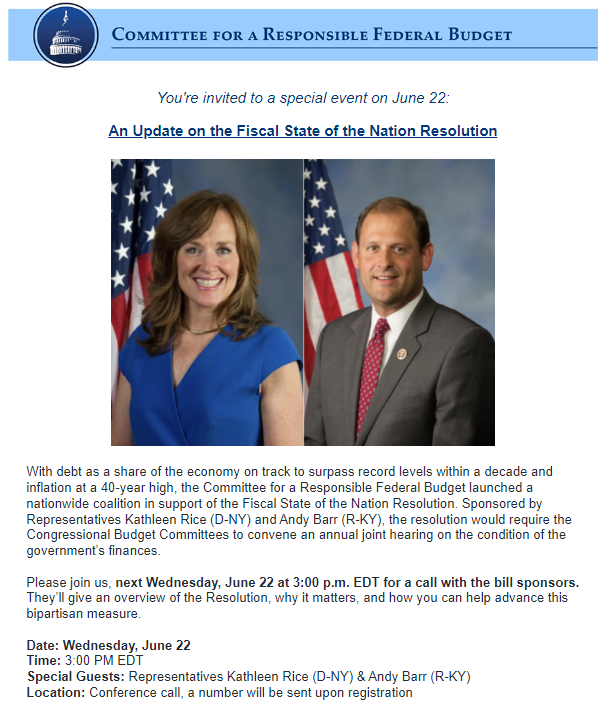
Here is the entirety of a page posted by the Committee For A Responsible Budget, one of the organizations that continually tries to foist on you the false idea that you should have less.
Every single sentence, including the headline, is false and/or an outright lie:
FALSE. High and rising National (i.e., federal) Debt is not a problem. It is not even Debt. It is the total of deposits into Treasury security accounts at the Federal Reserve.
These accounts resemble safe-deposit boxes. When you buy a T-bill, T-note, or T-bond, you open an account at the Federal Reserve and deposit your dollars into it.
The federal government never touches those dollars. It has no need to.
The government can pay off the so-called “debt” merely by returning to you the dollars in your account.
This is no burden on the government, taxpayers, or the economy. There is no “Problem.”
High and rising national Debt will threaten economic growth and the standard of living for all Americans. High Debt will slow the growth of the economy and wages.
FALSE. Federal “debt,” i.e., the total of deposits in T-securities, is set by law to equal the cumulative total of federal deficits.
Bernanke: “The U.S. government has a technology, called a printing press (or, today, its electronic equivalent), that allows it to produce as many U.S. dollars as it wishes at essentially no cost.”
Deficits are the difference between the amount of money the government takes out of the economy vs. the amount it puts in (with some going to foreign nations).
Rising national “debt” occurs when the federal government puts more dollars into the economy than it takes out.
There is no mechanism by which adding money to the economy can “slow the growth of the economy and wages.”
On the contrary, when economic growth slows, the government adds more stimulus dollars (increases the “debt”) to prevent or cure a recession.
The “debt” has no direct effect on wages, which are a function of business profits (stimulated by federal deficit spending) and labor supply.
As Debt rises, higher interest payments will crowd outimportant investments in areas like education, infrastructure, and research that can help grow the economy.
FALSE. Federal Debt does not force higher interest rates. Interest rates are set arbitrarily by the Federal Reserve to control inflation.
The peaks and valleys of changes for Federal deficits (blue) neither correspond to changes in Interest rates (red) nor are they a leading indicator. Note the 12 years 2008 – 2020, when federal deficit spending grew massively while interest rates neared zero.
Federal interest payments do not “crowd out” other federal payments for “education, infrastructure, and research. The federal government has infinite money with which to pay for anything.
During periods of high deficit spending, interest rates have been low.
Getting the Debt under control once the crisis is over will be very beneficial for generations to come, from higher wages to increased investment to lower borrowing costs for families and businesses.
FALSE. This paragraph is just a restatement of the previous section. There is no mechanism by which fewer dollars coming into the economy can cause “higher wages, increased investment, and lower borrowing costs.
The last decade shows the opposite: Higher deficits along with higher wages, increased investment, and low borrowing costs.
The Congressional Budget Office predicts that the economy will grow faster with Debt on a declining path as opposed to a rising one.
FALSE: History shows that declining Debt leads to depressions and recessions.
1804-1812: U. S. Federal Debt reduced 48%. Depression began 1807. 1817-1821: U. S. Federal Debt reduced 29%. Depression began 1819. 1823-1836: U. S. Federal Debt reduced 99%. Depression began 1837. 1852-1857: U. S. Federal Debt reduced 59%. Depression began 1857. 1867-1873: U. S. Federal Debt reduced 27%. Depression began 1873. 1880-1893: U. S. Federal Debt reduced 57%. Depression began 1893. 1920-1930: U. S. Federal Debt reduced 36%. Depression began 1929. 1997-2001: U. S. Federal Debt reduced 15%. Recession began 2001.
The reason is quite simple. Reducing federal Debt requires taking dollars out of the economy.
Just as adding stimulus dollars to the economy prevents and cures recessions and depressions, taking dollars out of the economy causes recessions and depressions.
The rich do not fear recessions and depressions. They are less harmed than the rest of us. They have more cushion to weather the hard times.
During recessions and depressions, workers become more desperate for jobs, giving the rich the opportunity to cut wages and increase their own relative incomes.
In addition to publishing the completely non-sensical paragraphs just discussed, The rich-run CRFB runs “hearings” on the condition of the government’s finances.”
These hearings contain nothing more than recitations of the Big Lie — false propaganda we have just discussed. The purpose will be to give Congress excuses to:
Cut Social Security benefits
Cut Medicare benefits
Eliminated Obamacare
Increase FICA taxes
Cut other benefits for the poor and middle-classes
Widen the income/wealth/power Gaps between the rich and the rest
The drumming of lies and misstatements from the rich and toadies for the rich is relentless. So long as it works to indoctrinate the public, it never will end.
The attempts at indoctrination end only when you, the public, demonstrate your understanding of the lies and your willingness to punish the liars.
Fool you once; shame on them. Fool you thousands of times, over and over and over; shame on you.
[No rational person would take dollars from the economy and give them to a federal government that has the infinite ability to create dollars.]
Gap Psychology describes the common desire to distance oneself from those “below” in any socio-economic ranking, and to come nearer those “above.” The socio-economic distance is referred to as “The Gap.”
Wide Gaps negatively affect poverty, health and longevity, education, housing, law and crime, war, leadership, ownership, bigotry, supply and demand, taxation, GDP, international relations, scientific advancement, the environment, human motivation and well-being, and virtually every other issue in economics.Implementation of Monetary Sovereignty and The Ten Steps To Prosperity can grow the economy and narrow the Gaps: Ten Steps To Prosperity:
 This is the masthead for the online Libertarian magazine, Reason.
These folks boast about having “free minds,” which one might assume means they are open to learning and not locked into a rigid belief.
Sure, they are.
I find it ironic that perhaps the most stone-headed political-economics group in America could claim freedom of mind.
These are anarchists in thin disguise who have no idea how federal financing works, and day after day, they publish proofs of their determined ignorance.
Here is just one of a seemingly endless supply of misinformation and disinformation from the “free minds.”
This is the masthead for the online Libertarian magazine, Reason.
These folks boast about having “free minds,” which one might assume means they are open to learning and not locked into a rigid belief.
Sure, they are.
I find it ironic that perhaps the most stone-headed political-economics group in America could claim freedom of mind.
These are anarchists in thin disguise who have no idea how federal financing works, and day after day, they publish proofs of their determined ignorance.
Here is just one of a seemingly endless supply of misinformation and disinformation from the “free minds.”








 #Monetary Sovereignty - Mitchell