Yet another article that relies on you being ignorant about federal finances and Social Security

It takes only two things to keep people in chains:
.

The ignorance of the oppressed
and the treachery of their leaders.

——————————————————————————————————————————————————————————————————————————————————————————–

Let us begin with three, very simple, related facts:

  1. It is 100% impossible for the U.S. federal government to run short of dollars unless the President and Congress want it to.
  2. Thus, it is 100% impossible for any federal agency to run short of dollars unless the President and Congress want it to.
  3. Social Security is a federal agency.

Therefore:

Social Security cannot run short of dollars unless the President and Congress want it to.

Image result for crocodile tearsIgnore all the crocodile tears about the Social Security “trust fund” running short of money.

Or, there not being enough FICA dollars to pay for future retirees.

Or, the “need” to cut benefits to certain groups, or to tax benefits to other groups.

They are all lies, there is no better way to say it — lies — designed to make you accept fewer benefit dollars, while the rich continue to grab more.

What set me off is the following Motley Fool article, that simply is loaded with the above-mentioned lies.

Will This New Social Security Proposal Gain Traction in Congress?
With Social Security facing a $12.5 trillion cash shortfall, this proposal aims to generate more revenue and reward those disadvantaged by the program.
By: Sean Williams  Mar 10, 2018

Social Security, arguably the most important program in the country as more than 42 million retired workers receive a monthly payout, is in trouble.

Yes, Social Security indeed is in trouble, but not because of any shortfall in cash. Rather trouble lurks because the President and Congress want to screw you, on behalf of the rich, who run this country.

According to the 2017 report from the Social Security Board of Trustees, Social Security is expected to begin paying out more in benefits than it’s generating in revenue by 2022.

Just 12 years later, in 2034, the roughly $3 trillion in excess cash held by the program is forecast to be completely gone.

Based on the current payout trajectory, there’ll be an estimated $12.5 trillion budget shortfall between 2034 and 2091.

All of the above nonsense would be true if Social Security were a private enterprise, owned and operated by a private company — a monetarily non-sovereign company.

But it is absurd nonsense when describing an agency owned an operated by the United States government — a uniquely Monetarily Sovereign entity.

The federal government created from thin air, the laws that in turn created the very first dollars, also out of thin air. Today, it continues to own the laws that allow it to create dollars at will, simply by paying bills.

For that reason, the federal government needs no “revenue.” It always pays its bills by creating new dollars.

Think about this for a moment:

Federal spending has risen 37,500% (from $40 billion to $15 trillion) since 1940. Where did the $14, 960,000,000 additional dollars come from?

They can’t have come from federal borrowing. Where would those borrowed dollars have come from?

And the new dollars can’t have come from taxes. Tax dollars already exist.

Dollars are created in two ways and destroyed in two ways:

Created: Lenders create new dollars when they lend, and the federal government creates new dollars when it spends.

Destroyed: Dollars are destroyed when loans are paid down, and when the federal government collects taxes.

When the federal government pays an invoice, it sends instructions (in the form of a check or wire) to the creditor’s bank, instructing the bank to increase the balance in the creditor’s checking account.

The instant the creditor’s bank does as instructed, new dollars are added to the nation’s money supply. Thus, because the federal government creates dollars by spending, it never can run short of dollars.

This shortfall has a lot of people, including working Americans, pre-retirees, retired workers, people with disabilities, and survivors, very concerned.

Americans are concerned because writers like Sean Williams tell them to be concerned. The people seldom are told the facts, so in the absence of facts, the people believe the lies.

There’s good reason for that, as 62% of today’s retirees lean on Social Security for at least half of their monthly income, and a majority of future retirees are expected to rely on the program in some capacity to make ends meet.

Yet, the trustees’ report suggests that benefits could be cut across the board by up to 23% in order to preserve the solvency of the program through 2091.

How sweet. The people desperately need Social Security, while the lying politicians prepare excuses for cutting this already insufficient lifeline.

What sort of cruel minds would find this acceptable?

The silver lining is that Social Security can’t go bankrupt as a result of the payroll tax, which provides the bulk of its funding; but that doesn’t mean the current payout schedule is sustainable.

A lie. Social Security payouts are infinitely sustainable. The pols and the rich don’t want you to know that the federal government never can run short of its own sovereign currency — the currency it originally created by writing laws.

The only option for current and future retirees to avoid having their Social Security benefits slashed is through congressional action.

Yes, Congress and the President can set Social Security benefits and FICA taxes at any levels they choose. The first step should be to eliminate the FICA tax altogether, while increasing benefits.

Lawmakers in Washington, D.C., certainly aren’t denying that a problem exists. Unfortunately, they’ve been unable to come to an amicable solution.

However, a new Social Security proposal, laid out last week by Sen. Patty Murray (D-Wash.), is aiming to change that.

They are “unable” to come up with an “amicable” solution (i.e. a solution that would be approved by rich donors), simply because they don’t want a real solution.

They only want a “solution” that will further widen the Gap between the rich and the rest, exactly what their rich donors tell them to do.

Known as the Stronger Safety Net (SSN) Act, Murray’s proposal aims to modernize the 83-year-old program for women, children, people with disabilities, and survivors, while at the same time having those who can afford to pay more cover the long-term funding gap in the program.

“Modernize” is one of those deceptive words, like “reform” that implies improvement but actually means nothing.

Making anyone pay more does absolutely nothing to “cover the long-term funding gap.” It takes dollars from the private sector (aka, the economy), which is recessive.

The SSN Act has four key proposals.

1. Divorced people over 62 who were married for at least five years would qualify, with a 10% step-down for each year below 10. A divorced person who was married for seven years would have a maximum spousal benefit of 70%, whereas someone who was married for nine years could max out at 90%.

Women often take care of children or loved ones who are sick. This means they take time out of the labor force, which can reduce their lifetime earnings and retirement benefit.

All this cockamamie rejiggering is “necessary” because of the myth that FICA pays for benefits and dollars are limited. The entire problem could be solved by simply giving every recipient the same, more-generous benefit. (See: Ten Steps to Prosperity: Step 3: Monthly bonuses for all)

2. Establish an alternative benefit for the surviving spouse where both husband and wife are retired workers.

The surviving spouse would be entitled to 75% of the sum of the survivor’s own work benefit and the primary insurance amount of the deceased spouse. This alternative benefit would be paid if it’s higher than what survivors would receive under the current law, and would begin in 2019.

More cockamamie rejiggering. Who could understand such nonsense, much less justify it? 

The process resembles trying to feed a hundred people from one potato, by cutting the potato into a thousand pieces.

3. Under the current system, minor children have to be under the age of 18, or high school students under the age of 19, to qualify for benefits. But beginning in 2019, full-time students up to the age of 23 of retired, disabled, or deceased workers would be eligible to receive benefits.

Why age 18? 19? 23? Murray has no idea. It’s a complexity no one understands and no one needs.

Which leads us to this:

4. The SSN Act seeks to generate additional revenue for the Social Security Trust by imposing a 2% payroll tax on earned income in excess of $400,000. The current payroll tax of 12.4% does not apply to any income above $128,400.

The mythical Social Security “Trust Fund” doesn’t need additional revenue, especially since it is an accounting deception.

A Monetarily Sovereign nation can add to or subtract from any so-called “trust fund” at will. It’s all hocus pocus, smoke and mirrors, to make you believe the government can’t afford your benefits.

That said, taxing the rich to narrow the Gap between the rich and the rest is a good idea, even though those tax dollars disappear from the money supply.

The single most important problem in our economy and the world’s economies is the large and growing Gap between the rich and the rest.

I know what you’re probably thinking: “The rich aren’t reliant on Social Security, so they should pay extra tax to shore up the Social Security Trust.”

However, the $128,400 figure in 2018 — exists because there’s also a maximum monthly payout at full retirement age. It’s not “fair” to add a 2% payroll tax to an extra, say, $5 million in income if that individual won’t see an extra cent in Social Security benefits.

That’s not what I’m thinking. I’m thinking:

  1. The mythical “Trust Fund” doesn’t need “shoring up.” It needs to be eliminated as an excuse for not paying benefits.
  2. The government should increase benefits
  3. The benefits should be paid to every man, woman, and child in America.
  4. Taxing the rich more would narrow the Gap and benefit America (See: Ten Steps to Prosperity: Step 8: Tax the very rich more (dictatorship warning)

It’s unlikely that Republicans would go along with such a measure, and their votes will be needed in the Senate to pass the SSN Act.

I may be wrong, but I do not remember the Republican Party (the party of the rich) passing any legislation that was not designed to widen the Gap.

Undoubtedly, you have been told that Social Security (or Medicare, for that matter) will soon run short of money, and the “trust fund” will be empty.

And undoubtedly, you have been told your taxes must be increased and/or your benefits must be decreased.

And you will hear it from reliable sources with impeccable credentials:

The politicians, who have been bribed with campaign contributions and promises of lucrative employment when they leave office.

And the economists who have been bribed with university contributions and lucrative jobs with think tanks.

And the media, who are owned by the rich and have been bribed with advertising dollars.

It all is a lie, the biggest lie in economics. It is The Big Lie. So, next time you hear it, contact the liars and tell them you know: It’s a damnable lie paid for by the rich to widen the Gap between the rich and you.

Rodger Malcolm Mitchell
Monetary Sovereignty
Twitter: @rodgermitchell; Search #monetarysovereignty
Facebook: Rodger Malcolm Mitchell

………………………………………………………………………………………………………………………………………………………………………………………………………………………………………………………………………………………………………………………………………..

The most important problems in economics involve the excessive income/wealth/power Gaps between the have-mores and the have-less.

Wide Gaps negatively affect poverty, health and longevity, education, housing, law and crime, war, leadership, ownership, bigotry, supply and demand, taxation, GDP, international relations, scientific advancement, the environment, human motivation and well-being, and virtually every other issue in economics.

Implementation of The Ten Steps To Prosperity can narrow the Gaps:

Ten Steps To Prosperity:
1. ELIMINATE FICA (Ten Reasons to Eliminate FICA )
Although the article lists 10 reasons to eliminate FICA, there are two fundamental reasons:
*FICA is the most regressive tax in American history, widening the Gap by punishing the low and middle-income groups, while leaving the rich untouched, and
*The federal government, being Monetarily Sovereign, neither needs nor uses FICA to support Social Security and Medicare.
2. FEDERALLY FUNDED MEDICARE — PARTS A, B & D, PLUS LONG TERM CARE — FOR EVERYONE (H.R. 676, Medicare for All )
This article addresses the questions:
*Does the economy benefit when the rich can afford better health care than can the rest of Americans?
*Aside from improved health care, what are the other economic effects of “Medicare for everyone?”
*How much would it cost taxpayers?
*Who opposes it?”
3. PROVIDE A MONTHLY ECONOMIC BONUS TO EVERY MAN, WOMAN AND CHILD IN AMERICA (similar to Social Security for All) (The JG (Jobs Guarantee) vs the GI (Guaranteed Income) vs the EB (Economic Bonus)) Or institute a reverse income tax.
This article is the fifth in a series about direct financial assistance to Americans:

Why Modern Monetary Theory’s Employer of Last Resort is a bad idea. Sunday, Jan 1 2012
MMT’s Job Guarantee (JG) — “Another crazy, rightwing, Austrian nutjob?” Thursday, Jan 12 2012
Why Modern Monetary Theory’s Jobs Guarantee is like the EU’s euro: A beloved solution to the wrong problem. Tuesday, May 29 2012
“You can’t fire me. I’m on JG” Saturday, Jun 2 2012

Economic growth should include the “bottom” 99.9%, not just the .1%, the only question being, how best to accomplish that. Modern Monetary Theory (MMT) favors giving everyone a job. Monetary Sovereignty (MS) favors giving everyone money. The five articles describe the pros and cons of each approach.
4. FREE EDUCATION (INCLUDING POST-GRAD) FOR EVERYONE Five reasons why we should eliminate school loans
Monetarily non-sovereign State and local governments, despite their limited finances, support grades K-12. That level of education may have been sufficient for a largely agrarian economy, but not for our currently more technical economy that demands greater numbers of highly educated workers.
Because state and local funding is so limited, grades K-12 receive short shrift, especially those schools whose populations come from the lowest economic groups. And college is too costly for most families.
An educated populace benefits a nation, and benefitting the nation is the purpose of the federal government, which has the unlimited ability to pay for K-16 and beyond.
5. SALARY FOR ATTENDING SCHOOL
Even were schooling to be completely free, many young people cannot attend, because they and their families cannot afford to support non-workers. In a foundering boat, everyone needs to bail, and no one can take time off for study.
If a young person’s “job” is to learn and be productive, he/she should be paid to do that job, especially since that job is one of America’s most important.
6. ELIMINATE FEDERAL TAXES ON BUSINESS
Businesses are dollar-transferring machines. They transfer dollars from customers to employees, suppliers, shareholders and the federal government (the later having no use for those dollars). Any tax on businesses reduces the amount going to employees, suppliers and shareholders, which diminishes the economy. Ultimately, all business taxes reduce your personal income.
7. INCREASE THE STANDARD INCOME TAX DEDUCTION, ANNUALLY. (Refer to this.) Federal taxes punish taxpayers and harm the economy. The federal government has no need for those punishing and harmful tax dollars. There are several ways to reduce taxes, and we should evaluate and choose the most progressive approaches.
Cutting FICA and business taxes would be a good early step, as both dramatically affect the 99%. Annual increases in the standard income tax deduction, and a reverse income tax also would provide benefits from the bottom up. Both would narrow the Gap.
8. TAX THE VERY RICH (THE “.1%) MORE, WITH HIGHER PROGRESSIVE TAX RATES ON ALL FORMS OF INCOME. (TROPHIC CASCADE)
There was a time when I argued against increasing anyone’s federal taxes. After all, the federal government has no need for tax dollars, and all taxes reduce Gross Domestic Product, thereby negatively affecting the entire economy, including the 99.9%.
But I have come to realize that narrowing the Gap requires trimming the top. It simply would not be possible to provide the 99.9% with enough benefits to narrow the Gap in any meaningful way. Bill Gates reportedly owns $70 billion. To get to that level, he must have been earning $10 billion a year. Pick any acceptable Gap (1000 to 1?), and the lowest paid American would have to receive $10 million a year. Unreasonable.
9. FEDERAL OWNERSHIP OF ALL BANKS (Click The end of private banking and How should America decide “who-gets-money”?)
Banks have created all the dollars that exist. Even dollars created at the direction of the federal government, actually come into being when banks increase the numbers in checking accounts. This gives the banks enormous financial power, and as we all know, power corrupts — especially when multiplied by a profit motive.
Although the federal government also is powerful and corrupted, it does not suffer from a profit motive, the world’s most corrupting influence.
10. INCREASE FEDERAL SPENDING ON THE MYRIAD INITIATIVES THAT BENEFIT AMERICA’S 99.9% (Federal agencies)Browse the agencies. See how many agencies benefit the lower- and middle-income/wealth/ power groups, by adding dollars to the economy and/or by actions more beneficial to the 99.9% than to the .1%.
Save this reference as your primer to current economics. Sadly, much of the material is not being taught in American schools, which is all the more reason for you to use it.

The Ten Steps will grow the economy, and narrow the income/wealth/power Gap between the rich and you.

MONETARY SOVEREIGNTY


Ignore the most misleading words in economics and the reasons for Trump’s import duties.

It takes only two things to keep people in chains:Image result for making something disappear
.

The ignorance of the oppressed
and the treachery of their leaders.

——————————————————————————————————————————————————————————————————————————————————————————–

The words are “debt” and “deficit.”

In our personal lives, we wish to avoid them, so we easily are gulled into believing the federal government should avoid them too.

Your Deficit and Debt
If you continually run a deficit, i.e. if your income is less than your spending, eventually you will need to borrow, at which time you will accumulate debt. And this debt will be a financial burden on you, because you must use future income to service it and pay it off.

The same is true of your city, your county, your state, and your business.  All are monetarily non-sovereign. None of you has a sovereign currency.

Your income, your deficit, and your debt all are denominated in U.S. dollars (or some other currency), which is the sovereign currency of the U.S. federal government.

You can run short of this currency, because it is not yours to create. That is the characteristic of a monetarily non-sovereign entity.

The Federal Government’s Deficit and Debt
The federal government’s finances are totally different from yours, and from your city’s, county’s, state’s, and business’s. The federal government is Monetarily Sovereign.

The federal government has the unlimited ability to create its sovereign currency, the dollar.

Originally, the government created, from thin air, the laws that created the original dollars, also from thin air.

Today, the federal government continues to create laws from thin air, and those laws allow the government to continue creating dollars, which it does, ad hoc, every time it pays a bill.

It is functionally impossible for the federal government, unintentionally, to run short of dollars. It creates them in unlimited amounts as needed.

For that reason, the federal government has no functional need to borrow. The so-called federal “debt” is not borrowing in the usual sense, but rather it is the federal government acceptance of deposits into Treasury security (T-security) accounts, which are quite similar to your interest-paying bank savings accounts.

When you “lend” to the federal government, you actually instuct your bank to debit your checking account and to deposit the dollars into your T-security account, where they remain until your T-security matures, and the dollars, plus interest, are returned to you.

The dollars remain in your account, because the federal government has neither need for, nor use of, them.

That is why federal spending increases the money supply (however defined). It creates brand new dollars when it pays its bills.

The Federal Deficit
The federal deficit is the difference between federal spending and federal revenues.  Current law requires the federal government to issue T-securities in an amount corresponding to federal deficits.

These laws were created when the federal government was on gold and silver standards. Back then, the federal government arbitrarily restricted its own money-creation abilities to match the values of gold or silver. Running short of gold and silver meant new dollars could not be created, which required borrowing dollars.

Now, being off any metal standard, borrowing no longer is necessary. The federal government does not need to issue Treasury securities. In fact, during times when the federal Treasury lacks buyers for its securities, it has another federal agency, the Federal Reserve buy them.

Wait! If the federal government does not need income, why does it continue to borrow and tax?

Why Does The Government Issue T-securities?
As said, U.S. government does not need income. Even if all tax revenue and every other sort of revenue fell to $0, the federal government could continue spending, forever.

But T-securities have some value to the federal government and to the world.

  1. They provide America and the world with a safe place to invest U.S. dollars, which reduces world financial risk and market gyrations.
  2. This safety provides demand for U.S. dollars, which benefits America’s businesses.
  3. T-securities assist the Federal Reserve in setting interest rates, which help control inflation.

Why Does The Federal Government Levy Taxes?
The federal government (unlike state and local governments) has no need for tax dollars. So why levy taxes?

  1. To some degree, taxes reduce inflation, by removing dollars from the economy. Though this is the effect of federal taxation, it is not how the federal government uses taxes. Federal taxes are too political, too slow, and too blunt an instrument for effective inflation control.
  2. Progressive taxes help reduce the Gap between the rich and the rest.
  3. To encourage or discourage certain actions. “Sin” taxes on alcohol and smoking are examples.

Do Deficits Cause Inflation?
Yes — and no.

Inflation is far more than just the Supply of Money. Inflation even is far more than the Demand for Money / the Supply of Money.

Inflation is the complex result of the current and predicted Demand and Supply of money vs. the Demand and Supply of goods and services.

In the past few decades, money Supply has not been an important determinant of inflation. That honor goes to oil.

Worldwide, and in America, the single most important determinant of inflation is the Supply and Demand for oil, which affects the Supply and Demand for goods and services.

Here are two pictures worth more than 1000 words;

Red line = deficit spending growth. Blue line = inflation growth

While federal money creation (as indicated by Federal Debt Held By The Public) has risen massively, since 1971 (the year in which the U.S. went off a gold standard), the consumer price index has risen moderately.

Or, looking at the same figures another way:

Shows percentage change from previous year.

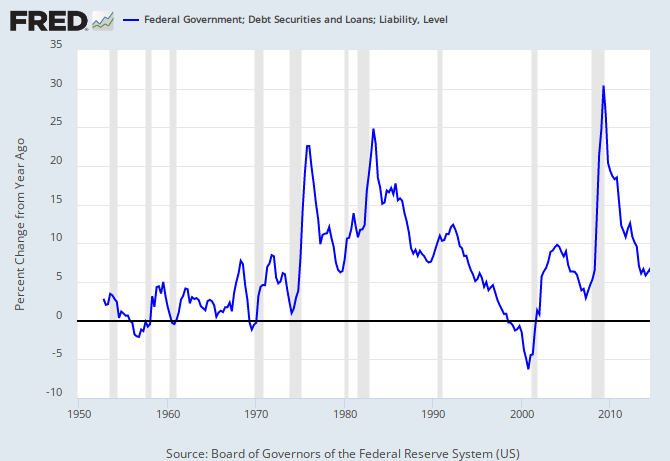
It would be difficult to imagine more dissimilar graph lines than the debt and inflation lines. During periods of highest debt growth, inflation declined.  Contrary to popular wisdom, massive federal deficit spending has been very weakly related to inflation — if at all.

The Trade Deficit
There is another sort of deficit that the public doesn’t understand: The trade deficit.

Because the phrase “trade deficit” contains the word “deficit,” it easily is manipulated

Trump’s Duties On Steel And Aluminum
As with many things Trump, his statements are meant to take advantage of the public’s ignorance of federal finance.

On March 5, 2018, Trump said,

“We lost, over the last number of years, $800 billion a year. Not a half a million dollars, not 12 cents. We lost $800 billion a year on trade. Not going to happen. We got to get it back.”

Not only are his numbers wrong, but the entire concept is wrong. Let’s say you gave your son $25 to go your local grocery store and spend $25 on various products.Image result for paying at a store

Your family now has run a “trade deficit” with your local grocery store. Your son gave them $25 and they gave him groceries. Here are some questions about that transaction:

  1. How much did your family “lose” in that trade deficit.
  2. Should you demand that the grocery store buy $25 worth of goods and services from you so that you will have a balanced trade budget?
  3. Will you impose an import tax on the items your son buys from the grocery store, so they will be more expensive to him?

Nations generally are not injured by people in one nation buying what people in another nation sell (i.e. trade deficits). The sole exceptions might be if:

  1. Vital domestic industries are damaged by overseas competion.
  2. Vital security products might be unobtainable during a war.

In today’s world economy, these exceptions are quite rare. If domestic industries are not competitive, they probably are unsuitable for local production. And war-specific materials seldom (never?) are available only from one place.

In short, a trade deficit is not the negative some populist politicians make it out to be. In the instant case, steel and aluminum are imported from many nations, and their lower cost or physical superiority are of great benefit to the American public.

The notion that these products can compete with domestic products, despite a massive shipping disadvantage, says much about domestic production incompetence. Raising the prices of these products (via duties), will hurt American industry and workers.

If the federal government wished to aid American steel and aluminum producers, it more productively could pay them money. Giving them X dollars per ton would aid the domestic producers — and the federal government could afford it without any cost to taxpayers.

The federal government, being Monetarily Sovereign, can afford anything without any cost to taxpayers.

In summary, the words “debt” and “deficit” often are misused as pejoratives, when in fact, they are assets to the economy:

  1. The federal government is Monetarily Sovereign. It never can run short of its own sovereign currency, the dollar. It does not need to levy taxes or to borrow to obtain the dollars it produces freely.
  2. Federal “debt” is nothing more than the total of dollars deposited in T-securities accounts.
  3. Millions of dollars in federal debt is paid off every day, simply by transferring dollars from those T-security accounts back to the checking accounts of the T-security owners. This involves no financial burden on the federal goverment or on federal taxpayers.
  4. The federal “debt,” which results  from federal “deficits,” is pro-growth, because federal deficits add dollars to the economy.
  5.  Trade “deficits” are an even exchange of money for goods and services. These exchanges are equally beneficial to both buyer and seller. No one “loses” by these exchanges.
  6. Trade deficits result when consumers of one nation purchase products of other nations either because these products are less costly or of better quality, than the same products produced domestically. This availability of cheaper or superior products benefits consumers.

Superior products entering the U.S. benefits the America. Dollars entering the U.S. do not benefit the U.S., because the U.S. already has the unlimited ability to create new dollars.

Rodger Malcolm Mitchell
Monetary Sovereignty
Twitter: @rodgermitchell; Search #monetarysovereignty
Facebook: Rodger Malcolm Mitchell

………………………………………………………………………………………………………………………………………………………………………………………………………………………………………………………………………………………………………………………………………..

The most important problems in economics involve the excessive income/wealth/power Gaps between the have-mores and the have-less.

Wide Gaps negatively affect poverty, health and longevity, education, housing, law and crime, war, leadership, ownership, bigotry, supply and demand, taxation, GDP, international relations, scientific advancement, the environment, human motivation and well-being, and virtually every other issue in economics.

Implementation of The Ten Steps To Prosperity can narrow the Gaps:

Ten Steps To Prosperity:
1. ELIMINATE FICA (Ten Reasons to Eliminate FICA )
Although the article lists 10 reasons to eliminate FICA, there are two fundamental reasons:
*FICA is the most regressive tax in American history, widening the Gap by punishing the low and middle-income groups, while leaving the rich untouched, and
*The federal government, being Monetarily Sovereign, neither needs nor uses FICA to support Social Security and Medicare.
2. FEDERALLY FUNDED MEDICARE — PARTS A, B & D, PLUS LONG TERM CARE — FOR EVERYONE (H.R. 676, Medicare for All )
This article addresses the questions:
*Does the economy benefit when the rich can afford better health care than can the rest of Americans?
*Aside from improved health care, what are the other economic effects of “Medicare for everyone?”
*How much would it cost taxpayers?
*Who opposes it?”
3. PROVIDE A MONTHLY ECONOMIC BONUS TO EVERY MAN, WOMAN AND CHILD IN AMERICA (similar to Social Security for All) (The JG (Jobs Guarantee) vs the GI (Guaranteed Income) vs the EB (Economic Bonus)) Or institute a reverse income tax.
This article is the fifth in a series about direct financial assistance to Americans:

Why Modern Monetary Theory’s Employer of Last Resort is a bad idea. Sunday, Jan 1 2012
MMT’s Job Guarantee (JG) — “Another crazy, rightwing, Austrian nutjob?” Thursday, Jan 12 2012
Why Modern Monetary Theory’s Jobs Guarantee is like the EU’s euro: A beloved solution to the wrong problem. Tuesday, May 29 2012
“You can’t fire me. I’m on JG” Saturday, Jun 2 2012

Economic growth should include the “bottom” 99.9%, not just the .1%, the only question being, how best to accomplish that. Modern Monetary Theory (MMT) favors giving everyone a job. Monetary Sovereignty (MS) favors giving everyone money. The five articles describe the pros and cons of each approach.
4. FREE EDUCATION (INCLUDING POST-GRAD) FOR EVERYONE Five reasons why we should eliminate school loans
Monetarily non-sovereign State and local governments, despite their limited finances, support grades K-12. That level of education may have been sufficient for a largely agrarian economy, but not for our currently more technical economy that demands greater numbers of highly educated workers.
Because state and local funding is so limited, grades K-12 receive short shrift, especially those schools whose populations come from the lowest economic groups. And college is too costly for most families.
An educated populace benefits a nation, and benefitting the nation is the purpose of the federal government, which has the unlimited ability to pay for K-16 and beyond.
5. SALARY FOR ATTENDING SCHOOL
Even were schooling to be completely free, many young people cannot attend, because they and their families cannot afford to support non-workers. In a foundering boat, everyone needs to bail, and no one can take time off for study.
If a young person’s “job” is to learn and be productive, he/she should be paid to do that job, especially since that job is one of America’s most important.
6. ELIMINATE FEDERAL TAXES ON BUSINESS
Businesses are dollar-transferring machines. They transfer dollars from customers to employees, suppliers, shareholders and the federal government (the later having no use for those dollars). Any tax on businesses reduces the amount going to employees, suppliers and shareholders, which diminishes the economy. Ultimately, all business taxes reduce your personal income.
7. INCREASE THE STANDARD INCOME TAX DEDUCTION, ANNUALLY. (Refer to this.) Federal taxes punish taxpayers and harm the economy. The federal government has no need for those punishing and harmful tax dollars. There are several ways to reduce taxes, and we should evaluate and choose the most progressive approaches.
Cutting FICA and business taxes would be a good early step, as both dramatically affect the 99%. Annual increases in the standard income tax deduction, and a reverse income tax also would provide benefits from the bottom up. Both would narrow the Gap.
8. TAX THE VERY RICH (THE “.1%) MORE, WITH HIGHER PROGRESSIVE TAX RATES ON ALL FORMS OF INCOME. (TROPHIC CASCADE)
There was a time when I argued against increasing anyone’s federal taxes. After all, the federal government has no need for tax dollars, and all taxes reduce Gross Domestic Product, thereby negatively affecting the entire economy, including the 99.9%.
But I have come to realize that narrowing the Gap requires trimming the top. It simply would not be possible to provide the 99.9% with enough benefits to narrow the Gap in any meaningful way. Bill Gates reportedly owns $70 billion. To get to that level, he must have been earning $10 billion a year. Pick any acceptable Gap (1000 to 1?), and the lowest paid American would have to receive $10 million a year. Unreasonable.
9. FEDERAL OWNERSHIP OF ALL BANKS (Click The end of private banking and How should America decide “who-gets-money”?)
Banks have created all the dollars that exist. Even dollars created at the direction of the federal government, actually come into being when banks increase the numbers in checking accounts. This gives the banks enormous financial power, and as we all know, power corrupts — especially when multiplied by a profit motive.
Although the federal government also is powerful and corrupted, it does not suffer from a profit motive, the world’s most corrupting influence.
10. INCREASE FEDERAL SPENDING ON THE MYRIAD INITIATIVES THAT BENEFIT AMERICA’S 99.9% (Federal agencies)Browse the agencies. See how many agencies benefit the lower- and middle-income/wealth/ power groups, by adding dollars to the economy and/or by actions more beneficial to the 99.9% than to the .1%.
Save this reference as your primer to current economics. Sadly, much of the material is not being taught in American schools, which is all the more reason for you to use it.

The Ten Steps will grow the economy, and narrow the income/wealth/power Gap between the rich and you.

MONETARY SOVEREIGNTY


Liberals, conservatives and gold bugs talking past each other.

It takes only two things to keep people in chains:
.

The ignorance of the oppressed
and the treachery of their leaders.

——————————————————————————————————————————————————————————————————————————————————————————–

One reason our nation is so screwed up: The partitioning of American minds. Liberals follow Rachel Maddow and MSNBC; conservatives follow Sean Hannity and Fox News. Libertarians follow The Daily Bell.

So in many cases, we are talking past one another, citing slanted news as proof of our positions.

I happen to think Rachel is far more informative, intelligent, and truthful than Sean, and way, way smarter than anyone at The Daily Bell. But could that be because she tells me what I already believe and they tell what I know to be lies?

Perhaps. Hey, I’m human.

But to resist my natural urges, I do read Breitbart and occasionally, The Daily Bell, two perfectly awful publications. In my opinion, the former is a conservative shill for anything that benefits the rich, while the latter is an anti-government, libertarian device to hawk gold and silver to suckers.

Both make me angry, and both make me wonder, “How can people believe such tripe.” But at least I can see what “tripe” is being believed. Reading “the other side” is a good learning device.

Here then is an example of tripe from The Daily Bell:

Treasury Department reports $1.2 TRILLION loss in 2017
By Simon Black – February 28, 2018

Earlier this month, the United States government released its annual financial report for the year 2017 — a complete horror show.

Right at the beginning of the report, the government explains that it’s “net loss” for the year was an unbelievable $1.2 TRILLION.

Read that number again. $1.2 trillion. That’s simply staggering. It’s larger than the size of the entire Australian economy… and constitutes a loss of more than $2.2 million per minute.

This is not a conspiracy theory or irrational fantasy. This is the Treasury Secretary of the United States of America publicly announcing that the federal government lost $1.2 trillion on page ‘i’ of its annual financial report.

(Actually, the federal government’s Net Costs for 2017 were $4.5 trillion while its Taxes and Other Revenues were $3.4 trillion.) 

Either way, oh, horrors. Mr. Black informs us that our Monetarily Sovereign government, which has the unlimited power to create dollars, so never can run short of dollars, pumped more of those dollars into the economy than it took out.

Is enriching the economy supposed to be a bad thing? He seems to think so.

What’s even more alarming is that 2017 was a great year. There was no war. No recession. No epic financial crisis.

In his introductory letter, in fact, the Treasury Secretary proudly stated that “[t]he country enjoyed a pick-up in [economic] growth in 2017. Unemployment is at its lowest level since February 2001, consumer and business confidence are at two-decade highs, and inflation is low and stable.”

In short, everything was awesome in 2017.

Hmmm . . . Let’s see. The government pumped dollars into the economy; we had an increase in economic growth; unemployment is low, and inflation is low.

Could there be a cause/effect relationship between adding dollars to the economy and economic growth? Of course, there is.

And then, The Daily Bell article piles ignorance upon ignorance:

If the government loses $1.2 trillion in a GOOD year, how much do you think they’ll lose in a BAD year? How much will they lose when they actually do have a recession to fight? Or another war. Or a major banking crisis?

The answer to that question:

Recessions (vertical gray bars) tend to result from periods of declining deficit growth. They are cured by periods of increasing deficit growth.

This is not an accident. Large economies have more dollars than do small economics. Thus, adding money, while controlling inflation, grows an economy.

More importantly, how long can something so unsustainable possibly last?

Ah, the inevitable word, “unsustainable.”

Can it last? The federal debt has been called “unsustainable” since 1940.

The Daily Bell doesn’t acknowledge that fact and the basic economic fact that a Monetarily Sovereign nation can “sustain” any size debt denominated in its own sovereign currency.

The so-called “unsustainable” Gross Federal Debt (red) has grown since 1940. So has the economy (blue).

The Daily Bell then further demonstrates its ignorance of Monetary Sovereignty:

In the report, the government reviews its own assets and liabilities… effectively calculating its “net worth”.

It’s just like how an individual might calculate his/her own net worth– you add up the value of your assets, like your home, car, and bank account balances. Then subtract liabilities like mortgage and credit card debt.

The end result is your net worth. And hopefully it’s positive.

The federal government, being Monetarily Sovereign, is not like you and me or any other individual. It also is not like city, county and state governments or private businesses, all of which are monetarily non-sovereign.

Mr. Black doesn’t understand the difference between Monetary Sovereignty and monetary non-sovereignty, yet he writes about economics!

To be clear, a net worth of negative $20.4 trillion means that the government added up the values of ALL of its assets. Every tank. Every aircraft carrier. Every acre of land. Every penny in the bank.

And then subtracted its enormous liabilities, like the national debt. The difference is negative $20.4 trillion, i.e. the government has far MORE liabilities than it has assets.

First, consider the impossibility of adding up all the federal government’s assets. What is the dollar value of the Grand Canyon? What is the dollar value of Yellowstone National Park? A used aircraft carrier? The Congress and the White House? The Washington Monument? A camp or a fort?

As if that were not sufficiently impossible, tell me the dollar value of a government that has the unlimited ability to create dollars? Think about it.

If you owned a printing press that endlessly and legally could print dollars, what would you be worth?

The government’s net worth is hopelessly negative: MINUS $20.4 trillion. And that’s worse than its result from the previous year’s MINUS $19.3 trillion– meaning that the government’s net worth decreased by about 6% year over year.

If the government were a business, it would have gone bankrupt long, long ago.

Finally, one true statement from The Daily Bell. Yes, if the government were a business, it would have gone bankrupt long, long ago.

So, Mr. Black, think very carefully: Why has the government not already gone bankrupt?

On top of that, though, the government separately calculated its long-term liabilities from Social Security and Medicare.

As we frequently discuss, both Social Security and Medicare are running out of money.

Yes, The Daily Bell does frequently make that regrettably wrong statement.

But both Social Security and Medicare are federal government agencies. No federal government agency ever can run out of money unless Congress and the President want that agency to run out of money.

All the hand-wringing about Social Security and Medicare and their so-called “trust funds” running out of money is completely bogus — a performance devoted to fooling the public.

And according to the government’s own calculations (on page 58), the “total present value of future expenditures in excess of future revenue” for Social Security and Medicare is MINUS $49 TRILLION.

This merely means that Social Security and Medicare will spend more than the total of FICA taxes. But, contrary to popular wisdom, FICA does not fund Social Security and Medicare. The federal government does.

Even if FICA collections totaled $0, the federal government could continue funding Social Security and Medicare, forever.

Essentially this means that the two largest and most important pension and healthcare programs in the United States are insolvent by nearly $50 trillion. Altogether, the government is in the red by almost $70 trillion.

Even if those questionable figures were correct, they merely would mean that the federal government is projected to pump 70 trillion more dollars into the economy than it takes out.

The Daily Bell doesn’t understand that enriching the economy by $70 trillion is a good thing for the economy, and no burden whatsoever on the federal government or on federal taxpayers.

It’s remarkable that this is not front page news. There has not been a single utterance from mainstream media about the pitiful, dangerously unsustainable finances of the federal government.

Yes, again “unsustainable.” But as usual, The Daily Bell is wrong, because one of the major problems facing the U.S. is that mainstream media do, in fact, wail about the so-called “unsustainable” finances of the U.S.

Image result for debt clock
Ignorance on display. Your family does not owe a penny of the federal debt.

And that wailing is what has led to unnecessary cuts in social benefits and the ridiculous “debt ceiling” and equally ridiculous “debt clocks.”

I’m certainly not suggesting that the sky is falling, or that there’s some imminent disaster that will strike tomorrow morning.

But that is exactly what Simon Black, the author, is suggesting, and it is diametrically wrong.

If however, the federal deficit and debt were declining, there would constitute an imminent disaster.

The last time the federal debt declined was during the Clinton administration (1998-2001), and that decline caused the recession of 2001.

President Clinton ran a surplus from 1998-2001, which caused a recession. The recession was cured by deficit spending in 2001.

But any rational person needs only look to the pages of history to find dozens of examples of once-dominant powers who were crippled by their excessive debts.

It may take several years to feel the full impact. But it would be utterly foolish to believe that this time is different.

Tellingly, Mr. Black does not provide even one example of a Monetarily Sovereign, “dominant power,” that was crippled by debt.

A Monetarily Sovereign nation can be crippled by several things — war, natural disaster, giving up its Monetary Sovereignty (as the euro nations have) — but debt isn’t one of them.

My suggestion to Mr. Black and The Daily Bell: Return to selling gold to suckers. You will do much less damage that way.

That said, I’ll continue to read The Daily Bell (once in a while). It’s painful, but it’s revealing and darkly entertaining. Breitbart, too. As for Hannity — no, that’s too painful. How much ignorance can a human survive?

Rodger Malcolm Mitchell
Monetary Sovereignty
Twitter: @rodgermitchell; Search #monetarysovereignty
Facebook: Rodger Malcolm Mitchell

………………………………………………………………………………………………………………………………………………………………………………………………………………………………………………………………………………………………………………………………………..

The most important problems in economics involve the excessive income/wealth/power Gaps between the have-mores and the have-less.

Wide Gaps negatively affect poverty, health and longevity, education, housing, law and crime, war, leadership, ownership, bigotry, supply and demand, taxation, GDP, international relations, scientific advancement, the environment, human motivation and well-being, and virtually every other issue in economics.

Implementation of The Ten Steps To Prosperity can narrow the Gaps:

Ten Steps To Prosperity:
1. ELIMINATE FICA (Ten Reasons to Eliminate FICA )
Although the article lists 10 reasons to eliminate FICA, there are two fundamental reasons:
*FICA is the most regressive tax in American history, widening the Gap by punishing the low and middle-income groups, while leaving the rich untouched, and
*The federal government, being Monetarily Sovereign, neither needs nor uses FICA to support Social Security and Medicare.
2. FEDERALLY FUNDED MEDICARE — PARTS A, B & D, PLUS LONG TERM CARE — FOR EVERYONE (H.R. 676, Medicare for All )
This article addresses the questions:
*Does the economy benefit when the rich can afford better health care than can the rest of Americans?
*Aside from improved health care, what are the other economic effects of “Medicare for everyone?”
*How much would it cost taxpayers?
*Who opposes it?”
3. PROVIDE A MONTHLY ECONOMIC BONUS TO EVERY MAN, WOMAN AND CHILD IN AMERICA (similar to Social Security for All) (The JG (Jobs Guarantee) vs the GI (Guaranteed Income) vs the EB (Economic Bonus)) Or institute a reverse income tax.
This article is the fifth in a series about direct financial assistance to Americans:

Why Modern Monetary Theory’s Employer of Last Resort is a bad idea. Sunday, Jan 1 2012
MMT’s Job Guarantee (JG) — “Another crazy, rightwing, Austrian nutjob?” Thursday, Jan 12 2012
Why Modern Monetary Theory’s Jobs Guarantee is like the EU’s euro: A beloved solution to the wrong problem. Tuesday, May 29 2012
“You can’t fire me. I’m on JG” Saturday, Jun 2 2012

Economic growth should include the “bottom” 99.9%, not just the .1%, the only question being, how best to accomplish that. Modern Monetary Theory (MMT) favors giving everyone a job. Monetary Sovereignty (MS) favors giving everyone money. The five articles describe the pros and cons of each approach.
4. FREE EDUCATION (INCLUDING POST-GRAD) FOR EVERYONE Five reasons why we should eliminate school loans
Monetarily non-sovereign State and local governments, despite their limited finances, support grades K-12. That level of education may have been sufficient for a largely agrarian economy, but not for our currently more technical economy that demands greater numbers of highly educated workers.
Because state and local funding is so limited, grades K-12 receive short shrift, especially those schools whose populations come from the lowest economic groups. And college is too costly for most families.
An educated populace benefits a nation, and benefitting the nation is the purpose of the federal government, which has the unlimited ability to pay for K-16 and beyond.
5. SALARY FOR ATTENDING SCHOOL
Even were schooling to be completely free, many young people cannot attend, because they and their families cannot afford to support non-workers. In a foundering boat, everyone needs to bail, and no one can take time off for study.
If a young person’s “job” is to learn and be productive, he/she should be paid to do that job, especially since that job is one of America’s most important.
6. ELIMINATE FEDERAL TAXES ON BUSINESS
Businesses are dollar-transferring machines. They transfer dollars from customers to employees, suppliers, shareholders and the federal government (the later having no use for those dollars). Any tax on businesses reduces the amount going to employees, suppliers and shareholders, which diminishes the economy. Ultimately, all business taxes reduce your personal income.
7. INCREASE THE STANDARD INCOME TAX DEDUCTION, ANNUALLY. (Refer to this.) Federal taxes punish taxpayers and harm the economy. The federal government has no need for those punishing and harmful tax dollars. There are several ways to reduce taxes, and we should evaluate and choose the most progressive approaches.
Cutting FICA and business taxes would be a good early step, as both dramatically affect the 99%. Annual increases in the standard income tax deduction, and a reverse income tax also would provide benefits from the bottom up. Both would narrow the Gap.
8. TAX THE VERY RICH (THE “.1%) MORE, WITH HIGHER PROGRESSIVE TAX RATES ON ALL FORMS OF INCOME. (TROPHIC CASCADE)
There was a time when I argued against increasing anyone’s federal taxes. After all, the federal government has no need for tax dollars, and all taxes reduce Gross Domestic Product, thereby negatively affecting the entire economy, including the 99.9%.
But I have come to realize that narrowing the Gap requires trimming the top. It simply would not be possible to provide the 99.9% with enough benefits to narrow the Gap in any meaningful way. Bill Gates reportedly owns $70 billion. To get to that level, he must have been earning $10 billion a year. Pick any acceptable Gap (1000 to 1?), and the lowest paid American would have to receive $10 million a year. Unreasonable.
9. FEDERAL OWNERSHIP OF ALL BANKS (Click The end of private banking and How should America decide “who-gets-money”?)
Banks have created all the dollars that exist. Even dollars created at the direction of the federal government, actually come into being when banks increase the numbers in checking accounts. This gives the banks enormous financial power, and as we all know, power corrupts — especially when multiplied by a profit motive.
Although the federal government also is powerful and corrupted, it does not suffer from a profit motive, the world’s most corrupting influence.
10. INCREASE FEDERAL SPENDING ON THE MYRIAD INITIATIVES THAT BENEFIT AMERICA’S 99.9% (Federal agencies)Browse the agencies. See how many agencies benefit the lower- and middle-income/wealth/ power groups, by adding dollars to the economy and/or by actions more beneficial to the 99.9% than to the .1%.
Save this reference as your primer to current economics. Sadly, much of the material is not being taught in American schools, which is all the more reason for you to use it.

The Ten Steps will grow the economy, and narrow the income/wealth/power Gap between the rich and you.

America’s long-term care. Suffer in illness, then die early in poverty

It takes only two things to keep people in chains:
.

The ignorance of the oppressed
and the treachery of their leaders.

——————————————————————————————————————————————————————————————————————————————————————————–

A nation that does not take care of its elderly is, to borrow a phrase from our President, a “shithole” country. In fact, if you could vote for a single measure of a nation’s greatness, the treatment of its elderly would rank near the top.

By that measure, the U.S. does moderately well, but certainly not “great,” especially considering our vast national wealth. Unfortunately, that vast national wealth is not spread evenly, so millions cannot afford long term care.

Could you afford these costs?

 It is not uncommon for someone to receive care at home for several months or longer, followed by a two and a half year stay in an assisted living facility, with almost 60% then requiring a nursing home stay of somewhere between nine months and a little over two years.

All combined, this is a total of approximately 4-5 years of long-term care. In this scenario, the total cost of care could easily exceed $300,000, depending on the cost of care in your region.

Would you find this affordable? Would paying for it leave you impoverished? And, after paying all that money, what would happen to you if you finally left the nursing home facility?

The U.S. offers two primary, but insufficient, programs to protect our elderly: Social Security for living expenses, and Medicare for hospital and doctor expenses.

SOCIAL SECURITY
For those people who have not earned enough or been prudent enough to save a significant amount for retirement, Social Security benefits are ridiculously inadequate.

How Big Is the Average Person’s Social Security Check?
The Motley Fool, Todd Campbell, Aug 30, 2017

In the 12-month period ending June 2017, over 2.9 million Americans signed up for Social Security benefits. On average, these retired workers were awarded $1,413.08 in monthly benefits, however, the average benefits payable were quite different for men and women.

In the period, 1.4 million women filed for Social Security benefits, and their average award was $1,231.50. Men, however, were awarded $1,583.77, on average.

Wage inequality arguably plays a role in women’s lower average payment, but so, too, does Social Security’s formula, which penalizes individuals who take time off from their career to raise children.

Congress has added two years to the date when you first can receive normal Social Security benefits. Why? Because Congress is run by the rich, and the rich want the Gap widened between the rich and the rest.

For the rich, the less given to the lower income groups, including the elderly, the better.

To deceive the public, politicians make the dual false claims that the federal government is running short of dollars, and that your federal taxes are necessary to fund federal spending.

As a result, too many of America’s elderly suffer in illness, then die early in poverty.

MEDICARE
It actually is a good program so far as it goes, but it won’t cover all your medical costs, which means you’ll have choices:

  1. Pay for a Medigap policy, or
  2. Pay for what Medicare doesn’t cover, or
  3. Do without some medical services.

And in the almost 100% probability that you’ll need medicines, you’ll either have to:

  1. Pay for a “Medicare Part D” policy, or
  2. Pay for the medicines, yourself
  3. Do without medicine.

Everything boils down to “pay for” (may be impossible for many) or “do without.”

Here’s how many Americans have nothing at all saved for retirement
Ester Bloom
If you’re overwhelmed by the financial responsibilities of day-to-day life and more focused on making it to the end of the month than on the possibility of being able to save for the distant future, you’re not alone.

In fact, the vast majority of Americans have under $1,000 saved and half of all Americans have nothing at all put away for retirement.

There is a related problem. Middle-income people lead middle-income lives. Over the years, they do middle-income things.

They live in middle-income communities, drive-middle-income cars and when planning for the future, they anticipate middle-income expenses.

But then, they are surprised:

Wages finally rising, but not for middle class
 Don Lee Washington Bureau
WASHINGTON —Jorge Hunzelmann was pleased enough when his employer bumped up his pay this year by $2.50 an hour to $19.50.

The truck driver, 52 and father of two, is a beneficiary of a tightening labor market, but he does not have company-provided health benefits, and he says it’s still a hand-to-mouth existence for his family. “We don’t have money to save to put into the bank,” said the Gaithersburg, Md., resident.

Most of us expect to lead modest lives when we first go to work. Then we anticipate significant wage gains until perhaps we are in our 50’s, after which we predict more modest wage gains, but gains nevertheless until we retire in our 60’s.

And we live according to our anticipations. So perhaps we plan to rent an apartment, followed by a modest house, then a bigger house, all of which we expect to be able to afford on our anticipated income.

But what happens if our income does not increase as we had planned, and here we already live in a neighborhood we can’t afford, and have children and friends we can’t afford? The step back is incredibly painful and humiliating for our entire family.

Across the country, wages that were stuck for years finally seem to have started to rise faster, especially in industries such as trucking, which is begging for workers. Average hourly earnings for all private-sector employees last month grew at a 2.9 percent annual rate of increase, the most since 2009.

That has fueled hopes for workers. It has also spooked some investors with fears of higher inflation and interest rates.

But wage gains thus far have been very uneven, according to Labor Department statistics. They’re concentrated at the higher end of the pay scale and the lower. By and large, the broad middle of the labor force has not seen much of a raise, mirroring a long-running trend.

Even with unemployment at a 17-year low of 4.1 percent, the proverbial rising tide has not lifted all boats: The fancy yachts have gotten most of the lift.

Take the finance sector, which has led the pack in the recent wage increases. Some 8.5 million people work in banking, insurance and real estate; their average hourly pay jumped 4.2 percent in January from a year earlier, to just a penny under $34 an hour.

But for ordinary nonsupervisory employees in finance — about four out of five financial-industry workers — the average increase was just 1.6 percent, to $26.75 an hour.

“It’s a pulling apart at the top,” said Elise Gould, a senior economist at the Economic Policy Institute, noting that if the trend continues, it will exacerbate the country’s already large income inequality. 

The problem is not that the poor are too “lazy” to work, or that the middle are too “ignorant” to have a plan.

The problem is that the rich have stacked the deck by bribing Congress to pass laws that favor the rich — laws that widen the Gap between the rich and the rest.

This brings us to long-term care.

LONG-TERM CARE
Caution on long-term care
Elliot Raphaelson, Chicago Tribune, raphelliot@gmail.com

When people live past 65, there is a high probability that they will need some form of long-term care.

A major problem for many insurance companies in the long-term care industry is that they are not profitable or are losing money.

Immediately, we see several problems:Related image

Long-term care is like medical care, in that the majority of us will need it as we grow older, but unlike medical care, there is no “Medicare” for long-term care. This is a terrible omission by Congress.

And unlike medical care, long-term care usually ends with death. While people ordinarily occupy a hospital bed for a day or two — a week is exceptional — an elderly person may spend many years needing long-term care.

Thus, it is difficult, if not impossible, for private insurance companies to provide affordable long-term care coverage at affordable premiums, and still be profitable.

People are living much longer now than when many of the long-term care policies were sold.

And, it was commonly assumed that 5 percent of policyholders would allow their policies to lapse annually. In fact, only about 1 percent of policyholders have done so.

There is something implicitly wrong with pricing a policy in the hopes that every year, 5% of policyholders would spend money on premiums, then allow the policy to lapse when it is needed most.

Another assumption was that insurance companies would be able to invest their capital at a 7.5 percent return. Interest rates, however, have remained below historical levels, and returns in 2017 were approximately 4.6 percent, according to A.M. Best.

The problem with private, for-profit insurance companies is that they are designed first to make a profit, and only secondarily, to provide a service.  This problem becomes quite serious in the case of a necessary service paid for by the public.

Many insurance companies offering LTC policies have either gone out of business or discontinued selling the policies. Most of the companies that remain in the business have taken steps to increase premiums for existing policyholders and new customers.

Healthy people have invested many thousands of dollars to have protection by LTC policies, only to discover that the LTC policies will not be there when finally needed.

Insurance companies cannot arbitrarily raise premiums for existing customers without the approval of the state insurance department. When premium increases have been granted, they have more than doubled. For those who had the foresight to buy these policies many years ago, it seems very unfair.

The majority of policyholders expected that their premiums would remain fixed. Unfortunately, I am not aware of any insurance company that guaranteed premiums would not increase.

If any company had guaranteed its premiums were fixed, that company is out of business, today. In essence, the underwriting either was knowingly fraudulent, with low premiums as a “come-on,” or it was done with extraordinary ignorance.

Another factor that makes the situation worse is that many of these policyholders have already retired and have few or no options to increase their income to be able to afford premium increases.

The people who can afford premium increases least, are the ones who lose coverage just before they need it most.

Insurance companies can go to their state insurance departments to try to obtain approval for premium increases. If the insurance department refuses to approve premium increases, the insurance company — facing large losses — may have to liquidate.

When an insurance company is forced to liquidate, the policyholder generally loses some coverage. There is no guarantee, when a company does liquidate, that policyholders will receive the coverage they initially contracted for.

Currently, only about a dozen companies still offer LTC policies.

In summary, long-term care is:

  1. Unaffordable for the average person,
  2. Necessary for
  3. A high percentage of people are
  4. Unprofitable to insure, except with high premiums and low coverage.

Those four factors: Costly, necessary, commonly needed and unprofitable cry out for federal support. They describe the exact services the federal government should provide.

The solution:

The problem lies with the private insurance companies and their profit motive.

The solution is a Medicare for All plan that includes long-term care, funded by a Monetarily Sovereign government that has no need for profits and cannot run short of dollars.

No public purpose is served by forcing Americans to self-insure or to pay for long-term care private insurance out of their own pockets.

Medicare is a social experiment that has identified the private insurance companies as useless middlemen. The experiment has worked, as far as it has gone. It just hasn’t gone far enough.

Our long-term care problems are mistakenly identified as “high costs,” or “lack of preparation by the young,”  The real problem is the unnecessary insertion of private insurance company “middlemen” into the situation.

With regard to long-term care, private insurance companies serve no function other than to increase costs and to decrease benefits. Federally funded Medicare should pay for long-term care.

Otherwise, our older Americans will continue to suffer in illness, then die early in poverty. And you probably will be one of them.

Rodger Malcolm Mitchell
Monetary Sovereignty
Twitter: @rodgermitchell; Search #monetarysovereignty
Facebook: Rodger Malcolm Mitchell

………………………………………………………………………………………………………………………………………………………………………………………………………………………………………………………………………………………………………………………………………..

The most important problems in economics involve the excessive income/wealth/power Gaps between the have-mores and the have-less.

Wide Gaps negatively affect poverty, health and longevity, education, housing, law and crime, war, leadership, ownership, bigotry, supply and demand, taxation, GDP, international relations, scientific advancement, the environment, human motivation and well-being, and virtually every other issue in economics.

Implementation of The Ten Steps To Prosperity can narrow the Gaps:

Ten Steps To Prosperity:
1. ELIMINATE FICA (Ten Reasons to Eliminate FICA )
Although the article lists 10 reasons to eliminate FICA, there are two fundamental reasons:
*FICA is the most regressive tax in American history, widening the Gap by punishing the low and middle-income groups, while leaving the rich untouched, and
*The federal government, being Monetarily Sovereign, neither needs nor uses FICA to support Social Security and Medicare.
2. FEDERALLY FUNDED MEDICARE — PARTS A, B & D, PLUS LONG TERM CARE — FOR EVERYONE (H.R. 676, Medicare for All )
This article addresses the questions:
*Does the economy benefit when the rich can afford better health care than can the rest of Americans?
*Aside from improved health care, what are the other economic effects of “Medicare for everyone?”
*How much would it cost taxpayers?
*Who opposes it?”
3. PROVIDE A MONTHLY ECONOMIC BONUS TO EVERY MAN, WOMAN AND CHILD IN AMERICA (similar to Social Security for All) (The JG (Jobs Guarantee) vs the GI (Guaranteed Income) vs the EB (Economic Bonus)) Or institute a reverse income tax.
This article is the fifth in a series about direct financial assistance to Americans:

Why Modern Monetary Theory’s Employer of Last Resort is a bad idea. Sunday, Jan 1 2012
MMT’s Job Guarantee (JG) — “Another crazy, rightwing, Austrian nutjob?” Thursday, Jan 12 2012
Why Modern Monetary Theory’s Jobs Guarantee is like the EU’s euro: A beloved solution to the wrong problem. Tuesday, May 29 2012
“You can’t fire me. I’m on JG” Saturday, Jun 2 2012

Economic growth should include the “bottom” 99.9%, not just the .1%, the only question being, how best to accomplish that. Modern Monetary Theory (MMT) favors giving everyone a job. Monetary Sovereignty (MS) favors giving everyone money. The five articles describe the pros and cons of each approach.
4. FREE EDUCATION (INCLUDING POST-GRAD) FOR EVERYONE Five reasons why we should eliminate school loans
Monetarily non-sovereign State and local governments, despite their limited finances, support grades K-12. That level of education may have been sufficient for a largely agrarian economy, but not for our currently more technical economy that demands greater numbers of highly educated workers.
Because state and local funding is so limited, grades K-12 receive short shrift, especially those schools whose populations come from the lowest economic groups. And college is too costly for most families.
An educated populace benefits a nation, and benefitting the nation is the purpose of the federal government, which has the unlimited ability to pay for K-16 and beyond.
5. SALARY FOR ATTENDING SCHOOL
Even were schooling to be completely free, many young people cannot attend, because they and their families cannot afford to support non-workers. In a foundering boat, everyone needs to bail, and no one can take time off for study.
If a young person’s “job” is to learn and be productive, he/she should be paid to do that job, especially since that job is one of America’s most important.
6. ELIMINATE FEDERAL TAXES ON BUSINESS
Businesses are dollar-transferring machines. They transfer dollars from customers to employees, suppliers, shareholders and the federal government (the later having no use for those dollars). Any tax on businesses reduces the amount going to employees, suppliers and shareholders, which diminishes the economy. Ultimately, all business taxes reduce your personal income.
7. INCREASE THE STANDARD INCOME TAX DEDUCTION, ANNUALLY. (Refer to this.) Federal taxes punish taxpayers and harm the economy. The federal government has no need for those punishing and harmful tax dollars. There are several ways to reduce taxes, and we should evaluate and choose the most progressive approaches.
Cutting FICA and business taxes would be a good early step, as both dramatically affect the 99%. Annual increases in the standard income tax deduction, and a reverse income tax also would provide benefits from the bottom up. Both would narrow the Gap.
8. TAX THE VERY RICH (THE “.1%) MORE, WITH HIGHER PROGRESSIVE TAX RATES ON ALL FORMS OF INCOME. (TROPHIC CASCADE)
There was a time when I argued against increasing anyone’s federal taxes. After all, the federal government has no need for tax dollars, and all taxes reduce Gross Domestic Product, thereby negatively affecting the entire economy, including the 99.9%.
But I have come to realize that narrowing the Gap requires trimming the top. It simply would not be possible to provide the 99.9% with enough benefits to narrow the Gap in any meaningful way. Bill Gates reportedly owns $70 billion. To get to that level, he must have been earning $10 billion a year. Pick any acceptable Gap (1000 to 1?), and the lowest paid American would have to receive $10 million a year. Unreasonable.
9. FEDERAL OWNERSHIP OF ALL BANKS (Click The end of private banking and How should America decide “who-gets-money”?)
Banks have created all the dollars that exist. Even dollars created at the direction of the federal government, actually come into being when banks increase the numbers in checking accounts. This gives the banks enormous financial power, and as we all know, power corrupts — especially when multiplied by a profit motive.
Although the federal government also is powerful and corrupted, it does not suffer from a profit motive, the world’s most corrupting influence.
10. INCREASE FEDERAL SPENDING ON THE MYRIAD INITIATIVES THAT BENEFIT AMERICA’S 99.9% (Federal agencies)Browse the agencies. See how many agencies benefit the lower- and middle-income/wealth/ power groups, by adding dollars to the economy and/or by actions more beneficial to the 99.9% than to the .1%.
Save this reference as your primer to current economics. Sadly, much of the material is not being taught in American schools, which is all the more reason for you to use it.

The Ten Steps will grow the economy, and narrow the income/wealth/power Gap between the rich and you.

MONETARY SOVEREIGNTY