Yet another economics writer who doesn’t understand the fundamentals.

A fundamental truth of economics: A Monetarily Sovereign nation never unintentionally can run short of its own sovereign currency.

The nation does not need to tax and does not need to borrow. It creates its sovereign currency at will.

To not understand that fact is to not understand economics, for it is the absolute foundation of economics.

THEWEEK Magazine recently published the article, “The big question about Modern Monetary Theory everyone is missing,” by Ryan Cooper.

Modern Monetary Theory (MMT) and Monetary Sovereignty (MS) share many characteristics regarding money in today’s economies.

Here are a few excerpts from the article, together with my comments.

Economists are in the midst of one of the periodic debate flare-ups over Modern Monetary Theory.

On the pro-MMT side we have economists like Stephanie Kelton and Randall Wray, while on the other we have the odd bedfellows of The New York Times’ Paul Krugman and the People’s Policy Project’s Matt Bruenig.

Professor Kelton has been a “pen pal” of mine for several years. I met Professor Wray years ago, when I gave a talk to his class at UMKC.

This intricate debate is about the main merits of MMT, an economic school of thought which has received wide attention for its dismissal of the need for taxes to pay for new spending.

Both MMT and MS agree that unlike state and local taxes, which do pay for state and local government spending, federal taxes do not pay for federal spending.

The reason is that the U.S. federal government is Monetarily Sovereign. It is sovereign over U.S. dollars, which it creates ad hoc, every time it pays a creditor.

Even if the U.S. government collected zero taxes, it could continue spending, forever.

However, there is an important question which has to this point not been raised. The MMT advocates say that inflation should be controlled through fiscal policy, instead of monetary policy conducted by the central bank as is current practice.

In other words, if prices start rising, we can keep them in line by raising taxes.

But does that actually work?

No, it doesn’t work, cannot work and never will work.

Raising taxes is too slow and too political (waiting for Congress), too undirected (which taxes?), not incremental enough (raise taxes how much?), and too damaging to economic growth (taxes reduce the money supply). 

Unfortunately, MMT takes incompatible positions. It says correctly, that federal taxes do not fund federal spending, but incorrectly that federal taxes are necessary to cause demand for U.S. dollars.

During times of recession and economic slack, a state borrowing in its own currency has unlimited capacity to spend, because printing money or borrowing to spend on public works and so on will not cause inflation so long as there are unemployed workers and idle capital stock.

Think, Mr. Cooper. If a state has the unlimited capacity to spend and to “print” money, why would it need to, or even want to, borrow? Think.

Contrary to popular wisdom, the U.S. does not borrow dollars. Instead, it accepts deposits into T-security accounts, the purpose of which are:

  1. To provide the world with a safe place to park unused dollars. This helps stabilize the dollar.
  2. To assist the Fed in controlling interest rates, which control inflation.

But if there is full employment, taxes are needed for new programs — to fund them for the former, or to stave off inflation for the latter.

Here, Cooper reveals he doesn’t understand the differences between monetarily non-sovereign state and local government financing (where borrowing is necessary), vs. Monetarily Sovereign federal financing (that requires no borrowing).

The federal government levies taxes, but not to obtain dollars. It freely produces all the dollars it needs.

The purpose of federal taxes is to control the economy by discouraging certain activities with higher taxes and by encouraging others with tax reductions.

The effect of federal taxes (as opposed to the purpose), is to reduce federal deficit spending which reduces the money supply.

All federal taxes do this — income taxes, FICA, sales taxes, import duties, etc. They all reduce the money supply. Just as tax cuts are economically stimulative, tax increases are recessionary.

And just as increased federal deficit spending helps cure recessions, decreased federal deficit spending causes recessions, and worst case, depressions.

U.S. depressions tend to come on the heels of federal surpluses.

1804-1812: U. S. Federal Debt reduced 48%. Depression began 1807.
1817-1821: U. S. Federal Debt reduced 29%. Depression began 1819.
1823-1836: U. S. Federal Debt reduced 99%. Depression began 1837.
1852-1857: U. S. Federal Debt reduced 59%. Depression began 1857.
1867-1873: U. S. Federal Debt reduced 27%. Depression began 1873.
1880-1893: U. S. Federal Debt reduced 57%. Depression began 1893.
1920-1930: U. S. Federal Debt reduced 36%. Depression began 1929.
1997-2001: U. S. Federal Debt reduced 15%. Recession began 2001.

Now, it should be noted that MMT’s style of argumentation seems to have dented the brainless pro-austerity mindset that dominates much of elite discourse, which is very much to its credit.

Remember the above comment, because later in his article, Cooper unknowingly supports the very austerity he calls “brainless.”

He discusses the key objection to MMT (and MS), inflation:

The way tax-side inflation control is supposed to work is through supply and demand.

Since taxation will leave buyers with less money in their pockets to spend, market competition will force suppliers to cut prices and workers to accept lower wages.

But if markets have become dominated by a few big firms, then business can resist this pressure, because buyers have nowhere else to go.

Taxation reduces the supply of money. Though taxation can support the demand for money, it is not necessary for that purpose.

Interest is a more effective device for supporting the demand for money. While taxes depress an economy, interest stimulates the economy by increasing federal dollar interest input.

Money growth grows an economy.

A good test of this prediction came in the late 1970s, when inflation was at its postwar peak.

Economist John Kenneth Galbraith argued for price controls, but conservative “monetarists” like Milton Friedman argued that (with) a steep hike in interest rates, inflation would come down quickly and easily.

The Fed tried Friedman’s policy, but it turned out Galbraith was right.

The Fed hiked interest rates to an eyewatering 20 percent, creating the worst recession since the Great Depression up to that time.

But inflation only came down very slowly — partly through Keynesian-style spending effects, but partly by badly damaging the labor movement, which cut unionization.

In the past 50 years, since President Nixon took the U.S. off a gold standard, inflation has not been caused by America’s massive federal deficit spending. See: Inflation has been caused by the price of oil.

The Fed wisely has not recommended controlling the price of oil, an action that would lead to an oil shortage, and a recession, if not a depression. That is what price controls do: Lead to shortages.

And what do shortages lead to? Hyperinflations.

So, Cooper writes that Galbraith was right about price controls?? Where did that come from? He provides no evidence.

The true effect of price controls is to reduce economic growth by reducing supply and profits — the economic necessities for growth.

Price control is a feature of the “brainless, pro-austerity mindset” that Cooper properly criticized a few paragraphs ago.

And do increased interest rates really lead to recessions? Or is it simply that recessions lead to decreased interest rates?

Interest rates (red); deficit spending increases (blue); recessions (vertical gray bars)

The above graph shows that sometimes interest rates peak at the start of recessions, sometimes they peak in the midst of economic growth, and sometimes they decline at the start of recessions.

One cannot say that increased interest rates historically have caused recessions.

The real pattern is that decreased deficit spending causes recessions and increased deficit spending cures recessions.

Why? Because a growing economy requires a growing supply of dollars, and deficit spending adds stimulus dollars to the economy.

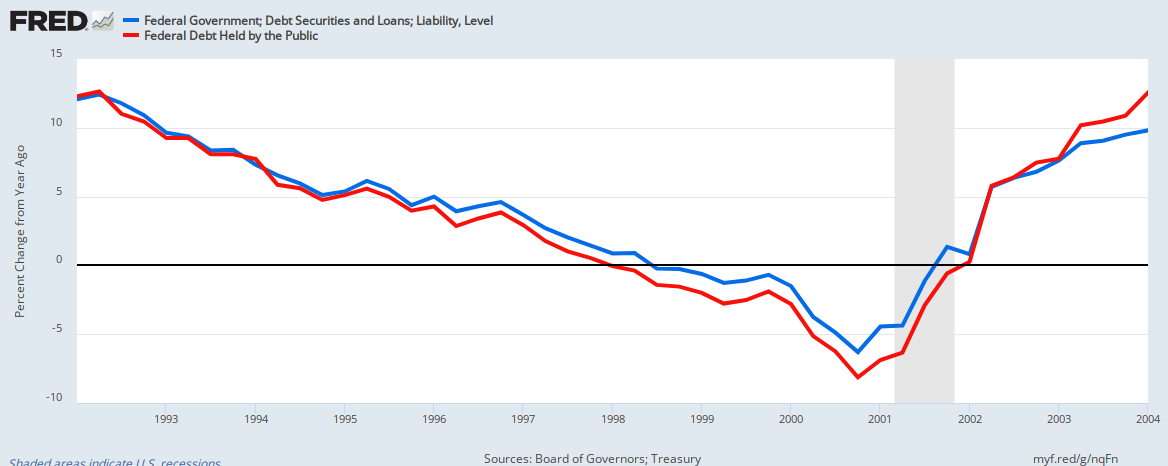
Federal deficit spending and debt don’t cause inflation.

Since the U.S. went off the gold standard in 1971, the federal debt (blue) has risen massively, while inflation (red) has been moderate.

Most inflations and nearly all hyperinflations are caused by shortages, usually shortages of food, and often shortages of oil.

For instance, Zimbabwe, an oft-mentioned hyperinflation victim, had its hyperinflation begin with a food shortage. (Farmland was stolen from farmers and given to non-farmers.)

One reason inflation control is delegated to the central bank is that it can work quickly, adjusting interest rates in response to economic conditions several times per year.

Congress works extremely slowly at the best of times, and control is usually split between the two parties.

The Fed may have performed poorly over the last decade, but do we really want Mitch McConnell having to sign off on inflation policy?

Exactly. Now that Cooper belatedly has confirmed why price controls and tax increases don’t work and can’t work, we come to the:

SUMMARY

Modern Monetary Theory (MMT) and Monetary Sovereignty MS) describe the realities of economics similarly.

They agree that a Monetarily Sovereign nation, such as the U.S., cannot run short of its own sovereign currency, and neither needs nor uses tax dollars to fund spending.

They differ in many other areas however, one of which has to do with controlling inflation:

Three inflation controls were discussed, only one of which is effective:

  1. Price controls which cut profits and thus cut economic growth, lead to recessions and ultimately cause inflations by causing shortages. They don’t work, and neither MMT nor MS supports this approach.
  2. Tax increases, which are too slow, too political, not incremental, and cause recessions by decreasing the money supply. They don’t work, though MMT supports this approach.
  3. Interest rate increases, which actually increase the money supply (by causing the federal government to pay more interest into the economy, and work by increasing the value of dollars (by increasing the demand for dollars). Works, and has been working since the end of WWII. MS supports this approach.

Rodger Malcolm Mitchell
Monetary Sovereignty
Twitter: @rodgermitchell
Search #monetarysovereigntyFacebook: Rodger Malcolm Mitchell

…………………………………………………………………………………………………………………………………………………………………………………………………………………………………………………………………………………………..

The most important problems in economics involve the excessive income/wealth/power Gaps between the richer and the poorer.

Wide Gaps negatively affect poverty, health and longevity, education, housing, law and crime, war, leadership, ownership, bigotry, supply and demand, taxation, GDP, international relations, scientific advancement, the environment, human motivation and well-being, and virtually every other issue in economics.

Implementation of The Ten Steps To Prosperity can narrow the Gaps:

Ten Steps To Prosperity:

1. Eliminate FICA

2. Federally funded medicare — parts a, b & d, plus long-term care — for everyone

3. Provide a monthly economic bonus to every man, woman and child in America (similar to social security for all)

4. Free education (including post-grad) for everyone

5. Salary for attending school

6. Eliminate federal taxes on business

7. Increase the standard income tax deduction, annually. 

8. Tax the very rich (the “.1%) more, with higher progressive tax rates on all forms of income.

9. Federal ownership of all banks

10. Increase federal spending on the myriad initiatives that benefit America’s 99.9% 

The Ten Steps will grow the economy, and narrow the income/wealth/power Gap between the rich and you.

MONETARY SOVEREIGNTY


Why cut the state tax deduction?

If you begin with the wrong assumptions, you come to the wrong conclusions.

Here are excerpts from an article in Bloomberg, where the author mistakenly assumes that federal taxes pay for federal spending. 

Image result for burning dollars
Your federal tax dollars are destroyed upon receipt.

While state and local taxes do fund state and local spending, federal taxes do not fund federal spending. Your federal tax dollars are destroyed upon receipt.

Not understanding the difference between federal and state finances, (the federal government uniquely is Monetarily Sovereign), the author offers wrong conclusions:

Get Rid of the State-Tax Deduction Altogether
High-income taxpayers in high-tax states don’t deserve special treatment.By Michael R. Strain, February 28, 2019

(Michael R. Strain is a Bloomberg Opinion columnist. He is director of economic policy studies and resident scholar at the American Enterprise Institute. He is the editor of “The U.S. Labor Market: Questions and Challenges for Public Policy.)

The 2017 tax law capped at $10,000 the amount of state and local tax payments a household can deduct from its federal income taxes. Previously, people could deduct the entire amount they paid in state and local property taxes, and either the state individual income tax or state sales tax.

According to a Treasury Department estimate released Tuesday, this cap will stop 10.9 million tax filers from writing off these payments from their federal income taxes, with the largest bite felt in high-tax states like New York, New Jersey and California.

Though politicians from these states are howling — New York Governor Andrew Cuomo recently met with President Donald Trump to discuss his concerns — limiting this deduction was the right thing to do.

Congress should go all the way and repeal what remains of it.

Importantly, just because 11 million people may lose this popular tax break — which has been in the federal code since the income tax was created a century ago — does not mean that all of them will be paying a larger share of their income in federal taxes.

An analysis by the Tax Policy Center in December 2017 found that 80 percent of households would receive a tax cut in 2018, while only 5 percent will face a tax increase. (As temporary provisions of the 2017 law expire, more households will face a tax increase in future years.)

An initially appealing argument in favor of this deduction is that it reduces an individual’s marginal income tax.

That’s only part of the story. By shrinking the federal income tax base relative to what it would be without the deduction, raising any given amount of revenue requires higher tax rates.

This likely offsets the deduction’s marginal rate reduction.

Mr. Strain reveals his belief that our Monetarily Sovereign government, which creates dollars by spending dollars, and never can run short of dollars,  needs to increase taxes when spending increases. He is wrong.

The federal debt itself demonstrates that federal taxes don’t fund federal spending.

Let me remind you of what two experts in the field have said:

Alan Greenspan: “A government cannot become insolvent with respect to obligations in its own currency.”

Ben Bernanke:The U.S. government has a technology, called a printing press (or, today, its electronic equivalent), that allows it to produce as many U.S. dollars as it wishes at essentially no cost.”

Could anything be clearer? Nothing “requires higher taxes.”  In fact, nothing requires federal taxes at all.

So why does a government, having the unlimited ability to create its own sovereign currency, levy taxes?

The primary reason is economic control. Things they wish to encourage (i.e. charity, business investment, etc.)  are tax deductible. Things they wish to discourage (i.e. smoking, alcohol, gambling, etc.) are heavily taxed.

And most importantly, the people the politicians wish to reward (i.e. rich donors) are given the lowest tax rates on what matters: Asset growth, long-term capital gains, dividends, and delayed taxes on various sorts of income.

The state and local deduction also encourages taxpayers to itemize their deductions rather than take the standard deduction.

This leads people to use other deductions more as well, amplifying the harm done from much less defensible tax breaks, like the one for mortgage interest payments.

The government made mortgage interest deductible in order to encourage home ownership.

There is no “harm done” by this deduction. On the contrary, the “harm done” is the taxing of mortgage payments. Tax dollars are taken from the private sector and given to the federal government, where they are destroyed.

Again, the U.S. Treasury destroys your hard-earned tax dollars upon receipt, and creates brand new dollars by spending. That is the government’s method for “printing” dollars.

The destruction of dollars impoverishes the economy, just as all federal taxes do.

For the reasons I mentioned above, we should want a broader base and lower rates, not a smaller base and higher rates.

The above sentence makes no economic sense. The federal government could get along quite nicely, thank you, if it collected, and then destroyed, zero taxes.

Meanwhile, the economy, i.e. the private sector, would flourish by the additional money that remained in consumers and businesses pockets.

In addition, the state and local deduction is a subsidy to states with large numbers of high-income individuals.

Because they face higher marginal income tax rates, deductions are relatively more valuable to this group of taxpayers.

The above sentences are mathematically correct but in practice, wrong.

The state and local tax deductions benefit residents, not the state governments, which receive no direct dollars from that tax deduction.

And it is not the rich who benefit most The rich pay for their homes via business expenses and other tax avoidance schemes. It is the middle and upper-middle classes in these states, that pay the penalty.

These are the people who have homes in higher-tax locations, and perhaps summer homes as well, but are not in the hundreds-of-millions or billions category.

Bottom line, everyone, rich and poor in America, is punished when the private sector must send dollars to the federal government. 

Residents of lower-tax states should not be on the hook for spending decisions of governments in higher-tax states.

Of course, higher-income households (many of which are located in higher-income states) do pay relatively more income tax, which is used to finance federal spending programs and transfer payments, some of which benefit citizens in other, lower-income states.

Again, Mr. Strain demonstrates ignorance of federal financial reality.

Residents of one state never are “on the hook” for spending in other states, neither with regard to federal taxes or to taxes in the other states. Residents of a state are “on the hook” for taxes in that state.

And federal income tax is not used to “finance federal spending programs and transfer payments.” The federal government destroys tax dollars, and creates new dollars to finance all spending.

State and local spending finances some public goods, like education. And there is a role for government to subsidize education, because the benefits of an educated citizenry extend beyond the individuals enrolled in school.

It would be better to directly subsidize education than to use a roundabout state and local deduction to achieve that goal.

I agree that the federal government should finance education. See: Ten Steps to Prosperity: Step 4: Free education for everyone and Ten Steps to Prosperity: Step 5: Salary for attending school.

But this has nothing to do with the useless, indeed harmful, tax on mortgage payments and other state taxes.

Importantly, the $10,000 cap mitigates some of these concerns. For example, the cap and the larger standard deduction — another feature of the 2017 tax law — will lead many fewer households to itemize.

It doesn’t eliminate them, however. And the remaining deduction is significant. According to the Joint Committee on Taxation, 16.6 million tax filers will still claim the state and local tax deduction in 2018.

Because of this subsidy, the federal government is estimated to have lost $20 billion in revenue last year.

” . . . will lead many fewer households to itemize, but allow the richest to continue itemizing charitable and business-related deductions.

And read carefully what Mr. Strain is saying.  He thinks of not taking your tax dollars from your pocket as a “subsidy,” as though the government were giving you something rather than you not giving the government something.

Next time you fail to give your neighbor a gift, Mr. Strain suggests you thank them for the “subsidy.”

Congress should get rid of the deduction entirely. To minimize disruption, the deduction should be set on a gradual glide path toward zero over a number of years.

Doing so might mean that high-income people leave high-tax states, although the benefits to them of living in major urban centers makes me suspect that relatively few will do so.

Even if this does happen to a significant degree, it would not be something to bemoan. Households should decide where to live based on their preferences, not on tax policy.

Oh really, Mr. Strain? Is that what households “should” do? I have news for you. Not all of the population increase in Florida is due to the weather. Much of it is due to Florida’s low taxes.

Many thousands of people live in Florida at least six months out of the year, just to take advantage of its low taxes.

And now comes Mr. Strain summarizing his own economic ignorance:

The real change would be in the behavior of states.

Some would still choose to provide more services than others — this key feature of the U.S.’s federalist system would remain.

But they won’t be relying on a subsidy from the federal government — from taxpayers in other states — to pick up part of the tab.

No, Mr. Strain. Taxpayers in other states do not pick up the tab for better schools, better healthcare, better support for the impoverished, etc. that you seem to feel should be cut.

That is the right-wing, anti-poor, pro-rich theme. You should be ashamed.

Here is a good idea for everyone:

To contact the author of this story: Michael R. Strain at mstrain4@bloomberg.net

To contact the editor responsible for this story: Katy Roberts at kroberts29@bloomberg.net

Rodger Malcolm Mitchell
Monetary Sovereignty
Twitter: @rodgermitchell
Search #monetarysovereigntyFacebook: Rodger Malcolm Mitchell

…………………………………………………………………………………………………………………………………………………………………………………………………………………………………………………………………………………………..

The most important problems in economics involve the excessive income/wealth/power Gaps between the richer and the poorer.

Wide Gaps negatively affect poverty, health and longevity, education, housing, law and crime, war, leadership, ownership, bigotry, supply and demand, taxation, GDP, international relations, scientific advancement, the environment, human motivation and well-being, and virtually every other issue in economics.

Implementation of The Ten Steps To Prosperity can narrow the Gaps:

Ten Steps To Prosperity:

1. Eliminate FICA

2. Federally funded medicare — parts a, b & d, plus long-term care — for everyone

3. Provide a monthly economic bonus to every man, woman and child in America (similar to social security for all)

4. Free education (including post-grad) for everyone

5. Salary for attending school

6. Eliminate federal taxes on business

7. Increase the standard income tax deduction, annually. 

8. Tax the very rich (the “.1%) more, with higher progressive tax rates on all forms of income.

9. Federal ownership of all banks

10. Increase federal spending on the myriad initiatives that benefit America’s 99.9% 

The Ten Steps will grow the economy, and narrow the income/wealth/power Gap between the rich and you.

MONETARY SOVEREIGNTY
Student debt: The intentional crisis.

While America struggles with the Republicans’ $6 Billion, phony, “Wall crisis,” several real crises remain unattended, one of which is the Student Debt Crisis.

Back in December, 2015, we published, “Student loans and the unforgivable debt.” Today, more than three years later, the student debt has grown massively and remains even less forgivable.

Consider excerpts from the following article:

Student loan balances jump nearly 150 percent in a decade, By Jessica Dickler, CNBC

Over the last decade, college-loan balances in the United States have jumped more than $833 billion to reach an all-time high of $1.4 trillion.

The average outstanding balance is now $34,144, up 62 percent over the last 10 years.

In addition, the percentage of borrowers who owe $50,000 or more has tripled over the same time period.

A college education is now the second-largest expense an individual is likely to make in a lifetime — right after purchasing a home.

Many graduates have expressed buyer’s remorse regarding the cost of their education. To that point, 57 percent said they regret taking out as many loans as they did, and 36 percent said they would not have gone to college if they fully understood the associated costs.

That debt also has long-term consequences. From buying a car or a home to getting married and even having children, many millennials are putting off life’s major milestones because of their record debt.

Here are several observations regarding the above.

  1. The vast majority of American students attend grades K through 12 free, paid for by city and state governments.
  2. City and state governments are monetarily non-sovereign, meaning they do not have the unlimited ability to create money. City and state taxpayers fund city and state government spending, yet taxpayers, realizing the importance of education, willingly pay for K-12 schooling.
  3. By contrast the federal goverment is Monetarily Sovereign; it has the unlimited ability to create U.S. dollars. The federal goverment never can run short of dollars. Federal taxpayers do not fund federal spending. The federal government self-funds its spending by creating new dollars, ad hoc.
  4. In today’s, more sophisticated and competitive world, the education of young people, beyond high school, has become more important to America’s growth and success.
  5. Student debt discourages entrance to college, discourages finishing college, and discourages success after college.
  6. Student debt is unnecessary. Our Monetarily Sovereign federal government has no need to collect dollars from students. Rather than lending dollars to students, the government should give dollars to students, to pay for college. See: Ten Steps to Prosperity: Step 4: Free education for everyone  and Ten Steps to Prosperity: Step 5: Salary for attending school.e

In short, saddling students with federal debt, when the federal government has no need to collect the debt, makes no economic sense, and in fact is harmful to America’s future.

So why do we do it?

First, the American people do not understand the federal government’s Monetary Sovereignty. They wrongly believe that federal taxes pay for federal spending, so they resist efforts to increase federal spending, lest federal taxes increase.

Image result for greenspan
Alan Greenspan: Of course. Central banks can issue currency, a non-interest-bearing claim on the government, effectively without limit. A government cannot become insolvent with respect to obligations in its own currency

The people do not know that though state and local taxes pay for state and local spending, federal taxes pay for nothing, and in fact, are destroyed upon receipt by the U.S. Treasury.

Thus, we have the incredible irony of Americans willing to pay taxes to fund grades K-12, but not to fund grades 13+, which would cost no tax dollars at all.

Second, the rich run America by bribing politicians via political “contributions.”

“Rich” is a comparative term. A person having $100 is rich if everyone else has only $1, but is poor if everyone else has $10,000. So, in order to become richer, one either must increase his own wealth, or decrease everyone else’s.

Image result for bernanke
Ben Bernanke: The U.S. government has a technology, called a printing press (or, today, its electronic equivalent), that allows it to produce as many U.S. dollars as it wishes at essentially no cost.

(Gap Psychology describes the human desire to widen the Gap below oneself, on any economic or social measure, and to narrow the Gap above.)

Motivated by Gap Psychology, the rich wish to distance themselves from the not-rich.

One of the many ways the rich do that is by indebting the not-rich. Because the rich pay for their children’s college simply by writing checks, while the not-rich pay by borrowing, the student loan debt is a perfect device for widening the Gap between the rich and the rest.

(The rich also widen the Gap by such actions as:

  1. Cutting Social Security benefits on the false claim that Social Security is “insolvent.”
  2. Taxing Social Security benefits
  3. Collecting FICA and limiting collection to salaries below $132K
  4. Requiring everyone to pay for Affordable Care Act (Obamacare), even when well.
  5. Taxing salaries at a higher rate than other forms of income most received by the rich.
  6. Allowing for tax shelters most used by the rich
  7. Requiring Medicare to be incomplete, i.e. not covering coinsurance, deductibles, and copayments.)

Bottom line: Student debt is an unnecessary, harmful program, perpetuated by the rich to widen the Gap between the rich and the rest.

To advance the interests of the United States, the federal government should eliminate student debt and provide a free college education for all who want one.

Rodger Malcolm Mitchell

Monetary Sovereignty

Twitter: @rodgermitchell

Search #monetarysovereigntyFacebook: Rodger Malcolm Mitchell

…………………………………………………………………………………………………………………………………………………………………………………………………………………………………………………………………………………………..

The single most important problems in economics involve the excessive income/wealth/power Gaps between the have-mores and the have-less.

Wide Gaps negatively affect poverty, health and longevity, education, housing, law and crime, war, leadership, ownership, bigotry, supply and demand, taxation, GDP, international relations, scientific advancement, the environment, human motivation and well-being, and virtually every other issue in economics.

Implementation of The Ten Steps To Prosperity can narrow the Gaps:

Ten Steps To Prosperity:

1. Eliminate FICA

2. Federally funded medicare — parts a, b & d, plus long-term care — for everyone

3. Provide a monthly economic bonus to every man, woman and child in America (similar to social security for all)

4. Free education (including post-grad) for everyone

5. Salary for attending school

6. Eliminate federal taxes on business

7. Increase the standard income tax deduction, annually. 

8. Tax the very rich (the “.1%) more, with higher progressive tax rates on all forms of income.

9. Federal ownership of all banks

10. Increase federal spending on the myriad initiatives that benefit America’s 99.9% 

The Ten Steps will grow the economy, and narrow the income/wealth/power Gap between the rich and you.

MONETARY SOVEREIGNTY

Duck! The sky is falling and the “debt” is rising!

Here we go again: The same old story — the same old lie — we have documented since 1940. Nothing has changed and nothing has been learned.

National debt tops $22 trillion for the first time as experts warn of ripple effects by Michael Collins, USA TODAY Feb. 12, 2019

WASHINGTON – The national debt surpassed $22 trillion for the first time on Tuesday, a milestone that experts warned is further proof the country is on an unsustainable financial path that could jeopardize the economic security of every American.

Yes, way, way back in 1940, the federal budget was a “ticking time-bomb which can eventually destroy the American system,” said Robert M. Hanes, president of the American Bankers Association. Image result for time bomb

Every year since then, the self-proclaimed experts have told you the federal debt either is a “ticking time bomb,” “unsustainable,” “a threat to the economic security of every American,” or some other bit of scare nonsense.

In 1940, the so-called “debt” (It actually is “deposits,” but why be accurate when you want to fool the public?) was only $40 Billion. Today, it is about $17 Trillion, a gigantic 45,000% increase.

(The $22 Trillion figure includes internal debt, money one department of the government owes another department of the government — left pocket owes the right pocket. The debt scare-mongers use the larger number so as to scare you more.)

Despite that massive debt increase in the past 80 years, where is the “threat to economic security?” Why has that “ticking time bomb” not exploded? Eighty years is a long time to keep ticking and nothing happens.

The Treasury Department reported the debt hit $22.012 trillion, a jump of more than $30 billion in just this month.

The national debt has been rising at a faster rate following the passage of President Donald Trump’s $1.5 trillion tax-cut package a little more than a year ago and as the result of congressional efforts to increase spending on domestic and military programs.

The nation has added more than $1 trillion in debt in the last 11 months alone.

“Reaching this unfortunate milestone so rapidly is the latest sign that our fiscal situation is not only unsustainable but accelerating,” said Michael A. Peterson, chief executive officer of the Peter G. Peterson Foundation, a nonpartisan organization working to address the country’s long-term fiscal challenges.

Here is all you need to know about the Peter G. Peterson Foundation, an organization devoted to spreading the “Big Lie,” that the federal government’s finances are like state and local government finances, and the debt is “a ticking time bomb,” etc., etc., etc.

These folks never seem to be embarrassed about being wrong, wrong, and wrong yet again, year after year. They just keep on making those wrong predictions as though reality means nothing.

The “unfortunate milestone” is the kind of milestone banks boast about: An increase in total deposits.

For Americans, the growing debt should be a concern, experts said, because over time it can push up interest rates for consumers and businesses.

The higher rates can ripple through the economy, nudging up rates for mortgages, corporate bonds and other types of consumer and business loans.

The above two paragraphs are so far out of touch with reality, they are laughable.

First, if the growing debt could “push up interest rates,” why hasn’t the 45,000% increase in debt already pushed up interest rates, which today remain quite low?

Second, the Fed controls interest rates by fiat. When the Fed wants low rates, it mandates low rates. When it wants high rates, it mandates high rates.

If it wants to issue T-securities at a certain rate, and the public doesn’t buy them, the Fed simply can buy the T-securities, itself.

Being Monetarily Sovereign, i.e. sovereign over the dollar, the government can do anything it wishes with the dollar.

Third, higher interest rates actually grow the economy by increasing the number of interest dollars the government pumps into the economy.

The most common measure of the economy is Gross Domestic Product. GDP = Federal Spending + Non-federal Spending + Net Exports. Notice the words “Spending”? They include interest.

Fourth, private interest does not inhibit an economy; it merely circulates dollars. The borrower pays interest to the lender. It’s a cost to one, and income for the other. The total of dollars stays essentially the same.

Then, we come to the biggest lie of all:

A big national debt can also make it harder for the government to increase spending to combat the next recession or devote more money to retraining workers and helping the poor, among other programs.

Here, Peterson confuses federal finances with monetarily non-sovereign state and local finances.

The number of dollars deposited into T-security accounts has no effect on the government’s ability to spend. The government doesn’t touch the dollars in T-security accounts.

When the federal government spends, it sends instructions (not dollars) to a supplier’s bank, instructing the bank to increase the balance in the creditor’s checking account.

When the creditor’s bank does as instructed, brand new dollars are created and added to the money supply measure, M1.

Peterson attributed the growing national debt to “a structural mismatch between spending and revenues.”

The biggest drivers are the aging population, high healthcare costs, and growing interest payments, combined with a tax code that fails to generate sufficient revenue, he said.

“Structural mismatch” is Peterson-speak meaning more dollars are spend than are received in taxes.

But this has no effect on the federal government’s ability to spend. Because the federal government creates brand new dollars, every time it pays a bill, it could continue spending forever, even if total tax collections were $0.

In fact, tax dollars are destroyed immediately upon receipt by the U.S. Treasury.

The debt eclipsing $22 trillion “is another sad reminder of the inexcusable tab our nation’s leaders continue to run up and will leave for the next generation,” said Judd Gregg and Edward Rendell, co-chairmen of the nonpartisan Campaign to Fix the Debt, a project of the nonpartisan Committee for a Responsible Federal Budget.

Let us dispense with the “next generation” nonsense. The “next generation” didn’t pay for the $40 Billion debt of 1940. The “next generation” didn’t pay for the $3 Trillion debt of 1992. And today’s generation is not paying for any past debt.Image result for the end is near

Taxpayers do not fund federal debt. The deposits themselves are returned upon maturity, and the interest on those deposits is paid by new dollars created by the federal government.

No tax dollars involved. They are destroyed.

Also, let us dispense with this “nonpartisan” nonsence. These guys are rabidly partisan. The root for the rich and against the poor.

They want taxes on the rich cut, and benefits for the poor cut. How much more partisan can you get.

With deficits rising and gross debt scheduled to jump by more than $1 trillion annually, Congress must take action to put the country on a more sustainable path, Gregg and Rendell said.

“The fiscal recklessness over the past years has been shocking, with few willing to step up with a real plan,” they said. “We need responsible leadership to fix the debt, not a worsening of partisanship.”

And that is exactly what the debt fear-mongers have been saying for the past 80 years.

Pretending federal finances are like state and local government finances, or like personal finances, is designed to fool the public.

Because few people understand the basics of economics, the plot seems to have worked.

Rodger Malcolm Mitchell
Monetary Sovereignty
Twitter: @rodgermitchell
Search #monetarysovereigntyFacebook: Rodger Malcolm Mitchell

…………………………………………………………………………………………………………………………………………………………………………………………………………………………………………………………………………………………..

The single most important problems in economics involve the excessive income/wealth/power Gaps between the have-mores and the have-less.

Wide Gaps negatively affect poverty, health and longevity, education, housing, law and crime, war, leadership, ownership, bigotry, supply and demand, taxation, GDP, international relations, scientific advancement, the environment, human motivation and well-being, and virtually every other issue in economics.

Implementation of The Ten Steps To Prosperity can narrow the Gaps:

Ten Steps To Prosperity:
1. Eliminate FICA

2. Federally funded medicare — parts a, b & d, plus long-term care — for everyone

3. Provide a monthly economic bonus to every man, woman and child in America (similar to social security for all)

4. Free education (including post-grad) for everyone

5. Salary for attending school

6. Eliminate federal taxes on business

7. Increase the standard income tax deduction, annually. 

8. Tax the very rich (the “.1%) more, with higher progressive tax rates on all forms of income.

9. Federal ownership of all banks

10. Increase federal spending on the myriad initiatives that benefit America’s 99.9% 

The Ten Steps will grow the economy, and narrow the income/wealth/power Gap between the rich and you.

MONETARY SOVEREIGNTY