Why does bigotry work so well?

It often is claimed, people vote with their wallets.

In 1992, James Carville, President Clinton’s strategist, famously said, “It’s the economy, stupid,” and those words have come down through the years as the mantra for successful politics.
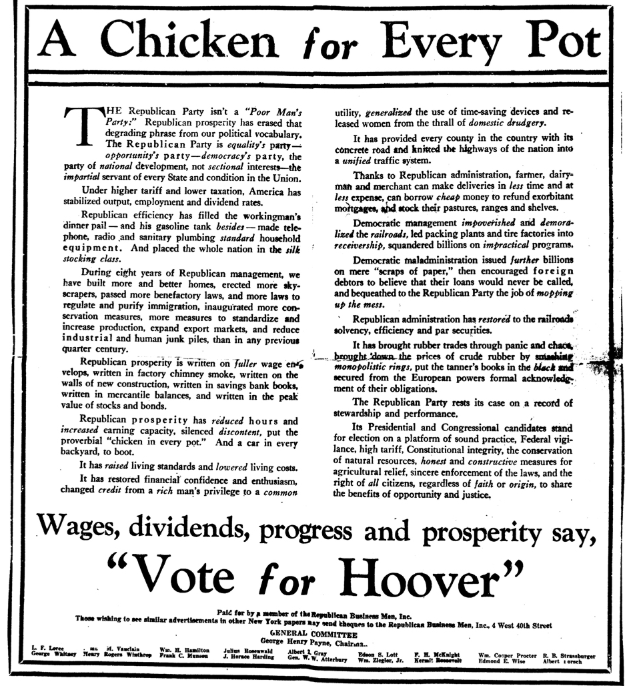
The idea is if you promise people jobs, money, and success –“a chicken in every pot” (1920’s Republican slogan) — you will win.

Ambition, greed, and compassion are strong motivators, appealing motivators, motivators that often work.

But I suggest there is an even stronger motivator, and that is bigotry. The most powerful human emotions are anger and fear — the ultimate survival emotions — and bigotry appeals to both.

Franklin Roosevelt’s famous “date which will live in infamy” speech was based on bigotry — anger at, and fear of “The Japanese Empire.” It was meant to stir up hatred of Japan and the Japanese people, and it succeeded so well that subsequently, Roosevelt was able to round up and sequester thousands of American citizens whose only crime was to be of Japanese descent.

Hitler, of course, used bigotry to justify the most terrible and gruesome acts. Hatred is not bounded by reason or compassion. The German people were able to sleep at night.

And Donald Trump has used the Hitler playbook to gather otherwise good, religious people, specifically white evangelicals, into his web.

Bigotry often masquerades as economics and safety. “The Mexicans will take your job.” “The Jews own everything.” “When the blacks move in, they will destroy your house values.”

Most people deny being bigots, so if you ask someone why they hate, they will give you a reason, not the real reason, but a reason.

When Trump talks to white, suburban housewifes, he makes a blatant overture to bigotry:

How Trump Is Using Westchester to Stir Up Suburban Fears
In an appeal to racism among white voters, the president says that Democrats tried to ruin Westchester County, N.Y., through fair housing policies.

“Westchester was ground zero, OK, for what they were trying to do,” Trump said on Monday, in an interview on Fox News with Laura Ingraham, referring to Mr. Biden and his fellow Democrats. “They were trying to destroy the suburban, beautiful place. The American dream, really. They want low-income housing, and with that comes a lot of other problems, including crime.”

It’s all a lie, of course. Democrats Obama, Clinton, Johnson et al didn’t “destroy the suburban, beautiful places.” In fact, suburbs have prospered over the years.

But like Hitler and other bigots, Trump tries to paint a vivid picture: Hoards of wild, untamed blacks and Mexicans, pillaging and raping and turning your neighborhood into a slum. And if you have a tendency to bigotry, this provides a perfect excuse for your beliefs.

Trump cannot cause you to become a bigot. He only can appeal to you if you already are a bigot. No one is born a bigot. Bigotry is a learned disease.

Here are excerpts from an article in “The American Conservative.”

After Trump Loss, ‘Deplorables’ Will Be The Democrats’ First Target
Blame the president for leaving his core supporters at the mercy of the opposition’s cultural and economic revolution
Robert M. Merry, September 7, 2020.

If President Trump loses his reelection bid in November, as appears likely, the greatest victims of his presidency will have been his own constituency—the Americans who have given him his consistent but sub-par approval rating of between 39 percent and 43 percent throughout his tenure.

And when the new Democratic regime takes over, those people will become its target of choice.

We know who they are: largely white, more male than female, generally older than 45, largely blue collar, educated through high school but not much beyond, agitated particularly by U.S. immigration policies of the past few decades, with widespread feelings that their financial standing in the country has been increasingly constricted.

Note the fear-loaded, anger-inducing words: “First target,” “cultural and economic revolution,” “victims,” “target of choice.” These are not words of logic. They are not thoughtful words. They are words to incite the torch-carrying, pitchfork-carrying mob gone mad.

And remember, the words are directed at Joe Biden, a man who has spent many years in public office, 36 as a U.S. Senator and 4 as the Vice-President of the United States. There is nothing in his history to indicate he seeks a “cultural and economic revolution” (whatever that means). But to bigots, facts mean nothing.

Resentful people, who believe their poor circumstances have been caused by “THEM,” need someone to blame — the rich, the criminal, the blacks, Mexicans, Democrats, unpatriotic, gays, and anyone of a different religion or no religion at all. In short, everyone but US.

So, illogically, they vote for a man who expresses hatred for “THEM,” despite the man being one of THEM: A rich, criminal, former Democrat, irreligious, draft-dodging, multiple adulterer. So long as he expresses fear and hatred for “THEM,” that is sufficient.

They are nationalist in outlook, not globalist, with strong feelings of traditional patriotism of the kind that guided their parents and grandparents.

Yes, they will overlook his draft-dodging, his tax-cheating, his four-star-general-insulting, his comments about those who die for their country as being “losers” and “suckers,” so long as he keeps expressing hatred for the people the bigots hate and fear.

Many of them don’t much care for Trump as a person. A Pew Research Center study during the 2016 primaries revealed that fewer than half of Trump supporters ascribed any favorable traits to him. Many didn’t consider him well informed, admirable, or even honest.

But, based on their consistent support for the president over the past four years, it seems that they view him as standing between them and an emerging Democratic coalition, whose policy prescriptions pose an economic threat to them and would otherwise marginalize them in American society.

And those are the key words — “marginalize them in American society.” Trump’s supporters are made to believe the GOP, the party of the rich, together with the rich man who passed a tax cut for the rich, and who has appointed rich incompetents who only try to line their own pockets — that man somehow will lift them from marginalization, while the Democrats, the party of the poor, will marginalize them.

Yes, there is no logic in bigotry, and it is so sad to see people who would benefit most from the implementation of the Ten Steps to Prosperity (below) — a liberal initiative — vote against their own best interests, to further be enslaved by a GOP, a Trump, and Trump’s rich, pack of convicted crooks.

They see the Democratic Party lurching to the left and know that, should the Dems take complete power over the federal government in January, it will go even worse for them than it has over the past quarter century.

U.S. borders will become more porous, largely through executive action. Asylum policies will be loosened up. Pro-immigrant legislation, such as free medical care for illegals, will serve as an enticement for greater illegal entry. A path to legal status, or even citizenship, will be pushed through.

All this will devastate wage rates, thus harming the economic wellbeing of the Trump constituency. It also will serve over time to generate millions of new Democratic voters who will overwhelm the beleaguered white middle-class.

Keep in mind that the immigrants are consumers, whose buying provides more jobs, not fewer, and better jobs because immigrants are less educated than “the beleaguered, white, middle-class.” Immigrants take the lowest, meanest, least remunerative jobs, not the jobs the white, middle-class wants.

And free medical care for the illegals also is free medical care for “the beleaguered white, middle-class” — a benefit the GOP consistently has fought. Medicare, Medicaid, Obamacare, poverty aids — those dreaded liberal initiatives — would be much more beneficial to the white middle-class if the Democrats were not hobbled by Mitch McConnell and his GOP Senate.

Even today, the Democrats wish to pump $3 trillion more into the economy, the vast majority of which would benefit Trump’s followers. The GOP says, “No.”

The Democratic elite will resuscitate the free-trade policies of recent decades, thus reviving the deterioration of industrial America that Trump sought to reverse.

Trump’s efforts largely consisted of ending existing trade agreements and replacing them with almost identical trade agreements, destroying any hope of international trust and cooperation, and importantly, levying tariffs on imports — tariffs that are paid by “the beleaguered, white, middle-class.”

As the world’s former moral, political, and economic leader, America under Trump has become just like Trump: A selfish, dishonest nation whose word means nothing on the international stage, and whose “America first, America only” policy prevented us from even being able to condemn Iran for breaking a treaty we alread had broken.

The further evaporation of working-class industrial jobs will deliver another financial blow to his constituency. A likely return to humanitarian interventionism, meanwhile, will lead to new foreign wars, sap the nation’s resources, stir internal frictions, and pull the sons and daughters of Middle America into the maw of conflict.

To “sap the nation’s resources” Trump has begun a war — a trade war — paid for by his followers, as is the Wall which was not paid for by Mexico.

The evaporation of industrial jobs was caused not by immigrants, but by computer automation, and was inevitable. Rather than curse the darkness, America’s leaders should have provided the finances and education necessary to help “the beleaguered, white, middle-class” benefit from this new reality. Trump could have done that, but he didn’t.

Machines now do the mind-numbing, repetitive, brainless industrial jobs Trump’s followers are told to desire. Is that what they really want for their children and grandchildren? Helping people to again become coal miners does them no favors. It merely destroys hope. It is Trump’s dystopian vision.

Trump supporters can see the shape of things to come when they witness Black Lives Matter protesters accosting people in restaurants and bars, yelling “silence is violence” into their faces and demanding gestures of support.

They can’t miss the implications of protests turning into violent riots, with property destroyed, businesses obliterated, downtowns turned into war zones, even violence perpetrated on innocent people with the wrong views—all while police forces in cities throughout America, hobbled by anti-police zealotry (or intimidation) on the part of liberal local officials, stand by and watch.

Portland is not everywhere, but it is far more interesting to the television networks than pictures of the many thousands of people all over America, quietly protesting against racial bigotry.

Rather than demonize the comparatively few violent protesters (many of whom are white supremacists, and Russian-backed thugs fomenting violence), Trump should use his power of office to eliminate the fundamental reason for the crime, the violence, and the protests: Poverty.

Instead, he blames the victims and adds fuel to the class-warfare fire. Given two ways to deal with unfairness in American society — penalize the rich or lift up the poor — Trump has chosen a third way: Beat down the poorest.

What went wrong? Trump went wrong.

He built his constituency by exposing to America the fundamental political reality of 2016—namely, the widening chasm between Middle America and its bicoastal elites of big media, government officials, think tanks, big tech, burgeoning financial institutions, the federal deep state, and mavens of popular culture.

He pulled his voters together into a tight knot of political support born of fear and intimidation and self-interest.

But then he couldn’t build on it. He could never take his 43 percent support and find a way to add another 10 percent by devising policies designed to operate on the political margin.

Trump identified a real problem — the Gap between the rich and the rest — and because he is a psychopath, he has not led us away from the Gap but right into it. His real policy has not been “America first” or even “America only.” His real policy has been “Trump only.”

That as many as 43 percent fell for it, is a credit to his personal charisma, a common feature of psychopaths.

(In the Robert Hare Checklist of Psychopathy Symptoms, #1 is: GLIB AND SUPERFICIAL CHARM — the tendency to be smooth, engaging, charming, slick, and verbally facile. Psychopathic charm is not in the least shy, self-conscious, or afraid to say anything.)

A well-crafted grand strategy on immigration probably could have served the purpose, had there been sufficient compromise involved.

A success on the health care issue would have helped.

A big factor could have been a foreign policy success fulfilling the president’s promise of reducing America’s military footprint overseas.

A use of language and a comportment signifying a sense of national unity, at least to the point of creating a majority coalition, could have helped tremendously—and would have been easy to do.

But Trump couldn’t do any of it. The result was that he couldn’t get beyond his core constituency and hence probably can’t be reelected. That likely will leave that core constituency in the lurch as the nation continues the politics of rancor, recrimination, and abuse under a new Democratic regime.

He couldn’t do any of it because he is a psychopath. He had no grand strategy on immigration or anything else. (Hare Checklist item #13 LACK OF REALISTIC, LONG-TERM GOALS — an inability or persistent failure to develop and execute long-term plans and goals.)

He had no success with health care because it didn’t affect him personally. He simply has no compassion for the sick. (Hare Checklist item #8 CALLOUSNESS and LACK OF EMPATHY — a lack of feelings toward people in general; cold, contemptuous, inconsiderate, and tactless.)

He had no foreign policy success because no one can trust him to live up to a commitment. (Hare Checklist item 15. IRRESPONSIBILITY — repeated failure to fulfill or honor obligations and commitments; such as not paying bills, defaulting on loans, performing sloppy work, being absent or late to work, failing to honor contractual agreements.)

He caused national disunity because he has Hare Checklist item 10. POOR BEHAVIORAL CONTROLS —  expressions of irritability, annoyance, impatience, threats, aggression and verbal abuse; inadequate control of anger and temper; acting hastily.

If Trump loses, his core constituency will not be left in the lurch. In fact, a Democratic White House and Senate would be the best thing that ever happened to “the beleaguered, white, middle-class.”

They will have free, comprehensive health care, jobs well above the ditch-digging, brainless jobs Trump wants them to have, education for their children, and better Social Security benefits.

And the violent protests, which really are protests against Trump’s violent police state, would end. Trump preaches violence, and his violence always begets more violence. Then he blames the protesters for what he has wrought.

The beleaguered, white, middle-class need only to ignore the siren song of a man and a party — Trump and the GOP –that uses them and takes from them, but cares nothing for them.

Bigotry works because it appeals to our fundamental emotions of fear and hatred, but bigotry is self-consuming, and those who follow Trump are being led into the darkness.

Rodger Malcolm Mitchell

Monetary Sovereignty Twitter: @rodgermitchell Search #monetarysovereignty Facebook: Rodger Malcolm Mitchell …………………………………………………………………………………………………………………………………………………………………………………………………………………………………………………………………………………………..

THE SOLE PURPOSE OF GOVERNMENT IS TO IMPROVE AND PROTECT THE LIVES OF THE PEOPLE.

The most important problems in economics involve:

  1. Monetary Sovereignty describes money creation and destruction.
  2. Gap Psychology describes the common desire to distance oneself from those “below” in any socio-economic ranking, and to come nearer those “above.” The socio-economic distance is referred to as “The Gap.”

Wide Gaps negatively affect poverty, health and longevity, education, housing, law and crime, war, leadership, ownership, bigotry, supply and demand, taxation, GDP, international relations, scientific advancement, the environment, human motivation and well-being, and virtually every other issue in economics. Implementation of Monetary Sovereignty and The Ten Steps To Prosperity can grow the economy and narrow the Gaps:

Ten Steps To Prosperity:

1. Eliminate FICA

2. Federally funded Medicare — parts A, B & D, plus long-term care — for everyone

3. Social Security for all or a reverse income tax

4. Free education (including post-grad) for everyone

5. Salary for attending school

6. Eliminate federal taxes on business

7. Increase the standard income tax deduction, annually. 

8. Tax the very rich (the “.1%”) more, with higher progressive tax rates on all forms of income.

9. Federal ownership of all banks

10.Increase federal spending on the myriad initiatives that benefit America’s 99.9% 

The Ten Steps will grow the economy and narrow the income/wealth/power Gap between the rich and the rest.

MONETARY SOVEREIGNTY

Your periodic reminder. After 80 years, the federal debt still is a “ticking time bomb.”

Here is your periodic reminder. After 80 years, the federal debt still is being called a “ticking time bomb,” the slowest time-bomb in history.

We don’t need to go into too much detail. We’ve said it often enough:

  1. The federal “debt” is not debt in the usual sense. The federal government does not borrow. The so-called “debt” is the total of deposits into Treasury Security accounts at the Federal Reserve. The federal government does not touch these deposits, and the accounts can be paid off instantly by returning the balances to the account owners. No tax dollars are involved. No burden on future generations.
  2. Federal deficits add dollars to the economy. Federal deficits are necessary for economic growth. Recessions and depressions result from decreased deficit growth and are cured by increased deficit growth.
  3. The U.S. government, being Monetarily Sovereign, cannot run short of its own sovereign currency. It never can become insolvent. Even if federal tax collections totaled $0, the federal government could continue spending, forever. That is why the federal government never borrows.
  4. The U.S. debt-to-GDP ratio is absolutely meaningless with regard to federal solvency. The ratio could go to 1,000% and the U.S. government still would be able to pay its bills.

These facts do not penetrate the minds of the debt shriekers, who after all these years still do not understand the financial differences between a Monteraily Sovereign government (the U.S. federal government) and monetarily non-sovereign governments (state & local governments).

The former has the unlimited ability to create dollars. The latter, like you, and me, and the states can become insolvent. Vast difference.

So every year, every month, perhaps every day, we see warnings like this:

29 Aug 2020 LOS ANGELES, California: Commentary: America’s mountain of debt is a ticking time bomb. The United States not only looks ill, but also dead broke.This image has an empty alt attribute; its file name is mountain-of-debt.png

To offset the pandemic-induced “Great Cessation,” the US Federal Reserve and Congress have marshalled staggering sums of stimulus spending out of fear that the economy would otherwise plunge to 1930s soup kitchen levels.

The 2020 federal budget deficit will be around 18 per cent of GDP, and the US debt-to-GDP ratio will soon hurdle over the 100 per cent mark.

Such figures have not been seen since Harry Truman sent B-29s to Japan to end World War II.

Assuming that America eventually defeats COVID-19 and does not devolve into a Terminator-like dystopia, how will it avoid the approaching fiscal cliff and national bankruptcy?

To answer such questions, we should reflect on the lessons of World War II, which did not bankrupt the US, even though debt soared to 119 per cent of GDP. By the time of the Vietnam War in the 1960s, that ratio had fallen to just above 40 per cent.

World War II was financed with a combination of roughly 40 per cent taxes and 60 per cent debt.

It all is utter nonsense, exactly the same nonsense that has been published and spoken by self-anointed “experts, since 1940. Every year, those same-old warnings about the same-old “ticking time-bomb” that never seems to go off.

It would be laughable if not for the fact that many people still believe this stuff.

To clarify:

World War II was not financed with taxes or debt. It was financed the same way all federal spending is financed: The federal government, being Monetarily Sovereign, pays all its bills by creating new dollars, ad hoc.

Federal taxes are destroyed upon receipt.

Federal “debt” actually is deposits into T-security accounts, the dollars in which are not taken by the federal government.

Here is a partial list of the “boy-who-cried-wolf” calls that have emanated from the debt scare-mongers.

================================================================================================================================================================================================

September, 1940, the federal budget was a “ticking time-bomb which can eventually destroy the American system,” said Robert M. Hanes, president of the American Bankers Association.

September 26, 1940, New York Times, Column 8

By 1960: the debt was “threatening the country’s fiscal future,” said Secretary of Commerce, Frederick H. Mueller. (“The enormous cost of various Federal programs is a time-bomb threatening the country’s fiscal future, Secretary of Commerce Frederick H. Mueller warned here yesterday.”)

By 1983: “The debt probably will explode in the third quarter of 1984,” said Fred Napolitano, former president of the National Association of Home Builders.

In 1984: AFL-CIO President Lane Kirkland said. “It’s a time bomb ticking away.”

In 1985: “The federal deficit is ‘a ticking time bomb, and it’s about to blow up,” U.S. Sen. Mitch McConnell. (Remember him?)

Later in 1985: Los Angeles Times: “We labeled the deficit a ‘ticking time bomb’ that threatens to permanently undermine the strength and vitality of the American economy.”

In 1987: Richmond Times–Dispatch – Richmond, VA: “100TH CONGRESS FACING U.S. DEFICIT ‘TIME BOMB’”

Later in 1987: The Dallas Morning News: “A fiscal time bomb is slowly ticking that, if not defused, could explode into a financial crisis within the next few years for the federal government.”

In 1989: FORTUNE Magazine: “A TIME BOMB FOR U.S. TAXPAYERS

In 1992: The Pantagraph – Bloomington, Illinois: “I have seen where politicians in Washington have expressed little or no concern about this ticking time bomb they have helped to create, that being the enormous federal budget deficit, approaching $4 trillion.

Later in 1992: Ross Perot: “Our great nation is sitting right on top of a ticking time bomb. We have a national debt of $4 trillion.”

In 1995: Kansas City Star: “Concerned citizens. . . regard the national debt as a ticking time bomb poised to explode with devastating consequences at some future date.”

In 2003: Porter Stansberry, for the Daily Reckoning: “Generation debt is a ticking time bomb . . . with about ten years left on the clock.”

In 2004: Bradenton Herald: “A NATION AT RISK: TWIN DEFICIT A TICKING TIME BOMB

In 2005: Providence Journal: “Some lawmakers see the Medicare drug benefit for what it is: a ticking time bomb.”

In 2006: NewsMax.com, “We have to worry about the deficit . . . when we combine it with the trade deficit we have a real ticking time bomb in our economy,” said Mrs. Clinton.

In 2007: USA Today: “Like a ticking time bomb, the national debt is an explosion waiting to happen.

In 2010: Heritage Foundation: “Why the National Debt is a Ticking Time Bomb. Interest rates on government bonds are virtually guaranteed to jump over the next few years.

In 2010: Reason Alert: “. . . the time bomb that’s ticking under the federal budget like a Guy Fawkes’ powder keg.”

In 2011: Washington Post, Lori Montgomery: ” . . . defuse the biggest budgetary time bombs that are set to explode.”

June 19, 2013: Chamber of Commerce: Safety net spending is a ‘time bomb’, By Jim Tankersley: The U.S. Chamber of Commerce is worried that not enough Americans are worried about social safety net spending. The nation’s largest business lobbying group launched a renewed effort Wednesday to reduce projected federal spending on safety-net programs, labeling them a “ticking time bomb” that, left unchanged, “will bankrupt this nation.”

In 2014: CBN News: “The United States of Debt: A Ticking Time Bomb

On Jun 18, 2015: The ticking economic time bomb that presidential candidates are ignoring: Fortune Magazine, Shawn Tully,

On February 10, 2016, The Daily Bell“Obama’s $4.1 Trillion Budget Is Latest Sign of America’s Looming Collapse”

On January 23, 2017: Trump’s ‘Debt Bomb’: Deficit May Grow, Defense Budget May Not, By Sydney J. Freedberg, Jr.

On January 27, 2017: America’s “debt bomb is going to explode.” That’s according to financial strategist Peter Schiff. Schiff said that while low interest rates had helped keep a lid on U.S. debt, it couldn’t be contained for much longer. Interest rates and inflation are rising, creditors will demand higher premiums, and the country is headed “off the edge of a cliff.”

On April 28, 2017: Debt in the U.S. Fuel for Growth or Ticking Time Bomb?, American Institute for Economic Research, by Max Gulker, PhD – Senior Research Fellow, Theodore Cangeros

Feb. 16, 2018  America’s Debt Bomb By Andrew Soergel, Senior Reporter: Conservatives and deficit hawks are hurling criticism at Washington for deepening America’s debt hole.

April 18, 2018 By Alan Greenspan and John R. Kasich: “Time is running short, and America’s debt time bomb continues to tick.”

January 10, 2019, Unfunded Govt. Liabilities — Our Ticking Time Bomb. By Myra Adams, Tick, tick, tick goes the time bomb of national doom.

January 18, 2019; 2019 Is Gold’s Year To Shine (And The Ticking US Debt Time-Bomb) By Gavin Wendt

[The following were added after the original publishing of this article]

April 10, 2019, The National Debt: America’s Ticking Time Bomb.  TIL Journal. Entire nations can go bankrupt. One prominent example was the *nation of Greece which was threatened with insolvency, a decade ago. Greece survived the economic crisis because the European Union and the IMF bailed the nation out.

July 11, 2019National debt is a ‘ticking time bomb‘: Sen. Mike Lee

SEP 12, 2019, Our national ticking time bomb, By BILL YEARGIN
SPECIAL TO THE SUN SENTINEL | At some point, investors will become concerned about lending to a debt-riddled U.S., which will result in having to offer higher interest rates to attract the money. Even with rates low today, interest expense is the federal government’s third-highest expenditure following the elderly and military. The U.S. already borrows all the money it uses to pay its interest expense, sort of like a Ponzi scheme. Lack of investor confidence will only make this problem worse.

JANUARY 06, 2020, National debt is a time bomb, BY MARK MANSPERGER, Tri City Herald | The increase in the U.S. deficit last year was about $1.1 trillion, bringing our total national debt to more than $23 trillion! This fiscal year, the deficit is forecasted to be even higher, and when the economy eventually slows down, our annual deficits could be pushing $2 trillion a year! This is financial madness.there’s not going to be a drastic cut in federal expenditures — that is, until we go broke — nor are we going to “grow our way” out of this predicament. Therefore, to gain control of this looming debt, we’re going to have to raise taxes.

February 14, 2020, OMG! It’s February 14, 2020, and the national debt is still a ticking time bomb!  The national debt: A ticking time bomb? America is “headed toward a crisis,” said Tiana Lowe in WashingonExaminer.com. The Treasury Department reported last week that the federal deficit swelled to more than $1 trillion in 2019 for the first time since 2012. Even more alarming was the report from the bipartisan Congressional Budget Office (CBO) predicting that $1 trillion deficits will continue for the next 10 years, eventually reaching $1.7 trillion in 2030

April 26, 2020, ‘Catastrophic’: Why government debt is a ticking time bomb, Stephen Koukoulas, Yahoo Finance  [Re. Monetarily Sovereign Australia’s debt.]

August 29, 2020LOS ANGELES, California: America’s mountain of debt is a ticking time bomb  The United States not only looks ill, but also dead broke. To offset the pandemic-induced “Great Cessation,” the US Federal Reserve and Congress have marshalled staggering sums of stimulus spending out of fear that the economy would otherwise plunge to 1930s soup kitchen levels. Assuming that America eventually defeats COVID-19 and does not devolve into a Terminator-like dystopia, how will it avoid the approaching fiscal cliff and national bankruptcy?

APR. 16, 2021NATIONAL POLICY: ECONOMY AND TAXES / MARK ALEXANDER /
The National Debt Clock: A Ticking Time Bomb: At the moment, our national debt exceeds $28 TRILLION — about 80% held as public debt and the rest as intragovernmental debt. That is $225,000 per taxpayer. Federal annual spending this year is almost $8 trillion, and more than half of that is deficit spending — piling on the national debt.

======================================================================

Oooh, “the approaching fiscal cliff and national bankruptcy” still are approaching — but never arriving. The only fiscal cliff we have is the one that Trump + COVID are pushing us over. The people in America may go bankrupt, but the federal government never will.

And yet, the GOP refuses to implement the latest $3 trillion rescue package proposed by the Democrats because . . . well, because it was proposed by the Democrats and it includes benefits for the poor and middle-income groups, and “not enough” for the rich.

Millions of Americans are jobless and starving, but that ole’ federal debt bomb is still ‘a tickin’.

Rodger Malcolm Mitchell

Monetary Sovereignty Twitter: @rodgermitchell Search #monetarysovereignty Facebook: Rodger Malcolm Mitchell …………………………………………………………………………………………………………………………………………………………………………………………………………………………………………………………………………………………..

THE SOLE PURPOSE OF GOVERNMENT IS TO IMPROVE AND PROTECT THE LIVES OF THE PEOPLE.

The most important problems in economics involve:

  1. Monetary Sovereignty describes money creation and destruction.
  2. Gap Psychology describes the common desire to distance oneself from those “below” in any socio-economic ranking, and to come nearer those “above.” The socio-economic distance is referred to as “The Gap.”

Wide Gaps negatively affect poverty, health and longevity, education, housing, law and crime, war, leadership, ownership, bigotry, supply and demand, taxation, GDP, international relations, scientific advancement, the environment, human motivation and well-being, and virtually every other issue in economics. Implementation of Monetary Sovereignty and The Ten Steps To Prosperity can grow the economy and narrow the Gaps:

Ten Steps To Prosperity:

1. Eliminate FICA

2. Federally funded Medicare — parts A, B & D, plus long-term care — for everyone

3. Social Security for all or a reverse income tax

4. Free education (including post-grad) for everyone

5. Salary for attending school

6. Eliminate federal taxes on business

7. Increase the standard income tax deduction, annually. 

8. Tax the very rich (the “.1%”) more, with higher progressive tax rates on all forms of income.

9. Federal ownership of all banks

10.Increase federal spending on the myriad initiatives that benefit America’s 99.9% 

The Ten Steps will grow the economy and narrow the income/wealth/power Gap between the rich and the rest.

MONETARY SOVEREIGNTY

Whose lies are more harmful to you: Trump’s or the libertarians’?

Donald Trump, being a demonstrated psychopath, is the most frequent liar of any previous American President, perhaps the most frequent of any human in history. His lies, plus his Presidential power, have caused grievous harm to America.

Everything he touches turns to disaster. Soldiers have died. Thousands of other Americans have died. People are homeless. Children are starving. The man walks in chaos. When historians evaluate America’s Presidents, I predict Trump will fall to the bottom.

Bernanke: “Guess what. The Libertarians still claim the government can become insolvent!” Greenspan: “And some people believe it??”

Yet with all that, I submit that the Libertarians and their believers are more harmful to you than he is.

See if you agree. Here are some excerpts from a Libertarian article.

Both Biden and Trump Plan to Spend Well Beyond the Government’s “Means.”
Whether Biden or Trump wins this November, we’re in for big, unaffordable government. How much bigger and how unaffordable are the only real questions. By: )

Immediately, we are confronted with lies.

First, the federal government, unlike state and local government, is Monetarily Sovereign. It has the unlimited ability to create dollars. It has no “means.” It never can run short of its own sovereign currency, the U.S. dollar. It neither needs nor uses tax dollars. It creates dollars at will.

Can you believe it? The Libertarians still claim the government can become insolvent.

Who says so?

Former Fed Chairman, Ben Bernanke: “The U.S. government has a technology called a printing press (or today, its electronic equivalent) that allows it to produce as many U.S. dollars as it wishes at essentially no cost.”

Former Fed Chairman Alan Greenspan: A government cannot become insolvent with respect to obligations in its own currency.”

And Greenspan again: There is nothing to prevent the federal government from creating as much money as it wants and paying it to somebody.”

And the St. Louis Federal Reserve Bank: As the sole manufacturer of dollars, whose debt is denominated in dollars, the U.S. government can never become insolvent, i.e. unable to pay its bills. In this sense, the government is not dependent on credit markets to remain operational.”

And then there’s Warren Buffet: “Those who regularly preach doom because of government budget deficits, (as I regularly did myself for many years) might note that our country’s national debt has increased roughly 400 fold during the last of my 77-year periods.”

I inspected J.D. Tuccille’s article very carefully, and nowhere does he define, “Well Beyond The Government’s Means.” And you will find that no other debt “hand-wringer” ever explains that phrase. Tuccille simply refers to “unaffordable government.” But unaffordable for whom? Here’s a hint:

Tuccille: “There are differences between what Republican Trump and Democrat Joe Biden threaten to inflict on us in terms of raising revenue and how to spend it.”

Tuccille claims “revenue (i.e. taxes) pay for federal spending. That would be true of monetarily non-sovereign governments — i.e. state and local governments and euro governments — but it is not true of the federal government. If it were true, then it would be possible for the federal government to become insolvent, and Greenspan, Bernanke, and the St. Louis Fed would be wrong.

So perhaps, Tuccille’s “unaffordable” refers to taxpayers. But since taxes do not fund federal spending, his comment makes no sense.

The federal government does not spend tax dollars. It destroys tax dollars, and creates new dollars, ad hoc, when it spends.

The details are hard to nail down—probably deliberately so on the part of the campaigns—but Trump essentially promises tax cuts (and penalties for those who cross him) while spending too much, and Biden intends to raise taxes while ignoring the idea that spending must be constrained in any way.

When it comes to taxes, Trump continues the Republican Party’s traditional interest in reducing the government’s take.

The Republican Party’s “traditional interest” would be correct, except for two small details. They become interested in tax reductions only when the President is a Democrat, and even then, they want tax reductions only for the rich.

And when federal spending is “constrained,” we have recessions and depressions, which are cured by unconstrained federal spending.

“Without further details or clarification, it is difficult to fully analyze President Trump’s second term tax policy agenda,” Erica York noted last week for the Tax Foundation. “Broad themes of the president’s agenda include providing tax relief to individuals and tax credits to businesses that engage in desired activities.”

“Difficult to fully analyze” is another way of saying, Trump has no tax policy agenda. (He also has no health-care agenda, no immigration agenda, no foreign policy agenda, and no COVID agenda). About the only agenda he consistently has had is, “What’s best for me.”

Also, “tax relief to individuals should read, “tax relief to wealthy Republicans.” Also, “tax credits to businesses that engage in desired activities” should read, “tax credits to businesses whose owners support me.”

The exception is on the matter of tariffs, given that the president has wandered from his party’s long-time support of free trade.

Trump has “wandered” because he believes, or rather, wants us to believe, that American’s import duties are paid by China, when in reality, they are paid by Americans.

“In his first term, President Trump has imposed more than $80 billion of tax increases in the form of tariffs,” adds York. “Recently, the president said he would impose tariffs on companies that do not move jobs back to the United States from overseas. Whether this is a formal policy proposal is unclear, but it indicates the possibility of continued tariffs if Trump wins reelection.”

Trump typically flails wildly at anything or anyone he believes does not support him. His flailing generally punishes Americans.

Biden, too, fulfills the role you would expect of his party affiliation as a Democrat.

“Biden has not released a single formal tax plan, but he has proposed many tax changes and increases connected to spending proposals related to issues like climate change, infrastructure, health care, education, and research & development,” Garrett Watson and Erica York wrote for the Tax Foundation. “Most of these proposals center around raising income taxes on high earners as well as on businesses.”

With a little more detail to analyze, Watson and York “estimate that Biden’s tax proposals would raise about $3.8 trillion over 10 years. The plan would also reduce long-run economic growth by 1.51 percent and eliminate about 585,000 full-time equivalent jobs.”

All federal taxes reduce economic growth because they reduce the supply of money in the economy. The only worthwhile federal taxes are those that narrow the Gap between the rich and the rest. The Gap is even more harmful to the economy than is the growth-reducing effects of money supply reduction.

Notice how Tuccille admits that taxes “reduce long-run economic growth,” then still talks about the government spending beyond its means. This reflects the knee-jerk, government hatred bythe Libertarians. To them, all government is too big and all government spending is too much. The reality of Libertarianism is that it always devolves to anarchy.

Whether or not a government is taxing too little, enough, or too much is relative to how much it plans to spend and how much ruckus taxpayers kick up in response to the legalized mugging. For both legacy-party candidates, lots of spending well beyond the government’s means is part of the plan.

Yes, yes, again the government’s non-existent “means.” In 1940, the federal debt was about $40 billion. Today, it is above $20 trillion, a 500-fold increase. For 80 years, the U.S. government has been spending beyond its non-existent “means,” and Tuccille still hasn’t caught on.

In Trump’s case, we know he isn’t shy about cutting checks. “Under Trump’s signature, before any true crisis hit, the annual price tag of government went up by $937 billion in less than four years,” Reason’s Matt Welch recently wrote.

For his 2021 budget (a theoretical document, since the federal government has given up on formal budgets), President Trump proposed continuously increasing federal spending, though slower growth than was originally forecast.

Libertarians and those of similar ilk, love to complain about “federal spending,” but when it comes to specifics, they strangely are mute (except for proposing cuts to spending that benefits the not-rich. They generally are happy to see cuts to Medicare, Social Security, and other anti-poverty initiatives.

“The federal deficit would be $2.1 trillion smaller under the President’s budget than in CBO’s baseline over the 2021–2030 period,” the Congressional Budget Office (CBO) projected earlier this year. That certainly sounds like an improvement, but the budget consistently spends more than the government collects to leave the country with a cumulative $11 trillion deficit instead of the baseline anticipated $13 trillion deficit.

There it is again. He admits that the government consistently spends more than it taxes — almost every year for the past 80 years — and yet here we are. The government has been spending beyond its “means” and nothing is unaffordable.

How do Libertarians explain the absence of insolvency? They ignore history and facts, and keep screaming that the sky is falling, or soon will fall, or us just about to fall. And still, it doesn’t fall.

Then again, that seems almost realistic when compared to what Trump’s main rival, Joe Biden, plans in terms of increased expenditures and benefits.

“From a variety of sources—campaign releases, independent analyses, media stories and the Congressional Budget Office—I have constructed a rough estimate of what it would cost to cover all the new benefits,” The Washington Post’s Robert Samuelson recently tallied. “The additional 10-year spending totals $7.74 trillion.”

“But wait, we’re not finished yet,” wrote Samuelson. “To these costs ought to be added the projected budget deficits under existing policies. For the period from 2021 to 2030, CBO figures that’s another $13 trillion. The grand total comes to $20.7 trillion (the $13 trillion, plus the $7.7 trillion).”

I should add here that the CBO recently admitted that it “has tended to overestimate revenues in its projections—especially those that extend further into the future.” That means we should expect deficits to be higher than all of this number-crunching predicts, with larger debt to result.

Oh, woe. The federal government, which has infinite money, plans to pump more money into the economy. And this is supposed to frighten us? You know what frightens me? The notion that someday again, a Libertarian idea might take hold in the federal government, and we again would have this:

1804-1812: U. S. Federal Debt reduced 48%. Depression began 1807.
1817-1821: U. S. Federal Debt reduced 29%. Depression began 1819.
1823-1836: U. S. Federal Debt reduced 99%. Depression began 1837.
1852-1857: U. S. Federal Debt reduced 59%. Depression began 1857.
1867-1873: U. S. Federal Debt reduced 27%. Depression began 1873.
1880-1893: U. S. Federal Debt reduced 57%. Depression began 1893.
1920-1930: U. S. Federal Debt reduced 36%. Depression began 1929.
1997-2001: U. S. Federal Debt reduced 15%. Recession began 2001.

Bill Clinton, the faux Democrat, was hailed by Libertarians (and by himself) for cutting the debt in the 1997-2001 period. Clearly, that didn’t turn out well. (What, Mr. Tuccille, you’re surprised that taking money out of the private sector led to a recession?)

And all of this is before we take into account the damage wrought by the pandemic and by government-imposed lockdowns.

And what does Mr. Tuccille want to do about that “damage”? He wants to cut federal spending at just the time when millions are jobless and starving. It’s classic Libertarian craziness.

Economic activity “appeared to have declined at a historically rapid rate in the second quarter,” the Federal Reserve conceded in July, adding that “the pace of declines in the unemployment rate, over the second half of this year were expected to be somewhat less robust than in the previous forecast.”

A smaller, struggling economy in which people are scrambling to rebuild businesses, jobs, and wealth isn’t going to surrender as much revenue as government types would like. It’s also likely to be more vulnerable than a thriving economy to burdensome taxes and tariffs.

All taxes and tariffs “burdensome.” Why? Because they all reduce the supply of dollars in the economy — which is exactly what the Libertarians wish to do.

Whoever wins the presidency—realistically, either Biden or Trump—we’re in for big, unaffordable government. How much bigger and how unaffordable are the only real questions.

No, the only question is: When will the Libertarians, the Democrats, the Republicans, and the media tell the American people that:

  1. A growing economy requires a growing supply of money
  2. Federal deficit spending supplies those growth dollars.
  3. The U.S. federal government, being Monetarily Sovereign, has infinite dollars. It never can run short. It never can be insolvent. The federal government never can be unaffordable.

But then, if the Libertarians admitted it, there would be no raison d’etre for Libertarianism, would there? And the populace, who understood it, would demand Gap-narrowing benefits, which the rich who run America don’t want.

So perhaps the real question is, What will it take to teach the Libertarians, the politicians, and the populace, what really should, at long last, be obvious?

Rodger Malcolm Mitchell

Monetary Sovereignty Twitter: @rodgermitchell Search #monetarysovereignty Facebook: Rodger Malcolm Mitchell …………………………………………………………………………………………………………………………………………………………………………………………………………………………………………………………………………………………..

THE SOLE PURPOSE OF GOVERNMENT IS TO IMPROVE AND PROTECT THE LIVES OF THE PEOPLE.

The most important problems in economics involve:

  1. Monetary Sovereignty describes money creation and destruction.
  2. Gap Psychology describes the common desire to distance oneself from those “below” in any socio-economic ranking, and to come nearer those “above.” The socio-economic distance is referred to as “The Gap.”

Wide Gaps negatively affect poverty, health and longevity, education, housing, law and crime, war, leadership, ownership, bigotry, supply and demand, taxation, GDP, international relations, scientific advancement, the environment, human motivation and well-being, and virtually every other issue in economics. Implementation of Monetary Sovereignty and The Ten Steps To Prosperity can grow the economy and narrow the Gaps:

Ten Steps To Prosperity:

1. Eliminate FICA

2. Federally funded Medicare — parts A, B & D, plus long-term care — for everyone

3. Social Security for all or a reverse income tax

4. Free education (including post-grad) for everyone

5. Salary for attending school

6. Eliminate federal taxes on business

7. Increase the standard income tax deduction, annually. 

8. Tax the very rich (the “.1%”) more, with higher progressive tax rates on all forms of income.

9. Federal ownership of all banks

10.Increase federal spending on the myriad initiatives that benefit America’s 99.9% 

The Ten Steps will grow the economy and narrow the income/wealth/power Gap between the rich and the rest.

MONETARY SOVEREIGNTY

Why police brutality cannot be cured

We cannot cure a disease by curing the symptoms.

The August 15, 2020 issue of Science News Magazine contained an article titled, “There’s little evidence showing which police reforms work, Rapid research is needed to find out what efforts are most effective.

The article discusses “de-escalation training,” body-worn cameras, early intervention systems, and civilian oversight of the police. The author, Robin Engel, “was unable to identify a single police reform with convincing evidence of behavior change among officers.

Should We Reassess Police Body Cameras Based on Latest Study? | American Civil Liberties Union
Cameras have not cured police brutality.

The reason is, police brutality is not the disease. It is the symptom.

Defunding the police will not work. “Reallocating police services to other agencies functions such as mental health calls or monitoring safety in schools” has not worked, will not work, and cannot work. Nor will increased funding for police.

Where police are brutal, it is because they suffer from the three “f’s,” fear, frustration, and fury.

Nothing can cure fear, frustration, and fury because they themselves are not the disease.

They are the symptoms.

Police are human. In big cities, what police experience in a day, emotionally exceeds what most of us experience in a lifetime. That makes them emotional. To ease the emotion we must cure the environment, not cure the police.

The police are caught between dangerous criminals on one side, and an ignorant and uncaring public on the other side. Fear, frustration, and fury.

Street crime is a symptom, not a disease. You could spend billions to flood neighborhoods with police officers, and you will not stop street crime. You could impose harsh sentences for street crimes — “lock ’em up and throw away the key” — and you will not stop street crime.

Bad schools are a symptom. You could spend billions to double teachers’ salaries, and to build new school buildings, and to provide computers to every student, and still you would not cure bad schools. They are only a symptom, not the disease.

Bad housing is not a disease; it is a symptom. You could spend trillions to provide everyone with a nice new house, and that would accomplish nothing. In a few years, the houses would be as bad as ever.

Housing segregation is not a disease; it is a symptom. You could pass strict laws that demand low-income housing in high-income neighborhoods, and you would not cure housing segregation. The rich would move away, the poor could not afford the upkeep, so the neighborhoods would decay.

“Food deserts” (the lack of neighborhood food sources) are not a disease. They are a symptom. It would do no good to build food stores where owners fear robberies and potential customers fear to go outside.

Juvenile delinquency is not a disease; it is a symptom. You could spend billions putting police in every school, and on every street corner; you could track down school absentees, and lecture parents, but you could not cure juvenile delinquency. It is not the disease. It is only a symptom.

I live in a suburb that borders only four miles from Chicago. While Chicago suffers greatly from police brutality, street crime, bad schools, bad housing, housing segregation, and juvenile delinquency, my suburb does not.

Bring in the psychologists; bring in the police; bring in the marchers, the preachers, the well-meaning reformers and politicians. It will do no good. You can’t cure a disease by treating the symptoms.

And what is the disease?

The disease is poverty, or more specifically, the wide Gap between the richer and the poorer.

Poverty is the disease that causes street crime, which in turn causes the fear, frustration, and fury, leading to police brutality.

Poverty is the disease the causes bad housing. Poor people cannot afford to buy or to maintain good housing. And bad housing begets bad housing next door, and down the block, and on to the adjoining blocks, until the entire neighborhood is a hopeless slum.

Juvenile delinquency is caused by bad parenting and by hopelessness about tomorrow and about years from tomorrow. Impoverished parents cannot provide time for guidance, nor money for worldly goods, nor can they provide the hope children need. Left untethered the children learn from older children, and become delinquent, stealing what they cannot buy.

12 years ago today, Fed chair Greenspan saw “froth” not housing bubbles – Orange County Register
Chairman Alan Greenspan: “There is nothing to stop the government from creating as much money as it wants, and paying it to somebody.”

America has spent millions, billions, and trillions trying to cure symptoms while pretending the fundamental disease is the fault of the victims.

The rich, who run America, and who have the power to cure poverty, are not motivated to do  so.

They prefer to shake their heads and “Tsk, tsk” at the impoverished.

They prefer to claim poverty is caused by immorality, laziness, and stupidity. They are wrong.

Poverty is — and also is caused by — lack of money. And money is the one thing the U.S. federal government does not lack.

Being Monetarily Sovereign, the U.S government has the unlimited ability to create dollars. It could fund every poverty-fighting program imaginable without levying a single penny in taxes.

It even could fund the Ten Steps to Prosperity (below) while eliminating federal taxes.

Imagine you have a broken leg, and your doctor, rather than resetting your leg, keeps prescribing pain killers, as your leg festers and worsens. That is how we treat the symptoms of poverty.

The rich do not wish to cure poverty, because that would narrow the Gap between them and the poor.

Fed wrestling with the size of aid program: Bernanke - The Economic Times
Chairman Ben Bernanke: “The U.S. government has a technology, called a printing press (or, today, its electronic equivalent), that allows it to produce as many U.S. dollars as it wishes at essentially no cost.”

“Rich” is a comparative term so in actual effect, narrowing the Gap makes the rich less rich. So the rich resist it.

Narrowing the Gap is a violation of “Gap Psychology,” the desire to distance oneself from those “below,” and to come closer to those “above” in any social measure.

Though money is said to be the root of all evil, it is the lack of money that is the root of so many evil symptoms.

We should stop scurrying in all directions trying to cure symptoms with treatments that are doomed to fail because they don’t treat the disease.

We should stop blaming the impoverished for “laziness” or “immorality.”

We should stop claiming that all poverty aids are “socialism,” or “paternalism” when they need to be neither.

We should stop false envy of the poor if they get something for not working; the rich do it all the time.

The key to ending police brutality and so many other evils of the world is to narrow the Gap between the rich and the rest. Our federal government has the power to do this at no cost to ourselves. The Ten Steps to Prosperity (below) is a good starting point.

So why not?

Rodger Malcolm Mitchell

Monetary Sovereignty Twitter: @rodgermitchell Search #monetarysovereignty Facebook: Rodger Malcolm Mitchell …………………………………………………………………………………………………………………………………………………………………………………………………………………………………………………………………………………………..

THE SOLE PURPOSE OF GOVERNMENT IS TO IMPROVE AND PROTECT THE LIVES OF THE PEOPLE.

The most important problems in economics involve:

  1. Monetary Sovereignty describes money creation and destruction.
  2. Gap Psychology describes the common desire to distance oneself from those “below” in any socio-economic ranking, and to come nearer those “above.” The socio-economic distance is referred to as “The Gap.”

Wide Gaps negatively affect poverty, health and longevity, education, housing, law and crime, war, leadership, ownership, bigotry, supply and demand, taxation, GDP, international relations, scientific advancement, the environment, human motivation and well-being, and virtually every other issue in economics. Implementation of Monetary Sovereignty and The Ten Steps To Prosperity can grow the economy and narrow the Gaps:

Ten Steps To Prosperity:

1. Eliminate FICA

2. Federally funded Medicare — parts A, B & D, plus long-term care — for everyone

3. Social Security for all or a reverse income tax

4. Free education (including post-grad) for everyone

5. Salary for attending school

6. Eliminate federal taxes on business

7. Increase the standard income tax deduction, annually. 

8. Tax the very rich (the “.1%”) more, with higher progressive tax rates on all forms of income.

9. Federal ownership of all banks

10.Increase federal spending on the myriad initiatives that benefit America’s 99.9% 

The Ten Steps will grow the economy and narrow the income/wealth/power Gap between the rich and the rest.

MONETARY SOVEREIGNTY