Rubio’s indentured servant plan for college students

Twitter: @rodgermitchell; Search #monetarysovereignty
Facebook: Rodger Malcolm Mitchell

Mitchell’s laws:
•Those, who do not understand the differences between Monetary Sovereignty and monetary non-sovereignty, do not understand economics.
•Any monetarily NON-sovereign government — be it city, county, state or nation — that runs an ongoing trade deficit, eventually will run out of money.
•The more federal budgets are cut and taxes increased, the weaker an economy becomes..

Liberals think the purpose of government is to protect the poor and powerless from the rich and powerful. Conservatives think the purpose of government is to protect the rich and powerful from the poor and powerless.

•The single most important problem in economics is the Gap between rich and the rest.r.
•Austerity is the government’s method for widening
the Gap between rich and poor.
•Until the 99% understand the need for federal deficits, the upper 1% will rule.
•Everything in economics devolves to motive, and the motive is the Gap between the rich and the rest..

============================================================================================================================================================================================================================================================

The Gap is the difference between the rich/powerful and the rest of us.

Without the Gap, no one would be rich (we all would be the same), and the wider the Gap, the richer the rich are. That is one result of the Gap: To separate the rich from the rest.

But, the Gap has another purpose: To give the rich control over the rest of us, and here is where Marco Rubio’s plan comes in:

Rubio’s College-Cost Plan Deserves a Chance
15 DEC 2, 2015, By Paula Dwyer (Paula Dwyer writes editorials on economics, finance and politics. She was previously London bureau chief for Businessweek and Washington economics editor for the New York Times.)

Marco Rubio has taken a lot of heat for endorsing what some have derided as indentured servitude for college students.

Intriguingly, the plan the Republican presidential candidate is backing is indentured servitude, though strictly voluntary, as he keeps pointing out.

It’s also one of the more promising solutions to the U.S. student-debt predicament.

Never mind that indentured servitude during the 17th and 18th century also was largely voluntary. It was oppressive and intolerable then; it would be oppressive and intolerable now.

[Indentured servitude was a labor system where people paid for their passage to the New World by working for an employer for a certain number of years. It was widely employed in the 18th century in the British colonies in North America and elsewhere.

It was especially used as a way for the poor in Britain and the German states to get passage to the American colonies.

They would work for a fixed number of years, then be free to work on their own. The employer purchased the indenture from the sea captain who brought the people over; he did so because he needed labor.

About half of the white immigrants to the American colonies in the 17th and 18th centuries were indentured.]

When people are desperate, they often will “volunteer” to do desperate things.

The rich count on that. Workers in the infamous garment industry sweatshops were largely “voluntary.”

The new method, called income sharing, typically involves a “loan” from investors to students.

Instead of paying the money back with interest, students contract to pay their investors a set percentage of income for a fixed number of years after graduation.

The concept dates to 1955, when economist Milton Friedman concluded it made no sense to require new graduates to make fixed loan payments when earnings are so low.

Instead, he suggested, why not make equity investments in human beings?

Investors could finance college students by buying a share in their earnings prospects.

Successful graduates, some of whom would pay back more than the initial investment, would compensate for the unsuccessful ones.

It all sounds so neat and cozy. Poor kids would take out these loans. (Rich kids won’t need Rubio’s loans)

Those poor kids, who need every penny they earn would, for years and years, give some percentage of their earnings to rich people.

What a concept!

But it gets even better:

Investors are more likely to offer generous repayment terms to students who choose fields in great demand, and who select colleges with a high rate of return on their degrees.

Said another way, “Investors are more likely to offer onerous repayment terms to students who choose fields or colleges the investors don’t like.”

The rich investors would gain control over:
1. The subjects students study.
2. The colleges the students attend.
3. The subjects those colleges offer.

4. The percentage of salary the students must pay.
5. The number of years the students must pay.

If you prove to be a good, little indentured slave er, ah, servant, you might even get a break on those terms — or not. That would depend on what your rich master wants.

Forget about studying in less remunerative areas like teaching, agriculture, physics, mathematics, geology and other sciences (How much do those guys make, anyway?) And for sure, don’t work for charities or other “do-gooder” enterprizes. We’d have to make you work for us, for the rest of your life.

We rich want you poor people to study banking, investing and other business courses, so  you can work for our companies. That’s where the real dollars are and that is where we’ll make the most money.

The college-debt problem is worse than we thought, recent data show. Outstanding balances now exceed $1.2 trillion, four times the amount of 12 years ago.

One in six borrowers is delinquent or in default.

Low-income borrowers, especially those attending historically black institutions, two-year community colleges and for-profit universities, hold much of the outstanding debt — and are behind 70 percent of the defaults.

The poorer you are, the more difficult it is for you to pay off your loan. Knowing that, what will an investor do?

Right. He will not make the loan or he will demand a high percentage from poorer people’s salaries, i.e those “repayment terms” mentioned earlier.

Bottom line: Rich investors want to own the rest of us. They want to get in on the thievery, while restoring the indentured servant system that traps the poor into never-ending servitude.

So they came up with this corollary to Bush’s attempt to privatize Social Security — a program to enrich Wall Street and create debt servants.

Of course, the whole thing is a gigantic, right-wing scam — completely unnecessary and economically damaging.

Think:

If elementary school students don’t pay for school. And high school students don’t pay for school. Why should college students pay for school?

And if monetarily non-sovereign cities can pay for elementary school, and monetarily non-sovereign counties and states can pay for high school, why can’t the Monetarily Sovereign federal government pay for college?

We could eliminate the disgraceful trillion dollar weight on the poor and middle classes with one simple law — a law similar to the one that makes elementary and high school free:

See: Federal payment for college.

Suggest that, and listen to the rich squeal.

Rodger Malcolm Mitchell
Monetary Sovereignty

===================================================================================
Ten Steps to Prosperity:
1. Eliminate FICA (Click here)
2. Federally funded Medicare — parts A, B & D plus long term nursing care — for everyone (Click here)
3. Provide an Economic Bonus to every man, woman and child in America, and/or every state a per capita Economic Bonus. (Click here) Or institute a reverse income tax.
4. Free education (including post-grad) for everyone. Click here
5. Salary for attending school (Click here)
6. Eliminate corporate taxes (Click here)
7. Increase the standard income tax deduction annually Click here
8. Tax the very rich (.1%) more, with higher, progressive tax rates on all forms of income. (Click here)
9. Federal ownership of all banks (Click here and here)

10. Increase federal spending on the myriad initiatives that benefit America’s 99% (Click here)

The Ten Steps will add dollars to the economy, stimulate the economy, and narrow the income/wealth/power Gap between the rich and the rest.
——————————————————————————————————————————————

10 Steps to Economic Misery: (Click here:)
1. Maintain or increase the FICA tax..
2. Spread the myth Social Security, Medicare and the U.S. government are insolvent.
3. Cut federal employment in the military, post office, other federal agencies.
4. Broaden the income tax base so more lower income people will pay.
5. Cut financial assistance to the states.
6. Spread the myth federal taxes pay for federal spending.
7. Allow banks to trade for their own accounts; save them when their investments go sour.
8. Never prosecute any banker for criminal activity.
9. Nominate arch conservatives to the Supreme Court.
10. Reduce the federal deficit and debt

No nation can tax itself into prosperity, nor grow without money growth. Monetary Sovereignty: Cutting federal deficits to grow the economy is like applying leeches to cure anemia.
1. A growing economy requires a growing supply of dollars (GDP=Federal Spending + Non-federal Spending + Net Exports)
2. All deficit spending grows the supply of dollars
3. The limit to federal deficit spending is an inflation that cannot be cured with interest rate control.
4. The limit to non-federal deficit spending is the ability to borrow.

THE RECESSION CLOCK
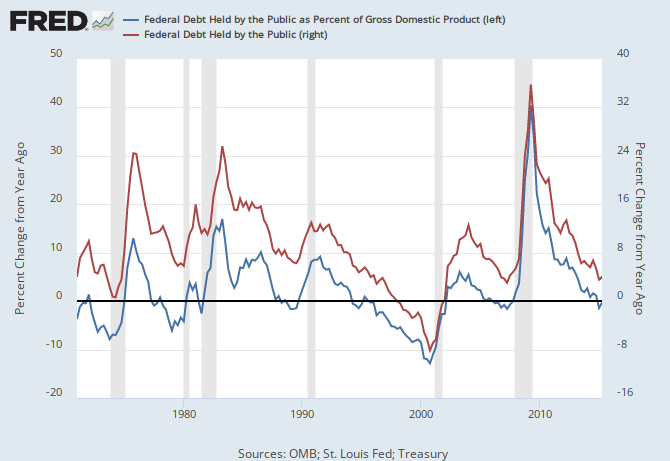
Monetary Sovereignty

Vertical gray bars mark recessions. Recessions come after the blue line drops below zero and when deficit growth declines.

As the federal deficit growth lines drop, we approach recessions, each of which has been cured only when the growth lines rose.

Increasing federal deficit growth (aka “stimulus”) is necessary for long-term economic growth.

#MONETARYSOVEREIGNTY

I don’t blame Trump

Twitter: @rodgermitchell; Search #monetarysovereignty
Facebook: Rodger Malcolm Mitchell

Mitchell’s laws:
•Those, who do not understand the differences between Monetary Sovereignty and monetary non-sovereignty, do not understand economics.
•Any monetarily NON-sovereign government — be it city, county, state or nation — that runs an ongoing trade deficit, eventually will run out of money.
•The more federal budgets are cut and taxes increased, the weaker an economy becomes..

Liberals think the purpose of government is to protect the poor and powerless from the rich and powerful. Conservatives think the purpose of government is to protect the rich and powerful from the poor and powerless.

•The single most important problem in economics is the Gap between rich and poor.
•Austerity is the government’s method for widening
the Gap between rich and poor.
•Until the 99% understand the need for federal deficits, the upper 1% will rule.
•Everything in economics devolves to motive, and the motive is the Gap between the rich and the rest..

============================================================================================================================================================================================================================================================

I don’t blame Trump.

He is what he is: A bigot, a megalomaniac, a tyrant and the would-be fuehrer of the United States of America. (“Fuehrer” means “leader,” but in Trump’s case “fuehrer” is more appropriate.)

All Hail Der Donald!
By Roger Simon

Do not say you were not warned. Der Donald has warned you.

Security is going to rule in America. And unthinkable things will be done.  Don’t believe me? Ask him.

“We’re going to have to do things that we never did before. And some people are going to be upset about it, but I think that now everybody is feeling that security is going to rule. … So we’re going to have to do certain things that were frankly unthinkable a year ago.”

On Saturday, a black man began shouting at a Trump speech in Birmingham, Alabama. People shout at Trump speeches all the time. But there are things you are allowed to shout, such as “We love you, Donald!”

And there are certain things you are not allowed to shout, such as “Trump is a racist!”

The black man was kicked and punched. Trump looked down upon him with lofty disdain. “Get him the hell out of here!” Trump said. “Throw him out.” The man was led away.

Trump would protect us from such people as president.

But I don’t blame Trump.  He is what he is:   A bigot, a megalomaniac, a tyrant and the would-be fuehrer of the United States of America.

I blame the people who support him.  I blame the good Republicans who are too cowardly to call him out.  I blame the “religious” (irony) right wing.

The price we would pay would be tiny. We would give up a civil liberty here, a freedom there.

Certain people would be registered. Their houses of worship would be spied upon. Names would be taken down.

But as long as these people are not Christians, do you really care? Trump is betting you do not.

We didn’t care when blacks were turned into slaves then hung from trees. We didn’t care when Jews were thrown into ovens and mass graves.  We didn’t care when native-born Americans lost their homes, because  their grandparents came from Japan or when native Americans were sent to reservations.

We don’t care when unarmed black men are murdered by police.

And now we don’t care again.

“I want surveillance of these people,” Trump has said. “I want surveillance if we have to, and I don’t care. … I want surveillance of certain mosques, OK?”

Martin Niemoller, a Lutheran pastor who first supported and then opposed Adolf Hitler, was imprisoned in concentration camps,  but felt he never did enough to speak out against fascism, especially when Hitler still could have been stopped.

Today he might have written:

“First they came for the black people, and I did not speak out — because I was not black.

“Then they came for the Muslims, and I did not speak out — because I was not a Muslim.

“When they come for you and me, who will be left to speak out?”

“Too many people have suffered and too many people have died for us to continue to hear racist words coming from major political leaders,” Bernie Sanders says.

“Turning away orphans, applying a religious test, discriminating against Muslims, slamming the door on every Syrian refugee — that is just not who we are. We are better than that,” Hillary Clinton says.

And what of Trump’s opponents for the Republican nomination? Most grovel and fawn.

They really don’t care that Trump wants to register Muslims, just as long as he doesn’t want to register guns.

I don’t blame Trump.  He is what he is:   A bigot, a megalomaniac, a tyrant and the would-be fuehrer of the United States of America.

I blame the good people who are only too glad to see other people’s lives destroyed, so long as their own lives are safe — safe temporarily, until he comes for them.

All that is necessary for the triumph of evil is for good men to do nothing.

Rodger Malcolm Mitchell
Monetary Sovereignty

===================================================================================
Ten Steps to Prosperity:
1. Eliminate FICA (Click here)
2. Federally funded Medicare — parts A, B & D plus long term nursing care — for everyone (Click here)
3. Provide an Economic Bonus to every man, woman and child in America, and/or every state a per capita Economic Bonus. (Click here) Or institute a reverse income tax.
4. Free education (including post-grad) for everyone. Click here
5. Salary for attending school (Click here)
6. Eliminate corporate taxes (Click here)
7. Increase the standard income tax deduction annually Click here
8. Tax the very rich (.1%) more, with higher, progressive tax rates on all forms of income. (Click here)
9. Federal ownership of all banks (Click here and here)

10. Increase federal spending on the myriad initiatives that benefit America’s 99% (Click here)

The Ten Steps will add dollars to the economy, stimulate the economy, and narrow the income/wealth/power Gap between the rich and the rest.
——————————————————————————————————————————————

10 Steps to Economic Misery: (Click here:)
1. Maintain or increase the FICA tax..
2. Spread the myth Social Security, Medicare and the U.S. government are insolvent.
3. Cut federal employment in the military, post office, other federal agencies.
4. Broaden the income tax base so more lower income people will pay.
5. Cut financial assistance to the states.
6. Spread the myth federal taxes pay for federal spending.
7. Allow banks to trade for their own accounts; save them when their investments go sour.
8. Never prosecute any banker for criminal activity.
9. Nominate arch conservatives to the Supreme Court.
10. Reduce the federal deficit and debt

No nation can tax itself into prosperity, nor grow without money growth. Monetary Sovereignty: Cutting federal deficits to grow the economy is like applying leeches to cure anemia.
1. A growing economy requires a growing supply of dollars (GDP=Federal Spending + Non-federal Spending + Net Exports)
2. All deficit spending grows the supply of dollars
3. The limit to federal deficit spending is an inflation that cannot be cured with interest rate control.
4. The limit to non-federal deficit spending is the ability to borrow.

THE RECESSION CLOCK
Monetary Sovereignty

Vertical gray bars mark recessions. Recessions come after the blue line drops below zero and when deficit growth declines.

As the federal deficit growth lines drop, we approach recessions, each of which has been cured only when the growth lines rose.

Increasing federal deficit growth (aka “stimulus”) is necessary for long-term economic growth.

#MONETARYSOVEREIGNTY

Why a finance professor should not teach economics

Twitter: @rodgermitchell; Search #monetarysovereignty
Facebook: Rodger Malcolm Mitchell

Mitchell’s laws:
•Those, who do not understand the differences between Monetary Sovereignty and monetary non-sovereignty, do not understand economics.
•Any monetarily NON-sovereign government — be it city, county, state or nation — that runs an ongoing trade deficit, eventually will run out of money.
•The more federal budgets are cut and taxes increased, the weaker an economy becomes..

Liberals think the purpose of government is to protect the poor and powerless from the rich and powerful. Conservatives think the purpose of government is to protect the rich and powerful from the poor and powerless.

•The single most important problem in economics is the Gap between rich and poor.
•Austerity is the government’s method for widening
the Gap between rich and poor.
•Until the 99% understand the need for federal deficits, the upper 1% will rule.
•Everything in economics devolves to motive, and the motive is the Gap between the rich and the rest..

============================================================================================================================================================================================================================================================

Noah Smith is an assistant professor of finance at Stony Brook University and a freelance writer for a number of finance and business publications.

Professor Smith wrote an article titled,  Japan’s Debt Trap Won’t Fix Itself in which he demonstrates his not understanding the differences between a Monetarily Sovereign government (Japan, the U.S., Canada et al) and a monetarily non-sovereign entity (Illinois, Chicago, businesses, people).

Perhaps because he teaches finance, he may think all finance is the same, so he seems to apply monetarily non-sovereign restrictions to Monetarily Sovereign governments.

Here are some examples:

With low unemployment and high labor force participation, Japan has essentially no idle resources. The scope for boosting the economy with fiscal stimulus or easy money is almost nil.

Its available resource is the yen. Japan, being Monetarily Sovereign, has the unlimited ability to create yen, with which it can buy unlimited resources.

The “scope for boosting the economy” via monetary stimulus is unlimited.

Japan continues to run an enormous budget deficit every year. Things are looking somewhat better for 2015. A hike in the consumption tax in 2014 has swelled revenues.

Here, Professor Smith demonstrates complete misunderstanding of national finances. He thinks “swelled revenues” (i.e. reduced revenues coming into the economy) in some unknown way, will benefit the economy.

No, Professor Smith, sending fewer yen into the Japanese economy, will not help grow the Japanese economy.

Government coffers have also been boosted by increased profits at Japanese companies — which is then subject to the country’s high corporate tax rate. As a result, the primary deficit is projected to be only about 3.3 percent in 2015.

A Monetarily Sovereign government, unlike a monetarily non-sovereign entity, has no “coffers.” It creates its own sovereign money ad hoc, by spending.

And that “high corporate tax rate” and low deficit is guaranteed to depress the economy.

In the long run, any deficit that stays higher than the rate of nominal GDP growth is unsustainable.

Why is it “unsustainable”? No one knows. Professor Smith doesn’t say. I only can surmise that he thinks the formula for GDP (GDP = Federal Spending + Non-federal Spending + Net Exports) is wrong.

Bank of Japan has not managed to increase core inflation to the 2 percent target despite Herculean efforts.

Even if interest rates stay at zero forever, borrowing 3.3 percent of GDP every year is just too much. And if interest rates rise, deficits would explode.

The government, of course, knows this, and has pledged to cut the primary deficit to 1 percent by 2018 and to zero by 2020.

Inflation follows this formula: Value = Demand/Supply.  Inflation is a reduction in Value.

The Bank of Japan’s “Herculean efforts” consist of cutting interest rates, which only reduce Demand.  But the reason inflation is too low (according to the BOJ) is that Supply is too low.

So what is the government’s “solution” to low Supply? Cut the deficit, which will cut Supply, further.  Is it any wonder Japan is in trouble?

The Ministry of Finance, full of sober-minded bureaucrats, projects that under more realistic growth assumptions, the primary deficit will shrink only to 2.2 percent. Even that improvement would require tax hikes, spending cuts or some combination of the two.

So the Japanese government will try to stimulate inflation by cutting the Supply of yen.  Hmmm . . . What next? Stimulate obesity by cutting the supply of food? Warm the house by turning down the heat?

A primary deficit of 2.2 percent would be at the very edge of long-term sustainability. If we assume a 1 percent real potential growth rate and 1.5 percent inflation, then a 2.2 percent deficit will be just barely under the maximum sustainable level of 2.5 percent.

If you understand his “sustainability” formula, please explain it to me. And while you’re at it, please explain why a deficit of 2.5% is the maximum sustainable level. Will the Japanese government run short of its own sovereign currency?

The article continues on and on, explaining the unexplainable: Why tax increases benefit the economy while deficits are “unsustainable.” It’s utter nonsense, of course, and unfortunately, a rather common nonsense.

Professor Smith can be forgiven his ignorance about economics. We all are ignorant about many things, and he probably should not be expected to understand Monetary Sovereignty if, as a finance professor, he teaches monetarily non-sovereign finance every day.

But the notion that leaders of major countries don’t understand Monetary Sovereignty is beyond belief, and in fact, I don’t believe it.

Increased deficit spending, especially on benefits for the middle and lower classes, narrows the Gap between the rich and the rest of us. The Gap is what makes them rich; without the Gap, no one would be rich, and the wider the Gap, the richer they are.

It is a fact of life, that the rich run every nation and always have. Because most of the rich want the Gap to widen, they pay the opinion leaders — the politicians, the university professors and the media — to teach the public that federal finances are like personal finances, where deficit spending causes debt and large debt is “unsustainable.”

Whether Finance Professor Smith really believes these things, or whether he has been paid to disseminate the “Big Lie,” is impossible to say.

But add him to the list of those spreading the rich .1%’s false narratives about federal financing.

If you wish to drop him a note to tell him so, his Email is: Noah.Smith@stonybrook.edu

Rodger Malcolm Mitchell
Monetary Sovereignty

===================================================================================
Ten Steps to Prosperity:
1. Eliminate FICA (Click here)
2. Federally funded Medicare — parts A, B & D plus long term nursing care — for everyone (Click here)
3. Provide an Economic Bonus to every man, woman and child in America, and/or every state a per capita Economic Bonus. (Click here) Or institute a reverse income tax.
4. Free education (including post-grad) for everyone. Click here
5. Salary for attending school (Click here)
6. Eliminate corporate taxes (Click here)
7. Increase the standard income tax deduction annually Click here
8. Tax the very rich (.1%) more, with higher, progressive tax rates on all forms of income. (Click here)
9. Federal ownership of all banks (Click here and here)

10. Increase federal spending on the myriad initiatives that benefit America’s 99% (Click here)

The Ten Steps will add dollars to the economy, stimulate the economy, and narrow the income/wealth/power Gap between the rich and the rest.
——————————————————————————————————————————————

10 Steps to Economic Misery: (Click here:)
1. Maintain or increase the FICA tax..
2. Spread the myth Social Security, Medicare and the U.S. government are insolvent.
3. Cut federal employment in the military, post office, other federal agencies.
4. Broaden the income tax base so more lower income people will pay.
5. Cut financial assistance to the states.
6. Spread the myth federal taxes pay for federal spending.
7. Allow banks to trade for their own accounts; save them when their investments go sour.
8. Never prosecute any banker for criminal activity.
9. Nominate arch conservatives to the Supreme Court.
10. Reduce the federal deficit and debt

No nation can tax itself into prosperity, nor grow without money growth. Monetary Sovereignty: Cutting federal deficits to grow the economy is like applying leeches to cure anemia.
1. A growing economy requires a growing supply of dollars (GDP=Federal Spending + Non-federal Spending + Net Exports)
2. All deficit spending grows the supply of dollars
3. The limit to federal deficit spending is an inflation that cannot be cured with interest rate control.
4. The limit to non-federal deficit spending is the ability to borrow.

THE RECESSION CLOCK
Monetary Sovereignty

Vertical gray bars mark recessions. Recessions come after the blue line drops below zero and when deficit growth declines.

As the federal deficit growth lines drop, we approach recessions, each of which has been cured only when the growth lines rose.

Increasing federal deficit growth (aka “stimulus”) is necessary for long-term economic growth.

#MONETARYSOVEREIGNTY

What science does economics most closely resemble?

Twitter: @rodgermitchell; Search #monetarysovereignty
Facebook: Rodger Malcolm Mitchell

Mitchell’s laws:
•Those, who do not understand the differences between Monetary Sovereignty and monetary non-sovereignty, do not understand economics.
•Any monetarily NON-sovereign government — be it city, county, state or nation — that runs an ongoing trade deficit, eventually will run out of money.
•The more federal budgets are cut and taxes increased, the weaker an economy becomes..

Liberals think the purpose of government is to protect the poor and powerless from the rich and powerful. Conservatives think the purpose of government is to protect the rich and powerful from the poor and powerless.

•The single most important problem in economics is the Gap between rich and poor.
•Austerity is the government’s method for widening
the Gap between rich and poor.
•Until the 99% understand the need for federal deficits, the upper 1% will rule.
•Everything in economics devolves to motive, and the motive is the Gap between the rich and the rest..

============================================================================================================================================================================================================================================================

In your opinion, which scientist is best equipped to understand economics:

  1. A physicist?
  2. A mathematician?
  3. A psychologist?
  4. A chemist?

Choose one.

Personally, I would choose the psychologist, because economics essentially is psychology.

While physics, mathematics and chemistry rely on specific, proven, reproducible relationships, economics almost wholly is arbitrary and subjective.

I’ll give you a painful example.

Commodity pricing is a function of economics. Years ago, I owned a commodity brokerage, where we employed a prize-winning chartist. (I can’t recall the name of the contest he won, but he and all the other entrants had to use charting techniques to predict various commodity prices.)

When we discussed his system, he spoke very authoritatively of “support levels,” “trend lines,” “resistance,” etc., all under the name, “technical analysis,” and it all sounded quite scientific.

Here is what stockcharts.com says:

Support is the price level at which demand is thought to be strong enough to prevent the price from declining further. The logic dictates that as the price declines towards support and gets cheaper, buyers become more inclined to buy and sellers become less inclined to sell. By the time the price reaches the support level, it is believed that demand will overcome supply and prevent the price from falling below support.

Amazon.com, Inc. (AMZN) Support and Resistance example chart from StockCharts.com

Support does not always hold and a break below support signals that the bears have won out over the bulls.

A decline below support indicates a new willingness to sell and/or a lack of incentive to buy.

Support breaks and new lows signal that sellers have reduced their expectations and are willing sell at even lower prices.

In addition, buyers could not be coerced into buying until prices declined below support or below the previous low. Once support is broken, another support level will have to be established at a lower level.

If you detect the faint aroma of bovine excrement, I don’t blame you. In essence “support” is an arbitrary line, meaning nothing.

Charting, as a means to predict commodity prices, works sometimes and doesn’t work sometimes. In other words: It doesn’t work.

So sadly, our prize-winning chartist later proved spectacularly unsuccessful in predicting prices in the real world, and those of our customers who relied on his prognostications lost money.

Charting still is widely used as a predictive commodity pricing tool.

The use of charts to predict economic events is typical of economics as a science, because we economists have the compulsive urge to prove we are “real scientists,” and as “everyone knows,” real scientists base their hypotheses on mathematics, especially graphs.

I do it. We all do it. But that doesn’t make it smell any better.

The problem, of course, is that economics is a reflection of human psychology. Even worse (i.e. more deceiving) is the fact that economics also is a reflection of real physical processes. It’s a blend.

Consider what might be the most basic equation in all of economics: Value = Demand / Supply.

It says that increased Demand and/or decreased Supply (scarcity) increases Value (as measured by price). Intuitively logical.

Value, though, is complex. What is the price of a TV set? The answer depends on many variables: Size, model, manufacturer, retailer, location, date.

And Supply is equally complex. It too depends on those variables.

But ultimately, one can measure Supply and Price. They are finite. You can walk into a store and see that the store has three of a specific item at a specific price.

But how does one measure Demand?

While Value (price) and Supply can be set arbitrarily, Demand cannot.

Demand is related to motivation, which is buried in the human psyche. How do you measure a population’s motivation to buy a Porche, a pansy or a pickle? You only can do it derivatively and approximately.

That is, when economists know the Price and the Supply, they can derive the approximate Demand. But, if they don’t know both the Price and the Supply, they cannot know or determine the Demand.

The inherent weakness of the equation Value = Demand/Supply, applies to most equations in economics. They are ruled by the variables of human psychology.

At the bottom of this post is a graph indicating that reductions in federal deficit spending lead to recessions.

It is not like a graph that shows, for instance, the relationships among distance, time and speed (Distance = Time x Speed). They are not functions of psychology. Each can be stated with exact precision.

The graph at the bottom of this page encompasses thousands, no trillions, of human actions and decisions, which unless you believe in determinism and not in free will, are beyond measure and prediction.

Thus, my chartist employee’s efforts to predict commodity prices were doomed from the beginning. Unpredictable and unmeasurable factors affected the outcome.

In most nations, and surely in America, the single biggest unpredictable economics factor is actions by the central government.

Will it create a war? Change interest rates? Deficit spend? Allow or reject immigrants? Allow or prevent the use of resources? Almost anything the central government does affects the economy.

The government is composed of human beings, each of whom is affected by other human beings, as well as being affected by health, weather, threats, anticipated and unanticipated events, fear, hope, greed — the list goes on and on.

The graph (below) indicates we have come dangerously (and unnecessarily) close to recession. But when people ask me, “When will we have the next recession?” my answer always is, “Tell me what the federal government will do, and I’ll tell you when we’ll have the next recession.”

Compare that vague answer with the specific answer a physicist will give you if you ask him how long it will take a photon to travel a mile, or a mathematician will give you if you ask a question about set theory.

I suspect a physicist, a mathematician or a chemist would become exasperated with the pretensions of economists.

Look in any economics textbook and you will see it is loaded with graphs and formulas, almost none of which are more than approximations, and usually less, but appearing to be much more.

If I tell you reductions in federal deficit spending lead to recessions and depressions, that statement is about as accurate as economics can be. There is no formula, no proof, that can improve on that statement for accuracy.

I can show you the many times when reductions in federal deficit spending did, in fact, lead to recessions and depressions. But repetition is not scientific proof. Physicists know that.

I have awakened 30,000 consecutive mornings, but even that massive repetition does not prove I always will awaken.

And if someone presents exceptions showing how at certain times, reductions in federal deficit spending did not lead to recessions and depressions, they merely are expressing the variables of human psychology. They neither have proved nor disproved anything.

That is the point of this blog. Economics tries to be — pretends to be — something it is not, and probably never will be: An exact science.

At best, economics is equal to psychology in its accuracy of prediction.

So where does that leave us? Is all useless? Is it fruitless to predict that A –> B? Are we lost in randomness?

Not at all. We still can learn from facts, logic and experience.

Consider federal debt. The politicians, media and economists stress about it, and claim it is similar to personal debt, and is “unsustainable.” But what are the facts?

Federal debt is the total of T-securities outstanding. That is a fact.

Federal agencies own some T-securities. But most are owned by people, businesses or governments other than U.S. federal government.

To acquire a T-security, one must debit a bank checking account and credit a T-security account at the Federal Reserve Bank. T-securities are bank deposits — deposits in accounts in the FRB.

To “pay off” ​a T-security, the Federal Reserve Bank debits the appropriate T-security account and credits a checking account. This is identical to what any bank does to pay off any savings account.

Those all are facts.

Logically then, since the Federal Reserve Bank pays off federal debt with dollars that already exist in T-security accounts, the federal debt never can be “unsustainable.”

And, our experience is that the U.S. government never has defaulted (i.e. not “sustained”) on its debts — not through recessions, depressions, wars, inflations, deflations or natural disasters.

Does any of this scientifically prove the federal debt always is and will be sustainable? No.

I can visualize scenarios in which the government might default — for instance, Sen. Ted Cruz becoming President.

Because economics is akin to psychology, strict proof of anything is rare. But using our prime tools — facts, logic and experience — we can approach predictability, the goal of any science.

Unfortunately, economists have shunned facts, logic and experience, in favor of abstruse mathematical formulas, to “prove” the unprovable.

Economics and psychology may never have the accuracy of physics, mathematics or chemistry. In striving for that exactitude, economists peer deeper and deeper into minutia, while losing the big picture and the fundamental facts, logic and experience.

(How else can one explain the widespread misunderstanding, within the economics community, of federal debt, deficits and money creation?)

Economics essentially is a “soft” science, like psychology or philosophy. In trying to be part of a “hard” science, economists have gone astray, and done a great disservice to the public, the nation and themselves.

It’s time to get real, economists.

Rodger Malcolm Mitchell
Monetary Sovereignty

===================================================================================
Ten Steps to Prosperity:
1. Eliminate FICA (Click here)
2. Federally funded Medicare — parts A, B & D plus long term nursing care — for everyone (Click here)
3. Provide an Economic Bonus to every man, woman and child in America, and/or every state a per capita Economic Bonus. (Click here) Or institute a reverse income tax.
4. Free education (including post-grad) for everyone. Click here
5. Salary for attending school (Click here)
6. Eliminate corporate taxes (Click here)
7. Increase the standard income tax deduction annually Click here
8. Tax the very rich (.1%) more, with higher, progressive tax rates on all forms of income. (Click here)
9. Federal ownership of all banks (Click here and here)

10. Increase federal spending on the myriad initiatives that benefit America’s 99% (Click here)

The Ten Steps will add dollars to the economy, stimulate the economy, and narrow the income/wealth/power Gap between the rich and the rest.
——————————————————————————————————————————————

10 Steps to Economic Misery: (Click here:)
1. Maintain or increase the FICA tax..
2. Spread the myth Social Security, Medicare and the U.S. government are insolvent.
3. Cut federal employment in the military, post office, other federal agencies.
4. Broaden the income tax base so more lower income people will pay.
5. Cut financial assistance to the states.
6. Spread the myth federal taxes pay for federal spending.
7. Allow banks to trade for their own accounts; save them when their investments go sour.
8. Never prosecute any banker for criminal activity.
9. Nominate arch conservatives to the Supreme Court.
10. Reduce the federal deficit and debt

No nation can tax itself into prosperity, nor grow without money growth. Monetary Sovereignty: Cutting federal deficits to grow the economy is like applying leeches to cure anemia.
1. A growing economy requires a growing supply of dollars (GDP=Federal Spending + Non-federal Spending + Net Exports)
2. All deficit spending grows the supply of dollars
3. The limit to federal deficit spending is an inflation that cannot be cured with interest rate control.
4. The limit to non-federal deficit spending is the ability to borrow.

THE RECESSION CLOCK
Monetary Sovereignty

Vertical gray bars mark recessions. Recessions come after the blue line drops below zero and when deficit growth declines.

As the federal deficit growth lines drop, we approach recessions, each of which has been cured only when the growth lines rose.

Increasing federal deficit growth (aka “stimulus”) is necessary for long-term economic growth.

#MONETARYSOVEREIGNTY