I long have favored a federal plan in which every man, woman, and child in America would receive a monthly stipend from the federal government. (Some call it UBI—Universal Basic Income. Others call it GI—Guaranteed Income, or Social Security for All.)
A federally funded Social Security for All program was described in a post published seven years ago.
Today, that post was brought to mind by the following article:
An Illinois Senate appropriations committee would review “the landscape of cash supports available to low-income residents” and identify “populations without significant access to cash supports.”
The bill, as filed, says after the board is dissolved at the end of 2027, DHS would administer the program with monthly cash payments of $1,000 to Illinois residents, regardless of immigration status, who provide care for a child or specified dependent, recently gave birth or adopted a child or is enrolled in an educational or vocational program.
By law, the Monetarily Sovereign U.S. government is an infinite horn of plenty, capable of creating an unending stream of dollars at the touch of a computer key without collecting a penny in taxes.
Mike Buehler, an opponent of the measure, said it’s irresponsible to discuss such a program without knowing how much it will cost taxpayers.
You may be surprised that I oppose this and other similar plans.
Here is why:
1. Localgovernments are monetarily non-sovereign (unlike the federal government, which being Monetarily Sovereign, has the infinite ability to create dollars).
With few exceptions, local governments get their spending money from taxpayers.
That is why it can run trillion-dollar deficits with no funding problem at all.
State, county, or city taxpayers pay for local government-funded UBI programs.
Most local tax dollars come from sales taxes and/or local income taxes, most of which are paid by middle—and lower-income residents. Extracting dollars from middle—and lower-income taxpayers is exactly the opposite of the UBI plan’s basic purpose.
2. While the federal government has unlimited access to dollars,local governments have limited abilities to pay for things. So, the benefits must be limited to local governments’ affordability estimates.
This, in turn, requires limiting benefits to specific groups and denying benefits to other groups, which creates two problems:
A. The government must set up a complex and expensive apparatus for monitoring recipients so that people do not cheat.
B. People just outside the limit of qualifications are unjustly deprived of aid, and/or try to find unanticipated ways to qualify.
“I understand that you would have to be a person with a child, or caring for someone in your home or school to be eligible for the benefits.
A local government would have to hire dozens (or thousands?) of people to monitor these qualifications. (Do you have a child? How old? Are you really “caring for” that boarder? Are you still in school, and exactly what is a “school.” How many days or hours do you attend?
Additionally, there would be extensive and expensive paperwork filed, read, and authenticated.
That could be millions of people and the cost could be in the tens of billions of dollars,” Buehler told The Center Square. “And where’s the state going to come up with these funds and the only place to come up with that is to get it from the taxpayers.”
Guaranteed income programs in Chicago and the Metro East St. Louis areas are ongoing, costing taxpayers millions. In 2022, the city of Chicago was in line to spend $31.5 million for $500 a month to go to 5,000 low-income residents.
That same year, Illinois legislators approved a pilot program using state taxpayer fundsworth $3.6 million for the Metro East St. Louis area.
Inevitably, a state-run, money-restricted program would evolve to a “nanny-state,” where the money only could be used for approved purposes. And that would have to be monitored.
Ameya Pawar with the Economic Security Project said there are 150 different programs across the country. He gave examples of people using the money to buy sports goods for their children or even to take a vacation.
There is widespread belief that the poor who receive money from taxpayers, should be told what to do with the money (the poor supposedly being too ignorant to know what is best for them). Buying sports goods and taking vacations is not “good” for the poor.
The nanny preference is only to feedstarving children, not just make them happy with toys and entertainment. Note the hinted outrage Ameya Pewar expresses for recipients buying baseballs to entertain their kids.
“And all of this money that goes into the pockets to stabilize households flows through local businesses,” Pawar told the committee. “So you see some of this money back in sales taxes, and other taxes.”
No buying from Amazon allowed??
Buehler said there could be unintended consequences, like reducing work productivity and more.
“For regardless of immigration status, I think an unintended consequence could be a flood of migrants coming to Illinois looking for benefits and not having to work for it,” he said.
3. If one state, county, city, or village offers better benefits than another, people will tend to go where the money is and the taxpayers will pay. This is true for citizens as well as migrants.
And note the common but false belief that the poor are so lazy and unmotivated, if you give them money, they won’t get jobs.
Pawar said the proposed statewide guaranteed program of “unrestricted cash” should be in addition to other taxpayer-funded safety net programs.
Programs like Supplemental Nutrition Assistance Program funds go to buy food. The Low Income Housing Energy Assistance Program is for heating bills. The Temporary Assistance for Needy Families program provides monthly cash assistance to low-income families with children.
“And to get this income, they may not necessarily spend that in their own best interest or the interest of the citizens at large,” he said.
Again, the taxpayer requirement exacerbated the nanny-state belief that the poor are too stupid to spend in their own best interests. “Why am I, as a taxpayer helping these people to take vacations, if I can’t afford one myself.”
All the above-mentioned problems would be addressed by a federally-funded, Social Security program covering every man, woman, and child in America, regardless of income or wealth.
The rich, poor, citizens, non-citizens, young, old, married, single, renter, homeowner, in or out of school, etc., all would receive the stated benefits — and unlike with state and local government programs, no one would pay a penny.
Federal Social Security payments made to every man, woman, and child, require much less monitoring. Most importantly, affordability would cease to be an issue. The federal government can afford anything, and without collecting taxes.
All of the money spent by the federal government would be addedto the local economy, increasing everyone’s income.
8 Million Have Slipped Into Poverty Since May as Federal Aid Has Dried Up, October 15, 2020. (By Leigh Lynes: New studies show the effect of the emergency $2 trillion package known as the Cares Act and what happened when the money ran out.)
Here are excerpts from another article on the subject.
Actually, there are “strings,” in the form of qualifications.
More than interest — when former US presidential candidate Andrew Yang announced that a UBI program of $1,000 direct payments to citizens every month would be the keystone policy of his platform, he drew an unexpected amount of grassroots support in a crowded primary year.
Guaranteed income programs have been gaining even more traction during the pandemic, which took a particular toll on low-wage workers and threw many Americans into poverty.
At least 11 direct-cash experiments went into effect this year, Bloomberg estimated in January.
Former Stockton, California mayor Michael Tubbs, took the idea to the next level by launching the Mayors for a Guaranteed Income network. As of this year, there are 60 mayors in the program, advocating — and launching pilot programs for — guaranteed income for their residents.
California recently launched the first statewide guaranteed income program in the US, providing up to $1000 per month to qualifying pregnant people and young adults leaving the foster care system.
“Young adults leaving foster care” and “pregnant people” comprise two, very narrow classes, and $1000 a month is a meager amount. The task of verifying qualifications would be costly. (Imagine trying to verify pregnancy for thousands of people, and who monitors when pregnancies end before birth?)
The basic income program that Tubbs launched in Stockton in 2019, the Stockton Economic Empowerment Demonstration, has been considered the model for other cities that have followed in its footsteps, offering low-income residents hundreds of dollars a month and measuring their job prospects, financial stability, and overall well-being afterward.
It seems like a massive and expensive project for just hundreds of dollars’ worth of benefits.
According to SEED, participants improved in all those metrics.
“Guaranteed income makes a case for investing in our undocumented neighbors and formerly incarcerated residents. In doing so, it addresses the reality of the nation’s fragmented, punitive welfare structure.”
Will taxpayers consider this a reward for being undocumented or incarcerated? (Want to make an easy few hundred dollars a month? Go to jail for some minor charge.)
This kind of program isn’t a new idea, however. The Eastern Band of Cherokee Indians Casino Dividend in North Carolina has been giving tribal members annual funds since 1997, for instance. Alaska has been paying residents out of its oil dividends since 1982.
The Eastern Band of Cherokee Indians Casino Dividend in North Carolina gets its money from casino revenue. Alaska gets its dividend money from oil. Neither collects taxes to pay recipients. That is a major consideration.
Here are a few of the 33 examples mentioned in the above article.
Compton, California. Duration: December 2020 to December 2022. Income amount: $1,800 every three months for 2 years. Number of participants: 800
Tacoma, Washington,Duration: December 2021 to December 2o22, Income amount: $500 every month for 1 year, Number of participants: 110
Stockton, California, Duration: February 2019 to February 2021, Income amount: $500 every month for 2 years, Number of participants: 1ount: Based on the annual dividend from state-owned oil companies, ranged from roughly $2,000 per person in 2015 to $800 in years with lower gas prices.
Oakland Resilient Families,Duration: Summer 2020 to present, Income amount: $500 per month for 18 months, Number of participants: 600
Alaska Permanent Fund , Duration: Annual, Income amount: Based on the annual dividend from state-owned oil companies, ranged from roughly $2,000 per person in 2015 to $800 in years with lower gas prices , Number of participants: Alaska residents
North Carolina, Cherokee Tribe, The Eastern Band of Cherokee Indians Casino Dividend pays every tribe member annually, Duration: Annual, Income amount: $4,000 – $6,000 per year, Number of participants: Every tribal member.
The Alaska and Cherokee programs succeed long term because they are not funded by taxpayers. A federally funded program would succeed for the same reason. Federal spending is not taxpayer funded.When state and local taxpayers fund a spending program, the result is that a large group of middle- and low-income people transfers some of their money to a smaller group of middle- and low-income people.
The large group includes all those who pay sales and income taxes. The small group is all those who receive those tax dollars. It’s just dollars rotating within the municipality, enriching some residents at the expense of others. The municipality’s economy receives nothing.
By contrast, when the federal government funds a guaranteed income program the government creates new dollars and sends them to the nation’s recipients. The result is that there is no expense to anyone, but the nation’s economy is enriched with net dollars. (GDP = Federal Spending + Nonfederal Spending + Net Exports).
Guaranteed income programs help narrow the income/wealth/power Gap between the rich and the poorer. While reducing poverty, in of itself, is a worthwhile goal, narrowing the Gap also helps address related, social problems:
Wide Gaps affect not only poverty itself, but health and longevity, education, housing, law and crime, war, ownership, bigotry, taxation, GDP, scientific advancement, the environment, human motivation and well-being, and virtually every other issue related to economics.
The most successful guaranteed income programs share several features:
Funded by a Monetarily Sovereign government or by state owned and controlled businesses. This takes taxpayer costs out of the equation.
Minimal requirements for participants achieve voter support by making the plan fairer.
Significant benefits. Trivial payments, i.e. $100 a month, etc. will not generate positive voter sentiment.
Easy entry and supervision. Difficult entry results in negative feelings by voters. Easy supervision lowers costs.
Easily understood goal.
Many good reasons for, and no good reasons why not.
A national Social Security for All plan, with a minimum benefit if $5,000 per year for each adult (18 and over) and $2,500 a year for a child would begin to address the abovementioned social problems.
The Cost:
The U.S. has about 260 million adults (18+) and about 70 million children.
At the $5,000/2,500 level, the benefit cost of the Social Security for All would be $1.3 trillion for adults and $175 billion for children, totaling somewhat south of only $1.5 trillion.
Why do I say “only”? By comparison:
In 2023, the federal government spent about $6.2 trillion.
The Gross Domestic Product (GDP) for the year 2023 had a current-dollar value of $27.36 trillion.
In 2023, the U.S. federal government collected a total of approximately $4.71 trillion in tax revenue.
In fiscal year 2023, the federal government’s spending exceeded its revenues, resulting in a deficit of $1.70 trillion
By the end of 2023, the cumulative federal deficit was $26.236 trillion.
The U.S. M2 money supply is about $20 trillion.
Given that:
Alan Greenspan: “A government cannot become insolvent with respect to obligations in its own currency. There is nothing to prevent the federal government from creating as much money as it wants and paying it to somebody. The United States can pay any debt it has because we can always print the money to do that.”
and
Ben Bernanke: “The U.S. government has a technology, called a printing press (or, today, its electronic equivalent), that allows it to produce as many U.S. dollars as it wishes at essentially no cost.”
A Monetarily Sovereign government spending $1.7 trillion to send an additional $5,000 to every adult and $2,500 to every child — and at no cost to anyone — would seem to be a bargain price and a great investment for America.
Further, because of the multiplier effect*, that additional $1.7 trillion in federal spending, would increase Gross Domestic Product far more than $1.7 trillion.
*Per Investopedia:A government increases spending or decreases taxes in part to inject more money into the system.
Such fiscal policy has a multiplier effect. That is, every dollar spent can be expected to cause an increase in the gross domestic product (GDP) by more than a dollar.
This is due to the sheer momentum created by the policy. Consumers spend more so businesses produce more goods.
Businesses have to hire more to produce more goods, so more people have more money to spend on goods.
The same phenomenon occurs for both government spending increases and tax cuts. Either tends to increase GDP disproportionately.
A cut in government spending can reduce GDP by a greater degree than the amount saved by the cut.
The expanded Child Tax Credit had a multiplier effect of 1.25 on GDP in the first quarter of 2021, according to an analysis by Moody’s Analytics. The increase in the Supplemental Nutrition Assistance Program boosted GDP by a 1.61 multiplier effect in the same period. Increased defense spending had a 1.24 multiplier effect.
Infinite benefits at no cost to anyone: Can any knowledgeable person object to Social Security for All?
Rodger Malcolm Mitchell
Monetary SovereigntyTwitter: @rodgermitchellSearch #monetarysovereigntyFacebook: Rodger Malcolm Mitchell
……………………………………………………………………..
The Sole Purpose of Government Is to Improve and Protect the Lives of the People.
Modern Monetary Theory (MMT) is a cousin to Monetary Sovereignty (MS), in that both concepts acknowledge the indisputable fact that the U.S. federal government’s ability to spend is not constrained by the availability of funds.
Neither the federal government nor any federal agency can run out of money unless Congress wants it to. Federal “Trust Funds” are a lie to prevent you from receiving federal benefits.
In short, the Monetarily Sovereign federal government cannot run short of dollars. It cannot “go broke.” It neither needs nor uses tax dollars.
Similarly, no agency of the federal government (Medicare, Medicaid, Social Security, et al) can run short of dollars unless Congress wants it to.
Even if all federal tax collections were $0, the government could continue spending, forever.
This is true of all sovereign issuers of a sovereign currency.
Federal taxes do not pay for federal spending.
The federal government pays for all spending by creating new dollars. Federal tax dollars are destroyed upon receipt.
Alan Greenspan: “A government cannot become insolvent with respect to obligations in its own currency.”
Ben Bernanke: “The U.S. government has a technology, called a printing press (or, today, its electronic equivalent), that allows it to produce as many U.S. dollars as it wishes at essentially no cost.”
Quote from Ben Bernanke when, as Fed chief, he was on 60 Minutes:Scott Pelley: Is that tax money that the Fed is spending?Ben Bernanke: It’s not tax money… We simply use the computer to mark up the size of the account.
Statement from the St. Louis Fed:“As the sole manufacturer of dollars, whose debt is denominated in dollars, the U.S. government can never become insolvent, i.e., unable to pay its bills. In this sense, the government is not dependent on credit markets to remain operational.”
Press Conference: Mario Draghi, President of the ECB, 9 January 2014Question: I am wondering: can the ECB ever run out of money?Mario Draghi: Technically, no. We cannot run out of money.
Sadly, MMT believers go astray with two false beliefs: MMT’s Jobs Guarantee and the belief that federal deficit spending can cause inflation.
I. JOBS GUARANTEE
Briefly, JG is just what it sounds like: The government guarantees it will find or provide (it’s not clear which) a job for anyone who wants a job.
We have published many articles describing the foolishness of that proposal. Rather than repeat the many, many reasons why the JG is naive, wrongheaded, and damaging, we’ll just provide you with these references:
Now, circumstances have arrived to demonstrate reality in the face of MMT’s academic ignorance.
All those people quitting jobs, where are they going?Kristin Schwab, Oct 28, 2021You may have heard the news that last week’s initial unemployment claims fell to a new pandemic low. But even though layoffs are decreasing, it’s also true that lots of workers are leaving their jobs and lots of employers are still having trouble filling them.So, where are the workers who are leaving jobs going?Right now, it is statistically more difficult to become a receptionist than to get into Harvard. That’s according to data from ZipRecruiter, where Julia Pollak is chief economist.“I have a lot of bad news for job seekers in certain occupations. Some are much more competitive even,” Pollak said.Some of these jobs are specialized or senior roles, but a lot of them are what Pollak calls pleasant jobs with predictable schedules, such as in customer service or communications — and fields like airport security.
Guess what, MMT? People aren’t simply mindless pegs to be fitted into crap-job holes as JG would do. Human beings have desires. They want — no, demand — goodjobs: Good pay, good conditions, good futures.
MMT’s JG program, designed by academics who have not experienced reality, relies on people being so desperate they will take any job offered.
When people are selective about their lives, JG falls apart.
“So, jobs where you have some degree of prestige, perhaps a uniform and a union looking out for your interests,” Pollak said.The growing interest in jobs that are more stable and offer better pay and benefits makes sense when you compare them to jobs that require similar skills and are begging people to come back — think less predictable or less protected industries like trucking and restaurants.
Imagine that, MMT, people want stability, better pay, and better benefits, not what a federal JG bureaucracy offers them.
“If you’re a worker at a restaurant and suddenly the restaurant is short-staffed, it’s going to be that much harder for you to actually manage your shift,” said Daniel Zhao, an economist at Glassdoor.People are tired, burned out and fed up. And a lot of them are looking for a new work-from-home lifestyle. Glassdoor said searches for remote roles is up more than 350% in the last year. Whether everyone can get one is a different story.
The paternalistic Jobs Guarantee was a depression-era solution, that is as appropriate as a hand-crank calculator in today’s computer age. Sadly, MMT still doesn’t get it.
Instead of JG nonsense, we finally are leaning toward Step #3 of the Ten Steps to Prosperity: Social Security for All.II SOCIAL SECURITY FOR ALL
The following article calls it, “Guaranteed Basic Income” (GBI). Different name, same fundamental concept: Instead of finding crap jobs for the poor, simply give people money.
Guaranteed basic income is comingBy Alice Yin and John Byrne Chicago Tribune, The Tribune’s Gregory Pratt contributedThousands of struggling Chicago residents will receive monthly cash payments from the city of Chicago as it becomes home to one of the largest guaranteed income programs in the U.S.Mayor Lori Lightfoot’s $31.5 million basic income program is just a sliver of the total $16.7 billion budget, which will be buoyed by federal COVID-19 relief funds and won City Council approval Wednesday.Few details of the pilot have been hammered out yet, except that 5,000 households will receive $500 per month for a year — with no strings attached. The lowest-income residents who suffered financial blows from the COVID-19 pandemic will be the focus.When the funds go out, Chicago will join a contingent of American cities that have warmed up to the concept of guaranteed income. Once deemed a pipe dream in mainstream politics, the idea of handing unconditional cash directly to those in need has particularly gained steam during the coronavirus-fueled recession, when most Americans saw multiple rounds of stimulus checks and other temporary social safety net expansions.However, guaranteed income pilots have launched before the pandemic too, such as in Stockton, California, under former Mayor Michael Tubbs. The program doled out $500 monthly payments to a small subset of low-income families. In June 2020, Tubbs started the coalition Mayors for a Guaranteed Income, which now has more than 50 mayors on board, more than two dozen of whom are piloting the concept in some form.Though Lightfoot has touted her proposal as the largest in U.S. history, Los Angeles is in the process of implementing its own guaranteed income pilot targeting 3,000 households with $1,000 a month for a year.Andrew Yang, a Democratic presidential candidate in 2020, has also championed a more far-reaching version of cash assistance known as universal basic income, which would go out to all adults regardless of means.
Rather than insisting on the Puritanical demand that people must labor in order to survive (i.e JG), more enlightened city governments recognize that at least at some basic level, poverty is harmful to the whole nation, and Americans have a right to live.
The irony is that monetarily non-sovereign cities (which are financially limited) are doing it rather than the Monetarily Sovereign federal government, which is financially unlimited.
But that is why the efforts are so small, with just a few thousand households receiving benefits.
Not all Chicago aldermen were on board with Lightfoot’s plan. Her overall budget passed 35-15, with some of the opposition pointing to the basic income program.Southwest Side Ald. Matt O’Shea said after the vote that the pilot won’t work because “in two years, we won’t be able to afford it.” He’d rather see resources spent on boosting child care and “getting people back to work,” he said.“Just giving money out to people when there’s tens of thousands of jobs in our city right now, that’s not something I can support,” O’Shea said.
But that is the whole point. There are “tens of thousands of jobs” people don’t want. Arrogant academic snobs claim the “underclass” should be grateful to work crap jobs for crap wages.
Those are Gap Psychology words. They serve only to widen the Gap between the rich and those below. JG is cruel and ignorant. It dooms people to failure. It is bad economics.
Giving people money turns them into consumers whose spending helps the entire economy.
Apparently, people are tired of the “work ’til you drop” routine. They have the strange desire to lead pleasant lives, no matter what the rich tell them. If people won’t work, it’s not because of laziness, as the rich love to claim. It’s because the jobs are unattractive.
Back in March, when aldermen held a hearing on a proposal over direct monthly checks, caucus chairman Jason Ervin said it would be a “slap in the face” to proceed with guaranteed income before setting up a reparations programs for descendants of slaves.
That’s a perfect example of the old, “We can’t do this before we do that” stalling routine.
It’s like this: “We can’t feed them until we clothe them, and we can’t clothe them until we house them, and we can’t house them until we educate them, and we can’t educate them until we give them free healthcare, and we can’t afford to give them free healthcare until we raise taxes — and we can’t raise taxes because no one wants that.
“So we can’t do anything. Sorry.”
One of City Council’s loudest voices for direct cash assistance has been Northwest Side Ald. Gilbert Villegas, who said his mother received a monthly $800 stipend through the Social Security survivors death benefits program after his father died. Villegas introduced a proposal ordinance this spring that largely resembled Lightfoot’s plan of $500 monthly payments to 5,000 households, but it did not pass.
Villegas’s mother received benefits from a federal agency, that is funded from an unlimited source. City governments are not unlimited sources.
Still, Villegas said he’s prepared to go all-in on helping work out the details of Lightfoot’s program. He wants an eligibility threshold of households earning 300% or less of the federal poverty level, and Chicago Public Schools families should be prioritized, he said.
The problem with income eligibility programs is they are expensive to administer, unfair to those who barely miss out, and subject to cheating.
Though most guaranteed income programs are still nascent, researchers have examined the effects — with limitations. The current pilots in place are narrow in size and duration, said Carmelo Barbaro, executive director of the University of Chicago Inclusive Economy Lab.Still, there is promise in further investigating the results because unlike other safety-net programs, direct cash assistance is simpler to implement, he said.“Broadly accessible and unconditional cash transfers like Chicago’s guaranteed income pilot are intended to address those limitations of existing programs,” Barbaro wrote in an email. “The cost of such programs is higher, but the benefits could also be higher.”
No deductible, comprehensive Social Security for All is affordable for the federal government (as are all federal expenses). It would be simple to administer, and massively beneficial to the economy.
University of Pennsylvania professor Ioana Marinescu, an economist who has also studied such programs, said the early signs show that some of the outcomes feared by critics may not have materialized. A 2014 research review on the effect of cash transfers on alcohol and tobacco purchases, for example, found virtually no change in or even a decrease in spending on these so-called temptation goods.“There’s advantages to cash in terms of flexibility,” Marinescu said. “There could be drawbacks if you’re worried that people misuse the cash. But that doesn’t seem to be the case based on the empirical evidence.”
The rich like to portray the poor as ignorant sloths who will use any extra money for drinking, gambling, smoking, and drugs. That gives the rich a fake excuse to widen the Gap and thereby make themselves richer. Republicans, the party of the rich, invariably vote against money for the poor.
(The Gap is what makes the rich rich. Without the Gap, no one would be rich. We all would be the same. The wider the Gap, the richer the rich are.)The lack of money is the biggest problem in any economy. The best way to cure that problem is to give people money.
The rich hate it, and invent excuses for not doing it, because they don’t want the Gap between the rich and the rest to be narrowed.
III Inflation
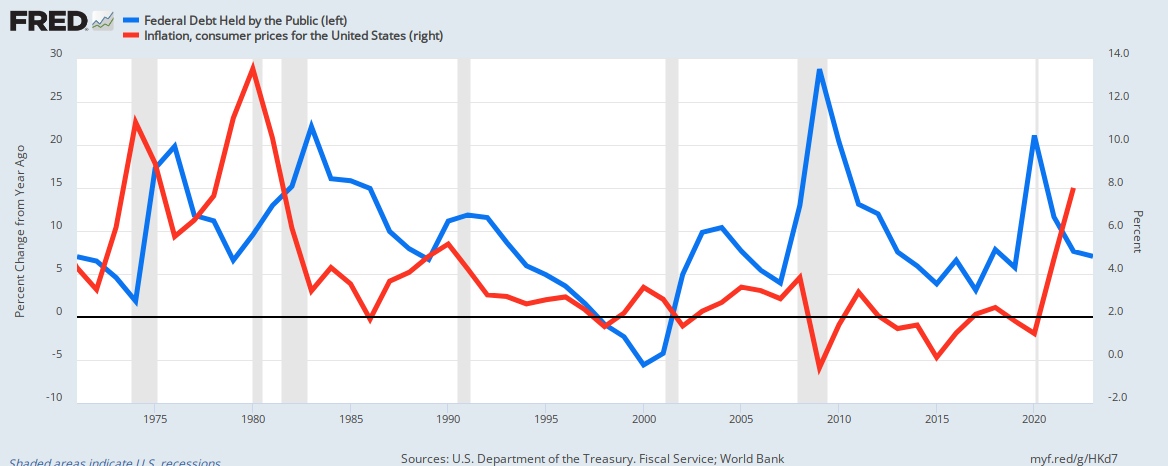
Contrary to popular myth, inflation never is caused by “too much” federal deficit spending. Inflation always is caused by shortages of key goods and services.There is no correlation between federal deficit spending (blue line) and inflation (red line).
Today’s inflation is related to shortages of energy, labor, food, and computer chips.
Inflation actually can be cured by additional federal spending to pay for scarce goods and services.
In Summary
The Monetarily Sovereign federal government has infinite access to dollars. Neither the government nor any agency of the government can run short of dollars unless Congress wants that to happen.
Federal taxes do not “pay for” federal spending. Federal spending is paid for by the creation of new dollars, which the government has the infinite ability to do.
Federal spending does not cause inflation. Inflation is caused by the scarcity of key goods and services. Federal spending can cure inflation by paying for scarce goods and services.
America is not short of jobs. America is short of good jobs. Modern Monetary Theory’s Jobs Guarantee will solve zero problems, and in fact exacerbate a “crap jobs” economy.
Poverty, the lack of money, is bad for the American economy. Poverty is not cured by bad jobs, but rather by putting money in the hands of the impoverished. This creates new consumers, whose purchases grow the economy, which grows businesses that are able to provide attractive jobs.
It all begins putting with money into the hands of the people, which the U.S. federal government has the infinite ability to provide.
Rodger Malcolm Mitchell
Monetary SovereigntyTwitter: @rodgermitchellSearch #monetarysovereigntyFacebook: Rodger Malcolm Mitchell
……………………………………………………………………..
THE SOLE PURPOSE OF GOVERNMENT IS TO IMPROVE AND PROTECT THE LIVES OF THE PEOPLE.
Gap Psychology describes the common desire to distance oneself from those “below” in any socio-economic ranking, and to come nearer those “above.” The socio-economic distance is referred to as “The Gap.”
Wide Gaps negatively affect poverty, health and longevity, education, housing, law and crime, war, leadership, ownership, bigotry, supply and demand, taxation, GDP, international relations, scientific advancement, the environment, human motivation and well-being, and virtually every other issue in economics.Implementation of Monetary Sovereignty and The Ten Steps To Prosperity can grow the economy and narrow the Gaps:
Ten Steps To Prosperity:
BACKGROUND We previously have discussed the parallels between the MonopolyⒸ game’s Bank and the U.S. federal government. Both are Monetarily Sovereign, which means:
Create a column for each player.
They cannot run short of money.
They have no need to borrow money.
They do not need to collect taxes.
And the taxes they collect are destroyed upon receipt.
Let’s say you wish to play the MonopolyⒸ game with three friends, but when you open the box you find it has no money.
What do you do?
The paper “money” in a MonopolyⒸ game merely is a convenience, not a necessity. The game can be played in exactly the same way, without paper MonopolyⒸ dollars.
You simply can draw four columns on a sheet of paper — one column for each player. Then you write 5,000 (or any amount) at the top of each column. The total of the columns (say, 20,000) is the total amount of money in the game.
When any player spends money, you deduct that amount from the last number in the column, and when any player receives money, you add that amount.
But what happens when a player is required to pay money to the Bank? There is no column for the Bank. So, you simply deduct that amount from the player’s column.
Since the bank has no column, the money is destroyed. No record is kept of Bank “deficits.” The total in the game is now less than 20,000 MonopolyⒸ dollars.
This is similar to what happens when you pay taxes to the federal government. Although the federal government keeps a record of that payment, it doesn’t use those dollars for anything. Effectively, the U.S. dollars are destroyed.
And, like the MonopolyⒸ bank, the U.S. federal government creates brand new dollars, every time it spends.
And what happens when the MonopolyⒸ Bank spends money (for instance by paying 200 dollars when a player passes “GO”)? You add that 200 dollars to the appropriate player’s column. The total money in the game now increases by 200 Monopoly dollars.
The MonopolyⒸ Bank doesn’t have debt, because it simply creates new MonopolyⒸ dollars by the very act of spending. Similarly, the federal government creates new U.S. dollars by the very act of spending.
QUESTIONS 1. What is the federal “deficit”?
The so-called “deficit is the misleading name given to the difference between the amount of money the federal government collects vs. the amount it spends.
The deficit is just an arithmetic difference; it does not imply a real financial relationship between collections and spending.
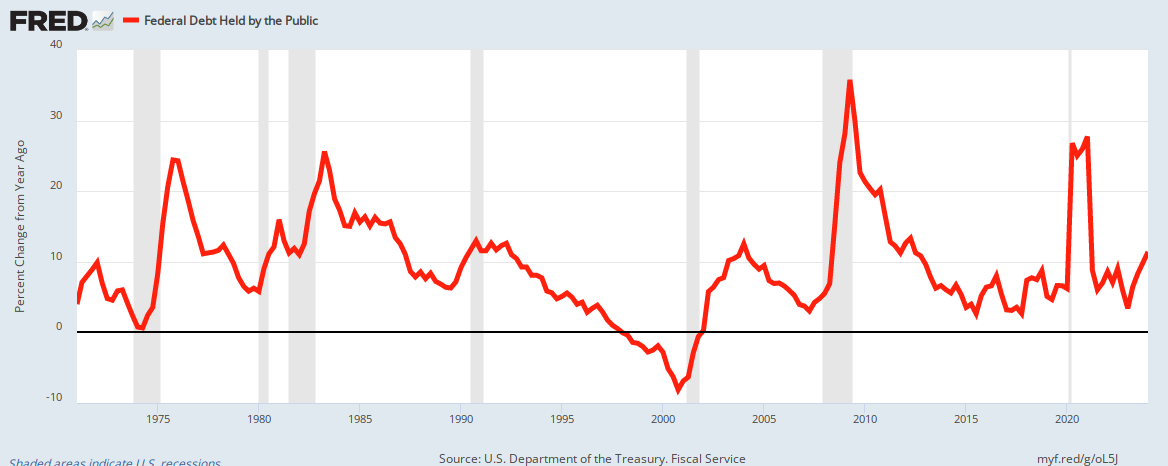
Reductions in federal debt growth introduce recessions (vertical gray bars). Recessions are cured by increases in federal debt growth.
The federal government has the unlimited ability to create U.S. dollars, so the deficit merely shows how many dollars the government sends into the economy compared to the number of dollars the government takes from the economy.
Thus the so-called “deficit” more properly should be viewed as an “economic surplus.”
Because deficits add dollars to the private sector, they are necessary to cure recessions and depressions.
2. What is the federal debt?
The government accepts deposits into U.S. Treasury Security accounts. The purpose of these accounts is not to supply the government with dollars (it creates dollars at will), but rather:
To help the government control interest rates.
To provide the world with a safe “parking” place for unused U.S. dollars, which helps stabilize the dollar.
The total of deposits into the U.S. Treasury Security accounts is misleadingly known as the federal “debt,” though the accurate term would be “deposits.”
3. Do federal taxpayers pay for the federal debt? These T-security accounts pose no burden on the federal government or on taxpayers. The government pays interest into these accounts by creating brand new dollars.
The accounts are paid off by sending the dollars that reside in the accounts, back to the account holders. No tax dollars are used.
4. Does the federal government borrow?
Unlike state and local governments, the U.S. federal government does not borrow.Why would it? Being Monetarily Sovereign, it has the unlimited ability to create dollars.
Though accepting deposits into Treasury Security accounts sometimes wrongly is called “borrowing,” those dollars are not used by the government. They stay in the accounts, earning interest, until maturity, at which time they return to the account owners.
The term “borrow,” implies that the borrower has some need of, or use for, the thing being borrowed. The federal government has neither need of, nor use for, the dollars deposited in T-security accounts.
The purposes of federal T-securities are:
To help the Federal Reserve control interest rates
To provide a safe parking place for unused dollars, which stabilizes the dollar.
To convince the public that the federal government does not have the unlimited ability to create dollars.
(#3 helps the very rich prevent the public from demanding more social spending.)
5. Does federal deficit spending cause inflation?
Federal deficit spending adds growth dollars to the economy.
There is a popular myth that “excessive” government spending causes inflation. The common belief is that increasing the supply of dollars, without increasing the demand for dollars, would make each dollar less valuable, which is the definition of “inflation.”
While the total of deficits (blue line) has increased massively, inflation (red line) has been comparatively modest.
In reality, however, adding dollars to the economy puts spending-dollars into consumers’ pockets, which grows the economy and increases the demand for dollars. (See #6.)
Since 1947, the U.S. federal deficit increases have totaled more than 80,000%, while prices have increased significantly less.
The illusion of deficit spending causing inflation comes partly from the images of wheelbarrows filled with money during hyperinflations.
But those were examples of hyperinflations causing currency printing, and not the other way around.
Example: Zimbabwe. Farmland was taken from white farmers and given to blacks who did not know how to farm. Food shortage and then hyperinflation predictable results.
6. How is inflation prevented and cured?
The standard, recommended cure for inflations and hyperinflations is to reduce government spending, aka “austerity.” Unfortunately, this actually can worsen the problem by exacerbating the shortages.
The best prevention/cure for modest inflation: First raise interest rates to increase the value of the currency. This can be done quickly and incrementally, without the need for time-consuming, politically-tilted debates in Congress.
Meanwhile, to prevent/cure more serious inflations, increase government financial support for farming and oil exploration. Because this requires a counter-intuitive increase in government spending, it can take longer for a government to implement, but it is the only path to ending an inflation.
In extraordinary circumstances, it may be necessary to introduce a new currency, while focusing financial efforts on food and oil supplies. Until food and oil shortages are cured, inflations and hyperinflations cannot be cured.
7. How does Modern Monetary Theory (MMT) differ from Monetary Sovereignty (MS)?
These two economic philosophies agree that the federal government cannot run short of its own sovereign currency, the U.S. dollar, federal taxing does not fund federal spending, and that federal deficit spending adds growth dollars to the economy.
They further agree that the federal “debt” is not a burden on the federal government or on federal taxpayers.
MMT’s primary goals are full employment (effected by a Jobs Guarantee) and a stable currency.
In contrast, MS’s primary goals are economic growth and a reduction in income/wealth inequality (via the Ten Steps to Prosperity, below).
Since the great recession of 2008, unemployment (blue line) has dropped to low levels, and inflation as been within the Federal Reserve target of 2.5%. That would mean the economy already has met MMT’s goals. Presumably then, for MMT, all is well.
But wealth/income inequality has grown markedly, so clearly MMT’s goals are inadequate.
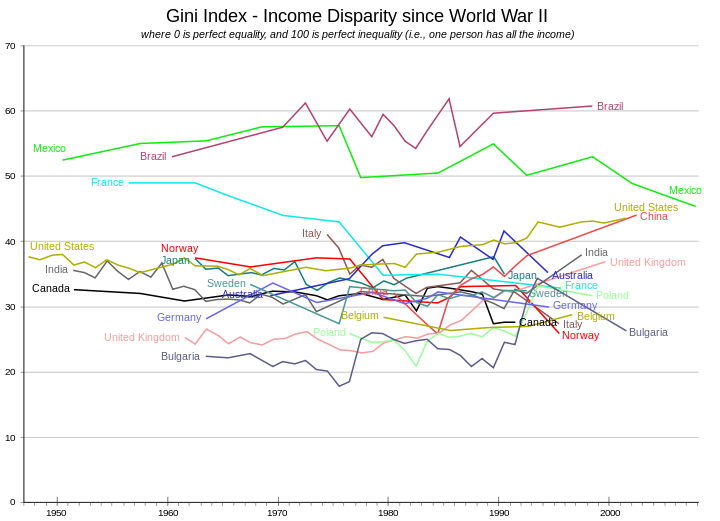
GINI index for the United States
Of the nations measured, only Brazil and Mexico have greater inequality than the U.S.
The most important problems in economics involve the excessive income/wealth/power Gaps between the richer and the poorer.
Wide Gaps negatively affect poverty, health and longevity, education, housing, law and crime, war, leadership, ownership, bigotry, supply and demand, taxation, GDP, international relations, scientific advancement, the environment, human motivation and well-being, and virtually every other issue in economics.
Implementation of The Ten Steps To Prosperity can narrow the Gaps:
A fundamental truth of economics: A Monetarily Sovereign nation never unintentionally can run short of its own sovereign currency.
The nation does not need to tax and does not need to borrow. It creates its sovereign currency at will.
To not understand that fact is to not understand economics, for it is the absolute foundation of economics.
THEWEEK Magazine recently published the article, “The big question about Modern Monetary Theory everyone is missing,” by Ryan Cooper.
Modern Monetary Theory (MMT) and Monetary Sovereignty (MS) share many characteristics regarding money in today’s economies.
Here are a few excerpts from the article, together with my comments.
Economists are in the midst of one of the periodic debate flare-ups over Modern Monetary Theory.
On the pro-MMT side we have economists like Stephanie Kelton and Randall Wray, while on the other we have the odd bedfellows of The New York Times’ Paul Krugman and the People’s Policy Project’s Matt Bruenig.
Professor Kelton has been a “pen pal” of mine for several years. I met Professor Wray years ago, when I gave a talk to his class at UMKC.
This intricate debate is about the main merits of MMT, an economic school of thought which has received wide attention for its dismissal of the need for taxes to pay for new spending.
The reason is that the U.S. federal government is Monetarily Sovereign. It is sovereign over U.S. dollars, which it creates ad hoc, every time it pays a creditor.
Even if the U.S. government collected zero taxes, it could continue spending, forever.
However, there is an important question which has to this point not been raised. The MMT advocates say that inflation should be controlled through fiscal policy, instead of monetary policy conducted by the central bank as is current practice.
In other words, if prices start rising, we can keep them in line by raising taxes.
But does that actually work?
No, it doesn’t work, cannot work and never will work.
Raising taxes is too slow and too political (waiting for Congress), too undirected (which taxes?), not incremental enough (raise taxes how much?), and too damaging to economic growth (taxes reduce the money supply).
Unfortunately, MMT takes incompatible positions. It says correctly, that federal taxes do not fund federal spending, but incorrectly that federal taxes are necessary to cause demand for U.S. dollars.
During times of recession and economic slack, a state borrowing in its own currency has unlimited capacity to spend, because printing money or borrowing to spend on public works and so on will not cause inflation so long as there are unemployed workers and idle capital stock.
Think, Mr. Cooper. If a state has the unlimited capacity to spend and to “print” money, why would it need to, or even want to, borrow? Think.
Contrary to popular wisdom, the U.S. does not borrow dollars. Instead, it accepts deposits into T-security accounts, the purpose of which are:
To provide the world with a safe place to park unused dollars. This helps stabilize the dollar.
To assist the Fed in controlling interest rates, which control inflation.
But if there is full employment, taxes are needed for new programs — to fund them for the former, or to stave off inflation for the latter.
Here, Cooper reveals he doesn’t understand the differences between monetarily non-sovereign state and local government financing (where borrowing is necessary), vs. Monetarily Sovereign federal financing (that requires no borrowing).
The federal government levies taxes, but not to obtain dollars. It freely produces all the dollars it needs.
The purpose of federal taxes is to control the economy by discouraging certain activities with higher taxes and by encouraging others with tax reductions.
The effect of federal taxes (as opposed to the purpose), is to reduce federal deficit spending which reduces the money supply.
All federal taxes do this — income taxes, FICA, sales taxes, import duties, etc. They all reduce the money supply. Just as tax cuts are economically stimulative, tax increases are recessionary.
And just as increased federal deficit spending helps cure recessions, decreased federal deficit spending causes recessions, and worst case, depressions.
U.S. depressions tend to come on the heels of federal surpluses.
1804-1812: U. S. Federal Debt reduced 48%. Depression began 1807.
1817-1821: U. S. Federal Debt reduced 29%. Depression began 1819.
1823-1836: U. S. Federal Debt reduced 99%. Depression began 1837.
1852-1857: U. S. Federal Debt reduced 59%. Depression began 1857.
1867-1873: U. S. Federal Debt reduced 27%. Depression began 1873.
1880-1893: U. S. Federal Debt reduced 57%. Depression began 1893.
1920-1930: U. S. Federal Debt reduced 36%. Depression began 1929.
1997-2001: U. S. Federal Debt reduced 15%. Recession began 2001.
Now, it should be noted that MMT’s style of argumentation seems to have dented the brainless pro-austerity mindset that dominates much of elite discourse, which is very much to its credit.
Remember the above comment, because later in his article, Cooper unknowingly supports the very austerity he calls “brainless.”
He discusses the key objection to MMT (and MS), inflation:
The way tax-side inflation control is supposed to work is through supply and demand.
Since taxation will leave buyers with less money in their pockets to spend, market competition will force suppliers to cut prices and workers to accept lower wages.
But if markets have become dominated by a few big firms, then business can resist this pressure, because buyers have nowhere else to go.
Interest is a more effective device for supporting the demand for money. While taxes depress an economy, interest stimulates the economy by increasing federal dollar interest input.
Money growth grows an economy.
A good test of this prediction came in the late 1970s, when inflation was at its postwar peak.
Economist John Kenneth Galbraith argued for price controls, but conservative “monetarists” like Milton Friedman argued that (with) a steep hike in interest rates, inflation would come down quickly and easily.
The Fed tried Friedman’s policy, but it turned out Galbraith was right.
The Fed hiked interest rates to an eyewatering 20 percent, creating the worst recession since the Great Depression up to that time.
But inflation only came down very slowly — partly through Keynesian-style spending effects, but partly by badly damaging the labor movement, which cut unionization.
In the past 50 years, since President Nixon took the U.S. off a gold standard, inflation has not been caused by America’s massive federal deficit spending. See:Inflation has been caused by the price of oil.
The Fed wisely has not recommended controlling the price of oil, an action that would lead to an oil shortage, and a recession, if not a depression. That is what price controls do: Lead to shortages.
And what do shortages lead to? Hyperinflations.
So, Cooper writes that Galbraith was right about price controls?? Where did that come from? He provides no evidence.
The true effect of price controls is to reduce economic growth by reducing supply and profits — the economic necessities for growth.
Price control is a feature of the “brainless, pro-austerity mindset” that Cooper properly criticized a few paragraphs ago.
And do increased interest rates really lead to recessions? Or is it simply that recessions lead to decreased interest rates?
The above graph shows that sometimes interest rates peak at the start of recessions, sometimes they peak in the midst of economic growth, and sometimes they decline at the start of recessions.
One cannot say that increased interest rates historically have caused recessions.
The real pattern is that decreased deficit spending causes recessions and increased deficit spending cures recessions.
Why? Because a growing economy requires a growing supply of dollars, and deficit spending adds stimulus dollars to the economy.
Since the U.S. went off the gold standard in 1971, the federal debt (blue) has risen massively, while inflation (red) has been moderate.
Most inflations and nearly all hyperinflations are caused by shortages, usually shortages of food, and often shortages of oil.
For instance, Zimbabwe, an oft-mentioned hyperinflation victim, had its hyperinflation begin with a food shortage. (Farmland was stolen from farmers and given to non-farmers.)
One reason inflation control is delegated to the central bank is that it can work quickly, adjusting interest rates in response to economic conditions several times per year.
Congress works extremely slowly at the best of times, and control is usually split between the two parties.
The Fed may have performed poorly over the last decade, but do we really want Mitch McConnell having to sign off on inflation policy?
Exactly. Now that Cooper belatedly has confirmed why price controls and tax increases don’t work and can’t work, we come to the:
SUMMARY
Modern Monetary Theory (MMT) and Monetary Sovereignty MS) describe the realities of economics similarly.
They agree that a Monetarily Sovereign nation, such as the U.S., cannot run short of its own sovereign currency, and neither needs nor uses tax dollars to fund spending.
They differ in many other areas however, one of which has to do with controlling inflation:
Three inflation controls were discussed, only one of which is effective:
Price controls which cut profits and thus cut economic growth, lead to recessions and ultimately cause inflations by causing shortages. They don’t work, and neither MMT nor MS supports this approach.
Tax increases, which are too slow, too political, not incremental, and cause recessions by decreasing the money supply. They don’t work, though MMT supports this approach.
Interest rate increases, which actually increase the money supply (by causing the federal government to pay more interest into the economy, and work by increasing the value of dollars (by increasing the demand for dollars). Works, and has been working since the end of WWII. MS supports this approach.
The most important problems in economics involve the excessive income/wealth/power Gaps between the richer and the poorer.
Wide Gaps negatively affect poverty, health and longevity, education, housing, law and crime, war, leadership, ownership, bigotry, supply and demand, taxation, GDP, international relations, scientific advancement, the environment, human motivation and well-being, and virtually every other issue in economics.
Implementation of The Ten Steps To Prosperity can narrow the Gaps:







 #Monetary Sovereignty - Mitchell