Oh, Veronique, you write so much and seem to know so little about America’s #1 scam.

Veronique de Rugy
Veronique d Rugy. Is she lying or does she really not understand federal finance? Or?

VERONIQUE DE RUGY is a contributing editor at Reason.

She is a senior research fellow at the Mercatus Center at George Mason University.

According to the 2017 Global Go To Think Tank Index Report (Think Tanks and Civil Societies ProgramUniversity of Pennsylvania), Mercatus is number 39 in the “Top Think Tanks in the United States” and number 18 of the “Best University-Affiliated Think Tanks”. 

The Koch family has been a major financial supporter of the organization since the mid-1980s. Charles Koch serves on the group’s board of directors.

The following is Ms. de Rugy’s article from the Libertarian website, REASON.com.

Social Security Is on the Brink of Collapse. The GOP Won’t Touch It. In 1950, there were more than 16 workers for every beneficiary. In 2035, that ratio will be only 2.3 workers per retiree. VERONIQUE DE RUGY | 1.26.2023 12:01 AM

If you follow policy debates long enough, arguments you never thought you’d hear can become key components of the two parties’ policy platforms.

That’s certainly the case when it comes to some Republicans, and their new “never touch Social Security and Medicare” position.

Over the weekend, newly elected Sen. J.D. Vance (R–Ohio) tweeted that former President Donald Trump was 100 percent correct to demand that “under no circumstances should Republicans vote to cut a single penny from Medicare or Social Security.”

Vance’s tweet was issued amid the debt ceiling fight, but Trump has long held this position.

The Republicans would love to cut Medicare and Social Security benefits because that would increase the income/wealth/power Gap between the rich and the rest. The Gap is what makes the rich rich. If not for the Gap, no one would be rich. We all would be the same. The wider the Gap, the richer are the rich. The GOP, the party of the rich, is always ready to help make the rich richer. Their big tax reduction during the Trump years enriched the rich and did nothing for the middle and poor. The GOP complaints about funding the IRS had to do with protecting the rich. So long as the IRS is underfunded, they don’t have the manpower to investigate the complex tax returns of the rich, so currently, they focus on the middle and lower levels. The only reason the GOP won’t try to cut Medicare and Social Security benefits is that they would be punished at the polls, not because they care about the health and well-being of the middle or poor. They don’t. Watch for the GOP “solution” to the non-problem of Social Security and Medicare finances to be something that doesn’t hurt the rich, such as increasing the FICA income limit. Rich people aren’t worried about paying FICA taxes on an above $150M salary. Not only is that chump change for the rich, but many don’t pay any FICA because they aren’t salaried.

Now, to be fair, the GOP’s well-intentioned engagement in the overall debt ceiling dispute is limited by the short time Congress has to raise the limit, all but ruling out credible reforms of Medicare or Social Security.

GOP’s “well-intentioned” engagement in the debt ceiling dispute?? I didn’t realize Veronique was a humor writer. Or perhaps she believes her readers are fools.

Reforming these two programs will take a considerable amount of time and requires bipartisan action. However, this reality is no reason to assert that the programs’ benefits should never be touched.

In right-wing speak (Yes, Libertarians are closet right-wingers), “reform” Social Security and Medicare means cut benefits to the middle class and the poor.

I cannot wait to hear the grand plan that the “don’t touch Social Security and Medicare” Republican caucus has to address the $116 trillion over 30-year shortfall—that’s 6 percent of U.S. GDP—facing the two programs.

No action from Congress means no money to pay for all the benefits. That means enormous cuts that will hurt the low-income seniors who depend on the programs.

That is a bald-faced lie. The federal government could double, triple, or quadruple benefits for both programs while eliminating all FICA collections and still have money to pay Congressional, Presidential, and SCOTUS salaries. Contrary to popular myth, FICA pays for nothing. Every FICA dollar ripped from your paycheck and sent to the U.S. Treasury is destroyed upon receipt. The dollars come from the M2 money supply, so when you pay $1 in federal taxes, the M2 money supply declines by $1. But when those M2 dollars reach the Treasury, they instantly cease to exist in any money supply measure. There is no money supply measure for federal funds simply because the federal government has the infinite ability to create dollars. Thus, the federal government, being Monetarily Sovereign, has infinite dollars. Adding your tax dollars to infinity doesn’t change infinity.

Of course, if Vance and friends insist on not touching benefits, they could address the Social Security and Medicare shortfalls with enormous tax hikes.

Federal taxes don’t fund federal spending, so they can’t “address Social Security and Medicare shortfalls.”

For Social Security alone, when the trust fund dries out, they will have to agree to immediately raise the payroll tax from 12.4 percent to 15.64 percent—or close to a 25 percent tax increase.

Add to that the tax hike necessary for Medicare and then repeat the exercise over the years to fill the entire shortfall.

The tax hikes would have no effect on Social Security and Medicare solvency. These federal agencies and all other federal agencies are solvent because they are funded by the infinitely solvent U.S. government. The misnamed federal “debt” is not a debt of the federal government. The government has paid all its debt the same way: By creating dollars from thin air. The federal debt is the net total of all federal deficits — the difference between total spending and total taxing. That difference is bridged by federal money creation so that all obligations are paid on time. Have you ever wondered how the federal government can raise the debt ceiling whenever it wishes? According to the U.S. Department of the Treasury, the debt ceiling has been raised, extended, or revised 78 separate times since 1960. And all these increases were done without tax increases (otherwise, the debt ceiling would not have been reached) because federal taxes don’t fund anything. (State and local governments (unlike the federal government) are monetarily NON-sovereign. They don’t have the unlimited ability to create dollars, so their taxes do fund their spending.)

It’s not as if we haven’t been warning politicians that these troubles were brewing. Back in 2000, roughly when I started working on fiscal issues, experts already warned that the Social Security trust fund would run out of assets by 2037, triggering painful benefit cuts.

Not only does the Social Security trust fund not pay SS benefits, but it isn’t even a trust fund. To quote right-winger Pete Peterson:

WHAT ARE FEDERAL TRUST FUNDS? Sep 20, 2016, Peter G. Peterson Foundation

A federal trust fund is an accounting mechanism used by the federal government to track earmarked receipts (money designated for a specific purpose or program) and corresponding expenditures.

The largest and best-known funds finance Social Security, Medicare, highways and mass transit, and pensions for government employees.

Federal trust funds bear little resemblance to their private-sector counterparts.

In private-sector trust funds, receipts are deposited and assets are held and invested by trustees on behalf of the stated beneficiaries.

In federal trust funds, the federal government does not set aside the receipts or invest them in private assets.

Rather, the receipts are recorded as accounting credits in the trust funds, and the receipts themselves are comingled with other receipts that Treasury collects and spends.

The misnamed trust funds are wholly owned and controlled by the federal government. It can add to them, subtract from them or do whatever else it wishes with them. The notion that the trust funds will run out of money and so can’t pay Social Security or Medicare benefits is ridiculous on its face. The federal government pays whatever benefits it wishes, regardless of so-called “trust funds.’ Further, the government has the unlimited power to add to, or subtract from those fake trust funds whenever it wishes. The whole Social Security/Medicare trust fund fiction is a giant scam to make you believe the government can’t afford SS and Medicare benefits. When politicians whined that Medicare for All or Social Security for All needed to be “paid for” by tax increases or benefit cuts, the sole purpose was to make you agree to widening the income/wealth/power Gap between you and the rich. It is America’s biggest, most crooked scam, and you have been falling for it since Social Security began on August 14, 1935. And you still fall for it without complaint. It’s a scam that makes Bernie Madoff look like an angel. One wonders why you don’t fret about the White House trust fund, the SCOTUS trust fund, the Congress trust fund, the Bureau of Labor Statistics trust fund, the Capitol Police trust fund, the Army trust fund, the Coast Guard trust fund, and all the other federal department and agency trust funds. Oh, they don’t have trust funds? So where do they get their money? Ah, the federal government simply pays the bills by creating dollars from thin air. Just pay thepreciselyand stop lying about “trust funds.” that is exactly what the federal government should do about Social Security and Medicare.

Today, the situation has deteriorated further, with the trust fund now on track to run dry in 2035, along with any practicable hope for fixing the problem.

The fake “trust fund” will run dry only if Congress and the President want it to run dry.

In other words, these problems shouldn’t surprise anyone. When Social Security started, life expectancies were lower. In 1950, there were more than 16 workers for every beneficiary. That ratio is now below three workers per retiree and will be only 2.3 workers per retiree by 2035.

The number of workers per beneficiary is completely irrelevant. Workers do not pay for beneficiaries. FICA does not pay for anything. It’s destroyed. It exists only to con you. Period.

Add to this trend decades of politicians buying votes by expanding benefits beyond incoming payroll taxes, and you have a true fiscal crisis.

To the Libertains’ sneering and twisted minds, giving the populace benefits is “buying votes.” But the sole purpose of any government is to protect and enhance the people’s lives.  If any government doesn’t provide benefits, it’s not doing what it was created to do.

That’s why it’s so alarming that so many in the GOP are giving up on educating a public that’s been brainwashed for years with misleading soundbites like “You earned your Social Security benefits, so you are entitled to the benefits now promised,” or “There’s an account with your name on it.”

There is, in fact, an account with your name on it, and it’s called a T-security account. If you have deposited money into a T-bill, T-note, or a T-bond, you have put dollars into your T-security account. Those dollars belong to you. The federal government never touches them. When your account matures, the government returns the dollars in your account. The total of dollars in all T-security accounts is erroneously termed, “the federal debt.” But it not federal and it is not debt. Your dollars belong to you, not the federal government, and there is no debt. Your dollars are safe and comfortably resting in your account just as though they were in your pocket or safe deposit box. Just as the contents of bank safe deposit boxes are not bank debt, the contents of T-security accounts are not federal debt.

Such misinformation has made serious discussion of reform very difficult.

Yes, that is exactly what misinformation has done.

There’s no question that retirees deserve fair treatment, but the facts are that the Supreme Court ruled in 1960 that workers do not have a legally binding right to Social Security benefits, and if Congress cuts benefits even by, say, 50 percent, it can do so—no matter how much anyone has paid into the program.

And so goes the “trust fund” myth. If they were trust funds, you would have a legal right to those benefits, but you don’t and SCOTUS has said so. And they are not trust funds. Congress and the President have 100% control over benefits, which can be raised or cut, arbitrarily, as can the amount of money claimed to be in those fake “trust funds.” What does that say about the mythical trust funds? What does that say about Veronique de Rugy’s claims?

It won’t come to that, but the ruling still stands. It’s also fiction that all the benefits that have been promised were earned by workers—they weren’t.

That’s in part because current retirees are paid with taxes from current workers, not from funds saved out of the payroll taxes retirees paid when they were in the workforce.

No, no, no. Current retirees are not paid with federal taxes. They are paid by the federal government’s infinite ability to create dollars. The purpose of federal taxes is not to fund federal spending. The purpose of federal taxes is to control the economy by punishing what the government wishes to discourage and by rewarding (via tax breaks) what the government wishes to encourage.

It’s magical thinking to say that touching Social Security and Medicare is a nonstarter.

Touching Social Security and Medicare is not a financial nonstarter. The government could increase or decrease benefits at will. But decreasing benefits could be a voter nonstarter and increasing benefits could a rich-donor nonstarter. That rug-of-war is the called the “debt-limit-debate. It’s a debate between the rich and the rest, except the “rest” don’t even know there is a debate, much less a solution.

Even more strange, many of the same Republicans want to spare these two programs while still putting Medicaid on the chopping block. Medicaid should be reformed too, but at least that program serves poor people.

By contrast, the seniors who receive Social Security and Medicare today are overrepresented in the top income quintile while younger Americans are overrepresented in the bottom quintile.

So these guys want to cut benefits for poor people on Medicaid while subsidizing relatively wealthy boomers with taxes taken from relatively poor youngsters.

Yikes.

No, the real “yikes” to to writers like Veroique de Rugy who repeatedly promulgate misinformation about the federal “debt” and the fictional Social Security and Medicare “trust funds.” YIKES!!!!!

The GOP’s transformation into the party of big and fiscally reckless government is proceeding apace.

We agree there. Rodger Malcolm Mitchell Monetary Sovereignty Twitter: @rodgermitchell Search #monetarysovereignty Facebook: Rodger Malcolm Mitchell

……………………………………………………………………..

The Sole Purpose of Government Is to Improve and Protect the Lives of the People.

MONETARY SOVEREIGNTY

 
CONGRESS, GOVERNMENT SPENDING, SOCIAL SECURITY, MEDICARE, MEDICAID, DONALD TRUMP, ENTITLEMENTS, POLICY, FISCAL POLICY, OHIO, DEBT, NATIONAL DEBT, DEBT CEILING, REPUBLICAN PARTY, DEMOCRATIC PARTY, GDP, INCOME, POVERTY, TAXES, PAYROLL TAX, POLITICS, RETIREMENT, RETIREMENT BENEFITS, EMPLOYMENT, MISINFORMATION, SUPREME COURT, WEALTH, GOVERNMENT, FEDERAL GOVERNMENT, BIG GOVERNMENT, ECONOMY, ECONOMICS

America’s most dangerous and harmful conspiracy theory

It’s not the hammer. My problem is that I have a headache. Get me an aspirin.

What is America’s most dangerous and harmful conspiracy theory?

No, it’s not the idiocy from QAnon. There is no group of Satanists, cannibals, and child sex abusers plotting against Donald Trump.

Only the mentally challenged believe that tripe.

No, it’s not the ages-old, anti-Semitic B.S. that Jews drink children’s blood on holidays. Jews famously love children. Mogen David wine is the preferred imbibement.

And no, it isn’t that Trump was cheated out of the election (though he and the entire GOP already plan to make the same claim if they lose again).

Fifty lawsuits, dozens of judges — some Republican — and numerous recounts have demonstrated the ongoing perfidy of that assertion.

The guy lost by over 7 MILLION individual votes and 74 electoral votes! And still, he whines. What does it take to convince the MAGAs?

Only the bottom segment of America’s intelligence range still believes those ideas.

The single most dangerous and harmful conspiracy theory is believed by the majority of America because it is repeated by the majority of America. Repetition is convincing.

Here is a classic example:

The CRFB Fiscal Blueprint for Reducing Debt and Inflation October 26, 2022

The United States faces numerous economic and fiscal challenges, including surging inflation, rising interest rates, trust funds heading toward insolvency, a broken budget process, and an unsustainably increasing national debt.

The CRFB (Committee for a Responsible Federal Budget) is part of a conspiracy to spread the false theory that these are problems caused by too much federal deficit spending.

The very rich, who support the CRFB, want you to believe that if you would accept less help from Medicare and Social Security while paying more of your salary to FICA, America could survive financially.

You working stiffs who struggle to pay for food, clothing, a car, a few days of vacation, and education for your kids are simply being selfish by asking the government to help you with your medical bills and retirement.

Shame on you, especially when the rich have to scrimp along on the few millions they get from tax loopholes. After all, rich Donald Trump paid minimal taxes in three of the past ten years. What more do you expect?

In order to help the Federal Reserve fight inflation, reduce interest costs, and support economic growth, policymakers should put forward a plan to put the national debt on a sustainable long-term path.

Though there is no one single “correct” fiscal metric, the higher the debt-to-Gross-Domestic-Product (GDP) ratio and its growth trajectory, the more vulnerable the U.S. economy is.

If you believe those two sentences, you have been royally conned. They are lies.

You have been fed the same baloney since at least 1940 when the “debt” first was called a “ticking time bomb.” The so-called “national debt” was only $40 billion back then.

Today, it’s somewhere in the neighborhood of $25 TRILLION, an astounding 62,400% increase. Yet here we are. Still sustaining. How is that possible?

First, the so-called national debt isn’t really a debt; second, it is infinitely sustainable. The federal “debt” is two different things united by an unnecessary law.

I. The so-called “debt” is the net total of federal deficits, i.e., the difference between federal income (mainly tax collections) and federal spending.

But, while state/local government taxes fund state/local government spending, federal taxes do not fund federal spending. The Monetarily Sovereign federal government destroys every tax dollar it receives, and it funds all its spending by creating new dollars, ad hoc, every time it pays a bill. It works like this:

When you pay taxes, you take dollars from your checking account. Those dollars are part of the “M2” money supply measure.

When those dollars reach the U.S. Treasury, they suddenly are not part of any money supply measure. Because the federal government has infinite dollars, there is no measure of the government’s money. 

Your tax dollars disappear from existence. They effectively are destroyed.

State/local governments, being monetarily non-sovereign, put tax dollars into banks, where they continue to be part of the M2 money supply measure. While state/local government debt really is debt, the federal government has infinite money, so it has no measurable debt.

II. The so-called “debt” is the total of deposits into Treasury security accounts resembling bank safe deposit boxes. You put money into your T-security account, the government adds some money, and later, when the account matures, the government returns the dollars already in your account — just like your safe deposit box.

The contents of the boxes are yours, from beginning to end. The government doesn’t “owe” them to you because you never lose ownership of them. The government isn’t indebted to you for those dollars any more than the banks are indebted to you for the box’s contents.

In both cases, the bank and the government do not touch the contents of the “account box.” The government and banks simply store them for you.

Another reason why that misnamed “debt-that-isn’t-a-debt” is infinitely sustainable: The federal government, being Monetarily Sovereign, has the infinite ability to create its sovereign currency, the U.S. dollar. 

It never, never, never can unintentionally run short of dollars.

Quote from former Fed Chairman Ben Bernanke when he was on 60 Minutes: Scott Pelley: Is that tax money the Fed is spending? Ben Bernanke: It’s not tax money… We simply use the computer to mark up the size of the account.

Statement from the St. Louis Fed: “As the sole manufacturer of dollars, whose debt is denominated in dollars, the U.S. government can never become insolvent, i.e., unable to pay its bills. In this sense, the government is not dependent on credit markets to remain operational.”

In plain English, the federal government does not borrow dollars. Nor does it rely on taxes. It creates dollars, at will, by pressing computer keys.

Implant this in your mind: THE U.S. GOVERNMENT CANNOT UNINTENTIONALLY RUN SHORT OF DOLLARS. NOT TODAY. NOT TOMORROW. NOT EVER.

Even if the misnamed “debt” doubled or tripled tomorrow, that would have zero effect on the federal government’s ability to pay its bills.

And what goes for the government as a whole also goes for federal agencies. Medicare cannot run short of dollars unless that is what the President and Congress want.

Similarly, Social Security cannot run short of dollars unless that is what our leaders want.

The next time you hear some Congressperson expressing anguish about the “debt” or the “debt ceiling,” you can be sure he/she is lying or ignorant about federal finances.

And when you hear that the Medicare or Social Security fake “trust funds” are running short of money, you will know you are hearing the most dangerous and harmful conspiracy theory in America.

The conspiracy theory continues:

Ideally, debt should be gradually reduced to its half-century historical average of about 50 percent of GDP.

The “debt”/GDP ratio is 100% meaningless. It has no predictive value. It tells you nothing about the federal government’s ability to pay its bills. “Debt” is a measure that accounts for the full lifetime of America. GDP is a one-year measure.

“Debt” is the difference between federal income and federal spending. GDP is total spending (federal + non-federal) + net exports. They are as comparable as apples vs. Apple computers.

Here are the nations having the lowest Debt/GDP ratios: Suriname, United Kingdom, Mauritania, Costa Rica, Tunisia, Brazil, El Salvador, Croatia, Sao Tome/Prin, Austria, Belize, India, Bahamas, Hungary, Morocco, Slovenia, Albania, Qatar, Mauritius, Yemen, Trinidad/Tobago, Sierra Leone, Montenegro, South Africa, Sudan

Here are the nations having the highest Debt/GDP ratios: Japan, Greece, Lebanon, Italy, Singapore, Cape Verde, Portugal, Angola, Bhutan, Mozambique, United States, Djibouti, Jamaica, Belgium, France, Spain, Cyprus, Bahrain, Jordan, Egypt, Canada, Argentina.

What generalizations can you make about these nations? What does the Debt/GDP ratio tell you about their financial health? Absolutely nothing.

Yet it is quoted frequently by those who either want to fool you or are ignorant about national finances.

Every time you see or hear someone quoting that ratio as having some importance, know this: That person should not be listened to.

Given political constraints, we suggest at least stabilizing the debt at its current level within a decade, requiring roughly $7 trillion in savings.

The CRFB wants to reduce the “debt” by $7 trillion — about 25% — guaranteeing a depression that would make 1929 look like Christmas. What the CRFB doesn’t want you to know is every time we reduce the “debt,” we have a recession or a depression:

1804-1812: U. S. Federal Debt reduced 48%. Depression began 1807.
1817-1821: U. S. Federal Debt reduced 29%. Depression began 1819.
1823-1836: U. S. Federal Debt reduced 99%. Depression began 1837.
1852-1857: U. S. Federal Debt reduced 59%. Depression began 1857.
1867-1873: U. S. Federal Debt reduced 27%. Depression began 1873.
1880-1893: U. S. Federal Debt reduced 57%. Depression began 1893.
1920-1930: U. S. Federal Debt reduced 36%. Depression began 1929.
1997-2001: U. S. Federal Debt reduced 15%. Recession began 2001.

The Great Depression, which some “experts” claim was caused by “excessive speculation” or some other myth, actually was caused by federal surpluses.

The federal surplus President Clinton loves to boast about led to a recession that President Bush had to deal with.

Mathematically, a growing economy requires a growing supply of money, but federal surpluses take dollars out of the economy and destroy them, which leads to reduced economic growth or negative economic growth.


America's money supply growth (red) parallels GDP growth (blue)
America’s money supply growth parallels America’s GDP growth.

(The CRFB) blueprint puts forward a framework to achieve these goals through a combination of revenue and spending changes – with savings from health care, tax reform, discretionary spending caps, energy reforms, Social Security solvency, and other changes to the budget.

About 40 percent of the deficit reduction comes from revenue and 60 percent from changes in spending.

And virtually all of the deficit reduction comes from the middle classes and the poor.

Translation: The CRFB wants to cut Medicare (“health care”), increase the FICA tax (“tax reform”), reduce aids to the poor (“discretionary spending caps”), ignore global warming (“energy reforms”), and cut Social Security (“Social Security solvency”).

The very rich are laughing all the way to the bank.


Rodger Malcolm Mitchell
Monetary Sovereignty

Twitter: @rodgermitchell Search #monetarysovereignty
Facebook: Rodger Malcolm Mitchell

……………………………………………………………………..

Government’s Sole Purpose is to Improve and Protect the People’s Lives.

MONETARY SOVEREIGNTY

The Medicare disgrace keeps getting worse

BACKGROUND Being Monetarily Sovereign, the federal government (unlike state and local governments) can never run short of its sovereign currency, the U.S. dollar.

Even if the federal government didn’t collect a penny in taxes, it could continue spending forever.

The sole excuse for federal taxes is that they help the government control the economy by taxing what it wishes to discourage and providing tax breaks for what it wishes to encourage.

That is why, for instance, homeownership receives tax advantages while renting receives none. The federal government wished to encourage homeownership.

Why then does the federal government tax salaries at the highest rate while giving tax breaks to almost every other form of income?

The rich own the government.

And why does the government collect the Medicare and Social Security taxes? Is the government trying to discourage salaries, Medicare, and Social Security?

No, the reason is simple. The federal government is bought, paid for, and owned by the rich, thanks to Supreme Court decisions that bribe money is a form of free speech.

And it is the rich who receive most of their income from non-salary sources.

Medicare/Social Security taxes are designed to fall least heavily on the rich. To distance themselves from the rest of us, the rich have forced the federal government to give them breaks on taxes.

The federal government neither needs nor uses tax dollars. It destroys tax dollars, which is why the following is a disgrace:

The wholly unnecessary, unneeded, unused Medicare Part B premium has more than tripled since 2000.
  1. Medicare Part A is hospital insurance. It covers hospital stays and services provided by skilled nursing facilities along with home health care and hospice.
  2. Medicare Part B is outpatient medical insurance. Part B coverage applies whenever you see your doctor, receive outpatient care, or obtain preventive care.
  3. Medicare Part C, known as “Medicare Advantage,” provides coverage to seniors through private insurance companies, contracted by the federal government.
  4. Medicare Part D provides prescription drug coverage.

And here is the more interesting information: 

Monthly premiums for Part A are $0 for people who have worked long enough to qualify for Social Security benefits

If Medicare Part B charges rather substantial premiums — more than $2 thousand a year —  and Medicare Part A is given free to people who supposedly “paid for” Social Security, who pays for Part A?

Answer: The federal government simply creates the dollars that pay for Part A. No taxes. No fake “trust fund.” No worries that it is becoming insolvent. 

In that sense, Medicare Part A is like almost all other federal agencies: The Senate, the House of Representatives, the President and White House, the Supreme Court, the CIA, NFA, the military, etc. It simply is funded by federal money creation.

None of them levy dedicated taxes. None of them are burdened with a “trust fund.” The whole Medicare/Social Security taxes and trust fund performance is nothing but a charade.

The government takes money from you and destroys it.

Why? 

The answer: To prevent you from asking for the kinds of tax benefits the rich routinely receive. How else do you believe a billionaire like Donald Trump paid no income taxes in 10 out of 15 years beginning in 2000?

Think of it: You pay more taxes than did a billionaire. And when you ask for benefits, you are told the government can’t afford them. That is The Big Lie.

You were brought up to believe “there’s no such thing as a free lunch,” and that everything must be paid for. While that’s true for state and local governments, and for businesses, and for you, it’s not true for the federal government.

The government can create infinite dollars by pressing computer keys. Federal deficit spending costs you nothing, not one penny in taxes.

All this came to mind yet again when I saw these articles:

Calls intensify to roll back Medicare premium increaseDec. 13, 2021

The head of a Senate panel that oversees Medicare says the Biden administration should use its legal authority to cut back a hefty premium increase soon hitting millions of enrollees, as a growing number of Democratic lawmakers call for action amid worries over rising inflation.

Last month, Medicare announced one of the largest increases ever in its “Part B” monthly premium for outpatient care, nearly $22, from $148.50 currently to $170.10 starting in January.

The agency attributed roughly half the hike, about $11 a month, to the need for a contingency fund to cover Aduhelm, a new $56,000 Alzheimer’s drug from Biogen whose benefits have been widely questioned.

First: Medicare doesn’t need or use premiums. The federal government has the infinite ability to pay for Medicare, and as for those premiums, they are destroyed upon receipt by the Treasury.

That premium increase was wholly unnecessary. No matter what costs Medicare faces, the federal government simply pays them. Part A charges no premiums. Nether should Part B. (Or Part D for that matter.)

Second: The government can do whatever it wishes regarding Social Security and Medicare finances. It can increase premiums, cut premiums or do without premiums, altogether. 

Third: The “trust funds” are not real trust funds and the so called “trustees” are not trustees. The whole system merely is bookkeeping line items showing how many dollars come in and how many go out. The federal government has total control over its books and can change those numbers at will.

Fourth: The government doesn’t need or use “contingency funds.” It creates ad hoc dollars every time it pays a bill. As previous Fed Chairmen have said:

Alan Greenspan: “A government cannot become insolvent with respect to obligations in its own currency.”

Ben Bernanke: “The U.S. government has a technology, called a printing press (or, today, its electronic equivalent), that allows it to produce as many U.S. dollars as it wishes at essentially no cost.”

Subsequently, the manufacturer of Aduhelm cut the price in half, reducing Medicare’s anticipated payments. You might thing the government would return the premium dollars it had overcharged.

“That has generated sizeable savings for Medicare. But those savings will not be passed along to Medicare Part B enrollees in the form of a premium reduction — at least not this year.”

Then, from a related article:

Two years ago, plenty of pundits were warning that the pandemic-induced economic plunge would blow huge holes in these two mammoth social insurance battleships.

But reports issued this month by the trustees of the two programs show that the strong economic rebound last year contributed to slight improvements in the health of both Social Security and Medicare. [As federal agencies, Social Security and Medicare are as “healthy” as the entire federal government.]

More people were working and paying Federal Insurance Contributions Act, or FICA, taxes last year.

As a result, Social Security’s trustees forecast that the combined retirement and disability trust funds will be depleted in 2035—one year later than last year’s forecast.

The Medicare trustees report that the Hospital Insurance, or HI, trust fund will be emptied in 2028—two years later than forecast last year.

Let’s summarize:

  1. The federal government has absolute control over the finances of Medicare and Social Security. It can add, subtract or transfer dollars at will
  2. Neither the federal government nor any agency of our Monetarily Sovereign federal government can run short of its sovereign currency (the dollar) unless Congress and the President want that to happen. The government has infinite dollars.
  3. Yet, the government unnecessarily takes growth dollars (FICA taxes) from the private sector (aka “the economy”), dollars it neither needs nor uses.
  4. In fact, the government destroys those FICA dollars upon receipt.
  5. Nevertheless, when faced with a possible cost hike, the goverment recently increased the amount of money it unnecessarily takes from the economy.
  6. When the cost hike didn’t materialize, the government decided to keep the additional, unnecessary dollars it had taken from the economy rather than returning them.
  7. At some time in the future, the government falsely will claim that one or both of the fake “trust funds” is running short of dollars, and will take even more dollars from the private sector to keep the fake “trust funds” from fake “insolvency.”
  8. This chicanery makes the public believe federal financing is like personal financing, where spending relies on income. The belief prevents the public from demanding more benefits that the government easily could provide at the tap of a computer key.
  9. The fundamental purpose of all this is to widen the Gap between the rich and the rest, which is the way the rich, who run America, become richer.

The private sector, i.e. the people of America, are being cheated by their own government. Unfortunately, even the people who pretend to protect us promulgate the Big Lie that federal taxes are necessary to fund federal spending.

For most Medicare enrollees, the premium is deducted from their Social Security checks.

 Without further action, it would swallow up a significant chunk of seniors’ 5.9% cost of living increase. “Rather than assessing the current $21.60 per month … premium increase in full, I urge you to reduce the amount,” Senate Finance Chairman Ron Wyden, D-Ore., wrote health secretary Xavier Becerra.

“Reduce” the amount? How about, “Eliminate the entire premium”? Is it possible that Senate Finance Chairman Ron Wyden doesn’t understand that federal taxes don’t fund federal spending?

Quote from Ben Bernanke when he was on 60 Minutes:
Scott Pelley: Is that tax money that the Fed is spending?
Ben Bernanke: It’s not tax money… We simply use the computer to mark up the size of the account.

No, it isn’t possible. Senators are in on the scheme.

A copy of the letter was provided to The Associated Press on Monday. There was no immediate response from the administration.

But Wyden wrote Becerra that as secretary of Health and Human Services, he has “broad authority” to determine the “appropriate contingency margin” to use in setting premiums.

If Wyden has “broad authority,” he should set the amount to be collected at $0. The Federal government would continue to fund Medicare as before. 

Given that Medicare is still developing its formal policy for covering Aduhelm, Wyden said there is a clear rationale for collecting less up front at this particular time.

“It is possible that any near-term Medicare coverage for Aduhelm … could have a limited and narrow scope,” he wrote.

“Uncertainty” over the drug’s financial impact on Medicare appeared to be driving much of the calculation of the new premium, Wyden noted.

The drug will have no financial impact on Medicare. With or without paying for Aduhelm, the federal government still will have infinite dollars. Aduhelm will make no change in that.

Soon after Medicare announced the increase last month, Vermont Independent Sen. Bernie Sanders called on the administration to roll it back.

Sanders knows the truth. He had employed Professor Stephanie Kelton, a lady who understands Monetary Sovereignty, to be Chief Economist for the Democrats on the Senate Budget Committee and economic advisor to Bernie Sanders.

Wyden also said he had concerns and was exploring options.

And last week Democratic Senators Maggie Hassan of New Hampshire, Jacky Rosen of Nevada, Chris Van Hollen of Maryland, Mark Kelly of Arizona, and Jack Reed of Rhode Island wrote President Joe Biden that “we must address this issue as quickly as possible.”

Some groups representing older people are anticipating a backlash from Medicare recipients if nothing is done.

The way to “address the issue” is to tell the American public that federal taxes do not fund federal spending.

Period.

———-//———-

[No rational person would take dollars from the economy and give them to a federal government that has the infinite ability to create dollars.]

Rodger Malcolm Mitchell
Monetary Sovereignty

Twitter: @rodgermitchell Search #monetarysovereignty
Facebook: Rodger Malcolm Mitchell

……………………………………………………………………..

THE SOLE PURPOSE OF GOVERNMENT IS TO IMPROVE AND PROTECT THE LIVES OF THE PEOPLE.

The most important problems in economics involve:

  1. Monetary Sovereignty describes money creation and destruction.
  2. Gap Psychology describes the common desire to distance oneself from those “below” in any socio-economic ranking, and to come nearer those “above.” The socio-economic distance is referred to as “The Gap.”

Wide Gaps negatively affect poverty, health and longevity, education, housing, law and crime, war, leadership, ownership, bigotry, supply and demand, taxation, GDP, international relations, scientific advancement, the environment, human motivation and well-being, and virtually every other issue in economics. Implementation of Monetary Sovereignty and The Ten Steps To Prosperity can grow the economy and narrow the Gaps: Ten Steps To Prosperity:

  1. Eliminate FICA
  2. Federally funded Medicare — parts A, B & D, plus long-term care — for everyone
  3. Social Security for all
  4. Free education (including post-grad) for everyone
  5. Salary for attending school
  6. Eliminate federal taxes on business
  7. Increase the standard income tax deduction, annually. 
  8. Tax the very rich (the “.1%”) more, with higher progressive tax rates on all forms of income.
  9. Federal ownership of all banks
  10. Increase federal spending on the myriad initiatives that benefit America’s 99.9% 

The Ten Steps will grow the economy and narrow the income/wealth/power Gap between the rich and the rest.

MONETARY SOVEREIGNTY

What are the purposes of the federal gas tax, FICA and federal income tax?

Question: What are the purposes of the federal gas tax, FICA, and federal income tax?

Answers:

  1. The federal government and states both impose gas taxes, with much of the revenue raised going toward fixing highways and other infrastructure projects.
  2. The Federal Insurance Contributions Act (FICA) is a U.S. law that mandates a payroll tax on the paychecks of employees, as well as contributions from employers, to fund the Social Security and Medicare programs.
  3. Tax revenue allows the government to operate and provide goods and services for citizens. These goods and services include roads, bridges, national parks, education, research and national defense.

The answers to the questions can be summarized as: The purpose of federal taxes is to fund federal spending. You can find these answers at the indicated links and in thousands of places on the Internet, except . . .

. . . the answers are wrong. Federal taxes fund nothing. 


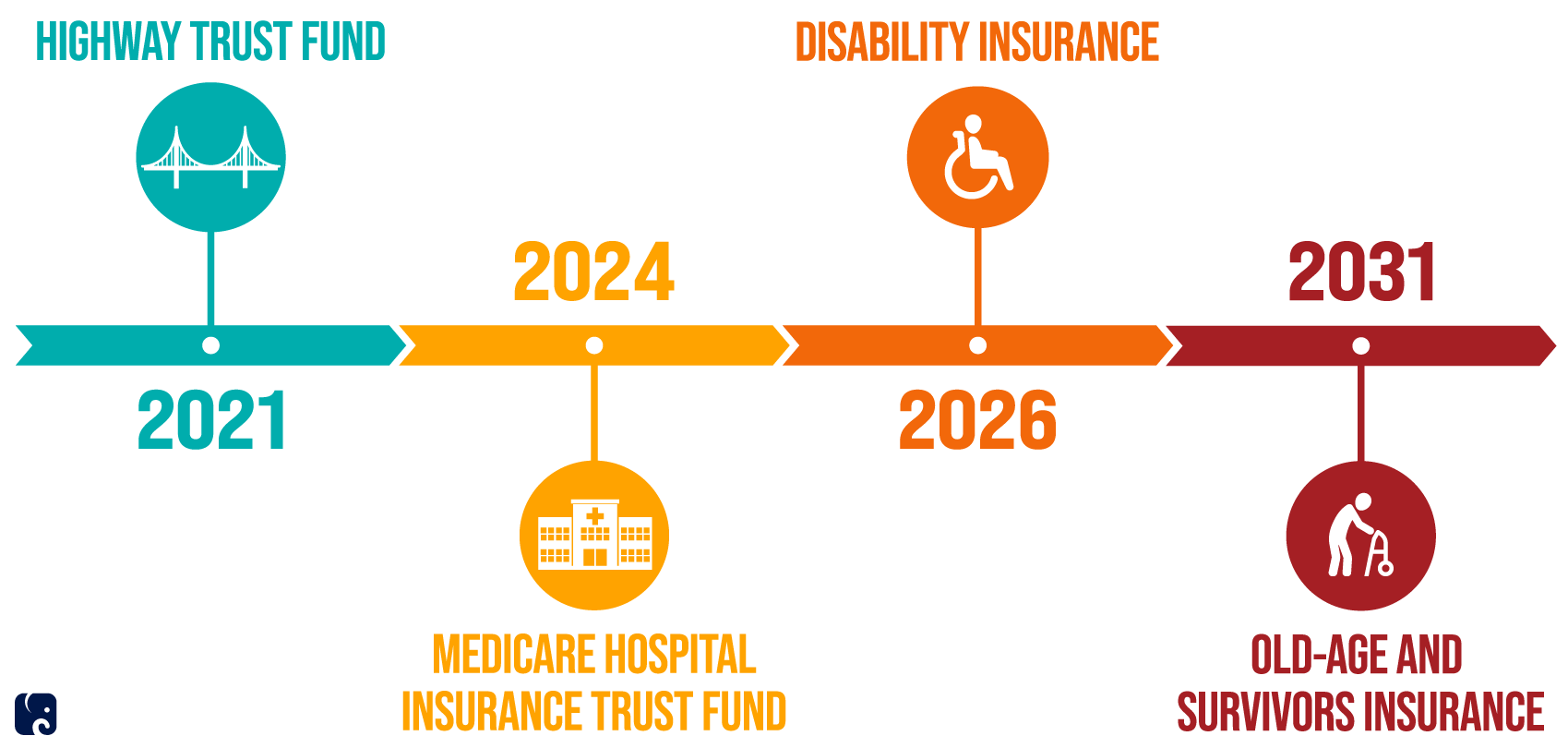
Status of Major Federal Trust Funds
Dates “trust funds” supposedly will exhaust their cash, except it’s all a lie. The “trust funds” are not real trust funds, and there is no cash. Congress and the President have total control over all spending, which is done with newly created dollars, ad hoc. The government never can run short of dollars.

State and local taxes stay in the economy (aka, the private sector). They are deposited in private banks and then are used to fund state and local spending.

But federal taxes are destroyed upon receipt. They no longer stay in the economy. They no longer are part of the money supply measure M2. They cease to exist.

This fact is not understood by the vast majority because of the erroneous communications sent every day.

I. The Purpose of the Federal Gas Tax

Biden says decision on gas tax holiday may come this week
Aamer Madhani and Josh Boak
Associated Press
REHOBOTH BEACH, Del. (AP) — The administration is increasingly looking for ways to spare the public from higher prices at the pump, which began to climb last year and surged after Russia invaded Ukraine in February.

The Biden administration has already released oil from the U.S. strategic reserve and increased ethanol blending for the summer, in additional to sending a letter last week to oil refiners urging them to increase their refining capacity.

Yet those efforts have yet to reduce price pressures meaningfully, such that the administration is now considering a gas tax holiday. Taxes on gasoline and diesel fuel help to pay for highways.

There it is, the Big Lie that federal taxes pay for things. 

The government, being Monetarily Sovereign, has the infinite ability to create its own sovereign currency, the U.S. dollar. 

The federal government never unintentionally can run short of dollars. Even if total federal tax collections equaled $0, the federal government could continue spending, forever. The federal government already has unlimited dollars to pay for highways.

Given that simple fact, there is no reason why the federal government would need to collect taxes for spending. The sole function of the federal gas tax is to discourage driving. It’s an effort to reduce gasoline usage.

And that is the fundamental difference between federal finances vs. state/local government finances. State and local governments can and do run short of dollars. Their taxes do fund spending.

Federal taxes have only one purpose: Taxes discourage what the government wants to limit, and tax breaks encourage what the government wants to grow.

The Penn Wharton Budget Model released estimates Wednesday showing that consumers saved at the pump because of gas tax holidays in Connecticut, Georgia and Maryland. 

Sadly, the state and local governments, which do not have the infinite ability to create dollars are doing what the federal government should have done.

In an interview Sunday on ABC’s “This Week,” Treasury Secretary Janet Yellen expressed an openness to a federal gas tax holiday to give motorists some relief.

Oil refiners say their ability to produce additional gas and diesel fuel is limited, meaning that prices could remain high unless demand starts to wane.

The gas tax holiday would encourage driving, but this would reduce supplies, thereby increasing prices. Clearly, Janet Yellen has no plan for reducing inflation.

In all fairness, however, reducing inflation requires reducing shortages of key goods and services, and that is Congress’s job, not the Fed’s.

Only Congress has the power to increase supplies of scarce goods and services.

The American Petroleum Institute and American Fuel & Petrochemical Manufacturers sent a joint letter to Biden on Wednesday that said refineries are operating near their maximum capacityalready and nearly half of the capacity taken off line was due to the facilities converting to renewable fuel production.

A gas tax holiday would make the scarcity situation worse, although there would be an economic benefit to not removing dollars from the economy.

“Today’s situation did not materialize overnight and will not be quickly solved,” the letter said. “To protect and foster U.S. energy security and refining capacity, we urge to you to take steps to encourage more domestic energy production,” including new infrastructure and reducing regulatory burdens.

That letter does indicate one of the steps the federal government should take to fight inflation: Take steps to encourage more domestic energy production,” including new infrastructure.

Last week, the Federal Reserve stepped up its drive to tame inflation by raising its key interest rate by three-quarters of a point — its largest increase in nearly three decades — and signaled more large rate increases to come.

The cause of inflation is shortages of gas, oil, foods, shipping, computer chips, lumber, housing, and labor. An increase in interest rates will not address any of those causes.

II. The purpose of FICA

The Federal Insurance Contributions Act (FICA) is a U.S. law that mandates a payroll tax on the paychecks of employees, as well as contributions from employers, to fund the Social ecurity and Medicare programs.

Wrong again. Federal taxes fund nothing.

The sole purpose of FICA, as told by President Franklin D. Roosevelt, was so that “no damn politician can ever scrap my Social Security program” (because it is an earned benefit ostensibly funded by the workers themselves.) FICA is not economics. FICA is psychology.

Sadly, rather than protecting Social Security, FICA and its fake “trust funds” have been an excuse for reducing benefits.

Social Security has undergone significant changes since Fuller received her first check, including the addition of disability benefits in 1956. Today, 59 million retired workers, spouses, disabled workers and survivors get monthly payments averaging $1,194.

The latest overhaul came in 1983, when Social Security was on the brink of insolvency. Congress increased payroll taxes, cut benefits and gradually extended the age when retirees can claim full benefits.

The changes shored up Social Security’s finances so it could absorb the initial wave of retiring baby boomers.

The preceding paragraphs demonstrate the lie about Social Security being paid by “trust funds.”

Social Security was “on the brink of insolvency” only because Congress and President Reagan wanted to cut benefits. Otherwise, they merely could have authorized additional federal payments to the program, just as they do when the Army needs more money.

In a real “trust fund,” the trustees (the government) could not arbitrarily add disability benefits. In a real trust fund, the trustee could not arbitrarily extend the age for claiming full benefits. In a real trust fund, the trustee could not arbitrarily invent new rules about working people receiving or not receiving benefits.

Social Security is nothing more than a government agency, and like all other government agencies, it rises or falls on the whim of Congress and the then-current President.

In that sense, it is no different from the military, NASA, or the FBI, except none of them are limited by a fake “trust fund.”

III. The purpose of federal income taxes.

You can spend your life searching sources, and the vast majority will tell you something like this one:

“Taxes (in all their various forms) are the revenue stream that a government needs to provide the services that its citizenry demand of it. If you want the government to perform some action, well, it needs some money to pay for it. Taxes are how we do that.”

The first clue that the author doesn’t know what he or she is talking about comes from the words, “a government.” The tacit assumption is that the finances of a monetarily sovereign government are the same as the finances of a monetarily non-sovereign government.

The former are money creators like the governments of the U.S., Canada, the UK, Mexico, Australia, et al. The latter are money users like the governments of Illinois, Chicago, France, Italy, et al.

Money creators cannot run short of their own sovereign currency, and for that reason they neither need nor use tax. 

Former Federal Reserve Chairman, Alan Greenspan: “A government cannot become insolvent with respect to obligations in its own currency.”

The U.S. government cannot run short of dollars. Similarly, the Canadian, UK, Mexican, Australian etc. government cannot run short of their currencies.

By contrast, money users like the Illinois and Chicago governments can run short of dollars, and the governments of France, Italy, etc. can run short of euros. So they need to collect taxes. That is the way they acquire euros.

In further contrast, the European Union is monetarily sovereign. It cannot run short of euros.

Press Conference: Mario Draghi, former President of the European Central Bank, 9 January 2014
Question: “I am wondering: can the ECB ever run out of money?”
Mario Draghi: “Technically, no. We cannot run out of money.”

Since federal taxes do not fund federal spending, why does the federal government collect them? 

The purposes of U.S. federal taxes are.

1. To narrow the gap between the rich and the rest. An overly wide gap gives the rich too much power in any economy, so tax rates take income into consideration, with increased rates for increased income.

Unfortunately, this purpose is followed more in the breach than in reality, because the rich have managed to distort tax collections in their favor. One outstanding example is Donald Trump, who despite being a billionaire, did not pay any federal taxes at all in 8 of the past 10 years.

2. To control the economy by taxing what the government wishes to discourage and giving tax breaks to what the government wishes to discourage.

A partial example is the gasoline tax which to a very small degree discourages gasoline usage. “Sin” taxes on cigarettes and alcohol fall into this category.

And then there is the real purpose of federal taxes:

3. To make the unwary populace believe that federal deficit spending is harmful so, federal benefits must be limited or taxes must be increased.

This is the insidious Big Lie promulgated by the rich, to widen the Gap between them and the rest of the people.

It is the reason why you repeatedly are told that the Social Security “trust fund” pays SS benefits, and the Medicare “trust fund” pays Medicare benefits, and both are running short of money. Neither of the so-called “trust funds” are real trust funds. Neither pays benefits and neither can run short of money unless Congress and the President want them to run short.

As with all federal agencies, the federal government pays for everything by creating new dollars, ad hoc.

In perhaps overly simple terms, it works like this for Social Security:

  • An agency of the federal government creates instructions (check or wire) from thin air and sends these instructions to your bank
  • Your bank is instructed to increase the balance in your checking account.
  • When your bank obeys those instructions, dollars are created and added to the M1 money supply. 
  • Your bank then “clears” (gets approval) the instructions through the Federal Reserve, which also is an agency of the federal government.

Thus, the circle is completed with one agency of the federal government’s approving the dollar-creation instructions by another agency of the federal government.

That is why federal checks don’t bounce. The federal government approves its own instructions.

Compare that to an agency of a state or local government. It too sends instructions to banks, and the banks obey those instructions. But when the banks try to clear the instructions through the Federal Reserve, the instructions will bounce unless the state or local government’s accounts have sufficient reserves.

For state/local governments, there is no self-approval system of dollar payments.

Actual dollar creation is done by banks at the instruction of the federal government. Those green paper Federal Reserve Notes printed by the Treasury are not in themselves, dollars. They are bearer titles to dollars.

Just as a house title document is not a title — it’s just a piece of paper — until it refers to a specific house, a dollar bill is just a piece of paper until it refers to a specific dollar on the government’s balance sheets.

Dollars are like laws.  They have no physical existence. You can’t hear, feel, smell, taste, or see a law or a dollar.

Dollars are only numbers on balance sheets. The Treasury provides banks with Federal Reserve Notes which merely are titles to dollars.

Banks use Federal Reserve Notes (dollar bills) as a substitute for increasing numbers in accounts. People use Federal Reserve Notes as titles to dollars that exist only as numbers on federal balance sheets.

For example, if you were to use dollar bills to purchase a car, you would exchange your title to dollars for the title to the car. The car seller then would own the dollar titles, proving he owned the numbers on the government’s books, and you would own the car title proving you own the car.


Rodger Malcolm Mitchell
Monetary Sovereignty

Twitter: @rodgermitchell Search #monetarysovereignty
Facebook: Rodger Malcolm Mitchell

……………………………………………………………………..

THE SOLE PURPOSE OF GOVERNMENT IS TO IMPROVE AND PROTECT THE LIVES OF THE PEOPLE.

The most important problems in economics involve:

  1. Monetary Sovereignty describes money creation and destruction.
  2. Gap Psychology describes the common desire to distance oneself from those “below” in any socio-economic ranking, and to come nearer those “above.” The socio-economic distance is referred to as “The Gap.”

Wide Gaps negatively affect poverty, health and longevity, education, housing, law and crime, war, leadership, ownership, bigotry, supply and demand, taxation, GDP, international relations, scientific advancement, the environment, human motivation and well-being, and virtually every other issue in economics. Implementation of Monetary Sovereignty and The Ten Steps To Prosperity can grow the economy and narrow the Gaps: Ten Steps To Prosperity:

  1. Eliminate FICA
  2. Federally funded Medicare — parts A, B & D, plus long-term care — for everyone
  3. Social Security for all
  4. Free education (including post-grad) for everyone
  5. Salary for attending school
  6. Eliminate federal taxes on business
  7. Increase the standard income tax deduction, annually. 
  8. Tax the very rich (the “.1%”) more, with higher progressive tax rates on all forms of income.
  9. Federal ownership of all banks
  10. Increase federal spending on the myriad initiatives that benefit America’s 99.9% 

The Ten Steps will grow the economy and narrow the income/wealth/power Gap between the rich and the rest.

MONETARY SOVEREIGNTY