The Libertarians and the missing data


Here is a Libertarian article, as usual, complaining about the federal deficit. 

Why Did Joe Biden Stop Talking About the Deficit?

You can read the entire article by clicking the above link, but here are excerpts to give you the essence. Can you guess what crucial data is missing from the report?

The federal budget deficit has exploded under Biden’s watch, and he can no longer pretend otherwise. ERIC BOEHM | 7.19.2023

At times last summer, it seemed like the only thing President Joe Biden wanted to talk about was the federal budget deficit.

We’re on track to cut the federal deficit by another $1.5 trillion by the end of this fiscal year. The biggest decline ever in a single year, ever, in American history,” Biden claimed during a May 2022 press conference.

Later that same month, in a Wall Street Journal op-ed touting his economic program, Biden wrote that the deficit would fall by $1.7 trillion and repeated the “largest reduction in history”claim. That talking point was still getting heavy rotation in September when the president bragged on 60 Minutes about his deficit-cutting powers.

Of course, as Reason (and other outlets) clarified, the falling deficit was not the result of anything the president had done. There had been an unprecedented amount of federal spending in 2020 and 2021 due to the COVID-19 pandemic, and that spending drove the budget deficit to record highs: over $3.1 trillion in 2020 and more than $2.7 trillion in 2021.

As the pandemic passed and federal spending returned to more normal levels, so did the annual budget deficit. (In fact, the deficit would have fallen further last year if not for Biden’s policies, thanks to things like the infrastructure bill and last year’s federal budget.)

 The CBO projects that the deficit will ring in around $1.5 trillion when the current fiscal year wraps up on September 30.

Funny that Biden doesn’t want to talk about that.

It’s less funny that he’s also ignoring the trajectory of the federal deficit in future years. Rather than shrinking, the gap between federal revenue and federal spending is on course to widen dramatically in the coming decades.

Wow, the federal budget deficit must awful for the economy. Here is what Eric Boehm, the Libertarians, and the Congressional Budget Office claim:

That means the federal government will have to take on more debt. The rising cost of that debt will “slow economic growth, drive up interest payments to foreign holders of U.S. debt, elevate the risk of a fiscal crisis, increase the likelihood of other adverse effects that could occur more gradually, and make the nation’s fiscal position more vulnerable to an increase in interest rates,” the CBO warned last month.

That’s quite a claim. Have you figured out what’s missing?

Data. There is no data. Just assumptions.

Let’s examine those assumptions: Will federal deficit spending “slow economic growth”?

The term “economic growth” means Gross Domestic Product (GDP) growth. The formula for GDP is GDP = Federal Spending + Nonfederal Spending +Net Exports.

Look at that formula and explain to me the mechanism by which federal deficit spending will “slow economic growth.”

Unless you believe there is some magic way in which increased taxes can increase economic growth, there is no mechanism by which increased federal deficit spending can “slow economic growth.”
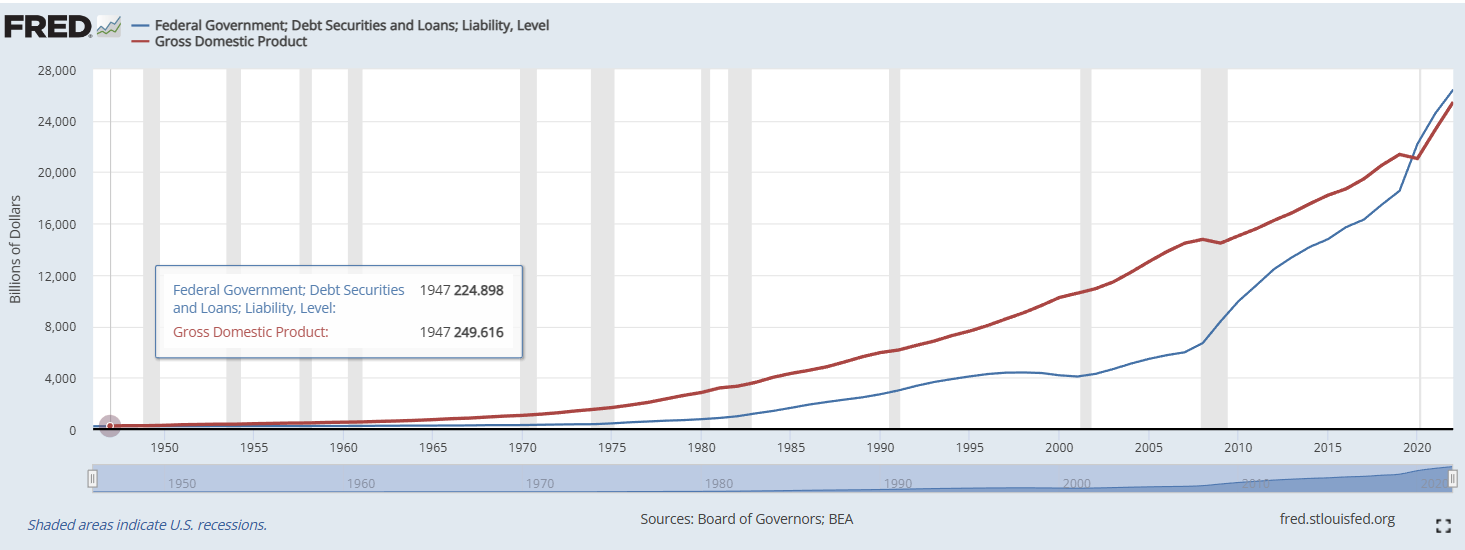
Federal deficit spending and GDP have risen since 1945

Will increased federal deficit spending “drive up interest payments to foreign holders of U.S. debt.” Yes, of course, it will. But is that supposed to be a problem?

Being uniquely Monetarily Sovereign, the federal government has infinite dollars. It pays all its dollar-denominated debts simply by pressing computer keys. No tax dollars are involved.

And despite the massive increase in deficits, the government never has and never will run short of dollars to pay interest.

Further, the federal government has absolute control over interest rates. The Fed sets rates arbitrarily to combat inflation, not to sell T-bonds.

The federal government has no need to sell any debt. It could stop offering T-securities tomorrow, and that would not affect the government’s ability to spend.

The sole purpose of T-securities is to provide a safe place to store unused dollars, which helps stabilize the dollar, not to provide spending money to the federal government/

(This is different from state/local government taxes, which do provide spending money to state/local governments.)

Will increased federal deficit spending “elevate the risk of a fiscal crisis”? What fiscal crisis? Unlike you and me. The government can’t run short of dollars. 

Liars love to use general language without data backup.

Will increased federal deficit spending “increase the likelihood of other adverse effects that could occur more gradually, and make the nation’s fiscal position more vulnerable to an increase in interest rates”?  What adverse effects?

The CBO Libertarians never say because there are none.

And what do they mean by the nation’s “fiscal position being vulnerable”? Again, they never say.

The warning is one big fat load of generalized poppycock, a vast word salad with zero meaning.

Why do they embarrass themselves by spewing such nonsense? Here’s one reason, probably the main reason:

Biden successfully blocked a House Republican attempt to impose stricter spending caps as part of that deal and refused to include entitlement spending—the real driver of long-term deficit growthin the negotiations.

Ah, yes. The “real driver” of deficit growth is entitlement spending, aka Social Security, Medicare, Medicaid, unemployment, and other “welfare” programs — all benefits to the middle- and lower-income groups.

Why do the Libertarians and the Republicans want to cut those programs? Why do they spread the nonsense that, somehow, the federal government can’t afford them, when the federal government can afford any payment denominated in U.S. dollars?

Statement from the St. Louis Fed: “As the sole manufacturer of dollars, whose debt is denominated in dollars, the U.S. government can never become insolvent, i.e., unable to pay its bills. In this sense, the government is not dependent on credit markets to remain operational.”

Get it? “Not dependent on credit markets. That’s Fed-speak meaning the government does not need to borrow, and in fact, does not borrow. It creates all the dollars it needs by pressing computer keys.

The reason has to do with Gap Psychology. The logic goes like this:

  1. “Rich” is a comparison, not an absolute. If you had $1,000, you would be rich if everyone else had $10, but you would be poor if everyone else had $10,000.
  2. To become more affluent, you must widen the Gap between you and those who have less while narrowing the Gap between you and those who have more.
  3. You can widen the Gap in two ways: Get more for yourself or make sure those below you have less.
  4. The rich, who run America, get richer by widening the Gap below them. This includes spreading the false tale that Social Security, Medicare, etc., must be cut. They spread the tale by bribing three influencers:
    • The media, bribed by advertising dollars and media ownership
    • The politicians, bribed by campaign contributions and promises of future employment
    • The economists, bribed by university contributions and lucrative jobs in “think tanks.”

Thus, the Big Lie (federal finances resemble personal and state/local government finances) is disseminated.

The public is led to believe their federal tax dollars fund federal spending. They don’t. The purpose of federal (as opposed to state/local) taxes is to control the economy by taxing what the federal government wishes to discourage and giving tax breaks to what the government wishes to help.

Additionally, federal taxes can help increase demand for the U.S. dollar by requiring taxes to be paid in dollars.

So, the entire article is based on lies. That is why it contains no historical data.

These general claims seem logical to the public because the claims apply to monetarily non-sovereign entities, not the Monetarily Sovereign U.S. government.

You never will see this graph presented by any Libertarian or Republican:
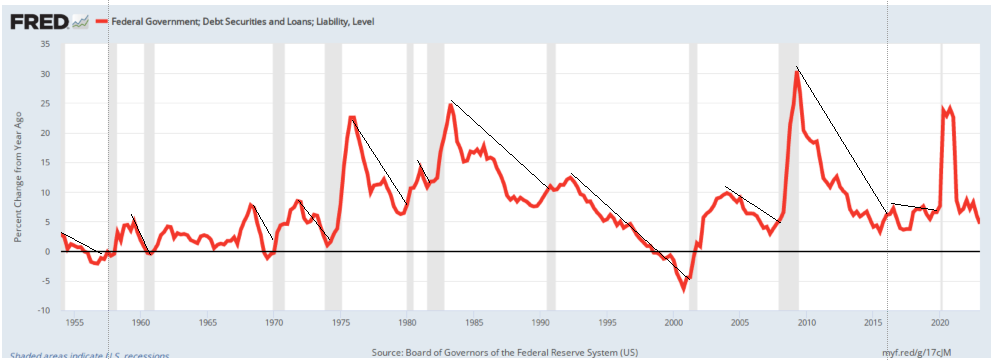
Before recessions (vertical gray bars), federal deficit growth declines, then increases to cure the recessions.

Note to politicians, media writers, and right-wing economists, you’ve done a great job lying to the public on behalf of the rich. You have helped make the rich richer. Congratulations.

One day, soon (I hope), the public will catch on to your lies.

At that time, the people will demand, vote for, and receive such benefits as Free Medicare, expanded Social Security, affordable food and housing, and free college education.

The rich already receive those benefits, courtesy of “friendly” tax laws.

The rest of the population soon will catch on to the fact that the federal government can supply all the benefits the rich receive, while collecting zero taxes.

The public just needs to see that they have been lied to.

Rodger Malcolm Mitchell
Monetary Sovereignty

Twitter: @rodgermitchell Search #monetarysovereignty
Facebook: Rodger Malcolm Mitchell

……………………………………………………………………..

The Sole Purpose of Government Is to Improve and Protect the Lives of the People.

MONETARY SOVEREIGNTY
And the scare headlines continue

I have been reading the Libertarian articles in Reason.com for several years and have noticed something odd. Despite ongoing claims that federal spending should be reduced, no data can support that myth. Like all other debt Henny Pennys, they focus on telling you how big the so-called debt is and how much will be spent on benefits. OK, we get it. The numbers are significant, but why are they bad? But there never is data. It is all speculation supported by more speculation. The following article is no exception:

CBO Projects Huge Deficits, $116 Trillion in New Borrowing Over the Next 30 Years A new Congressional Budget Office report warns of “significant economic and financial consequences” caused by the federal government’s reckless borrowing. Merely paying the interest costs on the accumulated national debt will require a staggering 35 percent of annual federal revenue by the end of that time frame. | 6.29.2023 11:00 AM

And what will those “significant economic consequences” be? And where is your evidence?

The federal government is on pace to borrow $116 trillion over the next 30 years, and merely paying the interest costs on the accumulated national debt will require a staggering 35 percent of annual federal revenue by the end of that time frame.

And that’s likely an optimistic scenario.

Actually, it is an optimistic scenario. Mathematically, the more the federal government spends, the more the economy grows. Why? Because the economy is measured by Gross Domestic Product (GDP) and:

GDP = Federal Spending + Nonfederal Spending + Net Exports

That $116 trillion in “borrowing” is not borrowing. It is the acceptance of deposits into Treasury Security accounts. The U.S. federal government never borrows dollars. Why would it? The federal government has the infinite ability to create (aka “print”) dollars, so why would it ever need to borrow what it can create at no cost, especially since borrowing requires paying interest?

Alan Greenspan: “There is nothing to prevent the federal government from creating as much money as it wants and paying it to somebody. The United States can pay any debt it has because we can always print the money to do that.”

Ben Bernanke: “The U.S. government has a technology, called a printing press (or, today, its electronic equivalent), that allows it to produce as many U.S. dollars as it wishes at essentially no cost.”

Statement from the St. Louis Fed: “As the sole manufacturer of dollars, whose debt is denominated in dollars, the U.S. government can never become insolvent, i.e., unable to pay its bills. In this sense, the government is not dependent on credit markets to remain operational.”

Get it, Libertarians? The U.S. government is not dependent on credit markets. It doesn’t borrow. Let me rephrase your comment: ” . . . merely paying the interest costs on the accumulated deposits into T-security accounts will require a staggering 35 percent of annual federal revenue by the end of that time frame.  Why is it “staggering” if Greenspan, Bernanke, and the St. Louis Fed say the government never can run out of dollars? Even if annual revenue totaled $0, the federal government could continue spending forever.

Those sobering figures were published Wednesday by the Congressional Budget Office (CBO) as part of the number-crunching agency’s new long-term budget outlook.

The report once again points to an unsustainable fiscal trajectory driven by a federal government that’s addicted to borrowing—even as it becomes readily apparent that the bill is coming due.

It’s Libertarian nonsense. Why is it “unsustainable”? And since the government never borrows, what is the “addiction”? And exactly what bill is “coming due”? The problem is Eric Boehm, and the rest of the Libertarians do not wish to acknowledge the fundamental difference between personal finance and federal finance. In short, they don’t seem to understand the difference between Monetary Sovereignty and monetary non-sovereignty. And not understanding those fundamental differences means they don’t understand economics. At all. Are they being devious or simply ignorant? I don’t know. I vote for devious. In my opinion, they have an agenda and are just pretending to be ignorant.

“Such high and rising debt would have significant economic and financial consequences,” the CBO warns.

Among other things, the mountain of debt will “slow economic growth, drive up interest payments to foreign holders of U.S. debt, elevate the risk of a fiscal crisis, increase the likelihood of other adverse effects that could occur more gradually, and make the nation’s fiscal position more vulnerable to an increase in interest rates.”

In what way does federal deficit spending “slow economic growth” when Federal Spending increases GDP by simple algebraic formula? As for interest payments, here’s the Libertarian theory: To acquire the dollars to pay its bills, the federal government needs to borrow. And because it needs to borrow so much, it has to raise interest rates to attract lenders. Wrong. The government never needs to borrow and, indeed, never borrows. The Fed determines the interest it pays on Treasury Securities, not to attract lenders but to regulate the economy. Example: Of late, interest on T-securities has gone up significantly, not because the Fed wants to attract more depositors, but because the Fed thinks that’s how to reduce inflation. Interest rates have nothing to do with the government needing dollars to pay its bills. As for foreign holders of U.S. “debt,” that is a convenience for foreigners. The Fed doesn’t give a fig whether Russia or China deposits dollars into Treasury Bill accounts. The purpose of those accounts is not to give America it own dollars. The purpose is to provide the Russians, Chinese et al. a safe place to deposit unused dollars. Further, what is the “fiscal crisis” the CBO worries about? The government always can pay its bills. If a creditor were to demand that the U.S. federal government pay $100 Trillion tomorrow, a functionary at the Federal Reserve would press a computer key, and the $100 Trillion instantly would be transferred to the creditor’s account. The CBO’s erroneous claims end with: ” . . . increase the likelihood of other adverse effects that could occur more gradually, and make the nation’s fiscal position more vulnerable to an increase in interest rates.” We don’t know what the “other adverse effects” supposedly are. We suspect the CBO has no idea, either. Finally, the federal government’s fiscal position is invulnerable. It can pay any bill of any size at any time it chooses.

The formula for massive deficits and unsustainable levels of borrowing is actually pretty simple: federal spending that far exceeds what the government collects in tax revenue.

Because the federal government has the infinite ability to create U.S. dollars, it neither needs nor even uses tax revenue to pay its bills. So why does it collect taxes at all? Three reasons:
  1. To control the economy by taxing what it wishes to discourage and giving tax breaks to what it wishes to encourage.
  2. To assure demand for the U.S. dollar and thus stabilize the dollar by requiring taxes to be paid in dollars.
  3. To make the public believe federal spending is limited by taxes and reduce public requests for benefits
As for #3, the rich who run America do not want the non-rich to receive the benefits that would narrow the Gap between the rich and the rest. The Gap makes the rich rich; the wider the Gap, the richer they are.

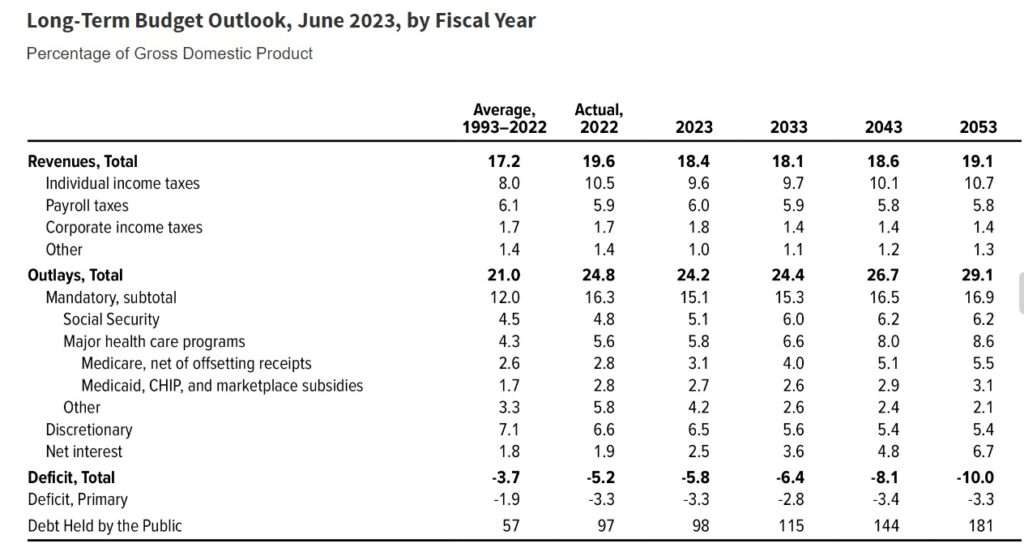
Over the past 30 years, federal spending has averaged 21 percent of gross domestic product (GDP), a rough measure of the size of the whole American economy, while tax revenue has averaged 17.2 percent, the CBO notes. That’s not great, but the future looks much worse.

By 2053, the CBO expects federal spending to grow to 29.1 percent of GDP while revenue climbs to just 19.1 percent.

Source: Congressional Budget Office (https://www.cbo.gov/publication/59331)

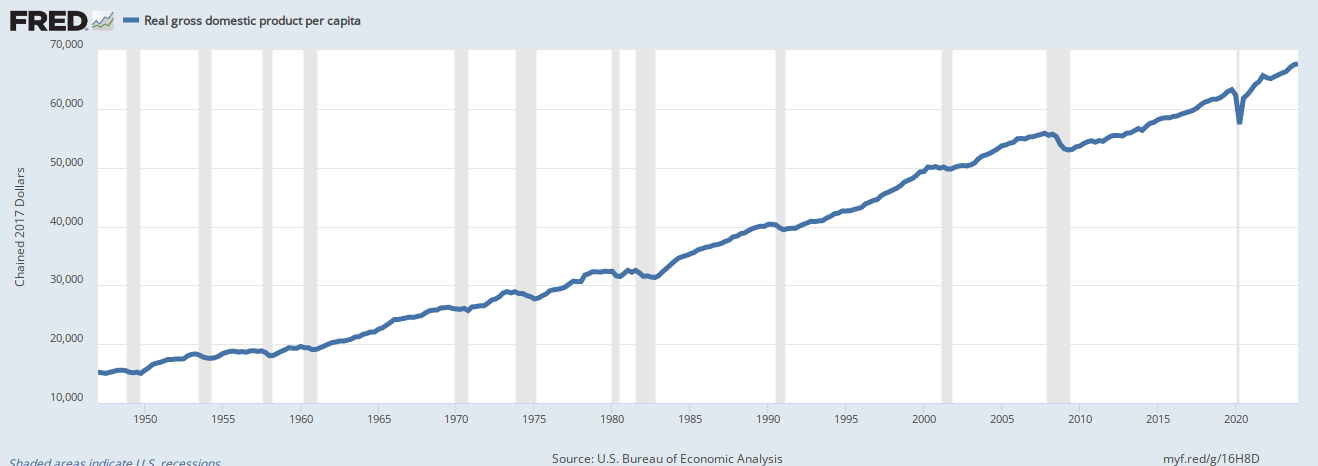
From being exposed to the above table, you might be led to believe that Federal Spending/GDP or federal taxes/GDP are essential measures. They aren’t. The first fraction tells you how much the federal government spends vs. the domestic private sector. What can you do with that information? Not much. You might wish to increase private sector spending, probably requiring federal tax reduction, which is almost always a good idea. And you should increase exports which need federal aid to exporters, though that might run afoul of international agreements. What you do not want to do is cut federal spending. That will only reduce GDP, which would only make it worse if you are concerned about the Federal Spending/GDP fraction. As for the Federal Taxes/GDP fraction, the analysis is straightforward. The more significant the fraction, the worse will be economic growth. Sadly, the CBO complains that the fraction will be getting smaller — Federal Spending will grow faster than GDP — and here is the crucial part: GDP is projected to grow. Even more importantly, real (inflation-adjusted) GDP has been growing per capita. That means despite all the moaning and groaning from the Libertarians and the CBO, Americans are getting richer. Here are the data:
Real Per Capita Gross Domestic Product
That, my friends, is a picture of a healthy economy — uh, except for this:
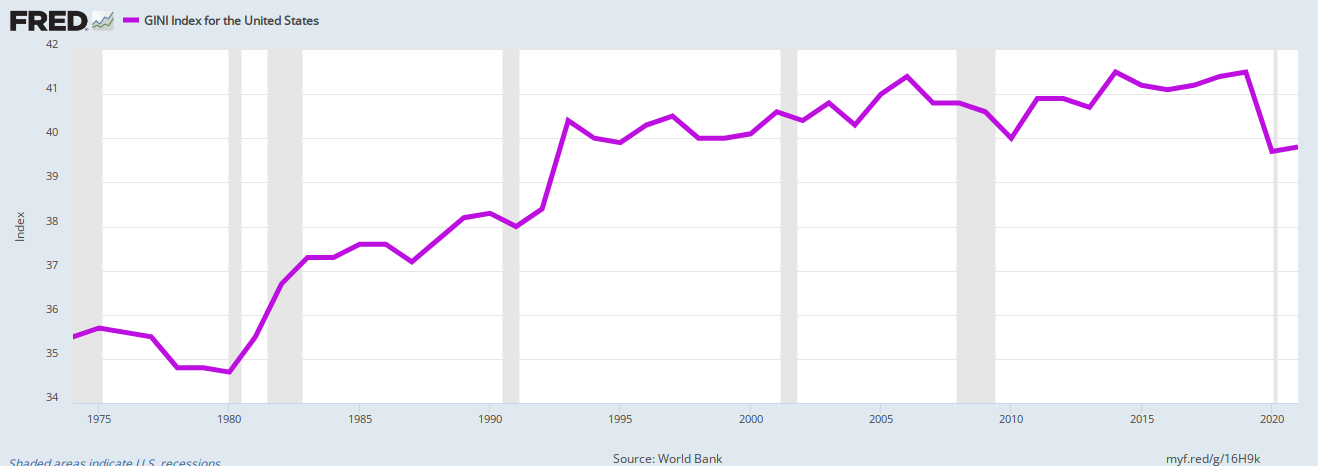
The GINI index shows the distribution of wealth. A level of “0” would mean everyone has the same wealth. A level of “1” would mean one person has all the wealth. The graph shows the rich getting more affluent than the rest of us, with only a small drop from 2019 to 2020.
Keep the GINI index in mind when you read about the Libertarians and the Republicans wanting to cut “Entitlements” (Social Security, Medicare, Medicaid), school lunch programs, and other poverty aids. The oft-quoted Federal Debt/GDP ratio is equally meaningless. It compares the amount deposited into T-security accounts by foreign nations, domestic companies, and Americans (aka “Federal Debt) vs. the amount spent by Americans and net imports. This ratio often is cited as something to be concerned about. Yet it has no predictive or analytic value. A low ratio is neither a sign of a healthy nor sick economy. It is not a prediction of the future nor a measure of the past. GDP doesn’t pay for Federal Debt, and Federal Debt doesn’t pay for GDP. Yet some so-called “economists” wring their hands when the ratio increases. The only relationship between the two is when Federal Debt increases, which helps GDP increase, though all the bleating about this ratio would make you think otherwise.

Entitlements are the primary driver of that future spending surge. Social Security spending will rise from about 5 percent of GDP to about 6.2 percent over the next 30 years. Costs for Medicare and Medicaid will jump from 5.8 percent of GDP to 8.6 percent by 2053.

And there it is. The right-wing pitch is to reduce Social Security, Medicare, and Medicaid. The purpose is to widen further the Gap between the rich and the rest.

Financing the national debt will become a major share of federal spending in the next few decades. The CBO projects that interest payments on the debt will cost $71 trillion over the next 30 years and consume more than one-third of all federal revenue by the 2050s.

As Greenspan, Bernanke, and the St. Louis Fed reminded us, it costs the U.S. government nothing to create those dollars; that dollar creation has been enriching Americans for decades.

“America’s fiscal outlook is more dangerous and daunting than ever, threatening our economy and the next generation,” Michael A. Peterson, CEO of the Peter G. Peterson Foundation, which advocates for fiscal responsibility, said in a statement.

The group responded to the new CBO report by renewing its calls for a bipartisan fiscal commission to consider plans for stabilizing the debt.

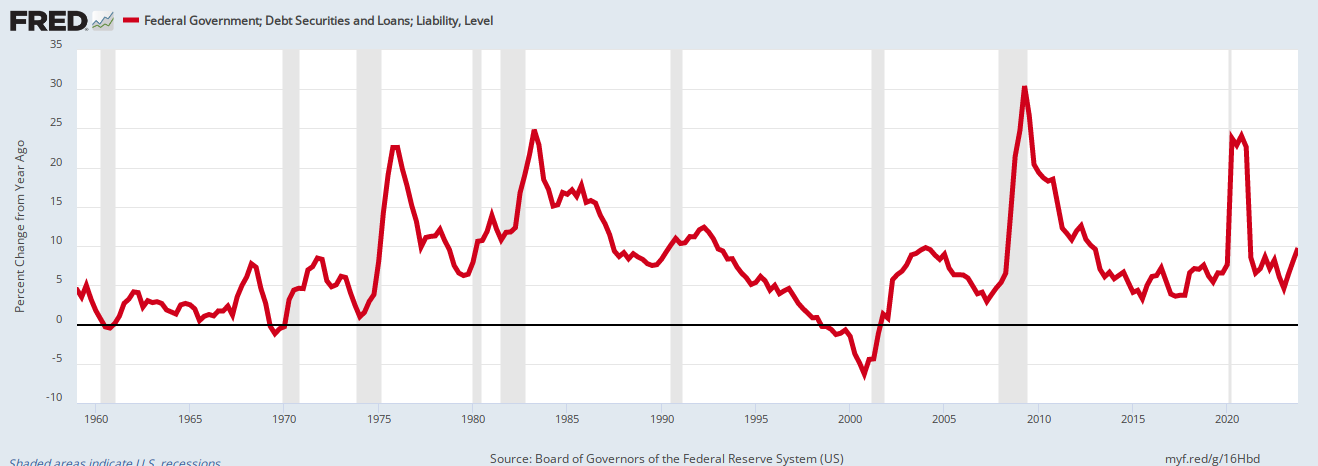
To a rich guy like Michael A. Peterson, “fiscal responsibility” means soaking the poor and middle-income groups while giving tax breaks to the rich. Stabilizing the debt” means creating recessions and depressions, during which the rich will buy all those low-priced assets to increase domination over the rest of us. Here is precisely what happens when we “stabilize the debt” as rich Mr. Peterson wishes”
When federal “Debt” growth (red) declines (“Debt” is stabilized), we have recessions (gray bars). To cure recessions, the government increases “Debt.” GDP = Federal Spending + Nonfederal Spending + Net Exports.

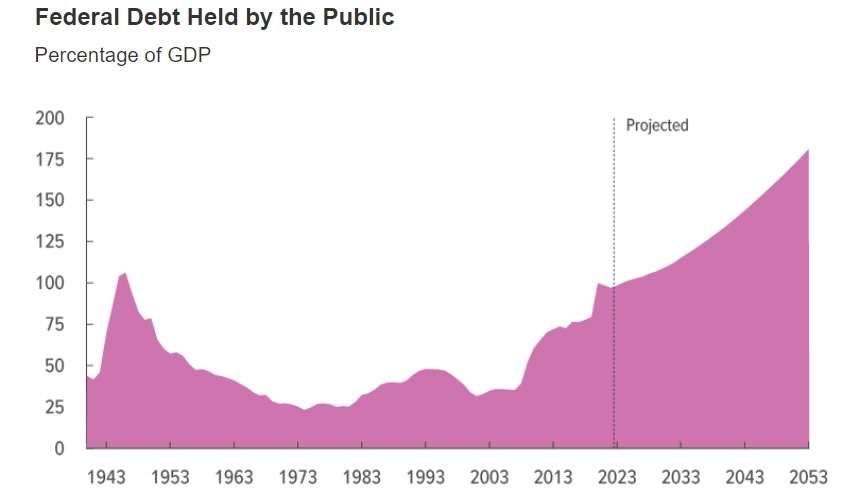
The national debt reached a record high of 106 percent as a share of GDP during World War II. The CBO projects the record to be broken in 2029, and the debt will keep climbing—to 181 percent of GDP by 2053.

 
A meaningless graph that tells you nothing about the U.S. economy yesterday, today, or tomorrow.
Even something called the “World Population Review” is hypnotized by this meaningless ratio. Here is what they say:

Typically used to determine the stability and health of a nation’s economy, the debt-to-GDP ratio is expressed as a percentage and offers an at-a-glance estimate of a country’s ability to pay back its current debts.

And here are the examples they give:

Top 12 Countries with the Highest Debt-to-GDP Ratios

Venezuela — 350% Japan — 266% Sudan — 259% Greece — 206% Lebanon — 172% Cabo Verde — 157% Italy — 156% Libya — 155% Portugal — 134% Singapore — 131% Bahrain — 128% United States — 128%

Top 12 Countries with the Lowest Debt-to-GDP Ratios (%)

Brunei — 3.2% Afghanistan — 7.8% Kuwait — 11.5% Congo (Dem. Rep.) — 15.2% Eswatini — 15.5% Burundi — 15.9% Palestine — 16.4% Russia — 17.8% Botswana — 18.2% Estonia — 18.2%

Isn’t it nice to know that all these countries — Russia, Afghanistan, Botswana, et al. — supposedly are more stable and healthy and better able to pay back their current debts than the United States and Japan? It must be true because that is what the Libertarians, the CBO. Michael A. Peterson and the World Population Review are telling you. So be sure to tell all your creditors not to pay you dollars because you’d rather receive Russian rubles. Right?

The (CBO’s) projections leave out the possibility that Congress will extend the Trump administration’s tax cuts past their planned expiration in 2025—which would add to the deficit and require more borrowing in the future—or the possibility that Social Security’s impending insolvency will be papered over with yet more borrowing.

The United States cannot become insolvent. Per Former Fed Chairman Alan Greenspan: “A government cannot become insolvent with respect to obligations in its own currency.” Because the U.S. can’t become insolvent, Social Security, a federal agency, can only become insolvent if that is what Congress and the President want. What the author calls “papered over” normal people would call “paying for,” which the government can do simply by pressing a computer key.

And do you really believe that no Congress or president will hike spending without offsetting tax increases in the next three decades?

If Congress and the President increase taxes they will not “offset” anything. Federal taxes do not fund federal spending. They are destroyed upon receipt, and new dollars are created ad hoc to pay for expenditures.

Under an alternative scenario in which the Trump administration’s tax cuts are extended, and federal spending grows at the same rate as the economy (rather than in line with inflation, as the CBO assumes), the Committee for a Responsible Federal Budget projects the debt to hit 222 percent of GDP by 2053.

And that 222 percent will have no meaning.

There’s one shred of good news inside the CBO’s latest report, however. Compared to last year, long-term borrowing is expected to be slightly lower. That resulted from the debt ceiling deal struck last month between Congress and the White House.

The deal included spending caps on nondefense discretionary spending for the next two years, and even that minimal bit of fiscal responsibility can have a measurable impact on future deficits.

This is terrible news. A limit on spending growth is, by definition, a limit on economic growth. Could you remember the formula for measuring the economy?

Still, the modest decline in future deficits mainly illustrates the daunting size of the federal government’s debt problem. By 2053, the debt will more than double the size of America’s economy—and, again, that’s only if you assume borrowing won’t increase for any reason in the next three decades.

“This level of debt would be truly unprecedented,” said Maya MacGuineas, president of the Committee for a Responsible Federal Budget, in a statement. “Time is of the essence; we simply cannot afford to keep borrowing at this unsustainable rate.”

May MacGuineas is another Henny Penny paid by the rich to claim that the middle and poor should receive less money. Good heavens, one needs to learn only five simple facts, and even that seems to be too much for the economic “experts.”
  1. Gross Domestic Product (the economy) = Federal Spending + Nonfederal Spending + Net Exports
  2. The U.S. government (unlike state/local governments, euro nations, businesses, you, and me) is Monetarily Sovereign. It, and any of its agencies, can only run short of its sovereign currency if Congress and the President will it.
  3. Federal taxes (unlike state/local government taxes) pay for nothing. They are destroyed upon receipt by the Treasury.
  4. Having the infinite ability to create dollars, the government never borrows. The so-called “debt” actually is deposited into T-security accounts. Those dollars remain the depositor’s property, never used by the federal government for anything, and “paid off” by returning them to the owners.
  5. Inflation never is caused by money creation. It always is caused by shortages of crucial goods and services, most often oil and food.
If you understand these five facts, you know more than most economists, politicians, and media writers. Just five things. Is that so hard? Rodger Malcolm Mitchell Monetary Sovereignty Twitter: @rodgermitchell Search #monetarysovereignty Facebook: Rodger Malcolm Mitchell

……………………………………………………………………..

The Sole Purpose of Government Is to Improve and Protect the Lives of the People.

MONETARY SOVEREIGNTY
What Libertarians want you to believe

Cameron Craig: Libertarians are non-interventionists and strong advocates for property rights, free immigration, legalizing all drugs and prostitution. “Libertarians are against taxes, any form of social benefits and believe everyone must pull themselves up by their own bootstraps. “The core tenet of libertarianism is that one’s liberty and right to own property should never be infringed upon.

Reason.com, is a voice of Libertarianism. Read what they say about the National “Debt.” Libertarian Party vice presidential candidate talks about campaign on Action Line - KINY
Hey, Nancy Pelosi: ‘National Debt Should Be a Top Priority’ A bipartisan group of lawmakers are calling for two deficit-reduction ideas to be included in this year’s federal budget bill. ERIC BOEHM | 2.23.2022 2:40 PM
Immediately, you see that Eric Boehm is spouting ignorance, and I’m not referring to his incorrect use of “are” rather than “is.” The national “debt” isn’t a priority; it shouldn’t even be a mild concern. In fact, it’s not “debt.” It’s the total of deposits into Treasury security accounts, which resemble interest-paying, bank safe-deposit boxes. When you invest in a T-bill, T-note, or T-bond, you deposit your dollars into your T-security account. The federal government neither needs, uses, nor touches your dollars, and when your account matures, your dollars are sent back to you. No tax dollars are involved.  As with the contents of safe-deposit boxes, the government doesn’t owe anyone the deposits in T-security accounts. Neither do you owe them. Nor do your grandchildren owe them. They are not a financial burden on anyone or anything. So why would a thinking person tell you they are a “priority”? And as for so-called “deficits,” they represent the net growth dollars our Monetarily Sovereign government pumps into the economy. The U.S. government has infinite dollars to give; the economy needs growth dollars in order to grow. Without federal “deficits” we have recessions and depressions, all of which are cured by “deficits.” Reductions in federal debt growth lead to inflation

Recessions (vertical bars) follow REDUCTIONS in deficit growth. Recessions are cured by INCREASES in deficit growth.

Mr. Boehm’s article begins with faulty premises, and only goes downhill from there. He asks:
How are we actually going to pay for all this?
“We” (you, and I, and the government) are not going to pay for “all this.” As each T-security account reaches maturity, the dollars that reside in those accounts will be transferred to the owners’ checking accounts, upon request. It’s a simple dollar transfer. No new dollars are needed. And even if the federal government did owe the money, it has infinite dollars with which to pay any financial obligation. Mr. Boehm’s (and the rest of the Libertarians’) deficit/debt concern is based on the Big Lie that federal finances resemble state/local government finances and personal finances. But the federal government uniquely is Monetarily Sovereign, while you, all local governments and all businesses are monetarily non-sovereign. The Libertarians don’t want you to understand that a Monetarily Sovereign entity never unintentionally can run short of its own sovereign currency. Even if the federal government collected $0 taxes, it could continue spending, forever. (The purpose of federal taxes is not to finance spending. The purpose is to control the economy. Taxes discourage what the government doesn’t want, and tax breaks encourage what the government does want.) The federal government does not borrow dollars. The so-called “national debt” is not a debt to be repaid.
In a letter sent on Tuesday, 24 members of the House of Representatives called on Speaker of the House Nancy Pelosi (D–Calif.) to take some small but important steps to rein in America’s out-of-control national debt.
The misnamed “national debt” (that isn’t a debt), also isn’t “out of control” and doesn’t need to be “reined in.” The federal government controls to the penny, how many T-security dollars to accept from the public.  To prevent the public’s T-security account deposits from growing higher than desired, the federal government can lower interest rates. That discourages further deposits. Or the Federal Reserve can use its infinite dollar-creation abilities to take the public’s place (what the uninformed would term “borrowing from itself.”) Similarly, if in its wisdom, the Federal Reserve decides deposits should be higher, it can increase interest rates, or again, the Federal Reserve can increase deposits. The source of Mr. Boehm’s disinformation is the wrongheaded belief that the federal government borrows when its tax income is insufficient to pay its bills. That “income vs. borrowing” scenario is true of state and local governments. It also is true of businesses. And it is true of you and me. We borrow when cash at hand is insufficient. It is not true of our Monetarily Sovereign, U.S. federal government. It has infinite cash at hand. Here is what knowledgeable people say about Monetary Sovereignty:

Alan Greenspan: “A government cannot become insolvent with respect to obligations in its own currency.”

Ben Bernanke: “The U.S. government has a technology, called a printing press (or, today, its electronic equivalent), that allows it to produce as many U.S. dollars as it wishes at essentially no cost.”

Quote from Ben Bernanke when, as Fed chief, he was on 60 Minutes: Scott Pelley: Is that tax money that the Fed is spending? Ben Bernanke: It’s not tax money… We simply use the computer to mark up the size of the account.

Statement from the St. Louis Fed: “As the sole manufacturer of dollars, whose debt is denominated in dollars, the U.S. government can never become insolvent, i.e., unable to pay its bills. In this sense, the government is not dependent on credit markets to remain operational.”

Press Conference: Mario Draghi, President of the ECB, 9 January 2014 Question: I am wondering: can the ECB ever run out of money? Mario Draghi: Technically, no. We cannot run out of money.

Messrs. Greenspan, Bernanke, and Draghi, and the St. Louis Fed, were describing Monetary Sovereignty, the unlimited ability of a Monetarily Sovereign entity to create its own sovereign currency. The U.S. government not only has this unlimited ability, but it also has the unlimited ability to determine, by fiat, the value of the U.S. dollar, an ability it has exercised many times over the years, when fixing the dollar to varying amounts of silver and gold. Thus, the U.S. federal government has the absolute power to control inflation. So why do T-bills, T-notes, and T-bonds even exist? The federal government’s spending and income are recorded in what is known as the “General Fund.” It’s not really a “fund.” It’s just a bookkeeping record. But for historical reasons, having to do with a young nation needing acceptance for its money, this record is not allowed to have a negative balance. It’s an obsolete law. There is no current reason why the General Fund, or any bookkeeping item can’t have a negative balance. But the convoluted workaround for this obsolete law is to pretend to borrow by issuing Treasury securities, and allowing the public to invest in them, with the balance being purchased by the government itself. It’s all bookkeeping hocus-pocus, to satisfy an obsolete set of rules, originally designed to prevent what mathematically cannot ever happen: Unintended federal insolvency. Today, the functional purpose for issuing T-securities is to provide a safe interest-paying parking place for unused dollars, which helps to stabilize the value of the U.S. dollar.
The letter highlights the fact that policies enacted during the past five years—including pandemic relief, but also “Congress’ perennially broken budget process and fiscal policies”—have added $13 trillion to the projected levels of debt in 2031, at the end of the 10-year window Congress uses for budgeting.
Mr. Boehm is referring to $13 trillion federal growth dollars, without which the economy would fall into the deepest depression in world history.
“It has been over a decade since Congress enacted any legislation that significantly addressed these longstanding structural problems or improved the nation’s fiscal outlook,” the lawmakers wrote to Pelosi. “Our national debt should be a top priority for both parties and addressed on a bipartisan basis.”
The misnamed “debt” neither is a structural problem, nor a “priority,” and it has nothing to do with a “fiscal outlook.” It’s all lies.
Yes, the letter represents the view of just 24 of the House’s 435 members. Still, any discussion of the debt and the need to address it is welcome.
It is encouraging that only 24 of the House’s 435 members are misinformed or dishonest enough to sign such a letter.
The Congressional Budget Office (CBO) now forecasts that the debt will be twice the size of the economy by 2051, while the Government Accountability Office (GAO) predicts that the debt will grow to four times the size of America’s economy before the end of the century.
Here, Mr. Boehm referred to the most ridiculous, nonsensical, meaningless ratio in all of economics: The debt/GDP ratio. It is a ratio that says nothing about the health of the economy (see Debt to GDP Ratio by Country 2022). It is a ratio that predicts nothing. It isn’t even mathematically logical, because it describes different time sequences. “Debt” is the net accumulation of deficits during the past two centuries, while GDP refers to one year.
“U.S. fiscal policy today is not sustainable,” argue Veronique de Rugy and Jack Salmon, researchers at the Mercatus Center, a free market think tank, in a new report published Wednesday. “Not only is our debt ratio at the highest level in peacetime history, but also our future budgetary outlook is even bleaker.”
The two researchers from the Libertarian Mercatus Center imply that the federal government can run short of its own sovereign currency, a fiscal impossibility. And the “not sustainable” trope has been disseminated, without evidence, since at least 1940. See: “Your periodic reminder. After 80 years, the federal debt still is a ‘ticking time bomb.’ Libertarians were wrong then. They are wrong now. The federal “debt,” far from being a priority, or a problem or a burden on future generations, is an absolute necessity for economic growth — the larger the  “debt” (i.e. net deficits), the faster the growth.
Perhaps it was the symbolic $30 trillion debt threshold that has prompted some lawmakers to call on Pelosi to take action. But another factor is the high levels of inflation America is currently experiencing. As Reason has previously explained, inflation and high debt create a trap for policymakers: higher inflation could lead the Federal Reserve raise interest rates, which would increase the payments owed on the debt.
Because Libertarians seem to think that all federal spending is excessive, the notion that the federal government would pay more interest into the economy upsets them. In reality however, there is no downside to increased federal interest. The government has infinite dollars, and the economy benefits from additional dollars. Contrary to the Libertarian philosophy of ignorance, federal spending is stimulative, and also contrary to popular wisdom, not inflationary. Inflations never are caused by “too much money.” Inflations always are caused by shortages of key goods and services. Those shortages, and the resultant inflation, can be cured by increased federal spending to encourage the availability of the scarce goods and services. Today’s inflation is an example: Current shortages of oil, computer chips, food, shipping, and lumber can be cured by federal aid to oil production, computer chips, farming, and lumber. Current shortages of labor can be cured by the elimination of FICA and income taxes, which serve only to reduce the reward for work. Fighting inflation with deficit reduction, would lead to recession.

Regardless of the reasons, the 24 lawmakers who signed this week’s letter are asking for two policies that are the lowest of low-hanging fruit.

First, they are seeking the creation of a bipartisan debt commission, similar to one implemented during President Barack Obama’s first term that helped trigger modest reductions in annual budget deficits following the Great Recession.

I’m not sure what economy Mr. Boehm lives in, but the Great Recession was cured by massive increases in federal deficit spending, which then returned to average levels, only to rise again to combat COVID. Mr. Boehm closes his article with a summary of ignorance and disinformation:

Lawmakers are asking Pelosi to include in the budget changes to how the debt ceiling operates.

The proposed changes would allow the president to unilaterally lift the debt limit as long as Congress has passed a budget resolution that contains certain debt-reduction measures for the current year.

Raising the debt ceiling is not the same as adding to the debt. The debt ceiling merely authorizes the Treasury to borrow funds to pay for spending already approved by Congress.

Objections to increasing the debt ceiling amount to little more than a refusal to pay overdue credit card bills—a temper tantrum that doesn’t address the actual problem of overspending.

Mr. Boehm is correct that the debt ceiling doesn’t address anything, much less the mythical problem of “overspending.” Rather than recommending the end of this laughable anachronism, Mr. Boehm supports Presidential fiddling with the debt ceiling:

“(Deficit cuts) . . . won’t fix America’s fiscal mess, but they are “commonsense ideas” that “would be important steps in the right direction,” according to the Committee for a Responsible Federal Budget, a nonpartisan group that advocates for reducing the deficit.

And they are steps that the country will have to take, sooner or later. “We owe it to our children,”the lawmakers wrote to Pelosi, “to acknowledge our country’s unsustainable fiscal trajectory and work together, across the aisle, to address it over time.”

Yes, Boehm delivers a final dose of utter BS. The ideas neither are “commonsense” nor are they “important steps in the right direction.” Our children do not owe, nor will they pay for the federal “debt.” Instead, if the debt is reduced our children will be punished by the resultant recessions and depressions. And, the country’s “fiscal trajectory” (presumably, he means rising “debt”) is not “unsustainable.” It’s necessary. Here is what happens whenever we reduce the “debt.”

1804-1812: U. S. Federal Debt reduced 48%. Depression began 1807. 1817-1821: U. S. Federal Debt reduced 29%. Depression began 1819. 1823-1836: U. S. Federal Debt reduced 99%. Depression began 1837. 1852-1857: U. S. Federal Debt reduced 59%. Depression began 1857. 1867-1873: U. S. Federal Debt reduced 27%. Depression began 1873. 1880-1893: U. S. Federal Debt reduced 57%. Depression began 1893. 1920-1930: U. S. Federal Debt reduced 36%. Depression began 1929. 1997-2001: U. S. Federal Debt reduced 15%. Recession began 2001.

Libertarians are the kissin’ cousins of Republican conservatives. Birds fly. Fish swim. Libertarians lie. Apparently, those are three constants in nature. Why do the Libertarians lie about the federal “debt”? Go back to one of the tenets of Liberalism: “Libertarians are against taxes, any form of social benefits and believe everyone must pull themselves up by their own bootstraps. Libertarians want the federal “debt” reduced, and the easiest way to accomplish that is to cut such social benefits as Medicare, Social Security, Medicaid, poverty aids, etc. Rather than complain about social benefits, which the populace loves (and the government has the infinite ability to provide), Libertarians find it easier to complain about so-called “debt” and deficits. By convincing the public that “debt” and deficits must be cut, the Libertarians are able to justify cutting benefits to the middle- and lower-income groups. It’s the backdoor way of making the rich richer by widening the Gap between the rich and the rest. Thus, Libertarians are Republicans in disguise, pretending to be a middle-ground compromise between liberals and conservatives, but in fact, being as right wing, pro-rich, anti-middle, anti-poor as any Republican, perhaps more so. [Why would any sane person take dollars from the economy and give them to a federal government that has the infinite ability to create dollars?] Rodger Malcolm Mitchell Monetary Sovereignty Twitter: @rodgermitchell Search #monetarysovereignty Facebook: Rodger Malcolm Mitchell

……………………………………………………………………..

THE SOLE PURPOSE OF GOVERNMENT IS TO IMPROVE AND PROTECT THE LIVES OF THE PEOPLE.

The most important problems in economics involve:
  1. Monetary Sovereignty describes money creation and destruction.
  2. Gap Psychology describes the common desire to distance oneself from those “below” in any socio-economic ranking, and to come nearer those “above.” The socio-economic distance is referred to as “The Gap.”
Wide Gaps negatively affect poverty, health and longevity, education, housing, law and crime, war, leadership, ownership, bigotry, supply and demand, taxation, GDP, international relations, scientific advancement, the environment, human motivation and well-being, and virtually every other issue in economics. Implementation of Monetary Sovereignty and The Ten Steps To Prosperity can grow the economy and narrow the Gaps: Ten Steps To Prosperity:
  1. Eliminate FICA
  2. Federally funded Medicare — parts A, B & D, plus long-term care — for everyone
  3. Social Security for all
  4. Free education (including post-grad) for everyone
  5. Salary for attending school
  6. Eliminate federal taxes on business
  7. Increase the standard income tax deduction, annually. 
  8. Tax the very rich (the “.1%”) more, with higher progressive tax rates on all forms of income.
  9. Federal ownership of all banks
  10. Increase federal spending on the myriad initiatives that benefit America’s 99.9% 
The Ten Steps will grow the economy and narrow the income/wealth/power Gap between the rich and the rest.

MONETARY SOVEREIGNTY

Federal Budget: Doing right by doing “wrong.”

His adversaries in Congress accuse him of defying the law, acting like a king, and speaking and acting in a way that was unbecoming of the presidency.

He is an outspoken, temperamental populist given to fiery speeches laden with insults, blatant racism, and suggestions that his political enemies be hanged.

He rose to political power by aligning himself with a loyal base of poor mountaineers and small farmers seeking a political champion.

He is hated for his adamant opposition to racial equality and the rule of law. Rather than root out institutional white supremacy that had fueled the American Civil War, he thwarts attempts to bring blacks equal protection under the law.

“Everyone would and must admit that the white race is superior to the black,” he said.

He suggests deporting millions of black men. He accuses [his political opponents] of plotting a coup.

He casts himself as the only thing standing between whites and “negro domination.”

As you may have guessed, the above excerpt is from an article titled, The impeachment of Andrew Johnson,” though it sounds uncannily familiar, doesn’t it?

Donald Trump is the least intelligent, most immoral, least capable, most psychopathic President I’ve seen in my 84 years, and his administration’s record collection of temporary and acting incompetents (like substitute teachers) does nothing to improve his decision-making.

Yet despite himself, Trump sometimes accidentally does something right, though he probably doesn’t realize it — nor does Eric Boehm and the editors of Reason.com, as excerpts from the following article demonstrate:

BUDGET DEFICIT
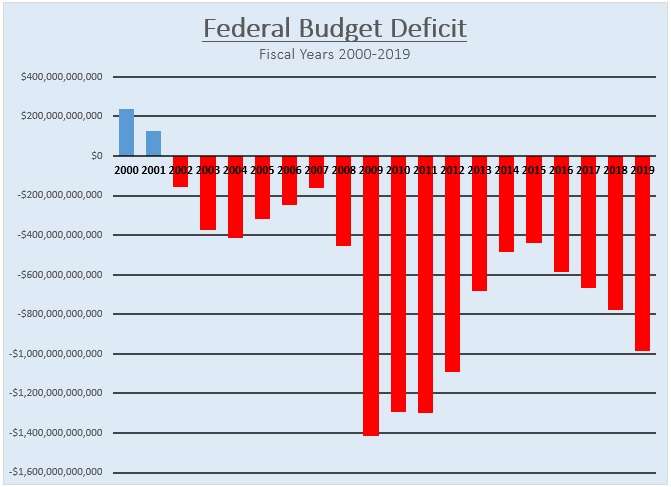
Federal Deficit Hit $984 Billion Last Year—a Nearly 50 Percent Increase Since Trump Took Office
In three years in office, Trump has added more to the national debt than President George W. Bush did in his entire two terms.
Eric Boehm | 10.25.2019

During the 2016 campaign, President Donald Trump said he’d be able to wipe out the national debt in eight years. Instead, after three years in office, he’s overseen a nearly 50 percent increase in the gap between how much the government takes in and how much it spends.

Chart by Eric Boehm. Source: U.S. Treasury data

The Treasury Department announced Friday that the official federal deficit for fiscal year 2019, which ended in September, was $984 billion—in line with what the Congressional Budget Office (CBO) estimated last month.

The announcement serves as official confirmation that the federal government’s mountain of red ink has grown dramatically during Trump’s first three years in the White House.

It is now approaching levels not seen since the early Obama years.

In order to “wipe out the national debt in 8 years,” (a 100% reduction in the debt) the Trump administration would have to run an 8-year surplus totaling about $20 trillion, i.e take $20 trillion out of the economy.

History has taught us that removing $20 trillion from the private sector — would cause, not just a recession, but a depression — and not just any old depression, but a depression the likes of which America never has experienced.

Every depression in U.S. history has been introduced with federal debt reduction, which takes dollars out of the private sector.

1804-1812: U. S. Federal Debt reduced 48%. Depression began 1807.
1817-1821: U. S. Federal Debt reduced 29%. Depression began 1819.
1823-1836: U. S. Federal Debt reduced 99%. Depression began 1837.
1852-1857: U. S. Federal Debt reduced 59%. Depression began 1857.
1867-1873: U. S. Federal Debt reduced 27%. Depression began 1873.
1880-1893: U. S. Federal Debt reduced 57%. Depression began 1893.
1920-1930: U. S. Federal Debt reduced 36%. Depression began 1929.
1997-2001: U. S. Federal Debt reduced 15%. Recession began 2001.

The economy usually is measured by Gross Domestic Product (GDP), and the formula for GDP is:

GDP =Federal Spending + Non-federal Spending + Net Exports.

To reduce federal debt one must reduce federal spending, and/or increase tax collections, both of which reduce GDP.

Federal deficit decreases cause recessions (vertical gray bars), which are cured by federal deficit increases.

By formula, federal debt reductions cut GDP.

The deficit is growing despite growth in tax revenues. The Treasury Department reported that while overall tax receipts rose by about 4 percent, federal spending grew by 8 percent.

In a statement, Treasury Secretary Steve Mnuchin said the data showed “President Trump’s economic agenda is working”; he also touted the low unemployment rate and ongoing economic growth.

One would think that deficit growth and economic growth happening simultaneously, and the fact that deficits pump growth dollars into the economy, would be sufficient to convince Trump, Mnuchin, and Eric Boehm that deficts grow the economy.

Sadly, such irrefutable evidence + mathematical logic don’t seem to be sufficient.

What’s really irresponsible is spending growth that’s outpacing revenue growth by a rate of 2-to-1.

Trump’s defenders will point out that he’s not solely responsible for setting the government’s budget.

That’s true, but he has the final say on all spending bills and he has been refusing to force the spending cuts Mnuchin says are necessary.

Why is “spending that’s outpacing revenue growth” (i.e. adding dollars to the economy) “irresponsible”?

Mnuchin never says, probably because it isn’t irresponsible; it’s necessary for economic growth.

When Congress passed a bipartisan budget plan in March 2017 that annihilated Obama-era spending caps, Trump begrudgingly signed the bill while promising that he’d never agree to another spending hike like that.

Earlier this year, when Congress passed another budget-busting spending bill, Trump signed it without so much as expressing a second thought.

Could it be that Trump intuitively understands that federal deficits spending adds growth dollars to the economy?

Perhaps nothing demonstrates Republicans’ complete abdication of fiscal conservatism as much as this: In three years in office, Trump has added more to the national debt than President George W. Bush did in his entire two terms. (Though Bush did have the advantage of starting out with a budget surplus in his first year.)

Fiscal conservatism, aka “austerity,” aka taking money from the private sector which needs the money, and giving it to the federal government, which doesn’t need the money, is the worst possible financial plan — unless one prefers recessions and depressions.

Recessions are caused by money shortages and cured by money supplements. The private sector is limited in its ability to create growth dollars; the federal government, being Monetarily Sovereign, is not limited.

Now we come to two of the most amazing sentences in Mr. Boehm’s article:

In the early Obama era, it was not uncommon to hear Republicans admit that Bush’s spendthrift ways had paved the way for worse.

Now, on an annual basis, Trump’s deficit spending is nearly as bad a Obama’s was over two terms.

During Bush’s 2nd term, the deficit averaged only about $250 Billion, at which point began the “Great Recession.”

During Obama’s 2 terms, the deficit averaged over $1 trillion, and the economy grew massively, and it continues to grow.

And yet, Mr. Boehm wants deficit reduction! It boggles.

Give Trump a few more years and I’m sure he’ll surpass Obama. That’s because the nature of the current budget deficit is fundamentally different from the peaks of the early 2010s.

Those deficits eventually tapered off for a variety of reasons. Recovery from the Great Recession boosted tax revenue.

The spending binge approved in response to the recession faded away.

And fiscally prudent Republicans imposed some modest caps on future spending growth.

But, Mr. Boehm, the deficit still averaged over $700 Billion — far more than the Bush later years — and the economy still grows, also far faster than during the Bush later years.

Coincidence, Mr. Boehm?

Now? The country is running a massive (and growing) deficit despite a decade of economic growth and a low unemployment rate.

“Higher outlays for Medicare, Social Security, Defense, and interest on the public debt” drove the deficit increase in fiscal year 2019, the Treasury Department says.

See how Boehm still doesn’t get it?

The “massive (and growing) deficit” has caused “a decade of economic growth and a low unemployment rate.”

Then Boehm goes on to exacerbate the ignorance:

The current deficit isn’t the result of temporary circumstances like World War II or a major recession.

It’s a systemic deficit, a result of poor budgeting and bad decision-making by members of Congress and the current administration.

It’s not going to resolve itself, and it’s on pace to get much worse.

We only can pray that he is correct and that the deficit will get much “worse,” i.e. pump much more growth money into the economy.

The Government Accountability Office (GAO) has called the federal government’s current fiscal situation “unsustainable,” and the CBO expects the national debt to hit “unprecedented levels” in the coming decades, well above the record highs set during World War II.

Ah, yes: “Unsustainable.” The favorite word of the economic ignorant. You probably have seen dozens of articles decrying the debt or deficit by using this word, and in not one of those articles did you ever see an explanation of why it supposedly is “unsustainable.”

The economic blowhards have been condemning the debt for longer than you have been alive, and still they have learned nothing. (See: “It is 2019, and the phony federal debt “time bomb” still is ticking.”)

“A deficit of this size following the longest span of economic growth in history shows just how reckless our leaders have become.

This is exactly the time when deficits should be contracting, not expanding,” Leon Panetta, co-chairman of the Committee for a Responsible Federal Budget, said in a statement.

No, Mr. Panetta. “The longest span of economic growth in history” was caused by deficits. Without deficits, there could have been no growth.

There is no time when deficits should be contracting unless one prefers a contracting economy.

And please don’t get me started on that Committee for a Responsible Federal Budget, which has been wrong forever about federal finances.

“But instead of getting our fiscal house in order and preparing for the next downturn, our leaders continue to binge on debt-fueled tax cuts and spending hikes rather than showing the leadership necessary to set our fiscal path.”

Clearly, Panetta believes (or more likely, is trying to make you believe) that our Monetarily Sovereign federal government can run short of its own sovereign currency, the U.S. dollar.

He also wants you to believe that federal financing is like personal financing.

You’ll notice (and this is important) that nowhere in Boehm’s diatribe is there any data showing how federal deficits have an adverse effect on the economy.

He simply spouts generalized reprimands like, “unsustainable,” “mountain of red ink,” “irresponsible,” “abdication of fiscal conservatism,” “spendthrift ways,” “spending binge,” “poor budgeting and bad decision-making,” and on and on.

But where, Mr. Boehm, are the data showing cause and effect — the data showing that large deficits cause some negative effect? They are nowhere to be found.

You will not find anywhere, a graph like the one above, showing that Federal deficit decreases cause recessions, which are cured by federal deficit increases.

The reason for the absence of such data: They do not exist.

A growing economy requires a growing supply of money, and federal deficit spending increases the money supply.

Even the ordinarily distasteful words “deficit,” and “debt,” are misleading, because they really represent surpluses for the economy.

Everything — language and the absence of data — has been gathered together to make you fear the one thing necessary to grow our economy: Federal deficit spending.

Why?

The very rich, who run America, do not want you to ask for more benefits from the federal government. This is their way making you agree to unnecessary limitations on what you receive from the government.

It’s a function of Gap Psychology, the desire of the rich to distance themselves from the rest of us. It is their way of becoming richer, for the larger the Gap the richer they are.

Democrats have abandoned all pretense of caring about the national debt, or even attempting to explain how they might pay for new federal programs.

And Republicans seem capable of offering nothing more than obviously false promises and empty rhetoric.

Mr. Boehm is right about the Democrats and Republicans duplicity, but not in the way he claims. These are the parties that have agreed on the useless — no, harmful — federal debt ceiling.

Both parties have capitulated the demands of the rich that you be misled.

Aside from that, Mr. Boehm’s article is one giant, misleading mess of false economics.

Rodger Malcolm Mitchell
Monetary Sovereignty
Twitter: @rodgermitchell
Search #monetarysovereignty Facebook: Rodger Malcolm Mitchell

…………………………………………………………………………………………………………………………………………………………………………………………………………………………………………………………………………………………..

The most important problems in economics involve:

  1. Monetary Sovereignty describes money creation and destruction.
  2. Gap Psychology describes the common desire to distance oneself from those “below” in any socio-economic ranking, and to come nearer those “above.” The socio-economic distance is referred to as “The Gap.”

Wide Gaps negatively affect poverty, health and longevity, education, housing, law and crime, war, leadership, ownership, bigotry, supply and demand, taxation, GDP, international relations, scientific advancement, the environment, human motivation and well-being, and virtually every other issue in economics.

Implementation of Monetary Sovereignty and The Ten Steps To Prosperity can grow the economy and narrow the Gaps:

Ten Steps To Prosperity:

1. Eliminate FICA

2. Federally funded Medicare — parts a, b & d, plus long-term care — for everyone

3. Provide a monthly economic bonus to every man, woman and child in America (similar to social security for all)

4. Free education (including post-grad) for everyone

5. Salary for attending school

6. Eliminate federal taxes on business

7. Increase the standard income tax deduction, annually. 

8. Tax the very rich (the “.1%”) more, with higher progressive tax rates on all forms of income.

9. Federal ownership of all banks

10. Increase federal spending on the myriad initiatives that benefit America’s 99.9% 

The Ten Steps will grow the economy and narrow the income/wealth/power Gap between the rich and the rest.

MONETARY SOVEREIGNTY