The “unsustainable,” “ticking time bomb” federal debt isn’t an unsustainable ticking time bomb at all

If you are a regular reader of this blog you may be familiar with this post: Historical claims the Federal Debt is a “ticking time bomb.” It describes the ongoing, relentless claims that the federal debt is “unsustainable and a “ticking time bomb.

The first entry was in 1940, when the so-called “federal debt” was about $40 Billion. Today, it is about $30 Trillion, a monstrous 74,900% increase.

You read that right. The so-called “federal debt” has increased nearly seventy five thousand percent since Robert M. Hanes, president of the American Bankers Association, claimed, the federal budget was a ticking time-bomb which can eventually destroy the American system,”

Now, here we are, 84 years and $30 Trillion dollars later. And still we survive. Not much of a time bomb.

I was reminded yet again, about the absurdity of the debt worries, when I read the following article, Here are some excerpts:

Record-high national debt is fiscal time bomb for US. Congress must defuse it. Founding Father’s fear has come true: Federal debt burden now is the greatest threat to the U.S. economy, national security and social stability. David M. Walker and Mark J. Higgins Opinion contributors

Apparently the “time bomb” still is ticking in the minds of the debt fear mongers.

In the late 1780s, the finances of the United States were in disarray. Revolutionary War debts incurred by the Continental Congress and former colonies were defaulting, and the democratic experiment in the New World was on the brink of failure.

But the nation caught a break when President George Washington appointed Alexander Hamilton as the first secretary of the Treasury.

In 1790 and 1791, Hamilton persuaded a reluctant Congress to establish the nation’s first central bank and consolidate all outstanding state and federal debt.

The federal debt burden after this action was just 30% of gross domestic product. A few years later, President Washington reinforced in his farewell address the need to avoid excessive debt.

We repeatedly have shown that the Debt/GDP ratio signifies nothing. It predicts nothing. It says nothing about a nation’s ability to pay its financial debts. It has no meaning whatsoever.

Yet it is quoted, again and again, by pundits who use it as evidence of . . . whatever they are trying to prove.

What next, Annual Rainfall/Number of Children named “Tom”? Here is the nonsense being peddled by Investopedia:

The debt-to-GDP ratio is the metric comparing a country’s public debt to its gross domestic product (GDP).
By comparing what a country owes with what it produces, the debt-to-GDP ratio reliably indicates that particular country’s ability to pay back its debts.
Often expressed as a percentage, this ratio can also be interpreted as the number of years needed to pay back debt if GDP is dedicated entirely to debt repayment.

Oh, really? The ratio “reliably indicates”?

Here are some sample ratios. The nations with the ten highest ratios are shown to the left. The nations with the ten lowest ratios are shown to the right. According to the debt fear-mongers, the most financially secure nations are listed in the right-hand column:
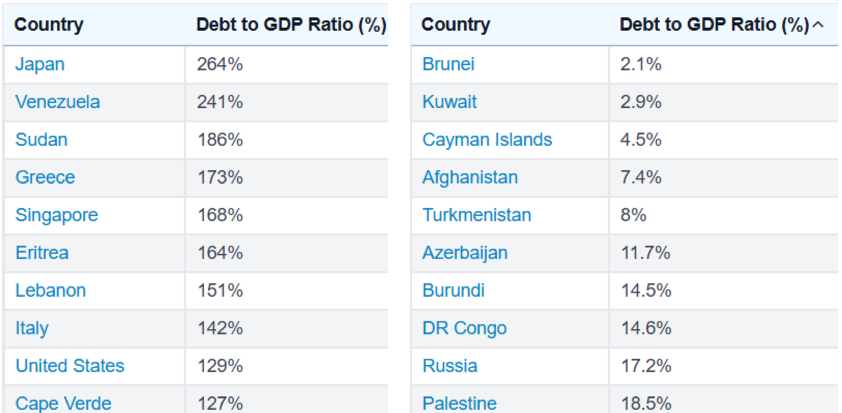
According to the infamous Debt/GDP formula, the U.S. government has less ability to pay its debts than Cape Verde, and every one of the nations in the right-hand column.

And Japan supposedly has less ability to pay its debts than any other nation in the world. Does anyone really believe this nonsense?

But wait. Buried deep in the Investopedia article is this little paragraph:

Economists who adhere to modern monetary theory (MMT) argue that sovereign nations capable of printing their own money cannot ever go bankrupt, because they can simply produce more fiat currency to service debts; however, this rule does not apply to countries that do not control their monetary policies, such as European Union (EU) nations, who must rely on the European Central Bank (ECB) to issue euros.

Thus, the Debt/GDP “rule” does not apply to the United States, Canada, Mexico, China, Australia, the UK, Switzerland, Sweden, Norway, India, South Africa and others. The “rule” doesn’t apply to most of the world’s largest, most significant economies.

Yet, pundits in America insist on using the useless — no harmful — Debt/GDP ratio as a cudgel to ram debt reduction into financial planning.

Never mind that debt reduction causes depressions and recessions:

1804-1812: U. S. Federal Debt reduced 48%. Depression began 1807.
1817-1821: U. S. Federal Debt reduced 29%. Depression began 1819.
1823-1836: U. S. Federal Debt reduced 99%. Depression began 1837.
1852-1857: U. S. Federal Debt reduced 59%. Depression began 1857.
1867-1873: U. S. Federal Debt reduced 27%. Depression began 1873.
1880-1893: U. S. Federal Debt reduced 57%. Depression began 1893.
1920-1930: U. S. Federal Debt reduced 36%. Depression began 1929.
1997-2001: U. S. Federal Debt reduced 15%. Recession began 2001.

Why does that happen? Simple algebra. The formula for Gross Domestic Product is:

GDP = Federal Spending + Nonfederal Spending + Net Exports.

To reduce the so-called federal debt, one must decrease Federal Spending and/or increase federal taxes, which decreases Nonfederal Spending.

To increase real (inflation-adjusted) economic growth, a nation must do the opposite: Increase Federal Spending and/or decrease federal taxes, both of which add to the so-called “federal debt.”

Mathematically, there is no way to grow real GDP without growing “federal debt” enough to overcome inflation. So, if inflation is say, 2% (the Fed’s goal), the debt increase must overcome an annual 2% inflation handicap for GDP just to stay even.

Add to that, the need to overcome a net export figure (which America almost always has) and large annual deficits become vital.

When we have deficits that are too small, we have recessions, which the following graph demonstrates:

When federal debt declines, we experience recessions (vertical gray bars), which are cured by federal debt increases.

Strangely, the “science” of economics, which seems to love mathematical formulas and graphs, ignores the obvious. Growing an economy requires a growing supply of money.

Federal deficits add money to the economy. Federal taxes take money from the economy.

Continuing with the ticking time bomb article:

Over the next 175 years, politicians across the political spectrum largely adhered to Hamiltonian principles to preserve the integrity of the public credit.

The most important principle was that debt should be issued primarily to address emergencies – especially those involving foreign wars – and that debt burdens should be reduced during times of peace.

This changed completely in the 1970’s when President Nixon mandated the end of the dollar “backing” (actually the convertibility) to gold, and made the federal government Monetarily Sovereign in full.

Until then, the federal government’s ability to create dollars was limited by its inventory of gold. When the inventory did not keep up with GDP growth needs, recessions resulted.

Now, with gold no longer a factor, the government’s ability to grow the nation’s money supply also gave the government the ability to grow GDP.

This discipline enabled America to establish and maintain its excellent credit record, which provided ample lending capacity during periodic crises.

As Hamilton predicted, the ability of the nation to borrow proved critical during the War of 1812, the Civil War, World War I and World War II.

The nation now has no need to borrow, a far superior situation. It can create, at will, the growth dollars it needs.

 After World War II, fiscal discipline was temporarily restored, and debt/GDP was reduced by growing the economy much faster than the debt even though the federal government continued to run budget deficits during most years.

Again, there is no magic. GDP still = Federal Spending + Nonfederal Spending + Net Exports.

If the Federal debt is reduced, the growth dollars must come from somewhere. In this case, growth came from Net Exports.

Subsequently, our wealthy economy began buying, buying, buying, which is a good thing. We were exchanging dollars that cost us nothing (We created them by pressing computer keys) for valuable goods and services.

Because the American government has access to infinite dollars, importing goods and services makes economic sense.

The U.S. is the world’s most massive consumer economy. Our Net Exports fell while GDP grew only because of massive federal deficit spending.

The one exception was in 1998-2001, when the federal government ran budget surpluses and even paid down debt in two of these years.

That exception proves the debt reduction is an economic disaster. Here is what happened when we paid down debt: 1997-2001: U. S. Federal Debt reduced 15%. Recession began 2001.

Reduced deficit spending morphed into a surplus in 1998. The result: A recession in 2001, which was cured by increased federal deficit spending.

Since then, the Hamiltonian principle has been decisively abandoned, and the federal government now routinely runs large deficits, resulting in ever-increasing debt burdens. This behavior is projected to worsen in the future.

Translation: The federal government now routinely runs large deficits, which pump growth dollars into the economy, thus growing GDP.

Mounting federal debt burdens now represent the greatest threat to the U.S. economy, national security and social stability.

The federal debt/GDP ratio is 123%. The nonpartisan Congressional Budget Office projects that, under current law, it will increase to 192% by 2053.

The federal government has the infinite ability to create dollars. The major threat to the U.S. economy (i.e. to GDP) is a reduction in federal money creation.

Clearly this is irresponsible, unsustainable and in sharp contrast to Hamilton’s founding principle.

There it is, the word “unsustainable,” to describe what we have been sustaining since 1940. Hamilton did not anticipate the post-1973, Monetarily Sovereign America.

National debt has topped $34 trillion.Does anyone actually have the guts to fix it?

The fastest way to “fix” the national debt would be to stop accepting deposits into T-security accounts (T-bills, T-notes, and T-bonds).

The government doesn’t use those dollars. They remain the property of the depositors. The problem is that those deposits do have two functions (neither of which is to supply the government with dollars):

  1. To provide a safer place to store dollars than bank savings accounts
  2. To help the Fed control interest rates by providing a floor for rates.

Why does the United States continue to behave so irresponsibly? One reason is that U.S. politicians routinely avoid spending cuts and tax increases because they may threaten their reelection prospects.

Voters rightfully don’t want tax increases and they don’t want federal benefit reductions, both of  which take money out of voters’ pockets and lead to recessions.

Another is that, as the issuer of the world’s dominant reserve currency, the United States can run fiscal deficits so long as surplus countries, such as China and Saudi Arabia, continue to purchase U.S. Treasuries.

The U.S. does not need anyone to purchase U.S. Treasuries. The federal government creates all the dollars it needs simply by pressing computer keys. The government does not use the dollars in T-security accounts. They are the property of the depositors.

In fact, proponents of the flawed and failed Modern Monetary Theory implicitly argue that the dollar’s reserve currency status is permanent, which allows deficit spending to continue indefinitely.

The dollar is the world’s leading reserve currency, which is a currency banks keep on reserve to facilitate international commerce. But, other currencies — the British pound, the euro, the Chinese renminbi — also are reserve currencies.

Being a reserve currency has nothing to do with the federal government’s ability to spend indefinitely.

Congress must defuse America’s fiscal time bomb.

Yikes, there it is again, the silly “time bomb” analogy. It’s the time bomb that never explodes.

A debt crisis is not imminent in 2024, but one will occur in the future if the nation’s addiction to deficits and debt persists.

Translation: A debt crisis is not imminent in 2024. We have no idea when if ever it will occur, but it makes us sound smart to threaten it.

The greatest risk is the one that Alexander Hamilton feared most: One day, the United States could face a threat to its very existence – perhaps in the form of a foreign war – and Americans will lack the debt capacity to fund an adequate response.

Lessons from the switch to Bernanke from Greenspan - MarketWatch
Obviously, the government never can run short of dollars. I wonder why they don’t understand that.

Lack the capacity to fund? Utter nonsense. Here are the facts:

Former Fed Chairman, Alan Greenspan: “A government cannot become insolvent with respect to obligations in its own currency. There is nothing to prevent the federal government from creating as much money as it wants and paying it to somebody. The United States can pay any debt it has because we can always print the money to do that.”

Former Fed Chairman, Ben Bernanke: “The U.S. government has a technology, called a printing press (or, today, its electronic equivalent), that allows it to produce as many U.S. dollars as it wishes at essentially no cost. It’s not tax money… We simply use the computer to mark up the size of the account.

Statement from the St. Louis Fed: “As the sole manufacturer of dollars, whose debt is denominated in dollars, the U.S. government can never become insolvent, i.e., unable to pay its bills. In this sense, the government is not dependent on credit markets to remain operational.”

That’s the real capacity.

Fortunately, the future is far from hopeless. America sits on a huge reservoir of natural resources and remains the world’s technological innovation engine.

It also possesses sufficient time to enact fiscal reforms and reestablish fiscal discipline.

Because the authors, David M. Walker and Mark J. Higgins, don’t understand Monetary Sovereignty, they think federal government fiscal discipline is the same a personal fiscal discipline. 

Federal finance is so unlike personal finance that not understanding the difference is like not understanding the difference between butter and a butterfly.

The challenge for Americans today is that the longer we wait to reinstate this principle, the more pain that will be incurred. It is our belief that the solution is in the hands of “We the People.”

The math doesn’t lie.Republicans and Democrats own every missing dollar of our growing national debt crisis.

Politicians have powerful incentives to respond to short-term demands, and if Americans collectively demand that short-term desires must be satisfied at the expense of the nation’s long-term prosperity and solvency, that is what politicians will deliver.

Heaven forbid that Americans demand increases in taxes and cuts to federal spending. The result would be a depression.

On the other hand, if Americans place equal value on the longevity of their country and the prosperity of their children and grandchildren, they will demand that politicians take steps to defuse America’s fiscal “time bomb.”

Oops, more time bomb that never explodes.

Ever notice that the debt worriers never come up with evidence? They say “debt is bad,” but they don’t say,”Here is a graph of what has happened to the economy when federal debt increased and decreased.

Here is one such graph:

As federal debt (red) has grown, the economy (GDP, blue) has grown.

As you can see, there is no sign of a “debt crisis.”

History suggests that Americans will eventually pursue the correct course of action. Our hope is that they embrace it quickly to ensure that America’s future is brighter than its past.

David M. Walker, a former U.S. comptroller general, is also a recipient of the Alexander Hamilton Award for economic and fiscal policy leadership from the Center for the Study of the Presidency and the Congress.

Mark J. Higgins is author of “Investing in U.S. Financial History: Understanding the Past to Forecast the Future,” coming Feb. 27. Connect with Mark on LinkedIn. 

It is frightening that a former U.S. comptroller general and recipient of an award for policy leadership, and the author of a book about U.S. finances can be so clueless about U.S. federal finances. No wonder the public is so ill-informed.


Rodger Malcolm Mitchell
Monetary Sovereignty

Twitter: @rodgermitchell Search #monetarysovereignty
Facebook: Rodger Malcolm Mitchell

……………………………………………………………………..

The Sole Purpose of Government Is to Improve and Protect the Lives of the People.

MONETARY SOVEREIGNTY

Liars, fakers and fear-mongers lurk among us

Liars, fakers, and fear-mongers lurk among us. They masquerade as prudent economics advisors. They sell you their snake oil linament to cure your . . . whatever.

That brings us to one of America’s most prominent snake oil sales groups, the CRFB (Committee for a Responsible Federal Budget).

They have been selling the same nonsense for many years. Their president even testified before Congress, with all those old, sage heads nodding dumbly in agreement at the foolishness she was spouting.

The CRFB want you to believe in this.
The CRFB is trying to sell you this.

We’ve spoken of the CRFB many times, but they keep selling the same lies.

Here they go again:

New Projection: Federal Debt Will Reach Record Levels Sooner Than Expected NOV 16, 2022 BUDGETS & PROJECTIONS

The nation’s fiscal and economic outlook has deteriorated substantially since the last Congressional Budget Office (CBO) baseline in May, when CBO projected debt would reach a record 110 percent of Gross Domestic Product (GDP) by 2032.

Under an updated current law baseline, we now project debt in 2032 will reach 116 percent of GDP, deficits will reach 6.6 percent of GDP, and interest will reach a record 3.4 percent of GDP.

Under a more pessimistic (and in many ways realistic) scenario, debt in 2032 would reach 138 percent of GDP, deficits would reach 10.1 percent, and interest would total 4.4 percent of GDP.

These projections suggest an unsustainable fiscal trajectory.

Oh, horrors. Federal “debt” will exceed GDP. And federal interest payments will be some “high” percentage of GDP. How awful. Right? WRONG!

The innocent reader would be led to believe there must be some crucial connection between so-called “debt” and GDP. Is it that GDP pays for “debt” so that when “debt” exceeds GDP, the “debt” can’t be paid?

That’s what the liars, fakers, and fear-mongers want you to believe. However, no such connection exists. None. Here’s why:

First: The so-called “federal debt” isn’t a federal debt. The federal government doesn’t owe it.

GDP is the one-year total of national spending (federal + non-federal) + net exports. It’s just the cumulative net difference between federal taxes and federal spending for at least 30 years. So the CRFB is comparing a 30-year (apples) total to a 1-year (oranges) total. Apples and oranges.

What commonly is called “debt” actually equals the total dollars invested into Treasury Security accounts. The vast majority of these accounts are owned by the public and foreign nations.

You first open a T-security account when you invest in a T-bill, T-note, or T-bond. You own that account. The dollars you invest go into your account and stay there until maturity.

Second: The federal government does not touch your dollars. The federal government does not use your dollars to pay its bills. Your dollars just sit there, accumulating interest.

The closest corollary would be a bank safe deposit box. The bank does not owe you the contents of your safe deposit box. The contents belong to you and are unrelated to the bank’s finances.

Similarly, the contents of T-security accounts are unrelated to federal finances. As with safe deposit boxes, the government pays off those accounts simply by returning the contents to you.

Third: The sole purposes of T-bills, T-notes, and T-bonds are to provide a safe storage place for unused dollars and to help the Fed control interest rates. This helps stabilize the dollar.

T-security accounts do not, in any way, help the federal government pay its bills. The federal government could stop accepting deposits into T-security accounts today and still pay all its bills forever. People, businesses, and nations would need to find some other places to store unused dollars, which for nations like China could be inconvenient.

Fourth: Even if the misnamed “federal debt” were actually debt, that still would have nothing to do with Gross Domestic Product. GDP doesn’t pay for any debts, not yours, mine, or the federal government’s.

GDP is not even a measure of federal income. GDP is just a one-year measure of all the spending in the economy, federal and non-federal. 

Fifth: Even if the federal government owed the so-called “federal debt,” that would not be a problem. The federal government pays all its debts by creating new dollars ad hoc.

To pay a creditor, the federal government sends instructions, not dollars, to the creditor’s bank, instructing the bank to increase the balance in the creditor’s checking account. When the creditor’s bank obeys those instructions, it creates new dollars, which are added to the money supply measure, M2.

The instructions then are cleared by the Fed, an agency of the U.S. government. Thus, the government approves its own money-creation instructions.

The government doesn’t use tax dollars. It destroys tax dollars upon receipt by the Treasury. To pay you taxes you take M2 money supply dollars from your checking and send them to the Treasury. When your M2 dollars reach the Treasury, they cease to be part of any money supply measure.

Because the U.S. government has infinite dollars, there can be no measure of its dollar supply, so your tax dollars effectively are destroyed.

The U.S. government never borrows dollars. What erroneously is termed “borrowing” merely is the acceptance of deposits into those T-security accounts that the government never touches.

The government doesn’t use any form of income. Even if the federal government collected $0 taxes, it could continue paying its financial obligations forever.

None of the above applies to state and local governments, which are monetarily non-sovereign. They do use tax receipts and other forms of income with which to pay their bills. They do not destroy tax dollars; they store them in bank accounts, just like you do.

Side note: Some European nations are monetarily non-sovereign, and some are Monetarily Sovereign. This difference often is not recognized by economists, the media, and politicians. Often you will read papers that purport to prove U.S. federal debt is dangerous because “look at Greece, Italy, France, et al.”

This is a false comparison, Monetary Sovereignty vs. monetary non-sovereignty. The two are diametrically opposed, which also is why your debt can be overwhelming while the federal government’s never is.

Being Monetarily Sovereign, the federal government has the infinite ability to create dollars just by pressing computer keys.

Alan Greenspan: “A government cannot become insolvent with respect to obligations in its own currency.”

Ben Bernanke: “The U.S. government has a technology, called a printing press (or, today, its electronic equivalent), that allows it to produce as many U.S. dollars as it wishes at essentially no cost.”

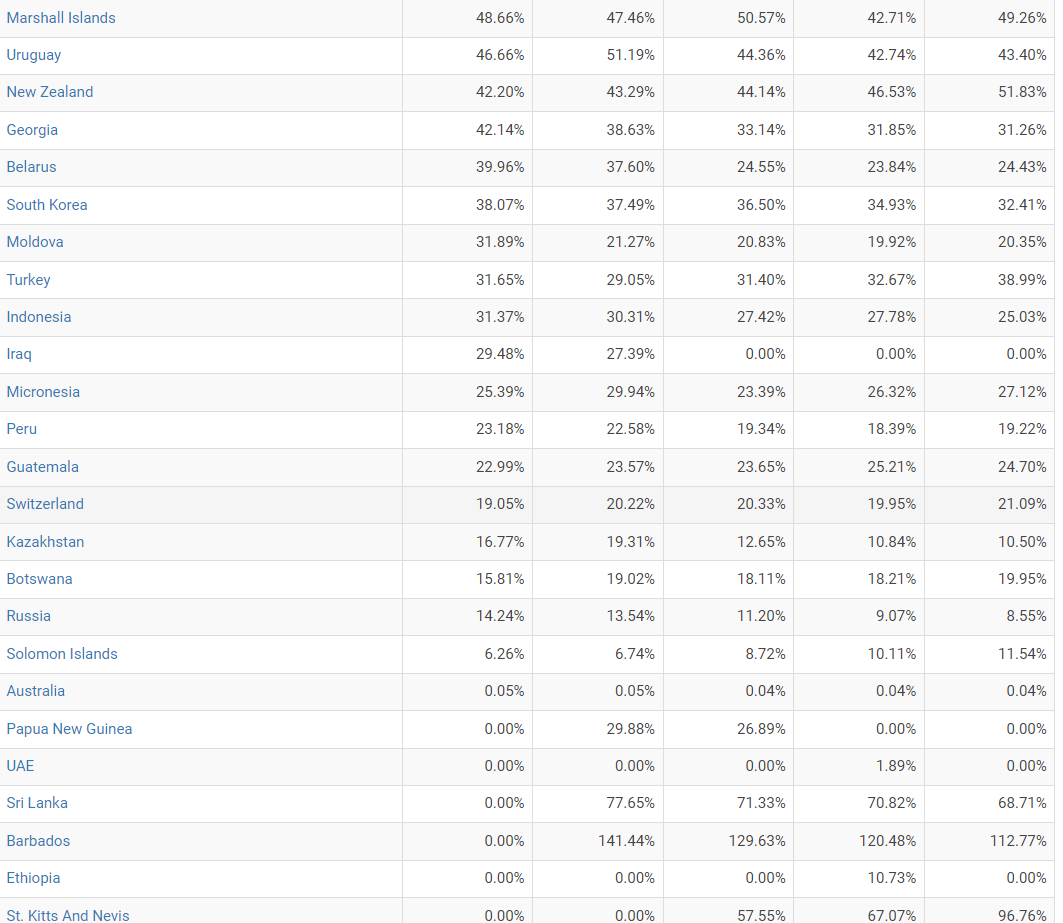
Finally: The proof is in the results. If the CRFB were telling the truth, you would see the nations with the highest Debt/GDP ratio having what the CRFB calls a “financially unstable trajectory,” while the countries with the lowest Debt/GDP ratio would be the most “financially stable.”

Study this list from Macrotrends, and using it as a guide, tell me which nations are more  financially stable and which are less financially stable:

Was Jamaica more or less financially stable than Japan and the United Kingdom? What about the United States vs. Russia? South Korea vs. St. Lucia? The U.K. vs. Jordan?

As you can see, Debt/GDP means nothing concerning “financial stability.” The whole concept is a giant lie foisted upon the American public by mouthpieces for the rich.

The federal "debt" (that isn't a debt of the federal government) grew fron 222 Billion
The federal “debt” (that isn’t a real debt) grew from $222 BILLION in 1951 to more than $26 TRILLION in 2022 — an 11,000 percent increase — and our Monetarily sovereign government has no problem paying its bills. Today, it is as “financially stable” as it ever has been and ever will be.

Those are the facts. The federal “debt” (that isn’t a debt of the federal government) grew eleven thousand percent since 1951. Is today’s America more financially unstable than it was after WWII? 

And there’s this:

There is no relationship between the Debt/GDP ratio (green) and inflation (purple).

If a high Debt/GDP ratio caused inflation, one would expect some correspondence between the peaks and valleys of Debt/GDP and inflation. No such parallel exists.

What does cause inflation?

Inflation (purple) mainly is caused by the price of oil (black).

The price of oil, not the Debt/GDP ratio, is the prime driver of inflation. The peaks and valleys of the Oil Price / Inflation ratio correspond.

The RBFB’s B.S. continues:

Perhaps most troubling is the effect of these changes on interest spending.

Under CBO’s baseline, interest costs were already projected to triple from roughly $400 billion in 2022 to $1.2 trillion in 2032.

As a result of higher debt and higher interest rates, we now expect them to rise to $1.3 trillion in our baseline scenario, $1.4 trillion in our intermediate scenario, and $1.6 trillion in our high-cost alternate scenario.

As a share of the economy, interest costs would be in uncharted territory. In all of American history, federal interest costs have never exceeded 3.2 percent of GDP.

We project interest costs will reach 3.4 percent of GDP by 2032 under our baseline scenario, 3.9 percent under the intermediate alternate scenario, and 4.4 percent under the high-cost alternate scenario.

And why is this a problem? It isn’t. The U.S. federal government never, never, never can run short of dollars to pay interest. And those dollars go right into Gross Domestic Product.

Federal interest payments add directly to GDP. They stimulate economic growth. They make the private sector richer.

GDP = FEDERAL SPENDING + NON-FEDERAL SPENDING + NET EXPORTS

Objecting to federal spending is objecting to GDP growth. Why does the CRFB object to that?

There is a reason, which I will get to shortly.

At the same time as inflation is surging and interest rates are rising, our new projections show that the United States faces an unsustainable fiscal outlook. 

Liars like the CRFB have called the federal debt “unsustainable” (and a ticking time bomb) every year since the 1940s. Yet, here we are. Sustaining. We are “sustaining” an eleven thousand percent increase in federal “debt” (that isn’t debt) very nicely, thank you.

Year, after year, for 75 years, liars, fakers, and fear-mongers have been wrong. Again. Again. Again. How stupid do we have to be to keep believing the same lie when every scary prediction fails?

We laugh when the Peanuts character Lucy keeps pulling the football away, and Charlie Brown keeps believing. But we are the Charlie Browns, the CRFB, and all the other lying pundits are Lucy. They keep “pulling the football away,” and we keep believing that next time . . . but next time never comes.

And the beat goes on: The lies just keep coming:

The following is a statement from Maya MacGuineas, president of the Committee for a Responsible Federal Budget: 

We are asking lawmakers to take one small step towards fiscal responsibility and agree there should be no new borrowing for the remainder of 2022.   There is not one single economic justification to borrow rather than pay for any new priorities. 

This is only 46 days, and it will be good practice for politicians to break their addiction to debt. Those who are being negatively affected by high levels of inflation – as in, all of us – should ask any policymaker who votes for new borrowing why they are choosing to make inflationary conditions worse rather than better.  

The last thing this country needs is a Christmas Tree package full of unpaid-for tax breaks and spending hikes.

Any policymaker who votes for new borrowing instead of paid-for legislation under these economic conditions is not taking the hardships they are creating on working families seriously enough. 

What’s wrong with it? It’s all a lie. 

First, the U.S. government never borrows dollars. Why should it, given that it can create dollars simply by pressing computer keys.

Statement from the St. Louis Fed:
“As the sole manufacturer of dollars, whose debt is denominated in dollars, the U.S. government can never become insolvent, i.e., unable to pay its bills. In this sense, the government is not dependent on credit markets to remain operational.”

That thing erroneously called “borrowing” is the acceptance of deposits into T-security accounts, and the federal government never touches those dollars. It’s like accepting deposits into safe deposit boxes. Is that bank borrowing?

Second, tax breaks are nothing more than dollars not taken from the economy. Tax breaks are economically stimulative. Leaving money in the private sector is the only way the economy can grow.

Third, no one ever pays for tax breaks. The only thing paid for is taxes, which take growth dollars out of the economy.

Fourth, all legislation that requires spending dollars is “paid for.” The federal government pays all its bills by creating new dollars ad hoc. It never fails to pay, despite all the hand-wringing about “unsustainability.”

And finally, federal deficit spending never causes inflation. The sole cause of all inflations and hyperinflations throughout history is the scarcity of critical goods and services, usually oil and food, but additionally, computer chips, shipping, rare earths, labor, water, etc.

What caused these shortages? Not federal spending. Federal spending didn’t cause the oil shortage, or the food shortages, or the lumber shortage. Primarily, COVID caused the shortages that caused inflation.

Before COVID, we had massive annual deficit spending and near-zero inflation.

WHY DO THEY LIE, AND WHY DO WE BELIEVE?

Some in the CRFB, the media, economists, and politicians may lie out of ignorance. But many lie because they are bribed by the rich to lie.

The rich bribe the media via advertising dollars and ownership. The rich bribe the politicians via campaign contributions and promises of lucrative employment later. The rich bribe the economists via university contributions and promises of lucrative jobs in think tanks.

The CRFB is supported by rich people who want nothing more than to see benefits to the middle and the poor cut.

Raising taxes or cutting federal spending are recessionary steps that affect middle- and lower-income people. This is particularly true because the cuts always focus on Medicare, Social Security, Medicaid, and other benefits for those who are not rich.

Those cuts widen the Gap between the rich and the rest. Widening the Gap makes the rich richer. The Gap is what makes the rich rich.

In Summary

The Debt/GDP ratio is comparable to a Contents-of-Bank- Safe-Deposit-Boxes / Bank Spending ratio. It’s a meaningless nonsense ratio that predicts nothing, demonstrates nothing, and reveals nothing but the ignorance of those who quote it.

The ratio tells you nothing about the health of a nation’s finances or its ability to pay its obligations. It is a ratio quoted by those who are ignorant of economics or are lying about economics. No other alternatives.

To paraphrase, “There are lies, damned lies, and the Federal Debt / GDP liars, the damnedest liars of all.

May the Debt/GDP liars’ spawn be forever cursed. 


Rodger Malcolm Mitchell
Monetary Sovereignty

Twitter: @rodgermitchell Search #monetarysovereignty
Facebook: Rodger Malcolm Mitchell

……………………………………………………………………..

The Sole Purpose of Government Is to Improve and Protect the Lives of the People.

MONETARY SOVEREIGNTY

Wall Street Journal gets it wrong, again. Do they have a learning disability?

20 Easy Things That Will Make You the Next Millionaire | Inc.com
Being Monetarily Sovereign, the U.S. government owns infinite dollars.
You reasonably might expect that, of all the newspapers in the world, the Wall Street Journal surely would print articles by only writers who understand federal finances. Ah, would that it were so. Unfortunately, some writers published by WSJ either are as ignorant as the general populace or as intentionally ignorant as the bribed-by-the-rich politicians and university economists. Here is an example saw in a recent WSJ edition (OK, the article printed in several papers, but I read in WSJ, which should know better):
U.S. National Debt Tops $30 Trillion as Borrowing Surged Amid Pandemic The record red ink, fueled by spending to combat the coronavirus, comes as interest rates are expected to rise, which could add to America’s costs. After a protracted standoff last year, Congress agreed in December to raise the nation’s borrowing cap to $31.4 trillion. By Alan Rappeport, Feb. 1, 2022
We can’t even get past the headline and subheads without being subjected to WSJ ignorance.
Safe Deposit Box: What You Should (And Shouldn't) Store | Bankrate
Federal “debt” is deposits into accounts similar to safe deposit boxes. The federal government never touches those deposits except to return them to the owners.
The so-called “national debt” neither is “red ink,” nor is it debt. It is the total of deposits into Treasury Security accounts. When you invest in a T-bill, T-note, or T-bond, you do not lend the federal government money. You merely deposit your dollars into your T-security account. It’s an account similar to an interest-paying, safe-deposit box. As with a safe deposit box, the federal government does not touch your dollars. It merely stores them for you, and allows you to accumulate interest. Upon the maturity of your account, the government “pays it off” simply by returning to you, the dollars in your account. Since the dollars already exist in your account, and remain yours, this payoff is no burden on you, on the government, or on taxpayers. It’s merely a transfer of your dollars. If the national “debt” were a real governemnt debt, it would go something like this:

The government needs dollars to pay its bills. Federal taxes are insufficient to pay all the creditors, so the government must borrow dollars, and in return it gives the lenders its IOUs in the form of T-securities (T-bills, T-notes, T-bonds).

Later, to obtain the dollars to pay off the T-securities, the government levies more taxes. This means we taxpayers ultimately are liable for the government’s debts.

You have just read what the Wall Street Journal and the vast majority of Americans believe about the federal debt. And it is 100% wrong. Back in the late 1770s, the federal government created the U.S. dollar from thin air. The government simply passed laws (from thin air) that created as many dollars as it wished, and gave those dollars whatever value it wished.

The first U.S. silver dollars were coined on Oct 15,1794. On that day, 1,758 of them were produced, but no more the rest of the year.

In 1794, a new coin called the Draped Bust Dollar, featuring a matronly Liberty of considerable endowment wearing a draped blouse. Over 40,000 Draped Bust dollars were minted in 1795.

Why 1,158 and 40,000? Because the government arbitrarily based its coin on silver. Each coin contained 0.7737 oz of silver. Why 0.7737? Because the government arbitrarily made its dollar similar in weight to the Spanish dollar. Note the word “arbitrarily.” The government could have produced any number of dollars, and could have made them equivalent to anything it wished. The base could have been gold, lead, tin, or nothing at all. Because we were a new country, we tried to create demand for the dollar by making it equivalent to an existing coin. But it was all arbitrary. The federal government arbitrarily has changed the metal content of all U.S. coins many, many times over the years. Today, the vast majority of dollars are nothing more than numbers on spreadsheets, and have no physical existence. The federal government retains the infinite ability to create laws from thin air, and those laws have the infinite ability to create dollars from thin air.

Alan Greenspan: “A government cannot become insolvent with respect to obligations in its own currency.”

Ben Bernanke: “The U.S. government has a technology, called a printing press (or, today, its electronic equivalent), that allows it to produce as many U.S. dollars as it wishes at essentially no cost.”

Quote from Ben Bernanke when, as Fed chief, he was on 60 Minutes: Scott Pelley: Is that tax money that the Fed is spending? Ben Bernanke: It’s not tax money… We simply use the computer to mark up the size of the account.

Statement from the St. Louis Fed: “As the sole manufacturer of dollars, whose debt is denominated in dollars, the U.S. government can never become insolvent, i.e., unable to pay its bills. In this sense, the government is not dependent on credit markets to remain operational.”

Read the above quotes carefully, then ask, what is Alan Rappeport talking about when he refers to the federal “debt” (i.e. deposits) as “red ink?” How can accepting deposits into T-security accounts be considered “borrowing,” when, as Greenspan, Bernanke, and the St. Louis Fed say the federal government has the infinite ability to create dollars? Why would the government ever need to borrow? It wouldn’t and it doesn’t.
WASHINGTON — America’s gross national debt topped $30 trillion for the first time on Tuesday, an ominous fiscal milestone that underscores the fragile nature of the country’s long-term economic health as it grapples with soaring prices and the prospect of higher interest rates.
It’s not “ominous.” On the contrary, it’s a sign of a growing economy. It would be “ominous” if the misnamed national “debt” were declining. That would demonstrate we are in a recession or depression. In fact, the so-called”debt” isn’t even debt or borrowing. It’s the total of investments in T-securities (T-bills, T-notes, T-bonds). The government never touches the dollars invested in these securities, and the government pays them off every day, simply by returning the balances in the accounts. No tax dollars are involved. This is not a burden on the government or on taxpayers. The sole purpose of T-securities is not to provide the federal government with its own dollars, but rather to provide a safe “parking place” for unused dollars. This stabilizes the dollar. It is not borrowing in any sense of the term.
The breach of that threshold, which was revealed in new Treasury Department figures, arrived years earlier than previously projected as a result of trillions in federal spending that the United States has deployed to combat the pandemic. That $5 trillion, which funded expanded jobless benefits, financial support for  small businesses and stimulus payments, was financed with borrowed money.
No, no, no. It was NOT financed with borrowed money. Every penny the government pays for anything is created, ad hoc, with the press of a computer key. The federal government never borrows the currency it has the infinite ability to create from thin air. Here is how:

To pay a creditor, the federal government creates instructions. These instructions tell the creditor’s bank to increase the balance in the creditor’s checking account.

At the instant the instructions are obeyed, new dollars are created and added to the money supply measure called “M1.”

That is how the federal government creates money: By using its infinite ability to create instructions telling banks to increase checking account balances. Why would the federal government borrow, when as Chairman Ben Bernanke said, it can “produce as many U.S. dollars as it wishes at essentially no cost.”
The borrowing binge, which many economists viewed as necessary to help the United States recover from the pandemic, has left the nation with a debt burden so large that the government would need to spend an amount larger than America’s entire annual economy in order to pay it off.
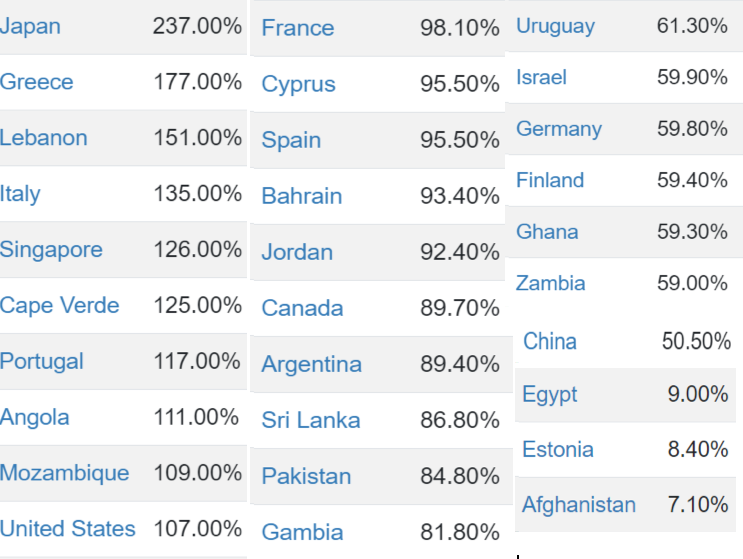
Utter nonsense. The so-called “debt” (that isn’t a debt) is not a debt “burden.” The government pays off all T-securities simply by returning the dollars in T-security accounts. It does this every day. And the phrase, “entire annual economy” is a non-sequitur based on ignorance. The size of the U.S. economy (i.e. the Gross Domestic Product) does not pay for any part of the “debt.” That comparison of the so-called “debt” vs. the US. economy — known as the “debt/GDP ratio — often is quoted as a way to shock the reader, though it is a meaningless comparison.

Here are a few similar comparisons.

Country Debt To GDP Ratio  2022 Population
Japan 237.00% 125,584,838
Greece 177.00% 10,316,637
Lebanon 151.00% 6,684,849
Italy 135.00% 60,262,770
Singapore 126.00% 5,943,546
Cape Verde 125.00% 567,678
Portugal 117.00% 10,140,570
Angola 111.00% 35,027,343
Mozambique 109.00% 33,089,461
United States 107.00% 334,805,269
Djibouti 104.00% 1,016,097
Jamaica 103.00% 2,985,094
. . .
Guinea 18.00% 13,865,691
Nigeria 17.50% 216,746,934
Libya 16.50% 7,040,745
Palestine 16.40% 5,345,541
Republic of the Congo 15.70% 5,797,805
Burundi 15.20% 12,624,840
Kuwait 14.80% 4,380,326
Russia 12.20% 145,805,947
Bhutan 11.00% 787,941
Eswatini 10.75% 1,184,817
Egypt 9.00% 106,156,692
Estonia 8.40% 1,321,910
Afghanistan 7.10% 40,754,388
Cayman Islands 5.70% 67,277
. . . . . . . . . . Do you see any relationship between the Debt/GDP ratio and the economic strength of the nation? Of course not, because there is no such relationship. The Debt/GDP relationship is meaningless. So why does Rappeport refer to it? Either he doesn’t understand federal finance or he is trying to scare you.  (The Wall Street Journal is designed for the rich, and the rich want to convince the populace that the government cannot afford to give benefits to the not-rich.)
Some economists contend that the nation’s large debt load is not unhealthy given that the economy is growing, interest rates are low and investors are still willing to buy U.S. Treasury securities, which gives them safe assets to help manage their financial risk. Those securities allow the government to borrow money relatively cheaply and use it to invest in the economy.
More nonsense. The so-called “debt load” is not unhealthy, and low interest rates are not a factor. The federal government, having the unlimited ability to create dollars, has no difficulty paying any amount of interest. Totally painless. And the federal government doesn’t need investors to buy Treasury securities. These are offered as a benefit to investors, not to the government. And in any event, any unsold T-securities are purchased by the Federal Reserve.
For years, presidents have promised to limit federal borrowing and bring down the nation’s budget deficit, which is the gap between what the nation spends and what it takes in. Under President Bill Clinton, the United States actually ran a budget surplus between 1998 and 2001.
Yes, Presidents have made this promise, and every time they actually kept the promise, we had depression or a recession. Mr. Rappeport fails to mention that Clinton’s surplus led to the recession of 2001.

1804-1812: U. S. Federal Debt reduced 48%. Depression began 1807. 1817-1821: U. S. Federal Debt reduced 29%. Depression began 1819. 1823-1836: U. S. Federal Debt reduced 99%. Depression began 1837. 1852-1857: U. S. Federal Debt reduced 59%. Depression began 1857. 1867-1873: U. S. Federal Debt reduced 27%. Depression began 1873. 1880-1893: U. S. Federal Debt reduced 57%. Depression began 1893. 1920-1930: U. S. Federal Debt reduced 36%. Depression began 1929. 1997-2001: U. S. Federal Debt reduced 15%. Recession began 2001.

But taming deficits had fallen out of fashion in recent years, including during the Trump administration, when lawmakers blew through budget caps and borrowed money to fund tax cuts and other federal spending.
Deficits don’t need to be “tamed.” Remember what Greenspan, Bernanke, and the St. Louis Fed said about the government’s infinite ability to pay its bills. Further, the federal government does not borrow its own sovereign dollars, the dollars it has the unlimited ability to create from thin air. And all federal spending is funded, not by taxes, but by ad hoc creation of new dollars. Why does the federal government levy taxes? To control the economy. It taxes what it wishes to discourage, and it gives tax breaks to what it wishes to encourage. Further, taxes give the impression that federal benefits must be limited. The rich, who control Congress and the President, want the Gap between the rich and not-rich to widen. The wider the Gap, the richer are the rich. It’s called “Gap Psychology“, the human desire to widen the Gap below and to narrow the Gap above.
“Hitting the $30 trillion mark is clearly an important milestone in our dangerous fiscal trajectory,” said Michael A. Peterson, the chief executive officer of the Peter G. Peterson Foundation, which promotes deficit reduction. “For many years before Covid, America had an unsustainable structural fiscal path because the programs we’ve designed are not sufficiently funded by the revenue we take in.”
The Peter G. Peterson Foundation is notorious for crying “wolf” about the deficit and predicting calamity that never happens — until we actually do reduce the deficit, at which time we have the aforementioned depressions or recessions. Until then, it’s all warnings and hand wringing about the “ticking time bomb of debt.” It’s a “time bomb” that has been ticking since 1940 and still no explosion.
The gross national debt represents debt held by the public, such as individuals, businesses and pension funds, as well as liabilities that one part of the federal government owes to another part.
Right, the so-called debt (T-bills et al) are assets of the private sector. When you own a T-bill, that is one of your assets. Alan Rappeport doesn’t want you to have that asset. He wants the government, which has infinite assets, to take that asset from you. Smart?
While Republican lawmakers helped run up the nation’s debt load, they have since blamed Mr. Biden for putting the nation on a rocky fiscal path by funding his agenda. After a protracted standoff in which Republicans refused to raise America’s borrowing cap, threatening a first-ever federal default, Congress finally agreed in December to raise the nation’s debt limit to about $31.4 trillion.
It was all political theater — cynical politicians trying to convince the innocent public that they are fiscally prudent. But if they really were prudent, they would spend more on global warming, poverty, healthcare, education, transportation, infrastructure, science, ecology, etc. — not debating about how to spend less.
In January 2020, before the pandemic spread across the United States, the Congressional Budget Office projected that the gross national debt would reach $30 trillion by around the end of 2025. The total debt held by the public outpaced the size of the American economy last year, a decade faster than forecasters projected.
Yes, as usual, the economic forecasters were wrong about the meaningless Debt/GDP ratio. So?
The nonpartisan office warned last year that rising interest costs and growing health spending as the population aged would increase the risk of a “fiscal crisis” and higher inflation, a situation that could undermine confidence in the U.S. dollar.
By “fiscal crisis,” we assume Rappeport means the federal government would be unable to pay its debts — which as we know is impossible for our Monetarily Sovereign government. (It can happen to state/local government, which are monetarily non-sovereign.) And inflation always is caused by shortages, never by federal deficit spending. In fact, federal deficit spending is one of the best methods for curing inflation, if the spending is for curing the shortages. Todays inflation is caused by shortages of oil, food, computer chips, labor, and other needs. The federal government could stop inflation by spending more to support oil drilling, efficient farming, and chip manufacture, and by eliminating FICA (FICA lowers the net income of workers and makes them less willing to accept jobs).
Trillions in federal spending has left the United States approaching levels of red ink not seen since World War II.
Actually, the so-called “debt” is much higher than it was during WWII. And when spending for WWII ended, we had recessions.
The Biden administration has said the $1.9 trillion pandemic relief package the Democrats passed last year was a necessary measure to protect the economy from further damage. Treasury Secretary Janet L. Yellen has argued that such large federal investments are affordable because interest costs as a share of gross domestic product are at historically low levels thanks to persistently low interest rates.
Yes, the $1.9 Trillion in deficit spending did protect the economy, just as cuts to federal spending will injure the economy. So why cut? Interest costs as a share of GDP are irrelevant, as are low interest rates. In fact, higher interest rates have one advantage: They force the federal government to pump more stimulus dollars into the economy.
What is inflation? Inflation is a loss of purchasing power over time, meaning your dollar will not go as far tomorrow as it did today. It is typically expressed as the annual change in prices for everyday goods and services such as food, furniture, apparel, transportation and toys. What causes inflation? It can be the result of rising consumer demand. But inflation can also rise and fall based on developments that have little to do with economic conditions, such as limited oil production and supply chain problems.
Inflation always is caused by shortages and always is cured by curing the shortages, which the federal government can do by federal deficit spending.
Esther L. George, the president of the Federal Reserve Bank of Kansas City, suggested during a speech this week that the Fed’s big bond holdings might be lowering longer-term interest rates by as much as 1.5 percentage points — nearly cutting the interest rate on 10-year government debt in half.  As rates rise, so does the amount that the United States owes to investors who buy its debt. The Congressional Budget Office estimates that if interest rates rise in line with their own forecasts, net interest costs will reach 8.6 percent of gross domestic product in 2051. That would amount to about $60 trillion in total interest payments over three decades.
That’s 60 trillion stimulus dollars pumped into the economy — dollars the federal government easily can create with the touch of a computer key, and dollars the economy uses for growth.
“A larger amount of debt makes the United States’ fiscal position more vulnerable to an increase in interest rates,” the C.B.O. said in its long-term budget outlook.
What does he mean by “vulnerable”? Is he saying that our Monetarily Sovereign government, which has the infinite ability to create dollars, will not be able to pay interest? Nonsensical.
Biden administration officials insist that they view fiscal responsibility as a priority. They have pledged that their economic agenda will be fully paid for through tax increases on wealthy Americans and corporations and by more rigorous enforcement of the tax code.
Biden wants you to believe that federal taxes fund federal spending. It is a lie. Federal taxes are destroyed upon receipt by the Treasury. Taxes come out of checking accounts that are part of the M1 money-supply measure. When they reach the Treasury, they cease to be part of any money-supply measure. They effectively disappear. There is no money supply measure that includes the federal government, because the government has infinite money. No one can answer the question, “How much money does the federal government have?” The only answer is, “Infinite.”
In recent months, the budget deficit has started to shrink as a stronger economy has boosted tax receipts and as government payments of pandemic relief money have slowed.
And this means economic growth will slow. If federal deficits fall enough, we will have a recession or depression.
And some economists argue that a more recent economic phenomenon — inflation — may have a silver lining in that it could chip away at the nation’s debt burden.
The federal “debt” is not a burden on the federal government or on taxpayers or on anyone else. It’s not debt, and even if it were, the federal government has the unlimited ability to pay.
Kenneth Rogoff, a Harvard University economist, said “You would rather have no debt, of course, but compared to other issues at the moment that’s not the principal problem.”
He’s a Harvard economist and he thinks that having no debt (which would require removing $30 trillion from the economy) is something we “would rather have”?? Is this the nonsense they teach at Harvard? In summary:

A federal deficit is necessary for economic growth. The federal Debt/GDP ratio is meaningless as a measure of economic health.

The federal government creates dollars, ad hoc, by paying creditors, which it can do endlessly.

Unlike state/local governments, the federal government is Monetarily Sovereign. It has the unlimited ability to create its sovereign currency, the U.S. dollar, and instantly can pay any obligation based on dollars.

The government never unintentionally can run short of dollars.

Federal taxes are destroyed upon receipt and do not fund federal spending.

The federal debt is nothing more than the total of deposits in T-security accounts, which are “paid off” by returning the dollars in them. This is not a burden on the federal government or taxpayers.

Federal deficit spending does not cause inflation; shortages cause inflation. A prime way to combat inflation is with federal deficit spending to cure shortages.

Rodger Malcolm Mitchell Monetary Sovereignty Twitter: @rodgermitchell Search #monetarysovereignty Facebook: Rodger Malcolm Mitchell

……………………………………………………………………..

THE SOLE PURPOSE OF GOVERNMENT IS TO IMPROVE AND PROTECT THE LIVES OF THE PEOPLE.

The most important problems in economics involve:
  1. Monetary Sovereignty describes money creation and destruction.
  2. Gap Psychology describes the common desire to distance oneself from those “below” in any socio-economic ranking, and to come nearer those “above.” The socio-economic distance is referred to as “The Gap.”
Wide Gaps negatively affect poverty, health and longevity, education, housing, law and crime, war, leadership, ownership, bigotry, supply and demand, taxation, GDP, international relations, scientific advancement, the environment, human motivation and well-being, and virtually every other issue in economics. Implementation of Monetary Sovereignty and The Ten Steps To Prosperity can grow the economy and narrow the Gaps: Ten Steps To Prosperity:
  1. Eliminate FICA
  2. Federally funded Medicare — parts A, B & D, plus long-term care — for everyone
  3. Social Security for all
  4. Free education (including post-grad) for everyone
  5. Salary for attending school
  6. Eliminate federal taxes on business
  7. Increase the standard income tax deduction, annually. 
  8. Tax the very rich (the “.1%”) more, with higher progressive tax rates on all forms of income.
  9. Federal ownership of all banks
  10. Increase federal spending on the myriad initiatives that benefit America’s 99.9% 
The Ten Steps will grow the economy and narrow the income/wealth/power Gap between the rich and the rest.

MONETARY SOVEREIGNTY

Rick Scott shovels the myth

Senator Rick Scott is a Floridian. He is a Republican. And he is a Trumper.
Official Portrait of Senator Rick Scott (R-FL).jpg
Would this face lie to you?
He sent me a form letter telling me how he is going to improve my life:
(Republican) Senator Rick Scott led his colleagues in introducing the Federal Debt Emergency Control Act to rein in Washington’s out-of-control spending and provide a concrete path forward to tackle the nation’s nearly $30 trillion debt.
“Out-of-control” is a synonym for “Gosh, that’s a lot of money to waste on the poor.” In fact, the “Out-of-control” spending is controlled by Congress, of which Republican Senator Rick Scott is a part. This is the same Republican Congress that gave the rich a vast, over-budget tax reduction, without a whimper from Senator Rick Scott. Suddenly, with a Democratic majority Congress and Presidency, the Republicans have re-discovered federal deficits. And they are “shocked, shocked I tell you.” “Out of control” also is a synonym for “ticking time bomb,” about which we have written several times. It’s the bomb that for 80+ years, debt haters have been telling you is ready to explode. Yet, here we are. No explosion. Economic growth. Decades of low inflation.
The Federal Debt Emergency Control Act requires the Office of Management and Budget to declare a “Federal Debt Emergency” in any fiscal year where the federal debt exceeds 100% of that year’s Gross Domestic Product (GDP).
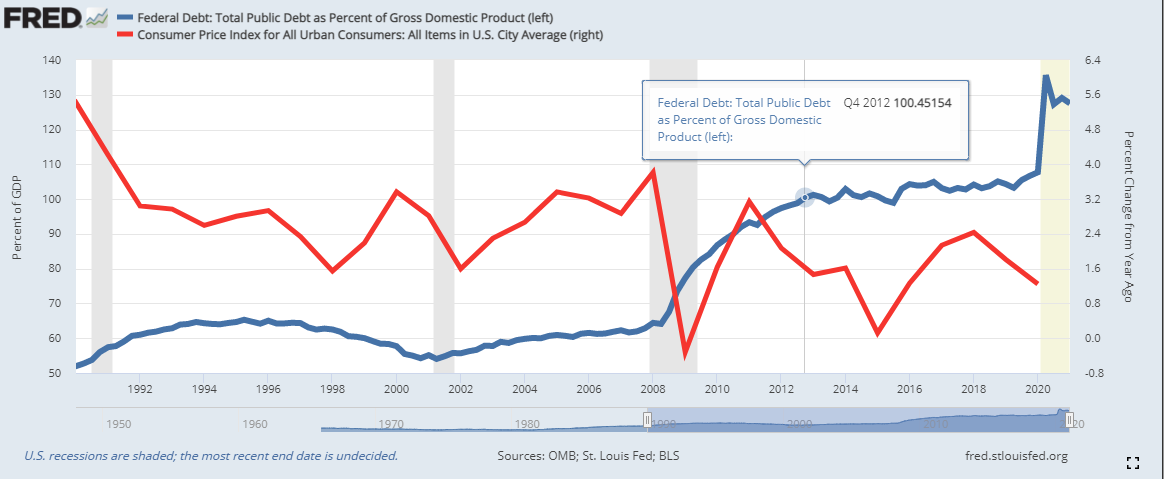
Why the 100% figure? There’s no reason for it other than ignorance. The ratio of federal debt to GDP has absolutely no significance regarding the health of the U.S. economy. It’s a useless, meaningless ratio that gets fire-breathed with alarm by those who either know nothing about economics, or worse, want you to know nothing about economics. If (Republican) Senator Rick Scott is right, you would expect the sickest, weakest economies to have the highest Debt/GDP ratios, while the healthiest, weakest economics have the lowest Debt/GDP ratios. But what do we find? Here are some examples:

Sample Nations: DEBT / GDP Ratios

Based on the above ratios, which nations would you say have the strongest, healthiest economies, and which have the weakest, sickest economies? Right. The Debt/GDP ratio tells you exactly nothing about the health or strength of a nation’s economy. But Republican Senator Rick Scott wants to cut federal spending as soon as our ratio hits the arbitrary and meaningless number: 100% (which it already did way back in the 4th qtr of 2012 — blue line). And by the way, inflation (red line), the current Republican excuse for cutting benefits for the poor, has averaged below the Fed’s 2% target.
This emergency designation would trigger several provisions to help control and reduce the federal debt to levels below 100% of GDP, including: Terminating any unobligated funding from the American Rescue Plan Act, and any previous stimulus bills, and sending it back to the Treasury General Fund immediately for deficit reduction.
He’s not specific about what should be cut. He just wants to cut “any unobligated funds,” no matter how vital to the economy and the people they may be. Exactly what is supposed to happen in the Treasury General Fund for deficit reduction? What is the “it” he wants to send back? Which dollars are not to be spent? The whole thing is financially senseless, but it is a classic right-wing approach. The American Rescue Plan Act and the previous stimulus bills rescued America from the severe recession that was exacerbated by Donald Trump’s incompetent and deadly COVID denial along with his economically damaging trade duty war against China. Scott is silent about that. Scott never says. Why? Because, being a Republican, he would cut all the spending that benefits the poor and middle classes, while falsely claiming that the rich are “job makers” who should be rewarded even more than they already are.
Requiring all legislation that increases the federal deficit, as determined by the Congressional Budget Office, to carry its own offsets.
This means running a balanced budget, perhaps the least intelligent idea ever to come out of any Congressperson’s mouth because: A balanced federal budget is absolutely, positively guaranteed to cause a deep recession if we are lucky, or a deep depression if we are not lucky. If you can find anyone on this planet who can demonstrate how running a balanced federal budget would allow for economic growth and/or prevent a depression, I would love to see the evidence. Perhaps the same person also can prove that global warming is a Chinese myth, and that Donald Trump actually won the election — two equally nutsy claims coming from the GOP.
If it does not, the legislation shall be considered out of order and will require at least two-thirds of all Senators to vote to increase federal debt before even being able to consider the bill.
Wait! What if two-thirds of all Senators were, by some miracle, to vote to increase the federal debt, would that mean it then becomes OK? Suddenly it would be within the government’s “means”? And, don’t we already have the ridiculous federal “debt limit,” that not only does the same thing, but is raised every time it’s reached? And why is the debt limit always raised? Because, Congress is well aware that limiting federal debt would destroy the U.S. economy.
Fast-tracking any legislation that would reduce the federal deficit by at least 5 percent over ten years.
Where did that 5% number come from? It surely wasn’t derived by any scientific method. Scott apparently thinks it’s a nice number, so he uses it. It reminds one of dearly departed Herman Cain’s meaningless “9-9-9” tax plan. Just numbers with no real reason. And where is the math that says reducing the federal deficit would benefit the economy in some way? Non-existent.
Senator Rick Scott said, “America is in a debt crisis. Our nation is barreling toward $30 trillion in debt – an unimaginable $233,000 in debt for every family in America.
It’s not that families owe that debt. The government does. But Scott tries to imply, falsely, that your family will have to pay for that debt.
It’s a crisis caused by decades of wasteful and reckless spending by Washington politicians. Now, President Biden is continuing this way of governing by pushing for trillions in wasteful spending, raising the U.S. federal debt by 60% to $39 trillion and the debt-to-GDP ratio to 117% in 2030, the highest level ever recorded in American history.
And what has been the result of all this “wasteful and reckless spending? Taxes are down and GDP is up. But Scott wants to fix that, by raising taxes and/or reducing GDP.
Spending beyond our means has consequences.
The federal government, being Monetarily Sovereign, has no “means.”
We’re already seeing rising inflation, which disproportionately hurts the poorest families, like mine growing up.
The “rising inflation,” which for decades has been below Federal goals, is the result of the pandemic, not the result of federal spending. It was the pandemic, and Trump’s atrocious handling of it, that led to the shortages of goods and services, that resulted in a thoroughly predictable inflation. Someone, please ask Sen. Scott, “Where was the inflation last year and the year before, and the decades before, when deficit spending was massive?” And yes, we caught that “I grew up poor” disgusting attempt at ingratiating yourself with the people you are trying to screw. But hey, as long as you’re talking about your history, let’s get into where your calculations might have come from:
In 1987, after serving in the United States Navy and becoming a law firm partner, Scott co-founded Columbia Hospital Corporation. Columbia later merged with another corporation to form Columbia/HCA, which eventually became the nation’s largest private for-profit health care company. Scott was pressured to resign as chief executive of Columbia/HCA in 1997. During his tenure as chief executive, the company defrauded Medicare, Medicaid and other federal programs. The Department of Justice ultimately fined the company $1.7 billion in what was at the time the largest health care fraud settlement in U.S. history.
And this fraudster is the guy who suddenly has become so concerned about the federal government’s “means” and its ability to pay its bills. No wonder this criminal is a Trumper. “Birds of a feather,” as they say. He must have envied Trump University.
I look forward to every fiscally responsible Republican and Democrat working with me to quickly pass the Federal Debt Emergency Control Act.”
Yes, do vote for good old “fiscally responsible” Rick Scott, who can hardly wait to cut benefits to the poor, while driving the economy into a depression, thus allowing his rich backers to buy up property and businesses at discount prices, while paying workers depression-era wages. And, there are people who actually believe this guy! Strange. Fortunately, with a currently Democratic Congress and President, this idiotic ploy has no chance to pass, and least not in the near future. And it wasn’t meant to pass. There isn’t a new idea in the entire proposal. It’s a rehash of all the discredited nonsense that has been floated by populists for decades.  It was assembled in a half-hour as a political stunt to show how fiscally sound is the do-nothing, historically crooked Senator from Columbia/HCA. Rodger Malcolm Mitchell Monetary Sovereignty Twitter: @rodgermitchell Search #monetarysovereignty Facebook: Rodger Malcolm Mitchell ………………………………………………………………………………………………………………………………

THE SOLE PURPOSE OF GOVERNMENT IS TO IMPROVE AND PROTECT THE LIVES OF THE PEOPLE.

The most important problems in economics involve:
  1. Monetary Sovereignty describes money creation and destruction.
  2. Gap Psychology describes the common desire to distance oneself from those “below” in any socio-economic ranking, and to come nearer those “above.” The socio-economic distance is referred to as “The Gap.”
Wide Gaps negatively affect poverty, health and longevity, education, housing, law and crime, war, leadership, ownership, bigotry, supply and demand, taxation, GDP, international relations, scientific advancement, the environment, human motivation and well-being, and virtually every other issue in economics. Implementation of Monetary Sovereignty and The Ten Steps To Prosperity can grow the economy and narrow the Gaps: Ten Steps To Prosperity:
  1. Eliminate FICA
  2. Federally funded Medicare — parts A, B & D, plus long-term care — for everyone
  3. Social Security for all
  4. Free education (including post-grad) for everyone
  5. Salary for attending school
  6. Eliminate federal taxes on business
  7. Increase the standard income tax deduction, annually. 
  8. Tax the very rich (the “.1%”) more, with higher progressive tax rates on all forms of income.
  9. Federal ownership of all banks
  10. Increase federal spending on the myriad initiatives that benefit America’s 99.9% 
The Ten Steps will grow the economy and narrow the income/wealth/power Gap between the rich and the rest. MONETARY SOVEREIGNTY