Obeying the rich: Telling the Big Lie and cutting benefits to the middle and poor.

“The federal ‘debt’ is too high.”

Debt ceiling: Biden says debt deal 'very close'
The Big Lie as expressed in a sign. The federal government doesn’t owe the so-called “debt,” and your family doesn’t owe any of it either.

That false belief — the Big Lie in economics — is so deeply implanted into the public’s brain that one seldom sees any discussion about its falsity.

The simple assumption is that debt is a burden, and more debt is a greater burden, and the federal government is deeply in debt, so the government should spend less and tax more to get rid of the debt burden.

And it’s all a gigantic, horrible, damaging lie, a Big Lie that locks the middle and bottom incomes in place while enriching the top.

That is the whole plan.

The very rich, who run America, send the Big Lie at us from all sides: The media, the politicians, and the economists, either via bribery or ignorance.

The rich bribe the media with advertising dollars or outright ownership. The rich bribe politicians with campaign contributions or promises of lucrative employment—the rich bribe economists with contributions to schools or employment at think tanks.

And those not bribed are influenced by constant repetition of the Big Lie, which addles their brains, reducing their ability to recognize obvious flaws in the Big Lie. Here are but three examples.

I. Why proposed GOP spending cuts hardly dent national debt, David Lightman

We assume David Lightman means federal, not national, debt. His reference is not to the nation’s debt but to the federal government’s.

But what he and virtually all others call “debt,” those Treasury bills, notes, and bonds aren’t debt. And contrary to popular wisdom, they aren’t “borrowing.”

We of the private sector (including state and local governments) borrow dollars to help us pay for things.

We don’t have the unlimited ability to create dollars, so we can run short. We are what is known as monetarily NON-sovereign.

You, I, and the local governments need a sovereign currency we can create instantly. We use the dollar.

By contrast, the U.S. federal government is Monetarily Sovereign. It created the first dollar and still creates the U.S. dollar from thin air merely by tapping computer keys.

The federal government cannot unintentionally run short of dollars. Even if the U.S. government stopped collecting taxes, it could continue creating and spending dollars forever.

Why does the government collect taxes if it doesn’t use them for spending?

  1. To control the economy by taxing what it wishes to discourage and giving tax breaks to those it rewards and encourages.
  2. To provide a certain demand for the dollar by requiring taxes to be paid in dollars.
  3. To fool the public into believing that certain benefits are unaffordable, thus widening the income/wealth/power Gaps between the rich and the rest. This is how the rich become richer.

Why does the government issue Treasury bills, notes, and bonds if this isn’t borrowing and the government doesn’t need the money? The purposes of T-securities are:

  1. To provide a safe, interest-paying place for the world to store unused dollars. This helps stabilize and secure the value of the dollar.
  2. To help the Federal Reserve control interest rates.
  3. To fool the public into believing the government must borrow dollars to pay for benefits given to the middle- and lower-income groups. This stifles the public’s objections to benefit cuts for the middle and lower-income groups and enriches the rich.

Why isn’t this borrowing? When you invest in a T-security, you open your account and deposit your dollars into it.

Think of this account as being like your bank safe deposit box. You, not the bank, own the contents of the box.

Similarly, you, not the federal government, own the contents of your T-security account.

The federal government neither uses nor even touches those dollars. That is why it’s not borrowing.

When your deposit reaches maturity, the government merely transfers the contents of your account to you. This is no more a burden on the federal government than is your bank allowing you to retrieve the contents of your safe deposit box.

That is why the contents of your safe deposit box are not your bank’s debt, and the contents of your T-security account are not the federal government’s debt.

Then why do so many people erroneously call T-securities “borrowing” and “debt”?

The Big Lie survives because of confusion and ignorance. The public needs to learn the differences between Monetary Sovereignty and monetary non-sovereignty. The people must also learn the differences between federal T-bills, T-notes, and T-bonds vs. private sector bills, notes, and bonds.

The words look the same, but they are homonyms. They describe vastly different things, like the word “band” (a ring vs a musical group.) 

A private sector bond transfers dollars from a lender’s account to a borrower’s account. The lender surrenders ownership of the dollars in exchange for the borrower’s bond.

The borrower then controls those dollars and uses them for his purposes. This is true even for state and local government bonds. The dollars go to the state and local government checking accounts at private-sector banks.

A T-bond transfers dollars from the bond owner’s checking account to the bond owner’s bond account. The bond owner never loses ownership of the dollars, and the government never touches the dollars.

The dollars are returned to the bond owner’s checking account upon maturity.

Private sector bonds denote borrowing and resultant debt. Treasury bonds indicate deposits, not debt. This confusion and ignorance help the rich to foster the Big Lie.

The relentless conservative drive to dramatically cut federal spending — a campaign that nearly caused a government shutdown and helped topple House Speaker Kevin McCarthy — wouldn’t do much to reduce the national debt anytime soon significantly.

There is zero reason to cut federal spending and a huge reason not to: When federal spending is cut or even increased too little, we have recessions and depressions.
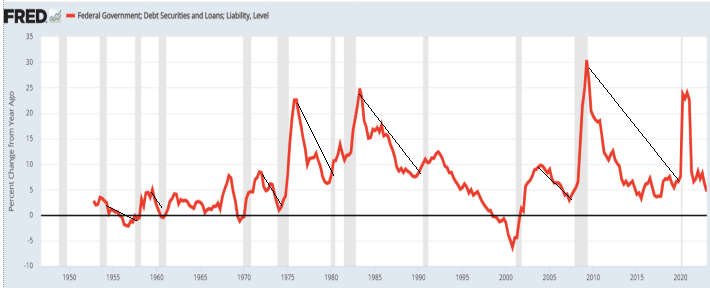
Vertical gray bars denote recessions. The red line indicates changes in federal deficit spending. Recessions begin with reductions in deficits.

The above graph dramatically shows how reduced federal deficits lead to recessions cured by increased obligations.

The Federal Reserve calls the red line “Federal Government Debt Securities and Loans, Liability, Level” when it is more like “Deposits into T-Security Accounts.” Even the Fed gets it wrong.

Going back in time, here is what happens when the federal government runs a surplus (taxes exceed spending).

U.S. depressions tend to come on the heels of federal surpluses.

1804-1812: U. S. Federal Debt reduced 48%. Depression began in 1807.
1817-1821: U. S. Federal Debt reduced 29%. Depression began in 1819.
1823-1836: U. S. Federal Debt reduced 99%. Depression began in 1837.
1852-1857: U. S. Federal Debt reduced 59%. Depression began in 1857.
1867-1873: U. S. Federal Debt reduced 27%. The depression began in 1873.
1880-1893: U. S. Federal Debt reduced 57%. Depression began in 1893.
1920-1930: U. S. Federal Debt reduced 36%. Depression began in 1929.
1997-2001: U. S. Federal Debt reduced 15%. The recession began 2001.

Why do the rich want the government to run surpluses?

  1. A surplus requires a tax increase and/or a spending decrease. Congress has provided tax loopholes so the rich seldom are affected by the tax increases paid for by the rest of us. Concerns about deficit rarely translate into a reduction of loopholes for the rich. A federal surplus effectively widens the income/wealth/power Gap between the rich and the rest
  2. The spending decreases invariably come from benefits important to those who are not rich — Medicare, Medicaid, Social Security, and other poverty aids — further widening the Gap.
  3. Surpluses cause depressions and recessions, forcing unemployment and providing rich business owners with a ready supply of desperate workers who will labor at starvation wages.

During recessions and depressions, the rich can maintain their lavish lifestyles while the rest of the populace suffers.

The push for drastic reductions in federal spending is expected to come up again once House Republicans pick a new speaker.

Whoever takes the gavel is expected to keep pushing for deep cuts. The Democratic-run Senate is unlikely to go along, but the GOP effort matters as a message to constituents about what Republicans are seeking.

The Republicans are the party of the rich. They are more likely to do the rich’s bidding than the Democrats, as evidenced by the divergent stances on federal spending.

The GOP initiative is also a reminder of why Congress is so stuck on adopting a budget.

When McCarthy, R-Bakersfield, agreed last month to a bipartisan plan to continue current spending for 45 days, angry conservatives plotted his successful removal.

The GOP is so in thrall of the rich it even demoted its House Speaker when he failed to end the government’s ability to spend.

The GOP budget plans range: For instance, aid that 702,000 Californians receive to buy healthy produce (through the Women’s, Infant and Children’s program WIC) would be dramatically cut.

So would the federal tax credit for electric vehicle charge equipment.

While such reductions collectively would save billions, nonpartisan budget analysts maintain that the cuts barely address the broader question of how to reduce the nation’s $33 trillion debt significantly.

Why is reducing the government’s “debt” (that isn’t a debt) an important question? Because it’s what the rich want, and their money talks.

Republican budget-cutters claim that their changes are a vital first step toward making the federal government more efficient and starting on a useful path to reducing the debt.

Reduced spending does not make government “more efficient.” Growing the economy is the government’s job, so reducing federal spending makes the government less efficient at its job.

Gross Domestic Product (GDP) is a common measure of the economy.

GDP = Federal Spending + Non-federal Spending Net Exports.

When Federal Spending increases, Non-federal spending also increases. When two terms of the equation increase, GDP increases.

Mathematically, there is no way for the government to do its job — growing the economy — by cutting spending.

“Stop bleeding money, stop racking up debt, defend the United States, stop social engineering, and just do your damn job as Congress.

I think that ought to be a pretty simple goal and a bipartisan goal,” said Rep. Chip Roy, R-Texas.

The key words are “stop social engineering.” This is right-wing speak for “cut Social Security, Medicare, Medicaid, and cut all benefits received by those who aren’t rich but don’t touch the loopholes that allow people like Donald Trump to pay $500 per year in federal taxes.”

Struggling with debt, The federal budget had annual surpluses from fiscal 1998 to 2001, as a booming economy, a 1995 budget deal, and a 1993 tax increase helped revenue pour into the Treasury. 

As you can see in the above graph, the recession of 2001 resulted from the federal surplus that began in 1998 and ended in 2002, when we emerged from the recession.

Since then, there have been nothing but annual deficits—$1.35 trillion in fiscal 2022—and the national debt has grown to $33 trillion.

David Lightman conveniently forgets that in the same period, Gross Domestic Product more than tripled, due to federal spending.

The deficit began climbing as Washington responded to the Sept. 11, 2001, terrorist attacks, pumping an estimated $2 trillion into wars in Iraq and Afghanistan. It spent to combat the Great Recession in 2009, delivered significant tax cuts in 2017, and passed huge COVID aid packages in 2020 to 2022.

Here is where the logic gets wacky. The government always spends to combat recessions. Federal spending is the one thing that cures recessions.

Why, then is it so hard for the debt nuts to understand that federal spending prevents recessions and grows the economy?

In fiscal 2022, the 12-month period that ended last September, the federal government spent $6.2 trillion. About two-thirds is called “mandatory spending,” meaning Congress does not have to vote on it. This includes Social Security benefits and Medicare payments.

That leaves only about one-third that Congress can control annually.

Wrong. Congress and the President have 100% control. They can, and should, expand Social Security and Medicare to include everyone in America, from birth to death, and for heaven’s sake, stop taxing Social Security benefits. That makes no sense from any standpoint.

Roughly half is defense, and the other half is domestic programs like education, transportation, energy, and others.

Most independent budget analysts agree that meaningful debt reduction involves costly entitlement spending. Social Security is estimated to be 11 years from insolvency. Medicare also faces financial problems in a few years.

You never will read a better expression of the Big Lie than the preceding paragraph. The phrase “meaningful debt reduction” should be changed to “harmful debt reduction.”

Neither Social Security nor Medicare can be “insolvent” or face “financial problems” unless that is what Congress and the President want.

The prevention and cure for those problems: A few touches of computer keys to provide money to these two vital programs — programs that benefit the “not-rich” far more than the rich.”

Those programs’ benefits are automatically funded and adjusted annually for inflation. Social Security benefits this year are up 8.7%, and next year are expected to climb about 3%.

The House’s GOP-run budget committee released a budget blueprint this summer that, while it proposes deep spending cuts, would not change Social Security. It does propose billions in Medicare savings through reforms.

Isn’t it clear why the budget cutters always use the word “reforms” when the honest word would be “cuts.”

Every conceivable “reform” for Medicare involves the Monetarily Sovereign federal government sending fewer dollars to the monetarily non-sovereign private sector.

As we repeatedly have experienced, reducing federal spending is recessionary or depressionary.

“Our budget protects and strengthens Medicare through policies that drive down out-of-pocket costs for seniors, stop overpayments, and enhance our healthcare workforce,” the budget says.

The budget does no such thing, neither protecting nor strengthening Medicare. To protect and strengthen:

  1. Eliminate FICA, which pays for nothing. Instead pay for Medicare the same way the government pays for Congress, POTUS, SCOTUS and nearly every other federal program: Create new dolllars, ad hoc.
  2. Eliminate Medicare deductibles. 
  3. Cover all the things that aren’t covered (dental, drugs, many procedures, etc.)
  4. Cover every man, woman. and child in America, from birth.
  5. Stop referring to the non-existent, fictional, phony Medicare Trust Fund.

It also urges the creation of a bipartisan commission to tackle the programs’ future. The commission would devise ways to get the programs on a sustainable financial path and help modernize the systems.

We don’t need another fake “bipartisan commission” that is ignorant (or feigns ignorance) of Monetary Sovereignty. Point #1 would get Medicare on a 100% sustainable path.

This sort of commission was arguably successful in the 1980s, when Social Security faced financial uncertainty.

It proposed what at the time were politically shaky reforms, including tax increases to fund the program and an increase in the age of eligibility.

The commission may have been “arguably” successful, but it wasn’t actually successful. It was a disaster.

The so-called “reforms” did nothing but shift the financial burden from the Monetarily Sovereign federal government (which never can run short of dollars) to the monetarily non-sovereign private sector (for which dollars always are scarce).

That could be called “successful” only in the eyes of the very rich. The Gap below widened, which is how the rich become richer.

Cuts and more cuts. The political focus is on spending cuts and taking incremental steps that are unlikely to get final approval. Once the House gets down to business again, those cuts will be the main topic of debate for some time.

Spending cuts always are harmful. By mathematical definition, they reduce GDP.

The House Budget Committee said in its blueprint that its plan can deliver a surplus by fiscal 2033. In addition to cuts, it assumes 3% economic growth per year, above what the nonpartisan Congressional Budget Office forecasts. More growth usually means more revenue and less spending.

The same surplus that repeatedly caused depressions in the past 200 years? Or Clinton’s surplus that “only” caused a recession?

Do these people not understand simple algebra? GDP=Federal Spending + Nonfederal Spending + Net Exports. How will federal spending cuts increase GDP?

The budget also reverses some of the plans Democrats recently approved. Outlays for green energy and technology “should have been targeted towards traditional roads and bridges, not wasteful initiatives,” the committee said, listing several programs it found excessive.

The committee claims that green energy and technology to save our planet are “excessive” and “wasteful initiatives”? What planet do these people live on?

Among them: $7.5 billion for electric vehicle charging stations, $5 billion for electric and low emissions buses and ferries and $10 million for career skills training to install energy efficient building technologies.

The Republicans prefer CO2-emitting, pollution-causing, gas-guzzling cars, busses, and ferries. And of course, they don’t want “energy efficient building technologies”.

Rep. Marjorie Taylor Greene, R-Georgia, proposed the reduction in Pentagon Secretary Austin’s salary, arguing “he is destroying our military.” She cited the chaotic American withdrawal from Afghanistan, saying Austin “failed America.”

If Marjorie Taylor Greene speaks for the GOP, need I say more?

Some analysts warn that such cuts have the potential to harm the people who need help the most.

Not “potential” harm; real harm to real people.

Cutting Women, Infants and Children program funds to buy healthy produce would leave recipients with roughly $11 to $15 monthly to spend, the left-learning Center on Budget and Policy Priorities estimates.

It said the cuts would affect an estimated 702,000 toddlers, preschoolers, and pregnant, postpartum, and breastfeeding California participants in the program.

This is exactly what happens when politicians value the federal government’s finances (which are infinite) more than personal finances (which are limited).

Republicans have argued that strengthening work requirements in assistance programs will help motivate people to work, reducing the programs’ cost and helping the economy as people pay more taxes and increase their spending.

“Motivate people to work” follows the right-wing claim that the poor are lazy takers who would rather wallow in their poverty than work, while the rich are industrious givers who labor so hard on their yachts, private planes, gated communities, and chauffeur-driven limos.

===================================

Then there was this example of economics ignorance from Chartr, the web site that provides graphs for many different subjects:

II. Like most developed nations, the US spends more than it takes in taxes essentially “living beyond its means”. For years, that wasn’t an issue, with Uncle Sam able to borrow at close to record-low rates for a decade.

Again, Uncle Sam never borrows its own sovereign currency, the U.S. dollar. It creates all the dollars it needs

However, higher borrowing costs have changed the game. Indeed, forecasts from the Congressional Budget Office project that the majority of future government deficits will not be down to net new spending, but rather paying the interest on what’s already owed (some $33 trillion), with deficits expected to rise as a share of GDP for the coming decades.

“Living beyond its means” is another version of the Big Lie, this one popularized by economically dense Democrat Barach Obama. The federal government has infinite means, so cannot live beyond it.

The deficit/GDP fraction is a popular, but meaningless number. It demonstrates nothing about the federal government’s financial health or its ability to pay its debts (which is infinite) and predicts nothing about the future.

You can visit a related website, “Debt to GDP Ranking by Country” and decide for yourself what the fraction tells you about anything at all.

Would the author of this article prefer to be owed money by Zambia (with a 119% score) rather than by the United States (with an “inferior” 128% score).

==========================================

And finally, to demonstrate how the Big Lie is everywhere, we come to the New York Times:

Higher rates stoke growing chorus of deficit concerns NYSE on June 13. The interest rate on 10-year Treasury bonds has spiked since July. By Jeanna Smialek, Jim Tankersley and Joe Rennison The New York Times

The U.S. government’s persistent budget deficit and growing debts were low on Wall Street’s list of worries when interest rates were at rock bottom for years.

But borrowing costs have risen so sharply that it is causing many investors and economists to fret that the United States’ big debt pile could prove less sustainable.

In 1940, The Gross Federal Debt Held by the Public totaled $41 Billion and was called a “ticking time bomb.” Now, it’s somewhere near $31 TRILLION.

Yet the bomb still ticks, and we still sustain, though the NY Times continues to clutch its pearls. Must be a slow tick.

The exact cause of the latest run-up in Treasury rates is hard to pinpoint. Many economists say a combination of drivers is probably helping to drive it — including strong growth, fewer foreign buyers of America’s debt, and concerns about debt sustainability in and of itself.

Gee, does the Times think “the run-up in Treasury rates” might be related to the Fed’s repeated rate increases?

That old worry about “foreign buyers” not buying America’s “debt” should be retired. It’s complete nonsense.

The federal government is not in debt and does not rely on foreigners to provide it with its own sovereign currency, the U.S. dollar. It creates all the dollars it needs by touching computer keys. No limit.

What’s clear is that if rates remain elevated, the federal government will need to pay investors more interest in order to fund its borrowing.

“Paying investors more” is a good thing. It adds to GDP. But, since the U.S. federal government never borrows dollars, investors can’t “fund borrowing.”

The nation’s gross national debt stands just above $33 trillion, more than the total annual output of the U.S. economy. The debt is projected to keep growing both in dollar figures and as a share of the economy.

The fact that the non-existent “debt” (i.e., deposits in Treasury security accounts) is greater than GDP reveals zero about the economy. The oft cited Debt/GDP fraction is meaningless. 

It’s like saying the Chicago Cubs had more runs than the Bears had field goals. Same “meaningful” comparison.

While the climbing cost of holding so much debt is stoking conversations among economists and investors about the appropriate size of the government’s annual borrowing, there is no consensus in Washington for deficit reduction in the form of either higher taxes or big spending cuts.

There’s no consensus because both higher taxes and spending cuts would injure the economy. Both take dollars from the economy and give them to the federal government, which promptly destroys them.

Should you cure anemia by applying leeches or by cutting wrists? No consensus there, either.

Still, the renewed concern is a stark reversal after years in which mainstream economists increasingly thought that the United States might have been too timid when it came to its debt: Years of low interest rates had convinced many that the government could borrow cheap money to pay for relief in times of economic trouble and investments in the future.

Our Monetarily Sovereign federal government has the infinite ability to “pay for relief in times of economic trouble,” no matter what interest rates have been. It does not borrow, cheap money or otherwise.

As always, the media confuse Monetary Sovereignty with monetary non-sovereignty. The former cannot run short of money; the latter can and often do.

“How big a problem deficits are depends — and it depends very critically on interest rates,” said Jason Furman, an economist at Harvard and former economic official under the Obama administration. 

Oops, another Obama economist. That tells us all we need to know. What is it with Harvard that their economists believe the federal government borrows and needs to worry about the interest it pays?

We’ll finish with a lovely compilation of economic ignorance, widely promulgated, widely believed, and widely wrong.

Furman had previously estimated that the growing cost of interest on federal debt would remain sustainable for some time, after factoring in inflation and economic growth. But now that rates have climbed so much, the calculus has shifted, he said.

The deficit has been sustainable since — uh, since the federal government had the power to create laws, and laws had the power to create dollars.

The deficit will continue to be sustainable forever. The U.S. government cannot unwillingly run short of dollars. Not now. Not tomorrow. Not ever.

Higher interest rates are a leading cause, along with surprisingly weak tax collections, of what the Congressional Budget Office projects will be a doubling of the federal budget deficit over the last year. 

The deficit, when properly measured, grew from $1 trillion in the 2022 fiscal year to an estimated $2 trillion in the 2023 fiscal year, which ended last month.

This means the federal government will pump about two trillion growth dollars into the economy. And this is a bad thing??

If borrowing costs climb further — or simply remain where they are for an extended period — the government will accumulate debt at a much faster rate than officials expected even a few months ago.

The federal government does not owe the misnamed “debt,” and even if it did, it could pay it all instantly.

The Big Lie in economics is that the federal government can run short of its sovereign currency. The Lie is repeated endlessly by nearly every information source — media, politicians, and economists.

The facts as explained by Monetary Sovereignty, are overwhelmed by the sheer volume of lies being promulgated from everywhere.

At long last, is there any one out there who has world standing plus even a modicum of knowledge about economics and Monetary Sovereignty? Is so, would that person please debunk the false notions that federal finances resemble personal finances and that federal benefits are “unsustainable”?

Hello?

Anyone?

Rodger Malcolm Mitchell
Monetary Sovereignty

Twitter: @rodgermitchell Search #monetarysovereignty
Facebook: Rodger Malcolm Mitchell

……………………………………………………………………..

The Sole Purpose of Government Is to Improve and Protect the Lives of the People.


MONETARY SOVEREIGNTY

Here is how the Big Lie picks your pocket (It’s a lot but it’s not even a complete list.)

The Big Lie in economics is, “Federal taxes fund federal spending.” While state and local taxes fund state and local spending, federal taxes do not fund federal spending. The difference is that state and local governments are monetarily non-sovereign, while the federal government is Monetarily Sovereign.
Pickpocketing in Las Vegas - What is the penalty if I get caught?
The Big Lie steals your money and your benefits
Either the authors of the following article and the entire Congress of the United States are lying, or they really don’t understand the differences between monetary non-sovereignty and Monetary Sovereignty. Both possibilities are disgraceful. The differences are described in detail here, but fundamentally, a Monetarily Sovereign government is the creator and issuer of its own sovereign currency, in this case, the U.S. dollar. The U.S. is Monetarily Sovereign because it created the U.S. dollar from thin air by passing laws from thin air. Just as it never can run short of laws, the federal government never can run short of its dollars. Even if the federal government collected zero taxes, it could continue spending forever because it has the infinite ability to create its own sovereign currency. By contrast, state and local governments did not create the U.S. dollar. They, like you and me, simply are users of the dollar. And unlike the federal government, they and we all can run short of dollars. These differences mean that federal government financing is nothing at all like personal or state/local government financing, but the purpose of the Big Lie is to make you believe federal financing and personal financing are similar. Just one of the dozens of examples: While state/local governments use tax dollars for spending, the federal government destroys tax dollars upon receipt.
Here’s what’s in the bipartisan infrastructure package By Katie Lobosco and Tami Luhby, CNN, November 15, 2021 It will deliver $550 billion of new federal investments in America’s infrastructure over five years, touching everything from bridges and roads to the nation’s broadband, water and energy systems. Experts say the money is sorely needed to ensure safe travel, as well as the efficient transport of goods and produce across the country. The nation’s infrastructure system earned a C- score from the American Society of Civil Engineers earlier this year. Democrats claim the legislation pays for itself through a multitude of measures and without raising taxes.
The legislation cannot “pay for itself,” nor can spending cuts pay for the legislation, nor can tax increases pay for the legislation. The legislation will be paid for the same way all federal legislation is paid for:
  1. The involved federal agencies will send instructions, in the form of checks or wires, to the federal government’s creditors’ banks, instructing these banks to increase the balances in the creditor’s checking accounts.
  2. At the instant the banks obey those instructions, new dollars are created, deposited in checking accounts, and added to the M1 money supply.
  3. To balance their books, the banks then clear these deposits through the Federal Reserve which debits the federal government’s infinite supply of dollars. Thus federal deficit spending adds growth dollars to the economy.
  4. Had the federal government levied an equal amount of taxes, these tax dollars would not have “paid for” what was owed — the instructions already paid for it — but the taxes would have removed growth dollars from the economy.
The Congressional Budget Office brushed aside several of those pay-for provisions, ultimately finding the package would add $256 billion to the deficit over the next 10 years.
Translation: The package would have added 256 billion growth dollars to the economy at no cost to anyone — no cost to taxpayers, no cost to our children and grandchildren, no cost to anyone. The dollars would have been created by the banks obeying federal instructions.
The legislation calls for investing $110 billion for roads, bridges and major infrastructure projects. That’s significantly less than the $159 billion that Biden initially requested in the American Jobs Plan.
Translation: But for the Big Lie, an additional $49 billion could have been used to grow the economy,
Included is $40 billion for bridge repair, replacement and rehabilitation, $16 billion for major projects that would be too large or complex for traditional funding programs, $11 billion for transportation safety, $1 billion to reconnect communities, and $39 billion to modernize public transit, according to the text. That’s less than the $85 billion that Biden initially wanted to invest in modernizing transit systems and help them expand to meet rider demand.
That’s $46 billion in growth that will not happen because of the Big Lie.
The legislation provides a $65 billion investment in improving the nation’s broadband infrastructure, according to the text. Biden initially wanted to invest $100 billion in broadband.
Translation: 35 billion new growth dollars will not enter the economy. And now we come to a flat-out statement of the Big Lie:
How Congress will pay for it The legislation includes a multitude of measures to pay for the proposal — none of which would raise taxes. But while lawmakers claim the package pays for itself, the CBO score found it would instead add billions of dollars to the deficit over 10 years and that many of the pay-for provisions would not raise as much money as Democrats said they would.
No federal spending can “pay for itself.” The federal government pays for everything by issuing instructions, which it has the unlimited ability to do.
The bottom line is that the legislation would directly add roughly $350 billion to the deficit, when taking into account $90 billion of spending in new contract authority, said Marc Goldwein, senior vice president at the Committee for a Responsible Federal Budget, a nonpartisan group that tracks federal spending.
Translation: The legislation would directly add roughly 350 billion growth dollars to the economy. The Committee for a Responsible Federal Budget (CRFB) is a group that is paid by wealthy people to promulgate the Big Lie. The primary purpose of the Big Lie is to prevent the general public from asking for federal benefits. The goal is to widen the Gap between the rich and the rest, thus making the rich richer.
According to the text and a 57-page summary of the legislation, lawmakers leaned heavily on repurposing unused Covid-19 relief funds to pay for the legislation. 
Translation: Rather than creating 22 billion growth dollars for COVID relief, those growth dollars will instead supposedly be used to “pay for” Biden’s programs.
Another item in the text is $53 billion that stems in part from states opting to terminate the pandemic unemployment benefits early in hopes of pushing the jobless to return to work. Some 24 states stopped at least one of the federal unemployment programs before they officially ended in early September.
Translation: Rather than giving the $53 to the lower-income people as unemployment benefits, Congress has decided to starve these people into submission, so in desperation, they will go to poorly paying and/or unpleasant jobs they otherwise would have avoided. This way, the rich factory owners can rule with iron hands over needy workers.
The agency also found that the Federal Communications Commission’s spectrum auctions would generate far less than the $87 billion originally claimed by lawmakers.
Translation: The agency also found that the Federal Communications Commission’s spectrum auctions would take far fewer dollars from the economy than the $87 billion originally claimed by lawmakers.
The CBO also said that the legislation will raise about $50 billion by imposing new Superfund fees and changing the tax reporting requirements for cryptocurrencies, among other measures.
Translation: $50 billion unnecessarily will be taken from the public for fees and taxes.
The package leaves out Biden’s proposal to spend $400 billion to bolster caregiving for aging and disabled Americans — the second largest measure in the American Jobs Plan.
Translation: $400 billion would have grown the economy, but why should the aged and disabled poor receive dollars when the rich have tax loopholes to exploit?
His proposal would have expanded access to long-term care services under Medicaid, eliminating the wait list for hundreds of thousands of people. It would have provided more opportunity for people to receive care at homethrough community-based services or from family members. It would also have improved the wages of home health workers, who now make approximately $12 an hour, and would have put in place an infrastructure to give caregiving workers the opportunity to join a union.
None of the above were included because they don’t benefit the rich.
Also left on the sideline: $100 billion for workforce development, which would have helped dislocated workers, assisted underserved groups and put students on career paths before they graduate high school.
Translation: 100 billion growth dollars would have stimulated the economy, but we really don’t care about dislocated workers, underserved groups, and students.
The legislation also leaves out the $18 billion Biden proposed to modernize Veterans Affairs hospitals, which are on average 47 years older than private-sector hospitals.
Translation: There goes another 18 billion economic growth dollars, and really, why worry about our hospitalized veterans? Do they vote much?
What’s also out is a slew of corporate tax hikes that Biden wanted to use to pay for the American Jobs Plan. Biden’s original proposal called for raising the corporate income tax rate to 28%, up from the 21% rate set by Republicans’ 2017 tax cut act, as well as increasing the minimum tax on US corporations to 21% and calculating it on a country-by-country basis to deter companies from sheltering profits in international tax havens.
Sorry Joe, but taxes don’t fund federal spending. The federal government could continue spending forever, even if it collected $0 in taxes.
CNN’s Manu Raju contributed to this report.
Apparently, CNN’s Manu Raju knows as little about economics as do Katie Lobosco and Tami Luhby. SUMMARY Not only is the Big Lie eliminating many billions of growth dollars from the economy, but a great many worthwhile projects and people will go unfunded. Because the rich take advantage of the public’s ignorance about economics, they win and you lose. They manage to widen the Gap, while you lose the growth benefits of federal spending along with the specific benefits that spending could have funded. Ignorance has its penalties. Rodger Malcolm Mitchell Monetary Sovereignty Twitter: @rodgermitchell Search #monetarysovereignty Facebook: Rodger Malcolm Mitchell

……………………………………………………………………..

THE SOLE PURPOSE OF GOVERNMENT IS TO IMPROVE AND PROTECT THE LIVES OF THE PEOPLE.

The most important problems in economics involve:
  1. Monetary Sovereignty describes money creation and destruction.
  2. Gap Psychology describes the common desire to distance oneself from those “below” in any socio-economic ranking, and to come nearer those “above.” The socio-economic distance is referred to as “The Gap.”
Wide Gaps negatively affect poverty, health and longevity, education, housing, law and crime, war, leadership, ownership, bigotry, supply and demand, taxation, GDP, international relations, scientific advancement, the environment, human motivation and well-being, and virtually every other issue in economics. Implementation of Monetary Sovereignty and The Ten Steps To Prosperity can grow the economy and narrow the Gaps: Ten Steps To Prosperity:
  1. Eliminate FICA
  2. Federally funded Medicare — parts A, B & D, plus long-term care — for everyone
  3. Social Security for all
  4. Free education (including post-grad) for everyone
  5. Salary for attending school
  6. Eliminate federal taxes on business
  7. Increase the standard income tax deduction, annually. 
  8. Tax the very rich (the “.1%”) more, with higher progressive tax rates on all forms of income.
  9. Federal ownership of all banks
  10. Increase federal spending on the myriad initiatives that benefit America’s 99.9% 
The Ten Steps will grow the economy and narrow the income/wealth/power Gap between the rich and the rest.

MONETARY SOVEREIGNTY

The single most important question in economics

Economics involves many questions, of course, but is there one question that is key? Is there one question, the answer to which opens the door to the entire study of economics? After some thought, I believe such a question exists, and I will reveal my nomination here. You may disagree with my choice, and if so, I’d be glad to know yours, or if you feel no question is that important. First, a bit of: BACKGROUND In the first eleven billion years of the universe’s existence, and the first 4 billion years of the earth’s existence, there was no such thing as the United States or the U.S. dollar. But beginning in the 1700’s AD, men created a variety of laws. The laws were completely arbitrary and created from thin air, as all laws are. And as is true for all laws, these laws had no physical existence. They merely were concepts. The laws could be spoken, handwritten, typed, printed, mimeographed, texted, Emailed, or delivered in any number of ways, but the laws themselves had no physical existence. They merely were an amalgam of ideas, concepts, and beliefs.Measure the Magic | ifundraiser blog Some of those laws, which were created, from thin air, produced the political entity known as “the United States of America.” and some of those laws created, also from thin air, the U.S. dollar. Those laws arbitrarily created millions of dollars, and arbitrarily created the value of those dollars, with regard to arbitrary amounts of silver and gold. And now for the question that I believe to be the most important question in economics:
How Many Laws Can The U.S. Federal Government Create?

I suggest that the answer to this question is: “Infinite.” Now “infinite” is a very big number. It is bigger than the number of glasses of water in all the oceans on earth. It is bigger than the number of stars in the sky. Infinite is bigger than the number of atoms in the known universe. How is it possible for humans to create here on earth, something that is bigger than the oceans, stars, and the universe’s atoms? The reason is that water, stars, and atoms are physical objects, but laws have no physical existence. Like creating numbers, the ability to create laws is limitless. You cannot see, hear, feel, taste, or smell a number or a law. You can sense representations of numbers and laws, but the numbers and laws themselves merely are concepts. Similarly, the dollars created by laws, have no physical existence. You can see representations of dollars — dollar bills, bank statements, savings account passbooks, T-bill records, etc. — but you cannot see, hear, feel, taste, or smell a dollar. It is just a number in a balance sheet. When you go to a store to make a purchase, you pay by presenting your credit card. Invisible dollars are taken from that card and sent to the card issuer, who in turn, sends invisible dollars to the store. Soon thereafter, invisible dollars will be taken from your checking account and sent to the credit card company, which will deposit these invisible dollars into its balance sheets. All the while, invisible dollars will flow to and from the Federal Reserve, tidying things up. And it all will be done in thin air, with nothing but the occasional atom moving. Because the U.S. dollar was created by U.S. laws, and because the federal government has the infinite ability to create U.S. laws, and because neither laws nor dollars have any physical existence:

I. Dollars are created by laws. The U.S. federal government has the infinite ability to create laws, so it has the infinite ability to create U.S. dollars.

We’re not even talking about an infinite ability to “print” dollars. Those printed green paper things you carry in your wallet are not dollars. They are representations of, or titles to, dollars. The real dollars are just numbers in numerous records and balance sheets all over the world. Because the U.S. government has the infinite ability to create the laws that create dollars, and so has the infinite ability to create dollars, the government never unintentionally can run short of dollars. And because the government has the infinite ability to create U.S. dollars:

II. The U.S. government has no need to collect U.S. dollars from anyone or anywhere.

This means the government has no need to borrow or to tax. It does not need to ask you for dollars. It does not need to ask China for dollars. It does not need to ask anyone for dollars. The federal government creates from thin air all the dollars it uses. Even if all federal tax collections fell to zero, the federal government could continue spending forever. Not only that, but:

III. All the tax dollars you send to the federal government are destroyed upon receipt.

The amount of money that exists in the United States is divided into “M”classifications such as MZM, M0, M1, M2, and M3, according to the type and size of the account in which the instrument is kept. The money supply reflects the different types of liquidity each type of money has in the economy. It is broken up into different categories of liquidity or spendability.
The tax dollars you, and everyone else  sends to the federal government generally come from checking accounts, which are part of the money supply measure called “M1.” When you pay taxes, you take money from your M1 checking account and send them to the Treasury where they cease to be part of any money supply measure. Effectively, your tax dollars are destroyed. The reason is clear. Because the federal government has the unlimited ability to create dollars, it would make no sense to try to measure its money supply, which is infinite.  If, say, you send $1,000 to the federal government, $1,000 + infinity = infinity. No difference. That is why no one ever can answer the question, “How much money does the federal government have?” The only accurate answer is “Infinite.” The Monopoly Example If you ever have played the board game Monopoly, you know that it usually is played with four players, plus a Bank. The function of the Bank is to distribute Monopoly dollars to, and to collect Monopoly dollars from, the players, according to the rules. But, one rule of Monopoly is that the Bank never can run short of dollars. If you were to open the game box to discover all the printed dollar certificates were missing, what would you do in order to play the game?
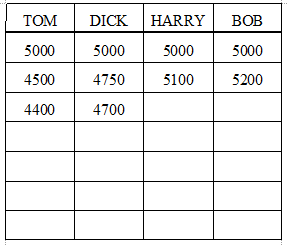
How to play Monopoly without using Monopoly paper dollars. Create a table. No column for the Bank.
One approach would be to take a sheet of paper and divide it into four columns, one column for each player. At the top of each column you would print each player’s name, and below each name, a starting amount of money. The illustration at the right shows that each player begins with 5,000 Monopoly dollars. Then as each player spends and receives money, the amounts below that player’s name are changed. Many of those dollars go to, and come from, the Bank, but the bank has no column because the Bank has infinite dollars. In the game, when you pay dollars to the “Community Chest,” the dollars are supposed to go to the Bank, and when you receive $200 for passing “GO,” the dollars are supposed to come from the Bank. Although the rules specify that tax dollars and other dollars go to the Bank, the above example shows that they really are destroyed upon receipt. The Bank has no column. There is no way to determine how many dollars the Bank has. It has infinite dollars. In the real world, the federal government operates just like the Monopoly Bank: It collects dollars from the public, and it distributes dollars to the public. But once dollars are received by the Treasury, they disappear. Though the Treasury keeps internal records, there is no way to determine how many dollars the government has. It has infinite dollars. Since the federal government has no use for tax dollars, why does the federal government collect tax dollars? There are three reasons: One real, one mythical, and one secret.
  1. The real reason the government collects tax dollars is to control the economy. It taxes what it wishes to discourage and it gives tax breaks to what it wishes to reward or encourage. That is why there are so many tax breaks for the rich people who control the government.
  2. The mythical reason the federal government collects tax dollars — a reason espoused by many economists — is to create demand for dollars with which to pay taxes. The demand for such cryptocurrencies as Bitcoin, Ethereum, and Litecoin, which are not supported by taxes, debunks this reason.
  3. The secret reason the federal government collects taxes is to help make you believe dollars are scarce to the government. This belief keeps you from demanding more benefits like expanded Social Security, Medicare for All, poverty aids, free college for all, and an end to the FICA tax.
The rich people and rich companies are rich only because of the Gap between them and those who are not as rich. If there were no Gap, we all would be the same. No one would be rich. And the wider the Gap, the richer are the rich. The rich always want to be richer. This is known as “Gap Psychology,” the desire to widen the income/wealth/power Gap below, and to narrow it above. Widening the Gap below can involve either gaining more for oneself or preventing those below from gaining. Either will make one richer. To make themselves richer, the rich bribe the key sources of your information. They bribe the politicians (via political contributions and promises of lucrative employment later). They bribe the media (via ownership and advertising dollars). They bribe the economists (via university contributions and “think tank” employment). All these sources of information combine to tell you the Big Lie, that in order for you to receive more federal benefits, taxes must be increased. That misinformation provides an excuse for the current battles against President Biden’s “Build Back Better” Act, which first was proposed at a $3.5 trillion level, and since has been cut in half because of the Big Lie. The pretext was that this proposal must be “paid for” with taxes. But, as you now know, taxes do not fund federal spending. The federal government pays for everything by merely sending instructions (checks and wires) to creditors’ banks, instructing the banks to increase the balances in creditors’ checking accounts. When the banks do as instructed, this creates more M1 dollars, the same kind of dollars you send to the federal government as taxes. Since the federal government has no need to ask anyone for dollars, why does it borrow dollars? The U.S. federal government never borrows dollars. The acceptance of deposits into Treasury Security accounts (T-bills, T-notes, T-bills) is wrongly called “borrowing” and federal “debt.” It neither is borrowing nor debt.IBV's Billionaires-Only Bank Vault In London Is So Hollywood It's Ridiculous The closest parallel to a T-security account is a safe deposit box. When you put dollars into your safe deposit box, your bank never touches those dollars, and your bank doesn’t owe you those dollars. They neither are loans to your bank nor are they debts of your bank. The bank “pays you back” simply by allowing you to take back whatever dollars are in your box. Similarly, when you make a deposit into your T-security account, the federal government never touches those dollars. The government “pays you back” by allowing you to take back whatever dollars are in your account. Since the federal government has no need to ask anyone for dollars, why does it provide for deposits into T-security accounts? There are two real reasons and one secret reason:
  1. The first real reason is to help the Federal Reserve to control interest rates. These accounts pay interest, the rates for which begin with Federal Reserve decisions regarding the state of the economy.
  2. The second real reason is to provide a safe, interest-paying place for people, businesses, and nations to “park” unused dollars.
  3. The secret reason is again to help make you believe the federal government is so deeply “in debt” it cannot afford to help narrow the Gap between the rich and the rest.
The federal government has no need to ask anyone for dollars, and has the infinite power to spend. But, doesn’t too much government spending cause inflation? Remember that way back in the 1780s, the federal government created as many dollars as it wished and gave those dollars whatever value it wished — and it did all this by passing laws. The federal government still has the unlimited power to:
  1. Pass laws
  2. Create dollars, and
  3. Control the value of dollars.
Over the years, the government has used all three of those powers. While nos. 1 and 2 already have been explained, you may be curious about how the government controls the value of dollars. It has two primary tools:
  • When the government raises interest rates, more people will want to obtain more dollars to invest in interest-paying bonds, and this increased demand for U.S. dollars increases their value.
  • Government fiat. When the U.S. was on various silver and gold standards, the government merely would pass laws saying that a dollar could be exchanged for specific amounts of gold or silver. The U.S. Constitution gives Congress the power “To coin Money, regulate the Value thereof.” The government, by fiat, can change the exchange rate between dollars and other currencies. This is known as “devaluation” and “revaluation.”
That said, the primary driver of inflation is not interest rates, or federal fiat, or federal deficit spending, or so-called federal “debt.” The primary driver of inflation is shortages. If the “federal deficit spending” myth were true, an increase in federal deficit spending should correspond to an increase in prices.
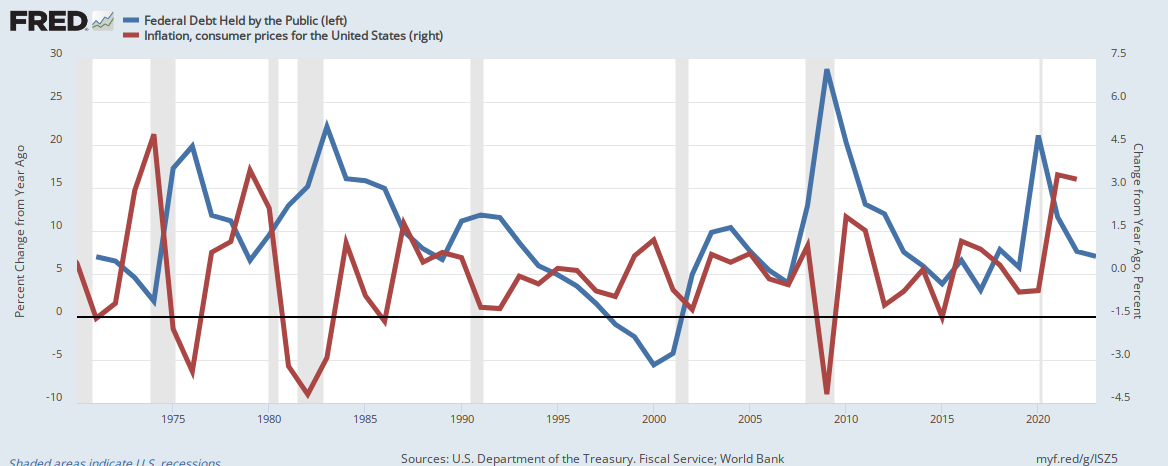
Changes in federal deficit spending (blue line) vs. inflation (red line). Vertical bars are recessions.
There is no historical relationship between changes in federal deficit spending (blue line) and changes in inflation (red line). Federal deficits do not cause inflations.

IV. The driver of inflation never is federal deficit spending, but rather the scarcity of key goods and services.

Like all inflations through history, today’s inflation is caused by shortages of energy, food, computer chips, supply chain resources, and labor. Some of these are related to global warming and some are related to COVID. Many are related to inefficient government. Contrary to popular wisdom, today’s inflation could be controlled via increased federal spending to eliminate the shortages. Federal spending to increase oil and gas drilling, renewable energy production, farmer aids, computer chip production, shipping, and the elimination of taxes that discourage employment (i.e. FICA), would reduce inflation. Also notice in the above graph that:

V. Recessions begin with reductions in federal deficit growth and are cured by increases in federal deficit growth.

This should surprise no one because economic growth requires money growth. The most common measure of economic growth is Gross Domestic Product (GDP) a formula for which is:

GDP=Federal Spending + Non-federal Spending + Net Exports.

All three factors on the right-hand side of the equation are related to an increased dollar supply. What happens when the federal “debt” (i.e., the net total of deficits) decreases?

1804-1812: U. S. Federal “Debt” reduced 48%. Depression began 1807. 1817-1821: U. S. Federal “Debt” reduced 29%. Depression began 1819. 1823-1836: U. S. Federal “Debt” reduced 99%. Depression began 1837. 1852-1857: U. S. Federal “Debt” reduced 59%. Depression began 1857. 1867-1873: U. S. Federal “Debt” reduced 27%. Depression began 1873. 1880-1893: U. S. Federal “Debt” reduced 57%. Depression began 1893. 1920-1930: U. S. Federal “Debt” reduced 36%. Depression began 1929. 1997-2001: U. S. Federal “Debt” reduced 15%. Recession began 2001.

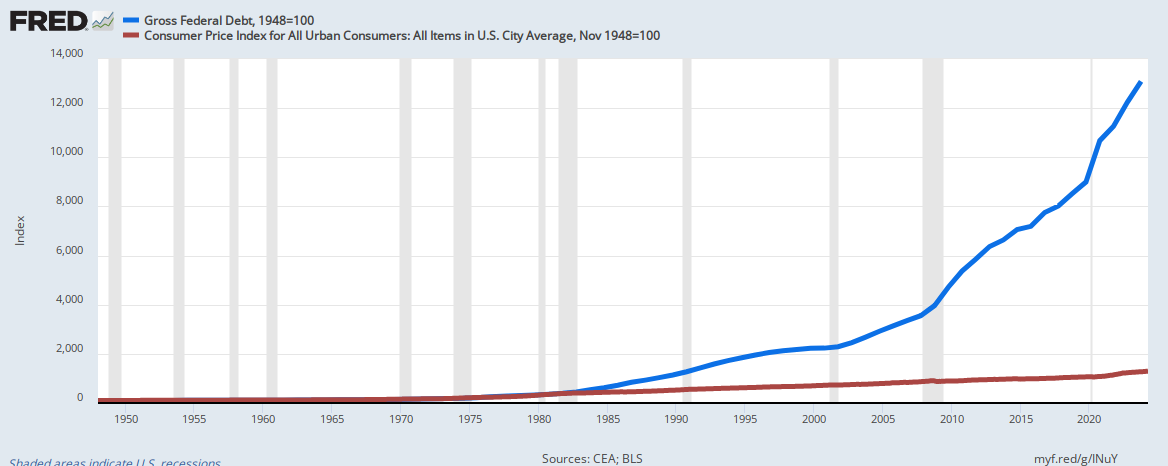
Again, this should surprise no one. Just as a growing economy requires a growing supply of money, reducing federal “debt” (i.e. running federal surpluses) takes dollars from the economy and sends them to the Treasury, where they are destroyed.. By definition, GDP is reduced when dollars are taken from the economy. Fortunately, the U.S. federal government has the ability to create infinite U.S. dollars and to control their value, i.e. prevent excessive inflation. So, the federal government has the ability to fund Medicare for All, Social Security for All and college for all who want it. Further, the government has the financial ability to eliminate the grossly recessive employment taxes (FICA) and to help the states, counties, and cities to reduce their tax burdens. Given this infinite power, the federal government is left with one final question: Is there a limit? We know the government has the power, but is there a limit as to how much of this power the government should use? The problem has two parts: Financial and political. Financially, is there a dollar limit, beyond which federal deficit spending actually harms the economy rather than benefitting it? There may be, but no evidence exists for any limit. As the following graph shows, federal “debt” (blue line) has increased massively, while inflation (red line) has followed a comparatively modest, even trajectory. If federal deficit spending caused inflations, the blue line (federal deficits) and the red line (inflation) would be parallel. Claims that future federal deficit spending, in any given amount, will cause inflation are based on intuition and guesswork and not on historical precedent. Politically, is there a point beyond which federal deficit spending gives the federal government “too much power”?Libertarians think so. In fact, Libertarians can be trusted to object to any amount of federal deficit spending, or even any amount of federal spending at all. They think people should be “free” to pay for unaffordable health care, education, infrastructure, housing, schooling, sustenance, and retirement. Others think local governments should do what the federal government does because, in their belief, local governments know what local people want, and after all, aren’t we all “local” people? Sadly, while the federal government, being Monetarily Sovereign, has infinite funds, monetarily non-sovereign local governments do not. They must levy burdensome taxes in order to spend. The question of “too much federal power” often is answered in a general sense, but when specifics are broached, the answers are not clear. I, for one, have no idea what “too much” federal power is, except when it impinges on what I personally view as a personal privilege. Outlawing recreational drugs, liquor, abortions, certain marriages, and certain books fall into that category. Mandating vaccination to protect our species does not. But that’s just my view. Power begets criminality, but on balance I suspect local government tend to be less honest than does the federal government for one reason: The media do a better job of investigating and shining light on federal government than on local governments, where media have less investigative power and less influence. SUMMARY The most important question in economics is: How Many Laws Can The U.S. Federal Government Create? The answer is “infinite.” Since U.S. dollars are created by laws, the U.S. government can create infinite dollars and can give these dollars any value it chooses. Thus, the U.S. government has no need to collect U.S. dollars from anyone or anywhere. All the tax dollars you send to the federal government are destroyed upon receipt. Economic growth requires money growth, which requires federal deficit growth. The insufficiency of federal deficit growth leads to recessions and depressions, which can be cured only by federal deficit growth. The driver of inflation never is federal deficit spending, but rather the scarcity of key goods and services. Inflations actually can be prevented and cured by increased federal deficit spending to cure shortages. To date, despite massive federal deficits, particularly in the past decade, we never have reached the level of “too much federal spending.” Rodger Malcolm Mitchell Monetary Sovereignty Twitter: @rodgermitchell Search #monetarysovereignty Facebook: Rodger Malcolm Mitchell

……………………………………………………………………..

THE SOLE PURPOSE OF GOVERNMENT IS TO IMPROVE AND PROTECT THE LIVES OF THE PEOPLE.

The most important problems in economics involve:
  1. Monetary Sovereignty describes money creation and destruction.
  2. Gap Psychology describes the common desire to distance oneself from those “below” in any socio-economic ranking, and to come nearer those “above.” The socio-economic distance is referred to as “The Gap.”
Wide Gaps negatively affect poverty, health and longevity, education, housing, law and crime, war, leadership, ownership, bigotry, supply and demand, taxation, GDP, international relations, scientific advancement, the environment, human motivation and well-being, and virtually every other issue in economics. Implementation of Monetary Sovereignty and The Ten Steps To Prosperity can grow the economy and narrow the Gaps: Ten Steps To Prosperity:
  1. Eliminate FICA
  2. Federally funded Medicare — parts A, B & D, plus long-term care — for everyone
  3. Social Security for all
  4. Free education (including post-grad) for everyone
  5. Salary for attending school
  6. Eliminate federal taxes on business
  7. Increase the standard income tax deduction, annually. 
  8. Tax the very rich (the “.1%”) more, with higher progressive tax rates on all forms of income.
  9. Federal ownership of all banks
  10. Increase federal spending on the myriad initiatives that benefit America’s 99.9% 
The Ten Steps will grow the economy and narrow the income/wealth/power Gap between the rich and the rest.

MONETARY SOVEREIGNTY

Why is Medicare the way it is?

The purpose of government is to improve and protect the lives of the governed.

Is the Medicare Advantage plan an admission that Medicare itself is unnecessarily incomplete?

Rolls-Royce Phantom Prices, Reviews and New Model Information
Free, but with strings.

A story: You receive a call from the wealthiest man on earth. He owns an infinite amount of money.

He tells you he’s in the mood to do a good deed.

He has picked your name randomly, not based on anything but the luck of the draw, and he is giving you a free, no-strings-attached, Rolls Royce automobile.

Well, actually, there are two small strings. You must choose between two Rolls.

One has no heater. The other has no air conditioning.

And you must wait until you are 65 years old before you pick your car.

This puzzles you, so you ask him, “Why would someone having infinite money decide that when does his good deed, he gifts you a car that is missing either a heater or air conditioner?”

And why must you wait until you’re 65?

What’s his purpose?

While you ponder that question, consider this: The federal government, being uniquely Monetarily Sovereign, has infinite dollars. It never can run short of its own sovereign currency.

The government provides you with Medicare, which comes in two basic “models,” Original Medicare and Medicare Advantage.

And you typically must wait until you are 65 to join (with certain exceptions).

But Medicare and Medicare Advantage have different options depending on many of your personal factors.

WHY? Why doesn’t Original Medicare simply cover all medical conditions for everyone?

The American Association of Retired People (AARP) published “8 Reasons to Change Medicare:

1. My prescription costs have jumped.
That happens usually due to one of two scenarios: You’ve been prescribed a new drug your Plan D policy doesn’t cover, or your current medicines have fallen off your Plan D’s formulary (list of covered medicines), Neuman says.

Each September, Part D prescription plans will send out a list of changes to drug coverage, giving you time to make sure your medicines are still covered.

If not, you can shop around for another plan or ask your doctor to apply for an exception in covering your favored medicine.

WHY? Why must a person pay extra for Part D, and why must that person shop around for a plan that covers all his medicines?

2. I’ve decided to spend my winters (or summers) in a different state.
Advantage plans typically charge more to go to doctors outside of their networks; in some cases they won’t cover any charges if it’s not an emergency.

So a Midwesterner might have to pay more to see out-of-network doctors while in Florida.

You need to read the details of your plan, or talk with a representative, to know where you stand. If you’ll be living a dual-residence existence for years to come, you might consider a switch to original Medicare, with the usual caveats.

WHY? Why the “in-network, out-of-network” rigamarole?

3. I need surgery and prefer a specific doctor.
Original Medicare allows patients to choose any doctor or hospital that accepts Medicare.

But if you’re in a Medicare Advantage plan and its surgeons don’t meet your needs, you may need a different MA plan or to switch to OM.

The people who really need to focus on whether doctors are in network are those who’ve suffered major problems like cancer and heart attack, says Joseph Antos, health care expert at the American Enterprise Institute.

“A specialist may be key to their treatment,” he says.

WHY? Why does one Medicare plan cover any doctors or hospitals that accept Medicare and the other plan doesn’t?

4. I’m super healthy and rarely need a doctor.
If you’re in original Medicare, all should be well: As a “pay-for-service” arrangement, not seeing the doctor isn’t costing you anything extra beyond your mandatory parts B and D monthly insurance premiums.

If you’re in an MA plan in which you’re paying a monthly premium on top of your standard Part B premium, that may be for a plan that offers lots of extras , such as gym memberships.

Consider switching to a lower-cost MA plan that doesn’t offer services you don’t plan to use in the coming year.

WHY? Why are there any premiums, and why does one plan not cover the “extras?

5. I’ve been diagnosed with a chronic condition.
A serious medical change should trigger a full review of your Medicare coverage. Make sure your Plan D policy pays for new prescriptions.

Consider the care you’ll need . If you want disease-specific programs, find an MA plan that offers them.

But if you will need lots of specialists, there’s an argument for OM. Making critical changes early can “really affect your pocketbook and save you money,” says Gretchen Jacobson, a vice president with the Commonwealth Fund.

WHY? Why the difference in plans? Why doesn’t one plan cover everything?

6. My income has dropped sharply.
If you are in original Medicare, your Part B monthly premium is locked in, but your Part D drug plan isn’t.

And there’s a chance you can find a lower-cost policy that covers the medicines you are on.

If you’re in an Advantage plan, consider a switch to a plan in which there is no extra payment on top of the mandatory Part B premium.

And you might qualify for help. Ask your state Medicaid office about Medicare Savings Programs. Find the state offices here or call 800-MEDICARE (800-633-4227).

WHY? Why is there a monthly premium? Why does one plan not even lock in premiums? Why the difference in costs?

7. My former employer is changing its retiree health benefits.
Some companies provide retirees with Medigap supplemental insurance, which covers many health costs not covered by OM.

If you have changes to your retiree benefit coverage, or for some reason that coverage no longer is offered, contact Medicare’s Benefits Coordination & Recovery Center (855-798-2627).

Someone can tell you whether you fall in the window in which Medigap insurers cannot deny you coverage based on preexisting conditions.

WHY? Why are some retirees not covered by Medigap supplemental? Why is there even a need for supplemental?

8. My regular doctor is no longer in network for my plan.
If you deeply want to stay with a doctor, ask directly whether he or she is moving to a different MA plan, accepting OM patients or dropping out of Medicare completely.

If you decide to make a change, make sure a short-term decision won’t affect your long-term coverage (for example, switching to original Medicare to temporarily stay with one doctor but sacrificing Medigap coveragefor the long term).

It might be safer to ask your doctor to recommend a colleague in your current plan.

I’m in need of serious dental care. Original Medicare doesn’t cover routine dental care costs, but many Medicare Advantage plans do.

If you don’t have your own dental insurance and can’t afford dentistry costs out of pocket, consider finding an MA plan that will cover a portion of the costs of your needed work.

Antos warns that figuring out what portion of your dental bills an MA plan will cover is complicated, so it helps to know what services you will use in the coming year.

WHY? Why does a person need to consult a crystal ball to guess what medical coverage will be needed at some unknown time in the future?

WHY?


HERE IS WHY: Our Monetarily Sovereign government has infinite funds. It can afford any expense, even without collecting a single dollar in taxes. It has ultimate control over the value of the dollar, i.e. inflation.

Thus, the federal government has the unlimited ability to fund comprehensive, no-deductible Medicare for every man, woman, and child in America. There is no financial reason why you, your family and everyone you know does not have free, total healthcare protection.

But . . . 

At the behest of the very rich, who run America, our information leaders promulgate the Big Lie that taxpayers fund federal spending, and that the federal government is in danger of running short of dollars if spending increases without tax increases.

You have been sold the bill of goods that “there is no such thing as a free lunch,” and that federal spending causes inflation, and that the phony Medicare “trust fund” is running short of money.

The rich do this to widen the Gap between the rich and the rest, for it is the Gap that makes them rich. The wider the Gap, the richer they are.

Better “Medicare for All” plans have been proposed, but they have been rejected supposedly because tax dollars are needed to pay for it. 

They aren’t. It’s the Big Lie, the sole purpose of which is to make the rich richer.

There is no other purpose.

Rodger Malcolm Mitchell Monetary Sovereignty Twitter: @rodgermitchell Search #monetarysovereignty Facebook: Rodger Malcolm Mitchell

……………………………………………………………………..

THE SOLE PURPOSE OF GOVERNMENT IS TO IMPROVE AND PROTECT THE LIVES OF THE PEOPLE.

The most important problems in economics involve:

  1. Monetary Sovereignty describes money creation and destruction.
  2. Gap Psychology describes the common desire to distance oneself from those “below” in any socio-economic ranking, and to come nearer those “above.” The socio-economic distance is referred to as “The Gap.”

Wide Gaps negatively affect poverty, health and longevity, education, housing, law and crime, war, leadership, ownership, bigotry, supply and demand, taxation, GDP, international relations, scientific advancement, the environment, human motivation and well-being, and virtually every other issue in economics. Implementation of Monetary Sovereignty and The Ten Steps To Prosperity can grow the economy and narrow the Gaps: Ten Steps To Prosperity:

  1. Eliminate FICA
  2. Federally funded Medicare — parts A, B & D, plus long-term care — for everyone
  3. Social Security for all
  4. Free education (including post-grad) for everyone
  5. Salary for attending school
  6. Eliminate federal taxes on business
  7. Increase the standard income tax deduction, annually. 
  8. Tax the very rich (the “.1%”) more, with higher progressive tax rates on all forms of income.
  9. Federal ownership of all banks
  10. Increase federal spending on the myriad initiatives that benefit America’s 99.9% 

The Ten Steps will grow the economy and narrow the income/wealth/power Gap between the rich and the rest.

MONETARY SOVEREIGNTY