AARP continues to promulgate the Big Lie in economics: Social Security version

While it’s difficult to verify the exact words or the precise historical record of the exchange, the essence of the story is historically consistent with Franklin D. Roosevelt’s thinking about Social Security.

Here’s the most widely cited version of the exchange:

During the creation of the Social Security program in the 1930s, FDR was advised by his economic team — particularly economist John Kenneth Galbraith and others in the Treasury — that the federal government, as a monetary sovereign, did not need to collect payroll taxes to fund Social Security benefits.

They explained that the government could simply create the money and pay the benefits directly.

Roosevelt is reported to have responded with something along these lines:

“I guess you’re right on the economics — but the politics are what matter here. Those taxes aren’t really needed for revenue. They’re needed to give the workers a sense of personal stake in the system — to give them a legal, moral, and political claim to their benefits.”

“With those taxes in there, no damn politician can ever scrap my Social Security program.

Now compare that to what AARP wrote in its  May/June 2025 issue of the AARP Bulletin, Social Security and Medicare, by T.R. Reid:

“These two programs (Social Security and Medicare) have protected the quality of life for older Americans,” (AARP’s Nancy) LeaMond observes. “So we need to save them.

“Job 1 is ensuring the solvency of the programs for current beneficiaries, but also for future generations. To do that, we have to ensure that the trust funds are  stable.”

And there it is, the Big Lie, that Social Security and Medicare are paid for by taxes via federal trust funds. It is a lie believed by most Americans, and possibly most federal politicians, most media writers, and even most economists.

But despite common belief, it is a pernicious, harmful, cruel lie.

Even Franklin D. Roosevelt, the creator of Social Security, knew it was a lie, but he allowed it, not for financial reasons, but for political reasons — so that “no damn politician can ever scrap my Social Security program.

How little did even he realize the depths of ignorance the damn politicians would plumb in order to limit benefits to the common people vs. the rich.

The rich have bribed the media (via ownership and advertising dollars), the economists (via university grants and promises of future think tank employment for professors), and the politicians (via many routes), to feed you false information. This guarantees ignorance through false information from trusted sources.

It is a multi-layered campaign of receipt:

1. Ignorance About Monetary Sovereignty: Unlike state and local governments, businesses, and individuals, the federal government is Monetarily Sovereign. It is the original creator of the U.S. dollar and continues to create dollars at will.

The federal government can never unintentionally run short of its sovereign currency, the U.S. dollar. Even if the federal government did not collect a single dollar in taxes, it could continue creating and spending dollars forever.

2. Ignorance about federal deficits, debt, and borrowing. Federal deficits are the net amount of money that an infinitely rich federal government sends to the private sector to grow Gross Domestic Product. Without federal deficits, the economy cannot grow and instead would fall into a depression.

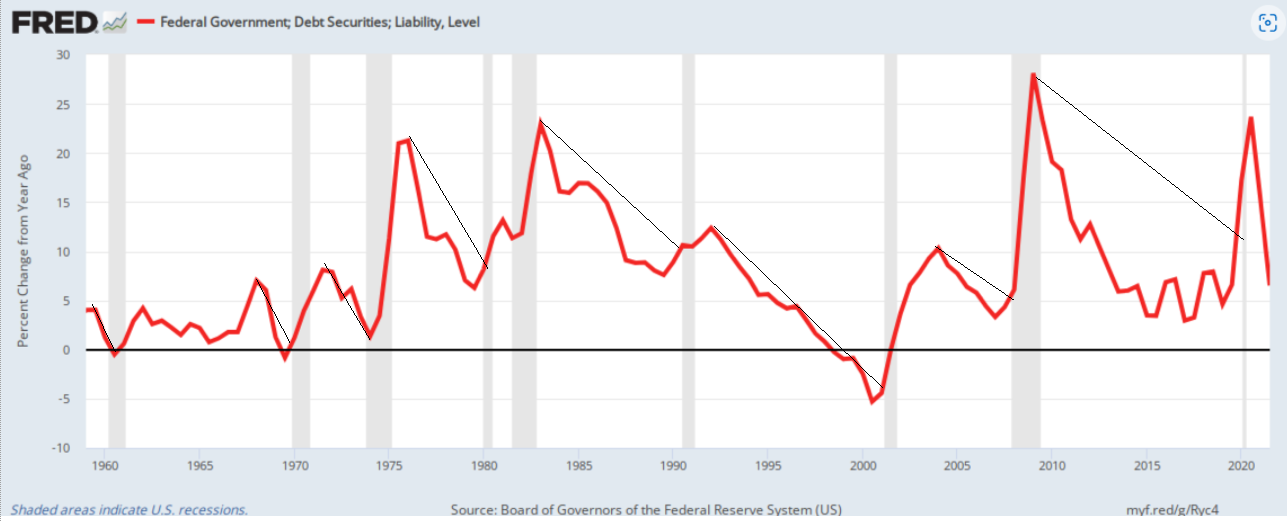
The federal “debt” is not federal, and it is not “debt.” It is the total of outstanding Treasury security accounts (T-bills, T-notes, T-bonds) the dollars in which are owned by depositors and only held by the federal government for safety.

Those dollars are never used by the federal government for anything. The accounts are similar to bank safe deposit boxes in which the contents are held for safety and not part of the bank’s debt.

The federal government does not borrow dollars; it has the infinite ability to create them from thin air. As the St. Louis Federal Reserve wrote in their October 2011 publication titled “Why Health Care Matters and the Current Debt Does Not”:

“As the sole manufacturer of dollars, whose debt is denominated in dollars, the U.S. government can never become insolvent, i.e., unable to pay its bills. In this sense, the government is not dependent on credit markets to remain operational.

3. Ignorance About Federal Taxes: Federal taxes fund nothing. The purposes of federal taxes are different from the purposes of state/local gov. taxes. The sole purposes of federal taxes are:
  • To assure demand for the U.S. dollars by requiring taxes to be paid in dollars
  • To control the economy by taxing what the government wishes to discourage and by giving tax breaks to what the government wishes to reward
  • To deceive the public into believing that benefits must be limited by taxes. This is a belief fostered by the rich to limit benefits to the rest of us.

Contrary to popular wisdom, the rich pay a much lower tax rate than you do. Pay no attention to the tax rate table that say otherwise. The rich have managed to engineer special tax deductions that make the tax tables invalid.

For example: Billionaire Donald Trump paid no federal income taxes at all in 10 of 15 years prior to 2016, In 2016 and 2017, he paid just $750 each year in federal income taxes.

In 2020, he paid $0 in federal income tax. He reported large losses across many years, some in the tens or hundreds of millions, which allowed him to offset future income.

These losses were often carried forward using legal provisions in the tax code. He claimed major business expenses — including for residences, aircraft, and other personal luxuries — as deductions.

(Have you been able to deduct the costs of your home, transportation, meals, clothing, cars, furniture, entertainment, etc.? Trump and other billionaires could.) But Social  Security and Medicare are headed toward insolvency?? Really?

4. Ignorance about Inflation: No sooner does anyone realize that the federal government’s finances are nothing like state and local governments’ finances, than we hear the false claim of last resort about federal spending, “but that would cause inflation.”

Let me be very clear about this: Inflation is not a spending problem, and inflation is not a demand problem. Inflation is, always has been, and always will be a supply problem.

Federal spending does not cause inflation. In fact, federal spending cures inflation when directed at curing the shortages that cause inflation. We discuss this in more detail here.

The inflation myth has been promulgated solely to prevent the populace from demanding the kinds of federal spending and tax relief afforded to the rich — the kind of relief that has allowed billionaires like Donald Trump to pay less federal taxes than you have.

5. Ignorance about Federal Trust Funds: The USA.gov A–Z Index lists over 400 federal departments, agencies, and related entities. This includes executive departments, independent agencies, government corporations, commissions, and government-sponsored enterprises.

Very few federal agencies are (supposedly) funded through trust funds. The largest and most well-known trust funds include:

  • Social Security Trust Funds: Managed by the Social Security Administration, supposedly funded by payroll taxes.

  • Medicare Trust Funds: Managed by the Centers for Medicare & Medicaid Services, supposedly funded by payroll taxes, premiums, and general revenues.

  • Highway Trust Fund: Managed by the Department of Transportation, supposedly funded by fuel and excise taxes.

  • Unemployment Trust Fund: Managed by the Department of Labor, supposedly funded by federal and state unemployment taxes.

  • Civil Service Retirement and Disability Fund: Managed by the Office of Personnel Management, supposedly funded by employee and agency contributions.

In total, there are approximately a dozen major federal trust funds. So, only a small number of agencies are supposedly funded through these mechanisms.

The Supreme Court is not supposedly funded via a trust fund. Nor is the Executive Branch (The White House). Nor is Congress itself. Nor are the military services. Why, out of 400 federal departments, agencies, etc., are there only about a dozen trust funds?

Trust funds are not used because the government needs the money. They’re used because Congress wants to: Create political protection for specific programs (e.g., Social Security, Medicare), give the illusion of self-funding (“you paid in, so you earned it”), and limit or earmark spending, to avoid general budget fights — not for any financial reasons.

As the Peter G. Peterson Foundation wrote:

A federal trust fund is an accounting mechanism used by the federal government to track earmarked receipts (money designated for a specific purpose or program) and corresponding expenditures.

The largest and best-known trust funds finance Social Security, portions of Medicarehighways and mass transit, and pensions for government employees.

Federal trust funds bear little resemblance to their private-sector counterparts, and therefore the name can be misleading.

A “trust fund” implies a secure source of funding. However, a federal trust fund is simply an accounting mechanism used to track inflows and outflows for specific programs.

In private-sector trust funds, receipts are deposited and assets are held and invested by trustees on behalf of the stated beneficiaries.

In federal trust funds, the federal government does not set aside the receipts or invest them in private assets.

Rather, the receipts are recorded as accounting credits in the trust funds, and then combined with other receipts that the Treasury collects and spends.

Further, the federal government owns the accounts and can, by changing the law, unilaterally alter the purposes of the accounts and raise or lower collections and expenditures.

Note the last line, which is worth repeating: “The federal government unilaterally can alter the purposes of the accounts and raise or lower collections and expenditures.

While Congress, the media (including AARP), and the economists pretend to fret over the coming “insolvency” of the Social Security and Medicare “trust funds,” the simple and honest fact is this:

Congress and the President could prevent or cure any “insolvency” simply by voting to do so.

They could vote to add a few trillion dollars to the fake trust funds, or they could vote to do away with the trust funds altogether and pay for Social Security and Medicare the same way they pay for the POTUS, the SCOTUS, or Congress.

At one time, there even was the suggestion to create a multi-trillion dollar platinum coin (which the Treasury specifically is allowed to do) and to deposit that coin in the Social Security trust fund account, to prevent insolvency. This solution was rejected because. . . because it would have demonstrated the Big Lie about federal financing.

When did you ever hear that the President was running short of money? Or that SCOTUS couldn’t pay for the justices’ salaries? Or that Senators couldn’t be paid?

Answer: Never, and you never will.

There has never been a time when the Supreme Court, the Presidency, the military, or Congress was said to be “facing insolvency.”

Why? Because those agencies are funded directly by Congressional appropriations from the General Fund of the U.S. Treasury, which is not constrained by tax revenue or borrowing.

The Social Security and Medicare programs were deliberately designed to resemble savings accounts. This has enabled politicians and media to manufacture a crisis narrative: “We’re running out of money!” But that’s accounting fiction.

The difference is purely political, not financial:

Agency/Program Funding Mechanism Ever faced “insolvency”? Why or Why Not
Department of Defense General Fund (appropriated) ❌ Never Congress always appropriates what it wants
Congress itself General Fund (appropriated) ❌ Never Congress won’t default on itself
Supreme Court General Fund (appropriated) ❌ Never Treated as an essential government function
Social Security Trust Fund + FICA tax ✅ “Facing insolvency” Artificial limit imposed by political design
Medicare (HI) Trust Fund + payroll tax ✅ “Facing insolvency” Same as above — not a real constraint
 

.

.

.

For years, you have been told about the Social Security and Medicare crisis, which is exacerbated by Congress’s and the President’s ridiculous decision to tax your benefits.

Why would a federal government, that neither uses nor needs tax dollars, tax the benefits it gives to the populace? For only one reason: To widen the Gap between the rich and the rest. “Rich” is a relative term. The wider the Gap, the wealthier the rich.

So to make themselves wealthier, the rich bribe Congress to pass laws that widen the Gap, bribe the media to promulgate those laws, and bribe economists to justify those laws. And that is why you see persistence in the Big Lie.

SUMMARY

The Big Lie in economics is that federal taxes and borrowing fund federal spending.

The Big Truth in economics is that even if the federal government didn’t collect a penny in taxes, and continues not to borrow dollars, it could keep spending forever, without causing inflation.

The so-called “crisis” in Social Security and Medicare solvency is a lie invented by the very rich, to widen the income/wealth/power Gap between them and you. There is no crisis other than a crisis of truth.

Your information sources and leaders are lying to you, and they will continue lying until you demonstrate that you will reject their lies. Vote the liars out of office. Stop using the lying media until they expose the truth. Stop funding universities that teach the lies.

Then one day, you will pay the same taxes as Donald Trump.

Rodger Malcolm Mitchell

Monetary Sovereignty

Twitter: @rodgermitchell

Search #monetarysovereignty

Facebook: Rodger Malcolm Mitchell; MUCK RACK: https://muckrack.com/rodger-malcolm-mitchell;

https://www.academia.edu/

……………………………………………………………………..

A Government’s Sole Purpose is to Improve and Protect The People’s Lives.

MONETARY SOVEREIGNTY

Airlines are 3 trillion in debt. The Monetary Sovereignty of airline loyalty programs.

Frightening headline? It shouldn’t be. Here’s a bit of context:

Airlines don’t disclose how many miles are outstanding or the value used to calculate these liabilities. However, if we assume a valuation of 1 cent per outstanding mile, loyalty program members would have around 3 trillion outstanding miles.

Some economists, politicians, and media talking heads might tell you it means the airlines are seriously in debt. OK, that “3 trillion” is not dollars; it’s miles or points. But there is a point (pun intended) to be made.

Travelers be warned: your air miles may be at risk  by Jenny Surane, Justing Backman, and Bloomberg May 19, 2021, at 6:54 AM EDT

Frequent flyers, consider yourselves warned: Sitting on a pile of unused airline miles could cost you.

Liabilities tied to the five most valuable airline-loyalty programs in the U.S. soared almost 12% to $27.5 billion last year, according to new analysis by LendingTree Inc.’s consumer-finance website ValuePenguin.

Airlines looking to shore up their balance sheets could reduce the value of those rewards or reinstate policies that allow miles or points to expire, the firm warned.

If the airlines wanted to reduce their mileage “debt,” they arbitrarily could reduce the value of their mileage reward points or allow miles to expire. They are mileage-points sovereign. As the issuer of mileage points, the airlines can do anything they wish with those points. They can issue as many as they wish, increase or reduce the value, or void them simply by pressing computer keys. If the Airlines felt generous, they could give you a few million mileage points. Or if they felt stingy, they could “tax” you points by reducing their value. Suddenly, flying to your favorite city would cost you double the number of points you thought. Effectively, that would be a 50% “wealth” tax on your point holdings. Or they could tell you to use all your points by December 31st at which time the points would be worthless. The effect would be like a tax on you. The airlines are to mileage points as the U.S. federal government is to U.S. dollars. By giving out more points than they receive, the airlines run “points deficits”; cumulatively, the airlines have “points debt.” The airlines create points by pressing computer keys. Nothing prevents the airlines from pressing keys, forever. The U.S. government creates dollars by pressing computer keys. nothing stops the U.S. government from pressing keys, forever. Being points sovereign, the airlines never can run short of mileage points. The U.S. government, being Monetarily Sovereign, never can run short of dollars. The airlines never borrow points. The government borrows dollars.

“Especially in a time where airlines have gone through such financial issues, it would be easy to see that they would look at some sort of devaluation of the miles and points as a way to make up a little bit of financial ground,” Matt Schulz, LendingTree’s chief credit analyst, said in an interview.

“I would suspect we might see something like that going forward.”

This demonstrates the total control a Monetarily Sovereign entity has over its currency, whether airline points or dollars. The airlines create all the rules re. points. The government creates all the rules (i.e. laws) regarding dollars.

At the height of the Covid-19 pandemic, Delta, American, and United pledged their loyalty programs as collateral for bonds as the virus and resulting government restrictions sapped travel demand. Such deals could prevent any material changes to the programs, said Joe DeNardi, an analyst with Stifel Financial Corp., who follows airline loyalty programs closely.

United, for its part, doesn’t see currency devaluation as a handy tool to lower that accounting liability, said Michael Covey, managing director of the loyalty program at the airline.

Yes, it’s an accounting liability, but not a real liability because the airlines have total control over its value. They arbitrarily can create points by pushing computer keys, or they could eliminate the points altogether. Goodbye, “points debt.” Does an airline owe someone a billion points? No problem. They can just type 1,000,000,000 into a computer and Voila! Here are the billion points. Does the federal government owe someone a billion dollars? No problem. Just type the number into a computer and the dollars come into existence. Think about that the next time someone tells you that Medicare or Social Security are running short of money.

A decade ago, revenue-based airline programs (rather than mileage-based) were fairly uncommon in the U.S. JetBlue was one of the first U.S. airlines to launch a revenue-based program when it revamped its program in 2009. Southwest followed with a program “enhancement” in 2011.

Then, the big airlines jumped on the bandwagon. Delta transitioned to a revenue-based system in 2015, and American Airlines and United quickly followed suit. Now, almost all major U.S. airlines operate a revenue-based program.

There again is that total control a monetary sovereign has over its currency. The airlines arbitrarily went from awarding mileage points to awarding revenue points.

However, programs differ a bit in how they award miles.

For better or worse, the three biggest U.S. airlines have similar mileage earning systems. General members earn 5 miles per dollar of eligible spending on travel with the airline.

Elite members earn a bonus on this base earning, with all three programs topping out at 11 miles per dollar for top-tier elites.

On Dec. 9, 2021, Delta became the first domestic airline to make basic economy fares ineligible for mileage earning. Basic economy flyers will no longer earn SkyMiles or Elite Qualifying Miles, Dollars, or Segments.

Again, the above demonstrates the total control by a monetary sovereign. Delta simply made the change by fiat. The federal government can, and often has, arbitrarily changed the value of the U.S. dollar. The “Nixon shock” was an arbitrary move by President Nixon to end the convertibility of dollars into gold. Suddenly, the dollar was no longer worth 1/35th of an ounce of gold. If airlines made the same kind of change, suddenly airline points would no longer be worth 1 cent or 1.5 cents each. The “problem” of the “points debt” would disappear.

Selling frequent-flyer points to banks Airlines make money from loyalty programs by selling frequent-flyer points to banks, which then award them to credit card holders as purchase rewards.

The banks pay airlines 1 to 1.5 cents per mile, plus a bonus when new customers sign up for their branded credit card.

By selling their loyalty program frequent flyer miles to banks, credit card companies, car rental firms, hotels, and supermarkets, the airlines have found an almost guaranteed way to make a profit from their tickets.

In effect, most major airlines have a business model which is more like a bank than a transport company.

No, it’s not more like a bank. It’s more like a Monetarily Sovereign nation — Canada, Mexico, the UK, Australia, Japan, China, and yes, the United States — all of whom can create andvprice their currencies at will (unlike monetarily non-sovereign entities like cities, counties, states, euro nations, businesses, you, and me.) This is the airline profitability program:
  1. The airlines create points from thin air. They create as many points as they wish at virtually no cost.
  2. They sell those points to credit card companies for whatever price they can extract from the companies.
  3. They also give points to passengers as a temptation to continue using the airline.
  4. Airlines lose money by moving passengers. All their profits come from loyalty programs, which allow the airlines to print money quite literally, which, is exactly what the U.S. government does with dollars.
  5. Of course, airlines have to offer travel in exchange for points, so that is a cost of the program, but:
  6. Airlines control how many points each flight costs passengers. So, high-demand days cost far more points than other days. This way, the airlines dissuade passengers from using points on those days when they can sell seats for dollars.
  7. Finally, not all points are redeemed. Those not redeemed are free money to the airlines.
This shows you that Monetary Sovereignty is everywhere, though the public is kept in the dark. (See: “The genius of the board game, Monopoly.”) When a retailer issues coupons, they essentially issue money in lieu of a price reduction. The retailer is sovereign over the coupons and can issue as many coupons as he wishes and make them any value he wishes. All outstanding coupons could be counted as retailers’ “debt” – -i.e., the value of outstanding coupons—except customers pay for the coupons when they buy the products. Imagine an airline saying, “We are going to raise the price of a seat from 100 points to 200 points because we are running short of points.” You would think that’s crazy. How could an airline run short its points, points it creates at will, by clicking computer keys? But that is exactly what the federal government says when it claims Medicare and Social Security are short on dollars. You should ask the same question. How can the U.S. federal government run short of its own dollars, dollars it creates at will by clicking computer keys? The reason you don’t ask is simple. No one questions the airlines’ ability to create their points at will, but your information sources tell you the U.S. government can’t create its dollars at will. They tell you the federal debt (that neither is federal nor debt) is “unsustainable.”  They tell you the government should “ive within its means.” They tell you your taxes must be increased and/or your benefits reduced. All these statements are deceptive, based on the hope that you don’t understand Monetary Sovereignty. The lie that the federal government can run short is dollars is told so that the rich can become richer while the rest survive in ignorance. It’s that sort of ignorance someone like Eric Boehm promulgates when he writes an article like this:

The White House Claims Borrowing $16 Trillion Over the Next Decade Is Fiscally Responsible If you can’t even get close to balancing the budget when unemployment is low, tax revenues are near record highs, and the economy is booming, when can you do it?

The article pretends that the federal government is not Monetarily Sovereign, can’t create dollars at will, needs tax dollars to pay its bills, and in some unexplained way actually could run out of U.S. dollars. It’s a monstrous lie, aimed at keeping you down and the rich up by widening the income/wealth Gap between the rich and you. If you ever feel like protesting something, this is what you should protest. The Big Lie in economics that the federal government can’t afford to provide certain benefits and/or that taxpayers fund federal spending. The lie claims the U.S. “debt” is a “ticking time bomb,” to scare you. (It’s a “bomb” that has been “ticking” since 1940, and still no explosion.) Rodger Malcolm Mitchell Monetary Sovereignty Twitter: @rodgermitchell Search #monetarysovereignty Facebook: Rodger Malcolm Mitchell

……………………………………………………………………..

The Sole Purpose of Government Is to Improve and Protect the Lives of the People.

MONETARY SOVEREIGNTY

The Big Lie for suckers is all crap to widen the Gap.

Stated simply, the Big Lie in economics is: “Federal taxes fund federal spending.” Suckers believe it.

The Big Truth in economics is: Federal taxes don’t fund a damn thing. In fact, they are destroyed upon receipt at the Treasury.

No federal tax dollars are spent. The federal government creates new dollars, ad hoc, to pay all its bills.

The federal government never can run short of dollars. It has infinite dollars. Even if the federal government didn’t collect a penny in taxes, it could continue to spend, forever.

Tax Preparation Services for Individual | Green Tree Tax | Tax Help
From the TV show 60 Minutes: Scott Pelley: Is that tax money that the Fed is spending? Ben Bernanke: It’s not tax money… We simply use the computer to mark up the size of the account.

To the federal government, which created the first US dollars from thin air, dollars are not physical things.  They simply are numbers on balance sheets, and the government controls the balance sheets.

The government can put any numbers it wishes on those balance sheets. In short:

  1. The government never can run short of numbers
  2. The government never can run short of laws.
  3. The government never can run short of dollars.

If you sent $100 trillion dollars to the federal government, it wouldn’t help to pay for anything, not even one little bit.

Twenty-two Republican governors have signed a letter sent to President Joe Biden calling on him to withdraw his student loan forgiveness plan. 

In the letter, dated Monday, the governors wrote that they “fundamentally oppose (Biden’s) plan to force American taxpayers to pay off the student loan debt of an elite few.”

Calm down, fellow taxpayers; we won’t pay any of that student loan debt. 

So why does the GOP claim it? Because they want you to help them widen the Gap between the rich and the rest of us

Note the words “elite few” in their letter? That’s part of the GOP con job. The party that gave a giant tax break to the rich wants you to believe they are all for the poor.

No, they don’t want the poor and middle classes to be able to afford college at all. They want the only people to afford college to be the “elite few.”

They create a phony culture war to make you believe the federal government can’t afford to pay for your benefits.

The rich falsely claim Social Security is going broke; Medicare is growing broke; the government can’t afford food stamps and other anti-poverty measures — and it’s all crap to widen the Gap.

Why widen the Gap? Because it’s the Gap that makes the rich rich. Without the Gap, no one would be rich, and the wider the Gap, the richer they are. Widening the Gap is a way for the rich to become richer.

The Republicans, including Texas Gov. Greg Abbott and Florida Gov. Ron DeSantis, also claimed that Biden’s plan would harm low-income families – writing, “hourly workers will pay off the master’s and doctorate degrees of high salaried lawyers, doctors, and professors. … Simply put, your plan rewards the rich and punishes the poor.”

What an ironic sham. Essentially, they say, “Federal aid to the middle and poor harms the middle and poor.”  And people believe it!!

White House spokesperson Abdullah Hasan said, “These same Republican governors didn’t seem to object when their Republican colleagues in Congress passed a $2 trillion tax giveaway for the rich or had hundreds of thousands of dollars of their own small business loans forgiven.”

“While Republican elected officials try to keep working middle-class Americans in mountains of debt, President Biden is committed to delivering relief to the borrowers who need it most,” Hasan wrote in an email sent to USA TODAY Wednesday afternoon.

Hasan is absolutely correct. But so long as people believe the Big Lie that federal finances are like state and local government finances, and specifically, that federal taxes fund federal spending, the BIG LIE will continue to be told.

Federal taxes have three purposes:

  1. To help control the economy by discouraging what the government wishes to limit and by encouraging what the government wishes to increase.
  2. To provide demand value to the US dollar by required taxes to be paid with dollars.
  3. And the most important one: To help the rich become richer by providing tax breaks available only to the rich. (which is how billionaire  Donald Trump paid less taxes than you did.)

Hey, it works. The rich keep getting richer, and the suckers keep voting against federal spending that would help them.

Rodger Mitchell

That Big Lie just keeps on rollin’ along

Like that ol’ man river of song, some things just keep rollin’ along.

This image has an empty alt attribute; its file name is image-2.png
“Federal taxes fund federal spending.”

Some lies do, too, especially The Big Lie in economics.

The Big Lie ranks as the most significant lie because it affects virtually everything Congress does — every bill, every speech, every vote, every proposal, every crooked backroom deal.

The Big Lie is the biggest because it adversely affects every man, woman, and child in America, plus many men, women, and children in the rest of the world.

The Big Lie rains on us all.

The Big Lie is the biggest because it is so clearly and obviously wrong, on the same level of truth as claiming that the stars are pinholes in a black, velvet sky.

The Big Lie in economics is: Federal taxes fund federal spending.

There are only two types who promulgate the Big Lie:

  1. Those who do not understand economics. That includes you unfortunate souls who wasted years of your lives obtaining economics degrees at prestigious schools like the U. of Chicago. You could have learned the facts at less prestigious, but far better economics schools, like UMKC. 
  2. Those liars who do not give a gnat’s behind about the people of America and the world., and are interested only in power.

The next time you hear or read of someone expressing The Big Lie, you can decide which of the two he/she is.

Here’s today’s expression of The Big Lie as seen in the South Florida Sun-Sentinel.

Dems work to revive economic bill
Boosted taxes on some would extend Medicare’s solvency
Senate Majority Leader Chuck Schumer, D-N.Y., is working on a revised economic legislative package. J. Scott Applewhite/AP
By Alan Fram Associated Press

WASHINGTON — Senate Democrats want to boost taxes on some high earners and use the money to extend the solvency of Medicare, the latest step in the party’s election-year attempt to craft a scaled-back version of the economic package that collapsed last year, Democratic aides said.

The sentence above expresses The Big Lie in all its glory. 

Medicare is a federal agency. It is part of the federal government.

The federal government and its agencies cannot run short of dollars unless that is what Congress and the President want. That is why federal taxes do not fund federal spending. 

The federal government is an infinite cornucopia.

The federal government is an infinite cornucopia that never runs dry.

“Boosted taxes” would not extend Medicare’s solvency.

Today, the U.S. Treasury does not have the money to extend the solvency of any federal agency.

Instead, the government creates the necessary dollars, by the act of paying bills.

Even if all federal tax collections were $0, the federal government could continue spending, forever.

The U.S. federal government is unlike state and local governments, businesses, euro nations, you, and me. The U.S. federal government uniquely is Monetarily Sovereign.

I’m sorry to tell you that you are not Monetarily Sovereign. You can run short of dollars. You can be unable to pay for some things. You can be insolvent. 

The federal government and its agencies cannot. 

The government passed the laws that created the very first dollars. The government passed as many laws as it needed.

Those laws created as many dollars as the government wanted and gave those dollars the value the government wished.

At its whim, the federal government repeatedly revalued the dollar according to various gold standards and silver standards.

Finally, in 1971, President Richard Nixon unilaterally ordered the cancellation of the direct convertibility of the United States dollar to gold.

This allowed the federal government to create infinite dollars at any time and for any purpose, merely by passing laws.

Former Federal Reserve Chairman Alan Greenspan: “A government cannot become insolvent with respect to obligations in its own currency.”

Because the U.S. government cannot become insolvent, no agency of the U.S. government can become insolvent unless Congress and the President want it to become insolvent.

This applies to all federal agencies, from the AbilityOne Commission to the Women’s Bureau. There are hundreds of federal agencies, none of which can become insolvent unless that is what Congress and the President want.

Each of those hundreds of federal agencies is funded by federal money creation. Yet, for political reasons that have nothing to do with reality, just a few agencies are limited by fake “trust funds.”

According to the Peter G. Peterson Foundation

“The largest and best-known trust funds finance Social Security, portions of Medicare, highways, mass transit, and pensions for government employees.

“Federal trust funds bear little resemblance to their private-sector counterparts, and therefore the name can be misleading.

“A ‘trust fund’ implies a secure source of funding. However, a federal trust fund is simply an accounting mechanism used to track inflows and outflows for specific programs.

“In private-sector trust funds, receipts are deposited and assets are held and invested by trustees on behalf of the stated beneficiaries. In federal trust funds, the federal government does not set aside the receipts or invest them in private assets.

“Rather, the receipts are recorded as accounting credits in the trust funds and then combined with other receipts that the Treasury collects and spends.

“Further, the federal government owns the accounts and can, by changing the law, unilaterally alter the purposes of the accounts and raise or lower collections and expenditures.”

In short, Congress and the President can do anything they damn well please with the “trust funds.” They can add dollars, subtract dollars, or eliminate the “trust funds” altogether.

The government doesn’t need to search for U.S. dollars. It creates U.S. dollars.

As for Medicare, only Part A is related to a trust fund. Part B is funded the same way virtually all other agencies are funded — the same way the military, Congress, SCOTUS, the White House, et al. are funded — via payment from the federal government’s General Fund.

And in no case do federal taxes pay for anything.

Former Federal Reserve Chairman Ben Bernanke: “The U.S. government has a technology, called a printing press (or, today, its electronic equivalent), that allows it to produce as many U.S. dollars as it wishes at essentially no cost.”

There are various measures of the money supply:

In the United States, the money supply is categorized by various monetary aggregates, including M0, M1, and M2.

The monetary base, or M0, equals coin currency, physical paper, and central bank reserves.

M1, typically the most commonly used aggregate, covers M0 in addition to demand deposits and travelers’ cheques.

M2 covers M1 in addition to savings deposits and money market shares.

When you pay your federal taxes, you take M1 dollars from your checking account and send them to the U.S. Treasury. Dollars held by the Treasury are not counted in any money-supply measure because the Treasury has access to infinite dollars.

Adding dollars to infinite dollars is still infinite dollars. Thus, the Treasury effectively destroys your federal tax dollars upon receipt. They are not used for anything.

To pay its bills, the Monetarily Sovereign federal government creates new dollars ad hoc. When it approves an invoice for payment, the government (or the appropriate agency) sends instructions (not dollars) to the creditor’s bank, instructing the bank to increase the balance in the creditor’s checking account.

The instant the bank obeys those instructions, new dollars are added to the M1 money supply. Tax dollars are destroyed, and new dollars are created. That is the federal government’s method for creating dollars, which is why federal taxes do not fund federal spending.

(State and local governments, being monetarily non-sovereign, operate differently. Their tax dollars remain in the economy by being deposited into private banks. Those same tax dollars are used for invoice payment.)

Continuing with the Sun-Sentinel article:

Majority Leader Chuck Schumer, D-N.Y., and Sen. Joe Manchin, D-W.Va., could be edging toward a compromise the party hopes to push through Congress this summer over solid Republican opposition. Manchin scuttled last year’s bill.

Under the latest proposal, people earning more than $400,000 a year and couples making more than $500,000 would have to pay a 3.8% tax on their earnings from tax-advantaged businesses called pass throughs. Until now, many of them have been using a loophole to avoid paying that levy.

That would raise an estimated $203 billion over a decade, which Democrats say would go to delay until 2031 a shortfall in the Medicare trust fund that pays for hospital care.

That fund is currently projected to start running out of money in 2028.

And it’s all a lie, The Big Lie.

Manchin “scuttled” last year’s bill because, through ignorance or maliciousness, he claimed it would cost too much and/or increase the deficit too much.

But “cost” is meaningless for an entity with the infinite ability to create dollars, and the “deficit” adds growth dollars to the economy. 

Deficits are so crucial to economic growth that we have recessions when deficits don’t grow enough.


When federal deficit growth declines, we have recessions cured by increased deficit growth. Rising federal deficits are necessary to stimulate economic growth.

Continuing the article:

Most U.S. businesses are pass-throughs, which include partnerships and sole proprietorships and range from one-person law practices to some large companies.

Owners count the profits as income when they pay individual income taxes, but such companies do not pay corporate taxes — meaning they avoid paying two levels of taxation.

Translation: Because of The Big Lie, Schumer and Manchin have devised a plan whereby $203 Billion growth dollars would be removed from the private sector. 

Contrary to what The Big Lie tells you, those dollars will not pay for anything. They simply will be destroyed.

Presumably, new dollars will be created to delay a fictional shortfall in a non-existent “trust fund.”

Democrats this week also sent the parliamentarian a separate 190-page piece of the emerging Schumer-Manchin compromise aimed at lowering prescription drug costs for patients and the government.

Provisions include requiring Medicare to negotiate drug prices, limiting beneficiaries’ out-of-pocket costs to $2,000 annually and increasing federal subsidies for copays and premiums for some low-income people.

There are both bad and good in the above. The bad part is “negotiate drug prices,” which means the government would pay the private sector (“the economy) less for drugs. Reducing federal payments is recessionary.

The good part is “increasing federal subsidies,” which is stimulative.

Democrats say both plans will show voters they are battling to curb health care costs and protect Medicare, positions they say will be dangerous for Republicans to oppose.

The government should “battle health care costs” by creating a generous, comprehensive, no-deductible Medicare for All program, not by taking money from the economy.) 

Former Fed Chairman Ben Bernanke when he was on 60 Minutes:
Scott Pelley: Is that tax money that the Fed is spending?
Ben Bernanke: It’s not tax money… We simply use the computer to mark up the size of the account.

Schumer and Manchin have been bargaining privately for weeks on a package aides say could include around $500 billion in spending and tax credits, more than paid for with about $1 trillion in revenue and other savings. 

Translation: “More than paid for” means the federal government, which has infinite money, unnecessarily will take 1 trillion growth dollars out of the economy, which has limited money.

The suggestions of progress were emerging seven months after Manchin derailed a roughly $2 trillion, 10-year social and environment bill, dealing a stunning blow to a cornerstone of Biden’s domestic agenda.

That’s 2 trillion potential stimulus dollars that are denied the economy.

And now we come to the other phase of The Big Lie. Call it “The Big Lie II,” the claim that federal deficit spending causes inflation.

This one has been an article of faith in most economics classes — the notion that inflation is “too many dollars chasing too few goods.” It’s memorable, even poetic in its rhythm, but it isn’t factual.

There is no predictive relationship between the money supply (blue line) and inflation (red line).

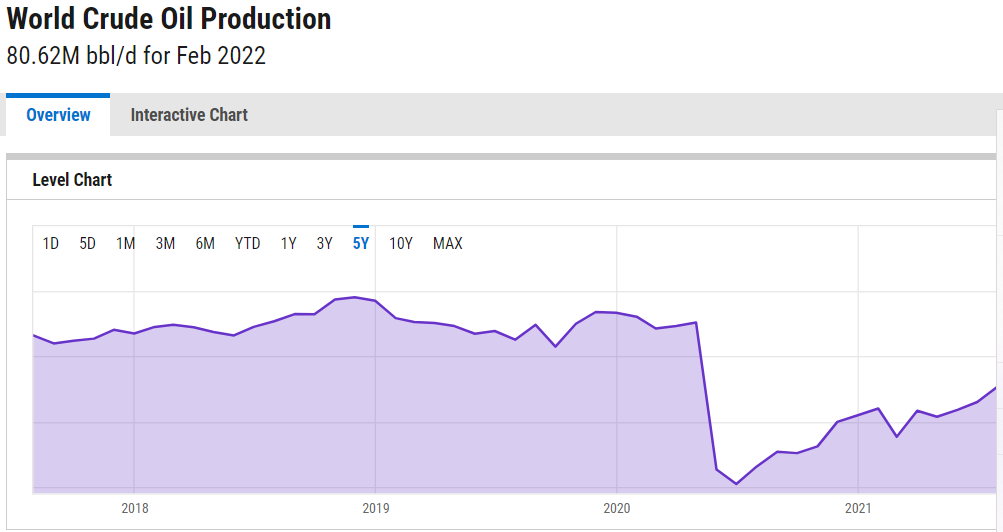
Inflation is caused by shortages. Today, the primary cause of inflation is the oil shortage, while other critical goods and services shortages contribute.

Those essential goods and services include lumber, computer chips, shipping, foods, housing, labor, and other commodities too numerous to list.

And no, those shortages were not caused by “too much money.” Too much money did not cause you to eat, build, ship, or live in more houses.

All of those shortages resulted from less production and/or supply. In fact, most shortages can be cured by more federal spending to increase supply and availability.

COVID, not deficit spending, caused oil production to drop precipitously, and even today, the oil shortage has not been cured. That is the primary reason for today’s inflation.

Additional deficit spending, not less, and certainly not the Fed’s interest rate increases, will cure the oil shortage and inflation. All inflations are supply-shortage problems, not excessive-demand problems.

The Fed cannot cure the shortage problems by manipulating interest rates.

The Democratic-run House approved the measure in November, but Manchin abruptly withdrew his support because of its cost and worries that it would fuel inflation.

That is what Manchin said. If he really believed it, he is a victim of The Big Lie. If he didn’t believe it, he is a liar.

Polls show widespread public alarm over recent months’ historically high inflation rates, supply chain problems, and other economic issues that, along with President Joe Biden’s dismal popularity ratings, are pushing voters toward Republicans, the GOP says.

And then, for one last statement of The Big Lie II:

Asked for comment, a spokesperson for Senate Minority Leader Mitch McConnell said the Kentucky Republican told constituents this week that Democrats would make inflation “considerably worse” by reviving their economic bill.

McConnell is terrified that the Democrats would be able to revive their economic bill because that would stimulate the economy just before the elections, the last thing the GOP wants.

[Taxation: No rational person would take dollars from the economy and give them to a federal government that has the infinite ability to create dollars.]

Rodger Malcolm Mitchell
Monetary Sovereignty

Twitter: @rodgermitchell Search #monetarysovereignty
Facebook: Rodger Malcolm Mitchell

……………………………………………………………………..

THE SOLE PURPOSE OF GOVERNMENT IS TO IMPROVE AND PROTECT THE LIVES OF THE PEOPLE.

The most important problems in economics involve:

  1. Monetary Sovereignty describes money creation and destruction.
  2. Gap Psychology describes the common desire to distance oneself from those “below” in any socio-economic ranking, and to come nearer those “above.” The socio-economic distance is referred to as “The Gap.”

Wide Gaps negatively affect poverty, health and longevity, education, housing, law and crime, war, leadership, ownership, bigotry, supply and demand, taxation, GDP, international relations, scientific advancement, the environment, human motivation and well-being, and virtually every other issue in economics. Implementation of Monetary Sovereignty and The Ten Steps To Prosperity can grow the economy and narrow the Gaps: Ten Steps To Prosperity:

  1. Eliminate FICA
  2. Federally funded Medicare — parts A, B & D, plus long-term care — for everyone
  3. Social Security for all
  4. Free education (including post-grad) for everyone
  5. Salary for attending school
  6. Eliminate federal taxes on business
  7. Increase the standard income tax deduction, annually. 
  8. Tax the very rich (the “.1%”) more, with higher progressive tax rates on all forms of income.
  9. Federal ownership of all banks
  10. Increase federal spending on the myriad initiatives that benefit America’s 99.9% 

The Ten Steps will grow the economy and narrow the income/wealth/power Gap between the rich and the rest.

MONETARY SOVEREIGNTY