Yet another economics writer who doesn’t understand the fundamentals.

A fundamental truth of economics: A Monetarily Sovereign nation never unintentionally can run short of its own sovereign currency.

The nation does not need to tax and does not need to borrow. It creates its sovereign currency at will.

To not understand that fact is to not understand economics, for it is the absolute foundation of economics.

THEWEEK Magazine recently published the article, “The big question about Modern Monetary Theory everyone is missing,” by Ryan Cooper.

Modern Monetary Theory (MMT) and Monetary Sovereignty (MS) share many characteristics regarding money in today’s economies.

Here are a few excerpts from the article, together with my comments.

Economists are in the midst of one of the periodic debate flare-ups over Modern Monetary Theory.

On the pro-MMT side we have economists like Stephanie Kelton and Randall Wray, while on the other we have the odd bedfellows of The New York Times’ Paul Krugman and the People’s Policy Project’s Matt Bruenig.

Professor Kelton has been a “pen pal” of mine for several years. I met Professor Wray years ago, when I gave a talk to his class at UMKC.

This intricate debate is about the main merits of MMT, an economic school of thought which has received wide attention for its dismissal of the need for taxes to pay for new spending.

Both MMT and MS agree that unlike state and local taxes, which do pay for state and local government spending, federal taxes do not pay for federal spending.

The reason is that the U.S. federal government is Monetarily Sovereign. It is sovereign over U.S. dollars, which it creates ad hoc, every time it pays a creditor.

Even if the U.S. government collected zero taxes, it could continue spending, forever.

However, there is an important question which has to this point not been raised. The MMT advocates say that inflation should be controlled through fiscal policy, instead of monetary policy conducted by the central bank as is current practice.

In other words, if prices start rising, we can keep them in line by raising taxes.

But does that actually work?

No, it doesn’t work, cannot work and never will work.

Raising taxes is too slow and too political (waiting for Congress), too undirected (which taxes?), not incremental enough (raise taxes how much?), and too damaging to economic growth (taxes reduce the money supply). 

Unfortunately, MMT takes incompatible positions. It says correctly, that federal taxes do not fund federal spending, but incorrectly that federal taxes are necessary to cause demand for U.S. dollars.

During times of recession and economic slack, a state borrowing in its own currency has unlimited capacity to spend, because printing money or borrowing to spend on public works and so on will not cause inflation so long as there are unemployed workers and idle capital stock.

Think, Mr. Cooper. If a state has the unlimited capacity to spend and to “print” money, why would it need to, or even want to, borrow? Think.

Contrary to popular wisdom, the U.S. does not borrow dollars. Instead, it accepts deposits into T-security accounts, the purpose of which are:

  1. To provide the world with a safe place to park unused dollars. This helps stabilize the dollar.
  2. To assist the Fed in controlling interest rates, which control inflation.

But if there is full employment, taxes are needed for new programs — to fund them for the former, or to stave off inflation for the latter.

Here, Cooper reveals he doesn’t understand the differences between monetarily non-sovereign state and local government financing (where borrowing is necessary), vs. Monetarily Sovereign federal financing (that requires no borrowing).

The federal government levies taxes, but not to obtain dollars. It freely produces all the dollars it needs.

The purpose of federal taxes is to control the economy by discouraging certain activities with higher taxes and by encouraging others with tax reductions.

The effect of federal taxes (as opposed to the purpose), is to reduce federal deficit spending which reduces the money supply.

All federal taxes do this — income taxes, FICA, sales taxes, import duties, etc. They all reduce the money supply. Just as tax cuts are economically stimulative, tax increases are recessionary.

And just as increased federal deficit spending helps cure recessions, decreased federal deficit spending causes recessions, and worst case, depressions.

U.S. depressions tend to come on the heels of federal surpluses.

1804-1812: U. S. Federal Debt reduced 48%. Depression began 1807.
1817-1821: U. S. Federal Debt reduced 29%. Depression began 1819.
1823-1836: U. S. Federal Debt reduced 99%. Depression began 1837.
1852-1857: U. S. Federal Debt reduced 59%. Depression began 1857.
1867-1873: U. S. Federal Debt reduced 27%. Depression began 1873.
1880-1893: U. S. Federal Debt reduced 57%. Depression began 1893.
1920-1930: U. S. Federal Debt reduced 36%. Depression began 1929.
1997-2001: U. S. Federal Debt reduced 15%. Recession began 2001.

Now, it should be noted that MMT’s style of argumentation seems to have dented the brainless pro-austerity mindset that dominates much of elite discourse, which is very much to its credit.

Remember the above comment, because later in his article, Cooper unknowingly supports the very austerity he calls “brainless.”

He discusses the key objection to MMT (and MS), inflation:

The way tax-side inflation control is supposed to work is through supply and demand.

Since taxation will leave buyers with less money in their pockets to spend, market competition will force suppliers to cut prices and workers to accept lower wages.

But if markets have become dominated by a few big firms, then business can resist this pressure, because buyers have nowhere else to go.

Taxation reduces the supply of money. Though taxation can support the demand for money, it is not necessary for that purpose.

Interest is a more effective device for supporting the demand for money. While taxes depress an economy, interest stimulates the economy by increasing federal dollar interest input.

Money growth grows an economy.

A good test of this prediction came in the late 1970s, when inflation was at its postwar peak.

Economist John Kenneth Galbraith argued for price controls, but conservative “monetarists” like Milton Friedman argued that (with) a steep hike in interest rates, inflation would come down quickly and easily.

The Fed tried Friedman’s policy, but it turned out Galbraith was right.

The Fed hiked interest rates to an eyewatering 20 percent, creating the worst recession since the Great Depression up to that time.

But inflation only came down very slowly — partly through Keynesian-style spending effects, but partly by badly damaging the labor movement, which cut unionization.

In the past 50 years, since President Nixon took the U.S. off a gold standard, inflation has not been caused by America’s massive federal deficit spending. See: Inflation has been caused by the price of oil.

The Fed wisely has not recommended controlling the price of oil, an action that would lead to an oil shortage, and a recession, if not a depression. That is what price controls do: Lead to shortages.

And what do shortages lead to? Hyperinflations.

So, Cooper writes that Galbraith was right about price controls?? Where did that come from? He provides no evidence.

The true effect of price controls is to reduce economic growth by reducing supply and profits — the economic necessities for growth.

Price control is a feature of the “brainless, pro-austerity mindset” that Cooper properly criticized a few paragraphs ago.

And do increased interest rates really lead to recessions? Or is it simply that recessions lead to decreased interest rates?

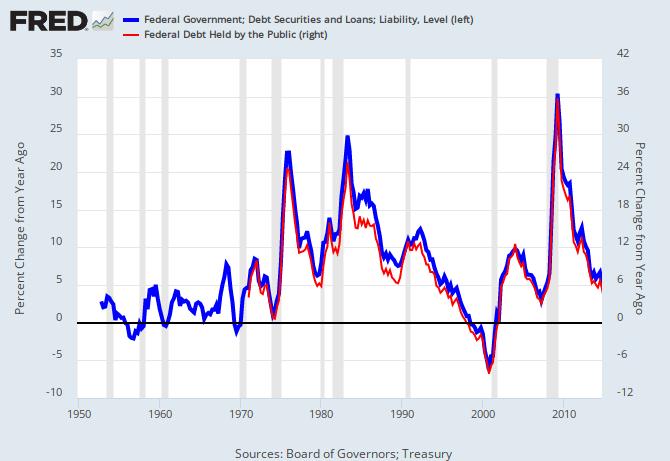
Interest rates (red); deficit spending increases (blue); recessions (vertical gray bars)

The above graph shows that sometimes interest rates peak at the start of recessions, sometimes they peak in the midst of economic growth, and sometimes they decline at the start of recessions.

One cannot say that increased interest rates historically have caused recessions.

The real pattern is that decreased deficit spending causes recessions and increased deficit spending cures recessions.

Why? Because a growing economy requires a growing supply of dollars, and deficit spending adds stimulus dollars to the economy.

Federal deficit spending and debt don’t cause inflation.

Since the U.S. went off the gold standard in 1971, the federal debt (blue) has risen massively, while inflation (red) has been moderate.

Most inflations and nearly all hyperinflations are caused by shortages, usually shortages of food, and often shortages of oil.

For instance, Zimbabwe, an oft-mentioned hyperinflation victim, had its hyperinflation begin with a food shortage. (Farmland was stolen from farmers and given to non-farmers.)

One reason inflation control is delegated to the central bank is that it can work quickly, adjusting interest rates in response to economic conditions several times per year.

Congress works extremely slowly at the best of times, and control is usually split between the two parties.

The Fed may have performed poorly over the last decade, but do we really want Mitch McConnell having to sign off on inflation policy?

Exactly. Now that Cooper belatedly has confirmed why price controls and tax increases don’t work and can’t work, we come to the:

SUMMARY

Modern Monetary Theory (MMT) and Monetary Sovereignty MS) describe the realities of economics similarly.

They agree that a Monetarily Sovereign nation, such as the U.S., cannot run short of its own sovereign currency, and neither needs nor uses tax dollars to fund spending.

They differ in many other areas however, one of which has to do with controlling inflation:

Three inflation controls were discussed, only one of which is effective:

  1. Price controls which cut profits and thus cut economic growth, lead to recessions and ultimately cause inflations by causing shortages. They don’t work, and neither MMT nor MS supports this approach.
  2. Tax increases, which are too slow, too political, not incremental, and cause recessions by decreasing the money supply. They don’t work, though MMT supports this approach.
  3. Interest rate increases, which actually increase the money supply (by causing the federal government to pay more interest into the economy, and work by increasing the value of dollars (by increasing the demand for dollars). Works, and has been working since the end of WWII. MS supports this approach.

Rodger Malcolm Mitchell
Monetary Sovereignty
Twitter: @rodgermitchell
Search #monetarysovereigntyFacebook: Rodger Malcolm Mitchell

…………………………………………………………………………………………………………………………………………………………………………………………………………………………………………………………………………………………..

The most important problems in economics involve the excessive income/wealth/power Gaps between the richer and the poorer.

Wide Gaps negatively affect poverty, health and longevity, education, housing, law and crime, war, leadership, ownership, bigotry, supply and demand, taxation, GDP, international relations, scientific advancement, the environment, human motivation and well-being, and virtually every other issue in economics.

Implementation of The Ten Steps To Prosperity can narrow the Gaps:

Ten Steps To Prosperity:

1. Eliminate FICA

2. Federally funded medicare — parts a, b & d, plus long-term care — for everyone

3. Provide a monthly economic bonus to every man, woman and child in America (similar to social security for all)

4. Free education (including post-grad) for everyone

5. Salary for attending school

6. Eliminate federal taxes on business

7. Increase the standard income tax deduction, annually. 

8. Tax the very rich (the “.1%) more, with higher progressive tax rates on all forms of income.

9. Federal ownership of all banks

10. Increase federal spending on the myriad initiatives that benefit America’s 99.9% 

The Ten Steps will grow the economy, and narrow the income/wealth/power Gap between the rich and you.

MONETARY SOVEREIGNTY


A letter to our good friends, the British

Dear friends,

Congratulations on ridding yourselves of the unelected, wealthy bankers who have been running your country without your say so.

We discussed this at “What will Brexit mean”? and at “Brexit: How Obama bailed, then failed”

Be assured that your newfound freedom of self-determination has angered and frightened the above-mentioned wealthy bankers. They will not relinquish you, their cash cow, lightly.

During the weeks and months to come, you will be subject to repeated pressures to reverse your vote.

For example:

(LONDON)— Standard & Poor’s has stripped the United Kingdom of its top credit grade in the wake of the vote to leave the European Union.

The rating agency downgraded the country’s sovereign rating by two notches, from AAA to AA, saying the vote is a “seminal event” that “will lead to a less predictable, stable and effective policy framework in the U.K.”

It is also keeping a negative outlook on the rating, which means it could downgrade the country further.

It added in a report published Monday that the outlook reflects the risk to the economy and public finances, as well as the pound’s role as an international reserve currency.

It also cited “risks to the constitutional and economic integrity of the U.K.” as Scotland’s strong vote to remain in the EU could raise the prospect of another referendum on Scottish independence.

Do you see what is happening here?  S&P, which is owned by the rich, has begun the drumbeat for a reversal of Brexit.

And everything it says is lies.

  1. There is not a “less predictable, stable policy framework.” Quite the opposite, without the EU ruling for itself rather than for the people of Britain, policy should be more predictable.There will be no contradictions of motive. All decisions can be for the people, and the profitability of the ECB will not be an divisive issue.
  2. And here comes the threat: “It could downgrade the country further.” (Come back under our thumb, or else we’ll cut your credit rating — OR ELSE.)
  3. “The pound’s role as an international reserve currency” is a truly ironic concern. Where was this concern when the EU wanted Britain to leave the pound and join those tragic unfortunates who surrendered the single most valuable asset any nations have — their Monetary Sovereignty?In any event, leaving the EU will not affect the pound’s role as an international reserve currency. It actually will boost the pound’s role by strengthening the British economy.
  4. Then even more irony: ” . . . risks to the constitutional and economic integrity of the U.K.” Where in the constitution does it say that unelected, wealthy bankers and their compliant clerks should rule and overrule your constitutionally elected government?What is the “economic integrity” of having foreigners run your government?

S&P supposedly measures creditworthiness, i.e. the ability and willingness to service one’s debts. How has leaving the grasp of the EU bankers reduced Britain’s ability and willingness to service its debts?

(S&P is one of the rating organizations that reduced America’s credit rating below that of corporations domiciled in America! Think of what would befall the credit rating of those corporations should America ever fail to pay its debts.)

S&P relies on the goodwill of the rich for its business.

The S&P action is a fraud, funded by the rich. Any politician, economists or media who claim otherwise, also are frauds.

(As in America, the rich bribe your politicians with campaign contributions; the rich bribe the media via ownership; and the rich bribe the university economists with contributions to schools.)

The rich are afraid that if there are any future exits from the EU, there will begin an exit stampede of cash cows. The bankers will say anything and do anything to continue the milking.

Then, there is this article:

How Brexit Threatens to Turn the UK Into “Borisland”

Brexit is about much more than frustration about the E.U. and immigration.

It is about a shortage of decent and secure jobs; an impossibly precarious labour market; inexplicable inequalities in incomes and wealth; closed access to affordable education, and a terrible deficiency of affordable housing.

And it is about British Chancellor of the Exchequer Osborne’s single-minded austerity economics and the rule-free and tax-free space created for big banks and corporations.

Decision-making in the European Union symbolizes a largely unaccountable, elitist and undemocratic system, which is why Labour Party leader Jeremy Corbyn was half-hearted in his support for a Remain vote.

The recent examples of Greece, Spain and other southern European countries, all in a Brussels-induced economic lockdown, speak volumes against the political feasibility of “reforming the European Union from within.”

The sovereignty regained at the cost of deeply dividing the nation is unlikely to produce the more socially just and economically inclusive Britain that many voters sought.

The hopes of progressives are likely to be betrayed as Britain is turned into “Borisland” – a deindustrializing nation suffering from sluggish productivity growth, growing in-work poverty and rising inequalities, and with government in permanent austerity mode.

At long last, Britain has regained its Monetary Sovereignty.. Your leaders have the ability to benefit only you.

They do not need to cowtow to the greedy, foreign bankers, who care nothing for the people, but only for their own purses.

Sadly, your leaders have lied to you that austerity is necessary for economic growth, when exactly the opposite is true.

A growing economy requires a growing money supply. Austerity is like applying leeches to cure anemia.

To accomplish economic growth and citizen wellbeing, the national government of a Monetarily Sovereign government must add to the money supply. That is, your government always must run deficits, and larger the deficits the greater will be your Gross Domestic Product.  

GDP =  Government Spending + Non-government Spending + Net Exports

You will be told falsely that deficits are “unsustainable” and will cause inflation. But for a Monetarily Sovereign nation, no deficit of any size is “unsustainable,” and inflation is contained via interest rate control.

You have won the first battle, but the war remains in jeopardy. You will have to fight those outsiders, who wish to subjugate you, and to resume bleeding your economy.

And you will have to fight those insiders,  who will try to impose austerity.

The outsiders and the insiders are directed by the rich, whose sole motive is to brainwash you into allowing them to line their pockets with British gold.

Don’t allow it to happen.

Good luck to you.

=Rodger Malcolm Mitchell
Monetary Sovereignty

===================================================================================
Ten Steps to Prosperity:
1. ELIMINATE FICA (Ten Reasons to Eliminate FICA )
Although the article lists 10 reasons to eliminate FICA, there are two fundamental reasons:
*FICA is the most regressive tax in American history, widening the Gap by punishing the low and middle-income groups, while leaving the rich untouched, and
*The federal government, being Monetarily Sovereign, neither needs nor uses FICA to support Social Security and Medicare.
2. FEDERALLY FUNDED MEDICARE — PARTS A, B & D, PLUS LONG TERM CARE — FOR EVERYONE (H.R. 676, Medicare for All )
This article addresses the questions:
*Does the economy benefit when the rich afford better health care than the rest of Americans?
*Aside from improved health care, what are the other economic effects of “Medicare for everyone?”
*How much would it cost taxpayers?
*Who opposes it?”
3. PROVIDE AN ECONOMIC BONUS TO EVERY MAN, WOMAN AND CHILD IN AMERICA, AND/OR EVERY STATE, A PER CAPITA ECONOMIC BONUS (The JG (Jobs Guarantee) vs the GI (Guaranteed Income) vs the EB) Or institute a reverse income tax.
This article is the fifth in a series about direct financial assistance to Americans:

Why Modern Monetary Theory’s Employer of Last Resort is a bad idea. Sunday, Jan 1 2012
MMT’s Job Guarantee (JG) — “Another crazy, rightwing, Austrian nutjob?” Thursday, Jan 12 2012
Why Modern Monetary Theory’s Jobs Guarantee is like the EU’s euro: A beloved solution to the wrong problem. Tuesday, May 29 2012
“You can’t fire me. I’m on JG” Saturday, Jun 2 2012

Economic growth should include the “bottom” 99.9%, not just the .1%, the only question being, how best to accomplish that. Modern Monetary Theory (MMT) favors giving everyone a job. Monetary Sovereignty (MS) favors giving everyone money. The five articles describe the pros and cons of each approach.
4. FREE EDUCATION (INCLUDING POST-GRAD) FOR EVERYONEFive reasons why we should eliminate school loans
Monetarily non-sovereign State and local governments, despite their limited finances, support grades K-12. That level of education may have been sufficient for a largely agrarian economy, but not for our currently more technical economy that demands greater numbers of highly educated workers.
Because state and local funding is so limited, grades K-12 receive short shrift, especially those schools whose populations come from the lowest economic groups. And college is too costly for most families.
An educated populace benefits a nation, and benefiting the nation is the purpose of the federal government, which has the unlimited ability to pay for K-16 and beyond.
5. SALARY FOR ATTENDING SCHOOL
Even were schooling to be completely free, many young people cannot attend, because they and their families cannot afford to support non-workers. In a foundering boat, everyone needs to bail, and no one can take time off for study.
If a young person’s “job” is to learn and be productive, he/she should be paid to do that job, especially since that job is one of America’s most important.
6. ELIMINATE CORPORATE TAXES
Corporations themselves exist only as legalities. They don’t pay taxes or pay for anything else. They are dollar-tranferring machines. They transfer dollars from customers to employees, suppliers, shareholders and the government (the later having no use for those dollars).
Any tax on corporations reduces the amount going to employees, suppliers and shareholders, which diminishes the economy. Ultimately, all corporate taxes come around and reappear as deductions from your personal income.
7. INCREASE THE STANDARD INCOME TAX DEDUCTION, ANNUALLY. (Refer to this.) Federal taxes punish taxpayers and harm the economy. The federal government has no need for those punishing and harmful tax dollars. There are several ways to reduce taxes, and we should evaluate and choose the most progressive approaches.
Cutting FICA and corporate taxes would be an good early step, as both dramatically affect the 99%. Annual increases in the standard income tax deduction, and a reverse income tax also would provide benefits from the bottom up. Both would narrow the Gap.
8. TAX THE VERY RICH (THE “.1%) MORE, WITH HIGHER PROGRESSIVE TAX RATES ON ALL FORMS OF INCOME. (TROPHIC CASCADE)
There was a time when I argued against increasing anyone’s federal taxes. After all, the federal government has no need for tax dollars, and all taxes reduce Gross Domestic Product, thereby negatively affecting the entire economy, including the 99.9%.
But I have come to realize that narrowing the Gap requires trimming the top. It simply would not be possible to provide the 99.9% with enough benefits to narrow the Gap in any meaningful way. Bill Gates reportedly owns $70 billion. To get to that level, he must have been earning $10 billion a year. Pick any acceptable Gap (1000 to 1?), and the lowest paid American would have to receive $10 million a year. Unreasonable.
9. FEDERAL OWNERSHIP OF ALL BANKS (Click The end of private banking and How should America decide “who-gets-money”?)
Banks have created all the dollars that exist. Even dollars created at the direction of the federal government, actually come into being when banks increase the numbers in checking accounts. This gives the banks enormous financial power, and as we all know, power corrupts — especially when multiplied by a profit motive.
Although the federal government also is powerful and corrupted, it does not suffer from a profit motive, the world’s most corrupting influence.
10. INCREASE FEDERAL SPENDING ON THE MYRIAD INITIATIVES THAT BENEFIT AMERICA’S 99.9% (Federal agencies)Browse the agencies. See how many agencies benefit the lower- and middle-income/wealth/ power groups, by adding dollars to the economy and/or by actions more beneficial to the 99.9% than to the .1%.
Save this reference as your primer to current economics. Sadly, much of the material is not being taught in American schools, which is all the more reason for you to use it.

The Ten Steps will grow the economy, and narrow the income/wealth/power Gap between the rich and you.

MONETARY SOVEREIGNTY
The sure way not to solve any unemployment problem

Twitter: @rodgermitchell; Search #monetarysovereignty
Facebook: Rodger Malcolm Mitchell

============================================================================================================================================================================================================================================================

Every politician tells voters he/she plans to bring jobs back to America. It is a lie, designed to fool desperate people.

It is a lie when Donald Trump says it. It is a lie when Ted Cruz and Hillary Clinton say it. It is a lie when Bernie Sanders says it.

The very words, “bring jobs back to America” always are, and always must be a lie.

I’ll tell you why, but first let’s go over what Bernie Sanders says, for it is quite typical of all politicians.

Bernie Sanders Slams United Technology’s Plan to Outsource Jobs By Andrew Emett, April 29, 2016 News Report

Speaking at a United Steelworkers rally, Sen. Bernie Sanders lambasted United Technologies’ decision to outsource 1,400 U.S. jobs to Mexico.

Despite the fact that United Technologies recently posted larger earnings and revenue than expected, roughly 2,100 employees in Indiana are expected to lose their jobs to foreign labor willing to work $3/hour.

“I intend to do everything I can to prevent United Technologies from shutting down their plants in Indianapolis and Huntington from throwing 2,100 American workers out on the street and moving to Monterey, Mexico, where they’re gonna pay people there three dollars an hour,” Sanders asserted on Friday.

Can you think of any reasons why United Technologies would transfer operations to Mexico? Do the words “profit,” “lower costs,” “lower selling prices,” and “competitive advantages” come to mind?

Are these bad words in business? If you were running a business, would you forget about profits, costs, selling prices and competitive advantages?

Would you consider your company to be a charitable operation, the purpose of which is to pay more money than necessary for labor and materials?

“Today we are sending a very loud and clear message to the CEO of United Technologies: Stop the greed. Stop destroying the middle class in America. Respect your workers. Respect the American people,” Sanders announced to the crowd of protesting workers.

Actually, the loud and clear message is, “Be as inefficient as possible. Force American businesses to pay more for labor and goods. Make sure American businesses can’t compete with the rest of the world.”

But, of course, there is another part to the story.

In 2014, United Technologies provided its retired CEO, Louis Schenevert, a golden parachute of $172 million along with a pension worth $31 million. Making a profit of more than $7 billion last year, United Technologies also received $6 billion in defense contracts.

While receiving more than $58 million in corporate welfare from the Export-Import Bank, United Technologies also received nearly $530,000 of Indiana taxpayer money in training grants.

Despite the fact that United Technologies recently posted more revenue than expected, totaling $13.357 billion for the quarter, roughly 2,100 Indiana employees will lose their jobs in an attempt for the company to “stay competitive and protect the business.”

Supposedly, because the CEO was overpaid, and because United Technologies made a big profit, and because it received big defense contracts, and because it received lots of money from Indiana as well as from the U.S. — because of all these things, United Technologies should pay more than necessary for labor and materials.

The “logic” is that because UT is profitable, it can afford to pay more than necessary, so that is exactly what a patriotic American should do.

“Look around Indiana and you will find once vibrant and strong manufacturing towns like Gary, South Bend, Muncie, Bloomington, Indianapolis and Evansville shattered by abandoned factories, shut down steel mills, sky-high poverty rates, and foreclosed homes,” Sanders observed.

“You do not have to have a PhD in economics to understand that our unfettered free trade policies have failed. We need new trade policies in this country, policies that are designed to protect the interests of American workers, not just the compensation-packages of corporate CEOs.”

You also do not need to have a PhD in economics to understand that there are many reasons for unemployment in manufacturing, and trade policies isn’t one of them — unless one believes that protectionism is long-term beneficial to a nation’s economy.

Remember, protectionism runs both ways. What we do to other countries, those other countries will do to us.

The Great Recession caused unemployment. The fault: Lack of federal government regulation of banks.

Every recession and depression has been cured by federal deficit spending.  Tea Partyish austerity has delayed our recovery. The fault: Insufficient deficit spending by the federal government.

Manufacturing largely uses unskilled labor. Third-world nations can supply unskilled labor at a low cost.

As a result, the U.S. has been converting to industries that require more skilled and educated workers.

But, the excessive cost of education together with widespread poverty, has taken many American workers from school.   The fault: Insufficient federal support for education and insufficient financial support for the poor.

See the pattern here? The politicians blame business for doing exactly what businesses should do: Be efficient, creative and competitive.

The real problems are the fault of the federal government and its austerity-leaning policies.

Singling out United Technologies, Sanders also noted that the layoffs in Indiana have been happening across the nation over the last 35 years with no end in sight.

Since the passage of the North American Free Trade Agreement (NAFTA) in 1994, Indiana alone has lost 113,000 good-paying manufacturing jobs.

Although Sanders fought against the NAFTA and other disastrous trade agreements, Hillary Clinton staunchly supported their passage.

Hmmm . . . He says layoffs have been happening for 35 years, and NAFTA came 22 years ago, but the layoffs are the fault of NAFTA?  

“It is not acceptable to me that today the top one tenth of one percent owns almost as much wealth as the bottom 90 percent,” Sanders declared.

“We need a political revolution. We need millions of Americans to begin to stand up and fight back and demand a government that represents all of us.

Agreed. The Gap between the rich and the rest is too wide.  In fact, it is the single worst economic problem in America and in the world.

But that problem will not be solved by erecting federal trade barriers to shelter increasingly inefficient businesses (i.e. protectionism.)

It will not be solved with federal spending cuts and tax increases (i.e. austerity).

It will not be solved by impoverishing America with college debt, or by allowing criminal bankers to run wild.

Bernie Sanders hates the Citizens United (Supreme Court) case that indicated corporations are people. Yet, wants corporations to act like super patriots, and give their profits to charity  — a sure way to destroy the American economy by making our businesses inefficient.

Bernie has some good ideas. Medicare for All is one.  But the notion that companies are responsible for unemployment, and should pay excessively for labor and materials, is economically suicidal.

The federal government was responsible for the Great Recession, and in fact has been responsible for every recession and depression in U.S. history.

Growing the American economy does not involve building a wall of protection around inefficient businesses and their workers. Growing the American economy requires American business to be competitive.

Finger pointing at business for not solving the federal government’s problems is a sure way never to solve the Gap problem.

A NATION DOES NOT CREATE JOBS BY CUTTING BUSINESS PROFITS.

To create prosperity, we must stop over-taxing businesses and start educating the American workforce. That is the federal government’s job.

Rodger Malcolm Mitchell
Monetary Sovereignty


===================================================================================
Ten Steps to Prosperity:
1. Eliminate FICA (Click here)
2. Federally funded Medicare — parts A, B & D plus long term nursing care — for everyone (Click here)
3. Provide an Economic Bonus to every man, woman and child in America, and/or every state a per capita Economic Bonus. (Click here) Or institute a reverse income tax.
4. Free education (including post-grad) for everyone. Click here
5. Salary for attending school (Click here)
6. Eliminate corporate taxes (Click here)
7. Increase the standard income tax deduction annually Click here
8. Tax the very rich (.1%) more, with higher, progressive tax rates on all forms of income. (Click here)
9. Federal ownership of all banks (Click here and here)

10. Increase federal spending on the myriad initiatives that benefit America’s 99% (Click here)

The Ten Steps will grow the economy, and narrow the income/wealth/power Gap between the rich and you.
========================================================================================================================================================================================================================================================================================================

10 Steps to Economic Misery: (Click here:)
1. Maintain or increase the FICA tax..
2. Spread the myth Social Security, Medicare and the U.S. government are insolvent.
3. Cut federal employment in the military, post office, other federal agencies.
4. Broaden the income tax base so more lower income people will pay.
5. Cut financial assistance to the states.
6. Spread the myth federal taxes pay for federal spending.
7. Allow banks to trade for their own accounts; save them when their investments go sour.
8. Never prosecute any banker for criminal activity.
9. Nominate arch conservatives to the Supreme Court.
10. Reduce the federal deficit and debt

THE RECESSION CLOCK

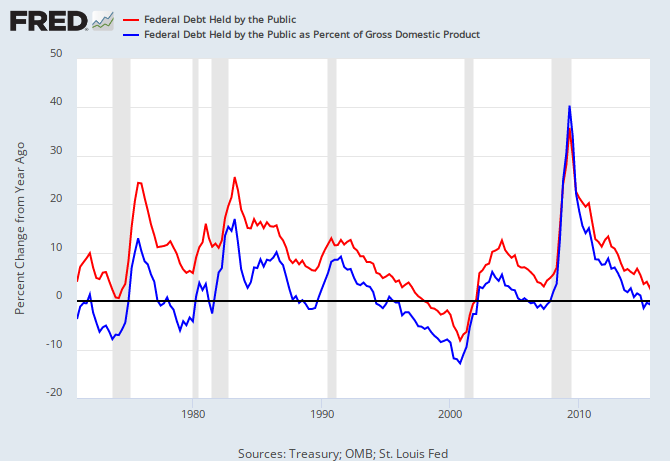
Recessions begin an average of 2 years after the blue line first dips below zero. A common phenomenon is for the line briefly to dip below zero, then rise above zero, before falling dramatically below zero. There was a brief dip below zero in 2015, followed by another dip – the familiar pre-recession pattern.
Recessions are cured by a rising red line.

Monetary Sovereignty

Vertical gray bars mark recessions.

As the federal deficit growth lines drop, we approach recession, which will be cured only when the growth lines rise. Increasing federal deficit growth (aka “stimulus”) is necessary for long-term economic growth.

————————————————————————————————————————————————————————————————————————————————————————————————-

Mitchell’s laws:
•Those, who do not understand the differences between Monetary Sovereignty and monetary non-sovereignty, do not understand economics.
•Any monetarily NON-sovereign government — be it city, county, state or nation — that runs an ongoing trade deficit, eventually will run out of money.
•The more federal budgets are cut and taxes increased, the weaker an economy becomes..

•No nation can tax itself into prosperity, nor grow without money growth.
•Cutting federal deficits to grow the economy is like applying leeches to cure anemia.
•A growing economy requires a growing supply of money (GDP = Federal Spending + Non-federal Spending + Net Exports)
•Deficit spending grows the supply of money
•The limit to federal deficit spending is an inflation that cannot be cured with interest rate control.
•The limit to non-federal deficit spending is the ability to borrow.
Liberals think the purpose of government is to protect the poor and powerless from the rich and powerful. Conservatives think the purpose of government is to protect the rich and powerful from the poor and powerless.

•The single most important problem in economics is the Gap between rich and the rest..
•Austerity is the government’s method for widening
the Gap between rich and poor.
•Until the 99% understand the need for federal deficits, the upper 1% will rule.
•Everything in economics devolves to motive, and the motive is the Gap between the rich and the rest..

MONETARY SOVEREIGNTY


–On being thrown off the cliff: Where is the George Washington of Greece?

Twitter: @rodgermitchell; Search #monetarysovereignty
Facebook: Rodger Malcolm Mitchell

Mitchell’s laws:
●Those, who do not understand the differences between Monetary Sovereignty and monetary non-sovereignty, do not understand economics.
●The more federal budgets are cut and taxes increased, the weaker an economy becomes. .
Liberals think the purpose of government is to protect the poor and powerless from the rich and powerful. Conservatives think the purpose of government is to protect the rich and powerful from the poor and powerless.
●The single most important problem in economics is
the gap between rich and poor.
●Austerity is the government’s method for widening
the gap between rich and poor.
●Until the 99% understand the need for federal deficits, the upper 1% will rule.
To survive long term, a monetarily non-sovereign government must have a positive balance of payments.
●Everything in economics devolves to motive,
and the motive is the Gap.

=========================================================================================================================================================================================================================

In the previous post, we showed how federal deficit cutting (austerity) and the misguided attempt to create a government surplus, harms the middle and lower income groups (the “99%”) by draining dollars from the economy.

We described how deficit cutting has been sold to the 99% as “prudent” economics, while in reality, it is a plan to widen the income/wealth/power Gap between the rich and the rest.

Not well understood is that the widening of the Gap is a self-perpetuating process that once begun, can continue and accelerate of its own momentum.

It’s much like being thrown from a cliff.

G-7 Throws Greece Under the Bus
Posted on June 8, 2015 by Yves Smith

Statements coming out of (the G-7) signal that the U.S., Canada, Germany, France, Japan, Italy and the U.K are backing the creditor position.

The Obama administration had changed its position in February from pushing the lenders to come up with more pro-growth policies (meaning give relief to Greece) to stressing that Greece needed to “find a constructive path forward in partnership with Europe and the IMF to build on the foundation that exists.”

“There was unanimity of opinion in the room that it was important for Greece and their partners to chart a way forward that builds on crucial structural reforms” and returns to growth, White House spokesman Josh Earnest told reporters.

This means, continuing the analogy, that Greece, having been thrown from the euro cliff, now must find a way magically to fly back up, with no help.

Greece does not own sufficient euros to pay its bills. Austerity already has ravaged Greece’s economy, so it has no way to generate euros. The G-7 “solution” is more austerity, which will ravage Greece’s economy further in an unending, unstoppable fall.

The G-7, having applied leeches to Greece’s economic bloodstream, and seeing that the leeches caused the inevitable economic anemia, now demand that more leeches be applied.

Poverty begets poverty by making the climb out of poverty increasingly difficult.

Impoverished people suffer from poor primary education. The schools themselves are inferior.

Additionally, college may be unaffordable, and even those few colleges that are affordable don’t have the cache to provide entry to the best jobs.

Even less understood are the austerity effects on the people themselves. Poverty begets more poverty by changing the impoverished, in body and mind.

Less nutritious food, leading to physical exhaustion, inhibit work, study and thought. Job seeking and job keeping become less successful.

But there is even more:

Look What Austerity Does to a Child’s Brain
Posted on Jun 7, 2015

The stressful conditions of poverty—“overcrowding, noise, substandard housing, separation from parent(s), exposure to violence, family turmoil”—can have toxic effects on the developing brain, permanently diminishing the ability to think clearly and calmly.

Profiling the work of Pat Levitt, a developmental neuroscientist who serves as science director of the National Scientific Council on the Developing Child, Madeline Ostrander writes at The New Yorker:

These conditions provoke the body to release hormones such as cortisol, which is produced in the adrenal cortex.

In a pregnant woman, the hormone can “get through the placenta into the fetus,” Levitt told me, potentially influencing her baby’s brain and tampering with its circuitry.

Later, as the same child grows up, cortisol from his own body may continue to sabotage the development of his brain.

The negative effect of poverty on the human brain has been documented.

In March, in the journal Nature Neuroscience, a group of researchers from nine hospitals and universities published a major study of more than a thousand children.

They took DNA samples, made MRI scans of the children’s brains, collected data on their families’ income level and educational background, and gave them a series of tests for skills like reading and memory.

The DNA samples allowed the scientists to factor out the influence of genetic heritage and look more closely at how socioeconomic status affects a growing brain.

As might be expected, more educated families produced children with greater brain surface area and a more voluminous hippocampus.

But income had its own distinct effect: living in the lowest bracket left children with up to six per cent less brain surface area than children from high-income families.

Wealth can’t necessarily buy a better brain, but deprivation can result in a weakened one.

In a longer-term study published two years ago, neuroscientists at four universities scanned the brains of a group of twenty-four-year-olds and found that, in those who had lived in poverty at age nine, the brain’s centers of negative emotion were more frequently buzzing with activity, whereas the areas that could rein in such emotions were quieter.

Elsewhere, stress in childhood has been shown to make people prone to depression, heart disease, and addiction in adulthood.

The above findings are expanded upon in the June 4, 2105 article, What Poverty Does to the Young Brain by Madeline Ostrander.

Bottom line: Greece’s austerity-riven economy is in a depression. The nation, deeply in debt, has insufficient sources of euros ever to pay that debt.

But the “troika” — European Central Bank (ECB), the European Commission (EC), and the International Monetary Fund (IMF) – knowing Greece never will repay, still insists Greece apply more of the same austerity that pushed Greece into depression.

The troika’s fear is that Greece will awaken, leave the euro, become Monetarily Sovereign by re-installing the drachma, and reclaim its sovereignty. That would put an end to the troika’s free lunch at Greece’s expense.

The myth, that Monetary Sovereignty would drive Greeks into a greater hardship than they already suffer, is ridiculous on its face (greater hardship than the current depression??)

The myth is promulgated by the banks, to dissuade Greece from freeing itself from their greedy clutches.

The troika’s even larger fear is that other euro nations, seeing Greece’s escape and resultant success, would themselves leave the euro, and then, for the rich banks, the feeding frenzy would be over.

Already impoverished, the Greek people face an increasingly difficult road, making emergence from debt ever more unlikely. The difficulties not only are financial, but physical and mental.

Ultimately, if the troika has its way, the Greek people would be turned into idiot slaves of the rich, desperate and with no hope or facilities for recovery, thankful for the crumbs the rich allow them.

Greece can put a stop to the torture of its people, simply by refusing to pay any more tribute to the troika.

This would require political courage, but just as George Washington led the United States to freedom from tyranny, the leader who leads Greece from troika tyranny, forever will be remembered as the “George Washington of Greece.”

Let us pray that, like George Washington, such a leader somehow emerges.

And let us pray that another George Washington arrives to save us from our own greedy and pusillanimous leaders, before we too are swallowed by the current austerity and the rich.

Rodger Malcolm Mitchell
Monetary Sovereignty

===================================================================================
The Ten Steps to Prosperity:

1. Eliminate FICA (Click here)
2. Federally funded Medicare — parts A, B & D plus long term nursing care — for everyone (Click here)
3. Provide an Economic Bonus to every man, woman and child in America, and/or every state a per capita Economic Bonus. (Click here) Or institute a reverse income tax.
4. Federally funded, free education (including post-grad) for everyone. Click here
5. Salary for attending school (Click here)
6. Eliminate corporate taxes (Click here)
7. Increase the standard income tax deduction annually. (Refer to this.)
8. Tax the very rich (.1%) more, with higher, progressive tax rates on all forms of income. (Click here)
9. Federal ownership of all banks (Click here and here)

10. Increase federal spending on the myriad initiatives that benefit America’s 99% (Click here)

Initiating The Ten Steps sequentially will add dollars to the economy, stimulate the economy, and narrow the income/wealth/power Gap between the rich and the rest.
——————————————————————————————————————————————

10 Steps to Economic Misery: (Click here:)
1. Maintain or increase the FICA tax..
2. Spread the myth Social Security, Medicare and the U.S. government are insolvent.
3. Cut federal employment in the military, post office, other federal agencies.
4. Broaden the income tax base so more lower income people will pay.
5. Cut financial assistance to the states.
6. Spread the myth federal taxes pay for federal spending.
7. Allow banks to trade for their own accounts; save them when their investments go sour.
8. Never prosecute any banker for criminal activity.
9. Nominate arch conservatives to the Supreme Court.
10. Reduce the federal deficit and debt

No nation can tax itself into prosperity, nor grow without money growth. Monetary Sovereignty: Cutting federal deficits to grow the economy is like applying leeches to cure anemia.
1. A growing economy requires a growing supply of dollars (GDP=Federal Spending + Non-federal Spending + Net Exports)
2. All deficit spending grows the supply of dollars
3. The limit to federal deficit spending is an inflation that cannot be cured with interest rate control.
4. The limit to non-federal deficit spending is the ability to borrow.

THE RECESSION CLOCK

Long term view:
Monetary Sovereignty

Recent view:
Monetary Sovereignty

Vertical gray bars mark recessions.

As the federal deficit growth lines drop, we approach recession, which will be cured only when the growth lines rise. Increasing federal deficit growth (aka “stimulus”) is necessary for long-term economic growth.

#MONETARYSOVEREIGNTY