The difference between misinformation and disinformation is that the former can be accidental and unintentional, while the latter is intentional.
While the Libertarian website, Reason.com, always has spewed wrong ideas, I have come to believe they now are well into the disinformation stage.
In short, they have transitioned from loud-mouth, bar-stool buffoons to louder-mouth Tucker Carlson.
I admitted that even I don’t believe what I say. Why should you?
Here is the latest headline:
I caught up with the 96-year-old recently in Southern California and conducted a long interview about his life and work that will appear as a Reason podcast.
Here’s part of our conversation about President Joe Biden’s massive $6.8 trillion budget plan, the role of government spending and Federal Reserve policy in causing inflation, the bailout of Silicon Valley Bank, and why Smith believes “it’s very hard to keep Democrats [from] wanting to make the world better by spending other people’s money.“
I must admit that the headline and the introductory paragraphs told me I would not be able to stomach listening to the entire drivel. Here are my comments based on just the above:
Greenspan: A government cannot become insolvent with respect to obligations in its own currency.
Starting with the simplest, there is no Nobel Prize in economics, nor should there be. It’s called The Sveriges Riksbank Prize in Economic Sciences in Memory of Alfred Nobel.
It’s like me injuring myself and awarding me the Rodger Mitchell medal in memory of the Military Order of the Purple Heart.
Or, having taking some pictures at my family Thanksgiving dinner, I award myself the Mitchell Award for Best Picture in memory of the Academy of Motion Pictures Arts and Sciences Awards for Best Pictures.
Also, there should be no real Nobel Prize in economics because economics has not yet graduated to science levels. It is a philosophy that lacks proof, but exists on intuition and belief.
Sciences make verifiable predictions. Economics makes predictions that can’t be verified. They are little more than hunches.
Economists are like stock market chartists with their “head and shoulders” graphs, histograms, and MACDs, all of which sound scientific but in reality are balderdash.
“GOVERNMENT SPENDING CAUSING INFLATION”
Next, there is no evidence that federal spending causes inflation. It is a common belief in economics circles, but it is based on the logical intuition that if you have more of something its value declines.
Sadly, Facts don’t agree with intuition.
Money is unlike other commodities. It always is in demand.
If we have plenty of oil, we don’t use more. There becomes a surfeit that needs to be stored at a significant cost. The price goes down. When there is too much, production can’t be shut down in and instant; when there is a shortage, production can’t be started instantly.
If we have plenty of food, we don’t begin to eat more. The extra must expensively be stored or allowed to rot. The the price goes down. When there is too much or too little, production can’t respond quickly.
By contrast, the federal government quickly can produce more dollars when needed, simply by giving them away or spending them. In the unlikely event there ever are too many dollars, the government could tax them away.
Another major reason why money is unique: If you have plenty of money, you still want more. Storage not only is free, but receives interest. The usual rules of supply and demand don’t operate.
Having plenty of money does not reduce the price of money. It actually can increase the value of money, because investing opens new areas for more investing.
That is why we see graphs like this:
There is no relationship between federal debt (red line) and inflation (blue line).
The peaks and valleys in the above graph do not match. There is no cause/effect relationship.
There is a strong relationship between inflation and oil supplies (green, as evidenced by oil prices).
The peaks and valleys match. There is a cause/effect relationship.
“BAILOUT OF SILICON VALLEY BANK”
The bailout of the Silicon Valley Bank (SVP) was necessary to prevent massive losses to the economy and to individual depositors.
Bernanke: The U.S. government has a technology, called a printing press (or, today, its electronic equivalent), that allows it to produce as many U.S. dollars as it wishes at essentially no cost.
Gross Domestic Product (GDP) is a measure of the economy by being a measure of spending (GDP = Federal and Nonfederal Spending + Net Exports).
Adding dollars to the economy increases GDP; taking dollars from the economy reduces GDP.
Dollars held by banks are dollars in the economy as part of the M2 money supply measure. Allowing SVP depositors to lose money would reduce GDP, which would be recessionary.
Gillespie and Zuckerman advocate punishing the bank and those responsible by allowing them to fail, the classic “cut one’s nose to spite one’s face” situation.
Because banks operate under a profit motive, their leaders face the ongoing temptation to engage in higher-risk activities. When these activities fail, the banks, not having infinite funds with which to pay off depositors, fail.
The prevention and cure is to have all banks owned by the federal government, an entity that is not motivated to take higher risks and has the infinite ability to pay depositors. There is no public purpose for banks to be privately owned.
Bank depositors already are insured (up to $250,000) by the federal government. Federal ownership would expand that protection while decreasing risk.
“SPENDING OTHER PEOPLE’S MONEY”
This pejorative trope, though often expressed, is based on the false notion that the federal government spends federal tax dollars.
While state and local governments, being monetarily non-sovereign, do spend taxpayer dollars, the federal government operates differently.
Greenspan: There is nothing to prevent the federal government from creating as much money as it wants and paying it to somebody.
Being Monetarily Sovereign, the federal government has the infinite ability to create dollars.
Alan Greenspan: “A government cannot become insolvent with respect to obligations in its own currency.”Ben Bernanke: “The U.S. government has a technology, called a printing press (or, today, its electronic equivalent), that allows it to produce as many U.S. dollars as it wishes at essentially no cost.”Alan Greenspan: “There is nothing to prevent the federal government from creating as much money as it wants and paying it to somebody.”Alan Greenspan: “The United States can pay any debt it has because we can always print the money to do that.”
The federal government neither needs nor uses tax dollars. Even if it stopped collecting taxes, the federal government could continue spending forever.
The primary purpose of federal taxes is to control the economy by taxing what the government wishes to discourage and by giving tax breaks to what the government wishes to encourage. A secondary purpose is to insure acceptance of US dollars by requiring them to be used for taxes and other payments.
Reason.com, that Libertarian, anarchist organization, has become more far right-wing of late, and following in the Fox News / Tucker Carlson tradition, has resorted to exaggeration and outright lies — i.e misinformation and disinformation — to push its anti-government agenda.
The federal government is very good at one thing: Creating dollars. Thus it has no profit motive. Its motives revolve around its voter constituency. The more it can do to please its voters, the more votes it can acquire.
The Republican constituency is the rich, and the Republicans know it.
The Democrats’ constituency is the not-rich, but the Democrats don’t understand economics. So, despite creating such social programs as Social Security, Medicare, Medicaid, and poverty-fighting plans, the Democrats repeatedly fall into the trap of not recognizing Monetary Sovereignty.
Thus, they go along with the “can’t afford it” excuses for not implementing Medicare for All, Social Security for All, free college for all and other social programs that would benefit America.
Meanwhile, the Libertarians join hands with the Republicans to widen the Gap between the rich and the rest. Disgraceful.
The next time you read any Libertarian or Republican wish list, ask yourself, does this help the not-rich or does it widen the Gap between the rich and the rest? Then vote accordingly.
Rodger Malcolm Mitchell
Monetary SovereigntyTwitter: @rodgermitchellSearch #monetarysovereigntyFacebook: Rodger Malcolm Mitchell
……………………………………………………………………..
The Sole Purpose of Government Is to Improve and Protect the Lives of the People.
Self-evaluation corresponds with intelligence. If you are smart, being smart lets you understand that you are smart. If you are stupid, being stupid keeps you from knowing you are stupid. Thus, everyone thinks they are smart.In related issues, everyone thinks they are above-average drivers and that the federal government can run short of dollars.
==============/////=================
A rose by any other name may smell as sweet, but what if they called it “stinkwort”? Labels do matter. Visualize this scenario:
The boater must take more water from the ocean than he receives from the ocean. That is, the ocean must run a water deficit for the boater to survive, just as the federal government must run a dollar deficit for the economy to survive.
A man sits in a rowboat in the Pacific Ocean.
Using his desalinization kit he fills his canteen with one pint of water, which he later drinks and excretes as urine,
But, because of perspiration evaporation and breathing, he excretes only 9/10th pint of urine.
So, for boater the Pacific Ocean runs a deficitof 1/10th pint of water.
Does anyone care?
No, the Pacific Ocean running a 1/10th pint of water deficit is meaningless, because for all intents, the ocean has infinite water.
Infinite water minus 1/10th pint still equals infinite. No change.
Now imagine the same scenario, except instead of viewing it from the ocean’s standpoint, view it from the boater’s standpoint.
The man has drunk a pint of water, 9/10th of which he has excreted as urine into the ocean, and used the rest for perspiration, and other bodily functions.
That pint of water has allowed him to live for a certain time. Without the pint of water, he would have died.
That’s important.
In both scenarios we gave you the same information, but in one case we labeled it as a water measure from the standpoint of the ocean, and in the other case we labeled it as a water measure from the standpoint of the boater.
The following graph comes from https://www.chartr.co/newsletters/2023-02-08/. It labels money flow from the standpoint of the U.S. government:This graph shows the nation’s money flow from the standpoint of the U.S. government, not from the standpoint of the economy.
Here are excerpts from the accompanying article:
State of the union’s walletLast night, President Biden held the annual State of the Union. A big theme was the economy. He threatened to veto any proposal that would cut spending on Social Security and Medicare while also imploring Congress to raise the debt ceiling.
I O U $1.4 trillion: In fiscal year 2022, the federal government collected nearly $5tn in revenue, with more than 50% of that coming from individual income taxes.
However, the US government spent even more, leading to a nearly $1.4tndeficit.
To make up for the difference the US government does what everyone who overspends their budget does — they borrow.
This then adds to its already enormous tab (AKA the national debt), which currently sits at the $31.4tn debt ceiling limit.
With a debt pile that big, the interest payments aren’t small. Indeed, last year the US government spent ~$480bn on net interest payments, just shy of Ireland, Norway or Nigeria’s annual GDP.
There are three major problems with the above scenario.
It draws a false parallel between the finances of our Monetarily Sovereign governmentand the finances of monetarily non-sovereign “everyone.” The former has infinite money and the latter does not.
It falsely states that the federal government must borrow in order to “make up the difference.” The federal government, having the infinite ability to create its sovereign currency, never borrows dollars, and never needs to “make up the difference.” To pay all its obligations, the federal government creates new dollars, ad hoc. It destroys all the tax dollars it receives.
It labels the money movement from the standpoint of the federal government rather than from the standpoint of the economy.
Think of the Pacific Ocean as analogous to the U.S. federal government, and the boater as analogous to the economy.
Like the Pacific Ocean’s water, the federal government has infinite dollars. And like the boater’s limited water supply, the economy has limited dollars.
Alan Greenspan: “A government cannot become insolvent with respect to obligations in its own currency. There is nothing to prevent the federal government from creating as much money as it wants and paying it to somebody. The United States can pay any debt it has because we can always print the money to do that.”
Ben Bernanke: “The U.S. government has a technology, called a printing press (or, today, its electronic equivalent), that allows it to produce as many U.S. dollars as it wishes at essentially no cost.”
Quote from from 60 Minutes:Scott Pelley: Is that tax money that the Fed is spending?Ben Bernanke: It’s not tax money… We simply use the computer to mark up the size of the account.
Statement from the St. Louis Fed: “As the sole manufacturer of dollars, whose debt is denominated in dollars, the U.S. government can never become insolvent, i.e., unable to pay its bills. In this sense, the government is not dependent on credit markets to remain operational.”
(The final sentence, above, is Fed-speak for, “The government does not borrow to pay its bills.”)
The U.S. government is not the only Monetarily Sovereign government. The European Central Bank also is Monetarily Sovereign (and like the U.S. economy, individual euro nations are monetarily non-sovereign.)
Press Conference: Mario Draghi, President of the ECB, 9 January 2014Question: I am wondering: can the ECB ever run out of money?Mario Draghi: Technically, no. We cannot run out of money.
To survive, the boater needs the Pacific Ocean to run a water deficit. Similarly, to survive, the economy needs the federal government to run a dollar deficit.
The Pacific Ocean does not need to receive any water from the boater nor does the Ocean “owe” the boater any water. Similarly, the economy should not be asked to give the federal government any money, nor does the government “owe” the economy any money.
Finally, the Pacific Ocean does not borrow water to give water to the boater.
Think of the Pacific Ocean and the boater the next time you hear about federal debt limits and taxes.
Labels matter.
Rodger Malcolm Mitchell
Monetary SovereigntyTwitter: @rodgermitchellSearch #monetarysovereigntyFacebook: Rodger Malcolm Mitchell
……………………………………………………………………..
The Sole Purpose of Government Is to Improve and Protect the Lives of the People.
Debt-to-GDP Ratio: How High Is Too High? It DependsOctober 07, 2020, By Heather Hennerich
How much federal debt is too much? Is there a tipping point at which it becomes a big problem for a country?
One way to gauge the size of a country’s national debt is to compare it with the size of its economy—the ratio of debt to GDP. (GDP serves as a measure of an economy’s overall size and health, measuring the total market value of all of a country’s goods and services produced in a given year.)
Gross Domestic Product (GDP) is one measure of size, but it is not a measure of health. There is no relationship between the health of an economy and the Debt/GDP ratio.
Heather Hennerich’s claim that “GDP serves as a measure of an economy’s overall size and health” simply is false. In fact, the Debt/GDP ratio signifies nothing, nothing at all.
Yes, it’s a fraction that is quoted all the time by people who should know better. But you might as well quote an apples/Apple phones comparison.
Debt is a cumulative measure of federal government deficitssince the beginning of time.GDP is a one yearmeasure of an entirenation’sspending.
If you want a similar comparison try the total amount of water a city has wasted vs. the amount of orange juice the mayor drank, yesterday. Call it the “waste/OJ” ratio, and claim it means something.
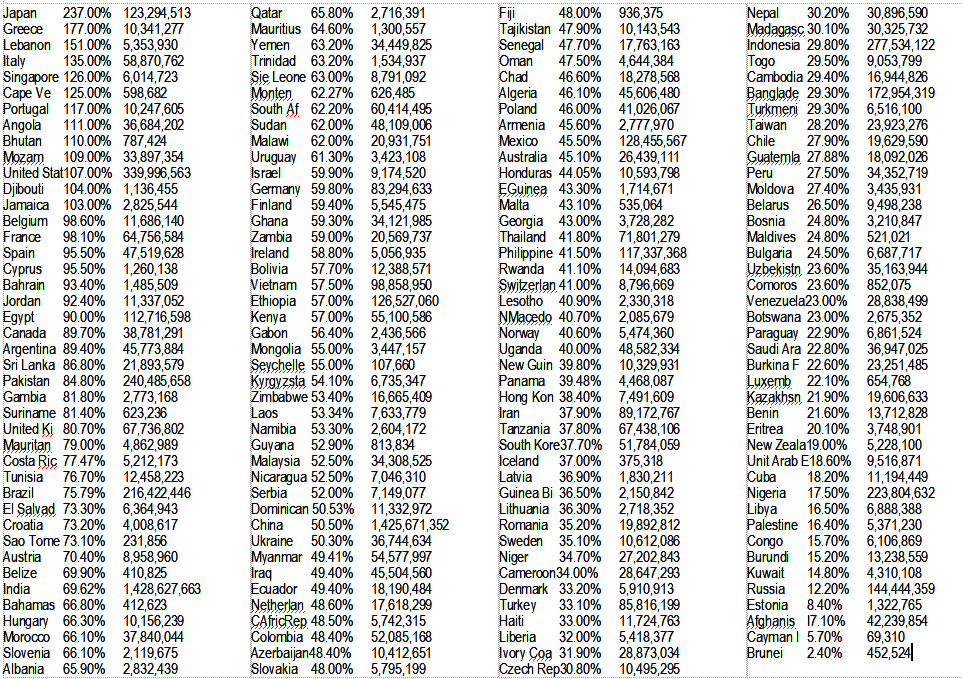
Skim the following list of Debt/GDP ratios, and see if you can find any relationship between the Debt/GDP ratio, the population of the nation, and what you know about the health of its economy.
Begin with the fact that wealthy, powerfulJapan and weak, impoverished Greece are 1,2 on the list. The United States falls right between Mozambique and Djbouti on the list. Russia has one of the lowest ratios, indicating the “health” of its economy.
NATION — DEBT/GDP RATIO — POPULATION
The Debt/GDP ratio does not measure the health of an economy.
The next time you hear or read some pundit’s concerns about America’s Debt/GDP ratio, you will know that pundit does not know what he/she is talking about.
The U.S. federal debt-to-GDP ratio was 107% late last year, and it went up to nearly 136% in the second quarter of 2020 with the passage of a coronavirus relief package.
By comparison, Japan’s ratio at the end of 2019 was higher: about 200%, according to data from the Bank of Japan and Japan’s Ministry of Foreign Affairs and calculations by St. Louis Fed Economist Miguel Faria-e-Castro.
By comparing the total federal debt to the size of a country’s economy, we can see how that government can use the resources at hand to finance the debt, according to Your Guide to America’s Finances from the U.S. Department of Treasury.
This wrongly assumes that federal (Monetarily Sovereign) finances are like personal (monetarily non-sovereign) finances.
The federal government does not “finance” its debt. (Here the word “finance” seems to mean pay it off or perhaps pay interest on it.)
The so-called “debt” is nothing more than deposits into privately owned, Treasury Security accounts. We say “privately owned” because the federal government never touches those dollars. As a depositor, you alone decide when to take dollars out or leave them in (following certain initial rules). The dollars are yours when you deposit them and when you retrieve them.
That’s why they are not a “loan.”If they were a loan, the borrower would control them. But there is no borrower. The federal government never borrows dollars.
These accounts are similar to safe deposit boxes into which you place your valuables. Just as the bank never touches those valuables, the federal government, being Monetarily Sovereign, never needs to touch your deposited money.
To pay off the so-called “debt” the government merely returns your dollars to you, the depositor.
As for the “resources at hand,” we assume this means that in some mysterious way, the government supposedly uses GDP or perhaps Lake Michigan, to pay off T-securities. No one knows how that works.
It’s all gibberish and nonsensical.
In his research, Faria-e-Castro explores big questions about the economy, so we asked him about this issue last year.
Deficit spending means that a government is choosing not to raise taxes today to pay for that spending but is choosing to wait until tomorrow, Faria-e-Castro said.
Monetarily non-sovereign governments (state, local, euro) use taxes to fund spending. But Monetarily Sovereign governments (US, Canada, Japan, Australia, et al) do not use taxes to fund spending. A huge difference Faria-e-Castro seems not to understand. (And he’s an economist for the St. Louis Fed!!)
Monetarily Sovereign governments use taxes to direct their economies by taxing what they want to discourage and giving tax breaks to what they want to encourage.
There is scant similarity between federal finances and state/local government finances. Those who do not understand the difference should not be writing for the Federal Reserve.
While state/local governments rely on tax income, the federal government could continue spending, forever, with no tax income at all.
Ben Bernanke: “The U.S. government has a technology, called a printing press (or, today, its electronic equivalent), that allows it to produce as many U.S. dollars as it wishes at essentially no cost.”
Then we come to this bit of misinformation, that applies to state/local governments, but not to the federal government:
When federal spending exceeds revenue, the difference is a deficit. The government mostly borrows money to make up the difference.
The federal government doesn’t borrow dollars. Why would it, given its infinite ability to create new dollars?
Alan Greenspan: “There is nothing to prevent the federal government from creating as much money as it wants and paying it to somebody.”
Greenspan understood Monetary Sovereignty. Too bad he didn’t make his knowledge clear so we no longer would have ridiculous laws mandating a “debt ceiling.”
Now, again, the nation is paralyzed by the useless debt ceiling while the GOP demands spending cuts though they have no idea what they want to cut. (They don’t have the courage to admit they really would like to cut Social Security and Medicare, so as to help the rich become richer.)
The total national debt is an accumulation of federal deficits over time, minus any repayments of debt, among other factors.
By law, the federal government accepts deposits into T-security accounts equal to the accumulation of federal deficits. This is a point of confusion, because people mistakenly are led to believe that the deposits pay for the deficits. They don’t. The deposits pay for nothing.
The purpose of deposits (i.e. T-securities) is to provide a safe place to store dollars, which stabilizes the dollar.
A big consequence of deficit spending is that the fiscal burden shifts from one generation to the next, Faria-e-Castro said.
This is entirely wrong. You never have endured a “fiscal burden” for previous deficits. The government pays for all its deficits by creating new dollars from thin air. This is not a burden on anyone, not on you and not on the government.
The “fiscal burden” myth, promulgated through the decades, is a result of ignorance about Monetary Sovereignty.
That’s fine if a country’s economy is growing, because you know that the next generation will, on average, be better off than the current one, and likely able to pay a little more in taxes to decrease the debt, Faria-e-Castro said.
But if a country’s economy is slowing and economic growth rates are lower than they used to be, “this starts becoming a more divisive issue.”
It’s only divisive for those who are ignorant about federal finances. “The next generation” doesn’t pay for back debt. The taxes paid by every generation see the same fate: All federal taxes are destroyed upon receipt.
Tax dollars are paid from what is known as “the M2 money supply measure.” The moment they are received by the Treasury, they cease to be part of any money supply measure. In short, they are destroyed.
Say the government of “Country X” borrows money to cover its deficits, Faria-e-Castro said. Investors—many of them international—buy that debt and then want to be repaid.
“One day, the president of Country X can just organize a press conference and just tell people, ‘OK. We’re not paying,’” Faria-e-Castro said. “That’s an outright hard default.”
But countries that take that action will have trouble borrowing again. Lenders will be less willing to lend to them and will charge higher interest rates.
Here, Faria-e-Castro displays remarkable ignorance of national finance because he doesn’t differentiate between Monetarily Sovereign governments and monetarily non-sovereign governments.
The monetarily non-sovereign governments borrow money because they have no sovereign currency.
“The president of Country X can call the governor of the central bank and say, ‘OK, you have to print money to pay for this debt,’” Faria-e-Castro said.
In a country where the central bank is not an independent authority, the central bank can be pressured more easily by politicians to start printing money to pay for the country’s debt, he said.
But the flow of new money will invariably lead to high inflation in that country. That erases the value of the debt—a “soft default”—but it also typically kicks off hyperinflation, Faria-e-Castro said.
Astoundingly, that is precisely what does not happen, and the evidence is there for all to see.
Whether one views federal debt as “Federal Debt Held by The Public” (first graph below) or as “Federal Debt as a Percent of Gross Domestic Product” (2nd graph below), there is no relationship between federal debt and inflation.
There is no relationship between federal debt held by the public and inflation. Peaks and valleys do not correspond.There is no relationship between the Debt/GDP ratio and inflation. Peaks an valleys do not correspond.
It never ceases to amaze that obvious and readily available statistics are ignored by so-called “experts” in favor of hand-me-down beliefs having no basis in fact.
Inflation is not related to federal spending because inflation is caused by shortages of key goods and services.
Some claim that federal deficit spending causes those shortages, but for years and years, we’d seen massive federal spending, with low inflation.
The federal dollars that led to increased demand also facilitated increased supply. That is how capitalism works; supply rises to meet demand.
But suddenly, in 2020, we began to see inflation. What suddenly changed in 2020?
COVID.
The inflation that came suddenly in 2020, an inflation we still endure, was caused by COVID-related shortages of oil, food, computer chips, lumber, steel, shipping, labor, etc.
There is no statistical relationship between federal deficit spending and inflation.
But would you like to see something that does have a relationship with inflation?Shortages of key goods and services (most often oil) cause inflation. Oil prices are closely related to supply. The peaks and valleys correspond between oil supply and inflation.
Yes, if you’re looking for the primary cause of inflation, start with oil shortages, which then relate to other shortages. COVID was responsible for shortages of oil, food, etc.
It would be hard to make the case that after decades of big deficits, suddenly federal spending caused an increase in oil demand. Inflations are supply-related.
Federal spending actually can cure inflation if the spending is directed toward obtaining the scarce goods and services and distributing them to the public.
Contrary to popular wisdom, restricting federal spending during an inflation is counterproductive.
Hyperinflation is excessive inflation, with very rapid and out of control general price increases. Economists usually consider monthly inflation rates of above 50% as hyperinflation episodes, as noted in a 2018 On the Economy blog post.
Faria-e-Castro explained, countries that are not politically stable and don’t have independent central banks are not going to have very credible institutions. As a consequence, they can’t borrow easily: Investors won’t be willing to lend them that much for fear of future default.
But the debt of countries with strong institutions and independent central banks—like the U.S. and Japan—doesn’t present the same risks, Faria-e-Castro said.
He thinks the difference between countries has to do with a “strong, central bank.” Poppycock.
The central bank of a Monetarily Sovereign nation is strong because Monetary Sovereignty makes it strong. It has the unlimited ability to create its nation’s sovereign currency.
Monetarily non-sovereign nations also have central banks. Sadly, these banks are weak because they do not have the unlimited ability to create sovereign currency: They have no sovereign currency to create.
Few believe, for example, that the Japanese government will ever pressure the Bank of Japan to actually “print” money to pay for the country’s debt, Faria-e-Castro said.
First, the Bank of Japan “prints” (creates) yen all the time. No “pressure” needed. It’s a normal, daily process.
And second, those yen do not pay for the country’s debt. They pay for the country’s purchases. Like the U.S., the Japanese government does not borrow to pay for anything. It creates yen to pay for everything.
“As a consequence, these countries can typically sustain very high levels of debt to GDP,” he said. “Because people really believe that they will be repaid, so they can keep lending.”
There’s that phony Debt/GDP ratio, again. The U.S. doesn’t borrow. It issues Treasury bills, notes, and bonds, and if not enough are issued to satisfy the law, the Federal Reserve Bank simply buys the rest.
The strength of institutions also affects interest rates on the debt, which is another factor in determining the sustainability of high debt-to-GDP ratios.
No, the Fed determines short-term interest rates by fiat. And that meaningless Debt/GDP ratio is infinitely sustainable.
If a country has strong institutions, interest rates on the debt will be low, which means the cost of borrowing will be low, Faria-e-Castro said.
When he talks about the “cost of borrowing,” he mistakenly believes government T-securities represent borrowing. They don’t. They represent deposits.
These deposits are paid off, not with taxes but by returning the dollars that are in the accounts.
And whether interest rates are high or low is irrelevant to a Monetarily Sovereign nation having the infinite ability to create the currency to pay interest.
Because the institutional strength and riskiness of countries varies, there’s no rule of thumb for how high a debt-to-GDP ratio can be before it poses a risk to a country’s economy.
“At the end of the day, it all boils down to strong and independent institutions,” Faria-e-Castro said.
“A lot of economists try to study this. There’s no single measure that we can come up with… Measuring institutional strength is not obvious.”
It’s not obvious because Faria-e-Castro is confusing federal financing with private financing. He doesn’t understand the difference between Monetary Sovereignty and monetary non-sovereignty. And he’s speaking for the Federal Reserve!? Yikes!
He falls in line with the current mistaken belief that fighting inflations requires the pain of recession that cuts in federal spending beget.
That is the kind of leadership that destroys nations.
Rodger Malcolm Mitchell
Monetary SovereigntyTwitter: @rodgermitchellSearch #monetarysovereigntyFacebook: Rodger Malcolm Mitchell
……………………………………………………………………..
The Sole Purpose of Government Is to Improve and Protect the Lives of the People.
The efforts of the rich to become even richer never end.
The rich incessantly promulgate lies about our economy. More importantly, they bribe the primary influencers — the politicians, the media, and the economists — to spread the Big Lie that federal spending is funded by federal taxes.
Bernanke: “It’s not tax money… We simply use the computer to mark up the size of the account.”
In reality, federal spending is funded by ad hoc federal money creation, not taxes.
The tax dollars no longer exist in the economy (the private sector), and since the federal government has infinite dollars, the tax dollars no longer exist anywhere.
The Big Lie convinces the populace that the federal government’s ability to provide benefits is financially limited by tax receipts.
(Politicians are bribed via campaign contributions and promises of lucrative jobs. The media are bribed via advertising dollars and actual ownership. Economists are bribed via gifts to universities and lucrative positions on “think tanks.”)
Whenever you hear about a federal benefit, and someone asks, “Who will pay for it?” you should know you are about to listen to the Big Lie. The answer is: “The federal government will pay for it by creating dollars.”
Quote from former Fed Chairman Ben Bernanke when he was on 60 Minutes: Scott Pelley: Is that tax money that the Fed is spending? Bernanke: It’s not tax money… We simply use the computer to mark up the size of the account.
“Social Security and Medicare are about to become insolvent” is an example of the Big Lie, the purpose of which is to distance the rich from the rest of us.
“Rich” is a comparative, not an absolute. If you have a million dollars, you are rich if most others have less than a million. But you are not wealthy if everyone else has ten million.
That leaves you two ways to become richer: Get more for yourself or make the others have less. The rich in America have chosen both courses.
They try to grab more for themselves; their efforts to force you to have less are not as obvious.
The rich receive most of their income from sources other than salaries. Consider FICA. Congress has deemed FICA should be collected only from salaries, not from other forms of income.
Further, Congress has decided FICA is to be collected on salaries less than $142,800. Anything above that is not taxed.
The FICA limit is just one of the thousands of tax breaks the rich have “encouraged” Congress to give them. The purpose: To widen the Gap between them and you. Widening the Gap makes them richer.
U.S. federal finances are unlike state & local government finances, business finances, and euro nation finances.
Former Fed Chairman Alan Greenspan: “A government cannot become insolvent with respect to obligations in its own currency.”
The U.S. government is Monetarily Sovereign. It has the unlimited ability to create its own sovereign currency.
It never unintentionally can run short of dollars.
Yet we see organizations funded by the rich claiming that federal spending, which goes to the middle- and lower-income people, is detrimental to the middle- and lower-income people.
They want you to believe you should receive lower benefits and pay more taxes.
If they can cement that belief in your minds, you’ll vote for the very people who take money from your pocket.
Here is the entirety of a page posted by the Committee For A Responsible Budget, one of the organizations that continually tries to foist on you the false idea that you should have less.
Every single sentence, including the headline, is false and/or an outright lie:
FALSE. High and rising National (i.e., federal) Debt is not a problem. It is not even Debt. It is the total of deposits into Treasury security accounts at the Federal Reserve.
These accounts resemble safe-deposit boxes. When you buy a T-bill, T-note, or T-bond, you open an account at the Federal Reserve and deposit your dollars into it.
The federal government never touches those dollars. It has no need to.
The government can pay off the so-called “debt” merely by returning to you the dollars in your account.
This is no burden on the government, taxpayers, or the economy. There is no “Problem.”
High and rising national Debt will threaten economic growth and the standard of living for all Americans. High Debt will slow the growth of the economy and wages.
FALSE. Federal “debt,” i.e., the total of deposits in T-securities, is set by law to equal the cumulative total of federal deficits.
Bernanke: “The U.S. government has a technology, called a printing press (or, today, its electronic equivalent), that allows it to produce as many U.S. dollars as it wishes at essentially no cost.”
Deficits are the difference between the amount of money the government takes out of the economy vs. the amount it puts in (with some going to foreign nations).
Rising national “debt” occurs when the federal government puts more dollars into the economy than it takes out.
There is no mechanism by which adding money to the economy can “slow the growth of the economy and wages.”
On the contrary, when economic growth slows, the government adds more stimulus dollars (increases the “debt”) to prevent or cure a recession.
The “debt” has no direct effect on wages, which are a function of business profits (stimulated by federal deficit spending) and labor supply.
As Debt rises, higher interest payments will crowd outimportant investments in areas like education, infrastructure, and research that can help grow the economy.
FALSE. Federal Debt does not force higher interest rates. Interest rates are set arbitrarily by the Federal Reserve to control inflation.
The peaks and valleys of changes for Federal deficits (blue) neither correspond to changes in Interest rates (red) nor are they a leading indicator. Note the 12 years 2008 – 2020, when federal deficit spending grew massively while interest rates neared zero.
Federal interest payments do not “crowd out” other federal payments for “education, infrastructure, and research. The federal government has infinite money with which to pay for anything.
During periods of high deficit spending, interest rates have been low.
Getting the Debt under control once the crisis is over will be very beneficial for generations to come, from higher wages to increased investment to lower borrowing costs for families and businesses.
FALSE. This paragraph is just a restatement of the previous section. There is no mechanism by which fewer dollars coming into the economy can cause “higher wages, increased investment, and lower borrowing costs.
The last decade shows the opposite: Higher deficits along with higher wages, increased investment, and low borrowing costs.
The Congressional Budget Office predicts that the economy will grow faster with Debt on a declining path as opposed to a rising one.
FALSE: History shows that declining Debt leads to depressions and recessions.
1804-1812: U. S. Federal Debt reduced 48%. Depression began 1807. 1817-1821: U. S. Federal Debt reduced 29%. Depression began 1819. 1823-1836: U. S. Federal Debt reduced 99%. Depression began 1837. 1852-1857: U. S. Federal Debt reduced 59%. Depression began 1857. 1867-1873: U. S. Federal Debt reduced 27%. Depression began 1873. 1880-1893: U. S. Federal Debt reduced 57%. Depression began 1893. 1920-1930: U. S. Federal Debt reduced 36%. Depression began 1929. 1997-2001: U. S. Federal Debt reduced 15%. Recession began 2001.
The reason is quite simple. Reducing federal Debt requires taking dollars out of the economy.
Just as adding stimulus dollars to the economy prevents and cures recessions and depressions, taking dollars out of the economy causes recessions and depressions.
The rich do not fear recessions and depressions. They are less harmed than the rest of us. They have more cushion to weather the hard times.
During recessions and depressions, workers become more desperate for jobs, giving the rich the opportunity to cut wages and increase their own relative incomes.
In addition to publishing the completely non-sensical paragraphs just discussed, The rich-run CRFB runs “hearings” on the condition of the government’s finances.”
These hearings contain nothing more than recitations of the Big Lie — false propaganda we have just discussed. The purpose will be to give Congress excuses to:
Cut Social Security benefits
Cut Medicare benefits
Eliminated Obamacare
Increase FICA taxes
Cut other benefits for the poor and middle-classes
Widen the income/wealth/power Gaps between the rich and the rest
The drumming of lies and misstatements from the rich and toadies for the rich is relentless. So long as it works to indoctrinate the public, it never will end.
The attempts at indoctrination end only when you, the public, demonstrate your understanding of the lies and your willingness to punish the liars.
Fool you once; shame on them. Fool you thousands of times, over and over and over; shame on you.
[No rational person would take dollars from the economy and give them to a federal government that has the infinite ability to create dollars.]
Gap Psychology describes the common desire to distance oneself from those “below” in any socio-economic ranking, and to come nearer those “above.” The socio-economic distance is referred to as “The Gap.”
Wide Gaps negatively affect poverty, health and longevity, education, housing, law and crime, war, leadership, ownership, bigotry, supply and demand, taxation, GDP, international relations, scientific advancement, the environment, human motivation and well-being, and virtually every other issue in economics.Implementation of Monetary Sovereignty and The Ten Steps To Prosperity can grow the economy and narrow the Gaps: Ten Steps To Prosperity: