TOKYO (AP) — Japan logged a deficit for a second straight year last year as its exports were hurt by a slowdown of demand in China amid a tariff war with the U.S.
Government data released Thursday showed Japan’s exports fell 5.6% in 2019, to 76.9 trillion yen ($701.6 billion), while imports fell 5.0% to 78.6 trillion yen ($710 billion).
That left a deficit of 1.6 trillion yen ($14 billion).
Japan had a trade surplus of 6.6 trillion yen ($60 billion) with the U.S.last year, as exports fell 1.4% from 2018, and imports fell 4.4%.
Shipments of computers, construction and textiles equipment and power generating machines contributed to a 3.7% increase in exports of machinery to the U.S.
Vehicle exports, which account for nearly 40% of Japanese exports to the U.S., declined 5.5%, the data show.
Is all of this bad news or good news for Japan? The use of the words “deficit,” and “red ink,” which has pejorative insinuations, would lead one to believe this is terrible news.
If you are associated with vehicle manufacturing you may believe it’s bad news — unless exports to other nations and local consumption increased enough to offset the decline in shipments to the U.S. — and that is assuming exports of vehicles to the U.S. are profitable.
Or then again, if you’re associated with the manufacture of computers, construction and textiles equipment, and power generating machines, you might feel it’s good news.
But in reality, looked at from the whole Japanese nation’s standpoint, it’s no news at all.
A “trade deficit” merely means that Japan as a nation, sent fewer goods and services to the U.S. than the U.S. sent to Japan, and in return, Japan sent more money to the U.S. than the U.S. sent to Japan.
But is that a trade “deficit” or is it a trade surplus?
Trade is an even exchange. Goods and services sent one way, and an equivalent value in money sent the other way.
Since trade is an even exchange, is Japan better off sending more goods and services overseas or sending more money overseas?
Asked another way, which is more difficult for Japan to obtain, goods and services or money?
Japan is Monetarily Sovereign. It has the unlimited ability to create an infinite amount of Japanese yen, at no cost, and at the touch of a computer button. Money is free and easy for Japan to obtain.
By contrast, Japan is a geographically small, island nation, with limited natural resources. Goods and services are costly and hard-to-get.
So again, is it better to produce and send away something that is costly and hard-to-get and to receive something in return that is free and easy-to-get (aka a “trade surplus”) or is it better to receive costly and hard-to-get goods, and send away something that costs you nothing (aka a trade “deficit.”)?
I, for one, would prefer the so-called trade “deficit.”
But, you may ask this good question, “What about the individual industries, like vehicles, that rely on exports?”
They are in a different category from the Japanese government. While the government is Monetarily Sovereign, the private sector is monetarily non-sovereign. Unlike the government, businesses cannot create yen at the touch of a computer key.
For the private sector, money is hard-to-get. So what’s to be done?
The obvious solution is for the government to fund businesses and their employees. In that way, the private sector would not suffer because of duties and trade deficits.
Yes, I know. International trading pacts frown on government support of business, but these rules are honored mostly in the breach. The vast number of government-owned and government-funded businesses speaks to this.
And yes, this solution would increase a government’s deficit and debt. But, of course, a deficit and debt is meaningless for an entity that can create its own sovereign currency at will.
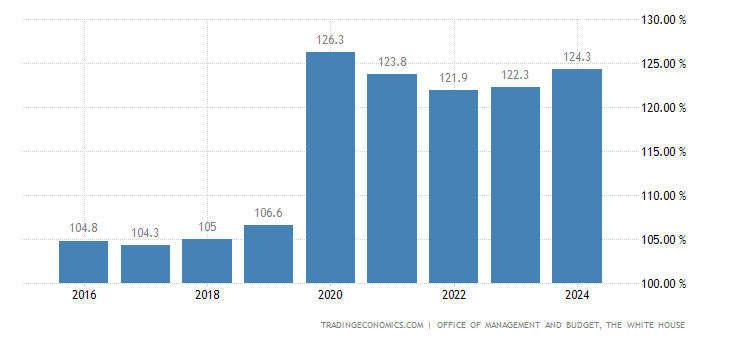
There was a time when the economically ignorant predicted that if ever the U.S. debt rose to 100% of the U.S. Gross Domestic Product, the stars would fall from the skies, and pestilence would ravage the earth.
Well, here we are:
U.S. Debt now at 106% of GDP
And as for Japan, it’s more than twice as “bad” (good).
Japan would not need to export one yen’s worth of goods and services, and it could survive very nicely, thank you, via government deficit spending.
“Looking ahead, we think the recovery in exports will be weaker than many expect. That reflects our view that GDP growth in Japan’s main trading partners will remain subdued this year,” Tom Learmouth of Capital Economics said in a report.
Although export growth and GDP growth in trading partners can be connected, the former is meaningless to Japan, and the latter is meaningful to the trading partners.
He noted that an increase in Japan’s sales tax, to 10% from 8%, as of Oct. 1 has also hurt consumer demand and private investment.
Why would Monetarily Sovereign Japan increase the sales tax its own citizens pay? No good reason at all. It’s foolishness at a high level. Japan has no need or use for tax money.
President Donald Trump has thrown out past trade deals, including that with China, that he said added to the U.S. trade deficit and cost the country manufacturing jobs.
In his typical ignorance, President Donald Trump “solves” the jobs problem by raising tariffs, an act which is guaranteed to cost the U.S. private-sector jobs.
A better approach would be to eliminate business taxes, not raise them, which would increase company competitiveness, sales, and employment.
The best approach would be to institute the Ten Steps to Prosperity, which would narrow the Gap between the rich and the rest, put more money into the private sector, and improve the lives of the people.
That, ultimately, is the purpose of government.
Nearly 50 years have passed since President Richard Nixon removed the handcuffs of a gold standard and freed the U.S. government to be a true Monetary Sovereign.
Yet still, we remain shackled by our own fears and ignorance, leaving us not much better than the euro nations, which gave away their Monetary Sovereignty many years ago.
Too many Americans suffer from inadequate health care, inadequate housing, inadequate nourishment, inadequate education, inadequate financial resources — and it all is so unnecessary.
Gap Psychology describes the common desire to distance oneself from those “below” in any socio-economic ranking, and to come nearer those “above.” The socio-economic distance is referred to as “The Gap.”
Wide Gaps negatively affect poverty, health and longevity, education, housing, law and crime, war, leadership, ownership, bigotry, supply and demand, taxation, GDP, international relations, scientific advancement, the environment, human motivation and well-being, and virtually every other issue in economics.
Implementation of Monetary Sovereignty and The Ten Steps To Prosperity can grow the economy and narrow the Gaps:
Our country club invites speakers to give presentations about various, interesting subjects.
I could volunteer to present my friends and neighbors with information they don’t have, and should have, and would find interesting.
Sadly, I’ve found that most people want to hear what they already believe, and they tend to become angry at anyone who tells them otherwise.
What follows is the text of a speech I never will give to my friends at the club because they probably won’t believe me, and at my age, who needs the aggravation?
TEN THINGS YOU ABSOLUTELY DON’T KNOW ABOUT OUR ECONOMY — BUT YOU SHOULD
I’m going to tell you some things about our economy, and specifically about money — a subject which you already understand quite well because you have lots of it.
But I’m going to tell you ten things you didn’t know.
The vast majority of you own more than a million U.S. dollars, which used to be a much-respected sum, but no longer is.
Because you own so many dollars, let me ask you this: What does a U.S. dollar look like? For instance, what is the color of the U.S. dollar?
Green, right?
And what is a dollar made of? How big is it?
Paper and about 6 inches?
And what is the purpose of dollars?
They are a medium of exchange and a measure of value or wealth. OK?
And, if the purpose of dollars is, for example, to act as a medium of exchange, that means you exchange dollars for the goods and services you want, right?
.
So, for instance, let’s say you walk into a car dealership to buy a car.
After proper negotiation, you give the dealer a giant stack, let’s say 75,000, of those green, 6-inch pieces of paper, and he gives you the car keys.
That’s the way it works, right? You schlep big stacks of paper around?
No?? It doesn’t work that way??
Actually, to buy that car, you sign some papers that probably are not green and don’t measure 6 inches.
And in fact, I venture to guess, that while the vast majority of your life’s purchases do involve dollars, they do not involve green pieces of paper.
You gave that car dealer $75,000. So, let me ask you again, What did those dollars — the dollars you gave the dealer — look like?
The answer is: Those dollars didn’t look like anything. They are bookkeeping entries.
The U.S. dollar is not a physical entity. The dollar is a legal entity. It is a group of laws. You can’t see, smell, taste, feel, or hear a dollar any more than you can see, smell, taste, feel, or hear a law.
Titles
That green piece of paper is not a dollar; it is a dollar bill. It represents the ownership of a dollar. Just as a car title is not a car, and a house title is not a house, a dollar bill is not a dollar.
A dollar bill is a bearer title to a dollar.
A dollar is a legal entity that exists only in law books. And if there is one thing you know about governments and laws it’s this: A government can make as many laws as it wishes. A government cannot run short of laws.
Before the year 1780, there were no U.S. dollars. Then, as if by magic, the U.S government created from thin air, a bunch of laws, and among them were laws that created from thin air, millions of dollars.
And not only did the government laws and dollars from thin air, but it created other laws from thin air that gave those dollars a value relative to ounces of silver.
In 1792 the US Congress passed the Coinage Act, which states that the U.S. dollar coin must contain four hundred and sixteen grains of standard silver.
And ever since, the U.S. government has continued to create more and more laws, and more and more dollars from thin air, and has continued to pass laws changing the value of U.S. dollars.
All of this was arbitrary, and arbitrarily changed many times, and it demonstrated the unique sovereign power of the federal government over the U.S. dollar.
The American government proved what so many other governments had proved and continue to prove to this day:
The U.S. federal government has the unlimited ability to pass laws, which means it has the unlimited ability to create its sovereign currency, the U.S. dollar and the unlimited ability to give the dollar any value it wishes.
The term for that is Monetary Sovereignty.
You now know more than 90% of the people — make that 99% of the people — in America.
You know more than most of the media. You know more than most of the politicians. You even know more than most of the economists.
Why do I say that? Because every day, the media, the politicians and the economists tell you the U.S. federal debt is too high. It’s “unsustainable.”
What does “unsustainable” mean? It means the U.S. government will not have enough dollars to pay off its debt.
It even may mean the U.S. government won’t be able to make payments against its debt or even to cover the interest payments.
And it might mean that the government will have to raise taxes on you and your children to obtain dollars to pay its debt.
And as you now have learned, that is all nonsense.
Think about it, and answer for yourself these two questions:
How can a government that has the unlimited ability to create dollars from thin air, run short of dollars to pay its debts? (It can’t.)
Does a government having the unlimited dollars to pay its debts, need to ask you or your children for tax dollars? (No.)
What? The federal government doesn’t need your tax dollars?
That’s right folks, those tax dollars you sweat and strain to obtain, and then send to the government — the U.S. government does not need those tax dollars.
In fact, the federal government destroys your tax dollars upon receipt.
Really.
Think of it this way. Have you ever played the board game, Monopoly?
It usually is played with four players, one of whom also serves as the Bank.
Think of the Bank as the federal government and the players as the U.S. economy.
Monopoly money
According to the game rules, or laws, the Bank starts the game by distributing a certain amount of Monopoly money to each player.
One time, my friends and I wished to play Monopoly, but when we opened the box we discover the board, some game tokens, and some instruction cards, but no Monopoly dollars inside.
What would you have done?
No problem. The Bank simply took a sheet of paper and drew four columns, one for each player.
Like the U.S. federal government, the Bank created dollars out of thin air, simply by writing numbers into each player’s column.
The Bank has no source of dollars other than the rules or laws of the game.
Obviously, the Bank could have written any starting number at the top of each column.
Like the federal government, the Monopoly Bank has the unlimited power to create Monopoly dollars.
Then, as the game progressed, the Bank kept paying out and receiving dollars.
When the Bank paid out more dollars than it received, this was a deficit for the Bank and a surplus for the players— that is, a surplus for the economy — just like in the real world.
Now here comes the interesting part: At various points in the game, the rules require players to pay money to the Bank, either for properties, for fines, or for taxes.
Let’s say a player must pay a $100 tax to the Bank. In that case, 100 was deducted from that player’s column.
But where did the $100 go? The Bank had no column. The $100 simply disappeared. Those tax dollars were destroyed, just like in the real world.
That is why, if you ask someone, “How much money does the federal government have,” you will not get an answer. The federal government has infinite money.
If the federal government doesn’t need or use tax dollars, why does it collect them? Two reasons:
To control the economy. It taxes what it wishes to limit and it gives tax breaks to what and whom it wishes to reward.
To control the middle- and lower-income groups. Taxes provide a handy excuse for limiting benefits and preventing the non-rich from asking for benefits.
Why does the federal government wish to limit benefits to the non-rich?
A rich man
The rich run America.
Indeed the rich run the world.
“Rich” is a comparative word.You are rich if you have $100 and everyone else has $1, but you are poor if you have $1 million and everyone else has $10 million.
The rich wish to be richer which requires widening the gap between them and the non-rich.
The gap can be widened not only by giving more to the rich, but also by giving less to the non-rich.
The desire to widen the gap between those below, on any economic measure, and to narrow the gap above, is called Gap Psychology.
The rich are motivated by Gap Psychology.
The rich want the gap between you and them to widen.
That is why you are told falsely that Medicare for All, and Social Security for All, and the growing debt all are unsustainable.
And as for that so-called “debt,” it isn’t even a debt — at least not in the way you usually think about debt.
Loans are made to those who need money.
But the federal government has no need to borrow money. The U.S. federal government already has infinite money.
Those so-called “loans” to the federal government actually are deposits into T-bill, T-note, and T-bond accounts held at the Federal Reserve Bank.
They are deposits, similar to your bank savings account deposit.
When China “lends” to the U.S government, it actually opens T-bill accounts and directs dollars from its checking account at the Federal Reserve Bank to be deposited into its T-bill accounts, also at the Federal Reserve Bank.
There China’s dollars stay, in its T-bill accounts, accumulating interest until the T-bills mature.
Then, how does the government pay off its Chinese loans? It merely sends the dollars that are sitting in China’s T-bill accounts, back to China’s checking account.
It’s a simple dollar transfer. It does this every day.
No tax dollars involved. No burden on the government or future generations.
If the government doesn’t use the dollars in Treasury accounts, why then does the government issue T-bills, notes, and bonds? Two primary reasons:
To provide a safe parking place for unused dollars, which stabilizes the dollar, and
To assist the Federal Reserve in controlling interest rates
In summary, and contrary to what you have been told, the federal debt is not a burden on anyone, not on you, not on your grandchildren and not on the government.
Why is this important?
Well, for one thing, you repeatedly have been told that the Social Security Trust Fund is running out of money, and to save Social Security, we must either increase FICA taxes or reduce benefits.
In fact, benefits already have been reduced by increasing the qualifying ages.
But the U.S. government has the unlimited ability to create dollars. It cannot go broke, And because the U.S. government cannot go broke, no agency of the government can go broke, unless that is what the politicians want.
The Supreme Court, Congress, and the Presidency all are agencies of the government. Have you ever heard concerns about any of them going broke? No, and you never will.
The idea that Social Security can run short of dollars is false. Even if all FICA collections were zero, the federal government could continue paying benefits, forever.
And then we come to the newly famous “Medicare-for-All.”
In its best case, Medicare for All would lower the entrance age to zero, eliminate deductibles, cover long-term care completely, and pay for all drugs.
Who wouldn’t want all health costs to be free? People want it. Companies — except for insurance companies — want it. The benefits to America would be enormous.
And yet, Medicare-for-All is controversial, primarily because of one question: Who would pay for it?”
And the answer, very simply is, the federal government could pay for the whole thing, without levying even a dollar in taxes. It simply would do what it always has done, to fund every federal expense: Create dollars from thin air.
“Oh,” you say. “Sure the government can print money.
“But, remember what happened to Weimar Germany. Remember what happened to Zimbabwe. We’re talking about hyperinflation. People carrying wheelbarrows full of money.”
I’ll let you in on a well-kept secret: Every hyperinflation and nearly every inflation in history has been caused not by deficit spending, but rather by shortages — usually shortages of food and/or energy.
Think of the Zimbabwe hyperinflation. The government took farmland from farmers and gave it to non-farmers.
Predictably, that caused a food shortage, which caused the hyperinflation.
Rather than importing more food, and training people to farm, which would have cured the shortage and the hyperinflation, the Zimbabwe government simply printed currency of higher denominations.
When you hear that the price of potatoes has gone up, do you immediately think it’s because the federal government is spending too much? No, the price of potatoes goes up when there is a shortage of potatoes.
In fact, the best way for a government to end an inflation is to increase deficit spending to cure the shortage.
Potato prices gone up? The solution: More deficit spending to import more potatoes, and/or to pay more farmers to grow more potatoes, and/or
That is the irony of inflations. They can be cured by deficit spending to eliminate the shortages.
The government has other means of ending inflations: It can raise interest rates which strengthen the dollar by creating more demand for dollars.
And it can simply revalue the dollar vs. other currencies, which it has done often in its 240-year history. Being sovereign over the dollar, the government can do anything it wishes with the dollar.
The U.S. government is Monetarily Sovereign.
Your city is not Monetarily Sovereign. Nor is your county. Nor is your state. Nor is your business. Nor are the euro nations. Nor are you, nor am I. But the federal government is. It has unlimited sovereign power over the U.S. dollar, which is nothing more than a creation of federal law.
And that makes all the difference.
And remember that statement at the beginning of this post: “The U.S. dollar is not a physical entity. The dollar is a legal entity. It is a group of laws. You can’t see, smell, taste, feel, or hear a dollar any more than you can see, smell, taste, feel, or hear a law.”
If you don’t believe it, the kindly describe the dollars we Monopoly players used when the game didn’t have any paper certificates. What color were those dollars? What did they smell and feel like?
In summary:
The federal government created the very first dollar, and subsequent dollars, out of thin air, simply by writing federal laws, also out of thin air.
Dollars are not physical entities; they are legal entities, and so to the federal government, they are in unlimited supply.
Even if all federal tax collections fell to $0, the federal government easily could continue spending, and paying all its bills, forever.
Unlike state and local governments, the federal government is Monetarily Sovereign, so it cannot run short of its own sovereign currency, the U.S. dollar.
No agency of the federal government can run short of dollars unless Congress and the President want it to.
Social Security and Medicare are federal agencies. They cannot run short of dollars unless Congress and the President want them to.
Because the federal government is Monetarily Sovereign, it does not borrow its own sovereign currency. The primary purposes of federal debt are to stabilize the dollar and to help control interest rates.
The federal government, being sovereign over the dollar, has absolute control over the value of the dollar, also known as inflation. The government can give the dollar any value it chooses.
Inflations are caused by shortages, most often shortages of food or energy, and seldom if ever, by federal deficit spending, which actually can control inflation.
Being Monetarily Sovereign, the federal government has absolute control over inflation, either by raising interest rates, and/or by using deficit spending to eliminate shortages.
Gap Psychology describes the common desire to distance oneself from those “below” in any socio-economic ranking, and to come nearer those “above.” The socio-economic distance is referred to as “The Gap.”
Wide Gaps negatively affect poverty, health and longevity, education, housing, law and crime, war, leadership, ownership, bigotry, supply and demand, taxation, GDP, international relations, scientific advancement, the environment, human motivation and well-being, and virtually every other issue in economics.
Implementation of Monetary Sovereignty and The Ten Steps To Prosperity can grow the economy and narrow the Gaps:
And now comes Bloomberg, a respected fountain of financial information, with an article the effect of which (if not the purpose of which) is to confuse you.
The U.S. Treasury will start issuing 20-year bonds in the first half of 2020, expanding its roster of securities as the government seeks ways to fund a ballooning deficit.
T-notes, T-bills, and T-bonds do not fund the deficit. Period.
The government funds its deficit spending by creating new dollars, ad hoc. The federal government (unlike state and local governments) never can run short of dollars. It does not use tax dollars. It does not borrow dollars. It is Monetarily Sovereign, i.e. sovereign over its own currency.
Amazing that Bloomberg does not understand this . . . or does he?
Now, for the real reason for the new 20-year bonds:
Institutional investors have been clamoring for more longer-dated, risk-free securities that offer some nominal yield, amid a global total of $11 trillion of debt with negative rates.
“The 20-year bond fits more easily into the existing market structure,” said Lou Crandall, chief economist at Wrightson ICAP LLC in New York.
Right. The purpose of federal bonds is not to fund anything. The primary purposes are:
To give holders of U.S. dollars what they want: A safe, interest-paying parking place for unused dollars, and
To help the Fed control interest rates.
“This is a way of taking advantage of long-term interest rates that are low by historical standards without introducing a wild-card such as an ultra-long bond, which would have had more growing pains.”
Nah, the Treasury doesn’t need to “take advantage of” low interest rates. It could pay any rate, simply by pressing a computer key. The Treasury, having infinite access to dollars, doesn’t need to hunt for bargains.
“It’s much more useful than a 50- or 100-year bond, which only really work for a pension portfolio,” said Gene Tannuzzo, deputy global head of fixed income at Columbia Threadneedle Investments.
“Twenty-year bonds are a much more natural fit in mutual funds and institutional bond mandates.”
Right. The whole issue has nothing whatsoever to do with “funding a rising deficit.” It’s strictly a financial deal for investors.
Treasury Secretary Steven Mnuchin said in the statement that “we will continue to evaluate other potential new products” to finance debt at the lowest cost over time.
As usual, Mnuchin shovels manure. The so-called “debt” is nothing more than deposits in T-security accounts.
The Federal government does not spend those dollars. The dollars are not “borrowed.” The dollars remain in the accounts until the security matures, at which time they are returned.
That is how the “debt” is financed.
If you buy a T-security, and at some time before maturity, you ask how much money is in your account, you will find that all of your dollars still are there. The government will not have used them to “fund” the deficit.
At President Donald Trump’s request, Mnuchin in August began a second review into ultra-long bonds since taking office. Trump has said repeatedly the U.S. should seek to take advantage of historically low interest rates.
Yes, I lie for Trump.
The usual Trumpian misstatement:
The federal government does not benefit from low interest rates, but
The economy benefits from higher rates, which cause the government to pump more growth dollars into the economy.
Issuing extremely long-term debt would limit the cost to taxpayers of plugging a budget deficit that’s headed to $1 trillion annually.
No, taxpayers do not fund the federal debt. It is paid off by returning the dollars in T-security accounts.
There’s a large gap between the 10-year and 30-year bonds so “there will be demand for it,” said Tony Farren, managing director at broker-dealer Mischler Financial in Stamford, Connecticut. It will appeal to “people that don’t want to go all out to 30 years,” he said.
— With assistance by Chris Anstey, Emily Barrett, Vivien Lou Chen, Adam Haigh, Stephen Spratt, Liz McCormick, Benjamin Purvis, and Nick Baker
Right. The 20-year bonds fill the gap between the 10-year and the 30-year bonds. That is the reason these bonds are being introduced, not to fund anything.
Gap Psychology describes the common desire to distance oneself from those “below” in any socio-economic ranking, and to come nearer those “above.” The socio-economic distance is referred to as “The Gap.”
Wide Gaps negatively affect poverty, health and longevity, education, housing, law and crime, war, leadership, ownership, bigotry, supply and demand, taxation, GDP, international relations, scientific advancement, the environment, human motivation and well-being, and virtually every other issue in economics.
Implementation of Monetary Sovereignty and The Ten Steps To Prosperity can grow the economy and narrow the Gaps:
Regular readers of this post are familiar with the“ticking time bomb,”the name the Debt Henny Pennys have given to the federal debt.
You see, the Debt Henny Pennys (DHPs) do not understand the difference between the finances of a Monetarily Sovereign government (i.e. the U.S., Canada, Australia, Japan et al) and the monetarily non-sovereign finances of cities, counties, states, euro nations, you, and me.
Do the fools actually believe we use their tax dollars?
Ben Bernanke:“The U.S. government has a technology, called a printing press (or, today, its electronic equivalent), that allows it to produce as many U.S. dollars as it wishes at essentially no cost.”
Alan Greenspan:“Central banks can issue currency, a non-interest-bearing claim on the government, effectively without limit. A government cannot become insolvent with respect to obligations in its own currency.”
St. Louis Federal Reserve:“As the sole manufacturer of dollars, whose debt is denominated in dollars, the U.S. government can never become insolvent, i.e., unable to pay its bills. In this sense, the government is not dependent on credit markets (borrowing) to remain operational.
The DHPs do not understand that while Monetarily Sovereign entities cannot run short of their own sovereign currency, and do not even need or use any sort of income (including tax income), we monetarily non-sovereign folks can and often do run short of money, simply because we, as individual people, do not have a sovereign currency.
If I asked you how much money you own, you probably could give me a pretty good estimate. But if I asked you how much money the United States government owns, you could Google forever and never find the answer.
The reason: Being Monetarily Sovereign, the U.S. government has infinite dollars. It can create dollars instantly and endlessly.
Denying economic reality, the DHPs, do not want you to know that they called the federal deficit and debt (they mix the two), a “ticking time bomb”way back in 1940, when the federal debt was $40 Billion.
(It reminds me of the cult leader who annually tells his flock the world is ending, so they give him all their worldly possessions and climb a mountain to sit and wait for the apocalypse. Then, when the world doesn’t end, they climb back down, financially poorer and having learned nothing, and a year later, the same thing happens.)
Today, the debt has climbed to over $20 Trillion, a 50,000% increase from 1940, and here we are, with the strongest economy in our history.
Well, here’s a new one from the DHPs: Out with the misleading, “Ticking Time Bomb” and in with even more misleading, “Decade of Deficit Doomsday.” Different words; even more ignorant.
The decade that just ended saw a period of uninterrupted economic growth. In the decade to come, we’ll pay for squandering it.
Since the so-called Great Recession officially ended in the third quarter of 2009, the United States has enjoyed 42 consecutive quarters of solid if unspectacular economic growth.
That’s the longest run of uninterrupted growth since government economists began tracking the business cycle in the 1850s, far outpacing the average economic expansion of 18 months.
Employment has increased by 12 percent, the jobless rate reached record lows, and America’s gross domestic product (GDP) has increased by more than 25 percent.
It has been, by almost any measure, one of the best times in American history. Almost.
Ah, poor Eric Boehm, the author of the above. He describes the last decade’s economy in glowing terms, but forgets to mention one important fact: The economy grew because the federal government pumped money into it. How?
With deficit spending.
Increased rate of deficit spending (red line) cured the “Great Recession” (vertical gray bar) and led to increased economic growth (blue line).
Reduced deficit growth leads to recessions which are cured by increased deficit growth:
All seven recessions in the past 60 years have been introduced by reduced deficit growth and cured by increased deficit growth.
Hanging over this decade of good news is the gloom of a missed opportunity.
After piling up trillions of dollars in deficit spending during the last recession, the federal government took some modest steps towards reducing that red ink during the middle years of the 2010s.
But after Republicans took full control in 2017, spending skyrocketed and the deficit inflated again.
Why is Boehm concerned about the federal deficit? Does he believe the government will run short of money? (It can’t.)
Is he concerned about inflation? (The Monetarily Sovereign government has absolute control over the value of its own sovereign currency, which is why we don’t have high inflation despite high deficits.)
Is Boehm ignorant about economics or is he a liar? (The only two alternatives.)
Since Trump was inaugurated, Washington has added $4.7 trillion to the national debt—almost entirely the result of a gigantic spending binge, but with a small assist from the 2017 tax cuts, which reduced revenues without offsetting spending cuts.
And that $4.7 trillion constituted growth dollars entering the economy.
Now, more than a decade after the last recession ended, the United States is carrying a record amount of debt: more than $23 trillion. The country is on track to add more than $1 trillion to that total in every year of the coming decade, with old age entitlements ramping up as Baby Boomers retire and the country as a whole ages.
It isn’t even “debt” in the usual sense. It’s the total of deposits into Treasury Security accounts (T-bills, T-notes, T-bonds) which are paid off simply by returning the dollars in those accounts to the account holders. No problem at all.
Banks boast about the amounts of deposits they hold, and they are monetarily non-sovereign. But Boehm fears the deposits our Monetarily Sovereign government holds.
Ridiculous.
“Debt matters because it’s the one issue that impacts all others,” says Michael A. Peterson, CEO of the Peter G. Peterson Foundation, a nonpartisan policy center dedicated to fiscal issues.
“Debt threatens our economic health and hinders our ability to make important investments in our future. If we want to tackle big issues like climate change, student debt or national security, then we shouldn’t saddle ourselves with growing interest costs.”
The Peterson Foundation is as “nonpartisan” as Mitch McConnell.
The second paragraph (above) implies that the federal government can run short of its own sovereign currency with which to pay its bills.
It can’t.
According to the Congressional Budget Office, the national debt will approach the size of the entire U.S. economy by the end of the current decade—and will keep on growing until it hits 144 percent of U.S. GDP in 2049.
The current situation, warns the Government Accountability Office (GAO), is “unsustainable.”
Rather than “unsustainable,” they should have called it a “ticking time bomb,” like the other DHPs do. Both characterizations would be equally inaccurate.
By the way, Japan (a Monetarily Sovereign government) has a “debt” (holds deposits) that total more than 250% of its economy. They never have had any difficulty servicing their debt, and never will.
Compare all this with early 2001, at the end of the second-longest economic expansion in history. The federal government was running a surplus.
The national debt was falling and amounted to only 31 percent of GDP. That’s what you’d expect to see now, since deficits typically fall when the economy is growing and grow when the economy is rotten.
Oops. Boehm “forgot” to mention that the surplus led to the recession of 2001. Why?
Federal surpluses bleed money out of the economy, and give them to the federal government, which destroys them.
Reduced deficit growth which transitioned to a surplus in 1998, cause the recession of 2001, which was cured by increased deficit growth
Indeed, since the end of World War II, the U.S. has seen deficits greater than 4 percent of GDP only in years when the country was either deep in the throes of a serious recession or emerging from one.
Boehm’s key words are, “emerging from one.” It’s the deficit growth that emerges us from recessions, by adding growth dollars to the economy.
Only by running deficits can America ever cure a recession or depression.
The Committee for a Responsible Federal Budget (CRFB), citing federal government data says that in the short term, deficit spending—or tax cuts that aren’t offset with spending cuts—can juice the economy and boost growth.
But in the long term, high levels of debt drag down economic growth.
The CBO projects that the average American household will lose between $2,000 and $6,000 in annual wealth by 2040 if the current trajectory continues. It also says America’s GDP will shrink by 2 percent over the next two decades if current policies continue and the debt keeps growing.
The “long term” comment is absolute nonsense, as demonstrated by history and by logic.
History shows that the federal debt has increased more than 50,000% since 1940, and the economy today is growing exuberantly.
History also shows that reducing federal debt (i.e taking dollars from the economy) causes depressions and recessions.
1804-1812: U. S. Federal Debt reduced 48%. Depression began 1807.
1817-1821: U. S. Federal Debt reduced 29%. Depression began 1819.
1823-1836: U. S. Federal Debt reduced 99%. Depression began 1837.
1852-1857: U. S. Federal Debt reduced 59%. Depression began 1857.
1867-1873: U. S. Federal Debt reduced 27%. Depression began 1873.
1880-1893: U. S. Federal Debt reduced 57%. Depression began 1893.
1920-1930: U. S. Federal Debt reduced 36%. Great Depression began 1929.
1997-2001: U. S. Federal Debt reduced 15%. Recession began 2001.
Logic shows that adding dollars to the economy (which is what federal deficits do) is necessary to grow the economy, and that is exactly what the government does to cure recessions and depressions.
And the CBO projections are probably too rosy. They predate the approval of a new bipartisan budget deal in late 2019 that is expected to add another $1.7 trillion to the national debt over 10 years.
That would be 1.7 million growth dollars added to the economy. Growth dollars help prevent recessions.
Furthermore, the CBO is required to build projections based on current policies. Those assume, among other things, that some of the 2017 tax cuts will expire in the middle of this decade. Politically, that’s unlikely to happen.
Tax cuts grow the economy. Tax increases stifle economic growth.
Worse yet, the CBO’s projections don’t account for the inevitable eventual end to this run of economic growth. If we’re running a trillion-dollar deficit in the good years, what happens when the next downturn occurs?
When the next downturn occurs, the government will increase deficit spending to stimulate the economy.
“A recession could quickly push the deficit up towards $2 trillion,” says Brian Riedl, a former Republican congressional staffer now based at the Manhattan Institute. A recession would likely trigger politically-motivated calls for even more deficit spending, causing the debt to skyrocket even more than it already has.
Why would there be “calls for more deficit spending”? Because deficit spending is the only way to prevent or cure a recession.
And these calls would not be “politically-motivated.” They would be economically necessary.
It might also cause interest rates to spike, compounding America’s debt problem. Every percentage point that interest rates rise will add $1.8 trillion in added costs over the decade.
Isn’t it fascinating that intelligent people can make truly ignorant predictions that are completely at odds with obvious historical fact?
First, despite massive increases in the federal “debt” (deposits) interest rates have not “spiked.” Quite the opposite. They are low. The federal government has absolute control over the interest rates on its own sovereign currency.
Second, the federal government, being Monetarily Sovereign, can pay any amount of interest simply by pressing a few computer keys. It never can run short of dollars with which to pay its bills.
And third, if interest rates did “spike,” that would add growth dollars to the economy, thereby benefiting the economy.
“A nervous bond market could demand higher interest rates, further weakening both the economy and the deficit,” says Riedl. “So while the economy looks strong and the deficit seems irrelevant, the fiscal situation is quite fragile.”
The above paragraph is 100% bullsh*t, for the reasons explained previously. And the deficit is not “irrelevant.” The deficit is necessary for economic growth.
America’s fiscal situation is not fragile at all. It is a rock-solid as any fiscal situation can be. It has the unlimited ability to pay bills, instantly and in any amount. Does that sound “fragile”?
Assigning blame isn’t the most important thing, but there is plenty to go around. The Trump administration and current crop of Republicans in Congress have made the problem worse than it already was.
Some of them—like former deficit hawk Mick Mulvaney and former House Speaker Paul Ryan, who made his name in Congress as the GOP’s budget-maker—deserve special ignominy for abandoning their fiscal conservatism when it was most needed.
Trump came into office promising to eliminate the national debt in eight years, and that’s even more of a joke now than it was then.
The “Trump administration and current crop of Republicans in Congress” are composed of the most incompetent, ignorant butt-kissers who ever have soiled the floors of the White House and the Congress building.
The fact that Trump promised what he didn’t do should come as no surprise to anyone who has been reading something more scrupulous than Brietbart.
(Still waiting to read Trump’s oft-promised replacement for Obamacare.)
Meanwhile, Democrats’ aversion to spending reductions and their refusal even to consider changes to entitlement programs—the biggest driver of the national debt—are equally large obstacles to any meaningful attempt at fixing this mess.
The party’s progressive wing is pushing for Medicare for All and expanding Social Security benefits, while elevating economic theories that say we should ignore the deficit.
The above is typical of the Party of the Rich — desperate to cut benefits to the middle- and lower- classes, but never eliminating those huge tax breaks for the rich.
In contrast to their elected officials, most Americans believe the debt and deficit are important.
A Pew Research Center poll conducted earlier this month found that 53 percent of Americans view the federal budget deficit as a “very big” problem facing the country.
That’s a larger share of the public than the portion that views terrorism (39 percent), racism (43 percent), or climate change (48 percent) as a major problem.
Sadly, the economic ignorance of the American public is equaled only by the economic mendacity of America’s politicians, media, and university economists, the majority of whom have been influenced (read: “bribed”) by the rich to lie about federal spending.
We had time. We may yet have more. But Washington is more likely to squander the 2020s, just like it did the latter half of the 2010s.
If by “squander, Mr. Boehm means “pump growth dollars into the economy,” then clearly the government has “squandered” the latter half of the 1900s, and we hope will continue to “squander” all of the 2000s and beyond.
Those who regularly preach doom because of government budget deficits (as I regularly did myself for many years) might note that our country’s national debt has increased roughly 400 fold during the last of my 77-year periods. That’s 40,000%!
Suppose you had foreseen this increase and panicked at the prospect of runaway deficits and a worthless currency. To “protect” yourself, you might have eschewed stocks and opted instead to buy 3 1/4 ounces of gold with your $114.75.
And what would that supposed protection have delivered? You would now have an asset worth about $4,200, less than 1% of what would have been realized from a simple, unmanaged investment in American business.
Gap Psychology describes the common desire to distance oneself from those “below” in any socio-economic ranking, and to come nearer those “above.” The socio-economic distance is referred to as “The Gap.”
Wide Gaps negatively affect poverty, health and longevity, education, housing, law and crime, war, leadership, ownership, bigotry, supply and demand, taxation, GDP, international relations, scientific advancement, the environment, human motivation and well-being, and virtually every other issue in economics.
Implementation of Monetary Sovereignty and The Ten Steps To Prosperity can grow the economy and narrow the Gaps: