Should communities defund the police?

Should communities defund the police?

Many, good, well-meaning people seem to  think so.

U.S. PROTESTS: WHY PROTESTERS WANT TO DEFUND POLICE DEPARTMENTS
Why Protesters Want to Defund Police Departments, BY LISSANDRA VILLA
JUNE 7, 2020

When you talk to activists who are pushing to defund police departments, there’s a specific word that comes up often: Reimagine.

The idea that police are the only answer to preventing crime and protecting people is one that has been so ingrained into American society that it can be hard to imagine a different reality.

But amid a national uprising against police brutality and systemic racism, activists say it’s time to reimagine what the public actually needs.

In the wake of George Floyd’s death, proponents say it’s time to defund police departments and put that money toward community programs, like after-school programs for students and housing assistance for disadvantaged communities.

Among racial-justice activists, the idea isn’t new: organizers, including in Minneapolis, had already been calling to defund the police for some time.

But now the idea has been taken up by protesters across the country, who say efforts to reform police departments have been unsuccessful and it’s time to curtail the role police play in society.

The U.S. spends more than $100 billion on policing per year.

For many major cities, police department budgets make up a disproportionate amount of overall spending, even as other departments face steep cuts amid the coronavirus. Now, that spending is coming under scrutiny.

One must sympathize with the notion that increased availability of after-school programs for students and housing assistance for disadvantaged communities, would have a positive effect on crime.

Robin DiAngelo, Whiteness, and Police Brutality - The Atlantic
Gratuitous violence

But one must ask, how will the “solution” of less money spent on police departments address the current problem: Racial bigotry in police departments?

Devoting less money to police departments certainly will do nothing to make the police more effective against crime.

And it will do nothing to make the police more racially sensitive.

In fact, it could have the reverse effect.

With less money, police departments will be less able to pay competitive salaries, which will mean attracting and having to accept less-qualified applicants.

There is no scenario by which reducing police budgets will reduce crime.

Crime is directly related to poverty, so spending money to reduce poverty will reduce crime (See the Ten Steps to Prosperity, below). Reducing police budgets will have the opposite effect.

Defunding the police to solve the crime problem would be like solving the hunger problem by taking money from farmers and giving it to the poor.

“People across the country are ready for a defunding framework,” says Patrisse Cullors, co-founder of Black Lives Matter and founder of Reform LA Jails. “We’re ready to chip away at the line items inside of a police budget that really are nonsensical.

Police should not be in charge of mental health crises. They should not be in charge of dealing with homelessness.

They should not be in charge of ‘supporting’ people with drug dependency and addiction. Those are three line items which we can cut out of the police budget and then put that back into health care.”

The author is correct. Where police are responsible for mental health, homelessness and drug addiction, these functions would be better addressed by health care and other specific experts.

But removing these obligations from a police department does nothing to address the fundamental issue: Police bigotry and police brutality.

Police act the way they are trained to act, with no fear of punishment.

Think of the police as being like German Shepherd dogs. Anyone who has owned a German Shepherd knows these can be the most loving and loyal dogs anyone could ask for.

Properly trained, these dogs will allow all sorts of innocent abuse from little children, and will be perfectly safe around adults. Similarly, they can be wonderful protectors of the family.

But poorly trained they can be vicious, unpredictable killers.

Those police who exhibit racial brutality are poorly trained and are surrounded by poorly trained role models. Defunding will not solve that.

Further, police are protected from punishment by laws and unions. Defunding will not solve that.

In fact, defunding itself solves nothing.

If “defunding” merely transfers some police obligations to other socially helpful agencies, that could prove helpful.

But if defunding merely results in less crime-fighting equipment and less manpower, that would prove self-defeating.

Among the national groups calling to defund the police are Black Lives Matter, which is currently collecting signatures for a petition calling for a national defunding of police.

The Movement for Black Lives, a coalition of black organizations that includes Black Lives Matter, is also calling to defund the police, and during one day of action earlier this week encouraged people to press elected officials on the issue.

If my home town of Chicago were to take money from the police department, that would reduce the number of police patrolling the crime hotbeds in the south and west sides of the city.

That would not reduce the number of murders. Nor would it cut down on street-corner drug sales, prostitution, home invasions, car-jackings, rapes, robberies, burglaries, counterfeiting, kidnapping or any other crime you can mention.

In fact, the crime rate almost surely would go up, even with more money devoted to social projects, as the likelihood of being caught would drop.

In New York City, there are growing cries from both activists and officials to cut the New York Police Department’s $6 billion budget.

In Los Angeles, Mayor Eric Garcetti announced up to $150 million could be cut from the police budget and redirected to investments in communities of color.

One might as well cut funding for judges in an attempt to make trials fairer. The solution does not match the problem: Police bigotry and police brutality.

The only police-related solutions are better training and surer punishment. More money (not less) should be spent on teaching police officers what is considered “right” and what is considered “wrong.”

More (not less) should be spent on supervision and, where necessary, punishment.

One of the biggest problems is police unions. They, and all other governmental unions, should be abolished. They don’t benefit the public. They don’t benefit the police department.

And they don’t even benefit the individual police officers. They are a costly waste — worse than a waste — an expensive hinderance.

Unions are an excellent protection for private workers, but are wholly inappropriate for vital government services. (See: Should there be workers’ unions in government?)

Finally, we come to the question of cost. How does a state, county, or city pay for adequate police protection without raising taxes unduly.

The answer, of course, has to do with Monetary Sovereignty. While local governments are monetarily non-sovereign, and run short of money, the federal government is Monetarily Sovereign and never can run short of dollars.

The federal government neither needs nor uses tax dollars. So if the people of this nation truly want to have well-trained, adequately funded police departments, without adding more burden to local taxpayers, it should demand that the federal government provide the added funding.

One method would be a population ration, where my local governments are compensated on a per capita basis, by the federal government.

That could pay for local social programs as well as police, at no cost to any taxpayer.

Rodger Malcolm Mitchell

Monetary Sovereignty Twitter: @rodgermitchell Search #monetarysovereignty Facebook: Rodger Malcolm Mitchell …………………………………………………………………………………………………………………………………………………………………………………………………………………………………………………………………………………………..

THE SOLE PURPOSE OF GOVERNMENT IS TO IMPROVE AND PROTECT THE LIVES OF THE PEOPLE.

The most important problems in economics involve:

  1. Monetary Sovereignty describes money creation and destruction.
  2. Gap Psychology describes the common desire to distance oneself from those “below” in any socio-economic ranking, and to come nearer those “above.” The socio-economic distance is referred to as “The Gap.”

Wide Gaps negatively affect poverty, health and longevity, education, housing, law and crime, war, leadership, ownership, bigotry, supply and demand, taxation, GDP, international relations, scientific advancement, the environment, human motivation and well-being, and virtually every other issue in economics. Implementation of Monetary Sovereignty and The Ten Steps To Prosperity can grow the economy and narrow the Gaps:

Ten Steps To Prosperity:

1. Eliminate FICA

2. Federally funded Medicare — parts A, B & D, plus long-term care — for everyone

3. Social Security for all or a reverse income tax

4. Free education (including post-grad) for everyone

5. Salary for attending school

6. Eliminate federal taxes on business

7. Increase the standard income tax deduction, annually. 

8. Tax the very rich (the “.1%”) more, with higher progressive tax rates on all forms of income.

9. Federal ownership of all banks

10.Increase federal spending on the myriad initiatives that benefit America’s 99.9% 

The Ten Steps will grow the economy and narrow the income/wealth/power Gap between the rich and the rest.

MONETARY SOVEREIGNTY

Unemployment down? Now a depression is assured.

There was a time recently, when even a recession was unthinkable. The latest Republican budget had indicated more than a trillion dollars in new deficit spending — more than a trillion new growth dollars added to the economy.

Then came COVID-19.

How Far Will The Market Fall?
Coming to you, courtesy of the GOP.

The economy was crushed and continues to be crushed, by many trillions of dollars. How many? No one knows.

Months ago, I wrote that at least $7 trillion in new deficit spending would be needed to save the economy.

Now, it could take at least ten trillion dollars, probably much more.

Whatever the actual number, it definitely is far more than the three trillion the government already has voted in, and even that came from great pressure by the Democrats.

Yes, to prevent a recession, or even a depression, many more trillions are needed.

And then we read this:

 Will Republicans doom Trump by declaring premature economic victory?
Ryan Cooper, THEWEEK

For the first time since the coronavirus pandemic struck, we now have a pretty decent jobs report.

There were 2.5 million new jobs in May, the biggest number recorded since statistics started being recorded in 1939.

The unemployment rate fell somewhat to 13.3 percent. Republicans were jubilant. “It’s a stupendous number. It’s joyous, let’s call it like it is. The Market was right. It’s stunning!” President Trump posted during his usual morning cable news live-tweet.

White House economic adviser Stephen Moore told the Washington Post‘s Jeff Stein that no more rescue was needed: “There’s no reason to have a major spending bill. The sense of urgent crisis is very greatly dissipated by the report.”

A Senate Republican aide added: “This definitively kills any chance of trillions of new spending.”

At the May rate, we will not reach the pre-crisis employment level for about eight months — or January of 2021.

But there is little reason to suspect even that will happen. The economic rescue payment has long passed, applications to the small business grant program will end at the end of June, and super-unemployment is set to expire at the end of July.

The gigantic austerity and layoffs from state and local governments will be a further ongoing drag on recovery.

And there it is, folks. The suicide pact between Donald Trump and the Republican party now is signed, sealed, and delivered.

The Republicans — Moscow Mitch McConnell, Bill Barr, Lindsey Graham, et al — eventually will disavow their allegiance to Trump, i.e. claim they never were his puppets. But it will be too late.

Belatedly, all but the most mindless of Trump’s followers will accept what they already know, but have not yet allowed themselves to see: Trump concentrates into one hideous body, all of the bad qualities possessed by the entire human race. 

He single-handedly is destroying America.

Ironically, it is the Democrats who are calling for more growth trillions to be added to our economy. Seemingly, they are the sole party that actually cares about the futures of the planet, the nation, the states, and the people.

The Republicans care about the rich and votes, but will lose both by the time November rolls around.

Just as Donald Trump and the GOP are crowing about the current rebound from the deep depths to the shallower depths — a rebound which federal deficit spending made possible — the right-wing will try to distance themselves from the coming crash.

And if by some miracle, the GOP-led Senate adopts enough Democrat recommendations to cause even a tiny growth bump in our shattered economy, Trump and the GOP will crow about that, too.

But it will be too late. Too late for the economy, too late for Trump, too late for the GOP, and too late for suffering Americans.

Destroying is much easier than building. Trump and the trumpers will have destroyed what was America, and only an heroic effort by people of wisdom and vision could have any chance to rebuild us.

The irony of Trump’s slogan “Make America Great Again,” will not be lost.

Later, in an amazing display cluelessness, the rich will demand tax increases — on the poor, of course — to “pay for” the deficits.

Blackrock, Inc. Chief Executive Officer Larry Finkwarned clients on a call last week that the U.S. will have to raise taxes to pay for the emergency economic rescue.

Ray Dalio, founder of the investment management firm Bridgewater Associates LP told JPMorgan Chase & Co.’s private-banking clients to expect higher tax rates no matter who wins November’s race for the White House.

The above are examples of the rich “grooming the public” for tax increases (together with new tax avoidance mechanisms available only to the rich).

The truth is: Our Monetarily Sovereign federal government has no need for taxes. Even if all federal tax collections totaled  $0, the federal government could continue deficit spending forever.

Federal tax collects fall most heavily on the not-rich. Even corporate taxes batter the employees and the customers, far more than any effect on rich corporate executives.

In summary:

  1. The current administration will cause a depression by telling the Big Lie, that federal deficits are “unsustainable.
  2. Trump will take no blame, but will boast about any slight uptick in the long fall.
  3. During the depression, the Gap between the rich and the rest will widen.
  4. Poverty will increase dramatically.
  5. Desperate workers will be forced to accept the worst jobs at the worst pay under the worst conditions.
  6. The very rich will grow richer.

And the public will wonder how this could have happened.

Rodger Malcolm Mitchell

Monetary Sovereignty Twitter: @rodgermitchell Search #monetarysovereignty Facebook: Rodger Malcolm Mitchell …………………………………………………………………………………………………………………………………………………………………………………………………………………………………………………………………………………………..

THE SOLE PURPOSE OF GOVERNMENT IS TO IMPROVE AND PROTECT THE LIVES OF THE PEOPLE.

The most important problems in economics involve:

  1. Monetary Sovereignty describes money creation and destruction.
  2. Gap Psychology describes the common desire to distance oneself from those “below” in any socio-economic ranking, and to come nearer those “above.” The socio-economic distance is referred to as “The Gap.”

Wide Gaps negatively affect poverty, health and longevity, education, housing, law and crime, war, leadership, ownership, bigotry, supply and demand, taxation, GDP, international relations, scientific advancement, the environment, human motivation and well-being, and virtually every other issue in economics. Implementation of Monetary Sovereignty and The Ten Steps To Prosperity can grow the economy and narrow the Gaps:

Ten Steps To Prosperity:

1. Eliminate FICA

2. Federally funded Medicare — parts A, B & D, plus long-term care — for everyone

3. Social Security for all or a reverse income tax

4. Free education (including post-grad) for everyone

5. Salary for attending school

6. Eliminate federal taxes on business

7. Increase the standard income tax deduction, annually. 

8. Tax the very rich (the “.1%”) more, with higher progressive tax rates on all forms of income.

9. Federal ownership of all banks

10.Increase federal spending on the myriad initiatives that benefit America’s 99.9% 

The Ten Steps will grow the economy and narrow the income/wealth/power Gap between the rich and the rest.

MONETARY SOVEREIGNTY

Should there be workers’ unions in government?

Lest there be any doubt, I am pro-union. My father was in a union; I was in two unions, , and I feel that we and our employers benefited by the existence of those unions.

Unquestionably, in the absence of a union, most employers hold a much stronger hand than do most individual employees.

Yes, there are exceptions. Some employees are so valuable that the employer would lose more than the employee would lose, if the employee were to be fired. But these truly are exceptions.

How the Chicago Teachers' Strike Extends Beyond Schools | Time
Unions make many different executive demands.

How unions benefit employees is clear — better pay, benefits, and working conditions — but less obvious is how unions benefit employers.

One surprising example is professional sports. While unions help athletes make enormous salaries, they also put a lid on total team salaries.

Without that lid, salaries would explode to the point of bankrupting teams, thereby killing the golden-egg goose.

Unions often train workers and insist on certain levels of personnel and production quality. Unions often fight bigotry (though the reverse sometimes has been true).

On balance, unions are good for labor and for management (though management sometimes fights them).

But are unions appropriate for government agencies?

Management has several weapons at hand: Salaries, working conditions, benefits, etc. Workers have one big weapon: Quitting. Unions use strikes and the threat of strikes, as their ultimate bargaining tool.

Using that ultimate tool, unions have the power to demand many changes in business operations, often to the point of functioning as a quasi-management.

The title question then resolves around another question: Should a government union ever be allowed to strike?

The question is especially relevant now, as expressed by the following article:

Labor activists want to reform police unions. Union leaders don’t want to talk about it.

The killing of George Floyd has launched calls for reforming police forces nationwide, as well as reforming the unionsthat may have allowed the officers involved in Floyd’s death to keep working even after prior complaints.

But the leaders of major unions that represent those police unions have been reluctant to talk about reform — and are “tiptoeing” around police brutality altogether.

After the killing of Michael Brown in Ferguson, Missouri, “the AFL-CIO began to talk more openly about racism in the police force,” Alexia Fernández Campbell writes.

Yet both then and today, Richard Trumka, head of the AFL-CIO labor federation, has avoided placing any blame on individual officers.

“Police unions have written labor contracts that bar law enforcement agencies across the country from immediately interrogating or firing officers after egregious acts of misconduct,” Fernández Campbell notes.

Former Minneapolis police officer Derek Chauvin “had at least 17 complaints filed against him but never got more than a written reprimand,” leading advocates to call for reforming police unions or abolishing them altogether, Fernández Campbell continues.

Imagine: A police officer theoretically could throw hand grenades into a filled, 20,000 seat arena, and because of unions, no enforcement official could even question him, much less fire him.

Or imagine this: Because the police are the civilian version of the military, similar rules logically would apply. Would you vote to unionize the military? Would you want a union to dictate military strategy?

Government institutions are not like businesses. Generally they are vital institutions having a profound effect on the public.

If elementary school teachers go on strike, who suffers? Should a union have the power to dictate curriculum, teaching methods, staffing, class size?

If firefighters would exercise the power to go on strike, who suffers? What should a union be able to direct?

If postal workers would go on strike, who would suffer? What should a union be able to direct?

If the police were to go on strike, who would suffer?

Should unions have executive power over these vital institutions?

We already have seen far too many examples of police unions defending the most horrendous crimes by police officers.

The irony is that police unions actually can weaken police officers by reducing public trust. Much of the public has come to believe that the police do not defend them, but rather care only for their own little blue clique.

When the public doesn’t trust the police, the public won’t cooperate with the police. The police then find themselves not only battling criminals, but battling the public at large.

When a police officer believe that he is unloved by the public, this is one emotional result:

Record number of US police officers died by suicide in 2019

A record number of current or former police officers died by suicide last year, according to Blue H.E.L.P., a nonprofit that works to reduce stigmas tied to mental health issues for those in law enforcement.

When a government worker — any government worker — whose job generally is to help the public, feels that the public is his/her primary enemy, the job-stress can interfere with job performance.

You should have empathy for the often underpaid, overworked government employees, but you also should have concern for the overall public. A teacher strike hits at the heart of our nation, as would a firefighter strike, a postal strike, a police strike, a soldier strike, etc.  . . .

I submit that no government workers should be allowed to unionize. Their work is too vital for the nation, to allow for union executive control.

Government unions are bad for the public and bad for the workers.

Rodger Malcolm Mitchell

Monetary Sovereignty Twitter: @rodgermitchell Search #monetarysovereignty Facebook: Rodger Malcolm Mitchell …………………………………………………………………………………………………………………………………………………………………………………………………………………………………………………………………………………………..

THE SOLE PURPOSE OF GOVERNMENT IS TO IMPROVE AND PROTECT THE LIVES OF THE PEOPLE.

The most important problems in economics involve:

  1. Monetary Sovereignty describes money creation and destruction.
  2. Gap Psychology describes the common desire to distance oneself from those “below” in any socio-economic ranking, and to come nearer those “above.” The socio-economic distance is referred to as “The Gap.”

Wide Gaps negatively affect poverty, health and longevity, education, housing, law and crime, war, leadership, ownership, bigotry, supply and demand, taxation, GDP, international relations, scientific advancement, the environment, human motivation and well-being, and virtually every other issue in economics. Implementation of Monetary Sovereignty and The Ten Steps To Prosperity can grow the economy and narrow the Gaps:

Ten Steps To Prosperity:

1. Eliminate FICA

2. Federally funded Medicare — parts A, B & D, plus long-term care — for everyone

3. Social Security for all or a reverse income tax

4. Free education (including post-grad) for everyone

5. Salary for attending school

6. Eliminate federal taxes on business

7. Increase the standard income tax deduction, annually. 

8. Tax the very rich (the “.1%”) more, with higher progressive tax rates on all forms of income.

9. Federal ownership of all banks

10.Increase federal spending on the myriad initiatives that benefit America’s 99.9% 

The Ten Steps will grow the economy and narrow the income/wealth/power Gap between the rich and the rest.

MONETARY SOVEREIGNTY
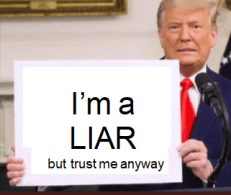
What to read if you want the facts

If you want the facts, read a dictionary:

Merriam-Webster Logo
Trumpery

Webster Trumpery

synonyms for trumpery

========================================================================================================================================================

Urban dictionary
Trumper

Trumper

Trumper II