
(Republican) Senator Rick Scott led his colleagues in introducing the Federal Debt Emergency Control Act to rein in Washington’s out-of-control spending and provide a concrete path forward to tackle the nation’s nearly $30 trillion debt.“Out-of-control” is a synonym for “Gosh, that’s a lot of money to waste on the poor.” In fact, the “Out-of-control” spending is controlled by Congress, of which Republican Senator Rick Scott is a part. This is the same Republican Congress that gave the rich a vast, over-budget tax reduction, without a whimper from Senator Rick Scott. Suddenly, with a Democratic majority Congress and Presidency, the Republicans have re-discovered federal deficits. And they are “shocked, shocked I tell you.” “Out of control” also is a synonym for “ticking time bomb,” about which we have written several times. It’s the bomb that for 80+ years, debt haters have been telling you is ready to explode. Yet, here we are. No explosion. Economic growth. Decades of low inflation.
The Federal Debt Emergency Control Act requires the Office of Management and Budget to declare a “Federal Debt Emergency” in any fiscal year where the federal debt exceeds 100% of that year’s Gross Domestic Product (GDP).Why the 100% figure? There’s no reason for it other than ignorance. The ratio of federal debt to GDP has absolutely no significance regarding the health of the U.S. economy. It’s a useless, meaningless ratio that gets fire-breathed with alarm by those who either know nothing about economics, or worse, want you to know nothing about economics. If (Republican) Senator Rick Scott is right, you would expect the sickest, weakest economies to have the highest Debt/GDP ratios, while the healthiest, weakest economics have the lowest Debt/GDP ratios. But what do we find? Here are some examples:
Sample Nations: DEBT / GDP Ratios
 Based on the above ratios, which nations would you say have the strongest, healthiest economies, and which have the weakest, sickest economies?
Right. The Debt/GDP ratio tells you exactly nothing about the health or strength of a nation’s economy.
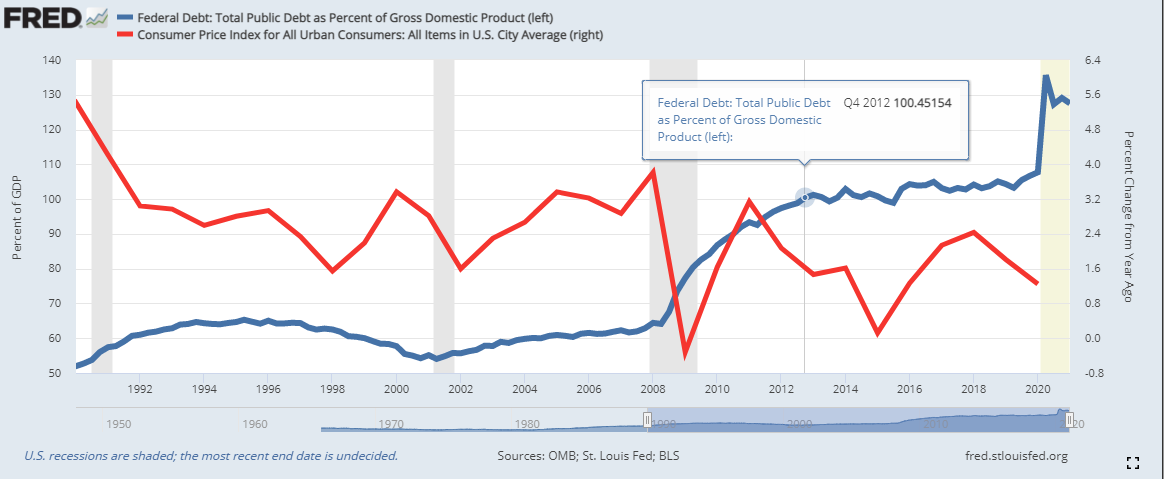
But Republican Senator Rick Scott wants to cut federal spending as soon as our ratio hits the arbitrary and meaningless number: 100% (which it already did way back in the 4th qtr of 2012 — blue line).
And by the way, inflation (red line), the current Republican excuse for cutting benefits for the poor, has averaged below the Fed’s 2% target.
Based on the above ratios, which nations would you say have the strongest, healthiest economies, and which have the weakest, sickest economies?
Right. The Debt/GDP ratio tells you exactly nothing about the health or strength of a nation’s economy.
But Republican Senator Rick Scott wants to cut federal spending as soon as our ratio hits the arbitrary and meaningless number: 100% (which it already did way back in the 4th qtr of 2012 — blue line).
And by the way, inflation (red line), the current Republican excuse for cutting benefits for the poor, has averaged below the Fed’s 2% target.

This emergency designation would trigger several provisions to help control and reduce the federal debt to levels below 100% of GDP, including: Terminating any unobligated funding from the American Rescue Plan Act, and any previous stimulus bills, and sending it back to the Treasury General Fund immediately for deficit reduction.He’s not specific about what should be cut. He just wants to cut “any unobligated funds,” no matter how vital to the economy and the people they may be. Exactly what is supposed to happen in the Treasury General Fund for deficit reduction? What is the “it” he wants to send back? Which dollars are not to be spent? The whole thing is financially senseless, but it is a classic right-wing approach. The American Rescue Plan Act and the previous stimulus bills rescued America from the severe recession that was exacerbated by Donald Trump’s incompetent and deadly COVID denial along with his economically damaging trade duty war against China. Scott is silent about that. Scott never says. Why? Because, being a Republican, he would cut all the spending that benefits the poor and middle classes, while falsely claiming that the rich are “job makers” who should be rewarded even more than they already are.
Requiring all legislation that increases the federal deficit, as determined by the Congressional Budget Office, to carry its own offsets.This means running a balanced budget, perhaps the least intelligent idea ever to come out of any Congressperson’s mouth because: A balanced federal budget is absolutely, positively guaranteed to cause a deep recession if we are lucky, or a deep depression if we are not lucky. If you can find anyone on this planet who can demonstrate how running a balanced federal budget would allow for economic growth and/or prevent a depression, I would love to see the evidence. Perhaps the same person also can prove that global warming is a Chinese myth, and that Donald Trump actually won the election — two equally nutsy claims coming from the GOP.
If it does not, the legislation shall be considered out of order and will require at least two-thirds of all Senators to vote to increase federal debt before even being able to consider the bill.Wait! What if two-thirds of all Senators were, by some miracle, to vote to increase the federal debt, would that mean it then becomes OK? Suddenly it would be within the government’s “means”? And, don’t we already have the ridiculous federal “debt limit,” that not only does the same thing, but is raised every time it’s reached? And why is the debt limit always raised? Because, Congress is well aware that limiting federal debt would destroy the U.S. economy.
Fast-tracking any legislation that would reduce the federal deficit by at least 5 percent over ten years.Where did that 5% number come from? It surely wasn’t derived by any scientific method. Scott apparently thinks it’s a nice number, so he uses it. It reminds one of dearly departed Herman Cain’s meaningless “9-9-9” tax plan. Just numbers with no real reason. And where is the math that says reducing the federal deficit would benefit the economy in some way? Non-existent.
Senator Rick Scott said, “America is in a debt crisis. Our nation is barreling toward $30 trillion in debt – an unimaginable $233,000 in debt for every family in America.It’s not that families owe that debt. The government does. But Scott tries to imply, falsely, that your family will have to pay for that debt.
It’s a crisis caused by decades of wasteful and reckless spending by Washington politicians. Now, President Biden is continuing this way of governing by pushing for trillions in wasteful spending, raising the U.S. federal debt by 60% to $39 trillion and the debt-to-GDP ratio to 117% in 2030, the highest level ever recorded in American history.And what has been the result of all this “wasteful and reckless spending? Taxes are down and GDP is up. But Scott wants to fix that, by raising taxes and/or reducing GDP.
Spending beyond our means has consequences.The federal government, being Monetarily Sovereign, has no “means.”
We’re already seeing rising inflation, which disproportionately hurts the poorest families, like mine growing up.The “rising inflation,” which for decades has been below Federal goals, is the result of the pandemic, not the result of federal spending. It was the pandemic, and Trump’s atrocious handling of it, that led to the shortages of goods and services, that resulted in a thoroughly predictable inflation. Someone, please ask Sen. Scott, “Where was the inflation last year and the year before, and the decades before, when deficit spending was massive?” And yes, we caught that “I grew up poor” disgusting attempt at ingratiating yourself with the people you are trying to screw. But hey, as long as you’re talking about your history, let’s get into where your calculations might have come from:
In 1987, after serving in the United States Navy and becoming a law firm partner, Scott co-founded Columbia Hospital Corporation. Columbia later merged with another corporation to form Columbia/HCA, which eventually became the nation’s largest private for-profit health care company. Scott was pressured to resign as chief executive of Columbia/HCA in 1997. During his tenure as chief executive, the company defrauded Medicare, Medicaid and other federal programs. The Department of Justice ultimately fined the company $1.7 billion in what was at the time the largest health care fraud settlement in U.S. history.And this fraudster is the guy who suddenly has become so concerned about the federal government’s “means” and its ability to pay its bills. No wonder this criminal is a Trumper. “Birds of a feather,” as they say. He must have envied Trump University.
I look forward to every fiscally responsible Republican and Democrat working with me to quickly pass the Federal Debt Emergency Control Act.”Yes, do vote for good old “fiscally responsible” Rick Scott, who can hardly wait to cut benefits to the poor, while driving the economy into a depression, thus allowing his rich backers to buy up property and businesses at discount prices, while paying workers depression-era wages. And, there are people who actually believe this guy! Strange. Fortunately, with a currently Democratic Congress and President, this idiotic ploy has no chance to pass, and least not in the near future. And it wasn’t meant to pass. There isn’t a new idea in the entire proposal. It’s a rehash of all the discredited nonsense that has been floated by populists for decades. It was assembled in a half-hour as a political stunt to show how fiscally sound is the do-nothing, historically crooked Senator from Columbia/HCA. Rodger Malcolm Mitchell Monetary Sovereignty Twitter: @rodgermitchell Search #monetarysovereignty Facebook: Rodger Malcolm Mitchell ………………………………………………………………………………………………………………………………
THE SOLE PURPOSE OF GOVERNMENT IS TO IMPROVE AND PROTECT THE LIVES OF THE PEOPLE.
The most important problems in economics involve:- Monetary Sovereignty describes money creation and destruction.
- Gap Psychology describes the common desire to distance oneself from those “below” in any socio-economic ranking, and to come nearer those “above.” The socio-economic distance is referred to as “The Gap.”
- Eliminate FICA
- Federally funded Medicare — parts A, B & D, plus long-term care — for everyone
- Social Security for all
- Free education (including post-grad) for everyone
- Salary for attending school
- Eliminate federal taxes on business
- Increase the standard income tax deduction, annually.
- Tax the very rich (the “.1%”) more, with higher progressive tax rates on all forms of income.
- Federal ownership of all banks
- Increase federal spending on the myriad initiatives that benefit America’s 99.9%


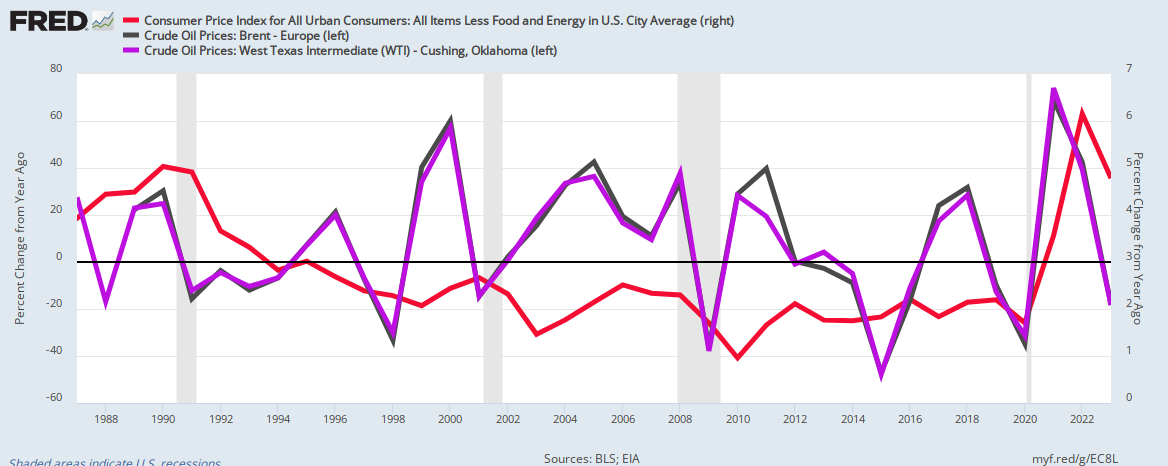
 The prior graph indicated that inflation at some unknown level, has existed for many years, though measurements differ significantly.
The second graph shows that year-to-year inflation changes generally have trended down. The outlier continues to be the Fed’s preference, PCE, while
The prior graph indicated that inflation at some unknown level, has existed for many years, though measurements differ significantly.
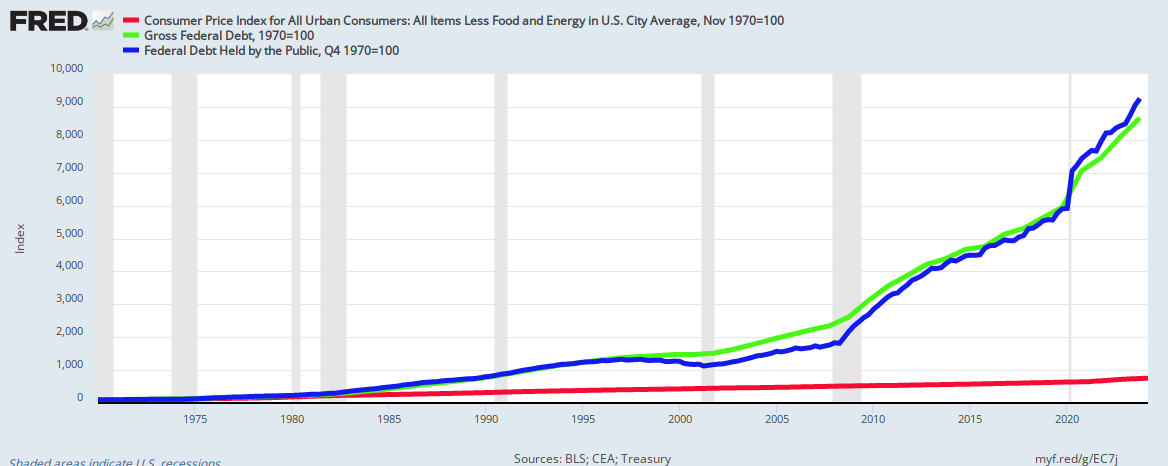
The second graph shows that year-to-year inflation changes generally have trended down. The outlier continues to be the Fed’s preference, PCE, while  We find no relationship between deficits and any commonly-used measure of inflation.
Look closely, and you will see that the maroon line (Federal Debt Held By The Public), the measure of federal deficit spending, does not move in concert with any measure of inflation.
There simply is no evidence to support the commonly held notion that inflation is caused by federal deficit spending. The belief in the monetary cause of inflation simply is wrong, though that belief is a primary source of federal debt fear.
Here is the “logic,” as expressed by Investopedia:
We find no relationship between deficits and any commonly-used measure of inflation.
Look closely, and you will see that the maroon line (Federal Debt Held By The Public), the measure of federal deficit spending, does not move in concert with any measure of inflation.
There simply is no evidence to support the commonly held notion that inflation is caused by federal deficit spending. The belief in the monetary cause of inflation simply is wrong, though that belief is a primary source of federal debt fear.
Here is the “logic,” as expressed by Investopedia:
 To pay for its deficit spending, the federal government sends instructions (not dollars) to each creditor’s bank, instructing the bank to increase the balance in the creditor’s checking account.
The instant the bank does as instructed, new dollars are created and added to the money measure known as
To pay for its deficit spending, the federal government sends instructions (not dollars) to each creditor’s bank, instructing the bank to increase the balance in the creditor’s checking account.
The instant the bank does as instructed, new dollars are created and added to the money measure known as 
 No one lends money to a government that has, via its own laws, given itself the unlimited ability to create its own sovereign currency.
The U.S. federal government never unwillingly can run short of laws, and it never unwillingly can run short of dollars.
No one lends money to a government that has, via its own laws, given itself the unlimited ability to create its own sovereign currency.
The U.S. federal government never unwillingly can run short of laws, and it never unwillingly can run short of dollars.



 #Monetary Sovereignty - Mitchell