How are the Democrats actively helping Trump win in 2020?

Let’s begin with the absolute fact that Donald J. Trump is an immoral, incompetent, lying, bigot, and a fool. So how can he possibly win the next election?
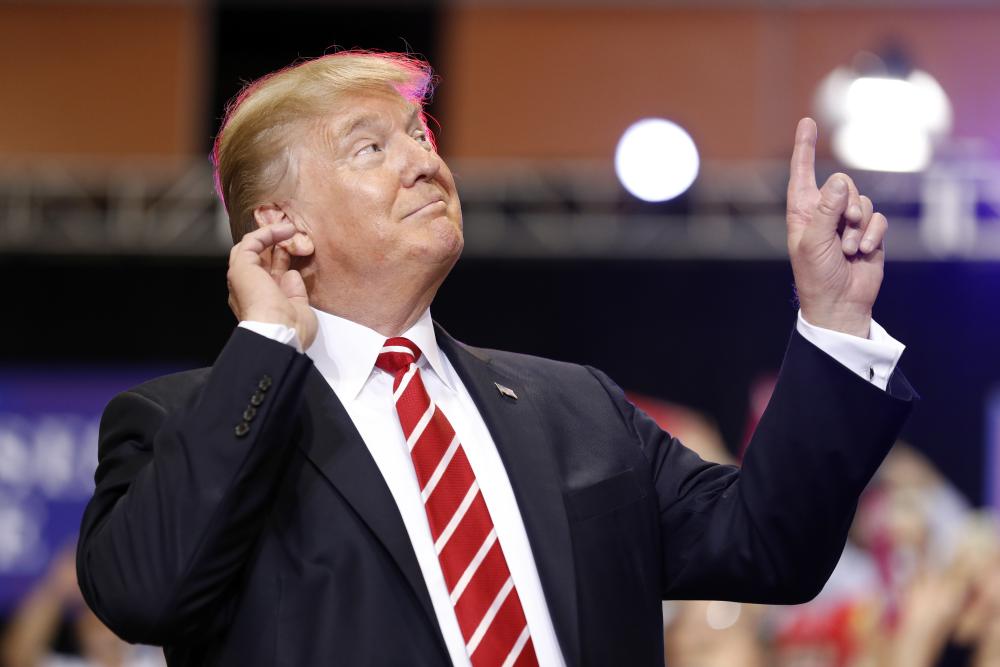
Image result for trump
—I am a stable genius. Believe me.—

Are we to believe that the majority  of Americans either don’t see it, or don’t care, or even actively demand that their President be an immoral, incompetent, lying, bigot, and a fool?

Somehow, I have more faith in the American electorate than that. Trump can’t win on his own.

But what if he has help from the Democrats? 

Here are excerpts from an article published by Reason.com 7/22/19:

Possible Budget Deal Will Add $2 Trillion to the National Debt
If President Donald Trump signs the deal into law, he will have authorized a 22 percent increase in federal discretionary spending during his first term in office.
ERIC BOEHM | 7.22.2019 4:15 PM

It holds true that the only thing pretty much everyone in Congress and the White House can agree on is to spend more money.

The White House and Congress are closing in on a deal to hike spending and postpone a battle over the debt limit until July 2021—eight months after the next presidential election.

The proposed plan will increase current spending caps by $320 billion over the next two years, with the spending hikes equally split between domestic programs and the military.

Have you ever heard the phrase, “It’s the economy, stupid“? Per HuffPost: [In 1992, James Carville, an aide to Bill Clinton, focused on, “It’s the economy, stupid,” until it became a part of the American political lexicon.]

It simply means that for most voters, the single most important vote-determining factor is their wallet. Whichever candidate makes the most extravagant claims about future employment and wages, has the best chance to win.

Depending on the details, the new budget could add as much as $2 trillion to the national debt over the next decade, according to the Committee for a Responsible Federal Budget (CRFB), a self-proclaimed, “nonpartisan” group that favors balanced federal budgets.

Every U.S. depression has resulted from federal debt reduction:

1804-1812: U. S. Federal Debt reduced 48%. Depression began 1807.
1817-1821: U. S. Federal Debt reduced 29%. Depression began 1819.
1823-1836: U. S. Federal Debt reduced 99%. Depression began 1837.
1852-1857: U. S. Federal Debt reduced 59%. Depression began 1857.
1867-1873: U. S. Federal Debt reduced 27%. Depression began 1873.
1880-1893: U. S. Federal Debt reduced 57%. Depression began 1893.
1920-1930: U. S. Federal Debt reduced 36%. Depression began 1929.
1997-2001: U. S. Federal Debt reduced 15%. Recession began 2001.

By law, the federal “debt” (i.e. deposits into T-security accounts) is increased with federal deficit spending. And federal deficit spending adds growth dollars to the economy.

So, the proposed increase in current spending caps by $320 billion over the next two years, will enrich the economy, and add jobs and payroll.

Because the Democrats are going along with this, they are helping the party in power to retain its power, while helping the President to retain the Presidency. (It’s the economy, stupid.)

Why would Democrats do this?

In a statement, the CRFB said the budget deal “may be the worst in history,” given the country’s current precarious fiscal condition.

“Members of Congress should cancel their summer recess and return to the negotiating table for a better deal. If they don’t, those who support this deal should hang their heads in total shame as they bolt town,” says Maya MacGuineas, president of the CRFB.

“This deal would amount to nothing short of fiscal sabotage.”

If President Donald Trump signs the deal into law, he will have authorized a 22 percent increase in federal discretionary spending during his first term in office—having signed a March 2018 budget deal that similarly jacked up both domestic and military spending.

As always, the wrong-headed CRFB spews the austerity notion that by some magic, adding dollars to the economy will have a negative effect on economic growth, while taking dollars from the economy will stimulate growth.

It’s utter nonsense, but it’s nonsense the CRFB is paid to spew.

Why? Because the rich grow richer when the Gap between them and the non-rich grows. Increased government spending usually benefits the poor and middle classes (narrowing the gap).

The rich, who run America, hate spending that benefits the middle and poor. So they pay people like CRFB to disseminate the Big Lie that the federal debt is “unsustainable,” The same lie they have been telling during all the years the government has “sustained” a growing debt.

Democrats are largely a lost cause when it comes to fiscal responsibility, while Republicans—with few exceptions—are little better, having abandoned decades of lip service to the benefits of smaller government.

Note the subtle shift: Suddenly the CRFB is talking about “smaller government,” which is substantially different from “less spending.”

Naturally, CRFB does not explain how it was possible for the nation to have grown while its government spending also has grown. According to CRFB, the massive increase in federal debt should have thrown us into recession, depression or worse.

But here we are, growing, growing, growing, in GDP and “debt.”.

We’re not even a decade removed from the moment when every major Republican candidate for president said they would reject a budget deal that included $1 in tax increases for every $10 in budget cuts.

Now, the modus operandi of the GOP is to ignore the threat of what near-record debt levels will do to economic growth in the coming decades.

I’ll tell you what near-record debt levels will do to economic growth. Near-record debt levels will add growth dollars to the economy, thereby growing the economy and (oh, dear!) perhaps funding things like Medicare for All and more generous Social Security — the very last things the rich want.

The Republican Study Committee, a coalition that includes most members of the House GOP caucus, has condemned the budget deal as fiscally irresponsible, and the president of the conservative Club for Growth has said the agreement will “propel our country toward bankruptcy and fiscal crisis.”

Image result for time bombIf this ridiculous, actually impossible “sky is falling” prediction sounds familiar to you regular readers, perhaps you last saw it here: “It is 2019, and the phony federal debt “time bomb” still is ticking.”

But again, why would the Democrats go along with something that advances the possibility of Trump winning another term?

One is tempted to say it is due to ignorance and cowardice.

Some Democrats truly might be ignorant of the absolute fact that increased federal deficit grows the economy, and there is zero danger the Monetarily Sovereign, U.S. federal government ever can run short of its own sovereign currency, the U.S. dollar.

Most of the Democrats, however, are well aware of the truth. In fact, Bernie Sanders hired Professor Stephanie Kelton, an economist who understands Monetary Sovereignty, as his economic advisor.

I’ve communicated with Professor Kelton; she told him the facts.

What of cowardice? Are the Democrats afraid the American electorate is so obtuse and so resistant to learning, that any politician telling them the truth will be pilloried? Perhaps, but . . .

I believe the truth is to be found elsewhere — with the fundamental difference between the two parties:

The Republicans are united and victory-driven. As a group, they are perfectly willing to sacrifice any principles for votes. They are conservative only when that is a winning strategy.

Donald Trump, for instance, never has had an underlying philosophy. He has changed with the wind, depending on what his daughter and Fox News’ Sean Hannity tell him, today.

Our Republican president says he doesn’t have to worry about the coming debt crisis because he “won’t be here” when it happens, and conservative talking heads that once blasted President Barack Obama for soaring levels of national debt now argue, as Rush Limbaugh did last week, that “all this talk about concern for the deficit and the budget has been bogus for as long as it’s been around.”

As Republican Senator Mitch McConnell once said, “The single most important thing we want to achieve is for President Obama to be a one-term president.” That is classic Republican aspiration.

By contrast, the Democrats are divided and ideology-driven. They each wish to help the tired, the poor, the homeless, the huddled masses yearning to breathe free, each in a different way.

The Democrats will sacrifice votes for principle, as witness the intramural battles for the soul of the party. Example: “The Squad” of Reps. Alexandria Ocasio-Cortez, D-N.Y., Ilhan Omar, D-Minn., Ayanna Pressley, D-Mass., and Rashida Tlaib, D-Mich. pull the Democrats into electorally unpopular, but ideologically impelled directions.

There is, among Democrats, a greater insistence on ideological purity, and less reliance on political cleverness.

We’ll end with the CRFB’s final gasp of nonsense:

The CBO presently projects that by 2049, the national debt will be more than one and a half times the size of the entire U.S. economy, breaking a record set during World War II.

If a recession hits, those numbers could be worse.

And yet the only thing officials in Washington can agree to do is spend more money. May our children forgive us.

Three sentences; three moments of nonsense:

  1. A low federal debt / Gross Domestic Product fraction never can indicate economic growth. See: Enough already, with the Debt/GDP ratio
  2. Insufficient deficit spending actually will cause the recession the CRFB claims to fear.
  3. Federal deficit spending on assistances to the middle classes and the poor (Social Security, Medicare, poverty aids, school aids) will benefit our children.

The Democrats know; the Republicans know; the rich know. Sadly the poor and middle-class majorities don’t know, which is why the worst President in U.S. history was elected and may be re-elected.

Ignorance has its penalties

Summary:

In answer to the title question: “How are the Democrats actively helping Trump win in 2020?”

The Republicans are more united and victory-driven. Together they sacrifice principle for votes. The Democrats are more divided and individually ideology-driven. They sacrifice votes for personal principle.

One might think that because “the tired, the poor, the homeless, the huddled masses yearning to breathe free” outnumber Protestant, white, males, and that self-described Democrats outnumber self-described Republicans, the Democrats would win more elections.

But while Republicans find it easy to unite behind any scoundrel who will win, the Democrats engage in internecine, divisive battles based on personal ideological purity.

That lack of unity can be deadly.

Rodger Malcolm Mitchell
Monetary Sovereignty
Twitter: @rodgermitchell
Search #monetarysovereigntyFacebook: Rodger Malcolm Mitchell

…………………………………………………………………………………………………………………………………………………………………………………………………………………………………………………………………………………………..

The most important problems in economics involve the excessive income/wealth/power Gaps between the richer and the poorer.

Wide Gaps negatively affect poverty, health and longevity, education, housing, law and crime, war, leadership, ownership, bigotry, supply and demand, taxation, GDP, international relations, scientific advancement, the environment, human motivation and well-being, and virtually every other issue in economics.

Implementation of The Ten Steps To Prosperity can narrow the Gaps:

Ten Steps To Prosperity:

1. Eliminate FICA

2. Federally funded Medicare — parts a, b & d, plus long-term care — for everyone

3. Provide a monthly economic bonus to every man, woman and child in America (similar to social security for all)

4. Free education (including post-grad) for everyone

5. Salary for attending school

6. Eliminate federal taxes on business

7. Increase the standard income tax deduction, annually. 

8. Tax the very rich (the “.1%”) more, with higher progressive tax rates on all forms of income.

9. Federal ownership of all banks

10. Increase federal spending on the myriad initiatives that benefit America’s 99.9% 

The Ten Steps will grow the economy, and narrow the income/wealth/power Gap between the rich and you.

MONETARY SOVEREIGNTY


10 questions about America’s trade deficit. Oh woe, the trade deficit is (too high?, too low?, too just right?)

Oh woe, the trade deficit is (too high?, too low?, too just right?)

Here are excerpts from an article in “the balance.com,” that will help you come to a conclusion.

US Trade Deficit With China and Why It’s So High
The Real Reason American Jobs Are Going to China
BY KIMBERLY AMADEO

The U.S. trade deficit with China was $419 billion in 2018. The trade deficit exists because U.S. exports to China were only $120 billion while imports from China were $540 billion.

The biggest categories of U.S. imports from China were computers and accessories, cell phones, and apparel and footwear.

A lot of these imports are from U.S. manufacturers that send raw materials to China for low-cost assembly. Once shipped back to the United States, they are considered imports.

Let’s say you market cell phones under your brand name.

You buy the phones from a Chinese manufacturer for $200 each. You apply your brand name and wholesale the phones for $300 each, after which they retail for $500 each.

This process involves a $200 per phone, U.S. trade deficit with China

If the phones had been 100% American made, they would have cost you $300, and you would have had to wholesale them in America for $450 each, after which they would have cost American consumers $750 each.

We’ll lead off with the ten questions. At the end of the article, we’ll discuss the answers.

Question #1: Is this trade deficit a good thing or a bad thing for America as a nation and for Americans as consumers?

Here is more from the article:

China’s biggest imports from America are commercial aircraft, soybeans, and autos. In 2018, China canceled its soybean imports after President Trump started a trade war. He imposed tariffs on Chinese steel exports and other goods.

Questions #2 & #3: Who pays for the tariffs on Chinese steel and other goods? Who pays for the cancelation of China’s soybean imports?

Since 2012, the U.S. trade deficit with China has increased. It was $315 billion in 2012, rose to $367.3 billion in 2015, then fell to $346.9 billion in 2015. In just two years, it’s increased to $419.2 billion.

Question #4: Who pays for a trade deficit?

China can produce many consumer goods at lower costs than other countries can. Americans, of course, want these goods for the lowest prices.

How does China keep prices so low? Most economists agree that China’s competitive pricing is a result of two factors:

–A lower standard of living, which allows companies in China to pay lower wages to workers.

–An exchange rate that is partially fixed to the dollar.

Question #5: Who pays for a lower standard of living? 

China pegs its currency to the dollar using a modified fixed exchange rate. When the dollar loses value, China buys dollars through U.S. Treasurys to support it.

Question #6: Who pays for a stronger (higher value) dollar?

China must buy so many U.S. Treasury notes that it is the largest lender to the U.S. government. Japan is the second largest.

As of April 2019, the U.S. debt to China was $1.1 trillion. That’s 27% of the total public debt owned by foreign countries.

Question #7: Why does lending to the U.S. strengthen the U.S. dollar?

Many are concerned that this gives China political leverage over U.S. fiscal policy. They worry about what would happen if China started selling its Treasury holdings.

It would also be disastrous if China merely cut back on its Treasury purchases.

Why are they so worried? By buying Treasurys, China helped keep U.S. interest rates low. If China were to stop buying Treasurys, interest rates would rise.

That could throw the United States into a recession. But this wouldn’t be in China’s best interests, as U.S. shoppers would buy fewer Chinese exports. In fact, China is buying almost as many Treasurys as ever.

Question #8: Why does China’s purchase of Treasury securities reduce interest rates?

U.S. companies that can’t compete with cheap Chinese goods must either lower their costs or go out of business.

Many businesses reduce their costs by outsourcing jobs to China or India. Outsourcing adds to U.S. unemployment. Other industries have just dried up.

U.S. manufacturing, as measured by the number of jobs, declined 34% between 1998 and 2010. As these industries declined, so has U.S. competitiveness in the global marketplace.

Question #9: Why is a decline in manufacturing a concern?

President Trump promised to lower the trade deficit with China.

On March 1, 2018, he announced he would impose a 25% tariff on steel imports and a 10% tariff on aluminum. On July 6, 2018, Trump’s tariffs went into effect for $34 billion of Chinese imports. China canceled all import contracts for soybeans.

Trump’s tariffs have raised the costs of imported steel, most of which is from China. Trump’s move comes a month after he imposed tariffs and quotas on imported solar panels and washing machines.

China has become a global leader in solar panel production. The tariffs depressed the stock market when they were announced.

Trump also asked China to do more to raise its currency. He claims that China artificially undervalues the yuan by 15% to 40%.

That was true in 2000. But former Treasury Secretary Hank Paulson initiated the U.S.-China Strategic Economic Dialogue in 2006. He convinced the People’s Bank of China to strengthen the yuan’s value against the dollar.

It increased by 2% to 3% annually between 2000 and 2013. Former U.S. Treasury Secretary Jack Lew continued the dialogue during the Obama administration. The Trump administration continued the talks until they stalled in July 2017.

The dollar strengthened 25% between 2013 and 2015. It took the Chinese yuan up with it. China had to lower costs even more to compete with Southeast Asian companies.

The PBOC tried unpegging the yuan from the dollar in 2015. The yuan immediately plummeted. That indicated that the yuan was overvalued. If the yuan were undervalued, as Trump claims, it would have risen instead.

Question #10: Is Donald Trump clueless about international trade?

==================================================================================

Image result for ANSWERS

Question #1: Is this trade deficit beneficial or detrimental for America as a nation and for Americans as consumers?

Our “trade deficit,” as the term is used, means that America sends more dollars to foreign countries than they send to us.

One of life’s enduring mysteries is why this even exchange is known as a “deficit.” It just as well could be called a “surplus” because the foreign countries send us more goods and services than we send them.

The United States is Monetarily Sovereign. It creates dollars at will.

Fed Chairman Ben Bernanke: “The U.S. government has a technology, called a printing press (or, today, its electronic equivalent), that allows it to produce as many U.S. dollars as it wishes at essentially no cost.”

Fed Chairman Alan Greenspan: “Central banks can issue currency, a non-interest-bearing claim on the government, effectively without limit. A government cannot become insolvent with respect to obligations in its own currency.”

St. Louis Federal Reserve: “As the sole manufacturer of dollars, whose debt is denominated in dollars, the U.S. government can never become insolvent, i.e.,unable to pay its bills. In this sense, the government is not dependent on credit markets to remain operational.

But the United States has only a limited supply of goods and services.

Something you can create at will and at no cost (dollars) is not as valuable as something that is in limited supply (goods and services). To America, dollars are much less valuable than are goods and services.

Therefore, from the standpoint of America as a nation, the so-called trade “deficit” actually is a trade “surplus,” and is beneficial for America.

From the standpoint of American consumers,  the trade “deficit” means Americans have money, and are able to use that money to obtain desired goods and services from other nations. This is a good thing.

Every time you walk into a store and buy something, you run what the economists might call a “trade deficit” with the store. Yet no one suggests that running a “deficit” with a store is detrimental to a consumer.

Questions #2 & #3: Who pays for the tariffs on Chinese steel and other goods? Who pays for the cancelation of China’s soybean imports?

Tariffs are taxes levied on the buyers. The tariffs on Chines steel and other goods are paid by U.S. consumers, and these tariff dollars are sent to the U.S. Treasury, where they are destroyed. (“Does the U.S. Treasury really destroy your tax dollars?“)

Like all U.S. taxes, U.S. tariffs take growth dollars out of the American economy and therefore are recessionary. Trump’s tariffs take money from your pockets.

And China’s cancellation of soybean imports hurts American soybean farmers.

Question #4: Who pays for a trade deficit?

A trade “deficit” reflects an even exchange between dollars vs. goods and services. As discussed in #1, the so-called trade-deficit actually is a trade surplus, that is beneficial to America.

Question #5: Who pays for a lower standard of living? 

The poor. No matter how low a nation’s standard of living may be, the rich always have a high standard of living.

If, to achieve a trade “surplus,” a nation cuts wages, the working poor and the average standard of living will suffer.

Question #6: Who pays for a stronger (higher value) dollar?

Americans, who buy foreign goods, benefit from a higher value dollar. To some degree, every American buys foreign goods, much of which are part of the contents of the goods we buy.

Thus, despite the stock market’s immediate negative reaction to higher interest rates, higher rates strengthen the dollar and fight inflation by making imports cheaper in dollars.

Higher interest rates also are beneficial also because they force the federal government to pay more growth dollars into the economy, when paying interest on Treasury securities.

On balance, higher interest rates benefit the economy and consumers.

Question #8: Why does China’s purchase of Treasury securities reduce interest rates?

The common belief is that the U.S. must sell a certain amount of T-securities, and if China didn’t buy, then the government would have to raise rates in order to entice other people to buy.

In fact, being Monetarily Sovereign, the federal government has absolute control over everything related to the dollar, including interest rates.

Further, it is not forced to sell any amount of T-securities. If the government wished, it could stop accepting deposits into T-security accounts at any time.

Thus, it would not “be disastrous if China merely cut back on its Treasury purchases,” as the article’s author claimed.

Dollars were a creation of the U.S. government laws. The U.S. government is not permanently bound by the laws it alone creates.

Interest rates are what the government wishes them to be, as the Fed demonstrates every day.

Question #9: Why is a decline in manufacturing a concern?

It is a concern only to those who hold the outdated belief that the American economy relies on manufacturing.

While manufacturing employment has declined, employment in non-manufacturing industries has grown.

Today, unemployment is at historic lows, demonstrating the declining importance of the manufacturing sector.

Question #10: Is Donald Trump clueless about international trade?

Without a doubt. His pressure on the Federal Reserve to lower interest rates, and his trade wars, are ample proof of his ineptness.

He continually needs someone to blame for something — anything — to deflect any blame from himself, so he wrongly blames the Fed for less than impressive economic growth.

Business hates uncertainty.

The rapid turnover in Trump’s administration, plus his erratic flip-flopping on issues, plus his character attacks, plus his trade wars, plus his sudden and arbitrary withdrawals from international agreements, plus his nativist bigotry, all contribute to an adverse business climate.

Answer to the big question: The so-called “trade deficit” is a benefit to the United States.

Rodger Malcolm Mitchell
Monetary Sovereignty
Twitter: @rodgermitchell
Search #monetarysovereigntyFacebook: Rodger Malcolm Mitchell

…………………………………………………………………………………………………………………………………………………………………………………………………………………………………………………………………………………………..

The most important problems in economics involve the excessive income/wealth/power Gaps between the richer and the poorer.

Wide Gaps negatively affect poverty, health and longevity, education, housing, law and crime, war, leadership, ownership, bigotry, supply and demand, taxation, GDP, international relations, scientific advancement, the environment, human motivation and well-being, and virtually every other issue in economics.

Implementation of The Ten Steps To Prosperity can narrow the Gaps:

Ten Steps To Prosperity:

1. Eliminate FICA

2. Federally funded Medicare — parts a, b & d, plus long-term care — for everyone

3. Provide a monthly economic bonus to every man, woman and child in America (similar to social security for all)

4. Free education (including post-grad) for everyone

5. Salary for attending school

6. Eliminate federal taxes on business

7. Increase the standard income tax deduction, annually. 

8. Tax the very rich (the “.1%”) more, with higher progressive tax rates on all forms of income.

9. Federal ownership of all banks

10. Increase federal spending on the myriad initiatives that benefit America’s 99.9% 

The Ten Steps will grow the economy, and narrow the income/wealth/power Gap between the rich and you.

MONETARY SOVEREIGNTY

Where were you at the moment America became a fascist dictatorship?

Memory is divided into moments.

Few of us remember what we were doing on December 6, or December 8, of 1941, but if you’re old enough,  you well may remember what you were doing, on December 7, 1941, when the Japanese bombed Pearl Harbor and precipitated America’s official entry into World War II.

It was called, “a date which will live in infamy.”

You well may remember where you were, and what you were doing, on September 11, 2001, when America was attacked by the Islamic terrorist group al-Qaeda.

It too, is a date which will live in infamy.

And in the future, you may remember where you were and what you were doing on the day Donald J. Trump officially turned America into a fascist dictatorship.

On July 14, 2019, Trump tweeted:

“So interesting to see ‘Progressive’ Democrat Congresswomen, who originally came from countries whose governments are a complete and total catastrophe, the worst, most corrupt and inept anywhere in the world, now loudly and viciously telling the people of the United States, the greatest and most powerful nation on earth, how our government is to be run.”

“Why don’t they go back and help fix the totally broken and crime-infested places from which they came. Then come back and show us how it is done.”

“These places need your help badly, you can’t leave fast enough. I’m sure that Nancy Pelosi would be very happy to quickly work out free travel arrangements!”

If you saw the video of the Trump crowd screaming, “Send her back,” you might have been reminded of Hitler.

I have written on several occasions — as far back as 2015 — about the uncanny resemblances between Hitler’s crowds and Trump’s crowds — the same blind, foaming-at-the-mouth, animal hatred — the same ability to believe the most outrageous lies, simply because der Fuhrer told the people to believe

Hitler in America. Why a bigot can win the Presidency Saturday, Jul 4, 2015

Hitler redux Monday, Dec 7, 2015

And again in 2016:

Astounding similarities: Hitler in America. It’s happening now. Friday, Sep 30 2016

And still again in 2017:

“Lügenpresse”: Hitler’s “fake news.” We’re making the same mistake, again. Sunday, Dec 10 2017

And this year, yet again.

Would your friends and neighbors turn you in? Tuesday, Jun 11 2019

Hitler’s lesson: Bigotry didn’t end with the Gypsies Tuesday, Jul 16 2019

Nothing has changed.

Just as the Germans in the 30s neither could have anticipated nor believed what was about to befall them, today’s Trump followers scoff smugly at the notion of Trump being a reincarnation of Hitler.

Some of them even wish to follow a Hitler clone, because he’s a “strong leader.”

The following quotes from the Encyclopedia Brittanica eerily describe Donald Trump:

Hitler’s ideas included inequality among races, nations, and individuals as part of an unchangeable natural order that exalted the “Aryan race” as the creative element of mankind. [vs.  “shithole,” black nations and Latinos.]

According to Hitler, the natural unit of mankind was the Volk (“the people”), of which the German people was the greatest. [“America first.” “Make America great again.”]

Parliamentary democratic government stood doubly condemned. [Trump’s angry battles with judges who rule against him.]

Hitler assumed the equality of individuals did not exist and supposed that what was in the interests of the people could be decided by parliamentary procedures. [Trump’s repeated attempts to bypass the Constitution]

Instead, Hitler argued that the unity of the people would find its incarnation in the Führer, endowed with perfect authority. Below the Führer the party was drawn from the people and was in turn its safeguard. [Criticism of Trump is “unAmerican.” The GOP Congress does not dare disagree with him.]

Beyond Marxism Hitler believed the greatest enemy of all to be the Jew, who was for Hitler the incarnation of evil. As early as 1919 he wrote, “Rational anti-Semitism must lead to systematic legal opposition. Its final objective must be the removal of the Jews altogether.” In Mein Kampf, he described the Jew as the “destroyer of culture,” “a parasite within the nation,” and “a menace.” [Trump’s attempts to remove immigrants and Muslims. The concentration camps at our southern border.]

In 1930, with the help of Hugenberg’s newspapers, Hitler was able for the first time to reach a nationwide audience. The alliance also enabled him to seek support from many of the magnates of business and industry who controlled political funds and were anxious to use them to establish a strong right-wing, antisocialist government. [Magnate Rupert Murdoch’s FOX News, Breitbart, Twitter help Trump reach a nationwide audience.]

The subsidies Hitler received from the industrialists enabled him to make effective his emotional appeal to the lower middle class and the unemployed, based on the proclamation of his faith that Germany would awaken from its sufferings to reassert its natural greatness. [See the character of Trump’s audiences. Trump: “I love the poorly educated.” “Make America great again.”]

Those who deny, or even agree with, Trump’s obvious, hate-filled bigotry and public failings, and are anxious to believe he will “make America great again,” have forgotten history, if they ever knew it.

And history forgotten will be repeated.

Yes, it can happen here and it is happening here. The people of Germany learned much too late.

And they and their children paid a very high price.

Rodger Malcolm Mitchell
Monetary Sovereignty
Twitter: @rodgermitchell
Search #monetarysovereigntyFacebook: Rodger Malcolm Mitchell

…………………………………………………………………………………………………………………………………………………………………………………………………………………………………………………………………………………………..

The most important problems in economics involve the excessive income/wealth/power Gaps between the richer and the poorer.

Wide Gaps negatively affect poverty, health and longevity, education, housing, law and crime, war, leadership, ownership, bigotry, supply and demand, taxation, GDP, international relations, scientific advancement, the environment, human motivation and well-being, and virtually every other issue in economics.

Implementation of The Ten Steps To Prosperity can narrow the Gaps:

Ten Steps To Prosperity:

1. Eliminate FICA

2. Federally funded Medicare — parts a, b & d, plus long-term care — for everyone

3. Provide a monthly economic bonus to every man, woman and child in America (similar to social security for all)

4. Free education (including post-grad) for everyone

5. Salary for attending school

6. Eliminate federal taxes on business

7. Increase the standard income tax deduction, annually. 

8. Tax the very rich (the “.1%”) more, with higher progressive tax rates on all forms of income.

9. Federal ownership of all banks

10. Increase federal spending on the myriad initiatives that benefit America’s 99.9% 

The Ten Steps will grow the economy, and narrow the income/wealth/power Gap between the rich and you.

MONETARY SOVEREIGNTY

Close your windows. Lock your doors. The Big Lie is coming to get you.

Well, it’s that time of year again, when the politicians on all sides of the spectrum get together to tell you the Big Lie.

Here’s an example:

[Politico, The Washington Post]
Pelosi says no debt-ceiling hike without budget deal

House Speaker Nancy Pelosi (D-Calif.) said Monday that the House would not raise the debt ceiling unless the move is part of a budget deal.

Treasury Secretary Steven Mnuchin told reporters that Congress will have to raise the debt ceiling before its August recess if there is no budget deal before then. Otherwise, he said, the federal government won’t have enough money to pay all of its bills.

Now, compare the above with the following:

Ben Bernanke: “The U.S. government has a technology, called a printing press (or, today, its electronic equivalent), that allows it to produce as many U.S. dollars as it wishes at essentially no cost.”

Alan Greenspan: “Central banks can issue currency, a non-interest-bearing claim on the government, effectively without limit. A government cannot become insolvent with respect to obligations in its own currency.”

St. Louis Federal Reserve: “As the sole manufacturer of dollars, whose debt is denominated in dollars, the U.S. government can never become insolvent, i.e.,unable to pay its bills. In this sense, the government is not dependent on credit markets to remain operational.

Notice the “slight” difference? Mnuchin said the government will run short of money, while his predecessors and the St. Louis Federal Reserve said it is impossible for the government to run short of money.

In a sense, they both are right. The federal government can run short of dollars with which to pay its bills — but only if it votes to run short of dollars.

If the federal government (Congress) votes to limit federal debt, that is identical with voting not to pay what it owes to creditors.

Here is the convoluted scenario. See if you can follow it.

    1. Federal finances are different from state and local government finances.The so-called federal “debt” actually is the total of deposits in credit market accounts: Treasury security accounts, i.e. T-bill, T-note, and T-bond accounts.
    2. These accounts are paid off simply by returning the dollars in those accounts to the account owners. As Bernanke, Greenspan and the St. Louis Fed said, “the government is not dependent on credit markets (i.e. borrowing) to remain operational, so the federal government does not spend the dollars in those credit market accounts.The dollars remain there, gathering interest until each security matures, at which time its dollars are returned to the owners. That is how the federal government “pays off” its debt.
    3. The federal government pays its bills, not with tax dollars (which are destroyed upon receipt), but rather by creating brand new dollars, ad hoc.
    4. Even though the government doesn’t use the dollars in T-security accounts, by law, the government must accept deposits in the same amount as the total of federal deficits.This may have made some sense during the times when dollars needed to be backed by gold and silver reserves, but since 1971, when President Nixon took us off the last of the metal standards, the law has made no fiscal sense whatsoever. Yet it persists.
    5. So the only effect of not raising the debt ceiling is to prevent the federal government from paying for goods and services it already has purchased.
    6. And because of the invented equivalence between deficits and “debt” (deposits), reducing the debt requires increasing federal taxes while reducing federal spending, which together reduces the nation’s money supply and leads to recessions and depressions.

Imagine that a wealthy woman becomes angry with her husband for buying an expensive car, that they already have been driving.

They easily can afford to pay for the car, but she simply doesn’t want to. So, she puts a ceiling on their checking account, and thereby stiffs the car dealer.

And that is what the debt ceiling is designed to do: Stiff all federal creditors.

Since no sane person wishes to destroy America’s credit, the whole debt-ceiling process becomes a game of “chicken” or “Russian roulette,” to see which political party will blink first.

It has absolutely nothing to do with fiscal prudence, but rather it is, “Give me my way or I will kill both of us.”

And that is the “Big Lie.” Each party, especially when not in power, pretends it is fiscally prudent by demanding that the federal debt be reduced.

But, it is a game based on the public’s ignorance of federal financing. The public has been led to believe that federal “debt” (deposits in T-security accounts) is like personal debt (borrowing to facilitate spending). It is not.

Confusingly, the word “debt” has been used to describe two completely different things. If you were told that deposits in T-security account are at an all-time high,” does that worry you as much as “debt is at an all-time high.”

The first phrase sounds good and the 2nd phrase sounds bad, yet they mean the same.

Lawmakers have until the end of September to hammer out a budget deal, as that’s when funding for several agencies is scheduled to run out.

The Treasury Department can only issue debt up to the limit set by Congress. Since President Trump’s inauguration, total government debt has increased by about $3 trillion, to more than $22 trillion. [Politico, The Washington Post]

The federal government pays its creditors about $4 trillion – $5 trillion a year. Assuming it pays most of this on a 30-day schedule, that would mean in any one month, the federal government would owe creditors about $400 billion.

That $400 billion, not $20 trillion, is the federal government’s true debt at any given moment of time.

Note that this has absolutely nothing to do with tax receipts (which are destroyed) or with incorrectly called “borrowing” (T-security dollars remain in T-security accounts and are not touched.

In summary, the “debt ceiling” is an exercise in ignorance. It uses a harmful plan to achieve a harmful result.

The harmful plan: Exercising a debt ceiling requires the federal government to cheat creditors and hurt America’s credit.

The harmful result: Reducing the federal deficit requires reducing the amount of growth money entering the economy, which always results in recessions and depressions.

Recessions, depressions, hurting creditors and hurting America’s credit: It is stupid from beginning to end, which probably is why politicians love it.

The debt ceiling is the economists’ version of trying to destroy the sun and the moon by sacrificing virgins and children.

==============================================================================

After I wrote the above post, I came to a Newsweek article that provides one small demonstration of the harm ignorance can cause:

A bill that would compensate first responders and survivors of the September 11 terrorist attacks who have since fallen ill from the toxins and chemicals they inhaled at the site has been blocked in the Senate by Rand Paul and Mike Lee.

Utah Senator Mike Lee placed a procedural hold on the extension of the 9/11 compensation fund Wednesday, blocking it from coming to a floor vote.

Said Paul. “It has long been my feeling that we need to address our massive debt in this country—we have a $22 trillion debt, [and] we’re adding debt at about a trillion dollars a year—and therefore any new spending that we are approaching, any new program that’s going to have longevity of 70, 80 years, should be offset by cutting spending that’s less valuable.”

Paul spouts the Big Lie. Our “massive debt” is only savings deposits, made by U.S. citizens and foreigners, into T-security accounts. These are no burden on the federal government or on future taxpayers.

They could be paid off tomorrow, simply by returning the dollars in these accounts.

Every depression in U.S. history has been associated with federal debt cuts:
1804-1812: U. S. Federal Debt reduced 48%. Depression began 1807.
1817-1821: U. S. Federal Debt reduced 29%. Depression began 1819.
1823-1836: U. S. Federal Debt reduced 99%. Depression began 1837.
1852-1857: U. S. Federal Debt reduced 59%. Depression began 1857.
1867-1873: U. S. Federal Debt reduced 27%. Depression began 1873.
1880-1893: U. S. Federal Debt reduced 57%. Depression began 1893.
1920-1930: U. S. Federal Debt reduced 36%. Depression began 1929.
1997-2001: U. S. Federal Debt reduced 15%. Recession began 2001.

Recessions (vertial bars) begin with reductions in deficit growth and are cured by increases in deficit growth.

===================================================================================
Rodger Malcolm Mitchell
Monetary Sovereignty
Twitter: @rodgermitchell
Search #monetarysovereigntyFacebook: Rodger Malcolm Mitchell

The most important problems in economics involve the excessive income/wealth/power Gaps between the richer and the poorer.

Wide Gaps negatively affect poverty, health and longevity, education, housing, law and crime, war, leadership, ownership, bigotry, supply and demand, taxation, GDP, international relations, scientific advancement, the environment, human motivation and well-being, and virtually every other issue in economics.

Implementation of The Ten Steps To Prosperity can narrow the Gaps:

Ten Steps To Prosperity:

1. Eliminate FICA

2. Federally funded Medicare — parts a, b & d, plus long-term care — for everyone

3. Provide a monthly economic bonus to every man, woman and child in America (similar to social security for all)

4. Free education (including post-grad) for everyone

5. Salary for attending school

6. Eliminate federal taxes on business

7. Increase the standard income tax deduction, annually. 

8. Tax the very rich (the “.1%”) more, with higher progressive tax rates on all forms of income.

9. Federal ownership of all banks

10. Increase federal spending on the myriad initiatives that benefit America’s 99.9% 

The Ten Steps will grow the economy, and narrow the income/wealth/power Gap between the rich and you.

MONETARY SOVEREIGNTY