Would you like free healthcare for life? Don’t accept the Big Lie

This is a message for all Americans: Free healthcare for life truly can be yours, unless you accept the Big Lie.Image result for big lie

Unfortunately, you are treated to the Big Lie almost everywhere. Case in point: Here are excerpts from a typical, Big Lie article that appeared in the 11/25/2019 issue of Reason.com.

More Americans Want Bigger Government—If It’s Free
A more active government wins growing approval, but only so long as it doesn’t raise taxes, require tradeoffs, or interfere with private enterprise.
J.D. Tuccille | 11.25.2019 7:30 AM

Good news for control freaks and nanny-staters across the U.S.: Americans’ support for a bigger, more active government is edging up, potentially creating an opening for politicians and activists who want their countrymen to snuggle in the warm bosom of a nurturing state that provides an ever-greater variety of goods, services, and rules for people’s lives.

There’s just one catch: Americans don’t want to pay for it.

Support for a big, muscular government falls off a cliff if it comes with a price tag.

Consider that the article was published by the “any-government-is-too-much-government” Reason.com, don’t be surprised at the sarcasm delivered by such phrasing as “control-freaks,” “nanny-staters,” “warm bosom of a nurturing state,” and “ever variety of . . . rules for people’s lives.”

If one is blessed with the notion that good people need or want no help, and that only the lazy and indolent ask for it, one can sneer smugly, as J.D. Tuccille does, at those less fortunate.

And when one also is blessed with the abject ignorance of the federal government’s Monetary Sovereignty, one can declare, “Americans don’t want to pay for it” without disclosing that Americans do not pay for any federal spending.

That is why net federal deficits now total more than $20 trillion, and neither the government, nor the economy, nor the federal taxpayers have suffered any ill effects.

On the contrary, the economy has been booming since 2008 because the federal government has pumped trillions of dollars into consumers’ pockets (aka “running trillions of dollars in deficits”).

The article continues:

“Since 2010, the percentage of Americans saying government should do more to solve the country’s problems has increased 11 percentage points, to 47%, and the percentage wanting government to take active steps to improve people’s lives is up eight points, to 42%,” Gallup reported last week.

Forty-nine percent think the government is doing too much, and 29 percent prefer a government that provides just basic services.

It gets back to the question, “What is the purpose of our government?”

The answer is:

“The purpose of our government is to protect us and to improve our lives.”

Why else would we, and people all over the world, create governments?

Yes, bad government can be burdensome, but bad anything is burdensome: Bad police, bad roads, bad banks,  and bad phones, etc. But we don’t suggest doing without police, roads, banks, and phones. Similarly, it is foolish to suggest doing without government.

Can there be “too much” government? Yes, if the government interferes with the economy, negatively. But even then, it’s not a matter of “too much,” but rather “bad.”

A tiny government can be bad and a huge government can be good. Or vice versa. It’s not quantity; it’s quality that matters.

Here’s the opportunity politicians—especially Democrats—have been looking for as they promise “Medicare for All,” student loan forgiveness, universal basic income, government-supported housing, subsidized child care, and more.

And what is wrong with that? Are we to believe that Americans must suffer in order to be “good”? Must life be difficult so that we may “earn” a decent life?

If so, why then do the rich seem to avoid the miseries we foist upon ourselves?

Why do we allow ourselves to accept the myth that there is no such thing as a free lunch, and so we must sweat and hurt, and strain, while the rich glide through life blissfully?

Though the rich do not want you to know this, our government really does have the ability to provide a “free lunch.” You simply need to understand the facts of Monetary Sovereignty.

The Reason.com article continues:

Progressive standard-bearers Sen. Elizabeth Warren (D-Mass.) and Sen. Bernie Sanders (I-Vt.) have made particular waves with their plans for government largesse, but Pete Buttigieg and others have their own schemes for turning the federal government into Santa Claus with a bottomless bag of gifts.

To continue the sarcastic analogy, I don’t hear anyone asking Santa for fewer gifts. The author doesn’t believe the government should provide anything that benefits the poor and middle classes.

Apparently, he believes Medicare should be ended, and students should be burdened with loans. And as for the poor, why give them any help, because it’s their own fault. Right?

But tax cuts for big business and for the very rich are just fine. Isn’t that correct, Mr. Tuccile?

But a government that provides everything to everybody is going to run up some bills.

Oh, you can cut some existing programs and transfer the funds to other programs, but that’s hardly going to satisfy the demands of “Americans saying government should do more.”

Or, you simply can provide programs without cutting anything. The federal government, being Monetarily Sovereign, is perfectly capable of doing that.

More programs and spending will require more resources that have to come from somewhere.

And since bake sales usually fall a bit short when you’re talking about funding government takeovers of large segments of the economy and extensive new programs, that’s going to mean turning tax collectors into busy beavers.

Whoops.

VA Hospital: Socialist

“Whoops,” indeed. Clearly, J.D. Tuccille, the author, is ignorant of the difference between state/local governments’ finances, vs. the federal government’s finances.

If he had even a modicum of understanding about federal finances, he would know that not only does the government not need bake sales, it doesn’t need tax collectors.

And as a further demonstration of his economic ignorance, Medicare for All does not involve a government “takeover of a large segment of the economy,” or a takeover of any segment of the economy.

Like the current Medicare, which Tuccille clearly hates, Medicare for All simply would pay for medical care, not take it over.

“A more active government would almost certainly result in higher taxes,” Gallup adds.

“However, relatively few Americans favor that approach… In the latest poll, 25% would opt for increased taxes and services, 32% want no change and 42% prefer smaller government.”

Support for higher taxes to pay for expanded government is up a bit in the survey from years past, but it remains a distinctly minority taste.

Private hospital: Not socialist

And here is the crux of the problem: The very rich, who control the government, want you to believe that the only way you can have the same benefits the rich and the politicians have (paid-for healthcare, no need for college loans, plenty of money for retirement, etc.) is for you to pay more taxes — and that idea is a gigantic, smelly pile of bull poop.

Keeping you down is the easiest way for the rich to lift themselves up (See: Gap Psychology), and the easiest way to keep you down is to indoctrinate you with the false belief that your taxes are necessary to fund federal spending.

That means Americans are growing increasingly enthusiastic about placing orders for health care, higher education, housing, and more from the government—for free.

But when they see prices on the menu, they balk, big time.

And balk they should, for the “prices on the menu” are a lie. Federal taxes do not fund federal spending. Period.

You, as a federal taxpayer, do not pay for anything. Not only are your tax dollars not used by the federal government, but they are destroyed upon receipt.

Once your tax dollars are received by the U.S. Treasury, they cease to exists in any money supply measure. To pay it’ s bills, the federal government creates brand new dollars. That is how the federal government can continue to deficit spend without ever running short of money.

Medicare for All gains overwhelming support—as high as 71 percent in a Kaiser Family Foundation survey—from Americans so long as they think it’s entirely cost-free and devoid of tradeoffs.

But throw in some real-world qualifiers, and that support erodes.

Unfortunately, those “real-world qualifiers” are as “real-world” as the bogey man meets the tooth fairy.

But this does demonstrate the strong desire for free medical availability. It’s want Americans want, and it is what Americans should receive from an infinitely wealthy government.

“Net favorability drops as low as -44 percentage points when people hear the argument that this would lead to delays in some people getting some medical tests and treatments,” the Kaiser survey adds.

The notion that there would be “delays in some people getting some medical tests and treatments” is based on one truth and one fiction.

The truth is that more people would get medical tests and treatment, which is a wonderful thing. Every year, literally millions of poor and middle-income Americans stay sick too long and die too early for lack of funds.

“Net favorability is also negative if people hear it would threaten the current Medicare program (-28 percentage points), require most Americans to pay more in taxes (-23 percentage points), or eliminate private health insurance companies (-21 percentage points).”

Those so-called “real-world qualifiers” are about as “real-world” as the bogey-man meets the tooth fairy.

The argument about “delays in some people getting some medical tests and treatments,” is based on one implied truth and one implied fiction.

The implied truth is that more people would get medical tests and treatments, which is a wonderful thing.

Today, millions of Americans stay sick too long and die too early because they can’t afford medical tests and treatments. Apparently, some (i.e. rich) Americans think this is a good idea, so that doctors and hospitals will be freed up to treat the rich.

So yes, when medical tests and treatments are free, more Americans would use them and live better, longer lives. Isn’t this what we should want?

The implied fiction is that there is a fixed number of doctors, nurses, hospitals, etc. to go around, so if the poor start to make use of them, that will cause a shortage, and there won’t be enough for wealthier patients.

Utter nonsense. The creation of today’s Medicare made it possible for millions of the elderly, who formerly could not afford medical care, now to enjoy it. That has not caused a shortage of medical tests and treatment.

On the contrary, the additional money that Medicare has pumped into the medical field has caused a massive expansion of medical resources.

And the expansion would be even greater if Medicare stopped cutting doctors’ fees so much, didn’t require deductibles, and fully funded pharmaceuticals.

Availability follows money. The more money, the more availability. Medicare for all, properly done, would increase the availability of medical tests and treatment.

Costs for these plans are unavoidable.

Warren’s spending schemes would run to at least $26 trillion in new taxes, although she likes to pretend that her scheme would be paid for by a wealth tax that would simultaneously extract funds from successful people while punishing them for their success.

Sanders himself concedes that his plan for government-run health care would cost between $30-$40 trillion over ten years. He honestly admits that it would be the middle class that constitutes the majority of the population—not just some rich people somewhere—who would foot the bill.

Tens of trillions of dollars in new taxes are likely to prove a bit of a hurdle for Americans who want lots of new goodies from the government only if they’re entirely free.

Anyone who understands Monetary Sovereignty knows the above is “The Big Lie,” that federal taxes are necessary to fund federal spending.

It should be obvious, even to the ill-informed, that the federal government continually deficits spends and never seems to have any trouble paying its bills.

You can’t do that. Your state, county, and city can’t do that. Your business can’t do that. But the federal government uniquely can.

Why? It is Monetarily Sovereign. It created the very first dollars simply by creating laws from thin air. And those laws allowed the federal government to continue creating dollars from thin air.

The federal government simply cannot run short of its own sovereign currency.

It has no need for tax dollars. It has no need to borrow. Even if all federal taxes and all issuance of Treasury Certificates totaled $0, the federal government could continue spending, forever.

Despite Elizabeth Warren’s and Bernie Sanders’s ridiculous and ironic statements that Medicare for All would require an increase in federal taxes, it simply is not true.

The U.S. government easily could provide a no-deductible, comprehensive Medicare for All, that covered 100% of all hospital, doctor, drug, and equipment costs, along with long-term care, without collecting a single penny in taxes.

If you’re looking for more evidence that people are a little confused about what they want, try asking Americans about the widely reported growing enthusiasm for socialism.

Capitalism—the free market—remains the preferred choice of 60 percent of respondents, with 39 percent having a positive view of socialism, according to Gallup.

As with everything in this country, the division is increasingly partisan: Positive views of socialism have risen to 65 percent among Democrats and declined to 9 percent among Republicans. Fifty-two percent of Democrats have a positive view of capitalism vs. 78 percent of Republicans.

No, if you’re looking for more evidence that people are a little confused about what they want, try asking Americans, “What is socialism?”

Contrary to popular wisdom,  Medicare is not socialism. Neither is Social Security. Neither are food stamps and other poverty aids.

The word “socialism” is the handy pejorative the rich like to use whenever federal spending for benefits are discussed. So if anything helps the middle or the poor, the rich shout “socialism.” (Of course, benefits to the rich, like special tax breaks, never are called “socialism.”)

Socialism is government ownership and administration of production and distribution.

The Veterans Administration hospitals, which are owned and administered by the federal government, are socialist. The military is socialist. The federal highway system is socialist. In many communities, the water system is socialist. Most dams are socialist. NASA, the U.S. Treasury, and the Lincoln Memorial are socialist. Your street probably is socialist.

But Medicare is not. Medicare does not own anything. It merely pays for things. The same with Social Security and food stamps and other poverty aids. Paying for things is what all governments do, socialist or not.

Why does the article’s author introduce the word, “socialism”? Either he truly is ignorant of what “socialism” means, which seems impossible considering that he is a former managing editor of Reason.com and current contributing editor. Or, knowing that the word “socialism” has negative connotations to most Americans, he is trying to con you into believing Medicare for All is a bad idea, and that only the rich deserve the best possible medical care.

Don’t fall for the con. Don’t fall for the Big Lie. Medicare for All could be a free blessing upon you and this nation if you understand the truth: The federal government has unlimited control over its own sovereign currency, the U.S. dollar. That means it can control both the supply and the value of the dollar.

It never can run short of dollars; it can pay for anything, even without collecting taxes; it can prevent and cure inflation.

If you don’t believe me, believe them:

Alan Greenspan: “A government cannot become insolvent with respect to obligations in its own currency.”

Ben Bernanke: “The U.S. government has a technology, called a printing press (or, today, its electronic equivalent), that allows it to produce as many U.S. dollars as it wishes at essentially no cost.”

St. Louis Federal Reserve: “As the sole manufacturer of dollars, whose debt is denominated in dollars, the U.S. government can never become insolvent, i.e., unable to pay its bills. In this sense, the government is not dependent on credit markets to remain operational.

Yes, America, free healthcare for life can be yours . . .  unless you accept the Big Lie.

Rodger Malcolm Mitchell
Monetary Sovereignty
Twitter: @rodgermitchell
Search #monetarysovereignty Facebook: Rodger Malcolm Mitchell

…………………………………………………………………………………………………………………………………………………………………………………………………………………………………………………………………………………………..

The most important problems in economics involve:

  1. Monetary Sovereignty describes money creation and destruction.
  2. Gap Psychology describes the common desire to distance oneself from those “below” in any socio-economic ranking, and to come nearer those “above.” The socio-economic distance is referred to as “The Gap.”

Wide Gaps negatively affect poverty, health and longevity, education, housing, law and crime, war, leadership, ownership, bigotry, supply and demand, taxation, GDP, international relations, scientific advancement, the environment, human motivation and well-being, and virtually every other issue in economics.

Implementation of Monetary Sovereignty and The Ten Steps To Prosperity can grow the economy and narrow the Gaps:

Ten Steps To Prosperity:

1. Eliminate FICA

2. Federally funded Medicare — parts A, B & D, plus long-term care — for everyone

3. Provide a monthly economic bonus to every man, woman and child in America (similar to social security for all)

4. Free education (including post-grad) for everyone

5. Salary for attending school

6. Eliminate federal taxes on business

7. Increase the standard income tax deduction, annually. 

8. Tax the very rich (the “.1%”) more, with higher progressive tax rates on all forms of income.

9. Federal ownership of all banks

10. Increase federal spending on the myriad initiatives that benefit America’s 99.9% 

The Ten Steps will grow the economy and narrow the income/wealth/power Gap between the rich and the rest.

MONETARY SOVEREIGNTY

A note to those who sneer at Medicare for All

Some people sneer at Medicare for All because it is “unaffordable” or “unnecessary,” or some other non-reason. They sneer at Elizabeth Warren and Bernie Sanders for backing MfA.

For those people, here is an all-too-common situation:

Nextdoor Blog

Community Brings Hope to a Homeless Neighbor
November 19, 2019
Written by Shannon Toliver

When neighbors Melissa and Jenn were out shopping one day, they came across an elderly woman living in a car with two dogs. By reaching out and uniting their Pennsylvania community, they were able to change this woman’s life in a matter of hours.

Upon approaching the car to ask if she was okay, they discovered Lynn, a retired pharmacist and longtime member of their community who insisted she was fine despite spending the past two years living out of her car due to family losses and piling medical bills.

Although they did not know her, Melissa and Jenn were determined to hear Lynn’s story and help her get back on her feet.

Lynn’s life took a turn when her husband passed away suddenly at just 47-years-old, leaving her with no family beyond her two dogs.

Later, Lynn suffered a series of strokes along with breast cancer rendering her disabled and unable to work.

Lynn had to downsize to a small apartment in order to afford her medical expenses, but soon fell behind on payments and was left without a home.

While evaluating her options, Lynn found out that she did not qualify for additional assistance and could not find affordable housing. Homeless shelters were not an option as she could not bear to part with her dogs.

With no alternatives, Lynn and her two dogs moved into her car with a few remaining belongings. Once the dogs were fed and she had saved enough money, she would take a monthly shower at a local motel and drive around to avoid running into past neighbors and colleagues.

“I didn’t want to have to explain to people that I don’t have a home.

“You feel like somewhere you had to have failed. You accomplished all this but now here you are in the gutter and you don’t want people to know. You don’t want to ask for help,”

Despite her efforts to remain out of sight over the years, Lynn was running out of food and water and decided to accept Melissa and Jenn’s help. The neighbors posted her story on Nextdoor and called on their community to help.

The post gathered hundreds of supportive comments and some neighbors even shared that they, too, were once homeless. Kind neighbors brought Lynn homemade meals, pet food, and clean laundry while local businesses generously donated services such as car detailing, a haircut, and dog grooming.

Eventually, the community raised enough money to house Lynn and her dogs in a fully-furnished studio apartment that had been paid off for the next two years.

Melissa and Jenn surprised Lynn with the apartment in a heartwarming video sharing that, “It was unbelievable the way our community came together.”

Lynn was brought to tears as she thanked her neighbors.

She told ABC News, “It wouldn’t have happened without these angels. I just want people to realize that this can happen to anybody. I had a good job. I had good retirement but I got sick and health insurance only covers so much.

“I have no children. I have no family. I had nowhere to turn. Sometimes, just the kindness of strangers just makes all the difference in someone’s life.”

For the first time in years, Lynn now has a home for the holidays, supportive neighbors that stop by to drop off meals or walk the dogs, and loving friends to spend Thanksgiving with.

Stuff happens.

If this, or something like this, has not happened to you, count yourself as fortunate. Most of us live our lives in ignorant bliss, thankfully not having to contemplate a future with limited money and poor health.

In America, the richest nation in world history, this never needs to happen, but it does because the “haves” cannot empathize with the “have-nots.”

Blaming the poor for their circumstances is a convenient way to rationalize widening the income/power/wealth Gap below us.

No folks, Medicare for All is not “unaffordable.” And Social Security is not destined to be “insolvent.” And anti-poverty aids and free college are not “unsustainable.”

These are the lies, based on Gap Psychology, to justify widening the Gap. The people who spread those lies have no hearts, no compassion.

Kind neighbors helped one woman with their own money. The U.S. federal government could help millions of needy people, and use no one’s money.

The people who argue against this — the federal debt fear-mongers — should feel shame for their callous cruelty.

Rodger Malcolm Mitchell
Monetary Sovereignty
Twitter: @rodgermitchell
Search #monetarysovereignty Facebook: Rodger Malcolm Mitchell

…………………………………………………………………………………………………………………………………………………………………………………………………………………………………………………………………………………………..

The most important problems in economics involve:

  1. Monetary Sovereignty describes money creation and destruction.
  2. Gap Psychology describes the common desire to distance oneself from those “below” in any socio-economic ranking, and to come nearer those “above.” The socio-economic distance is referred to as “The Gap.”

Wide Gaps negatively affect poverty, health and longevity, education, housing, law and crime, war, leadership, ownership, bigotry, supply and demand, taxation, GDP, international relations, scientific advancement, the environment, human motivation and well-being, and virtually every other issue in economics.

Implementation of Monetary Sovereignty and The Ten Steps To Prosperity can grow the economy and narrow the Gaps:

Ten Steps To Prosperity:

1. Eliminate FICA

2. Federally funded Medicare — parts A, B & D, plus long-term care — for everyone

3. Provide a monthly economic bonus to every man, woman and child in America (similar to social security for all)

4. Free education (including post-grad) for everyone

5. Salary for attending school

6. Eliminate federal taxes on business

7. Increase the standard income tax deduction, annually. 

8. Tax the very rich (the “.1%”) more, with higher progressive tax rates on all forms of income.

9. Federal ownership of all banks

10. Increase federal spending on the myriad initiatives that benefit America’s 99.9% 

The Ten Steps will grow the economy and narrow the income/wealth/power Gap between the rich and the rest.

MONETARY SOVEREIGNTY

Why do the richer grow richer and the poorer stay poorer?

The November 2019 issue of Scientific American magazine included an article titled, “The Inescapable Casino,” by Bruce M. Boghosian a professor of mathematics at Tufts University, with research interests in applied dynamical systems and applied probability theory.

Professor Bruce M. Boghosian

The article purportedly reveals:

“A novel approach developed by physicists and mathematicians describing the distribution of wealth in modern economics with unprecedented accuracy.”

Economics is based mostly on psychology, which itself is a science only in the loosest application of the term. Thus, unlike most sciences, economics rarely is capable of creating reproducible tests that result in mathematical laws.

But, SA being a science magazine, Professor Boghosian’s article attempts to attach scientific credibility to economics by creating a casino-based mathematical explanation of why the rich get richer and the poor stay poorer.

His own summary of his findings is:

“1. Wealth inequality is escalating in many countries at an alarming rate, with the U.S. arguably having the highest inequality in the developed world.

“2. A remarkably simple model of wealth distribution developed by physicists and mathematicians can reproduce inequality in a range of countries with unprecedented accuracy.

“3. Surprisingly, several mathematical models of free-market economies display features of complex macroscopic physical systems such as ferromagnets, including phase transitions, symmetry breaking and duality.”

Here are a few more snippets from Professor Boghosian’s article:

Suppose you are invited to play a game. You must place some ante—say, $100—on a table, and a fair coin will be flipped. If the coin comes up heads, the casino will pay you 20 percent of what you have on the table, resulting in $120 on the table.

If the coin comes up tails, the house will take 17 percent of what you have on the table, resulting in $83 left on the table. You can keep your money on the table for as many flips of the coin as you would like.

Each time you play, you will win 20 percent of what is on the table if the coin comes up heads, and you will lose 17 percent of it if the coin comes up tails. Should you agree to play this game?

After five wins and five losses in any order, the amount of money remaining on the table will be:

1.2 x 1.2 x 1.2 x 1.2 x 1.2 x 0.83 x 0.83 x 0.83 x 0.83 x 0.83 x $100 = $98.02

so you will have lost about $2 of my original $100 ante.

The rest of the article describes the mathematics of why supposedly even exchanges between richer persons and poorer persons ultimately favor the richer persons. And mathematical examples are given of water boiling, the strength of a ferromagnet and phase transitions.

Aha. But, it’s mathematics, so it must be true — except not only does it have nothing to do with casino play, it has nothing to do with real-world economics.

First, the examples do not describe “wealth.” They seemingly describe net income, a different concept.

But far more important, although the examples are supposed to demonstrate why the richer grow richer and the poorer stay poor (or poorer), they do not.

The problem has long been known in the computer world as “GIGO,” Garbage In, Garbage Out. What is the basis for Boghosian’s 20% and 17% starting figures? There is none.  The professor arbitrarily chose numbers that “worked,” which “amazingly” multiplied to prove his point, whatever that may be.

Had he arbitrarily chosen even slightly different numbers, the results would have been vastly different. Try it yourself with ever-so-slightly different numbers.

Further, the whole concept of paying or receiving a percentage of what’s “on the table” has nothing to do with the way a casino operates, and even less to do with the way your personal finances operate.

You do not make or lose a percentage of what’s on the table. You make or lose a percentage of what you invest.

Finally, Boghosian proves his point by making predictions of the past. It’s a problem all we economists face. Unable to predict the future with any reasonable degree of accuracy, we predict the past.

We take any set of inputs and compare them to all past results, and if we can find some inputs that correspond with results, we claim to have discovered cause and effect.

It’s, for instance, the classic problem of chartists — the people who use graphs of past stock market movements to predict future stock market movements. The graphs provide perfect representations of the past — until they don’t, because the past does not perfectly create the future in psychology.

Not being an economist, Boghosian hasn’t encountered this flaw, so he is excited to have discovered this strange mathematical relationship among boiling water, ferromagnets, phase transitions, and wealth transfers.

(He also has no understanding of Monetary Sovereignty, so he speaks of taxes funding government activities, which is true only of monetarily non-sovereign governments. But that is a mere detail.)

That said, Boghosian is correct about money tending to flow upward from poorer to richer, and he is correct that it involves percentages, but not in the way he claims.

Here, in simple terms, are the three reasons why the richer grow richer and the poorer stay poorer.

  1. Richer people have higher incomes.
  2. Richer people spend a lower percentage of their higher incomes.
  3. Richer people save and invest a higher percentage of their higher incomes.

Put those three bits of mathematics together and you can see the rather obvious solution to the title question.

Consider three classic nuclear families of two parents and two children.

In nuclear family “A” the parents together earn $30,000 a year. To pay for food, housing, clothing, taxes, entertainment, school, etc. the nuclear family just scrapes by, spending $30,000 a year, and saving/investing $0. After 10 years, they have saved $0, and their children will receive nothing when the parents die.

In nuclear family “B” the parents together earn $50,000 a year. To pay for food, housing, clothing, taxes, entertainment, school, etc. the nuclear family spends $45,000 a year, and saves/invests $5,000, about 10% of their income. After 10 years, they have saved about $50,000, more or less, depending on how well they invested, and their children may, or may not, receive a minimal amount when the parents die.

In nuclear family “C” the parents together earn $1,000,000 a year. To pay for food, housing, clothing, taxes, entertainment, school, etc. this nuclear family spends $500,000 a year, and saves/invests $500,000, about 50% of their income. After ten years they have saved about $5 million, depending on how well they invested, and their children will receive millions when the parents die.

And there it is, in simplistic terms, the reason why the richer grow richer and the poorer stay poorer, and the Gap between them widens.

Choose any set of numbers you wish, and you will find that the richer are able to save and invest not just more of their incomes, but a higher percentage of their incomes, and they are able to pass down to their children substantially more.

The pseudo-mathematical formula is:

More x More = Increasingly more.

So mathematically, the Gap between the richer and the poorer not only must grow, but it must grow at an increasing rate.

But there’s even more.

The Gap is what make the rich rich and the poor poor. Without the Gap no one would be rich or poor. We all would be the same. So to feed their desire to become richer, the rich must widen the Gap, which can be accomplished by increasing their own wealth or by decreasing the wealth of the poorer.

This desire to widen the Gap is known as “Gap Psychology.”

The rich run the politics of America. To become richer, they pay politicians to provide favorable tax laws for the rich, and to resist giving benefits to the poor. They also pay the media and university economists to disseminate false statements about Social Security, Medicare, and other social benefits becoming “unsustainable” and  “insolvent.”

In summary, the Gap between the rich and the rest naturally widens, not because of a mathematical formula involving inter-class transactions, but rather because the rich are able to retain, invest, and pass to their children a higher percentage of their higher incomes.

And that is why a nation’s overall prosperity depends on such efforts as are described in the Ten Steps to Prosperity (below).

Rodger Malcolm Mitchell
Monetary Sovereignty
Twitter: @rodgermitchell
Search #monetarysovereignty Facebook: Rodger Malcolm Mitchell

…………………………………………………………………………………………………………………………………………………………………………………………………………………………………………………………………………………………..

The most important problems in economics involve:

  1. Monetary Sovereignty describes money creation and destruction.
  2. Gap Psychology describes the common desire to distance oneself from those “below” in any socio-economic ranking, and to come nearer those “above.” The socio-economic distance is referred to as “The Gap.”

Wide Gaps negatively affect poverty, health and longevity, education, housing, law and crime, war, leadership, ownership, bigotry, supply and demand, taxation, GDP, international relations, scientific advancement, the environment, human motivation and well-being, and virtually every other issue in economics.

Implementation of Monetary Sovereignty and The Ten Steps To Prosperity can grow the economy and narrow the Gaps:

Ten Steps To Prosperity:

1. Eliminate FICA

2. Federally funded Medicare — parts A, B & D, plus long-term care — for everyone

3. Provide a monthly economic bonus to every man, woman and child in America (similar to social security for all)

4. Free education (including post-grad) for everyone

5. Salary for attending school

6. Eliminate federal taxes on business

7. Increase the standard income tax deduction, annually. 

8. Tax the very rich (the “.1%”) more, with higher progressive tax rates on all forms of income.

9. Federal ownership of all banks

10. Increase federal spending on the myriad initiatives that benefit America’s 99.9% 

The Ten Steps will grow the economy and narrow the income/wealth/power Gap between the rich and the rest.

MONETARY SOVEREIGNTY


The Donald Trump, Rod Blagojevich parallels

Rod who?

OK, this post will be brief. Although the details are endless, the point can be made briefly, and adding evidence upon evidence will sway no one.

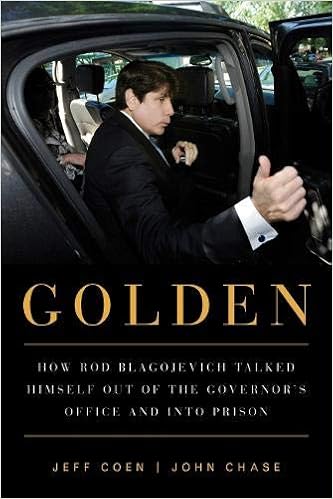
Illinois Governor Rod Blagojevich had been under a corrupt activity investigation by United States Attorney for the Northern District of Illinois, Patrick Fitzgerald.

Image result for rod blagojevich
Golden: How Rod Blagojevich Talked Himself out of the Governor’s Office and into Prison

Blagojevich ultimately was impeached and removed from office for wire fraud, attempted extortion, and conspiracy to solicit bribes.

He had attempted, though failed, to sell Barack Obama’s vacant U.S. Senate seat after Obama was elected president.

Blagojevich had also been charged with:

*Attempting to extort the owners of the Tribune Company to fire Chicago Tribune editors who criticized the governor’s handling of state affairs.
*Abuse of power concerning the release of $8 million of state funds to Children’s Memorial Hospital, as a quid pro quo for a $50,000 campaign contribution

Blagojevich’s defense was in part, that he never actually had received the bribe money, and that the accusations were politically motivated.

During the impeachment trial, Blagojevich requested the opportunity to deliver his own closing arguments, although he would not testify or submit himself to cross-examination.

Blagojevich’s said the process was tainted because it did not allow him to call witnesses or challenge the evidence (although, the process did allow the governor to call witnesses and challenge the evidence, but he did neither).

But perhaps the best witness was (inadvertently) Blagojevich himself, who was recorded saying, “I’ve got this thing and it’s fucking golden. I’m just not giving it up for fucking nothing. I’m, I’m not going to do it and I can use it and fuckin’ parachute me there.”

Sometimes, crooked leaders simply can’t keep their crooked mouths shut.

Blagojevich was convicted and sentenced to 14 years in federal prison.

==============================================================

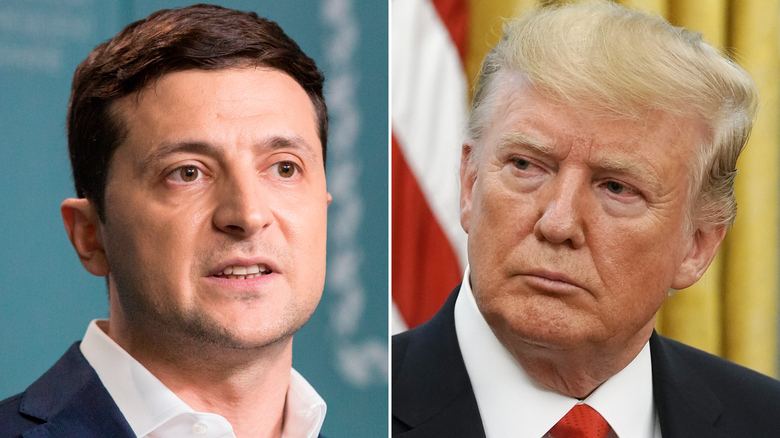
Donald Trump had been under investigation for corrupt activity by Robert Mueller, the special counsel investigating allegations of Russian interference in the 2016 U.S. presidential election.

Mueller released a document that depicted a Trump campaign expecting to “benefit electorally” from information stolen and released by Russia and a president who saught the firing of various officials and who demanded a memo that would clear his name.Image result for zelensky trump

Mueller concluded that he could not clear the president of obstruction of justice, and in fact, listed ten incidents that could be considered obstruction.

Trump is now being impeached for abuse of power, extorting Ukraine, and conspiring — and temporarily succeeding — to delay $400 million Congress had allocated for Ukraine, in exchange for an investigation of Trump’s political opponent, Joseph Biden, and his son.

That was the “favor” Trump requested in exchange for the money Ukraine desperately needed.

The money finally was given to Ukraine two days after the scheme was discovered and reported by a whistleblower, who heard about a damning phone call (i.e. wire fraud).

Trump has complained that the investigation is politically motivated. Democrats claim that Trump’s prevention of testimony by administration officials amounts to obstruction of justice.

Excerpts from an article by Damon Linker:

Trump has flagrantly, almost flamboyantly, violated the Emoluments clause of the Constitution from his first day in office.

He regularly warps policy by placing his personal interest ahead of the public good — which is what the ongoing impeachment inquiry is all about.

The administration has responded to this inquiry by refusing to comply with congressional subpoenas or cooperate with routine efforts at congressional oversight.

And of course, the president has also asserted as a blanket claim that the Constitution gives him the “right to do whatever I want.”

This is reminiscent of President Nixon’s famous line, “When the president does it, that means it is not illegal.” 

The phrase is,  “Power corrupts, and absolute power corrupts absolutely.” But power, in itself, neither is good nor bad, neither corrupting nor purifying.  God is not corrupt.

Blagojavich, Trump, Nixon, Hitler, Putin, Kim, Stalin, Mao, et al were corrupt with negligible power long before they gained enormous power and enormous corruption.

Greed, immorality, and corruption do not spring forth, suddenly and unpredictably, when an otherwise compassionate person achieves power. Corruption grows within the corrupt, often quiescently, waiting to be energized by power.

Some people do wondrous things with power. But corrupt people absolutely corrupt power.

We are seeing that demonstrated every day.

Rodger Malcolm Mitchell
Monetary Sovereignty
Twitter: @rodgermitchell
Search #monetarysovereignty Facebook: Rodger Malcolm Mitchell