Two questions that solve the Medicare-for-All dilemma.

It takes only two things to keep people in chains: The ignorance of the oppressed and the treachery of their leaders.

……………………………………………………………………………………………………………………………….

Before you read yet another article about Medicare-for-All and the “Who Will Pay For It” question, please take some time to think about, and answer, just two questions:Image result for hospital bed ill people in hospital

  1. Do you believe every American should have medical care, or should some Americans be forced to do without medical care?
  2. If you believe every American, rich or poor, should have medical care, who will pay for it?

Peter Suderman, the features editor at Reason.com, writes regularly on health care, the federal budget, tech policy, and pop culture. He believes the government should not pay for health care.

I don’t know why; he never says. He is a libertarian, so he doesn’t like “big” government. Why? Again, he never says. How big is too big? Yet again, he never says.

But if the government doesn’t pay, all who’s left is you.

    • You pay if your company pays because your company figures the cost of health care insurance as being part of your salary.
    • You pay if your insurance company pays; it’s in your premiums.
    • You pay if the hospital emergency room pays because that forces the hospital to raise prices for all other services.
    • You pay if no one pays, and some Americans lack health care; their ill health means they can’t be productive contributors to the U.S. economy.
    • You pay if your city, county, or state pays for health care because these governments rely on your taxes to fund all their spending.

In short, there is no magic. You always have to pay, directly or indirectly. Except, there is magic. It’s the magic of Monetary Sovereignty.

The U.S. federal government is Monetarily Sovereign. About 240 years ago, the new U.S. government created the U.S. dollar — millions of them from thin air — simply by creating laws from thin air.

Alan Greenspan: “A government cannot become insolvent with respect to obligations in its own currency.”
Ben Bernanke: “The U.S. government has a technology, called a printing press (or, today, its electronic equivalent), that allows it to produce as many U.S. dollars as it wishes at essentially no cost.”
St. Louis Federal Reserve: “As the sole manufacturer of dollars, whose debt is denominated in dollars, the U.S. government can never become insolvent, i.e.,unable to pay its bills. In this sense, the government is not dependent on credit markets to remain operational.”

Since then it has continued to create laws and dollars, all from thin air. The very first dollars were not funded by taxes. They were created by laws.

And ever since then, the tax dollars you send to Washington, DC, willingly or grudgingly, still pay for nothing. Even if you don’t send a single tax dollar or even a tax penny to Washington, the U.S. federal government still could continue spending, endlessly.

So you, as a voter, have two choices:

  1. You can continue to pay for your healthcare, either via direct payment from your checking account, or via indirect payment through your company’s insurance plan, or via indirect payment via higher hospital charges, or you can pay by being sick without care, or
  2. The federal government can pay, and it would cost you nothing.

That’s it. Just two choices. There are no other options.

All those people who complain about the cost of Medicare-for-All really are telling you that you should pay, directly or indirectly.

Keep that in mind as you read the following excerpts:

How to pay for Medicare-for-All. Multiple estimates have found that the single-payer plan, which would eliminate virtually all private health insurance, would require more than $30 trillion in additional government spending over a decade, a historically unprecedented sum.

Additional federal government spending costs you nothing. The federal government already has spent more than $20 trillion dollars, and it has cost you nothing.

How do I know? Because the federal debt is more than $20 trillion dollars, and the federal debt represents federal spending you clearly have not paid for. 

Further, the taxes you paid don’t even fund any federal spending. Unlike state and local taxes, federal tax dollars are destroyed upon receipt. (The federal government creates brand new dollars, ad hoc, every time it pays a recipient.)

And if an additional $30 trillion really is needed for healthcare, that means Americans currently are doing without $30 trillion worth of healthcare. That’s way too much sickness not being treated in this, the world’s wealthiest nation.

Bernie Sanders cited a a study “that just came out of Yale University, published in Lancet magazine, one of the prestigious medical journals in the world.”

The study purports to show that Sanders’ Medicare-for-All plan would save $450 billion a year, and 68,000 lives.

A detailed article produced by Kaiser Health News and Politifact, however,  (disagrees).

The Lancet study assumes, for example, that the Sanders plan could pay Medicare rates across the board.

Medicare rates are far lower than private insurance rates, and the hospital lobby is a powerful political force that has successfully fought off payment reductions in multiple venues.

Suderman ignores one simple fact: The “hospital lobby” has existed a long time, and Medicare exists — and “its rates are far lower than private insurance rates.” How did that happen?

Could it be that past left-wing Congresses were more caring and moral than today’s right-wing Senate?

Not that it really matters, for as we have said on numerous occasions, the federal government, being Monetarily Sovereign, can afford anything. In fact, the more the federal government deficit spends, the more economic growth dollars enter the private sector.

That is how economies grow.

The Lancet study Sanders cites also lowballs the likely increase in utilization that would come from eliminating copayments and other cost-sharing mechanisms, as Sanders’ Medicare-for-All plan calls for.

Although it allows that the newly insured would use more care, it assumes that the currently insured would not seek to use more health services.

As Harvard health policy researcher Adrianna McIntyre points out, that’s deeply unrealistic.

Yes, utilization would increase, and that is a very good thing, indeed.

It is quite doubtful that people would make unnecessary visits to the doctor or hospital, just because they are free. So the additional utilization would benefit healthfulness. That is the whole idea: To improve America’s health.

There are other problems as well, most notably that the study simply doesn’t account for about $4 trillion in expected long-term care spending that would be part of the bill under Sanders’ Medicare-for-All plan.

Is this supposed to be a bug or a feature? The lack of long-term care, particularly for the elderly, is a real disgrace in America. Visualize yourself without long-term care insurance and having to choose between care at a facility, and no care, dying alone at home.

The heartlessness of Suderman’s position is truly stunning.

The study handwaves away research suggesting that its headline “lives saved” figure is substantially overstated.

Is 68,000 lives saved too high and estimate? Suderman never says what the “correct” number is. How about 50,000 saved lives? 40,000 saved lives? How many saved lives are too few for Suderman to be concerned about?

The question of how to pay for Medicare-for-All has come up quite frequently in the debates, and the repetition may even be having a substantial impact on the race.

Sen. Kamala Harris (D–Calif.)struggled with the (payment) question. Her stumbles probably contributed to her declining position in the race, and she eventually left the field.

Sen. Elizabeth Warren (D–Mass.) released a complex financing scheme. This generated substantial criticism and helped demonstrate how she relies on a veneer of wonkiness to avoid tough questions.

Eventually, Warren released a second plan that called for a delayed implementation of full-fledged Medicare for All, which many (understandably) read as a sign that she wasn’t serious about the idea.

In both cases, we learned something essential about the candidates and how they respond to pressure: Harris didn’t have a firm initial grasp of the policy mechanics, and she flailed and flip-flopped in search of a politically palatable answer. Warren bandwagoned with the most progressive candidate, eventually releasing a dubious (but detailed) plan that suggested she wasn’t serious, then followed it with another one that undercut the first, all while pretending it didn’t.

The same is now true of Sanders. And his response, it appears, is to point to an obviously unsound study conducted by a sympathetic voice, and then lie about the rest of the existing research.

The Medicare for All financing question is not just a policy question. It is a test of character—and Sanders failed it.

No, Mr. (Libertarian) Peter Suderman, the Medicare-for-All is not just a test of character. It also is a test of economic knowledge, and you failed both tests.

You failed the test of character by giving the back of your hand to all the sick people who are or will, lead lives of misery or die early because they can’t afford proper care. You throw compassion to the wind, and prefer to talk about money.

And you failed the test of economic knowledge because you don’t understand the difference between federal financing vs. state and local government, business, and personal financing.

You also don’t understand the effect that illness has on America’s economic growth. (Perhaps the coronavirus will teach you.)

And while the Democrats may favor Medicare-for-all for compassionate and economic reasons, they too display a stunning ignorance of federal financing.

And that ignorance will kill a program the people of this nation so greatly need.
OMG! It’s February 14, 2020, and the national debt is still a ticking time bomb!

Alan Greenspan: “A government cannot become insolvent with respect to obligations in its own currency.”
Ben Bernanke: “The U.S. government has a technology, called a printing press (or, today, its electronic equivalent), that allows it to produce as many U.S. dollars as it wishes at essentially no cost.”

…………………………………………………………………………………………………………………………………………….

Well, you can add it to the long list, another information source that claims the national debt is a “ticking time bomb.”

Since 1940, maybe even longer, some “expert” makes that same claim and uses those same words, “ticking time bomb.”ticking time bomb.png

Which is more disturbing, the wrong-headed pronouncement or the lack of creativity?

This time it’s THE WEEK Magazine. Here are a few truly laughable excerpts:

 The national debt: A ticking time bomb?
America is “headed toward a crisis,” said Tiana Lowe in WashingonExaminer.com.

The Treasury Department reported last week that the federal deficit swelled to more than $1 trillion in 2019 for the first time since 2012.

Even more alarming was the report from the bipartisan Congressional Budget Office (CBO) predicting that $1 trillion deficits will continue for the next 10 years, eventually reaching $1.7 trillion in 2030.

That means that the total federal debt will balloon to $31.4 trillion over the next decade, pushing the debt-to-GDP ratio to 98 percent, or the highest since World War II.

Nevermind that the “time bomb” crisis has been ticking for 80+ years and still hasn’t exploded, and nevermind that the debt/GDP ratio is absolutely meaningless.

The influential know-nothings will continue to pump the same nonsense into the minds of the populace, who have been trained to fear something — federal deficit spending –that actually is beneficial.

It is absolutely necessary to grow the economy. Without federal deficit spending, we would have nothing but recessions and depressions.

And this wave of red ink is hitting us during boom years, when the country’s deficits should be shrinking so that we can borrow and spend money to stimulate the economy during the inevitable recession to come.

Except for these small facts.

  1. The federal government does not borrow, nor does it ever need to. It accepts deposits into T-security accounts. It never touches those dollars, and it pays off those accounts by the simple expedient of returning the dollars.
  2. The government never, never, never can run short of dollars — its sovereign currency. It always can spend whatever is necessary to stimulate the economy.
  3. Shrinking deficits cause recessions and depressions, which are cured only by increasing deficits.

In short, the author of the above paragraph doesn’t understand the difference between a Monetarily Sovereign government (i.e. the U.S. federal government) vs. monetarily non-sovereign governments (i.e. state and local governments).

The former has a sovereign currency, which it can create endlessly. The latter do not have a sovereign currency, so they often run short of whatever currency they use. It’s Economics 101.

There’s little doubt who’s to blame, said John Cassidy in NewYorker.com.

After campaigning on a promise to pay off the entire deficit, Trump has run up “vast amounts of new debt” to finance a military buildup and the $1.5 trillion tax cut in 2017.

Unfortunately, this relentless fiscal stimulus has achieved little, despite the president’s claims of stewarding “The Greatest Economy in American History.”

Last year, GDP grew 2.3 percent, nowhere near the 4 percent Trump promised, and the CBO now predicts a steady decline to 1.5 percent by 2025.

Let’s stop to examine Cassidy’s strange doubletalk. He admits that “vast amounts of new debt” amount to “relentless fiscal stimulus” — which is correct.

So, if increasing the debt stimulates, what would decreasing the debt do? Right. Decreasing debt recesses. It causes recessions and depressions.

Cassidy doesn’t dispute that. He admits the economy grew. He merely complains that the new debt didn’t grow the economy enough. Doesn’t that indicate there wasn’t enough debt, not that debt should be reduced?

His solution seems to be to stop doing what grows the economy in order to . . . what? Grow the economy less? This is the kind of “logic” to which the public is treated every day.

Americans should be “absolutely furious,” said Jordan Weissmann in Slate.com.

Republicans preach frugality with a Democrat in the White House, but burn money every time they’re in power.

Just watch: If Trump loses, Republicans will “rediscover their old-time faith in fiscal prudence and start shrieking about how the U.S. is on the road to becoming Argentina or Zimbabwe.”

Yes, Americans should be furious about many things — for instance, having a criminal President backed by a Congress filled with Sgt. Schultz wannabes (“I see nothing; I know nothing; I hear nothing”) who turn a blind eye and a deaf ear to the criminality.

But Americans should not be furious about the increased economic stimulus. And there is zero possibility that federal spending will cause another Argentinian or Zimbabwean hyperinflation.

Hyperinflations are not caused by government spending (which actually can cure hyperinflations) but rather by shortages — usually by scarcities of food or oil.

Don’t blame the Trump tax cuts, said Jake Novak in CNBC.com. The U.S. Treasury just booked a record quarter in tax revenue: $806.5 billion. “If tax revenues are rising, then tax cuts can’t possibly be the reason for rising federal debts.” It’s out-of-control spending that’s the cause.

Still, when the deficit bill comes due, said the Los Angeles Times in an editorial, there’s little doubt that the poor will end up paying for our profligacy.

Rather than cut defense or “the vast tax giveaways and subsidies” for the rich, fiscal conservatives will target “safety net programs” like Medicaid and food stamps.

That would be redistributing wealth in the cruelest possible way—“from the impoverished to the well-to-do.”

Total gibberish from Novak. Tax cuts and increased spending both led to increased deficits. But the word “blame” is misused.

Since increased deficits are stimulative, the word “credit” would be more appropriate. The combination of tax cuts and spending increases can be credited for the continuing economic growth.

The Los Angeles Times is correct that the poor will wind up paying, but not because that is a necessary result.

The federal government, being Monetarily Sovereign, does not need to raise taxes on the poor, nor does it need to cut safety net programs. It can create all the dollars it needs, forever.

It will raise taxes and/or cut social programs only because that is what the richest Americans (who run America) want.

The richest of us wish to widen the Gap between the rich and the rest. It is the Gap that makes them rich.

The two ways to widen the Gap are:

  1. Take from the poorer
  2. Give to the richer

Reducing social spending will accomplish #1. The Trump tax cuts accomplished #2.

We’ll finish this post by providing our usual reminder about the ridiculous, misleading, verging on humorous warnings about that “ticking time bomb”:

……………………………………………………………………………………………………………………………………………………..

Back in 1940, the federal budget was a “ticking time-bomb which can eventually destroy the American system,” said Robert M. Hanes, president of the American Bankers Association.

September 26, 1940, New York Times, Column 8

By 1960: the debt was “threatening the country’s fiscal future,” said Secretary of Commerce, Frederick H. Mueller. (“The enormous cost of various Federal programs is a time-bomb threatening the country’s fiscal future, Secretary of Commerce Frederick H. Mueller warned here yesterday.”)

By 1983: “The debt probably will explode in the third quarter of 1984,” said Fred Napolitano, former president of the National Association of Home Builders.

In 1984: AFL-CIO President Lane Kirkland said. “It’s a time bomb ticking away.”

In 1985: “The federal deficit is ‘a ticking time bomb, and it’s about to blow up,” U.S. Sen. Mitch McConnell. (Remember him?)

Later in 1985: Los Angeles Times: “We labeled the deficit a ‘ticking time bomb’ that threatens to permanently undermine the strength and vitality of the American economy.”

In 1987: Richmond Times–Dispatch – Richmond, VA: “100TH CONGRESS FACING U.S. DEFICIT ‘TIME BOMB’”

Later in 1987: The Dallas Morning News: “A fiscal time bomb is slowly ticking that, if not defused, could explode into a financial crisis within the next few years for the federal government.”

In 1989: FORTUNE Magazine: “A TIME BOMB FOR U.S. TAXPAYERS

In 1992: The Pantagraph – Bloomington, Illinois: “I have seen where politicians in Washington have expressed little or no concern about this ticking time bomb they have helped to create, that being the enormous federal budget deficit, approaching $4 trillion.

Later in 1992: Ross Perot: “Our great nation is sitting right on top of a ticking time bomb. We have a national debt of $4 trillion.”

In 1995: Kansas City Star: “Concerned citizens. . . regard the national debt as a ticking time bomb poised to explode with devastating consequences at some future date.”

In 2003: Porter Stansberry, for the Daily Reckoning: “Generation debt is a ticking time bomb . . . with about ten years left on the clock.”

In 2004: Bradenton Herald: “A NATION AT RISK: TWIN DEFICIT A TICKING TIME BOMB

In 2005: Providence Journal: “Some lawmakers see the Medicare drug benefit for what it is: a ticking time bomb.”

In 2006: NewsMax.com, “We have to worry about the deficit . . . when we combine it with the trade deficit we have a real ticking time bomb in our economy,” said Mrs. Clinton.

In 2007: USA Today: “Like a ticking time bomb, the national debt is an explosion waiting to happen.

In 2010: Heritage Foundation: “Why the National Debt is a Ticking Time Bomb. Interest rates on government bonds are virtually guaranteed to jump over the next few years.

In 2010: Reason Alert: “. . . the time bomb that’s ticking under the federal budget like a Guy Fawkes’ powder keg.”

In 2011: Washington Post, Lori Montgomery: ” . . . defuse the biggest budgetary time bombs that are set to explode.”

June 19, 2013: Chamber of Commerce: Safety net spending is a ‘time bomb’, By Jim Tankersley: The U.S. Chamber of Commerce is worried that not enough Americans are worried about social safety net spending. The nation’s largest business lobbying group launched a renewed effort Wednesday to reduce projected federal spending on safety-net programs, labeling them a “ticking time bomb” that, left unchanged, “will bankrupt this nation.”

In 2014: CBN News: “The United States of Debt: A Ticking Time Bomb

On Jun 18, 2015: The ticking economic time bomb that presidential candidates are ignoring: Fortune Magazine, Shawn Tully,

On February 10, 2016, The Daily Bell“Obama’s $4.1 Trillion Budget Is Latest Sign of America’s Looming Collapse”

On January 23, 2017: Trump’s ‘Debt Bomb’: Deficit May Grow, Defense Budget May Not, By Sydney J. Freedberg, Jr.

On January 27, 2017: America’s “debt bomb is going to explode.” That’s according to financial strategist Peter Schiff. Schiff said that while low interest rates had helped keep a lid on U.S. debt, it couldn’t be contained for much longer. Interest rates and inflation are rising, creditors will demand higher premiums, and the country is headed “off the edge of a cliff.”

On April 28, 2017: Debt in the U.S. Fuel for Growth or Ticking Time Bomb?, American Institute for Economic Research, by Max Gulker, PhD – Senior Research Fellow, Theodore Cangeros

Feb. 16, 2018  America’s Debt Bomb By Andrew Soergel, Senior Reporter: Conservatives and deficit hawks are hurling criticism at Washington for deepening America’s debt hole.

April 18, 2018 By Alan Greenspan and John R. Kasich: “Time is running short, and America’s debt time bomb continues to tick.”

January 10, 2019, Unfunded Govt. Liabilities — Our Ticking Time Bomb. By Myra Adams, Tick, tick, tick goes the time bomb of national doom.

January 18, 2019; 2019 Is Gold’s Year To Shine (And The Ticking US Debt Time-Bomb) By Gavin Wendt

[The following were added after the original publishing of this article]

April 10, 2019, The National Debt: America’s Ticking Time Bomb.  TIL Journal. Entire nations can go bankrupt. One prominent example was the *nation of Greece which was threatened with insolvency, a decade ago. Greece survived the economic crisis because the European Union and the IMF bailed the nation out.

July 11, 2019National debt is a ‘ticking time bomb‘: Sen. Mike Lee

SEP 12, 2019, Our national ticking time bomb, By BILL YEARGIN
SPECIAL TO THE SUN SENTINEL | At some point, investors will become concerned about lending to a debt-riddled U.S., which will result in having to offer higher interest rates to attract the money. Even with rates low today, interest expense is the federal government’s third-highest expenditure following the elderly and military. The U.S. already borrows all the money it uses to pay its interest expense, sort of like a Ponzi scheme. Lack of investor confidence will only make this problem worse.

JANUARY 06, 2020, National debt is a time bomb, BY MARK MANSPERGER, Tri City Herald | The increase in the U.S. deficit last year was about $1.1 trillion, bringing our total national debt to more than $23 trillion! This fiscal year, the deficit is forecasted to be even higher, and when the economy eventually slows down, our annual deficits could be pushing $2 trillion a year! This is financial madness.there’s not going to be a drastic cut in federal expenditures — that is, until we go broke — nor are we going to “grow our way” out of this predicament. Therefore, to gain control of this looming debt, we’re going to have to raise taxes.

February 14, 2020, OMG! It’s February 14, 2020, and the national debt is still a ticking time bomb!  The national debt: A ticking time bomb? America is “headed toward a crisis,” said Tiana Lowe in WashingonExaminer.com. The Treasury Department reported last week that the federal deficit swelled to more than $1 trillion in 2019 for the first time since 2012. Even more alarming was the report from the bipartisan Congressional Budget Office (CBO) predicting that $1 trillion deficits will continue for the next 10 years, eventually reaching $1.7 trillion in 2030

April 26, 2020, ‘Catastrophic’: Why government debt is a ticking time bomb, Stephen Koukoulas, Yahoo Finance  [Re. Monetarily Sovereign Australia’s debt.]

Eighty years of wrong-headed “ticking time bomb” predictions, and still they come. Why are the thought leaders incapable of learning?

My belief: It’s intentional. The rich, who run America, do not want the not-rich to learn that the government can provide all the things described in the Ten Steps to Prosperity (below), without raising taxes.

It’s just that simple.

Rodger Malcolm Mitchell
Monetary Sovereignty
Twitter: @rodgermitchell
Search #monetarysovereignty Facebook: Rodger Malcolm Mitchell

…………………………………………………………………………………………………………………………………………………………………………………………………………………………………………………………………………………………..

THE SOLE PURPOSE OF GOVERNMENT IS TO IMPROVE AND PROTECT THE LIVES OF THE PEOPLE.

The most important problems in economics involve:

  1. Monetary Sovereignty describes money creation and destruction.
  2. Gap Psychology describes the common desire to distance oneself from those “below” in any socio-economic ranking, and to come nearer those “above.” The socio-economic distance is referred to as “The Gap.”

Wide Gaps negatively affect poverty, health and longevity, education, housing, law and crime, war, leadership, ownership, bigotry, supply and demand, taxation, GDP, international relations, scientific advancement, the environment, human motivation and well-being, and virtually every other issue in economics.

Implementation of Monetary Sovereignty and The Ten Steps To Prosperity can grow the economy and narrow the Gaps:

Ten Steps To Prosperity:

1. Eliminate FICA

2. Federally funded Medicare — parts A, B & D, plus long-term care — for everyone

3. Provide a monthly economic bonus to every man, woman and child in America (similar to social security for all)

4. Free education (including post-grad) for everyone

5. Salary for attending school

6. Eliminate federal taxes on business

7. Increase the standard income tax deduction, annually. 

8. Tax the very rich (the “.1%”) more, with higher progressive tax rates on all forms of income.

9. Federal ownership of all banks

10. Increase federal spending on the myriad initiatives that benefit America’s 99.9% 

The Ten Steps will grow the economy and narrow the income/wealth/power Gap between the rich and the rest.

MONETARY SOVEREIGNTY

How bigots are confused, and we pay the price

The man who said these things is a bigot:

They are laughing  at us, at our stupidity. And now they are beating us economically. They are not our friends, believe me. But they’re killing us economically.

“The U.S. has become a dumping ground for everybody else’s problems.

“When Mexico sends its people, they’re not sending their best. They’re not sending you. They’re not sending you. They’re sending people that have lots of problems, and they’re bringing those problems with us. They’re bringing drugs. They’re bringing crime. They’re rapists. And some, I assume, are good people.

“But I speak to border guards and they tell us what we’re getting. And it only makes common sense. It only makes common sense. They’re sending us not the right people.

“It’s coming from more than Mexico. It’s coming from all over South and Latin America, and it’s coming probably— probably— from the Middle East.

“Why are we having all these people from s—hole countries (Haiti and Africa, and (the middle east) coming here?”

Some translations:

” . . . they are killing us economically.” Poverty-stricken little Mexico is killing big, rich America economically? Get real. This is a flat-out, fear-mongering lie.

” . . . dumping ground . . .” Translation: These aren’t people; they are garbage.

“They’re not sending you. They’re not sending you.” Said twice for emphasis. They look different and they act different, so don’t have compassion for them. They are sub-human.

“They’re bringing drugs. They’re bringing crime. They’re rapists.” Another fear-mongering lie. Immigrants are less likely to commit crimes than are native-born Americans.

” . . . what we’re getting.” Another dehumanizing comment, made especially repugnant by his use of the word “what” rather than “who.”

” . . . the right people. This is a continuation of the desire for more immigrants from countries like Norway (read: rich and white) and not from “s—hole” countries like Haiti and much of Africa (read: poor and black or brown). Note the references to Mexico, South and Latin America, and Middle East.

People tend to support people who are like them. Blacks tend to support blacks. Jews tend to support Jews. White Christians tend to support white Christians. Gays tend to support gays. Muslims tend to support Muslims. Educated people tend to support educated people.

People from a geographical area tend to support others from that same area (aka “favorite sons”). Democrats tend to support Democrats. Republicans tend to support Republicans.

And bigots tend to support bigots.

His appeal is not only to the xenophobic fearful. Being a bigot, his primary appeal is to bigots.

But while bigotry may provide a comforting and quasi-logical appeal to other bigots, bigotry also has its penalties.

One penalty is that bigotry prevents much-needed people from entering, or even trying to enter, America. Bigotry prevents economic growth.

WASHINGTON–By Marisa Shultz, February 6, 2019

President Trump said Wednesday that his ad-lib comment that he wants legal immigrants “in the largest numbers ever” was a shift in policy – which up until now focused on a crackdown on illegal immigrants.

“I need people coming in because we need people to run the factories and plants and companies that are moving back in,” Trump told the Regional Reporters Association. “We need people.”

Asked if he was changing his stance on legal immigration, Trump said “yes” because the US needs more workers in a booming economy.

“We need people in our country because our unemployment numbers are so low and we have massive numbers of companies coming back into our country – car companies, we have seven car companies coming back in right now and there’s going to be a lot more,” Trump said. “We’ve done really well with this, and we need people.”

And:

Chief of Staff Mick Mulvaney had described our country at a private gathering in England as being quite the opposite of “full.”

Instead of having too many newcomers, Mulvaney told the crowd that we have too few.

We are desperate — desperate — for more people,” Mulvaney said. “We are running out of people to fuel the economic growth that we’ve had in our nation over the last four years. We need more immigrants.”

Well, what exactly does Trump and his team believe?

The Trump administration’s efforts to curb immigration look like they’re working, The New York Times reports.

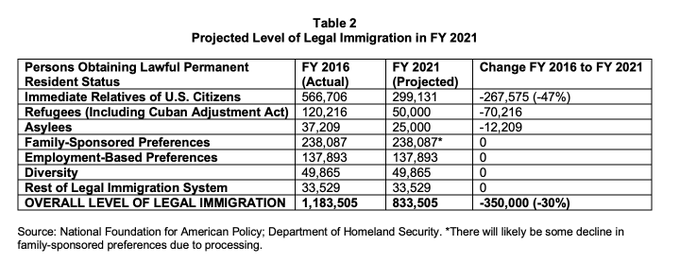
A report released Monday by the National Foundation for American Policy projects policies like Trump’s recently-expanded travel ban or the public charge rule preventing immigrants who may rely on welfare assistance from entering the country will alter legal immigration to the U.S. for quite some time.

But change may also be noticeable rather quickly. Legal immigration had already declined by 11 percent between the 2016 and 2018 fiscal years, and the NFAP report predicts the decline will have reached 30 percent by 2021.

View image on Twitter
That could have long-term consequences for U.S. economic growth, which will NFAP says will slow because the average annual growth rate of the U.S. labor force will also sputter as a result of the immigration decline.

The report says the rate will slow somewhere between 35 percent and 59 percent going forward if the policies remain in place.

“The significant decline in the annual level of legal immigration means lower long-term economic growth may be Donald Trump’s most lasting economic legacy,” the report reads.

Image result for fortress AmericaHere is the predicament for bigot Trump and his bigot followers.

Last year, the immigrants were “rapists, murders, and job-takers.” Now, they are “consumers, workers, and job-producers.”

The haters had rallied around a hate-mongering leader.

They hate gays, Latinos, Central Americans, Africans, people from the middle east, people of color, Muslims, most foreigners (from “sh-t hole countries”), and even, to some extent, women.

Trump and his party created “Fortress America” with a Wall behind which his haters could hide.

But Trump and his party love money, big business, economic growth, and the jobs that immigration produces.

So what is a confused bigot to do? Support the economic growth, job-promising Trump, or vote for the immigrant torturing, big Wall, bigot Trump?

‘Tis a quandary for the GOP. ‘Tis a quandary for bigots.

Rodger Malcolm Mitchell
Monetary Sovereignty
Twitter: @rodgermitchell
Search #monetarysovereignty Facebook: Rodger Malcolm Mitchell

…………………………………………………………………………………………………………………………………………………………………………………………………………………………………………………………………………………………..

THE SOLE PURPOSE OF GOVERNMENT IS TO IMPROVE AND PROTECT THE LIVES OF THE PEOPLE.

The most important problems in economics involve:

  1. Monetary Sovereignty describes money creation and destruction.
  2. Gap Psychology describes the common desire to distance oneself from those “below” in any socio-economic ranking, and to come nearer those “above.” The socio-economic distance is referred to as “The Gap.”

Wide Gaps negatively affect poverty, health and longevity, education, housing, law and crime, war, leadership, ownership, bigotry, supply and demand, taxation, GDP, international relations, scientific advancement, the environment, human motivation and well-being, and virtually every other issue in economics.

Implementation of Monetary Sovereignty and The Ten Steps To Prosperity can grow the economy and narrow the Gaps:

Ten Steps To Prosperity:

1. Eliminate FICA

2. Federally funded Medicare — parts A, B & D, plus long-term care — for everyone

3. Provide a monthly economic bonus to every man, woman and child in America (similar to social security for all)

4. Free education (including post-grad) for everyone

5. Salary for attending school

6. Eliminate federal taxes on business

7. Increase the standard income tax deduction, annually. 

8. Tax the very rich (the “.1%”) more, with higher progressive tax rates on all forms of income.

9. Federal ownership of all banks

10. Increase federal spending on the myriad initiatives that benefit America’s 99.9% 

The Ten Steps will grow the economy and narrow the income/wealth/power Gap between the rich and the rest.

MONETARY SOVEREIGNTY

The rich-poor Gap widens in ways you may not realize

If you are not rich, but you still support Donald Trump and the GOP, congratulations. You now are ready to send your remaining money to a Nigerian prince, who clearly will do more for you than Trump will.

You undoubtedly know Trump and his subservient GOP have tried everything they can to end ACA (Obamacare), primarily because Trump doesn’t want Obama’s name on anything. And you undoubtedly know that though Trump claims to have a better plan in mind, he really has nothing, after all these years.

And by now, you have learned that Trump’s much-bragged-about tax cuts benefited the rich and did nothing for the rest of us. You learned that when you discovered your charitable contributions are too small to be deducted from your taxes.

And you surely have heard of the phony need to cut Social Security benefits and/or raise FICA taxes to “pay for it,” because Social Security, Medicare, and the U.S. government supposedly are “broke.”

And of course, there are the growing salary differences between the top executives and the underlings — you know about those too,

And then there’s the gigantic and growing student debt that funnels money from the middle and lower-income groups to the government and the rich lenders.

Wolf Richter: Subprime Credit Card Delinquencies Spike to Record High, Past Financial-Crisis Peak, as Other Consumers Relish the Good Times. Why?
By Wolf Richter, editor of Wolf Street. 

The rate of credit card balances that are 30 days or more delinquent at the 4,500 or so commercial banks that are smaller than the top 100 banks spiked to 7.05% in the fourth quarter, the highest delinquency rate in the data going back to the 1980s (red line).

But at the largest 100 banks, the credit card delinquency rate was 2.48%, which kept the overall credit-card delinquency rate at all commercial banks at 2.7% (blue line), though it was the highest since 2012, according to the Federal Reserve.

What’s going on here, with this bifurcation of the delinquency rates and what does that tell us about consumers?

The above-mentioned “bifurcation” (aka the Gap between the rich and the rest) has to do with the fact that the largest banks serve the rich, and the smaller banks serve the not-rich. It really is that simple.

A similarly disturbing trend is going on with auto loans. Seriously delinquent auto loans jumped to 4.94% of total auto loans and leases outstanding.

This is higher than the delinquency rate in Q3 2010 amid the worst unemployment crisis since the Great Depression.

On closer inspection, there was that bifurcation again; prime-rated loans had historically low delinquency rates; but a shocking 23% of all subprime loans were 90+ days delinquent.

During the Financial Crisis, delinquencies on credit cards and auto loans were soaring because over 10 million people had lost their jobs and they couldn’t make their payments.

But these are the good times – with the unemployment rate near historic lows. And yet, there are these skyrocketing delinquency rates in the subprime subset of credit cards and auto loans.

It means these people are working, and they’re falling behind in their debts.

Contrary to the right-wing’s repeated assertions that the poor are simply lazy and unwilling to work, the poorer on average work harder and longer hours than do the richer, but are paid skimpy wages.

Consumers with subprime credit scores (below 620) can still get credit cards, but under subprime terms – namely interest rates of 25% or 30% or more.

These rates comes at a time when, according to the FDIC, banks’ average cost of funding was around 1.0%.

The difference between a bank’s average cost of funding and the interest it charges is its net interest margin. For banks, subprime credit-card balances, with interest rates of 30%, are the most profitable assets out there.

Borrowing $5,000 at 30% means you pay $1,500 annual interest, a double-whammy for someone who barely can afford food and rent, let alone frivolous things like warm clothing, decent transportation, good schools, and a safe neighborhood in which to live.

The largest 100 banks have a delinquency rate of just 2.48%, which is low by historical standards.

They go aggressively after consumers with high credit scores and high incomes, and to get them, the big banks offer big benefits, and so a bidding war has broken out for these high-credit-score consumers, with “2% cash back on every purchase” and other benefits that small banks cannot offer.

The rich receive the best money-back cards. The not-rich don’t even learn about them.

The rich don’t have to borrow on credit cards, which charge those enormous percentages.

When the rich borrow, they go to a lender who might charge 3-5% or even less, where that same $5,000 loan would cost under $250 a year.

So why are these delinquencies spiking now? We haven’t seen millions of people getting laid off. These are the good times.

It’s a sign of the sharp bifurcation of the economy for consumers. One group of consumers is doing well.

They have rising incomes, and they can afford the surging home prices, the surging healthcare costs, and the surging new-vehicle prices.

Those price increases are not reflected in the inflation measures. For example, the price of a Ford F-150 XLT has skyrocketed 163% since 1990 while the official CPI for all new vehicles, allowing for hedonic quality adjustments over the same period has increased only 22%.

Hedonic quality adjustment: The practice of examining an item by its characteristics, estimating the value of the utility derived from each characteristic, and using those value estimates to adjust prices when the quality of a good changes.

Consider two TVs, one new and one made in 2015. The features of the new one, that were not available in 2015 are evaluated, and their value is added to the 2015 price.

For instance, if a new set has verbal command and the old one didn’t, the government estimates the value of the verbal command and adds that to the price of the old set.

Say the old set cost $1,000 and the new set, with verbal command costs $2,000. That would seem to be a 100% price increase.

But if the government estimates the value of verbal command to be $500, the official price of the old set would be increased to $1,500, which means the CPI has increased only 33% ($1,500 vs. $2,000) rather than 100%.

Same with used cars. The official CPI for used cars has declined by 11% since 1995, an amazing feat of hedonic quality adjustments, as actual used-car prices have soared since 1995.

There are other consumers whose incomes have not budged much – maybe it went up in line with CPI, but CPI doesn’t reflect actual price increases of cars and homes and other items.

Everything big they’re trying to buy or rent or use has soared in price – new and used vehicles, housing, healthcare, education, etc.

And those consumers, though they’re working hard, are getting squeezed.

That’s the bifurcation.

The rich receive tax breaks from the right-wing, while the not-rich receive criticism and cuts to safety nets like Medicare, Social Security, food stamps, housing aids, education, etc.

And this can happen from one day to the next, for example when the landlord raises the rent by 15%, or when the car turns into a hopeless heap and has to be replaced, or when the insurance premium jumps 25%, or when the kid ends up in the emergency room. Or a combination.

And suddenly, there is no money left to make the minimum payment on the credit card.

And this is happening while people are working.

This subgroup of consumers that are getting squeezed is growing, and their problems are growing, and their credit-card delinquencies and auto-loan delinquencies are spiking into the stratosphere like never before.

And that’s the bifurcation that we’re seeing.

But when Bernie Sanders wants to provide Medicare-for-All, the rich say, “No, it’s Socialism,” and the not-rich are suckered into going along with the “socialism” lie.Image result for dollar bills denominations

The “bifurcation” repeatedly mentioned by Mr. Richter is the Gap we often have discussed. The Gap or bifurcation exists because the rich, who run America, want it to exist.

“Rich” is a comparative word. If you have $100 and everyone else has $1, you are rich. But if you have $100 and everyone else has $1,000 you are poor.

So to be rich, you must widen the Gap, which can be accomplished in two ways: Accumulate more for yourself or prevent the others from accumulating more.

This post has given examples of the latter: Prevent others from accumulating more. The credit card scam is one of those.

Rodger Malcolm Mitchell
Monetary Sovereignty
Twitter: @rodgermitchell
Search #monetarysovereignty Facebook: Rodger Malcolm Mitchell

…………………………………………………………………………………………………………………………………………………………………………………………………………………………………………………………………………………………..

THE SOLE PURPOSE OF GOVERNMENT IS TO IMPROVE AND PROTECT THE LIVES OF THE PEOPLE.

The most important problems in economics involve:

  1. Monetary Sovereignty describes money creation and destruction.
  2. Gap Psychology describes the common desire to distance oneself from those “below” in any socio-economic ranking, and to come nearer those “above.” The socio-economic distance is referred to as “The Gap.”

Wide Gaps negatively affect poverty, health and longevity, education, housing, law and crime, war, leadership, ownership, bigotry, supply and demand, taxation, GDP, international relations, scientific advancement, the environment, human motivation and well-being, and virtually every other issue in economics.

Implementation of Monetary Sovereignty and The Ten Steps To Prosperity can grow the economy and narrow the Gaps:

Ten Steps To Prosperity:

1. Eliminate FICA

2. Federally funded Medicare — parts A, B & D, plus long-term care — for everyone

3. Provide a monthly economic bonus to every man, woman and child in America (similar to social security for all)

4. Free education (including post-grad) for everyone

5. Salary for attending school

6. Eliminate federal taxes on business

7. Increase the standard income tax deduction, annually. 

8. Tax the very rich (the “.1%”) more, with higher progressive tax rates on all forms of income.

9. Federal ownership of all banks

10. Increase federal spending on the myriad initiatives that benefit America’s 99.9% 

The Ten Steps will grow the economy and narrow the income/wealth/power Gap between the rich and the rest.

MONETARY SOVEREIGNTY