The 2nd dumbest, most overused word in economics

Here are a few excerpts from a February 11, 2020 article in the Washington Post.

Economy
Fed Chair Powell warns Congress that $1 trillion budget deficits are unsustainable
Powell also said it is ‘very likely’ the coronavirus will impact the U.S. economy, but it is too early to tell how much or for how long
By Heather Long, an economics correspondent, former senior economics reporter at CNN and a columnist and deputy editor at the Patriot-News in Harrisburg, Pa. Also worked at an investment firm in London.

Federal Reserve Board Chair Jerome H. Powell told Congress on Tuesday that now would be a good time to reduce the federal budget deficit, which is expected to top $1 trillion this year.

Think about it. Powell told Congress two things:

  1. It is ‘very likely’ the coronavirus will impact the U.S. economy. By “impact,” he doesn’t mean “stimulate growth.” He means that to some degree, he doesn’t know how much, the coronavirus will reduce economic growth.
  2. Now would be a good time to reduce the federal budget.

Consider those two opposing ideas coming from one mouth on one day to one audience.

Is it possible the Chairman of the Federal Reserve Board doesn’t know that the only way to overcome the recessionary effects of the virus is with federal deficit spending?

Yes sadly, it is possible.

Equally sad is his repeated use of the 2nd dumbest, most overused word in economics, and that word is “unsustainable,” when referring to federal deficit spending.

(The dumbest word, or rather three words, are “ticking time bomb” also when referring to federal deficit spending. We have discussed these three dumb words on several occasions, most recently on February 14th.)

“Ticking time bomb” and “unsustainable” are proven wrong. The federal debt, a consequence of the federal deficits, has risen more than 50,000% — from $40 Billion to $20 Trillion in the past 80 years, and the government has “sustained” quite well, thank you, and no “ticking time bomb” has exploded.

One might think (hope) the self-anointed Experts would take their prediction failures as clues.

The words are dumb and not explained, coherently. That is, the dire warnings never come with this simple sentence, “If we don’t cut deficits the federal government will run out of dollars.”

Why don’t we see those sentences? Because they would be so obviously and patently wrong, that to proffer them would be to admit stupidity. Better to just stick with vague “bomb” and “sustainability” comments, and let people believe you are an Expert.

Continuing the article:

“Putting the federal budget on a sustainable path when the economy is strong would help ensure that policymakers have the space to use fiscal policy to assist in stabilizing the economy during a downturn,” Powell said in testimony to the House Financial Services Committee.

Let’s translate, ” . . .  have the space to use fiscal policy to assist in stabilizing the economy during a downturn” is mumbo jumbo.

He means, but won’t say, “Have the money to use deficit spending to help grow the economy if it begins to shrink.”

So, this Chairman of the Fed, the world’s most important financial officer, nominated by the President of the United States and approved by the Republican Senate, this financial guru, has wrongly implied (but not said) that the federal government can run short of money, while simultaneously admitting that deficit spending grows the economy.

Back to the article:

In past recessions, the Fed has played a large role in reviving the economy by sharply cutting interest rates.

But Powell has been warning lawmakers that the central bank won’t have much ammunition left to fight the next downturn because interest rates are so low (the benchmark rate is just below 1.75 percent, far below rates above 5 percent in the past).

More government spending is likely to be needed to aid the economy in the next recession.

The effect of interest rate cuts is minimal because it’s a mixed effect. Cuts encourage borrowing, but they discourage lending. Can’t have one without the other. So, mixed.

And while low rates leave dollars in consumers’ pockets, they cause the government to pump fewer T-security interest dollars into the economy. Again, mixed.

The real economic stimulus is federal government spending, and not just spending, but deficit spending. It’s deficit spending that adds net stimulus dollars to the economy.

Very simply:

Federal deficits are stimulative; surpluses are recessive.

The Fed chair’s warning comes as the U.S. federal debt has grown by about $3 trillion since President Trump took office, and the president’s latest budget proposal submitted this week would add another $5 trillion to the debt over the coming decade.

“Add another $5 trillion to the debt” is just another way of saying, “Add 5 trillion growth dollars to the economy” thereby assuring that we won’t have a recession (unless we have a worldwide crisis like a huge meteor impact or the most serious effects of a pandemic),.

Economists worry that so much U.S. government debt can dampen private investment by driving investors to buy public bonds instead of private ones.

The above sentence is short, but it packs into few words a great deal of misinformation  The sentence wrongly implies:

  1. The federal government needs to sell T-bonds. NO.  Being Monetarily Sovereign, the federal government does not need to sell T-bonds. It never can run short of its own sovereign currency, the U.S. dollar. Who says so?
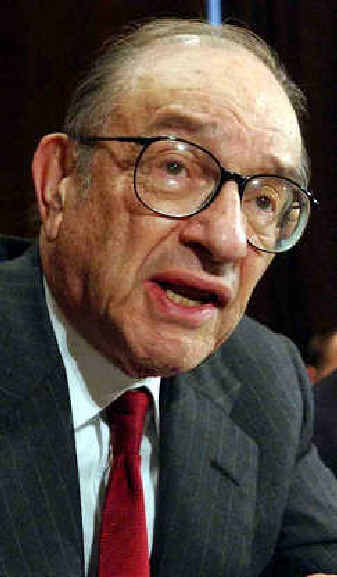
    Image result for greenspan
    Greenspan

    Alan Greenspan: “A government cannot become insolvent with respect to obligations in its own currency.”
    Ben Bernanke: “The U.S. government has a technology, called a printing press (or, today, its electronic equivalent), that allows it to produce as many U.S. dollars as it wishes at essentially no cost.”
    St. Louis Federal Reserve: “As the sole manufacturer of dollars, whose debt is denominated in dollars, the U.S. government can never become insolvent, i.e., unable to pay its bills. In this sense, the government is not dependent on credit markets to remain operational.”

  2.  The federal government will need to raise interest rates to sell its T-bonds. NO. Not only does the federal government not need to sell T-bonds, but when it wants to sell them, the Fed can and does buy them, via regular open market operations or  “quantitative easing,” both of which reduce interest rates
  3. Deficit spending dampens private investment. NO. Deficit spending adds investment dollars to the economy, thus stimulating private investment.

The most concerning part of all this is that Powell surely must know it, or at least he should know it.

Yet, he persists in disseminating misinformation. Or could it be intentional disinformation?

“A more sustainable federal budget could also support the economy’s growth over the long term,” said Powell, who spent time before he joined the Fed educating Congress about the debt limit as a Bipartisan Policy Center scholar.

The debt limit?? “Scholar” Powell was educating Congress about the phony debt limit, which not only is harmful, but unnecessary, and it isn’t even a debt limit.

It’s a limit on the federal government paying for its existing debts. The next time you receive a credit card bill, call them to say, “Sorry, but I can’t pay you. I have a debt limit.”

See how well that goes.

Trump blasted Powell, tweeting in the middle of the congressional hearing that the Fed chair was keeping interest rates too high.

“When Jerome Powell started his testimony today, the Dow was up 125, & heading higher. As he spoke it drifted steadily downward, as usual, and is now at -15.

Germany & other countries get paid to borrow money.

We are more prime, but Fed Rate is too high, Dollar tough on exports,” Trump wrote on Twitter.

The Dow Jones  industrial average ended the day flat.

Donald Trump doesn’t know what he is talking about. You might think that a rich man would understand finance, but he seems clueless.

He tweeted that the Fed “should get our interest rates down to ZERO, or less,” allowing the federal government to refinance its massive debt at a lower cost.

Why would anyone think the federal government, which creates dollars at the touch of a computer key, needs or even wants to “refinance its massive debt at a lower cost?” It makes no sense at all.

As we discussed earlier, low rates have a mixed effect on the economy.

And as for exports, the supposed benefit is that America gets to trade precious goods and services for dollars. But, the U.S. government has the unlimited ability to create dollars. So what is the purpose of sending precious goods, created by the sweat of American workers, overseas while we create unlimited dollars at the touch of a computer key?

All that exports accomplish is to add dollars to the U.S. private sector, which the federal government can do directly, at no cost, either by eliminating taxes or by direct contribution.

For a Monetarily Sovereign nation like the U. S., exports are unnecessary, and somewhat harmful, and at least dramatically overrated.

Even if U.S. exports totaled $0, the federal government could support the private sector, while not wasting precious resources or adding CO2 to the climate.

The United States has never had a negative interest rate. When asked about that possibility on Tuesday, Powell said that’s “not a tool we are looking at.”

Economists widely view negative interest rates as only worth doing when the economy is in a terrible situation. Trump keeps calling for lower interest rates to further boost growth and the stock market.

A negative interest rate would mean you would pay a bank to store your dollars. The belief is that you would prefer not to pay the bank but instead go out and spend and invest all your dollars, thus stimulating the economy.

Not only doesn’t that work but more realistically, why would any administration want the citizenry to have no cash reserves in the bank, while wildly spending on stocks and “stuff”?

And why would any administration want to cut bank deposits (i.e. reserves) and bank profits against which banks lend?

Any economists who would use negative rates “when the economy is in a terrible situation” are the same boobs who would apply leeches to cure anemia, or who think cuts to deficit spending will stimulate the economy.

In summary:

Chairman Powell acts as though he doesn’t understand the federal government is Monetarily Sovereign.

He acts as though he is the bookkeeper for a monetarily non-sovereign town, wondering where the next dollar will come from and how they can borrow enough to spend. For that bookkeeper, the debt truly might be “unsustainable.”

Not for the federal government.

The next time you read that the federal debt is “unsustainable,” know that the author either is lying or ignorant about federal economics.

Rodger Malcolm Mitchell
Monetary Sovereignty
Twitter: @rodgermitchell
Search #monetarysovereignty Facebook: Rodger Malcolm Mitchell

…………………………………………………………………………………………………………………………………………………………………………………………………………………………………………………………………………………………..

THE SOLE PURPOSE OF GOVERNMENT IS TO IMPROVE AND PROTECT THE LIVES OF THE PEOPLE.

The most important problems in economics involve:

  1. Monetary Sovereignty describes money creation and destruction.
  2. Gap Psychology describes the common desire to distance oneself from those “below” in any socio-economic ranking, and to come nearer those “above.” The socio-economic distance is referred to as “The Gap.”

Wide Gaps negatively affect poverty, health and longevity, education, housing, law and crime, war, leadership, ownership, bigotry, supply and demand, taxation, GDP, international relations, scientific advancement, the environment, human motivation and well-being, and virtually every other issue in economics.

Implementation of Monetary Sovereignty and The Ten Steps To Prosperity can grow the economy and narrow the Gaps:

Ten Steps To Prosperity:

1. Eliminate FICA

2. Federally funded Medicare — parts A, B & D, plus long-term care — for everyone

3. Provide a monthly economic bonus to every man, woman and child in America (similar to social security for all)

4. Free education (including post-grad) for everyone

5. Salary for attending school

6. Eliminate federal taxes on business

7. Increase the standard income tax deduction, annually. 

8. Tax the very rich (the “.1%”) more, with higher progressive tax rates on all forms of income.

9. Federal ownership of all banks

10. Increase federal spending on the myriad initiatives that benefit America’s 99.9% 

The Ten Steps will grow the economy and narrow the income/wealth/power Gap between the rich and the rest.

MONETARY SOVEREIGNTY

President Trump’s great plan to deal with the virus crisis

Buttkisser Felon #1: “Mr. Wonderful, Terrific, Best-president-of-all-time President, the people will need reassurance that you have a plan for the coronavirus.”
Trump: “Oh, I have a plan. I’m going to tweet it. By the way, you’re fired for not worshipping me enough or being crooked enough.
Virus 1.png
BF #2: Oh glorious King Trump, I’m not sure that will do it. People might expect a bit more specificity about your marvelous plan. And by the way, it’s spelled c-o-r-o-n-a-v-i-r-u-s.
Trump: More speci – what? Oh, details? OK, I’ll give ’em details if that’s what they need. And by the way, you’re fired for correcting me. Here are the details.
virus 2.png
BF #3: That was really super most holy Emperor Trump, but will people believe that global warming, which isn’t really happening, kill the virus — since it really isn’t happening?
Trump: If I say it’s global warming is not happening . . . where is that fool who brought a snowball into Congress, when I need him? Anyway, you’re fired for mentioning the global warming hoax. So here is my greatest idea in the history of ideas.
virus 3.png
BF #4: That was a great idea President Cult Leader. This way if he fails, you’re clear and if he succeeds, you take the credit. Brilliant. May I get off my knees now?
Trump: But now that I’m on a roll, I feel I should keep on tweeting. It always seems to work with my dumb followers, who would support me even if I shot someone on 5th Avenue. And you’re fired for not kissing both cheeks.
BF #4: Before I go to jail, did I mention that Pence is spelled P-e-n-c-e? And predictably, he failed miserably, just like in Indiana.
Virus 4.png
BF #5.  President Modest Stable Genius, everything seems to be falling apart. People are sick and dying. No help is coming from anywhere. You fired all the good people in the Health and Human Services Department, and now you are left with ignorant, incompetent buttkissers like me.
Trump: That’s just a rumor started by Romney who is jealous because I came up with the idea of screwing creditors by going bankrupt multiple times. He wishes he thought of it. Anyway, I’ll tweet this thing out of existence. And you’re fired for telling the truth. Didn’t you learn anything in my administration? No truth. My followers hate truth.
virus 5.png
BF #6. Well, here we are Mr. Orange President-For-Life. The virus has killed a lot of people, but you’ll be glad to know that most of them are Democrats, gays, people of color, Muslims, people from shithole countries, the Indians you insulted because they served you vegetables you wouldn’t eat, the students from Trump University, your creditors, and all the women you cheated with. All gone. So bye.
Trump: Great. The plan is working. And you can’t quit; you’re fired because I’m a star and you wouldn’t let me grab your p*ssy.
virus 6.png
Trump: From my golf courses, where I spend most of my time and I can charge the government outrageous fees, I tweeted the greatest plans, which were loved by everyone, including Vladimir Putin (who never helped me win the election and who hid the pee pee tape) and that little rocket man, Kim (whose love letter assured me he would not fire any more missiles).

But overrated Obama, nasty Pelosi, lightweight Sondland, weak Comey, Sleepy Joe, disgraced Vindman, Crazy Bernie, terrible Yates, nut job Pocahontas, crooked Hillary, loser Schumer, lying Bolton, dope Scaramucci, and that stupid whistleblower sabotaged my beautiful plans by telling the truth to the dumb, dopey, irrelevant, clueless, stupid, failed, fake, sad, dying, disgraced, phony, weak NY Times and the terrible, dishonest Washington Post.

Even suckup traitors to America like Barr (who I don’t know), Giuliani (who I never met), Graham (complete stranger), and McConnell (who?),  jumped ship when the uneducated peasants, who were my base, came with pitchforks and lanterns.

And as for Melania, who wouldn’t sleep in the same room with me, I’m only sorry your replacements, who I already had groped, didn’t survive.

So there’s no one left but me, the greatest President in the history of America . . .  no, the world . . . the universe.

Now, where is clown DJTJ, who I never will love as much as Ivanka (if she weren’t my daughter, perhaps I’d be dating her)? I want to kick his butt for no reason. It would make everyone feel good.

How YOU can help cure the coronavirus crisis. Yes, you.

The coronavirus is not just a medical crisis. It is a crisis of ignorance, a financial crisis that easily could be avoided if anyone in Washington had a brain.

Sadly, with a proven psychopathic leader, who has dismissed all the knowledgeable and experienced people who did not worship him sufficiently, and replaced them with brainless, corrupt sycophants, the likelihood of coronavirus morphing into full-blown economic crises is quite strong.

Here are excerpts from an excellent, THE WEEK Magazine article, that was written with more intelligence than exists in the entire, Trump administration:

How to fight a coronavirus recession
Jeff Spross, THE WEEK, February 27, 2020

At this point, the spreading COVID-19 coronavirus is not just a clear and present danger to American lives, but to our economy as well.

The major quarantines in China have curtailed both the country’s exports of goods and parts, as well as its imports from the U.S. and the rest of the world.

Other outbreaks of the virus are popping up around the globe, and U.S. officials are saying it’s all but certain to spread domestically as well.

But there are steps the U.S. government could take to protect the American economy from a recession, if they move as quickly as possible.

Specifically, the Federal Reserve should cut interest rates, and Congress and President Trump should put together a fiscal stimulus package to support the economy going forward.

There are four things history, both long and recent, should have taught us, they are:

  1. To cause recessions, cut deficit spending, and to prevent and cure recessions increase deficit spending. Recessions are symptoms of money shortages.
  2. Cutting interest rates does little to cure recessions. Cuts do not stimulate purchases enough to overcome the fact that low interest rates reduce the amount of interest money the federal government pumps into the economy.
  3. The federal government has the unlimited ability to deficit spend. It never can run short of dollars, and never needs to levy taxes to fund spending.
  4. Federal deficit spending does not cause inflations. All inflations and hyperinflations are caused by scarcity, usually shortages of food and/or energy (oil).  To cure inflations, the government must cure the scarcities, which generally requires more, not less, deficit spending.

.

Reductions in federal debt growth lead to inflation
This graph demonstrates that insufficient deficit growth (blue line) leads to recessions (vertical gray bars), and those recessions are cured by increases in deficit growth.

Almost half of U.S. companies that have business with China told a recent survey they expect to see revenue declines if things can’t return to normal by May — and one-fifth said they could lose half their revenue if COVID-19 isn’t contained by the end of August.

The Fed’s next meeting is not until mid-March. But to some degree, Fed officials could convince the financial markets to begin offering more credit right now simply by declaring unequivocally that they will cut at the next meeting.

This might be a good psychological step if it doesn’t convince Washington that nothing else is needed.

During the Obama administration, at the height of the “Great Recession,” rates were cut significantly, but fiscal stimulus was necessary to grow the economy.

The vertical gray bar is the “Great Recession.” The blue line is interest rates.

Here is a closeup of the graph showing how little effect interest rate cut had:

Rates were beginning to be cut in 2007. Yet, the recession began in 2008 and didn’t end until 2009.

The central bank’s recent cuts have been very modest adjustments of 0.25 percent each, and it should take the next meeting as an opportunity to do at least that much.

In fact, economist Kevin Warsh — a former Fed official, and usually a monetary policy hawk — has already called for the central bank to do just that. Financial analysts just told Politico they anticipate two rate cuts in April and June, and U.S. financial markets are already pricing in an 85 percent chance of a rate cut by mid-summer. 

Yet even with financial markets anticipating rate cuts, the stock market has dropped like a stone.

The reason. Rate cuts have at best, a modest stimulative effect, and may even have a recessive effect.

Fiscal policy should also get in on the act. Obviously, the government should be making whatever public investments are necessary to respond to the virus directly: more resources for health responders to screen for symptoms, monitor the spread, and care for people who have become infected.

Congress is already debating spending packages of $4 billion to over $8 billion — and policymakers have blasted the Trump administration for a tepid response so far.

No one should be surprised at the “tepid response.” Remember, this is the administration that moved heaven and earth to eliminate ACA (Obamacare), not because it was bad but because it has Obama’s name attached to it.

This also is the administration that favors cuts to Social Security and Medicare, increases in the FICA tax, and is rabidly opposed to Medicare for All.

But we also need broader measures to support economic activity as a whole, and get more spending money out there.

A good example is the tax cut passed in response to the 2001 recession: President George W. Bush signed the tax cut in February, and by the end of April rebate checks were going out to Americans in the mail.

And that 2001 recession ended in the 4th quarter of 2001.

Another example is the temporary payroll tax cut that was part of the 2009 stimulus under President Obama. Federal payroll taxes bring in a colossal amount of money — roughly six percent of GDP each year — and reducing them or even eliminating them for a temporary period would leave that money in the economy for spending.

Indeed, since payroll taxes are automatically collected out of each paycheck, a halt to the tax would immediately put more money in Americans’ pockets.

If there were a clear head in Washington, the payroll tax (FICA) would be permanently eliminated in its entirety. (See Step 1. of the Ten Steps to Prosperity, below.)

Contrary to popular myth, the FICA does not fund Social Security, nor does it fund Medicare. In fact, the FICA tax does not fund anything.

Every single FICA dollar deducted from your paycheck and every single FICA dollar paid by your employer is destroyed upon receipt by the U.S. Treasury. They cease to exist in any money supply measure.

The reason is quite simple. The federal government (unlike state and local governments) is Monetarily Sovereign. It has the unlimited ability to create its own sovereign currency, the U.S. dollar. It never can run short of dollars.

Alan Greenspan: “A government cannot become insolvent with respect to obligations in its own currency.”
Ben Bernanke: “The U.S. government has a technology, called a printing press (or, today, its electronic equivalent), that allows it to produce as many U.S. dollars as it wishes at essentially no cost.”
St. Louis Federal Reserve: “As the sole manufacturer of dollars, whose debt is denominated in dollars, the U.S. government can never become insolvent, i.e.,unable to pay its bills. In this sense, the government is not dependent on credit markets to remain operational.”

Even if the federal government collected $0 taxes, it could continue spending forever. It creates brand new dollars, ad hoc, every time it pays a bill.

Spending, i.e. paying bills, is the federal government’s method for creating dollars. 

Now, there are real limits to what monetary and fiscal policy can do in a situation like this.

Both an interest rate cut and deficit spending are ways to increase aggregate spending.

But when a disease like the coronavirus shuts down economic activity, people can’t shop and spend money, and they also can’t go into work to produce the goods and services that other still-healthy populations are ready and willing to buy.

As dramatic as the stock market’s 10 percent nose-dive is, this effect on normal consumers and workers is the real threat to the economy.

If workers can’t man a factory because they have to stay home — or have been ordered to stay home — to avoid spreading a disease, no amount of money pumped into the economy can coax more production out of them.

This is also why a fiscal response to the coronavirus should focus on pure cash stimulus, since it will be hard to predict what specific areas of real-world work and production will and won’t be affected.

The author of the article is correct that a substantial pure-cash stimulus is necessary. Checks should go out to every man, woman, and child in America.

But he overstates the “can’t shop, can’t spend, can’t go to work,” claim.

At any given moment, even under the worst of circumstances, only a very small percentage of American people will be homebound. The vast majority of people who contract the disease, will recover in a few days and be forever immune.

And remember, Amazon.com, online grocery, restaurant delivery, and all the other on-line services available to the home-bound.

That said, many businesses will be hurt, so not only should the federal government provide dollars to consumers; it should provide dollars to the businesses most likely to suffer and most critical to the economy.

Tax cuts and rebates should go especially to industries supplying food and oil (to prevent the scarcities that cause inflations), health care, transportation, communication, and infrastructure.

Finally, we should think about longer-term policy changes that could help prevent future outbreaks.

I would begin with the Ten Steps to Prosperity

For instance, if the U.S. had a national paid sick leave system, employees would not feel nearly so much pressure to come into work when they’re ill or showing symptoms.

And guaranteeing affordable health care access for all Americans, such as with a Medicare-for-all program, would allow everyone to get treated as soon as possible when they think they might be sick, as opposed to forgoing a doctor visit entirely in order to avoid the costs.

And our failures to properly regulate market structures or enforce antitrust law have left us with highly-concentrated and monopolized global supply chains with little redundancy; we’re vulnerable to shortages and collapse if one key part goes down.

Good ideas. There is no reason not to plan and implement them — other than Washington ignorance.

Trump economic advisor Larry Kudlow may have brushed off the need for stimulus, saying the outbreak isn’t likely to become an “economic tragedy.”

But when it comes to COVID-19, moving now with an aggressive emergency-style stimulus is the best way to ensure that prediction actually comes true.

We have written about Kudlow before, here, here, and here. I consider him to be at Trump-level in competence (i.e. incompetence). He is a Trump acolyte, whose knowledge of economics seeming can be purchased cheap. Either that or he truly is ignorant.

Finally, the title of this post is, “How you can help cure the coronavirus crisis. You can help by contacting to your Congresspeople and telling them what is in this post.

At first contact, you will receive a stock non-answer to which you should respond by trying again and again and again. Write letters interspersed with phone calls, Emails, and texts. And urge your friends and family to write, call and text. And urge them to do the same.

Pols respond to volume. A dozen contacts won’t do much, but ten thousand will make a dent.

This is an election year, when all Representatives and 1/3 of Senators are running, and are more responsive to constituents. Take advantage of it.

Ten contacts won’t do much. But ten thousand will make a huge dent. And follow up with letters and calls to your local newspaper, radio, and TV. Do a YouTube bit.

One young girl is making a dent regarding climate change.

Maybe, just maybe, you too can change the world.

Rodger Malcolm Mitchell
Monetary Sovereignty
Twitter: @rodgermitchell
Search #monetarysovereignty Facebook: Rodger Malcolm Mitchell

…………………………………………………………………………………………………………………………………………………………………………………………………………………………………………………………………………………………..

THE SOLE PURPOSE OF GOVERNMENT IS TO IMPROVE AND PROTECT THE LIVES OF THE PEOPLE.

The most important problems in economics involve:

  1. Monetary Sovereignty describes money creation and destruction.
  2. Gap Psychology describes the common desire to distance oneself from those “below” in any socio-economic ranking, and to come nearer those “above.” The socio-economic distance is referred to as “The Gap.”

Wide Gaps negatively affect poverty, health and longevity, education, housing, law and crime, war, leadership, ownership, bigotry, supply and demand, taxation, GDP, international relations, scientific advancement, the environment, human motivation and well-being, and virtually every other issue in economics.

Implementation of Monetary Sovereignty and The Ten Steps To Prosperity can grow the economy and narrow the Gaps:

Ten Steps To Prosperity:

1. Eliminate FICA

2. Federally funded Medicare — parts A, B & D, plus long-term care — for everyone

3. Provide a monthly economic bonus to every man, woman and child in America (similar to social security for all)

4. Free education (including post-grad) for everyone

5. Salary for attending school

6. Eliminate federal taxes on business

7. Increase the standard income tax deduction, annually. 

8. Tax the very rich (the “.1%”) more, with higher progressive tax rates on all forms of income.

9. Federal ownership of all banks

10. Increase federal spending on the myriad initiatives that benefit America’s 99.9% 

The Ten Steps will grow the economy and narrow the income/wealth/power Gap between the rich and the rest.

MONETARY SOVEREIGNTY

HIV Pence appointed first “caronavirus” czar. Trump’s next appointment revealed

Don’t worry America, I’ve got this.

©

Life under a Mad Magazine© administration.

…………………………………………………………………………………………………………………………………………….

Apple News Insideapple.apple.com, Fri, Feb 28 at 9:02 AM: Even as health officials warn the spread of the virus is all but inevitable, developments suggest the U.S. is underprepared for the threat. Diagnostic kits sent to local health providers aren’t working, and the CDC’s testing criteria meant an infected patient in California wasn’t screened for the coronavirus for days.  REUTERS

CNBC, Kevin Breuninger, White House chief of staff Mick Mulvaney on Friday, 2/28/20, suggested that Americans should ignore media reports about the coronavirus amid fears of the deadly disease spreading into the U.S.

FOX News: Pete Hegseth: It’s a shame Dems and media are using coronavirus to score political points. Democratic leadership has called out the administration for an “anemic” response to the outbreak, including accusing them of not requesting enough emergency funding. Hegseth. “Frankly, at this moment, the difference between $2 billion and $8 billion…what’s the difference in the face of this crisis?”