When even a Harvard economics professor gets it wrong, what hope is there for the average voter?

MANKIW
N. Gregory Mankiw is a well-known (in the economics community) professor of economics at prestigious Harvard University. So it is both remarkable and saddening that he seems to have no understanding of the economic reality that is Monetarily Sovereignty. He wrote an opinion piece that was accepted for publication by the prestigious New York Times, an acceptance that in itself also is remarkable and saddening. Here are excerpts from Professor Mankiw’s article, together with my comments:
Can America Afford to Become a Major Social Welfare State? Guest Essay, Sept. 15, 2021, By N. Gregory Mankiw  In the reconciliation package now being debated in Washington, President Biden and many congressional Democrats aim to expand the size and scope of government substantially. Americans should be wary of their plans — not only because of the sizable budgetary cost but also because of the broader risks to economic prosperity. The details of the ambitious $3.5 trillion social spending bill are still being discussed, so it is unclear what it will end up including. In many ways, it seems like a grab bag of initiatives assembled from the progressive wish list.
Mankiw’s use of such trigger phrases as, “Welfare State,” “expand . . . government substantially,” “sizable . . . cost,” “risks to economic prosperity,” “grab bag,” and “wish list,” all tell us about his anti-deficit spending proclivity. Apparently, he subscribes to the false notion that federal debt is harmful, and should be reduced. Unfortunately, that is not the only false notion to which he subscribes:
People of all ages are in line to get something: government-funded pre-K for 3- and 4-year-olds, expanded child credits for families with children, two years of tuition-free community college, increased Pell grants for other college students, enhanced health insurance subsidies, paid family and medical leave, and expansions in Medicare for older Americans.
And why are these wonderful benefits supposedly bad things? Read on:
If there is a common theme, it is that when you need a helping hand, the government will be there for you. It aims to assist people who are struggling in our rough-and-tumble market economy. On its face, that instinct doesn’t sound bad.
It doesn’t sound bad to me, either. But for an economics professor who seemingly doesn’t understand Monetary Sovereignty, good often is bad, primarily because good doesn’t make the poor suffer enough.
Many Western European nations have more generous social safety nets than the United States. The Biden plan takes a big step in that direction. Can the United States afford to embrace a larger welfare state? From a narrow budgetary standpoint, the answer is yes.
Yes, the Monetarily Sovereign, U.S. government easily can afford everything mentioned, and much more. So, again, what’s the problem?
But the policy also raises larger questions about American values and aspirations, and about what kind of nation we want to be. The Biden administration has promised to pay for the entire plan with higher taxes on corporations and the very wealthy. But there’s good reason to doubt that claim.
The “values and aspirations” phrase has to do with the Puritanical belief (by the “haves”) that the “have-nots” should be made to suffer and labor in order to receive assistance. (Of course, that does not apply to the born-rich or the got-rich-by-pure-luck recipients of excessive monetary largess.) Biden’s claim that he will “pay for” the plan with taxes, simply is a lie. Because the federal government is Monetarily Sovereign, federal taxes do not fund federal spending. Period. Even if all federal tax collections were $0, the federal government could continue spending, forever. (This is different for state/local/euro governments which are monetarily non-sovereign):

Alan Greenspan: “A government cannot become insolvent with respect to obligations in its own currency.”

Ben Bernanke: “The U.S. government has a technology, called a printing press (or, today, its electronic equivalent), that allows it to produce as many U.S. dollars as it wishes at essentially no cost.”

Budget experts, such as Maya MacGuineas, president of the Committee for a Responsible Federal Budget, are skeptical that the government can raise enough tax revenue from the wealthy to finance Mr. Biden’s ambitious agenda.
The fact that Mankiw considers MacGuineas to be a “budget expert” falls somewhere between laughable and shocking. She is a paid shill for the rich, “debt-is-a-ticking-time-bomb” fakers, who neither understand nor want you to understand, the substantial differences between federal finances and personal finances.
The United States could do what Western Europe does — impose higher taxes on everyone. Most countries use value-added tax, a form of a national sales tax, to raise a lot of revenue efficiently. If Americans really want larger government, we will have to pay for it, and a VAT could be the best way.
Here, Mankiw demonstrates his own misunderstanding of the differences between Monetary Sovereignty and monetary non-sovereignty. Many Western European nations are monetarily non-sovereign, meaning they do not have the unlimited ability to create their own sovereign currency. Why? Because they have no sovereign currency. They use the euro, which is the sovereign currency of the European Union, not of any Western European nation.
There are also broader economic effects. Arthur Okun, the former economic adviser to President Lyndon Johnson, addressed this timeless issue in his 1975 book, “Equality and Efficiency: The Big Tradeoff.” According to Mr. Okun, policymakers want to maximize the economic pie while slicing it equally. But these goals often conflict. As policymakers attempt to rectify the market’s outcome by equalizing the slices, the pie tends to shrink. Mr. Okun explains the trade-off with a metaphor: Providing a social safety net is like using a leaky bucket to redistribute water among people with different amounts. While bringing water to the thirstiest may be noble, it is also costly as some water is lost in transit.
That false metaphor would be apt if no water could be added to the bucket. But our Monetarily Sovereign federal government has infinite “water” (dollars) at its disposal. The bucket never is empty. So giving dollars to one group does not reduce the number of dollars available to other groups. The federal government has the infinite ability to provide infinite slices of pie. The pie need not “shrink.”
In the real world, this leakage occurs because higher taxes distort incentives and impede economic growth.
That distortion of incentives and reduction of economic growth is a function of all federal taxes, not just higher taxes. Since federal taxes pay for nothing (They are destroyed upon receipt by the Treasury), raising taxes to “pay for” spending is a useless — no, not just useless, but harmful –fools mission.
And those taxes aren’t just the explicit ones that finance benefits such as public education or health care. They also include implicit taxes baked into the benefits themselves. If these benefits decline when your income rises, people are discouraged from working. This implicit tax distorts incentives just as explicit taxes do.
Again, Mankiw cites the Big Lie that federal taxes fund federal spending. The implicit taxes include, for instance, Social Security benefits which needlessly decline as income increases. Does that discourage anyone from working? Doubtful. But this is the trope the rich love to cite: Paying unemployment benefits discourages people from working. It would be true only when salaries are so miserly, normal humans can’t survive on them. These are the starvation wages the rich want to pay.
Economists disagree about why European nations are less prosperous than the United States. But a leading hypothesis, advanced by Edward Prescott, a Nobel laureate, in 2003, is that Europeans work less than Americans because they face higher taxes to finance a more generous social safety net. In other words, most European nations use that leaky bucket more than the United States does and experience greater leakage, resulting in lower incomes. By aiming for more compassionate economies, they have created less prosperous ones. Americans should be careful to avoid that fate.
The above is so misleading as to be incomprehensible for a Harvard economist. Let’s begin with a bit of nit-picking. Prescott won the Sveriges Riksbank Prize in Economic Sciences in Memory of Alfred Nobel. He is not a “Nobel laureate.” There is no Nobel prize in Economics. Europeans may face higher taxes, but the reasons are mixed. For the monetarily non-sovereign nations, this sadly, is necessary. These nations voluntarily surrendered the single most valuable asset any government can have: Their Monetary Sovereignty. Like U.S. cities and states, They must levy taxes in order to pay for things. The Monetarily Sovereign nations don’t need to levy taxes in order to pay for things, but they (like the U.S. government) don’t want the taxpayers to know it. Why? Because the rich run governments, and the rich have rigged the U.S. tax system to widen the Gap between the rich and the rest. Do you remember when Warren Buffett admitted he pays taxes at a lower rate than does his secretary? And I am quite sure you pay more taxes than does billionaire Donald Trump, who actually paid zero taxes in eight of the past ten years. Did you pay zero taxes in eight of the past ten years? Although some European nations are Monetarily Sovereign, and so, don’t need to levy taxes, the rich who run those nations want the poor suckers to pay, pay, pay. There are various reasons why America is so prosperous: World War II, our size, our natural resources, our lack of intermural wars, just to name a few. The “leaky bucket theory isn’t one of those reasons. And now we come to: “the poor should labor, while the rich don’t need to” pseudo-moralistic meanderings of an economics professor who should be ashamed:
Compassion is a virtue, but so is respect for those who are talented, hardworking and successful. Most Americans descended from immigrants, who left their homelands to find freedom and forge their own destinies. Because of this history, we are more individualistic than Europeans, and our policies rightly reflect that cultural difference. That is not to say that the United States has already struck the right balance between compassion and prosperity. It is a continuing tragedy that children are more likely to live in poverty than the overall population. That’s why my favorite provision in the Biden plan is the expanded child credit, which would reduce childhood poverty. (I am also sympathetic to policies aimed at climate change, which is an entirely different problem. Sadly, the Biden plan misses the opportunity to embrace the best solution — a carbon tax.)
Call the above, Mankiw’s “I pretend to be compassionate but I’m not really” fake moralism.
But the entire $3.5 trillion package is too big and too risky.
Why is it “risky” for a government that has the unlimited ability to create dollars and spent $6.6 trillion in 2020, to budget another $3.5 trillion in spending? What exactly is the “risk”? No, it’s not inflation, which comes from scarcity, never from federal spending. No, it’s not insolvency. The federal government cannot unintentionally become insolvent (though Sen. McConnell threatens to force insolvency on us with the phony debt “ceiling”). No, it’s not reduced GDP. By formula, federal spending increases GDP.

(GDP = Federal Spending + Non-federal Spending + Net Exports)

There is, in fact, zero risk associated with the $3.5 trillion package.
N. Gregory Mankiw is a professor of economics at Harvard. He was the chairman of the Council of Economic Advisers under President George W. Bush from 2003 to 2005.
And we all know what a great economist was George W. Bush, who started his Presidency with a recession, and having learned nothing, ended his Presidency with another recession.
George W. Bush Presidency, 2001-2009 (GDP is red line. Vertical gray columns are recessions
In Summary Biden’s proposed $3.5 spending program would benefit hundreds of millions of Americans. It easily is affordable, requires zero tax increases, would not be a burden on anyone, and would not be inflationary. It has zero downsides, which is the real reason why the Republicans don’t want it. Rodger Malcolm Mitchell Monetary Sovereignty Twitter: @rodgermitchell Search #monetarysovereignty Facebook: Rodger Malcolm Mitchell

……………………………………………………………………..

THE SOLE PURPOSE OF GOVERNMENT IS TO IMPROVE AND PROTECT THE LIVES OF THE PEOPLE.

The most important problems in economics involve:
  1. Monetary Sovereignty describes money creation and destruction.
  2. Gap Psychology describes the common desire to distance oneself from those “below” in any socio-economic ranking, and to come nearer those “above.” The socio-economic distance is referred to as “The Gap.”
Wide Gaps negatively affect poverty, health and longevity, education, housing, law and crime, war, leadership, ownership, bigotry, supply and demand, taxation, GDP, international relations, scientific advancement, the environment, human motivation and well-being, and virtually every other issue in economics. Implementation of Monetary Sovereignty and The Ten Steps To Prosperity can grow the economy and narrow the Gaps: Ten Steps To Prosperity:
  1. Eliminate FICA
  2. Federally funded Medicare — parts A, B & D, plus long-term care — for everyone
  3. Social Security for all
  4. Free education (including post-grad) for everyone
  5. Salary for attending school
  6. Eliminate federal taxes on business
  7. Increase the standard income tax deduction, annually. 
  8. Tax the very rich (the “.1%”) more, with higher progressive tax rates on all forms of income.
  9. Federal ownership of all banks
  10. Increase federal spending on the myriad initiatives that benefit America’s 99.9% 
The Ten Steps will grow the economy and narrow the income/wealth/power Gap between the rich and the rest.

MONETARY SOVEREIGNTY

The Gaslighting of the American Public

In His Own Words – Digby's Hullabaloo
THE GASLIGHTING OF AMERICA
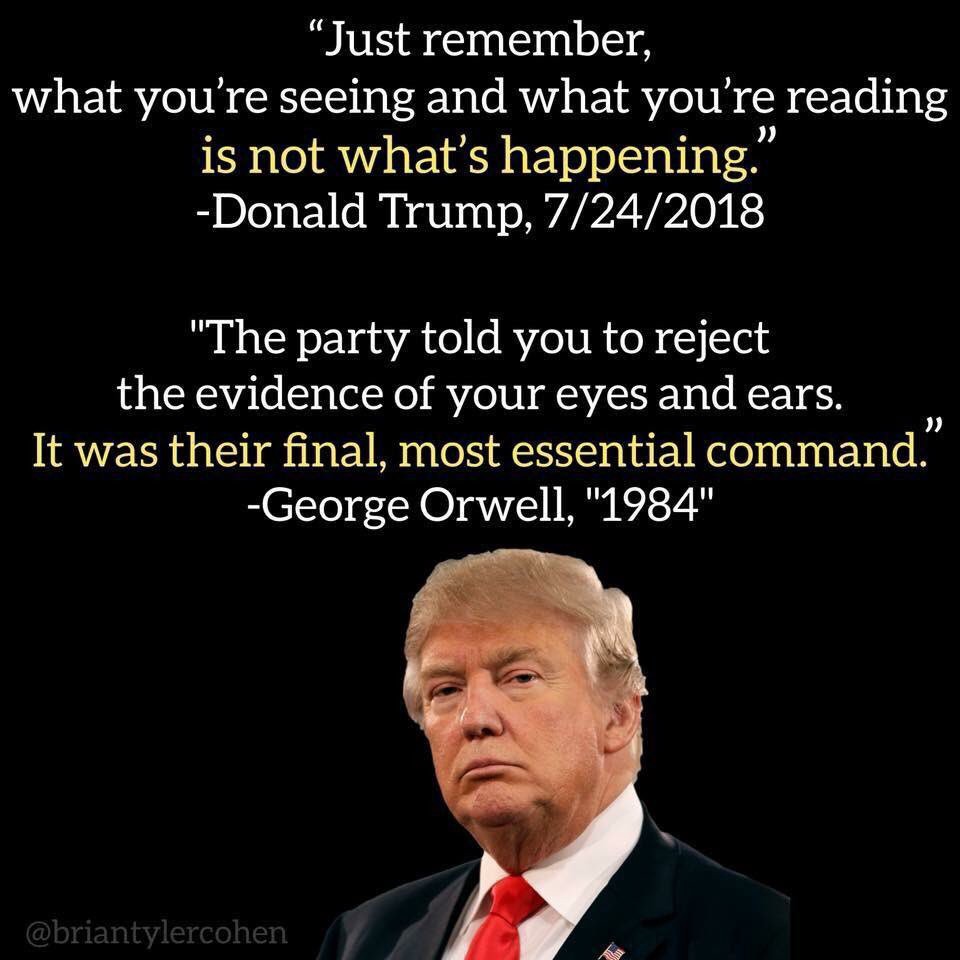
Wikipedia: The term “gaslighting describes someone (a “gaslighter”) who puts forth a false narrative that leads others to doubt their own perceptions.
It was the fundamental plotline of the movie, “Gaslight.” Over the years, there have been several comedic movies in which a character caught cheating by his wife, brazenly looks up and says to her, “Are you going to believe me or your eyes?”
This dynamic is generally only possible when the audience is vulnerable such as in unequal power relationships or when the audience is fearful of the losses associated with challenging the false narrative.
Donald Trump, and more recently his current Republican Party, have been gaslighting the American public for many years. They do it by denying the obvious, i.e denying what you see before your own eyes. The psychology is that if brazen deniers of fact deny often enough and forcefully enough, the weaker-minded among us will come to believe their own senses are wrong and that the deniers must be right. Eventually, the weakest-minded join the ranks of deniers and become inadvertent gaslighters, themselves. Here are just a few of the truths Trump and his Republican Party deny, despite all evidence. When you hear or read these denials, understand the deniers are trying to gaslight you. No President and political party in American history have been so focused on gaslighting America as has Trump and the GOP. Whether you believe them depends mostly on your confidence in your own senses and your understanding of the facts. Trump and the GOP have denied and/or continue to deny that:
  1. Climate change exists
  2. Human-caused climate change exists
  3. Climate change is a serious problem
  4. Poverty is a national problem, not the fault of the impoverished.
  5. Slavery was a serious historical problem
  6. Police focus negatively and unfairly on people of color
  7. Police are needlessly killing people of color
  8. Biden won the Presidential election
  9. Biden was elected, fairly
  10. Trump has no evidence of election fraud
  11. Masks help prevent sickening from COVID
  12. Vaccines help prevent sickening from COVID
  13. Masks help prevent the transmission of COVID
  14. COVID vaccines are safe
  15. COVID vaccines help prevent the transmission of COVID
  16. Trump is a pathological liar
  17. Trump encouraged an attempted coup.
  18. There was an attempted coup
  19. Trump tried to steal the Presidential election
  20. The Republican Party continues to try to steal elections
  21. Trump has surrounded himself with criminals
  22. Trump has surrounded himself with incompetent sycophants
  23. Trump is a massive liar
  24. Trump cheated on all three wives
  25. Trump cheated employees and lenders
  26. Trump cheated on his taxes
  27. The Trump Foundation was a scam
  28. Trump cheated students in his Trump University
  29. Trump molested many women
  30. Trump is a psychopath
  31. Social Security, Medicare, and all other federal agencies never can become insolvent.
  32. The U.S. Supreme Court is dominated by biased, right-wing, partisan political hacks.
  33. Republican-dominated states are trying to prevent people of color from voting.
  34. Trump and the Republican Party are fascists
Fox “News,” Breitbart, the numerous nutsy conspiracy blogs all attempt to gaslight you on behalf of Trump and the GOP. Hundreds of thousands of Americans have sickened and died because they yielded to right-wing gaslighting about COVID. And despite the results, the right-wing COVID gaslighting continues. But gaslighting is not limited to COVID. Gaslighting touches all aspects of your life, and always is done to benefit some power group, usually the very rich. They never will stop, so long as they are successful. Whether they continue to succeed depends on you and your psychological strength. It depends on your weakly yielding to gaslighting, and refusing to believe the facts right in front of you. You, your children, and the future of America are at risk from the gaslighters. Rodger Malcolm Mitchell Monetary Sovereignty Twitter: @rodgermitchell Search #monetarysovereignty Facebook: Rodger Malcolm Mitchell

……………………………………………………………………..

THE SOLE PURPOSE OF GOVERNMENT IS TO IMPROVE AND PROTECT THE LIVES OF THE PEOPLE.

The most important problems in economics involve:
  1. Monetary Sovereignty describes money creation and destruction.
  2. Gap Psychology describes the common desire to distance oneself from those “below” in any socio-economic ranking, and to come nearer those “above.” The socio-economic distance is referred to as “The Gap.”
Wide Gaps negatively affect poverty, health and longevity, education, housing, law and crime, war, leadership, ownership, bigotry, supply and demand, taxation, GDP, international relations, scientific advancement, the environment, human motivation and well-being, and virtually every other issue in economics. Implementation of Monetary Sovereignty and The Ten Steps To Prosperity can grow the economy and narrow the Gaps: Ten Steps To Prosperity:
  1. Eliminate FICA
  2. Federally funded Medicare — parts A, B & D, plus long-term care — for everyone
  3. Social Security for all
  4. Free education (including post-grad) for everyone
  5. Salary for attending school
  6. Eliminate federal taxes on business
  7. Increase the standard income tax deduction, annually. 
  8. Tax the very rich (the “.1%”) more, with higher progressive tax rates on all forms of income.
  9. Federal ownership of all banks
  10. Increase federal spending on the myriad initiatives that benefit America’s 99.9% 
The Ten Steps will grow the economy and narrow the income/wealth/power Gap between the rich and the rest.

MONETARY SOVEREIGNTY

The end of poverty in America

Liberals think the purpose of government is to protect the poor and powerless from the rich and powerful. Conservatives think the purpose of government is to protect the rich and powerful from the poor and powerless. Poverty in America | The Economist The poor you will always have with you, and you can help them any time you want. (Mark 14:7)
For there will never cease to be poor in the land; that is why I am commanding you to open wide your hand to your brother and to the poor and needy in your land. (Deuteronomy 15:11)
Is it true that there always will be poor people? Should it be true? Must it be true? Yes, the poor have been with us in most societies, but it should not be true, and it need not be true. Mathematically, in any scale of wealth, income, or power, some must be closer to the bottom. If “having less” is your definition of “poor” then yes, the poor always must be with us. But what if your definition of “poor” referenced “insufficiency” rather than “less” — insufficiency of food, healthcare, education, housing — then perhaps the poor need not all ways be with us. I suggest that it is not necessary for some people in America to be starving, sick, uneducated, and/or homeless.
Poverty fell overall in 2020 due to massive stimulus checks and unemployment aid, U.S. Census says By Heather Long and Amy Goldstein U.S. poverty fell overall in 2020, a surprising decline that is largely a result of the swift and large federal aidthat Congress enacted at the start of the pandemic to try to prevent widespread financial hardship as the nation experienced the worst economic crisis since the Great Depression.
Federal deficit spending for benefits to the poor “surprisingly” helped reduce the percentage of poor people. Who possibly could have expected that?
After accounting for all the federal relief payments, the so-called supplemental poverty measure declined to 9.1 percent in 2020 — the lowest on record and a significant decline from 11.8 percent in 2019. The decline in the poverty rate means that millions of Americans were lifted out of severe financial hardship last year, the U.S. Census said. Poverty is defined as having an income of less than $26,250 a year for a family of four.
If you happen to believe that poverty is bad for America, and that honestly religious people wish to help the impoverished, then all that deficit spending opposed by debt-scare peddlers was good for this country. If, however, you believe that the poor are lazy, good-for-nothing, takers, who deserve their poverty, then you will be saddened at learning the poverty rate declined. And if you have been told that federal taxes fund federal spending, you will be flummoxed by all that spending with federal taxes staying the same. And if you believe it’s better for the public to run a deficit with the federal government than for the federal government to run a deficit with the public, then you may be surprised to learn that federal deficit spending has allowed fewer people to be thrust into poverty.
Extensive federal relief assistance passed during the coronavirus pandemic is widely credited by economists and policy experts for preventing another Great Depression. The stimulus payments provided $1,200 cash payments to most low-income and middle-class Americans last year, moving 11.7 million people out of poverty, the Census said. Another 5.5 million people were prevented from falling into povertyby the enhanced unemployment insurance aid. “This really highlights the importance of our social safety net,” said Liana Fox, chief of the U.S. Census Bureau’s Poverty Statistics Branch.
Try to remember the fight against deficit spending, put up mostly by the right wing (with just a couple faux Democrats dissenting). If they had had their way, we would have had a depression.
The annual findings also showed that median income declined by 2.9 percent in 2020 to $67,500. Still, after accounting for the government aid, every age group, racial and ethnic group and educational level saw a decline in poverty. Some of the largest declines in poverty were reported for families headed by single moms, African Americans, Hispanic Americans and adults without a high school degree. “The federal government responded quickly and significantly. And it’s very clear that those efforts prevented a sharp rise in poverty,” said James Sullivan, an economics professor at the University of Notre Dame. “The concern is that we will see poverty rise again because we’ve now seen these relief packages expire.”
Remember also that the Monetarily Sovereign U.S. government has the infinite ability to create its own sovereign currency, U.S. dollars. It never can run short of dollars, and neither needs nor uses tax dollars for spending.

Alan Greenspan: “A government cannot become insolvent with respect to obligations in its own currency.”

Ben Bernanke: “The U.S. government has a technology, called a printing press (or, today, its electronic equivalent), that allows it to produce as many U.S. dollars as it wishes at essentially no cost.”

Despite current debates about “how will it be paid for,” the fact is that all federal spending is paid for the same way: The federal government, creates from thin air, its spending dollars. It can do so endlessly.
President Biden is urging Congress to enact more programs to help the poor and working class as part of a $3.5 trillion package that would make significant investments in many parts of the economy. Top White House aides point to the success of the pandemic aid as an example of how additional resources can make a dramatic difference in lowering poverty and hardship.
You can be certain that 100% of the GOP will oppose any aid to the poor, though the same politicians will approve of aid to the rich. All any insurance does is provide money, which the federal government is far more able to do. There is no advantage to your paying for health insurance, when the federal government is able to pay for health insurance.
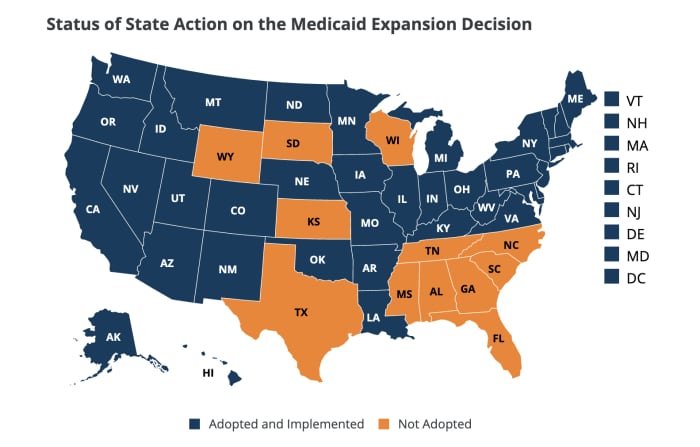
The census data shows that the rate of uninsured was especially high in a dozen states that have chosen not to expand Medicaid eligibility under the ACA. Unlike his predecessor, President Biden has been pressing to expand Medicaid in the dozen holdout states, and Congressional Democrats are considering proposals that would allow people frozen out of the program by their state governments to buy private ACA health plans inexpensively.
Here are the states whose political majority is Republican, and who do not consider poverty and lack of medical care to be a problem.
FROM KAISER FAMILY FOUNDATION
What happens next to family incomes and poverty will depend largely on how many Americans are able to return to work in the coming months and whether the U.S. government extends some aid to low-income Americans.
Contrary to popular wisdom, federal deficit spending does not cause inflation. All inflations have been caused by shortages of key goods and services, most often food and oil. Today’s inflation results from shortages of labor, food, and oil. Sadly, some voters have so little regard for humanity that they vote against the federal financing to ease poverty — financing that costs them nothing, but that will lift their neighbors from agonizing poverty and free children from starvation, homelessness, illness, and lack of education. SUMMARY
  1. The U.S. federal government has demonstrated how federal deficit spending can reduce poverty in America.
  2. The federal government, being Monetarily Sovereign, has the unlimited ability to deficit spend, without collecting taxes. It cannot unintentionally run short of dollars
  3. Federal deficit spending never has caused inflation; shortages of key goods and services are the sole cause of inflation.
  4. People who are homeless, uneducated, ill, and hungry are a drag on the economy. They are less able to produce and to consume.
  5. Poverty in America could be cured by the adoption of the Ten Steps to Prosperity (below).
The U.S. federal government has all the tools it needs to end poverty in America. All it needs is the will. Rodger Malcolm Mitchell Monetary Sovereignty Twitter: @rodgermitchell Search #monetarysovereignty Facebook: Rodger Malcolm Mitchell

……………………………………………………………………..

THE SOLE PURPOSE OF GOVERNMENT IS TO IMPROVE AND PROTECT THE LIVES OF THE PEOPLE.

The most important problems in economics involve:
  1. Monetary Sovereignty describes money creation and destruction.
  2. Gap Psychology describes the common desire to distance oneself from those “below” in any socio-economic ranking, and to come nearer those “above.” The socio-economic distance is referred to as “The Gap.”
Wide Gaps negatively affect poverty, health and longevity, education, housing, law and crime, war, leadership, ownership, bigotry, supply and demand, taxation, GDP, international relations, scientific advancement, the environment, human motivation and well-being, and virtually every other issue in economics. Implementation of Monetary Sovereignty and The Ten Steps To Prosperity can grow the economy and narrow the Gaps: Ten Steps To Prosperity:
  1. Eliminate FICA
  2. Federally funded Medicare — parts A, B & D, plus long-term care — for everyone
  3. Social Security for all
  4. Free education (including post-grad) for everyone
  5. Salary for attending school
  6. Eliminate federal taxes on business
  7. Increase the standard income tax deduction, annually. 
  8. Tax the very rich (the “.1%”) more, with higher progressive tax rates on all forms of income.
  9. Federal ownership of all banks
  10. Increase federal spending on the myriad initiatives that benefit America’s 99.9% 
The Ten Steps will grow the economy and narrow the income/wealth/power Gap between the rich and the rest.

MONETARY SOVEREIGNTY

Lest we forget: 9/11/2001, 1/6/2021

LEST WE FORGET

TWO DATES WHICH WILL LIVE IN INFAMY: 9/11/2001, 1/6/2021

RECENT ATTEMPTS TO DESTROY AMERICA’S DEMOCRACY

14 Bad ideas | batman christian bale, remembering september 11th, 911 never forget
Osama bin Laden

Donald Trump