Here’s your old friend again: The “ticking time bomb” of federal debt.

Regular readers of this blog have seen this before. Periodically, we reference the latest ignorant claim that the federal debt is a “ticking time bomb” ready to destroy America and the world.

The most recent reference to the ticking time bomb of federal debt came yesterday:

‘The world’s largest Ponzi scheme’: Peter Schiff just blasted the US debt ceiling drama. Here are 3 assets he trusts amid major market uncertainty
Story by Bethan Moorcraft
A ticking time bomb in the U.S. economy is running perilously close to detonation.

With the U.S. reaching its debt limit of $31.4 trillion on Jan. 19, Treasury Secretary Janet Yellen urged lawmakers to increase or suspend the debt ceiling.

Debt head: “Trust me, the world is about to end. Soon. Any minute now. Here it comes. Watch out. It’s happening. I really mean it.”

The first reference we found came in 1940 when the federal debt was about $40 Billion. Previous reviews can be found here and here.

Today, the federal debt zips past $25 Trillion, and still, the time bomb hasn’t exploded. We were confronted with our latest entry, dated February 5, 2023, which we placed at the bottom of the list. 

It just proves the debt heads have learned nothing in 84 years and counting.

We still have the media, the economists, and the politicians whining, moaning, complaining, and warning about the impending disaster that never seems to happen. 

Whether by ignorance or intent, these folks want the federal government to stop deficit spending on such benefits as Medicare and other healthcare, Social Security, all the poverty aids, education aids, and every type of scientific research and development, national parks, infrastructure — well just about everything that makes American life beautiful.

Oh, and they also want you to pay more taxes.

The only thing that seems to have some immunity is the military. Everyone loves the military because that’s patriotic. Right? Oh, and any benefits to the rich will remain intact, because the rich pay the politicians via “campaign contributions.” (aka “bribes.”)

The complaints come from people who do not understand, or don’t want you to understand, the differences between federal government financing (Monetary Sovereignty) and all other financings (monetary non-sovereignty).

A Monetarily Sovereign entity (the U.S., Canada, Australia, et al) never can run short of its own sovereign currency. So, for instance, the U.S. can pay any financial obligations denominated in U.S. dollars.

A monetarily non-sovereign entity (you, me, cities, counties, states, euro nations like France and Greece) have no sovereign currency, so they can and do run short of the money to pay their debts.

Those who do not understand the differences between Monetary Sovereignty and monetary non-sovereignty do not understand economics. You should believe their opinions on federal debt about as much as you believe their opinions about quantum chromodynamics.

Here is a picture of how the federal debt has grown. Keep in mind that every year it has been called a “ticking time” bomb” by debt-nuts. and every year they are proven wrong.

Here’s the partial list of debt head, sky-is-falling, warnings. Try not to laugh (or cry) at the repeated Henny Penny wrongheadedness.

————————//—————————

September 1940, the federal budget was a “ticking time-bomb which can eventually destroy the American system,” said Robert M. Hanes, president of the American Bankers Association.

September 26, 1940, New York Times, Column 8

By 1960: the debt was “threatening the country’s fiscal future,” said Secretary of Commerce, Frederick H. Mueller. (“The enormous cost of various Federal programs is a time-bomb threatening the country’s fiscal future, Secretary of Commerce Frederick H. Mueller warned here yesterday.”)

By 1983“The debt probably will explode in the third quarter of 1984,” said Fred Napolitano, former president of the National Association of Home Builders.

In 1984: AFL-CIO President Lane Kirkland said. “It’s a time bomb ticking away.”

In 1985“The federal deficit is ‘a ticking time bomb, and it’s about to blow up,” U.S. Sen. Mitch McConnell. (Remember him?)

Later in 1985: Los Angeles Times: “We labeled the deficit a ‘ticking time bomb’ that threatens to permanently undermine the strength and vitality of the American economy.”

In 1987: Richmond Times-Dispatch – Richmond, VA: “100TH CONGRESS FACING U.S. DEFICIT’ TIME BOMB'”

Later in 1987: The Dallas Morning News: “A fiscal time bomb is slowly ticking that, if not defused, could explode into a financial crisis within the next few years for the federal government.”

In 1989: FORTUNE Magazine: “A TIME BOMB FOR U.S. TAXPAYERS

In 1992: The Pantagraph – Bloomington, Illinois: “I have seen where politicians in Washington have expressed little or no concern about this ticking time bomb they have helped to create, that being the enormous federal budget deficit, approaching $4 trillion.

Later in 1992: Ross Perot: “Our great nation is sitting right on top of a ticking time bomb. We have a national debt of $4 trillion.”

In 1995: Kansas City Star: “Concerned citizens. . . regard the national debt as a ticking time bomb poised to explode with devastating consequences at some future date.”

In 2003: Porter Stansberry, for the Daily Reckoning: “Generation debt is a ticking time bomb . . . with about ten years left on the clock.”

In 2004: Bradenton Herald: “A NATION AT RISK: TWIN DEFICIT A TICKING TIME BOMB

In 2005: Providence Journal: “Some lawmakers see the Medicare drug benefit for what it is: a ticking time bomb.”

In 2006: NewsMax.com, “We have to worry about the deficit . . . when we combine it with the trade deficit we have a real ticking time bomb in our economy,” said Mrs. Clinton.

In 2007: USA Today: “Like a ticking time bomb, the national debt is an explosion waiting to happen.

In 2010: Heritage Foundation: “Why the National Debt is a Ticking Time Bomb. Interest rates on government bonds are virtually guaranteed to jump over the next few years.

In 2010: Reason Alert: “. . . the time bomb that’s ticking under the federal budget like a Guy Fawkes’ powder keg.”

In 2011: Washington Post, Lori Montgomery:”. . . defuse the biggest budgetary time bombs that are set to explode.”

June 19, 2013Chamber of Commerce: Safety net spending is a ‘time bomb’, By Jim Tankersley: The U.S. Chamber of Commerce is worried that not enough Americans are worried about social safety net spending. The nation’s largest business lobbying group launched a renewed effort Wednesday to reduce projected federal spending on safety-net programs, labeling them a “ticking time bomb” that, left unchanged, “will bankrupt this nation.”

In 2014: CBN News: “The United States of Debt: A Ticking Time Bomb

On June 18, 2015The ticking economic time bomb that presidential candidates are ignoring: Fortune Magazine, Shawn Tully,

On February 10, 2016The Daily Bell“Obama’s $4.1 Trillion Budget Is Latest Sign of America’s Looming Collapse”

On January 23, 2017Trump’s ‘Debt Bomb‘: Deficit May Grow, Defense Budget May Not, By Sydney J. Freedberg, Jr.

On January 27, 2017: America’s “debt bomb is going to explode.” That’s according to financial strategist Peter Schiff. Schiff said that while low interest rates had helped keep a lid on U.S. debt, it couldn’t be contained for much longer. Interest rates and inflation are rising, creditors will demand higher premiums, and the country is headed “off the edge of a cliff.”

On April 28, 2017Debt in the U.S. Fuel for Growth or Ticking Time Bomb?, American Institute for Economic Research, by Max Gulker, PhD – Senior Research Fellow, Theodore Cangeros

February 16, 2018 America’s Debt Bomb By Andrew Soergel, Senior Reporter: Conservatives and deficit hawks are hurling criticism at Washington for deepening America’s debt hole.

April 18, 2018 By Alan Greenspan and John R. Kasich: “Time is running short, and America’s debt time bomb continues to tick.”

January 10, 2019Unfunded Govt. Liabilities — Our Ticking Time Bomb. By Myra Adams, Tick, tick, tick goes the time bomb of national doom.

January 18, 2019; 2019 Is Gold’s Year To Shine (And The Ticking U.S. Debt Time-Bomb) By Gavin Wendt

[The following were added after the original publishing of this article]

April 10, 2019, The National Debt: America’s Ticking Time Bomb. TIL Journal. Entire nations can go bankrupt. One prominent example was the *nation of Greece which was threatened with insolvency, a decade ago. Greece survived the economic crisis because the European Union and the IMF bailed the nation out.

July 11, 2019National debt is a ‘ticking time bomb: Sen. Mike Lee

SEP 12, 2019Our national ticking time bomb, By BILL YEARGIN
SPECIAL TO THE SUN SENTINEL | At some point, investors will become concerned about lending to a debt-riddled U.S., which will result in having to offer higher interest rates to attract the money. Even with rates low today, interest expense is the federal government’s third-highest expenditure following the elderly and military. The U.S. already borrows all the money it uses to pay its interest expense, sort of like a Ponzi scheme. Lack of investor confidence will only make this problem worse.

JANUARY 06, 2020, National debt is a time bomb, BY MARK MANSPERGER, Tri City Herald | The increase in the U.S. deficit last year was about $1.1 trillion, bringing our total national debt to more than $23 trillion! This fiscal year, the deficit is forecasted to be even higher, and when the economy eventually slows down, our annual deficits could be pushing $2 trillion a year! This is financial madness. there’s not going to be a drastic cut in federal expenditures — that is, until we go broke — nor are we going to “grow our way” out of this predicament. Therefore, to gain control of this looming debt, we’re going to have to raise taxes.

February 14, 2020, OMG! It’s February 14, 2020, and the national debt is still a ticking time bomb! The national debt: A ticking time bomb? America is “headed toward a crisis,” said Tiana Lowe in WashingonExaminer.com. The Treasury Department reported last week that the federal deficit swelled to more than $1 trillion in 2019 for the first time since 2012. Even more alarming was the report from the bipartisan Congressional Budget Office (CBO) predicting that $1 trillion deficits will continue for the next 10 years, eventually reaching $1.7 trillion in 2030

April 26, 2020, ‘Catastrophic’: Why government debt is a ticking time bomb, Stephen Koukoulas, Yahoo Finance  [Re. Monetarily Sovereign Australia’s debt.]

August 29, 2020LOS ANGELES, California: America’s mountain of debt is a ticking time bomb  The United States not only looks ill, but also dead broke. To offset the pandemic-induced “Great Cessation,” the U.S. Federal Reserve and Congress have marshalled staggering sums of stimulus spending out of fear that the economy would otherwise plunge to 1930s soup kitchen levels. Assuming that America eventually defeats COVID-19 and does not devolve into a Terminator-like dystopia, how will it avoid the approaching fiscal cliff and national bankruptcy?

April 16, 2021NATIONAL POLICY: ECONOMY AND TAXES / MARK ALEXANDER /
The National Debt Clock: A Ticking Time Bomb: At the moment, our national debt exceeds $28 TRILLION — about 80% held as public debt and the rest as intragovernmental debt. That is $225,000 per taxpayer. Federal annual spending this year is almost $8 trillion, and more than half of that is deficit spending — piling on the national debt.

June 17, 2022 Time Bomb On National Debt Is Counting Down Faster Thanks To Fed’s Rate Hike,  Tim Brown / 
We are now staring down the barrel of the end of the U.S. economy based on fiat money, printed out of thin air but charged back to the people at ridiculous interest rates. Now, the national debt is approaching $31 trillion, which is $12 trillion more than when Donald Trump took office in 2017 and more than half of that debt was tacked on in his final year. Then we’ve had the disastrous year and a half of Joe Biden. Now, the Fed is now hiking its rates and that spells even more trouble for the national debt and the economy at large.

December 4, 2022 America’s ticking time bomb: $66 trillion in debt that could crash the economy
By Stephen Moore, The national debt is $31 trillion when including Social Security’s and Medicare’s unfunded liabilities. Wake up, America.That ticking sound you’re hearing is the American debt time bomb that with each passing day is getting precariously close to detonating and crashing the US economy.

January 13, 2023. A ticking time bomb in the U.S. economy is running perilously close to detonation. Long considered a harbinger of bad luck, Friday, Jan. 13 came with a warning for Congress that the country could default on its debt as soon as June. With the U.S. reaching its debt limit of $31.4 trillion on Jan. 19, Treasury Secretary Janet Yellen urged lawmakers to increase or suspend the debt ceiling.

February 5 2023 ‘The world’s largest Ponzi scheme’: Peter Schiff just blasted the US debt ceiling drama. Here are 3 assets he trusts amid major market uncertainty Story by Bethan Moorcraft, A ticking time bomb in the U.S. economy is running perilously close to detonation. With the U.S. reaching its debt limit of $31.4 trillion on Jan. 19, Treasury Secretary Janet Yellen urged lawmakers to increase or suspend the debt ceiling.

———————–//———————–

If, year after year for 84years, you keep predicting something is imminent, yet it never happens, at what point do you reexamine your beliefs?

Apparently never, for the debt heads. 

Truly pitiful.

Rodger Malcolm Mitchell
Monetary Sovereignty

Twitter: @rodgermitchell Search #monetarysovereignty
Facebook: Rodger Malcolm Mitchell

……………………………………………………………………..

THE SOLE PURPOSE OF GOVERNMENT IS TO IMPROVE AND PROTECT THE LIVES OF THE PEOPLE.

The most important problems in economics involve:

  1. Monetary Sovereignty describes money creation and destruction.
  2. Gap Psychology describes the common desire to distance oneself from those “below” in any socio-economic ranking, and to come nearer those “above.” The socio-economic distance is referred to as “The Gap.”

Wide Gaps negatively affect poverty, health and longevity, education, housing, law and crime, war, leadership, ownership, bigotry, supply and demand, taxation, GDP, international relations, scientific advancement, the environment, human motivation and well-being, and virtually every other issue in economics. Implementation of Monetary Sovereignty and The Ten Steps To Prosperity can grow the economy and narrow the Gaps: Ten Steps To Prosperity:

  1. Eliminate FICA
  2. Federally funded Medicare — parts A, B & D, plus long-term care — for everyone
  3. Social Security for all
  4. Free education (including post-grad) for everyone
  5. Salary for attending school
  6. Eliminate federal taxes on business
  7. Increase the standard income tax deduction, annually. 
  8. Tax the very rich (the “.1%”) more, with higher progressive tax rates on all forms of income.
  9. Federal ownership of all banks
  10. Increase federal spending on the myriad initiatives that benefit America’s 99.9% 

The Ten Steps will grow the economy and narrow the income/wealth/power Gap between the rich and the rest.

MONETARY SOVEREIGNTY
The Relentless Con Job By The Rich. The Big Lie In Economics

The efforts of the rich to become even richer never end.

The rich incessantly promulgate lies about our economy. More importantly, they bribe the primary influencers — the politicians, the media, and the economists — to spread the Big Lie that federal spending is funded by federal taxes.

File:Scottpelley.jpg - Wikimedia Commons
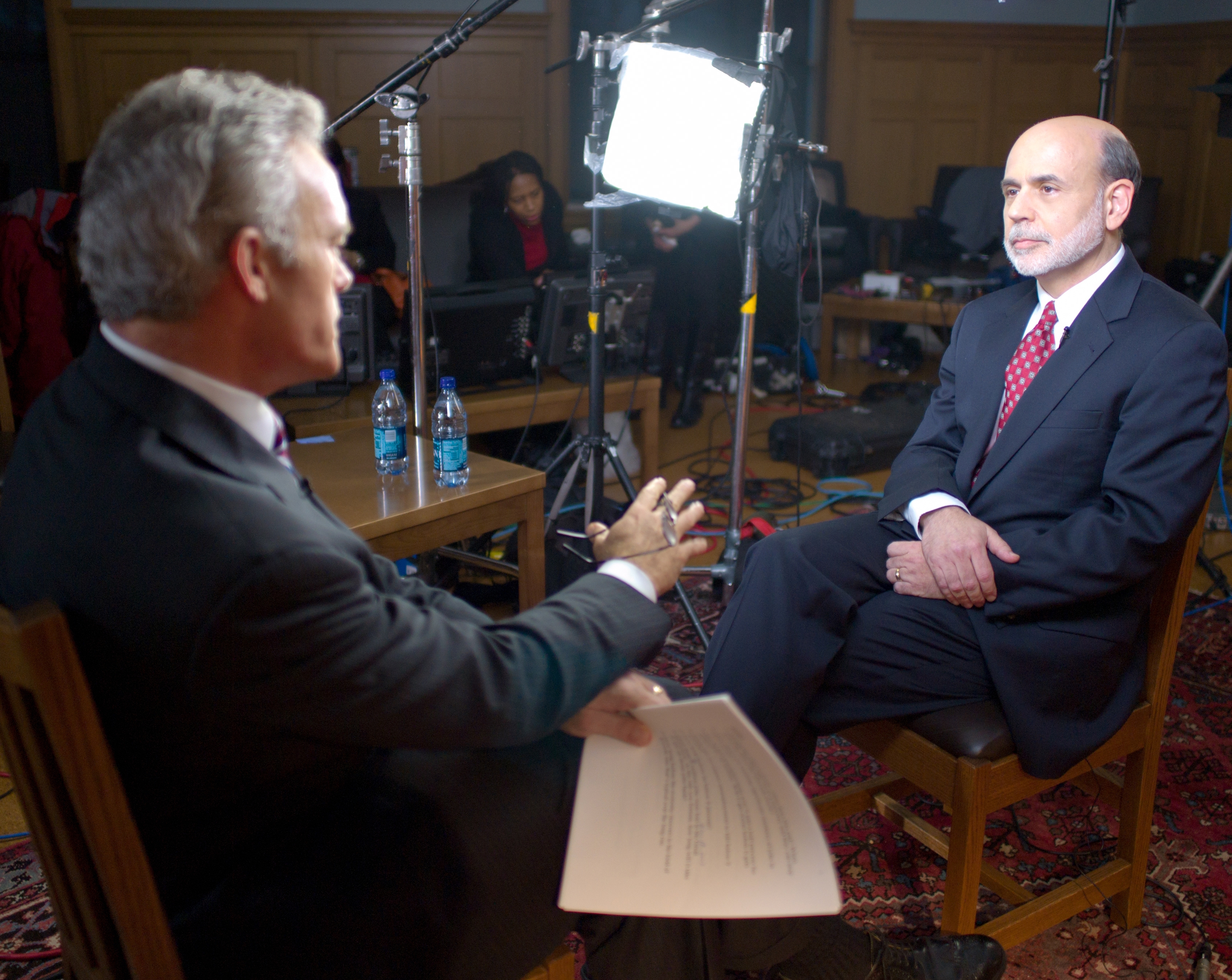
Bernanke: “It’s not tax money… We simply use the computer to mark up the size of the account.”

In reality, federal spending is funded by ad hoc federal money creation, not taxes.

Unlike state and local government taxes, all federal tax dollars are destroyed upon receipt.

The tax dollars no longer exist in the economy (the private sector), and since the federal government has infinite dollars, the tax dollars no longer exist anywhere.

The Big Lie convinces the populace that the federal government’s ability to provide benefits is financially limited by tax receipts.

(Politicians are bribed via campaign contributions and promises of lucrative jobs. The media are bribed via advertising dollars and actual ownership. Economists are bribed via gifts to universities and lucrative positions on “think tanks.”) 

Whenever you hear about a federal benefit, and someone asks, “Who will pay for it?” you should know you are about to listen to the Big Lie. The answer is: “The federal government will pay for it by creating dollars.”

Quote from former Fed Chairman Ben Bernanke when he was on 60 Minutes:
Scott Pelley: Is that tax money that the Fed is spending?
Bernanke: It’s not tax money… We simply use the computer to mark up the size of the account.

“Social Security and Medicare are about to become insolvent” is an example of the Big Lie, the purpose of which is to distance the rich from the rest of us.

“Rich” is a comparative, not an absolute. If you have a million dollars, you are rich if most others have less than a million. But you are not wealthy if everyone else has ten million.

That leaves you two ways to become richer: Get more for yourself or make the others have less. The rich in America have chosen both courses.

They try to grab more for themselves; their efforts to force you to have less are not as obvious.

The rich receive most of their income from sources other than salaries. Consider FICA. Congress has deemed FICA should be collected only from salaries, not from other forms of income.

Further, Congress has decided FICA is to be collected on salaries less than $142,800. Anything above that is not taxed.

The FICA limit is just one of the thousands of tax breaks the rich have “encouraged” Congress to give them. The purpose: To widen the Gap between them and you. Widening the Gap makes them richer.

U.S. federal finances are unlike state & local government finances, business finances, and euro nation finances.

The Map and the Territory, by Alan Greenspan | Financial Times
Former Fed Chairman Alan Greenspan: “A government cannot become insolvent with respect to obligations in its own currency.”

The U.S. government is Monetarily Sovereign. It has the unlimited ability to create its own sovereign currency.

It never unintentionally can run short of dollars.

Yet we see organizations funded by the rich claiming that federal spending, which goes to the middle- and lower-income people, is detrimental to the middle- and lower-income people.

They want you to believe you should receive lower benefits and pay more taxes.

If they can cement that belief in your minds, you’ll vote for the very people who take money from your pocket.

Here is the entirety of a page posted by the Committee For A Responsible Budget, one of the organizations that continually tries to foist on you the false idea that you should have less.

Every single sentence, including the headline, is false and/or an outright lie:

Why High and Rising National Debt is a Problem

FALSE. High and rising National (i.e., federal) Debt is not a problem. It is not even Debt. It is the total of deposits into Treasury security accounts at the Federal Reserve.

These accounts resemble safe-deposit boxes. When you buy a T-bill, T-note, or T-bond, you open an account at the Federal Reserve and deposit your dollars into it.

The federal government never touches those dollars. It has no need to.

The government can pay off the so-called “debt” merely by returning to you the dollars in your account.

This is no burden on the government, taxpayers, or the economy. There is no “Problem.”

High and rising national Debt will threaten economic growth and the standard of living for all Americans. High Debt will slow the growth of the economy and wages.

FALSE. Federal “debt,” i.e., the total of deposits in T-securities, is set by law to equal the cumulative total of federal deficits.

Bernanke sees decent chance for Fed to pull off a 'soft-ish landing' | The  Hill
Bernanke: “The U.S. government has a technology, called a printing press (or, today, its electronic equivalent), that allows it to produce as many U.S. dollars as it wishes at essentially no cost.”

Deficits are the difference between the amount of money the government takes out of the economy vs. the amount it puts in (with some going to foreign nations).

Rising national “debt” occurs when the federal government puts more dollars into the economy than it takes out.

There is no mechanism by which adding money to the economy can “slow the growth of the economy and wages.”

On the contrary, when economic growth slows, the government adds more stimulus dollars (increases the “debt”) to prevent or cure a recession.

The “debt” has no direct effect on wages, which are a function of business profits (stimulated by federal deficit spending) and labor supply.

As Debt rises, higher interest payments will crowd out important investments in areas like education, infrastructure, and research that can help grow the economy.

FALSE. Federal Debt does not force higher interest rates. Interest rates are set arbitrarily by the Federal Reserve to control inflation.

The peaks and valleys of changes for Federal deficits (blue) neither correspond to changes in Interest rates (red) nor are they a leading indicator. Note the 12 years 2008 – 2020, when federal deficit spending grew massively while interest rates neared zero.

Federal interest payments do not “crowd out” other federal payments for “education, infrastructure, and research. The federal government has infinite money with which to pay for anything.

During periods of high deficit spending, interest rates have been low.

Getting the Debt under control once the crisis is over will be very beneficial for generations to come, from higher wages to increased investment to lower borrowing costs for families and businesses.

FALSE. This paragraph is just a restatement of the previous section. There is no mechanism by which fewer dollars coming into the economy can cause “higher wages, increased investment, and lower borrowing costs.

The last decade shows the opposite: Higher deficits along with higher wages, increased investment, and low borrowing costs.

The Congressional Budget Office predicts that the economy will grow faster with Debt on a declining path as opposed to a rising one.

FALSE: History shows that declining Debt leads to depressions and recessions.

1804-1812: U. S. Federal Debt reduced 48%. Depression began 1807.
1817-1821: U. S. Federal Debt reduced 29%. Depression began 1819.
1823-1836: U. S. Federal Debt reduced 99%. Depression began 1837.
1852-1857: U. S. Federal Debt reduced 59%. Depression began 1857.
1867-1873: U. S. Federal Debt reduced 27%. Depression began 1873.
1880-1893: U. S. Federal Debt reduced 57%. Depression began 1893.
1920-1930: U. S. Federal Debt reduced 36%. Depression began 1929.
1997-2001: U. S. Federal Debt reduced 15%. Recession began 2001.

The reason is quite simple. Reducing federal Debt requires taking dollars out of the economy. 

Just as adding stimulus dollars to the economy prevents and cures recessions and depressions, taking dollars out of the economy causes recessions and depressions.

The rich do not fear recessions and depressions. They are less harmed than the rest of us. They have more cushion to weather the hard times.

During recessions and depressions, workers become more desperate for jobs, giving the rich the opportunity to cut wages and increase their own relative incomes.

In addition to publishing the completely non-sensical paragraphs just discussed, The rich-run CRFB runs “hearings” on the condition of the government’s finances.”

These hearings contain nothing more than recitations of the Big Lie — false propaganda we have just discussed. The purpose will be to give Congress excuses to:

    • Cut Social Security benefits
    • Cut Medicare benefits
    • Eliminated Obamacare
    • Increase FICA taxes
    • Cut other benefits for the poor and middle-classes
    • Widen the income/wealth/power Gaps between the rich and the rest 

The drumming of lies and misstatements from the rich and toadies for the rich is relentless. So long as it works to indoctrinate the public, it never will end.

The attempts at indoctrination end only when you, the public, demonstrate your understanding of the lies and your willingness to punish the liars.

Fool you once; shame on them. Fool you thousands of times, over and over and over; shame on you.

[No rational person would take dollars from the economy and give them to a federal government that has the infinite ability to create dollars.]

Rodger Malcolm Mitchell Monetary Sovereignty Twitter: @rodgermitchell Search #monetarysovereignty Facebook: Rodger Malcolm Mitchell

……………………………………………………………………..

THE SOLE PURPOSE OF GOVERNMENT IS TO IMPROVE AND PROTECT THE LIVES OF THE PEOPLE.

The most important problems in economics involve:

  1. Monetary Sovereignty describes money creation and destruction.
  2. Gap Psychology describes the common desire to distance oneself from those “below” in any socio-economic ranking, and to come nearer those “above.” The socio-economic distance is referred to as “The Gap.”

Wide Gaps negatively affect poverty, health and longevity, education, housing, law and crime, war, leadership, ownership, bigotry, supply and demand, taxation, GDP, international relations, scientific advancement, the environment, human motivation and well-being, and virtually every other issue in economics. Implementation of Monetary Sovereignty and The Ten Steps To Prosperity can grow the economy and narrow the Gaps: Ten Steps To Prosperity:

  1. Eliminate FICA
  2. Federally funded Medicare — parts A, B & D, plus long-term care — for everyone
  3. Social Security for all
  4. Free education (including post-grad) for everyone
  5. Salary for attending school
  6. Eliminate federal taxes on business
  7. Increase the standard income tax deduction, annually. 
  8. Tax the very rich (the “.1%”) more, with higher progressive tax rates on all forms of income.
  9. Federal ownership of all banks
  10. Increase federal spending on the myriad initiatives that benefit America’s 99.9% 

The Ten Steps will grow the economy and narrow the income/wealth/power Gap between the rich and the rest.

MONETARY SOVEREIGNTY

Does Bernie Sanders have a secret plan about Social Security?

Modern Monetary Theory Got a Pandemic Tryout. Inflation Is Now Testing It. - The New York Times
Stephanie Kelton
Bernie Sanders is a “friend” to the extent that he wishes to expand Social Security (and Medicare). He once had Modern Monetary Theory’s Stephanie Kelton as his chief economic adviser during his 2016 presidential campaign. Kelton tried and seemingly failed to educate Sanders about the facts of federal economics, the key one being that a Monetarily Sovereign government cannot run short of its own sovereign currency. It neither needs nor uses tax receipts, which are destroyed upon receipt.

(When you pay taxes to the federal government, money is removed from the private sector [aka “the economy”] and flows to the U.S. Treasury. Because the Treasury has infinite money, your tax dollars effectively are destroyed. (Infinity + any number = infinity. No change.)

Perhaps Sanders is playing politics because he continues to mouth the absurdity that the federal government and its agencies unintentionally can run short of U.S. dollars.

‘Time to Scrap the Cap’: Sanders, Warren Bill Targets Rich to Expand Social Security Posted on June 10, 2022 by Yves Smith, By Jake Johnson, a staff writer at Common Dreams. Originally published at Common Dreams

Yves here. It’s no secret that the assertions that Social Security is in dire financial straits are fabrications.

First, like so much of our Federal government funding, the device of having a trust fund is a convenient fiction.

So far, so good. Despite incessant allusions to the contrary, the so-called Medicare Trust Fund and Social Security Trust Fund are not trust funds. They merely are notations on a balance sheet. Those numbers are completely controlled by the federal government. The federal government can change the numbers at will — quite different from a trust fund.

In reality, Social Security is a pay-as-you-go program.

She is correct if Susan Webber (aka Yves Smith) means that the federal government pays for Social Security by creating dollars, ad hoc.

Second, for those who nevertheless like the appearance that Social Security is paid for by payroll contributions, the most obvious fix has long been to raise or eliminate the cap on salaries subject to payroll taxes.

The fact that this problem has not been solved strongly suggests some influential parties don’t want it solved.

Those “influential parties” are the very rich, who wish to widen the Gap between them and those below them on any income/wealth/power scale. It’s known as “Gap Psychology.” Unfortunately, most Americans believe the lie that Social Security is paid for by a trust fund. The solution to a lie is not to accept the lie, as Smith seems to advocate, but rather to tell the truth. But, she doesn’t seem to advocate for the truth.

Sens. Bernie Sanders and Elizabeth Warren led a group of lawmakers Thursday in unveiling legislation that would expand Social Security’s modest annual benefits by $2,400 and ensure the program is fully funded for the next 75 years.

The benefit boost under the Social Security Expansion Act would be funded by lifting the cap on the maximum amount of income subject to the Social Security payroll tax.

This year the cap was $147,000—meaning millionaires stopped paying into the program in late February.

Lifting the cap would fund nothing because the Social Security payroll tax (FICA) funds nothing. The dollars are destroyed when they hit the Treasury. President Roosevelt, the creator of Social Security, knew this, but he wanted the tax to make Social Security impossible to end. He reportedly said, concerning FICA:

“I guess you’re right on the economics (that payroll taxes are unnecessary).

“They are politics all the way through. We put those payroll contributions there so as to give the contributors a legal, moral, and political right to collect their pensions and their unemployment benefits.

“With those taxes in there, no damn politician can ever scrap my social security program. Those taxes aren’t a matter of economics. They’re straight politics.”

All federal programs can end, and many do when an opposing party comes into power. But if the voters believe they have contributed to a program, the opposing party will find it politically challenging to end the program.

If passed, the expansion bill would apply the payroll tax to all income, including capital gains, above $250,000 a year, a change that would only raise taxes on around 7% of U.S. households.

“At a time when half of older Americans have no retirement savings and millions of senior citizens are living in poverty, our job is not to cut Social Security,” Sanders (I-Vt.), head of the Senate Budget Committee and a co-chair of the Expand Social Security Caucus, said in a statement.

“Our job must be to expand Social Security so that every senior citizen in America can retire with the dignity they deserve and every person with a disability can live with the security they need,” the senator continued.

“And we will do that by demanding that the wealthiest people in America finally pay their fair share of taxes.

It is absurd that a billionaire in America today pays the same amount of Social Security taxes as someone making $147,000 a year.

It is time to scrap the cap, expand benefits, and fully fund Social Security.”

Does Sanders believe that? Does he think raising the $147,000 FICA salary cap will expand benefits and fully fund Social Security? Or is his plan simply to make the rich pay so that it appears a Social Security increase will be fully funded? Is that his way of answering the question, “Who will pay for it? Or does he have an even deeper plot?

The legislation comes a week after the annual Social Security trustees report showed that—contrary to Republicans’ claims that it is barreling toward insolvency—the program is positioned to fully fund benefits until 2035.

Thereafter, even if Congress takes no action, the program is projected to be 90% funded for the next 25 years and 81% funded for the next 75 years.

Social Security is fully funded, not by any fake trust fund but by the full faith and credit of the United States government. Neither the U.S. government nor any government agency can run short of dollars unless Congress and the President want it to. What is their real plan assuming Sanders and Warren are intelligent and well-informed?

“Social Security is an economic lifeline for millions of Americans, but many seniors are struggling with rising costs,” said Warren (D-Mass.).

“As Republicans try to phase out Social Security and raise taxes on more than 70 million hardworking Americans, I’m working with Senator Sanders to expand Social Security and extend its solvency by making the wealthy pay their fair share, so everyone can retire with dignity.”

That “fair share” hints at the real purpose of Sanders’ plan.

Sanders announced the new bill Thursday during a Senate Budget Committee hearing, at which Republicans—including Sen. Mitt Romney (R-Utah), who has previously voiced support for privatizing Social Security—made clear they would oppose the legislation, which has been endorsed by more than 50 advocacy organizations and labor unions.

The Republicans’ ostensible purpose for privatizing Social Security is the claim that stock market investments will grow enough to safeguard Social Security growth. The claim is false for at least two reasons.
  1. Social Security is funded by the federal government’s money creation, not taxes or any other outside mechanism.
  2. The stock market is not a secure growth mechanism, and if somehow it were made to fund Social Security, the current S&P drop demonstrates the folly of relying on private markets.
The true purpose of Romney’s and other Republicans repeated drumbeat for privatization is simple: To provide another lucrative money-making opportunity for wealthy investment firms.

In addition to increasing annual benefits and lifting the tax cap, the Social Security Expansion Act would also boost the program’s cost-of-living adjustments by switching to a more accurate measure of inflation.

According to the Social Security Administration, the average monthly Social Security benefit payment was around $1,540 as of April 2022.

“With the cost of living at an all-time high, Social Security has never been more important, yet congressional Republicans continue to play games with its funding,” said Rep. Peter DeFazio (D-Ore.), the lead sponsor of a companion bill in the House.

An example of Gap Psychology at work. A wealthy person will spend $12.8 million to distance himself from those who have less, and to come closer to those who have more.

“This legislation would ensure that the Social Security Trust Fund remains solvent for another 75 years, increase monthly benefits for most recipients by $200, and alter the cost-of-living-adjustment formula to meet the everyday needs of our nation’s seniors,” DeFazio added.

Lifting the tax cap won’t accomplish any of those stated purposes. So, what may be the fundamental purpose? Could it be Sanders’ and Warren’s secret plan to narrow the income/wealth/power Gap between the rich and the rest? Is this their Gap Psychology plan?

(Gap Psychology describes the common desire to distance oneself from those below, on any socioeconomic scale, and to come closer to those above.)

The plan implies to those who believe FICA funds Social Security, a direct money transfer from the richer to the poorer, from those whose salary exceeds $147,000 to those whose salary is lower. Since there are more voters in the latter position than in the former, it’s a pretty good Gap Psychology election ploy. Because the plan would, though by a minimal amount, help narrow the Gap, I wish I could be in favor. But I simply can’t support the idea of ratifying the Big Lie that federal taxes fund federal spending. So long as the populace believes the Big Lie, the myth that the U.S. is as financially hamstrung as the states, counties, cities, and euro nations. We must free ourselves of that myth to have control over our economic future. The honest plan would be to tell the world that the federal government can’t run short of dollars, federal taxes don’t fund federal spending, and federal spending doesn’t cause inflation. (See: “First do no harm. How ‘Dr.’ Jerome Powell will worsen the inflation and cause a recession”) The rich will continue to rule until those truths are exposed and understood. (Every federal spending cut demanded by conservatives is designed to widen the income/wealth/power Gap between the rich and the rest, while the few federal spending increases backed by the conservatives are designed to reward and protect the rich.) Rodger Malcolm Mitchell Monetary Sovereignty Twitter: @rodgermitchell Search #monetarysovereignty Facebook: Rodger Malcolm Mitchell

……………………………………………………………………..

THE SOLE PURPOSE OF GOVERNMENT IS TO IMPROVE AND PROTECT THE LIVES OF THE PEOPLE.

The most important problems in economics involve:
  1. Monetary Sovereignty describes money creation and destruction.
  2. Gap Psychology describes the common desire to distance oneself from those “below” in any socio-economic ranking, and to come nearer those “above.” The socio-economic distance is referred to as “The Gap.”
Wide Gaps negatively affect poverty, health and longevity, education, housing, law and crime, war, leadership, ownership, bigotry, supply and demand, taxation, GDP, international relations, scientific advancement, the environment, human motivation and well-being, and virtually every other issue in economics. Implementation of Monetary Sovereignty and The Ten Steps To Prosperity can grow the economy and narrow the Gaps: Ten Steps To Prosperity:
  1. Eliminate FICA
  2. Federally funded Medicare — parts A, B & D, plus long-term care — for everyone
  3. Social Security for all
  4. Free education (including post-grad) for everyone
  5. Salary for attending school
  6. Eliminate federal taxes on business
  7. Increase the standard income tax deduction, annually. 
  8. Tax the very rich (the “.1%”) more, with higher progressive tax rates on all forms of income.
  9. Federal ownership of all banks
  10. Increase federal spending on the myriad initiatives that benefit America’s 99.9% 
The Ten Steps will grow the economy and narrow the income/wealth/power Gap between the rich and the rest.

MONETARY SOVEREIGNTY

Two pieces of knowledge could turn America into a paradise

We could turn America into a paradise by understanding two truths: 1. Our Monetarily Sovereign federal government never can run short of money.

Ben Bernanke: “The U.S. government has a technology, called a printing press (or, today, its electronic equivalent), that allows it to produce as many U.S. dollars as it wishes at essentially no cost.

Alan Greenspan: “A government cannot become insolvent with respect to obligations in its own currency.

Money is not a physical object. It is not a dollar bill or a coin, both of which are titles to money, not money itself. Money is nothing more than numbers on a balance sheet. The federal government has absolute control over its balance sheets. It can change numbers at will, merely by passing laws, which is how it created the first U.S. dollars. It simply passed laws. The federal government can add money to your checking account by instructing your bank to increase the account’s balance. It sends your bank a “Pay to the order of” document. New dollars are created and added to your account when your bank obeys those instructions. Federal checks don’t bounce because Congress passes laws to prevent bouncing. Example: Every time we reach a “debt ceiling,” Congress raises it so that federal checks are honored. That is how the federal government pays bills and creates dollars. 2. Federal spending never causes inflation. Shortages of critical goods and services cause inflation. The most common inflation-causing shortage is the shortage of oil.
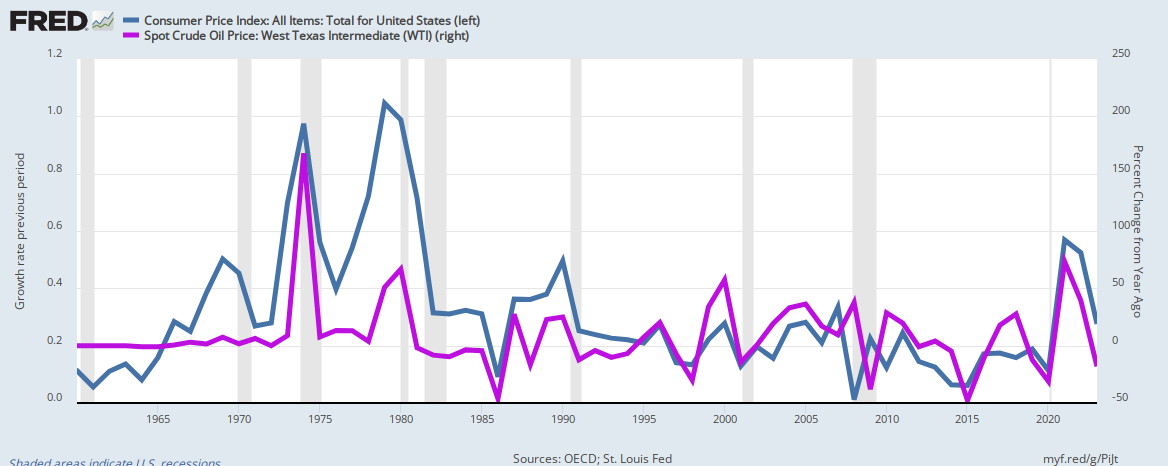
The blue line is inflation. Purple is oil pricing. Vertical gray bars are recessions. Inflation tends to parallel oil pricing. The data show that oil shortages cause oil prices to rise, leading to inflation.
The best way to cure inflations is to remedy the shortages. Contrary to popular wisdom, federal spending does not cause the shortages that cause inflation.
Again, the blue line is inflation. The red line represents federal deficit spending. You’ll see no parallelism here. The data show that spending does not cause inflation.
The federal government cannot run short of dollars, and federal deficit spending does not cause inflation. Once you fix those two absolute truths in your mind, you will understand the rest of this post. We cannot rely solely on a private sector, constrained by money supply and the profit motive, to finance what the world needs. The federal government is constrained neither by money supply nor profit motive. Here is how I visualize paradise. No poverty. No hunger. No crime. No “bad” neighborhoods. Good healthcare for all. The Gaps between the richest and the rest are narrow. All who want a good education receive one. Children and the elderly receive good care. There is plenty of good food, good water, suitable affordable housing, good air, and good weather. How do you visualize paradise? Here are just a few of the things we could do: 1. Provide free, comprehensive, no-deductible healthcare and long-term care to everyone in America, regardless of age, income, or health history. The government can pay for everything related to medical care: Doctors, nurses, hospitals, drugs, ambulances, equipment manufacturers, etc. There would be no need for Medicare Part A, B, C, D, or Supplementary. The government would function as the insurance company. It would not be “socialized medicine.” As with Medicare, the government only would pay, not administer. Doctors and nurses still would make all medical decisions. 2. Eliminate the Federal Insurance Contribution Act (FICA) tax on employees and employers. FICA is the ultimate regressive, anti-employment tax that is utterly useless. Contrary to popular myth, FICA does not fund Social Security or Medicare. FICA dollars taken from employees and employers come from the economy. Those dollars are destroyed upon receipt by the U.S. Treasury. 3. Provide tax-free Social Security benefits to everyone in America. Each person would receive the same benefits. There would be no age, current employment, or previous employment history deductions. This may be the most direct benefit to employ because it can be done at the stroke of a pen. President Obama did it temporarily in 2011. FICA should be cut permanently. Payroll-Tax Cut Measure Signed Into Law by Obama 4. Provide free college for everyone who wants one. Education is so essential to America’s future that the founders of this nation made sure it was provided free to everyone — at least, for grades K-12, where monetarily non-sovereign (state & local) governments offer it. Today, college is far more critical than it was back in the 1700s, so for the same reasons that grades k-12 generally are free, college should be free and accessible to all. 5. Pay a salary to all those attending school. Going to school is a job, like any other job. America needs an educated populace. Many children, especially those of high school and college-age, don’t attend school because they and their families need income. A school salary will help young people resist the temptation to quit school, commit crimes, or join gangs. 6. Federally funded school lunch for pre-school through grade 12. No means-testing, thus eliminating the stigma.

The National School Lunch Program (NSLP) is a federally assisted meal program operating in public and nonprofit private schools and residential child care institutions. It provides nutritionally balanced, low-cost lunches to children each school day. 

About 7.1 million children participated in the NSLP in its first year. By 2016: 30.4 million children participated.

Like most federal programs, the NLSP is unnecessarily complex and means-tested. There is a lunch program (“high lunch” and “low lunch), a breakfast program (“severe-need” and “non-severe need), an after-school-snack program, a special milk program, a summer food service program, and a seamless summer program, each having various remuneration schedules. Rather than having a government agency serve as America’s dietician, the entire breakfast/lunch program should be handled like Medicare, where the doctor makes the decisions and Medicare pays the bills. For NLSP, the local dietician should schedule the meals and submit costs to the government. Not only would this be simpler, but it would encourage serving fuller, better, more nutritious meals. 7. Eliminate means-testing from all federal programs. Federal means-testing is complex and expensive. It arbitrarily defines who will receive benefits and eliminates the poor who almost, but not quite, are poor enough. Means-testing stigmatizes those who receive benefits; it encourages cheating to qualify and discourages efforts to improve one’s means. A classic means-testing example is the Supplemental Nutrition Assistance Program (SNAP, food stamps). It is a massively complex program with many requirements. According to the Council on Aging:

*The Supplemental Nutrition Assistance Program, or SNAP, is the most extensive domestic hunger safety net program, helping low-income older adults achieve food security.

*Approximately three out of five seniors who qualify to receive SNAP are missing out on benefits—an estimated 5 million people.

*For older adults with low income, the $1,248 average annual benefits can mean the difference between having food and going without.

Federal means-testing has one purpose: To minimize the amount of money the federal government spends. Yet, there is no reason the federal government ever needs to minimize spending. The federal government has infinite money; federal spending creates economic growth, and federal spending does not cause inflation. Federal means-testing for benefit programs is all negatives with no positives. It is based on the false premise that the federal government’s finances are limited, like state and local government finances. 8. Financially support the research, development, and usage of renewable, low- or zero-carbon energy. We have begun to experience the terrible result of carbon-based fuels. Global warming is upon us, with even worse results coming. The government must do much more to encourage zero-carbon energy: solar, wind, geothermal, hydrogen, hydro, and nuclear. It must fund research on unknown or unproven energy sources, for instance, the massively expensive tokamak. Solar panel production should be supported, and installation should be free. Financial support should be given to companies offering existing forms of renewables and to people who use renewables. That will help reduce climate change and take inflationary pressure off oil. 9. Financially support the research and development of low-carbon-fueled cars, trucks, buses, ships, trains, airplanes, homes, offices, and factories. This includes funding research into more efficient batteries and electric infrastructure, transmission networks, superconductors, and charging stations. 10. Financially support the purchase and use of low-carbon-fueled cars, trucks, buses, ships, trains, airplanes, homes, offices, and factories. Often, the public is slow to adopt new technology, especially if it is not immediately and financially beneficial. The federal government has the power to make adoption financially beneficial while R&D brings the technology into economic self-sufficiency. 11. Financially support water purification and desalination research, development, and distribution. The world is covered with water that isn’t good for drinking or growing crops. We need more efficient water purification, desalination, transportation, and usage. America is losing its fresh water daily.

An ‘environmental nuclear bomb’ as Utah’s Great Salt Lake dries up.

What is Water Scarcity? Water scarcity involves water crisis, water shortage, water deficit or water stress.

Water scarcity can be due to physical water scarcity and economic water scarcity. Physical water scarcity refers to a situation where natural water resources are unable to meet a region’s demand while economic water scarcity is a result of poor water management resources.

About 70% of the Earth’s surface is covered with water, and 3% of it is actually freshwater that is fit for human consumption. Around two-thirds of that is tucked in frozen glaciers and unavailable for our use.

Water scarcity already affects every continent and around 2.8 billion people around the world. More than 1.2 billion people lack access to clean drinking water.””

Causes of Water Scarcity: Overuse, pollution, conflict, distance, drought, governmental access, global warming, illegal dumping, groundwater pollution, and natural disasters.

All of these can be moderated or eliminated by properly used government funding. 12. Financially support farmers and advanced farming methods (for example, hydroponics, genetic engineering of more productive, healthful crops, reduced use of fertilizers, water, and pesticides). The federal government financially should support the purchase of efficient farm equipment. American farmers are nearing extinction. President Trump’s trade war hasn’t helped matters. After the United States slapped tariffs on Chinese goods, including steel and aluminum, last year, China retaliated with 25 percent tariffs on agricultural imports from the U.S.China then turned to other countries such as Brazil to replace American soybeans and corn. Even large companies are facing unprecedented challenges; Dean Foods, a global dairy producer that buys milk from thousands of small farmers, filed for bankruptcy in 2019. 13. Give more financial support to pure scientific research. Unlike applied research, pure research is not designed to result in profits. Its purpose is to add to scientific knowledge. It is why we went to the moon and want to go to Mars, not for immediate gains but for learning. Sometimes we learn much that is valuable today. Sometimes we find that much we may discover has value 100 years from now. We build a long-term knowledge base handed down through the generations. That is one of the qualities that differentiates humans from all other animals. Even “failed” research has immediate value in showing what doesn’t or might work in the distant future. Failed research can be the beginning of serendipity. The profit-motivated private sector cannot justify doing much pure research. For example, pharmaceutical companies are reluctant to spend money searching for the causes and cures of rare diseases. But that research is valuable, not only for curing rare diseases today, but it may lead to other purposes we hadn’t even imagined. Consider such projects as weather prediction and control, meteor and comet protection, volcano prediction and control, 14. Support the states with a per-capita payment. Something like Social Security for the U.S. states. State and local governments are monetarily non-sovereign. Unlike the Monetarily Sovereign U.S. government, states generally run short of the dollars they need to take care of local problems: Schools, streets, infrastructure, parks, garbage/recycling/water, police, fire departments, etc. Most states borrow, which means they later will need to spend less (provide less to their residents), tax more (take more from their residents), or both. The federal government should take those burdens from local taxpayers’ shoulders. 15. Federal support for the postal service. The mail is as vital to America as any other government service. There is no public benefit to requiring the postal service to pay its own way.

The Postal Service receives no direct taxpayer funds. It relies on revenues from stamps and other service fees.

Although COVID-19 has choked off the USPS revenue in recent months, factors that arose well before coronavirus have contributed to the unsustainability of the Postal Service’s financial situation for years.

While the USPS generates enough revenue to cover its operating costs, its pension and retiree health care liabilities push its bottom line into the red. The USPS has operated at a loss since 2007. Because of the rise of email and digital communication, USPS has seen the volume of First-Class Mail decline from a peak of 103.5 billion pieces in 2000 to just shy of 55 billion pieces in 2019. USPS has tried to increase the delivery of marketing mail and has tried to compete with UPS and FedEx in the parcel delivery sector, including by forging a delivery deal with Amazon. This has provoked criticism from (past) President Trump (Because of his personal animosity with Jeff Bezos.)
08
Can there be life without beauty?
16. Increase support for the arts. The arts are the difference between seeing the world in color vs. drab shades of gray. Science provides pronouns, nouns, and verbs, but the arts offer adjectives, adverbs, and interjections. To live as humans, we need music, painting, architecture, poetry, and literature. If you have visited or seen photos of Soviet-era architecture, you understand the cold, functional, inhumanity of a joyless world. 17. Eliminate income taxes on all but the top 1%. The Gap is too wide, and it is widening. In that regard, here is what FOX wrote:

In 2018, the top 1% of taxpayers – defined as those with adjusted gross income (AGI) (AGI) above $540,009 – earned 20.9% of all AGI and paid 40.1% of all federal income taxes, according to data from the Tax Foundation.

The group paid more in income taxes (at about $615 billion) than the bottom 90% of taxpayers combined ($440 billion).

Do you see what’s wrong with what the mouthpiece for the rich wrote? That 20.9% figure is bogus. Much of the income the top 1% receives isn’t counted in AGI (Adjusted Gross Income.) Think of the fully paid, comprehensive health insurance, travel, meals, vacations, apartments, stock options, entertainment, clothing, taxis, and other expenses that companies spend on behalf of key employees. You pay for those things using your AGI dollars, but the upper 1% doesn’t. The richest among us may not remember what it’s like to write a personal check. Do you think Donald Trump even carries a wallet? Then there is real estate depreciation, which is how billionaire Donald Trump pays fewer tax dollars than you did. And remember, FICA and other taxes paid by the “lowly” 99% are not paid by the 1% who don’t take salaries. GOVERNMENT WASTE Waste is bad. The word “waste” is a pejorative. State and local government waste comes out of your pocket. But federal waste is another matter. The dollars cost you nothing. In fact, wasted federal spending adds stimulus dollars to the economy. Of course, it would be far better for those dollars to have produced something of value, but the mere spending benefits us all. So, don’t worry so much about wasted federal spending. Of course, we want federal dollars to be functional, but even the most outrageously wasted dollars — bridges to nowhere — still add to the nation’s economic growth. SUMMARY There is so much the wealthiest entity on the planet — the U.S. government — could do to benefit Americans and the world. But, the government is restricted by the widespread false belief that federal finances are like state and local government finances. That false belief seems logical to the private sector, which is monetarily non-sovereign and limited in what it can spend. I have listed several areas where the populace would benefit from federal money input. You probably can think of many others. None of these suggestions involves socialism, which is ownership and control. All the federal government would be asked to do is provide money. The federal government already has the power to bring us closer to paradise. You only need to understand the two essential truths and convey them to the world:
  1. The federal government cannot unintentionally run short of dollars.
  2. Federal deficit spending does not cause inflation and often can cure inflation.

Scott Pelley: Is that tax money that the Fed is spending? Ben Bernanke: It’s not tax money… We simply use the computer to mark up the size of the account. (Quote from Ben Bernanke when, as Fed chief, he was on 60 Minutes:)

Statement from the St. Louis Fed: “As the sole manufacturer of dollars, whose debt is denominated in dollars, the U.S. government can never become insolvent, i.e., unable to pay its bills. In this sense, the government is not dependent on credit markets to remain operational.”

Press Conference: Mario Draghi, President of the ECB, 9 January 2014 Question: I am wondering: can the ECB ever run out of money? Mario Draghi: Technically, no. We cannot run out of money

Rodger Malcolm Mitchell Monetary Sovereignty Twitter: @rodgermitchell Search #monetarysovereignty Facebook: Rodger Malcolm Mitchell

……………………………………………………………………..

THE SOLE PURPOSE OF GOVERNMENT IS TO IMPROVE AND PROTECT THE LIVES OF THE PEOPLE.

The most critical problems in economics involve:
  1. Monetary Sovereignty describes money creation and destruction.
  2. Gap Psychology describes the common desire to distance oneself from those “below” in any socioeconomic ranking and to come nearer those “above.” The socioeconomic distance is referred to as “The Gap.”
Wide Gaps negatively affect poverty, health and longevity, education, housing, law and crime, war, leadership, ownership, bigotry, supply and demand, taxation, GDP, international relations, scientific advancement, the environment, human motivation and well-being, and virtually every other issue in economics. Implementation of Monetary Sovereignty and The Ten Steps To Prosperity can grow the economy and narrow the Gaps: Ten Steps To Prosperity:
  1. Eliminate FICA
  2. Federally funded Medicare — parts A, B & D, plus long-term care — for everyone
  3. Social Security for all
  4. Free education (including post-grad) for everyone
  5. Salary for attending school
  6. Eliminate federal taxes on business
  7. Increase the standard income tax deduction annually. 
  8. Tax the very rich (the “.1%”) more, with higher progressive tax rates on all forms of income.
  9. Federal ownership of all banks
  10. Increase federal spending on the myriad initiatives that benefit America’s 99.9% 
The Ten Steps will grow the economy and narrow the income/wealth/power Gap between the rich and the rest.

MONETARY SOVEREIGNTY