Let me begin at the end, with a summary: “Inflation,” or “price inflation” as some prefer to call it, never is the traditional “too much money chasing too few goods.” It always is “too few goods (and services).” Never, “too much money.”
Inflation always is caused by shortages of key goods and services, most often, energy, food, and/or labor.
I’ll explain by quoting from the following article:
High Inflation Is Here To StayBut the people in power won’t even say as much, let alone do something about it.BRUCE YANDLENews that the September Consumer Price Index (CPI) rose by 5.4 percent on a year-over-year basis should be evidence enough for Federal Reserve Chair Jerome Powell, White House economists, and even the president to admit that we have more than a temporary inflation uptick on our hands. Better yet, it’s proof that we should avoid adding fuel to the fire, even if it means cutting back on President Joe Biden’s multi-trillion-dollar American Rescue Plan.
“Fuel to the fire” means federal deficit spending. Mr. Yandle wrongly believes federal deficits lead to inflation. So let us address that myth directly.
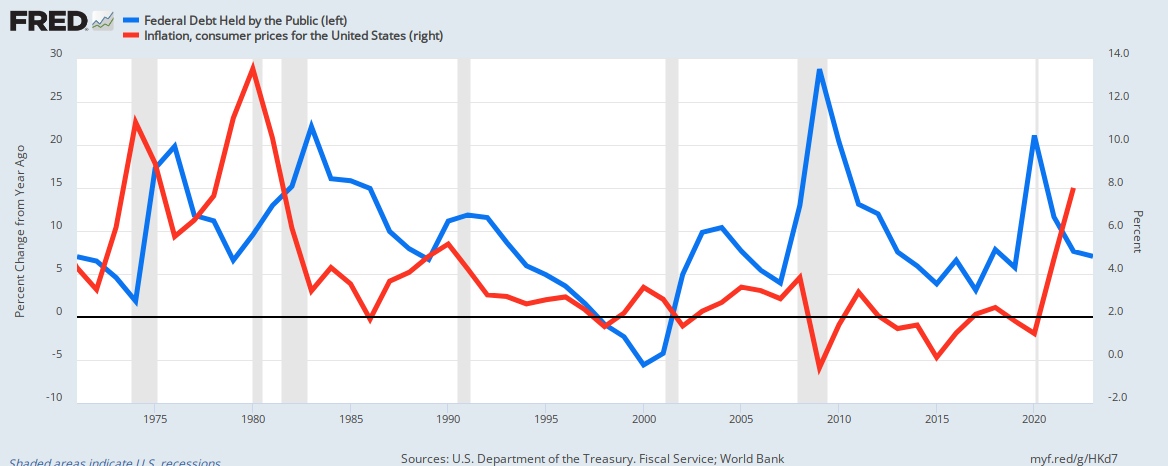
If the myth were true, an increase in federal deficit spending should correspond to an increase in prices. But does it?
There is no relationship between inflation (red line) and changes in federal deficit spending (blue line).
We see absolutely no evidence that deficit spending has led to today’s, or any day’s, inflation. Sadly, the myth is taken for granted as truth, and seldom do we see anyone daring to doubt it.
Until recently, evidence of inflation exceeding 2 percent—the Fed’s traditional goal for inflation—has been dismissed as temporary or transitory, and for good reason. Newly printed stimulus money has been passing through the system. This, accompanied by serious supply-chain disruptions, might be over in another 12 months—if we’re lucky.
Ah, “supply-chain disruptions,” (aka shortages). Here, too briefly, Mr. Yandle hints at the fact that shortages are primary cause of inflation.
Does that give Mr. Yandle a clue? Apparently not:
Then in August, the Biden administration indicated that 2021’s economy would show as much as 4.8 percent inflation—but, with an optimistic spin, would fall to 2.5 percent the next year. Meanwhile, there is some stimulus money pending in the yet-to-be determined infrastructure bill, and that complicates the issue.Avoiding the hard truth or waiting before countering inflationary forces carries a cost. In this case, delays could mean harsher action later when, for example, the Fed hits the money brakes harder to cool the economy. In such a case we might see interest rates head to the ceiling, construction activity and high-tech investment plummet, and the economy roll into a recession.
Mr. Yandle, staying with the false “spending causes inflation” trope, is not clear about what he means by “money brakes.”
If he thinks that raising interest rates would lead to recession, you would expect there to be an inverse relationship between interest levels and Gross Domestic Product growth.
Is there?
There is not the expected inverse relationship between interest rates (brown) and GDP growth (green).
The above graph does not indicate Mr. Yandle’s expected inverse relationship between interest rates and GDP growth. In fact, we see something of a positive relationship.
Contrary to the knee-jerk, temporary reaction of the stock markets, high interest rates seem to correspond with high GDP growth.
Why? Probably because higher rates force the federal government to pump more interest (i.e. growth) dollars into the economy.
If by, “hit the money brakes,” Mr. Yandle means add fewer dollars to the economy, he undoubtedly is correct. Economic growth, by formula, requires money growth.
GDP = Federal Spending+ Non-federal Spending + Net Exports
Clearly, GDP growth relies on spending growth, and one seldom will see spending growth without money growth.
In 1978, the CPI was exceeding 7.5 percent and economic growth was slowing because of deliberate Fed action to cool the economy.
“Cool the economy” surely is not anyone’s goal, if “cooling” means reduced economic growth. But Mr. Yandle, and other economists love to use ambiguous terminology, to protect themselves from error.
Increasing interest rates does not “cool” an economy, but reducing federal deficits does “cool” economic growth.
Fed chair Paul Volcker “hit the brakes” long and hard and squeezed out inflation, along with employment growth.
Although rising interest rates didn’t cut into GDP, there is a very close relationship between the money supply (approximated by total debt) and GDP growth.
Again, Yandle, intentionally or unintentionally uses imprecise terms. In what way did Volker “hit the brakes”? We assume Yandle means “raised interest rates.”
If so, that clearly does not hit any economic brakes, nor ever has. Higher interest rates do not cause recessions.
But increases in money supply do cause increased GDP growth.
No one in authority wants to admit that the dollars we hold are systematically losing their purchasing power.
“No one”? Actually, everyoneunderstands and says we are in an inflation. The only questions being, Why?”“How deep?” and “How long?”
The “why” is shortages. The “how deep” and “how long” depend on what the government does. If it spends to reduce shortages, the inflation will not be deep or long. If it does as Mr. Yandle wants — cuts spending — we probably will fall into a stagflation.
We are being quietly robbed by Washington’s dollar-printing press, with politicians calling the shots. The presses are not operating without drivers.
Wrong, wrong, wrong. As we have shown in the first graph (above), the “dollar-printing press” does not cause inflation.
Seemingly, it’s okay for the Fed chair to recognize CPI heading north, but only if he qualifies the trip by calling it temporary. And while Washington analysts argue that COVID-19 disruptions are affecting just some key items, such as used cars and lumber—
“Just some key items”? Really? How about, virtually all items and labor? How about oil, food, electronics, rare earths, etc., etc.
— and that ports clogged with container ships waiting for workers, drivers, and trucks to be unloaded are the culprit—an analysis of the price movements in the July Consumer Spending Index, which is the Fed’s preferred inflation measuring rod, shows 84 percent of included items rising.
That’s right. Clogged ports and a shortage of workers and drivers, also leads to the product shortages that are the causes of inflation. Amazing that Mr. Yandle doesn’t see it.
The price increases are widespread, which suggests they are embedded.
“Embedded” into shortages.
What Mr. Yandle doesn’t recognize is that increased federal spending can cure inflationby curing shortages.
No matter how analysts choose to slice and dice the data, the answer is the same: The U.S. inflation rate calls for taking offsetting actions, such as avoiding direct distributions of stimulus or minimum family income dollars (though not harsh, invasive measures to cool off the economy).
The perfect right-wing solution to everything: Cut family income.
Let us not forget that inflation is not about rising prices. The rising price level is the result of an inflated money supply—all those trillions of stimulus dollars now out and chasing harder after goods and services.
Exactly and diametrically wrong. Inflation IS about rising prices and IS NOT about money supply. Despite all the counter-evidence, Mr. Yandle promulgates the “deficits cause inflation” myth.
Why does he avoid fact in favor of fiction? Here’s a hint:
BRUCE YANDLE is a distinguished adjunct fellow with the Mercatus Center at George Mason University.Wikipedia: The Mercatus Center at George Mason University is a libertarian, non-profit, free-market-oriented research, education, and outreach think tank. The Koch family has been a major financial supporter of the organization since the mid-1980s. Charles Koch serves on the group’s board of directors.
And there you have it. Yandle is a Libertarian being paid by a think tank that is supported (bribed) by the infamous and wealthy Kochs. Their goal in life seems to be to widen the Gap between the rich and the rest.
Widening the Gap is how the rich become richer. (Without the Gap no one would be rich. We all would be the same.) The rich widen the Gap, i.e. become richer, by gaining more for themselves or by forcing the rest to have less.
By blaming federal deficits for inflation, Yandle, Mercatus, and the Kochs are able to demand the next “logical” step, cut deficit spending on such social programs as: Social Security, Medicare, and all poverty aids.
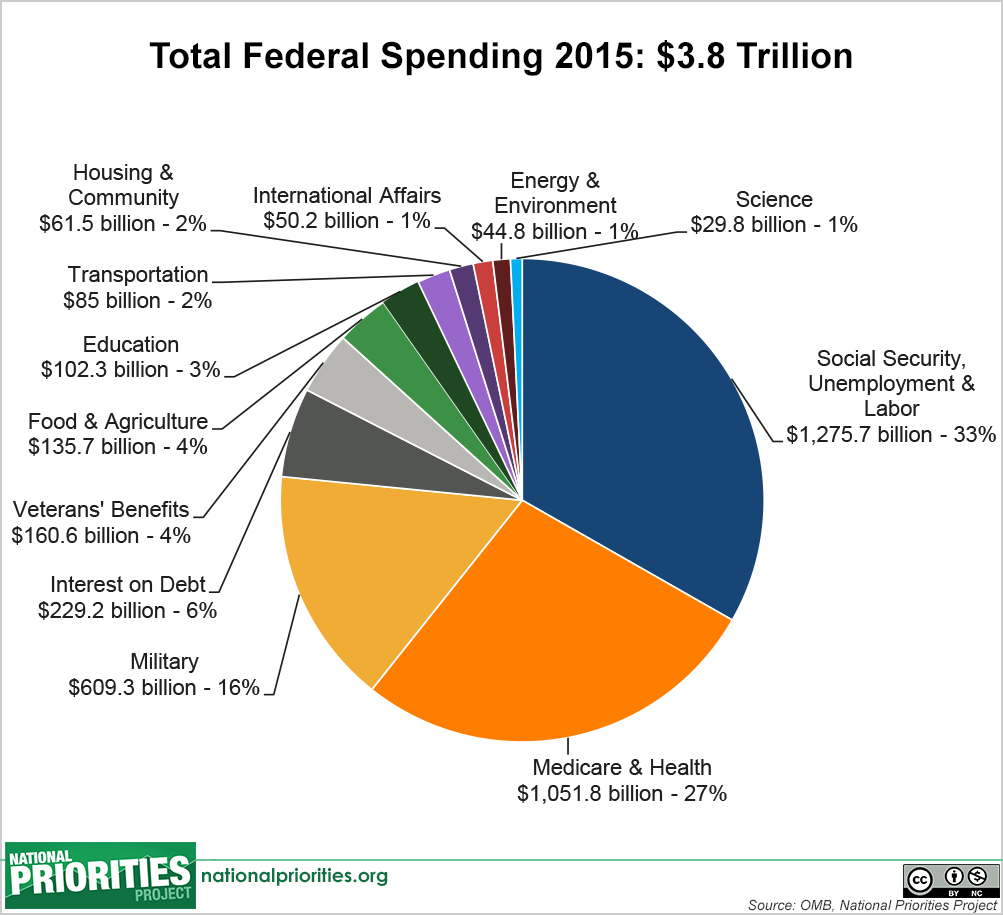
Along with the military, those constitute the largest federal deficit expenditures.
Libertarians and Republicans falsely claim that deficit spending should be cut to cure inflation. They are deceptive and wrong.
The rich widen the Gap by bribing thought leaders:
Economists are bribed via “think tank” salaries and payments to universities
The Media are bribed via ownership and advertising dollars
Politicians are bribed via political contributions and promises of lucrative employment later
Libertarians and Republicans wrongfully claim that deficit spending should be cut to cure inflation.
But, cuts to federal deficit spending do not cure inflation. Rather, spendingcuts cause recessions and depressions, while punishing the poor and middle classes.
Yandle’s suggested cuts simply would make the rich richer and the rest, poorer. In short, Yandle’s cuts would widen the Gap between the rich and the rest, and we believe that is what he is paid to want.
Rodger Malcolm Mitchell
Monetary SovereigntyTwitter: @rodgermitchellSearch #monetarysovereigntyFacebook: Rodger Malcolm Mitchell
……………………………………………………………………..
THE SOLE PURPOSE OF GOVERNMENT IS TO IMPROVE AND PROTECT THE LIVES OF THE PEOPLE.
Gap Psychology describes the common desire to distance oneself from those “below” in any socio-economic ranking, and to come nearer those “above.” The socio-economic distance is referred to as “The Gap.”
Wide Gaps negatively affect poverty, health and longevity, education, housing, law and crime, war, leadership, ownership, bigotry, supply and demand, taxation, GDP, international relations, scientific advancement, the environment, human motivation and well-being, and virtually every other issue in economics.Implementation of Monetary Sovereignty and The Ten Steps To Prosperity can grow the economy and narrow the Gaps:
Ten Steps To Prosperity:
Mitchell’s laws:
•Those, who do not understand the differences between Monetary Sovereignty and monetary non-sovereignty, do not understand economics.
•Any monetarily NON-sovereign government — be it city, county, state or nation — that runs an ongoing trade deficit, eventually will run out of money.
•The more federal budgets are cut and taxes increased, the weaker an economy becomes..
•Liberals think the purpose of government is to protect the poor and powerless from the rich and powerful. Conservatives think the purpose of government is to protect the rich and powerful from the poor and powerless.
•The single most important problem in economics is the Gap between rich and poor.
•Austerity is the government’s method for widening the Gap between rich and poor.
•Until the 99% understand the need for federal deficits, the upper 1% will rule.
•Everything in economics devolves to motive, and the motive is the Gap between the rich and the rest..
============================================================================================================================================================================================================================================================
In comment #4 of the previous post titled, Someone please tell me what this means, reader Elizabeth Harris disagreed with the notion, stated by Warren Mosler and others, that the gold standard limited the amount of money the federal government could create.
What follows is my answer:
…………………………………………………………………………….
Elizabeth, you have identified a fundamental Truth about a sovereign government and money: A sovereign government has the power to do anything it wishes with its money, but creates rules and laws that temporarily can limit that power.
The U.S. federal government always has been Monetarily Sovereign, even during gold standard days, but has chosen to act as though it didn’t have that sovereignty.
Even now, after the gold standard ended, the government still chooses to act as though it is not MS, by enforcing a “debt limit,” issuing T-securities and engaging in complex intra-governmental loans between imaginary “trust funds.”
All laws are temporary, and the government can change or disobey any laws, at will. And that leaves us with the fact that all sovereign governments are MS.
By that logic, even the euro nations are Monetarily Sovereign, because they elected to join the EU and have the power to leave, if they so choose. Sovereignty is the power to choose.
But that logic leaves us with no way to differentiate between Monetarily Sovereign nations.
So, for convenience, we say that today’s U.S. government became MS in 1971, while in reality, it exhibited only a greater degree of MS after 1971.
Depending on ones’s perspective, Mosler and Wray were wrong — and right — for referring to limits on money creation. With current law, the government still is limited, though less limited than it was with the gold standard.
In essence, the government has created a game — call it “Monopoly” — for which it originally created the rules, and ever since, has changed those rules at will.
According to past rules, it could run short of Monopoly money, so then it changed the rules. According to current rules, it still could be unable to pay its debts (though less so), and at the appropriate time, it will (we hope) change the rules further.
Since it is both a player and the rules maker, it cannot lose at its own game.
And through all the 235+ years of its existence, the U.S. government (its leaders, actually) has pretended an inability to change the very rules it created.
At some level of awareness, we the people understand this, but we submerge that understanding so as to widen the Gap below us. (The “Gap” is the difference in income, wealth and power between those who have more and those who have less.
It sometimes mathematically is expressed as the “GINI ratio.”)
Mentally, we say:
“I know it’s a lie, but I go along with it, because it suits me.
“Deep within me, I know there isn’t a magical being, who looks like me, who made everything five thousand years ago, and who controls every atom of the universe. But I go along with the story, because for various reasons, it makes me feel good.
“And deep within me, I know bigotry is evil, but I go along with our government deporting undocumented families and police shooting unarmed blacks, and I know Mexicans aren’t rapists and the poor aren’t lazy, because bigotry comfortably separates me from those below me.
“And deep within me, I know the government can change the rules, and never run short of its own sovereign currency, but I like the unnecesary limitations, because they push the poor down and away from me.”
So where does that leave us? How do we provide the Truth, when the populace prefers the Lie? How do we narrow the Gap, when the populace likes the Gap?
I suspect the answer lies in the nature of the Gap, for there is not one Gap but many, at all levels from the upper .001% all the way down to the bottom, where people have nothing.
The people at any given level generally wish to distance themselves from levels below (widen the Gap), while coming closer to levels above (narrow the Gap).
The problem in providing the Truth, is that the higher levels have more power than the lower levels, so the push to widen the Gap is greater than the desire to narrow it. And widening the Gap is facilitated by the Lie about government money shortages.
It would seem then, that in order for the Truth to be accepted, the upper income/wealth/levels — especially the upper 1% — somehow must come to believe there is a greater benefit to narrowing the Gap than to widening it.
Perhaps that can be accomplished by demonstrating how the Gap can be narrowed without threatening the upper 1%, the people who hold the real power in America. That is, can the poor be brought up closer to the middle classes, while the rich maintain their distance from the middle?
The middle might not accept it at first, but their minds and hearts are ruled by the rich, and eventually the middle will believe what the rich tell them, as always.
Why would the rich want this? Because increasing the incomes of the poor provides the rich with more consumers of goods and services provided by rich-owned businesses.
There are several ways this might be done, and perhaps you can visualize some. But, for example, the first seven steps of the “Ten Steps to Prosperity” might compress the Gaps within the lower levels, while allowing the 1% to maintain or even increase the Gap between them and the rest:
1: Eliminating FICA would help the low-middle-to-middle classes, and help business owners, too, who wouldn’t have to pay for FICA.
2: Federally funded Medicare for all, would compress the Gaps within the 99%, while not bringing them “uncomfortably” close to the 1%.
3: A $5,000 (for example) bonus for every man, woman and child, would help the lowest and low-middle classes to be better consumers, while being viewed as “fair” to the highest classes.
4, 5, 6, 7: Free education for all, salary for attending school, eliminate corporate taxes and increase the standard deduction all would benefit the poor and middle classes, but also benefit, in different ways, the businesses the rich own.
Bottom line: The world is run by the rich. Nothing will happen unless the rich want it to happen. There is no use bemoaning the Gap; the rich want the Gap. And with ownership of politicians, the media and university economists, the rich create their version of the truth.
A strategy must be found to compress the Gaps between the poor and the upper middle classes, while allowing the 1% to maintain their Gap.
If the 1% are satisfied that their Gap is maintained, they will feel comfortable in telling the 99% that lifting the poor is good. And the 99% will follow.
=================================================================================== Ten Steps to Prosperity:
1. Eliminate FICA (Click here)
2. Federally funded Medicare — parts A, B & D plus long term nursing care — for everyone (Click here)
3. Provide an Economic Bonus to every man, woman and child in America, and/or every state a per capita Economic Bonus. (Click here) Or institute a reverse income tax.
4. Free education (including post-grad) for everyone. Click here
5. Salary for attending school (Click here)
6. Eliminate corporate taxes (Click here)
7. Increase the standard income tax deduction annually Click here
8. Tax the very rich (.1%) more, with higher, progressive tax rates on all forms of income. (Click here)
9. Federal ownership of all banks (Click here and here)
10. Increase federal spending on the myriad initiatives that benefit America’s 99% (Click here)
The Ten Steps will add dollars to the economy, stimulate the economy, and narrow the income/wealth/power Gap between the rich and the rest.
——————————————————————————————————————————————
10 Steps to Economic Misery: (Click here:)
1. Maintain or increase the FICA tax..
2. Spread the myth Social Security, Medicare and the U.S. government are insolvent.
3. Cut federal employment in the military, post office, other federal agencies.
4. Broaden the income tax base so more lower income people will pay.
5. Cut financial assistance to the states.
6. Spread the myth federal taxes pay for federal spending.
7. Allow banks to trade for their own accounts; save them when their investments go sour.
8. Never prosecute any banker for criminal activity.
9. Nominate arch conservatives to the Supreme Court.
10. Reduce the federal deficit and debt
No nation can tax itself into prosperity, nor grow without money growth. Monetary Sovereignty: Cutting federal deficits to grow the economy is like applying leeches to cure anemia.
1. A growing economy requires a growing supply of dollars (GDP=Federal Spending + Non-federal Spending + Net Exports)
2. All deficit spending grows the supply of dollars
3. The limit to federal deficit spending is an inflation that cannot be cured with interest rate control.
4. The limit to non-federal deficit spending is the ability to borrow.
THE RECESSION CLOCK
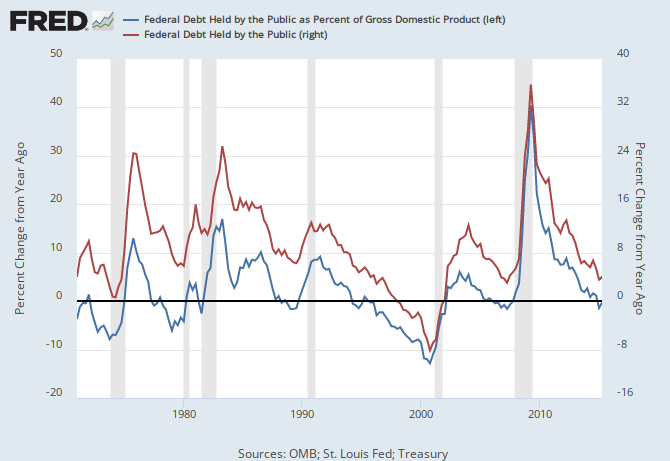
Vertical gray bars mark recessions. Recessions come after the blue line drops below zero and when deficit growth declines.
As the federal deficit growth lines drop, we approach recessions, each of which has been cured only when the growth lines rose.
Increasing federal deficit growth (aka “stimulus”) is necessary for long-term economic growth.



 #Monetary Sovereignty - Mitchell