What are the purposes of the student loan program?

What are the purposes of the student loan program?
A street made out of dollars leads to a school
The road to school is paved with dollars.

1. It provides financial assistance to students who may not be able to pay for their education upfront. 2. Educated individuals tend to have higher earning potential and contribute more to the economy. 3. Education provides individuals with critical thinking, problem-solving, and communication skills that are valuable in both personal and professional life. 4. Education can be a pathway out of poverty for many individuals, providing them with the tools and opportunities to improve their socioeconomic status. 5. Student loans provide a significant source of revenue for educational institutions, helping them maintain and improve their programs and facilities.

Federal student loans account for about 92% of the total outstanding student loan debt in the United States, while private student loans account for approximately 8%. Federal loan rates range from 6.5% to 9%, and private loan rates range from 3.5% to 17%. Approximately 40% of the loans provided by the government to help students pay for their education are delinquent or in default. The federal government collected approximately $4.92 trillion in tax revenue for the most recent fiscal year (FY 2024). According to the Federal Reserve, the student loan debt balance in the U.S. has increased by 66% over the past decade and now totals more than $1.74 trillion.
Washington Post, January 18, 2025, By Danielle Douglas-Gabriel In his last week in office, President Joe Biden capped a tumultuous effort to deliver widespread student loan forgiveness by canceling another $600 million in education debt for longtime borrowers and those defrauded by their colleges. With Biden’s final round of student debt relief, he has approved a total of $189 billion in loan cancellation for 5.3 million borrowers — more than any other president. Yet higher education experts are split on whether his mission to ease the debt burden for millions of Americans did more harm than good. Many of Biden’s sweeping debt relief policies have either been struck down by the courts or tied up in litigation that has left the student loan repayment system in disarray.
Ironically, the lawsuits and court cases depend on Republican obstruction, the party of the wealthy. Millions of people who would have benefited from debt relief voted for Trump. Now, more than ever, the wealthy have control over America. They always wish to be more prosperous, which requires widening the income/wealth/power Gap between the rich and the rest. The children of the rich do not need to borrow for college, but the children of the rest do. Therefore, forcing the rest to be indebted widens the Gap, making the rich richer. It’s the same motivation for why the rich complain about the cost of Medicare and Social Security but never about the costs of special tax breaks available only to the rich.

college graduates are higher than the poor
College graduates see a successful future
The “federal spending causes inflation” trope is how the rich justify voting against spending that benefits the not-rich.
Still, the president’s relentless pursuit of debt forgiveness, primarily through long-existing federal programs, has helped millions of people. “Four years ago, President Biden made a promise to fix a broken student loan system. We rolled up our sleeves and, together, we fixed existing programs that had failed to deliver the relief they promised,” Education Secretary Miguel Cardona said Thursday. The Education Department announced three separate rounds of student loan forgiveness in Biden’s last week in office. On Monday, the department canceled loans for 150,000 borrowers mostly through a 1994 statute called “borrower defense to repayment,” which lets the agency cancel federal student loans when colleges violate students’ rights and state law. A majority of those cancellations were for students who attended defunct schools owned by the Center for Excellence in Higher Education, including Stevens-Henager College, Independence University and California College San Diego. “My Administration has taken historic action to reduce the burden of student debt, hold bad actors accountable, and fight on behalf of students across the country,” Biden said Monday. “For the first time in the history of the student loan system, we saw the federal loan program deliver on its promise to more than 5 million student loan borrowers,” said Persis Yu, deputy executive director at the Student Borrower Protection Center (SBPC), an advocacy group. Conservatives have also succeeded in stalling Biden’s Saving on a Valuable Education (Save) repayment plan, which ties monthly student loan payments to earnings and family size, and offers a shorter path to loan forgiveness.  A court injunction has halted Save and the Education Department has suspended payments for the 8 million people enrolled in the plan but denied them credit toward loan forgiveness during the forbearance period. While President-elect Donald Trump is likely to end the program, it is unclear what his administration will do with all of those borrowers.  Republicans have become hardened against what many have called a fiscally irresponsible giveaway to college graduates at the expense of taxpayers.
To the Trump right-wing, “fiscally irresponsible” means anything that benefits the middle and the poor. It does not include tax breaks for the rich. Think of :
  • Private foundations or charitable trusts
  • Real estate depreciation deductions, tax-deferred exchanges (like 1031 exchanges)
  • Family limited partnerships (FLPs)
  • Offshore accounts and trusts
  • Business owners can deduct expenses, including travel, entertainment, and even personal use of company assets.
  • Grantor-retained annuity trusts (GRATs) and dynasty trusts
  • Carried interest
  • Deferred compensation plans
  • Foreign tax credits
  • Opportunity zone investments
  • Grantor trusts
  • Conservation easements
  • Like-kind Exchanges (Section 1031)
a doctor overworked overburdened drowning in patients
The future of the poorly educated.
Have you taken advantage of any of the above? They all reduce federal taxes, thus taking dollars from the federal government. If they were used by middle—and lower-income taxpayers, the rich would complain that they are “fiscally irresponsible giveaways” or that programs (like Medicare and Social Security) are running short of money. But you will hear no complaints from the rich about the abovementioned tax breaks. The rich complain only when the rest of us receive something from the government.
House Education and the Workforce Committee Chairman Tim Walberg (R-Michigan) accused the Biden administration of giving “handouts with zero accountability.”
“Handouts with zero accountability” is how Donald Trump paid virtually no taxes during the years he made billions.
“Instead, the administration should have been working to address the fact that student loan debt is too high, completion rates are too low, and far too many students are left worse off after paying for college than if they had never enrolled in the first place,” Walberg said Monday. “
Which is precisely what Biden’s loan forgiveness does.
It is shameful that, in its final days, the Biden-Harris administration is doubling down on efforts to push as much forgiveness as possible through the door, once again ignoring the rule of law.”
Neither Walbert nor the rest of the Republican Party has solutions for reducing excessive student loan debt, low completion rates, and the financial strains students face after college. In fact, as the techies say about flawed programs, “Those aren’t bugs; they’re features.”
Congressional Republicans are likely to push wholesale changes to the federal lending system through the budget reconciliation process, including a proposal to eliminate Plus loan programs for graduate students and parents. For his part, Trump has derided Biden’s student loan forgiveness policies as “vile,” but has not put forth a plan of his own.
This is a common complaint by Trump, who routinely criticizes anything the Democrats do, then promises to come up with a better plan and, in the end, fails to do so. Who could forget the eight years of broken promises to develop an “improved” version of Obamacare?
Persis Yu, the Deputy Executive Director and Managing Counsel at the Student Borrower Protection Center (SBPC) said, “The last Trump administration looked the other way when students’ and borrowers’ rights were denied — routinely siding with predatory schools and servicers. 
The fact that education benefits America was known to our first settlers,  whose first acts were to create schools. The first free public school in what is now the United States was established in 1635 in Boston, Massachusetts, funded by taxpayer dollars Today, grades K-12 are still funded by taxpayer dollars, without direct student cost, by monetarily non-sovereign governments. So surely, grades 13+ can be financed by our Monetarily Sovereign government without taxpayer dollars. These days, advanced education is more important than it was four centuries ago, so all the same reasons for free elementary and high school now exist for free college and advanced. The solution to educating everyone who wants it is federal funding of all education. Further, the federal government should fund student salaries to compensate for lost working hours. The “federal debt” excuse is meaningless for a Monetarily Sovereign government. The “inflation” excuse is false. Inflation is caused by shortages of oil, food, shipping, labor, etc., none of which is affected by federal spending on education. We seem to have plenty of money for the military, Congress, the White House, and SCOTUS, as well as tax breaks that benefit the rich. (There is no FICA for tax shelters.) Rich property and business owners receive massive tax breaks; renters and salaried employees get nothing. Trump famously stated, “I love the poorly educated.” It seems he is so enthusiastic about the poorly educated that he wants millions more to join that group. The federal government does not need to lend. Federal lending is a Mafia-like solution for students of modest means who are desperate to climb the social/financial ladder, but become trapped in future-destroying debt. The government should give benefits to the people rather than lend, which would not only help the individuals receiving benefits but, unlike lending, add growth dollars to the economy. We should end all student loan programs and start anew with comprehensive student support programs for grades K-16+, financed by the federal government at no cost to federal, state, or local taxpayers. “Comprehensive” should encompass tuition, books and materials, room and board, tutoring, transportation, and salaries to cover lost work time. This would decrease the number of poorly educated individuals, increase the number of well-educated individuals, and alleviate a significant financial burden on students, their families, and state or local governments. Rodger Malcolm Mitchell Monetary Sovereignty Twitter: @rodgermitchell Search #monetarysovereignty Facebook: Rodger Malcolm Mitchell; MUCK RACK: https://muckrack.com/rodger-malcolm-mitchell; https://www.academia.edu/

……………………………………………………………………..

The Sole Purpose of Government Is to Improve and Protect the Lives of the People.

MONETARY SOVEREIGNTY
The day Joe Biden lost the November 2024 election

Admirably, President Bident wishes to narrow the income/wealth/power Gap between the rich and the rest of us. I agree with this sentiment because the current Gap, very simply, is bad economics and bad for humanity. Wide Gaps negatively affect health and longevity, education, housing, law and crime, war, leadership, ownership, bigotry, supply and demand, GDP, international relations, scientific advancement, the environment, human motivation and well-being, freedom, and virtually every other issue in economics and the human condition. To narrow the Gaps, Biden proposes changes to federal law.  In broad strokes, he has just three options:
  1. Increase taxes on the rich (“rich” by any arbitrary measure).
  2. Reduce taxes on those who are not rich.
  3. Provide supplementary income and benefits to those who are not rich.
All three would narrow the Gap, though in different ways. From the standpoint of the U.S. economy, as measured by Gross Domestic Product, #1 would have a dramatically different effect than #2 and #3. Increasing taxes on the rich (if the rich actually paid those increased tax levels) would take dollars out of the economy. #2 and #3 would add dollars to the economy). In short, #1 is recessive, and #s 2 and 3, would grow the economy. This is demonstrated by the formula:

GDP = Federal Spending + Nonfederal Spending – Net Imports.

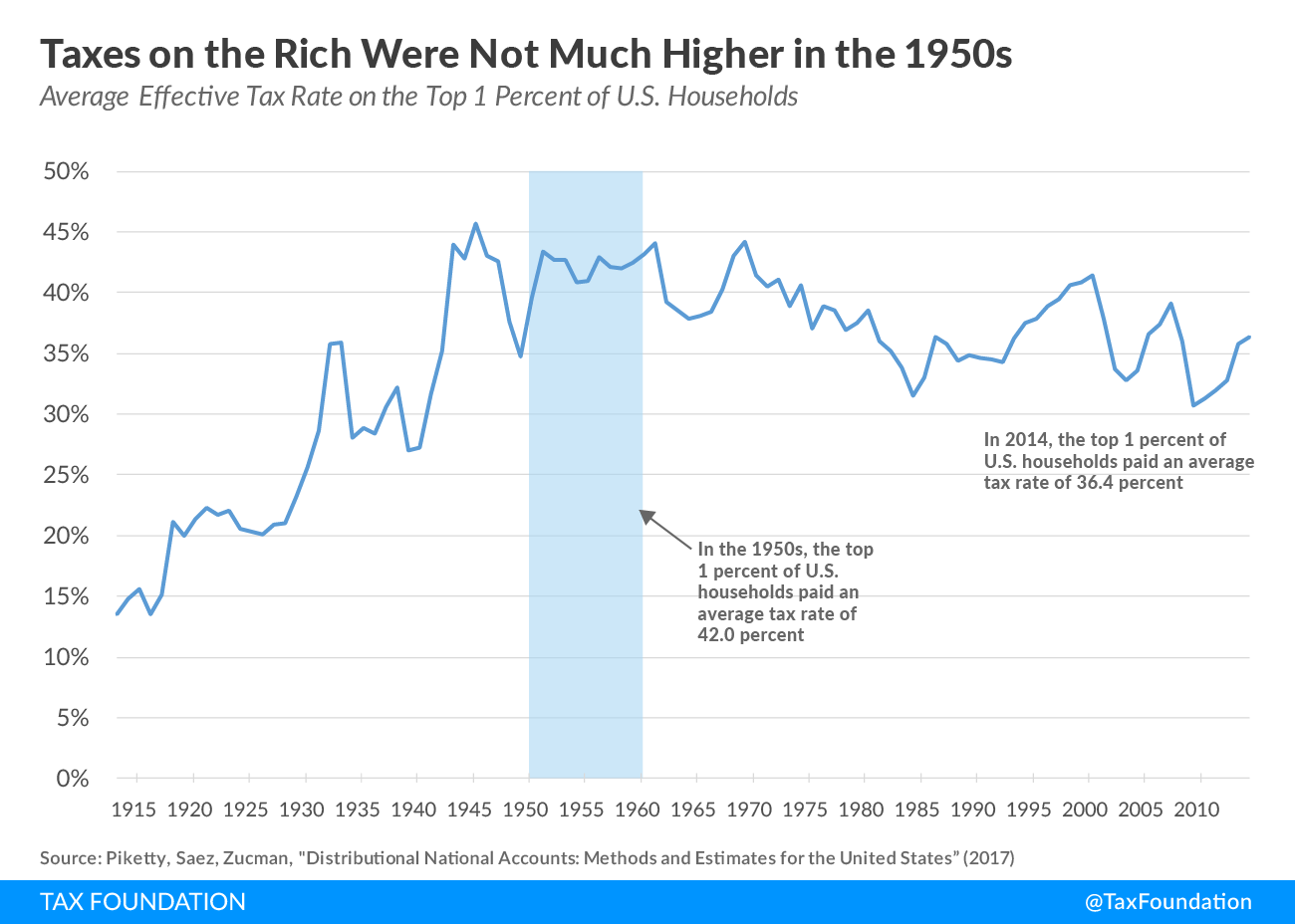
If the rich paid more taxes (#1), Nonfederal Spending would decline. The amount of the decline would be determined by various factors, most having to do with how much the rich actually pay. History indicates that payment would be less than anticipated because of existing loopholes and/or new loopholes the rich would bribe Congress to enact. Average Effective Tax Rate on the Top 1 Percent of U.S. Households Considering that the top tax rate in the 1950s was 90%, the rich did not pay much more in that period than they do now. And some of the richest among us pay little if anything. For example, Donald Trump paid no income taxes at all, during ten of the fifteen years, 2000-2015, despite being a billionaire. Tax laws, favorable to the rich, gave him the ability to claim losses on investments that an ordinary taxpayer may not look at as “losing” money. In summary, using federal taxation of the rich to narrow the Gap is bad economics. History shows the rich would find ways to avoid paying higher rates. But, even if the rich were forced to pay more, the higher rates would take dollars out of the economy and recess the economy. Option #1 is a “heads-you-lose (the rich don’t pay more), tails-you-lose” (GDP falls) plan. Sadly, that is the plan Biden seems to have chosen, and it will cost him the November election. The electorate may be ignorant about economics, but the rich would make sure the voters understood that raising taxes — anyone’s taxes — would hurt the economy. It’s simple math. The more the federal government takes out of the economy, the less the economy (GDP) has. Reducing federal taxes and/or providing supplementary benefits to those who are not rich, (#2 and #3) are the sole economically sensible ways to narrow the income/wealth/power Gap. Sadly this sensible approach is blocked by the non-sensible belief that federal deficit spending is “unsustainable.” That’s associated with the equally wrong belief that “excessive” federal spending or an “overheated” economy cause inflation. The fact: Inflation is not caused by “heat” (whatever that is) or by federal spending. All inflations are caused by shortages of critical goods and services, most often oil and food. Inflation can be cured by additional federal spending to acquire and distribute the scarce goods and services. Here is what the right-leaning Tax Foundation thinks:Details and Analysis of President Biden’s Fiscal Year 2025 Budget Proposal

March 22, 2024, By: Garrett Watson, Erica York, William McBride, Alex Muresianu, Huaquin Li, Alex Durante

11-Year Revenue (Trillions) Long-run GDP Long-Run Wages Long-Run FTE Jobs

+$2.2T

-2.2%

-1.6%

-788k

In plain English, the government would remove from the economy, an additional $2,2 Trillion. This would cause GDP to fall by 2.2%, wages to fall by 1.6%, and Full-Time Equivalent Jobs to shrink by 788 thousand.

Because the Tax Foundation has a right-wing agenda, one may doubt the specifics of their calculations, but I believe they are on the right track. When the federal government collects more taxes, the economy loses money. When the economy loses money, the GDP, wages, and jobs all shrink. It’s straightforward math.

The tax changes Biden proposes fall under three main categories: additional taxes on high earners, higher taxes on U.S. businesses—including increasing taxes that Biden enacted with the Inflation Reduction Act (IRA)—and more tax credits for a variety of taxpayers and activities.

The combination of policies would move the tax code further away from simplicity, transparency, and neutrality while making the U.S. economy less competitive.

The increase in the corporate tax rate and the additional taxes on top earners would result in U.S. top marginal tax rates on income that are among the highest in the developed world.

I urge you to read the entire Details and Analysis of President Biden’s Fiscal Year 2025 Budget Proposal as this post offers you the barest outline. Everything Biden may propose is based on two false assumptions:
  1. The federal government is running short of money while the private sector has too much money.
  2. The middle- and lower-income taxpayers will not understand that taking dollars from the economy is recessive, and instead will happily vote for a “soak-the-rich” administration.
The ignorance and cynicism of these beliefs cannot be overstated. Biden seems to believe that taking the populist approach will gain him votes. But, it is such government deceit that keeps you from:
  1. The end of the FICA tax deduction from your salary
  2. Comprehensive, no deductible Medicare for every adult and child.
  3. Social Security benefits for everyone of all ages
  4. Food cost aid
  5. Free college for those who want it
  6. Free public transportation
  7. Housing aid
  8. And a myriad of other benefits our Monetarily Sovereign government easily could afford, while preventing recessions and inflations.
Biden could beat Trump in a “truth vs. lies” competition, but he will not be able to out-lie Trump. If he tries, he will lose. Narrowing the Gap is good economics, but doing it by taxing businesses and the rich is a lie. It may be a good time to repeat a few facts:

•Those, who do not understand the differences between Monetary Sovereignty and monetary non-sovereignty, do not understand economics. •Any monetarily NON-sovereign government — be it city, county, state or nation — that runs an ongoing trade deficit, eventually will run out of money. •The more federal budgets are cut and taxes increased, the weaker an economy becomes. •Liberals think the purpose of government is to protect the poor and powerless from the rich and powerful. Conservatives think the purpose of government is to protect the rich and powerful from the poor and powerless. •The single most important problem in economics is the Gap between rich and poor. •Austerity is the government’s method for widening the Gap between rich and poor. •Until the lower 99% understand the need for federal deficits, the upper 1% will continue to rule. •Everything in economics devolves into motive, and the motive is the Gap between the rich and the rest.

Rodger Malcolm Mitchell Monetary Sovereignty Twitter: @rodgermitchell Search #monetarysovereignty Facebook: Rodger Malcolm Mitchell; MUCK RACK: https://muckrack.com/rodger-malcolm-mitchell

……………………………………………………………………..

The Sole Purpose of Government Is to Improve and Protect the Lives of the People.

MONETARY SOVEREIGNTY

The single most important question in economics

Economics involves many questions, of course, but is there one question that is key? Is there one question, the answer to which opens the door to the entire study of economics? After some thought, I believe such a question exists, and I will reveal my nomination here. You may disagree with my choice, and if so, I’d be glad to know yours, or if you feel no question is that important. First, a bit of: BACKGROUND In the first eleven billion years of the universe’s existence, and the first 4 billion years of the earth’s existence, there was no such thing as the United States or the U.S. dollar. But beginning in the 1700’s AD, men created a variety of laws. The laws were completely arbitrary and created from thin air, as all laws are. And as is true for all laws, these laws had no physical existence. They merely were concepts. The laws could be spoken, handwritten, typed, printed, mimeographed, texted, Emailed, or delivered in any number of ways, but the laws themselves had no physical existence. They merely were an amalgam of ideas, concepts, and beliefs.Measure the Magic | ifundraiser blog Some of those laws, which were created, from thin air, produced the political entity known as “the United States of America.” and some of those laws created, also from thin air, the U.S. dollar. Those laws arbitrarily created millions of dollars, and arbitrarily created the value of those dollars, with regard to arbitrary amounts of silver and gold. And now for the question that I believe to be the most important question in economics:
How Many Laws Can The U.S. Federal Government Create?

I suggest that the answer to this question is: “Infinite.” Now “infinite” is a very big number. It is bigger than the number of glasses of water in all the oceans on earth. It is bigger than the number of stars in the sky. Infinite is bigger than the number of atoms in the known universe. How is it possible for humans to create here on earth, something that is bigger than the oceans, stars, and the universe’s atoms? The reason is that water, stars, and atoms are physical objects, but laws have no physical existence. Like creating numbers, the ability to create laws is limitless. You cannot see, hear, feel, taste, or smell a number or a law. You can sense representations of numbers and laws, but the numbers and laws themselves merely are concepts. Similarly, the dollars created by laws, have no physical existence. You can see representations of dollars — dollar bills, bank statements, savings account passbooks, T-bill records, etc. — but you cannot see, hear, feel, taste, or smell a dollar. It is just a number in a balance sheet. When you go to a store to make a purchase, you pay by presenting your credit card. Invisible dollars are taken from that card and sent to the card issuer, who in turn, sends invisible dollars to the store. Soon thereafter, invisible dollars will be taken from your checking account and sent to the credit card company, which will deposit these invisible dollars into its balance sheets. All the while, invisible dollars will flow to and from the Federal Reserve, tidying things up. And it all will be done in thin air, with nothing but the occasional atom moving. Because the U.S. dollar was created by U.S. laws, and because the federal government has the infinite ability to create U.S. laws, and because neither laws nor dollars have any physical existence:

I. Dollars are created by laws. The U.S. federal government has the infinite ability to create laws, so it has the infinite ability to create U.S. dollars.

We’re not even talking about an infinite ability to “print” dollars. Those printed green paper things you carry in your wallet are not dollars. They are representations of, or titles to, dollars. The real dollars are just numbers in numerous records and balance sheets all over the world. Because the U.S. government has the infinite ability to create the laws that create dollars, and so has the infinite ability to create dollars, the government never unintentionally can run short of dollars. And because the government has the infinite ability to create U.S. dollars:

II. The U.S. government has no need to collect U.S. dollars from anyone or anywhere.

This means the government has no need to borrow or to tax. It does not need to ask you for dollars. It does not need to ask China for dollars. It does not need to ask anyone for dollars. The federal government creates from thin air all the dollars it uses. Even if all federal tax collections fell to zero, the federal government could continue spending forever. Not only that, but:

III. All the tax dollars you send to the federal government are destroyed upon receipt.

The amount of money that exists in the United States is divided into “M”classifications such as MZM, M0, M1, M2, and M3, according to the type and size of the account in which the instrument is kept. The money supply reflects the different types of liquidity each type of money has in the economy. It is broken up into different categories of liquidity or spendability.
The tax dollars you, and everyone else  sends to the federal government generally come from checking accounts, which are part of the money supply measure called “M1.” When you pay taxes, you take money from your M1 checking account and send them to the Treasury where they cease to be part of any money supply measure. Effectively, your tax dollars are destroyed. The reason is clear. Because the federal government has the unlimited ability to create dollars, it would make no sense to try to measure its money supply, which is infinite.  If, say, you send $1,000 to the federal government, $1,000 + infinity = infinity. No difference. That is why no one ever can answer the question, “How much money does the federal government have?” The only accurate answer is “Infinite.” The Monopoly Example If you ever have played the board game Monopoly, you know that it usually is played with four players, plus a Bank. The function of the Bank is to distribute Monopoly dollars to, and to collect Monopoly dollars from, the players, according to the rules. But, one rule of Monopoly is that the Bank never can run short of dollars. If you were to open the game box to discover all the printed dollar certificates were missing, what would you do in order to play the game?
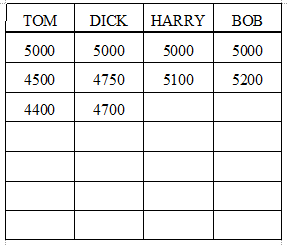
How to play Monopoly without using Monopoly paper dollars. Create a table. No column for the Bank.
One approach would be to take a sheet of paper and divide it into four columns, one column for each player. At the top of each column you would print each player’s name, and below each name, a starting amount of money. The illustration at the right shows that each player begins with 5,000 Monopoly dollars. Then as each player spends and receives money, the amounts below that player’s name are changed. Many of those dollars go to, and come from, the Bank, but the bank has no column because the Bank has infinite dollars. In the game, when you pay dollars to the “Community Chest,” the dollars are supposed to go to the Bank, and when you receive $200 for passing “GO,” the dollars are supposed to come from the Bank. Although the rules specify that tax dollars and other dollars go to the Bank, the above example shows that they really are destroyed upon receipt. The Bank has no column. There is no way to determine how many dollars the Bank has. It has infinite dollars. In the real world, the federal government operates just like the Monopoly Bank: It collects dollars from the public, and it distributes dollars to the public. But once dollars are received by the Treasury, they disappear. Though the Treasury keeps internal records, there is no way to determine how many dollars the government has. It has infinite dollars. Since the federal government has no use for tax dollars, why does the federal government collect tax dollars? There are three reasons: One real, one mythical, and one secret.
  1. The real reason the government collects tax dollars is to control the economy. It taxes what it wishes to discourage and it gives tax breaks to what it wishes to reward or encourage. That is why there are so many tax breaks for the rich people who control the government.
  2. The mythical reason the federal government collects tax dollars — a reason espoused by many economists — is to create demand for dollars with which to pay taxes. The demand for such cryptocurrencies as Bitcoin, Ethereum, and Litecoin, which are not supported by taxes, debunks this reason.
  3. The secret reason the federal government collects taxes is to help make you believe dollars are scarce to the government. This belief keeps you from demanding more benefits like expanded Social Security, Medicare for All, poverty aids, free college for all, and an end to the FICA tax.
The rich people and rich companies are rich only because of the Gap between them and those who are not as rich. If there were no Gap, we all would be the same. No one would be rich. And the wider the Gap, the richer are the rich. The rich always want to be richer. This is known as “Gap Psychology,” the desire to widen the income/wealth/power Gap below, and to narrow it above. Widening the Gap below can involve either gaining more for oneself or preventing those below from gaining. Either will make one richer. To make themselves richer, the rich bribe the key sources of your information. They bribe the politicians (via political contributions and promises of lucrative employment later). They bribe the media (via ownership and advertising dollars). They bribe the economists (via university contributions and “think tank” employment). All these sources of information combine to tell you the Big Lie, that in order for you to receive more federal benefits, taxes must be increased. That misinformation provides an excuse for the current battles against President Biden’s “Build Back Better” Act, which first was proposed at a $3.5 trillion level, and since has been cut in half because of the Big Lie. The pretext was that this proposal must be “paid for” with taxes. But, as you now know, taxes do not fund federal spending. The federal government pays for everything by merely sending instructions (checks and wires) to creditors’ banks, instructing the banks to increase the balances in creditors’ checking accounts. When the banks do as instructed, this creates more M1 dollars, the same kind of dollars you send to the federal government as taxes. Since the federal government has no need to ask anyone for dollars, why does it borrow dollars? The U.S. federal government never borrows dollars. The acceptance of deposits into Treasury Security accounts (T-bills, T-notes, T-bills) is wrongly called “borrowing” and federal “debt.” It neither is borrowing nor debt.IBV's Billionaires-Only Bank Vault In London Is So Hollywood It's Ridiculous The closest parallel to a T-security account is a safe deposit box. When you put dollars into your safe deposit box, your bank never touches those dollars, and your bank doesn’t owe you those dollars. They neither are loans to your bank nor are they debts of your bank. The bank “pays you back” simply by allowing you to take back whatever dollars are in your box. Similarly, when you make a deposit into your T-security account, the federal government never touches those dollars. The government “pays you back” by allowing you to take back whatever dollars are in your account. Since the federal government has no need to ask anyone for dollars, why does it provide for deposits into T-security accounts? There are two real reasons and one secret reason:
  1. The first real reason is to help the Federal Reserve to control interest rates. These accounts pay interest, the rates for which begin with Federal Reserve decisions regarding the state of the economy.
  2. The second real reason is to provide a safe, interest-paying place for people, businesses, and nations to “park” unused dollars.
  3. The secret reason is again to help make you believe the federal government is so deeply “in debt” it cannot afford to help narrow the Gap between the rich and the rest.
The federal government has no need to ask anyone for dollars, and has the infinite power to spend. But, doesn’t too much government spending cause inflation? Remember that way back in the 1780s, the federal government created as many dollars as it wished and gave those dollars whatever value it wished — and it did all this by passing laws. The federal government still has the unlimited power to:
  1. Pass laws
  2. Create dollars, and
  3. Control the value of dollars.
Over the years, the government has used all three of those powers. While nos. 1 and 2 already have been explained, you may be curious about how the government controls the value of dollars. It has two primary tools:
  • When the government raises interest rates, more people will want to obtain more dollars to invest in interest-paying bonds, and this increased demand for U.S. dollars increases their value.
  • Government fiat. When the U.S. was on various silver and gold standards, the government merely would pass laws saying that a dollar could be exchanged for specific amounts of gold or silver. The U.S. Constitution gives Congress the power “To coin Money, regulate the Value thereof.” The government, by fiat, can change the exchange rate between dollars and other currencies. This is known as “devaluation” and “revaluation.”
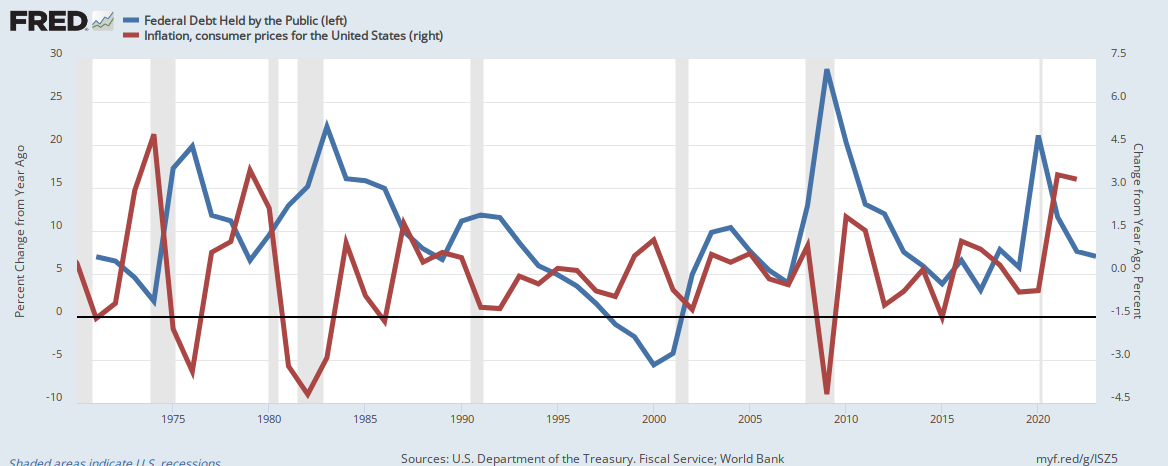
That said, the primary driver of inflation is not interest rates, or federal fiat, or federal deficit spending, or so-called federal “debt.” The primary driver of inflation is shortages. If the “federal deficit spending” myth were true, an increase in federal deficit spending should correspond to an increase in prices.
Changes in federal deficit spending (blue line) vs. inflation (red line). Vertical bars are recessions.
There is no historical relationship between changes in federal deficit spending (blue line) and changes in inflation (red line). Federal deficits do not cause inflations.

IV. The driver of inflation never is federal deficit spending, but rather the scarcity of key goods and services.

Like all inflations through history, today’s inflation is caused by shortages of energy, food, computer chips, supply chain resources, and labor. Some of these are related to global warming and some are related to COVID. Many are related to inefficient government. Contrary to popular wisdom, today’s inflation could be controlled via increased federal spending to eliminate the shortages. Federal spending to increase oil and gas drilling, renewable energy production, farmer aids, computer chip production, shipping, and the elimination of taxes that discourage employment (i.e. FICA), would reduce inflation. Also notice in the above graph that:

V. Recessions begin with reductions in federal deficit growth and are cured by increases in federal deficit growth.

This should surprise no one because economic growth requires money growth. The most common measure of economic growth is Gross Domestic Product (GDP) a formula for which is:

GDP=Federal Spending + Non-federal Spending + Net Exports.

All three factors on the right-hand side of the equation are related to an increased dollar supply. What happens when the federal “debt” (i.e., the net total of deficits) decreases?

1804-1812: U. S. Federal “Debt” reduced 48%. Depression began 1807. 1817-1821: U. S. Federal “Debt” reduced 29%. Depression began 1819. 1823-1836: U. S. Federal “Debt” reduced 99%. Depression began 1837. 1852-1857: U. S. Federal “Debt” reduced 59%. Depression began 1857. 1867-1873: U. S. Federal “Debt” reduced 27%. Depression began 1873. 1880-1893: U. S. Federal “Debt” reduced 57%. Depression began 1893. 1920-1930: U. S. Federal “Debt” reduced 36%. Depression began 1929. 1997-2001: U. S. Federal “Debt” reduced 15%. Recession began 2001.

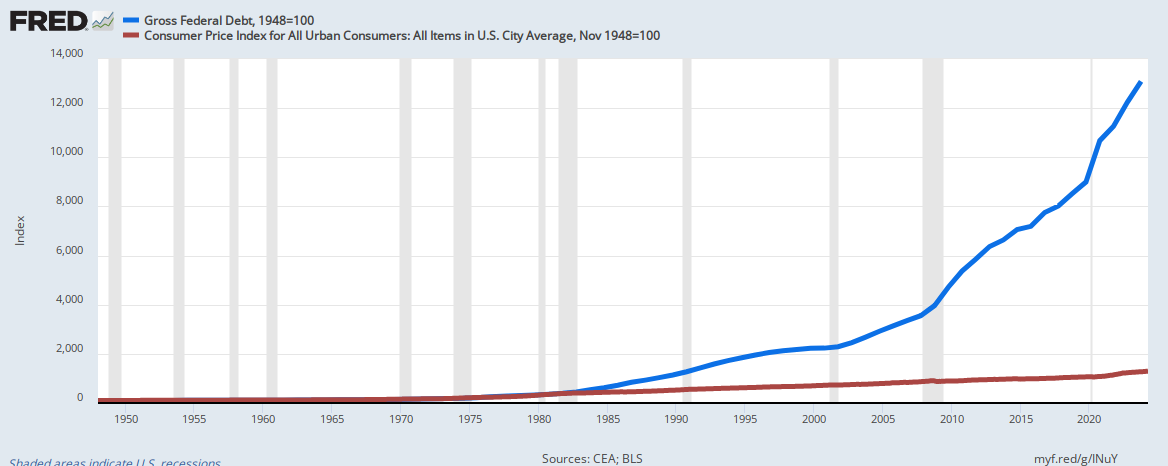
Again, this should surprise no one. Just as a growing economy requires a growing supply of money, reducing federal “debt” (i.e. running federal surpluses) takes dollars from the economy and sends them to the Treasury, where they are destroyed.. By definition, GDP is reduced when dollars are taken from the economy. Fortunately, the U.S. federal government has the ability to create infinite U.S. dollars and to control their value, i.e. prevent excessive inflation. So, the federal government has the ability to fund Medicare for All, Social Security for All and college for all who want it. Further, the government has the financial ability to eliminate the grossly recessive employment taxes (FICA) and to help the states, counties, and cities to reduce their tax burdens. Given this infinite power, the federal government is left with one final question: Is there a limit? We know the government has the power, but is there a limit as to how much of this power the government should use? The problem has two parts: Financial and political. Financially, is there a dollar limit, beyond which federal deficit spending actually harms the economy rather than benefitting it? There may be, but no evidence exists for any limit. As the following graph shows, federal “debt” (blue line) has increased massively, while inflation (red line) has followed a comparatively modest, even trajectory. If federal deficit spending caused inflations, the blue line (federal deficits) and the red line (inflation) would be parallel. Claims that future federal deficit spending, in any given amount, will cause inflation are based on intuition and guesswork and not on historical precedent. Politically, is there a point beyond which federal deficit spending gives the federal government “too much power”?Libertarians think so. In fact, Libertarians can be trusted to object to any amount of federal deficit spending, or even any amount of federal spending at all. They think people should be “free” to pay for unaffordable health care, education, infrastructure, housing, schooling, sustenance, and retirement. Others think local governments should do what the federal government does because, in their belief, local governments know what local people want, and after all, aren’t we all “local” people? Sadly, while the federal government, being Monetarily Sovereign, has infinite funds, monetarily non-sovereign local governments do not. They must levy burdensome taxes in order to spend. The question of “too much federal power” often is answered in a general sense, but when specifics are broached, the answers are not clear. I, for one, have no idea what “too much” federal power is, except when it impinges on what I personally view as a personal privilege. Outlawing recreational drugs, liquor, abortions, certain marriages, and certain books fall into that category. Mandating vaccination to protect our species does not. But that’s just my view. Power begets criminality, but on balance I suspect local government tend to be less honest than does the federal government for one reason: The media do a better job of investigating and shining light on federal government than on local governments, where media have less investigative power and less influence. SUMMARY The most important question in economics is: How Many Laws Can The U.S. Federal Government Create? The answer is “infinite.” Since U.S. dollars are created by laws, the U.S. government can create infinite dollars and can give these dollars any value it chooses. Thus, the U.S. government has no need to collect U.S. dollars from anyone or anywhere. All the tax dollars you send to the federal government are destroyed upon receipt. Economic growth requires money growth, which requires federal deficit growth. The insufficiency of federal deficit growth leads to recessions and depressions, which can be cured only by federal deficit growth. The driver of inflation never is federal deficit spending, but rather the scarcity of key goods and services. Inflations actually can be prevented and cured by increased federal deficit spending to cure shortages. To date, despite massive federal deficits, particularly in the past decade, we never have reached the level of “too much federal spending.” Rodger Malcolm Mitchell Monetary Sovereignty Twitter: @rodgermitchell Search #monetarysovereignty Facebook: Rodger Malcolm Mitchell
……………………………………………………………………..

THE SOLE PURPOSE OF GOVERNMENT IS TO IMPROVE AND PROTECT THE LIVES OF THE PEOPLE.

The most important problems in economics involve:
  1. Monetary Sovereignty describes money creation and destruction.
  2. Gap Psychology describes the common desire to distance oneself from those “below” in any socio-economic ranking, and to come nearer those “above.” The socio-economic distance is referred to as “The Gap.”
Wide Gaps negatively affect poverty, health and longevity, education, housing, law and crime, war, leadership, ownership, bigotry, supply and demand, taxation, GDP, international relations, scientific advancement, the environment, human motivation and well-being, and virtually every other issue in economics. Implementation of Monetary Sovereignty and The Ten Steps To Prosperity can grow the economy and narrow the Gaps: Ten Steps To Prosperity:
  1. Eliminate FICA
  2. Federally funded Medicare — parts A, B & D, plus long-term care — for everyone
  3. Social Security for all
  4. Free education (including post-grad) for everyone
  5. Salary for attending school
  6. Eliminate federal taxes on business
  7. Increase the standard income tax deduction, annually. 
  8. Tax the very rich (the “.1%”) more, with higher progressive tax rates on all forms of income.
  9. Federal ownership of all banks
  10. Increase federal spending on the myriad initiatives that benefit America’s 99.9% 
The Ten Steps will grow the economy and narrow the income/wealth/power Gap between the rich and the rest.

MONETARY SOVEREIGNTY

Why does bigotry work so well?

It often is claimed, people vote with their wallets.

In 1992, James Carville, President Clinton’s strategist, famously said, “It’s the economy, stupid,” and those words have come down through the years as the mantra for successful politics.

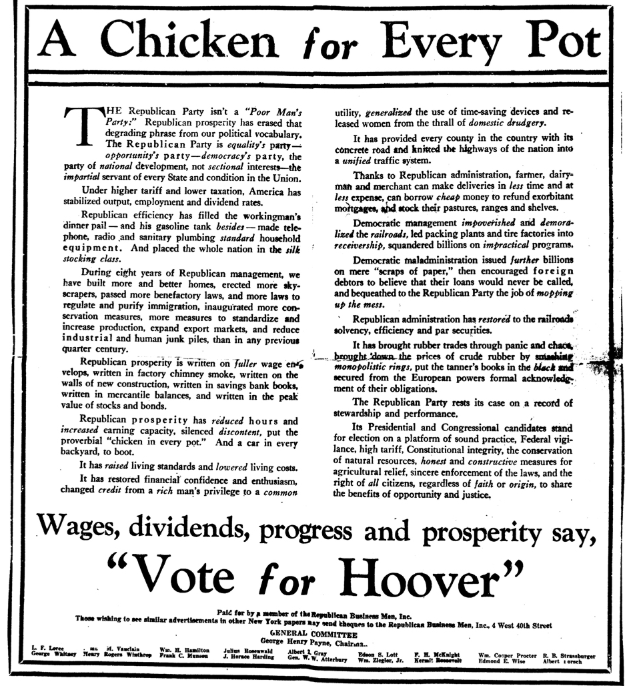
The idea is if you promise people jobs, money, and success –“a chicken in every pot” (1920’s Republican slogan) — you will win.

Ambition, greed, and compassion are strong motivators, appealing motivators, motivators that often work.

But I suggest there is an even stronger motivator, and that is bigotry. The most powerful human emotions are anger and fear — the ultimate survival emotions — and bigotry appeals to both.

Franklin Roosevelt’s famous “date which will live in infamy” speech was based on bigotry — anger at, and fear of “The Japanese Empire.” It was meant to stir up hatred of Japan and the Japanese people, and it succeeded so well that subsequently, Roosevelt was able to round up and sequester thousands of American citizens whose only crime was to be of Japanese descent.

Hitler, of course, used bigotry to justify the most terrible and gruesome acts. Hatred is not bounded by reason or compassion. The German people were able to sleep at night.

And Donald Trump has used the Hitler playbook to gather otherwise good, religious people, specifically white evangelicals, into his web.

Bigotry often masquerades as economics and safety. “The Mexicans will take your job.” “The Jews own everything.” “When the blacks move in, they will destroy your house values.”

Most people deny being bigots, so if you ask someone why they hate, they will give you a reason, not the real reason, but a reason.

When Trump talks to white, suburban housewifes, he makes a blatant overture to bigotry:

How Trump Is Using Westchester to Stir Up Suburban Fears
In an appeal to racism among white voters, the president says that Democrats tried to ruin Westchester County, N.Y., through fair housing policies.

“Westchester was ground zero, OK, for what they were trying to do,” Trump said on Monday, in an interview on Fox News with Laura Ingraham, referring to Mr. Biden and his fellow Democrats. “They were trying to destroy the suburban, beautiful place. The American dream, really. They want low-income housing, and with that comes a lot of other problems, including crime.”

It’s all a lie, of course. Democrats Obama, Clinton, Johnson et al didn’t “destroy the suburban, beautiful places.” In fact, suburbs have prospered over the years.

But like Hitler and other bigots, Trump tries to paint a vivid picture: Hoards of wild, untamed blacks and Mexicans, pillaging and raping and turning your neighborhood into a slum. And if you have a tendency to bigotry, this provides a perfect excuse for your beliefs.

Trump cannot cause you to become a bigot. He only can appeal to you if you already are a bigot. No one is born a bigot. Bigotry is a learned disease.

Here are excerpts from an article in “The American Conservative.”

After Trump Loss, ‘Deplorables’ Will Be The Democrats’ First Target
Blame the president for leaving his core supporters at the mercy of the opposition’s cultural and economic revolution
Robert M. Merry, September 7, 2020.

If President Trump loses his reelection bid in November, as appears likely, the greatest victims of his presidency will have been his own constituency—the Americans who have given him his consistent but sub-par approval rating of between 39 percent and 43 percent throughout his tenure.

And when the new Democratic regime takes over, those people will become its target of choice.

We know who they are: largely white, more male than female, generally older than 45, largely blue collar, educated through high school but not much beyond, agitated particularly by U.S. immigration policies of the past few decades, with widespread feelings that their financial standing in the country has been increasingly constricted.

Note the fear-loaded, anger-inducing words: “First target,” “cultural and economic revolution,” “victims,” “target of choice.” These are not words of logic. They are not thoughtful words. They are words to incite the torch-carrying, pitchfork-carrying mob gone mad.

And remember, the words are directed at Joe Biden, a man who has spent many years in public office, 36 as a U.S. Senator and 4 as the Vice-President of the United States. There is nothing in his history to indicate he seeks a “cultural and economic revolution” (whatever that means). But to bigots, facts mean nothing.

Resentful people, who believe their poor circumstances have been caused by “THEM,” need someone to blame — the rich, the criminal, the blacks, Mexicans, Democrats, unpatriotic, gays, and anyone of a different religion or no religion at all. In short, everyone but US.

So, illogically, they vote for a man who expresses hatred for “THEM,” despite the man being one of THEM: A rich, criminal, former Democrat, irreligious, draft-dodging, multiple adulterer. So long as he expresses fear and hatred for “THEM,” that is sufficient.

They are nationalist in outlook, not globalist, with strong feelings of traditional patriotism of the kind that guided their parents and grandparents.

Yes, they will overlook his draft-dodging, his tax-cheating, his four-star-general-insulting, his comments about those who die for their country as being “losers” and “suckers,” so long as he keeps expressing hatred for the people the bigots hate and fear.

Many of them don’t much care for Trump as a person. A Pew Research Center study during the 2016 primaries revealed that fewer than half of Trump supporters ascribed any favorable traits to him. Many didn’t consider him well informed, admirable, or even honest.

But, based on their consistent support for the president over the past four years, it seems that they view him as standing between them and an emerging Democratic coalition, whose policy prescriptions pose an economic threat to them and would otherwise marginalize them in American society.

And those are the key words — “marginalize them in American society.” Trump’s supporters are made to believe the GOP, the party of the rich, together with the rich man who passed a tax cut for the rich, and who has appointed rich incompetents who only try to line their own pockets — that man somehow will lift them from marginalization, while the Democrats, the party of the poor, will marginalize them.

Yes, there is no logic in bigotry, and it is so sad to see people who would benefit most from the implementation of the Ten Steps to Prosperity (below) — a liberal initiative — vote against their own best interests, to further be enslaved by a GOP, a Trump, and Trump’s rich, pack of convicted crooks.

They see the Democratic Party lurching to the left and know that, should the Dems take complete power over the federal government in January, it will go even worse for them than it has over the past quarter century.

U.S. borders will become more porous, largely through executive action. Asylum policies will be loosened up. Pro-immigrant legislation, such as free medical care for illegals, will serve as an enticement for greater illegal entry. A path to legal status, or even citizenship, will be pushed through.

All this will devastate wage rates, thus harming the economic wellbeing of the Trump constituency. It also will serve over time to generate millions of new Democratic voters who will overwhelm the beleaguered white middle-class.

Keep in mind that the immigrants are consumers, whose buying provides more jobs, not fewer, and better jobs because immigrants are less educated than “the beleaguered, white, middle-class.” Immigrants take the lowest, meanest, least remunerative jobs, not the jobs the white, middle-class wants.

And free medical care for the illegals also is free medical care for “the beleaguered white, middle-class” — a benefit the GOP consistently has fought. Medicare, Medicaid, Obamacare, poverty aids — those dreaded liberal initiatives — would be much more beneficial to the white middle-class if the Democrats were not hobbled by Mitch McConnell and his GOP Senate.

Even today, the Democrats wish to pump $3 trillion more into the economy, the vast majority of which would benefit Trump’s followers. The GOP says, “No.”

The Democratic elite will resuscitate the free-trade policies of recent decades, thus reviving the deterioration of industrial America that Trump sought to reverse.

Trump’s efforts largely consisted of ending existing trade agreements and replacing them with almost identical trade agreements, destroying any hope of international trust and cooperation, and importantly, levying tariffs on imports — tariffs that are paid by “the beleaguered, white, middle-class.”

As the world’s former moral, political, and economic leader, America under Trump has become just like Trump: A selfish, dishonest nation whose word means nothing on the international stage, and whose “America first, America only” policy prevented us from even being able to condemn Iran for breaking a treaty we alread had broken.

The further evaporation of working-class industrial jobs will deliver another financial blow to his constituency. A likely return to humanitarian interventionism, meanwhile, will lead to new foreign wars, sap the nation’s resources, stir internal frictions, and pull the sons and daughters of Middle America into the maw of conflict.

To “sap the nation’s resources” Trump has begun a war — a trade war — paid for by his followers, as is the Wall which was not paid for by Mexico.

The evaporation of industrial jobs was caused not by immigrants, but by computer automation, and was inevitable. Rather than curse the darkness, America’s leaders should have provided the finances and education necessary to help “the beleaguered, white, middle-class” benefit from this new reality. Trump could have done that, but he didn’t.

Machines now do the mind-numbing, repetitive, brainless industrial jobs Trump’s followers are told to desire. Is that what they really want for their children and grandchildren? Helping people to again become coal miners does them no favors. It merely destroys hope. It is Trump’s dystopian vision.

Trump supporters can see the shape of things to come when they witness Black Lives Matter protesters accosting people in restaurants and bars, yelling “silence is violence” into their faces and demanding gestures of support.

They can’t miss the implications of protests turning into violent riots, with property destroyed, businesses obliterated, downtowns turned into war zones, even violence perpetrated on innocent people with the wrong views—all while police forces in cities throughout America, hobbled by anti-police zealotry (or intimidation) on the part of liberal local officials, stand by and watch.

Portland is not everywhere, but it is far more interesting to the television networks than pictures of the many thousands of people all over America, quietly protesting against racial bigotry.

Rather than demonize the comparatively few violent protesters (many of whom are white supremacists, and Russian-backed thugs fomenting violence), Trump should use his power of office to eliminate the fundamental reason for the crime, the violence, and the protests: Poverty.

Instead, he blames the victims and adds fuel to the class-warfare fire. Given two ways to deal with unfairness in American society — penalize the rich or lift up the poor — Trump has chosen a third way: Beat down the poorest.

What went wrong? Trump went wrong.

He built his constituency by exposing to America the fundamental political reality of 2016—namely, the widening chasm between Middle America and its bicoastal elites of big media, government officials, think tanks, big tech, burgeoning financial institutions, the federal deep state, and mavens of popular culture.

He pulled his voters together into a tight knot of political support born of fear and intimidation and self-interest.

But then he couldn’t build on it. He could never take his 43 percent support and find a way to add another 10 percent by devising policies designed to operate on the political margin.

Trump identified a real problem — the Gap between the rich and the rest — and because he is a psychopath, he has not led us away from the Gap but right into it. His real policy has not been “America first” or even “America only.” His real policy has been “Trump only.”

That as many as 43 percent fell for it, is a credit to his personal charisma, a common feature of psychopaths.

(In the Robert Hare Checklist of Psychopathy Symptoms, #1 is: GLIB AND SUPERFICIAL CHARM — the tendency to be smooth, engaging, charming, slick, and verbally facile. Psychopathic charm is not in the least shy, self-conscious, or afraid to say anything.)

A well-crafted grand strategy on immigration probably could have served the purpose, had there been sufficient compromise involved.

A success on the health care issue would have helped.

A big factor could have been a foreign policy success fulfilling the president’s promise of reducing America’s military footprint overseas.

A use of language and a comportment signifying a sense of national unity, at least to the point of creating a majority coalition, could have helped tremendously—and would have been easy to do.

But Trump couldn’t do any of it. The result was that he couldn’t get beyond his core constituency and hence probably can’t be reelected. That likely will leave that core constituency in the lurch as the nation continues the politics of rancor, recrimination, and abuse under a new Democratic regime.

He couldn’t do any of it because he is a psychopath. He had no grand strategy on immigration or anything else. (Hare Checklist item #13 LACK OF REALISTIC, LONG-TERM GOALS — an inability or persistent failure to develop and execute long-term plans and goals.)

He had no success with health care because it didn’t affect him personally. He simply has no compassion for the sick. (Hare Checklist item #8 CALLOUSNESS and LACK OF EMPATHY — a lack of feelings toward people in general; cold, contemptuous, inconsiderate, and tactless.)

He had no foreign policy success because no one can trust him to live up to a commitment. (Hare Checklist item 15. IRRESPONSIBILITY — repeated failure to fulfill or honor obligations and commitments; such as not paying bills, defaulting on loans, performing sloppy work, being absent or late to work, failing to honor contractual agreements.)

He caused national disunity because he has Hare Checklist item 10. POOR BEHAVIORAL CONTROLS —  expressions of irritability, annoyance, impatience, threats, aggression and verbal abuse; inadequate control of anger and temper; acting hastily.

If Trump loses, his core constituency will not be left in the lurch. In fact, a Democratic White House and Senate would be the best thing that ever happened to “the beleaguered, white, middle-class.”

They will have free, comprehensive health care, jobs well above the ditch-digging, brainless jobs Trump wants them to have, education for their children, and better Social Security benefits.

And the violent protests, which really are protests against Trump’s violent police state, would end. Trump preaches violence, and his violence always begets more violence. Then he blames the protesters for what he has wrought.

The beleaguered, white, middle-class need only to ignore the siren song of a man and a party — Trump and the GOP –that uses them and takes from them, but cares nothing for them.

Bigotry works because it appeals to our fundamental emotions of fear and hatred, but bigotry is self-consuming, and those who follow Trump are being led into the darkness.

Rodger Malcolm Mitchell

Monetary Sovereignty Twitter: @rodgermitchell Search #monetarysovereignty Facebook: Rodger Malcolm Mitchell …………………………………………………………………………………………………………………………………………………………………………………………………………………………………………………………………………………………..

THE SOLE PURPOSE OF GOVERNMENT IS TO IMPROVE AND PROTECT THE LIVES OF THE PEOPLE.

The most important problems in economics involve:

  1. Monetary Sovereignty describes money creation and destruction.
  2. Gap Psychology describes the common desire to distance oneself from those “below” in any socio-economic ranking, and to come nearer those “above.” The socio-economic distance is referred to as “The Gap.”

Wide Gaps negatively affect poverty, health and longevity, education, housing, law and crime, war, leadership, ownership, bigotry, supply and demand, taxation, GDP, international relations, scientific advancement, the environment, human motivation and well-being, and virtually every other issue in economics. Implementation of Monetary Sovereignty and The Ten Steps To Prosperity can grow the economy and narrow the Gaps:

Ten Steps To Prosperity:

1. Eliminate FICA

2. Federally funded Medicare — parts A, B & D, plus long-term care — for everyone

3. Social Security for all or a reverse income tax

4. Free education (including post-grad) for everyone

5. Salary for attending school

6. Eliminate federal taxes on business

7. Increase the standard income tax deduction, annually. 

8. Tax the very rich (the “.1%”) more, with higher progressive tax rates on all forms of income.

9. Federal ownership of all banks

10.Increase federal spending on the myriad initiatives that benefit America’s 99.9% 

The Ten Steps will grow the economy and narrow the income/wealth/power Gap between the rich and the rest.

MONETARY SOVEREIGNTY