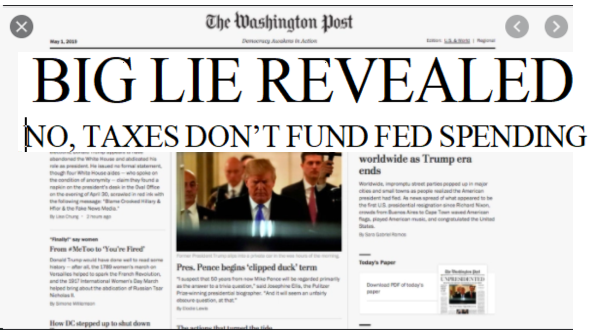
The “unsustainable” federal debt

If you type “unsustainable federal debt” into your search bar, you will see this: (Try it)

Implications of Unsustainable Debt
1. Economic Growth Risks: Rising debt levels can lead to slower economic growth as more government resources are allocated to interest payments rather than productive investments.

2. Increased Borrowing Costs: As debt accumulates, the government’s borrowing costs may rise, crowding out investments in other critical areas such as infrastructure and education.

3. Potential Default: If corrective actions are not taken, the U.S. could face a situation where it defaults on its debt obligations, either explicitly or through inflationary measures.

Experts suggest that without significant fiscal reforms, the U.S. government may face a fiscal crisis within the next 20 years.

Recommendations for Addressing Federal Debt To mitigate the risks associated with unsustainable federal debt, policymakers are urged to develop strategies that include:
*Reforming Spending: Addressing the key drivers of federal spending, particularly in healthcare and social programs, to align expenditures with revenues. 
*Increasing Revenues: Exploring options to enhance tax revenues, such as eliminating certain tax deductions and increasing corporate and individual income taxes.
*Implementing Fiscal Policies: Establishing a comprehensive fiscal policy framework that prioritizes long-term sustainability over short-term gains. 

Not one sentence in the above is true. Together, they form what is widely known in economics as “The Big Lie.”

It’s a series of lies that may not be the result of malevolence; it may just be ignorance. Either way, it’s wrong and harmful.

Let’s begin at the top:

The Lie: “Rising debt levels can lead to slower economic growth as more government resources are allocated to interest payments rather than productive investments.”

This lie includes two false assumptions: That federal deficit spending slows growth and government resources are limited by interest payments.

The Truth: Government deficit spending adds growth dollars to the economy as this formula illustrates: Gross Domestic Product = Federal Spending + Nonfederal Spending + Net Exports. 

By formula, the more federal spending, the more economic growth.

The lie that federal deficit spending slows growth is disproven by the mathematical definition of economic growth.

The idea that Government resources are limited by interest payments is disputed by the experts from the three Fed Chairmen, the St. Louis Fed Bank, and the Treasury, all acknowledging that the federal government has unlimited resources. It cannot run short of dollars.

=======================================

The Lie:As debt accumulates, the government’s borrowing costs may rise, crowding out investments in other critical areas such as infrastructure and education.”

This Lie makes false assumptions:

False assumption: The federal government borrows U.S. dollars.

The Truth: The federal government never borrows U.S. dollars. Having the infinite ability to create dollars, the assumption makes no sense on its face. The confusion arises because of the words, “bill,” “note,” “bond,” and “debt” all of which have different meanings in federal finance vs. private finance.

In private finance, those words indicate that money is owed. In federal finance, a T-bill, T-note, and T-bond represent deposits (not borrowing) into Treasury security accounts.

The purpose of those accounts is not to acquire spending money but rather to:

*Provide dollar holders with a safe place to store unused dollars — safer than any bank in the world — which is why nations such as China store dollars there, and

*Help the Fed control interest rates by creating a base rate upon which all other rates are calculated.

The total of outstanding T-bills, T-notes, and T-bonds is misnamed “debt,” though nothing is owed. These accounts resemble bank safe-deposit boxes, in which valuables are held by a bank but not owed to the depositor. 

The so-called “debt” is nothing more than a simple exchange of money. You send dollar bills to the government, and the government sends you Treasury bills. They both are U.S. money, with exactly the same backing: the full faith and credit of the United States government.

A dollar bill and a Treasury bill are identical in terms of government liability. They both are U.S. money issued by the U.S. government.

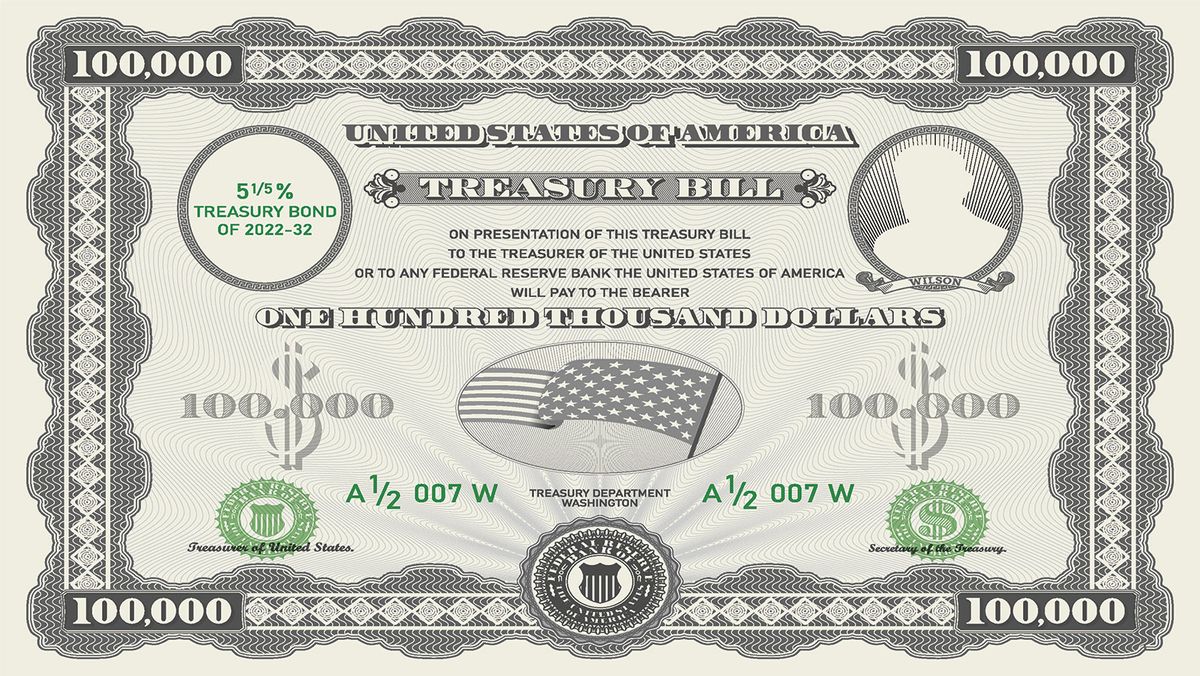
 

United States one-dollar bill - Wikipedia

How Treasury Bills Work | HowStuffWorks

As the St. Louis Fed clearly said, “the government is not dependent on credit markets (i.e., does not borrow) to remain operational.”


False assumption: “… the government’s ‘borrowing’ costs may rise, crowding out investments in other critical areas

The Truth: The government’s “borrowing costs” (meaning interest payments) will have no effect on the government’s ability to pay interest. It has infinite ability to pay for anything.

We are not sure what “crowding out” means. If it means the government will run short of dollars, that clearly is impossible.

If it means that private sector borrowers will be unable to borrow, that too is false. Interest rates are arbitrarily controlled by the Fed and are not related to the issuance of Treasury securities. The Fed sets interest rates to control inflation.

===================================

The Lie: “… the U.S. could face a situation where it defaults on its debt obligations, either explicitly or through inflationary measures. 

The Truth: Again, we see multiple false assumptions:

First false assumption: “… the U.S. could face a situation where it defaults on its debt obligations.”

As every competent economist (including those mentioned above) has said, “The federal government never can become insolvent, i.e., unable to pay its bills.” Having the infinite ability to create dollars confirms this.

Second false assumption: “… through inflationary measures.”

We are not sure if this means that federal spending causes inflation, a claim not in accord with history.” 

Inflation never has been caused by federal spending. Every inflation has been caused by shortages of critical goods and services. The most recent COVID-related inflation was caused by shortages of oil, food, shipping, metals, lumber, labor, computer chips, and other needs. Inflation was being mitigated by federal spending to obtain and distribute scarce items.

See: “At long last, let’s put this inflation question to bed.”

Or does “inflationary measures” mean that the measures to forestall inflation actually cause defaults on debt obligations?  The Fed mistakenly raises interest rates to combat inflation, but a nation with the ability to create its own money can never default.

And in any event, the government pays its misnamed “debt” by the simple act of returning the dollars that reside in T-security accounts. This is not a financial burden on the government. 

Did you know that the federal “debt” has been called “unsustainable” for the past eighty-five years? (See: “A trip down memory lane, or proof ignorance is hard to conquer if the ignorant want to remain that way.”) 

Yes, for eighty-five years, they have been crying wolf, and the people have yet to catch on. Talk about slow learners!

Why the lies?

That is the most important question. The so-called “cures” for the non-existent “problem” of federal debt involve tax increases on the poor and/or reducing social programs that primarily aid those who are not wealthy, such as Social Security, Medicare, Medicaid, and food stamps. 

Thought seldom is given to reducing benefits for the rich, like eliminating tax loopholes.

This was driven home yet again when billionaire President Trump revealed that he had paid virtually no income tax for ten years, a most enviable position — and his political party just passed a “Big, Beautiful” law that saves the rich billions, while the rest receive a pittance while losing some benefits.

This is no accident.

The lies that FICA taxes fund Social Security and Medicare, and that social programs must be cut, are told on behalf of the rich, whose money runs America.

An infinite pile of dollars rising high into space
The federal government has infinite money. It never can run short. It never can default on its obligations for lack of money.

Those of our information sources that promulgate The Big Lie either are ignorant of the facts or are bribed to lie. The rich bribe:

  1. The media, via ownership and advertising dollars
  2. The politicians, via political contributions and promises of lucrative employment later
  3. The economists, via promises of employment with “think tanks” and university endowments.

IN SUMMARY

Even if the federal government did not collect a single penny in taxes, it could fund:

  1. A generous “living-income” Social Security benefit for every man, woman, and child in America.
  2. A livable Social Security benefit for every man, woman, and child in America
  3. Comprehensive, no-deductible Medicare for every man, woman, and child in America
  4. Generous aid for grades K-12.
  5. Free college for all who want it.
  6. Housing assistance
  7. Generous support for the various scientific and medical research projects in America.
  8. Economic growth

And it could do all of that without causing inflation.

America, you have been cheated and lied to, perhaps intentionally, perhaps ignorantly. The federal government has the wherewithal to make America a paradise on Earth. But the rich don’t want that, because if we all were equal, no one would be rich.

The rich want the income/wealth/power gap between the rich and the rest o us to widen. They want the desperation that forces people to accept jobs they don’t like and receive low pay.

So they bribe your sources of information to promulgate The Big Lie, that federal finances are like personal finances, and the government can’t afford to aid the “lazy” poor (who, on average, work harder than the rich).

It doesn’t have to be this way. However, it will remain so if the people reject the facts and choose to believe the lies.

If you don’t protest — if you don’t call, write, and gather groups to demand what if rightfully yours — if you weakly accept The Big Lie and think the truth “is too good to be true– then it always will be that you work hard, receive little, and your children and their children will do the same.

Now that you have heard the facts, the choice is yours. 

Rodger Malcolm Mitchell

Monetary Sovereignty

Twitter: @rodgermitchell

Search #monetarysovereignty

Facebook: Rodger Malcolm Mitchell;

MUCK RACK: https://muckrack.com/rodger-malcolm-mitchell;

https://www.academia.edu/

……………………………………………………………………..

A Government’s Sole Purpose is to Improve and Protect The People’s Lives.

MONETARY SOVEREIGNTY

Does Bernie Sanders have a secret plan about Social Security?

Modern Monetary Theory Got a Pandemic Tryout. Inflation Is Now Testing It. - The New York Times
Stephanie Kelton
Bernie Sanders is a “friend” to the extent that he wishes to expand Social Security (and Medicare). He once had Modern Monetary Theory’s Stephanie Kelton as his chief economic adviser during his 2016 presidential campaign. Kelton tried and seemingly failed to educate Sanders about the facts of federal economics, the key one being that a Monetarily Sovereign government cannot run short of its own sovereign currency. It neither needs nor uses tax receipts, which are destroyed upon receipt.

(When you pay taxes to the federal government, money is removed from the private sector [aka “the economy”] and flows to the U.S. Treasury. Because the Treasury has infinite money, your tax dollars effectively are destroyed. (Infinity + any number = infinity. No change.)

Perhaps Sanders is playing politics because he continues to mouth the absurdity that the federal government and its agencies unintentionally can run short of U.S. dollars.

‘Time to Scrap the Cap’: Sanders, Warren Bill Targets Rich to Expand Social Security Posted on June 10, 2022 by Yves Smith, By Jake Johnson, a staff writer at Common Dreams. Originally published at Common Dreams

Yves here. It’s no secret that the assertions that Social Security is in dire financial straits are fabrications.

First, like so much of our Federal government funding, the device of having a trust fund is a convenient fiction.

So far, so good. Despite incessant allusions to the contrary, the so-called Medicare Trust Fund and Social Security Trust Fund are not trust funds. They merely are notations on a balance sheet. Those numbers are completely controlled by the federal government. The federal government can change the numbers at will — quite different from a trust fund.

In reality, Social Security is a pay-as-you-go program.

She is correct if Susan Webber (aka Yves Smith) means that the federal government pays for Social Security by creating dollars, ad hoc.

Second, for those who nevertheless like the appearance that Social Security is paid for by payroll contributions, the most obvious fix has long been to raise or eliminate the cap on salaries subject to payroll taxes.

The fact that this problem has not been solved strongly suggests some influential parties don’t want it solved.

Those “influential parties” are the very rich, who wish to widen the Gap between them and those below them on any income/wealth/power scale. It’s known as “Gap Psychology.” Unfortunately, most Americans believe the lie that Social Security is paid for by a trust fund. The solution to a lie is not to accept the lie, as Smith seems to advocate, but rather to tell the truth. But, she doesn’t seem to advocate for the truth.

Sens. Bernie Sanders and Elizabeth Warren led a group of lawmakers Thursday in unveiling legislation that would expand Social Security’s modest annual benefits by $2,400 and ensure the program is fully funded for the next 75 years.

The benefit boost under the Social Security Expansion Act would be funded by lifting the cap on the maximum amount of income subject to the Social Security payroll tax.

This year the cap was $147,000—meaning millionaires stopped paying into the program in late February.

Lifting the cap would fund nothing because the Social Security payroll tax (FICA) funds nothing. The dollars are destroyed when they hit the Treasury. President Roosevelt, the creator of Social Security, knew this, but he wanted the tax to make Social Security impossible to end. He reportedly said, concerning FICA:

“I guess you’re right on the economics (that payroll taxes are unnecessary).

“They are politics all the way through. We put those payroll contributions there so as to give the contributors a legal, moral, and political right to collect their pensions and their unemployment benefits.

“With those taxes in there, no damn politician can ever scrap my social security program. Those taxes aren’t a matter of economics. They’re straight politics.”

All federal programs can end, and many do when an opposing party comes into power. But if the voters believe they have contributed to a program, the opposing party will find it politically challenging to end the program.

If passed, the expansion bill would apply the payroll tax to all income, including capital gains, above $250,000 a year, a change that would only raise taxes on around 7% of U.S. households.

“At a time when half of older Americans have no retirement savings and millions of senior citizens are living in poverty, our job is not to cut Social Security,” Sanders (I-Vt.), head of the Senate Budget Committee and a co-chair of the Expand Social Security Caucus, said in a statement.

“Our job must be to expand Social Security so that every senior citizen in America can retire with the dignity they deserve and every person with a disability can live with the security they need,” the senator continued.

“And we will do that by demanding that the wealthiest people in America finally pay their fair share of taxes.

It is absurd that a billionaire in America today pays the same amount of Social Security taxes as someone making $147,000 a year.

It is time to scrap the cap, expand benefits, and fully fund Social Security.”

Does Sanders believe that? Does he think raising the $147,000 FICA salary cap will expand benefits and fully fund Social Security? Or is his plan simply to make the rich pay so that it appears a Social Security increase will be fully funded? Is that his way of answering the question, “Who will pay for it? Or does he have an even deeper plot?

The legislation comes a week after the annual Social Security trustees report showed that—contrary to Republicans’ claims that it is barreling toward insolvency—the program is positioned to fully fund benefits until 2035.

Thereafter, even if Congress takes no action, the program is projected to be 90% funded for the next 25 years and 81% funded for the next 75 years.

Social Security is fully funded, not by any fake trust fund but by the full faith and credit of the United States government. Neither the U.S. government nor any government agency can run short of dollars unless Congress and the President want it to. What is their real plan assuming Sanders and Warren are intelligent and well-informed?

“Social Security is an economic lifeline for millions of Americans, but many seniors are struggling with rising costs,” said Warren (D-Mass.).

“As Republicans try to phase out Social Security and raise taxes on more than 70 million hardworking Americans, I’m working with Senator Sanders to expand Social Security and extend its solvency by making the wealthy pay their fair share, so everyone can retire with dignity.”

That “fair share” hints at the real purpose of Sanders’ plan.

Sanders announced the new bill Thursday during a Senate Budget Committee hearing, at which Republicans—including Sen. Mitt Romney (R-Utah), who has previously voiced support for privatizing Social Security—made clear they would oppose the legislation, which has been endorsed by more than 50 advocacy organizations and labor unions.

The Republicans’ ostensible purpose for privatizing Social Security is the claim that stock market investments will grow enough to safeguard Social Security growth. The claim is false for at least two reasons.
  1. Social Security is funded by the federal government’s money creation, not taxes or any other outside mechanism.
  2. The stock market is not a secure growth mechanism, and if somehow it were made to fund Social Security, the current S&P drop demonstrates the folly of relying on private markets.
The true purpose of Romney’s and other Republicans repeated drumbeat for privatization is simple: To provide another lucrative money-making opportunity for wealthy investment firms.

In addition to increasing annual benefits and lifting the tax cap, the Social Security Expansion Act would also boost the program’s cost-of-living adjustments by switching to a more accurate measure of inflation.

According to the Social Security Administration, the average monthly Social Security benefit payment was around $1,540 as of April 2022.

“With the cost of living at an all-time high, Social Security has never been more important, yet congressional Republicans continue to play games with its funding,” said Rep. Peter DeFazio (D-Ore.), the lead sponsor of a companion bill in the House.

An example of Gap Psychology at work. A wealthy person will spend $12.8 million to distance himself from those who have less, and to come closer to those who have more.

“This legislation would ensure that the Social Security Trust Fund remains solvent for another 75 years, increase monthly benefits for most recipients by $200, and alter the cost-of-living-adjustment formula to meet the everyday needs of our nation’s seniors,” DeFazio added.

Lifting the tax cap won’t accomplish any of those stated purposes. So, what may be the fundamental purpose? Could it be Sanders’ and Warren’s secret plan to narrow the income/wealth/power Gap between the rich and the rest? Is this their Gap Psychology plan?

(Gap Psychology describes the common desire to distance oneself from those below, on any socioeconomic scale, and to come closer to those above.)

The plan implies to those who believe FICA funds Social Security, a direct money transfer from the richer to the poorer, from those whose salary exceeds $147,000 to those whose salary is lower. Since there are more voters in the latter position than in the former, it’s a pretty good Gap Psychology election ploy. Because the plan would, though by a minimal amount, help narrow the Gap, I wish I could be in favor. But I simply can’t support the idea of ratifying the Big Lie that federal taxes fund federal spending. So long as the populace believes the Big Lie, the myth that the U.S. is as financially hamstrung as the states, counties, cities, and euro nations. We must free ourselves of that myth to have control over our economic future. The honest plan would be to tell the world that the federal government can’t run short of dollars, federal taxes don’t fund federal spending, and federal spending doesn’t cause inflation. (See: “First do no harm. How ‘Dr.’ Jerome Powell will worsen the inflation and cause a recession”) The rich will continue to rule until those truths are exposed and understood. (Every federal spending cut demanded by conservatives is designed to widen the income/wealth/power Gap between the rich and the rest, while the few federal spending increases backed by the conservatives are designed to reward and protect the rich.) Rodger Malcolm Mitchell Monetary Sovereignty Twitter: @rodgermitchell Search #monetarysovereignty Facebook: Rodger Malcolm Mitchell

……………………………………………………………………..

THE SOLE PURPOSE OF GOVERNMENT IS TO IMPROVE AND PROTECT THE LIVES OF THE PEOPLE.

The most important problems in economics involve:
  1. Monetary Sovereignty describes money creation and destruction.
  2. Gap Psychology describes the common desire to distance oneself from those “below” in any socio-economic ranking, and to come nearer those “above.” The socio-economic distance is referred to as “The Gap.”
Wide Gaps negatively affect poverty, health and longevity, education, housing, law and crime, war, leadership, ownership, bigotry, supply and demand, taxation, GDP, international relations, scientific advancement, the environment, human motivation and well-being, and virtually every other issue in economics. Implementation of Monetary Sovereignty and The Ten Steps To Prosperity can grow the economy and narrow the Gaps: Ten Steps To Prosperity:
  1. Eliminate FICA
  2. Federally funded Medicare — parts A, B & D, plus long-term care — for everyone
  3. Social Security for all
  4. Free education (including post-grad) for everyone
  5. Salary for attending school
  6. Eliminate federal taxes on business
  7. Increase the standard income tax deduction, annually. 
  8. Tax the very rich (the “.1%”) more, with higher progressive tax rates on all forms of income.
  9. Federal ownership of all banks
  10. Increase federal spending on the myriad initiatives that benefit America’s 99.9% 
The Ten Steps will grow the economy and narrow the income/wealth/power Gap between the rich and the rest.

MONETARY SOVEREIGNTY

Why is Medicare the way it is?

The purpose of government is to improve and protect the lives of the governed.

Is the Medicare Advantage plan an admission that Medicare itself is unnecessarily incomplete?

Rolls-Royce Phantom Prices, Reviews and New Model Information
Free, but with strings.

A story: You receive a call from the wealthiest man on earth. He owns an infinite amount of money.

He tells you he’s in the mood to do a good deed.

He has picked your name randomly, not based on anything but the luck of the draw, and he is giving you a free, no-strings-attached, Rolls Royce automobile.

Well, actually, there are two small strings. You must choose between two Rolls.

One has no heater. The other has no air conditioning.

And you must wait until you are 65 years old before you pick your car.

This puzzles you, so you ask him, “Why would someone having infinite money decide that when does his good deed, he gifts you a car that is missing either a heater or air conditioner?”

And why must you wait until you’re 65?

What’s his purpose?

While you ponder that question, consider this: The federal government, being uniquely Monetarily Sovereign, has infinite dollars. It never can run short of its own sovereign currency.

The government provides you with Medicare, which comes in two basic “models,” Original Medicare and Medicare Advantage.

And you typically must wait until you are 65 to join (with certain exceptions).

But Medicare and Medicare Advantage have different options depending on many of your personal factors.

WHY? Why doesn’t Original Medicare simply cover all medical conditions for everyone?

The American Association of Retired People (AARP) published “8 Reasons to Change Medicare:

1. My prescription costs have jumped.
That happens usually due to one of two scenarios: You’ve been prescribed a new drug your Plan D policy doesn’t cover, or your current medicines have fallen off your Plan D’s formulary (list of covered medicines), Neuman says.

Each September, Part D prescription plans will send out a list of changes to drug coverage, giving you time to make sure your medicines are still covered.

If not, you can shop around for another plan or ask your doctor to apply for an exception in covering your favored medicine.

WHY? Why must a person pay extra for Part D, and why must that person shop around for a plan that covers all his medicines?

2. I’ve decided to spend my winters (or summers) in a different state.
Advantage plans typically charge more to go to doctors outside of their networks; in some cases they won’t cover any charges if it’s not an emergency.

So a Midwesterner might have to pay more to see out-of-network doctors while in Florida.

You need to read the details of your plan, or talk with a representative, to know where you stand. If you’ll be living a dual-residence existence for years to come, you might consider a switch to original Medicare, with the usual caveats.

WHY? Why the “in-network, out-of-network” rigamarole?

3. I need surgery and prefer a specific doctor.
Original Medicare allows patients to choose any doctor or hospital that accepts Medicare.

But if you’re in a Medicare Advantage plan and its surgeons don’t meet your needs, you may need a different MA plan or to switch to OM.

The people who really need to focus on whether doctors are in network are those who’ve suffered major problems like cancer and heart attack, says Joseph Antos, health care expert at the American Enterprise Institute.

“A specialist may be key to their treatment,” he says.

WHY? Why does one Medicare plan cover any doctors or hospitals that accept Medicare and the other plan doesn’t?

4. I’m super healthy and rarely need a doctor.
If you’re in original Medicare, all should be well: As a “pay-for-service” arrangement, not seeing the doctor isn’t costing you anything extra beyond your mandatory parts B and D monthly insurance premiums.

If you’re in an MA plan in which you’re paying a monthly premium on top of your standard Part B premium, that may be for a plan that offers lots of extras , such as gym memberships.

Consider switching to a lower-cost MA plan that doesn’t offer services you don’t plan to use in the coming year.

WHY? Why are there any premiums, and why does one plan not cover the “extras?

5. I’ve been diagnosed with a chronic condition.
A serious medical change should trigger a full review of your Medicare coverage. Make sure your Plan D policy pays for new prescriptions.

Consider the care you’ll need . If you want disease-specific programs, find an MA plan that offers them.

But if you will need lots of specialists, there’s an argument for OM. Making critical changes early can “really affect your pocketbook and save you money,” says Gretchen Jacobson, a vice president with the Commonwealth Fund.

WHY? Why the difference in plans? Why doesn’t one plan cover everything?

6. My income has dropped sharply.
If you are in original Medicare, your Part B monthly premium is locked in, but your Part D drug plan isn’t.

And there’s a chance you can find a lower-cost policy that covers the medicines you are on.

If you’re in an Advantage plan, consider a switch to a plan in which there is no extra payment on top of the mandatory Part B premium.

And you might qualify for help. Ask your state Medicaid office about Medicare Savings Programs. Find the state offices here or call 800-MEDICARE (800-633-4227).

WHY? Why is there a monthly premium? Why does one plan not even lock in premiums? Why the difference in costs?

7. My former employer is changing its retiree health benefits.
Some companies provide retirees with Medigap supplemental insurance, which covers many health costs not covered by OM.

If you have changes to your retiree benefit coverage, or for some reason that coverage no longer is offered, contact Medicare’s Benefits Coordination & Recovery Center (855-798-2627).

Someone can tell you whether you fall in the window in which Medigap insurers cannot deny you coverage based on preexisting conditions.

WHY? Why are some retirees not covered by Medigap supplemental? Why is there even a need for supplemental?

8. My regular doctor is no longer in network for my plan.
If you deeply want to stay with a doctor, ask directly whether he or she is moving to a different MA plan, accepting OM patients or dropping out of Medicare completely.

If you decide to make a change, make sure a short-term decision won’t affect your long-term coverage (for example, switching to original Medicare to temporarily stay with one doctor but sacrificing Medigap coveragefor the long term).

It might be safer to ask your doctor to recommend a colleague in your current plan.

I’m in need of serious dental care. Original Medicare doesn’t cover routine dental care costs, but many Medicare Advantage plans do.

If you don’t have your own dental insurance and can’t afford dentistry costs out of pocket, consider finding an MA plan that will cover a portion of the costs of your needed work.

Antos warns that figuring out what portion of your dental bills an MA plan will cover is complicated, so it helps to know what services you will use in the coming year.

WHY? Why does a person need to consult a crystal ball to guess what medical coverage will be needed at some unknown time in the future?

WHY?


HERE IS WHY: Our Monetarily Sovereign government has infinite funds. It can afford any expense, even without collecting a single dollar in taxes. It has ultimate control over the value of the dollar, i.e. inflation.

Thus, the federal government has the unlimited ability to fund comprehensive, no-deductible Medicare for every man, woman, and child in America. There is no financial reason why you, your family and everyone you know does not have free, total healthcare protection.

But . . . 

At the behest of the very rich, who run America, our information leaders promulgate the Big Lie that taxpayers fund federal spending, and that the federal government is in danger of running short of dollars if spending increases without tax increases.

You have been sold the bill of goods that “there is no such thing as a free lunch,” and that federal spending causes inflation, and that the phony Medicare “trust fund” is running short of money.

The rich do this to widen the Gap between the rich and the rest, for it is the Gap that makes them rich. The wider the Gap, the richer they are.

Better “Medicare for All” plans have been proposed, but they have been rejected supposedly because tax dollars are needed to pay for it. 

They aren’t. It’s the Big Lie, the sole purpose of which is to make the rich richer.

There is no other purpose.

Rodger Malcolm Mitchell Monetary Sovereignty Twitter: @rodgermitchell Search #monetarysovereignty Facebook: Rodger Malcolm Mitchell

……………………………………………………………………..

THE SOLE PURPOSE OF GOVERNMENT IS TO IMPROVE AND PROTECT THE LIVES OF THE PEOPLE.

The most important problems in economics involve:

  1. Monetary Sovereignty describes money creation and destruction.
  2. Gap Psychology describes the common desire to distance oneself from those “below” in any socio-economic ranking, and to come nearer those “above.” The socio-economic distance is referred to as “The Gap.”

Wide Gaps negatively affect poverty, health and longevity, education, housing, law and crime, war, leadership, ownership, bigotry, supply and demand, taxation, GDP, international relations, scientific advancement, the environment, human motivation and well-being, and virtually every other issue in economics. Implementation of Monetary Sovereignty and The Ten Steps To Prosperity can grow the economy and narrow the Gaps: Ten Steps To Prosperity:

  1. Eliminate FICA
  2. Federally funded Medicare — parts A, B & D, plus long-term care — for everyone
  3. Social Security for all
  4. Free education (including post-grad) for everyone
  5. Salary for attending school
  6. Eliminate federal taxes on business
  7. Increase the standard income tax deduction, annually. 
  8. Tax the very rich (the “.1%”) more, with higher progressive tax rates on all forms of income.
  9. Federal ownership of all banks
  10. Increase federal spending on the myriad initiatives that benefit America’s 99.9% 

The Ten Steps will grow the economy and narrow the income/wealth/power Gap between the rich and the rest.

MONETARY SOVEREIGNTY

Correcting the Big Lie

If the Washington Post and the other major media were honest, this is what tomorrow’s front pages would look like

For those who wish to see a classic example of the Big Lie (that federal deficits cause inflation and are a burden on taxpayers) read this article from the Washington Post.

U.S. government spent $660 billion more in March than it collected in revenue, the third-largest monthly deficit on record

Translation: “. . . the third-largest monthly economic gain on record.” (When the government pumps more money into the economy than it takes out in taxes, that is an economic gain for the economy.)

Stimulus plan and $1,400 checks drove spending much higher as the White House and Republicans clash over where to spend money next.
By Jeff Stein, April 12, 2021 at 2:00 p.m. EDT

The federal government spent $660 billion more than it collected in tax revenue this March, the Department of Treasury said Monday, as the Biden administration’s stimulus package pushed the U.S. monthly deficit near record highs.

Translation: ” . . . pushed the U.S. monthly economic gain near record highs.” (That’s the purpose of a stimulus — adding money grows the economy.)

The U.S. spent $927 billion in March alone — more than double the level from March 2020 — a jump due primarily to the disbursal of tens of millions of $1,400 stimulus payments under the American Rescue Plan. Meanwhile, tax revenues stayed largely flat, with the government only collecting slightly more than last March.

The resulting deficit is the third largest ever in American history, Treasury officials said, eclipsed only by April and June of last year — when the U.S. authorized larger levels of emergency spending to head off the economic crisis caused by the pandemic.

The monthly deficit had contracted relative to the summer months as federal spending expired and the U.S. economy began to heal.

Translation: “The resulting economic gain is the third highest in American history . . . to head off the economic crisis caused by the pandemic.” (Neither you, nor your children, nor your children’s children will ever pay for the so-called “deficit.” Our Monetarily Sovereign federal government funds its payments by creating new dollars, ad hoc.)

The U.S. budget deficit breached $3.1 trillion in 2020 as the pandemic slammed economy

Over the first six months of the current fiscal year, the government’s budget deficit has reached $1.7 trillion, a massive sum.

America’s annual deficit hit $3.1 trillion in 2020, an all-time high that far surpassed the previous record of $1.4 trillion, which came in 2009 during the depths of the Great Recession.

Translation: “The U.S. economic gain breached $3.1 trillion as the pandemic slammed the economy.”

“. . . the economic gain has reached $1.7 trillion, a massive sum.”

“America’s annual economic gain hit $3.1 trillion in 2020, an all-time high . . . ” (And despite all the handwringing by pundits, there is no inflation.)

Democrats and Republicans authorized much of the emergency spending last year as a way to try and stop an economic collapse. They are at odds, though, over spending levels in 2021.

The government has to borrow money to cover deficits, and it does this by issuing debt.

Interest rates are relatively low, which has made it cheaper to borrow, but the federal debt has grown markedly in the past year.

Translation: “The federal government, being Monetarily Sovereign, does not need to borrow money to fund an economic gain, nor does it issue debt.

In an unrelated process, the government accepts deposits into T-security accounts, which are like interest-paying safe-deposit boxes. Unlike “borrowing,” the federal government never touches the dollars in T-security accounts.”

” . . . relatively low, and interest rates have no effect on the federal government’s ability to increase the economic gain.

Most of the new stimulus payments have already been sent out and are reflected in the March data. Still, budget experts say higher-than-usual deficit totals are likely to continue for the rest of the year.

On a call with reporters, Treasury officials noted that all the funding from last year’s Cares Act and the rescue plan had not yet been allocated.

Translation: “Fortunately, budget experts say higher-than-usual economic gain totals are likely to continue for the rest of the year.”

“This is going to be a big deficit year because we were already running substantial deficits and passed a $1.9 trillion bill,” said Marc Goldwein, a budget expert at the Committee for a Responsible Federal Budget, which advocates for lowering the deficit.

“This is not higher than expected. It’s what you’d expect with a $1.9 trillion stimulus on top of a structural deficit.”

Translation: “This is going to be a big economic gain year, because the economy already was running substantial gains . . . “

“It’s what you would expect with a $1.9 trillion stimulus on top of a structural gain.”

Jeff Stein is the White House economics reporter for The Washington Post. 

Translation: Jeff Stein is a White House economics reporter who is paid to promulgate the Big Lie that economic gains are a burden on the federal government and on taxpayers.

Because the federal government is Monetarily Sovereign, it pays for its spending by creating new dollars, ad hoc.

The federal government has the infinite ability to create dollars, so no tax dollars are used for federal spending.

(The sole economic purpose of federal taxes is to allow the government to control the economy. It taxes things it wishes to discourage, and it give tax breaks to what it wishes to encourage.)

Thus, the whole reason for calling it a federal “deficit” is to mislead. The purpose of the misrepresentation is to dissuade you, the public, from demanding more benefits from the government.

Because those benefits tend to narrow the income/wealth/power Gap between the rich and the rest, the rich pay the politicians, the media, and many economists to promulgate the Big Lie.

Shame on Mr. Stein, and shame on the Washington Post, and shame on all the other media, the politicians, and the economists who disseminate the Big Lie. Shame, for doing the dirty work of the very rich.

…………………………………………………………………………

Wide Gaps negatively affect poverty, health and longevity, education, housing, law and crime, war, leadership, ownership, bigotry, supply and demand, taxation, GDP, international relations, scientific advancement, the environment, human motivation and well-being, and virtually every other issue in economics. Implementation of Monetary Sovereignty and The Ten Steps To Prosperity can grow the economy and narrow the Gaps: Ten Steps To Prosperity: The Ten Steps will grow the economy and narrow the income/wealth/power Gap between the rich and the rest. MONETARY SOVEREIGNTY</span