The states, counties, and cities are becoming insolvent. Do you care?

If you don’t live in a state that now is heading toward insolvency, you are fortunate. You are even more fortunate if your county and/or your city are not on the edge of insolvency.

An insolvent state or local government is not able to provide much-needed local services — education, poverty aids, infrastructure, etc. — without a tax increase. So as a citizen of an insolvent government, you are faced with the unfortunate choice of paying more taxes or doing with less service.

By contrast, the U.S. government never can be insolvent. It has the unlimited ability to create its own sovereign currency, the U.S. dollar.

The federal government never can run short of dollars, and in fact, its method for creating dollars is to pay creditors.

So it is the height of ignorance that the following outrageous situation exists.

11 states pay more in federal taxes than they get back

  • Alabama: Total balance of payments: -$169 million; Per capita balance of payments: -$291
  • California: Total balance of payments: -$13.7 billion; Per capita balance of payments: -$348
  • Connecticut: Total balance of payments: -$4.4 billion; Per capita balance of payments: -$1,242
  • Illinois: Total balance of payments: -$14.8 billion; Per capita balance of payments: -$1,158
  • Massachusetts: Total balance of payments: -$10.5 billion; Per capita balance of payments: -$1,532
  • Minnesota: Total balance of payments: -$6 billion; Per capita balance of payments: -$1,078
  • Nebraska: Total balance of payments: -$267 million; Per capita balance of payments: -$139
  • New Hampshire: Total balance of payments: -$749 million; Per capita balance of payments: -$558
  • New Jersey: Total balance of payments: -$24.7 billion; Per capita balance of payments: -$2,748
  • New York: Total balance of payments: -$24.1 billion; Per capita balance of payments: -$1,216
  • Wyoming: Total balance of payments: -$169 million; Per capita balance of payments: -$291

In summary, a government that has infinite money takes more money from eleven states than it gives to them.

That alone is economically ignorant and outrageous, but it gets worse. Much worse.

Here are a few excerpts from a web article, today:

If the Federal Government Won’t Fund the States’ Emergency Needs, There Is Another Solution
Posted on May 25, 2020 by Yves Smith
Yves here. I’m glad to see Marshall Auerback mention the program that great American socialist Richard Nixon implemented, revenue sharing, which was the Federal government handed out money to local government.

No, Yves doesn’t really believe Nixon was a socialist. She is making a point for the right-wingers who in their ignorance and/or spite, term any federal spending that benefits those in the lower 99% income brackets, as “socialist.”

In the first week of October, 39,000 cities, counties, towns, villages and other communities across the county received checks from the Treasury, some as small as $201. The biggest -$41,957,530 – went to New York City.

With these checks, the program of Federal revenue-sharing came to an end, 14 years and $85 billion after it began.

In that span of time, from before Watergate to the afternoon of the Reagan era, this low-overhead, highly practical, widely popular program brought an extraordinary array of benefits to the people of New York and every state.

Revenue-sharing paid for teachers in Manhattan and streetlights in Buffalo, provided snowplows for Adirondack villages and built the community hall and ice rink in New Hartford.

A so called “revenue-Sharing” plan is defined by the Encyclopedia Britannica as:

A government unit’s apportioning part of its tax income to other units of government. For example, provinces or states may share revenue with local governments, or national governments may share revenue with provinces or states.

The problem with that definition is that it does not consider Monetarily Sovereign governments like the U.S. government, which does not spend revenue, nor does it share revenue with anyone.

A Monetarily Sovereign (MS) government destroys all the revenue it receives, and it creates brand new money when it spends.

Unlike monetarily non-sovereign governments –i.e.  the states and local entities —  for the federal government there is no “flow-through” of income to out-go.

Incoming money is destroyed: outgoing money is created.

There is no link between the two.

The program was misnamed “revenue-sharing” by its creators, economist Walter Heller and President Richard Nixon, to make it more palatable to the public.

Presumably, if it were not called “sharing” it would be called “socialism,” and Nixon’s base didn’t want that.

Nixon believed the Federal government could collect taxes cheaply and more efficiently than could the states and cities, while local governments were closer to the needs of their citizens and could often deploy funds more efficiently and in a more tailored manner than could the Federal government.

The Federal government’s “cheaper and more efficient” ability to collect taxes is irrelevant, and may not even be true., because destroys the taxes it collects.

Many states are now experiencing severe budget deficits as they cope with the combined collapse of tax revenues and corresponding expansion of spending brought about by the coronavirus.

Although the most recent $3 trillion fiscal package of the House Democrats proposes significant funding for the state and local governments, the GOP and the president have already said it’s “DOA.”

It’s “DOA” because the states experiencing the worst budget deficits primarily are “blue” states, and the current President would rather give up cheating on his wife and lying to the public than to do anything to help the “blue” people.

His focus is, and has been, on helping the rich.

Absent assistance from the federal government, many of the country’s states might have to introduce cuts amid a crisis at a time when the economy has already collapsed into a depression.

Today’s dire situation evokes what many states experienced in the wake of the 2008 financial crisis (if not worse).

At that time, many of the same arguments marshaled against revenue sharing for the states were being made (especially by Republicans)—namely, that this kind of a measure represented a bailout for fiscally irresponsible governments that were failing to adequately reform their bloated pension schemes or undertake “meaningful reforms” (which in many cases was code for weakening public-sector unions that espoused political views contrary to the prevailing orthodoxy).

Let’s face it. All states have some degree of “fiscal irresponsibility,” blue being no different from “red.”

But President Donald Trump and his groupies seldom miss a chance to throw hatred and vengeance on the poor, the foreign, blacks, browns, yellows, Muslims, gays, and anyone who doesn’t stroke Trump’s fragile ego.

Calling it a “bailout” rather than “sharing” is just another excuse to kick those who are down.

But the truth is that today we are in the midst of a pandemic. Unlike 2008, it is a federal government-mandated shutdown that is the key precipitating factor behind the states’ respective fiscal crises, not runaway pension funds or uncontrolled government spending.

Washington should therefore supply the funds required to help the states close their budget gaps and to maintain public services at baseline levels, for the duration of the crisis.

That not only is the norm; it is the fundamental purpose of a central government.

Anytime a state is hit with a national emergency, the federal government does not first demand that the state government get its fiscal house in order. (FEMA does not wait for an auditor’s report on state finances.)

It mobilizes national funding immediately to deal with the crisis at hand, whatever the cause.

Except, of course, when it’s Puerto Rico, in which case the President tosses a few rolls of paper towels at the desperate people.

Back in 2009, when faced with a similar fiscal crisis, California’s state controller, John Chiang, began printing IOUs in lieu of cash to pay taxpayers, vendors, and local governments.

These IOUs came with a potentially radical provision, namely allowing them to be used for personal income tax refunds—an action that effectively would have meant that California was de facto entering the currency issuing business.

The tax payment provisions of the IOU program were headed off before they came into use.

These IOUs were a form of money, no different from the money issued by the U.S. Treasury.

Contrary to popular belief, nothing in the U.S Constitution prevents states, counties, cities, businesses, even you or me from printing money.

In fact, businesses do it all the time, when they print coupons.

Walgreens prints money when it offers costumers points, redeemable for merchandise. Those points represent money as do airline miles, credit card points and casino chips.

If you would like to create your own money, feel free. Your only challenge would be public acceptance, which primarily would be based on your full faith and credit.

If you issued “Reader-bucks,” which were accepted by individuals and businesses, you would be a Monetarily Sovereign money issuer, and so long as people and businesses kept accepting them, you could keep issuing them.

In the words of the American economist Abba Lerner, from his essay in the 1947 edition of the American Economic Review: “The modern state can make anything it chooses generally acceptable as money…”

A key insight is that in a world of fiat currencies (i.e., money established via government fiat), both the use of currency and the value of said currency are based on the power of the issuing authority, as opposed to some underlying intrinsic value (as would be the case, say, if a currency was backed by gold).

Though Lerner is correct about the “modern state,” he then drifts into mythology.

All government currencies are “established via government fiat (i.e. decree), and gold has no “underlying intrinsic value.”

In a gold-backed currency, the relationship between the value of the currency and the value of gold is determined by the currency issuer, and subject to change.

The Gold Standard Act of 1900 arbitrarily fixed the value of $100 at 150.46 grams of gold (4.83740133 troy ounces) and subsequently, the government changed the value at will.

Then we come to what I term is the “tax myth” of money:

As I have written before, “The tax (and the corresponding ability to enforce payment) is what gives an otherwise worthless piece of paper with pictures of dead presidents on it its value.

Even though this paper is not ‘backed’ by anything, taxes function to create the notional (i.e. theoretical) demand for said paper dollars.”

The tax provision itself imparts the value or, as the economist A. Mitchell Innes termed it, “A dollar of money is a dollar, not because of the material of which it is made, but because of the dollar of tax which is imposed to redeem it.”

This is widely believed by MMTers, but it is false. First, a very minor point: There are no “paper dollars.” There are paper dollar bills, which represent dollars.

Dollars themselves have no physical existence. They are mere balance sheet numbers, which also have no physical existence.

More importantly, the author confuses acceptance with value. While the need to pay taxes with a certain currency does force some acceptance of that currency, it does not give the currency value.

Inflations and hyperinflations, where the value of currencies declines dramatically — sometimes effectively to zero — are not caused by changes in tax rates.

While money acceptance is related to the full faith and credit of the issuer, money value is far more related to the scarcity of key items, usually food and/or energy.

If California did move in this direction, it would not be historically unique. Economist Rob Parenteau and I have documented five instances of paper currency being used simultaneously and interchangeably in the U.S. in the 1920s:

  • Gold Certificates (redeemable in gold coin until FDR’s prohibition on private citizens holding gold)
  • Silver Certificates (redeemable for coin or bullion)
  • National Bank Notes (issued by U.S. government-chartered banks with equivalent face value of bonds deposited by bank at Treasury)
  • United States Notes (issued directly by Treasury and called Legal Tender Notes, but with no “backing”)
  • Federal Reserve Notes (redeemable in gold on demand at Treasury or in gold or “lawful money” at any Federal Reserve Bank, until FDR’s prohibition, when it was just declared legal tender redeemable in lawful money at the Fed or Treasury)Similarly, in this instance, the proposed IOU would not replace the dollar, but could operate in parallel to extinguish state liabilities.

A good analogy for real money is Monopoly™ game money. The game could be played without any paper “money” at all, but rather just with a scoresheet.

And now we get to the good part:

Per capita distributions to all states to allow them to sustain relief efforts and public health policies designed to mitigate the spread of the coronavirus, similar in model to the range of block grants that the federal government has in the past allocated nationally.

That is exactly what should be done, with the only question being: Per capita distributions to the states, or per capita directly to the people, or both.

There is nothing inherently radical or “un-American” about this proposal. Indeed, it was a Republican president, Richard Nixon, who first introduced the concept.

As I described in an earlier piece:

Nixon viewed the federal bureaucracy as a poor revenue manager and argued that much counter-cyclical spending should go to the states, as they are closer to people’s needs and more directly hurt by falling revenues.

But instead of simply cutting taxes, as later conservatives would, he proposed a new system called revenue sharing, which redirected funds to states and municipalities…

Passed after contentious debate, the State and Local Assistance Act of 1972 initially delivered $4 billion per year in matching funds to states and municipalities.

The program, before it was killed by Ronald Reagan in 1986, proved enormously popular.

Direct, per capita payment to the states plus Social Security for All, would be far superior to tax cuts. The former would benefit the 99% far more, and put the money where it is needed.

The latter would likely be of most benefit to the upper 1% income/wealth/power groups, widening the Gap, when it really needs to be narrowed.

And the mechanics today would likewise be very easy: the Treasury would appropriate the funds and the Federal Reserve would credit the states’ existing bank accounts.

The states in turn could then spend those dollars to sustain vital services.

This is another instance where the GOP’s obliviousness to the ramifications of the states’ respective fiscal crises is likely to make things far worse.

The GOP is not oblivious. It knows exactly what it is doing.

It wishes to widen the Gap (which makes the rich richer) by allowing the lower 99% to be crushed by recession and depression.

The U.S. already operates a fiscal transfer union, so the chaotic issues of distribution and implementation that have characterized many of the newer federal relief programs would be non-factors here.

There would be no bureaucratic obstacles to overcome, as has characterized other programs, such as the government’s Paycheck Protection Program (PPP) nightmare.

Done on a per capita basis, it would be effective at dealing with fiscal crises in a manner less prone to the kind of fascistic crony capitalism that continues to erode the political legitimacy of our existing institutions.

But if per capita revenue distributions fail to pass muster in Washington, then California, as it has done so many times in the past, should be prepared to adopt a more radical policy stance in order to help lead the nation as a whole out of a self-inflicted fiscal crisis.

ADDENDUM

Every form of money is a form of debt backed by the full faith and of the issuer, i.e. the debtor. (https://mythfighter.com/2010/02/23/understanding-federal-debt/)

The notion that money is, or ever was, backed by gold, silver, or some other valuable physical asset is nonsense, since it is the issuer that determines the backing (aka the “collateral“).

Gold is not, and never has been money. It has been, at best, collateral for the issuer’s debt that is implicit in money distribution.

When gold and silver supposedly collateralized the U.S. dollar, the U.S. arbitrarily changed this “backing” on several occasions. Because a money issuer arbitrarily can change the collateral at will, the collateral is of no use.

The U.S. states vis a vis the U.S. government are in exactly the same position as the euro nations vis a vis the EU.

Like the U.S. states, the euro nations cannot control their money supply nor do they have the unlimited ability to create money.

That is why some of the euro nations and some of the U.S. states are in perpetual financial difficulty.

The entire process of one Monetarily Sovereign entity controlling multiple monetarily non-sovereign entities must at least include the MS entity continually providing money to the non-MS entities.

This has nothing to do with frugality or supposed fiscal irresponsibility on the part of the non-MS entities.

The U.S. federal government has the unlimited ability, indeed the duty, to provide the means for making the health and welfare of all its people possible.

Punishing the states for political purposes, is not what makes America great.

Rodger Malcolm Mitchell

Monetary Sovereignty Twitter: @rodgermitchell Search #monetarysovereignty Facebook: Rodger Malcolm Mitchell …………………………………………………………………………………………………………………………………………………………………………………………………………………………………………………………………………………………..

THE SOLE PURPOSE OF GOVERNMENT IS TO IMPROVE AND PROTECT THE LIVES OF THE PEOPLE.

The most important problems in economics involve:

  1. Monetary Sovereignty describes money creation and destruction.
  2. Gap Psychology describes the common desire to distance oneself from those “below” in any socio-economic ranking, and to come nearer those “above.” The socio-economic distance is referred to as “The Gap.”

Wide Gaps negatively affect poverty, health and longevity, education, housing, law and crime, war, leadership, ownership, bigotry, supply and demand, taxation, GDP, international relations, scientific advancement, the environment, human motivation and well-being, and virtually every other issue in economics. Implementation of Monetary Sovereignty and The Ten Steps To Prosperity can grow the economy and narrow the Gaps:

Ten Steps To Prosperity:

1. Eliminate FICA

2. Federally funded Medicare — parts A, B & D, plus long-term care — for everyone

3. Social Security for all or a reverse income tax

4. Free education (including post-grad) for everyone

5. Salary for attending school

6. Eliminate federal taxes on business

7. Increase the standard income tax deduction, annually. 

8. Tax the very rich (the “.1%”) more, with higher progressive tax rates on all forms of income.

9. Federal ownership of all banks

10. I

Increase federal spending on the myriad initiatives that benefit America’s 99.9% 

The Ten Steps will grow the economy and narrow the income/wealth/power Gap between the rich and the rest.

MONETARY SOVEREIGNTY
Want to be more creative? Try this trick.

Creativity is based on the denial of the obvious.

Much of what seems obvious today will be, or already has been, disproved. For example, these “obvious truths” about economics, though held by much of the public, are wrong:

  1. Money is not a form of debt.
  2. Dollar bills are money.
  3. Federal taxes fund federal spending.
  4. Federal government debt is a burden on the federal government.
  5. Federal debt will be a burden on future generations.
  6. Federal deficits and debt can lead to federal insolvency.
  7. Federal finances are like state/local government and personal finances.
  8. Federal deficit spending can lead to inflation.
  9. A federal balanced budget or surplus is more prudent than a federal deficit.
  10. Low interest rates are stimulative; high rates are recessive.

Not one of the above statements is true, and in fact the denial of #1 (Money really IS a form of debt) provided the starting point for Monetary Sovereignty.

Creativity involves taking a statement thought to be true and asking:

“What if this isn’t true?”

Consider even a statement that you know, absolutely positively is true, for instance: The circumference of a circle = π times the diameter of the circle.

Being a geometry buff, and wanting to be creative, you might ask, “What if this isn’t true?” which could lead you to the fact that the circumference of circle drawn on a sphere is always less than π times the diameter if the diameter must follow the surface of the sphere.

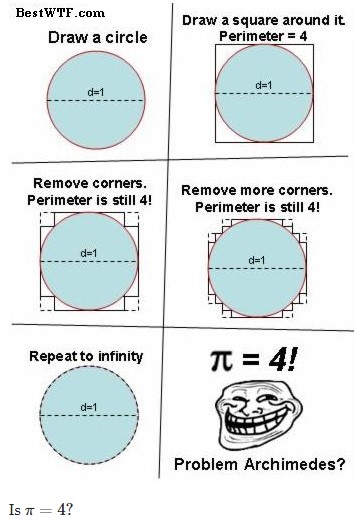
O.K., that was pretty simple, so for you real geometry buffs, there is “The staircase paradox, or why π≠4”

circle with squares
Why doesn’t the perimeter of infinite squares equal the circumference of the circle? 

The point is that creativity begins with the denial of the obvious. “What if this isn’t true?” is the question all scientists ask when searching for a new solution.

What if it isn’t true that:

The sun circles the earth? (Galileo Galilei)
Stomach ulcers are caused by stress? (Barry Marshall and Robin Warren)
Time moves the same for everyone? (Albert Einstein)

What if what I believe isn’t true?

Creative fashion designers ask that question all the time. What if it isn’t true that:

Image number 1 showing, Mid-Rise Distressed Rockstar Super Skinny Jeans for Women
When they get holes, you should throw them away
pants, different color, blue, pink, leggings, purple, pantone ...
Pants legs should be the same color.

Depending on what you are trying to accomplish, you can begin with such statements as:

“What if it’s not true that:”

  • Energy can not be created or destroyed
  • The laws of physics do not change over time
  • The same shoe cannot fit everyone.
  • The universe is expanding
  • A virus doesn’t talk.
  • The entropy of a closed system always increases
  • A child’s toy should be safe.
  • The world still exists when I sleep.
  • What I see (hear, feel) actually exists.
  • A lamp should provide light.
  • A roof should be water-impermeable.
  • The world (the universe, the moon) was created billions of years ago.
  • A song should be musical.
  • Lightening is electric.
  • I (you, they) exist.
  • Nothing could live on the sun.
  • Now lasts an instant.
  • I will not live forever.
  • Time runs in one direction.
  • Life requires water.
  • Ice is cold.
  • You see what I see.
  • Gravity exists.
  • I am one of billions of people.
  • The earth is a sphere.
  • A murder mystery story requires a murder or a mystery.
  • Yesterday happened.
  • For every action there is an equal and opposite reaction.
  • Trees (buildings, people) are not transparent.*

*See The Material Revolutionizing the Construction Industry? Wood

You could go on and on listing “truths” as you know them. As you dig deeply through all the implications of any indisputable “truth” not being true,  you will find the enjoyment of creativity.

It’s a way to move off that notorious “blank sheet.”

Rodger Malcolm Mitchell

Monetary Sovereignty Twitter: @rodgermitchell Search #monetarysovereignty Facebook: Rodger Malcolm Mitchell …………………………………………………………………………………………………………………………………………………………………………………………………………………………………………………………………………………………..

THE SOLE PURPOSE OF GOVERNMENT IS TO IMPROVE AND PROTECT THE LIVES OF THE PEOPLE.

The most important problems in economics involve:

  1. Monetary Sovereignty describes money creation and destruction.
  2. Gap Psychology describes the common desire to distance oneself from those “below” in any socio-economic ranking, and to come nearer those “above.” The socio-economic distance is referred to as “The Gap.”

Wide Gaps negatively affect poverty, health and longevity, education, housing, law and crime, war, leadership, ownership, bigotry, supply and demand, taxation, GDP, international relations, scientific advancement, the environment, human motivation and well-being, and virtually every other issue in economics. Implementation of Monetary Sovereignty and The Ten Steps To Prosperity can grow the economy and narrow the Gaps:

Ten Steps To Prosperity:

1. Eliminate FICA

2. Federally funded Medicare — parts A, B & D, plus long-term care — for everyone

3. Social Security for all or a reverse income tax

4. Free education (including post-grad) for everyone

5. Salary for attending school

6. Eliminate federal taxes on business

7. Increase the standard income tax deduction, annually. 

8. Tax the very rich (the “.1%”) more, with higher progressive tax rates on all forms of income.

9. Federal ownership of all banks

10. I

Increase federal spending on the myriad initiatives that benefit America’s 99.9% 

The Ten Steps will grow the economy and narrow the income/wealth/power Gap between the rich and the rest.

MONETARY SOVEREIGNTY

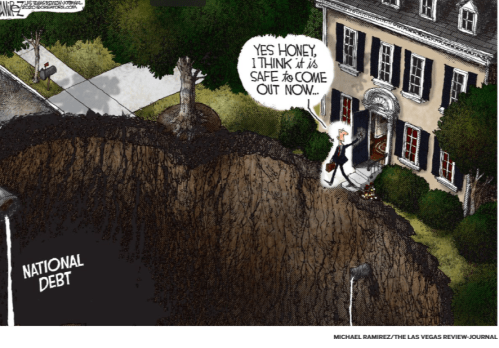
An absolutely perfect illustration of the Big Lie con job you’re subject to every day.

Here it is in all its glory: The Big Lie, perfectly illustrated:

BIG LIE big ditch
The Big Lie: The federal debt (aka “national debt”) is a danger.

It shows the federal debt (aka “national debt”) as a gigantic ditch, just waiting to swallow an innocent homeowner. And it’s all a lie — not just a lie but, “The Big Lie.”

The Big Lie in economics is promulgated via various myths. Which of these myths have you heard:

  1. Federal spending is paid for by federal taxes.
  2. Our children will be responsible for paying the federal debt.
  3. The federal debt is a burden on the economy.
  4. China lends dollars to the U.S. federal government.
  5. If China demands repayment, the federal government will be insolvent.
  6. The federal debt is an unsustainable ticking time bomb.
  7. The federal debt (the total of federal deficits) can cause inflation like Zimbabwe or __[fill in the blank]__.
  8. If you must live within your means, so must the federal government.
  9. The federal government can’t afford __[fill in the blank]__.
  10. A balanced federal budget is more prudent than running a deficit.

You probably have read or hear some of these, and sadly you might even believe some. Not one is correct. Not one.

    1. Because it is Monetarily Sovereign (unlike state and local governments) the U .S. federal government has the unlimited ability to create U.S. dollars. It has no need for taxes, which in fact are destroyed upon receipt.
    2. The so-called federal “debt” is paid by returning the dollars that are in T-security accounts. No one has been, is, or ever will be “responsible.”
    3. Reducing the federal debt is what causes depressions and recessions.
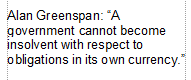
    4. China does not lend dollars to the U.S. federal government. Nobody does. The U.S. government does not borrow. It creates dollars by paying bills. The thing erroneously called federal “debt” does not result from borrowing. It results from deposits.Greenspan quote
    5. The federal government cannot become insolvent. “Insolvent” means: “unable to satisfy creditors or discharge liabilities, either because liabilities exceed assets or because of inability to pay debts as they mature.” But the government’s method of creating dollars is to pay bills.
    6. The “ticking time bomb” fear-mongering phrase has been thrust upon the American public for 80 years. No explosion. Being wrong for 80 years says it all.
    7. All inflations and hyperinflation are caused by shortages of food and/or energy, never by an excess of government spending.
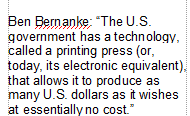
    8. The federal government has no means. That is why those few economists who have tried to demonstrate that federal debt has a negative influence on an econoBernanke quotemy, have failed miserably. Deficit spending is necessary for economic growth; the lack of deficit spending causes recessions and depressions.
    9. The federal government has the infinite ability to create dollars. Therefore, it can afford anything. (See The Ten Steps to Prosperity, below.)
    10. A balanced federal budget is the least prudent notion imaginable. Reducing federal deficit spending leads to recessions and depressions.

1804-1812: U. S. Federal Debt reduced 48%. Depression began 1807.
1817-1821: U. S. Federal Debt reduced 29%. Depression began 1819.
1823-1836: U. S. Federal Debt reduced 99%. Depression began 1837.
1852-1857: U. S. Federal Debt reduced 59%. Depression began 1857.
1867-1873: U. S. Federal Debt reduced 27%. Depression began 1873.
1880-1893: U. S. Federal Debt reduced 57%. Depression began 1893.
1920-1930: U. S. Federal Debt reduced 36%. Depression began 1929.
1997-2001: U. S. Federal Debt reduced 15%. Recession began 2001.

The Big Lie is promulgated by the rich to discourage the rest of us from asking for more federal benefits and as an excuse to reduce our benefits.

As a result of Gap Psychology, the rich grow richer when the Gap between them and the rest of us is widened. The Big Lie accomplishes exactly what the rich want.

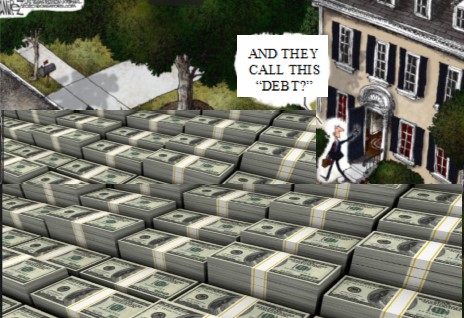
Here is a revision to the misleading cartoon at the start of this post. Perhaps it can serve as a mnemonic for reality:

And they call this debt

Rodger Malcolm Mitchell

Monetary Sovereignty Twitter: @rodgermitchell Search #monetarysovereignty Facebook: Rodger Malcolm Mitchell …………………………………………………………………………………………………………………………………………………………………………………………………………………………………………………………………………………………..

THE SOLE PURPOSE OF GOVERNMENT IS TO IMPROVE AND PROTECT THE LIVES OF THE PEOPLE.

The most important problems in economics involve:

  1. Monetary Sovereignty describes money creation and destruction.
  2. Gap Psychology describes the common desire to distance oneself from those “below” in any socio-economic ranking, and to come nearer those “above.” The socio-economic distance is referred to as “The Gap.”

Wide Gaps negatively affect poverty, health and longevity, education, housing, law and crime, war, leadership, ownership, bigotry, supply and demand, taxation, GDP, international relations, scientific advancement, the environment, human motivation and well-being, and virtually every other issue in economics. Implementation of Monetary Sovereignty and The Ten Steps To Prosperity can grow the economy and narrow the Gaps:

Ten Steps To Prosperity:

1. Eliminate FICA

2. Federally funded Medicare — parts A, B & D, plus long-term care — for everyone

3. Provide a monthly economic bonus to every man, woman and child in America (similar to social security for all)

4. Free education (including post-grad) for everyone

5. Salary for attending school

6. Eliminate federal taxes on business

7. Increase the standard income tax deduction, annually. 

8. Tax the very rich (the “.1%”) more, with higher progressive tax rates on all forms of income.

9. Federal ownership of all banks

10. I

Increase federal spending on the myriad initiatives that benefit America’s 99.9% 


The Ten Steps will grow the economy and narrow the income/wealth/power Gap between the rich and the rest.

MONETARY SOVEREIGNTY

The long, sad suicide of Donald J. Trump

That Donald J. Trump is a psychopath cannot be denied. He scores an astounding 29 out of 30 on the Hare Psychopathy Checklist-Revised which is used to diagnose the presence of psychopathy.

To Trump, the worst epithet is “Loser.” From his early years, he has feared being seen as a “loser,” and being unaccepted by the people he admires most: The rich whom he considers to be “winners.”

Yet as is so common in human psychology, the more one tries to assume a persona that is not natural or inbred, the further one drifts from it.

And so it has been for Trump, who craves acceptance like an infant craves a breast, yet sees it repeatedly taken away. With each perceived slight, he screams and stomps his feet.

Today, the intelligent wealthy, even in his home state are turned against him, and it is more than just symbolic that not one bank in America will lend him money. 

His repeatedly naming his properties, “Trump,” his overstatements about his health, wealth, and accomplishments, his admiration for dictators, his bigotry, his hiding of his school transcripts, his refusal ever to admit error or blame, along with his insistence on receiving undeserved credit for anything good, all bespeak massive feelings of inferiority and rejection, which may have begun in early childhood.

He even cheats at his favorite game, golf, — cheats to the extent that he will not allow his scores to be known.

In his long, sad, suicidal drive for acceptance, he first became a Republican, switched to the Reform Party, then to the Democratic Party, and most recently, in 2009, back to the Republican Party.

The irony is, he has the charisma and extemporaneous speaking ability to excite followers. Had he remained a Democrat, and used those assets to benefit the poor and middle classes, rather than the rich, he might have been viewed by history as among our great Presidents. 

American Presidents assume the title, “great” when they win a war and/or fight for the downtrodden. Trump could have used his communication ability to support equality and justice, yet he has done the opposite.

He has incorporated virtually every negative aspect of the human condition.

His fear of disappointment and rejection has become so profound that his reflex reaction to anything proposed by a perceived “enemy” is to argue against it, even when the proposal would help him.

“There is no urgency”.

Despite once arguing that Congress should “go big” with stimulus money,  Trump now argues against the one thing that could save his Presidency — a growing economy — only because the rescuing money was proposed by Nancy Pelosi.

Pelosi introduces $3T virus bill
House speaker warns inaction costs more
By Lisa Mascaro and Andrew Taylor Associated Press

WASHINGTON — House Speaker Nancy Pelosi unveiled a more than $3 trillion coronavirus aid package Tuesday, providing nearly $1 trillion for states and cities, “hazard pay” for essential workers and a new round of cash payments to individuals.

Senate Majority Leader Mitch McConnell has said there is no “urgency.” The Senate will wait until after Memorial Day to act.

In parroting Trump’s own words, Pelosi said, “We must think big, for the people now. Not acting is the most expensive course,” but even his own words are not sufficient for Trump. They come from “the enemy.”

The sooner money can be added to the economy, the sooner it will recover. The very formula for the measure of economic performance, Gross Domestic Product, shows Pelosi to be correct:

GDP = Federal Spending + Non-Federal Spending + Net Exports

Three more trillion will add to GDP and not cost taxpayers one cent. The economy dies daily. Yet Trump’s mouthpiece in the Senate, McConnell, claims there is “no urgency.”

The Heroes Act from Democrats is built around nearly $1 trillion for states, cities and tribal governments to avert layoffs, focused chiefly on $375 billion for smaller suburban and rural municipalities largely left out of earlier bills.

The bill will offer a fresh round of $1,200 direct cash aid to individuals, increased to up to $6,000 per household, and launches a $175 billion housing assistance fund to help pay rents and mortgages.

There is $75 billion more for virus testing.

It would prolong, through January, the $600-per-week boost to unemployment benefits. It adds a 15% increase for food stamps and new help for paying employer-backed health coverage.

For businesses, it provides an employee retention tax credit.

There’s $200 billion in “hazard pay” for essential workers on the front lines of the crisis.

There are other new resources, including $25 billion for the U.S. Postal Service. There is help for the 2020 Census.

For the November election, the bill provides $3.6 billion to help local officials prepare for the challenges of voting during the pandemic.

The popular Payroll Protection Program, which has been boosted in past bills, would see $10 billion more to ensure underserved businesses and nonprofit organizations have access to grants through a disaster loan program.

For hospitals and other health care providers, there’s an additional $100 billion infusion to help cover costs and additional help for hospitals serving low-income communities.

There’s $600 million more in funding to tackle the issue of rapid spread of the virus in state and federal prisons, along with $600 million in help to local police departments for salaries and equipment.

You might think the above would be welcomed by Trump and the GOP, who surely would take credit for the economic bounce that would ensue. The added money would help stave off a Depression and save Trump from himself.

Yet it probably will not be.


If history guides us, we will have the Depression, which Trump will blame on Pelosi — and on the Democrats, and on Hillary, and on Obama, and on China,  and on the Federal Reserve, and on the “Fake Media.” 

Trump will take no blame, whatsoever.

And he will fire some of his own people, who despite swallowing their pride while trying to adhere to some of his wavering, incomprehensible policies, will find themselves receiving his blistering tweets.

Some will lie for him and then disgraced, they will go to jail.

“There are those who said, ‘Let’s just pause,’ ” Pelosi added. “Hunger doesn’t take a pause. Rent doesn’t take a pause. Bills don’t take a pause.”

But the 1,800-page package is heading straight into a Senate roadblock. Senate Republicans are not planning to vote on any new relief until June, after a Memorial Day recess.

“I don’t think we have yet felt the urgency of acting immediately,” McConnell told reporters earlier this week at the Capitol.

Sen. John Cornyn, R-Texas, said, “I don’t think there’s a sense of urgency to do it now.”

At least a dozen Capitol police officers and other staff have tested positive for the virus, and at least one senator, Lamar Alexander of Tennessee, is in isolation at home after exposure from a staff member who tested positive.

Other lawmakers have cycled in and out of quarantine.

Senate Democratic Leader Chuck Schumer warned that if Trump and congressional Republicans “slow walk” more aid they will be repeating President Herbert Hoover’s “tepid” response to the Great Depression.

As the ship of state accelerates over the waterfall of depression, Trump rejects all scientific help while his cowardly acolytes claim there is no urgency.

Trump had the opportunity to be great, to be revered on a pedestal. Instead, we watch his long, sad emotional suicide.

He, I predict, will die a broken man, to the end blaming the mythical wraiths churning in his brain, accusing all but himself for his misfortune. And America will suffer for it.

Ah, what could have been. What could have been.

Rodger Malcolm Mitchell

Monetary Sovereignty

Twitter: @rodgermitchell Search #monetarysovereignty Facebook: Rodger Malcolm Mitchell …………………………………………………………………………………………………………………………………………………………………………………………………………………………………………………………………………………………..

THE SOLE PURPOSE OF GOVERNMENT IS TO IMPROVE AND PROTECT THE LIVES OF THE PEOPLE.

The most important problems in economics involve:

  1. Monetary Sovereignty describes money creation and destruction.
  2. Gap Psychology describes the common desire to distance oneself from those “below” in any socio-economic ranking, and to come nearer those “above.” The socio-economic distance is referred to as “The Gap.”

Wide Gaps negatively affect poverty, health and longevity, education, housing, law and crime, war, leadership, ownership, bigotry, supply and demand, taxation, GDP, international relations, scientific advancement, the environment, human motivation and well-being, and virtually every other issue in economics. Implementation of Monetary Sovereignty and The Ten Steps To Prosperity can grow the economy and narrow the Gaps:

Ten Steps To Prosperity:

1. Eliminate FICA

2. Federally funded Medicare — parts A, B & D, plus long-term care — for everyone

3. Provide a monthly economic bonus to every man, woman and child in America (similar to social security for all)

4. Free education (including post-grad) for everyone

5. Salary for attending school

6. Eliminate federal taxes on business 7. Increase the standard income tax deduction, annually. 

8. Tax the very rich (the “.1%”) more, with higher progressive tax rates on all forms of income.

9. Federal ownership of all banks

10. Increase federal spending on the myriad initiatives that benefit America’s 99.9% 

The Ten Steps will grow the economy and narrow the income/wealth/power Gap between the rich and the rest.

MONETARY SOVEREIGNTY