Supreme Court Justices often justify their decisions by claiming to be “originalists,” or “textualists,” and no one wishes to be considered “activist.’
The reason: They can hide behind the framers of the Constitution in a “Don’t-blame-me. The-law-forces-my-opinion. If-you-don’t-like-the-law,-change-it” exercise.
Justices are people. They have beliefs and prejudices that have built up over many years. Based on those beliefs and prejudices, they want cases to go a certain way.
You may think that in making a decision, a justice first researches the Constitution for guidance, and then refreshes with a comb-through of previous decisions. finally to amalgamate it all into a decision.
The reality seems quite the opposite.
Based on the decisions themselves, it seems clear that the decision usually comes first, and then the research is done to justify it.
How else could there be predictably “right-wing” and “left-wing” justices? They all read the same Constitution. They all have the same precedents before them. They all know the same law.
Yet most of the time, they vote along “party” lines. That is why the GOP was in such a hurry to nominate Amy Coney Barrett. Barring a rare surprise, they know how she will rule.
Unless you believe it is all coincidence, there is only one way in which you repeatedly see the same justices making the same “right” or “left” decisions: Their minds are made up beforehand, and then they search for justification.
And that is why “originalism” and “textualism” are monstrous lies. In truth, all justices are activists.
This concept views the Constitution as stable from the time of enactment and that the meaning of its contents can be changed only by the steps set out in Article Five. This notion stands in contrast to the concept of the Living Constitution, which asserts that the Constitution should be interpreted based on the context of the current times, even if such interpretation is different from the original interpretations of the document.
Originalism, a term that was adopted in the 1980s, is related to:
TEXTUALISM:
Textualism is a formalist theory in which the interpretation of the law is primarily based on the ordinary meaning of the legal text, where no consideration is given to non-textual sources, such as intention of the law when passed, the problem it was intended to remedy, or significant questions regarding the justice or rectitude of the law.
ACTIVISM:
Making decisions based on personal political views or considerations rather than on the law as written or intended. This is closely related to the concept of the Living Constitution.
To the right-wing, “activist” is what left-leaning justices are called, when their decisions disagree with the right-wing. In truth, all justices, left and right, are activists.
The ostensible, though often subtle, difference between originalism and textualism is the former looks for the intent of the authors and the latter is more strict in following the actual meaning of the words. The real difference comes up when a Justice shifts between the two, in trying to justify a position.
All Justices are originalist and textualist and activist, with the degree depending on the subject.
The conclusion: Originalism/Textualism does not really exist. It is an excuse for a decision by a Justice who has his/her mind locked by political or emotional biases.
The “king,” though not the originator of the term “originalism” was Antonin Scalia, who proudly defended originalism this way:
“Non-originalists must agonize over what the modern Constitution ought to mean with regard to (various) subjects,” and then agonize over the very same questions five or 10 years later, because times change.”
Because, for instance, abortion and LGBTQ rights weren’t specifically granted in the Constitution they, in Scalia’s opinion, were not rights. Being an originalist made his job easier, he said.
In short, Scalia boasted about how not having to agonize about decisions as times changemakes his job easier, as though the ease of his workload was more important than making decisions appropriate to changing circumstances. And this lazy concept is widely respected?
Justices Clarence Thomas, Neil Gorsuch, Brett Kavanaugh, and Amy Coney Barrett are today’s self-proclaimed originalists.
Proudly “originalist” Justice Neil Gorsuch said:
“A good originalist judge will not hesitate to preserve, protect, and defend the Constitution’s original meaning, regardless of contemporary political consequences. Whether that means . . . prohibiting the government from slapping a GPS tracking device on the underside of your car without a warrant (the Fourth Amendment) . . . “
” . . . often enough it may be tempting for a judge to do what he thinks best for society in the moment, to bend the law a little to an end he desires, to trade just a bit of judicial integrity for political expediency.”
Whoa, “originalist” Justice Gorsuch. Where does the Constitution mention GPS tracking devices, or for that matter, cars? Aren’t you bending the law a little for political expediency? Yes, but this is different, right? No, wrong.
How does a Fourth Amendment prohibition against “unreasonable searches and seizures” textually prohibit GPS tracking devices? Is a GPS a “search”? Is a GPS a “seizure”? Is it “unreasonable”? Where are these definitions in the Constitution?
Is observing someone by using binoculars, or standing close and overhearing, or merely following someone, an unreasonable search or a seizure? And aren’t you liable to commit the “crime” of “agonizing over the very same questions five or 10 years later, because times change” every time a new observation device is invented?
Justice Amy Comey Barrett: “[Originalism] means that I interpret the Constitution as a law, that I interpret its text as text and I understand it to have the meaning that it had at the time people ratified it. So that meaning doesn’t change over time. And it’s not up to me to update it or infuse my own policy views into it.”
But if she is interpreting it “as text,” where is the interpretation?
Soon she will rule on hot button items like the Affordable Care Act and abortion. One wonders on what specific text in the Constitution she will rely.
The classic example of how the “isms” may be used and twisted come with the 2nd Amendment:
“A well regulated Militia, being necessary to the security of a free State, the right of the people to keep and bear Arms, shall not be infringed.”
“Well-regulated”: Why did the framers say not just “regulated,” but “well-regulated”? Clearly, they recognized the real danger inherent in people keeping and bearing deadly Arms, but felt this danger was acceptable for the security of America, so long as it was part of a well-regulated Militia, and not solely composed of gun-nuts.
“Militia”: Defined as a military force that is raised from the civil population to supplement a regular army in an emergency. The purpose of the people keeping and bearing arms is not for hunting, target shooting, or for self-protection. The purpose is to be ready on a moment’s notice, to supplement the regular army.
“Keeping and bearing”: As part of a well-regulated Militia, the people can store and carry Arms.
“Arms”: Here’s where the originalists and textualists really have to twist and turn, because they have no idea what this term means. Currently, it seems to include modern weapons that did not exist when the Constitution was written, which certainly should disqualify them from textualism and arguably from originalism.
I put my impartial finger on the law. It’s not up to me to infuse my own policy views into it.
But it gets even worse. There seems to be some tacit agreement that “Arms” includes semi-automatic weapons, but does not include automatic rifles. (You can get one, but the process is difficult, slow, and expensive, and you have to have a perfectly clean record.)
Where is that distinction anywhere in the Constitution? An honest reading by an originalist or a textualist would hold that neither intent nor text could include weapons that were not even conceived of by the framers, and certainly not by any difference between semi-automatic and automatic.
Making such a distinction would be considered activist, unless it’s made by a right-wing justice, in which case its originalist — somehow.
Will Amy Comey Barrett understand the 2nd Amendment to have the meaning that it had at the time people ratified it — well-regulated militia, flintlock pistols and all?
Don’t bet on it.
The most hilarious distinction was made by the spiritual leader of originalism, Antonin Scalia, who somehow was able to justify eliminating all first thirteen words of the Second Amendment, while still not being considered “activist.”
Shall we assume his being not only a right-winger but, like his grandfather, an avid hunter — a member of the International Order of St. Hubertus, a “secretive society of elite hunters,” — had nothing to do with his decision?
In summary:
Depending on the subject, there are no originalist justices. There are no textualists. All justices are activists, some more so than others. Don’t believe any justice who says otherwise.
It is a list of common myths and bits of popular false wisdom. All have been foisted on you by the ignorance or the intent of the media, the economists, and the politicians.
Mostly, these misleading statements have been made at the behest of the very rich who don’t want you to understand the realities of finance.
Example: Groups like the Committee for a Responsible Federal Budget (CRFB) are paid by the very rich to dissuade you from demanding social benefits like Medicare and Social Security. The pretext is that the federal deficit and debt are large and “unsustainable.” It is all a lie.
Gap Psychology: The common desire to distance oneself from those below and to approach those above.
The ultimate purpose of the lie: To widen the financial/wealth/power Gap between the rich and you.
The effort to widen the Gap is described in Gap Psychology, which is the common desire to distance oneself from those below in any socio-economic measure, and to approach those above.
Subsequent to the May, 2011 post, in literally thousands of posts, we have discussed the myths it listed, and we explained why they are myths.
Today, more than nine years later, the public still believes the myths. Those nine years of posts educated some, but overall, were to little avail.
Failure can be discouraging or encouraging, depending on one’s attitude. For me, it is both. Only semi-daunted, I now will try once again to explain the truths of economics in a way that even the “experts” can understand.
You don’t need to read a complex economics text. You can understand certain basics in order to realize what your government really is doing to you. In any science, it is the basics that light the way to clarity.
Fundamentally, economics is about money. Yes, it also has to do with things like production, consumption, demand and supply, imports and exports, and wealth and value, and psychology. Ultimately, they all are described in terms of money.
Few people understand money. Unless you (objective “you,” not you personally) understand what money actually is, you will find understanding economics impossible.
“Full faith and credit” may sound nebulous to some, but it actually involves certain, specific, and valuable guarantees, among which are:
A. –The government will accept only U.S. currency in payment of debts to the government
B. –It unfailingly will pay all it’s dollar debts with U.S. dollars and will not default
C. –It will force all your domestic creditors to accept U.S. dollars, if you offer them, to satisfy your debt.
D. –It will not require domestic creditors to accept any other money
E. –It will take action to protect the value of the dollar.
F. –It will maintain a market for U.S. currency
G. –It will continue to use U.S. currency and will not change to another currency.
H. –All forms of U.S. currency will be reciprocal, that is five $1 bills always will equal one $5 bill and vice versa.
A physical dollar bill is not a dollar. A dollar bill is an evidence that the bearer owns a dollar. Just as a car title is not a car — it is evidence — and a house title is not a house, a dollar bill is not a dollar; it represents a dollar.
A U.S. dollar is nothing more than a legal number on a balance sheet. As a number, it has no physical existence. You cannot see, hear, taste, smell, or feel a number or a dollar. They both are mere concepts.
In one of its earliest steps, the U.S. government created laws from thin air, which also have no physical existence. These laws created dollars from thin air. As there is no limit to the number or form of the laws the U.S. government creates, there is no limit to the number or form of the dollars these laws can create.
Just as the U.S. never can run short of laws, the U.S. never can run short of dollars.The U.S. never needs to borrow laws; similarly, it never needs to borrow dollars. It can create infinite laws and infinite dollars, forever.
The U.S., as the issuer of the dollar, is Monetarily Sovereign. It is sovereign over its laws and its dollar. It can create dollars at will and give those dollars any value it wishes.
Ben Bernanke, Former Chair of the U.S. Federal Reserve: “The U.S. government . . . can produce as many U.S. dollars as it wishes at essentially no cost.”
Alan Greenspan, Former Chair of the U.S. Federal Reserve: “There is nothing to prevent the Federal Government from creating as much money as it wants and paying it to somebody.”
Here is pictured a $50 gold coin. It, in itself, is not money. It represents $50 in money, and if you turn it in to the United States Treasury, you will receive a $50 credit to your checking account. (BTW, your checking account also has no physical existence.)
The coin is made with 1/4 ounce of gold, so if you sold it to a private party, you would receive something in excess of $500, because that is the selling price of gold as a mineral.
The federal government can create a coin from whatever mineral it wishes and give that coin any face value.
A $50 coin made from tin would be worth $50 in money, as is a $50 coin made from gold.
A $50 coin made from platinum also would be worth $50 in money, but more than gold and far more than tin on the open market.
Thus gold, platinum, tin, and paper are not money. Money had no physical existence.
The federal government creates dollars by spending. To pay a creditor, the government sends instructions (not money) to the creditor’s bank, instructing the bank to increase the balance in the creditor’s checking account.
The instant the bank obeys those instructions, new dollars are created and added to a money measure called “M1.” Though the creditor’s bank technically creates the dollars, it is the instructions from the government that make it possible.
We have stressed money’s lack of physical existence to demonstrate the federal government’s infinite ability to create money. Money is just a number on a balance sheet, controlled by the federal government.
THE FEDERAL DEBT
The so-called federal debt, so often claimed to be “unsustainable,” is not even debt in the classic sense, and definitely is not unsustainable.
Because the federal government has the infinite ability to create dollars, it never borrows dollars. What erroneously is termed “borrowing” merely is the acceptance of deposits into Treasury Security accounts, the total of which is called “debt.”
To pay off this “debt” the government merely returns the dollars in those accounts to the account holders. The government never uses those dollars. It creates new dollars, ad hoc, every time it pays a creditor.
The deposits in T-security accounts remain there, accumulating interest, until the deposit matures, at which time the dollars are returned to the owner of the account.
Those who think the “debt” is a burden on the government or on future taxpayers, do not understand federal finance. Those deposits are a burden on no one.
The federal debt sometimes and erroneously is called “a ticking time bomb,” but having ticked for more than 80 years, that “bomb” is a dud.
The federal government already has the legal power to produce platinum coins in any amount and of any value. It could, if it chose, create a $100 trillion coin, and deposit it with the Federal Reserve, thus eliminating all federal “debt.”
The annually debated “debt ceiling“ does not put a ceiling on debt. It puts a ceiling on paying what already is legitimately owed. There is no reason for a debt ceiling, and the proof is that it is raised, by the passage of laws, every time that “ceiling” is reached.
Those who opt for a debt ceiling demonstrate ignorance of money.
Another common bit of misinformation is the claim that federal “borrowing” reduces the availability of bank lending funds. This is wrong for several reasons:
The federal government does not borrow. It has no need to. It has infinite money.
The claim probably refers to accepting deposits into T-security accounts, which erroneously is termed, “borrowing.”
Federal deficit spending, rather than reducing borrowing funds, adds dollars to the economy, making more dollars available for private lending.
Banks create lending funds merely by writing contracts. The only legal limit to bank lending is bank capital.
Often, you will hear or read some variation of, “Rather than being a net borrower, the federal government should be a net lender.” As discussed, the federal government does not borrow, but it does lend, and that is a problem.
For example, the government lends to students, in a misguided effort to encourage college attendance. Lending involves payback, but there is no reason why the federal government should require payback. The government doesn’t need or use the money paid back (It is destroyed), and those paid-back dollars are subtracted from the private sector, which has a recessive effect.
The primary effect of the student loan program is needlessly to impoverish millions of students at just the time of their lives when they should invest in businesses rather than pay back loans.
Speaking of lending, there is a myth about something erroneously termed, “fractional reserve lending.” The myth is that banks keep a fraction of deposits (i.e. reserves) and lend the rest. So, as the myth goes, if a bank has a million dollars on deposit, it could lent say $900 thousand, and keep $100 thousand on reserve. You can read the myth here.
FEDERAL TAXES
Contrary to popular wisdom, federal taxes do not fund federal spending. You, as a federal taxpayer, do not pay for anything. You just pay whatever taxes the federal government arbitrarily decides to collect from you.
Those FICA dollars deducted from your paycheck, do not fund Medicare of Social Security. The federal government could fund Medicare and Social Security out of the General Fund, without collecting a penny in taxes. (That is mostly how Medicare Part B already is funded.)
All those hard-earned tax dollars you send to the federal government are destroyed upon receipt. As soon as they are received by the federal government they cease to exist in any measure of any money-supply definition. They simply disappear.
That is why no one can answer the question, “How much money does the federal government have?” The sole answer: “Infinite.” That answer does not change, whether or not you send the government your tax dollars. (Infinite + your taxes = Infinite.)
Both before and after you send your tax dollars to the government, the government has exactly the same infinite dollars. You could send the federal government $1 in taxes, or you could send the government $1 billion in taxes, and either way, the government would have exactly the same amount of money: Infinite.
They deceptively are called “trust funds” to make you believe they hold your taxes in trust. The “trust funds” are just numbers, totally controlled by the federal government, which can and has changed those numbers at will.
Real trust funds include a grantor, beneficiary, and trustee.
The grantor of a real trust fund can set terms for the way assets are to be held, gathered, or distributed.
A trustee manages a real trust fund’s assets and executes its directives, while the beneficiary receives the assets or other benefits from the fund.
(Your 1040 income tax form includes a little box asking whether you would like to contribute $3 to the Presidential Election Campaign fund. Don’t do it. If you check that box, you will be $3 poorer and the federal government will be precisely $0 richer. Your $3 will be destroyed.)
If the Medicare trust fund were a real trust fund, the grantor would be the FICA payer (you and your employer). But neither you nor your employer sets terms. The government sets terms.
Further, the Medicare trust fund doesn’t manage or distribute anything. Congress does that. The “trust fund simply is a balance sheet, showing “IN” and “OUT” like the old time desk boxes.
The federal government could take dollars from it any time it wishes (It already has done that), change the terms, or add dollars at will — all by the press of a computer key.
Our children and grandchildren will not pay for today’s federal deficit spending. Contrary to popular wisdom, you and your family are not liable for servicing federal debt. The federal debt has no relationship to tax rates.
The purpose of federal taxation is not to provide spending funds to the federal government. The federal government could end all taxation and still continue spending, forever.
To control the economy by taxing things it wishes to discourage, and to give tax breaks to things it wishes to encourage.
To add to the demand for U.S. dollars.
To convince you, the public, that benefits are unaffordable or “unsustainable,” so you will refrain from demanding benefits. (An example of how the rich, who control the government, are motivated by Gap Psychology.)
Contrary to popular wisdom, your Medicare and Social Security will not go bankrupt if their “trust funds” run short of dollars. Do not believe the scare stories. The federal government can change the balance in its trust funds, simply by pressing a computer key.
Medicare and Social Security will go bankrupt only if Congress and the President want them to go bankrupt. All the fake handwringing about the need to cut benefits or to increase taxes is meant to fool you.
Bernie Sanders repeatedly was asked, “How will you pay for Medicare for All,” his honest answer should have been: “The government can pay for anything.” Sadly he was deterred by the myths of debt “unsustainability” and cries of “socialism.”
The federal government could fund the Ten Steps to Prosperity (below), without collecting a dime in taxes.
The pernicious misinformation about America’s impending financial doom is designed to widen the Gap between you and the very rich, who run America.
Liberals think the purpose of government is to protect the poor and powerless from the rich and powerful. Conservatives think the purpose of government is to protect the rich and powerful from the poor and powerless.
Populists, particularly progressives, often suggest taxing the rich in order to “pay for” certain beneficial projects.
The “soak the rich” notion is a mixed bag.
The federal government doesn’t need the tax dollars.
Taxing anyone, rich or poor, is recessionary because it removes dollars from the private sector.
Step #8 of the Ten Steps to Prosperity, advocates taxing the rich more, not to raise funds for any specific function, but to narrow the Gap.
.
.
MONETARY SOVEREIGNTY AND NON-SOVEREIGNTY
We have discussed the fact that the federal government is Monetarily Sovereign over the U.S. dollar. Other nations — i.e. Japan, Canada, Australia, Mexico, China — are sovereign over their currencies. They too are Monetarily Sovereign.
Many governments, however, are monetarily non-sovereign. Examples are state, county, city, and village governments. To the degree they use the U.S. dollar, they are non-sovereign.
Contrary to popular myth, they are not legally precluded from creating their own sovereign currency. Detroit,, MI has created “Cheers.” Ithaca, NY has issued “Ithaca Hours.” “Berkshares” were issued by a part of Massachusetts. In each case, the issuer is sovereign over its currency, and can do whatever it wishes regarding that currency — issue more, revalue it, or give it any usage terms.
The University of Missouri, Kansas City (UMKC), the home of Modern Monetary Theory (MMT), is in partnership to issue a currency called “RooBucks,” a perfectly legal currency.
Notably, the euro-using nations are monetarily non-sovereign. France, Greece, Germany, Italy, et al, use the euro, but they are not the issuers. Unlike Monetarily Sovereign nations, they can run short of the currency they use.
The euro nations surrendered their Monetary Sovereignty in exchange for ease of trade. It was a bad move because it left them with no control over their money supply, and no way to fight recessions. Greece, France, Italy, et al, financially troubled euro nations, are forced to exercise spending restraint (aka “austerity“), which is recessive, and the resultant recessions are a feedback mechanism that leads to more recessions.
The euro nations constantly struggle against recession, and when recession hits, have very little power to reverse it.
The issuer of the euro is the European Union (EU), via the European Central Bank. It is the European Union that is sovereign over the euro. The EU (like the U.S. federal government with respect to the U.S. states) that has the power to reverse recessions.
In that regard, state governments often are criticized for being profligate and not living within their means. But many states pay more money to the federal government than they receive from the government, so they constantly are being drained of money that only can come from taxpayers. This constant drain impoverishes the residents of the state, as it requires ever-higher taxes, with no end in sight.
Incidentally, if you wish, you can create your own currency, and be Monetarily Sovereign over it. Your biggest problem would be to gain acceptance of your currency, which would depend largely on your full faith and credit.
Being monetarily non-sovereign like you are, U.S. states, counties, and cities can and often do, run short of dollars. Unlike the federal government, they often are forced to borrow dollars in order to pay their creditors. The federal government never borrows.
In summary, your finances, and state and local government finances, are nothing like federal finances.
Years ago, President Obama gave one of the most money-ignorant speeches, ever:
President Obama today unveiled a plan for economic growth and deficit reduction that details how to pay for the American Jobs Act while also paying down our debt over time. The President’s plan lays out a blueprint that will enable Washington to live within its means.
“It comes down to this: We have to prioritize. Both parties agree that we need to reduce the deficit by the same amount — by $4 trillion. So what choices are we going to make to reach that goal? Either we ask the wealthiest Americans to pay their fair share in taxes, or we’re going to have to ask seniors to pay more for Medicare. We can’t afford to do both.
“Either we gut education and medical research, or we’ve got to reform the tax code so that the most profitable corporations have to give up tax loopholes that other companies don’t get. We can’t afford to do both.
“This is not class warfare. It’s math. The money is going to have to come from someplace. And if we’re not willing to ask those who’ve done extraordinarily well to help America close the deficit and we are trying to reach that same target of $4 trillion, then the logic, the math says everybody else has to do a whole lot more: We’ve got to put the entire burden on the middle class and the poor. We’ve got to scale back on the investments that have always helped our economy grow. We’ve got to settle for second-rate roads and second-rate bridges and second-rate airports, and schools that are crumbling.
“That’s unacceptable to me. That’s unacceptable to the American people. And it will not happen on my watch. I will not support — I will not support — any plan that puts all the burden for closing our deficit on ordinary Americans. And I will veto any bill that changes benefits for those who rely on Medicare but does not raise serious revenues by asking the wealthiest Americans or biggest corporations to pay their fair share. We are not going to have a one-sided deal that hurts the folks who are most vulnerable.”
Whew! That entire speech was a lie. It was the Big Lie.
The federal government never should reduce the deficit; seniors should not have to pay for Medicare; we never need to gut education and medical research; the money doesn’t need to “come from somewhere.” It can come from the federal government.
It is foolish to tax corporations. Such a tax merely takes dollars from the private sector and gives it to the government, where it is destroyed. Taking dollars from the private sector causes recessions and depressions, that are cured by adding money to the private sector (which the government now is doing to cure the COVID-caused recession.
Every paragraph in the above speech demonstrates abject ignorance about money and federal finances.
Politicians often shovel praise onto the concept of a balanced federal budget. They claim it is prudent. But, in fact, a balanced budget always leads to a recession or a depression. A “balanced budget” means the federal government takes as much money from the private sector as it adds in.
It is mathematically impossible for the economy to grow when the money supply remains static or declines. The common measure of the economy is Gross Domestic Product (GDP). The formula for GDP is:
GDP = (Federal Spending) + (Non-federal Spending) + (Net Exports).
Each of those three terms is related to the supply of money in our economy. Federal deficit spending increases the supply of money in the economy. That is why federal deficit spending is used to stimulate the economy during recessions and depressions.
Some media writers, and even some economists, scream when the federal debt/GDP ratio rises. Recently you may have read that the federal debt exceeded GDP, and this was a terrible thing.
Actually, the federal debt, which is a bookkeeping number that evolves from federal deficit spending, always stimulates economic growth. The aforenamed ratio is, if anything, a positive, certainly not a negative.
Contrary to popular myth, the federal debt/GDP ratio does not measure the federal government’s ability to service its financial obligations. That ability is infinite. The government never can run short of the dollars with which to pay its obligations.
Nor does the federal debt/GDP ratio measure the health of the economy. Depending on how one measures “health,” the best measure might be GDP percentage growth.
The oft-heard screaming about the debt/GDP ratio often is paired to the misguided screaming about federal waste. You surely have experienced one or more of your federal representatives criticizing federal earmarks, pork-barrel spending, and wasteful projects.
That all is done for show. There are no federal wasteful projects. All federal spending, no matter the ostensible purpose, benefits the economy by adding dollars to the private sector.
Clearly, some spending is more beneficial than other spending, but because the government creates dollars at the touch of a computer key, no spending is wasteful.
Even spending on foreign projects is beneficial, because it enriches the world, a world of which we are part.
So, you can save your outrage for state and local government spending, which because it is monetarily non-sovereign spending, can be and often is, wasteful.
Not understanding the differences between state/local government finances vs. federal finances leads to the mistaken belief that America would benefit if it exported more and imported less, to achieve a positive balance of payments.
Why would the government want to receive dollars in exchange for goods and services? The U.S. government can create unlimited dollars at no cost. Dollars are free to us. But goods and services are expensive. We create those by sacrificing some of our physical assets along with expending valuable labor.
If we can create all the dollars we want, at no cost to us, why would we prefer to sacrifice valuable goods and services in exchange for dollars?
INFLATION
Popular wisdom claims that federal deficit spending or too much money causes inflation. This is not true, has never happened, in history, and in fact, federal deficit spending might be the best cure for inflation.
The illusion that deficits cause inflation comes from the experience of hyperinflation leading to extreme paper currency printing. Consider, for example, the Zimbabwe hyperinflation, in which massive amounts of currency were printed.
That inflation began when the Zimbabwean government stole farmland from white farmers and gave the land to blacks who didn’t know how to farm. The inevitable result was food shortages, and shortages always cause prices to rise. In response to those rising prices, the government printed more currency, which did nothing to eliminate the fundamental problem: Shortages.
Inflations can be cured by increased deficit spending if the spending alleviates the shortages. Because Zimbabwe’s inflation was caused by food shortages, the government should have deficit spent to bring more food to the people, via imports and/or educating the black farmers and/or giving these farmers modern equipment, fertilizer, weed-killer, and/or improving roads and warehouses, etc.
The least intelligent way to cure inflation is to reduce the amount of money in the economy, either by raising taxes or by reducing deficit spending. Both of those efforts will lead to recessions or depressions, and inflation is not the opposite of recession or depression. It is quite possible to have inflation along with recession. (See: “Stagflation.”)
The Federal Reserve modulates inflation slightly by making dollars more valuable. It accomplishes this by increasing the demand for dollars, which in turn is accomplished by raising interest rates.
Another common myth: Reducing interest rates is economically stimulative. The hypothesis is based on the belief that more people will borrow when rates are low, and this borrowing adds stimulus dollars to the economy.
Historically however, the volume of borrowing is not determined by interest rates. It is based on expectations of profit, of which interest is a minuscule factor. More importantly, low interest rates reduce the number of interest dollars the federal government pumps into the economy for T-securities. Reducing federal dollar input is recessionary, not stimulative.
SOCIALISM
We have seen that the government has infinite money and can spend infinite money, without collecting taxes.
Debt-fear mongers, as a last resort, like to call federal spending, “Socialism.” It is a proven scare word among Americans who have on idea what socialism is, but think it is bad, somehow.
Social Security is socialism, but Medicare is not. The Veterans Administration hospitals are socialism, but your local hospital is not. Most highways and streets are socialism. The nations sewage systems are socialism, as are most drinking water systems. Most dams are socialism. NASA is socialism, as is the FBI, CIA and the military.
Socialism is not government spending. Socialism is governmental ownership and administration of the means of production and distribution of goods and services. That is why, for instance, a program like Medicare for All is not socialism. The means of production (hospitals, doctors, equipment, etc.) are not owned and administered by the government.
It is doubtful whether the “socialism” scare mongers really would like to eliminate Social Security, the VA hospitals, highways, streets, sewage systems, drinking water, dams, police, NASA, FBI, CIA, and the military.
The phony cries of “socialism” are designed to restrict you from receiving federal benefits. Period.
IN SUMMARY
Money is scarce to you, to me, to state/local governments, euro governments, and to businesses. We all are monetarily non-sovereign.
But money is free to the U.S. government, which is Monetarily Sovereign. In fact, when the U.S. government receives money, it destroys that money, and instead creates new money for spending purposes.
Whenever you hear of a plan that involves sending money to the U.S. government, or saving money for the U.S. government, be very skeptical. The U.S. government neither needs nor uses financial income.
Even if all tax collections totaled $0, the federal government could spend forever.
While deficit spending is stimulative, and it cures recessions, it never causes inflation. That general increases in prices always is caused by shortages, usually shortages of food or energy.
The Ten Steps will grow the economy and narrow the income/wealth/power Gap between the rich and the rest.
(Liberals think the purpose of government is to protect the poor and powerless from the rich and powerful. Conservatives think the purpose of government is to protect the rich and powerful from the poor and powerless.)
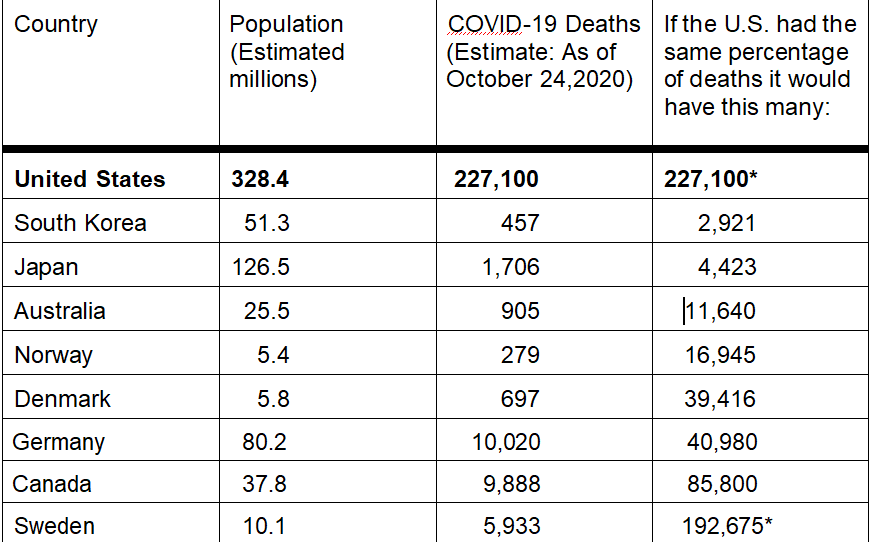
President Trump claims that if not for him, millions of Americans would have died from COVID-19. Has he really done a good job on COVID? Here’s the data. You decide.
Example: If the U.S. had done what South Korea did, we would have only 2,921 deaths by now.
*The findings of a study published Oct. 12 in the Journal of the American Medical Association pointed out that, of the countries the researchers investigated, Sweden and the U.S. essentially make up a category of two: they are the only countries with high overall mortality rates that failed to rapidly reduce those numbers as the pandemic progressed.
The numbers speak for themselves. Despite Trump’s claims, the U.S. has done almost the worst, if not the worst, job of any nation on earth, in controlling COVID-19 mortality.
His refusal to use the pandemic plans left for him by the Obama administration, his refusal to wear a mask, his mocking of people who do wear masks, his denial of COVID’s seriousness, his sabotaging of the CDC, his use of incompetent, anti-science personnel who follow his lethal lead, and his daily lying about all phases of the pandemic, have led to hundreds of thousands of unnecessary American deaths.
As such, Donald Trump is the single worst mass-murderer in American history, far outdoing Osama bin-Laden and the 9-11 terrorist act which killed “only” 2996people (including terrorists).
Trump also has far exceeded the December 7, 1941 Pearl Harbor attack, which killed 2,403, the Vietnam war which killed 47,424 Americans, and the Korean War which killed 33,686 Americans. Even World War I killed “only” 53,402 Americans.
Even now, as the rate of deaths continues to rise, Trump falsely claims we have “rounded the corner,” and fails to aggressively fight the killer.
Instead, he holds maskless ego-building rallies, from which more people will die, while he withholds money from those whose financial lives have been shattered by the disease.
No traitor or murderer in American history has been responsible for as many American deaths as has Donald J. Trump, in collusion with the Republican party.
The health of a President of the United States always is an issue. In fact, Donald Trump continually makes it an issue with repeated references to Joe Biden’s age. Biden is three years older than Trump.
Recently, Trump was interviewed by Lesley Stahl. It was a typical interview. Trump bragged, lied, repeatedly changed the subject, attacked Barack Obama, Hillary Clinton and Biden, blamed the media, and quoted unfounded conspiracy theories.
All normal.
But, something else seemed rather strange: the odd, two-handed way he drank water, as though he didn’t trust his hands not to shake.
Here are shots from the interview:
I don’t pretend to be a doctor, so I looked it up at:
What causes hand tremors?
In some cases, the cause is unknown, but tremors often result from neurological conditions, movement disorders, or other health problems.
Neurological conditions
Some neurological conditions that can cause shaky hands include:
Multiple sclerosis (MS): Many people with MS experience some degree of tremor. This often develops when the disease damages areas in the pathways of the central nervous system that control movement. Stroke: An ischemic stroke occurs when a blood clot blocks an artery, preventing blood from reaching the brain. This can cause lasting damage to neurological pathways and lead to tremors. Traumatic brain injury: Physical injury to the brain can also damage nerves that play a role in coordinating movement. Hand tremors may occur when an injury affects certain nerves. Parkinson’s disease: More than 25 percent of people with Parkinson’s disease have a related action tremor, as well as a more common resting tremor in one or both hands. Tremors usually begin on one side of the body, and they may spread to the other side. Shaking may become more pronounced during periods of stress or strong emotion.
Movement disorders
Anxiety and depression may cause movement disorders.
The following are examples of movement disorders that can cause hand tremors:
Essential tremor: This is among the most common movement disorders, and the cause is unknown. The tremor usually affects both sides of the body, but it may be more noticeable in the dominant hand. It tends to occur when the person is moving as well as when standing still. Genetics may be responsible for around half of the cases of essential tremor. Dystonic tremor: In a person with dystonia, the brain sends incorrect messages, resulting in overactive muscles, abnormal postures, and sustained undesired movements. Young adults and those in middle age are most likely to develop dystonic tremors, which can occur in any muscle.
The following health issues can also cause shaky hands:
psychiatric conditions, such as depression or post-traumatic stress disorder
inherited degenerative disorders, such as hereditary ataxia or fragile X syndrome
alcohol abuse or withdrawal mercury poisoning hyperthyroidism, or an overactive thyroid liver or kidney failure anxiety or panic
Certain drugs can also cause hand tremors, such as:
some asthma medicines
amphetamines
caffeine corticosteroids
medicines used to treat certain psychiatric and neurological disorders
Again, not to play doctor, but Trump has been taking powerful drugs for COVID-19. For example, He took hydroxychloroquine sulfate. Among the side effects are:
Mood changes, and feeling nervous or irritable.
He also took VEKLURY® (remdesivir).
“Coadministration of VEKLURY and chloroquine phosphate or hydroxychloroquine sulfateis not recommended based on in vitro data demonstrating an antagonistic effect of chloroquine on the intracellular metabolic activation and antiviral activity of VEKLURY.
Metabolic activation is the chemical conversion of a relatively benign substance into a more hazardous one by normal biochemical processes in cells and tissues.
Older adults and people who have severe underlying medical conditions are at higher risk for developing more serious complications from COVID-19 illness.
The virus can affect the whole nervous system — the brain, spinal cord, nerves, and muscles.
The reaction of the immune system to the infection can cause inflammation that can damage the brain and nerves, Koralnik added.
I still don’t pretend to be a doctor, but anyone who takes COVID-19 lightly and diminishes its risk, as Trump continually does, is asking for trouble, not only for himself but for everyone who believes him.
And that trouble can be exacerbated by powerful drugs combined with advanced age.
One only can hope Trump is receiving advice and treatment from experienced doctors like Dr. Fauci, and not from Dr. Atlas, the COVID-19 minimizer.




 #Monetary Sovereignty - Mitchell