Disgraceful: “Respected” economist repeats all the common myths about our economy.

Imagine someone with these credentials not understanding how federal finance works.

This is a man who spends a good part of his life being asked to pontificate about economics, yet he promulgates the same old intuitive myths that history has disproven.

I’m talking about

“John Howland Cochrane, an American economist specializing in financial economics and macroeconomics. Formerly a professor of economics and finance at the University of Chicago, Cochrane serves as the Rose-Marie and Jack Anderson Senior Fellow at the Hoover Institution at Stanford University.”

Here he is, on the right, being interviewed on CNN by Michael Smerconish:
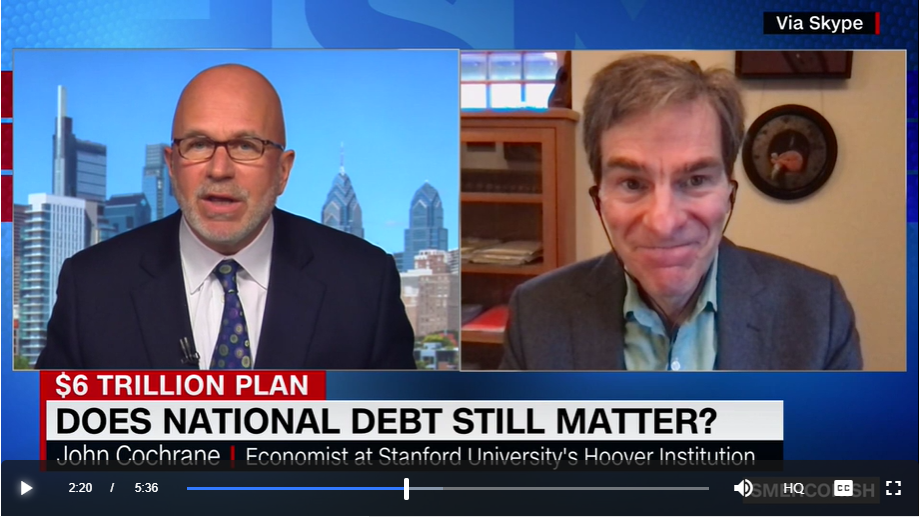
John Cochrane (right) being interviewed by Michael Smerconish

I won’t subject you to the entire interview, but rather with the following quotes give you the gist.

John Cochrane: “Sooner or later debt has to be paid off. The real worry for me is there is no plan to pay off this debt.

“Sooner or later bond markets notice you have no plan to pay it off”

Throughout the interview, Cochrane demonstrates he has no idea what Monetary Sovereignty is, and no desire to learn from history.

The federal “debt” (which isn’t really debt as you know it), is instead, the net total of all deposits into Treasury Security accounts.

When you invest in these securities (aka T-bills, T-notes, T-bonds), you actually open a T-security account in your name. It resembles a safe deposit box with one difference: The federal government pays interest into T-security accounts.

The federal government, being Monetarily Sovereign, has the unlimited ability to create its own sovereign currency, the U.S. dollar. Thus, it has no need to borrow dollars and indeed, the federal government does not borrow dollars.

The purpose of normal “borrowing” is to provide the borrower with money to use for some purpose.

But because the federal government has the unlimited ability to create dollars it does not borrow, the T-securities are not “loans,” and the federal “debt” is not a debt.

That is why, for instance, any money you may put into a bank safe deposit box is not considered a debt of the bank, and it is no burden on the bank to “pay off” that box. It simply returns to you what already is yours.

When you open a T-security account, you are aware of the exact date upon which the dollars in the account will be returned to you. That is called the “maturity” date.

During that period of time, your dollars remain in your account, earning interest. They are not used by any agency of the federal government.

At maturity, the dollars in the misnamed “debt”  are paid off (i.e. returned to you) by the simple act of sending the money in your T-security account to your bank checking account.

This is not a burden on the federal government, nor is it a burden on future taxpayers. It is a simple money transfer from one of your bank accounts to another of your bank accounts.

It is not a transfer of dollars from the government to you. “Paying off” federal debt is a transfer of your dollars to yourself.

At one point Cochrane draws a parallel between federal debt and household debt. Thus he demonstrates abject ignorance of federal financing. The federal government is Monetarily Sovereign. You and I are monetarily non-sovereign.

You and I can run short of dollars, which is why we borrow money. The federal government never can run short of dollars, which is why it never borrow moneys.

At one point, Cochrane says:

“The more the government borrows the less is available for private capital.”

This short sentence is wrong on three counts: 

First, the government does not borrow.

Second, the amount available for private capital is based on federal deficit spending and bank lending, not on deposits into T-securities (which in fact are privately owned capital).

Third, according to Cochrane, the federal government has “borrowed” trillions of dollars, yet there is plenty available for private capital. He simply ignores the obvious facts on the ground.

The Cochrane said,

“This is like a financial crisis. It’s like a run on the bank. It’s like an earthquake. You can’t predict it. The sky falls when people lose confidence that the U.S. will pay back the debt.

The next crisis when the U.S. wants to borrow another $10 trillion, and the bond market says, ‘You guys are not worth it.”

The implication is that the federal government can run short of dollars if the “bond market” won’t lend to them. Utter nonsense.

As we’ve said, the federal government does not borrow and cannot run short of dollars. It creates dollars at will, which it surely has proved in the past 12 months by creating trillions of stimulus dollars.

Further, if Cochrane is implying that somehow the federal government will not be able to sell its T-securities, he has it all backward.

The sole purpose of T-securities is not to provide spending money for the government. The sole purposes are:

  1. To help the Federal Reserve control interest rates by setting a bottom rate, and
  2. To provide a safe parking place for unused dollars, which helps stabilize the dollar.

In the event that the federal government wished to sell T-securities but was unable to find a buyer, the Federal Reserve Bank can (and always has) buy whatever it deems necessary.

The Treasury never can be “stuck” with something it really has no need to sell in the first place.

At one point in the interview, Cochrane displays the following graph to shock you:
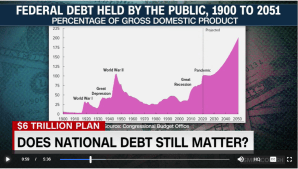
It shows the absolutely meaningless fraction: Debt/GDP (Gross Domestic Product).

Its rise is a favorite scare tactic by those who cannot explain why the total of deposits into T-security accounts (aka “federal debt”) should have any significant relationship to Gross Domestic Product.

The graph also demonstrates the gigantic increase in the Debt/GDP ratio, which according to debt hawk should by now, have cause an economic disaster of biblical proportions. So where is the disaster?

The fraction Debt/GDP is not predictive of anything and it is not evaluative of anything. It says nothing about future booms, busts, inflations, recessions, depressions, poverty, or prosperity. It is a 100% meaningless fraction that economisfits use all the time.

To demonstrate how meaningless it is, look at these ratios:

Here were some of the lower Debt/GDP ratios a few years ago:
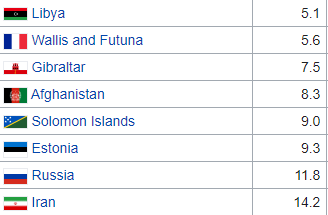
 

Here were some of the higher Debt/GDP ratios at the same time:

Oh, and did we mention that powerhouse Japan’s ratio was 223?

Niow, looking at just the numbers in these two tables, you would expect Lybia to have the healthiest economy, and Puerto Rice to have the sickest, with the U.S. somewhere in the middle.

So called “economists” ignore these obvious facts.

Finally, after briefly admitting that, yes, the government can’t run short of dollars, Cochrane mumbles something about “that would cause inflation.”

Wrong yet again, Mr. Cochrane. Here are excerpts from an article Cochrane wrote ten years ago:

“For several years, a heated debate has raged among economists and policymakers about whether we face a serious risk of inflation.

“That debate has focused largely on the Federal Reserve — especially on whether the Fed has been too aggressive in increasing the money supply, whether it has kept interest rates too low, and whether it can be relied on to reverse course if signs of inflation emerge.

“But these questions miss a grave danger.

“As a result of the federal government’s enormous debt and deficits, substantial inflation could break out in America in the next few years.”

OMG! That was ten years ago, and this guy still is peddling the same old “federal-debts-cause-inflation” nonsense he spouted way back then (!), and he has learned absolutely nothing since. 

Debt and deficits have grown, while interest rates and inflation have stayed low, and still the same old, same old. 

Oh, but the BS goes on and on: 

“If people become convinced that our government will end up printing money to cover intractable deficits, they will see inflation in the future and so will try to get rid of dollars today — driving up the prices of goods, services, and eventually wages across the entire economy.”

The government has run enormous deficits, and people like Cochrane have been telling the people this would cause inflation.

But being smarter than the know-nothing economists, the people have not tried to “get rid of dollars,” and they have not driven up the prices of goods, services, and sadly, “wages across the country” barely have budged.

“This would amount to a “run” on the dollar.

“As with a bank run, we would not be able to tell ahead of time when such an event would occur. But our economy will be primed for it as long as our fiscal trajectory is unsustainable.

And there it is again, the favorite word of the wrong-for-80-years debt hawks: “Unsustainable.”

Any time you read that the U.S. federal debt is, or even soon might be, “unsustainable,: immediately stop reading. The author knows nothing, and reading what he/she says is a waste of your valuable time.

It’s almost as bad as reading that the federal debt is a “ticking time bomb” (which it supposedly has been since 1940, and still ticking).

I am an economist, but for the past 25 years, I have told all who would listen that economics is not a science. It could be. It should be. But it isn’t, because the practitioners deny the obvious and instead rely on their vague intuition.

Not that there aren’t data in economics. There are mountains of data. But econodufuses would rather juggle abstruse data than look at the clear and obvious facts all around them.

They keep predicting causes and effects when the causes keep happening without the predicted effects. 

They talk about ticking time bombs that never explode. 

They talk about unsustainable deficits and debt that have been sustained for 80 years.

They talk about cutting the debt, when every time the debt is cut, we have depressions. (Once, only a recession).

1804-1812: U. S. Federal Debt reduced 48%. Depression began 1807.
1817-1821: U. S. Federal Debt reduced 29%. Depression began 1819.
1823-1836: U. S. Federal Debt reduced 99%. Depression began 1837.
1852-1857: U. S. Federal Debt reduced 59%. Depression began 1857.
1867-1873: U. S. Federal Debt reduced 27%. Depression began 1873.
1880-1893: U. S. Federal Debt reduced 57%. Depression began 1893.
1920-1930: U. S. Federal Debt reduced 36%. Depression began 1929.
1997-2001: U. S. Federal Debt reduced 15%. Recession began 2001.

They keep making claims that the facts on the ground disprove.

This is science?

And then guys like Cochrane repeatedly go on TV, and write articles, and spout absolute nonsense, with no basis in fact. 

And sadly, people believe it. Even President Biden seems to believe it, and that is the real tragedy.

We could have the Ten Steps to Prosperty (below), end poverty, reduce crime, improve education, and make America that “shining city on a hill,” were it not for the debt hawks.

The debt hawks are to economics as the creationists are to biology. 

Those, who do not understand Monetary Sovereignty, do not understand economics.

…………………………………………………………………………

Rodger Malcolm Mitchell 

[ Monetary Sovereignty, Twitter: @rodgermitchell, Search: #monetarysovereignty Facebook: Rodger Malcolm Mitchell ]

THE SOLE PURPOSE OF GOVERNMENT IS TO IMPROVE AND PROTECT THE LIVES OF THE PEOPLE. The most important problems in economics involve:

  • Monetary Sovereignty describes money creation and destruction.
  • Gap Psychology describes the common desire to distance oneself from those “below” in any socio-economic ranking, and to come nearer those “above.” The socio-economic distance is referred to as “The Gap.”

Wide Gaps negatively affect poverty, health and longevity, education, housing, law and crime, war, leadership, ownership, bigotry, supply and demand, taxation, GDP, international relations, scientific advancement, the environment, human motivation and well-being, and virtually every other issue in economics. 

Implementation of Monetary Sovereignty and The Ten Steps To Prosperity can grow the economy and narrow the Gaps: Ten Steps To Prosperity:

  1. Eliminate FICA
  2. Federally funded Medicare — parts A, B & D, plus long-term care — for everyone
  3. Social Security for all
  4. Free education (including post-grad) for everyone
  5. Salary for attending school
  6. Eliminate federal taxes on business
  7. Increase the standard income tax deduction, annually.
  8. Tax the very rich (the “.1%”) more, with higher progressive tax rates on all forms of income.
  9. Federal ownership of all banks
  10. Increase federal spending on the myriad initiatives that benefit America’s 99.9% 


The Ten Steps will grow the economy and narrow the income/wealth/power Gap between the rich and the rest. 

MONETARY SOVEREIGNTY


The genius of the board game, Monopoly®.

If you have, like I have, spent the most recent 25 years of your life trying to explain to your friends and strangers, something the basics of which an 8-year-old should be able to understand — and like me, you have utterly failed — try using the board game Monopoly® as your example.

First, why do I say 8-year-old? Well, this is the on-line ad:

GREAT FAMILY GAME: This Monopoly board game is fun for families and kids ages 8 and up.

So yes, and 8-year-old can understand Monopoly®.

But, why do I reference Monopoly®?

You, your friends and strangers almost surely have played Monopoly®. Behind chess, checkers, and backgammon, Monopoly® is the world’s most popular board game in history.

So, even the semi-literate universe knows how the game works.

As they will recall, it is a game about buying, improving, renting, and selling real estate. There are players — usually four, plus a Bank.

The players are analogs for the U.S. private sector (aka, “the economy”), and the Bank is an analog for the U.S. Treasury. It doles out money. It collects money that it doesn’t need.

And by law (i.e. by rule), it never can run short of money — just like the Treasury. Here are some of the Monopoly® game’s parallels to reality:

1. The real world and the game use paper “money,” which isn’t really money. The U.S. dollar bill is the title to a dollar,not in of itself a dollar. The actual dollar is merely a bookkeeping notation in the government’s accounting records.

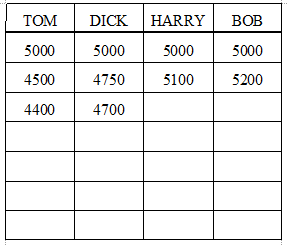
How to play Monopoly without using Monopoly paper dollars. Create a table. THE BANK HAS NO COLUMN BECAUSE IT HAS INFINITE MONEY.

A U.S. dollar has no physical presence. It is just a number in a balance sheet.

Similarly, a Monopoly® paper dollar merely represents game points.

Years ago, I played a game of Monopoly® that did not include any paper “dollars” at all.

We simply used a record of points — a table in which each participant had a column in which his/her winnings and losings were recorded.

The Bank had no column, because the Bank (like the U.S. Treasury), had the infinite ability to create dollars.

Such a column would have made no sense.

The use of the table proves that, like U.S. dollars, Monopoly® dollars have no physical substance. They are just balance sheet numbers.

2. Like the U.S. Treasury, the Monopoly® Bank generally runs a deficit, which is an asset for the private sector.

Just as the U.S. Treasury never can run short of U.S. dollars, the Monopoly® Bank never can run short of Monopoly® dollars.

This is stated in the rules of the game.

Monopoly taxes, which are paid to the Bank, do not fund Band spending. Since the Bank had no column to show how much money it has, all taxes paid to the bank disappear upon payment.

When players pass “GO” and receive $200, no taxpayers are obligated to fund those $200 payments. No one asks, “How will the Bank pay for it?” just as no one should ask, how will the federal government pay for (anything).

3. For historical reasons, based on obsolete gold standards and silver standards, the U.S. federal government keeps track of “deficits” (i.e. the difference between tax income and spending).

In U.S. history, there have been intermittent gold and silver standards, in which the U.S. required itself to store physical gold and silver in dollar amounts equal to those deficits.

“Wait,” you say. “Gold and silver are physical metals, measured in ounces. How can ounces be equal to dollars?”

Answer: The U.S. government, being Monetarily Sovereign, has the unlimited power to fix an ounce of silver and an ounce of gold to equal any number of dollars it wishes.

The government has the unlimited power to fix the price of any commodity vs. the dollar: Iron, corn, cotton, water, oil, etc.

Ever since 1971, when President Nixon took us off the last gold standard, the value of gold vs. dollars has varied wildly.

For that reason, keeping track of deficits no longer is necessary other than to measure dollars going into the economy.

When too few dollars are pumped into the economy we have recessions, and when dollars actually are taken out of the economy we have depressions.

1804-1812: U. S. Federal Debt reduced 48%. Depression began 1807.

1817-1821: U. S. Federal Debt reduced 29%. Depression began 1819.

1823-1836: U. S. Federal Debt reduced 99%. Depression began 1837.

1852-1857: U. S. Federal Debt reduced 59%. Depression began 1857.

1867-1873: U. S. Federal Debt reduced 27%. Depression began 1873.

1880-1893: U. S. Federal Debt reduced 57%. Depression began 1893.

1920-1930: U. S. Federal Debt reduced 36%. Depression began 1929.

1997-2001: U. S. Federal Debt reduced 15%. Recession began 2001.

By contrast, the game of Monopoly® does not keep track of the Bank’s deficits. There is no need to, because the deficits do not affect the Bank’s ability to pay, just as federal deficits do not affect the federal government’s ability to pay.

4. Similarly, neither the Monopoly® Bank nor the federal government ever borrows dollars. Being Monetarily Sovereign, they never need to.

The U.S. Treasury issues Treasury certificates (T-bills, T-notes, T-Bonds), which misleadingly are called “borrowing.”

In a typical borrowing situation, someone needs additional money temporarily, so they borrow it from a lender, and later, pay it back.

But, the federal government, having the unlimited ability to create dollars, never is in a  position in which it needs money.

It has the infinite ability to create money, at the touch of a computer screen. Those T-securities, which misleadingly are labeled “borrowing,” are more akin to safe-deposit boxes, into which depositors place values, and later retrieve them.

The sole differences between T-security accounts and safe deposit boxes are:

a. T-security accounts have a maturity date; safe-deposit boxes do not

b. T-security accounts receive interest; safe deposit boxes do not (although negative interest rates for T-security accounts have been discussed, which would make them even more like safe-deposit boxes.)

The federal government never touches the contents of safe-deposit boxes or of T-security accounts, and to “pay them off,” the owner simply retrieves the contents of the T-security accounts and the safe-deposit boxes.

There is no bank or government obligation to “pay off” safe-deposit boxes or T-security accounts. The sole financial purposes of T-securities are:

a. To provide a safe place to store unused dollars, which stabilizes the dollar

b. To assist the Federal Reserve to control interest rates, which helps control inflation

T-securities do not provide spending funds for the federal government. Every time you think of federal government financing ( which is nothing like state/local government financing) think of the Monopoly® Bank.

That will help you visualize why federal deficits and debt are not a burden on the government or on taxpayers. Compare that with the contents of the following article from the Committee for a Responsible Federal Deficit (CRFB):

The Nation’s Upcoming Fiscal Challenges APR 29, 2021 | BUDGETS & PROJECTIONS
Record Debt Levels: Debt held by the public will total 108 percent of Gross Domestic Product this fiscal year. After the previous record of 106 percent of GDP, set in 1946 just after World War II, policymakers ran years of balanced budgets to bring debt down to manageable levels. We now face large structural deficits and an ever-rising debt-to-GDP ratio.

The “debt” / GDP ratio is meaningless. It predicts nothing. It has nothing to do with the federal government’s ability to pay its debts. It does not say anything about the health of the economy.

The End of Discretionary Spending Caps: Since 2012, discretionary spending caps have been in place (though in practice, these caps have often been increased and in some instances violated).

“Increased” and “violated” because they serve no function.

These caps expire at the end of this fiscal year, leaving appropriators without a legal constraint on discretionary spending and thus creating the opportunity for a spending free-for-all.

Obviously, caps that are “increased” and “violated” are not caps at all, and do nothing to prevent Congress from spending as much as it wishes. Further, there are no economic reasons to restrict Congressional spending. On the contrary, federal spending stimulates economic growth.

Predictable Expirations and Fiscal Deadlines: President Biden’s agenda, like those who came before him, will be in many ways dictated by a series of expirations and deadlines.
This year alone, the country will have to deal with the return of the debt limit (August 1), the end of expanded unemployment benefits (September 6), the expiration of numerous program authorizations (September 30), and the end of the expanded Child Tax Credit and other tax breaks (December 31).

The “debt limit” is one of the least intelligent laws passed by Congress, and that is saying something. The “limit” does not limit debt. It limits payment for debt already contracted.

It’s a “stiff your creditors” law, that has no economic purpose. Zero. Zilch. None. The fact that every time it is reached, Congress raises it, should reveal something to even the least educated among us.

Policymakers must also address the statutory Pay-As-You-Go scorecard if they choose to avoid an across-the-board sequestration. 

“Pay-As-You-Go” is a system by which the federal government would add net zero dollars to the economy, thereby guaranteeing a depression. Not smart, which is why the CRFB likes it.

Major Trust Funds Are Headed Toward Insolvency: Four major trust funds are projected to deplete their reserves within the next 14 years: the Highway Trust Fund in FY 2022; The Medicare Hospital Insurance trust fund in FY 2026; Social Security’s retirement fund in calendar year 2032; and the Social Security Disability Insurance trust fund in calendar year 2035.
Given this tight timeline, all of these trust funds should ideally be secured during President Biden’s time in office.

Just as federal “debt” is not debt, federal “trust funds” are not trust funds, and they cannot “deplete their reserves” unless Congress and the President want them to.

Just as the federal government cannot run short of dollars, no agency of the federal government can run short of dollars, again, unless Congress and the President want them to.

See if you can learn when the non-existent trust funds for the military, the Supreme Court, the White House, the Senate, and the House of Representatives will face insolvency. Oh, they have no trust funds? Ask yourself, “Why not?”

IN SUMMARY The board game, Monopoly®, is similar to the U.S. economy.

The Monopoly® Bank resembles the U.S. government, and the Monopoly® players resemble the U.S. economy.

Just as the Monopoly® Bank never can run short of dollars, the U.S. government never can run short of dollars.

Just as the Bank does not borrow dollars, the U.S. government does not borrow dollars.

Federal Treasury securities, misnamed “borrowing,” actually are similar to safe deposit boxes. Just as your bank doesn’t touch what you put into your safe deposit box, the federal government doesn’t touch what you put into your T-security account.

To “pay off” that misnamed “debt,” the federal government simply allows you to take back the contents of your T-security account, in the same way as you would take back the contents of your safe deposit box. No tax payers or tax dollars are involved.

………………………………………………………………………….

Rodger Malcolm Mitchell [ Monetary Sovereignty, Twitter: @rodgermitchell, Search: #monetarysovereignty Facebook: Rodger Malcolm Mitchell ]

THE SOLE PURPOSE OF GOVERNMENT IS TO IMPROVE AND PROTECT THE LIVES OF THE PEOPLE. The most important problems in economics involve:

  • Monetary Sovereignty describes money creation and destruction.
  • Gap Psychology describes the common desire to distance oneself from those “below” in any socio-economic ranking, and to come nearer those “above.” The socio-economic distance is referred to as “The Gap.”

Wide Gaps negatively affect poverty, health and longevity, education, housing, law and crime, war, leadership, ownership, bigotry, supply and demand, taxation, GDP, international relations, scientific advancement, the environment, human motivation and well-being, and virtually every other issue in economics. Implementation of Monetary Sovereignty and The Ten Steps To Prosperity can grow the economy and narrow the Gaps: Ten Steps To Prosperity:

  1. Eliminate FICA
  2. Federally funded Medicare — parts A, B & D, plus long-term care — for everyone
  3. Social Security for all
  4. Free education (including post-grad) for everyone
  5. Salary for attending school
  6. Eliminate federal taxes on business
  7. Increase the standard income tax deduction, annually.
  8. Tax the very rich (the “.1%”) more, with higher progressive tax rates on all forms of income.
  9. Federal ownership of all banks
  10. Increase federal spending on the myriad initiatives that benefit America’s 99.9% 

The Ten Steps will grow the economy and narrow the income/wealth/power Gap between the rich and the rest.

MONETARY SOVEREIGNTY

Whipping a horse while reining it in.

What happens when you spur the economy and rein it in at the same time.

Imagine you and me debating quantum chromodynamics.

I know nothing about the subject, and in all probability, you know virtually nothing, too.

So, our debate would be meaningless.

And yet, this is precisely what is happening in America, with regard to federal taxes: Debates by people who know nothing.

Consider excerpts from the following article:

The Memo: Biden tries to flip the script on taxes, by Niall Stanage
President Biden’s plan to increase taxes on wealthy Americans is reigniting one of the fiercest divides in politics: How much should the government do, and who should foot the bill?

Immediately you see the first bit of ignorance, with the words, “who should foot the bill?”

No one “foots the bill” for federal government spending.

The federal government creates new dollars, ad hoc, every time it pays a creditor.

Unlike state and local government taxes, which do fund state and local government spending, federal taxes do not fund federal spending.

This is basic economics that Biden and most in Congress surely must understand.

They understood it when they passed earlier trillion-dollar stimulus bills without tax increases. So how could they not understand it for the proposed trillion-dollar stimulus bill?

Biden this week will propose a massive boost to social infrastructure spending on things such as paid leave, child care and tuition-free community college.
To pay for it, according to multiple media reports, he will nudge up the highest rate of income tax and dramatically hike the capital gains tax paid by top earners.

Biden claims that the purpose of his proposed tax increase is to “pay for” his proposed spending boost. If he truly believes that, he is ignorant about federal financing.

More likely, he doesn’t believe it, which would mean he is lying. So, why?

The plan is expected to call for an approximate doubling of the capital gains tax, from its current level of 20 percent, for Americans with incomes of over $1 million.
At the heart of the plan is a key question: whether income derived from the sale of assets should be treated basically the same as income in the form of a paycheck.
Biden and his backers answer with an emphatic yes. Wealthier Americans derive a greater proportion of their overall income from investment, they note.
The beneficial treatment of capital gains, they say, has the effect of further helping those who are already in a privileged position – and therefore exacerbating wealth inequality and social incohesion.
A Gini ratio of 0 indicates perfect equality, where everyone has the same income. A Gini ratio of 1 indicates total inequality, where one person has all the income. Inequality in America has grown substantially.

Could it be that the real purpose of Biden’s tax proposal is to narrow the income/wealth/power Gap between the very rich and the rest of us?

Could it be that he is using the need for infrastructure and other spending, as an excuse to tax the rich more, while benefiting the “not-rich”?

If that is his motive, then I bow to him as a genius, and I pray he succeeds.

The wide, and widening, income/wealth/power Gap between the relative handful of Americans and the rest of us, is the single biggest, most corrosive economic problem facing America.

But there are counterarguments, too.
Those who favor keeping the capital gains tax low insist that it is a key driver of investment and that high rates encourage people to hold on to their assets rather than incur a high tax bill, thus diluting economic dynamism.

That “key driver of investment” line is utter nonsense.

All investment begins in the short term, and only after a year of inactivity does it become long-term and earn the lower tax rate.

In that sense, yes, it “dilutes economic dynamism.” But, is that a good thing?

Is there an economic benefit from encouraging people to hold on to their investments for a year or more?

I don’t see it. That phrase “dilute economic dynamism” is another way to say, “reduce speculation,” which the public has been taught is a bad thing.

Some economists hate “speculation,” which is short-term investing. But speculation is what grows America.

Every entrepreneur is a speculator, i.e. one who invests in businesses, stocks, property, or other ventures in the hope of gain but with the risk of loss.

That is how new businesses are created. “Economic dynamism” built the American dream, and now some stodgy, old economists want to tax it?

No, I hope the real reason for Biden’s tax proposal is to narrow that debilitating Gap between the haves and the have-lesses.

Then there are the politics to consider. Democrats up until recently were petrified of being labeled the “tax-and-spend” party by conservatives – a fear that was rooted in the knowledge of how effective such attacks had been in the 1980s and early ’90s.
Given the razor-thin Democratic majorities on Capitol Hill, whether Biden can even get his proposals passed will depend upon his ability to corral moderates such as Sens. Joe Manchin (D-W.Va.) and Kyrsten Sinema (D-Ariz.).

Because federal taxing does not fund federal spending, Democrats should become the “spend-and-don’t-tax” party.

Manchin and Sinema probably are not moderate in their beliefs. They are Democrats who won in historically Republican-leaning states.

So to maintain office, they must appear to be moderate. Yet, they probably are are social spending, economic-growth Democrats at heart.

Success is far from guaranteed. Progressives are adamant that the time is right for Democrats to cast off their traditional timidity about taxation and push a more egalitarian agenda.
Conservatives are equally emphatic that doing so would be a huge mistake. “This is how you stall an economy,” said Grover Norquist, the president of Americans for Tax Reform and perhaps Washington’s best-known anti-tax campaigner.

Norquist is absolutely correct when it comes to federal taxes.

Unlike state/local taxes, federal taxes do not provide spending money to the federal government, which has infinite spending money. Federal taxes, absolutely, positively are an anchor slowing the U.S. economy.

Most federal taxes should be eliminated, altogether. The sole purpose of federal taxes is to control the economy by taxing what the government wishes to discourage and giving tax breaks to what the government wishes to encourage.

Think of federal taxes as reins on a horse. They steer the horse, but reins do not make a horse go faster.

A problem occurs when taxation is linked with federal deficits and debt, both of which erroneously are decried as economic negatives. But deficit spending grows the economy.

Combining federal deficit spending with federal taxes is like spurring a horse while reining it in.

Biden, Norquist insisted, “could just have sat back because you are going to see this surge in the second quarter.
“There could be this incredible growth. You could be coasting on that, but instead what you are doing is chasing investment away from the United States, telling people, ‘You don’t want to get capital gains in the U.S.'”

Norquist is wrong about “sitting back” and “coasting.” In this competitive world, that is no way to win a race against other nations. Winning jockeys do not sit back and coast.

The Biden plan, Norquist argued, “is a boat anchor on economic growth when, going into 2022, you would want to be going gangbusters.”

The best way to “go gangbusters” (a phrase from the dark ages) is for the federal government to spend more and tax less.

Biden aides have been stressing how few people would be affected by the new top rate of capital gains tax.
Jen Psaki, the White House press secretary, emphasized the $1 million income threshold for the top rate on Friday, and added, “The president’s bottom line is that people making under $400,000 a year should not, will not, have their taxes go up.”

Is it $1 million or is it $400,000? A bit of confusion, here.

Ron Klain, Biden’s chief of staff, tweeted that the plan was one Biden had “campaigned on extensively.”
Klain added that it “changes the tax rate for less than 1% of Americans (in fact, less than 1/2 of 1% of Americans).”

If that is the case, then Biden would be using the federal tax for exactly what it is designed to do: Narrow the Gap between the rich and the rest.

Conservatives such as Norquist argue this framing is misleading.
They say, for a start, that a capital gains tax hike would have a detrimental impact on the stock market, thus affecting the huge number of Americans who have individual investments, 401(k) accounts or IRAs.
“If a 1 percent fall in stock prices is all that you get from a really major increase in capital gains taxes, that’s not a big problem,” Paul Krugman, the Nobel Prize-winning economist and liberal New York Times columnist, told Bloomberg TV.
More broadly, progressives are scathing of the predictions of doom from what they see as a basic move toward a more equitable tax structure.

Yes, that is exactly what America needs: A more equitable tax structure.

The current tax system disadvantages the middle- and lower-income groups, while providing massive tax breaks to the rich.

Donald Trump apparently paid no taxes at all in eight of the last ten years, and most business owners pay taxes at a lower rate than do their employees.

Begin with the FICA tax, which ostensibly supports Social Security and Medicare, but does neither.

It is a 15.3% tax on lower salaries. Then there are the business owners tax breaks on “business” (i.e. personal) expenses like vacations, yachts, clubs, meals, cars, planes, etc.

And while a home renter gets no tax breaks on rent, a home owner receives various tax breaks.

Jonathan Tasini, a Democratic strategist who backed Sen. Bernie Sanders (I-Vt.) in the 2016 presidential race, argued that any assertion about the dangers of hiking the capital gains tax rate “is greed dressed up as economic argument.”
“There is no rich person in the world who will honestly tell you that he … would not have invested money in a company because of capital gains rates.
You are making a profit already! What we are saying is you have to give back,” he added.

Correct. The tax is on profits. And, in fact, if there are losses, they lead to tax breaks (which is why Trump avoided taxes)

Tasini also argued that debates about taxation in general often proceed along false lines – as if the tax revenue simply disappears into the ether rather than being used for public benefit.

Here, Taxini veers into an area of which he knows little. Federal tax revenue does, in fact, “disappear into the ether.

It is not “used for public benefit.” When the U.S. Treasury receives tax dollars, those dollars disappear from any part of any money measure (M1, M2, M3, etc.) They simply are destroyed.

Federal taxes are destroyed upon receipt.

That is why federal taxes are, as Norquist describes them, a boat anchor on economic growth.” A growing economy requires a growing supply of money. Federal taxes reduce the supply of money.

(By contrast, state and local government taxes, do not disappear into the ether. They are deposited into commercial banks where they become part of the M1 money supply and bank reserves.)

“Nobody who makes money, whether you become rich or less than that, does so entirely on their own or because of their own genius.
All taxes are about giving back to pay for everything that society provides that allows you to make money and invest – and that includes having the roads and bridges that take you to the office where you make a living,” he said.

No, federal taxes do not pay for roads and bridges, although state and local government taxes do pay for these things.

The above is where Tasini confuses federal (Monetarily Sovereign) finances with state/local (monetarily non-sovereign) finances.

He now has moved into what we mentioned in the very first sentence of this post” Pontificating about quantum chromodynamics when he doesn’t even understand the basics of physics.

Mark Zandi, the chief economist of Moody’s Analytics, argued that the overall impact of Biden’s proposals was likely to be fairly modest, especially when the benefits of infrastructure spending are factored into the equation.
Taxpayers in the million-dollar-plus bracket are “a very rarefied group,” Zandi said. If the Biden plan were to pass, he added, then maybe in a decade “an econometrician would be able to tease out some negative effects, all else being equal.
But I think it is going to be very much on the margins.

Zandi is correct. The sole effect of the tax on the rich will be, to some very slight degree, narrow the income/wealth/power Gap.

The real narrowing device will be the increased spending for benefits to the middle- and lower-income groups.

The problem is that the Republican Party has become “the Party of the rich,” so it opposes taxes that affect the rich while supporting taxes that affect the not-rich, like FICA increases.

This is revenue that is going to presumably pay for the American Family Plan, which is child care and family leave, and some of it is going to less wealthy households who are going to use it and spend it.
It could help them go to work and so raise labor force participation.”
Overall, Zandi predicted, the plan would be “a tailwind rather than a headwind” for economic activity.
Even so, Biden faces a pitched political battle to get his plan passed. And opponents such as Norquist insist the American public is on their side. 

Biden faces a pitched political battle for two reasons:

  1. The rich, who run America, have bribed the media (via advertising and ownership), the politicians (via political contributions and promises of employment, later), and the university economists (via contributions to the universities and promises of lucrative employment in think tanks). They are the ones who fight against taxes on the rich.
  2. Economic ignorance afflicting the public and some in Congress.

If Biden simply cut taxes on the not-rich, he wouldn’t have to ask for a tax increase on the rich, and he still could pay for everything while narrowing the income/wealth/power Gap. That would be ideal.

……………………………………………………………………………………………………………………………

Rodger Malcolm Mitchell [ Monetary Sovereignty, Twitter: @rodgermitchell, Search: #monetarysovereignty Facebook: Rodger Malcolm Mitchell ]

THE SOLE PURPOSE OF GOVERNMENT IS TO IMPROVE AND PROTECT THE LIVES OF THE PEOPLE. The most important problems in economics involve:

  • Monetary Sovereignty describes money creation and destruction.
  • Gap Psychology describes the common desire to distance oneself from those “below” in any socio-economic ranking, and to come nearer those “above.” The socio-economic distance is referred to as “The Gap.”

Wide Gaps negatively affect poverty, health and longevity, education, housing, law and crime, war, leadership, ownership, bigotry, supply and demand, taxation, GDP, international relations, scientific advancement, the environment, human motivation and well-being, and virtually every other issue in economics.

Implementation of Monetary Sovereignty and The Ten Steps To Prosperity can grow the economy and narrow the Gaps:

Ten Steps To Prosperity:

  1. Eliminate FICA
  2. Federally funded Medicare — parts A, B & D, plus long-term care — for everyone
  3. Social Security for all
  4. Free education (including post-grad) for everyone
  5. Salary for attending school
  6. Eliminate federal taxes on business
  7. Increase the standard income tax deduction, annually.
  8. Tax the very rich (the “.1%”) more, with higher progressive tax rates on all forms of income.
  9. Federal ownership of all banks
  10. Increase federal spending on the myriad initiatives that benefit America’s 99.9% 


The Ten Steps will grow the economy and narrow the income/wealth/power Gap between the rich and the rest.

MONETARY SOVEREIGNTY


The five ignorant reasons why the U.S. should not try to reduce global warming

Here are the five ignorant reasons why we should do nothing to reduce global warming:

I. Why should we do it if some other countries don’t do it?

Here's Why Cage Divers Don't Become Shark Bait
If you don’t close the door, why should I?


II. Human-caused global warming is not happening, no matter what 98% of scientists say

Fire? What fire? I see no fire.


III. Even if global warming is happening, it would cost too much to fix

We don’t want to pay for a baby sitter


IV. It would hurt businesses and cost jobs.

UPDATED! Pandemic Diary, November 24th, 2020: The Dam Bursts – Ryan Schultz
Don’t tell anyone. It’ll be bad for business.


V. Donald Trump

===========================================================

The Wall Street Journal.
Biden to Propose Cutting U.S. Emissions in Half by 2030 Andrew Restuccia, Timothy Puko, Sha Hua “Unless China stops its uninhibited growth of emissions, anything we do will be offset fourfold by the Chinese,” said Rep. Garret Graves (R., La.), the top Republican on the House Select Committee on the Climate Crisis.
Mr. Biden’s emissions target is certain to face criticism from GOP lawmakers and some in the business community who worry that the administration’s climate policies could harm the economy. Rep. Michael McCaul (R., Texas) criticized the Paris agreement this week, arguing it “disproportionately penalizes American workers.”
The New York Times Amid Biden Climate Push, a Question Looms: Is America’s Word Good?
The question is dogging Biden as he tries to reassert the American role in other parts of the world stage after four years of Donald Trump’s America First isolationism.
Biden was vice president when the world applauded the Obama administration for resuming climate talks after his predecessor, George W. Bush, rejected the 1997 Kyoto Protocol climate treaty.
Now he’s trying to lead another comeback as the U.S. returns to the Paris Agreement that Trump deserted in a flashy show of defiance.
Sen. Mitch McConnell of Kentucky, the Republican leader, has already said his party will oppose Biden’s $2 trillion infrastructure plan, which is the cornerstone of the administration’s efforts to meet current and future climate goals.
A group of Republican House leaders last week also introduced legislation calling for a wholesale renegotiation of the Paris Agreement and denounced Biden’s plans for global re-engagement.
Adam S. Posen, president of the Peterson Institute for International Economics, said “Obviously, Trump made it worse because of incompetence and overt nationalism.”
These are the 130 current members of Congress who have doubted or denied climate change
Ellen Cranley Apr 29, 2019 Collin Peterson is notably the only Democrat to appear on this list.
Politico reported in January 2019 that though House Agriculture Committee Chairman Peterson was feeling “some” pressure to pursue action on climate policy, but said climate change policy poses a threat to agricultural workers and he believes that activists “would like us to quit farming.”

Click the above link to see the names of the Congressional climate change deniers. 

Actual Twitter message from Mitch McConnell:

“This Administration’s zeal for costly climate policy at home is not matched by our biggest competitors.

China’s share of emissions is nearly double ours. The Paris Agreement is largely toothless. Democrats can kill U.S. jobs & industries with no real impact on global emissions.”

So there you have it. The Republicans have ignorant reasons for not wanting to help control global warming.

The destruction of the earth and the future for our children and grandchildren is not as important as those five ignorant reasons.

…………………………………………………………………………

Rodger Malcolm Mitchell [ Monetary Sovereignty, Twitter: @rodgermitchell, Search: #monetarysovereignty Facebook: Rodger Malcolm Mitchell ]

THE SOLE PURPOSE OF GOVERNMENT IS TO IMPROVE AND PROTECT THE LIVES OF THE PEOPLE. The most important problems in economics involve:

  • Monetary Sovereignty describes money creation and destruction.
  • Gap Psychology describes the common desire to distance oneself from those “below” in any socio-economic ranking, and to come nearer those “above.” The socio-economic distance is referred to as “The Gap.”

Wide Gaps negatively affect poverty, health and longevity, education, housing, law and crime, war, leadership, ownership, bigotry, supply and demand, taxation, GDP, international relations, scientific advancement, the environment, human motivation and well-being, and virtually every other issue in economics. Implementation of Monetary Sovereignty and The Ten Steps To Prosperity can grow the economy and narrow the Gaps: Ten Steps To Prosperity:

  1. Eliminate FICA
  2. Federally funded Medicare — parts A, B & D, plus long-term care — for everyone
  3. Social Security for all
  4. Free education (including post-grad) for everyone
  5. Salary for attending school
  6. Eliminate federal taxes on business
  7. Increase the standard income tax deduction, annually.
  8. Tax the very rich (the “.1%”) more, with higher progressive tax rates on all forms of income.
  9. Federal ownership of all banks
  10. Increase federal spending on the myriad initiatives that benefit America’s 99.9% 


The Ten Steps will grow the economy and narrow the income/wealth/power Gap between the rich and the rest.

MONETARY SOVEREIGNTY