And still the money supply = inflation myth survives

You see it all the time. Even my friends at Modern Monetary Theory (MMT) believe it: Inflation is caused by too much money in the economy. It must be correct intuitively, because the myth persists. For instance:

Business Insider
Inflation could spike to 20% in the next few years as the US money supply explodes, says Wharton professor Jeremy Siegel 5/15/2021
wdaniel@businessinsider.com (Will Daniel)
Wharton professor Jeremy Siegel said inflation could spike to 20% in the next two or three years due to “unprecedented” fiscal and monetary stimulus and an explosion of the US money supply.
“I’m predicting here that over the next two, three years, we could easily have 20% inflation with this increase in the money supply,” Siegel said in a recent interview with CNBC. Siegel went on to criticize Fed chair Jerome Powell for not acting to quell inflation in the near term. The Wharton professor called Powell the “most dovish chairman” that he’s ever seen and said that the Fed chair’s stance could “be a problem down the road.”

Fiscal stimulus adds growth dollars to the economy via increased government spending and/or lowering of taxes. In short, it’s increased deficit spending. The purpose is to increase economic growth and employment via increases in the money supply.

Fiscal stimulus is done by Congress and the President. It has nothing to do with the Fed. Monetary stimulus is done by the Fed. It also adds growth dollars to the economy, along with reduced interest rates.

Professor Siegel does not criticize the federal government for its fiscal stimulus (deficit spending) that has added much-needed dollars to the economy and has pulled us out of the COVID recession. He criticizes the Fed for adding much-needed dollars to the economy, while keeping interest rates low, which he believes will increase economic growth and employment.

Siegel likes the government putting its foot on the gas, but wants the Fed to undo what the government does by putting its foot on the brakes. Only in the “science” of economics does that make sense.

In the meantime, Siegel said he is bullish on stocks because fiscal and monetary support is going to keep flowing in.

Being “bullish on stocks” means he believes businesses will be more profitable and the economy will grow, because of the increased money supply.

Siegel noted that the total money supply in the US has gone up almost 30% since the start of the year alone.

But at the same time, he equates growth with inflation.

“That money is not going to disappear. That money is going to find its way into spending and higher prices,” Siegel said.
“The unprecedented monetary expansion, the unprecedented fiscal support, you know, I think excessive, was first going to flow into the financial markets, into the stock market, and then once we’re reopening, and we’re right at that cusp, it was going to explode into inflation,” he added.

Though Siegel claims the fiscal support is “excessive,” he doesn’t say what level of support would not be excessive. And he expects the Fed to cure the excessiveness by undoing what Congress and the President are doing. His use of the term “explode” reminds us of the claim that the growth of the federal debt is a “ticking time bomb,” a claim that has been made by thousands of “experts” for more than 80 years.

That bomb has yet to explode.

In Summary Siegel agrees that adding dollars to the economy grows the economy at a time when the economy suffers from recession. But he predicts that growth will come at a cost: Inflation. And though inflation currently is low, Siegel believes the Fed immediately should begin to fight inflation by undoing what the Congress and the President are doing.

He wants the Fed to cut the flow of dollars to the economy and to raise interest rates. Professor Siegel is wrong on all counts. Inflation is not caused by “excessive” money supply.

While federal debt growth (red line) has been massive, inflation (blue line) has been moderate.
There is no relationship between changes in federal debt and changes in inflation.

Inflation is caused by shortages of key goods, most often food and/or energy. Inflation actually can be cured by increased government spending to acquire the scarce goods and to distribute them to the populace.

…………………………………………………………………………

Rodger Malcolm Mitchell [ Monetary Sovereignty, Twitter: @rodgermitchell, Search: #monetarysovereignty Facebook: Rodger Malcolm Mitchell ]

THE SOLE PURPOSE OF GOVERNMENT IS TO IMPROVE AND PROTECT THE LIVES OF THE PEOPLE. The most important problems in economics involve:

  • Monetary Sovereignty describes money creation and destruction.
  • Gap Psychology describes the common desire to distance oneself from those “below” in any socio-economic ranking, and to come nearer those “above.” The socio-economic distance is referred to as “The Gap.”

Wide Gaps negatively affect poverty, health and longevity, education, housing, law and crime, war, leadership, ownership, bigotry, supply and demand, taxation, GDP, international relations, scientific advancement, the environment, human motivation and well-being, and virtually every other issue in economics. Implementation of Monetary Sovereignty and The Ten Steps To Prosperity can grow the economy and narrow the Gaps: Ten Steps To Prosperity:

  1. Eliminate FICA
  2. Federally funded Medicare — parts A, B & D, plus long-term care — for everyone
  3. Social Security for all
  4. Free education (including post-grad) for everyone
  5. Salary for attending school
  6. Eliminate federal taxes on business
  7. Increase the standard income tax deduction, annually.
  8. Tax the very rich (the “.1%”) more, with higher progressive tax rates on all forms of income.
  9. Federal ownership of all banks
  10. Increase federal spending on the myriad initiatives that benefit America’s 99.9% 


The Ten Steps will grow the economy and narrow the income/wealth/power Gap between the rich and the rest.

MONETARY SOVEREIGNTY


What does the universe think?

As a relief from discussing the sad state of the “science” of economics, and as a mental stimulus, I sometimes like to speculate about the seemingly unanswerable.

This is one of those times.

I hope you enjoy that sort of contemplation.

Here are samples from several articles that at first may seem disparate, but actually lead to an interesting possible conclusion: The universe thinks. From COSMOS:

Artificial Intelligence (AI) machines can be trained to solve puzzles on their own, by learning to recognize rules and patterns in data, rather than by simply following the rules humans program into them.
But often, researchers don’t know what rules the AI have made for themselves.
Peter Koo, an assistant professor at Cold Spring Harbor Laboratory, Long Island, US, has developed a new method – described today in PLOS Computational Biology – that quizzes an AI to figure out what rules it has learned on its own, and whether they’re the right ones.
“If you learn general rules about the math instead of memorizing the equations, you know how to solve those equations.
So rather than just memorizing those equations, we hope that these models are learning to solve it and now we can give it any equation and it will solve it,” says Koo. Koo has developed an AI called a deep neural network (DNN), that looks for patterns in strands of RNA that increase the ability of a protein to bind to them.
Koo’s DNN, called Residual Bind (RB), has been trained with thousands of RNA sequences matched to protein binding scores, and is able to predict scores for new RNA sequences.

As you read further, I ask you to give your thoughts to the word, “network.”

It is fundamental to the process we call “thinking.” “Network,” “web,” “interchange,” “connection,” “entanglement” — they are words used to describe the complex communication system of a brain. From The Guardian:

Secrets of a tree whisperer: ‘They get along, they listen – they’re attuned’
‘It was like intercepting a covert conversation over the airwaves that could change the course of history,’ says Suzanne Simard.
When Suzanne Simard made her extraordinary discovery – that trees could communicate and cooperate through subterranean networks of fungi – the scientific establishment underreacted.
Even though her doctoral research was published in the Nature journal in 1997 – a coup for any scientist – the finding that trees are more altruistic than competitive was dismissed by many as if it were the delusion of an anthropomorphising hippy.
Her moment has come: research into forest ecosystems and mycorrhizal networks (those built of connections between plants and fungi) is now mainstream and there is a hunger for books related to the subject: Peter Wohlleben’s The Hidden Life of Trees and Merlin Sheldrake’s Entangled Life – about the hidden life of fungi – extend her thinking about the “woodwide web.
One of Simard’s most thrilling beliefs is that trees can recognize us. “Trees perceive many things.
They know when they’re infected and have an instantaneous biochemical response. When we manipulate trees, they respond.”
“Trees don’t have a brain, but the network in the soil is a neural network and the chemicals that move through it are the same as our neural transmitters.”
She is currently collaborating on research to see whether trees can distinguish us as humans.

A communication network can be composed of any form of communication connection, not just wires. From Mental Floss:

5 Ways Plants Communicate
By Shaunacy Ferro
Plants can’t run away, so they have to develop other strategies to stay alive, as James Cahill, an environmental plant ecologist at the University of Alberta, explains in “What Plants Talk About,” a documentary from the PBS show NATURE.
They’ve evolved the use of chemicals to communicate with insects and each other in order to thrive.
1. Plants can call for help When you inhale the sweet smell of freshly mown grass or cut flowers, what you’re actually smelling is the plant’s distress call.
“The scent attracts insects that will eat the pests currently munching on their plant-bodies.
“For instance, the wild tobacco plant can identify a hornworm caterpillar by its saliva.
When attacked by this caterpillar, the tobacco plant emits a chemical signal that appeals to the insect’s enemies.
“Within hours, caterpillar predators like the big-eyed bug show up, ideally driving the pest away.” 
2. Plants can eavesdrop Plants sometimes respond to another plant’s SOS cry by ramping up their own defenses.
When wounded by a hornworm, sagebrush releases defensive proteins called trypsin proteinase inhibitors (TPIs), which prevent the insect from digesting protein and stunt its growth.
Wild tobacco begins prepping to make these TPIs when it senses a distress call from sagebrush, giving it a head start on defending itself.
3. Plants can defend their territory The invasive knapweed plant has roots that release certain chemicals that kill off native grass competitors.
Some plants, however, have formed a defense. Lupin roots secrete oxalic acid, which forms a protective barrier against the toxic chemicals given off by knapweed.
Lupin can even protect other plants in its vicinity.
4. Plants can recognize their siblings In an experiment with sea rocket, a plant that often grows close together with its siblings, plants that were grown in pots with relatives had more restrained root growth than plants grown with random strangers.
The plants in the stranger condition grew more roots in order to better compete for food, whereas the sibling plants were more considerate of each other’s needs.
Further experiments showed that sibling plants recognize each other via chemical signals.
5. Plants can communicate with mammals Plants go out of their way to attract more than just insects.
A carnivorous pitcher plant native to Borneo has evolved to hijack bat communication systems, turning the bats’ echolocation to its advantage.
Nepenthes hemsleyan has a concave structure that is specially suited to reflect bat echolocation, helping the bats find the plant.
The bats roost in the pitcher plant, and provide important nutrients by way of the bat guano that gets distributed in the soil nearby.

At this point, you might object that we merely are talking about mindless chemistry — no intent or thinking involved.

The plants don’t intend to communicate, but rather the communication is a natural accident of the trial-and-error process we call “evolution.”

I suggest that intent is irrelevant. We do not intend for our brain to operate the way it does, and all thinking could be described as “mindless chemistry.”

Nor are all our communications intended. A facial blush, a frown, a narrowing of eyes — the list goes on — all communicate without thought.

Rather, the point is that a melding of complexity and communication to some end are exactly the features of a brain.

Plants are said not to have brains, but their complex communications function like brains, and the results resemble thought.

You might object, “What about awareness? Isn’t thinking something more than mere chemical or physical reactions?

Doesn’t thinking require at least some minimal form of awareness?”

Wikipedia: Awareness: The ability to directly know and to perceive, to feel, or to be cognizant of events.

After all, a rock in a river communicates with the river by diverting the stream, but one would have difficulty claiming the rock is thinking about the river or the river about the rock.

I suggest that everything we call “thinking” involves some sort of neural network.

The rock in the river does not constitute a neural network, and intuitively, existence of such a network might be the dividing line between thinking and mere physical reaction. From Treehugger:

dew on spider's web | dew on spider's web on miniature pine.… | Flickr
SPIDER WEB
A Spider’s Web Is Part of Its Mind, New Research Suggests By Bryan Nelson, February 18, 2020
Spiders, it turns out, appear to possess an extraordinary form of consciousness that we’re only beginning to understand, and it has to do with their webs, reports New Scientist.
Researchers are slowly coming around to the idea that spider webbing is an essential part of these creatures’ cognitive apparatus.
The animals don’t just use their webs to sense with; they use them to think.
Scientists are discovering that some spiders possess cognitive abilities rivaling those of mammals and birds, including foresight and planning, complex learning, and even the capacity to be surprised. 
The crux of these newly discovered cognitive abilities of spiders comes down to their webs. We’re finding that if you take away a spider’s webbing, it loses some of these capabilities.
We now also know that spiders can even distinguish between different types of (web) vibrations.
They know which vibrations are caused by different types of critters, by leaves and other debris brushing past, and even vibrations caused by the wind.
What’s really surprising, however, is what we’re now learning about how spiders use their webbing to actually think through problems.
When a spider sits at the hub of its web, it isn’t just passively waiting for vibrations. It is actively tugging and loosening different strands, manipulating the web in subtle ways.
Research has shown that these manipulations are how to tell where a spider is paying attention. When it tenses one strand of webbing, that strand becomes more sensitive to vibrations.
It’s essentially the equivalent of a spider cupping its ears to hear better in a certain direction. “She tenses the threads of the web so that she can filter information that is coming to her brain,” explained extended cognition researcher Hilton Japyassú, in a report by Quanta Magazine.
“This is almost the same thing as if she was filtering things in her own brain.”
Furthermore, researchers have tested this hypothesis with experiments that involve cutting out pieces of webbing.
When its web gets cut, a spider starts to make different decisions. According to Japyassú, it’s as if the already-built portions of silk are reminders, or chunks of external memory.
Cutting the web is like performing a spider lobotomy.
Spiders both passively receive information from their webbing, and actively manipulate that information by making adjustments.

The brain analogy has to do not only with the web-like appearance, but the information communications running through the web tendrils.

And the web not only provides pathways for communication; the web construction promotes synergy. From Big Think:

Cosmic thread that binds us revealed
COSMIC WEB
THE COSMIC WEB
Composed of massive filaments of galaxies separated by giant voids, the cosmic web is the name astronomers give to the structure of our universe.
Why does our universe have this peculiar, web-like structure?
The answer lies in processes that took place in the first few hundred thousands years after the Big Bang.
The cosmic web is composed of interconnecting filaments of clustered galaxies and gases stretched out across the universe and separated by giant voids.
Because matter attracts matter through gravity, these discrepancies explain why matter clumped together in some places and not others.
But this doesn’t fully explain the structure of the cosmic web. After the inflationary period (roughly, 10-32 seconds after the Big Bang), the universe was full of primordial plasma clumping together.
As this matter clumped together, it created pressure that counteracted gravity, creating ripples akin to a sound wave in the matter of the universe.
These ripples are the product of regular matter and dark matter.

Information was transmitted along the filaments via gravity, physical pressure, magnetism, chemistry, light, and electric charge — in many ways similar to a brain.

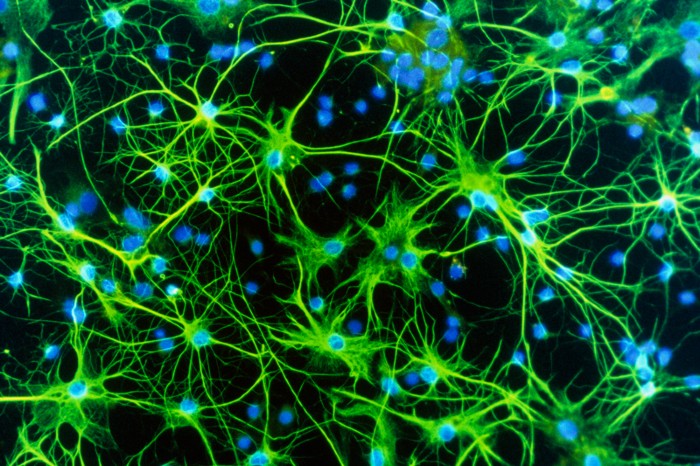
Immunofluorescent light micrograph of brain cells from the cortex of a mammalian brain
BRAIN SLICE

THE BRAIN

Brains, human and otherwise, are convoluted webs, and that web structure is the secret of their abilities.

Brains function because their many trillions of parts send, receive, and store information, coming from within the carrier body, coming from without, and coming from self-created changes, chemically and electronically.

Scientists suggest that some of the brain’s amazing power comes from functioning at the quantum level.

From Quanta:

Brain’s ‘Background Noise’ May Hold Clues to Persistent Mysteries
By digging out signals hidden within the brain’s electrical chatter, scientists are getting new insights into sleep, aging and more., By Elizabeth Landau
Janna Lendner is one of a growing number of neuroscientists energized by the idea that noise in the brain’s electrical activity could hold new clues to its inner workings.
The patterns that Lendner, neuroscientist Bradley Voytek and others look for are related to a phenomenon that scientists started noticing in complex systems throughout the natural world and technology in 1925.
The statistical structure crops up mysteriously in so many different contexts that some scientists even think it represents an undiscovered law of nature.
Our bodies groove to the familiar rhythms of heartbeats and breaths — persistent cycles essential to survival.
But there are equally vital drumbeats in the brain that don’t seem to have a pattern, and they may contain new clues to the underpinnings of behavior and cognition.

Consider the brain as a web of massive, complex, chemical and electronic communication among its trillions of parts.

The communications come both in cycles and in signals that don’t seem to have a pattern. In brains, size matters.

On balance, bigger brains yield more — and more complex — communication, which yields more complex thought.

And all this — size, complexity, communication, cycles, electronic noise — describes the universe.

Every cubic inch of space receives communication from every star in the universe. Float in space with a good enough telescope, and you will see every star.

You will sense trillions of photons and neutrinos every second, plus whisps of gravity and magnetism that sufficiently effective sensors could detect at vast distances.

Thus, every one of the many trillions of stars “senses” what every other trillions of other stars are doing.

The information flow approaches infinity. According to physicists, information never is lost. It continues forever. 

What does the universe do with its infinite trove of knowledge?

Examine an individual brain and you do not see the consciousness, awareness, purpose, or emotion. These all are imputed from outside.  

You see only the physical web structure. And that is all we see today when we examine the universe.

Is it possible that the universe, with its vast web, the context of which our brains cannot imagine, does nothing with its unimaginably huge information flow? Infinite information created, then totally wasted?

All brains have one commonality: From the tree-root, flower aroma “brains,” to spider webs, to the remarkable brains of humans, no brain is a purposeless, stand-alone object. All brains function for a purpose.

And if, in fact, the entire universe is an infinite brain with infinite communication and infinite information, that leaves us with one obvious question.

What is the purpose of the universe?

……………………………………………………………………………………………………………

Rodger Malcolm Mitchell [ Monetary Sovereignty, Twitter: @rodgermitchell, Search: #monetarysovereignty Facebook: Rodger Malcolm Mitchell ]

THE SOLE PURPOSE OF GOVERNMENT IS TO IMPROVE AND PROTECT THE LIVES OF THE PEOPLE. The most important problems in economics involve:

  • Monetary Sovereignty describes money creation and destruction.
  • Gap Psychology describes the common desire to distance oneself from those “below” in any socio-economic ranking, and to come nearer those “above.” The socio-economic distance is referred to as “The Gap.”

Wide Gaps negatively affect poverty, health and longevity, education, housing, law and crime, war, leadership, ownership, bigotry, supply and demand, taxation, GDP, international relations, scientific advancement, the environment, human motivation and well-being, and virtually every other issue in economics. Implementation of Monetary Sovereignty and The Ten Steps To Prosperity can grow the economy and narrow the Gaps: Ten Steps To Prosperity:

  1. Eliminate FICA
  2. Federally funded Medicare — parts A, B & D, plus long-term care — for everyone
  3. Social Security for all
  4. Free education (including post-grad) for everyone
  5. Salary for attending school
  6. Eliminate federal taxes on business
  7. Increase the standard income tax deduction, annually.
  8. Tax the very rich (the “.1%”) more, with higher progressive tax rates on all forms of income.
  9. Federal ownership of all banks
  10. Increase federal spending on the myriad initiatives that benefit America’s 99.9% 


The Ten Steps will grow the economy and narrow the income/wealth/power Gap between the rich and the rest.

MONETARY SOVEREIGNTY


Given the choice between Paying the poor vs. Starving the poor . . .

Background: The government is paying unemployed people only $300 per week, and (surprise, surprise) some people are reluctant to go back to work at jobs that will cost them money.

People gather to show their support for the 2020 Basic Income March at the Utah State Capitol, Sept. 19, 2020, in Salt Lake City.

The purpose of the payments is to prevent families from falling into poverty, which would also help cause the entire economy to slide into poverty.

The payments themselves, though not enough in of themselves to prevent poverty, do benefit every American, rich or poor, by increasing GDP, narrowing the Gap between rich and poor, and preventing a more serious recession.

So what’s a government now to do about those unemployed people who won’t go back to work? It has several choices.

  1. The government can do nothing different, and let the unemployment payments end at the allotted times. This is the “we’re afraid to do anything controversial, so we’ll do nothing” approach of timid politicians.
  2. The government can stop all payments now. This is the “starve ’em ’til they beg for work” approach that businesses and primarily the GOP want.
  3. The government can set a minimum pay requirement that is high enough to make returning to work financially advantageous. This is the “let businesses pay more because the government is going broke” approach.
  4. The government can eliminate the unemployment necessity, and simply give all people a weekly or monthly stipend. This is the “Social Security for All,”  progressive approach.
Yahoo Money Calls to end pandemic unemployment benefits gain steam after disappointing jobs report By Denitsa Tsekova, reporter for Yahoo Finance and Cashay, a new personal finance website. Follow her on Twitter @denitsa_tsekovaSat, May 8, 2021
Calls to cancel pandemic-era unemployment benefits intensified this week as worries over a labor shortage gained steam, culminating in a crescendo on Friday after a wildly disappointing jobs report for April.
South Carolina and Montana announced plans before the report to end the jobless programs at the end of July, after weeks of local reports across the country recounted how restaurants couldn’t fill positions.
After the jobs report on Friday, the U.S. Chamber of Commerce announced its support of stopping the extra $300 in weekly unemployment benefits, citing worker shortages, while Sen. Roger Marshall (R-KS) introduced a bill to repeal the pandemic unemployment programs.

The Republicans are sure to favor the “starve ’em ’til they beg for work” approach.

The GOP is, after all, the Party of the Rich, and if there is one thing the rich hate it’s for the poor and middle-classes to have more money or power.

It’s all a reflection of Gap Psychology, a state of mind in which the rich wish to widen the Gap between them and the rest of America.

The Gap is what makes them rich (without the Gap, no one would be rich or poor), and the wider the Gap the richer they are.

Interestingly, many of the poor and middle, having been brainwashed by the rich, to favor punishing the poor and middle to favor the rich.

That too is part of Gap Psychology, the desire to come closer to those above you in the social structure, by agreeing with them.

Voting for a right-winger essentially says, “I admire rich people, and though I myself am not currently rich, I aspire to be rich, and in some twisted way, my voting against the poor moves me closer to being rich.”

“While there are certainly people that needed access to increased unemployment benefits during the heart of this pandemic, we should not be in the business of creating lucrative government dependency that makes it more beneficial to stay unemployed rather than return to work,” Marshall said in a statement on Friday.

While $300 per week is hardly “lucrative,” the U.S. Chamber of Commerce most definitely wishes to avoid a “government dependency” by creating a business dependency, in which people are so desperate they will take any job, even at starvation wages.

That is, rather than giving the government power over people’s lives, the U.S. Chamber wants business CEOs to have power over people’s lives.

As to which is the more benevolent rule might be subject to debate.

All the government wants is your vote and your acquiescence. The business CEOs want your sweat labor and your money. Which is more onerous?

What’s to blame for the disheartening job performance in April, though, has no consensus among economists.
After payroll gains missed by over 700,000 — 266,000 jobs were added last month versus estimates of 1 million — a firestorm on Twitter ignited among economists and analysts, who largely agreed that tightness in the labor market existed, but argued over the culprit.

The so-called “culprit” is quite obvious. Too many jobs pay too little.

Despite right-wing wishes, people are not stupid enough to accept a job paying $300 a week (or even a tad more), especially considering the kind of unpleasant jobs those generally are), when $300 are available for not subjecting oneself to unpleasant jobs ruled by unpleasant supervisors.

Complicating matters is that the jobs recovery is not occurring in a vacuum, but amid a public health crisis that introduces multiple variables.
While there is no single measure for workforce shortage, increased work hours and wages are considered some of the signs that indicate employers are struggling to fill jobs and the labor market is tightening, according to Heidi Shierholz, senior economist and director of policy at the Economic Policy Institute. 

Apparently, employers are not struggling enough to make their jobs more attractive, preferring to save money by letting the unemployed struggle.

“If employers really can’t find the workers that they need, they’ll respond by ramping up the hours of the workers,” Shierholz told Yahoo Money.

Rather than hiring more people at improved wages and working conditions, employers prefer to work people to death, even if this requires paying overtime wages.

One clue to unemployment is provided by a story that has been typical even well before COVID:

The New York Times Schools Are Open, but Many Families Remain Hesitant to Return By, Dana Goldstein, Sun, May 9, 2021
Pauline Rojas’ high school in San Antonio is open.
But like many of her classmates, she has not returned and has little interest in doing so.
During the coronavirus pandemic, she started working 20 to 40 hours per week at Raising Cane’s, a fast-food restaurant, and has used the money to help pay her family’s internet bill, buy clothes and save for a car.
Rojas, 18, has no doubt that a year of online school, squeezed between work shifts that end at midnight, has affected her learning.
Still, she has embraced her new role as a breadwinner, sharing responsibilities with her mother, who works at a hardware store. “I wanted to take the stress off my mom,” she said.
“I’m no longer a kid. I’m capable of having a job, holding a job and making my own money.”
“There are so many stories, and they are all stories that break your heart,” said Pedro Martinez, the San Antonio schools superintendent, who said it was most challenging to draw teenagers back to classrooms in his overwhelmingly Hispanic, low-income district.
Half of high school students are eligible to return to school five days a week, but only 30% have opted in.
Concerned about flagging grades and the risk of students dropping out, he plans to greatly restrict access to remote learning next school year.

And thus, the Gap between the rich and the rest widens, and it is the lower-income groups who help widen it, not only with their votes but with their personal life decisions.

We discuss, in Ten Steps to Prosperity (See below), this common, seeming paradox, of children and their families rejecting even free college, to work: (See Step 5. Salary for attending school.)

It demonstrates why unemployment is a multi-faceted situation, having disparate reasons that cannot be addressed by just one government action.

Lack of good schooling can doom otherwise bright children, our nation’s greatest asset, to lives of wasted potential and abject failure — a great loss to America and a threat to our international leadership. Returning to the original article:

Average hourly earnings for workers in labor and hospitality also increased to $17.88 in April, up from their pandemic low of $16.92 in July and are higher than their pre-pandemic level of $16.90 in February 2020, according to data from the Labor Department.
Some economists pointed to the increase as a sign that employers are competing with the enhanced unemployment benefits, specifically the extra $300 a week that the Chamber of Commerce said “results in approximately one in four recipients taking home more in unemployment than they earned working.

What a disgrace for America: While corporations and their executive leadership pocket record salaries and perks, 25% of the workforce makes less than $300 a week!

Shierholz noted that the wage increases in some sectors may not be robust enough.
For instance, nonsupervisory workers in leisure and hospitality still make less than $21,000 a year after wage increases, according to Shierholz, or about $10 an hour.
“While there’s definitely signs of isolated and temporary tightness in the labor market,” Shierholz said, “a lot of the huge complaints that we’re seeing really are about businesses being frustrated that they can’t find workers at extremely low wages.”

If your business can’t survive even at slavery-level wages, you had better reassess your business model. Or maybe, just maybe, you should go out of business and not rely on poverty dependency to populate your workforce.

The number of women in the labor force fell by 64,000 in April, while the number of men increased by 493,000, Michael Madowitz, an economist at American Progress, pointed out to Yahoo Money.
“If there is a labor shortage, it’s all about women,” Madowitz tweeted on Friday after the jobs report.

Well, perhaps not exactly:

Scant difference between total unemployment (red) vs women unemployment (blue).
In Summary The purpose of a government is not to increase business profits or to maximize the wealth of the very richest among us.
Nor is the purpose of government to maximize employment.
The sole purpose of government is to protect and improve the lives of the people — all the people.
And since the majority is composed of people, whose lives most need improving — the poor and middle classes — government should focus on helping them rather than on punishing them for not accepting menial labor at starvation wages.
Unemployment is not a disease to be cured by punishing the victims, as the right-wing politicians wish.
Unemployment is a failure symptom of a Monetarily Sovereign government, despite having infinite financial assets, fails to use those asset to address in its primary purpose: To improve the lives of the people.

…………………………………………………………………………

Rodger Malcolm Mitchell [ Monetary Sovereignty, Twitter: @rodgermitchell, Search: #monetarysovereignty Facebook: Rodger Malcolm Mitchell ]

THE SOLE PURPOSE OF GOVERNMENT IS TO IMPROVE AND PROTECT THE LIVES OF THE PEOPLE. The most important problems in economics involve:

  • Monetary Sovereignty describes money creation and destruction.
  • Gap Psychology describes the common desire to distance oneself from those “below” in any socio-economic ranking, and to come nearer those “above.” The socio-economic distance is referred to as “The Gap.”

Wide Gaps negatively affect poverty, health and longevity, education, housing, law and crime, war, leadership, ownership, bigotry, supply and demand, taxation, GDP, international relations, scientific advancement, the environment, human motivation and well-being, and virtually every other issue in economics. Implementation of Monetary Sovereignty and The Ten Steps To Prosperity can grow the economy and narrow the Gaps: Ten Steps To Prosperity:

  1. Eliminate FICA
  2. Federally funded Medicare — parts A, B & D, plus long-term care — for everyone
  3. Social Security for all
  4. Free education (including post-grad) for everyone
  5. Salary for attending school
  6. Eliminate federal taxes on business
  7. Increase the standard income tax deduction, annually.
  8. Tax the very rich (the “.1%”) more, with higher progressive tax rates on all forms of income.
  9. Federal ownership of all banks
  10. Increase federal spending on the myriad initiatives that benefit America’s 99.9% 


The Ten Steps will grow the economy and narrow the income/wealth/power Gap between the rich and the rest.

MONETARY SOVEREIGNTY

What is the purpose of government? What is the purpose of business? What are their goals and methods?

We are not born with governments and businesses. We create them. But why?

Why do people voluntarily allow themselves to be ruled by others? You might believe it is not necessarily voluntary, particularly in the case of dictatorial governments.

But there always are vastly more ruled than rulers, and if government was not what the ruled wanted — if government was a burden — they have the numerical power to rid themselves of this device.

Sometimes this happens. Sometimes the governed rise up and free themselves of dictators. And when they do, what happens?

They form another government.Brexit: Rediscovering Europe as a win-win project – EURACTIV.com

So what is the purpose of this institution that virtually all humans and even some animals have adopted.?

It has persisted for millennia, so it clearly has an evolutionary advantage.

While one can list several specific purposes, there is one general, overall purpose of government:

The purpose of government is to improve the lives of the people.

Government is a form of mandated cooperation. Having a government says two things:

  1. Cooperation is more efficient than working individually, and
  2. Cooperation works better when there is leadership

So we give up our individual freedoms and rights to reap the benefits of cooperation and leadership. In that sense, businesses are very much like governments.

We form businesses because specialization is more efficient than the “jack-of-all-trades” who most often is “master-of-none.”

To accomplish this efficiency, businesses are formed as legal mini-governments, complete with rulers and the ruled.

Governments tell people what to do and what not to do, and the people allow this because it improves their lives.

Business owners and managers tell their people what to do and what not to do, and the people allow this, because it improves their lives.

The purpose of business is to improve the lives of the people.

That said, it is crucial not to confuse purpose with goal. While improving the lives of the people is the purpose of government and business, it is not the goal of government and business.

The goal of government and business is to improve the lives of the leaders.

The leaders accomplish this goal via several methods.

In analyzing government and business, we not only must consider purpose and goal but also, method. Governments essentially balance two methods: Providing benefits and applying force.

The benefits — food, clothing, shelter, medical care, entertainment — lead to acquiescence among the populace.

Government force — laws, police, military — does the same. Either way discourages action against the leaders.

Businesses also balance two methods: Providing benefits and force. The benefits are promotion, salary, and perks, while the force is demotion and firing.

Again, business and government use similar methods — the carrot and the stick — to reach their goals.

Keep the purpose, the goals, and the methods of business and government in mind as we discuss the following articles.

Pay a Living Wage or ‘Flip Your Own Damn Burgers’: Progressives Blast Right-Wing Narrative on Jobs Posted on May 8, 2021 by Yves Smith
Yves here. Glad to see someone is calling out the Republican “You need to keep them hungry so they’ll turn up” approach to labor management.
Corporate profit share of GDP has been record highs for years, which means nearly two times the level Warren Buffett deemed to be unsustainably high in the early 2000s.
Time for corporate owners to pay a decent wage.
By Kenny Stancil, staff writer at Common Dreams. Originally published at Common Dreams
………………………………………………………………………………………………………………………………………………
The U.S. Chamber of Congress blamed last month’s weak employment growth on the existence of a $300 weekly supplemental jobless benefit and began urging lawmakers to eliminate the federally enhanced unemployment payments that were extended through early September when congressional Democrats passed President Joe Biden’s American Rescue Plan.
“No. We don’t need to end [the additional] $300 a week in emergency unemployment benefits that workers desperately need,” Sen. Bernie Sanders (I-Vt.) said in response to the grumbles of the nation’s largest business lobbying group.
“We need to end starvation wages in America.”
“If $300 a week is preventing employers from hiring low-wage workers there’s a simple solution,” Sanders added. “Raise your wages. Pay decent benefits.”
According to the Chamber’s analysis, the extra $300 unemployment insurance (UI) benefit results in roughly one in four recipients taking home more pay than they earned working.
In response to that claim, Sanders’ staff director Warren Gunnels said: “If one in four recipients are making more off unemployment than they did working, that’s not an indictment of $300 a week in UI benefits. It’s an indictment of corporations paying starvation wages.”

The problem: Government believes that the more benefits government gives to workers, the more likely the government’s goal — improving the lives of the political leaders by acquiring votes — will be reached.

Business believes that keeping salaries low will improve business’s goal of improving the lives of business leaders by increasing profits.

Today, Government benefits to the people are high enough that going to work provides little marginal benefit for many people.

The Republican proposed method is for the government to stop paying benefits, so that workers will be starved back to work, and business profits will keep increasing.

The Democratic proposed method is for businesses to pay more — enough to tempt workers to forego government benefits, but this may reduce profits.

While both goals are different, and the methods may seem incompatible, the solution is mind-numbingly simple: Do both.

Rather than the current either/or of government benefits coming instead of business benefits, as unemployment compensation does, pay government benefits in addition to business benefits.

This would come under the heading:

Medicare for All, Social Security for All, Free College for All, etc.

A wage of $300 per week is at poverty levels. It is a starvation wage. It is an “abandon all hope” wage.

How a multi-billionaire, a person whose wealth measures up to $170 billion could countenance such a wage, is beyond cruel.

Do these people lack all sense of sympathy and empathy? Are they made of compassionless stone?

Well, yes. Compassion comes from Latin, and means “co-suffering,” as in “I feel your pain.” But how many of us really do feel someone else’s pain?

Keep in mind, the goal of business is to improve the lives of the leaders, and the leaders are certain that keeping costs down, which leads to keeping salaries down, will improve profits and thereby improve their lives.

“Raise your wages and benefits or flip your own damn burgers and sweep your own damn floors,” Gunnels added.
Other progressives like former labor secretary Robert Reich and Rep. Alexandria Ocasio-Cortez (D-N.Y.) also chimed in. “We do not have a shortage of willing workers in this country,” Morris Pearl of the Patriotic Millionaires said in a Friday afternoon statement responding to the Chamber. “We have a shortage of employers who are willing to pay workers enough to live.”
“Claiming that today’s disappointing jobs report is a result of expanded unemployment insurance is nothing more than a cruel tactic to pressure the administration into helping companies that they represent to continue to underpay and exploit their workforce,” Pearl continued.
“Our leaders are supposed to be helping to increase wages for low paid workers, not helping employers to keep wages down.”
“Instead of blaming struggling workers,” Pearl continued, “large corporations that do not pay their employees a liveable wage… should take this moment to self-reflect.
Maybe—just maybe—paying their workers more than starvation wages would incentivize workers to reenter the workforce.”

Yes, this is all true, but it ignores the true goal of business: Profits that enrich the leaders.

One might argue that paying workers more will make the workers bigger consumers who in buying more will enrich companies, but that too ignores reality.

If Company “A” pays its workers more, those workers may spend more, but not necessarily with Company “A.”

If Ford raises wages, nothing says those newly enriched workers will, out of the goodness of their hearts, buy Fords.

The public has as little compassion as do the business executives. The people who formerly were myriad small-business customers, but now are Amazon customers, have proved that.

Loyalty is something honored more in the breach.

Writing for Jacobin earlier this week, Sandy Barnard noted that another overlooked factor is the increased morbidity rates among food and agricultural workers, which increased more than any other occupation during the Covid-19 pandemic.

Is big agriculture supposed to have such guilt that workers immediately are given raises? Dream on.

“Living, breathing people… have decided they do not want to risk their lives for $7.25 per hour and no health benefits,” Barnard wrote.
Rep. Ilhan Omar (D-Minn.) responded to the Chamber’s call for an end to enhanced unemployment benefits by arguing that “the interests of big business are at war with the interests of the working class.”

And that is the fundamental problem. It is a war, with one side winning and the other sides losing.

The solution is for all sides — government, business, and the populace — to win.

Government can win — win votes, that is — by providing benefits.

Business can win by paying enough to attract workers — while remaining profitable. The populace can win by receiving benefits from both sides, from government and from business.

There absolutely will be no long-term solutions that involve either business, government, or the people losing.

The only intelligent solution is for all sides to get what they want, or at least to get enough of what they want. See the Ten Steps to Prosperity, below.

…………………………………………………………………………

Rodger Malcolm Mitchell [ Monetary Sovereignty, Twitter: @rodgermitchell, Search: #monetarysovereignty Facebook: Rodger Malcolm Mitchell ]

THE SOLE PURPOSE OF GOVERNMENT IS TO IMPROVE AND PROTECT THE LIVES OF THE PEOPLE. The most important problems in economics involve:

  • Monetary Sovereignty describes money creation and destruction.
  • Gap Psychology describes the common desire to distance oneself from those “below” in any socio-economic ranking, and to come nearer those “above.” The socio-economic distance is referred to as “The Gap.”

Wide Gaps negatively affect poverty, health and longevity, education, housing, law and crime, war, leadership, ownership, bigotry, supply and demand, taxation, GDP, international relations, scientific advancement, the environment, human motivation and well-being, and virtually every other issue in economics. Implementation of Monetary Sovereignty and The Ten Steps To Prosperity can grow the economy and narrow the Gaps: Ten Steps To Prosperity:

  1. Eliminate FICA
  2. Federally funded Medicare — parts A, B & D, plus long-term care — for everyone
  3. Social Security for all
  4. Free education (including post-grad) for everyone
  5. Salary for attending school
  6. Eliminate federal taxes on business
  7. Increase the standard income tax deduction, annually.
  8. Tax the very rich (the “.1%”) more, with higher progressive tax rates on all forms of income.
  9. Federal ownership of all banks
  10. Increase federal spending on the myriad initiatives that benefit America’s 99.9% 


The Ten Steps will grow the economy and narrow the income/wealth/power Gap between the rich and the rest.

MONETARY SOVEREIGNTY