Presidential health?

It takes only two things to keep people in chains: The ignorance of the oppressed and the treachery of their leaders.
………………………………………………………………………………………………………………………………………………………………………………

President Donald Trump’s doctor, Harold Bornstein shamelessly told us this about his obese patient, “If elected, Mr. Trump, I can state unequivocally, will be the healthiest individual ever elected to the presidency,” a statement that has all the exorbitance of a Trump speech.Image result for fake doctor

“Healthiest individual ever”? Puleeeze. It’s pure Trump.

Many in America and elsewhere shake their heads at the things Trump says and does. There actually is rather widespread belief that the President has some forms of mental illness.

If that is true, what forms of mental illness?

What Are the Different Types of Personality Disorders?

  • Paranoid personality disorder: People with paranoid personality disorder are very distrustful of others and suspicious of their motives. They also tend to hold grudges.
  • Antisocial personality disorder: People with antisocial personality disorder tend to manipulate or treat others harshly without expressing remorse for their actions. They may lie or steal.
  • Histrionic personality disorder: In histrionic personality disorder, people frequently try to gain more attention by being overly dramatic. They are extremely sensitive to criticism or disapproval.
  • Narcissistic personality disorder: People with narcissistic personality disorder believe that they are more important than others. They tend to exaggerate their achievements and may brag about their attractiveness or success. They have a deep need for admiration, but lack empathy for other people.

Distrustful, hold grudges, lie, steal, overly dramatic, extremely sensitive to criticism, exaggerate achievements, deep need for admiration — these would seem to be perfect descriptions of Donald Trump.

To this layman’s eyes, Trump is a psychopath.

Sociopath vs. Psychopath: What’s the Difference

Both have what is known as “antisocial personality disorder” (ASP).

A key difference between a psychopath and a sociopath is whether he has a conscience. A psychopath doesn’t have a conscience. If he lies to you so he can steal your money, he won’t feel any moral qualms.

A sociopath typically has a conscience, but it’s weak. He may know that taking your money is wrong, and he might feel some guilt or remorse, but that won’t stop his behavior.

Trump never has exhibited a conscience. His cheating of students at Trump University, his cheating of creditors with his bankruptcies, his cheating of employees out of their wages, his cheating on his wives, his actions against innocent Muslims, Mexicans, gays, and transgenders all bespeak a man lacking morals, compassion or conscience.

Here are more symptoms:

Compensatory Narcissistic Personality Disorder 

A pervasive pattern of unstable, “overtly narcissistic behaviors [that] derive from an underlying sense of insecurity and weakness rather than from genuine feelings of self-confidence and high self-esteem” (Millon), beginning by early adulthood and present in a variety of contexts, as indicated by ten (or more) of the following:

  1. Seeks to create an illusion of superiority and to build up an image of high self-worth;
  2. Has disturbances in the capacity for empathy;
  3. Strives for recognition and prestige to compensate for the lack of a feeling of self-worth;
  4. May acquire a deprecatory attitude in which the achievements of others are ridiculed and degraded;
  5. Has persistent aspirations for glory and status;
  6. Has a tendency to exaggerate and boast;
  7. Is sensitive to how others react to him or her, watches and listens carefully for critical judgment, and feels slighted by disapproval;
  8. Is prone to feel shamed and humiliated and especially hyper-anxious and vulnerable to the judgments of others;
  9. Covers up a sense of inadequacy and deficiency with pseudo-arrogance and pseudo-grandiosity;
  10. Has a tendency to periodic hypochondria;
  11. Alternates between feelings of emptiness and deadness and states of excitement and excess energy;
  12. Entertains fantasies of greatness, constantly striving for perfection, genius, or stardom;
  13. Has a history of searching for an idealized partner and has an intense need for affirmation and confirmation in relationships;
  14. Frequently entertains a wishful, exaggerated, and unrealistic concept of himself or herself which he or she can’t possibly measure up to;
  15. Produces (too quickly) work not up to the level of his or her abilities because of an overwhelmingly strong need for the immediate gratification of success;
  16. Is touchy, quick to take offense at the slightest provocation, continually anticipating attack and danger, reacting with anger and fantasies of revenge when he or she feels frustrated in his or her need for constant admiration;
  17. Is self-conscious, due to a dependence on approval from others;
  18. Suffers regularly from repetitive oscillations of self-esteem;
  19. Seeks to undo feelings of inadequacy by forcing everyone’s attention and admiration upon himself or herself
  20. May react with self-contempt and depression to the lack of fulfillment of his or her grandiose expectations

Aside from perhaps (unknown) #’s 10, 11, 18 and 20, the above is a perfect description of Trump.  The author said Compensatory Narcissistic Personality Disorder is diagnosed by ten or more of the above symptoms. Trump has at least sixteen.

Trump also seems to have a sick envy and fixation on Barack Obama:

By David Ludden, Ph.D:  Envy is a complex social emotion. It starts with the perception that someone else has something of value that you don’t have.

But this perception is also accompanied by a painful or unpleasant feeling. From an evolutionary perspective, envy provides us with information about our social standing and the drive to improve our position in society.

But envy also has a dark side. Instead of focusing our efforts on gaining the things we want in life, we brood over what we don’t have and resent those who have what we want.

The experience of envy is doubly damaging, as we not only feel bad about ourselves, we also harbor ill will towards others who’ve done us no wrong.

Consider some of Trump’s initiatives:

  1. He has fought, and continues to fight, angrily and aggressively, against Obamacare (though he has no idea of a replacement).
  2. He has fought, and continues to fight, against the Paris Climate Accords signed by Obama
  3. Revoked Obama’s Executive Order 13690 that proposed a new Federal Flood Risk Management Standard.
  4. Revoked Obama’s policy on transgenders in the military.
  5. Ended Obama’s Deferred Action for Parents of Americans (DAPA) that protected undocumented immigrants with children.
  6. Repeatedly insisted that Obama is not a citizen of the United States and implied Obama is a Muslim (thus not a “real” American).
  7. Falsely claimed Obama had tapped Trump’s telephones
  8. Falsely claimed his inauguration crowd was bigger than Obama’s crowd.
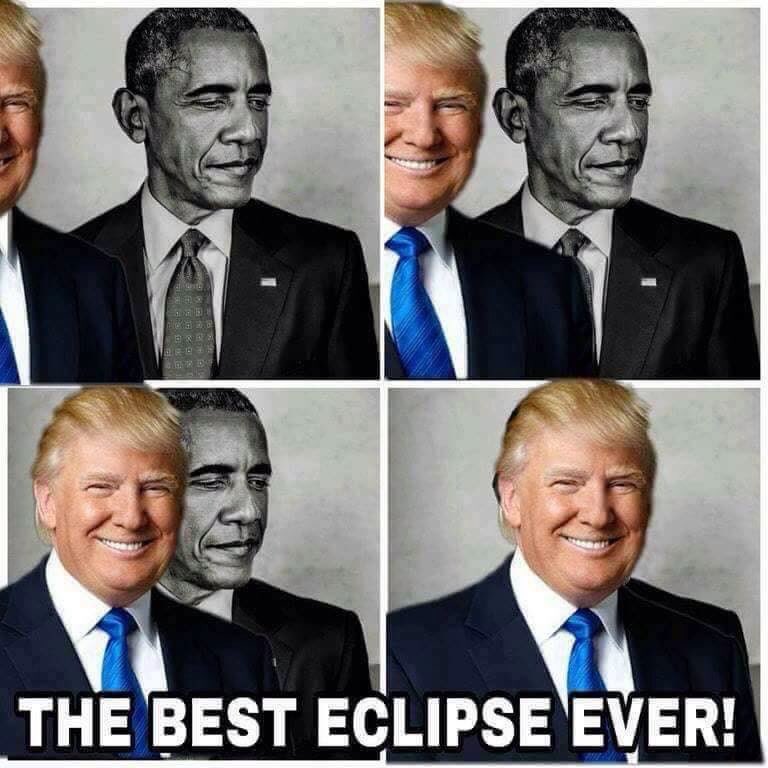
Donald Trump tweeted this series

Just recently, Trump tweeted this composite —————->

As you can see, it shows a full-color, smiling Trump literally blotting out a gray, downcast President Obama, as though to obliterate any memories Americans may have of our previous President.

Could there be anything more obvious — a childish attempt to conceal Obama behind the glory of Trump?

There is a certain sadness in all of this — the emotional weakness of a man who has money and honors but still cannot feel fulfilled.

Despite having won the Presidency, he continues to run campaign events, where he can stand before adoring crowds who cheer is every word, while ejecting any who disagree with him.

He is the spoiled child who crying and stamping his feet, demands ever more toys, compliments, and participation trophies — ever more adulation.

I admit to not being a professional psychiatrist or psychologist so you can take the following for what it’s worth.

I believe Donald Trump is a very sick man. I believe he is a psychopath, a man with severe personality disorders that prevent him from leading America in a responsible way.

I believe his alarming emotional inadequacy translates into fits of imprudence that already, after only seven months, have been harmful to America, harmful to the world and harmful to the individuals who suffer from his cruel disregard.

I fear his combination of vast power, wanton recklessness, ignorance, and unending ego ultimately will prove deadly to us all.

Rodger Malcolm Mitchell
Monetary Sovereignty

………………………………………………………………………………………………………………………………………………………………………………………………………………………………………………………………………………………………………………………………………..

The single most important problems in economics involve the excessive income/wealth/power Gaps between the have-mores and the have-less.

Wide Gaps negatively affect poverty, health and longevity, education, housing, law and crime, war, leadership, ownership, bigotry, supply and demand, taxation, GDP, international relations, scientific advancement, the environment, human motivation and well-being, and virtually every other issue in economics.

Implementation of The Ten Steps To Prosperity can narrow the Gaps:

Ten Steps To Prosperity:
1. ELIMINATE FICA (Ten Reasons to Eliminate FICA )
Although the article lists 10 reasons to eliminate FICA, there are two fundamental reasons:
*FICA is the most regressive tax in American history, widening the Gap by punishing the low and middle-income groups, while leaving the rich untouched, and
*The federal government, being Monetarily Sovereign, neither needs nor uses FICA to support Social Security and Medicare.
2. FEDERALLY FUNDED MEDICARE — PARTS A, B & D, PLUS LONG TERM CARE — FOR EVERYONE (H.R. 676, Medicare for All )
This article addresses the questions:
*Does the economy benefit when the rich can afford better health care than can the rest of Americans?
*Aside from improved health care, what are the other economic effects of “Medicare for everyone?”
*How much would it cost taxpayers?
*Who opposes it?”
3. PROVIDE A MONTHLY ECONOMIC BONUS TO EVERY MAN, WOMAN AND CHILD IN AMERICA (similar to Social Security for All) (The JG (Jobs Guarantee) vs the GI (Guaranteed Income) vs the EB (Economic Bonus)) Or institute a reverse income tax.
This article is the fifth in a series about direct financial assistance to Americans:

Why Modern Monetary Theory’s Employer of Last Resort is a bad idea. Sunday, Jan 1 2012
MMT’s Job Guarantee (JG) — “Another crazy, rightwing, Austrian nutjob?” Thursday, Jan 12 2012
Why Modern Monetary Theory’s Jobs Guarantee is like the EU’s euro: A beloved solution to the wrong problem. Tuesday, May 29 2012
“You can’t fire me. I’m on JG” Saturday, Jun 2 2012

Economic growth should include the “bottom” 99.9%, not just the .1%, the only question being, how best to accomplish that. Modern Monetary Theory (MMT) favors giving everyone a job. Monetary Sovereignty (MS) favors giving everyone money. The five articles describe the pros and cons of each approach.
4. FREE EDUCATION (INCLUDING POST-GRAD) FOR EVERYONE Five reasons why we should eliminate school loans
Monetarily non-sovereign State and local governments, despite their limited finances, support grades K-12. That level of education may have been sufficient for a largely agrarian economy, but not for our currently more technical economy that demands greater numbers of highly educated workers.
Because state and local funding is so limited, grades K-12 receive short shrift, especially those schools whose populations come from the lowest economic groups. And college is too costly for most families.
An educated populace benefits a nation, and benefitting the nation is the purpose of the federal government, which has the unlimited ability to pay for K-16 and beyond.
5. SALARY FOR ATTENDING SCHOOL
Even were schooling to be completely free, many young people cannot attend, because they and their families cannot afford to support non-workers. In a foundering boat, everyone needs to bail, and no one can take time off for study.
If a young person’s “job” is to learn and be productive, he/she should be paid to do that job, especially since that job is one of America’s most important.
6. ELIMINATE FEDERAL TAXES ON BUSINESS
Businesses are dollar-transferring machines. They transfer dollars from customers to employees, suppliers, shareholders and the federal government (the later having no use for those dollars). Any tax on businesses reduces the amount going to employees, suppliers and shareholders, which diminishes the economy. Ultimately, all business taxes reduce your personal income.
7. INCREASE THE STANDARD INCOME TAX DEDUCTION, ANNUALLY. (Refer to this.) Federal taxes punish taxpayers and harm the economy. The federal government has no need for those punishing and harmful tax dollars. There are several ways to reduce taxes, and we should evaluate and choose the most progressive approaches.
Cutting FICA and business taxes would be a good early step, as both dramatically affect the 99%. Annual increases in the standard income tax deduction, and a reverse income tax also would provide benefits from the bottom up. Both would narrow the Gap.
8. TAX THE VERY RICH (THE “.1%) MORE, WITH HIGHER PROGRESSIVE TAX RATES ON ALL FORMS OF INCOME. (TROPHIC CASCADE)
There was a time when I argued against increasing anyone’s federal taxes. After all, the federal government has no need for tax dollars, and all taxes reduce Gross Domestic Product, thereby negatively affecting the entire economy, including the 99.9%.
But I have come to realize that narrowing the Gap requires trimming the top. It simply would not be possible to provide the 99.9% with enough benefits to narrow the Gap in any meaningful way. Bill Gates reportedly owns $70 billion. To get to that level, he must have been earning $10 billion a year. Pick any acceptable Gap (1000 to 1?), and the lowest paid American would have to receive $10 million a year. Unreasonable.
9. FEDERAL OWNERSHIP OF ALL BANKS (Click The end of private banking and How should America decide “who-gets-money”?)
Banks have created all the dollars that exist. Even dollars created at the direction of the federal government, actually come into being when banks increase the numbers in checking accounts. This gives the banks enormous financial power, and as we all know, power corrupts — especially when multiplied by a profit motive.
Although the federal government also is powerful and corrupted, it does not suffer from a profit motive, the world’s most corrupting influence.
10. INCREASE FEDERAL SPENDING ON THE MYRIAD INITIATIVES THAT BENEFIT AMERICA’S 99.9% (Federal agencies)Browse the agencies. See how many agencies benefit the lower- and middle-income/wealth/ power groups, by adding dollars to the economy and/or by actions more beneficial to the 99.9% than to the .1%.
Save this reference as your primer to current economics. Sadly, much of the material is not being taught in American schools, which is all the more reason for you to use it.

The Ten Steps will grow the economy, and narrow the income/wealth/power Gap between the rich and you.

MONETARY SOVEREIGNTY
Evaluating lies: Harm vs. benefits

It takes only two things to keep people in chains: The ignorance of the oppressed and the treachery of their leaders.
………………………………………………………………………………………………………………………………………………………………………………

Humans lie.  Even animals lie.

Lies have many advantages. The so-called “white lie” is a social method that is welcome and considered courteous. On many occasions, it would be rude to tell someone the truth. (“Your plastic surgery makes you look ugly.” “Your child is stupid.”)

Lying can build relationships, and even when the recipient of a lie knows it’s a lie, the lie and the liar are appreciated. The harm of a social lie is minimal compared to the benefit.

Lying, in of itself, is part of the normal human experience. Humans tend to accept and believe lies. Otherwise, humans wouldn’t lie, as acceptance and belief are the purpose.

Some political lies are valuable to humanity.

Ozone in the atmosphere helps protect us from solar radiation.  You’ve heard of the “ozone hole.”  It’s a hole in the air above the north and south pole, that lets in dangerous radiation — except, there is no “hole.” There is some depletion, much of it natural and cyclical, but the notion of a “hole” is a lie.

The value of the ozone “hole,” or more specifically the value of calling it a “hole,” is that it creates a picture in our minds.

This picture makes us amenable to paying the cost and suffering inconvenience of eliminating chlorofluorocarbons(CFCs), halons, and other ozone-depleting chemicals, which are used in air conditioning and spray propellants.

So the hole is a lie, but it’s a “good lie.” The harm is minimal compared to the benefit.

Image result for pacific garbage patch
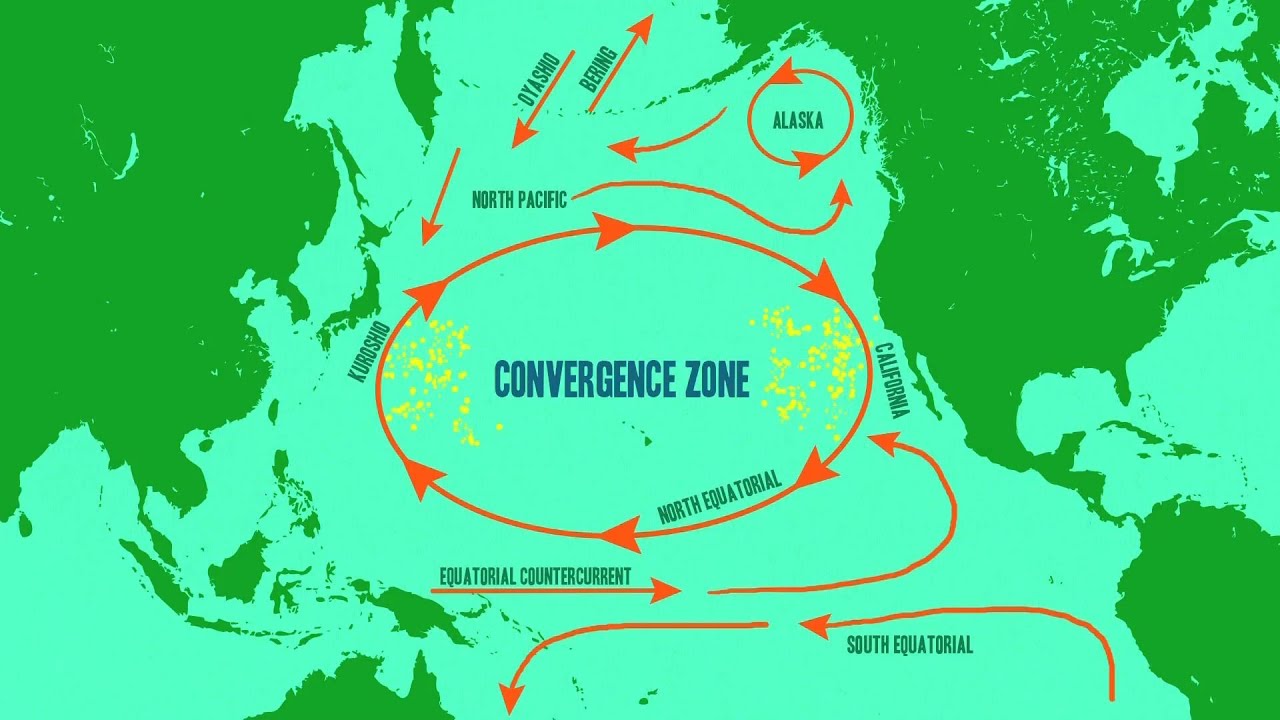
The Pacific Garbage Patch

In the same vein, you may have heard of the “Great Pacific Garbage Patch.” It’s an area of the Pacific Ocean where the natural currents create a swirl that entraps all floating trash, which builds up into piles of plastic, wood, bottles, sludge, chemicals, and other floatables.

It is a disgusting example of how mankind is polluting even our largest ocean, and is a good reason why we should exert every effort to reduce pollution — except the Great Pacific Garbage Patch is a lie. It doesn’t exist, at least not the way you might visualize it.

The words probably draw to your mind a picture of a huge floating island of garbage, but in fact, the “Great Pacific Garbage Patch” is invisible. It merely is an area of the ocean that has a slightly higher concentration of particulate matter, especially plastic particles. You could boat or even swim right through it and not realize it.

The problem is that when fish swim through it, a few of those tiny plastic particles might be ingested and enter their flesh, and when we eat those fish, the plastic enters our bodies, with potentially harmful physical effects.

The value of the “Great Pacific Garbage Patch” lie is that by drawing a vivid pollution picture, it might encourage stricter anti-pollution laws (except under the current American political administration, which seems not to worry about pollution).

So it’s a lie, but a “good” lie. The harm is minimal compared to the benefit.

Because lying is such a common part of our daily experience, we have evolved ways to deal with lies. To survive in our society, we must know which lies to accept as courteousness, which to believe as fact, and which to disbelieve.

And it isn’t easy.

There are several aspects to lies that help make them seem believable, among which are:.

  1. Source: Do we trust the source delivering the lie?
  2. Logic: Does the lie sound reasonable?
  3. Desire: Do we have a personal motive to believe the lie?
  4. Repetition: Does the lie square with what we previously have heard?

On this site, we often discuss “The Big Lie, a group of lies that deny Monetary Sovereignty.  Within that group of lie are such statements as:

*Federal finances are like your personal finances (They aren’t.)
*Federal taxes fund federal spending. (They don’t.)
*The federal deficit and debt are unsustainable (They aren’t.)
*Federal spending causes inflation (It doesn’t.)
*And the federal government can run short of its own sovereign dollars. (It can’t.)

Though this blog discusses, in detail, why each of these statements is false, many people resist the facts. That is, despite proof showing otherwise, they continue to believe the lie, because.

  1. Trusted sources like the media, the politicians, and many economists promulgate The Big Lie.
  2. Because The Big Lie equates federal financing with people’s own personal financial experience, the lie sounds reasonable.
  3. People want to believe The Big Lie because it justifies their desire to cut benefits to those who are poorer.
  4. The incessant, unrelenting repetition of the lie.

The Big Lie is harmful because it vindicates widening the Gap between the rich and the poor. It justifies reductions in federal spending for such social programs as Medicare, Medicaid, Social Security, poverty aids, education aids and other benefits for the “not-rich.”

It condones the easing of federal regulations meant to stop criminal bankers. It rationalizes the reduction in budgets for food, drug, and environmental protections. It reduces federal spending that grows the economy.

The Big Lie clearly is harmful, but does it have any redeeming qualities?

Some would say, “Yes.” They would say The Big Lie discourages Americans from constantly asking the federal government for benefits and it lessens the likelihood Congress will provide an endless succession of those benefits.

They would say that without The Big Lie, federal politicians, hoping to please constituents with gifts and tax cuts, would be helpless to prevent the massive growth of federal spending.

Said as briefly as possible, The Big Lie prevents “excessive” deficit spending. And that leaves us with a question: What is “excessive” deficit spending?

There are those of a Libertarian bent, who believe the federal government is too big and powerful (to use their favorite word a “Leviathan”), and most or even any deficit spending is too much.

That belief cannot be argued. There is no proof possible that the federal government is “too big.” It is an emotional, not a factual, judgment.

We can observe however that in 1940, the federal “debt” was $40 billion, and some called it a “ticking time bomb. Today, it is $14 trillion, and that time bomb still is ticking.

We also can observe that every recession and depression has been introduced by reduced deficit growth, and every recession and depression has been cured by increased deficit growth.

Then, there are those who believe “excessive” federal deficit spending causes inflations, even Zimbabwe-style hyperinflations.

However, we can observe that despite periods of massive deficit spending, the U.S. never in its history has had a hyperinflation.

And we can observe that even with the massive deficit spending that brought us out of the “Great Recession” of 2008, and which has continued to this day, our rate of inflation is somewhat lower than the Fed’s target of about 2.5%.  The reasons:

  1. World inflation is caused by oil prices.
  2. The Fed controls U.S. inflation by increasing the Demand for the dollar, via interest rate control.

Finally, what about the theoretical helplessness of politicians to resist demands for deficit spending, if the public realized the federal government cannot run short of dollars, and does not use tax dollars?

  1. Politicians already yield to demands for gifts and tax cuts — but from their biggest contributors, the rich. Public understanding of Monetary Sovereignty would put the 99.9% on a par with the richest .1%.
  2. Deficit spending and tax cuts stimulate economic growth and enrich the populace, especially the 99.9% who benefit from social spending, the largest part of the federal budget. Cuts to regressive taxes — FICA, sales taxes, and remarkably even net income taxes (after special deductions for the rich) also would benefit the 99.9%.

And would the politicians really be  “helpless”? Today’s politicians already resist deficit spending. They do it by telling a lie, The Big Lie: “Taxpayers and the government can’t afford it.”

They just as well could resist deficit spending by telling the truth:

Deficit spending is limited only by an inflation the Fed cannot control via interest rates.

The Fed already determines current and future inflation. It adjusts interest rates upward when it believes inflation will rise above its target rate of about 2.5%. It lowers rates when it believes inflation will fall below its target rate.

The Fed already acts not only as a control but as a barometer.

If the Fed ever merely were to announce, “We predict inflation will be too high and we will not be able to control it reasonably close to our 2.5% target,” the politicians could use that announcement, not The Big Lie, as their excuse to resist further federal spending, or even to cut federal spending.

In summary, there are no excuses for The Big Lie. There is no value to The Big Lie. The harm is enormous compared to the non-existent benefit.

How about telling The Big Truth: Monetary Sovereignty.

Rodger Malcolm Mitchell
Monetary Sovereignty

………………………………………………………………………………………………………………………………………………………………………………………………………………………………………………………………………………………………………………………………………..

The single most important problems in economics involve the excessive income/wealth/power Gaps between the have-mores and the have-less.

Wide Gaps negatively affect poverty, health and longevity, education, housing, law and crime, war, leadership, ownership, bigotry, supply and demand, taxation, GDP, international relations, scientific advancement, the environment, human motivation and well-being, and virtually every other issue in economics.

Implementation of The Ten Steps To Prosperity can narrow the Gaps:

Ten Steps To Prosperity:
1. ELIMINATE FICA (Ten Reasons to Eliminate FICA )
Although the article lists 10 reasons to eliminate FICA, there are two fundamental reasons:
*FICA is the most regressive tax in American history, widening the Gap by punishing the low and middle-income groups, while leaving the rich untouched, and
*The federal government, being Monetarily Sovereign, neither needs nor uses FICA to support Social Security and Medicare.
2. FEDERALLY FUNDED MEDICARE — PARTS A, B & D, PLUS LONG TERM CARE — FOR EVERYONE (H.R. 676, Medicare for All )
This article addresses the questions:
*Does the economy benefit when the rich can afford better health care than can the rest of Americans?
*Aside from improved health care, what are the other economic effects of “Medicare for everyone?”
*How much would it cost taxpayers?
*Who opposes it?”
3. PROVIDE A MONTHLY ECONOMIC BONUS TO EVERY MAN, WOMAN AND CHILD IN AMERICA (similar to Social Security for All) (The JG (Jobs Guarantee) vs the GI (Guaranteed Income) vs the EB (Economic Bonus)) Or institute a reverse income tax.
This article is the fifth in a series about direct financial assistance to Americans:

Why Modern Monetary Theory’s Employer of Last Resort is a bad idea. Sunday, Jan 1 2012
MMT’s Job Guarantee (JG) — “Another crazy, rightwing, Austrian nutjob?” Thursday, Jan 12 2012
Why Modern Monetary Theory’s Jobs Guarantee is like the EU’s euro: A beloved solution to the wrong problem. Tuesday, May 29 2012
“You can’t fire me. I’m on JG” Saturday, Jun 2 2012

Economic growth should include the “bottom” 99.9%, not just the .1%, the only question being, how best to accomplish that. Modern Monetary Theory (MMT) favors giving everyone a job. Monetary Sovereignty (MS) favors giving everyone money. The five articles describe the pros and cons of each approach.
4. FREE EDUCATION (INCLUDING POST-GRAD) FOR EVERYONE Five reasons why we should eliminate school loans
Monetarily non-sovereign State and local governments, despite their limited finances, support grades K-12. That level of education may have been sufficient for a largely agrarian economy, but not for our currently more technical economy that demands greater numbers of highly educated workers.
Because state and local funding is so limited, grades K-12 receive short shrift, especially those schools whose populations come from the lowest economic groups. And college is too costly for most families.
An educated populace benefits a nation, and benefitting the nation is the purpose of the federal government, which has the unlimited ability to pay for K-16 and beyond.
5. SALARY FOR ATTENDING SCHOOL
Even were schooling to be completely free, many young people cannot attend, because they and their families cannot afford to support non-workers. In a foundering boat, everyone needs to bail, and no one can take time off for study.
If a young person’s “job” is to learn and be productive, he/she should be paid to do that job, especially since that job is one of America’s most important.
6. ELIMINATE FEDERAL TAXES ON BUSINESS
Businesses are dollar-transferring machines. They transfer dollars from customers to employees, suppliers, shareholders and the federal government (the later having no use for those dollars). Any tax on businesses reduces the amount going to employees, suppliers and shareholders, which diminishes the economy. Ultimately, all business taxes reduce your personal income.
7. INCREASE THE STANDARD INCOME TAX DEDUCTION, ANNUALLY. (Refer to this.) Federal taxes punish taxpayers and harm the economy. The federal government has no need for those punishing and harmful tax dollars. There are several ways to reduce taxes, and we should evaluate and choose the most progressive approaches.
Cutting FICA and business taxes would be a good early step, as both dramatically affect the 99%. Annual increases in the standard income tax deduction, and a reverse income tax also would provide benefits from the bottom up. Both would narrow the Gap.
8. TAX THE VERY RICH (THE “.1%) MORE, WITH HIGHER PROGRESSIVE TAX RATES ON ALL FORMS OF INCOME. (TROPHIC CASCADE)
There was a time when I argued against increasing anyone’s federal taxes. After all, the federal government has no need for tax dollars, and all taxes reduce Gross Domestic Product, thereby negatively affecting the entire economy, including the 99.9%.
But I have come to realize that narrowing the Gap requires trimming the top. It simply would not be possible to provide the 99.9% with enough benefits to narrow the Gap in any meaningful way. Bill Gates reportedly owns $70 billion. To get to that level, he must have been earning $10 billion a year. Pick any acceptable Gap (1000 to 1?), and the lowest paid American would have to receive $10 million a year. Unreasonable.
9. FEDERAL OWNERSHIP OF ALL BANKS (Click The end of private banking and How should America decide “who-gets-money”?)
Banks have created all the dollars that exist. Even dollars created at the direction of the federal government, actually come into being when banks increase the numbers in checking accounts. This gives the banks enormous financial power, and as we all know, power corrupts — especially when multiplied by a profit motive.
Although the federal government also is powerful and corrupted, it does not suffer from a profit motive, the world’s most corrupting influence.
10. INCREASE FEDERAL SPENDING ON THE MYRIAD INITIATIVES THAT BENEFIT AMERICA’S 99.9% (Federal agencies)Browse the agencies. See how many agencies benefit the lower- and middle-income/wealth/ power groups, by adding dollars to the economy and/or by actions more beneficial to the 99.9% than to the .1%.
Save this reference as your primer to current economics. Sadly, much of the material is not being taught in American schools, which is all the more reason for you to use it.

The Ten Steps will grow the economy, and narrow the income/wealth/power Gap between the rich and you.

MONETARY SOVEREIGNTY

What controls inflation? What stimulates the economy?

It takes only two things to keep people in chains: The ignorance of the oppressed and the treachery of their leaders.
………………………………………………………………………………………………………………………………………………………………………………

One simple definition of inflation is the loss in Value of Dollars (Inflation  = 1/Value of Dollars).

Increasing the Supply of dollars is inflationary; increasing the Demand for dollars is deflationary. Put the two together and you get:

Value of Dollars = Demand for Dollars/ Supply of Dollars.

Related image

The Demand for dollars is: Demand = Risk/Reward

The Risk of owning dollars is Inflation. The Reward for owning dollars is Interest. Thus, the Fed limits inflation by increasing interest rates, i.e. increasing the Reward for owning dollars.

Although the Fed can increase the inflation-limiting Reward (interest) endlessly, there are serious functional and political consequences for reducing interest rates below zero. In short, the Fed has more power to reduce inflation than to increase it.

But there is more to inflation than just the Demand and Supply of dollars. Also to be considered are the Demand and Supply of Goods and Services (G&S).

When goods and services are in high Demand or in low Supply, more dollars are needed to buy them. When the price goes up the Value of the dollar is decreased. (Value of the dollar = 1/Price)

This brings the formula for inflation to:

Value of Dollars = (Demand for Dollars/Supply of Dollars) / (Demand for G&S/Supply of G&S)

In plain English, with interest rates held even, we will have inflation (dollar Value declines) if Demand for G&S exceeds Supply.  That is called a “shortage,” and a shortage of G&S, not an excess of money, is the usual path to inflations and to hyperinflations.

(Weimar hyperinflation was precipitated by a shortage of gold which caused a shortage of Goods & Services. Zimbabwe’s hyperinflation was precipitated by a shortage of food.)

Consider this excerpt from an article that appeared in Bloomberg:

The Fed can switch gears and see if looser monetary policy can boost productivity growth. The persistently weak inflationary environment offers the perfect opportunity for such an experiment.

Low inflation already vexes the Fed. Core inflation tumbled early in the year and remains well below the Fed’s target.

This alone gives the Fed reason to allow a slower path on rate hikes in an experimental effort to boost productivity growth.

Said another way: The Fed wants to raise inflation to its 2% target rate, so it should cut interest rates to boost productivity growth.

This idea is based on an implied and related set of popular myths:

Myth I. An inflation rate above zero is necessary to encourage consumption, today. If inflation falls below zero, or even close to zero, the public will defer consumption, waiting for lower prices.
Myth II. High interest rates inhibit economic growth because they discourage consumer and business borrowing.
Myth III. The Fed can create and control economic growth by carefully managing interest rates and the money supply.

Let’s examine these myths:

Myth I. Inflation is necessary to encourage consumption, today.

No one accurately can measure inflation, which is defined as a “general increase in prices.” Investopedia says, “As a result of inflation, the purchasing power of a unit of currency falls. For example, if the inflation rate is 2%, then a pack of gum that costs $1 in a given year will cost $1.02 the next year.”

Think about it. Is that what really happens? Each commodity goes up 2%? Gum goes up 2 cents?

Realistically, in any given year, some prices go up, some go down, and most don’t change. I buy gum, and I haven’t seen those annual, fractional price increases. Have you?

To attempt any measurement of inflation, the government uses averages as described in Investopedia:

  • (CPI) – A measure of price changes in consumer goods and services such as gasoline, food, clothing, and automobiles. The CPI measures price change from the perspective of the purchaser. 
  • Producer Price Indexes (PPI) – A family of indexes that measure the average change over time in selling prices by domestic producers of goods and services. PPIs measure price change from the perspective of the seller.

But not only do CPI and PPI prices change over time, but products change. How does the government account for the prices of product improvements — a “better” car, TV, clothing, washing machine, smart phone, paint?

For instance, today’s 60″ TVs cost less than yesterday’s 36″ TVs. Would you consider that to be inflation, deflation or “none-of-the-above”?

Further, the rich use different products and services than do the poor. In fact, different products and services are used by each of many economic, geographic, age, and ethnic groups. There are no “average” purchasers or “average” sellers.

And as for the theory that inflation encourages consumption, did fear of inflation encourage you to buy a car today, a TV, clothing, a washing machine, a smart phone, paint today?

Aside from (maybe) a house, the threat of inflation doesn’t encourage you to buy anything today, does it?

The whole notion of inflation encouraging consumption, today, is based on textbook economic hypotheses and on what happens during hyperinflations, but not on human daily reality.

Myth II. High interest rates inhibit economic growth because they discourage consumer and business borrowing.

Yes, the stock market drops every time the Fed indicates it plans to raise rates. But, there is a saying in the market, “Buy the rumor; sell the fact.” It means stock prices are based on predictions about what other investors will do, not on reality.

Higher interest rates force the federal government to pay more interest into the economy, which is stimulative. That is why you see a graph like this:

Blue line = Interest rate; Red line = GDP growth

Over the 25-year period, 1955-1980, interest rates averaged higher and trended upward as GDP growth also trended upward. From 1980-2015, interest rates trended lower and while GDP growth also trended downward.

Historically, low interest rates have paralleled slow economic growth.

Myth III: The Fed can create and control economic growth by carefully managing interest rates.

The Fed can reduce and/or prevent unwanted inflation by increasing interest rates, which increases the Demand for dollars.  The Fed has unlimited power to increase interest rates, which gives it unlimited power to reduce inflation growth.

The Fed has much less power to prevent unwanted deflation because of the functional and political limits to how low it can take interest rates. Because the Value of a dollar =Demand for dollars/Supply of dollars, Congress has far more power than does the Fed to increase inflation by increasing Supply.

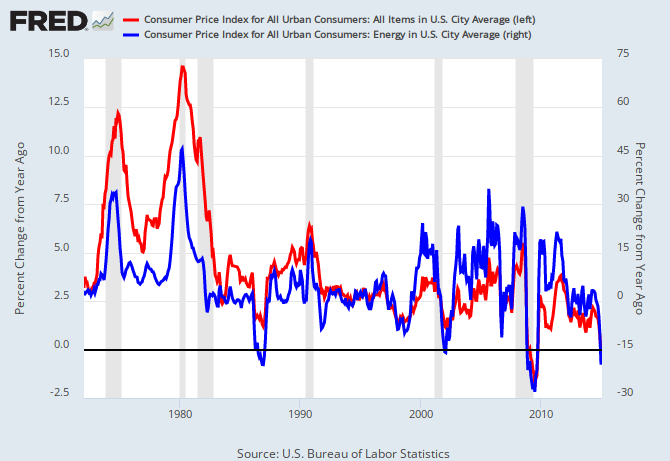
With all of the above considered, the current reality is: The initial influence on inflation in America today is oil prices. Oil prices affect, to some degree, the price of every product and every service.

The price of oil is embedded in all levels of manufacture, all levels of shipping, and every level of service.


Monetary Sovereignty
Red line = Changes in the Consumer Price Index for Energy; Blue line = Changes in the Consumer Price Index for All Items


The Fed uses its interest rate tool in a constant battle with oil prices and with Congressional budgeting, to control what it believes to be the nation’s optimum level of inflation for optimum economic growth.

Speaking of economic growth, a typical formula is:

Gross Domestic Product = Federal Spending + Non-federal Spending + Net Exports

Federal Spending not only is a direct factor, but it also affects Non-federal Spending by providing dollars to businesses.

Federal spending is the primary controllable driver of GDP growth, and this control over Federal Spending primarily is in the hands of Congress and the President, not the Fed.

The Senators and Representatives who claim the Fed is “not doing enough” to grow the economy merely are shifting blame from their own mishandling of the budget. Bottom line:

Congress and the President control economic growth, and the Fed controls inflation.

Contrary to what you repeatedly are told, federal “deficits” (economic surpluses) and federal “debt” (deposits in T-security accounts at the Federal Reserve Bank) are stimulative and infinitely sustainable.

Congress and the President, by pretending that federal deficits and debt are a danger to the economy, are the ones most responsible for low economic growth and a widening Gap between the rich and the rest of us.

In summary, the Federal Reserve has a limited mission: To manage banking and to prevent excessive inflation. Economic growth is the mission of Congress and the President.

Get to it, boys.

Rodger Malcolm Mitchell
Monetary Sovereignty

………………………………………………………………………………………………………………………………………………………………………………………………………………………………………………………………………………………………………………………………………..

The single most important problems in economics involve the excessive income/wealth/power Gaps between the have-mores and the have-less.

Wide Gaps negatively affect poverty, health and longevity, education, housing, law and crime, war, leadership, ownership, bigotry, supply and demand, taxation, GDP, international relations, scientific advancement, the environment, human motivation and well-being, and virtually every other issue in economics.

Implementation of The Ten Steps To Prosperity can narrow the Gaps:

Ten Steps To Prosperity:
1. ELIMINATE FICA (Ten Reasons to Eliminate FICA )
Although the article lists 10 reasons to eliminate FICA, there are two fundamental reasons:
*FICA is the most regressive tax in American history, widening the Gap by punishing the low and middle-income groups, while leaving the rich untouched, and
*The federal government, being Monetarily Sovereign, neither needs nor uses FICA to support Social Security and Medicare.
2. FEDERALLY FUNDED MEDICARE — PARTS A, B & D, PLUS LONG TERM CARE — FOR EVERYONE (H.R. 676, Medicare for All )
This article addresses the questions:
*Does the economy benefit when the rich can afford better health care than can the rest of Americans?
*Aside from improved health care, what are the other economic effects of “Medicare for everyone?”
*How much would it cost taxpayers?
*Who opposes it?”
3. PROVIDE A MONTHLY ECONOMIC BONUS TO EVERY MAN, WOMAN AND CHILD IN AMERICA (similar to Social Security for All) (The JG (Jobs Guarantee) vs the GI (Guaranteed Income) vs the EB (Economic Bonus)) Or institute a reverse income tax.
This article is the fifth in a series about direct financial assistance to Americans:

Why Modern Monetary Theory’s Employer of Last Resort is a bad idea. Sunday, Jan 1 2012
MMT’s Job Guarantee (JG) — “Another crazy, rightwing, Austrian nutjob?” Thursday, Jan 12 2012
Why Modern Monetary Theory’s Jobs Guarantee is like the EU’s euro: A beloved solution to the wrong problem. Tuesday, May 29 2012
“You can’t fire me. I’m on JG” Saturday, Jun 2 2012

Economic growth should include the “bottom” 99.9%, not just the .1%, the only question being, how best to accomplish that. Modern Monetary Theory (MMT) favors giving everyone a job. Monetary Sovereignty (MS) favors giving everyone money. The five articles describe the pros and cons of each approach.
4. FREE EDUCATION (INCLUDING POST-GRAD) FOR EVERYONE Five reasons why we should eliminate school loans
Monetarily non-sovereign State and local governments, despite their limited finances, support grades K-12. That level of education may have been sufficient for a largely agrarian economy, but not for our currently more technical economy that demands greater numbers of highly educated workers.
Because state and local funding is so limited, grades K-12 receive short shrift, especially those schools whose populations come from the lowest economic groups. And college is too costly for most families.
An educated populace benefits a nation, and benefitting the nation is the purpose of the federal government, which has the unlimited ability to pay for K-16 and beyond.
5. SALARY FOR ATTENDING SCHOOL
Even were schooling to be completely free, many young people cannot attend, because they and their families cannot afford to support non-workers. In a foundering boat, everyone needs to bail, and no one can take time off for study.
If a young person’s “job” is to learn and be productive, he/she should be paid to do that job, especially since that job is one of America’s most important.
6. ELIMINATE FEDERAL TAXES ON BUSINESS
Businesses are dollar-transferring machines. They transfer dollars from customers to employees, suppliers, shareholders and the federal government (the later having no use for those dollars). Any tax on businesses reduces the amount going to employees, suppliers and shareholders, which diminishes the economy. Ultimately, all business taxes reduce your personal income.
7. INCREASE THE STANDARD INCOME TAX DEDUCTION, ANNUALLY. (Refer to this.) Federal taxes punish taxpayers and harm the economy. The federal government has no need for those punishing and harmful tax dollars. There are several ways to reduce taxes, and we should evaluate and choose the most progressive approaches.
Cutting FICA and business taxes would be a good early step, as both dramatically affect the 99%. Annual increases in the standard income tax deduction, and a reverse income tax also would provide benefits from the bottom up. Both would narrow the Gap.
8. TAX THE VERY RICH (THE “.1%) MORE, WITH HIGHER PROGRESSIVE TAX RATES ON ALL FORMS OF INCOME. (TROPHIC CASCADE)
There was a time when I argued against increasing anyone’s federal taxes. After all, the federal government has no need for tax dollars, and all taxes reduce Gross Domestic Product, thereby negatively affecting the entire economy, including the 99.9%.
But I have come to realize that narrowing the Gap requires trimming the top. It simply would not be possible to provide the 99.9% with enough benefits to narrow the Gap in any meaningful way. Bill Gates reportedly owns $70 billion. To get to that level, he must have been earning $10 billion a year. Pick any acceptable Gap (1000 to 1?), and the lowest paid American would have to receive $10 million a year. Unreasonable.
9. FEDERAL OWNERSHIP OF ALL BANKS (Click The end of private banking and How should America decide “who-gets-money”?)
Banks have created all the dollars that exist. Even dollars created at the direction of the federal government, actually come into being when banks increase the numbers in checking accounts. This gives the banks enormous financial power, and as we all know, power corrupts — especially when multiplied by a profit motive.
Although the federal government also is powerful and corrupted, it does not suffer from a profit motive, the world’s most corrupting influence.
10. INCREASE FEDERAL SPENDING ON THE MYRIAD INITIATIVES THAT BENEFIT AMERICA’S 99.9% (Federal agencies)Browse the agencies. See how many agencies benefit the lower- and middle-income/wealth/ power groups, by adding dollars to the economy and/or by actions more beneficial to the 99.9% than to the .1%.
Save this reference as your primer to current economics. Sadly, much of the material is not being taught in American schools, which is all the more reason for you to use it.

The Ten Steps will grow the economy, and narrow the income/wealth/power Gap between the rich and you.

MONETARY SOVEREIGNTY

Do you deserve to be a desperate, low-wage worker? Protest. Learn. Vote.

It takes only two things to keep people in chains: The ignorance of the oppressed and the treachery of their leaders.
………………………………………………………………………………………………………………………………………………………………………………

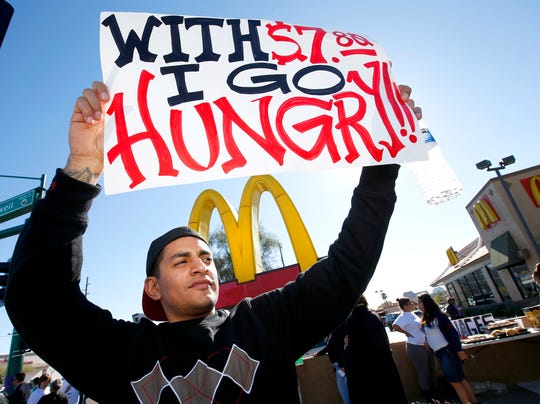
The pundits continue to mislead the public about Monetary Sovereignty, and that is just what the rich want. If you accept their lies, you will have less and less, while they have more and more — and that will make you desperate enough to slave permanently for low wages.Image result for minimum wage workers

In June, three columnists were quoted by The Week Magazine, Tom Rogan, Michael Tanner, and Jordan Weissmann. What these three men said was outrageously wrong, but it is the norm in today’s “made-to-misinform,” “owned-by-the-rich” media.

First, Rogan:

Why Trump’s budget is smart to propose cuts to healthcare research

The failure to reform entitlements is economic insanity. It will bury the nation in debt, and restrain the opportunities available to future generations.

“The money has run out,” said Rogan in WashingtonExaminer.com. This country is “taking on persistent deficits” and “slowly drowning” in $20 million of national debt.

Translations:

  1. “Reform entitlements” is conservative-speak for “gut Medicare, gut Medicaid, and gut Social Security.” This would widen the Gap between the rich and the rest, exactly what the rich pay the media to do.
  2. The so-called “debt” actually is the total of deposits in T-security accounts at the world’s safest bank, the Federal Reserve Bank. Does Rogan call his local bank’s deposits “debt”? Does he claim that his local bank is “drowning” in deposits? Why does he say it about the world’s safest bank? Paid by the rich.
  3. Federal “deficits” are the net dollars the government spends into the economy. Federal deficits are the economy’s income. Federal deficits are an economic surplus. If the federal government didn’t run deficits (economic surpluses), the economy would have no income other than net exports (which we seldom run), and we would fall into a depression.

Misunderstandings would disappear if we properly called the misnamed debt, “deposits,” and the misnamed deficits, economic “surpluses.”

Here is a bit of history. Debt reductions lead to depressions:
1804-1812: U. S. Federal Debt reduced 48%. Depression began 1807.
1817-1821: U. S. Federal Debt reduced 29%. Depression began 1819.
1823-1836: U. S. Federal Debt reduced 99%. Depression began 1837.
1852-1857: U. S. Federal Debt reduced 59%. Depression began 1857.
1867-1873: U. S. Federal Debt reduced 27%. Depression began 1873.
1880-1893: U. S. Federal Debt reduced 57%. Depression began 1893.
1920-1930: U. S. Federal Debt reduced 36%. Depression began 1929.

U.S recessions follow deficit growth reductions, and are cured by deficit (economic surplus) growth increases.

Monetary Sovereignty
As the federal deficit (economic surplus) growth falls, we approach recession, which is cured by deficit (economic surplus) growth increases. Economic surplus growth is necessary for economic growth.

Then, there’s Michael Tanner in National Review.com:

Trump realizes “he can’t actually balance the budget simply by eliminating ‘waste, fraud, and abuse. The only way to truly reduce federal spending is to . . . cut programs that are popular, supported by powerful, special interests, or both.”

Image result for minimum wage workersTranslation: “Balance the budget” means, “Add zero new dollars to the economy, thereby preventing economic growth.”

You need to balance your budget. Even your city and state need to balance their budgets.

But the federal government never should balance its budget. Never.

And then we come to the craziest comment yet, this one by Jordan Weissmann in Slate.com:

“If you really want to tackle the debt, you have to take on the two giants of federal spending: Social Security and Medicare.

Without entitlement reform, and with massive tax cuts for the wealthy to fund, Trump’s budget is nothing more than a ‘permission slip’ for Paul Ryan and company . . . telling them ‘they are free to go wild butchering the essential pieces of the safety net.”

Get it? Weissmann wants to “take on” (i.e. gut) Social Security and Medicare, but does not want to “butcher . . . the safety net” (i.e. Social Security and Medicare). Huh?

Finally, we are told that deficit spending is not just a fiscal problem, it is a moral problem:

GOP Budget: Deficit Spending ‘a Sin;’ We’ll Do It 9 More Years
By Terence P. Jeffrey | August 2, 2017

The Republicans in Congress today heroically (plan to) balance the budget in fiscal 2027 — after increasing the debt every year from 2017 through 2026.

“For too long, the federal government’s excessive spending has put future generations at risk,” says a statement on the committee’s website. “Failure to take swift and decisive action is not only inexcusable, it is immoral.”

We today, are the “future generations” who were “at risk” back in 1940, when the federal debt was $40 billion and was called a “ticking time bomb.  Today, the federal debt is $14 TRILLION, and that “at risk” time bomb supposedly still is ticking.

Here is the federal debt fear-mongers’ story:

A cult leader told his flock the world was about to end, so they should give him all their worldly goods and go to the top of the mountain to await the end. They believed, but when the end didn’t happen, they came down to destitution, haven given everything away.

The next year the cult leader said the same thing, and they believed him again, and every year after that he warned them, they believed, and gave away their possessions, again and again. They were incapable of learning from experience.

I have just told you the federal debt fear-mongers’ story.

“As Nobel Laureate James M. Buchanan wrote: ‘Politicians prior to World War II would have considered it to be immoral (to be a sin) to spend more than they were willing to generate in tax revenues, except during periods of extreme and temporary emergency,'” said the report.

“‘To spend borrowed sums on ordinary items for public consumption was, quite simply, beyond the pale of acceptable political behavior. There were basic moral constraints in place; there was no need for an explicit fiscal rule in the written constitution.'”

Oh, the immorality of it, spending for ordinary items that you, the public may consume.Image result for minimum wage workers

The rich, “high priests” of America want you to believe that only the rich are entitled to consume.

They want you “not-rich” to work endlessly for scraps. They want you to believe that the worse your life, the more moral you are, and the only way to be moral is to work ’til you drop.

That way, the rich would have a ready supply of slave labor, uncomplaining ignorant, low-wage slaves. It would be “good” for the economy.

Let’s summarize the lies the rich want you to believe.

  1. The federal government is running short of money. (It can’t. It is Monetarily Sovereign.)
  2. The federal “debt” and deficits are unsustainable. (Unsustainable like the phony “time bomb” that has been ticking since 1940.)
  3. The problem is: You receive too much in Social Security, Medicare, Medicaid, and other social benefits. You are not entitled to those benefits. Only the rich should live well. You should work ’til you drop. (Who made that rule?)

The rich want you to accept the lies so you will be a desperate worker. Your defense is to understand the truth and to protest, protest, protest. And learn. And vote.

And that brings us to our last point:

Up to 75.5 percent of those very lowest income families didn’t vote in 2014. Lower-income people tend to vote less than higher-income people.

Voting rates go up with income levels — the highest-income group, people in families making $150,000 or more, also had the highest turnout, at 56.6 percent.

The rich are not better than you. The rich do not deserve more than you. They are just people who think they are better and think they deserve more.

Protest. Learn. Vote.

If you let them con you, and if you accept their lies, well maybe they will be proved right.

Rodger Malcolm Mitchell
Monetary Sovereignty

………………………………………………………………………………………………………………………………………………………………………………………………………………………………………………………………………………………………………………………………………..

The single most important problems in economics involve the excessive income/wealth/power Gaps between the have-mores and the have-less.

Wide Gaps negatively affect poverty, health and longevity, education, housing, law and crime, war, leadership, ownership, bigotry, supply and demand, taxation, GDP, international relations, scientific advancement, the environment, human motivation and well-being, and virtually every other issue in economics.

Implementation of The Ten Steps To Prosperity can narrow the Gaps:

Ten Steps To Prosperity:
1. ELIMINATE FICA (Ten Reasons to Eliminate FICA )
Although the article lists 10 reasons to eliminate FICA, there are two fundamental reasons:
*FICA is the most regressive tax in American history, widening the Gap by punishing the low and middle-income groups, while leaving the rich untouched, and
*The federal government, being Monetarily Sovereign, neither needs nor uses FICA to support Social Security and Medicare.
2. FEDERALLY FUNDED MEDICARE — PARTS A, B & D, PLUS LONG TERM CARE — FOR EVERYONE (H.R. 676, Medicare for All )
This article addresses the questions:
*Does the economy benefit when the rich can afford better health care than can the rest of Americans?
*Aside from improved health care, what are the other economic effects of “Medicare for everyone?”
*How much would it cost taxpayers?
*Who opposes it?”
3. PROVIDE A MONTHLY ECONOMIC BONUS TO EVERY MAN, WOMAN AND CHILD IN AMERICA (similar to Social Security for All) (The JG (Jobs Guarantee) vs the GI (Guaranteed Income) vs the EB (Economic Bonus)) Or institute a reverse income tax.
This article is the fifth in a series about direct financial assistance to Americans:

Why Modern Monetary Theory’s Employer of Last Resort is a bad idea. Sunday, Jan 1 2012
MMT’s Job Guarantee (JG) — “Another crazy, rightwing, Austrian nutjob?” Thursday, Jan 12 2012
Why Modern Monetary Theory’s Jobs Guarantee is like the EU’s euro: A beloved solution to the wrong problem. Tuesday, May 29 2012
“You can’t fire me. I’m on JG” Saturday, Jun 2 2012

Economic growth should include the “bottom” 99.9%, not just the .1%, the only question being, how best to accomplish that. Modern Monetary Theory (MMT) favors giving everyone a job. Monetary Sovereignty (MS) favors giving everyone money. The five articles describe the pros and cons of each approach.
4. FREE EDUCATION (INCLUDING POST-GRAD) FOR EVERYONE Five reasons why we should eliminate school loans
Monetarily non-sovereign State and local governments, despite their limited finances, support grades K-12. That level of education may have been sufficient for a largely agrarian economy, but not for our currently more technical economy that demands greater numbers of highly educated workers.
Because state and local funding is so limited, grades K-12 receive short shrift, especially those schools whose populations come from the lowest economic groups. And college is too costly for most families.
An educated populace benefits a nation, and benefitting the nation is the purpose of the federal government, which has the unlimited ability to pay for K-16 and beyond.
5. SALARY FOR ATTENDING SCHOOL
Even were schooling to be completely free, many young people cannot attend, because they and their families cannot afford to support non-workers. In a foundering boat, everyone needs to bail, and no one can take time off for study.
If a young person’s “job” is to learn and be productive, he/she should be paid to do that job, especially since that job is one of America’s most important.
6. ELIMINATE FEDERAL TAXES ON BUSINESS
Businesses are dollar-transferring machines. They transfer dollars from customers to employees, suppliers, shareholders and the federal government (the later having no use for those dollars). Any tax on businesses reduces the amount going to employees, suppliers and shareholders, which diminishes the economy. Ultimately, all business taxes reduce your personal income.
7. INCREASE THE STANDARD INCOME TAX DEDUCTION, ANNUALLY. (Refer to this.) Federal taxes punish taxpayers and harm the economy. The federal government has no need for those punishing and harmful tax dollars. There are several ways to reduce taxes, and we should evaluate and choose the most progressive approaches.
Cutting FICA and business taxes would be a good early step, as both dramatically affect the 99%. Annual increases in the standard income tax deduction, and a reverse income tax also would provide benefits from the bottom up. Both would narrow the Gap.
8. TAX THE VERY RICH (THE “.1%) MORE, WITH HIGHER PROGRESSIVE TAX RATES ON ALL FORMS OF INCOME. (TROPHIC CASCADE)
There was a time when I argued against increasing anyone’s federal taxes. After all, the federal government has no need for tax dollars, and all taxes reduce Gross Domestic Product, thereby negatively affecting the entire economy, including the 99.9%.
But I have come to realize that narrowing the Gap requires trimming the top. It simply would not be possible to provide the 99.9% with enough benefits to narrow the Gap in any meaningful way. Bill Gates reportedly owns $70 billion. To get to that level, he must have been earning $10 billion a year. Pick any acceptable Gap (1000 to 1?), and the lowest paid American would have to receive $10 million a year. Unreasonable.
9. FEDERAL OWNERSHIP OF ALL BANKS (Click The end of private banking and How should America decide “who-gets-money”?)
Banks have created all the dollars that exist. Even dollars created at the direction of the federal government, actually come into being when banks increase the numbers in checking accounts. This gives the banks enormous financial power, and as we all know, power corrupts — especially when multiplied by a profit motive.
Although the federal government also is powerful and corrupted, it does not suffer from a profit motive, the world’s most corrupting influence.
10. INCREASE FEDERAL SPENDING ON THE MYRIAD INITIATIVES THAT BENEFIT AMERICA’S 99.9% (Federal agencies)Browse the agencies. See how many agencies benefit the lower- and middle-income/wealth/ power groups, by adding dollars to the economy and/or by actions more beneficial to the 99.9% than to the .1%.
Save this reference as your primer to current economics. Sadly, much of the material is not being taught in American schools, which is all the more reason for you to use it.

The Ten Steps will grow the economy, and narrow the income/wealth/power Gap between the rich and you.

MONETARY SOVEREIGNTY