Yogi Berra, the great Yankee philosopher, said in essence, “Predicting is hard, especially the future.”
But I am going do it because, as President John Kennedy said, ” . . . not because (it’s) easy, but because (it’s) hard.”
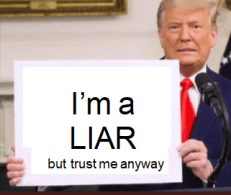
I predict the Senate will convict Donald Trump.
Follow my logic:
Too many to ignore, do trust him
The greatest danger to the Republican party comes not from the Democrats, but from Trump.
He controls a vast bloc of ignorant cult followers, who have proven they will vote for him even, as he himself claimed, he were to “shoot someone on 5th Avenue.”
The danger to the GOP is that Trump will run for President four years hence, and split the party as he already has, only even more so, when all his high crimes and misdemeanors come into bright light. That party split will lose to the Dems.
The more imminent danger is that two years hence, he will interfere with the midterm elections, and essentially take over the party.
So, just on the face of it, the GOP part of the Senate would be wise to convict him, just to prevent him from running and destroying the GOP.
But why would Trump even want to run in four years or to interfere with the midterms? He hates to work, and would much rather spend his years playing golf.
Answer: Because he is the classic AFAB (Anything For A Buck) guy, and he has some serious financial issues coming up.
Trump doesn’t give a hoot about the Presidency and he doesn’t give a fig about conservatism.
He’s not even a conservative. Never was. He was a Dem most of his life. He has no political philosophy to pass down through the ages. He strictly is a me-first, me-last and me-in-between psychopath.
But, as the slimy Republican Senator, Lindsey Graham said five years ago, “I’m thinking about running for president. You get a house and a car and a plane. It’s a pretty good gig,”
The financially needy/greedy Trump already has seen how good a gig it is.
Consider this:
He is one of the worst business leaders imaginable— nobody but Trump goes broke running casinos — three of them — plus other bankruptcies. He doesn’t know how to run anything, as the past four years have taught us.
Everything he touches fails — Trump steaks, Trump water, Trump airline, Trump vodka, Trump winery, Trump Magazine — or is crooked, like Trump University and Trump Foundation. The list of failures is endless.
He has survived, not by running anything, but by renting his name, which now has fallen apart. No one wants to touch him.
And another lucrative TV show is unlikely, because, being exposed as a crooked loser, he has nothing to offer.
He owes banks and other lenders hundreds of millions of dollars.
His Trumpers have given him hundreds of millions of dollars to do with as he chooses, and that money will keep flowing in, so long as he can keep running for President. When he no longer a candidate or prospective candidate, his leverage disappears.
And if clever Mitch McConnell knows this, then he is telling it to the other Senate Republicans. And though the GOP seems to have a near-monopoly on stupid Senators, enough of them will get the message to swing the vote — so long as Democrats don’t let their usual high-and-mighty, faux morality pull defeat from the jaws of victory.
The sole problem for the GOPers is how to get rid of Trump without looking like they want to get rid of Trump, and that will require piling on the evidence, i.e working with the Dems, rather than against them in the hearings.
So you are going to see a ton sh*t hit the Trump fan, so much that even the Hannityesque FOXy phonies “reluctantly” will opt to convict because “the Constitution and the good of the nation require it.” (As though these pols FOXies even care about the Constitution and the good of the nation.)
Having no electoral future, Trump will abandon the GOP like it was a poor, drunk uncle asking for a loan, and will try to work something out with Putin and the Saudis.
Good luck with that, Donald. They need you like a duck needs a raincoat.
Bottom line: Trump and his good-for-nothing-kids are finished, while the GOP moves on — perhaps with a good-looking, female (white, of course) Presidential candidate.
So that is what I predict. The Senate will convict Donald Trump, and he even may become “Convict Donald Trump,” and wear an orange jumpsuit to match his face.
Gap Psychology describes the common desire to distance oneself from those “below” in any socio-economic ranking, and to come nearer those “above.” The socio-economic distance is referred to as “The Gap.”
Wide Gaps negatively affect poverty, health and longevity, education, housing, law and crime, war, leadership, ownership, bigotry, supply and demand, taxation, GDP, international relations, scientific advancement, the environment, human motivation and well-being, and virtually every other issue in economics.Implementation of Monetary Sovereignty and The Ten Steps To Prosperity can grow the economy and narrow the Gaps:
Just An Introduction
Trump followers claim that Republican judges and SCOTUS justices are cowards who have yielded to mythical “pressure” into denying Trump’s absurd claims.
But, most of the so-called “pressure” is coming from Trump, and as for SCOTUS justices, what sort of pressure can affect them? They are immune.
Nevertheless, Trumpers have taken to the streets to scream, “Stop the Steal.”
I suggest the retort should be “Stop the Stupid,” for only a very stupid person actually believes that 30+ judges and the entire Supreme Court, most of whom are right-leaning, would ignore right-wing evidence.
(The problem is, when people are stupid, they are too stupid to realize they are stupid.)
The Main Idea
The phrase “Stop the Stupid” brings me to an article published by that ever-dependable source of economic ignorance, The Committee for a Responsible Federal Budget (CRFB)
Today’s article, like virtually all CRFB articles, suggests cutting federal benefits to everyone who is not rich.
Whether it be Social Security, Medicare, unemployment compensation, food stamps, or any other financial support program for the middle or poor, you can rely upon the CRFB to come in, all a-twitter, with charts and articles demonstrating the lie that the federal government can’t afford such spending.
And so it is now, with Pell grants.
WHAT ARE PELL GRANTS?
Today, the Pell Grant program assists undergraduates of low-income families, who are actively attending universities and or other secondary institutions. Before the Pell Grant became what it is today, it went through numerous changes.
In 1965, Congress passed the Higher Education Act of 1965 (HEA). President Lyndon B. Johnson implemented the HEA as a part of his administration’s “Great Society” agenda to assist and improve higher education in the United States.
It was the initial legislation to benefit lower- and middle-income students.
The HEA program included not only grants but also low-interest loans to students who did not qualify for grants.
Universities and other institutions, such as vocational schools, benefited as well from the HEA program, by receiving federal aid to improve the quality of the education process.
Student aid programs administered by the US Department of Education are contained in Title IV of the HEA and so are called “Title IV Programs.”
As you can see, the HEA, like all laws, was created from thin air by Congress and the President. It was a time when Congress and the President cared about helping low- and middle-income families. (Remember those days of yor?)
Congress was able to create HEA, and subsequent Amendments, because being Monetarily Sovereign, the U.S. has unlimited dollars available to it. Even without collecting a single dollar in taxes, the federal government cannot ever run short of dollars. Not ever.
In 1972, Title IX Higher Education Amendments were a response to the distribution of aid in the current grant.
Senator Claiborne Pell set forth the initial movements to reform the HEA. Lois Rice, an American corporate executive, scholar, and education policy expert is known as the “mother of the Pell Grant” for her work lobbying for its creation.
Opportunity Grant Programs (Basic Grant) were intended to serve as the “floor” or “foundation” of an undergraduate student’s financial aid package. Other financial aid, to the extent that it was available, would be added to the Basic Grant up to the limit of a student’s financial need.
Most changes to the federal student aid program result from a process called reauthorization.
Through the process of reauthorization, Congress examines the status of each program and decides whether to continue that program and whether a continued program requires changes in structure or purpose.
Congress has reauthorized campus-based programs every five or six years, beginning in 1972.
In short, the Pell program is completely arbitrary.
It has no intrinsic financial constraints. Pell’s finances are constrained only by what Congress and the President happen to voice on any particular day.
Pell primarily is funded by arbitrary appropriations.
The bill provides $72.8 billion in discretionary funding for the Department of Education (ED), a $1.3 billion increase from FY 2019. The bill boosts the maximum Pell Grant award to $6,345, though it relies on a $500 million recession from the program’s reserve fund.
The bill also increases funding for the Federal Supplemental Educational Opportunity Grant (FSEOG) program by $25 million (to $865 million) — which Trump proposed to cut entirely — and allocates $1.2 billion for the Federal Work-Study (FWS) program, a $50 million increase from FY 2019.
In Trump’s proposal, he suggested slashing funding for FWS in half.
To hammer home the central point, the Pell grant, and every other program financed by the government, can be at any cost. The federal government, unlike state and local governments, cannot run short of dollars.
Congress and the President decide what to spend, and create the spending dollars from thin air. The federal government controls infinite financial resources.
Here for instance is what Congress appropriated for Pell during a 5-year period, 2007 – 2011.
Appropriations
Fiscal Year 2011: $41,674,180,000
Fiscal Year 2010: $21,772,000,000
Fiscal Year 2009 : $19,378,000,000
Fiscal Year 2008 : $16,256,000,000
Fiscal Year 2007 : $13,660,711,000
Why the hugely different amounts? Congress simply voted for whatever it pleased. There are no financial limits placed on Congress or the President. You wouldn’t know that, however, if you read the latest CRFB histrionics:
With 2020 college enrollment down as a result of the COVID-19 pandemic, the Pell Grant program may add more to its reserves than previously estimated.
A lie. There are no “reserves.” They are a financial myth.
Think: Of what purpose would “reserves” be, when the supply of dollars is infinite. Creating “reserves” is just a way to con the poor and middle-income people into believing that federal money is tight.
It is a lie, and I have come to the conclusion that, after all these years, everyone at the CRFB knows it is a lie.
Policymakers may be tempted to spend these additional reserves in the end-of-year omnibus bill by expanding Pell Grants, for example, to cover short-term educational or training programs. They should avoid this temptation.
As recent experience from the Great Recession shows, economic downturns can quickly increase the costs of the Pell program and lead to large shortfalls.
A lie.“Shortfalls” only will come if Congress unnecessarily votes to create shortfalls. Fictional “reserves” can’t cover “shortfalls” or anything else. The federal government never unintentionally faces financial shortfalls.
Spending funds now on low-priority, questionable initiatives will leave less room to weather the economic downturn or target future funds where they are truly needed.
A lie. The “room to weather an economic downturn or target future funds” is infinite. This year, Congress voted to spend an additional $3 trillion in stimulus money.
No problem. It could (should) have voted double or triple that amount, and still there would be no problem. The federal government simply creates money by spending money. That is the federal government’s standard process for creating dollars.
The Pell Grant program, which provides financial aid to low- and middle-income college students, has a unique budgeting structure.
Program costs are based on the number of eligible applicants, and all eligible applicants automatically receive their award based on a formula.
It is mostly funded, however, through the annual appropriations process.
Exactly. Congress votes; the President signs; and the money is created from thin air, at the touch of a computer key.
When appropriations exceed costs, the program can essentially save the unspent dollars to expand its reserves. This has been the case in recent years, leading to an $11 billion reserve in 2020.
Prior to the COVID-19 pandemic, CBO projected reserves would continue to grow to $18 billion by 2030.
A lie. The “reserve” is a bookkeeping fiction. Totally unnecessary.
At the whim of Congress, the reserve could be $0 or $1 trillion, and nothing would change. Whenever it wishes, Congress merely can vote to increase the reserve, eliminate the reserve, or do anything else it wishes. The reserve is financially meaningless, meant to fool the uninformed.
CBO previously projected the Pell program would generate $850 million of extra funds in 2021; the actual amount is likely to be higher.
As a result of the pandemic, college enrollment for the 2020-2021 academic year is down 4 percent for all students and 16 percent for freshmen.
A lie.The Pell program generates nothing. Congress spends whatever it wishes to spend.
If Pell costs fell just 5 percent as a result, the Pell reserve would grow an additional $1 billion per year; if they fell 10 percent, it would expand by more than $2 billion per year.
A lie.The reserve is neither more nor less than what Congress and the President want.
The “reserve” is just numbers on a balance sheet that the government has the infinite ability to change at will. It’s like a game of Monopoly™, where the players can change the rules any time they wish.
Politicians may view these extra reserves as an opportunity to expand the Pell program. Given current economic uncertainty, however, this would be a mistake.
A lie.One cannot say what Congress viewed, but the reality is, “extra reserves” provide no opportunity to expand the program.
The opportunity to expand the program comes from Congress’s and the President’s acknowledgment that unlimited dollars are available.
While pandemics tend to reduce college enrollment, recessions often boost enrollment substantially.
During every recession since the 1960s, college enrollment has increased as unemployed workers looked to learn new skills and saw college as a more attractive option given the lack of available jobs.
This was particularly evident during the Great Recession, when the number of people collecting Pell Grants jumped 70 percent from 5.5 million in 2008 to 9.4 million in 2012.
The fact that more people opt for college during hard times merely demonstrates the wisdom of the populace.
It is no threat, whatsoever, to federal solvency, which is infinite.
Over this period, the Pell finances took a turn for the worse. In 2007, CBO’s projected future Pell costs would roughly match funding levels.
By 2012, the agency projected a ten-year shortfall of nearly $60 billion.
The expansions to the Pell program at the beginning of the Great Recession and subsequent rise in enrollment and average award meant Congress had to inject more than $50 billion above regular appropriationsbetween 2009 and 2014 and cut eligibility and benefits in the latter years.
A lie. Pell finances turn for the worse (or better) based on which political party is in control.
If the Democrats control, Pell usually is given more money. The GOP usually tries to cut Pell.
Note that Congress injected more than $50 billion extra into the program, simply by voting to do so. The money didn’t “come from” somewhere. Congress created it just by voting.
The same deterioration could occur again once an effective vaccine is distributed throughout the population and people are no longer avoiding in-person schooling.
This time enrollment could increase for several reasons – including from enrollment of those who delayed schooling through the pandemic, those who suffered job losses or business closures, and those who continue to enroll in newly expanded online programs.
Until these enrollment pressures are better understood, policymakers should avoid spending what is likely a very temporary source of excess funding.
A lie. If the Democrats regain control over Congress, there is a greater chance funding will increase. It’s that simple.
It has nothing to do with job losses and business closures. It has to do with the desire to support the more needy Americans.
Instead of expending a temporary Pell surplus on a questionable new policy, policymakers should save it for rainy days that could be soon to come.
As we monitor enrollment in the post-pandemic portion of the recovery, we will have a better sense of what resources are available and more time to deliberate on how to use them effectively to best achieve the goal of ensuring higher education access and affordability for low-income students.
A massive lie. In federal finances, there is no such thing as a “rainy day.”
For the federal government, every day is financially sunny. The federal government should not just expand Pell. Rather it should fund college for everyone who wants it, regardless of personal wealth and income. (See: Ten Steps to Prosperity, below)
Each dollar spent on college educations funds greater American brainpower, economic growth, and international competitiveness.
In Summary
CRFB is one gigantic lie, composed of numerous half-lies, innuendos, false comparisons, fear-mongering, and flat-out dishonesty.
It is funded by the very rich to provide the government with false excuses for not helping the middle and the poor.
The purpose is to widen the Gap between the rich and the rest.
If you want to know who the liars are, here’s a list.
Gap Psychology describes the common desire to distance oneself from those “below” in any socio-economic ranking, and to come nearer those “above.” The socio-economic distance is referred to as “The Gap.”
Wide Gaps negatively affect poverty, health and longevity, education, housing, law and crime, war, leadership, ownership, bigotry, supply and demand, taxation, GDP, international relations, scientific advancement, the environment, human motivation and well-being, and virtually every other issue in economics.Implementation of Monetary Sovereignty and The Ten Steps To Prosperity can grow the economy and narrow the Gaps:
RECESSION [rəˈseSH(ə)n] noun A period of temporary economic decline during which trade and industrial activity are reduced, generally identified by a fall in GDP in two successive quarters. Recessions generally occur when there is a widespread drop inSpending.
The measure of Spending is Gross Domestic Product (GDP), the formula for which is:
GDP = Federal Spending + Non-federal Spending + Net Exports
Spending is related to the supply of money in the economy. All recessions are caused by reductions in money supply growth, but they may be triggered by many different factors. As you will see, understanding the difference between “caused by” and “triggered by” is important.
Red line =Annual percentage changes in Federal Deficit Spending. Recessions = vertical gray bars.
The above graph shows that recessions (vertical gray bars) tend to occur following periods of reduced federal deficit spending growth. Recessions are cured by increased federal deficit spending growth.
The graph below is a close-up view of the period following the 2008 recession. It shows a 2009 – 2020 decline in deficit growth, which made the 2020 recession inevitable.
The line shows federal deficit spending growth.
Here is the same graph, with the addition of Gross Domestic Product.
Blue line = Gross Domestic Product
After the federal deficit spending to cure the 2008 recession started to decline, GDP growth had leveled off. We experienced a severe GDP decline in 2019 — well before COVID — when we already were on our way to recession.
In the Alps, snow often becomes so deep that dangerous avalanches are imminent. So, to forestall an unexpected and potentially fatal avalanche, cannons are fired at the snowpack, to triggera controlled avalanche.
It is not the cannons that cause the avalanche; the cause is the unstable snowpack. The avalanche, which eventually would have occurred with or without the cannons, was triggered by the cannons.
The uptick in the end-of 2019 federal deficit growth was the government’s response to the anticipated and realized GDP reduction. Sadly, it was not sufficient to prevent the recession.
Summary:
a recession is “a fall in GDP in two successive quarters,” and
GDP is based on spending, and
Because of reduced deficit spending growth, GDP began to fall in 2018, and seriously to fall in 2019, so
We were about to have a recession before COVID. The pandemic did not cause the recession. COVID merely was the “cannon fire” that triggered an already imminent recession.
Outside events — pandemics, weather, stock market disruptions, oil shocks, earthquakes, wars, etc. — do not cause recessions. They only trigger recessions that were destined to happen, because the economy lacked money. Ultimately, all recessions are caused by lack of money in the private sector.
The subprime mortgage crisis was a trigger for, not the cause of, the 2008 recession. Federal deficit growth already was declining.
The 9/11 attack and technology speculation were triggers for, not the causes of, the 2001 recession. Federal deficit growth already was declining.
An oil shock was a trigger for, not a cause of, the 1990 recession. Federal deficit growth already was declining.
Inflation and oil shortages were triggers for, not causes of, the “double-dip” recessions of 1980 & 1981. Federal deficit growth already was declining.
Oil price increases were a trigger for, not a cause of, the recession of 1974. Federal deficit growth already was declining.
The real cause of all recessions is Congress’s and the President’s failure to pump enough stimulus money into the economy via deficit spending. Prior to recessions, federal deficit growth declines.
All of the above recessions were cured by increases in federal deficit spending.
Even in those cases where recessions were triggered by oil shortages, the U.S. government could have deficit-spent to purchase oil, then sold it at a loss in America, to prevent the inflationary results. Because all inflations are caused by shortages of key goods, purchasing and redistributing scarce items is how a Monetarily Sovereigngovernment always can prevent/cure inflation.
“The economy needs at least $7 Trillion net added from the federal government. But, our Congress is spending far too little and spending way too late. Unless Congress and the President deign to see the light, we have no way to prevent a depression.”
“The $3 trillion rescue package helped avoid the catastrophe that is certain unless at least $7 trillion is pumped into the private sector.”
That was then; this is now, and Congress still is reluctant to do the deficit spending necessary to prevent a depression.
Neither proposal would have been sufficient to cure the recession, but they would have moderated the suffering.
However, the Republicans still objected, and instead resorted to the old political ploy of claiming the fault was the Democrats’ for not compromising.
Now, families are starving, and Congress is at a standstill, which will continue through the January inauguration. Even then, unless the Democrats win Georgia’s two Senate seats, Republicans may prevent any further stimulus, and the nation will fall into a depression.
The reasons given for the Republican obstruction is that the deficit is “unsustainable,” “unaffordable,” “imprudent” and/or are “socialism.” All those reasons are false.
Further, socialism is not just federal deficit spending. Socialism is ownership and control over resources. When the government merely spends, that is not ownership and control. Medicare, food stamps, unemployment compensation, and all federal purchases from the private sector do not constitute socialism.
Even further, socialism in itself neither is bad nor good. When socialism devolves to a dictatorship, as happens with communism, it is bad. But we have a great deal of socialism in America that is good.
The military, federal agencies like NASA, the FBI, the CIA, the White House, Congress, our court system, roads and highways, most dams, public beaches, public libraries, public parks, West Point military academy, and many others are examples of “good” socialism.
The word “socialism” is used as a pejorative to confuse the public.
Bottom line: Today’s recession is wholly unnecessary. While the politicians blame it on COVID, they merely are finger-pointing. The blame for today’s recession, and indeed for all recessions and depressions, lies squarely with Congress and the President.
It is they who determine the private sector’s money supply, which is the true driver of recessions and depressions.
If Congress and the President can agree on spending an additional $5 trillion – $7 trillion in stimulus money, depending on where the money is spent, the recession would end. The economy would grow, businesses would survive, and the populace would thrive.
Congress and the President have all the power they need if they are willing to use that power to save America rather than using it to put the other party at a political disadvantage.
I fear, however, that if the Republicans maintain control over the Senate, Mitch McConnell has demonstrated he has no interest in helping the American economy and people, but rather seems solely concerned with preventing whatever the Democrats wish to do.
That attitude will lead to a depression in which only the rich will survive unscathed.
Gap Psychology describes the common desire to distance oneself from those “below” in any socio-economic ranking, and to come nearer those “above.” The socio-economic distance is referred to as “The Gap.”
Wide Gaps negatively affect poverty, health and longevity, education, housing, law and crime, war, leadership, ownership, bigotry, supply and demand, taxation, GDP, international relations, scientific advancement, the environment, human motivation and well-being, and virtually every other issue in economics.Implementation of Monetary Sovereignty and The Ten Steps To Prosperity can grow the economy and narrow the Gaps:
And to quote President Ronald Reagan, “There you go, again.”
Except the first time he was talking about President Jimmy Carter’s charge that Reagan opposed Medicare. This time, we reference the Libertarian ongoing, interminable, economically ignorant claim that the so-called “federal debt” is too high by once again calling it a “ticking time bomb.”
I won’t go into details about why the federal “debt” is not a debt in the usual sense; rather, it is deposits that easily are paid off simply by returning them to the depositors. You can read about that,here.
Instead, we will dive directly into an article written by Todd G. Buchholz, “a former White House director of economic policy under President George H.W. Bush and managing director of the Tiger Management hedge fund, who was awarded the Allyn Young Teaching Prize by the Harvard Department of Economics. He is the author of New Ideas from Dead Economists and The Price of Prosperity.”
In 75 years, a 90-fold increase in debt (blue) vs. a 10-fold increase in inflation (red). Still no “time bomb” explosion.
America’s New Debt Bomb, Aug 20, 2020, by TODD G. BUCHHOLZ
Like in World War II, the United States is piling on debt to confront a whole-of-society crisis, raising the question of who will foot the bill in the long term.
Immediately, we come across a misstatement. There is no “bill” for the federal debt. No one ever will pay for the federal debt, not today’s taxpayers nor tomorrow’s. Federal taxes do not fund federal debt.
Federal finances are nothing like personal finances, which require income to fund outgo. The federal government requires no income. It never can run short of dollars, and it does not use taxes to fund spending.
But, unlike the post-war era, the underlying conditions for robust economic recovery today are less than favorable, placing an even greater onus on wise policymaking.
The United States today not only looks ill, but dead broke. To offset the pandemic-induced “Great Cessation,” the US Federal Reserve and Congress have marshaled staggering sums of stimulus spending out of fear that the economy would otherwise plunge to 1930s soup-kitchen levels.
When someone or something is “dead broke,” they are unable to pay their bills. But the federal government never is unable to pay its bills. Being Monetarily Sovereign, it has the infinite ability to pay bills, even without collecting taxes.
The 2020 federal budget deficit will be around 18% of GDP, and the US debt-to-GDP ratio will soon hurdle over the 100% mark. Such figures have not been seen since Harry Truman sent B-29s to Japan to end World War II.
The debt/GDP ratio is completely meaningless.“Debt” is the net total of deposits into Treasury Security accounts in the 240+ years since the U.S. became a nation. GDP is one year’s total American spending — the ultimate apples/oranges comparison. There is no relationship between the debt/GDP ratio and America’s economic viability.
Assuming that America eventually defeats COVID-19 and does not devolve into a Terminator-like dystopia, how will it avoid the approaching fiscal cliff and national bankruptcy?
To answer such questions, we should reflect on the lessons of WWII, which did not bankrupt the US, even though debt soared to 119% of GDP.
The federal government cannot go bankrupt. It is a mathematical impossibility for a nation with the infinite ability to create its sovereign currency.
By the time of the Vietnam War in the 1960s, that ratio had fallen to just above 40%. WWII was financed with a combination of roughly 40% taxes and 60% debt.
Mr. Buchhotz first advises reflecting on the lessons of WWII, then promptly forgets what he has written.
WWII was not finanaced with taxes or with debt. It was financed with federal money creation. Even if the federal government had collected zero taxes and zero deposits, it easily could have paid all war bills. That is the fundamental difference between personal finance and federal finance.
These US bonds were bought predominantly by American citizens out of a sense of patriotic duty.
Fed employees also got in on the act, holding competitions to see whose office could buy more bonds. In April 1943, New York Fed employees snapped up more than $87,000 worth of paper and were told that their purchases enabled the Army to buy a 105-millimeter howitzer and a Mustang fighter-bomber.
It was a con job by the government, to make Americans feel they were part of the war effort. Similar psychological efforts included school children saving and turning in newspapers and housewives turning in used cooking oil.
Neither the newspapers, nor the cooking oil, nor the “war bonds” had any utility for the government.
Patriotism aside, many Americans purchased Treasury bonds out of a sheer lack of other good choices.
Until the deregulation of the 1980s, federal laws prevented banks from offering high rates to savers. Moreover, the thought of swapping US dollars for higher-yielding foreign assets seemed ludicrous, and doing so might have brought J. Edgar Hoover’s FBI to your door.
While US equity markets were open to investors (the Dow Jones Industrial Average actually rallied after 1942), brokers’ commissions were hefty, and only about 2% of American families owned stocks.
Investing in the stock market seemed best-suited for Park Avenue swells, or for amnesiacs who forgot the 1929 crash.
Today, bonds have two primary purposes:
To provide a safe “parking place” for unused dollars (which helps stabilize the dollar) and
To assist the Fed in controlling interest rates (which helps control inflation.
In no case are bonds a method for the U.S. government to obtain dollars. The federal government (unlike state and local governments) creates dollars, ad hoc, by spending dollars.
How, then, was the monumental war debt resolved? Three factors stand out.
First, the US economy grew fast. From the late 1940s to the late 1950s, annual US growth averaged around 3.75%, funneling massive revenues to the Treasury. Moreover, US manufacturers faced few international competitors. British, German, and Japanese factories had been pounded to rubble in the war, and China’s primitive foundries were far from turning out automobiles and home appliances.
Second, inflation took off after the war as the government rolled back price controls. From March 1946 to March 1947, prices jumped 20% as they returned to reflecting the true costs of doing business.
Third, the US benefited from borrowing rates being locked in for a long time. The average duration of debt in 1947 was more than ten years, which is about twice today’s average duration. Owing to these three factors, US debt had fallen to about 50% of GDP by the end of Dwight Eisenhower’s administration in 1961.
The “monumental war debt” (i.e. the total to deposits into Treasury Security Accounts) was “resolved” (reduced) when existing bonds matured and fewer people wanted to make deposits into new bond accounts.
This “resolution” neither benefited, nor was a burden on, the U.S. government. The government has total control over the number and face amount of bonds outstanding.
If it want more deposits, it either can raise interest rates or the Fed itself can create dollars and make those deposits.
So, what’s the lesson for today?
For starters, the US Treasury should give tomorrow’s children a break by issuing 50- and 100-year bonds, locking in today’s puny rates for a lifetime.
The above makes the implicit and false assumption that “tomorrow’s children” will fund federal debt. Again, this belief is based on the false assumption that Federal debt is like state/local debt and personal debt.
Finally, what about the post-war experience with inflation?
Should we try to launch prices into the stratosphere in order to shrink the debt? I advise against that. Investors are no longer the captive audience that they were in the 1940s. “Bond vigilantes” would sniff out a devaluation scheme in advance, driving interest rates higher and undercutting the value of the dollar (and Americans’ buying power with it).
Any effort to inflate away the debt would result in a boom for holders and hoarders of gold and cryptocurrencies.
Utter nonsense. Inflation does not “shrink the debt” (total deposits), and though inflation can shrink real deposits (i.e. inflation-adjusted, total deposits), there is no purpose served in trying to shrink it.
Further, inflation neither is caused nor cured by federal debt. All inflation, down through history, has been caused by shortages, usually shortages of food and/or energy. Inflation is cured by curing the shortages, which sometimes requires increased deficit spending.
The federal debt (total deposits in T-security accounts) is not a burden on the government, not a burden on taxpayers, not a burden on future generations, and not a burden on the economy.
The “debt” has increased massively, with no adverse effect on anyone. But the debt-scare-mongers are immune to learning from experience, which is why we continually add to the following list:
By 1960: the debt was “threatening the country’s fiscal future,”said Secretary of Commerce, Frederick H. Mueller. (“The enormous cost of various Federal programs is a time-bomb threatening the country’s fiscal future, Secretary of Commerce Frederick H. Mueller warned here yesterday.”)
In 1984: AFL-CIO President Lane Kirkland said. “It’s a time bomb ticking away.”
In 1985: “The federal deficit is ‘a ticking time bomb, and it’s about to blow up,” U.S. Sen. Mitch McConnell. (Remember him?)
Later in 1985: Los Angeles Times: “We labeled the deficit a ‘ticking time bomb’ that threatens to permanently undermine the strength and vitality of the American economy.”
In 1987: Richmond Times–Dispatch – Richmond, VA: “100TH CONGRESS FACING U.S. DEFICIT ‘TIME BOMB’”
Later in 1987: The Dallas Morning News: “A fiscal time bomb is slowly ticking that, if not defused, could explode into a financial crisis within the next few years for the federal government.”
In 1989: FORTUNE Magazine: “A TIME BOMB FOR U.S. TAXPAYERS”
In 1992: The Pantagraph – Bloomington, Illinois: “I have seen where politicians in Washington have expressed little or no concern about this ticking time bomb they have helped to create, that being the enormous federal budget deficit, approaching $4 trillion.”
Later in 1992: Ross Perot: “Our great nation is sitting right on top of a ticking time bomb. We have a national debt of $4 trillion.”
In 1995: Kansas City Star: “Concerned citizens. . . regard the national debt as a ticking time bomb poised to explode with devastating consequences at some future date.”
In 2003: Porter Stansberry, for the Daily Reckoning: “Generation debt is a ticking time bomb . . . with about ten years left on the clock.”
In 2004: Bradenton Herald: “A NATION AT RISK: TWIN DEFICIT A TICKING TIME BOMB”
In 2005: Providence Journal: “Some lawmakers see the Medicare drug benefit for what it is: a ticking time bomb.”
In 2006: NewsMax.com, “We have to worry about the deficit . . . when we combine it with the trade deficit we have a real ticking time bomb in our economy,” said Mrs. Clinton.
In 2007: USA Today: “Like a ticking time bomb, the national debt is an explosion waiting to happen.”
In 2010: Heritage Foundation: “Why the National Debt is a Ticking Time Bomb. Interest rates on government bonds are virtually guaranteed to jump over the next few years.
In 2010: Reason Alert: “. . . the time bomb that’s ticking under the federal budget like a Guy Fawkes’ powder keg.”
In 2011: Washington Post, Lori Montgomery: ” . . . defuse the biggest budgetary time bombs that are set to explode.”
June 19, 2013: Chamber of Commerce: Safety net spending is a ‘time bomb’, By Jim Tankersley: The U.S. Chamber of Commerce is worried that not enough Americans are worried about social safety net spending. The nation’s largest business lobbying group launched a renewed effort Wednesday to reduce projected federal spending on safety-net programs, labeling them a “ticking time bomb” that, left unchanged, “will bankrupt this nation.”
In 2014: CBN News: “The United States of Debt: A Ticking Time Bomb”
On January 27, 2017: America’s “debt bomb is going to explode.” That’s according to financial strategist Peter Schiff. Schiff said that while low interest rates had helped keep a lid on U.S. debt, it couldn’t be contained for much longer. Interest rates and inflation are rising, creditors will demand higher premiums, and the country is headed “off the edge of a cliff.”
Feb. 16, 2018 America’s Debt Bomb By Andrew Soergel, Senior Reporter: Conservatives and deficit hawks are hurling criticism at Washington for deepening America’s debt hole.
[The following were added after the original publishing of this article]
April 10, 2019,The National Debt: America’s Ticking Time Bomb. TIL Journal. Entire nations can go bankrupt. One prominent example was the *nation of Greece which was threatened with insolvency, a decade ago. Greece survived the economic crisis because the European Union and the IMF bailed the nation out.
SEP 12, 2019, Our national ticking time bomb, By BILL YEARGIN
SPECIAL TO THE SUN SENTINEL | At some point, investors will become concerned about lending to a debt-riddled U.S., which will result in having to offer higher interest rates to attract the money. Even with rates low today, interest expense is the federal government’s third-highest expenditure following the elderly and military. The U.S. already borrows all the money it uses to pay its interest expense, sort of like a Ponzi scheme. Lack of investor confidence will only make this problem worse.
JANUARY 06, 2020, National debt is a time bomb, BY MARK MANSPERGER, Tri City Herald | The increase in the U.S. deficit last year was about $1.1 trillion, bringing our total national debt to more than $23 trillion! This fiscal year, the deficit is forecasted to be even higher, and when the economy eventually slows down, our annual deficits could be pushing $2 trillion a year! This is financial madness.there’s not going to be a drastic cut in federal expenditures — that is, until we go broke — nor are we going to “grow our way” out of this predicament. Therefore, to gain control of this looming debt, we’re going to have to raise taxes.
February 14, 2020, OMG! It’s February 14, 2020, and the national debt is still a ticking time bomb! The national debt: A ticking time bomb? America is “headed toward a crisis,” said Tiana Lowe in WashingonExaminer.com. The Treasury Department reported last week that the federal deficit swelled to more than $1 trillion in 2019 for the first time since 2012. Even more alarming was the report from the bipartisan Congressional Budget Office (CBO) predicting that $1 trillion deficits will continue for the next 10 years, eventually reaching $1.7 trillion in 2030
August 29, 2020, LOS ANGELES, California: America’s mountain of debt is a ticking time bombThe United States not only looks ill, but also dead broke. To offset the pandemic-induced “Great Cessation,” the US Federal Reserve and Congress have marshalled staggering sums of stimulus spending out of fear that the economy would otherwise plunge to 1930s soup kitchen levels. Assuming that America eventually defeats COVID-19 and does not devolve into a Terminator-like dystopia, how will it avoid the approaching fiscal cliff and national bankruptcy?


 #Monetary Sovereignty - Mitchell