Should the United States be zero-sum or mutually beneficial?
Most games are zero-sum. Baseball, football, basketball, gin rummy, etc. If you win, I lose, so I must do everything possible not only to win, but also to make sure you lose.
Is that the type of United States of which you would be proud and in which you wish to live?
Or would you prefer a mutually beneficial United States?
Would you prefer a nation in which my winning supports your winning?
Most families are mutually beneficial. The traditional TV family of father works, mother cooks, children help out and learn to become good people, is an example of mutual benefit.
Two companies competing for the same business are zero sum.
But what about a company and its employees? The best ones are mutually beneficial. When the companies prosper, the employees prosper.
The worst companies are zero-sum, with the employees trying to get the most and the companies trying to give the least.
I remember being a Chicago Bulls basketball fan during the era of perhaps the greatest player of all time, Michael Jordan. Externally, they were zero-sum. When they won, the other team lost.
But internally, the team and Jordan were smart enough to realize that great as he was, Jordon couldn’t do it alone. So he took a lower salary than he otherwise could command, so there would be enough money to pay Scottie Pippin, Dennis Rodman, et al.
Together they won six championships.
The team owners set a salary ceiling, so that the richest owner wouldn’t acquire all the best players. But as greedy as the owners were, they realized that they had to leave enough to motivate enough great players, so fans would be attracted.
As a result, the owners became rich, and so did the players.
The very concept of the UnitedStates came with the realization that to acquire the benefits of mutual protection, each state had to give up some of its sovereignty to a central government. The Constitution itself is a result of compromise, and our glorious, democratic world comes from mutual benefit.
The short-sighted are selfish, and they refuse to compromise. The far-sighted understand the power of compromise, and realize that over the long run, giving a little to get a little becomes what these days is known as a “win-win.”
Today, that compromise, win-win, mutually beneficial idea has been lost, especially by the Republican party.
This is a party, led by a psychopathic, short-sighted philosophy. It has become embedded with the notion that anything the Democrats wish to do must be fought, lest the Democrats receive credit, regardless of the benefits to the United States as a whole.
This is a party whose politicians 100% voted against the $1.9 million dollar stimulus package despite the fact that it contains many things Republican constituents want and need.
The problem: It was a package put forth by Democrats, and heaven forbid that “enemy” party receive voter goodwill, despite the fact that the majority of Republican voters support the bill.
This is a party that puts loyalty to Donald Trump above loyalty to America, to its middle-class, or to its poor.
The idea that a politician should represent his/her constituents is largely gone. The idea that a politician should follow his/her conscience and do the right thing is totally gone.
One must admire the morality of the Democrats who seriously consider the impeachment of a governor from their own party, because he may have been too flirtatious with young women, and because he lied about COVID in nursing homes.
Can you imagine the Republicans wanting to impeach a politician who has admitted to grabbing women “by their p*ssies, and whose ongoing lies helped kill 500,000+ Americans?
Today, there are only two questions in American politics:
Will it help our side win?
Will it help the other side lose?
Lying is fine. Exaggeration, misleading, and defrauding are expected. If one group of voters leans toward the other side, try to cheat them out of their vote.
And of course, the “I-didn’t-lose;-I-was-cheated divisiveness is an admired “win-at-all-costs” ploy.
As for “What’s-best-for-America,” even the electorate believes that’s a loser’s game. The voters have become accustomed to the narrow-minded, massively unpatriotic notion of “Me first; to-hell-with-everyone-else.”
Patriotism has devolved to waving a flag, chanting “USA, USA” and vilifying half of Americans.
And as for that 100% who voted against the stimulus packages, and still denounce it because some of the money goes to something they don’t like, really? Really 100%?
Are you so willing to sink the opposition and see the entire country sink into poverty, that you cannot find it within your hearts and minds to allot some dollars to the “blue” states you despise?
Do you really hate the blacks and Mexicans so much that you feel they should be disenfranchised during the next election, just to make sure they have no voice in the future?
Do you really enjoy the ranting misstatements of an anti-unity, alienating little twerp like Tucker Carlson, who would slam Mother Theresa and your mother, if he thought they were Democrats?
If so, then I thank God you were not among the ones who created the United States and our Constitution, else we would be a balkanized little bunch of fiefdoms, powerless and laughed at by the world.
Today, the self-proclaimed “patriots” of some states, wish to leave the union so they can wave the Confederate flag above their own miserable tribes, perhaps to re-install slavery and erect statues to traitors.
It was not always thus. There have been times, even within the past few decades, when politicians of opposing political parties, negotiated “what-is-best-for-America.”
Well, that was a bloody waste of time. The Republicans wanted the infinitely rich federal government to spend less so the poor and middle-classes could receive less.
Even after the Dems compromised (fruitlessly, as it turns out) by cutting back on payments, still 100% of Republicans could find nothing to compromise about.
And horrors, the monetarily non-sovereign, on-the-edge-of-insolvency “blue” states will receive money to help support their poor urban areas that already send more dollars to the federal government than they receive.
I have news for you politicians and voters: The “winner-take-all, I-win, you-lose” attitude has not “made America great again.” Instead, it greatly has weakened the United States and turned us into the Divided States of America.
Once we were respected and admired. Today, we are scorned.
To paraphrase the Margueritaville song:
You Republicans claim The Dems are to blame, But you know, It’s your own damn fault.
Gap Psychology describes the common desire to distance oneself from those “below” in any socio-economic ranking, and to come nearer those “above.” The socio-economic distance is referred to as “The Gap.”
Wide Gaps negatively affect poverty, health and longevity, education, housing, law and crime, war, leadership, ownership, bigotry, supply and demand, taxation, GDP, international relations, scientific advancement, the environment, human motivation and well-being, and virtually every other issue in economics.Implementation of Monetary Sovereignty and The Ten Steps To Prosperity can grow the economy and narrow the Gaps:
And just when I began to feel so good about Congress and the President at long last beginning to understand and tell the truth about economics, then I am splashed by ice water coming from the Committee for a Responsible Federal Budget.
You know the CRFB.
They are the ones who run interference for those in Congress who want you to believe the common myth that federal finances are just like your finances.
Democratic lawmakers are planning to unveil legislation to substantially boost the child tax credit from $2,000 to $3,000, providing monthly payments to households and higher payments for younger children.
While this thoughtful proposal to expand support for children deserves consideration, it cannot legitimately be classified as COVID relief and should be fully paid for under the House PAYGO rules and normal principles of budgeting.
Briefly, “PAYGO” is an ill-considered concept that requires federal spending to be matched by taxes or T-security deposits.
It’s part of the myth that federal finances are like personal finances (and state/local government finances), where outgo must be funded by income. That’s why CRFB speaks of “normal principles of budgeting.”
Those “normal principles” are normal for you, normal for your state, county, and city, and normal for businesses. But they are not normal for the federal government, and this is what CRFB does not want you to understand.
When you pay for your spending, you must have a money source.
You must have a paying job, or you must borrow, or you must have savings. That’s because youare monetarily non-sovereign.
State and local governments, and businesses operate the same way. They too are monetarily non-sovereign.
The federal government is different. It is Monetarily Sovereign. It uses neither income nor borrowing. It creates, ad hoc, every dollar it spends,, each time it pays a creditor.
The federal government does not borrow and the taxes it collects are destroyed upon receipt.
The federal government does not have money; it creates money. Last year, it was able to spend trillions of dollars it did not have, and yet never ran short, and never bounced a check.
You can’t do that, nor can any other monetarily non-sovereign entity.
Soon, the Biden administration will spend another $2 trillion the government doesn’t have, and still no checks will bounce. That is Monetary Sovereignty.
The following is a statement from Maya MacGuineas, president of the Committee for a Responsible Federal Budget:
We are still in the midst of a pandemic and economic crisis, and more borrowing will be needed to provide necessary relief and support the economic recovery.
However, emergency borrowing authority must be reservedfor pandemic-related needs, not for enacting long-sought-after policy priorities.
It’s amazing how many misstatements the CRFB can pack into three short sentences:
What they call “borrowing” (T-bills, T-notes, T-bonds) merely consists of accepting deposits into T-security accounts. The government does not use those deposits. They remain in the accounts, accumulating interest, until maturity, at which time they are returned. You do not lend to the federal government. You make deposits into your own T-security account.
There is no need to “reserve emergency borrowing authority.” The government can accept as many dollars into T-securities accounts as it wishes, any time it wishes (though again, it doesn’t use the dollarsin those accounts. That’s why it isn’t “borrowing.)
I’m not sure why the CRFB tries to differentiate between “pandemic-related needs” and “long-sought-after policy priorities.” Spending is spending. All federal spending is funded exactly the same way: Via money creation.
House PAYGO rules make clear that new spending increases and tax cuts not related to the COVID response or climate change must be paid for.
Expanding the child tax credit clearly doesn’t qualify under either of these exemptions, as it is clearly meant as a permanent policy and is in many ways duplicative with the proposed $2,000 per child recovery rebates.
All federal spending is “paid for.” Apparently, the CRFB falsely means, “paid for via borrowing or taxing.” This demonstrably false statement has been disproven every year. In 2020 alone, trillions of dollars of federal spending easily were “paid for” without the need for tax increases or borrowing.
Replacing the current $2,000 child tax credit with a more broadly available $3,000 to $3,600 credit would help address the disadvantages that kids face in the federal budget.
But we shouldn’t borrow from our kids in order to pay for their care when there are plenty of offsets available.
This mixed-up sentence speaks of “borrowing from our kids,” which probably means future (totally unnecessary) tax increases. But then it talks about “offsets.” And what are those so-called “offsets” that don’t “borrow from our kids?
Overall, this policy will cost over $100 billion per year and more than $1 trillion over a decade if made permanent. Reducing child poverty is a worthy policy priority and one worth paying for.
Senator Mitt Romney’s recent proposal to consolidate existing support for children and workers and repeal regressive tax breaks represents one possible package of offsets.
The $5.8 trillion of tax increases and budget savings proposed by President Biden during the campaign also offers many alternatives.
Offsets could also be phased in to avoid imposing tax increases during a pandemic or disrupting a fragile recovery.
So, to help reduce child poverty, we should “consolidate existing support for children and workers”?? Ah, that lovely little word “consolidate” which in CRFB language means an even smaller word: “Cut.”
And, of course, “repealing tax breaks” is a synonym for “increasing taxes.” (Historically, the breaks the CRFB has seemed to favor eliminating are those that benefit the poor and middle classes.)
It is the “children and workers” who would have to pay the increased taxes and suffer the reduced support.
Offsets could also be phased in to avoid imposing tax increases during a pandemic or disrupting a fragile recovery.
This is a worthy policy aimed at achieving a worthy goal. That’s no reason to throw budget discipline out the window. Borrowing for the pandemic isn’t an excuse for unrelated tax cuts, nor is it a reason to enact permanent policies that aren’t properly financed.
So let’s see. The recovery is “fragile,” but we should have “budget discipline,” which means increasing taxes during this fragile recovery. How wise.
So the government should do something temporary — cut taxes and increase spending — and when we recover the government can increase taxes and cut spending.
“But we shouldn’t borrow from our kids.” Except that “borrowing from our kids” is exactly what future tax increases and spending cuts would do.
If empty-headed claims were dollars, the CRFB would be the wealthiest organization in the world.
Gap Psychology describes the common desire to distance oneself from those “below” in any socio-economic ranking, and to come nearer those “above.” The socio-economic distance is referred to as “The Gap.”
Wide Gaps negatively affect poverty, health and longevity, education, housing, law and crime, war, leadership, ownership, bigotry, supply and demand, taxation, GDP, international relations, scientific advancement, the environment, human motivation and well-being, and virtually every other issue in economics.Implementation of Monetary Sovereignty and The Ten Steps To Prosperity can grow the economy and narrow the Gaps:
The biggest story of the year, perhaps of the century, never happened.
Then-President Donald Trump did not pre-emptively announce without evidence, that if he lost the election, it will have been stolen.
After he lost the election, Trump did not repeat his fact-free claim that the election was stolen.
More than 50 judges plus the Supreme Court, many of them Republican-appointed, did not rule that there was no evidence to show the election was stolen.
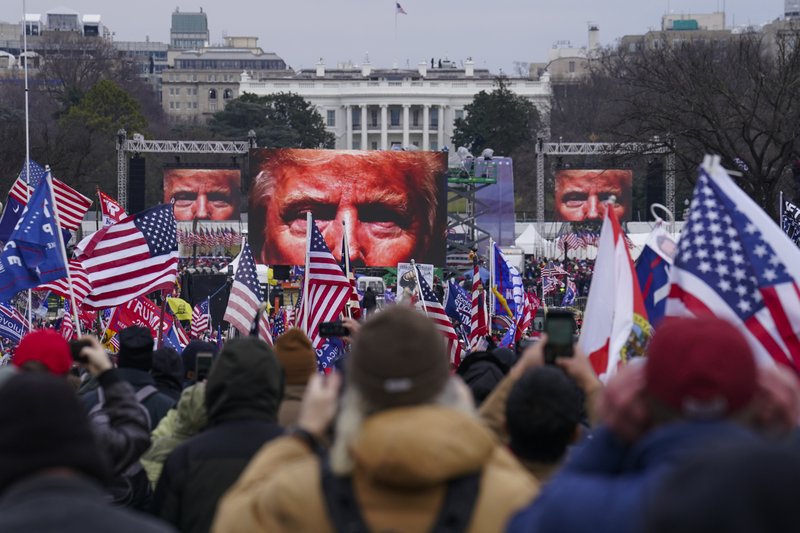
A crazed mob of traitors did not attack the Capitol of the United States and attempt to reverse the democratic election of President Joe Biden and Vice President Kamila Harris.
Many of the patriotic, flag-flying neo-fascists did not attempt to find Mike Pence, Nancy Pelosi, and others with the intention of kidnapping or killing them
Donald Trump did not incite the attempted coup, the first coup attempt in U.S. history
After the insurrection, Donald Trump did not express his appreciation for the traitors.
Donald Trump did not encourage such far-right, neo-fascist conspiracy theorists as Alex Jones, QAnon, Proud Boys, Sean Hannity, et al to spread riot-inducing lies
The entire Republican Party has not closed its eyes to the attempted coup and is not trying to pretend Trump is innocent of treason.
I know none of these things happened because surely, “law and order” politicians would not have forgotten so soon.
But in fact, forgetting seems to be what they really are doing.
Today (1/29/2021) I clicked on http://www.foxnews.com and these are the stories I found.
-WH dodges as Biden sits with secretary paid by fund linked to GameStop scandal
-Barstool’s Dave Portnoy accuses Robinhood of stealing from own clients
-GameStop stock short seller losses total more than $19B, data firm says
-Barstool’s Dave Portnoy, Mets’ Steve Cohen spar over GameStop drama
-Ex-FBI lawyer whose big lie fueled Russia probe sentenced to probation
-Special counsel Durham investigation ‘making good progress,’ Barr says
-Fauci at odds with Biden’s chief of staff over research about schools reopening
-Fauci says coronavirus variants a ‘wakeup call’ to be nimble in vaccine development
-March for Life virtual rally to take place amid coronavirus pandemic
-FBI investigation into DC pipe bomb suspect reveals new details; reward increased to $100G
-ERIC SHAWN: We were told Jimmy Hoffa was buried in a metal barrel — guess what Fox Nation found
-Chilling new details emerge in Texas murder-suicide
-Ex-NY Times editor Bari Weiss bashes former paper over ‘press release’ praising Kamala Harris’ stepdaughter
-Meet the bull leading the charge on GameStop phenomenon
-What to know about the GameStop stock price frenzy
-Dave Portnoy slams Robinhood over GameStop trading scandal: ‘Flat out criminal’
-Google deletes nearly 100,000 negative Robinhood reviews
-‘Squad’ member blasts Wall Street over GameStop scandal: ‘Send them to prison’
-Republican senator: GameStop, Robinhood scandal shows ‘the fix is in’ on Wall Street
-Montana brothers seen on viral video chasing Capitol Police officer face charges, prosecutors say
-This is unity? White House silent as AOC claims Cruz ‘almost had me murdered’
-Biden signs 40 executive orders and actions in 9 days, shunning Congress
-Biden climate orders put Wyoming in crosshairs
-Chicago union won’t teach in-person without vaccine, as most others return
-Our hometown president’: Florida Republicans embrace Trump
-Getting the COVID-19 vaccine? Don’t take over-the-counter pain relievers beforehand, experts say
-Chinese biotech firm had ulterior motive when offering to build COVID labs across US: report
-Gaetz fires back after Cheney ‘taunts’ him for wearing makeup on TV
-Police chief resigns after girlfriend outs alleged ‘double/triple life,’ secret family and children
-Johnson & Johnson reveals how effective one-shot vaccine is against coronavirus
-Sicilian village auctioning homes for $1 and paying for renovations
-Actor’s estranged wife breaks silence on cannibalism scandal: ‘No. Words.’
-Tim Tebow tells story of ‘miracle baby’ during March for Life speech
-Chiefs rookie gets hurt in practice, will miss Super Bowl: report
-Nikki Bella and Artem Chigvintsev reveal their wedding date
-‘The Mentalist’ star Simon Baker and wife split after 29 years of marriage
-‘Naked and afraid’: Actress who first placed starring role in ‘Game of Thrones’ talks being replaced by Emilia Clarke
-‘Baywatch’ star’s new marriage started as affair, ex claims
-‘Shark Tank’ star Kevin O’Leary says AOC’s ‘Tax The Rich’ sweatshirt proves this about socialists
-Your new Chevrolet Corvette Stingray won’t let you drive it fast until its ready
-Nunes: When will real world Americans get their voice back on social media?
-Rep. Malliotakis: We need answers from Cuomo on COVID deaths and we need them now
-Pelosi needs to apologize to nation for saying House GOP is ‘enemy within’: Rep. Norman
-Hannity: Biden’s executive orders causing ‘life-changing’ problems
-Tucker: Our financial system is dangerously corrupt
-Charles Payne: ‘Shame on’ Robinhood for blocking high-flying stock buys
-Firms crack down on GameStop investors after short sellers panic
-Dagen McDowell: Andrew Cuomo’s career might be over after nursing home report
It never happened, And anyway . . .
Not a word about the biggest story of the year, perhaps the century, that a losing Presidential candidate attempted a violent coup — a treasonous takeover of the American government by force.
Had the insurrectionists been successful, America’s democracy, our entire form of government, would be gone.
We would be a dictatorship like Hitler’s, Mussolini’s, Kim’s et al.
And yet, here we are, listening to Hannity, Carlson, Ingrahm, et al, tell us the violent acts of treason we saw and heard with our own eyes and ears are nothing to worry about.
They never happened.
And anyway, the insurrection doesn’t compare to the Black Lives Matter protests
And anyway, it was really a bunch of Black Lives Matter people who entered the Capitol.
And anyway, it was staged by George Soros as a false-flag operation.
And anyway, the Democrats are kidnapping children and eating them, just like Trump backer, QAnon says.
And anyway, there are more important things to do than to punish a former President who tried to destroy the American government.
And anyway, it’s unconstitutional to punish someone after they leave office.
And anyway, it’s the “cancel culture.”
And anyway, all those Republican-appointed judges who ruled against Trump are crooked and biased.
And anyway, they’re trying to take away our guns and our religion.
And anyway, all politicians lie, so what the big deal with Trump’s lies?
And anyway, what about Hillary and Benghazi?
And anyway, what about free speech?
Pay no attention to how close America came to losing our government to a mob sent by a psychopathic President of the United States.
None of that is important.
What’s really important is whether private citizen Hunter Biden might have received money from Russia or China.
The rumor is that Hunter made illegal millions by cheating students of Biden University and tax cheating the government with Biden Foundation.
And I heard that by lying about COVID and then refusing to do anything to protect people — in fact, even refusing to wear a mask — Hunter Biden caused the deaths of hundreds of thousands of Americans.
Yes, I even heard that Hunter surrounded himself with criminals and other unsavories like: Steve Bannon, Tom Price, Scott Pruitt, Paul Manafort, Rick Gates, Michael Flynn, Michael Cohen, Chris Collins, Salvatore Testa, Fat Tony Salerno, Roger Stone, Felix Sater, Jeffrey Epstein, Alexander Acosta, George Papadopoulos, Alex Van der Zwaan, Konstantin Kilimnik, Ralph Shortey, and Timothy Nolan.
But don’t worry; Hunter pardoned a bunch of them.
Yes, Hunter Biden should be punished severely for all that.
I heard it on Hannity.
And as for anyone selling out America. That never happened.
Gap Psychology describes the common desire to distance oneself from those “below” in any socio-economic ranking, and to come nearer those “above.” The socio-economic distance is referred to as “The Gap.”
Wide Gaps negatively affect poverty, health and longevity, education, housing, law and crime, war, leadership, ownership, bigotry, supply and demand, taxation, GDP, international relations, scientific advancement, the environment, human motivation and well-being, and virtually every other issue in economics.Implementation of Monetary Sovereignty and The Ten Steps To Prosperity can grow the economy and narrow the Gaps:
Economists, perhaps hoping to justify economics as a real science, love to complexify to the point of quantum entanglement absurdity.
My message to economists: KISS (Keep It Simple, Stupid).
Start here: Fundamentally, all recessions are alike; they all involve a shortage of money.
Today’s recession began with a virus that scared away customers, which led to businesses laying off employees Millions of people who couldn’t afford to spend led to businesses closing for lack of income, which required laying off even more employees. We descended from MONEY to Money to money.
What is the solution for a private sector’s lack of money? How about: Add money to the private sector.
There is no question about whether to add money. The only questions arewhere are the best, most effective places to add the money, and how much?
Fortunately, the federal government has the unlimited ability to add money to the private sector.
So we answer the “How much?” question simply this way: “Add more than you think is necessary to end the recession and to grow the economy. Way more.”
Sadly, we are bound at the ankles by articles like the following:
President Biden’s Unity Has a High Price Tag Biden’s proposed $1.9 trillion pandemic “relief” package would unite Americans in forcibly shared economic pain. J.D. TUCCILLE, former managing editor of Reason.com and current contributing editor. | 1.22.2021 11:00 AM
President Joe Biden’s inauguration speech was full of calls for “unity” to a bitterly divided nation. But mixed in with a positive acknowledgment that “politics need not be a raging fire destroying everything in its path” were a politician’s traditional calls to unify around favored policy proposals.
And among those proposals is a $1.9 trillion pandemic “relief” package that might unite Americans the way a sinking ship brings passengers and crew together as they await their fate.
“We must set aside the politics and finally face this pandemic as one nation,” Biden urged in his speech. But there’s no way to set aside politics when government acts, since political concerns inevitably determine how governments use their power, including in terms of gathering and spending other people’s money.
To label these preceding paragraphs as “bullshit,” would be to underestimate the value of fertilizer.
How can adding dollars to an economy that desperately needs dollars, be equated to gathering the passengers on a sinking ship to await their fate?
A more apt analogy would be to gather those passengers into helicopters for instant rescue.
And the phrase, “spending other people’s money,” demonstrates abject ignorance about federal finances.
Apparently, the author, Mr. Tuccille, does not understand that:
The federal government cannot run short of its own sovereign currency, the U.S. dollar because . . .
Being Monetarily Sovereign, the federal government (unlike state & local governments) creates dollars ad hoc, by paying creditors, so . . .
Federal taxes (i.e. “other people’s money”) never fund federal spending, and in fact . . .
Even if the federal government collected $0 taxes, it could continue spending forever. The federal government, unlike state/local governments, does not spend tax dollars.
And what “other people’s money” does Tuccille have in mind?
On top of the trillions already spent under the Trump administration to offset the pain of lockdowns or just to buy votes, the new Biden administration wants to distribute $1,400 per person “recovery rebates,” give hundreds of billions to state and local governments, underwrite a national vaccination program, subsidize government schools reopening, and offer more billions to small landlords and childcare providers.
Not counting the burden of hiking the national minimum wage to $15 an hour, which will fall on workers priced out of jobs and on frustrated employers, the total cost is an estimated $1.9 trillion.
Mr. Tuccille acknowledges that the spending would “offset the pain of lockdowns, give each person a minuscule $1,400, give much-need billions to state and local governments, underwrite a national vaccine program, subsidize schools reopening, and offer billion to small landlords and childcare providers” — but he’s against it, even though the federal government has unlimited money!
How can he be against those things? Here’s how? He erroneously believes (claims?) taxpayers will be forced to pay for them.
So, in his ignorance of federal financing, he is willing to forgo the end of the recession, in order to save taxpayers’ money.
And then, he complains that giving low wage workers $15 per hour will cost these people their current starvation jobs — some loss that is — and somehow cost the infinitely rich federal government $1.9 trillion.
Apparently, Mr. Tuccille doesn’t realize that exactly the same arguments could be used to justify slavery.
The proposed spending is supposed to help people.
The money is sold as s lifeline to a population hammered by social distancing and by government-mandated lockdowns as it weathers waves of COVID-19.
But the money, whether spent wisely or poorly, has to come from somewhere. For a government that was spending well beyond its means long before anybody heard of COVID-19, that means the money has to be borrowed.
No, Mr. Tuccille, that is not what it means.
Tuccille says, “The money has to come from somewhere. “ He is correct. It comes from where it always has come: From federal money creation.
The phrase, “spending beyond its means” indicates that the federal government will not be able to afford such spending. But for a Monetarily Sovereign government, no amount of spending is unaffordable.
Nothing is beyond the federal government’s means, the proof of which is the fact that the federal government already has spent more than $28 trillion “beyond its means” with zero adverse effect.
And finally, the federal government does not borrow money. Why would it, given its unlimited ability to create dollars?
What erroneously is termed “borrowing” is not borrowing at all. “Borrowing” involves the temporary acquisition of spending money. But that is not what the federal government does.
Issuing T-securities, wrongly called “borrowing,” actually is the acceptance of depositsinto T-security accounts. When you invest in a T-bond, you open your T-bond account, and you deposit your dollars therein. There your dollars remain, in your account, until maturity. They are not touched by the federal government.
Upon maturity, your dollars plus interest are returned to you. At no time are they ever spent by the federal government.
“In light of the enactment of the year-end spending and COVID relief deal, we estimate the deficit will total $2.3 trillion for Fiscal Year (FY) 2021,” the Committee for a Responsible Federal Budget noted earlier this month.
“This would be lower than the $3.1 trillion deficit in FY 2020 but at an estimated 10.4 percent of Gross Domestic Product (GDP), it would be higher than any other time in recorded history outside of World War II.”
Someone, please remind Mr. Tuccille that there were no recessions during World War II, while the federal government lived “beyond its means.”
It’s been years since the federal government balanced its books, so deficits add to debt accumulated long before the pandemic.
As of January 18, total debt held by the U.S. government is about $27.8 trillion, according to the U.S. Treasury Department, up from an already astonishing $23 trillion at the end of 2019.
By contrast, U.S. Gross Domestic Product at the end of 2020 was $21.17 trillion, according to the government’s Bureau of Economic Analysis.
Yes, “debt” accumulated long before the pandemic. And what has been the result? Economic growth. We only had recessions when debt growth was too low.
Recessions (vertical gray bars) coincide with reductions in federal debt growth (red line) and are cured by increases in federal debt growth. This is not a coincidence. Federal spending goes into the private sector, which mathematically increases GDP.
Deficits and debt of that size affect the economy.
Back in September, when federal pandemic-related spending was already mind-boggling but had yet to reach its full extent for the year, the Congressional Budget Office (CBO) projected the estimated impact.
“From fiscal year 2020 through 2023, for every dollar that it adds to the deficit, the legislation is projected to increase GDP by about 58 cents,” the CBO pointed out, indicating that, at best, taxpayers would lose 42 cents on every dollar spent.
“In the longer term, the legislation will reduce the level of real GDP, CBO estimates.”
Yes, deficits do affect the economy; they grow the economy.
And even if one were to agree with the dubious projection of 58 cent GDP increase for every dollar spent, what is wrong with that? Because Federal spending costs nobody anything, that 58 cents is free — additional GDP growth that would not have happened without the additional federal money.
Taxpayers would not lose a penny; they don’t pay anything for federal deficit spending.
“The legislation will increase federal debt as a percentage of GDP, and in the longer term, CBO expects that increase to raise borrowing costs, lower economic output, and reduce the income of U.S. households and businesses,” the CBO added.
“In addition, the higher debt—coming at a time when the longer-term path for debt was already high—could eventually increase the risk of a fiscal crisis or of less abrupt economic changes, such as higher inflation or the undermining of the U.S. dollar’s predominant role in global financial markets.”
More nonsense. How can increased federal borrowing costs (which are paid to the private sector) “lower economic activity” and “reduce the income of U.S. households and businesses”? The money goestohouseholds and businesses.
Although Tuccille is not clear about this, perhaps by “increased borrowing costs” he refers to increases interest rates.
Sadly, he is wrong about that, too, for the Fed has absolute control over interest rates. It sets the short term rate arbitrarily, and the long-term rate generally follows. Further, adding dollars to the economy does not increase lending rates.
Quite the opposite. Lending rates go up when money is scarcer, not when it is more plentiful.
Finally, federal deficit spending does not cause inflation. Contrary to popular myth, inflations are caused by shortages — usually shortages of food or energy — not federal money “printing”
To be fair, the U.S. isn’t the only country to have been spending beyond its means and to have piled massive debt on top of a large pre-existing bill.
“The pandemic has exacerbated the risks associated with a decade-long wave of global debt accumulation,” the World Bank observes in its latest Global Economic Prospects report, published this month. “Debt levels have reached historic highs, making the global economy particularly vulnerable to financial market stress.”
Here, Tuccille, as usual, fails to differentiate between the major, Monetarily Sovereignnations (U.S., UK, China, Japan, Canada, Australia, et al) vs the monetarily non-sovereign nations (euro nations).
For the former, so-called “debt” is no burden at all. In fact, Japan’s “debt” is more than double the size of its GDP, and the nation has no special vulnerability to financial market stress. In fact, the federal debt/GDP ratio is meaningless as a measure of a Monetarily Sovereign nation’s ability to finance anything. Completely meaningess.
“The pandemic-induced global recession has already reversed a decade or more of per capita income gains in roughly 30 percent of emerging market and developing economies (EMDEs),” the report adds. “By 2025, global output is still expected to be 5 percent below the pre-pandemic trend—a cumulative output loss that is equivalent to 36 percent of the world’s 2019 output.”
That’s a huge hit not just for Americans, but for a world in which governments were already borrowing against people’s economic futures in order to finance current expenditures. Pandemic-related spending—such as last year’s trillions in “stimulus,” and Joe Biden’s $1.9 trillion relief package—are proposed as means for alleviating suffering now. But, since the money they spend doesn’t exist, they can only do so by making us poorer in the future.
OMG! Tuccille says the recession has cost the world’s private sectors massive amounts of money, but he doesn’t want the federal government to create the money that would reverse that trend. Incredible?
At the end of 2020, the CBO returned to the problem of federal spending beyond the government’s means with a report exploring options for reducing the deficit from 2021 through 2030.
The report covered numerous ideas for reining-in spending and for hiking taxes, all with the goal of closing the gap between revenues and expenditures.
Nowhere in the report was there a suggestion for another $1.9 trillion in borrowing and spending to offset pandemic restrictions; its numbers depended, instead, on the assumption that the economy will produce and employ to generate wealth.
It just gets dumber and dumber. With the economy short of money, the CBO wants to reduce federal additions to the private sector while increasing federal deductions from the private sector.
It’s like treating anemia by applying leeches.
U.S. depressions tend to come on the heels of federal surpluses.
1804-1812: U. S. Federal Debt reduced 48%. Depression began 1807.
1817-1821: U. S. Federal Debt reduced 29%. Depression began 1819.
1823-1836: U. S. Federal Debt reduced 99%. Depression began 1837.
1852-1857: U. S. Federal Debt reduced 59%. Depression began 1857.
1867-1873: U. S. Federal Debt reduced 27%. Depression began 1873.
1880-1893: U. S. Federal Debt reduced 57%. Depression began 1893.
1920-1930: U. S. Federal Debt reduced 36%. Depression began 1929.
1997-2001: U. S. Federal Debt reduced 15%. Recession began 2001.
And how the heck is the economy supposed to “produce and employ to generate wealth” with the federal government taking billions out of the economy. It simply makes no sense at all.
Even so, the cost of just paying interest on the national debt is separately projected by the CBO to rise from 1.6 percent of GDP in 2020 to 8 percent in 2050.
That’s without accounting for massive additional “relief” spending, such as advocated by President Biden, to offset the cost of forcing businesses to close and people to restrict their movements.
Not only do economic forecasts predict that the economy of the future will be smaller than it would have been, much of it is already allocated to pay for past spending.
Unity can be a good thing. But Biden’s $1.9 trillion dollar vision of unity builds on an unfortunate history of forcibly shared economic pain. Instead of making everybody go down with the ship, he might try bringing people together for a voluntarily shared vision.
If federal interest payments increase, that means additional federal dollars will go into the private sector. That is known as “growth.”
And yes, additional relief spending is necessary to “offset the cost of forcing businesses to close.” And this is supposed to be a bad thing??
And will someone explain how adding federal dollars to the economy will “make the economy smaller than it would have been”.
Mr. Tuccille closes with one last bit of abject ignorance. The “forcibly shared economic pain” comes not from federal spending but from the lack of federal spending which leads to recessions.
Finally, though Tuccille doesn’t mention this, many people claim federal deficit spending is “socialism.” It isn’t. Socialism is government ownership and control, not spending. “Socialism” is just a word often used to scare the innocent.
All of the above nonsense is what you will hear for the next four years, not only from Mr. Tuccille and the GOP, but even from the Dems, who lack either the courage or the knowledge to explain the facts to the American public.
Recessions don’t just happen. They always, always, always are caused by a Congress that wants you to believe federal money is scarce while you of the private sector have all the money you need.
I remind you of these arguments because you repeatedly are being told the federal government cannot or should not spend so much. The purpose of the falsehoods is to keep you from asking for the benefits the rich receive.
It’s a function of Gap Psychology, the desire of the rich to distance themselves from you.
What a pity that we allow ourselves to starve, while we own an infinite supply of food seed to plant.
Gap Psychology describes the common desire to distance oneself from those “below” in any socio-economic ranking, and to come nearer those “above.” The socio-economic distance is referred to as “The Gap.”
Wide Gaps negatively affect poverty, health and longevity, education, housing, law and crime, war, leadership, ownership, bigotry, supply and demand, taxation, GDP, international relations, scientific advancement, the environment, human motivation and well-being, and virtually every other issue in economics.Implementation of Monetary Sovereignty and The Ten Steps To Prosperity can grow the economy and narrow the Gaps:





 #Monetary Sovereignty - Mitchell