Something too many economists don’t understand: Economics

One would hope that historians, and especially economists, would understand the differences between federal financing (Monetary Sovereignty) and personal financing (monetary non-sovereignty).

Sadly, any such hopes seem dashed by this MSN article.

‘We are guilty of spending our rainy-day fund in sunny weather’: Top economists, historians unite to urge action on $38 trillion national debt.

By Nick Lichtenberg

The national debt has grown to $38 trillion. The United States’ national debt, currently standing at $38 trillion and exceeding 120% of annual economic output, demands action, experts warn.

What about that $38 trillion national debt? To understand what it means, you might wish to review: Historical bullshit about federal “debt.” From September 26, 1940, to August 12, 2025

The article lists and describes the panic-stricken statements from “experts” about the federal debt from 1940 through today. In 1940, it was $43 billion— roughly 44% of GDP at the time.

As debt and the debt-to-GDP ratio rose, the economy grew and prospered. Yet, the panic has continued, and the screams have become ever more strident. Now, the so-called “debt” (that isn’t really debt; it’s deposits) has grown nearly a thousand-fold, the sky has not fallen, and we continue to be pummelled with articles like Nick Lichtenberg’s.

Having learned absolutely nothing in the past eighty-five (!) years, the experts continue to panic and scream, hoping you, too, will panic and scream. For your amusement, and perhaps sorrow, here’s the latest.

The nonpartisan Peter G. Peterson Foundation gathered a series of distinguished national economists and historians from outside the foundation in a collection of essays published Thursday.

They analyzed risks to U.S. economic strength, dollar dominance, and global leadership.

Ah, yes, distinguished national economists and historians — distinguished by their misunderstanding of the difference between federal government financing vs. state/local government financing. The former is Monetarily Sovereign; the latter is monetarily nonsovereign — two different animals.

The experts also explored the national debt’s impact on interest rates, inflation, and financial markets, with some characterizing this moment in history as a crisis.

A crisis of ignorance.

Collectively, they argue that the nation is operating under a dangerous fiscal gamble.

Assessing the mounting liabilities  delivered a stark judgment: “In simpler terms, we are guilty of spending our rainy-day fund in sunny weather.” Meaning, the government has little “dry powder” left to fund a major military effort or stimulate the economy during a crisis.

And what exactly is our “rainy-day fund”? How much is it? Where is it stored? And that “dry powder,” how much is it and where is it stored?

Feel free to ask Council on Foreign Relations President Emeritus Richard Haass and NYU professor Carolyn Kissane. However, they won’t know, because the fund and powder do not exist, not in real or even metaphorical terms.

Well, in one sense, they do exist in the Monetary Sovereignty of the U.S. government, which has the infinite ability to create dollars (and dry powder) merely by pressing computer keys.

Who says so? A few real experts, not the self-proclaimed, self-aggrandized, overly anointed kind:

Former Fed Chairman Alan Greenspan: “A government cannot become insolvent with respect to obligations in its own currency. There is nothing to prevent the federal government from creating as much money as it wants and paying it to somebody. The United States can pay any debt it has because we can always print the money to do that.”

Former Fed Chairman Ben Bernanke: “The U.S. government has a technology, called a printing press (or, today, its electronic equivalent), that allows it to produce as many U.S. dollars as it wishes at essentially no cost. It’s not tax money… We simply use the computer to mark up the size of the account.”

Fed Chairman Jerome Powell: “As a central bank, we can create money digitally.”

Statement from the St. Louis Fed: “As the sole manufacturer of dollars, whose debt is denominated in dollars, the U.S. government can never become insolvent, i.e., unable to pay its bills. In this sense, the government is not dependent on credit markets to remain operational.”

Former Secretary of the Treasury Paul O’Neill: “I come to you as a managing trustee of Social Security. Today, we have no assets in the trust fund. We have promises of the good faith and credit of the United States government that benefits will flow.”

Nobel Prize–winning economist Paul Krugman: “The U.S. government is not like a household. It literally prints money, and it can’t run out.” — Numerous op-eds/blog posts.

Economist Hyman Minsky: “The government can always finance its spending by creating money.”

Economist Eric Tymoigne: “A sovereign government does not need to collect taxes or issue bonds to finance spending. It finances directly through money creation.”

Now, back to the fun:

The debt crisis has reached a critical threshold. The U.S. now spends approximately $1 trillion annually servicing its debt—a figure that surpasses its defense spending.

And why is spending more on interest than on defence significant? It isn’t. Spending is spending. All federal spending adds to GDP. The phrase was just a desperate attempt to shock you. It shouldn’t.

The federal government can pay infinite interest, and the more it pays, the healthier the economy is. Here’s the evidence:

Gross Domestic Product = Federal Spending + Nonfederal Spending + Net Exports

Get it? The more the federal government spends, and the less it taxes (i.e., the greater the deficit), the more Gross Domestic Product grows.

What would be truly shocking is if the federal debt declined. History shows us examples of that decline:

Every Depression in U.S. History Came On the Heels of a Reduced Federal Debt

1804-1812: U. S. Federal Debt reduced 48%. Depression began in 1807.

1817-1821: U. S. Federal Debt reduced 29%. Depression began in 1819.

1823-1836: U. S. Federal Debt reduced 99%. Depression began in 1837.

1852-1857: U. S. Federal Debt reduced 59%. Depression began in 1857.

1867-1873: U. S. Federal Debt reduced 27%. Depression began in 1873.

1880-1893: U. S. Federal Debt reduced 57%. Depression began in 1893.

1920-1930: U. S. Federal Debt reduced 36%. Depression began in 1929.

1997-2001: U. S. Federal Debt reduced 15%. The recession began in 2001.

Economist Heather Long wrote that the 2020s are “fast becoming the era of big permanent deficits” with annual budget gaps projected to remain high (around 6% of GDP) even though unemployment is low, a startling departure from U.S. historical norms.

Let us pray for an “era of big permanent deficits.”  The alternative is small deficits or surpluses (which lead to recessions or depressions).

When deficit growth decreases, we have recessions (vertical gray bars), which are cured by increases in deficit growth.
Economists warn that solutions that worked in the past—such as the post-World War II debt reduction or the 1990s surpluses—are unavailable today. Economist Barry Eichengreen explained that the debt’s steep decline after World War II was supported by a highly favorable interest-rate-growth-rate differential (low real interest rates and fast GDP growth). Likewise, the 1990s reduction was fueled by the “peace dividend,” enabling deep cuts in defense spending. “None of these facilitating conditions is present today.”

The only necessary “facilitating conditions” for economic growth are increased federal deficit spending — exactly the thing that creates economic growth.

The Threat to National Security and the Dollar

Eichengreen, for his part, noted that current security threats from Russia, Iran, and the South China Sea create pressure for defense spending increases, not cuts.

Defense spending increases, if they occur, will grow the economy.
Compounding the problem is political polarization, which is cited as the most robust determinant of unsuccessful fiscal consolidation.

“Successful fiscal consolidation” is economics-speak for reduced deficit spending, which causes recessions and depressions.

With major entitlement programs politically protected, this fiscal gridlock leaves raising additional revenue as the most viable path, given that the United States is a low tax-revenue economy compared to its peers.

As the real economists — Greenspan, Bernanke, and Powell — stated above, the federal government neither needs (nor even uses) revenue. It creates all its spending money in three easy steps:

  1. Congress votes.
  2. The President signs
  3. Federal employees press computer keys

And voila, all the millions and billions of dollars the federal government spends are magically created. No tax dollars are involved. It’s all bookkeeping notations.

The debt is framed not just as a financial strain but as a direct threat to security. Haass and Kissane emphasized that money spent on borrowing is “money not available for more productive purposes, from discretionary domestic spending to defense,” a classic case of crowding out.

The above statement is ridiculous on its face, for two, what-should-be-obvious reasons:

  1. The federal government has the infinite ability to create dollars and,
  2. The dollars the government spends go into the economy, where the private sector can use them for productive purposes.

There never has been “crowding out,” and never will be. The government can’t run short, and every dollar spent is added to the economy, boosting spending.

Other underfunded programs—including cybersecurity and public health—hollow out internal capacities that protect the homeland.

It is unclear how an entity with the unlimited ability to create dollars can be “hollowed out,” nor is it explained how an economy that receives more dollars is being “hollowed out.”

I imagine there is no explanation simply because it cannot be explained. It is utter nonsense.

The crisis was characterized by Haass and Kissane as moving in “slow motion,” the most challenging type for democratic governments to address effectively. Avoiding a sudden “cliff scenario” in which bond markets crash, experts argue, is not avoiding the crisis itself; they added: “The day will come when the boiling water finally kills the frog.”
Ah, yes, “slow motion” because it isn’t happening yet, even though we’ve been predicting it for 85 years. And that darn old frog simply doesn’t understand that it’s supposed to have died by now.
The institutional integrity undergirding the U.S. dollar is also at risk. Historian Harold James wrote that he sees the situation as “the middle of a very dangerous experiment with the U.S. dollar, and with the international monetary system, whose fundamental driver is a fiscal gamble.” Erosion of the rule of law, accountability, and transparency raises the “specter of political risk in U.S. sovereign bond markets,” making it harder to maintain dollar dominance. Disturbingly, the potential for political interference in institutions, such as the Federal Reserve or the tampering with national statistics—as seen in Argentina’s cautionary tale—further erodes confidence.

Historian Harold James probably doesn’t realize it, but he’s not talking about the federal debt. Instead, he’s talking about dictator wannabe Donald Trump, and a cowardly do-nothing Congress, plus the morally compromised right wing of the Supreme Court.

They are the ones — not the essential debt growth –who are creating and countenancing the fall of the American economy, .

James’ colleague, Princeton politics professor Layna Mosley, cited the famous comment from the French statesman Valéry Giscard d’Estaing, who described the “exorbitant privilege” the U.S. enjoyed on the back of the dollar. She noted that, by virtue of the global role of the U.S. dollar and the U.S. leadership of the international financial system, the U.S. government has been able to borrow significant amounts on generous terms. But now, government actions and policy generate uncertainty and instability and “undermine the rules-based liberal international order from which the U.S. benefited greatly.”

Sounds frightening, except for one small detail. The U.S. federal government does not borrow.

As the representative of the St. Louis Fed correctly stated (above), the government is not dependent on credit markets to remain operational.”

The federal government creates all the dollars it spends just by pressing computer keys. The government neither needs nor uses any income, whether from borrowing or taxes.

Rather than providing spending money, the purposes of federal taxes are to:

  1. Control the economy by taxing what the government wishes to discourage and by giving tax breaks to what it wishes to reward.
  2. Assure demand for the U.S. dollar by requiring taxes to be paid in dollars.
The purposes of Treasury securities (T-bills, T-notes, T-bonds) are to:
  1. To help the Fed control interest rates by providing a “floor” rate.
  2. To provide dollar holders with a safe, interest-paying place to store unused dollars, which supports the value of dollars.
This loss of credibility empowers bond markets, and their displeasure can lead to sudden, painful economic consequences for everyday Americans through surging mortgage and loan interest rates. Haass and Kissane turned to another metaphor, saying the situation is akin to “forgoing fire or automobile insurance just because the odds are you will not suffer from a fire at home or an accident on the road.”

The above metaphor is a backward attempt to explain why all those “doomsday” predictions have been wrong. The better advice would be: “Don’t bet your life savings on misinformation from the media, the politicians and many economists, because for 85 years, you’d have lost.”

Learn from experience. The only loss of credibility will be endured by the noted historians and economists who, once again, as they have for the past eighty-five years, will be forced to come up with excuses for why the economy does not obey their dire predictions.

Rodger Malcolm Mitchell

Monetary Sovereignty

Twitter: @rodgermitchell

Search #monetarysovereignty

Facebook: Rodger Malcolm Mitchell;

MUCK RACK: https://muckrack.com/rodger-malcolm-mitchell;

https://www.academia.edu/

……………………………………………………………………..

A Government’s Sole Purpose is to Improve and Protect The People’s Lives.

MONETARY SOVEREIGNTY
Is the cost of the White House unsustainable?

The federal government has more than a thousand departments and agencies, including The White House, the House of Representatives, the Senate, the Supreme Court, the Central Intelligence Agency (CIA), Medicare (CMS), and the Social Security Administration (SSA). Contrary to popular myth, all federal agencies and departments are funded in precisely the same way: Congress votes, and dollars are created from thin air. A few agencies are associated with so-called “trust funds.” According to the Peter G. Peterson Foundation:

A federal trust fund is an accounting mechanism the federal government uses to track earmarked receipts (money designated for a specific purpose or program) and corresponding expenditures.

The largest and best-known trust funds finance Social Security, portions of Medicarehighways and mass transit, and pensions for government employees.

Federal trust funds bear little resemblance to private-sector counterparts; therefore, the name can be misleading.

A “trust fund” implies a secure source of funding. However, a federal trust fund is simply an accounting mechanism that tracks inflows and outflows for specific programs.

In private-sector trust funds, receipts are deposited, and assets are held and invested by trustees on behalf of the stated beneficiaries.

In federal trust funds, the federal government does not set aside the receipts or invest them in private assets.

Instead, the receipts are recorded as accounting credits in the trust funds and combined with other receipts that the Treasury collects and spends.

Further, the federal government owns the accounts and can, by changing the law, unilaterally alter their purposes and raise or lower collections and expenditures.

Read that last sentence carefully, for it is the heart of this discussion. It consists of three truths:
  1. The federal government owns the accounts
  2. The government can change the law and unilaterally change the purposes of the accounts.
  3. The government unilaterally can raise or lower collections and expenditures.
This all adds up to a powerful but little-understood fact. The so-called federal “trust funds” operate entirely at the whim of Congress and the President. These “trust funds were created and operated according to the laws the Congress and the President control. By adjusting laws, Congress and the President can determine how much money each “trust fund” collects, has, and spends. Congress and the President arbitrarily can decide that any trust fund has $1, or $1 trillion, or $1,000 trillion, merely by passing laws. There is no limit to what laws Congress and the President pass, nor what those laws say regarding money in the “trust funds.” Keep this total control in mind as you read excerpts from this article, also by the Peter G. Peterson Foundation:

SOCIAL SECURITY REFORM: SHOULD WE RAISE THE RETIREMENT AGE? In their 2022 Annual Report, the Social Security trustees estimate that the program’s primary trust fund — Old Age and Survivors Insurance (OASI) — will spend more on payments to beneficiaries than it collects yearly until it is depleted in 2034.

At that time, an estimated 70 million beneficiaries would see a substantial reduction in their benefits. OASI would only be able to distribute as much in benefits as it collects in annual revenues.

Driving that impending depletion are the dual demographic trends of retiring baby boomers and lengthening life expectancies, which together have placed considerable strain on Social Security’s finances.

Many options exist to shore up OASI’s solvency, including increasing revenues dedicated to the program, raising the full retirement age, and decreasing the program’s benefits.

A balanced approach that combined components from each option would likely provide the fairest, most lasting, and least painful adjustment for the future.

Translation: The primary “trust fund” will spend more than it collects –according to current law, which Congress and the President can change at will, but the only law changes being considered are:
  • Higher taxes
  • Raising the retirement age, and
  • Reduced dollar benefits
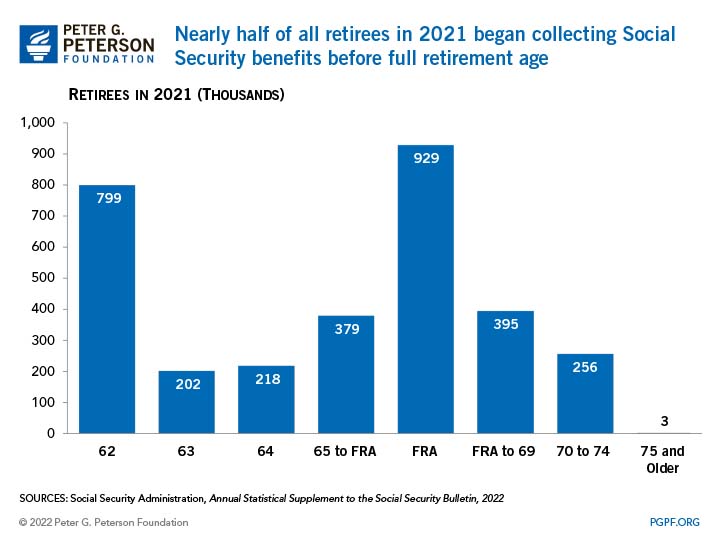
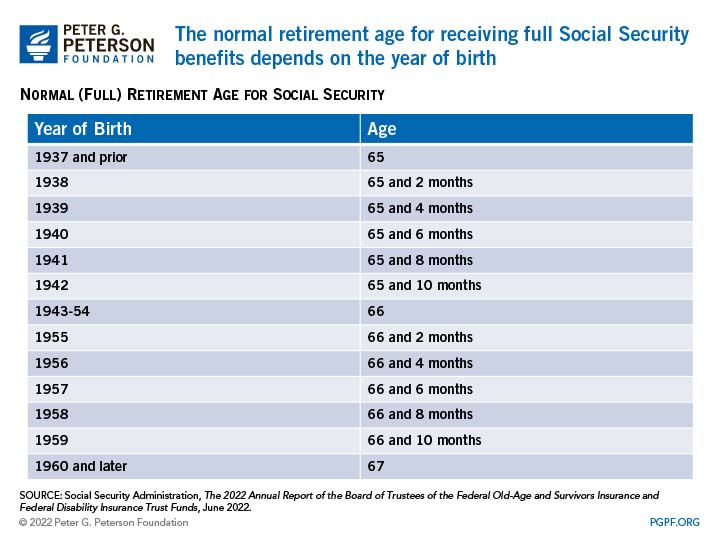
But here is another, even better approach: Congress and the President should simply vote to give Social Security more money, precisely as they do for the other thousand federal departments and agencies. There is no need to increase taxes. In fact, FICA should be eliminated. It is unnecessary and a double tax in that it is not deductible, but part of Social Security is taxed. It also punishes lower-income people. There also is no need to raise the retirement age. Social Security payments can and should be given to every man, woman, and child in America, Finally, there is no need to reduce dollar benefits. We should even end the faux “trust funds” and simply pay for Social Security the same way the federal government pays for nearly all of its other agencies: By recreating dollars from thin air.The normal retirement age for receiving full Social Security benefits depends on the year of birth The U.S. federal government is Monetarily Sovereign. It cannot run short of its own sovereign currency. To pay for your Social Security benefits, the federal government sends instructions (in the form of a wire or check) to your bank or you, instructing your bank to increase the dollar balance in your checking account. When your bank does as instructed, the balance in your account increases, creating new dollars and adding them to the M2 money supply measure, growing the economy. Sending instructions to banks is the primary way the federal government creates dollars. The federal government, being Monetarily Sovereign, has the infinite ability to send and clear instructions, thus, the endless ability to create dollars. (By contrast, everyone who writes a check or sends a wire can send instructions but not clear them. Checks that don’t clear are said to “bounce.”) Your bank then clears the transaction through the Federal Reserve, another federal agency. Thus, the federal government clears its own money-creation transactions, giving it the infinite power to create dollars.Nearly half of all retirees in 2021 began collecting Social Security benefits before full retirement age The government also has the infinite power to change Social Security laws, as demonstrated by the 12 benefit changes shown in this chart. More than half of all Social Security recipients take benefits before the official retirement age when benefits are reduced. This demonstrates an early need for benefits by those in lower-income groups.

WHAT EFFECT COULD RAISING THE FULL RETIREMENT AGE HAVE ON SOCIAL SECURITY’S LONG-TERM SOLVENCY? Given that more retirees are beginning to collect Social Security benefits earlier in their retirement and that overall life expectancy continues to increase, many policymakers have called for a modification to the program, wherein the full retirement age is gradually raised and ultimately pegged to average life expectancy.

According to an analysis from the Committee for a Responsible Federal Budget (CRFB), gradually increasing the full retirement age by two months per year until it reaches 69 and then indexing it for changes in overall life expectancy would save $90 billion over 10 years, but much more in future decades; CRFB estimates that the change would close over half of the structural mismatch between Social Security’s revenues and spending in the long run.

The above two paragraphs indicate ignorance of the difference between Monetary Sovereignty and monetary non-sovereignty. If Social Security were private insurance (i.e., monetarily non-sovereign), pegging benefits to life expectancy would be appropriate, even necessary. However, there are zero reasons for the federal government to do this. There is no fiscal reason why the federal government should try to extract $90 billion from the private sector. If one wishes to grow the U.S. economy, it is the worst possible course of action. This is what happens when the federal government closes the mismatch between revenues and spending“(i.e., runs a surplus). Federal surpluses extract dollars from the economy, causing depression or recessions:

U.S. depressions tend to come on the heels of federal surpluses.

1804-1812: U. S. Federal Debt reduced 48%. Depression began 1807. 1817-1821: U. S. Federal Debt reduced 29%. Depression began 1819. 1823-1836: U. S. Federal Debt reduced 99%. Depression began 1837. 1852-1857: U. S. Federal Debt reduced 59%. Depression began 1857. 1867-1873: U. S. Federal Debt reduced 27%. Depression began 1873. 1880-1893: U. S. Federal Debt reduced 57%. Depression began 1893. 1920-1930: U. S. Federal Debt reduced 36%. Depression began 1929. 1997-2001: U. S. Federal Debt reduced 15%. Recession began 2001.

Even without surpluses, just reducing federal deficits leads to recessions:
Reduced federal deficits (red line) lead to recessions (vertical gray bars). Recessions are cured by increased federal deficits.
Economic growth requires the federal government to spend more dollars into the economy than it extracts via taxes and fees (i.e., run deficits). Without federal deficits, we have depressions and recessions.
As federal deficits (spending and taxes) increase, the Gross Domestic Product increases—and that includes real (inflation-adjusted) Gross Domestic Product.
Those who argue against federal deficit spending may admit it grows the economy but sometimes claim it causes inflation. However, as the above graph indicates, the economy grows, even when adjusted for inflation. All evidence indicates that inflation is caused not by federal spending but by scarcities of critical goods and services.  Inflation usually is cured by federal spending to obtain and distribute the scarcities that caused the inflation. Federal taxes reduce non-federal spending (mostly private sector spending). Thus, no matter how one calculates it, increasing FICA and/or decreasing Social Security benefits will reduce economic growth. And it’s all unnecessary; the federal government has infinite money. It cannot become insolvent. Not understanding the differences between a Monetarily Sovereign government and the monetarily non-sovereign state/local governments, businesses and individuals is the single most significant cause of economic misery and self-defeating government spending decisions. In summary, if the White House, Congress, the Supreme Court, and hundreds of other federal agencies and departments are financially sustainable, so is Social Security and Medicare. There is no need for benefit cuts. There is no need for FICA tax increases. There is no need for FICA at all. The federal government can provide all its agencies and departments with every dollar they need at the touch of a computer key. Why Don’t They? Question: If the government can fund all its agencies and departments without taxes, why doesn’t it just do it? Answer: The very rich, who run the government, want you to believe the government can’t afford to give you benefits. “Rich” is a comparative term. A person having $1,000 would be rich if everyone else had only $100. But that person would be poor if everyone else had $10,000. You can grow richer if the income/wealth/power Gap below you widens and the Gap above you narrows. So, one major goal of the rich is to narrow the Gap below them, which requires limiting the benefits you receive from the government. To keep you from screaming about that, the rich bribe your sources of information — the media, the politicians, and the university economists — to convince you of the Big Lie that federal spending is funded by federal taxes. It’s a Big Lie because the federal government, being Monetarily Sovereign, creates all the money it uses. The only true purposes of federal taxes are to:
  1. Control the economy by taxing what the government wishes to discourage and by giving tax breaks to what the government wishes to reward and
  2. Assure demand for the U.S. dollar by requiring taxes to be paid in dollars.
That’s it. Federal taxes don’t fund anything. In fact, your precious tax dollars are destroyed the moment they are received by the U.S. Treasury. You pay with dollars that are part of the M2 money-supply measure. When your dollars reach the Treasury, they cease to be part of any money-supply measure and are effectively destroyed. Because the government has the infinite ability to create dollars, there is no point in trying to measure the government’s supply of dollars. Suppose you are made to believe the federal government is like monetarily non-sovereign state governments, relying on taxes. In that case, you won’t complain when your Social Security, Medicare, poverty aids, college tuition aids, etc. are cut for lack of money. The less you receive from the government, the richer are the rich. The rich still receive their federal benefits in the form of tax breaks. There never is a complaint about benefits for the rich being “unsustainable,” “unaffordable,” etc. Those terms are reserved for your benefits.  When you read articles telling you the Social Security age requirement must be raised, benefits must be decreased, or the FICA tax must increase, know this: It’s all part of the Big Lie fostered by the rich to make themselves richer. Rodger Malcolm Mitchell Monetary Sovereignty Twitter: @rodgermitchell Search #monetarysovereignty Facebook: Rodger Malcolm Mitchell

……………………………………………………………………..

The Sole Purpose of Government Is to Improve and Protect the Lives of the People.

MONETARY SOVEREIGNTY

Pete Peterson foundation, your center for economic ignorance, speaks again.

The Peter G. Peterson Foundation (PGPF), like the equally wrong, Committee for a Responsible Federal Budget (CRFB), continues to broadcast economic nonsense, the purpose of which is to widen the Gap between the rich and the rest.

On November 20, 2018, PGPF published a post titled “Top 10 Reasons Why The National Debt Matters.”

In typical PGPF fashion, some of its “top 10 reasons” aren’t really reasons at all, and the rest are utter nonsense.  Here is a sampling for your amusement or horror:

At $21 trillion and rising, the national debt threatens America’s economic future. Here are the top ten reasons why the national debt matters.

I. The national debt is a bipartisan priority for Americans. Nearly three-quarters of voters (71 percent) agree that the national debt should be a top-three priority for the country, including 69 percent of Democrats, 68 percent of Independents and 79 percent of Republicans.

The above is not a reason why “national debt matters.” It merely is the result of polling Americans who do not understand the economics of Monetary Sovereignty, and who mistakenly believe federal finances are like personal finances.

The so-called “debt” isn’t what most people think it is. It is ‘’DEPOSITS’‘ into T-security accounts.

When you (or China) “lends” to the federal government, you take dollars from your checking account and deposit them into your T-security account.

These accounts are similar to bank savings and CD accounts.

Then, to pay you back, the government sends your dollars from your T-security account back to your checking account. It’s a simple money transfer the Treasury does this every day as T-securities mature.

Banks boast about the size of their deposits. They don’t call them “debt,” though deposits are a form of debt.

Before maturity, your dollars remain in your T-security account. The government has no use for them, since the government creates new dollars, ad hoc, every time it pays a creditor.

The U.S. federal government, being Monetarily Sovereign, never can run short of its own sovereign currency. Even if all federal taxes were $0, and no T-security dollars were accepted, the government could continue spending forever.

The purpose of federal taxes is different from the purpose of state and local taxes, which supply state and local governments with money. The federal government neither needs nor uses tax dollars. It destroys them upon receipt.

The real function of tax dollars is to control the economy, so “desirable” things are encouraged by being taxed less than “undesirable” things.

The federal government has no need to borrow. The purpose of T-securities is:
1. To provide a safe parking place for unused dollars. This helps stabilize the U.S. dollar
2. To help the Fed control interest rates, which helps control inflation.

II. The return of trillion dollar deficits.  The Congressional Budget Office (CBO) projects that the budget deficit will rise from $779 billion in 2018 to $1.5 trillion by 2028, resulting in a cumulative deficit of $12.4 trillion over the 10-year period from 2019 to 2028.

“Reason” #II also is not a reason why federal debt matters, unless one believes all large numbers matter. Like the CRFB, the PGPF loves to quote big numbers without explaining why we should be concerned about them.

Deficits merely are the difference between federal taxes collected and destroyed, vs. the federal spending that grows the economy. There is no reason why we should be concerned about the federal government’s spending that helps grow the private sector. 

The PGPF quotes a big deficit number to make you think that, like you and me, the federal government can have difficulty paying large financial obligations.

But the federal government is not like you and me. Nor is the federal government like state and local governments. Being uniquely Monetarily Sovereign, the federal government never can run short of dollars. Never.

III. Interest costs are growing rapidly. Interest costs are projected to climb from $315 billion in 2018 to $914 billion by 2028. Over the next decade, interest will total nearly $7 trillion. By 2026, interest will become the third largest category of the budget. With our many important budget priorities, none of us wants interest to become the third largest government “program.”

Federal deficit spending grows the economy. In fact, when federal deficit spending is too low, we have recessions and depressions. And how are recessions and depressions cured? With increased deficit spending.

The more interest dollars the federal government pumps into the economy, the healthier is the economy.

Declining deficit growth leads to recessions (vertical bars) which are cured by increasing deficit growth. Federal interest payments stimulate economic growth.

IV. Key investments in our future are at a risk. In addition, growing federal debt reduces the amount of private capital for investments, which hurts economic growth and wages. A nation saddled with debt will have less to invest in its own future.

Growing federal “debt” increases the amount of private capital for investments. The so-called “debt” is related to federal deficit spending, which adds growth dollars to the economy.

Additionally, growing federal debt requires growing federal interest payments, which also add growth dollars to the economy.

V. Rising debt means lower incomes. Based on CBO projections from last year, growing debt would reduce the income of a 4-person family, on average, by $16,000 in 30 years. Stagnating wages and growing disparities in income and wealth are very concerning trends. The federal government should not allow budget imbalances to harm American citizens.

There is no economic mechanism that would cause rising federal “debt” to reduce incomes.

The additional stimulus dollars that increased federal “debt” produce, would stimulate higher incomes, not lower.

VI. Less flexibility to respond to crises. On our current path, we are at greater risk of a fiscal crisis, and high amounts of debt leave policymakers with much less flexibility to deal with unexpected events. If we face another major recession like that of 2007–2009, it will be more difficult to work our way out.

Once again, the Peterson Foundation demonstrates abject ignorance of economics or intentional deception about economics. Take your pick.

“Reason” VI  assumes that the federal government can run short of dollars with which to “deal with unexpected results.” Fact: Our Monetarily Sovereign federal government, never can run sort of U.S. dollars.

Since 1940, the federal debt has increased from $40 billion to $20 trillion, a gigantic 50,000% increase. Yet the government never has lacked “flexibility” in dealing with unexpected events.

During the Great Recession of 2008, the federal government ran massive deficits to grow us out of the recession, and it continued to run deficits every year, thereafter. No lack of flexibility occurred.

VII. Protecting the essential safety net. Our unsustainable fiscal path threatens the safety net and the most vulnerable in our society. If our government does not have sufficient resources, these essential programs, and those who need them most, could be put in jeopardy.

“Unsustainable” is a favorite word of the deficit Henny Pennys. No one can explain how our Monetarily Sovereign government can find debt or deficits unsustainable.

Once again, the Peterson Foundation tries to tell you that the federal government, like state and local governments, can run short of U.S. dollars. To put it a charitably as possible, it’s a damn lie.

VIII. A solid fiscal foundation leads to economic growth. A solid fiscal outlook provides a foundation for a growing, thriving economy. Putting our nation on a sustainable fiscal path creates a positive environment for growth, opportunity, and prosperity.

With a strong fiscal foundation, the nation will have increased access to capital, more resources for private and public investments, improved consumer and business confidence, and a stronger safety net.

In Peterson-speak, “solid fiscal foundation” means cutting deficit spending, i.e austerity, the program that always, always, always lead to recessions and depressions.

Every depression in U.S. history was the result of a Peterson-like attempt at a “solid fiscal foundation.”

1804-1812: U. S. Federal Debt reduced 48%. Depression began 1807.
1817-1821: U. S. Federal Debt reduced 29%. Depression began 1819.
1823-1836: U. S. Federal Debt reduced 99%. Depression began 1837.
1852-1857: U. S. Federal Debt reduced 59%. Depression began 1857.
1867-1873: U. S. Federal Debt reduced 27%. Depression began 1873.
1880-1893: U. S. Federal Debt reduced 57%. Depression began 1893.
1920-1930: U. S. Federal Debt reduced 36%. Depression began 1929.
1997-2001: U. S. Federal Debt reduced 15%. Recession began 2001.

IX. Many solutions exist! The good news is that there are plenty of solutions to choose from. The Peterson Foundation’s Solutions Initiative brought together policy organizations from across the political spectrum to develop long-term fiscal plans. Each of those organizations developed specific proposals that successfully stabilized debt as a share of the economy over the long term.

“Many solutions exist” is not a reason why “National Debt Matters.” We can only assume this so-called “reason” was included to get the magic number up to 10.

We feel quite confident that any “solutions” put forward by PFPG will accomplish just one thing: They will widen the Gap between the rich and the rest. 

X. The sooner we act, the easier the path. It makes sense to get started soon. According to CBO, we would need annual spending cuts or revenue increases (or both) totaling 1.9 percent of GDP in order to stabilize our debt. If we wait five years, that amount grows by 21 percent. If we wait ten years, it grows by 53 percent. Like any debt problem, the sooner you start to address it, the easier it is to solve. 

Again, number X isn’t a reason, nor are annual spending cuts or revenue increases a solution to anything.

The rich always favor spending cuts, particularly to social programs the benefit the non-rich:  Social Security, Medicare, Medicaid, aid to education, poverty aids, etc.

And tax increases are welcome, so long as they are increases in the taxes the non-rich must pay: FICA and taxes on Social Security benefits. You seldom will see Peterson recommend increases in taxes on capital gains or on the tax loopholes the rich love.

In Summary:

The Peter G. Peterson Foundation is just another right-wing, pro-rich organization that masquerades as a non-partisan think tank. Its goal is to widen the Gap between the rich and the rest of us.

Federal finances are not like personal finances or state and local finances. The federal deficit and debt neither are a threat to the federal government nor burden on taxpayers. The federal deficit is necessary for economic growth. The federal debt could be paid off, tomorrow.

The public’s ignorance about Monetary Sovereignty allows the PGPF and the CRFB to spread misinformation about the federal debt and deficit.


Rodger Malcolm Mitchell Monetary Sovereignty Twitter: @rodgermitchell Search #monetarysovereigntyFacebook: Rodger Malcolm Mitchell ………………………………………………………………………………………………………………………………………………………………………………………………………………………………………………………………………………………….. The single most important problems in economics involve the excessive income/wealth/power Gaps between the have-mores and the have-less. Wide Gaps negatively affect poverty, health and longevity, education, housing, law and crime, war, leadership, ownership, bigotry, supply and demand, taxation, GDP, international relations, scientific advancement, the environment, human motivation and well-being, and virtually every other issue in economics. Implementation of The Ten Steps To Prosperity can narrow the Gaps:

Ten Steps To Prosperity: 1. Eliminate FICA 2. Federally funded medicare — parts a, b & d, plus long-term care — for everyone 3. Provide a monthly economic bonus to every man, woman and child in America (similar to social security for all) 4. Free education (including post-grad) for everyone 5. Salary for attending school 6. Eliminate federal taxes on business 7. Increase the standard income tax deduction, annually.  8. Tax the very rich (the “.1%) more, with higher progressive tax rates on all forms of income. 9. Federal ownership of all banks 10. Increase federal spending on the myriad initiatives that benefit America’s 99.9% 

The Ten Steps will grow the economy, and narrow the income/wealth/power Gap between the rich and you. MONETARY SOVEREIGNTY

Fake federal trust funds and fake concerns

It takes only two things to keep people in chains:
The ignorance of the oppressed and the treachery of their leaders

The Peter G. Peterson Foundation is a self-described “nonpartisan” mouthpiece for the right wing.

Image result for pete peterson
Peter Peterson

Its “nonpartisan” leanings include advocating:

  1. cuts to federal support for Social Security
  2. cuts to federal support for Medicare
  3. increases to Social Security and Medicare taxes (FICA).
  4. increases to taxes on the middle-income groups.
  5. cuts to taxes for the rich
  6. cuts to the federal deficit spending that grows the economy

The Foundation continually publishes articles that falsely claim our Monetarily Sovereign nation somehow can run short of its own sovereign currency, and thus, Social Security, Medicare, and other federal “trust funds” are running short of dollars — all untrue.

It is 100% impossible for a Monetarily Sovereign entity to run short of its own sovereign currency. Similarly, it is 100% impossible for any agency of a Monetarily Sovereign entity to run short of the sovereign currency, unless that is what the entity wants.

Neither the U.S., nor Social Security, can run short of U.S. dollars, unless that is what Congress wants. Period.

So it was with amazement that I read these excerpts from an article published by the Peterson Foundation:

WHAT ARE FEDERAL TRUST FUNDS?
Sep 20, 2016, Peter G. Peterson Foundation

A federal trust fund is an accounting mechanism used by the federal government to track earmarked receipts (money designated for a specific purpose or program) and corresponding expenditures.

The largest and best-known funds finance Social Security, Medicare, highways and mass transit, and pensions for government employees.

Federal trust funds bear little resemblance to their private-sector counterparts.

In private-sector trust funds, receipts are deposited and assets are held and invested by trustees on behalf of the stated beneficiaries.

In federal trust funds, the federal government does not set aside the receipts or invest them in private assets.

Rather, the receipts are recorded as accounting credits in the trust funds, and the receipts themselves are comingled with other receipts that Treasury collects and spends.

This is all correct. Federal so-called “trust funds” are nothing like state and local government trust funds and nothing like private trust funds.Image result for money printing machine

All private sector financing is constrained by one simple fact: The private sector is monetarily non-sovereign.

It does not have the unlimited ability to create its own sovereign currency, for the simple fact that it has no sovereign currency.

The U.S. private sector (which includes state and local governments) uses the sovereign currency of the federal government.

And then, having admitted that federal “trust fund” receipts are comingled with other Treasury receipts, the article promptly forgets what it said:

Further, the federal government owns the accounts and can, by changing the law, unilaterally alter the purposes of the accounts and raise or lower collections and expenditures.

No need to raise or lower collections. The correct statement would be:

The federal government owns the accounts and can, by changing the law, unilaterally alter the purposes of the accounts and/or provide additional funding.

In the late 1770s, the federal government created the original U.S. dollars from nothing, and today it continues to create dollars at will.

Neither the federal government nor the misnamed “Social Security Trust Fund” (or any other federal trust fund) can run short of dollars unless Congress wants it to.

The Peterson Foundation, and far too many others, including those in the federal government, have been pretending that to save Social Security taxes must be increased or spending must be cut. It simply is not true.

The article continues:

What happens when a federal trust fund runs a deficit?
Treasury must finance trust fund interest payments and the redemption of trust fund securities through additional borrowing from the public (unless policymakers raise taxes or cut spending).

The above is wrong. Not only is it wrong about the supposed need for raising taxes and cutting spending, but it also is wrong about borrowing.

Unlike you and me and all other monetarily non-sovereign entities, our Monetarily Sovereign federal government creates unlimited dollars ad hoc, by paying creditors.

Thus, the federal government has no need for any kind of income. It has no need for tax income. It has no need to cut spending. And it has no need for borrowing.

Alan Greenspan: “A government cannot become insolvent with respect to obligations in its own currency.”

Ben Bernanke: “The U.S. government has a technology, called a printing press (or, today, its electronic equivalent), that allows it to produce as many U.S. dollars as it wishes at essentially no cost.”

St. Louis Federal Reserve: “As the sole manufacturer of dollars, whose debt is denominated in dollars, the U.S. government can never become insolvent, i.e., unable to pay its bills.”

Thomas Edison: If the Nation can issue a dollar bond it can issue a dollar bill.  The element that makes the bond good makes the bill good also. . . . It is absurd to say our Country can issue bonds and cannot issue currency.”

The federal government has several trust funds. The three most important trust funds are for Social Security, Medicare, and transportation projects.

Social Security Trust Funds
In 2034, unless reforms are enacted, the Social Security trust funds are projected to be fully exhausted. At that point, Social Security’s receipts will only be sufficient to cover 79 percent of benefits.

Benefits will then have to be cut by 21 percent to continue making payments to all beneficiaries. 

Wrong.

As the article previously said, Social Security “receipts are comingled with other receipts that Treasury collects and spends.Image result for shhh

This means the receipts cannot be “sufficient” to cover anything.

The dollars, once received by the Treasury and comingled, disappear from any money supply measure.

They effectively are destroyed upon receipt.

Asking how many dollars the Treasury has is akin to asking how many sentences you have. The Treasury creates its dollars as needed, and you create your sentences as needed.

Just as the Treasury is Monetarily Sovereign, you are “sentence sovereign.” You never have to ask anyone — via taxing or borrowing — for sentences, and you never can run short.

The Social Security Disability program is in worse condition. Its trust fund will be depleted in 2023, and unless its finances are addressed, its benefits will be cut by 11 percent.

The Social Security Disability benefits will be cut only if Congress wants them to be cut.

Medicare Trust Fund
In the Medicare program, payroll taxes are credited to the Medicare Hospital Insurance (HI) fund and premiums paid by Medicare beneficiaries are credited directly to Medicare’s Supplemental Medical Insurance (SMI) fund.

Unless reforms are enacted, Medicare’s Hospital Insurance Trust Fund is expected to be exhausted in 2028, which will precipitate a 13 percent cut in its payments to hospitals and other providers.

The SMI fund cannot be depleted — each year, general revenue contributions are set to cover whatever costs remain after beneficiary premiums are taken into account.

Wait! What?!

“The SMI fund cannot be depleted — each year, general revenue contributions cover whatever costs remain after beneficiary premiums are taken into account.”

SMI, which pays for Part B and Part D benefits, is funded by Congress. It doesn’t rely on a fake “trust fund.” Congress directly authorizes what funds are needed.

So you have the ridiculous situation in which, Medicare Part A supposedly runs short of funds, but Medicare Parts B and D do not. And you are expected to believe this??

Ask your Senator or Representative why all of Medicare and Social Security cannot be handled like SMI, with the federal government simply paying expenses.

That approach would end all talk of trust funds supposedly running short of dollars.

Highway Trust Fund
The Highway Trust Fund will be depleted by 2021. In this fund, taxes on gasoline and diesel fuel are credited directly to the Highway Trust Fund, but the fund’s income falls short of its spending.

This situation has already precipitated a slowdown of highway and other surface transportation projects as states prepare for a shortfall in federal funding.

The same fraudulent situation as with other phony federal “trust funds.” The result: Either infrastructure projects are delayed, not done at all, or are passed to the monetarily non-sovereign state and local governments.

Does it get any more outrageous than this? A Monetarily Sovereign government, which has an unlimited supply of dollars, claims poverty and passes spending responsibility to monetarily non-sovereign state and local governments, which are limited in their spending ability.

The article ends with these truths:

How do trust funds affect the overall budget?
Although many believe that the existence of trust funds guarantees the sustainability of programs in the future, trust funds are simply accounting mechanisms that are part of the way the federal government keeps its books.

The actual cash inflows and outflows of the programs are combined with all other federal programs and therefore contribute to federal surpluses and deficits.

If a program is in surplus, the federal government’s overall deficit balance improves because it uses the additional receipts from the program to fund costs of other programs.

In effect, the government is conducting transactions with itself but keeping track of inflows and outflows of funds through trust funds.

Ultimately, trust fund income and outlays are not separate from the rest of the federal budget, and the sustainability of trust fund programs, like Social Security, depends on the overall sustainability of the federal government.

That last sentence completely destroys any notion that the fake Social Security “trust fund” is running short of dollars and so, taxes must be increased and/or benefits decreased.

The U.S. federal government can “sustain” (i.e. pay for) any amount of expenses because it has the unlimited ability to create dollars. It never can run short.

Unlike you and me, and the states, and businesses, and the euro nations, the U.S government is Monetarily Sovereign.

Remember this whenever you hear that Social Security, Medicare and any other federal program will run short of money or become “insolvent.”

It is a lie designed by the very rich, to make you believe you must settle for fewer federal benefits or higher taxes.

Rodger Malcolm Mitchell
Monetary Sovereignty
Twitter: @rodgermitchell; Search #monetarysovereignty
Facebook: Rodger Malcolm Mitchell

………………………………………………………………………………………………………………………………………………………………………………………………………………………………………………………………………………………………………………………………………..

The single most important problems in economics involve the excessive income/wealth/power Gaps between the have-mores and the have-less.

Wide Gaps negatively affect poverty, health and longevity, education, housing, law and crime, war, leadership, ownership, bigotry, supply and demand, taxation, GDP, international relations, scientific advancement, the environment, human motivation and well-being, and virtually every other issue in economics.

Implementation of The Ten Steps To Prosperity can narrow the Gaps:

Ten Steps To Prosperity:
1. ELIMINATE FICA (Ten Reasons to Eliminate FICA )
Although the article lists 10 reasons to eliminate FICA, there are two fundamental reasons:
*FICA is the most regressive tax in American history, widening the Gap by punishing the low and middle-income groups, while leaving the rich untouched, and
*The federal government, being Monetarily Sovereign, neither needs nor uses FICA to support Social Security and Medicare.
2. FEDERALLY FUNDED MEDICARE — PARTS A, B & D, PLUS LONG TERM CARE — FOR EVERYONE (H.R. 676, Medicare for All )
This article addresses the questions:
*Does the economy benefit when the rich can afford better health care than can the rest of Americans?
*Aside from improved health care, what are the other economic effects of “Medicare for everyone?”
*How much would it cost taxpayers?
*Who opposes it?”
3. PROVIDE A MONTHLY ECONOMIC BONUS TO EVERY MAN, WOMAN AND CHILD IN AMERICA (similar to Social Security for All) (The JG (Jobs Guarantee) vs the GI (Guaranteed Income) vs the EB (Guaranteed Income)) Or institute a reverse income tax.
This article is the fifth in a series about direct financial assistance to Americans:

Why Modern Monetary Theory’s Employer of Last Resort is a bad idea. Sunday, Jan 1 2012
MMT’s Job Guarantee (JG) — “Another crazy, rightwing, Austrian nutjob?” Thursday, Jan 12 2012
Why Modern Monetary Theory’s Jobs Guarantee is like the EU’s euro: A beloved solution to the wrong problem. Tuesday, May 29 2012
“You can’t fire me. I’m on JG” Saturday, Jun 2 2012

Economic growth should include the “bottom” 99.9%, not just the .1%, the only question being, how best to accomplish that. Modern Monetary Theory (MMT) favors giving everyone a job. Monetary Sovereignty (MS) favors giving everyone money. The five articles describe the pros and cons of each approach.
4. FREE EDUCATION (INCLUDING POST-GRAD) FOR EVERYONE Five reasons why we should eliminate school loans
Monetarily non-sovereign State and local governments, despite their limited finances, support grades K-12. That level of education may have been sufficient for a largely agrarian economy, but not for our currently more technical economy that demands greater numbers of highly educated workers.
Because state and local funding is so limited, grades K-12 receive short shrift, especially those schools whose populations come from the lowest economic groups. And college is too costly for most families.
An educated populace benefits a nation, and benefitting the nation is the purpose of the federal government, which has the unlimited ability to pay for K-16 and beyond.
5. SALARY FOR ATTENDING SCHOOL
Even were schooling to be completely free, many young people cannot attend, because they and their families cannot afford to support non-workers. In a foundering boat, everyone needs to bail, and no one can take time off for study.
If a young person’s “job” is to learn and be productive, he/she should be paid to do that job, especially since that job is one of America’s most important.
6. ELIMINATE FEDERAL TAXES ON BUSINESS
Businesses are dollar-transferring machines. They transfer dollars from customers to employees, suppliers, shareholders and the federal government (the later having no use for those dollars). Any tax on businesses reduces the amount going to employees, suppliers and shareholders, which diminishes the economy. Ultimately, all business taxes reduce your personal income.
7. INCREASE THE STANDARD INCOME TAX DEDUCTION, ANNUALLY. (Refer to this.) Federal taxes punish taxpayers and harm the economy. The federal government has no need for those punishing and harmful tax dollars. There are several ways to reduce taxes, and we should evaluate and choose the most progressive approaches.
Cutting FICA and business taxes would be a good early step, as both dramatically affect the 99%. Annual increases in the standard income tax deduction, and a reverse income tax also would provide benefits from the bottom up. Both would narrow the Gap.
8. TAX THE VERY RICH (THE “.1%) MORE, WITH HIGHER PROGRESSIVE TAX RATES ON ALL FORMS OF INCOME. (TROPHIC CASCADE)
There was a time when I argued against increasing anyone’s federal taxes. After all, the federal government has no need for tax dollars, and all taxes reduce Gross Domestic Product, thereby negatively affecting the entire economy, including the 99.9%.
But I have come to realize that narrowing the Gap requires trimming the top. It simply would not be possible to provide the 99.9% with enough benefits to narrow the Gap in any meaningful way. Bill Gates reportedly owns $70 billion. To get to that level, he must have been earning $10 billion a year. Pick any acceptable Gap (1000 to 1?), and the lowest paid American would have to receive $10 million a year. Unreasonable.
9. FEDERAL OWNERSHIP OF ALL BANKS (Click The end of private banking and How should America decide “who-gets-money”?)
Banks have created all the dollars that exist. Even dollars created at the direction of the federal government, actually come into being when banks increase the numbers in checking accounts. This gives the banks enormous financial power, and as we all know, power corrupts — especially when multiplied by a profit motive.
Although the federal government also is powerful and corrupted, it does not suffer from a profit motive, the world’s most corrupting influence.
10. INCREASE FEDERAL SPENDING ON THE MYRIAD INITIATIVES THAT BENEFIT AMERICA’S 99.9% (Federal agencies)Browse the agencies. See how many agencies benefit the lower- and middle-income/wealth/ power groups, by adding dollars to the economy and/or by actions more beneficial to the 99.9% than to the .1%.
Save this reference as your primer to current economics. Sadly, much of the material is not being taught in American schools, which is all the more reason for you to use it.

The Ten Steps will grow the economy, and narrow the income/wealth/power Gap between the rich and you.

MONETARY SOVEREIGNTY