Do interest rate increases fight inflation?

The Federal Reserve fights inflation by raising interest rates. Here is an amalgam of what several sources say”

The Fed’s primary tool it can use to battle inflation is interest rates. It does so by setting the short-term borrowing rate for commercial banks, and then those banks pass it along to consumers and businesses.

That rate influences everything from interest on credit cards to mortgages and car loans, making borrowing more expensive.

Inflation is a general increase in prices. So, how does making borrowing more expensive affect inflation? Shouldn’t an increase in borrowing costs make products and services more expensive rather than less?

The answer is “Yes.” Interest is a cost that manufacturers, farmers, and services must add to prices, so they can make a profit.

The Fed aims to make borrowing more expensive so that consumers and businesses hold off on investing, thereby cooling off demand and bringing prices back in check.

How does reducing investments “cool off demand”? 

Higher interest rates might reduce the demand for large consumer items, like houses and cars. But does reducing investments reduce your demand for food?  Does it reduce your need for oil? For clothing?

Think of everything you buy? Which of those things will you buy less because interest rates went up? Probably, none.

The Fed believes that inflation is caused by (in their words) “an overheated economy.” But what is an overheated economy?  Here is what the Bing Artificial Intelligence (AI) says: 

An overheated economy is when the economy grows too fast. An overheated economy reaches the limits of how much output it can produce to meet the demand from consumers and businesses, as there are minimal unused resources.

In short, inflation is a supply problem. The Fed’s “overheated economy” is one where supply can’t meet demand.

The Fed’s inflation cure is to increase interest rates which reduces business investment and supply.

The Fed hopes that increasing interest rates will reduce demand more than supply, but what do we call reduced demand? Recession.

If the Fed’s approach is correct, we should see two things that we do not see:

  1. We should see that rising interest rates do not cause recessions
  2. We should see that falling interest rates do not cure recessions
  3. We should see that rising interest rates precede (i.e., cause precedes effect) falling inflation.

Look at the graph below, and you will see the opposite. In fact:

  1. Rising interest rates lead to recessions (vertical gray bars).
  2. Falling interest rates help cure recessions
  3. Rising inflation precedes rising interest rates (cause precedes effect).

As for #3, rising inflation precedes interest rate increases because the Fed reacts to inflation increases by raising rates.

Then after inflation begins to come down, the Fed lowers rates.

While the Fed claims that rising interest rates cause inflation to fall, rising inflation leads to higher interest rates.

Imagine the car going faster causes the driver to press the gas pedal down further. Inflation causes the Fed to increase interest.

What is the cause and cure for inflation if interest rate increases are recessionary and don’t cure inflation?

The cause and cure for inflation lie in the supply of oil.

The supply of oil is reflected in its price (black line). The shortages of oil parallel inflation (red line).

As opposed to common knowledge, the Fed’s interest rate increases do nothing to reduce inflation, which parallels oil prices and is determined by oil supply.

To the degree interest rate increases may reduce the oil demand, they cause recessions.

Until renewables become a more significant part of our energy supply, a reduced need for oil will signal recession.

Congress and the President have assigned the Fed the task of controlling inflation. But though the Fed doesn’t have the tools to manage inflation, Congress and the President do.

Short term, there should be federal incentives for drilling and refining oil. Longer term, the efforts to reduce oil usage via renewables should be accelerated with federal subsidies and tax credits.

More significant incentives for electric car purchases and usage, incentives for solar, wind, geothermal, and nuclear power production would do far more to reduce inflation, without a recession, than interest rate increases.

Congress and the President don’t want the inflation responsibility. The Fed does want the responsibility because it gives them greater power.

Currently, the Fed is like the child sitting in the back seat, furiously spinning his toy steering wheel. He thinks he steers the car, just as the Fed believes it steers the economy, when Congress, the President, and the world’s oil producers steer it.

The Fed’s money tinkering is but a blip on the screen.

Curing shortages, particularly oil shortages, but also renewable energy, food, computer chips, transportation, vital chemicals, and other shortages are needed to control inflation.


Rodger Malcolm Mitchell

Monetary Sovereignty Twitter: @rodgermitchell

Search #monetarysovereignty Facebook: Rodger Malcolm Mitchell

……………………………………………………………………..

The Sole Purpose of Government Is to Improve and Protect the Lives of the People.

MONETARY SOVEREIGNTY
A quick quiz to see whether you are smarter than Fed Chairman Jerome Powell

Here is a quick quiz. Learn whether you are smarter than Federal Reserve Chairman Jerome Powell. BACKGROUND: We currently suffer from inflation, “a general increase in prices.”  The Fed’s task is to bring inflation down while not causing a recession, i.e. “an economic decline during which trade and industrial activity are reduced.” Prices have increased for food, oil, cars and motorcycles, shipping,  labor, and household goods that use paper or cotton, such as diapers, incontinence supplies, sanitary napkins and tampons, and toilet paper, and labor. THE QUIZ: A. There is a shortage of food. The price of food has gone up. The solution should be either to:
  1. Force people to eat less, or to
  2. Help farmers grow more.
B. There is a shortage of oil. The price of oil has gone up. The solution should be either to:
  1. Force people to drive less and to heat their homes less, or to
  2. Help refineries produce more oil and help increase the availability of renewable energy.
C. There is a shortage of cars and motorcycles. The price of cars and motorcycles has gone up. The solution should be to:
  1. Force people to buy fewer cars and motorcycles, or to
  2. Help car manufacturers produce more cars and motorcycles.
D. There is a shortage of shipping ability (the “supply chain”). The price of shipping has gone up. The solution should be to:
  1. Force manufacturers and sellers to ship less, or to
  2. Help manufacturers and sellers to ship more.
E. There is a shortage of lumber. The price of lumber has gone up. The solution should be to:
  1. Force builders to build fewer homes and buildings, or to
  2. Help lumber growers grow more and/or help builders find substitutes for lumber.
F. There is a shortage of computer chips. The price of everything that uses computer chips has gone up. The solution should be to:
  1. Force manufacturers use fewer chips, or to
  2. Help computer chip manufacturers produce more chips
G. There is a shortage of household goods needing raw paper or cotton: diapers, incontinence supplies, sanitary napkins and tampons, and toilet paper. The solution should be to:
  1. Make people use fewer diapers, fewer incontinence supplies, fewer sanitary napkins and tampons, and less toilet paper, or to
  2. Help manufacturers produce more diapers, incontinence supplies, sanitary napkins and tampons, and more toilet paper.
H. There is a shortage of labor. The price of labor has gone up. The solution should be to:
  1. Force labor to accept lower wages, or to
  2. Help employers pay higher wages so more people will want to work.
THE ANSWERS: If you think that in all cases, answer #2 is the correct way to cure inflation without causing a recession, you are correct. Congratulations, you are smarter than Fed Chairman Jerome Powell. Incredibly, Powell thinks the answers all should be #1. He says the economy is “overheated” (whatever that means), and the solution to inflation without a recession is to “cool” the economy (whatever that means). So he raises interest rates and takes dollars from the economy. By his actions, he is trying to force people to eat less, drive less, heat their homes less, ship less, build and buy fewer homes and buildings, buy less of everything that uses computer chips, use fewer tampons and less toilet paper, and work for lower wages,. And these are the so-called “solutions” from Chairman Powell and his acolytes. Really? Yes, really, That is exactly what “cooling the economy” means. We know that Chairman Powell has dozens (hundreds?) of economists working for him, and we assume at least some of those economists see their own data, which we will share with you here:
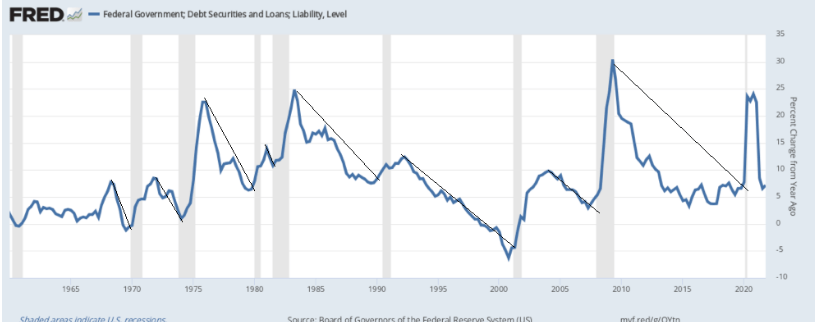
This image has an empty alt attribute; its file name is image-1.png
Federal deficit spending growth (blue line) and recessions (vertical gray bars)
Every recession begins after a period of reduced federal deficit spending growth. Every recession is cured by a period of increased federal deficit spending growth. Chairman Powell wishes to reduce federal deficit spending growth. What does history say about that? If Chairman Powell truly wants to prevent a recession, he should recommend that Congress and the President spend to help cure the abovementioned shortages. The very last thing Powell ever should do is make curing the shortages more difficult. All of the #2 answers require increased deficit spending by the federal government For some unknown reason, Chairman Powell seems to believe that federal deficit spending causes inflation. We have no idea how he developed that belief since it is exactly opposite to his own statistics: Here is the Federal Reserve graph comparing deficit spending with inflation:
Federal deficit spending (blue line) vs inflation (red line).
If federal deficit spending (blue line) caused inflation (red line), we would expect the blue and red lines to be essentially parallel. But that is nothing like what Chairman Powell’s own data show us. According to the Fed’s data, federal deficit spending and inflation mostly move in opposite directions. Surely, nothing says that federal deficit spending causes inflation or “overheats” the economy. The notion that “too much” federal deficit spending causes inflation is a myth, an illusion caused by the reaction of some governments to inflation.

Example: The notorious Zimbabwe hyperinflation was created when the government took farmland from farmers and gave it to people who didn’t know how to farm. The predictable result: A food shortage. The price of food skyrocketed.

Rather than spend to help farm owners grow more food, the government simply printed currency in higher denominations. This did nothing to cure the food shortage and its resultant inflation, but it created the illusion that currency printing caused the inflation.

All hyperinflations in history have followed the same scenario: Shortages cause higher prices; the government prints currency rather than curing the shortages.

Deficit spending to increase supplies of goods and services, instead of merely printing currency, is the way to cure inflation without causing a recession. Deficit spending prevents recessions and grows the economy, which is exactly what it did during the COVID crisis. Were it not for federal deficit spending, we would have had a COVID depression in 2020 and 2021. Today, the federal government should increase deficit spending to prevent recession, while using those additional dollars to encourage more farming, oil and gas drilling and refining, renewable energy production, sales of cars and motorcycles, home building, lumber growing and harvesting, and lumber-substitute development, computer chip manufacturing, and more people to join the workforce. The latter can be accomplished by ending the FICA tax and raising the minimum standard deduction. Additionally, the federal government should fund Medicare for All, which would reduce employment costs for employees and employers. Further, because the U.S. federal government is Monetarily Sovereign, deficit spending is not “paid for” by federal taxes. The U.S. federal government pays for all its spending by creating new dollars, ad hoc. Even if the federal government collected $0 in taxes, it could continue to deficit spend, forever. (A little secret: The federal government destroys all the tax dollars it receives, creating new dollars as needed.) The purpose of federal taxing is not to provide the government with the dollars it spends, but rather to control the economy by taxing what the government wishes to discourage, and by giving tax breaks to what it wishes to encourage. In the unlikely event that America can escape inflation without suffering a recession, it will not be because of what Chairman Powell is doing. It will be despite what Chairman Powell is doing. Fasten your seat belts. Powell doesn’t know what he is doing.

[No rational person would take dollars from the economy and give them to a federal government that has the infinite ability to create dollars.]

Rodger Malcolm Mitchell Monetary Sovereignty Twitter: @rodgermitchell Search #monetarysovereignty Facebook: Rodger Malcolm Mitchell

………………………………………………………………………

THE SOLE PURPOSE OF GOVERNMENT IS TO IMPROVE AND PROTECT THE LIVES OF THE PEOPLE.

The most important problems in economics involve:
  1. Monetary Sovereignty describes money creation and destruction.
  2. Gap Psychology describes the common desire to distance oneself from those “below” in any socio-economic ranking, and to come nearer those “above.” The socio-economic distance is referred to as “The Gap.”
Wide Gaps negatively affect poverty, health and longevity, education, housing, law and crime, war, leadership, ownership, bigotry, supply and demand, taxation, GDP, international relations, scientific advancement, the environment, human motivation and well-being, and virtually every other issue in economics. Implementation of Monetary Sovereignty and The Ten Steps To Prosperity can grow the economy and narrow the Gaps: Ten Steps To Prosperity:
  1. Eliminate FICA
  2. Federally funded Medicare — parts A, B & D, plus long-term care — for everyone
  3. Social Security for all
  4. Free education (including post-grad) for everyone
  5. Salary for attending school
  6. Eliminate federal taxes on business
  7. Increase the standard income tax deduction, annually. 
  8. Tax the very rich (the “.1%”) more, with higher progressive tax rates on all forms of income.
  9. Federal ownership of all banks
  10. Increase federal spending on the myriad initiatives that benefit America’s 99.9% 
The Ten Steps will grow the economy and narrow the income/wealth/power Gap between the rich and the rest.

MONETARY SOVEREIGNTY