II. Federal Spending is all the spending the federal government does. It includes every dollar the government spends.
III. Nonfederal spending includes all the dollars spent in the economy by every individual, every business, and every state/local government.
IV. Net Imports is the difference between dollars spent on imports vs. dollars received for exports. Usually, we spend more on imports than we receive for exports, so just to break even, either Federal Spending or Non-federal spending must take up the slack.
However, if we break even, the economy will shrink because of inflation. So — and this is very important– for the economy to grow, government spending must grow.
There is no way for the economy to grow when government spending does not grow. That is basic algebra.
Now someone might say, what if federal spending doesn’t grow but nonfederal spending grows enough to overcome both Net Imports and Inflation.
The problem with that hypothetical scenario is that when Federal Spending doesn’t grow, there is no way for the Non-federal sector to obtain the spending dollars that would grow the economy.
In fact, not only do we have recessions and depressions when Federal Spending doesn’t grow, we even have recessions and depressions when Federal Spending grows, but too little to overcome inflation and Net Imports.
U.S. depressions come on the heels of federal surpluses.
1804-1812: U. S. Federal Debt reduced 48%. Depression began 1807.
1817-1821: U. S. Federal Debt reduced 29%. Depression began 1819.
1823-1836: U. S. Federal Debt reduced 99%. Depression began 1837.
1852-1857: U. S. Federal Debt reduced 59%. Depression began 1857.
1867-1873: U. S. Federal Debt reduced 27%. Depression began 1873.
1880-1893: U. S. Federal Debt reduced 57%. Depression began 1893.
1920-1930: U. S. Federal Debt reduced 36%. Depression began 1929.
1997-2001: U. S. Federal Debt reduced 15%. Recession began 2001.
When the money supply decreases, or even increases, but not enough, we have recessions.Federal Spending increases the money supply. When the money supply increases, GDP increases. When the money supply decreases, we have recessions and depressions. The above graph shows the parallel paths taken by the money supply and GDP.
Again, GDP is the measure of two things. It is the measure of the economy, and it is the measure of spending. This is just simple algebra. You don’t need a degree in economics to understand it.
And yet, Congress, the President, the Republican, Democratic, and especially the Libertarian Parties pretend it’s all a mystery to them because they say they don’t want Federal Spending to grow.
In essence, they don’t want the economy to grow; more accurately, they want us to have recessions and depressions that affect the rich much less than they affect the rest of us.
Congress, the media, and the economists all parrot the same line. They claim federal spending is “unsustainable” and should be reduced. But what makes federal spending “unsustainable”?
The federal government is Monetarily Sovereign, meaning it cannot run short of U.S. dollars. The Federal government can pay any bill of any size if it’s denominated in dollars. Send the government an invoice for a trillion dollars; it could pay it tomorrow by pressing computer keys.
This is not just my opinion. It is a well-known fact:
Former Federal Reserve Chairman, Alan Greenspan: “A government cannot become insolvent with respect to obligations in its own currency.”
Alan Greenspan: “There is nothing to prevent the federal government from creating as much money as it wants and paying it to somebody.”
Alan Greenspan: “The United States can pay any debt it has because we can always print the money to do that.”
Former Fed Chairman, Ben Bernanke: “The U.S. government has a technology, called a printing press (or, today, its electronic equivalent), that allows it to produce as many U.S. dollars as it wishesat essentially no cost.”
Quote from Ben Bernanke when he was on 60 Minutes:Scott Pelley: Is that tax money that the Fed is spending?Ben Bernanke: It’s not tax money… We simply use the computer to mark up the size of the account.
Despite what you’ve read and heard, not only can the government create all the dollars it needs by pressing computer keys, but it never needs to borrow dollars.
Statement from the St. Louis Fed:“As the sole manufacturer of dollars, whose debt is denominated in dollars, the U.S. government can never become insolvent, i.e., unable to pay its bills. In this sense, the government is not dependent on credit markets to remain operational.”
The words “not dependent on credit markets” means the federal government does not borrow. Those T-bills, T-notes, and T-bonds that wrongly are called “borrowing” are nothing of the sort.
A borrower borrows because it needs money. The federal government doesn’t. The government merely accepts deposits into T-security accounts. It never touches those dollars. Why would it, given its infinite ability to create dollars?
The purposes of T-securities are not to provide the government with spending dollars, but rather to:
To provide a safe storage place for unused dollars. This helps stabilize the dollar
To help the Fed control interest rates.
And then there is the false “inflation” claim. The mantra is that we will have inflation if the federal government prints money.
Historically, that simply is not true:
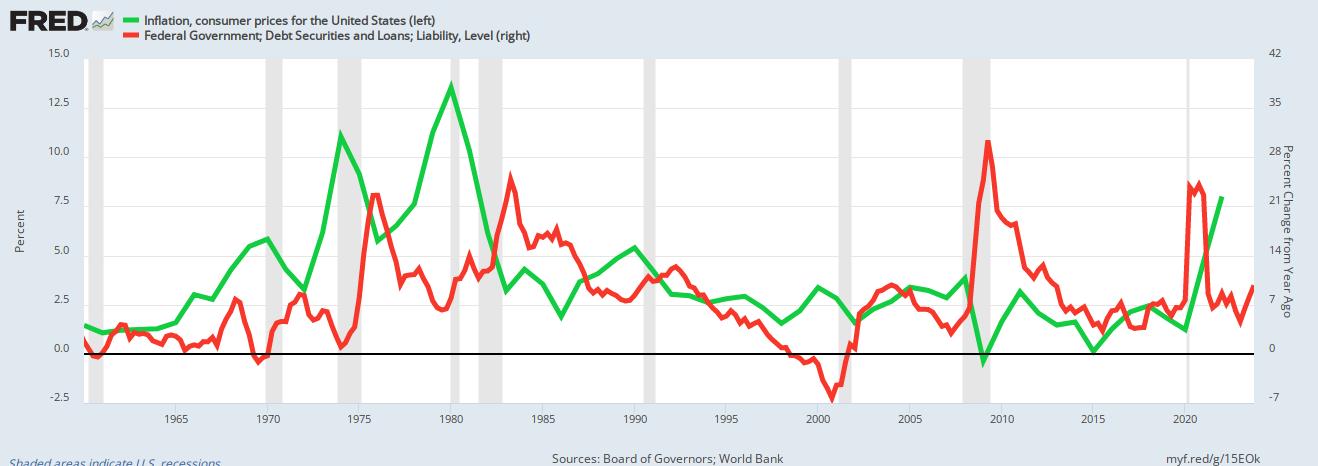
If federal spending caused inflation the red spending line and the green inflation line would essentially be parallel. They are not. They move randomly with respect to one another.The thing that always causes prices to rise is scarcity. You know this from experience.
When weather causes a shortage of oranges or apples, the price of oranges and apples goes up.
When COVID creates shortages of oil, steel, lumber, computer chips, labor, etc., the price of everything goes up. We have inflation.
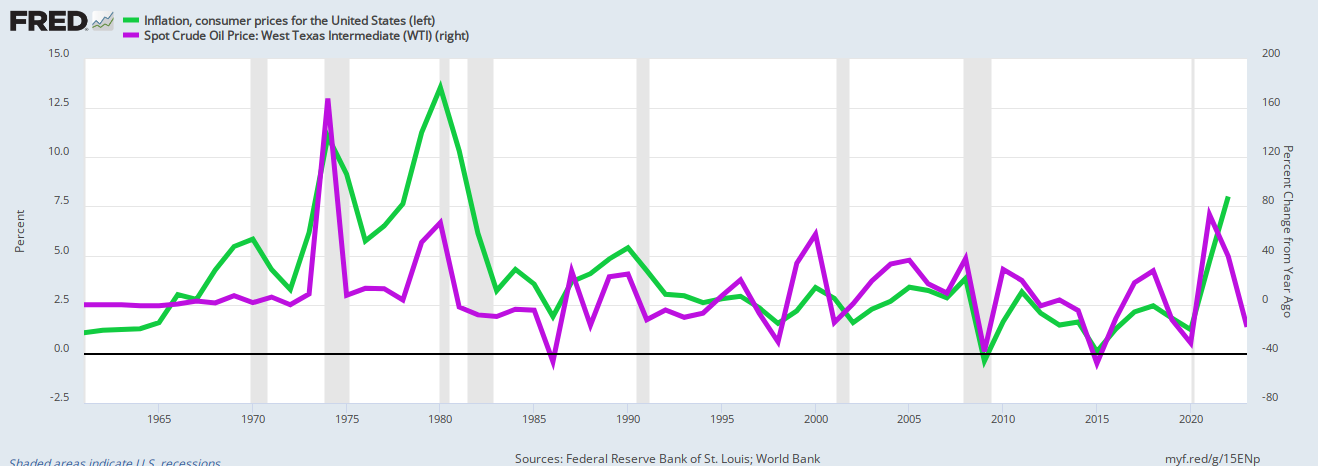
The single most common scarcity that has caused inflation for the past few decades is the scarcity of oil:Oil scarcity causes oil prices to rise, and because the price of oil affects the prices of almost every other product, oil scarcity causes inflation.
While federal spending does not parallel inflation, the scarcity of oil does parallel inflation.
Again, none of this is rocket science, and none of it is secret. Politicians, the media, and economists all have these data.
So why do they conduct these mock battles about a useless, meaningless, misleading debt ceiling? Why all the lies?
Because the politicians, media, and economists have been bribed by the rich, who run America.
The politicians are bribed by campaign contributions and promises of lucrative employment at think tanks.
The media are bribed by advertising dollars and by straight-out ownership of the media.
The economists are bribed by contributions to their universities and promises of employment in think tanks and controlled corporations.
And why do the rich want the politicians, media, and economists to pretend that federal spending should be reduced? It’s because of something called “Gap Psychology.”
The word “rich” is comparative, not absolute. Someone with a million dollars is poor if everyone else has ten million. Someone who has a hundred dollars is rich if everyone has one dollar. Getting richer requires acquiring more compared to everyone else.
You can do this in either or both of two ways:
Acquiring more for yourself and/or
Making sure everyone else has less.
Gap Psychology is the human desire to distance oneself from those below you and/or to come closer to those above you on any scale of income, wealth, or power.
Most people wish to become richer. This is especially true of the rich, who are driven by their insatiable desire to become even richer, i.e., distancing themselves from those below and coming closer to those above.
They hate your receiving government-funded healthcare insurance. They hate food stamps, unemployment benefits, government-funded college — anything that even slightly narrows the Gap between them and those below.
To distance themselves from the middle and lower quadrants, the rich do all they can to make you believe the federal government cannot afford to give you benefits. They draw false comparisons between your personal financing and federal government financing.
They talk about federal “borrowing”though the government, unlike you, does not borrow dollars.
They talk about the federal “credit card,” though the government uses nothing that resembles a credit card.
They talk about “out-of-control” spending, though unlike you, the federal government has the infinite ability to spend.
They claim federal deficit spending is “unsustainable” though the government has “sustained” deficit spending for more than 80 years — deficit spending that grew the economy from several billion dollars to thirty trillion.
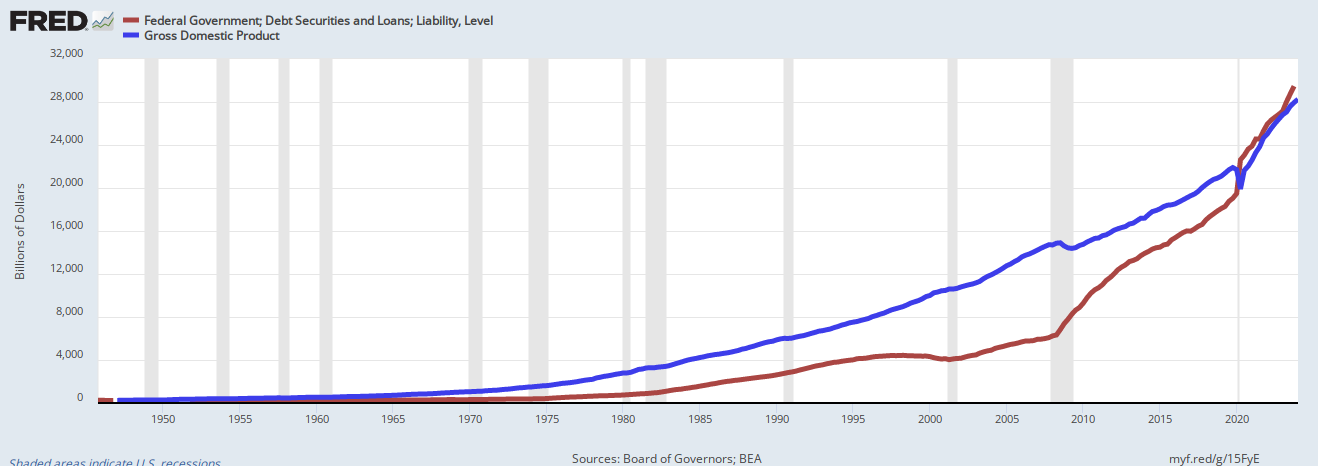
Here is another graph that shows the essentially parallel paths of federal spending and GDP.
Naturally, the lines essentially are parallel. Federal Spending is an integral part of GDP. It would be like a graph comparing total touchdowns with total points. The lines essentially would be parallel.
To say that federal spending is too high, unsustainable, or out-of-control — i.e., to say that federal spending should be reduced — is to say that economic growth is too high, unsustainable, out of control, and should be cut.
No one believes that, not even the rich. They just want to cut the benefits you receive, not the benefits they receive.
They bribe Congress to give them tax loopholes so that they, like Donald Trump, pay at a far lower rate than the average salaried person.
And they spread the myth that giving the Internal Revenue Service more money will send investigators after you when the money was meant to investigate the rich.
Everywhere you turn, the rich have bribed your sources of information to indoctrinate you with the belief that federal spending should be cut and taxes increased, especially the spending and taxes related to benefits for you who are not rich.The purpose of federal taxes is different from the purpose of state/local government taxes. Federal taxes do not provide spending money to the federal government, which already has infinite spending money. Federal taxes have two financial purposes plus a third purpose that should anger you:
To control the economy by taxing what the government wishes to discourage and by giving tax breaks to what the government wishes to encourage
To assure demand for the U.S. dollar by requiring taxes to be paid in dollars. And here is the one you’ll really hate:
To help widen the income/wealth/power Gap by giving tax loopholes to the rich.
And now we have the phony “debt-limit” struggle. The Republicans (the party of the rich) demand cuts to Medicare, Medicaid, food stamps, etc., and the Democrats (pretending to be the party of the poor) fight weakly against too many cuts (just a few).
And neither of them tells you the truth. The entire charade is a professional wrestling exhibition held in the halls of Congress.
The bottom line is: You have been brainwashed into ignorance. Federal deficit spending is not unsustainable, nor does it cause inflation.
The federal government easily could fund no-deductible, comprehensive, generous Medicare and Social Security benefits for every man, woman, and child in America, a college education for everyone who wanted it, food so that no child in America ever would need to go hungry, and decent housing for even the poorest among us.
The federal government could do all that while funding the military, medical research and development, the physical sciences, renewable energy, and all the other things that would improve your life and the lives of those you love.
It can be done, and it will be done, but first, you must understand the lies you are being fed and then demand, en masse, that the government does what it was formed to do.
Rodger Malcolm Mitchell
Monetary SovereigntyTwitter: @rodgermitchellSearch #monetarysovereigntyFacebook: Rodger Malcolm Mitchell
……………………………………………………………………..
The Sole Purpose of Government Is to Improve and Protect the Lives of the People.
When I was in elementary school, way, way, way back in the 1940s (!), common knowledge was:
Drinking water during physical activity causes cramps.
Applying heat to sore muscles prevents stiffness.
Swimming in the summer causes polio.
We all knew these things to be true, while we looked back at previous generations and smirked at the people who believed in witches and a flat earth.
In the near future, generations will look back at us, and snicker at some of our beliefs, as expressed in the following AP article:
We see that the article was written, not by some uninformed amateur, but by the Associated Press’s Economics Writer.
WASHINGTON (AP) — The Treasury Department says it will employ measures to avoid an unprecedented default on the national debtthis summer, but officials say those measures could be exhausted “much more quickly” than normal given the unusual circumstances of the global pandemic.
The national “debt” is the total of deposits into Treasury Security accounts. When you invest in a T-bill, T-note, or T-bond, you open a T-security account.
This account most closely resembles a bank safe-deposit box into which you deposit money. The money never leaves your box until you take it, just as the dollars never leave your T-security account until you take them.
The Treasury will continue to initiate the types of bookkeeping maneuvers it has used in the past to keep the government from breaching a level that would trigger a default on the massive national debt.
The Treasury, the Federal Reserve, and Congress all are agencies of the federal government. Among them, they have created all the rules regarding federal finances.
Those “bookkeeping maneuvers” are under the absolute control of the federal government. Nothing can “trigger a default” unless the federal government wishes it.
“In light of the substantial COVID-related uncertainty about receipts and outlays in the coming month, it is very difficult to predict how long extraordinary measures might last,” Brian Smith, Treasury’s deputy assistant secretary for federal finance said.
They are not “extraordinary” measures. They simply would be bookkeeping adjustments. The federal government created its byzantine bookkeeping system to suit its unique needs, and this system arbitrarily is changed whenever the federal government wishes to change it.
No set of circumstances ever can force the federal government to “default” on any of its financial obligations.
The government has been able to borrowenormous sums of money to finance trillions of dollars of support during the pandemic because the limit on borrowing has been suspended. But after July 31, the limit will return to whatever debt level exists at that time.
The federal government has the infinite ability to create its own sovereign currency, the U.S. dollar. In the 1780s, the federal government created from thin air, an arbitrary number of U.S. dollars and gave each dollar an arbitrary value.
Since then, the government arbitrarily has created trillions of U.S. dollars, and has given those dollars arbitrary values.
Having this infinite ability eliminates any need to borrow dollars. And indeed, the U.S. federal government does not borrow.
T-bills, T-notes, and T-bonds do not represent borrowing. They are deposits into accounts, the purposes of which are:
To provide a safe parking place for unused dollars, which helps stabilize the dollar, and
To help the Federal Reserve control interest rates which helps to control inflation.
The government does not touch the dollars in those accounts. It does not use those dollars to pay its debts.
To pay off the misnamed “borrowing,” the government simply returns the dollars in the accounts.
The so-called debt “limit” too, is an arbitrary number, that Congress can (and many times has) increased at any time it wishes.
The national debt subject to the limit now stands at a record $28.1 trillion. That amount covers debt the government owes to itself in the form of commitments to Social Security and other government trust funds. The amount of the debt that is held by the public currently totals $22.1 trillion, an amount slightly higher than 100% of the entire economy and heights not seen since the huge borrowing the government did in the 1940s to finance World War II.
The fact that deposits into T-security accounts exceed Gross Domestic Product is relevant of nothing. This is known as the Debt/GDP ratio, which though often quoted, has no meaning whatsoever.
It predicts nothing, and it evaluates nothing. It does not indicate the past, current, or future health of the economy.
It is no better an economic measure than would be the number of runs scored by the Chicago Cubs in the 2nd inning of their next game.
Borrowing has soared in recent years to finance huge budget deficits that reflected increased spending on domestic and military programs in budget deals then-President Donald Trump reached with Congress and also to cover the costs of Trump’s $1.5 trillion tax cut approved by Congress in December 2017.
The federal government does not borrow, and so called “borrowing” does not finance federal spending. The federal government finances its spending by creating dollars, ad hoc. The more it spends, the more dollars it creates.
Spending is the federal government’s method for creating dollars.
In its infinite wisdom, Congress created rules that require the issuance of T-securities to equal in value the net total of federal government deficits (the excess of spending vs. income).
Because these rules are obsolete (if they ever had any value), the government, rather than eliminating the rules, instituted a “cheat.” One branch of the government (the Federal Reserve) creates from thin air, dollars to deposit into T-security accounts, to satisfy the needs of a useless rule.
Thus, the Federal Reserve owns about $6 trillion of U.S. “debt.” If need be, the Federal Reserve could own all of U.S. “debt,” or the entire “debt” system could be eliminated.
Over the past year, the higher deficits have reflected the trillions of dollars the government has spent to provide support during the pandemic-triggered recession. In the latest package, President Joe Biden got Congress to approve $1.9 trillion in March to provide $1,400 payments to individuals and other types of support for individuals and small businesses.
The President and Congress simply passed laws that create spending. No law was made regarding the funding of this spending, because no law was necessary. Federal spending creates its own funding.
Treasury officials did not specify what measures it will employ if Congress has not acted by the July 31 deadline to either raise the borrowing limit or simply suspend the limit for a period of time.What Treasury essentially uses book-keeping maneuvers to avoid a debt default. They basically entail withdrawing money invested in government accounts such as the fund that covers government pensions. The money is always replaced with any lost interest once the debt limit standoff is resolved.
There is no real “debt.” There is no real burden on the government or on taxpayers. It’s all arbitrary juggling of the books. The government owns the books and all the laws. It can do whatever it wishes.
Congress has never railed to deal with the debt limit by the deadline although in 2011 the standoff between Republicans and the Obama administration was so prolonged that Standard & Poor’s, the credit rating agency, downgraded a portion of the country’s AAA credit rating for the first time in history.
Standard & Poors made fools of themselves. At one point several U.S. corporations was given a higher credit rating than the U.S. government. Consider what would have happened to these corporations had the U.S government defaulted. The corporations’ money and their credit rating would have become worthless, or near so.
No domestic entity can have better credit than the U.S. government.
Treasury said it expects to borrow $463 billion in the current April-June quarter which will be part of its plans to borrow $2.28 trillion for the full budget year, which ends Sept. 30.The $463 billion represents a significant jump from the government’s initial estimate three months ago that it would need to borrow just $95 billion in the current quarter. The change was attributed to passage of the most recent virus relief bill of $1.9 trillion in March.The government ran up a record $3.1 trillion budget deficit last year, reflecting the COVID relief spending and a drop in revenues caused by the recession. Private economists believe the deficit for the current budget year will be even higher, possibly hitting $3.3 trillion.
Those budget deficits are nothing more than the number of dollars the federal government plans to add to GDP.
GDP = Federal Spending + Non-federal Spending + Net Exports
The more the federal government spends, the greater is GDP, the primary measure of the economy.
Those who oppose federal spending are knowingly or unknowingly opposing economic growth.
Unlike you and me, and unlike your state, county, and city, the federal government does not use revenue. In fact, the federal government destroys all income it receives.To pay its bills, the federal government creates new dollars, ad hoc.
Put these facts together:
The only way to cut federal “debt” is to cut federal spending and/or to increase federal taxes.
By formula, cutting Federal Spending cuts GDP
Increasing taxes cuts Non-federal Spending, which cuts GDP
Therefore, the math is absolutely clear: Cutting the federal debt cuts GDP.
Those who try to reduce the so-called federal “debt” are, in fact, sabotaging the American economy. There is no way to reduce the federal debt, or even to keep it level (aka “balance the budget”) without forcing America into a recession (if we are lucky) or a depression.
This is demonstrated by history our history of debt reductions:
1804-1812: U. S. Federal Debt reduced 48%. Depression began 1807.
1817-1821: U. S. Federal Debt reduced 29%. Depression began 1819.
1823-1836: U. S. Federal Debt reduced 99%. Depression began 1837.
1852-1857: U. S. Federal Debt reduced 59%. Depression began 1857.
1867-1873: U. S. Federal Debt reduced 27%. Depression began 1873.
1880-1893: U. S. Federal Debt reduced 57%. Depression began 1893.
1920-1930: U. S. Federal Debt reduced 36%. Depression began 1929.
1997-2001: U. S. Federal Debt reduced 15%. Recession began 2001.
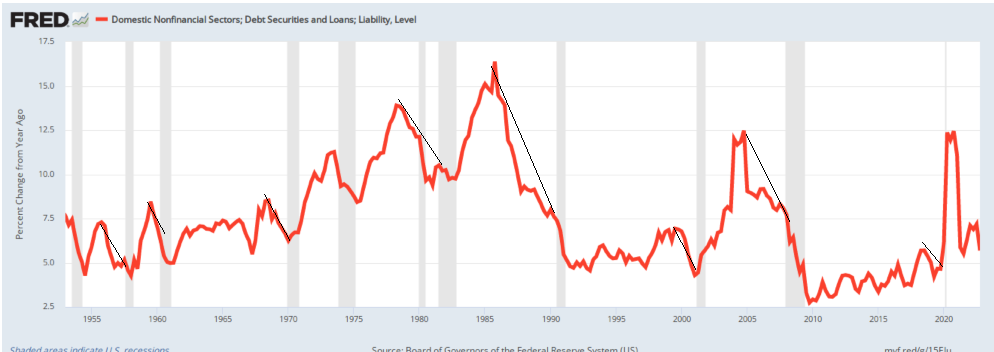
When federal debt growth declines, we have recessions (vertical gray bars), which are cured by increases in federal debt growth.The Myths Future Generations Will Laugh About
The federal government is too big
The Debt/GDP ratio is too high
Federal spending is “Socialism” (Socialism isn’t federal spending. It’s federal ownership and control over business).
The deficit or debt should be reduced
We should have a federal “balanced budget.”
The federal government is spending beyond its means.
Federal taxes “pay for” federal spending
Personal finance or state/local government finance are like federal finance.
Limits on federal deficit spending are “prudent.”
We don’t need additional federal spending.
We can’t afford programs that benefit the middle and lower-income groups (Elimination of FICA, Social Security for All, Medicare for All, Free College for All, Food and Housing supplements).
The federal government should not “bail out” the state governments.
All of the above are indicators of economic ignorance, equally ignorant to not drinking water when you exercise.
P.S. No sooner did I finish writing the above article than I came across this 100% hunk of bullshit:
Lord, have mercy.
…………………………………………………………………………
Rodger Malcolm Mitchell
[ Monetary Sovereignty, Twitter: @rodgermitchell, Search: #monetarysovereignty Facebook: Rodger Malcolm Mitchell ]THE SOLE PURPOSE OF GOVERNMENT IS TO IMPROVE AND PROTECT THE LIVES OF THE PEOPLE. The most important problems in economics involve:
Gap Psychology describes the common desire to distance oneself from those “below” in any socio-economic ranking, and to come nearer those “above.” The socio-economic distance is referred to as “The Gap.”
Wide Gaps negatively affect poverty, health and longevity, education, housing, law and crime, war, leadership, ownership, bigotry, supply and demand, taxation, GDP, international relations, scientific advancement, the environment, human motivation and well-being, and virtually every other issue in economics. Implementation of Monetary Sovereignty and The Ten Steps To Prosperity can grow the economy and narrow the Gaps: Ten Steps To Prosperity:



 #Monetary Sovereignty - Mitchell