I continually am puzzled by the misunderstanding (“disunderstanding”?) of Monetary Sovereignty. It is both simple and obvious, yet many (most?) people have trouble comprehending it.
MS is based on just four simple facts:
In the 1780s, the U.S. federal government created the laws that created the U.S. dollar from thin air — as many dollars as it wished – and gave them the value it wished.
The government’s own laws give it the power to continue creating dollars, infinitely
The government’s own laws give it the power to continue changingthe valueof the dollar — a power it has used many times.
The government can change its laws at will.
Really, what could be simpler, more obvious, and less controversial?
Derived from these simple, obvious facts comes the following:
The U.S. federal government never unintentionally can run short of U.S. dollars.
No agency of the government can run short of dollars unless the government wishes it.
Federal taxes are not used or needed to fund federal spending.
By changing the value of the dollar, the government has absolute control over inflation
And that’s it. Monetary Sovereignty.
Intuition is powerful. Many of us prefer to believe our intuition than believe facts.
Interestingly, where fiction parallels facts, you might not believe the facts about the fiction, while still believing fiction about the facts.
That is, you might read a historical novel of fiction, and not believe the background facts presented. Yet, you might be fooled by a conspiracy theory website presenting fiction as fact.
So here is the explanation that may appeal to intuition as well as to facts.
You probably have played the hugely popular board game, Monopolytm. As a game, it’s fiction, but you believe and understand the facts (i.e. “rules.’)
Here are some of the facts.
The game is played with multiple players plus a Bank. The Bank pays Monopoly dollars to the players for various benefits.The Bank collects taxes, fines, loans and interest from the players.The Bank “never goes broke.” If the Bank needs money, it may issue as many dollars as needed by printing on scraps of paper or simply by creating a bookkeeping tally.
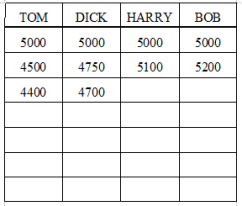
Example of a Monopoly running tally
A sample tally is demonstrated by the illustration at the right.
It reveals three things:
I. Monopoly money is not physical. Those printed $500, $100, $50, $20 $10 $5, and $1 bills aren’t dollars in of themselves.They merely representdollars, just as the numbers on a tally represent dollars.II. The Bank can createan infinite supply of Monopoly dollars.
If needed, the Bank instantly could pay Tom, Dick, Harry, or Bob $1, or $100, or $1,000,000,000 in Monopoly dollars.
In the tally, there is no need to create a column for the Monopoly Bank.
This lack of a column demonstrates the Bank’s ownership of infinite dollars.
It also demonstrates that all dollars sent to the Monopoly Bank are destroyed upon receipt.
If Tom, for instance, sent $100 to the Bank, his $4,400 would be reduced to $4,300. So, what happened to the $100 Tom paid? They simply disappeared. They no longer exist.
Although the Bank can create infinite dollars this creation process does not create Monopoly Bank “debt.” The Monopoly Bank does not borrow dollars nor does it owe any dollars.
Thus, taxes are not levied to “pay off” any Monopoly Bank debt.
By rule, the Monopoly Bank simply creates all the dollars it needs. Although the Bank is not precluded from keeping track of the dollars it receives from players, that record would not indicate how many dollars the Monopoly Bank “owes” or has.
There is no ongoing debt owed by the Monopoly Bank.
All of the above is easily understood by you and by virtually anyone else who has played the game.
Now, in the above paragraphs, substitute the words, “U.S. federal government” for the word “Bank.” And substitute “members of the public” for “players.”
The facts remain essentially the same.
There are multiple members of the public plus the federal government.
The federal government pays dollars to the public for various benefits.
The federal government collects taxes, fines, loans, and interest from the public.
The federal government “never goes broke.” If the federal government needs money, the government may issue as much as needed by printing on paper or simply by creating a bookkeeping tally.
[Former Fed Chairman, Alan Greenspan: “A government cannot become insolvent with respect to obligations in its own currency.”]
Continue reading and substituting until you come to the part that some people have difficulty understanding:
The federal government does not borrow dollars nor does it owe any dollars. Taxes are not levied to “pay off” any federal government debt.
[Quote from Ben Bernanke when, as Fed chief, he was on 60 Minutes:
Scott Pelley: Is that tax money that the Fed is spending?
Former Fed Chair, Ben Bernanke: It’s not tax money… We simply use the computer to mark up the size of the account.]
The Monopoly Bank and the U.S. federal government both are Monetarily Sovereign. They both are issuers of their dollars. Neither of them can run short of dollars.
Both the Monopoly Bank and the U.S federal government have infinite dollars.
[Former Fed Chair, Ben Bernanke: “The U.S. government has a technology, called a printing press (or, today, its electronic equivalent), that allows it to produce as many U.S. dollars as it wishes at essentially no cost.”]
Neither the Monopoly Bank nor the federal government borrows or taxes in order to pay their financial obligations. Spending by the Monopoly Bank or the U.S. federal government does not create future taxpayer obligations.
For that reason, Social Security, an agency of the federal government, cannot run short of dollars, unless that is what the government wants. Even if there were no FICA tax (which contrary to popular myth, does not fund Social Security), that agency need not run short of dollars.
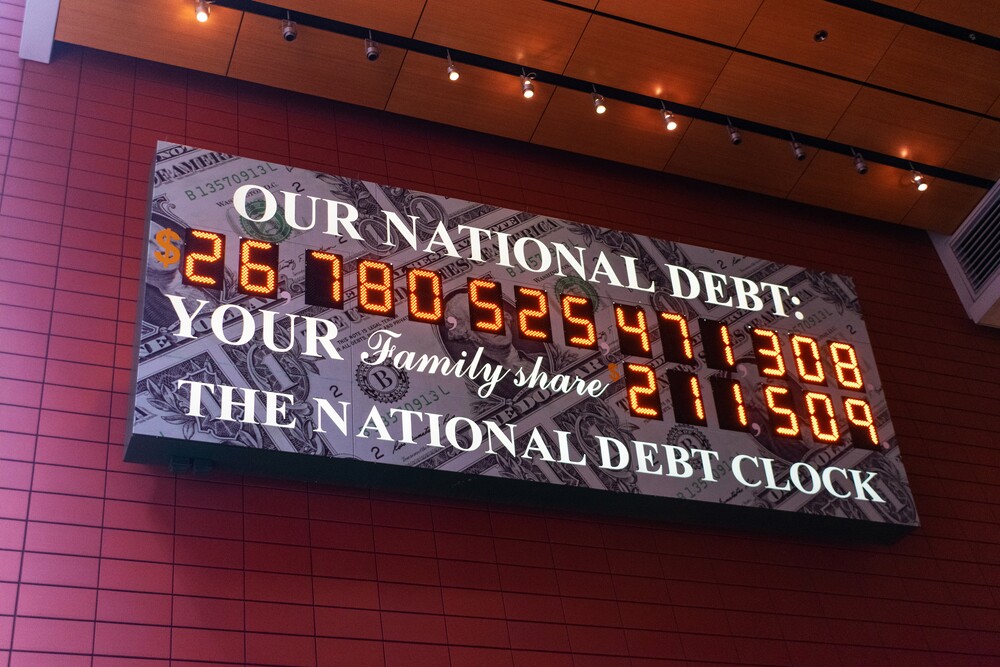
The “debt clock.” You have no share.
Medicare for All, college for all, upgraded infrastructure, good housing for all — every imaginable federal benefit — all are easily affordable. The so-called federal debt is not a burden on future taxpayers or on the government.
The famous “debt clock” implies the lie that somehow the federal “debt” is a danger to you, your children, and the federal government.
It is not a debt, and it is not a danger, to you or anyone.
It is just simple deposits by the public into accounts.
The parallels between the Monopoly game and federal financing are stunning.
Yet, though people tend to understand the rules of Monopoly, too many become hopelessly confused by the same set of facts when applied to real life.
Yes, one is fiction and the other is fact, but that difference is not the source of the confusion.
The confusion is caused by the longtime, ongoing, relentless dissemination of false information about the federal government’s finances and by the misnaming of T-securities as “borrowing” and “debt.” They are neither.
The misinformation is promulgated by agents for the rich, who want to prevent you from asking for the benefits the rich already receive: Retirement benefits, medical care, good housing, safe neighborhoods, college education, spending money for a good life.
Neither the government nor you owes the deposits that sit in T-security accounts. These accounts resemble bank safe deposit boxes, which the bank “pays off” simply by returning the contents. No “debt” or tax liability there.
The Monopoly board game is a good analog for the federal finance system. If you understand one, you should understand the other.
Rodger Malcolm Mitchell
Monetary SovereigntyTwitter: @rodgermitchellSearch #monetarysovereigntyFacebook: Rodger Malcolm Mitchell
……………………………………………………………………..
THE SOLE PURPOSE OF GOVERNMENT IS TO IMPROVE AND PROTECT THE LIVES OF THE PEOPLE.
Gap Psychology describes the common desire to distance oneself from those “below” in any socio-economic ranking, and to come nearer those “above.” The socio-economic distance is referred to as “The Gap.”
Wide Gaps negatively affect poverty, health and longevity, education, housing, law and crime, war, leadership, ownership, bigotry, supply and demand, taxation, GDP, international relations, scientific advancement, the environment, human motivation and well-being, and virtually every other issue in economics.Implementation of Monetary Sovereignty and The Ten Steps To Prosperity can grow the economy and narrow the Gaps:
Ten Steps To Prosperity:
In the post, we said, “The U.S. dollar is not a physical entity. The dollar is a legal entity. It is a group of laws. You can’t see, smell, taste, feel, or hear a dollar any more than you can see, smell, taste, feel, or hear a law.”
The purpose of that paragraph was to help readers visualize why the federal government has absolute control over the U.S. dollar and its value, and why the federal government cannot run short of dollars.
After all, if something has no physical existence, the creator of that thing cannot run short.
Therefore, warnings that the federal government owes too many dollars, or can run short of dollars, make absolutely no sense.It is like warning that the federal government will run short of laws or lies. The government has an infinite supply.
To help readers visualize the concept, we gave the example of the board game Monopoly™.
As you probably know Monopoly™ usually is played by 3-6 players. The object of the game is to make money by buying and selling real estate, and to accomplish this purpose, the game gives players various tokens, dice, instruction cards, and play dollars.
To begin the game, a mythical “Banker” provides each player with an equal amount of play dollars.
One day, four of us wished to play, but when we opened the game box, everything was there except the play dollars.
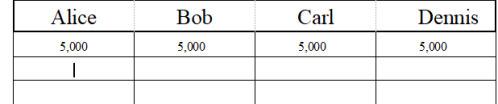
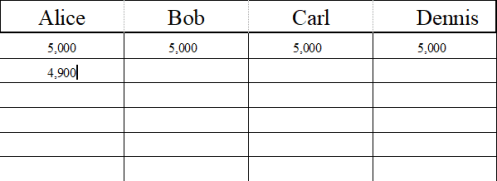
So we created this table to keep track of the Monopoly™ “economy”:
At this stage of the game, the “economy” had 20,000 dollars
It was a simple sheet of paper, containing a four-column table. At the top of each column, we wrote the name of one player.
Then, on the first line, under each player’s name, we wrote “5,000.” That showed how many dollars each player had.
We could have written any number, but we arbitrarily decided that the Bank should give each player 5,000 dollars.
In real-world terms, this corresponded to a total of 20,000 in deficit spending by the Bank, which added 20,000 dollars into the economy.
By rule, players take turns rolling dice, and at each roll, players may receive other moneys from the Bank, and/or pay the Bank for real estate, taxes, and other penalties.
So money flows back and forth from player to player, and to and from players to the Bank.
In the game’s first transaction Alice paid the Bank 100 dollars for a piece of property.
To memorialize the transaction, we deducted 100 dollars from Alice’s column, leaving her with 4,900 dollars.
Now, the money supply of the “economy” is 19,900 dollars.
In total, the money supply of the “economy” fell to 19,900.
But what about the Bank? It received 100 from Alice. But the Bank had no column.
Two questions: Where did that 100 Alice paid to the Bank go? And how much money did the Bank have?
The answers to those two questions lead to the central points of this post.
Where Is The Bank’s Money and How Much Does It Have?
The game’s rules specifically state that the Bank never can run out of money. (The rules even suggest cutting up pieces of paper, if necessary, and using them as Monopoly™ dollars.)
So again, where did Alice’s dollars go when she paid the Bank? Answer: The Monopoly™ dollars were destroyed. They ceased to exist.
And how much money did the Bank have? Answer: It has none but can create infinite.
Payments to the Bank cannot enrich the Bank; it can create infinite money at any time. Payments to the Bank serve only to impoverish the players. That is the sole effect and the sole purpose of payments to the Bank.
Similarly, payments from the Bank, which the Bank can make endlessly, enrich the players but do not impoverish the Bank. Infinity minus any number still is infinity.
Thus, the Monopoly™ game provides an interesting, simplified corollary to the U.S. financial system.
Players can be thought of as the real people in the United States who pay dollars to, and receive dollars from, the U.S. federal government.
The Monopoly™ Bank resembles the U.S. federalgovernment, and the players correspond to the U.S. economy.
The rules of the game correspond to the laws of the U.S.
Both the Bank and the U.S. government create dollars from thin air, simply by spending dollars into the economy.
Both receive tax dollars that are destroyed upon receipt.
Both can run deficits endlessly, and these deficits enrich the players (the “economy”), while deficits do not impoverish the Bank or the federal government.
For both the Bank and the U.S. federal government, debt and borrowing are meaningless, as they do not provide spending funds to the Bank or to the government.
Any amount of money owed by the Bank or the U.S. government can be paid instantly. Neither can run short of dollars. Neither needs to ask for tax dollars.
Although the Bank pays out far more dollars than it takes in (just like the U.S. federal government does), the players are not concerned that the Bank’s deficits are “unsustainable,” no matter how large they may grow.
Like the Monopoly Bank, the U.S. federal government does not borrow dollars. Why would it? It has the unlimited ability to create dollars from thin air.
What erroneously is termed “U.S. federal borrowing,” actually is the acceptance of deposits into Treasury Security Accounts. This so-called “borrowing” does not provide spending funds to the government. The government can create infinite spending funds.
The purposes of accepting deposits into federal T-security accounts are:
To provide a safe place to “park” unused dollars, which helps stabilize the dollar, and
To assist the Federal Reserve in its task of controlling interest rates.
And the purposes of federal taxes are not to provide the government with spending money, of which it has infinite, but rather:
To control the economy by rewarding activities the federal government wishes to encourage and by punishing the activities the government wishes to discourage, and
To make the populace believe the government’s ability to spend is limited by taxes, so that the people will not ask for more benefits.
The rules of Monopoly™ provides players with regular payments of 200 dollars when their tokens pass “Go.” These payments serve to enrich the players and the Monopoly “economy.”
The makers of the game could have decided on payments of any size — 10 dollars or 1,000 dollars, the Bank could afford anything — but arbitrarily settled on 200 dollars.
The purpose of the 200 dollar payments is to energize the “economy” by injecting dollars into it. Without the additional dollars, the economy could not grow.
Similarly, the U. S. federal government makes regular Social Security payments. These payments, which enrich the populace and the economy, could be of any size — the federal government can afford anything — but lately, benefits have been reduced.
The government arbitrarily collects taxes on benefits and delays benefits past the original age of 65.
Why would the U.S. federal government, which can afford anything, invent false claims that Social Security, an agency of the federal government, is running short of money? Why would the government reduce benefits that enrich the populace and the economy?
One might think the government would want to do the opposite. But there are reasons:
The Monopoly™ “Pass Go” payment is not more than 200 dollars only because the creators felt that would lengthen the game too much. The Bank easily could afford any level of payment.
The Social Security payments are not higher or extended to more people, because the very rich, who run America, do not want the Gap between them and the rest of Americans to be narrowed. The U.S. Treasury easily could afford any level of payment.
SUMMARY
The game of Monopoly™ provides an interesting corollary to the U.S. federal government and the U.S. economy. The Monopoly™ Bank mirrors the U.S. federal government, and the players represent the economy.
The U.S. federal government originally created laws that created an arbitrary number of U.S. dollars from thin air, and gave them an arbitrary value.
Today, the U.S. government retains the power to create an arbitrary number of dollars from thin air and to give them any value it wishes.
Thus, being Monetarily Sovereign, i.e. sovereign over the U.S. dollar, the government can control the U.S. money supply and the value of the dollar (U.S. inflation).
Like the Monopoly™ Bank, the federal government can sustain any level of deficit spending. It also can set any level of T-security issuance (wrongly termed “borrowing”).
Federal deficit spending is necessary to grow the U.S. economy, andclaims that federal spending and federal debt are harmful or unsustainable are false.
Ben Bernanke: “The U.S. government has a technology, called a printing press (or, today, its electronic equivalent), that allows it to produce as many U.S. dollars as it wishes at essentially no cost.”
Alan Greenspan:“Central banks can issue currency, a non-interest-bearing claim on the government, effectively without limit. A government cannot become insolvent with respect to obligations in its own currency.”
St. Louis Federal Reserve: “As the sole manufacturer of dollars, whose debt is denominated in dollars, the U.S. government can never become insolvent, i.e.,unable to pay its bills. In this sense, the government is not dependent on credit markets (borrowing) to remain operational.
Gap Psychology describes the common desire to distance oneself from those “below” in any socio-economic ranking, and to come nearer those “above.” The socio-economic distance is referred to as “The Gap.”
Wide Gaps negatively affect poverty, health and longevity, education, housing, law and crime, war, leadership, ownership, bigotry, supply and demand, taxation, GDP, international relations, scientific advancement, the environment, human motivation and well-being, and virtually every other issue in economics.
Implementation of Monetary Sovereignty and The Ten Steps To Prosperity can grow the economy and narrow the Gaps:
BACKGROUND We previously have discussed the parallels between the MonopolyⒸ game’s Bank and the U.S. federal government. Both are Monetarily Sovereign, which means:
Create a column for each player.
They cannot run short of money.
They have no need to borrow money.
They do not need to collect taxes.
And the taxes they collect are destroyed upon receipt.
Let’s say you wish to play the MonopolyⒸ game with three friends, but when you open the box you find it has no money.
What do you do?
The paper “money” in a MonopolyⒸ game merely is a convenience, not a necessity. The game can be played in exactly the same way, without paper MonopolyⒸ dollars.
You simply can draw four columns on a sheet of paper — one column for each player. Then you write 5,000 (or any amount) at the top of each column. The total of the columns (say, 20,000) is the total amount of money in the game.
When any player spends money, you deduct that amount from the last number in the column, and when any player receives money, you add that amount.
But what happens when a player is required to pay money to the Bank? There is no column for the Bank. So, you simply deduct that amount from the player’s column.
Since the bank has no column, the money is destroyed. No record is kept of Bank “deficits.” The total in the game is now less than 20,000 MonopolyⒸ dollars.
This is similar to what happens when you pay taxes to the federal government. Although the federal government keeps a record of that payment, it doesn’t use those dollars for anything. Effectively, the U.S. dollars are destroyed.
And, like the MonopolyⒸ bank, the U.S. federal government creates brand new dollars, every time it spends.
And what happens when the MonopolyⒸ Bank spends money (for instance by paying 200 dollars when a player passes “GO”)? You add that 200 dollars to the appropriate player’s column. The total money in the game now increases by 200 Monopoly dollars.
The MonopolyⒸ Bank doesn’t have debt, because it simply creates new MonopolyⒸ dollars by the very act of spending. Similarly, the federal government creates new U.S. dollars by the very act of spending.
QUESTIONS 1. What is the federal “deficit”?
The so-called “deficit is the misleading name given to the difference between the amount of money the federal government collects vs. the amount it spends.
The deficit is just an arithmetic difference; it does not imply a real financial relationship between collections and spending.
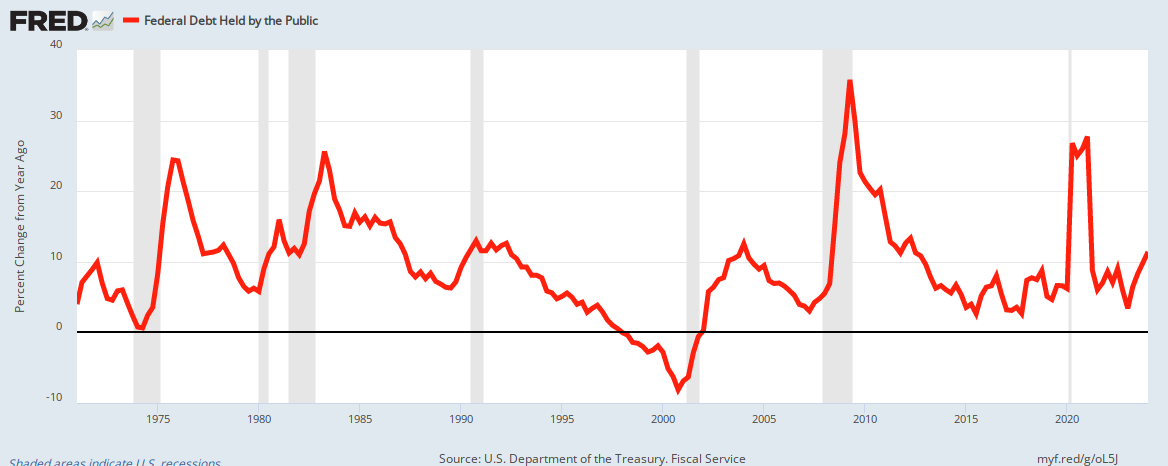
Reductions in federal debt growth introduce recessions (vertical gray bars). Recessions are cured by increases in federal debt growth.
The federal government has the unlimited ability to create U.S. dollars, so the deficit merely shows how many dollars the government sends into the economy compared to the number of dollars the government takes from the economy.
Thus the so-called “deficit” more properly should be viewed as an “economic surplus.”
Because deficits add dollars to the private sector, they are necessary to cure recessions and depressions.
2. What is the federal debt?
The government accepts deposits into U.S. Treasury Security accounts. The purpose of these accounts is not to supply the government with dollars (it creates dollars at will), but rather:
To help the government control interest rates.
To provide the world with a safe “parking” place for unused U.S. dollars, which helps stabilize the dollar.
The total of deposits into the U.S. Treasury Security accounts is misleadingly known as the federal “debt,” though the accurate term would be “deposits.”
3. Do federal taxpayers pay for the federal debt? These T-security accounts pose no burden on the federal government or on taxpayers. The government pays interest into these accounts by creating brand new dollars.
The accounts are paid off by sending the dollars that reside in the accounts, back to the account holders. No tax dollars are used.
4. Does the federal government borrow?
Unlike state and local governments, the U.S. federal government does not borrow.Why would it? Being Monetarily Sovereign, it has the unlimited ability to create dollars.
Though accepting deposits into Treasury Security accounts sometimes wrongly is called “borrowing,” those dollars are not used by the government. They stay in the accounts, earning interest, until maturity, at which time they return to the account owners.
The term “borrow,” implies that the borrower has some need of, or use for, the thing being borrowed. The federal government has neither need of, nor use for, the dollars deposited in T-security accounts.
The purposes of federal T-securities are:
To help the Federal Reserve control interest rates
To provide a safe parking place for unused dollars, which stabilizes the dollar.
To convince the public that the federal government does not have the unlimited ability to create dollars.
(#3 helps the very rich prevent the public from demanding more social spending.)
5. Does federal deficit spending cause inflation?
Federal deficit spending adds growth dollars to the economy.
There is a popular myth that “excessive” government spending causes inflation. The common belief is that increasing the supply of dollars, without increasing the demand for dollars, would make each dollar less valuable, which is the definition of “inflation.”
While the total of deficits (blue line) has increased massively, inflation (red line) has been comparatively modest.
In reality, however, adding dollars to the economy puts spending-dollars into consumers’ pockets, which grows the economy and increases the demand for dollars. (See #6.)
Since 1947, the U.S. federal deficit increases have totaled more than 80,000%, while prices have increased significantly less.
The illusion of deficit spending causing inflation comes partly from the images of wheelbarrows filled with money during hyperinflations.
But those were examples of hyperinflations causing currency printing, and not the other way around.
Example: Zimbabwe. Farmland was taken from white farmers and given to blacks who did not know how to farm. Food shortage and then hyperinflation predictable results.
6. How is inflation prevented and cured?
The standard, recommended cure for inflations and hyperinflations is to reduce government spending, aka “austerity.” Unfortunately, this actually can worsen the problem by exacerbating the shortages.
The best prevention/cure for modest inflation: First raise interest rates to increase the value of the currency. This can be done quickly and incrementally, without the need for time-consuming, politically-tilted debates in Congress.
Meanwhile, to prevent/cure more serious inflations, increase government financial support for farming and oil exploration. Because this requires a counter-intuitive increase in government spending, it can take longer for a government to implement, but it is the only path to ending an inflation.
In extraordinary circumstances, it may be necessary to introduce a new currency, while focusing financial efforts on food and oil supplies. Until food and oil shortages are cured, inflations and hyperinflations cannot be cured.
7. How does Modern Monetary Theory (MMT) differ from Monetary Sovereignty (MS)?
These two economic philosophies agree that the federal government cannot run short of its own sovereign currency, the U.S. dollar, federal taxing does not fund federal spending, and that federal deficit spending adds growth dollars to the economy.
They further agree that the federal “debt” is not a burden on the federal government or on federal taxpayers.
MMT’s primary goals are full employment (effected by a Jobs Guarantee) and a stable currency.
In contrast, MS’s primary goals are economic growth and a reduction in income/wealth inequality (via the Ten Steps to Prosperity, below).
Since the great recession of 2008, unemployment (blue line) has dropped to low levels, and inflation as been within the Federal Reserve target of 2.5%. That would mean the economy already has met MMT’s goals. Presumably then, for MMT, all is well.
But wealth/income inequality has grown markedly, so clearly MMT’s goals are inadequate.
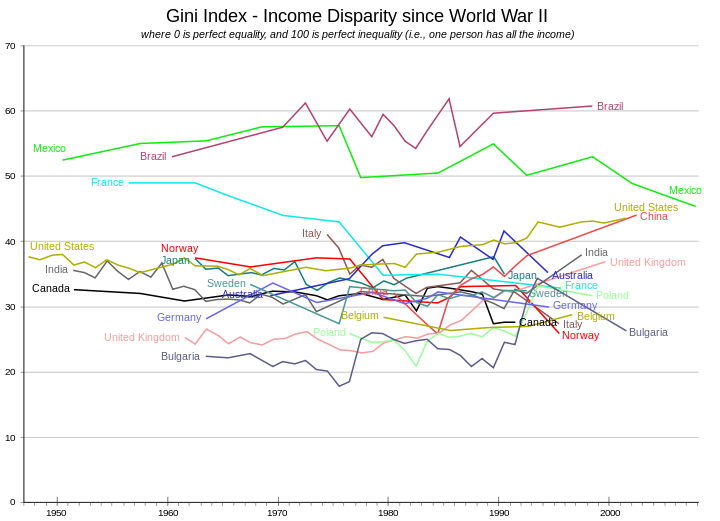
GINI index for the United States
Of the nations measured, only Brazil and Mexico have greater inequality than the U.S.
The most important problems in economics involve the excessive income/wealth/power Gaps between the richer and the poorer.
Wide Gaps negatively affect poverty, health and longevity, education, housing, law and crime, war, leadership, ownership, bigotry, supply and demand, taxation, GDP, international relations, scientific advancement, the environment, human motivation and well-being, and virtually every other issue in economics.
Implementation of The Ten Steps To Prosperity can narrow the Gaps:
 Here are some of the facts.

 “economy.”


 #Monetary Sovereignty - Mitchell