Here is how the Big Lie picks your pocket (It’s a lot but it’s not even a complete list.)

The Big Lie in economics is, “Federal taxes fund federal spending.” While state and local taxes fund state and local spending, federal taxes do not fund federal spending. The difference is that state and local governments are monetarily non-sovereign, while the federal government is Monetarily Sovereign.
Pickpocketing in Las Vegas - What is the penalty if I get caught?
The Big Lie steals your money and your benefits
Either the authors of the following article and the entire Congress of the United States are lying, or they really don’t understand the differences between monetary non-sovereignty and Monetary Sovereignty. Both possibilities are disgraceful. The differences are described in detail here, but fundamentally, a Monetarily Sovereign government is the creator and issuer of its own sovereign currency, in this case, the U.S. dollar. The U.S. is Monetarily Sovereign because it created the U.S. dollar from thin air by passing laws from thin air. Just as it never can run short of laws, the federal government never can run short of its dollars. Even if the federal government collected zero taxes, it could continue spending forever because it has the infinite ability to create its own sovereign currency. By contrast, state and local governments did not create the U.S. dollar. They, like you and me, simply are users of the dollar. And unlike the federal government, they and we all can run short of dollars. These differences mean that federal government financing is nothing at all like personal or state/local government financing, but the purpose of the Big Lie is to make you believe federal financing and personal financing are similar. Just one of the dozens of examples: While state/local governments use tax dollars for spending, the federal government destroys tax dollars upon receipt.
Here’s what’s in the bipartisan infrastructure package By Katie Lobosco and Tami Luhby, CNN, November 15, 2021 It will deliver $550 billion of new federal investments in America’s infrastructure over five years, touching everything from bridges and roads to the nation’s broadband, water and energy systems. Experts say the money is sorely needed to ensure safe travel, as well as the efficient transport of goods and produce across the country. The nation’s infrastructure system earned a C- score from the American Society of Civil Engineers earlier this year. Democrats claim the legislation pays for itself through a multitude of measures and without raising taxes.
The legislation cannot “pay for itself,” nor can spending cuts pay for the legislation, nor can tax increases pay for the legislation. The legislation will be paid for the same way all federal legislation is paid for:
  1. The involved federal agencies will send instructions, in the form of checks or wires, to the federal government’s creditors’ banks, instructing these banks to increase the balances in the creditor’s checking accounts.
  2. At the instant the banks obey those instructions, new dollars are created, deposited in checking accounts, and added to the M1 money supply.
  3. To balance their books, the banks then clear these deposits through the Federal Reserve which debits the federal government’s infinite supply of dollars. Thus federal deficit spending adds growth dollars to the economy.
  4. Had the federal government levied an equal amount of taxes, these tax dollars would not have “paid for” what was owed — the instructions already paid for it — but the taxes would have removed growth dollars from the economy.
The Congressional Budget Office brushed aside several of those pay-for provisions, ultimately finding the package would add $256 billion to the deficit over the next 10 years.
Translation: The package would have added 256 billion growth dollars to the economy at no cost to anyone — no cost to taxpayers, no cost to our children and grandchildren, no cost to anyone. The dollars would have been created by the banks obeying federal instructions.
The legislation calls for investing $110 billion for roads, bridges and major infrastructure projects. That’s significantly less than the $159 billion that Biden initially requested in the American Jobs Plan.
Translation: But for the Big Lie, an additional $49 billion could have been used to grow the economy,
Included is $40 billion for bridge repair, replacement and rehabilitation, $16 billion for major projects that would be too large or complex for traditional funding programs, $11 billion for transportation safety, $1 billion to reconnect communities, and $39 billion to modernize public transit, according to the text. That’s less than the $85 billion that Biden initially wanted to invest in modernizing transit systems and help them expand to meet rider demand.
That’s $46 billion in growth that will not happen because of the Big Lie.
The legislation provides a $65 billion investment in improving the nation’s broadband infrastructure, according to the text. Biden initially wanted to invest $100 billion in broadband.
Translation: 35 billion new growth dollars will not enter the economy. And now we come to a flat-out statement of the Big Lie:
How Congress will pay for it The legislation includes a multitude of measures to pay for the proposal — none of which would raise taxes. But while lawmakers claim the package pays for itself, the CBO score found it would instead add billions of dollars to the deficit over 10 years and that many of the pay-for provisions would not raise as much money as Democrats said they would.
No federal spending can “pay for itself.” The federal government pays for everything by issuing instructions, which it has the unlimited ability to do.
The bottom line is that the legislation would directly add roughly $350 billion to the deficit, when taking into account $90 billion of spending in new contract authority, said Marc Goldwein, senior vice president at the Committee for a Responsible Federal Budget, a nonpartisan group that tracks federal spending.
Translation: The legislation would directly add roughly 350 billion growth dollars to the economy. The Committee for a Responsible Federal Budget (CRFB) is a group that is paid by wealthy people to promulgate the Big Lie. The primary purpose of the Big Lie is to prevent the general public from asking for federal benefits. The goal is to widen the Gap between the rich and the rest, thus making the rich richer.
According to the text and a 57-page summary of the legislation, lawmakers leaned heavily on repurposing unused Covid-19 relief funds to pay for the legislation. 
Translation: Rather than creating 22 billion growth dollars for COVID relief, those growth dollars will instead supposedly be used to “pay for” Biden’s programs.
Another item in the text is $53 billion that stems in part from states opting to terminate the pandemic unemployment benefits early in hopes of pushing the jobless to return to work. Some 24 states stopped at least one of the federal unemployment programs before they officially ended in early September.
Translation: Rather than giving the $53 to the lower-income people as unemployment benefits, Congress has decided to starve these people into submission, so in desperation, they will go to poorly paying and/or unpleasant jobs they otherwise would have avoided. This way, the rich factory owners can rule with iron hands over needy workers.
The agency also found that the Federal Communications Commission’s spectrum auctions would generate far less than the $87 billion originally claimed by lawmakers.
Translation: The agency also found that the Federal Communications Commission’s spectrum auctions would take far fewer dollars from the economy than the $87 billion originally claimed by lawmakers.
The CBO also said that the legislation will raise about $50 billion by imposing new Superfund fees and changing the tax reporting requirements for cryptocurrencies, among other measures.
Translation: $50 billion unnecessarily will be taken from the public for fees and taxes.
The package leaves out Biden’s proposal to spend $400 billion to bolster caregiving for aging and disabled Americans — the second largest measure in the American Jobs Plan.
Translation: $400 billion would have grown the economy, but why should the aged and disabled poor receive dollars when the rich have tax loopholes to exploit?
His proposal would have expanded access to long-term care services under Medicaid, eliminating the wait list for hundreds of thousands of people. It would have provided more opportunity for people to receive care at homethrough community-based services or from family members. It would also have improved the wages of home health workers, who now make approximately $12 an hour, and would have put in place an infrastructure to give caregiving workers the opportunity to join a union.
None of the above were included because they don’t benefit the rich.
Also left on the sideline: $100 billion for workforce development, which would have helped dislocated workers, assisted underserved groups and put students on career paths before they graduate high school.
Translation: 100 billion growth dollars would have stimulated the economy, but we really don’t care about dislocated workers, underserved groups, and students.
The legislation also leaves out the $18 billion Biden proposed to modernize Veterans Affairs hospitals, which are on average 47 years older than private-sector hospitals.
Translation: There goes another 18 billion economic growth dollars, and really, why worry about our hospitalized veterans? Do they vote much?
What’s also out is a slew of corporate tax hikes that Biden wanted to use to pay for the American Jobs Plan. Biden’s original proposal called for raising the corporate income tax rate to 28%, up from the 21% rate set by Republicans’ 2017 tax cut act, as well as increasing the minimum tax on US corporations to 21% and calculating it on a country-by-country basis to deter companies from sheltering profits in international tax havens.
Sorry Joe, but taxes don’t fund federal spending. The federal government could continue spending forever, even if it collected $0 in taxes.
CNN’s Manu Raju contributed to this report.
Apparently, CNN’s Manu Raju knows as little about economics as do Katie Lobosco and Tami Luhby. SUMMARY Not only is the Big Lie eliminating many billions of growth dollars from the economy, but a great many worthwhile projects and people will go unfunded. Because the rich take advantage of the public’s ignorance about economics, they win and you lose. They manage to widen the Gap, while you lose the growth benefits of federal spending along with the specific benefits that spending could have funded. Ignorance has its penalties. Rodger Malcolm Mitchell Monetary Sovereignty Twitter: @rodgermitchell Search #monetarysovereignty Facebook: Rodger Malcolm Mitchell

……………………………………………………………………..

THE SOLE PURPOSE OF GOVERNMENT IS TO IMPROVE AND PROTECT THE LIVES OF THE PEOPLE.

The most important problems in economics involve:
  1. Monetary Sovereignty describes money creation and destruction.
  2. Gap Psychology describes the common desire to distance oneself from those “below” in any socio-economic ranking, and to come nearer those “above.” The socio-economic distance is referred to as “The Gap.”
Wide Gaps negatively affect poverty, health and longevity, education, housing, law and crime, war, leadership, ownership, bigotry, supply and demand, taxation, GDP, international relations, scientific advancement, the environment, human motivation and well-being, and virtually every other issue in economics. Implementation of Monetary Sovereignty and The Ten Steps To Prosperity can grow the economy and narrow the Gaps: Ten Steps To Prosperity:
  1. Eliminate FICA
  2. Federally funded Medicare — parts A, B & D, plus long-term care — for everyone
  3. Social Security for all
  4. Free education (including post-grad) for everyone
  5. Salary for attending school
  6. Eliminate federal taxes on business
  7. Increase the standard income tax deduction, annually. 
  8. Tax the very rich (the “.1%”) more, with higher progressive tax rates on all forms of income.
  9. Federal ownership of all banks
  10. Increase federal spending on the myriad initiatives that benefit America’s 99.9% 
The Ten Steps will grow the economy and narrow the income/wealth/power Gap between the rich and the rest.

MONETARY SOVEREIGNTY

When there is an unwanted effect, the solution is to kill the cause.

When you are faced with an unwanted effect, the solution is to find and then solve the cause. If you don’t understand the cause, you will be faced with the same effect again and again. Washington Post headline:
Inflation emerges as defining economic challenge of Biden presidency, with no obvious solution at hand America is emerging from the pandemic facing its biggest inflationary spike in decades, as startling and persistent price hikes threaten to undermine the recovery, while posing an entirely new kind of economic challenge to the Biden presidency. Policymakers are facing the devilish and unfamiliar quandary of booming consumer demand and dramatic supply disruptions combining to push higher the cost of necessities such as food, gas and housing.
I’m not sure why this is such a mystery. All inflations are caused by the same thing: Shortages of key goods and services. The cure for any inflation is to increase the availability of the scarce goods and services. So when the Washington Post says, “no obvious solution at hand,” they may be talking about no obvious political solution.
This inflationary burst has no single cause and no obvious solution.
The cause is a shortage of key goods and services. The cause is not federal deficit spending.
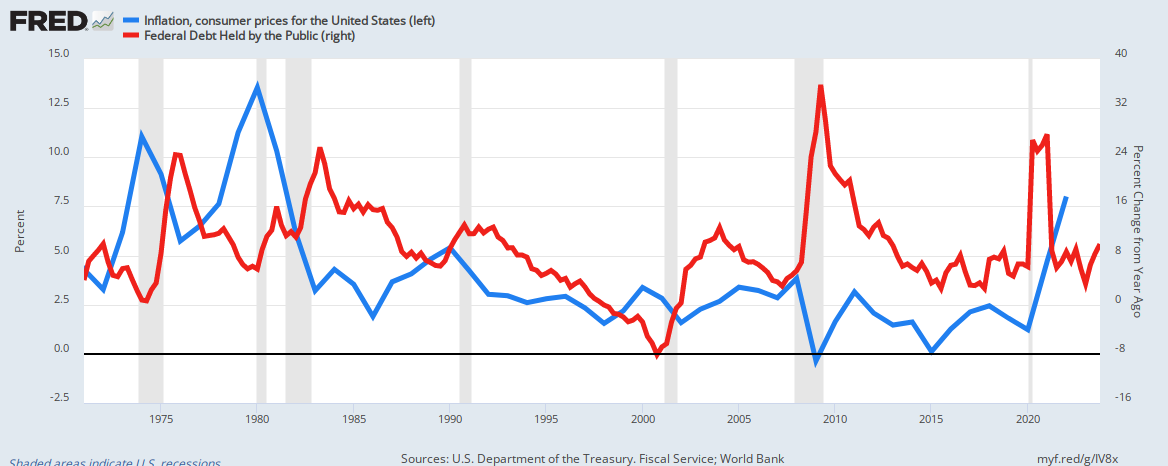
This graph shows there is no historical relationship between federal deficit spending (red) and inflation (blue). The graph also shows that reductions in deficit growth lead to recessions (vertical bars) which are cured by increases in deficit growth.
The economic solution is quite plain: Federal deficit spending to increase the supply of energy, food, computer chips, supply-chain methods, and labor.
Trillions of dollars in federal aid approved by Congress in response to the pandemic have led American consumers and companies to purchase more goods than ever before, putting new strains on global supply chains to accommodate the soaring volume. But that higher demand has collided with shortages in workers, supplies and transportation capacity — challenges caused in part by the pandemic as well as long-standing structural deficiencies in the national economy.
It is those shortages, not federal deficits, that have caused inflation. Cure the shortages and you cure the inflation.
A record 4.4 million Americans quit their jobs in September as labor market tumult continued.
The labor shortage exists partly because people quit their jobs for a variety of reasons including:
  1. Need for child home care
  2. Low wages
  3. FICA cost
  4. Bad hours.
  5. Virus fear
There are others, but these all could be solved by federal deficit spending — a kind of “Manhattan Project” to cure the shortages that cause inflation.
  1. Federal pay for child home care
  2. Higher minimum wage together with the elimination of business taxes, to help fund the higher wages
  3. Elimination of FICA and reduction of income taxes at the low pay scales
  4. Standard 4-day week and/or shorter workday
  5. Federal support for vaccination rewards in selected industries.
The federal government also should reduce the need for human labor by funding more development of Artificial Intelligence (AI) and mechanization along with other labor-saving initiatives.
This inflationary burst has no single cause and no obvious solution.
The single cause is shortages. The obvious solution is to cure the shortages.
Trillions of dollars in federal aid approved by Congress in response to the pandemic have led American consumers and companies to purchase more goods than ever before, putting new strains on global supply chains to accommodate the soaring volume. But that higher demand has collided with shortages in workers, supplies and transportation capacity — challenges caused in part by the pandemic as well as long-standing structural deficiencies in the national economy.
In the Eisenhower years, the federal government spent billions to improve highway traffic. Today, not only do highways need to be improved, but all other elements of the supply chain need similarly to be improved. Our railroads are a mess. Our ports are inadequate. The quasi-privatized postal service is struggling. Shipping itself should be funded. These all are critical national needs, surely as important as weapons development.
Gas prices are at a seven-year high amid a global energy crisis, exacerbated by unusually high demand in Europe and a coal shortage in China.
Solutions: Temporarily fund increased oil drilling while funding more research and development of renewable, non-carbon fuels.
Food prices are rising at the highest level in 12 years amid severe droughts and spiking demand from families and restaurant reopenings. Meat, fish and egg prices are up nearly 12 percent from a year ago — the highest increase since 1979 (other than the early days of the pandemic) — partly fueled by processing plants’ struggle to find workers.
While other industries have mechanized, food processing remains in the electronic dark ages. Federal funding of computerization would help, significantly, as would federal financial support for raising wages. Droughts are being caused by climate change, which has been denied by the right wing and largely ignored by the left. Federal support for non-carbon energy sources would help solve the problem.
The longer inflation lasts, the greater the political problem for the White House and congressional Democrats. Already news of the October inflation spike spurred new head winds for President Biden’s signature and key legislative initiative — the roughly $2 trillion Build Back Better package — exacerbating fears that other moderate Democrats may echo the concerns raised by Sen. Joe Manchin III (D-W.Va.) this past week about more spending.
Two people in California rescued by Coast Guard after boat bursts into flames | Daily Mail Online
Congress won’t use their infinite supply of water to put out our economic fire.
Meanwhile, Republicans have sharpened their attacks over inflation, seeing it as among their best arguments against the Biden’s presidency.
In other words, our boat is burning, but the politicians won’t put out the fire because they don’t want to use water.
Yet many economists say that the inflationary pressures hitting the U.S. economy were necessary to avoid the far worse scenario of a prolonged downturn and that focusing on rising prices risks obscuring the healthy facets of the current rebound such as the rapid rebound in jobs. Most families have more financial resources than they did before covid, especially among the bottom third. Even when accounting for inflation, disposable income has been roughly 9.5 percent higher in 2021 than it was before the coronavirus pandemic hit in 2019, according to Julia Coronado, president and founder of MacroPolicy Perspectives. “It’s safe to say the bottom 40 percent of Americans are definitely better off in the past year from a combination of rising wages and government aid, even with inflation,” said Arindrajit Dube, economics professor at the University of Massachusetts Amherst.
The Democrats are laughably (or “cryably”) bad at telling their story. Somehow, they expect the public to see “the obvious,” but history shows that the public would rather believe the words of a personality than the facts.
The U.S. economy is growing at a very fast clip, especially compared with the rest of the world, and could recover the lost economic output from the pandemic by the end of next year, according to some projections. Workers at the bottom of the income distribution are seeing meaningful wage increases, even factoring in inflation. Job openings are plentiful. The stock market has continued its meteoric rise under Biden, with the S&P 500 jumping by more than 20 percent since he took office. Inflation is up globally, not just in the United States, and the supply chain dysfunction reflects a decades-long trend of companies scattering their production sources across the globe.
All of the above is true, but who is telling the story? Certainly not Biden. And not the Vice President, whatever her name is and wherever she is hiding. The old saw is, “If you’re defending you’re losing”, and the Dems aren’t even defending.
The approximately 50 percent rise in gasoline prices from last year — and 6 percent jump in October alone — has proved one of the most visible burdens on American families, spurred by a mixture of factors from Chinese manufacturing and an acute energy crisis in Europe.
To the average American voter, gas prices = inflation. The federal government has the financial ability to lower gas prices, although it may not have the political ability, unless someone in the government figures out how to tell the story. Sadly, a personality like Donald Trump could do it, and he would do it, if it benefited him.
Supply chain backlogs also show little sign of easing before early 2023, said Phil Levy, chief economist at freight company Flexport. While shipping rates from Shanghai to Los Angeles came down modestly from their September peaks and auto companies report slightly easier access to semiconductors now, a record 81 container ships were sitting off the southern California coast on Tuesday, according to the Marine Exchange.
A “Manhattan Project” for America’s supply chain could fix the problem.
Rent prices also jumped 0.4 percent from September to October, continuing an upward trend, while the sales price of a single-family home jumped by 16 percent over one year, according to the National Association of Realtors. A red-hot housing market has been spurred on in part by low interest rates and shortages in supply caused by a freeze in construction during the pandemic.
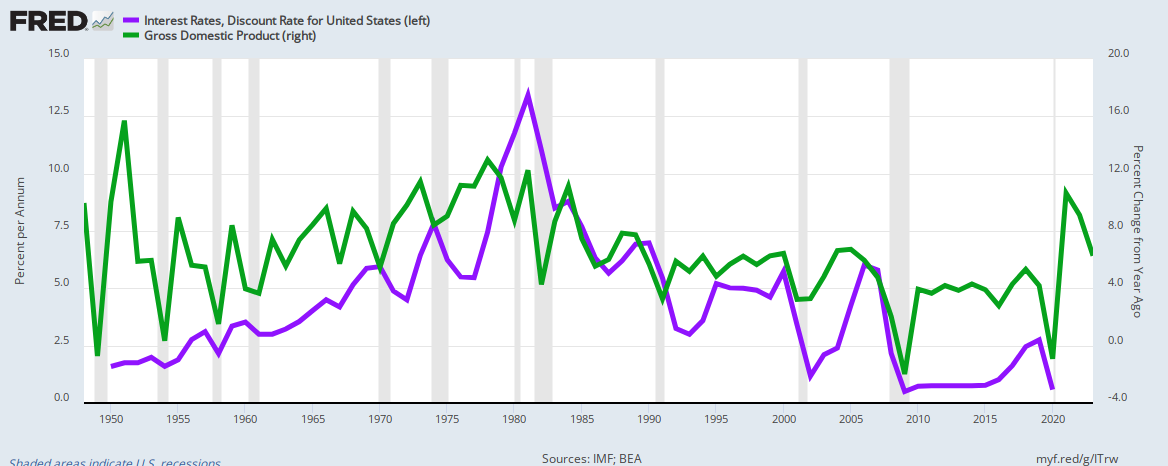
Annual interest rates (purple) vs. annual growth of Gross Domestic Product. Rate reductions do not stimulate GDP growth.
Shortages in supply always cause price increases. However, as with so many myths in economics, the myth that low interest rates are stimulative has no basis. In fact, there is evidence, as you can see from the above graph, that high interest rates are stimulative. The reason: High rates cause the federal government to pour more interest dollars into the economy.
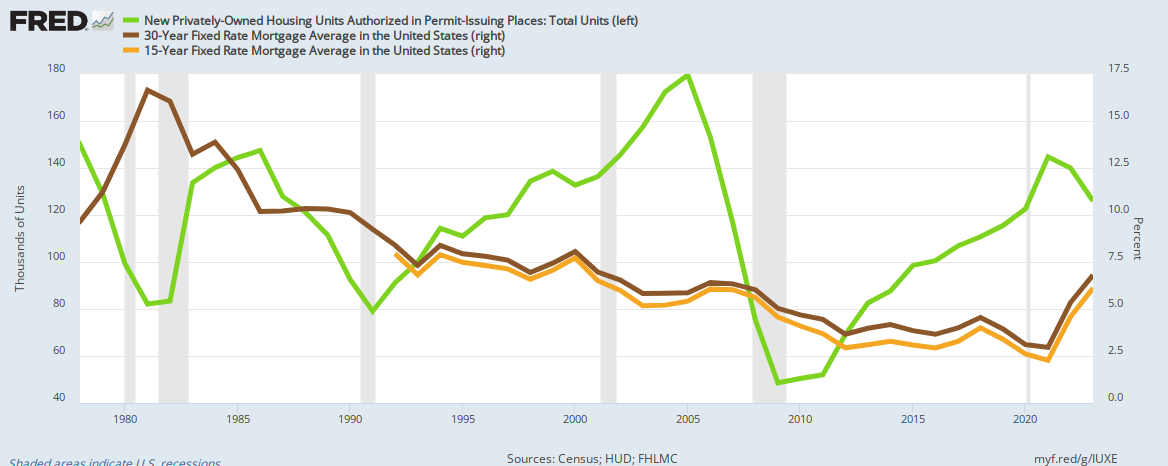
New housing construction (green) does not correlate with reductions in 30-year (brown) or 15-year (gold) mortgage rates.
New housing construction does not correlate with reduced mortgage rates. Both 30-year and 15-year mortgage rates have drifted downward since 1982, yet new housing construction (green) has changed wildly. One reason for the lack of correlation may be that interest rates are not the deciding factor for home buyers.
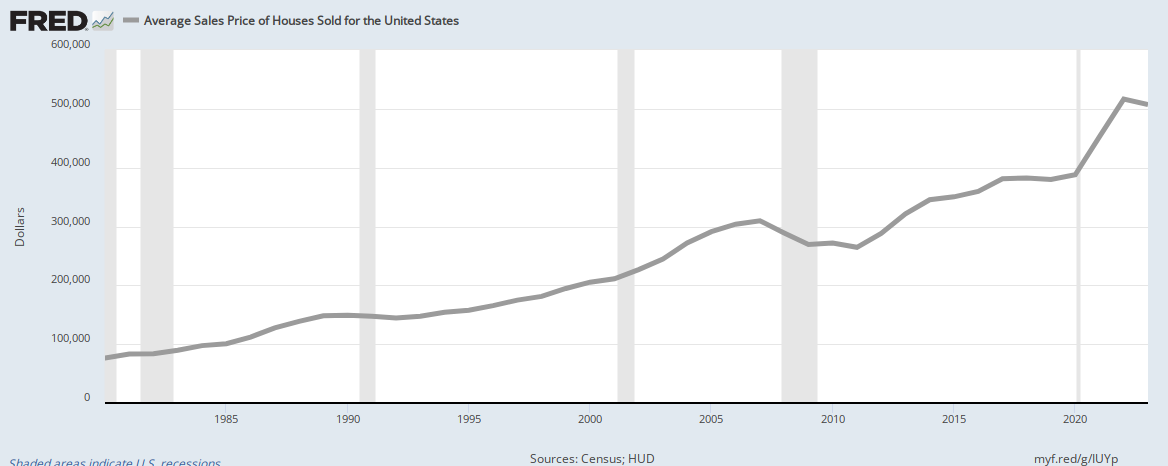
Since 1980, the average sales price of a house has increased from $80,000 to $450,000. A 1% drop in mortgage rates for a $450,000 house (less 20% down) comes to $3,600 per year or $300 per month, not nearly enough to encourage or discourage the purchase of a $450,000 house.
Thus, contrary to common knowledge and Federal Reserve dogma, reducing interest rates is not stimulative, and in fact, the argument could be made that rate reductions are recessive. Interest rates should be raised and home construction, especially the construction of modestly priced homes, should be federally aided. Raising interest rates also would mitigate against inflation, by increasing the value of the U.S. dollar.
If price increases continue, the Federal Reserve may raise interest rates, which would not only slow the pace of inflation, but also the pace of job and economic growth.
Yes and no. Yes, it would slow the pace of inflation, and no, it would not slow economic growth, as the above graphs indicate. SUMMARY The single greatest asset of the U.S. federal government is its Monetary Sovereignty. Yet myths and politics both have prevented the efficient use of this asset. The federal government has the infinite ability to create U.S. dollars, and the addition of dollars is economically stimulative. Further, there is no evidence that federal deficit spending causes inflation, and massive evidence that it does not. In short, there scarcely is an economic problem facing America that cannot be addressed by the wise addition of federal dollars, and there are no economic problems that can be solved by reductions in federal spending. Rodger Malcolm Mitchell Monetary Sovereignty Twitter: @rodgermitchell Search #monetarysovereignty Facebook: Rodger Malcolm Mitchell

……………………………………………………………………..

THE SOLE PURPOSE OF GOVERNMENT IS TO IMPROVE AND PROTECT THE LIVES OF THE PEOPLE.

The most important problems in economics involve:
  1. Monetary Sovereignty describes money creation and destruction.
  2. Gap Psychology describes the common desire to distance oneself from those “below” in any socio-economic ranking, and to come nearer those “above.” The socio-economic distance is referred to as “The Gap.”
Wide Gaps negatively affect poverty, health and longevity, education, housing, law and crime, war, leadership, ownership, bigotry, supply and demand, taxation, GDP, international relations, scientific advancement, the environment, human motivation and well-being, and virtually every other issue in economics. Implementation of Monetary Sovereignty and The Ten Steps To Prosperity can grow the economy and narrow the Gaps: Ten Steps To Prosperity:
  1. Eliminate FICA
  2. Federally funded Medicare — parts A, B & D, plus long-term care — for everyone
  3. Social Security for all
  4. Free education (including post-grad) for everyone
  5. Salary for attending school
  6. Eliminate federal taxes on business
  7. Increase the standard income tax deduction, annually. 
  8. Tax the very rich (the “.1%”) more, with higher progressive tax rates on all forms of income.
  9. Federal ownership of all banks
  10. Increase federal spending on the myriad initiatives that benefit America’s 99.9% 
The Ten Steps will grow the economy and narrow the income/wealth/power Gap between the rich and the rest.

MONETARY SOVEREIGNTY

Polio vaccine outlawed!

A shocking development that threatens the health of America’s students: A U.S. appeals court has extended its Nov. 6 order pausing the polio vaccine mandate for school children
The ruling, issued Friday by the New Orleans-based U.S. Court of Appeals for the 5th Circuit, solidifies its earlier order blocking implementation of the Occupational Safety and Health Administration’s emergency regulation.
Hospital Data – Florida COVID Action
Florida hospital overcrowded with the unvaccinated.,
Its ruling comes ahead of a Judicial Panel on Multidistrict Litigation lottery to determine which federal appeals court will be assigned to adjudicate the many legal challenges to the measure now pending across the country. The lottery is slated for Nov. 16. In a 22-page opinion, the court had harsh words for the vaccine mandate. The mandate “threatens to substantially burden the liberty interests of reluctant individual recipients put to a choice between their schooling and their jab(s),” the court said. “Likewise, the schools and parents seeking a stay in this case will also be irreparably harmed in the absence of a stay, whether by the school and financial effects or a lost or suspended student, compliance and monitoring costs associated with the Mandate, the diversion of resources necessitated by the Mandate, or by OSHA’s plan to impose stiff financial penalties on schools that refuse to punish or test unwilling student,” the court said. The U.S. had asked the court to set aside its prior order to allow that process to play out. OSHA’s rule requires qualifying schools to ensure that all students are fully vaccinated by Jan. 4, or subjected to testing for polio at least weekly. Barring a long-lasting injunction, schools will have to comply with other parts of the rule by Dec. 5, including developing a compliance plan, offering paid time off for vaccinations, and requiring unvaccinated students to wear masks. The 5th Circuit is considering challenges filed by Texas, joined by Louisiana, Mississippi, Utah, South Carolina and schools that claim they’re adversely affected by the rule. The plaintiffs contend the emergency temporary standard exceeds OSHA’s statutory authority.
Polio endangers the lives, not just of students and not just of their families, but of Americans everywhere. Polio is a virulent and dangerous disease, and the courts should not put some theoretical, invented “freedom” ahead of actual lives. Oh, wait! I’m sorry. I was confused. The article actually concerned COVID vaccines, not the vaccines that ALL states require of school children. But, those hepatitis A & B, measles, mumps, rubella, varicella, diphtheria, tetanus, pertussis, and poliovirus vaccines are different, because they help prevent the spread of fatal diseases throughout the population, and most are highly contagious, while the COVID vaccine . . . uh . . . is . . . only . . . something Trump Republicans don’t like. This just in:
DeSantis brings back Florida lawmakers to crack down on vaccination mandates Governor says special session will be ‘striking a blow for freedom’ in a state fighting federal vaccine requirements TALLAHASSEE — A special legislative session dubbed “Keep Florida Free” begins Monday at the behest of Gov. Ron DeSantis, who wants lawmakers to pass more measures to block vaccine mandates by public and private schools. The four bills being considered would ratchet up the penalties for schools, local governments and other entities that require workers to be vaccinated against the viruses and students to wear masks in school. According to DeSantis (R), the session will strengthen as well as augment rules already in place — in part through his own executive orders. “At the end of the day, we want people to be able to make informed decisions for themselves, but we’ve got to stop bossing people around,” DeSantis said last week as he officially announced his 2022 reelection bid. “We’ve got to stop the coercion. We’ve got to stop trying to browbeat people.”
Oops, sorry again. This article was about the COVID vaccination, not all the other vaccinations that Florida mandates to protect our schoolchildren. See, it’s like this. We don’t want our kids to die from hepatitis A & B, measles, mumps, rubella, varicella, diphtheria, tetanus, pertussis, and poliovirus, or to spread those diseases to friends and family, but we don’t care if our people die from or spread COVID to friends and family. It’s different, somehow, in the minds of the Trumpers. We have to stop browbeating our people. Remember, those other diseases are highly contagious, while COVID is not. Donald Trump and the rest of the GOP told me so.  
We’ve got to stop trying to browbeat people.” Florida Gov. Ron DeSantis.
Rodger Malcolm Mitchell Monetary Sovereignty Twitter: @rodgermitchell Search #monetarysovereignty Facebook: Rodger Malcolm Mitchell

……………………………………………………………………..

THE SOLE PURPOSE OF GOVERNMENT IS TO IMPROVE AND PROTECT THE LIVES OF THE PEOPLE.

The most important problems in economics involve:
  1. Monetary Sovereignty describes money creation and destruction.
  2. Gap Psychology describes the common desire to distance oneself from those “below” in any socio-economic ranking, and to come nearer those “above.” The socio-economic distance is referred to as “The Gap.”
Wide Gaps negatively affect poverty, health and longevity, education, housing, law and crime, war, leadership, ownership, bigotry, supply and demand, taxation, GDP, international relations, scientific advancement, the environment, human motivation and well-being, and virtually every other issue in economics. Implementation of Monetary Sovereignty and The Ten Steps To Prosperity can grow the economy and narrow the Gaps: Ten Steps To Prosperity:
  1. Eliminate FICA
  2. Federally funded Medicare — parts A, B & D, plus long-term care — for everyone
  3. Social Security for all
  4. Free education (including post-grad) for everyone
  5. Salary for attending school
  6. Eliminate federal taxes on business
  7. Increase the standard income tax deduction, annually. 
  8. Tax the very rich (the “.1%”) more, with higher progressive tax rates on all forms of income.
  9. Federal ownership of all banks
  10. Increase federal spending on the myriad initiatives that benefit America’s 99.9% 
The Ten Steps will grow the economy and narrow the income/wealth/power Gap between the rich and the rest.

MONETARY SOVEREIGNTY

Fear and loathing, and denial in America.

Hatred, i.e. loathing, along with its companion, fear — you cannot hate without fear — is the strongest emotion humans have. Evolution has made it the emotion that most often precipitates an immediate, thoughtless, violent reaction. Hate/fear is the emotion that moves us and saves us when a predator attacks. Donald Trump repeatedly taps into white people’s hate/fear of non-white, non-Christian, non-America-born people with his support for white supremacists, his talk of Mexican “rapists,” Muslim terrorists, Christmas elimination, and most recently, Critical Race Theory (CRT). He has convinced a large segment of the white Christian population that despite having most of the power, most of the money, and most of the votes, they are under dire threat from minorities. Trump is, in every sense of the phrase, a hate monger.  Bigotry and racism are the children of hate/fear.
Trump has assembled a long record of comment on issues involving African Americans as well as Mexicans, Hispanics more broadly, Native Americans, Muslims, Jews, immigrants, women, and people with disabilities. His statements have been reflected in his behavior—from public acts (placing ads calling for the execution of five young black and Latino men accused of rape, who were later shown to be innocent) to private preferences (“When Donald and Ivana came to the casino, the bosses would order all the black people off the floor,”) per a former employee of Trump’s Castle. Trump emerged as a political force owing to his full-throated embrace of “birtherism,” the false charge that the nation’s first black president, Barack Obama, was not born in the United States. His presidential campaign was fueled by nativist sentiment directed at nonwhite immigrants, and he proposed barring Muslims from entering the country.
Bigotry and racism are common in America and in every other nation. They are human failings. But we never should feel acceptance for these twin horrors. We should oppose them wherever and whenever we can, else they devour us. Today, they debilitate our nation. They weaken us. They remove potential producers and consumers from the economy. Chest thumping and flag-waving do not make America great. The Trump followers who attempted a coup in Washington waved dozens of American flags. They were traitors to America. Greatness comes from how we treat the least powerful among us. Ask any thinking person, and they will tell you they oppose bigotry and racism. Even Donald Trump claims that. But they merely deny the obvious. One would have to be totally uninformed not to know that blacks and Latinos in America — and to a lesser extent, other minorities — receive unfavorable treatment by the law. Those who argue against that truth are insincere. For them, no amount of fact will undo their prejudices. Children are not born bigoted. They must learn it. They must learn it from their parents and extended family, and they must learn it from their friends. “Learn” is the operative word. The only cure for learning is re-learning. To cure bigotry, children must be taught the evils of bigotry. They must be shown the meaning and the implications of bigotry. Where can this learning take place? Clearly, not in their homes, because that either is where they learned bigotry in the first place, or for whatever reason, their homes have failed to provide anti-bigotry learning. Now, we have the Republican party, the party of white supremacists, and Trumpism, claiming the teaching Critical Race Theory (CRT) is racist. Their hypocrisy is not to be surpassed. CRT is not an accusation as the Trumpers claim. CRT is a revelation of reality. It is a reality that bigots fear.
Critical race theory is a study in academia based on the concepts of systemic and institutional racism. Systemic racism refers to how the government has discriminated against Black, Indigenous and other people of color through unjust policies concerning housing, employment, criminal justice, education and more. From the conception of slavery in America, to the Jim Crow laws that segregated Black people, to the disproportionate criminalization and brutality against Black Americans, racism and white supremacy have persevered in the U.S. through law. Even if some discriminatory laws or policies are no longer in effect, they can still impact families for generations. “From who lives where to the disproportionate consequences of COVID,” Crenshaw said, “these are all current ways in which racial disparities are produced.”
Only a bigot or a fool could deny that the law in America too often has supported racism. Slavery once was legal. Blacks were not counted as full, legal humans for voting purposes. “Separate but equal” was enshrined in the law. Racial gerrymandering has grown nationally, especially in the south. Today, the Republicans are doing everything they can to reduce black voting. Police brutality against blacks is commonplace. Drug laws emphasize drugs most often used by blacks. Can any honest, thinking person deny it? Yet the white population is being told that educating our children about the true history of these laws constitutes a threat to white America. CRT constitutes a threat only to ignorance and systemic bigotry. By fomenting hatred and fear, Trump has gained millions of votes among the ignorant and the frightened. The GOP is following his lead. From the 11/6/21 Chicago Tribune:
The GOP is supercharging a message over race and education that helped catapult Republican Glenn Youngkin to a win in Virginia’s governor’s race Tuesday. (By Thomas Beaumont, Aaron Morrison and Will Weissert Associated Press) Republicans plan to forcefully oppose race and diversity curricula — tapping into a surge of parental frustration about public schools — as a core piece of their strategy in the 2022 midterm elections, a coordinated effort to supercharge a message that mobilized right-leaning voters in Virginia this week and which Democrats dismiss as race-baiting. Coming out of Tuesday’s elections, in which Republican Glenn Youngkin won the governor’s office after aligning with conservative parent groups, the GOP signaled that it saw the fight over teaching about racism as a political winner. Indiana Rep. Jim Banks, chairman of the conservative House Study Committee, issued a memo suggesting “Republicans can and must become the party of parents.”
“Party of parents” is a euphemism for “First scare ’em then pretend to protect ’em.”  Those “parent groups” who voted Republican are the same parent groups who taught their kids to be bigots. The home and the neighborhood are the primary places where bigotry is learned.
House Minority Leader Kevin McCarthy announced support for a “Parents’ Bill of Rights” opposing the teaching of “critical race theory,” an academic framework about systemic racism that has become a catch-all phrase for teaching about race in U.S. history. “Parents are angry at what they view as inappropriate social engineering in schools and an unresponsive bureaucracy,” said Phil Cox, a former executive director of the Republican Governors Association. Democrats were wrestling with how to counter that message. Some dismissed it, saying it won’t have much appeal beyond the GOP’s most conservative base.  They pointed to Republicans’ use of the “defund the police” slogan to hammer Democrats and try to alarm white, suburban voters after the demonstrations against police brutality and racism that began in Minneapolis after the killing of George Floyd.
The Democrats and Republicans have widely different agendas. The Democrats speak of improving healthcare, expanding Social Security, defending voting rights, and lifting people from poverty.

The GOP Fascist Party Of No Ideas preaches “change nothing,” fear everything, anti-vaxing, cut taxes on the rich, and hatred of immigrants and non-Christians.

This is the fascist party that denies global warming, refuses to take action against air and water pollution, tries to eliminate health care and other benefits for the poor, fights against plans for clean, renewable energy, but instead aids the use of coal, and tries to hinder electricity-producing “windmills.”

This is the fascist party that ignores species extinction in favor of immediate business profits, and fights against a minimum wage, and paid family and medical leave.

We are caught in a battle between compassion and fear, and sadly, but predictably, fear now is winning elections. The electorate has changed from “us” to “me only,” and from planning for the future, to “now-only.” Evolution has not rewarded compassion with the same urgency as hatred and fear. We don’t have a powerful, knee-jerk, instant reaction to morality as we do to terror. Decency simply is not as strong a survival motivator as loathing. And the immediate present always is more powerful than the future of the human Perhaps, part of the problem may be that whites understand the pain the law has inflicted on blacks, and now fear that the blacks will retaliate. Who better to understand the effects of hatred than fearful haters? My own fear is that as the white voters lose population dominance, white fear will grow, and increasingly, the laws will be twisted to countenance racism. Our right-wing Supreme Court, together with right-wing lower courts and a right-wing Congress, will need only a right-wing President to make the transformation complete. America will indeed become a bigoted racist nation, not just ideologically, but legally. The Statue of Liberty will be a cruel joke. And we will have no way to return. Rodger Malcolm Mitchell Monetary Sovereignty Twitter: @rodgermitchell Search #monetarysovereignty Facebook: Rodger Malcolm Mitchell

……………………………………………………………………..

THE SOLE PURPOSE OF GOVERNMENT IS TO IMPROVE AND PROTECT THE LIVES OF THE PEOPLE.

The most important problems in economics involve:
  1. Monetary Sovereignty describes money creation and destruction.
  2. Gap Psychology describes the common desire to distance oneself from those “below” in any socio-economic ranking, and to come nearer those “above.” The socio-economic distance is referred to as “The Gap.”
Wide Gaps negatively affect poverty, health and longevity, education, housing, law and crime, war, leadership, ownership, bigotry, supply and demand, taxation, GDP, international relations, scientific advancement, the environment, human motivation and well-being, and virtually every other issue in economics. Implementation of Monetary Sovereignty and The Ten Steps To Prosperity can grow the economy and narrow the Gaps: Ten Steps To Prosperity:
  1. Eliminate FICA
  2. Federally funded Medicare — parts A, B & D, plus long-term care — for everyone
  3. Social Security for all
  4. Free education (including post-grad) for everyone
  5. Salary for attending school
  6. Eliminate federal taxes on business
  7. Increase the standard income tax deduction, annually. 
  8. Tax the very rich (the “.1%”) more, with higher progressive tax rates on all forms of income.
  9. Federal ownership of all banks
  10. Increase federal spending on the myriad initiatives that benefit America’s 99.9% 
The Ten Steps will grow the economy and narrow the income/wealth/power Gap between the rich and the rest.

MONETARY SOVEREIGNTY