Gap Psychology dictates that to achieve superiority, one must claim inferiors and then distance oneself from those claimed inferiors. The greater the distance—i.e., the wider the “Gap,” the greater our superiority.
“Rich” and “poor” are comparatives, not absolutes. For one to be rich, someone else must be poor, or at least poorer.
A person with $100,000 is rich if everyone else has only $100, but he/she is “middle” if everyone else has $100,000. And he is poor if everyone else has $1,000,000.
Getting richer is not simply a matter of increasing one’s ownership of money. If a middle-income person has $100,000 and doubles that to $200,000, he still is “middle” if everyone else rises to $200,000.
Getting richer requires widening the Gap below and narrowing the Gap above. It is the Gap that measures wealth, not the wealth itself.
Gap Psychology describes the desire to widen the Gap below and to narrow the Gap above.
Gap Psychology enters into virtually all aspects of human existence, not only money or wealth. A person with an IQ of 130 is smart unless everyone else has an IQ of 170.
A 21-year-old man who can do 50 chin-ups is strong unless everyone else can do 150. A child who can read at age 4 is considered smart unless every other child can read at age 3. If you can run 100 meters in 9.5 seconds, you are blazingly fast unless you are a cheetah, which means you would be laughingly slow.
Self-improvement does not require improving yourself so long as you can widen the Gap below and narrow the Gap above.
You can be strong and do just two chin-ups if you hang a 300 lb. weight from everyone else’s ankles.
If you force everyone else to wear blindfolds, you can learn to read at age 8 and be considered smart. And if you tie everyone else’s legs together, you can be fast, running 100 meters in 20 seconds.
Figuratively, that is how the rich treat the rest of us to widen the Gap. They falsely claim that the federal government “can’t afford” to provide benefits to the middle and lower classes while accepting tax benefits for themselves.
Gap Psychology even enters into the abortion controversy. The rich can easily obtain abortions and other medical procedures. It is the poor who must suffer from a lack of care. That is a Gap the rich wish to widen.
Gap Psychology leads to bigotry, classes, and the caste system. Here is an excellent summary:
The Foundations of Caste: The Origins of our DiscontentsFor more than half of American history, slavery was the dominant social institution in the South.
Wilkerson argues that even after emancipation, legally sanctioned violence, harassment, and displacement of African Americans remained—and still remains—an existential threat.
According to Wilkerson, these behavioral scripts and socially reinforced biases have become deeply encoded in the American psyche at all levels of society, which unconsciously perpetuates the system.
Her research demonstrates that all caste systems have the eight essential characteristics (Pillars) in common.
Pillar Number One: Divine Will and the Laws of Nature
Hindu cosmology holds that the caste system is an aspect of the birth of Brahma, the supreme god, who created and populated the world out of various parts of his body in a way corresponding to the social functions dictated by the traditional order.
The Judeo-Christian tradition has a contrasting story about the creation of the world’s different races descending from the three sons of the Old Testament patriarch Noah.
The two “good” sons who are rewarded for their honor become the fathers of the Eastern and Western races, while the cursed son, Ham, and his own son Canaan are fated to be people of the South, forsaken by God.
For there to be “good,” there must be “bad.”
All caste systems, religions, and cults (similar to religions but smaller and not as mainstream) identify members as “good” and outsiders as “bad” or lesser in some way.
At the time when Spain and Portugal were beginning their global circumnavigations, the native inhabitants of Africa and India were believed by Europeans to be descendants of the biblical outcasts and thus divinely ordained to suffering and subjugation.
Pillar Number Two: HeritabilityIn India, caste is inherited through the father’s line, whereas the United States has historically determined caste through the mother.
In Judaism, to be Jewish, one must have a Jewish mother. The father can be Jewish or gentile.
Presidents Bush, father and son
Because enslaved mothers had no legal right to their own children, Black birth became a production process for slave labor, as Black children were regarded as valuable, durable commodities.
The major distinction between caste and class, Wilkerson writes, is that caste is predetermined, unchanging, and generationally upheld, whereas class implies an attainmentof certain conditions based on merit and effort and is much more inclusive within its respective caste “container.”
Yet we have the expressions “new” and “old” money, with “old money: considered superior by those whose ancestors were wealthy.
In the United States, the exclusion of African Americans regardless of their level of social or professional success—an exclusion based on superficial, inescapable, inherited characteristics—resembles in practice the treatment of India’s “untouchable” populations.
Pillar Number Three: Endogamy and the Control of Marriage and MatingIt is essential for a caste system to separate and manage bloodlines in a way that preserves the impenetrability of the dominant gene pool by subordinate-caste DNA.
This protects the Gap between white and non-white. Most American parents prefer that their children marry within their religion and color.
To achieve this, miscegenation laws are passed that restrict marriage and reproduction along caste lines, a policy known as endogamy—and something Hitler admired about the American model.
The objective of this kind of social engineering is to achieve racial purity among the dominant caste, but it also concentrates resources, value, and empathy among the various levels of the dominant caste that are systematically denied to non-white subordinates.
America’s racial boundaries had been set from its earliest days, and coupled with the nation’s historic exclusion of non-European immigrants, endogamy laws effectively created a process of selective breeding that reinforced caste divisions while reserving for white men the ownership of Black reproduction.
Pillar Number Four: Purity Versus Pollution
The United States has its own unique system of gradations on a scale of racial purity that defines itself in opposition to an obsession with contamination by genetic material from a perceived inferior bloodline.
Not only was there the so-called “one-drop rule” that defined Blackness and which the Nazis found so extreme, but there was also an elaborate status-defining class subsystem within the subordinate caste based on skin tone and proportion of African ancestry.
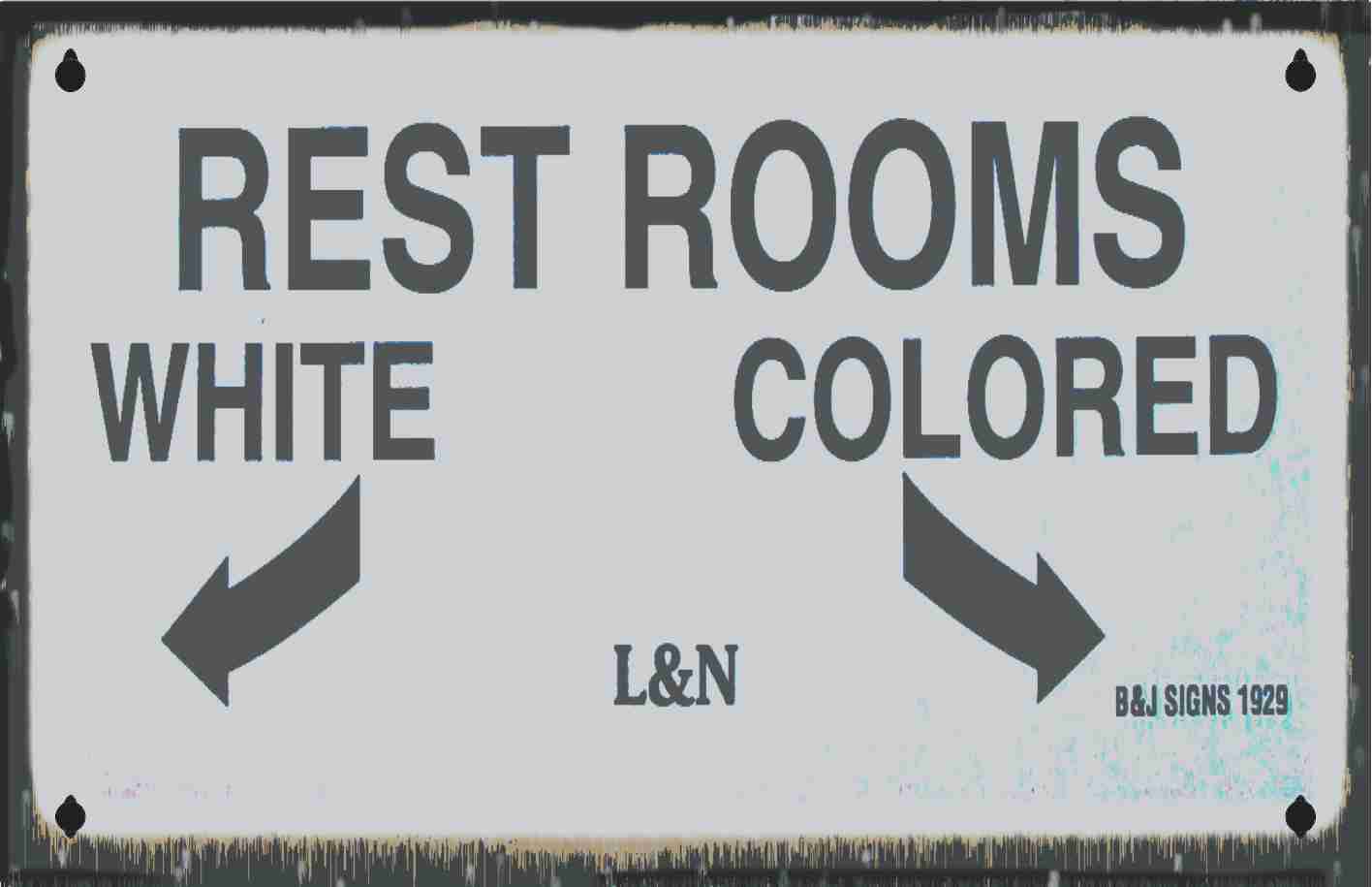
Systems like the examples Wilkerson uses all share a rabid aversion to the idea of public spaces and utilities, particularly water and swimming pools, being similarly contaminated not by blood but by mere exposure to the skin, breath, sweat, or even shadow of the subordinate caste.
Hitler and Trump have spoken of those who “poison the blood” of the nation. Hitler primarily (though not exclusively) was talking about Jews.
Trump was talking about non-white immigrants.
Pillar Number Five: Occupational Hierarchy: The Jatis and the MudsillWilkerson returns to the architectural metaphor she introduced in chapter 2 to describe the house’s most important structural element, where the framing meets the foundation, known as a mudsill.
In the segregationist political tradition, the enslaved caste of African American servants and laborers constituted an analogous base to the American social order.
The lowly work they performed for lack of choice was seen as the limit of their capabilities and their purpose for existence, a permanent servile class upon which the American economy was built.
This is part of the belief that the poor are lazy, stupid, and cannot be trusted. It provides an excuse for widening the employment Gap.
It also alludes to benefits given to the poor, i.e., “Who is going to pick up the garbage if we give them money?”
One major difference between the subordinate Americans and Indian Dalit is that while the Indian system has many subdivisions, known as jatis, within each group that determined one’s work, the African American subordinate class has been limited in professional options with few chances to break out except as performers or athletes.
Until recently, even these luminaries were expected to reinforce popular racist stereotypes if they were to be accepted by the dominant culture.
Pillar Number Six: Dehumanization and StigmaIn order to justify the extreme and often violent measures taken to maintain the oppressive status quo, dominant-caste authority invariably engages in a process of dehumanizing subordinate groups.
By denying subordinates equal regard for their virtue, dignity, and suffering, the dominant caste can so diminish subordinates’ humanity as to make them appear mere beasts of burden, pestilent scourges, or puppets on a string, insensitive to pain and humiliation.
The subordinate group thus becomes marked with pariah status, and their punishment is seen as just and moral, commensurate with the perceived bestiality and inhumanity that relegates them to ghettoization and marginalization.
This dehumanizing mindset is inculcated in generations of dominant-caste children who are raised believing in their superiority and entitlement, which desensitizes them to the victimization of others, even in brutal extremes.
Pillar Number Seven: Terror as Enforcement, Cruelty as a Means for ControlWilkerson describes the means necessary for the sustained oppression of an outcast group, which requires only that the members of the dominant class do nothing and remain silent, maintaining a complicity in which the order will thrive.
The image of the dreaded slaver’s whip encapsulates the violence and intimidation deemed necessary to hold the subordinates in their “container,” and the public complicity that allows the brutal enforcement of the order is the result of the racist attitudes bred into the dominant caste since childhood.
The savage business of terror seems like a part of normal life when it is tolerated by the majority of people.
Trump says he will deport a million undocumented immigrants. Imagine the terror these men, women, and children will feel waiting for their lives to be ripped apart when his brown shirts come banging on the door.
1. Ipsos Poll (2013):
30% think most illegal immigrants (with some exceptions) should be deported.
23% believe all illegal immigrants should be deported.
Only 5% believe all illegal immigrants should stay legally, and 31% want most illegal immigrants to stay.
2. Pew Research Center (2021):
25% of adults say undocumented immigrants should not be allowed to stay legally, advocating for national law enforcement efforts to deport them.
3. Harris Poll (2024):
Half of all Americans favor mass deportation of people who are illegally in the U.S.
Pillar Number Eight: Inherent Superiority Versus Inherent Inferiority
Wilkerson uses old Hollywood as an example of a cultural force that helped perpetuate popular stereotypes about African Americans’ inferiority and contributed to the same majority mindset that tolerated Jim Crow cruelty and injustice.
In the South, law and custom dictated at all levels of interaction between white and Black citizens that white people enjoy unquestioned superiority, while Black people were expected to treat the dominant caste with false deference and submission.
The consequence for African Americans is that these constant reminders from almost every aspect of American culture reinforce the generational effect of believing oneself inferior, resulting in defeatism and despair.
The eight pillars can be found not only in castes but in religions and cults.
Divine Will and the Laws of Nature
Heritability
Endogamy and the Control of Marriage and Mating
Purity Versus Pollution
Occupational Hierarchy: The Jatis and the Mudsill
Dehumanization and Stigma
Terror as Enforcement
Cruelty as a Means for Control, and Inherent Superiority Versus Inherent Inferiority
Look back at #1 through #8 and visualize religions and cults in America. They all implement some forms of the pollars, and all are related to Gap Psychology.
Gap Psychology is expressed secretly and overtly in various ways: Fear, hatred, disgust, avoidance, fanaticism, and the desire to inflict pain.
We each belong to groups that we view as extensions of ourselves. We find ways to view our groups as superior to others, which helps us feel superior.
These groups range from families to sports teams, cities, states, countries, political parties, tribes, social groups, religions, and cults.
Why is this so important to them? Gap Psychology
If our group “wins,” however that is defined, we win. And, if other groups “lose,” we win.
Personal note: In my younger days, I was a Chicago Bears football fan. I was nervous watching their games because winning meant so much. Finally, in 1985, they won a Super Bowl.
Crowds of screaming Bear fans clogged downtown Chicago. Logically, I had gained nothing, but I felt I had won. Gap Psychology is not based on logic.
When Donald Trump claims, against all evidence, that he won, MAGAs believe.
They disbelieve the 64 lawsuits he lost, the women who claim he attacked them, the criminality of Trump U. and the Trump Foundation, the many convicted criminals he surrounds himself with, and a trial’s 30+ criminal convictions.
To them, the evidence against Trump proves that someone else has committed crimes. (His attempts to overturn the election constitute the proofthe election was stolen.)
That is an outcome of Gap Psychology. When Trump is compared to God, a huge branch of Christianity believes, because when your leader is Godlike, the superiority Gap between you and the non-believers widens.
Gap Psychology is not logical, but it is the single, most important factor ruling our lives. Centuries from now, if we encounter another intelligent species, we will wish to dominate them or fear they will dominate us.
Like many Americans, the federal government is shelling out a lot more money to cover interest payments on its debt after a series of Federal Reserve rate hikes over the past year.
Translation: The federal government is nothing “like many Americans.” The federal government is Monetarily Sovereign, while the American people are monetarily non-sovereign. But we want you to believe the government is just like you.
The Treasury Department paid a record $213 billion in interest payments on the national debt in the last quarter of 2022, up $63 billion from the same period a year earlier.
Translation: The Treasury Department pumped a record $213 billion growth dollars worth of interest payments in the last quarter of 2022. That is $64 billion added to Gross Domestic Product (GDP)from the same period a year earlier.
The fourth-quarter tab was also nearly $30 billion more than in the prior quarter, which is the largest quarterly increase on record, said Jerry Dwyer, an economics professor emeritus at Clemson University.
Translation: The fourth-quarter addition to GDP was nearly $30 billion more than in the prior quarter, the largest stimulus to the economy on record.
Borrowing costs are expected to become an increasingly heavy burden in coming years. The Congressional Budget Office is set to provide its latest estimate on Wednesday.
The surge is due mainly to the Federal Reserve raising interest rates by 4.25% between March and December. The central bank increased the rate another quarter point in February.
Translation: The Federal Reserve is raising interest rates by 4.25%, which will increase the price of everything, in its effort to combat increased prices. Think about that.
Until recently, it cost the federal government very little to issue debt to finance its operations.
Translation: Until recently, it cost the federal government very little to create the dollars to finance its operations. Just the press of a few computer keys.
“It was almost free money,” Dwyer said. “You could borrow a trillion dollars, and if you financed it with Treasury bills, you paid almost no interest.”
Translation (courtesy of former Fed Chairman Ben Bernanke): “The U.S. government has a technology, called a printing press (or, today, its electronic equivalent), that allows it to produce as many U.S. dollars as it wishes at essentially no cost.”
Translation (courtesy of former Fed Chairman Alan Greenspan): “There is nothing to prevent the federal government from creating as much money as it wants and paying it to somebody.” So, why would the government borrow dollars? It doesn’t.
“But interest rates weren’t going to stay there forever.”
Translation: The Fed raises rates, which increases all prices, i.e., causes inflation, to fight inflation. It’s like a doctor bleeding a patient to cure anemia.
The national debt is once again in the spotlight now that the US has hit its $31.4 trillion debt ceiling, forcing Congress to take action or risk a catastrophic default.
Translation: The US has hit its $31.4 debt ceiling, which actually isn’t a “debt” ceiling. Everything has already been paid for, and nothing is owed. There is no debt. The dollars exist in T-security accounts. To pay off those accounts, the government merely returns the existing dollars.
Congress created the fake “debt” ceiling to make itself look prudent to an ill-informed electorate.
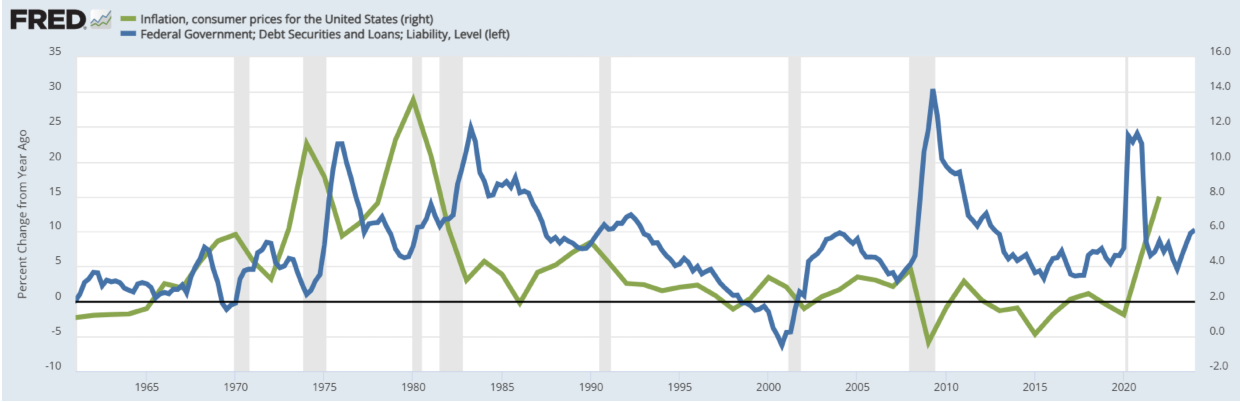
Decreases in federal deficits (red) cause recessions (vertical gray bars), which are cured by increases in federal deficits.
Those who call for a decrease in deficit spending ignore the fact that economic growth relies on the federal government continuing to pump money into the economy.
The Treasury Department is taking extraordinary measures to allow the government to continue paying its bills in full and on time, which it expects to last at least until early June.
Translation (Courtesy of Alan Greenspan): “The United States can pay any debt it has because we can always print the money to do that.” so the “extraordinary measures” are a bunch of hokum. And so is the fake “debt ceiling.”
The spike in interest payments also contributed to the federal government hitting the debt ceiling that much faster.
And it adds to the pressure on Congress to raise taxes, cut spending or allow the government to borrow more to meet all its obligations.
Translation: The spike in interest payments added growth dollars to GDP much faster. This adds unnecessary pressure on Congress to take dollars out of the economy, thereby causing a recession.
Even if the Federal Reserve slows or stops raising rates this year, as many economists expect, the nation’s borrowing costs will continue to increase.
That’s because as the existing debt matures, the government issues new debt with the higher prevailing interest rates.
Translation: As existing Treasury Securities mature, the government will increase the amount of growth dollars it pumps into the economy.
The higher rates could increase the net interest cost on the national debt to about $9 trillion over the next decade, according to estimates by the Peter G. Peterson Foundation, a nonpartisan organization that seeks to raise awareness of America’s long-term fiscal challenges.
Translation: The higher rates could increase the amount of growth dollars pumped into GDP to about $9 trillion, according to the Peter B. Peterson Foundation, a right-wing organization that, on behalf of the rich, seeks to spread disinformation about America’s finances.
That’s up from the record $8.1 trillion that the CBO projected in May 2022 and the $5.4 trillion it projected in July 2021.
Translation: That’s up from a record $8.1 trillion growth dollars the CBO projected in May 2022, and the $5.4 growth dollars it tried to scare you about in July 2021.
By 2032, interest costs will triple to more than $3 billion per day and to at least $9,400 per household, on average, according to the foundation.
Translation: (Courtesy of Ben Bernanke) “It’s not tax money… We simply use the computer to mark up the size of the account.” By 2032, growth dollars will triple to more than $3 billion per day, and not costing any household a single penny.
The federal government creates ad hoc every dollar it spends by pressing computer keys. No tax dollars are used.
They are on track to become the largest federal budget item, surpassing Social Security and Medicare by the middle of the century.
Translation: The government justifies paying too little to Social Security and Medicare by pretending it is short of money when, in fact, it has infinite money.
“Having rapidly growing interest makes it much more difficult for government to fund all the things that are important to our society,” said Michael Peterson, the foundation’s CEO.
Translation: To keep you from asking for benefits, we pretend that “Having rapidly growing interest makes it much more difficult for the government to fund all the things that are important to our society.”
Why do we do that? Because the rich tell us to widen the income/wealth/power Gap between them and you. The wider the Gap, the richer they are.
So, they bribe the main information sources to tell you the government can afford tax loopholes for the rich, but not Social Security and Medicare increases for the rest of you.
Economists are bribed with university grants and promises of lucrative employment later. The media are bribed with advertising dollars and ownership. Politicians are bribed with political contributions and lucrative jobs in “think tanks.”
All are bribed to tell you that increasing your benefits is unaffordable.
SUMMARY
The rich get richer when the income/wealth/Gapwidens. So they promulgate the lie that your taxes pay for benefits, and your federal deficits are unsustainable.
Rodger Malcolm Mitchell
Monetary SovereigntyTwitter: @rodgermitchellSearch #monetarysovereigntyFacebook: Rodger Malcolm Mitchell;MUCK RACK: https://muckrack.com/rodger-malcolm-mitchell
……………………………………………………………………..
The Sole Purpose of Government Is to Improve and Protect the Lives of the People.
I suggest a motto for the science of economics: “The easy we make impossible, but it takes forever.”
I say that because of my 25 years critiquing economics articles, and most recently because of an article titled, “Do Budget Deficits Cause Inflation?”
The answer to the question is, “No, not for Monetarily Sovereign nations,” and the article comes to that “No” conclusion. Except:
It never differentiates between Monetarily Sovereign governments (which create and control the value and supply of the money they use) and monetarily non-sovereign governments (cities, counties, states, euro nations, nations that use another nation’s currency, and nations that peg their currency to another nation’s currency}.
It never mentions shortages of critical goods and services, most commonly oil, food, and labor, which are the real causes of inflation.
It complexifies a straightforward solution: To cure a problem, eliminate the cause of the problem. In the case of inflation, the cause is shortages. To cure inflations, eliminate the shortages.
Keith Sill, Senior Vice President of Research and Director of the Real-Time Data Research Center. keith.sill@phil.frb.org (215) 574-3815
In 2004, the federal budget deficit stood at $412 billion and reached 4.5 percent of gross domestic product (GDP).
Though not at a record level, the deficit as a fraction of GDP is now the largest since the early 1980s.
Moreover, the recent swing from surplus to deficit is the largest since the end of World War II.
Comment: The deficit as a fraction of GDP is irrelevant to inflation. Federal deficits are beneficial because they add GDP growth dollars to the economy.
Federal surpluses take dollars from the economy, causing depressions and recessions. Mr. Sill could have answered the title question with two simple graphs:
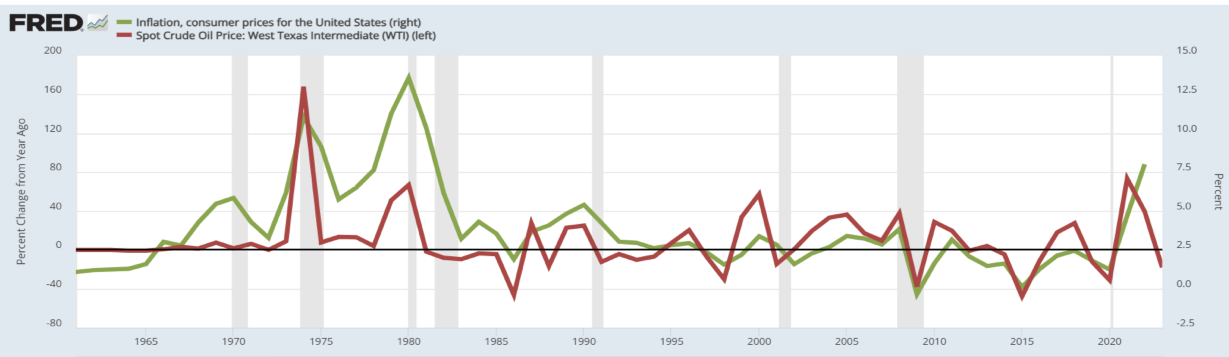
There is no relationship between federal deficit spending (blue line) and inflation.There is a strong relationship between the oil supply (red line) and inflation.
Inflation is caused by shortages of critical goods and services, most often oil, food, and labor.
The flip side of deficit spending is that the amount of government debt outstanding rises: The government must borrow to finance the excess of its spending over its receipts.
Comment: The federal government, being Monetarily Sovereign, never borrows. Why would it? It has the infinite ability to create its sovereign currency, the U.S. dollar, at virtually no cost (aka, “seigniorage”).
Further, unlike state/local government taxes, which fund state/local spending, federal taxes do not fund federal spending.
Federal taxes are destroyed upon receipt, while state and local tax dollars remain in the economy’s private banks. To finance all its spending, the federal government creates new dollars ad hoc.
It does this regardless of taxes collected. Even if federal tax collection totaled $0, the government could continue spending forever.
For the U.S. economy, the amount of federal debt held by the public as a fraction of GDP has been rising since the early 1970s. It now stands at a little over 37 percent of GDP.
The debt/GDP fraction is meaningless. It has no predictive or analytical power and does not tell anything about an economy’s health.
Do government budget deficits lead to higher inflation? When looking at data across countries, the answer is: it depends. Some countries with high inflation also have large government budget deficits. This suggests a link between budget deficits and inflation.
Yet for developed countries, such as the U.S., which tend to have relatively low inflation, there is little evidence of a tie between deficit spending and inflation.
Mr. Sill falsely equates “developed” with Monetary Sovereignty. However, there are “developed” nations – for example, Italy, France, Greece, etc. that are monetarily non-sovereign. They use the euro.
Why are budget deficits are associated with high inflation in some countries but not in others? Government deficit spending is linked to the quantity of money circulating in the economy through the budget restraint, i.e. the relationship between resources and spending.
Money spent has to come from somewhere: In the case of local and national governments, from taxes or borrowing.
But, nationalgovernments can also use monetary policy to help finance the government’s deficits.
I believe that Mr. Sill’s use of “resources” means the amount of money a government can spend, which it gets from taxes or borrowing.
Since he doesn’t differentiate among Monetarily Sovereign, monetarily non-sovereign, and “nationally,” his comments are either partially or totally wrong. First, a reminder about the differences between monetary policy and fiscal policy:
Monetary policy involves changing the interest rateand influencing the money supply.
Fiscal policy involves the government changing tax rates and spending levels to influence aggregate economic demand. (“Aggregate demand” is Gross Domestic Product at a specific time.)
Here are the sources of confusion:
1. Raising interest rates causes prices to rise. The cost of every product includes the cost of interest. Amazingly, this is the Fed’s tool to combat inflation. The Fed’s theory seems to be that raising prices will reduce demand, causing a recession that supposedly will cure inflation.
In short, the Fed causes inflation to cure inflation while claiming to hope a recession doesn’t occur but secretly relies on recession to cure inflation. (Clear?)
Of course, a result can also be stagflation, a combination of recession and inflation, at which point Fed Chairman Jerome Powell, having no solutions, will hide in his closet and pray. (The cure for stagflation is federal deficit spending to obtain and distribute the scarce products while adding growth dollars to the economy.)
2. As the issuer of its money, only a Monetarily Sovereign government can change interest rates by fiat. It sets the lowest rate on its Treasury Securities.
Because a monetarily non-sovereign government is not an issuer of money, it cannot unilaterally change interest rates. It must rely on markets or the issuer of its money.
For example, Italy cannot arbitrarily raise interest rates on euro-based loans. It uses the euro but is not the issuer.
3. Monetarily Sovereign governments don’t borrow their own currency. The above-mentioned Italy, being monetarily non-sovereign, borrows euros.
In short, Sill, an economist at the Fed (!), is confused about what different kinds of governments can do. Next, he confuses households with our Monetarily Sovereign government:
Budget constraints are a fact of life we all face. We’re told we can’t spend more than we have or more than we can borrow.
The U.S. government “has” infinite dollars, so it does not borrow dollars. Those federal T-securities are not a form of borrowing, which is what a monetarily non-sovereign government does when it needs money.
Rather than providing the U.S. government with dollars, T-securities:
Provide a safe parking place for unused dollars — safer than any other storage place (i.e., bank accounts, safe deposit boxes, etc.) The government never touches those dollars. They remain the property of the depositors.
Assist the Fed in controlling interest rates by setting a floor rate.
In that sense, budget constraints always hold: They reflect the fact that when we make decisions, we must recognize we have limited resources.
See the confusion? “We” and the Italian government have limited resources (money), but the U.S. government does not. It has unlimited money. Next, Mr. Sill expressly shows us his confusion between federal finance and personal finance:
Imagine a household that gets income from working and from past investments in financial assets. The household can also borrow, perhaps by using a credit card or getting a home-equity loan.
The household can then spend the funds obtained from these sources to buy goods and services, such as food, clothing, and haircuts.
It can also use the funds to pay back some of its past borrowingand to invest in financial assets such as stocks and bonds.
The household’s budget constraint says that the sum of its income from working, from financial assets, and from what it borrows must equal its spending plus debt repayment plus new investment in financial assets.
Not one word of the above applies to the U.S. government.
The government does not borrow or use dollars obtained from any source. It creates ad hoc all the funds it spends. Any income the federal government receives is destroyed upon receipt. (See: “Does the U.S. government really destroy your tax dollars?“)
The only federal budget constraint is not a budget constraint at all. Federal agencies routinely exceed budgets. The restraint is whatever Congress and the President say it is at any given moment.
Congress and the President have the unlimited ability to create dollars and stimulate the economy, plus a strong, though not unlimited, ability to obtain and distribute the scarcities causing inflation.
Mr. Sill continues with an explanation that is irrelevant to federal financing.
The household’s sources of funds and spending are all accounted for, and the two must be equal. The household may use borrowing to spend more than it earns, but that funding source is accounted for in the budget constraint.
If the household has hit its borrowing limit, fully drawn down its assets, and spent its work wages, it has nowhere else to turn for funds and would, therefore, be unable to finance additional spending.
I have no idea what Mr. Sills hoped to accomplish by giving household finances as his explanation for federal finances. The two are fundamentally opposite.
Here, Mr. Sills makes sure to show you that he doesn’t understand the difference between the federal government’s Monetary Sovereignty and your household’s monetary non-sovereignty:
Just like households, governments, face constraints that relate spending to sources of funds.
Governments can raise revenue by taxing their citizens, and they can borrow by issuing bonds to citizens and foreigners. In addition, governments may receive revenue from their central banks when new currency is issued.
Governments spend their resources on such things as goods and services, transfer payments such as Social Security to its citizens, and repayment of existing debt.
Central banks are a potential source of financing for government spending, since the revenue the government gets from the central bank can be used to finance spending in lieu of imposing taxes or issuing new bonds.
No, the U.S. government is not “just like households. It does not raise revenue by taxing you. It doesn’t borrow from the central bank. It doesn’t have an existing debt to repay.
And it finances its spending not with taxes or bonds but by creating new money ad hoc. Who says so, Mr. Sill? Your former bosses:
Former Fed Chairman Alan Greenspan: “A government cannot become insolvent with respect to obligations in its own currency. There is nothing to prevent the federal government from creating as much money as it wants and paying it to somebody. The United States can pay any debt it has because we can always print the money to do that.”
Former Fed Chairman Ben Bernanke: “The U.S. government has a technology, called a printing press (or, today, its electronic equivalent), that allows it to produce as many U.S. dollars as it wishes at essentially no cost. It’s not tax money… We simply use the computer to mark up the size of the account.”
Mr. Sill’s article continues for many more paragraphs, so I will just quote one more thought:
There may be limits on the government’s ability to borrow or raise taxes. Obviously, if there were no such limits, there would be no constraint on how much the government could spend at any point in time.
Congress and the president are the only constraints on federal spending. Unlike your checking account, There are no financial constraints. That is why net spending (spending vs. taxing) has risen to $32 trillion.
Certainly governments are limited in their ability to tax citizens. (That is, the government can’t tax more than 100 percent of income.) But are governments constrained in their ability to borrow?
Monetarily non-sovereign governments are constrained by their full faith and credit, i.e., their credit rating. Monetarily Sovereign governments have no need to borrow, so there is no constraint.
Indeed they are. Informally, the value of government debt outstanding today cannot be more than the value of the government’s resources to pay off the debt.
The U.S. government has the infinite ability to pay for anything. Just ask Fed Chairmen Greenspan and Bernanke.
How do governments pay their current debt obligations? One way is for the government to collect more tax revenue than it spends. In this case, the surplus can be used to pay bondholders.
Wrong. All a federal surplus does is reduce Gross Domestic Product, i.e., cause a recession or depression.
Another way to finance existing debt is to collect seigniorage revenue and use that to pay bondholders.
Half right, half wrong. “Collect seigniorage” is a fancy way to say “print money.”
Seigniorage is the difference between the face value of dollars and the cost of creating them, which comes close to zero. However, holders of U.S. Treasury bonds are paid in two ways: Seigniorage pays the interest, and the principal is paid by returning the bondholder’s deposit.
Finally, the government can borrow more from the public to pay existing debt holders.
Wrong again. The federal government does not borrow, though monetarily non-sovereign governments do borrow.
SUMMARY
It is discouraging to read an article written by the Senior Vice President of Research and Director of the Real-Time Data Research Center for the Federal Reserve that displays so little understanding of Monetarily Sovereign finance.
The article claims that federal finance is similar to personal finance, but it does not demonstrate any knowledge of the vast differences.
Cities, counties, states, businesses, and euro nations can run short of money. The federal government cannot, and a key figure in the Federal Reserve seems to not understand that.
The answer to the title question is, “No, deficits do not cause inflation. Inflation is caused by shortages of key goods and services, most often oil, food, and labor.
Deficit spending can cure inflation by paying for scarce goods and services and ending shortages.
“Cult leaders are notable for the enormous amount of power they have over their group,” Ashlen Hilliard, a cult intervention specialist and founder of People Leave Cults, told HuffPost. “This power is what many look for when defining a cult, but it’s not the only aspect that creates a cult leader.
When you take a closer look, a cult leader often exhibits a classic set of traits and behaviors. Although there is variety in how these traits present, certain themes tend to ring true.”
We asked Hilliard and other experts to break down some of those common characteristics. Here’s what they said:
CHARISMA“Cult leaders are often highly charismatic and persuasive, with a magnetic personality that can attract and influence followers,” Hilliard said.
Cult leaders tend to be charming and clever, and use that charm to persuade people that doing what the leader commands is the best way to achieve their personal goals.
Trump refused to visit the Aisne-Marne American Cemetery graves of Americans who died in WWI. “Why should I go to that cemetery? It’s filled with losers.” He referred to marines as “suckers” for getting killed.
“They would never have followers if they didn’t know how to make people feel special and like they’re actually the center of attention,” said mental health counselor and leading cult expert Steven Hassan.
They say the right words, but “it’s not genuine. It’s acting.”
Social psychologist and cult expert Alexandra Stein emphasized that being charming is not inherently toxic, however.
“Charisma is a personality trait that may be common amongst cult leaders, but if you know someone who is charismatic, that certainly doesn’t mean that they are on the pipeline to becoming a cult leader,” Stein said.
“I like to ask the following questions: How are they utilizing their charisma? Is there the potential for abuse? How would they respond to criticism of their actions?”
AUTHORITARIAN CONTROL“Cult leaders often have a strong need for control and may exhibit authoritarian behaviors, such as dictating the beliefs and actions of their followers,” Hilliard said.
The cult leader’s typical objective is to gain power over others, and to make their followers feel unable to break free.
“Coercive control is a pattern of behavior used to dominate, intimidate, and manipulate someone,” Hilliard explained.
“This can include a range of tactics, such as isolating the victim from friends and family, monitoring their movements, controlling their access to money and resources, and using threats or physical force to maintain control.”
When a cult group or leader applies coercive control to a follower, that person may be left feeling that their only viable path is to remain in the group ― even if unspeakable acts are committed.
There tends to be “a gradual escalation of abusive behavior,” as the leader employs psychological, emotional or physical tactics to maintain power.
“When a cult group or leader applies coercive control to a follower, that person may be left feeling that their only viable path is to remain in the group ― even if unspeakable acts are committed,” Hilliard added.
That’s why cults often operate with strict routines and particular eating and sleeping habits.
“Cult leaders even manipulate people into not having personal preferences,” said Robin Stern, a psychoanalyst and co-founder of the Yale Center for Emotional Intelligence. “Some people who grow up in cults don’t even know how to recognize their own emotions because they were told what to feel and [that] certain feelings weren’t allowed.”
She added that most cult leaders are master gaslighters who assert their reality over the reality of their followers, sow divisions and undermine people’s perceptions of their own feelings and beliefs.
“It was a perfect phone call.”
INABILITY TO TOLERATE BEING WRONG“Cult leaders are not able to tolerate being wrong, nor do they want to have to take any responsibility for having wronged you,” said Rachel Bernstein, a licensed marriage and family therapist and host of the “IndoctriNation” podcast.
“So if you have been hurt by them, it’s somehow your fault, because you must have done something to deserve it, and it’s your weakness that caused their mistreatment of you to bother you,” Bernstein continued.
“They are ultimately emotionally protected and impervious.”
She also noted that cult leaders tend to answer to no one and live by their own rules. It’s their world, and others need to learn how to exist in it.
“They often feel they are above the law, are beyond reproach, and enjoy shaming those in the group who defy them, disagree with them or, in essence, hurt their ego in any way,” Bernstein added.
That’s why it’s difficult to try to confront or reason with a cult leader.
“When cult leaders are confronted, or somebody questions anything they’re doing, they are likely to turn it to blame someone else and say they’re thinking in the wrong way or they’re being influenced by an outside force, like a parent or loved one,” Stern said.
“Sometimes when followers have contact with [their] family members, they question what the cult leader is doing or asking [the cult follower] to do,” Stern added. “Often then, the cult leader is critical of the family and puts them down or tries to gaslight the cult member into thinking that their family does not have their best interest at heart.”
MALIGNANT NARCISSISM Many cult leaders ”are malignant narcissists — those who have sociopathy and simply do not care about the pain they inflict, the damage they cause, and the lives they derail in order to get their very powerful ego needs met,” Bernstein said.
“They are insatiable in their neediness and no amount of devotion and sacrifice ever quite feels like enough.
So followers of these kinds of cult leaders often feel they are failing, and they need to work harder and sacrifice more of themselves each day.”
She said narcissistic cult leaders tend to lack empathy for others and may stop at nothing to get what they want.
[E]verything they did or were asked to do was in the service of the narcissistic needs of the cult leaders ― often their financial needs or sexual desires.Robin Stern, psychoanalyst.
“They often use doing charitable work or speaking about caring about others as a way to come across as loving, but ultimately it’s a way to launder their reputations,” Bernstein added. “When we look at the fact that most cult leaders are malignant narcissists, those with this disorder don’t often come with an ethical core that drives them.
They don’t think about how to make a difference in the world, but rather craft a world where they are the gods and others are to live their lives doing good for them.”
Cult leaders frequently make their followers feel as though they need to work hard to earn the leader’s trust, rather than the other way around.
“I’ve heard from people in cults that they felt their life was going really well and that they were doing something special in the world,” Stern said. “They felt seen, heard and understood.
But what they didn’t see for some time ― sometimes a long time ― was that everything they did or were asked to do was in the service of the narcissistic needs of the cult leaders ― often their financial needs or sexual desires.”
The multi-faces of Trump.
UNPREDICTABILITYUnpredictability is a common trait in cult leaders as well.
“A cult leader often benefits from members and outside authorities not knowing their next move,” Hilliard said.
“This can add to an air of divine inspiration or help convince devotees of [the leader’s] supernatural powers.”
By sowing chaos and uncertainty, cult leaders can establish their mere leadership presence as the only constant, even if their own behaviors are inconsistent.
Followers are left with the singular goal of pleasing their leader.
“They keep followers in an unstable relationship with them, walking on eggshells,” Stein said. “The followers never know if the ‘nice’ leader or the angry, cruel leader is going to appear at any given time.”
“Donald was abused by his father.” Mary Trump
INSECURE ATTACHMENT ISSUES“The latest theory amongst mental health professionals is that people with this level of disorder had insecure attachment in their first few years,” Hassan said.
He emphasized the power of loving caregivers. Growing up with someone who offers support and encouragement helps people develop a healthy sense of self.
“But these cult leaders have a hole where they should have a sense of self, so they’re always trying to compensate by getting people’s attention or feeling power over others, because they felt so helpless as a child,” Hassan added. “That’s a common profile.”
He noted that many cult leaders grew up in cults themselves and learned patterns of manipulation, control and abuse from adults, instead of developmentally appropriate, empowering and authoritative ― not authoritarian ― parenting.
DELUSION“Cult leaders may hold unconventional or bizarre beliefs that are not grounded in reality, and may promote these beliefs to their followers as absolute truths,” Hilliard said.
The role of delusional beliefs in cults tends to generate headlines.
Much of the recent attention on the Twin Flames Universe revolved around members’ fervent commitment to idea that they needed to be with one specific person ― even if it meant stalking that person or violating a restraining order.
Members of the Love Has Won cult consumed colloidal silver for extended periods of time, even after seeing the physical harm it could cause.
“Some cult leaders are suffering with a delusional disorder, but their charisma causes them to attract others who … believe their delusions,” Bernstein said.
They are the ultimate judge and jury, deciding who moves up in the ranks and who gets demoted on a daily basis, so everyone is on edge, not ever knowing where they truly stand or where they will stand tomorrow.
Trump sells digital (not real) playing cards of himself to followers for $99. Essentially, they get nothing.
SENSE OF GRANDIOSITY“When someone is beguiled into a cult, they’re working for the good, the pleasure or narcissistic needs of the cult leader, but they’re often told their work has some higher purpose and they’re going to find meaning and happiness in a way they’ve never had,” Stern said.
“It’s very effective, especially when the process of gaslighting and brainwashing is enhanced by tactics such as sleep deprivation, food control and isolation from their previous life.”
She pointed to the way many leaders create steps and levels of ascension into power for their followers ― and then use that system to make their followers feel important and recruit even more members.
“They are the ultimate judge and jury, deciding who moves up in the ranks and who gets demoted on a daily basis, so everyone is on edge, not ever knowing where they truly stand or where they will stand tomorrow,” Bernstein said.
“This is a way to get people to be working day and night to prove their allegiance in order to keep themselves safe in the group and liked by the leader, the person whose approval matters now more than anyone else’s.”
She noted that cult leaders tend to get “drunk with their power of being a Pied Piper.” As their following grows, so too does their self-importance and their craving for even more admiration and attention.
“They lie, build grandiose life stories, often with a kind of ‘once was blind but now I see and therefore have all the answers’ narrative,” Stein added.
Trump had to pay $25 million to followers who believed this scam.
EXPLOITATION“Cult leaders may exploit their followers financially, sexually or emotionally, using their position of power to gain personal benefits at the expense of their followers,” Hilliard said.
They exert undue influence on followers ― meaning they pressure or persuade people to do things that they wouldn’t otherwise do and that often run counter to their own best interests.
“For instance, a cult leader may convince a follower to sign over properties, businesses, or financial assets to the group to show their commitment,” Hilliard said.
“Once those exchanges take place, the follower may feel that they have to remain in the group or risk losing everything.
Undue influence can be difficult to identify, as the person being influenced may not be aware that they are being manipulated or may feel too intimidated to resist.”
She highlighted the many crimes committed by notorious cult leaders like Charles Manson and Jim Jones ― murder, terrorism, sex trafficking, sexual abuse, fraud, drug smuggling and more.
“It takes more than charisma to convince people to go along with ― or commit ― acts like these,” Hilliard said.
Stern stressed that people in cults usually lose their sense of personal identity.
“They often stop what they were doing before they met the leader ― going to school, having a job, being connected with friends and family,” she explained.
God said the election was stolen. There is no evidence, but we believe. We believe.
“They are often seduced into a psychological state where they are disinterested in anything other than working for the cult and the promise of the cult.”
Democracy is the antithesis of a cult. The MAGAs have been led to believe they are making their own decisions.
The reality is that they have surrendered their judgment and willpower to Donald Trump.
He decides. They believe and obey.
Evidence does not support what the cult leader says.
This tension between belief and reality creates emotional pressure on the followers, leading to extreme hostility and anger.
That is why Trump’s MAGAs so often are filled with hatred and outrage, leading to violence.
He has filled his followers with so much misinformation they quite literally have lost their minds.


opposition to an obsession with contamination by genetic material from a perceived inferior bloodline.

Wilkerson describes the means necessary for the sustained oppression of an outcast group, which requires only that the members of the dominant class do nothing and remain silent, maintaining a complicity in which the order will thrive.

/cdn.vox-cdn.com/uploads/chorus_asset/file/13649459/1074706918.jpg.jpg)