Alan Greenspan
The UK government, like the US government, is Monetarily Sovereign. It has the infinite ability to create its own sovereign currency.
Former Federal Reserve Chairman Alan Greenspan: “A government cannot become insolvent with respect to obligations in its own currency.
“There is nothing to prevent the federal government from creating as much money as it wants and paying it to somebody.
“The United States can pay any debt it has because we can always print the money to do that.”
Other governments have this ability — the UK, Canada, Japan, Australia, the EU (though not its euro-usingnations), China, etc.
Not only can they create infinite amounts of their sovereign currency, but they are large enough to assure acceptance of, and demand for, their currencies.
The currencies of the above-named nations are backed by the full faith and credit of those nations, so there always is demand.
(By contrast, if you decided to create and distribute “mybucks” as your sovereign currency, you, too, would be Monetarily Sovereign, but few, if any, people would want it because your full faith and credit do not support a widely used currency.)
Sadly, the leaders of those nations have been paid by the rich to pretend they are not Monetarily Sovereign and that their “debt” is not “sustainable.” The purpose of the bribe: To widen the Gap between the rich and the rest.
In many posts on this blog, I have discussed the facts that:
Federal deficits are necessary to grow the economy, necessary to prevent recessions and depressions, and necessary to cure recessions.
Lest you believe the U.S. is the only Monetarily Sovereign government that pretends it isn’t Monetarily Sovereign, I give you the following demonstration of economic ignorance from the UK:
The UK’s growth outlook remains weak; quantitative easing has significantly increased the sensitivity of the UK’s debt to changes in short-term interest rates; and it is unclear whether the Government’s fiscal rule, as it relates to the national debt, is fit for purpose.
The committee’s inquiry will investigate whether the UK’s national debt is on a sustainable path; if not, what steps are required; and whether the Government’s fiscal rule regarding the national debt is meaningful.
There it is, the “sustainable” lie. Like the Monetarily Sovereign U.S. “debt,” the UK debt is infinitely sustainable.
Call for evidenceThe committee is seeking answers to the following questions:
1. What is meant by a “sustainable” national debt? Does the metric of debt as a percentage of GDP adequately capture sustainability?
Answer: No. The “debt”/GDP has no meaning with regard to a Monetarily Sovereign government’s ability to “sustain” its so-called “debt.”
2. The Government’s target is for public sector net debt (excluding the Bank of England) to be falling, as a percentage of GDP, by the fifth year of the OBR’s forecast. How meaningful is this target; and how does it inform an evaluation of the sustainability of our national debt?
Answer: The only way to decrease the “debt”/GDP ratio is to reduce deficit spending, a reduction that has repeatedly caused recessions.
3. How robust are the assumptions used by the Office for Budget Responsibility when forecasting our national debt?
Answer: Since the forecasts are meaningless, the “robustness” question also is meaningless.
4. What implications does the structure of the UK’s national debt have for its short and longer-term funding?
Answer: The debt is the net total of deficit spending, which already has been funded by money creation.
5. What are the market risks created by high levels of public debt; and what factors will influence the market’s appetite for this debt?
Answer: National government deficit spending adds growth dollars to the economy. The real market risks — i.e., recession and depression — come from insufficient deficit spending.
The government does not need to sell deposits into so-called “debt.” So, there is no government need for “market appetite.” The UK government can spend endlessly without selling even one pound of debt securities.
6. If we are to ensure our national debt is sustainable, what might this mean for fiscal policy?
Answer: There is no need to “ensure’ the national debt is sustainable. It is infinitely sustainable. For that reason, paying higher interest on the “debt” is not a burden on the government
Higher rates often can benefit the economy by adding dollars to the private sector, thus increasing GDP.
7. Should the definition of the national debt differentiate between debt incurred for investments (which generate revenue for the Government), and other areas of spending?
Answer: The so-called “national debt” is nothing like private (monetarily non-sovereign) debt. The more “national debt” there is, the healthier the economy.
The UK government has no need for revenue. Even if it didn’t collect a pound in income or taxes, it could continue spending forever.
And then there is this bit of nonsense:
Rishi Sunak came under fire for some Treasury forecasts of tax rises.
The Labour Party droned on about “change” while endlessly repeating some imaginary numbers about “investing” in the NHS and creating “green jobs”.
Over the course of the election campaign, the main parties have argued furiously about trivialities.
Yet there is an ugly truth lurking behind this election: Britain is far closer to bankruptcy than our political elites are willing to admit.
This is absolutely false scaremongering. The UK cannot go bankruptbecause it cannot run short of money. Period.
Taxes are already at a 70-year high, and yet we are nowhere close to balancing the books.
Every pound of taxes reduces GDP growth. National taxes absolutely should be cut. They do not fund (monetary sovereign) national government spending. (Taxes do fund local — monetarily non-sovereign –government spending.)
If the UK stops running deficits, it will have a depression that will make the Great Depression look like a picnic — a depression that only will be cured by massive deficit spending.
Over the course of this year, we will add another £87 billion, or around 3 per cent of GDP, to the national debt, according to the Office for Budget Responsibility (OBR).
And this is happening at a time when the economy is recovering, and the Government has pushed through a series of punishing tax rises.
Did it occur to the authors that GDP = National + local government spending + Net Exports? An economy recovers because of deficit spending, not in spite of it.
We should be paying back debt at this point in the cycle, not racking up even more.
“Paying back requires either more taxes or less spending, both of which will reduce GDP. It’s simple algebra.
Our debt to GDP ratio is close to 100 per cent, and tripled in the 16 years to 2023, according to the Resolution Foundation, the largest ever increase in peacetime.
We are very near to the 112 per cent level that has just led to the humiliating downgrade of France’s credit rating twice over the past six months.
The UK is Monetarily Sovereign. France is monetarily non-sovereign. Sadly, the authors don’t understand the difference, yet they write about economics. Shameful.
It doesn’t stop there. We are still racking up huge off-balance sheet debts. Such as? There is already £200 billion of outstanding student debt, and that is forecast to rise to over £400 billion by the 2040s.
Again, students are monetarily non-sovereign. The authors confuse the burden of private debt with the economic necessity of national debt, demonstrating unforgivable ignorance by national leaders.
The government should increase its deficits by helping fund students’ debt.
Few believe that graduates will earn enough to pay back their loans in full, especially as our zero-growth economy is hardly creating any new professional jobs to absorb them all.
Government deficit spending could grow the economy and create jobs.
We are on the hook for some £2.6 trillion in “unfunded” public sector pension entitlements.
There are zero “unfunded” public sector pension entitlements. They all are funded by government money creation.
The claim is an attempt to widen the income/wealth/power Gaps between the rich and the rest. The claim is funded by the rich to make themselves richer. The wider the Gaps, the richer are the wealthy.
As the state employs more and more people – we added another 135,000 to the government payroll in the year to September 2023 – that figure will carry on getting larger and larger.
That means 135,000 people receive money that is added to GDP.
We are legally mandated to hit a net zero target which the OBR has calculated could add at least another £300 billion to the government’s costs over three decades.
If a “net zero” target means zero deficits, the UK is headed for a depression. That target is beyond stupid. It is criminal.
In Wales, a staggering 28 per cent of working age people are now on benefits, depending on the state to support them, and the figures are little better in the rest of the country.
If “the state” is the national government, those payments add to GDP and do not cost anyone anything.
And at last, we come to one Britisher who understands Monetary Sovereignty. Delight in reading one informed man’s comments:
I’m frankly amazed you have to ask this question. Firstly, a brief explanation as to what the National Debt actually is. The debt is nothing more than a record of all government expenditure into the economy less taxes removed from the economy.
The issuance of Gilts to match the difference between spending and tax is not borrowing and does not provision government. The sale/purchase of Gilts is an Open Market Operation with the purpose of managing interest rates, it is a hangover from the gold standard days.
Gilt sales serve no real purpose other than to provide a safe way for pension funds and other financial institutions to make money.
They also help control interest rates, but the point is correct. They do not provide the government with spending funds.
Not a bad thing in itself but let’s not pretend that our government, that is the monopoly issuer of the pound, needs to borrow pounds that it has already issued.
And what is the mechanism behind this simple fact? Reserves accounts of commercial financial institutions held at the Bank of England solely consist of pounds issued/spent by the government or loaned by the government.
The pounds in the reserve accounts of commercial institutions put there by our government are then used by commercial institutions to purchase Gilts issued by our government! In effect the pounds in the reserve account are transferred to a Gilts account which pays interest.
That’s it. There is no way that in any sense of the word could this be considered as the UK government borrowing.
Next, although we’ve just seen that the National Debt is a mirage and better described as savings, we still insist that we have to pay interest (often described as nothing more than corporate welfare) on the pounds we have issued.
And that is a lot of interest. How sustainable are these interest payments? The answer is infinitely sustainable.
As I’ve already stated the irrefutable fact that the UK government is the monopoly issuer of the pound. The UK government can never involuntarily become bankrupt.
It can never run out of pounds. It can therefore always service its ‘debt’ as long as the debt is in pounds (which of course it is).
You only have to look at the example of Japan to realise that debt to GDP ratios are totally meaningless.
Last time I looked, end of 2023, Japan had a debt to GDP of 263% with low inflation, low interest rates, high levels of employment and excellent public services.
Any debt to GDP target is completely arbitrary and designed to hold down the spending of public money for public purpose, in other words it is politically motivated rather than having any economic basis.
Last, just want to reiterate that the idea that the UK government is dependent on the private sector or market to finance its ‘debt’ is total nonsense.
As I’ve already stated the pounds used by private financial institutions to buy Gilts were already issued by the government but we still have to go through the theatre of pretence by selling Gilts on the primary market.
BoE just used to buy them directly until it was forbidden, but that is entirely self-impose constraint. Now, ifthe market loses its appetite for debt the BoE just steps in and buys on the secondary market.
It’s about time the law-makers of our country understood that the UK government is monetarily sovereign. UK government finances are not like a household’s.
The UK government can never go broke, can never run out of money, and can always sustain its debt.
That, however, is not to say there are no limits to government expenditure. UK government expenditure is constrained by the real resources that are available to buy priced in pounds.
Asking how we are going deploy our government’s infinite financial resources to invest to sustain the real economy, mobilise our workforce and the finite resources of our country and, at the same time, sustainthe environment are the real questions we should be asking.
Not worrying about an imaginary problem about how to sustain an imaginary ‘debt’, caused by imaginary ‘borrowing’. 23 January 2024
Thank you, Professor Camden. We can now assure everyone that there is at least one informed, though lonesome, person in England. Is there another?
Oh, wait. I think Camden is an American and a chemist. If that is the case, perhaps it shows that chemists rely on proofs and facts, while economists rely on intuition and hearsay.
So, thank you again, Professor Jon Camden, for your excellent article.
Rodger Malcolm Mitchell
Monetary SovereigntyTwitter: @rodgermitchellSearch #monetarysovereigntyFacebook: Rodger Malcolm Mitchell;MUCK RACK: https://muckrack.com/rodger-malcolm-mitchell
……………………………………………………………………..
The Sole Purpose of Government Is to Improve and Protect the Lives of the People.
The U.S. federal government is not like state/local governments, not like euro governments, not like businesses, and not like you and me.
It uniquely is Monetarily Sovereign. It cannot, unwillingly, run short of its own sovereign currency, the U.S. dollar. As real experts have said:
Former Federal Reserve Chairman Alan Greenspan: “A government cannot become insolvent with respect to obligations in its own currency. There is nothing to prevent the federal government from creating as much money as it wants and paying it to somebody. The United States can pay any debt it has because we can always print the money to do that.”
Former Fed Chairman Ben Bernanke: “The U.S. government has a technology, called a printing press (or, today, its electronic equivalent), that allows it to produce as many U.S. dollars as it wishes at essentially no cost. It’s not tax money… We simply use the computer to mark up the size of the account.”
Statement from the St. Louis Fed: “As the sole manufacturer of dollars, whose debt is denominated in dollars, the U.S. government can never become insolvent, i.e., unable to pay its bills. In this sense, the government is not dependent on credit markets to remain operational.”
Press Conference: Mario Draghi, President of the Monetarily Sovereign ECB, 9 January 2014 Question: can the ECB ever run out of money? Mario Draghi: Technically, no. We cannot run out of money.
Because the U.S. federal government has the infinite ability to create its sovereign currency, the U.S. dollar, it never borrows dollars.
Contrary to popular wisdom, T-bills, T-notes, and T-bonds do not represent borrowing. They simply are deposits, the purpose of which is to provide a safe place to store unused dollars and to help the Fed control interest rates.
The government never touches those dollars, which remain the property of the depositors. Not only can our Monetarily Sovereign government not run short of dollars, but federal deficits are necessary to grow the economy, as evidenced by the formula: GDP = Federal Spending + Nonfederal Spending + Net Exports.
When we don’t have sufficient federal deficits, we have depressions and recessions:
1804-1812: U. S. Federal Debt reduced 48%. Depression began 1807.
1817-1821: U. S. Federal Debt reduced 29%. Depression began 1819.
1823-1836: U. S. Federal Debt reduced 99%. Depression began 1837.
1852-1857: U. S. Federal Debt reduced 59%. Depression began 1857.
1867-1873: U. S. Federal Debt reduced 27%. Depression began 1873.
1880-1893: U. S. Federal Debt reduced 57%. Depression began 1893.
1920-1930: U. S. Federal Debt reduced 36%. Depression began 1929.
1997-2001: U. S. Federal Debt reduced 15%. Recession began 2001.
Periodically, we publish yet another shrieking claim that the U.S. federal debt is “unsustainable”and a “ticking time bomb.”
This lie has been told to you every year (really, almost every day) since 1940, and that bomb has never exploded, nor will it.
Rather than repeat the entire list of the thousands of lies to which you have been subject, I will list samples here as a reference and add periodically, at the end, new “federal debt is a ticking time bomb“ lies as I encounter them.
Read these and see that even respected economists replace facts with intuition:
September 26, 1940, New York Times: The federal budget was a “ticking time-bomb which can eventually destroy the American system,” said Robert M. Hanes, president of the American Bankers Association.
By 1960, the debt was “threatening the country’s fiscal future,” said Secretary of Commerce Frederick H. Mueller. (“The enormous cost of various Federal programs is a time-bomb threatening the country’s fiscal future, Secretary of Commerce Frederick H. Mueller warned here yesterday.”)
In 1984: AFL-CIO President Lane Kirkland said. “It’s a time bomb ticking away.”
In 1985: “The federal deficit is a ticking time bomb, and it’s about to blow up,” U.S. Sen. Mitch McConnell. (Remember him?)
Later in 1985: Los Angeles Times: “We labeled the deficit a ‘ticking time bomb‘ that threatens to permanently undermine the strength and vitality of the American economy.”
In 1987: Richmond Times-Dispatch – Richmond, VA: “100TH CONGRESS FACING U.S. DEFICIT’ TIME BOMB‘”
Later in 1987: The Dallas Morning News: “A fiscal time bombis slowly ticking that, if not defused, could explode into a financial crisis within the next few years for the federal government.”
In 1989: FORTUNE Magazine: “A TIME BOMB FOR U.S. TAXPAYERS“
In 1992: The Pantagraph – Bloomington, Illinois: “I have seen where politicians in Washington have expressed little or no concern about this ticking time bomb they have helped to create, that being the enormous federal budget deficit, approaching $4 trillion.“
Later in 1992, Ross Perot said, “Our great nation is sitting right on top of a ticking time bomb. We have a national debt of $4 trillion.”
In 1995: Kansas City Star: “Concerned citizens. . . regard the national debt as a ticking time bombpoised to explode with devastating consequences at some future date.”
In 2004: Bradenton Herald: “A NATION AT RISK: TWIN DEFICIT A TICKING TIME BOMB“
In 2005: Providence Journal: “Some lawmakers see the Medicare drug benefit for what it is: a ticking time bomb.”
In 2006: NewsMax.com, “We have to worry about the deficit . . . when we combine it with the trade deficit, we have a real ticking time bomb in our economy,” said Mrs. Clinton.
In 2007: USA Today: “Like a ticking time bomb, the national debt is an explosion waiting to happen.“
In 2010: Heritage Foundation: “Why the National Debt is a Ticking Time Bomb. Interest rates on government bonds are virtually guaranteed to jump over the next few years.
In 2010: Reason Alert: “. . . the time bomb that’s ticking under the federal budget like a Guy Fawkes’ powder keg.”
In 2011: Washington Post, Lori Montgomery:”. . . defuse the biggest budgetary time bombs that are set to explode.”
June 19, 2013: Chamber of Commerce: Safety net spending is a ‘time bomb’, By Jim Tankersley: The U.S. Chamber of Commerce is worried that not enough Americans are worried about social safety net spending. The nation’s largest business lobbying group launched a renewed effort Wednesday to reduce projected federal spending on safety-net programs, labeling them a “ticking time bomb” that, left unchanged, “will bankrupt this nation.”
On June 15, 2014: CBN News: “The United States of Debt: A Ticking Time Bomb“
On January 27, 2017: America’s “debt bomb is going to explode.” That’s according to financial strategist Peter Schiff. Schiff said that while low interest rates had helped keep a lid on U.S. debt, it couldn’t be contained for much longer. Interest rates and inflation are rising, creditors will demand higher premiums, and the country is headed “off the edge of a cliff.”
February 16, 2018 America’s Debt Bomb By Andrew Soergel, Senior Reporter: Conservatives and deficit hawks are hurling criticism at Washington for deepening America’s debt hole.
April 10, 2019,The National Debt: America’s Ticking Time Bomb. TIL Journal. Entire nations can go bankrupt. One prominent example was the *nation of Greece which was threatened with insolvency a decade ago. Greece survived the economic crisis because the European Union and the IMF bailed the nation out.
SEP 12, 2019, Our national ticking time bomb, By BILL YEARGIN SPECIAL TO THE SUN SENTINEL | At some point, investors will become concerned about lending to a debt-riddled U.S., which will result in having to offer higher interest rates to attract the money. Even with rates low today, interest expense is the federal government’s third-highest expenditure following the elderly and military. The U.S. already borrows all the money it uses to pay its interest expense, sort of like a Ponzi scheme. Lack of investor confidence will only make this problem worse.
JANUARY 06, 2020, National debt is a time bomb, BY MARK MANSPERGER, Tri City Herald | The increase in the U.S. deficit last year was about $1.1 trillion, bringing our total national debt to more than $23 trillion! This fiscal year, the deficit is forecasted to be even higher, and when the economy eventually slows down, our annual deficits could be pushing $2 trillion a year! This is financial madness. there’s not going to be a drastic cut in federal expenditures — that is, until we go broke — nor are we going to “grow our way” out of this predicament. Therefore, to gain control of this looming debt, we’re going to have to raise taxes.
February 14, 2020, OMG! It’s February 14, 2020, and the national debt is still a ticking time bomb! The national debt: A ticking time bomb?America is “headed toward a crisis,” said Tiana Lowe in WashingonExaminer.com. The Treasury Department reported last week that the federal deficit swelled to more than $1 trillion in 2019 for the first time since 2012. Even more alarming was the report from the bipartisan Congressional Budget Office (CBO) predicting that $1 trillion deficits will continue for the next 10 years, eventually reaching $1.7 trillion in 2030
August 29, 2020, LOS ANGELES, California: America’s mountain of debt is a ticking time bomb The United States not only looks ill, but also dead broke. To offset the pandemic-induced “Great Cessation,” the U.S. Federal Reserve and Congress have marshalled staggering sums of stimulus spending out of fear that the economy would otherwise plunge to 1930s soup kitchen levels. Assuming that America eventually defeats COVID-19 and does not devolve into a Terminator-like dystopia, how will it avoid the approaching fiscal cliff and national bankruptcy?
April 16, 2021, NATIONAL POLICY: ECONOMY AND TAXES / MARK ALEXANDER / The National Debt Clock: A Ticking Time Bomb: At the moment, our national debt exceeds $28 TRILLION — about 80% held as public debt and the rest as intragovernmental debt. That is $225,000 per taxpayer. Federal annual spending this year is almost $8 trillion, and more than half of that is deficit spending — piling on the national debt.
Now, the national debt is approaching $31 trillion,which is $12 trillion more than when Donald Trump took office in 2017 and more than half of that debt was tacked on in his final year. Then we’ve had the disastrous year and a half of Joe Biden.
Now, the Fed is now hiking its rates and that spells even more trouble for the national debt and the economy at large.
December 4, 2022 America’s ticking time bomb: $66 trillion in debt that could crash the economy By Stephen Moore, The national debt is $31 trillion when including Social Security’s and Medicare’s unfunded liabilities. Wake up, America.
That ticking sound you’re hearing is the American debt time bomb that with each passing day is getting precariously close to detonatingand crashing the US economy.
With the U.S. reaching its debt limit of $31.4 trillion on Jan. 19, Treasury Secretary Janet Yellen urged lawmakers to increase or suspend the debt ceiling.
April 22, 2023The Debt Ceiling Debate Is About More Than Debt, Jim Tankersley, WASHINGTON — Speaker Kevin McCarthy of California has repeatedly said that he and his fellow House Republicans are refusing to raise the nation’s borrowing limit,and risking economic catastrophe, to force a reckoning on America’s $31 trillion national debt. “Without exaggeration, America’s debt is a ticking time bomb that will detonate unless we take serious, responsible action,” he said this week.
November 3, 2023 The Fuse on America’s Debt Bomb Just Got Shorter,J Antoni Heritage Organization. The Treasury is now on track to borrow almost as much in just six months as it did in the previous 12 months. That’s nearly a doubling of the deficit. Because the federal debt is $33.7 trillion, just a 1 percent increase in yields adds $337 billion to the annual cost of servicing the debt over time. Absent spending reform, eventually no one will be willing to hold the bomb anymore, and the yields on U.S. debt will begin to resemble those in Argentina.
February 2, 2024How Florida can help defuse the nation’s debt bomb By BARRY W. POULSON,professor emeritus of economics at the University of Colorado Boulder and DAVID M. WALKER,former comptroller general of the United States. Washington’s out-of-control spending, combined with fiscal and monetary policies have resulted in trillion-dollar-plus annual deficits, over $34 trillion in federal debt, over $125 trillion in total federal liabilities and unfunded obligations, and excess inflation. Excessive spending and loose monetary policy increase inflation in the short term, and mounting debt burdens serve to reduce future economic growth and shift the economic burden and consequences of mounting debt burdens to future generations.
February 8, 2024Legendary investor Paul Tudor Jones says a ‘debt bomb’ is about to go off in the U.S.: ‘We’re fast-pouring consumption like crazy’. The U.S. economy may seem like it’s firing on all cylinders, but underneath the surface, a “debt bomb” could be on the verge of exploding, according to billionaire hedge fund manager Paul Tudor Jones. The esteemed investor said in an interview with CNBC that he couldn’t deny the economy was strong, but that it was actually “on steroids” due to massive government spending and borrowing.
Jones is not the only one to call attention to the growing deficit issue in the U.S. On Sunday, Federal Reserve Chairman Jerome Powell took a rare dive into politics, telling CBS’s 60 Minutes that the national debt was “growing faster than the economy,” and calling for lawmakers to get the federal government “back on a sustainable fiscal path.” Meanwhile, U.S. Treasury Secretary Janet Yellen has said she is not yet worried about the increasing national debt as long as the government keeps in check the net payments it makes on its debt relative to GDP.
Those payments are projected to rise from 2.5% last year to 2.9% next year, according to the Office of Management and Budget—below their level in the early 1990s. Jones told CNBC that the strong economy could postpone the effects of the government’s deficit spending, but only for a little while. “The only question is … when does that manifest itself in markets?” he added.
“It could be this year, it could be next year. Productivity may mask and it might be three or four years from now. But clearly, clearly we’re on an unsustainable path.”
June 21, 2024 My Weekly Column: Our debt crisis is a ticking time bomb by Randy Feenstra: On June 18th, the nonpartisan Congressional Budget Office (CBO) – the government agency tasked with monitoring our nation’s fiscal health – confirmed my serious concerns with President Biden’s reckless spending agenda.
His administration’s fiscal policies have not only caused cumulative inflation to skyrocket by over 20% since he took office, but they have also accelerated our accumulation of debt to levels that are beyond unsustainable. Instead of changing course, he recently released his budget for Fiscal Year 2025, which has a $ 7.3 trillion price tag and looks to raise taxes on our families, farmers, and businesses to the tune of $5.5 trillion.
The CBO estimates that his debt “cancelation” policies will cost taxpayers nearly $400 billion over the next ten years. I strongly oppose these bailouts. Iowans who never attended college entered the workforce early or helped put their kids through school should not be forced to pick up the tab for President Biden’s costly and unfair executive orders.
———————–//———————–
The latest installment contains the same old lies (“unsustainable,” “cost taxpayers” 0they’ve been telling since 1940.
They have been wrong for all those years. If we wait long enough, something will happen to prove them right, perhaps in a thousand years?
Today, this makes “only” 84 years of the debt nuts be ignorant.
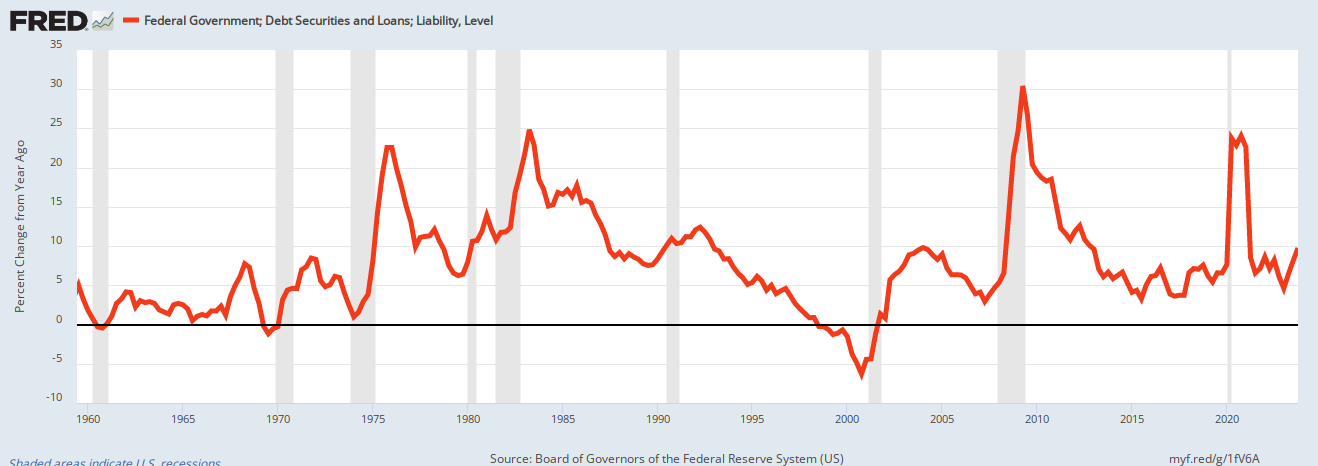
The federal deficit yields economic growth year after year. When deficits are insufficient, we have had recessions, which were cured by increased deficits.
When deficits decline, we have recessions (vertical gray bars), which are cured by increased deficits.
If respected economists keep predicting something terrible is imminent year after year, yet exactly the opposite happens, at what point do they reexamine their beliefs?
At what point does the public say, “Fool me once; shame on you. Fool me repeatedly for 84 years; shame on me”?
Gap Psychology describes the common desire to distance oneself from those “below” in any socio-economic ranking, and to come nearer those “above.” The socio-economic distance is referred to as “The Gap.”
Wide Gaps negatively affect poverty, health and longevity, education, housing, law and crime, war, leadership, ownership, bigotry, supply and demand, taxation, GDP, international relations, scientific advancement, the environment, human motivation and well-being, and virtually every other issue in economics.
Yes, Mr. Vargas Llosa, it is time to tell the truth about government finances. Some might say, “Well, past time. Sadly, your article does not do it.
The purpose of government financing is not to give the government more money. Because the U.S. federal government is Monetarily Sovereign, it already has infinite money.
Former Federal Reserve Chairman Alan Greenspan: “A government cannot become insolvent with respect to obligations in its own currency. There is nothing to prevent the federal government from creating as much money as it wants and paying it to somebody. The United States can pay any debt it has because we can always print the money to do that.”
Former Federal Reserve Chairman Ben Bernanke: “The U.S. government has a technology, called a printing press (or, today, its electronic equivalent), that allows it to produce as many U.S. dollars as it wishes at essentially no cost. It’s not tax money… We simply use the computer to mark up the size of the account.“
The purpose of the federal government — any government, in fact — is to improve the lives of the people. One measure of the improvement is Gross Domestic Product, the total amount of spending in an economy.
Here is what federal deficit spending has done to Gross Domestic Product.
As deficit spending increasingly adds dollars to the economy, the economy grows.
While the self-proclaimed “truth-tellers” complain about federal deficits and debt (red), America’s Gross Domestic Product (blue) has risen enormously.
“Ah,” they say, “but all that “money printing” has caused inflation, so Americans really are poorer now.”
I call the “truth-tellers” attention to the following graph.
Real (inflation-adjusted) GDP per personhas risen enormously for the past 90 years.
That graph shows that the average American is wealthier today than at any time in history. Federal deficit spending enriches Americans.
But—and it’s a big “but”— averages don’t tell the full story because of the income/wealth/power Gap, You can read more about that at the link.
If anyone living in the United States in the decades immediately after the Second World War had predicted the self-inflicted financial mess the U.S. government now finds itself in, nobody would have taken that person seriously.
A normal human would say that a “financial mess” is a situation in which a person has difficulty paying his/her financial obligations. But as Messrs. Greenspan and Bernanke explain, the Monetarily Sovereign U.S. government has no such difficulty.
It pays all its financial obligations simply by creating more dollars.
So what does Mr. Vargas Llosa mean by “financial mess“? Nowhere in his article does he explain. Typical for “debt- truth tellers” who use frightening words to deceive.
For most of American history, until the mid-1970s, annual federal spending and revenue were roughly in balance—the exceptions being in wartime.
Contrast that with the federal deficit in fiscal year 2023, which topped $1.7 trillion, an amount larger than Mexico’s total economy (the 12th largest in the world).
It exceeded $1 trillion again in the first eight months of the current fiscal year and, according to the Congressional Budget Office’s latest forecast, released on June 18, will approach $2 trillion by the end of fiscal 2024.
Translation: In 2023, the federal government pumped 1.7 trillion growth dollars into the economy. In the first eight months of the current fiscal year, it pumped another 1 trillion growth dollars into the economy and expects to pump 2 trillion growth dollarsinto the economy by the end of fiscal 2024.
These are dollars that go into the pockets of Americans at no cost to anyone — not to you, not to your friends and family, not to your neighbors. Why? Because federal taxes don’t fund federal spending. Even if federal tax collections totaled $0, the federal government could continue spending forever.
The Monetarily Sovereign U.S. federal government neither needs nor uses income. (It is different for state and local governments, businesses, and euro governments, all of which are monetarily non-sovereign, and they do need and use income to fund spending.)
The U.S. federal government destroys all the income it receives.
Paying creditors is the primary process by which the federal government creates dollars. To pay a creditor, the federal government first creates instructions (checks, wires, etc.) instructing the creditor’s bank to increase the balance in the creditor’s checking account.
The instant the creditor’s bank obeys those instructions, new dollars are added to the creditor’s checking account and to the M2 money supply measure. Those dollars are not deducted from the M2 money supply.
The bank clears those instructions through the Federal Reserve. Thus the federal government approves its own instructions, which is why it never can run short of dollars.
By contrast, when a local government sends instructions, M2 dollars are deducted from the local government’s checking account in a bank and added to a creditor’s bank account. No net dollars are created. They merely are transferred.
Not understanding the differences between Monetary Sovereignty and monetary non-sovereignty marks one as ignorant about economics.
This has fueled a massive increase in the federal debt, which now totals $34 trillion, about $6 trillion more than America’s gross domestic product (GDP), the value of all the goods and services produced by America’s 330 million residents in a year.
If we count Social Security and Medicare liabilities, total debt is several times larger than GDP.
The debt/GDP ratio is meaningless. Those who quote it hope to scare you with irrelevant numbers. Federal debt is not a burden on the government or on taxpayers. It is nothing like private sector debt.
Neither you nor anyone else pays for the federal debt—never has, never will. The so-called “debt” is nothing more than dollars deposited into T-security accounts. The contents of these accounts are wholly owned by the depositors and never used by the federal government.
The purpose of T-accounts is not to provide spending money to the government. The purpose is to stabilize the dollar by:
Providing a storage place for unused dollars that is safer than any private bank account.
To help the Fed control interest rates by providing a “floor” rate.
Upon request by the owners, the dollars in T- accounts are transferred back to their owners. This is not a financial burden on the federal government, and no tax dollars are involved.
The consequences are sobering. Politicians like to use euphemisms to describe what they’re doing. Government spending, in the current vernacular, is referred to as “investment.”
Government spending, however, crowds out investment, which explains why private investment, the equivalent of 4.8% of GDP, is 30% lower than in 2000.
Government spending is more properly termed “investments,” not “debt. The economy doesn’t care where he investments come from. In fact, federal spending creates new growth dollars, while private investment only moves existing dollars.
The “truth tellers” prefer the government to reduce its spending under the false narrative that this somehow will grow the economy. But:
GDP = Federal Spending + Non-federal Spending + Net Exports.
I have yet to communicate with a debt “truth-teller” who can explain the math of how cuts to federal spending will increase GDP.
At the same time, the purchasing power of the U.S. dollar, a reflection of both the federal government’s finances and the Federal Reserve’s money printing, also is down: by more than 50% since 2000.
That’s called “inflation,” and as we have seen, the economy has enjoyed real (inflation-adjusted) growth.
As a result of this economic mismanagement, the U.S. government will pay close to $900 billion this year just in interest payments on the national debt—and, according to Congressional Budget Office (CBO) projections, which assume an idyllic scenario of no major wars, no recessions, and no financial crises, debt service will steadily increase to some $5.3 trillion by 2054.
Translation: This year, at no cost to anyone, the government will pump 900 billion growth dollars into the economy in interest payments alone. In 2054, the government will pump 5.3 trillion growth dollars into the economy — also at no cost to anyone.
Most of those dollars will go into the pockets of the American people.
It was hard enough sustaining a debt that stood at 106% of GDP during WWII, when the country’s savings rate was 24%, but sustaining a much higher level of indebtedness with today’s 3% savings rate defies the imagination.
Oh, Mr. Vargas Llosa, I’ll bet you’re not even trying to use your imagination.
The only difficulty in “sustaining” the debt came from being on a gold standard, which limited the government’s ability to create dollars.
But Nixon took us off the gold standard in 1971 (Roosevelt did it for domestic us in 1933), and since then the federal government has had the infinite ability to “sustain” any level of deficit spending. It never can run short of dollars.
Private savings and the debt/GDP ratio are irrelevant to the government’s ability to “sustain.” but one must assume Mr. Vargas Llosa tosses in those numbers for fear effect, not because they make any sense whatsoever.
This catastrophe has been a long time in the making. In 1993, for instance, the annual deficit amounted to 3.8% of GDP, and the debt, which seemed astronomically high at a “mere” $4.4 trillion, was Lilliputian by today’s standards.
The U.S.’s real GDPwas approximately $7.1 trillion in 1993. In 2023, it increased to approximately $21.6 trillion. And this is a “catastrophe”?? One hopes we continue to have “catastrophes” like that.
The trend goes back longer than that. The growth of the U.S. government in modern times is the story of post-WWII America.
President Dwight Eisenhower seems to have been the last guy in the post-WWII era who understood that the welfare state, the warfare state, and tax cuts not backed by tough spending cuts are incompatible with fiscally responsible government, or at least with reasonably-sized government.
During Eisenhower’s term, we suffered, not one, not two, but threerecessions. One, called the “Eisenhower Recession,” occurred between 1957 and 1958. We had a sharp contraction in economic activity, high unemployment, and a decline in industrial production.
Is that an example of “fiscal responsibility?”
The “wonderful” Eisenhower years. Three recessions. When federal deficit spending declined, GDP declined into recessions,
The 1953-54 recession was caused by the reduced deficit spending for the Korean War.
This is a regular pattern: Reduced deficit spending leads to a recession, which is cured by increased deficit spending. See below.
A. Economic growth = B. Federal deficit growth + C. private sector spending. Cut B and C, and A declines into recession. Simple math.
The reason for the pattern is clear. Reduced deficit spending adds fewer growth dollars to the economy, so the economy sinks into recession. Curing the recession requires increased growth dollars.
Between 1950 and 1970, total debt (including government, household, corporate, and financial) was stable at about 150% of GDP. After Nixon did away with what was left of the gold standard in 1971, it was off to the races. Since then, total debt has grown by nearly 5,600%, more than double the U.S. economic growth rate.
This is another sleight-of-hand debt/GDP comparison that is meaningless. Nothing can be learned from comparing federal debt (i.e., the net cumulative total of deposits into Treasury Security accounts) vs. GDP (the total of all government and private spending in any given year).
They are akin to comparing tons of butter eaten in the past 10 years with the number of butterflies born this year. Totally meaningless.
If you don’t believe me, see Debt To GDP Ratio By Country. Scroll down to the middle of the page, where you will see every nation’s Debt/GDP ratio, from the highest (Japan) to tied for the lowest (Taiwan and several others).
Look at those ratios, and you will see they tell you nothing about a nation’s ability to pay its bills.
There was a time, even in the middle of the Cold War, when government leaders, despite their international responsibilities and the onerous legacy of the New Deal and Great Society that nobody dared reverse, understood the need for fiscal discipline and containing the growth of government.
And there it is: The Libertarian belief in an “onerous legacy” of programs designed to aid middle and lower-income groups.
That is the “onerous legacy” that gave us Social Security, Medicare, the War on Poverty, the Office of Economic Opportunity and the Economic Opportunity Act, a Job Corps for disadvantaged individuals, established work-study programs and community action initiatives, provided health insurance for elderly Americans, improving access to medical care, legislation addressing environmental concerns and conservation efforts, supported education, and Civil Rights Laws, focused on reducing racial injustice and promoting equality.
Is it any wonder that a right-wing Libertarian should consider those “onerous?” After all, they cost dollars the government creates at the touch of a computer key, and much to Libertarian dismay, narrow the Gap between the rich and the rest.
The 12 years under Presidents Ronald Reagan and George H. W. Bush averaged a 4% deficit due to defense spending increases, abandonment of domestic restraint—a legacy of Johnson’s “bread and butter” years and the Nixon-Ford presidencies’ about-face on most of the economic principles they previously had espoused—and the unfunded tax cutsinfluenced by Arthur Laffer’s notion that tax cuts would pay for themselves.
Oh, yes, cut defense spending to weaken the military at a time when we are the last hope for democracy. And eliminate the “bread and butter” for the poor and disadvantaged. Perfect.
And then there were the “unfunded tax cuts,” which is an oxymoron. Taxes need to be funded by the people. No one needs to fund tax cuts.
They don’t need to be paid for, and the government doesn’t need or use taxes. In fact, it destroys all tax dollars it receives.
The new millennium distorted matters even further, with the annual deficit from 2002 to 2023 averaging 5% over the two decades, 20% higher than nominal economic growth, which averaged 4.2%.
And yet again he mentions the meaningless debt/GDP ratio. It never ends for the Libertarians.
President Obama, under whom the deficit was double the Congressional Budget Office’s original projections, got the spending spree started, with Presidents Trump and Biden taking it to new levels.
And the economy grew massively.
It’s now come down to this. Unless a new generation of leaders has the courage to cut such “untouchables” as the defense, education, justice, and homeland security budgets, and privatize the Social Security program (as more than 40 countries wisely have done), sooner or later, the current trajectory of federal finances will lead to an extremely ugly place.
The above is a perfect description of the effort to widen the Gap between the rich and the rest, while weakening our economy and our national defense.
If you think things are bad now, just wait.
If we ever elect a right-wing, Libertarian fool to be President, along with our current, right-wing SCOTUS, and right-wing governors, things can get much worse.
Rodger Malcolm Mitchell
Monetary SovereigntyTwitter: @rodgermitchellSearch #monetarysovereigntyFacebook: Rodger Malcolm Mitchell;MUCK RACK: https://muckrack.com/rodger-malcolm-mitchell
……………………………………………………………………..
The Sole Purpose of Government Is to Improve and Protect the Lives of the People.
Gap Psychology dictates that to achieve superiority, one must claim inferiors and then distance oneself from those claimed inferiors. The greater the distance—i.e., the wider the “Gap,” the greater our superiority.
“Rich” and “poor” are comparatives, not absolutes. For one to be rich, someone else must be poor, or at least poorer.
A person with $100,000 is rich if everyone else has only $100, but he/she is “middle” if everyone else has $100,000. And he is poor if everyone else has $1,000,000.
Getting richer is not simply a matter of increasing one’s ownership of money. If a middle-income person has $100,000 and doubles that to $200,000, he still is “middle” if everyone else rises to $200,000.
Getting richer requires widening the Gap below and narrowing the Gap above. It is the Gap that measures wealth, not the wealth itself.
Gap Psychology describes the desire to widen the Gap below and to narrow the Gap above.
Gap Psychology enters into virtually all aspects of human existence, not only money or wealth. A person with an IQ of 130 is smart unless everyone else has an IQ of 170.
A 21-year-old man who can do 50 chin-ups is strong unless everyone else can do 150. A child who can read at age 4 is considered smart unless every other child can read at age 3. If you can run 100 meters in 9.5 seconds, you are blazingly fast unless you are a cheetah, which means you would be laughingly slow.
Self-improvement does not require improving yourself so long as you can widen the Gap below and narrow the Gap above.
You can be strong and do just two chin-ups if you hang a 300 lb. weight from everyone else’s ankles.
If you force everyone else to wear blindfolds, you can learn to read at age 8 and be considered smart. And if you tie everyone else’s legs together, you can be fast, running 100 meters in 20 seconds.
Figuratively, that is how the rich treat the rest of us to widen the Gap. They falsely claim that the federal government “can’t afford” to provide benefits to the middle and lower classes while accepting tax benefits for themselves.
Gap Psychology even enters into the abortion controversy. The rich can easily obtain abortions and other medical procedures. It is the poor who must suffer from a lack of care. That is a Gap the rich wish to widen.
Gap Psychology leads to bigotry, classes, and the caste system. Here is an excellent summary:
The Foundations of Caste: The Origins of our DiscontentsFor more than half of American history, slavery was the dominant social institution in the South.
Wilkerson argues that even after emancipation, legally sanctioned violence, harassment, and displacement of African Americans remained—and still remains—an existential threat.
According to Wilkerson, these behavioral scripts and socially reinforced biases have become deeply encoded in the American psyche at all levels of society, which unconsciously perpetuates the system.
Her research demonstrates that all caste systems have the eight essential characteristics (Pillars) in common.
Pillar Number One: Divine Will and the Laws of Nature
Hindu cosmology holds that the caste system is an aspect of the birth of Brahma, the supreme god, who created and populated the world out of various parts of his body in a way corresponding to the social functions dictated by the traditional order.
The Judeo-Christian tradition has a contrasting story about the creation of the world’s different races descending from the three sons of the Old Testament patriarch Noah.
The two “good” sons who are rewarded for their honor become the fathers of the Eastern and Western races, while the cursed son, Ham, and his own son Canaan are fated to be people of the South, forsaken by God.
For there to be “good,” there must be “bad.”
All caste systems, religions, and cults (similar to religions but smaller and not as mainstream) identify members as “good” and outsiders as “bad” or lesser in some way.
At the time when Spain and Portugal were beginning their global circumnavigations, the native inhabitants of Africa and India were believed by Europeans to be descendants of the biblical outcasts and thus divinely ordained to suffering and subjugation.
Pillar Number Two: HeritabilityIn India, caste is inherited through the father’s line, whereas the United States has historically determined caste through the mother.
In Judaism, to be Jewish, one must have a Jewish mother. The father can be Jewish or gentile.
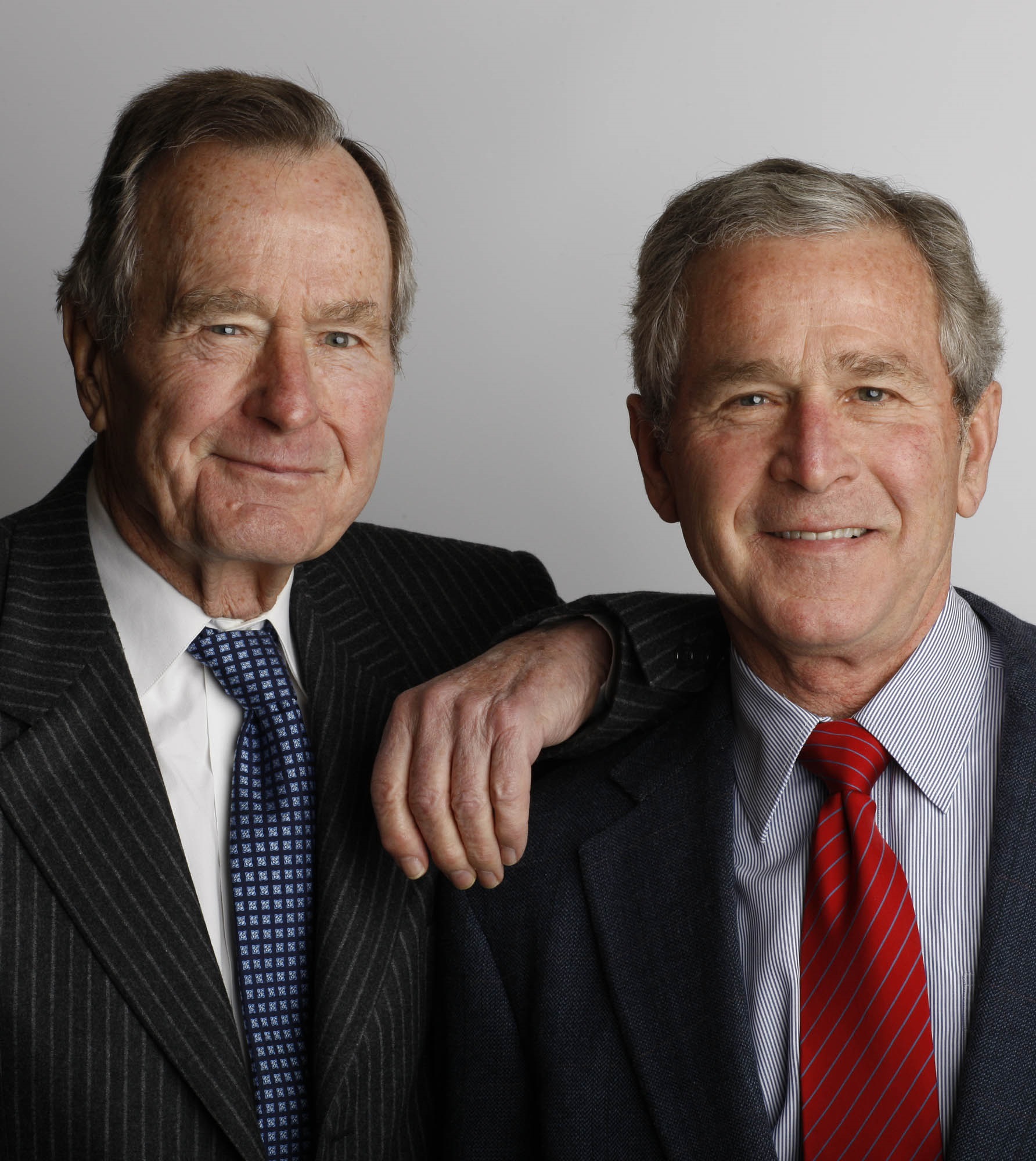
Presidents Bush, father and son
Because enslaved mothers had no legal right to their own children, Black birth became a production process for slave labor, as Black children were regarded as valuable, durable commodities.
The major distinction between caste and class, Wilkerson writes, is that caste is predetermined, unchanging, and generationally upheld, whereas class implies an attainmentof certain conditions based on merit and effort and is much more inclusive within its respective caste “container.”
Yet we have the expressions “new” and “old” money, with “old money: considered superior by those whose ancestors were wealthy.
In the United States, the exclusion of African Americans regardless of their level of social or professional success—an exclusion based on superficial, inescapable, inherited characteristics—resembles in practice the treatment of India’s “untouchable” populations.
Pillar Number Three: Endogamy and the Control of Marriage and MatingIt is essential for a caste system to separate and manage bloodlines in a way that preserves the impenetrability of the dominant gene pool by subordinate-caste DNA.
This protects the Gap between white and non-white. Most American parents prefer that their children marry within their religion and color.
To achieve this, miscegenation laws are passed that restrict marriage and reproduction along caste lines, a policy known as endogamy—and something Hitler admired about the American model.
The objective of this kind of social engineering is to achieve racial purity among the dominant caste, but it also concentrates resources, value, and empathy among the various levels of the dominant caste that are systematically denied to non-white subordinates.
America’s racial boundaries had been set from its earliest days, and coupled with the nation’s historic exclusion of non-European immigrants, endogamy laws effectively created a process of selective breeding that reinforced caste divisions while reserving for white men the ownership of Black reproduction.
Pillar Number Four: Purity Versus Pollution
The United States has its own unique system of gradations on a scale of racial purity that defines itself in opposition to an obsession with contamination by genetic material from a perceived inferior bloodline.
Not only was there the so-called “one-drop rule” that defined Blackness and which the Nazis found so extreme, but there was also an elaborate status-defining class subsystem within the subordinate caste based on skin tone and proportion of African ancestry.
Systems like the examples Wilkerson uses all share a rabid aversion to the idea of public spaces and utilities, particularly water and swimming pools, being similarly contaminated not by blood but by mere exposure to the skin, breath, sweat, or even shadow of the subordinate caste.
Hitler and Trump have spoken of those who “poison the blood” of the nation. Hitler primarily (though not exclusively) was talking about Jews.
Trump was talking about non-white immigrants.
Pillar Number Five: Occupational Hierarchy: The Jatis and the MudsillWilkerson returns to the architectural metaphor she introduced in chapter 2 to describe the house’s most important structural element, where the framing meets the foundation, known as a mudsill.
In the segregationist political tradition, the enslaved caste of African American servants and laborers constituted an analogous base to the American social order.
The lowly work they performed for lack of choice was seen as the limit of their capabilities and their purpose for existence, a permanent servile class upon which the American economy was built.
This is part of the belief that the poor are lazy, stupid, and cannot be trusted. It provides an excuse for widening the employment Gap.
It also alludes to benefits given to the poor, i.e., “Who is going to pick up the garbage if we give them money?”
One major difference between the subordinate Americans and Indian Dalit is that while the Indian system has many subdivisions, known as jatis, within each group that determined one’s work, the African American subordinate class has been limited in professional options with few chances to break out except as performers or athletes.
Until recently, even these luminaries were expected to reinforce popular racist stereotypes if they were to be accepted by the dominant culture.
Pillar Number Six: Dehumanization and StigmaIn order to justify the extreme and often violent measures taken to maintain the oppressive status quo, dominant-caste authority invariably engages in a process of dehumanizing subordinate groups.
By denying subordinates equal regard for their virtue, dignity, and suffering, the dominant caste can so diminish subordinates’ humanity as to make them appear mere beasts of burden, pestilent scourges, or puppets on a string, insensitive to pain and humiliation.
The subordinate group thus becomes marked with pariah status, and their punishment is seen as just and moral, commensurate with the perceived bestiality and inhumanity that relegates them to ghettoization and marginalization.
This dehumanizing mindset is inculcated in generations of dominant-caste children who are raised believing in their superiority and entitlement, which desensitizes them to the victimization of others, even in brutal extremes.
Pillar Number Seven: Terror as Enforcement, Cruelty as a Means for ControlWilkerson describes the means necessary for the sustained oppression of an outcast group, which requires only that the members of the dominant class do nothing and remain silent, maintaining a complicity in which the order will thrive.
The image of the dreaded slaver’s whip encapsulates the violence and intimidation deemed necessary to hold the subordinates in their “container,” and the public complicity that allows the brutal enforcement of the order is the result of the racist attitudes bred into the dominant caste since childhood.
The savage business of terror seems like a part of normal life when it is tolerated by the majority of people.
Trump says he will deport a million undocumented immigrants. Imagine the terror these men, women, and children will feel waiting for their lives to be ripped apart when his brown shirts come banging on the door.
1. Ipsos Poll (2013):
30% think most illegal immigrants (with some exceptions) should be deported.
23% believe all illegal immigrants should be deported.
Only 5% believe all illegal immigrants should stay legally, and 31% want most illegal immigrants to stay.
2. Pew Research Center (2021):
25% of adults say undocumented immigrants should not be allowed to stay legally, advocating for national law enforcement efforts to deport them.
3. Harris Poll (2024):
Half of all Americans favor mass deportation of people who are illegally in the U.S.
Pillar Number Eight: Inherent Superiority Versus Inherent Inferiority
Wilkerson uses old Hollywood as an example of a cultural force that helped perpetuate popular stereotypes about African Americans’ inferiority and contributed to the same majority mindset that tolerated Jim Crow cruelty and injustice.
In the South, law and custom dictated at all levels of interaction between white and Black citizens that white people enjoy unquestioned superiority, while Black people were expected to treat the dominant caste with false deference and submission.
The consequence for African Americans is that these constant reminders from almost every aspect of American culture reinforce the generational effect of believing oneself inferior, resulting in defeatism and despair.
The eight pillars can be found not only in castes but in religions and cults.
Divine Will and the Laws of Nature
Heritability
Endogamy and the Control of Marriage and Mating
Purity Versus Pollution
Occupational Hierarchy: The Jatis and the Mudsill
Dehumanization and Stigma
Terror as Enforcement
Cruelty as a Means for Control, and Inherent Superiority Versus Inherent Inferiority
Look back at #1 through #8 and visualize religions and cults in America. They all implement some forms of the pollars, and all are related to Gap Psychology.
Gap Psychology is expressed secretly and overtly in various ways: Fear, hatred, disgust, avoidance, fanaticism, and the desire to inflict pain.
We each belong to groups that we view as extensions of ourselves. We find ways to view our groups as superior to others, which helps us feel superior.
These groups range from families to sports teams, cities, states, countries, political parties, tribes, social groups, religions, and cults.
Why is this so important to them? Gap Psychology
If our group “wins,” however that is defined, we win. And, if other groups “lose,” we win.
Personal note: In my younger days, I was a Chicago Bears football fan. I was nervous watching their games because winning meant so much. Finally, in 1985, they won a Super Bowl.
Crowds of screaming Bear fans clogged downtown Chicago. Logically, I had gained nothing, but I felt I had won. Gap Psychology is not based on logic.
When Donald Trump claims, against all evidence, that he won, MAGAs believe.
They disbelieve the 64 lawsuits he lost, the women who claim he attacked them, the criminality of Trump U. and the Trump Foundation, the many convicted criminals he surrounds himself with, and a trial’s 30+ criminal convictions.
To them, the evidence against Trump proves that someone else has committed crimes. (His attempts to overturn the election constitute the proofthe election was stolen.)
That is an outcome of Gap Psychology. When Trump is compared to God, a huge branch of Christianity believes, because when your leader is Godlike, the superiority Gap between you and the non-believers widens.
Gap Psychology is not logical, but it is the single, most important factor ruling our lives. Centuries from now, if we encounter another intelligent species, we will wish to dominate them or fear they will dominate us.






 opposition to an obsession with contamination by genetic material from a perceived inferior bloodline.



/cdn.vox-cdn.com/uploads/chorus_asset/file/13649459/1074706918.jpg.jpg)

