Before we answer, let’s make one point very clear: The U.S. federal government, being Monetarily Sovereign, has the unlimited ability to create U.S. dollars.
It never can run short of dollars. It can pay any bills of any size, instantly, and without collecting a single penny in taxes.
Further, and contrary to the popular myth, federal deficit spending does notcause inflation. Instead, inflations are caused by shortages, most often shortages of food or energy (oil), not by “excessive” federal deficits or debt. (Ironically, shortages often are cured by federal deficit spending.)
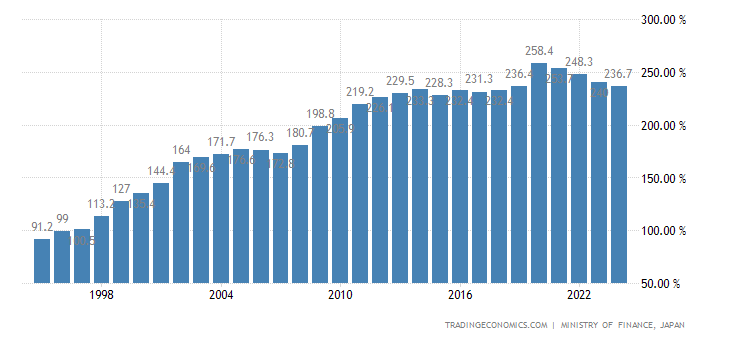
Consider Japan, which has a much-derided Debt/GDP of 240%:
Chart: Japanese debt/GDP ratio for 25 years.
America’s debt terrorists would claim that level of debt must lead to inflation.
But Japan’s inflation generally has languished below 1% and often has been below 0%:
Chart: Japan’s inflation rates for 25 years
In summary, the U.S. government easily could provide a free college education to everyone in America, who wanted one.
So, if a college education benefits not only the students, but everyone in the nation, why doesn’t the U.S. federal government fund college for everyone?
The reason: Our deficit terrorists persist in telling you that despite the American government being Monetarily Sovereign, while the public is monetarily non-sovereign, funding college would be unaffordable for the government.
While the cost of college education in the US has reached record highs, Germany has abandoned tuition fees altogether for German and international students alike.
An increasing number of Americans are taking advantage and saving tens of thousands of dollars to get their degrees.
Before we continue with excerpts from the article, keep this in mind: Unlike the U.S. government, which has the unlimited ability to pay for anything, without collecting taxes, the German government is monetarily non-sovereign.
It does not have a sovereign currency. It uses the euro, which is the sovereign currency of the European Union.
When Germany spends, German taxpayers pay.
So why are German taxpayers willing to pay for college, while the American government is not?
Germans have a greater belief in the importance of education than do Americans.
Some Americans believe a college education is an unnecessary, but expensive, form of elitism. They don’t understand that the competitive future of America will be determined by the educated.
Other Americans adopt the “If I had to pay, they should have to pay” attitude, a kind of cutting one’s nose to spite one’s face.
And it hurts us all.
In rural South Carolina one night, Hunter Bliss told his mother he wanted to apply to university in Germany. Amy Hall chuckled, dismissed it, and told him he could go if he got in.
“When he got accepted I burst into tears,” says Amy, a single mother.
“For him to stay here in the US was going to be very costly,” says Amy. “We would have had to get federal loans and student loans because he has a very fit mind and great goals.”
More than 4,600 US students are fully enrolled at Germany universities, an increase of 20% over three years.
At the same time, the total student debt in the US has reached $1.3 trillion (£850 billion).
Health insurance for students in Germany is €80 ($87) a month, much less than what Amy would have had to pay in the US to add him to her plan.
To cover rent, mandatory health insurance and other expenses, Hunter’s mother sends him between $6,000-7,000 each year.
At his nearest school back home, the University of South Carolina, that amount would not have covered the tuition fees.
Even with scholarships, that would have totalled about $10,000 a year. Housing, books and living expenses would make that number much higher.
We interrupt again to remind you that sometimes even a college scholarship isn’t sufficient, when one needs to pay ancillary expenses, and when one must forego a regular paying job.
The financial advantages of studying in Germany have not been lost on other US students. Katherine Burlingame decided to get her Master’s degree at a university in the East German town of Cottbus.
A graduate of Pennsylvania State University, Katherine spent less than €500 ($570) a month in Cottbus, which included housing, transportation and healthcare.
On top of that she received a monthly scholarship by the DAAD (German Academic Exchange Council) of €750 ($815) which more than covered her costs.
“When I found out that just like Germans I’m studying for free, it was sort of mind blowing,” Katherine says.
“I realized how easy the admission process was and how there was no tuition fee. This was a wow moment for me.”
In the 2014-2015 academic year, private US universities charged students on average more than $31,000 for tuition and fees, with many schools charging well over $50,000.
The lie that federal debt is “unsustainable” “unaffordable,” and somehow immoral, has prevented many thousands of bright, ambitious, future American leaders from fulfilling the destiny that would have benefited them and America.
We cannot know how many potential American scientists, mathematicians, inventors, business leaders, etc. America has lost for lack of education funds. We cannot know what it has cost us as a nation and as individuals.
But we do know this. The cost has been enormous, especially when compared to the zero cost to us of federal spending.
Gap Psychology describes the common desire to distance oneself from those “below” in any socio-economic ranking, and to come nearer those “above.” The socio-economic distance is referred to as “The Gap.”
Wide Gaps negatively affect poverty, health and longevity, education, housing, law and crime, war, leadership, ownership, bigotry, supply and demand, taxation, GDP, international relations, scientific advancement, the environment, human motivation and well-being, and virtually every other issue in economics.
Implementation of Monetary Sovereignty and The Ten Steps To Prosperity can grow the economy and narrow the Gaps:
Someone I care deeply about has two relatively rare disease conditions: Thymoma (cancer of the thymus) and myelodysplastic syndromes (MDS — disorders that reduce the bone marrow’s ability to create normal blood cells.)
The treatment for the uncommon thymoma and MDS, together with her age, sex, other conditions, and her unique genetic profile, requires more than using an approved drug or drugs.
It requires finding a unique, specialized treatment, perhaps appropriate only to one person on earth.
Though today doctors generally prescribe a standard approved treatment for a common ailment — i.e. aspirin for a headache, chemotherapy for a cancer — each of us responds differently to every chemical and to every treatment, much to the frustration of doctors and their patients, who expect everyone to react the same.
Each of us is a unique human specimen as DNA searches reveal. At some time in the future, possibly every disease will be custom-treated for each individual.
Until them, it is the enormous differences in people multiplied by their infinite reactions to treatments, multiplied again by the immeasurable number of diseases and other afflictions, that makes the following excerpts germane.
18 DECEMBER 2019 How Artificial Intelligence Will Change Medicine
Claudia Wallis, Contributing Editor (This report was produced independently by the editors of Scientific American, who take sole responsibility for the editorial content.)
The biomedical world is awash in data. We have terabytes of genomic information from mouse to human, troves of health metrics from clinical trials, and reams of so-called real-world data from insurance companies and pharmacies.
Using powerful computers, scientists have scrutinized this bounty with some fine results, but it has become clear that we can learn much more with an assist from artificial intelligence.
Over the next decade, deep-learning neural networks will likely transform how we look for patterns in data and how research is conducted and applied to human health.
Innovations In AI and Digital Health
Right now the biggest bets are being placed in the realm of drug discovery. And for good reason.
The average cost of bringing a new drug to market nearly doubled between 2003 and 2013 to $2.6 billion, and because nine out of 10 fail in the final two phases of clinical trials, most of the money goes to waste.
Every large pharma company is working with at least one AI-focused start-up to see if it can raise the return on investment.
Machine-learning algorithms can sift through millions of compounds, narrowing the options for a particular drug target.
Perhaps more exciting, AI systems—unconstrained by prevailing theories and biases—can identify entirely new targets by spotting subtle differences at the level of tissues, cells, genes or proteins between, say, a healthy brain and one marked by Parkinson’s—differences that might elude or even mystify a human scientist.
The pharmaceutical companies “waste” many billions of dollars searching for the one drug that works on enough similar people,who have a certain condition common enough that sales of the cure will be profitable.
If a company somehow discovered a drug that could cure the thymoma for just one woman, that drug would not be produced. Even if a drug could cure the MDS of a thousand people, it never would be brought to market.
The profit motive would prevent it.
And that takes us to the single biggest problem in health care. It is the biggest problem facing hospitals; the biggest problem facing doctors and nurses, etc. It is the biggest problem facing pharmaceutical companies. It is the biggest problem facing patients.
The single biggest problem in the entire realm of healthcare involves money.
And fortunately, we Americans own a solution to that problem. Our federal government has the unlimited ability to create money, specifically our sovereign currency, the U.S. dollar.
Our federal government, being Monetarily Sovereign, is not constrained by a profit motive. It wants no profits; it needs no income; it never can run short of dollars. Never.
Contrary to the disinformation by those who say America’s deficit spending is “unsustainable,” or harmful, federal deficits and debt are neither. They not only are beneficial, but absolutely necessary.
The search for medical preventions and cures is constrained by money. For pharmaceutical companies, it is constrained by the need for profits. For universities, it is constrained by the need to pay for researchers, their research, and their equipment.
And all of it could be funded by the press of a federal computer, money-creation key.
Ben Bernanke: “The U.S. government has a technology, called a printing press (or, today, its electronic equivalent), that allows it to produce as many U.S. dollars as it wishes at essentially no cost.”
Will the inefficiencies of today’s electronic health records (EHRs) be addressed by smart systems that prevent prescribing errors and provide early warnings of disease?
Some of the world’s biggest tech giants are working on it.
More accurately, some of the world’s biggest tech giants are working on systems they can sell for a profit — which does not always correlate with the needs of patients.
By contrast, all phases of medical research could be federally funded, allowing for the goals to be preventions and cures rather than only profits.
The bigger concern is a shortage of people with both biomedical knowledge and algorithm-building proficiency.
This brings us to a related article that appeared in the December 18, 2019 issue of Nature Magazine. Excerpts:
Hunting for New Drugs with AI
The $1-trillion global pharmaceutical industry has been in a drug development and productivity slide for at least two decades.
Pharmaceutical companies are spending more and more—the 10 largest ones now pay nearly $80 billion a year—to come up with fewer and fewer successful drugs.
Ten years ago every dollar invested in research and development saw a return of 10 cents; today it yields less than two cents.
In part, that is because the drugs that are easiest to find and that safely and effectively treat common disorders have all been found; what is left is hunting for drugs that address problems with complex and elusive solutions and that would treat disorders affecting only tiny portions of the population—and thus could return far less in revenue.
These same challenges have increased the lab-to-market time line to 12 years, with 90 percent of drugs washing out in one of the phases of human trials.
The private sector cannot afford endlessly to lose money, but the federal government can. Remember that since 1940 the federal government has lost more than $20 trillion, with no ill effects.
Alan Greenspan: “Central banks can issue currency, a non-interest-bearing claim on the government, effectively without limit. A government cannot become insolvent with respect to obligations in its own currency.”
In fact, the federal government easily could afford to lose double or triple that amount and the only effect would be for the economy to be strengthened and the populace to be enriched by the addition of dollars to their pockets.
And did we mention that finding new and better cures faster, would benefit everyone?
Step #10 of the Ten Steps to Prosperity reads: “Increase federal spending on the myriad initiatives that benefit America’s 99.9%”
I suggest that vastly increased federal funding for medical research and development be one of those “myriad initiatives.”
The federal government has the unlimited ability to fund personnel and equipment in the pharmaceutical industry and universities, and to provide financial incentives that encourage and enable faster and more complete searches for new preventions and cures.
It can be done. It should be done. It must be done, or development will continue to decline and we all will suffer.
The people who prevent this, by making false claims about “unsustainable” federal deficits and debt, are complicit in the suffering and too-early deaths of billions.
Disregard their deceptions. Demand more federal spending on projects vital to America.
Gap Psychology describes the common desire to distance oneself from those “below” in any socio-economic ranking, and to come nearer those “above.” The socio-economic distance is referred to as “The Gap.”
Wide Gaps negatively affect poverty, health and longevity, education, housing, law and crime, war, leadership, ownership, bigotry, supply and demand, taxation, GDP, international relations, scientific advancement, the environment, human motivation and well-being, and virtually every other issue in economics.
Implementation of Monetary Sovereignty and The Ten Steps To Prosperity can grow the economy and narrow the Gaps:
An update of the biggest con job in American history, that still is running:
Once again, I am compelled by recent articles to remind you that in 1940, when the phony federal debt was described as a”ticking time bomb,” America had not yet entered World War II.
The most popular songs were: Tommy Dorsey’s “I’ll Never Smile Again,” Bing Crosby’s “Only Forever,” and Artie Shaw’s “Frenesi”
In 1940, when the federal debt first became a “ticking time bomb,” it was only $40-50 Billion. Today it exceeds $22 Trillion.
Year after year, that “ticking time bomb” of federal debt has kept ticking, and here we are, in 2020, with a healthy economy, and still that phony bomb hasn’t exploded.
Eighty years of warnings, eighty years of being wrong, eighty years and many people still believe the doomsday sayers.
As we dance down Memory Lane, here they are, again:
By 1960: the debt was “threatening the country’s fiscal future,”said Secretary of Commerce, Frederick H. Mueller. (“The enormous cost of various Federal programs is a time-bomb threatening the country’s fiscal future, Secretary of Commerce Frederick H. Mueller warned here yesterday.”)
In 1984: AFL-CIO President Lane Kirkland said. “It’s a time bomb ticking away.”
In 1985: “The federal deficit is ‘a ticking time bomb, and it’s about to blow up,” U.S. Sen. Mitch McConnell. (Remember him?)
Later in 1985: Los Angeles Times: “We labeled the deficit a ‘ticking time bomb’ that threatens to permanently undermine the strength and vitality of the American economy.”
In 1987: Richmond Times–Dispatch – Richmond, VA: “100TH CONGRESS FACING U.S. DEFICIT ‘TIME BOMB’”
Later in 1987: The Dallas Morning News: “A fiscal time bomb is slowly ticking that, if not defused, could explode into a financial crisis within the next few years for the federal government.”
In 1989: FORTUNE Magazine: “A TIME BOMB FOR U.S. TAXPAYERS”
In 1992: The Pantagraph – Bloomington, Illinois: “I have seen where politicians in Washington have expressed little or no concern about this ticking time bomb they have helped to create, that being the enormous federal budget deficit, approaching $4 trillion.”
Later in 1992: Ross Perot: “Our great nation is sitting right on top of a ticking time bomb. We have a national debt of $4 trillion.”
In 1995: Kansas City Star: “Concerned citizens. . . regard the national debt as a ticking time bomb poised to explode with devastating consequences at some future date.”
In 2003: Porter Stansberry, for the Daily Reckoning: “Generation debt is a ticking time bomb . . . with about ten years left on the clock.”
In 2004: Bradenton Herald: “A NATION AT RISK: TWIN DEFICIT A TICKING TIME BOMB”
In 2005: Providence Journal: “Some lawmakers see the Medicare drug benefit for what it is: a ticking time bomb.”
In 2006: NewsMax.com, “We have to worry about the deficit . . . when we combine it with the trade deficit we have a real ticking time bomb in our economy,” said Mrs. Clinton.
In 2007: USA Today: “Like a ticking time bomb, the national debt is an explosion waiting to happen.”
In 2010: Reason Alert: “. . . the time bomb that’s ticking under the federal budget like a Guy Fawkes’ powder keg.”
In 2011: Washington Post, Lori Montgomery: ” . . . defuse the biggest budgetary time bombs that are set to explode.”
June 19, 2013: Chamber of Commerce: Safety net spending is a ‘time bomb’, By Jim Tankersley: The U.S. Chamber of Commerce is worried that not enough Americans are worried about social safety net spending. The nation’s largest business lobbying group launched a renewed effort Wednesday to reduce projected federal spending on safety-net programs, labeling them a “ticking time bomb” that, left unchanged, “will bankrupt this nation.”
In 2014: CBN News: “The United States of Debt: A Ticking Time Bomb”
On January 27, 2017: America’s “debt bomb is going to explode.” That’s according to financial strategist Peter Schiff. Schiff said that while low interest rates had helped keep a lid on U.S. debt, it couldn’t be contained for much longer. Interest rates and inflation are rising, creditors will demand higher premiums, and the country is headed “off the edge of a cliff.”
Feb. 16, 2018 America’s Debt Bomb By Andrew Soergel, Senior Reporter: Conservatives and deficit hawks are hurling criticism at Washington for deepening America’s debt hole.
[The following were added after the original publishing of this article]
April 10, 2019,The National Debt: America’s Ticking Time Bomb. TIL Journal. Entire nations can go bankrupt. One prominent example was the *nation of Greece which was threatened with insolvency, a decade ago. Greece survived the economic crisis because the European Union and the IMF bailed the nation out.
SEP 12, 2019, Our national ticking time bomb, By BILL YEARGIN
SPECIAL TO THE SUN SENTINEL | At some point, investors will become concerned about lending to a debt-riddled U.S., which will result in having to offer higher interest rates to attract the money. Even with rates low today, interest expense is the federal government’s third-highest expenditure following the elderly and military. The U.S. already borrows all the money it uses to pay its interest expense, sort of like a Ponzi scheme. Lack of investor confidence will only make this problem worse.
JANUARY 06, 2020, JANUARY 06, 2020, National debt is a time bomb, BY MARK MANSPERGER, Tri City Herald | The increase in the U.S. deficit last year was about $1.1 trillion, bringing our total national debt to more than $23 trillion! This fiscal year, the deficit is forecasted to be even higher, and when the economy eventually slows down, our annual deficits could be pushing $2 trillion a year! This is financial madness.there’s not going to be a drastic cut in federal expenditures — that is, until we go broke — nor are we going to “grow our way” out of this predicament. Therefore, to gain control of this looming debt, we’re going to have to raise taxes.
In Summary
The U.S. government is Monetarily Sovereign. It has the unlimited ability to create its own sovereign currency, the U.S. dollar.
The government has absolute control over all aspects of the dollar, including its value. Unlike state and local governments, and unlike businesses, and unlike the euro nations, and unlike you and me, the federal government can service any size debt without collecting a penny of income.
Yet, tick, tick, tick, the fake debt time bomb of terror keeps on ticking. The only question, “How many years of proven-wrong fear-mongering will you, the public fall for before the debt charlatans are excised from the news?”
By now, after 80 years of false warnings, you should have learned that phony concerns about the federal debt constitute the biggest con job in American history — and it still is running. And you still are buying it.
The fundamental purpose of this con job is to keep you from asking for benefits from the federal government — benefits the rich already receive, but because of Gap Psychology, don’t want you to have.
Is it possible that the rich really can fool all the people all the time?
Gap Psychology describes the common desire to distance oneself from those “below” in any socio-economic ranking, and to come nearer those “above.” The socio-economic distance is referred to as “The Gap.”
Wide Gaps negatively affect poverty, health and longevity, education, housing, law and crime, war, leadership, ownership, bigotry, supply and demand, taxation, GDP, international relations, scientific advancement, the environment, human motivation and well-being, and virtually every other issue in economics.
Implementation of Monetary Sovereignty and The Ten Steps To Prosperity can grow the economy and narrow the Gaps:
Our country club invites speakers to give presentations about various, interesting subjects.
I could volunteer to present my friends and neighbors with information they don’t have, and should have, and would find interesting.
Sadly, I’ve found that most people want to hear what they already believe, and they tend to become angry at anyone who tells them otherwise.
What follows is the text of a speech I never will give to my friends at the club because they probably won’t believe me, and at my age, who needs the aggravation?
TEN THINGS YOU ABSOLUTELY DON’T KNOW ABOUT OUR ECONOMY — BUT YOU SHOULD
I’m going to tell you some things about our economy, and specifically about money — a subject which you already understand quite well because you have lots of it.
But I’m going to tell you ten things you didn’t know.
The vast majority of you own more than a million U.S. dollars, which used to be a much-respected sum, but no longer is.
Because you own so many dollars, let me ask you this: What does a U.S. dollar look like? For instance, what is the color of the U.S. dollar?
Green, right?
And what is a dollar made of? How big is it?
Paper and about 6 inches?
And what is the purpose of dollars?
They are a medium of exchange and a measure of value or wealth. OK?
And, if the purpose of dollars is, for example, to act as a medium of exchange, that means you exchange dollars for the goods and services you want, right?
.
So, for instance, let’s say you walk into a car dealership to buy a car.
After proper negotiation, you give the dealer a giant stack, let’s say 75,000, of those green, 6-inch pieces of paper, and he gives you the car keys.
That’s the way it works, right? You schlep big stacks of paper around?
No?? It doesn’t work that way??
Actually, to buy that car, you sign some papers that probably are not green and don’t measure 6 inches.
And in fact, I venture to guess, that while the vast majority of your life’s purchases do involve dollars, they do not involve green pieces of paper.
You gave that car dealer $75,000. So, let me ask you again, What did those dollars — the dollars you gave the dealer — look like?
The answer is: Those dollars didn’t look like anything. They are bookkeeping entries.
The U.S. dollar is not a physical entity. The dollar is a legal entity. It is a group of laws. You can’t see, smell, taste, feel, or hear a dollar any more than you can see, smell, taste, feel, or hear a law.
Titles
That green piece of paper is not a dollar; it is a dollar bill. It represents the ownership of a dollar. Just as a car title is not a car, and a house title is not a house, a dollar bill is not a dollar.
A dollar bill is a bearer title to a dollar.
A dollar is a legal entity that exists only in law books. And if there is one thing you know about governments and laws it’s this: A government can make as many laws as it wishes. A government cannot run short of laws.
Before the year 1780, there were no U.S. dollars. Then, as if by magic, the U.S government created from thin air, a bunch of laws, and among them were laws that created from thin air, millions of dollars.
And not only did the government laws and dollars from thin air, but it created other laws from thin air that gave those dollars a value relative to ounces of silver.
In 1792 the US Congress passed the Coinage Act, which states that the U.S. dollar coin must contain four hundred and sixteen grains of standard silver.
And ever since, the U.S. government has continued to create more and more laws, and more and more dollars from thin air, and has continued to pass laws changing the value of U.S. dollars.
All of this was arbitrary, and arbitrarily changed many times, and it demonstrated the unique sovereign power of the federal government over the U.S. dollar.
The American government proved what so many other governments had proved and continue to prove to this day:
The U.S. federal government has the unlimited ability to pass laws, which means it has the unlimited ability to create its sovereign currency, the U.S. dollar and the unlimited ability to give the dollar any value it wishes.
The term for that is Monetary Sovereignty.
You now know more than 90% of the people — make that 99% of the people — in America.
You know more than most of the media. You know more than most of the politicians. You even know more than most of the economists.
Why do I say that? Because every day, the media, the politicians and the economists tell you the U.S. federal debt is too high. It’s “unsustainable.”
What does “unsustainable” mean? It means the U.S. government will not have enough dollars to pay off its debt.
It even may mean the U.S. government won’t be able to make payments against its debt or even to cover the interest payments.
And it might mean that the government will have to raise taxes on you and your children to obtain dollars to pay its debt.
And as you now have learned, that is all nonsense.
Think about it, and answer for yourself these two questions:
How can a government that has the unlimited ability to create dollars from thin air, run short of dollars to pay its debts? (It can’t.)
Does a government having the unlimited dollars to pay its debts, need to ask you or your children for tax dollars? (No.)
What? The federal government doesn’t need your tax dollars?
That’s right folks, those tax dollars you sweat and strain to obtain, and then send to the government — the U.S. government does not need those tax dollars.
In fact, the federal government destroys your tax dollars upon receipt.
Really.
Think of it this way. Have you ever played the board game, Monopoly?
It usually is played with four players, one of whom also serves as the Bank.
Think of the Bank as the federal government and the players as the U.S. economy.
Monopoly money
According to the game rules, or laws, the Bank starts the game by distributing a certain amount of Monopoly money to each player.
One time, my friends and I wished to play Monopoly, but when we opened the box we discover the board, some game tokens, and some instruction cards, but no Monopoly dollars inside.
What would you have done?
No problem. The Bank simply took a sheet of paper and drew four columns, one for each player.
Like the U.S. federal government, the Bank created dollars out of thin air, simply by writing numbers into each player’s column.
The Bank has no source of dollars other than the rules or laws of the game.
Obviously, the Bank could have written any starting number at the top of each column.
Like the federal government, the Monopoly Bank has the unlimited power to create Monopoly dollars.
Then, as the game progressed, the Bank kept paying out and receiving dollars.
When the Bank paid out more dollars than it received, this was a deficit for the Bank and a surplus for the players— that is, a surplus for the economy — just like in the real world.
Now here comes the interesting part: At various points in the game, the rules require players to pay money to the Bank, either for properties, for fines, or for taxes.
Let’s say a player must pay a $100 tax to the Bank. In that case, 100 was deducted from that player’s column.
But where did the $100 go? The Bank had no column. The $100 simply disappeared. Those tax dollars were destroyed, just like in the real world.
That is why, if you ask someone, “How much money does the federal government have,” you will not get an answer. The federal government has infinite money.
If the federal government doesn’t need or use tax dollars, why does it collect them? Two reasons:
To control the economy. It taxes what it wishes to limit and it gives tax breaks to what and whom it wishes to reward.
To control the middle- and lower-income groups. Taxes provide a handy excuse for limiting benefits and preventing the non-rich from asking for benefits.
Why does the federal government wish to limit benefits to the non-rich?
A rich man
The rich run America.
Indeed the rich run the world.
“Rich” is a comparative word.You are rich if you have $100 and everyone else has $1, but you are poor if you have $1 million and everyone else has $10 million.
The rich wish to be richer which requires widening the gap between them and the non-rich.
The gap can be widened not only by giving more to the rich, but also by giving less to the non-rich.
The desire to widen the gap between those below, on any economic measure, and to narrow the gap above, is called Gap Psychology.
The rich are motivated by Gap Psychology.
The rich want the gap between you and them to widen.
That is why you are told falsely that Medicare for All, and Social Security for All, and the growing debt all are unsustainable.
And as for that so-called “debt,” it isn’t even a debt — at least not in the way you usually think about debt.
Loans are made to those who need money.
But the federal government has no need to borrow money. The U.S. federal government already has infinite money.
Those so-called “loans” to the federal government actually are deposits into T-bill, T-note, and T-bond accounts held at the Federal Reserve Bank.
They are deposits, similar to your bank savings account deposit.
When China “lends” to the U.S government, it actually opens T-bill accounts and directs dollars from its checking account at the Federal Reserve Bank to be deposited into its T-bill accounts, also at the Federal Reserve Bank.
There China’s dollars stay, in its T-bill accounts, accumulating interest until the T-bills mature.
Then, how does the government pay off its Chinese loans? It merely sends the dollars that are sitting in China’s T-bill accounts, back to China’s checking account.
It’s a simple dollar transfer. It does this every day.
No tax dollars involved. No burden on the government or future generations.
If the government doesn’t use the dollars in Treasury accounts, why then does the government issue T-bills, notes, and bonds? Two primary reasons:
To provide a safe parking place for unused dollars, which stabilizes the dollar, and
To assist the Federal Reserve in controlling interest rates
In summary, and contrary to what you have been told, the federal debt is not a burden on anyone, not on you, not on your grandchildren and not on the government.
Why is this important?
Well, for one thing, you repeatedly have been told that the Social Security Trust Fund is running out of money, and to save Social Security, we must either increase FICA taxes or reduce benefits.
In fact, benefits already have been reduced by increasing the qualifying ages.
But the U.S. government has the unlimited ability to create dollars. It cannot go broke, And because the U.S. government cannot go broke, no agency of the government can go broke, unless that is what the politicians want.
The Supreme Court, Congress, and the Presidency all are agencies of the government. Have you ever heard concerns about any of them going broke? No, and you never will.
The idea that Social Security can run short of dollars is false. Even if all FICA collections were zero, the federal government could continue paying benefits, forever.
And then we come to the newly famous “Medicare-for-All.”
In its best case, Medicare for All would lower the entrance age to zero, eliminate deductibles, cover long-term care completely, and pay for all drugs.
Who wouldn’t want all health costs to be free? People want it. Companies — except for insurance companies — want it. The benefits to America would be enormous.
And yet, Medicare-for-All is controversial, primarily because of one question: Who would pay for it?”
And the answer, very simply is, the federal government could pay for the whole thing, without levying even a dollar in taxes. It simply would do what it always has done, to fund every federal expense: Create dollars from thin air.
“Oh,” you say. “Sure the government can print money.
“But, remember what happened to Weimar Germany. Remember what happened to Zimbabwe. We’re talking about hyperinflation. People carrying wheelbarrows full of money.”
I’ll let you in on a well-kept secret: Every hyperinflation and nearly every inflation in history has been caused not by deficit spending, but rather by shortages — usually shortages of food and/or energy.
Think of the Zimbabwe hyperinflation. The government took farmland from farmers and gave it to non-farmers.
Predictably, that caused a food shortage, which caused the hyperinflation.
Rather than importing more food, and training people to farm, which would have cured the shortage and the hyperinflation, the Zimbabwe government simply printed currency of higher denominations.
When you hear that the price of potatoes has gone up, do you immediately think it’s because the federal government is spending too much? No, the price of potatoes goes up when there is a shortage of potatoes.
In fact, the best way for a government to end an inflation is to increase deficit spending to cure the shortage.
Potato prices gone up? The solution: More deficit spending to import more potatoes, and/or to pay more farmers to grow more potatoes, and/or
That is the irony of inflations. They can be cured by deficit spending to eliminate the shortages.
The government has other means of ending inflations: It can raise interest rates which strengthen the dollar by creating more demand for dollars.
And it can simply revalue the dollar vs. other currencies, which it has done often in its 240-year history. Being sovereign over the dollar, the government can do anything it wishes with the dollar.
The U.S. government is Monetarily Sovereign.
Your city is not Monetarily Sovereign. Nor is your county. Nor is your state. Nor is your business. Nor are the euro nations. Nor are you, nor am I. But the federal government is. It has unlimited sovereign power over the U.S. dollar, which is nothing more than a creation of federal law.
And that makes all the difference.
And remember that statement at the beginning of this post: “The U.S. dollar is not a physical entity. The dollar is a legal entity. It is a group of laws. You can’t see, smell, taste, feel, or hear a dollar any more than you can see, smell, taste, feel, or hear a law.”
If you don’t believe it, the kindly describe the dollars we Monopoly players used when the game didn’t have any paper certificates. What color were those dollars? What did they smell and feel like?
In summary:
The federal government created the very first dollar, and subsequent dollars, out of thin air, simply by writing federal laws, also out of thin air.
Dollars are not physical entities; they are legal entities, and so to the federal government, they are in unlimited supply.
Even if all federal tax collections fell to $0, the federal government easily could continue spending, and paying all its bills, forever.
Unlike state and local governments, the federal government is Monetarily Sovereign, so it cannot run short of its own sovereign currency, the U.S. dollar.
No agency of the federal government can run short of dollars unless Congress and the President want it to.
Social Security and Medicare are federal agencies. They cannot run short of dollars unless Congress and the President want them to.
Because the federal government is Monetarily Sovereign, it does not borrow its own sovereign currency. The primary purposes of federal debt are to stabilize the dollar and to help control interest rates.
The federal government, being sovereign over the dollar, has absolute control over the value of the dollar, also known as inflation. The government can give the dollar any value it chooses.
Inflations are caused by shortages, most often shortages of food or energy, and seldom if ever, by federal deficit spending, which actually can control inflation.
Being Monetarily Sovereign, the federal government has absolute control over inflation, either by raising interest rates, and/or by using deficit spending to eliminate shortages.
Gap Psychology describes the common desire to distance oneself from those “below” in any socio-economic ranking, and to come nearer those “above.” The socio-economic distance is referred to as “The Gap.”
Wide Gaps negatively affect poverty, health and longevity, education, housing, law and crime, war, leadership, ownership, bigotry, supply and demand, taxation, GDP, international relations, scientific advancement, the environment, human motivation and well-being, and virtually every other issue in economics.
Implementation of Monetary Sovereignty and The Ten Steps To Prosperity can grow the economy and narrow the Gaps:
















 #Monetary Sovereignty - Mitchell