Why did Fitch downgrade U.S. “Debt”? It’s not what you may think.

The purpose of credit ratings is to assess the likelihood that an issuer of a debt document will adhere to the terms of the document. The U.S. debt documents consist of Treasury bills, bonds, and notes, including the Federal Reserve Notes you carry in your wallet, aka “money.” The value of U.S. debt/money is determined by the U.S. government’s full faith and credit, which includes:

A. –The government will accept only U.S. currency in payment of debts to the government B. –It unfailingly will pay all its dollar debts with U.S. dollars and will not default C. –It will force all your domestic creditors to accept U.S. dollars if you offer them to satisfy your debt. D. –It will not require domestic creditors to accept any other money E. –It will take action to protect the value of the dollar. F. –It will maintain a market for U.S. currency G. –It will continue to use U.S. currency and will not change to another currency. H. –All forms of U.S. currency will be reciprocal; that is, five $1 bills always will equal one $5 bill and vice versa.

The key to the downgrade is item “B,” the “not default” claim. The following article from Investor News attempts to explain why federal Treasuries were downgraded from AAA to AA+.

Credit Rating Alert: Why Did Fitch Downgrade U.S. Debt? Story by Josh Enomoto 

Primarily, the negative reassessment focuses on “the expected fiscal deterioration over the next three years,” a matter worsened by increasingly bitter political infighting.

The matter was not “worsened” by political infighting. The matter was entirely political infighting. As you will see, that was the sole reason for the downgrade.Editorial Cartoon: John Darkow (May 3, 2023) | Opinion | yakimaherald.com

Per the agency’s official statement, a “steady deterioration” in standards of governance during the past two decades imposes a dark cloud as policymakers struggle to navigate the extraordinarily difficult post-pandemic environment.

Specifically, “[t]he repeated debt-limit political standoffs and last-minute resolutions have eroded confidence in fiscal management.”

“Standards of governance” is the polite way to say that the GOP has become Trump-nuts, with such stellar brains as Matt Gaetz, Marjorie Taylor Greene, Lauren Boebert, Marsha Blackburn, et al leading the way. Really, would you lend to those people? The debt limit is 100% political. It is how the party not holding the Presidency exerts political power over the competing party. It has no other purpose.

As well, the combination of economic shocks and initiatives involving tax cuts and spending programs spiked the overall debt load.

Tax cuts and spending programs are irrelevant to the federal government’s ability to pay all its dollar debts. Even if the total “debt,” which stands at about $30 trillion, were instead only $1, that would have no effect on the federal government’s ability to pay. As the creator and issuer of the U.S. dollar (aka Monetarily Sovereign), the government has the infinite ability to create enough dollars to pay all its dollar-denominated debts. If, for instance, you sent a $50 trillion, or $100 trillion, invoice to the U.S. government today, it could pay that invoice today simply by passing laws and pressing computer keys.

Alan Greenspan: “A government cannot become insolvent with respect to obligations in its own currency.

Alan Greenspan: “There is nothing to prevent the federal government from creating as much money as it wants and paying it to somebody.”

Alan Greenspan: “The United States can pay any debt it has because we can always print the money to do that.”

Ben Bernanke: “The U.S. government has a technology, called a printing press (or, today, its electronic equivalent), that allows it to produce as many U.S. dollars as it wishes at essentially no cost.”

Quote from former Fed Chairman Ben Bernanke when he was on 60 Minutes: Scott Pelley: Is that tax money that the Fed is spending? Ben Bernanke: It’s not tax money… We simply use the computer to mark up the size of the account.

Statement from the St. Louis Fed: “As the sole manufacturer of dollars, whose debt is denominated in dollars, the U.S. government can never become insolvent, i.e., unable to pay its bills. In this sense, the government is not dependent on credit markets to remain operational.”

This infinite power is true not only of the U.S. federal government but also other Monetarily Sovereign entities. Consider the European Union, which is monetarily sovereign over the euro:

Question: I am wondering: can the ECB ever run out of money? Mario Draghi: Technically, no. We cannot run out of money.

No Monetarily Sovereign entity can run short of its sovereign currency unless it wishes to. Some elements of today’s Republican Party would like to see the U.S. economy fail, so they can claim, before elections, that the economic failure is the Democrat’s fault.

In addition, Fitch took into account the Federal Reserve’s efforts in combating historically high inflation into account regarding its latest credit rating decision.

“While headline inflation fell to 3% in June, core PCE inflation, the Fed’s key price index, remained stubbornly high at 4.1% yoy,” wrote the agency. As a result, this framework will likely preclude benchmark interest rate cuts until March of next year.

All inflations are caused by shortages of crucial goods and services, most often oil and food. So-called “core inflation” refers to this:

“Inflation is based on the consumer price index (CPI), covering the inflation of all the goods and services except the volatile food & fuel prices, excise duties, income tax, and other financial investments.

It guides the government in forecasting long-term inflation trends for a country.

Using “core inflation” as a forecasting tool is nonsensical because the primary causes of inflation are those “food & fuel prices, excise duties, income tax, and other financial investments.” It’s like predicting a baseball team’s wins while omitting runs-scored-and-allowed to get “core victories.”

In a possible reality check, the Fitch downgrade also incorporated recession risks. Based on the aforementioned tighter credit condition and a projected consumer spending slowdown, the U.S. economy may slip into a mild recession in the fourth quarter of 2023 and Q1 of 2024.

The predicted “mild recession and consumer spending slowdown have absolutely nothing to do with the federal government’s ability to service its Treasury paper. Zero. The only thing that affects debt service is the federal government’s willingness to service its debt.

As The Wall Street Journal pointed out, the Fitch downgrade represents the first by a major credit rating agency in more than a decade. In theory, the unfavorable reassessment clouds the outlook for the global market for Treasurys, which stands at $25 trillion.

Indeed, the WSJ states that “America’s reputation for reliably making good on its IOUs has cast Treasury bonds in an indispensable role in global markets: a safe-haven security offering nearly risk-free returns.”

The U.S. dollar is a safe-haven security only if the government wants it to be a safe-haven security. All those other factors — total debt, spending, inflation, taxes, etc. — are meaningless to that safe haven. There is but one question: Will the Republican party refuse, for political reasons, en masse, to authorize future payment. Period.

Treasury Secretary Janet Yellen blasted the Fitch downgrade as “arbitrary.” Yellen noted that the agency demonstrated deteriorating U.S. governance since 2018 but didn’t say anything until now. “The American economy is fundamentally strong,” she emphasized.

The downgrade was not arbitrary. The crazies have taken over the GOP, and Fitch merely is allowing for that craziness by, in effect, saying, “You have a political party that cares nothing about America’s credit rating, and instead, will do everything it can to destroy it. If I were Fitch, I too would have downgraded the U.S. credit rating, not because of any economic problems but solely because of the political situation, notably the craziness of the Trump-led GOP.

The New York Times op-ed writer and Nobel laureate Paul Krugman chimed in, calling the credit rating decision “bizarre.” Also, former Secretary of the Treasury Larry Summers, in an interview with Bloomberg, stated, “I can’t imagine any serious credit analyst is going to give this weight.”

Sorry, guys, it’s not bizarre. It’s legitimate and will continue to be legitimate so long as the Republicans are enslaved to their MAGA wing.

On paper, the credit rating falling appears rather ominous. However, Axios — while not dismissing the relevant concerns leading to the decision — stated that the Fitch downgrade is “largely symbolic.”

It’s symbolic but also a warning. If you invest in a T-bill, T-note, or T-bond, buy U.S. dollars, or sell something to the U.S., and will be paid in dollars — and if the crazies decide not to raise the so-called “debt ceiling” — you will lose money.

Also, it’s important to remember that credit rating agencies don’t always issue accurate prognostications. For instance, in October of last year, Fitch stated that it expected a mild recession to materialize in Q2 2023.

However, CNN recently reported that the economy picked up steam in Q2 “despite punishing rate hikes and still-high inflation.”

The wrong prediction of a mild recession may have been based on “core inflation,” which is irrelevant. If it was based on predicted shortages of oil and food, and those didn’t materialize, Fitch should have stated that. Bottom line: People are discouraged from buying the obligations of a crazy debtor. Wouldn’t you be? That unpredictable craziness, and not the size of the so-called “debt,” “core inflation,” or any other factor, are solely responsible for the value loss of the federal government’s full faith and credit. Eliminate the useless — no, harmful — debt limit, and/or get rid of the crazies, and the U.S. credit rating instantly will be AAA again. Rodger Malcolm Mitchell Monetary Sovereignty Twitter: @rodgermitchell Search #monetarysovereignty Facebook: Rodger Malcolm Mitchell

……………………………………………………………………..

The Sole Purpose of Government Is to Improve and Protect the Lives of the People.

MONETARY SOVEREIGNTY

Inflation: The myth and the reality

Economics is a strange science. It is loaded with statistics, but for lazy reasons, too many economists tend not to believe their own statistics, and instead lean toward intuition and comfortable adages.

One such adage is: “Inflation is too much money chasing too few goods.”

Here are excerpts from an article embracing that myth:

COVID Stimulus Checks Worsened Inflation Four economists at the Federal Reserve say America’s high rate of inflation relative to the rest of the world is the result of surging disposable income during the pandemic. ERIC BOEHM | 4.8.2022

Inflation is running higher in the United States than just about anywhere else right now. Why’s that?

According to a new paper from four economists at the Federal Reserve of San Francisco, it’s because the American government was relatively more generous during the pandemic, borrowing and spending trillions of dollars to not only fund COVID-19 relief efforts but to line the pockets of Americans with direct payments that enlarged the money supply and overheated the economy.

Contrary to popular wisdom, the federal government does not borrow dollars. It creates new dollars, ad hoc, every time it pays a creditor. That is the federal government’s method for creating dollars. The federal government has the infinite ability to create its own sovereign currency, so it never needs to borrow. (It also doesn’t need to acquire dollars by levying taxes, but that’s another issue.) That thing falsely labeled “borrowing,” actually should be termed “accepting deposits” into Treasury Security accounts — dollars the federal government never needs or touches — dollars that stay in those T-bill, T-note, and T-bond accounts until maturity, at which time they are returned to depositors. More to the point is the fact that there is no relationship between inflation and the nation’s money supply.
There is no relationship between inflation (blue line) and the money supply (M2) (gold line)
If an increased money supply caused inflation, one should expect the blue inflation line and the gold money supply line to be relatively parallel. We see nothing of the sort. Their relationship can better be described as random, not cause/effect..

“Since the first half of 2021, U.S. inflation has increasingly outpaced inflation in other developed countries.

Estimates suggest that fiscal support measures designed to counteract the severity of the pandemic’s economic effect may have contributed to this divergence.”

Blaming “fiscal support measures” merely restates the data-discredited “Too much money” part of the adage. But, at least, we have an admission from a debt nag that federal deficit spending helps grow the economy, a fact that Mr. Boehm’s Libertarian Party is reluctant to mention.

Governments all over the world spent heavily to combat the pandemic, of course, but few handed out cash directly to citizens as the American government did.

Mr. Boehm implies that government spending is superior to federally-financed, private-sector spending with regard to inflation. This strange idea never is explained. In both cases, money is added to the economy and circulates through the economy.

The four Federal Reserve researchers track sharp increases in “inflation-adjusted disposable personal income”—in layman’s terms, excess spending cash—reported by American households over the past two years.

“Throughout 2020 and 2021, U.S. households experienced significantly higher increases in their disposable income relative to their OECD peers,” they write.

Data shows that “inflation-adjusted disposable personal income” (aka “Real Disposable Personal Income) has no historical relationship to the rate of inflation.
Looking at data, rather than intuition and adages, we find the Real Disposable Personal Income (red) line is nowhere near parallel to the Inflation (blue) line. Again, the differences between them seem generally random.

About $817 billion in direct payments to American households were delivered in three rounds during the pandemic, according to the COVID Money Tracker run by the Committee for a Responsible Federal Budget (CRFB), a nonprofit that advocates for lower deficits.

The CRFB, which is funded by the rich, always advocates for lower deficits, or more specifically, advocates for less money going to the middle classes and the poor. The rich, in their ever-present desire to be richer, continually try to widen the Gap between the rich and the rest. (See Gap Psychology). Had we followed CRFB’s advice, we would be in the midst of a deep recession or a depression.

We’re now reaping what Congress sowed. All that excess cash is chasing the same number of goods.

Wrong. It’s not chasing the same number of goods. COVID dramatically has reduced our ability to manufacture and to ship. There are major shortages of goods, not because of increased demand but because of reduced creation: All inflations are caused by shortages, most often, shortages of oil and food.
The price of oil is closely related to the supply of oil, which in turn, has a primary influence on inflation. Note the parallel between oil prices and inflation
And no, increased federal debt has not increased the price of oil:
Oil prices are not historically related to the federal debt.
Food shortages also contribute to inflation:
COVID affected food farming and imports, forcing the availability of food to fall to historic levels, before rebounding. As a result, the price of food rose massively in 2020, and remains high as reserves are rebuilt.
Weirdly, the author of the article seems to imply that giving rescue money to people caused them to eat more food. In truth, demand is not an issue. The problem is lack of production.

Larry Summers, one of the Obama administration’s top economic advisers, was warning about rising inflation more than a year ago.

Passing another stimulus bill in the spring of 2021, Summers warned in a Washington Post op-ed, “will set off inflationary pressures of a kind we have not seen in a generation.”

Lord, please save us from the always wrong, Larry Summers. He rails against the stimulus bill which helped prevent a recession or a depression. Almost every recession has resulted from reduced federal deficit growth:
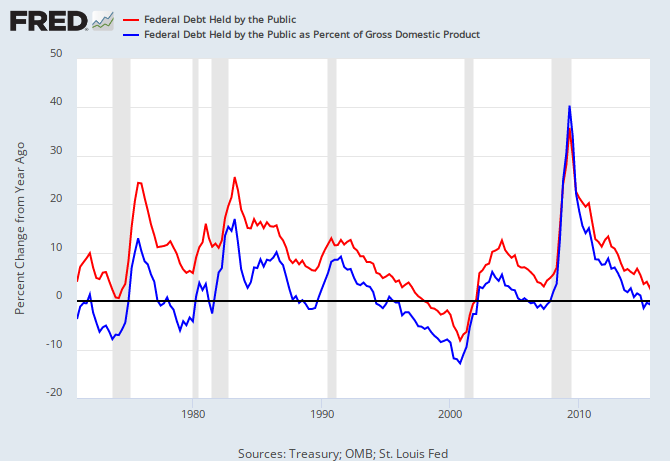
Reductions in federal debt growth lead to inflation
Recessions (vertical gray bars) result from reduced federal deficit spending (blue line), and are cured by increased federal deficit spending.

Other top economists, including a former chairman of the International Monetary Fund, offered similar warnings.

The Biden administration and Democrats in Congress did not listen, and now here we are.

Yes, “here” we are, without a depression, which we would have had were it not for the influx of cash from the federal government.

Putting more money directly in Americans’ pockets and bank accounts caused inflation to get worse than it otherwise would have been.

Wrong. There is no relationship between inflation and that old bugaboo, federal debt:
No historical relationship between inflation and federal debt.
Today’s inflation is the result of COVID-caused shortages of oil, food, computer chips, lumber, shipping, labor, and other commodities.

In fairness, the economists also point out that a less robust response to the pandemic may have caused a different kind of economic pain.

“Without these spending measures,” they write, “the economy might have tipped into outright deflation and slower economic growth, the consequences of which would have been harder to manage.”

Exactly right. We most likely would have slid right into a depression, had we followed the advice of Eric Boehm, the CRFB, Larry Summers, and other deficit nags.

1804-1812: U. S. Federal Debt reduced 48%. Depression began 1807. 1817-1821: U. S. Federal Debt reduced 29%. Depression began 1819. 1823-1836: U. S. Federal Debt reduced 99%. Depression began 1837. 1852-1857: U. S. Federal Debt reduced 59%. Depression began 1857. 1867-1873: U. S. Federal Debt reduced 27%. Depression began 1873. 1880-1893: U. S. Federal Debt reduced 57%. Depression began 1893. 1920-1930: U. S. Federal Debt reduced 36%. Depression began 1929. 1997-2001: U. S. Federal Debt reduced 15%. Recession began 2001.

And finally, Mr. Boehm straddles the fence, which will allow him at some future time to claim credit for his correct prediction, while avoiding the embarrassment of his wrong prediction.

Putting more money directly in Americans’ pockets and bank accounts caused inflation to get worse than it otherwise would have been.

Wrong, again. Increased money supply does not cause inflation, as we have shown. Now comes the other side of the fence

Any serious attempt to grapple with America’s current bout of inflation must be aware of that possible alternate reality—the grass is not necessarily greener on the other side.

And then back again to the first side of the fence.

But that doesn’t absolve the federal government—from the White House to Congress to the Federal Reserve—of its role in worsening this mess.

The whole world is suffering through a period of high inflation, but American policy makers added a uniquely high amount of fuel to the fire.

So, to summarize Mr. Boehm’s firm position: The federal government both should and should not have pumped money into the economy to fight off a possible COVID recession. And that’s definite. SUMMARY
  1. Current increases in prices (aka “inflations”) are caused by shortages of key goods and services, most often energy and food.
  2. The shortages all are  COVID-related.
  3. Today’s inflation involves many such shortages including oil, food, computer chips, lumber, shipping, labor, and other commodities.
  4. Historically, there has been no relationship between federal deficit spending and inflation.
  5. Deficit spending can cure inflation if it cures shortages by obtaining and distributing scarce commodities.
  6. The lack of federal deficit spending results in recessions and depressions.
Rodger Malcolm Mitchell Monetary Sovereignty Twitter: @rodgermitchell Search #monetarysovereignty Facebook: Rodger Malcolm Mitchell

……………………………………………………………………..

THE SOLE PURPOSE OF GOVERNMENT IS TO IMPROVE AND PROTECT THE LIVES OF THE PEOPLE.

The most important problems in economics involve:
  1. Monetary Sovereignty describes money creation and destruction.
  2. Gap Psychology describes the common desire to distance oneself from those “below” in any socio-economic ranking, and to come nearer those “above.” The socio-economic distance is referred to as “The Gap.”
Wide Gaps negatively affect poverty, health and longevity, education, housing, law and crime, war, leadership, ownership, bigotry, supply and demand, taxation, GDP, international relations, scientific advancement, the environment, human motivation and well-being, and virtually every other issue in economics. Implementation of Monetary Sovereignty and The Ten Steps To Prosperity can grow the economy and narrow the Gaps: Ten Steps To Prosperity:
  1. Eliminate FICA
  2. Federally funded Medicare — parts A, B & D, plus long-term care — for everyone
  3. Social Security for all
  4. Free education (including post-grad) for everyone
  5. Salary for attending school
  6. Eliminate federal taxes on business
  7. Increase the standard income tax deduction, annually. 
  8. Tax the very rich (the “.1%”) more, with higher progressive tax rates on all forms of income.
  9. Federal ownership of all banks
  10. Increase federal spending on the myriad initiatives that benefit America’s 99.9% 
The Ten Steps will grow the economy and narrow the income/wealth/power Gap between the rich and the rest.

MONETARY SOVEREIGNTY

Just when things are looking brighter, dim bulb Larry Summers gets screwed in.

So far as I can tell, too many media writers, politicians, and even economists do not understand the functional implications between Monetary Sovereignty and monetary non-sovereignty. Yet that ignorance does not stop them from pontificating about economics.

It is as though none of them understood the difference between a noun and a verb, yet insisted on pontificating about linguistics.

Image result for larry summers
Example of the Peter Principle

Larry Summers is a perfect example.

We’ve written about him before. “OMG! Please Mr. Biden, please: Not Larry Summers”, and “My humble apologies to Larry Summers. Or not”.

His writings truly are not fit for birdcage lining.

And yet, we continue to be punished by them as revealed in Ryan Cooper’s excellent article:

Senate Democrats whisked through a budget resolution Friday morning, clearing the way for the $1.9 trillion coronavirus relief package proposed by President Biden. 

Despite some lamentable amendments, retreats, and odd details that will have to be ironed out, overall Biden’s proposal is an excellent and badly-needed bill.

It might just keep America ticking over until everyone can be vaccinated (currently about 10 percent of Americans have gotten at least one shot).

Exactly correct, Mr. Cooper, although the package should be much larger and destined for a longer term, similar to the Ten Steps to Prosperity (below).

So right on cue, in step the savvy journalists at Politico and economist Larry Summers, playing some obnoxious D.C. insider games and doing their best to ruin the country.

Late on Thursday, Summers published a ponderous op-ed in The Washington Post fretting that maybe the COVID relief package is too big.

It might contain so much spending that it will push the economy above its potential full capacity, causing inflation and financial instability, he worried.

Then the jokers at Politico’s Playbook newsletter (your best source for ill-disguised advertorials and tips on hiding political bribes) repeated his argument.

Many “liberal wonks have been whispering about” Summers’ argument “for weeks,” worrying the package “could harm the economy next year, when Democrats will be defending narrow congressional majorities in the midterms,” they write. Politico claimed on Twitter that it was being circulated in the White House as well.

First, a bit of background. Inflations never are caused by federal spending in of itself. Inflations are caused by shortages of goods and services, primarily shortages of food and/or energy. Scarcity makes prices go up.

So the only time federal spending could cause inflation (i.e. a general increase in prices) is if at least one of two things happens:

  1. The government buys so much stuff, that shortages are caused or
  2. The government gives people so much money that they go on a buying tear, and cause shortages.

We already know #1 is not part of a package that essentially is comprised of money flowing to people’s pockets. And as the author of the article shows, #2 isn’t going to happen, either:

Let me first talk about the merits of the argument, because they shed light on the motivations here. In brief, these worries about “overshooting” the stimulus are completely ridiculous.

Jobs data released Friday show the economy is basically stalled out — with unemployment at 6.3 percent, and the fraction of prime-age workers who are employed four points below where it was before the pandemic (just barely above the bottom of the Great Recession), the U.S. is something like 10 million jobs in the hole.

Moreover, as economist Paul Krugman points out, the pandemic relief package is mostly not stimulus per se — it is more aimed at keeping the economy on ice until everyone can be vaccinated.

The boost to unemployment insurance and aid to state and local governments, for instance, will partly go unspent if we hit full employment rapidly.

Indeed, we may need another round of real stimulus once the vaccines are out.

And even if we were somehow to hit full capacity and inflation starts to spike, the Federal Reserve can easily raise interest rates to compensate — a fact Summers bizarrely skates over by limply suggesting they might not for some reason.

Right on. Summers, as usual, doesn’t know what he is writing about.

He still is in the camp that claims the Weimar and Zimbabwe hyperinflations were caused by government money-printing. They weren’t.

They were caused by shortages, with the currency-printing being a wrong-headed, government response.

While Zimbabwe never figured this out, Germany did. It cured its hyper-inflation with more spending, not less — spending to build the greatest war machine the world ever had known, which included purchases and distribution, not only of munitions but of food, energy, and salaries to a starving populace.

However, this argument about exceeding potential deserves close scrutiny. Summers bases his case on the recent Congressional Budget Office (CBO) estimate of economic capacity — that is, how much America can produce without causing spiraling inflation.

The only problem with the CBO estimate is that, as J.W. Mason and Mike Konczal argue in detail at the Roosevelt Institute, it is worthless garbage. For one thing, it is impossible to know for sure where full capacity might be when it is far off.

It is much wiser to simply stimulate until we see full capacity.

For another, the CBO estimate of what full employment looks like is based on the labor market in 2005, adjusted for demographic changes. There is no justification whatsoever for using this year, instead of 2000 or 1967 or 1944 or any other year.

Indeed, for the vast economic resources of the United States, only a war of far greater magnitude even than WWII, could cause general shortages leading to general price increases — OR — an oil shortage.

That latter event is not unthinkable, at some future date, but it is not in the foreseeable future, and definitely would have nothing to do with this year’s stimulus spending.

Barring an oil shortage, it is absolutely, positively impossible for the whole, or even a significant part of the American economy to hit full capacity. It cannot happen in the near future, and with advances in alternative energy production, it will not happen in the far future.

It would require that all the factories (or even most of them) run at full capacity, and none able to add capacity.

And this impossible scenario is what Summers says is supposed to keep us from curing the current recession?? Yikes!

Indeed, at a 2013 IMF conference, one famous economist argued convincingly that the mid-2000s was definitely not a full-employment period, despite the huge housing bubble juicing up spending:

If you go back and you study the economy prior to the [2008 financial] crisis, there’s something a little bit odd. Many people believe that monetary policy was too easy. Everybody agrees that there was a vast amount of imprudent lending going on.

Almost everybody believes that wealth as it was experienced by households was in excess of its reality … was there a great boom? Capacity utilization wasn’t under any great pressure. Unemployment wasn’t under any remarkably low level.

Inflation was entirely quiescent. So somehow, even a great bubble wasn’t enough to produce any excess in aggregate demand. [IMF]

That economist was named Larry Summers.

Not only does Summers not know what he is talking about. He doesn’t even know what he has talked about.

In any event, it functionally is not possible for the monster economy of America to have “excess” (i.e. unfulfillable) aggregate demand, at least not for a period extended enough to cause inflation.

Our remarkable ability to “catch up” with needed production, is beyond the imagination of the deficit hand-wringers.

Overall excess demand is classic textbook theory that never happens in real life, barring a giant meteor fall or a pandemic.

Oops, I guess even a pandemic won’t do it, either.

This weak argument and jarring inconsistency shows this discussion has little to do with economics. This is about political jockeying for influence, and the warped culture of D.C. journalism.

Summers has been frozen out of a job in the Biden administration, and so he is characteristically trying to elbow into the conversation by writing articles about how everyone but him is wrong.

In keeping with his prior history as a neoliberal ideologue — Summers was previously best known for bullying a deputy into lowballing the size of Obama’s Recovery Act, and preventing the regulation of dangerous financial derivatives — he’s worrying about inflation at the worst possible time.

Larry Summers is the classic example of the Peter Principle — the guy who gets promoted beyond his abilities, to wit:

Summers resigned as Harvard’s president after a no-confidence vote by the faculty, a financial conflict of interest, and his claim that there are so few women in science and engineering because there aren’t enough smart women.

Summers pressured the Korean government to raise its interest rates and balance its budget in the midst of a recession (!)

He advocated regime change in Indonesia

He opposed tax cuts that were proposed by the Republicans.

He told Governor Gray Davis to relax California’s environmental standards to help California’s economy and lift the stock market.

Summers favored eliminating the Glass-Steagall Act which prevented banks from offering commercial banking, insurance, and investment services. This led to the Great Recession of 2008.

In short, Larry Summers is to economics as Donald Trump is to the Presidency, an incompetent who has but one skill: Being appointed to high office.

Then the Playbook goofballs, who cover life-and-death political questions as amusing palace intrigue, then gleefully stoke the flames by credulously covering his argument — and apparently exaggerating his influence among “liberal wonks,” who dismissed his argument out of hand, and among the Biden team.

At any rate, the stakes for real life here are not small. The single worst thing Biden could do for his party’s prospects in the 2022 midterm elections would be to undershoot the recovery.

But with any luck, this will simply be an annoying footnote to history, and perhaps a lesson not to read Playbook even for insider tips.

The real lesson is not to assign any credibility to anything Larry Summers says or writes, and not to assign any credibility to the people who follow his advice.

As soon as the relief package hits the economy, let us begin with the Ten Steps, #1. Eliminate FICA. That surely will make Larry Summers faint.

Rodger Malcolm Mitchell

Monetary Sovereignty Twitter: @rodgermitchell Search #monetarysovereignty Facebook: Rodger Malcolm Mitchell …………………………………………………………………………………………………………………………………………………………………………………………………………………………………………………………………………………………..

THE SOLE PURPOSE OF GOVERNMENT IS TO IMPROVE AND PROTECT THE LIVES OF THE PEOPLE.

The most important problems in economics involve:

  1. Monetary Sovereignty describes money creation and destruction.
  2. Gap Psychology describes the common desire to distance oneself from those “below” in any socio-economic ranking, and to come nearer those “above.” The socio-economic distance is referred to as “The Gap.”

Wide Gaps negatively affect poverty, health and longevity, education, housing, law and crime, war, leadership, ownership, bigotry, supply and demand, taxation, GDP, international relations, scientific advancement, the environment, human motivation and well-being, and virtually every other issue in economics. Implementation of Monetary Sovereignty and The Ten Steps To Prosperity can grow the economy and narrow the Gaps:

Ten Steps To Prosperity:

  1. Eliminate FICA
  2. Federally funded Medicare — parts A, B & D, plus long-term care — for everyone
  3. Social Security for all or a reverse income tax
  4. Free education (including post-grad) for everyone
  5. Salary for attending school
  6. Eliminate federal taxes on business
  7. Increase the standard income tax deduction, annually. 
  8. Tax the very rich (the “.1%”) more, with higher progressive tax rates on all forms of income.
  9. Federal ownership of all banks
  10. Increase federal spending on the myriad initiatives that benefit America’s 99.9% 

The Ten Steps will grow the economy and narrow the income/wealth/power Gap between the rich and the rest.

MONETARY SOVEREIGNTY

Do you believe economics’ latest BS explanation — “secular stagnation”?

Twitter: @rodgermitchell; Search #monetarysovereignty
Facebook: Rodger Malcolm Mitchell

============================================================================================================================================================================================================================================================

Because economics is a social “science,” it contains more bulls**t than a rodeo chute.

The latest example is called “secular stagnation,” and wouldn’t you know it, right in the middle is the amazing Larry Summers, about whom you can read by clicking the link.

Never heard of “secular stagnation”? Here is a description by Jacob Davidson, a news editor at Time Magazine:

As a diagnosis, secular stagnation is simple: It’s the idea that the economic problems the U.S. continues to face aren’t a product of the “business cycle,” the ebb and flow of boom times and recession (hence the “secular” part), but may well be permanent drags on the modern economy.

“It’s a kind of long term and sustained slow-down in economic growth,” says Larry Summers, who served as Bill Clinton’s treasury secretary and is widely credited with dusting off the concept of secular stagnation and bringing it into the mainstream.

Yes, secular stagnation is simple: Slow growth.

But why say, “slow growth,” when you can give it the name, “secular stagnation,” and sound like you know what you’re talking about?

The phrase was originally coined in a 1938 address by economist Alvin Hansen to the American Economic Association.

Grappling with the sluggish recovery that followed the Great Depression, Hansen predicted that slower population growth and a lower speed of technological progress would combine to thwart full employment, wage increases, and general economic expansion.

In both cases, Hansen’s reasoning was the same: without new people entering the work force and new inventions coming onto the market, there would be less investment in new goods, employees and services.

Without investment, fewer businesses would open or expand, growth would slow, and more workers would be unable to find jobs.

And why is that appropriate to today’s situation? Do we have slow population growth? No, especially if we don’t deport 11 million immigrants, who constitute 11 million consumers of goods and services.

Do we have lower speed of technological progress? Are you kidding? Technology has exploded in the last two decades.

The article continues:

Hansen painted an eerily familiar picture: “This is the essence of secular stagnation,” he explained, “sick recoveries which die in their infancy and depressions which feed on themselves and leave a hard and seemingly immovable core of unemployment.”

He could have been describing 1938 or 2016.

The comparison between 1938 and 2016 is nuts, but suddenly, unexpectedly, it gets right to the heart of the matter:

World War II effectively solved at least one of Hansen’s concerns. The U.S. population exploded, thanks to a post-war baby boom.

Meanwhile, high government spending during the conflict boosted the economy, and new inventions jet airplanes, interstate highways, and eventually computers kept productivity and growth churning.

And there it is: “High government spending during the conflict boosted the economy.”

Could it be clearer or simpler? HIGH FEDERAL SPENDING —–> GROWING ECONOMY

Unfortunately, despite the obvious and undeniable experience of federal spending during WWII bringing us into prosperity, today’s economists, politicians and media writers either don’t get it or don’t want to admit it.

No, it wasn’t the bloodshed that stimulated the economy. It wasn’t the destruction of entire nations. It was:

HIGH FEDERAL SPENDING —–> GROWING ECONOMY

There were jobs because the federal government paid for jobs. It wasn’t even population growth. Millions of people left to serve overseas. It was, very simply: HIGH FEDERAL SPENDING —–> GROWING ECONOMY

And notice that the federal “debt” (i.e. deposits in T-security accounts) rose dramatically during WWII, and yet, miracle of miracles, the u>Monetarily Sovereign U.S. didn’t default, and in fact, never missed a single payment on any financial obligation.

We learned all that. It happened right there in front of us. Federal spending grew a previously moribund economy and federal “debt” was no problem whatsoever.

So how the heck could we, today, be talking about reducing the deficit, reducing the debt and still not understand what is happening to us?

One factor almost everyone agrees on is the lack of population growth that concerned Hansen has re-emerged as a problem.

Population growth means people need more stuff—especially capital-intensive things like housing that require especially large expenditures—and businesses invest in new workers and equipment to provide that stuff.

The reverse is also true: as U.S. population growth has fallen and the baby boom generation approaches retirement age, the number of new consumers and workers who can produce and buy things has dropped off.

“Slow or negative growth in the working-age population means low demand for new investments,” Nobel prize winner Paul Krugman explained in a 2014 article.

I’m not sure that “almost everyone agrees” or that low growth in “working-age” population is the problem. Aren’t older people consumers? Tell that to the medical and vacation industries. Aren’t children and teenagers consumers? Tell that to the clothing and entertainment industries.

But clearly a growing population does provide more consumers for economic growth.

And, as has become depressingly common, we again fail to learn from experience. Lying fearmongers stoke our xenophobia. We have made the immigration process more and more difficult, and the rabble rousers even wish to build a wall, embargo one whole religion and to deport 11 million consumers.

How then will we achieve population growth? Force everyone to take Viagra and ban all contraceptives?

Changing technological trends have also been blamed for discouraging investment. Summers notes that this has happened in two ways: first, the internet revolution has allowed companies like WhatsApp—which had just 55 employees when it was acquired for $19 billion by Facebook in 2014—to reach a higher market valuation than Sony.

Growing a multi-billion dollar company used to require hiring lots of workers, constructing offices and factories and so on. Nowadays, all you need is a loft and a couple of Macbooks.

Right. Humans have figured out how to grow an economy with so much human labor. All this proves is that lack of jobs is not a problem; lack of money is the problem.

Isn’t the whole idea of progress supposed to include our having to work less and to spend more of our lives doing what pleases us?

What if the 40-hour-week became the 20-hour-week, and the federal government paid for many things you now personally must afford: Healthcare, education, transportation, etc? Isn’t that where humanity should be heading?

Summers also identifies a related problem: the types of capital companies actually do need to invest in—computers and software—have gotten drastically cheaper. The result is that as businesses open or expand, they no longer need to spread their wealth around by purchasing costly machinery.

According to Summers, our economy was better off without labor saving devices for business. For him, business was much better with hundreds of people sitting in a huge production line, hand screwing widgets.

Berkeley professor Barry Eichengreen adds that all types of capital goods, not just computers, have fallen in price over time as manufacturing has gotten increasingly efficient.

“The one factor I’m most convinced by is the relative price of capital goods has being going down for 30 to 40 years,” the professor says. “Firms can do the same things spending less.”

Get it? Efficiency supposedly is a bad thing for economic growth.

Ah, witness the total departure of common sense from the “science of economics.

Beyond demographics and technological change, there are a myriad of other explanations for lack of investment. Growing inequality means those most likely to spend their money, the middle class and people with lower incomes, have seen their wages grow the least.

Thank you right wing politicians, who do everything possible to cut the incomes of the non-rich. Cut Social Security, cut Medicare, cut Medicaid, cut all poverty aids, cut aids to education: That how to stimulate the economy in the world of the right-wing.

That means less spending and less demand, which ultimately means less production and hiring.

Another proposed factor is high levels of consumer debt, which depresses spending as consumers divert money they would have used at the mall, say, toward paying their credit card interest.

When consumers pay credit card interest, where does that interest go? It goes to credit card companies, which employ people, and which use those interest payment to pay salaries.

If interest payment stay in the economy, they are not a drag on the economy. The only drag on the economy is dollars leaving the economy.

Harvard Professor Kenneth Rogoff agrees with some of the stagnation theory, such as lower population growth hurting output, but attributes most of the slowdown to a passing “debt supercycle” where post-recession economies are dragged down by high levels of debt that hold back growth until deleveraging is complete.

Not sure to what debt he refers — personal or federal. Federal debt is, as we have explained, beneficial to the economy.

Personal debt is the result of borrowing, which creates dollars. And, one man’s debt is another man’s assets. So, “high levels of debt” can be rephrased, “high levels of assets.”

Former Federal Reserve Chair Ben Bernanke chalks up slow post-recession growth to a global savings glut where investment is held back by various trade and economic policies, such as the decision by some countries to build large hoards of foreign currency reserves.

So there is too much debt and also too much savings? Could it get any sillier?

What makes secular stagnation so disconcerting for economists who do believe in the theory is that it defies traditional remedies for poor growth. In the past, if the economy had too little investment and growth stalled, the Federal Reserve could simply lower interest rates, which reduces returns on savings and makes borrowing and investing cheaper.

No, no, no, no, no. In the past, if the economy had too little investment and growth stalled, the federal government could simply increase deficit spending. Remember WWII.

But wait, is a light dawning?

One possible fix: instead of lowering interest rates, have the government fill in the investment gap with its own spending.

“I think there’s an overwhelming case for increased public investment, which I think is likely to raise economic growth,” Summers says.

He recommends a massive, 10-year infrastructure renewal program that would upgrade existing infrastructure like roads, bridges, and airports and build new capacity in areas like broadband, green technology and health care.

One downside to that plan is it’s unclear exactly when the economy would stop having to use government spending as a crutch for growth.

Summers is right (!) about federal spending.

Calling Federal deficit spending a “crutch” for economic growth is like saying “food is a crutch for a child’s growth.”

Federal deficit spending is absolutely necessary for economic growth. It’s a good and natural thing, not something to be avoided.

The good news is high government investment may improve at least some of the dismal economic fundamentals that power stagnation. For example, better infrastructure and more spending on education could increase productivity and stimulate growth.

Investments in green technology and health innovations could likewise produce new inventions and new industries.

Moreover, some of the factors dragging at the economy could actually power a government spending-based recovery. Low interest rates make borrowing money historically cheap, meaning the U.S. would be able to upgrade its infrastructure for relatively bargain prices.

If Summers’ plan works and growth rebounds, tax revenues would also increase, lowering America’s overall debt-to-GDP ratio.

We have made the transition from silliness to madness. Now, increasing tax revenues, which takes dollars out of the economy, supposedly is good for the economy.

And this is the state of economics, today, where lies beget illogic, and the poor public pays the price.

You now may shower and try to wash away the massive BS you have experienced. My apologies.

Rodger Malcolm Mitchell
Monetary Sovereignty


===================================================================================
Ten Steps to Prosperity:
1. Eliminate FICA (Click here)
2. Federally funded Medicare — parts A, B & D plus long term nursing care — for everyone (Click here)
3. Provide an Economic Bonus to every man, woman and child in America, and/or every state a per capita Economic Bonus. (Click here) Or institute a reverse income tax.
4. Free education (including post-grad) for everyone. Click here
5. Salary for attending school (Click here)
6. Eliminate corporate taxes (Click here)
7. Increase the standard income tax deduction annually Click here
8. Tax the very rich (.1%) more, with higher, progressive tax rates on all forms of income. (Click here)
9. Federal ownership of all banks (Click here and here)

10. Increase federal spending on the myriad initiatives that benefit America’s 99% (Click here)

The Ten Steps will grow the economy, and narrow the income/wealth/power Gap between the rich and you.
========================================================================================================================================================================================================================================================================================================

10 Steps to Economic Misery: (Click here:)
1. Maintain or increase the FICA tax..
2. Spread the myth Social Security, Medicare and the U.S. government are insolvent.
3. Cut federal employment in the military, post office, other federal agencies.
4. Broaden the income tax base so more lower income people will pay.
5. Cut financial assistance to the states.
6. Spread the myth federal taxes pay for federal spending.
7. Allow banks to trade for their own accounts; save them when their investments go sour.
8. Never prosecute any banker for criminal activity.
9. Nominate arch conservatives to the Supreme Court.
10. Reduce the federal deficit and debt

THE RECESSION CLOCK

Recessions begin an average of 2 years after the blue line first dips below zero. A common phenomenon is for the line briefly to dip below zero, then rise above zero, before falling dramatically below zero. There was a brief dip below zero in 2015, followed by another dip – the familiar pre-recession pattern.
Recessions are cured by a rising red line.

Monetary Sovereignty

Vertical gray bars mark recessions.

As the federal deficit growth lines drop, we approach recession, which will be cured only when the growth lines rise. Increasing federal deficit growth (aka “stimulus”) is necessary for long-term economic growth.

————————————————————————————————————————————————————————————————————————————————————————————————-

Mitchell’s laws:
•Those, who do not understand the differences between Monetary Sovereignty and monetary non-sovereignty, do not understand economics.
•Any monetarily NON-sovereign government — be it city, county, state or nation — that runs an ongoing trade deficit, eventually will run out of money.
•The more federal budgets are cut and taxes increased, the weaker an economy becomes..

•No nation can tax itself into prosperity, nor grow without money growth.
•Cutting federal deficits to grow the economy is like applying leeches to cure anemia.
•A growing economy requires a growing supply of money (GDP = Federal Spending + Non-federal Spending + Net Exports)
•Deficit spending grows the supply of money
•The limit to federal deficit spending is an inflation that cannot be cured with interest rate control.
•The limit to non-federal deficit spending is the ability to borrow.

Liberals think the purpose of government is to protect the poor and powerless from the rich and powerful. Conservatives think the purpose of government is to protect the rich and powerful from the poor and powerless.

•The single most important problem in economics is the Gap between rich and the rest..
•Austerity is the government’s method for widening
the Gap between rich and poor.
•Until the 99% understand the need for federal deficits, the upper 1% will rule.
•Everything in economics devolves to motive, and the motive is the Gap between the rich and the rest..

MONETARY SOVEREIGNTY