How really to stop inflation without doing damage to the economy.

The oft-revised Hippocratic oath for doctors contains variations on the phrase, “Do no harm.” If only the Fed, the President, Congress, most economists and economic writers understood and adhered to that admonision. Sadly the above-mentioned folks claim one very big and very wrong and very harmful thing. They claim Federal deficit spending causes inflation Inflation is not caused by federal deficits or any other type of money creation. Inflation always is caused by shortages of key goods and services. ALWAYS. Pick any inflation or hyperinflation in history and you will find that the cause was certain scarcities. Despite the photos of money in wheelbarrows, there never has been an inflation caused by money creation. In fact, the reverse is true: Inflation causes money creation by those who do not understand the problem. )See: Will the “Build Back Better” bill and “too much” federal debt cause inflation? An examination of myths. – #Monetary Sovereignty – Mitchell (mythfighter.com)
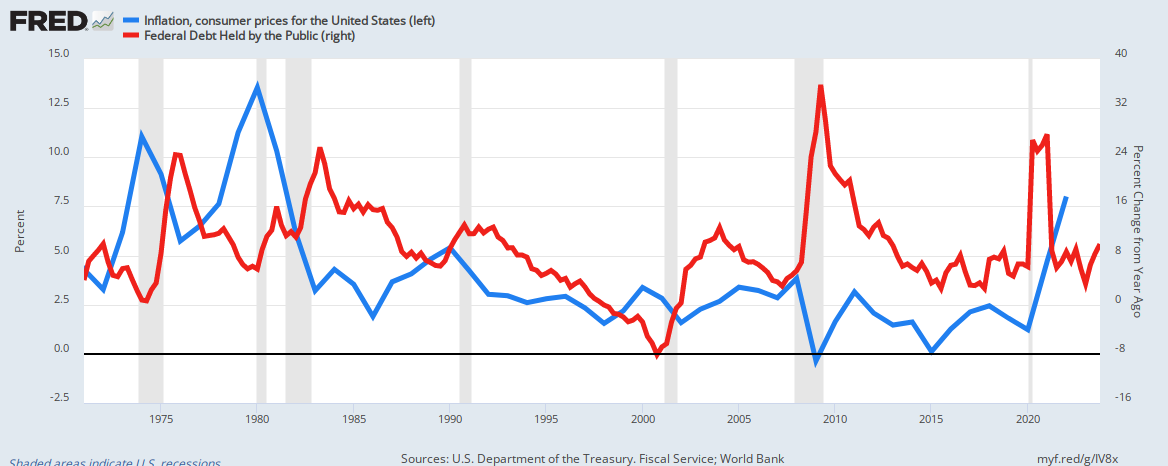
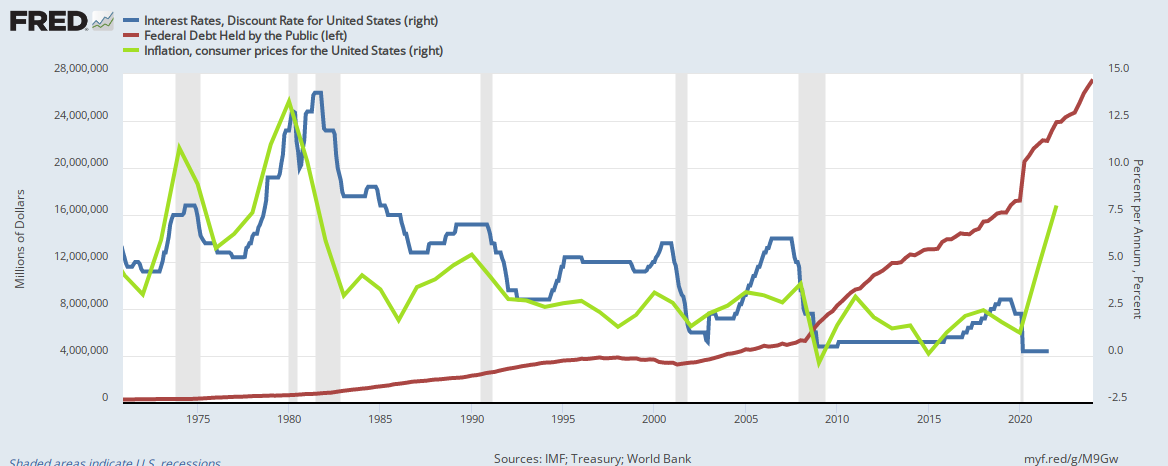
Interest rates (blue) and inflation (green) have trended down, while federal debt (red) has increased.
We have had massive federal deficit spending for more than a decade, and interest rates have been near zero. But, inflation remained low.
Now suddenly, we have inflation.
What is different, today? Think: What is different today from the past 10 years of low interest rates and high federal spending?
Today’s sudden inflation is not caused by deficit spending, which has been ongoing, not sudden, for decades, but rather by sudden shortages of oil, food, computer chips, shipping, lumber, labor, etc.
None of those shortages is related to federal deficit spending; most are related more closely to COVID.
We currently have a COVID inflation, not a deficit-spending inflation.
In reality, federal deficit spending can CURE inflation if the spending is directed toward obtaining and distributing the scarce goods.
To cure inflation, we must cure the shortages that caused the inflation.
The government could cure our inflation by spending to increase oil drilling (or better yet, spending to:
1. Increase the availability and use of renewable energy)
2. Aid more efficient and more productive farming,
3. Encourage more local computer chip manufacture
4. Develop a more efficient shipping and transportation systems
5. Facilitate more lumber-growing (and substitute-for-wood products)
6. Eliminating FICA and providing Medicare for All (allowing employers room to increase salaries, thus tempting workers back to work).
The primary power to cure inflation is in the hands of Congress and the President, not the Fed.
The Fed has some power, but it is small. Raising interest rates increases the value of the U.S. dollar, thus requiring fewer dollars to purchase the same amount of goods and services.
So when the Fed raises rates, this will help somewhat to reduce inflation. But if scarcities are not cured, inflation will continue to bedevil us.
Congress and the President, as usual, want to lay the responsibility anywhere but themselves. So, they ask the Fed to grow the economy and to control inflation, while the Congress and the President . . . well, what do they do about inflation? Not much, other than point fingers at the Fed.
Maybe they’ll continue to bicker like children about which party gets the credit for this and the blame for that. So while the Dems want to grow the economy, the GOP will vote against anything that grows the economy, lest the Dems get credit.
We are being led by a group of infantile liars. I would call them “useless,” except that doesn’t describe the damage they do.
Here is how the Fed plans to handle our scarcity-fueled inflation:
Inflation is still red hot, and it’s forcing the Federal Reserve into a new game plan Updated December 15, 2021 SCOTT HORSLEY The Federal Reserve is paving the way for possible interest rate hikesnext year, in an effort to contain stubbornly high inflation.
If oil, food, chip manufacture, shipping, and lumber-growing remain scarce, and FICA continues to chase people out of the labor poor, we will continue to have inflation, even if interest rates are raised to 10% or more.
At the conclusion of a two-day policy meeting Wednesday, the central bank announced plans to phase out its large-scale bond-buying program faster than initially planned. The Fed started purchasing bonds during the pandemic as a way to keep borrowing costs across the economy low and to prevent any market disruptions.
What the Fed bond-buying program actually does is to pump growth dollars into the economy. Unfortunately, turning off that money-creation pump will bring us closer to recession.
Reductions in federal debt growth lead to inflation
When federal debt growth (blue line) declines, we have recessions (vertical gray bars) which are cured by increases in federal debt growth.
Ending the bond purchases earlier would give the Fed more flexibility to raise interest rates sooner, if necessary, to keep prices from spiraling out of control. The central bank said previously it wanted to stop its bond purchases before considering raising interest rates.
Utter nonsense. The Fed doesn’t need more “flexibility.” It has the infinite ability to raise interest rates. It merely does so by fiat, and up the rates go. There is a zero relationship between bond purchases and the Fed’s ability to raise interest rates.
The Fed is taking a harder line against inflation after consumer prices in November jumped 6.8% from a year ago — the largest increase in nearly four decades.
The sudden jump in prices was not caused by the federal deficit spending, which will take place over as much as ten years. It was caused by COVID-related, OPEC-related, and regulation-related scarcities.
In a statement, the Fed acknowledged the rapid runup in prices. Although the central bank still believes inflation is largely driven by factors tied to the pandemic, which should ease when the health outlook improves, policymakers are no longer taking that as a given.
Yes, correct. Today’s inflation is not just largely driven, but totally driven, by pandemic factors.
Notably missing from Wednesday’s statement was the word “transitory,” which the Fed had used in the past to describe inflationary pressures. “The risk of higher inflation becoming entrenched has increased,” Fed chairman Jerome Powell told reporters. “It’s certainly increased. I don’t think it’s high at this moment but I think it’s increased. And I think that’s part of the reason behind our move today.”
He is clueless about the future for the same reason we all are clueless. He has no idea how much oil will be pumped, how much food will be grown (including weather considerations), or how many computer chips will be manufactured or needed. He has no way to know how and when the shipping situation will be fixed, and what we will do about the lumber shortage. Like all of us, he doesn’t know what the effect of the omicron variant of COVID will have, nor if there will be other variants and what their effect will be. He has no idea what effect global warming will have on shortages, and when. I would just as soon lay tarot cards on an ouija board as rely on economic predictions by the Fed chairman, or anyone else, including me. His problem is not just his inability to predict the future, but also his inability to judge cause and effect.
The Fed has kept interest rates near zero throughout the pandemic in an effort to prop up the economy.
And during all that time of low interest rates, we had massive federal deficits with low inflation. That alone should provide any thinking person with sufficient evidence to determine that deficits and debt do not cause inflation.
Twelve of the 18 members of the Fed’s rate-setting committee now say they expect interest rates to rise by three-quarters of a percent or more in 2022. That underscores the evolution in the Fed’s thinking. Three months ago, no one on the committee envisioned rates climbing by that much next year.
It’s not “evolution.” It’s ignorance. From just three months ago their thinking totally has reversed. Why would anyone trust their predictions?
The Fed has repeatedly been surprised this year by both the strength and staying power of inflationary forces. While average wages have been rising at a rapid pace, prices are climbing even faster.
Really? Given all their inside information, were they really surprised by the oil shortage? The computer chip shortage?
Committee members now say they expect inflation to be 2.6% at the end of next year, up from 2.2% that was projected in September.  Raising interest rates is the Fed’s traditional tool for keeping inflation under control, but it comes with its own price. Higher borrowing costs typically lead to slower economic growth, and the Fed has been reluctant to raise interest rates until it feels the U.S. had achieved “maximum employment.”
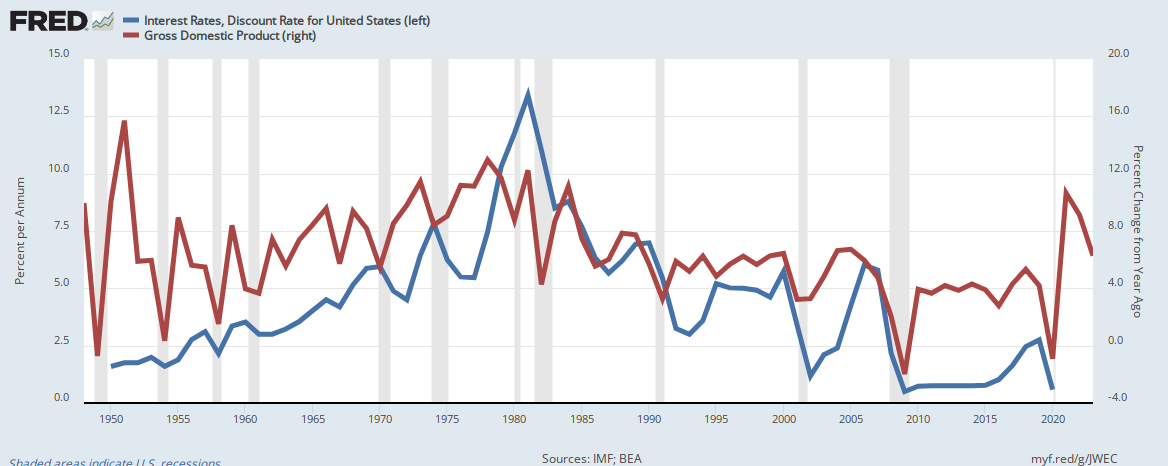
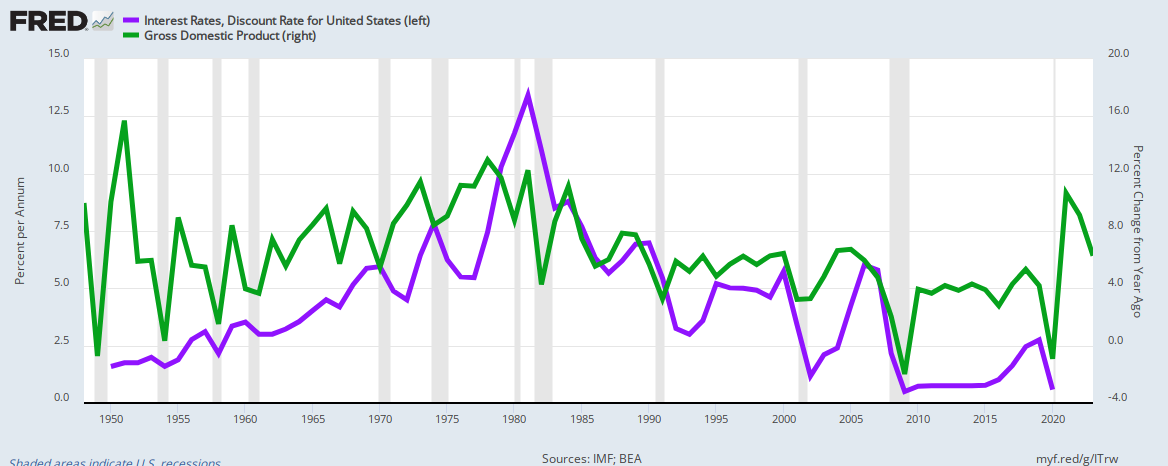
Do higher borrowing costs (blue) typically lead to slower growth. (red)? Not according to this map.
The popular wisdom is that low interest rates make borrowing easier, and so are stimulative, and high rates are stagnating or worse. But the above graph seems to show the popular wisdom to be incorrect, even opposite to the truth. While low rates make borrowing easier, they also mean that the federal government will pump fewer stimulus dollars into the economy (for interest on T-bills, T-notes, and T-bonds). If anything, there seems to be a correspondence between high interest rates and high GDP growth.
That’s the challenge facing Fed policymakers. “This was a different kind of recession that we’ve never really been through,” said Greene, who’s also chief economist at the Kroll Institute. “So the jury’s still out on what’s going to happen with the labor force.” Powell suggested that if inflation goes unchecked, that in itself could jeopardize a complete jobs recovery.
The inflation can be checked, but not by the Fed. Congress can check the inflation by:
  1. Using tax policy and spending policy to encourage the development and use of renewable energy.
  2. Using tax policy and spending policy to encourage the development of more and better food crops and other foods, that are able to feed more people, using less land, labor, and fertilizers, while renewing the soil.
  3. Using tax policy and spending policy to encourage the supply of lumber and other building-related materials.
  4. Using tax policy and spending policy to encourage the development of U.S. based computer chips and other computer-related hardware and software.
  5. Using tax policy and spending policy to improve both international and domestic shipping and mail. The postal service should be funded by the government and not be required to make a profit.
  6. Eliminating FICA so that employers are encouraged to raise salaries.
  7. Providing Medicare for All so that employers do not need to fund healthcare insurance, and again, are encouraged to raise salaries.
“What we need is another long expansion like the ones we’ve been having over the last 40 years,” Powell said. “And to have that happen, we need to make sure that we maintain price stability.” 
“Price stability,” i.e. low inflation, is beneficial, but it does not lead to “another long expansion. The primary factor leading to a long economic expansion is ongoing and increasing federal deficit spending. Rodger Malcolm Mitchell Monetary Sovereignty Twitter: @rodgermitchell Search #monetarysovereignty Facebook: Rodger Malcolm Mitchell

……………………………………………………………………..

THE SOLE PURPOSE OF GOVERNMENT IS TO IMPROVE AND PROTECT THE LIVES OF THE PEOPLE.

The most important problems in economics involve:
  1. Monetary Sovereignty describes money creation and destruction.
  2. Gap Psychology describes the common desire to distance oneself from those “below” in any socio-economic ranking, and to come nearer those “above.” The socio-economic distance is referred to as “The Gap.”
Wide Gaps negatively affect poverty, health and longevity, education, housing, law and crime, war, leadership, ownership, bigotry, supply and demand, taxation, GDP, international relations, scientific advancement, the environment, human motivation and well-being, and virtually every other issue in economics. Implementation of Monetary Sovereignty and The Ten Steps To Prosperity can grow the economy and narrow the Gaps: Ten Steps To Prosperity:
  1. Eliminate FICA
  2. Federally funded Medicare — parts A, B & D, plus long-term care — for everyone
  3. Social Security for all
  4. Free education (including post-grad) for everyone
  5. Salary for attending school
  6. Eliminate federal taxes on business
  7. Increase the standard income tax deduction, annually. 
  8. Tax the very rich (the “.1%”) more, with higher progressive tax rates on all forms of income.
  9. Federal ownership of all banks
  10. Increase federal spending on the myriad initiatives that benefit America’s 99.9% 
The Ten Steps will grow the economy and narrow the income/wealth/power Gap between the rich and the rest.

MONETARY SOVEREIGNTY

Reason Magazine is confused. Wrong about inflation but partly right about tariffs. And partly wrong.

Read how the right-wing “Libertarians” take opposite sides of the same issue. Here are excerpts from an online Reason (Libertarian) article:
By Refusing To End Trump’s Tariffs, Biden Is Making Inflation Worse Trump’s tariffs are adding an estimated 0.5 percent to annual inflation. ERIC BOEHM | Reason |12.10.2021 Tariffs do exactly one thing: raise prices.
No, tariffs do exactly two things: Yes, they raise prices, but they also take dollars from the economy.
Right now, prices don’t need any help getting higher. Economic data released Friday by the Bureau of Labor Statistics show that year-over-year inflation hit 6.8 percent in November—the highest level recorded since 1982. Despite other indicators showing that the economy is strong, persistently high inflation is a serious problem for American households. That includes the current resident of the White House, for whom inflation is becoming a major political headache. There’s probably not much President Joe Biden can do to curb inflation in the short term. That ship sailed when he pushed for and signed off on a major economic stimulus bill earlier this year—one that economists warned was too large and could overheat the economy.
The “too large” phrase might make you believe Mr. Boehm believes stimulus is good, just not so much. Don’t be misled. For Libertarians all federal spending is “too large.” Had the stimulus package been $5, Mr. Boehm would have complained it was “too large.” Why? Just because. Libertarians are anti-government everything, and would prefer that the economy sink into depression than see more federal spending.
Other factors influencing inflation, like the disconnect between supply and demand that’s largely a result of the ongoing COVID-19 pandemic, are well beyond Biden’s (or any president’s) power to change.
“The disconnect between supply and demand” are not “other factors influencing inflation” They are THE factors causing inflation, the only factors. All inflations are caused by shortages.  Today’s inflation is caused by shortages of oil, food, computer chips, lumber, shipping (and everything else that gets shipped), and labor. This stimulus package, like all previous stimulus packages, did not cause the oil shortage. It did not cause the food shortage. It did not cause the computer chip shortage. It did not cause the shipping shortage. It may temporarily have caused a labor shortage by giving people an alternative to low-pay, crap jobs. Unfortunately, the unemployment compensation safety net now has been pulled out from under workers, who the employers hope will be forced to accept those jobs.
But there is one thing Biden could do to immediately provide consumers with relief. He could eliminate the tariffs imposed by former President Donald Trump.
If Boehm is claiming that the tariffs were just another, stupid Trumpian attempt to punish China by punishing American consumers, he is correct. China doesn’t pay for American import taxes. Americans do. But what Boehm neglects to mention (or doesn’t realize) is that import tariffs take dollars from the American private sector (aka “the economy”) and give those dollars to the federal government, and that reduces the federal deficit and debt. And as anyone familiar with Libertarians knows, those folks absolutely hate the federal deficit and debt (despite the fact that whenever the deficit and debt are reduced we have recessions and depressions). So in the backward logic of Libertarians, deficit-reducing tariffs should be a good thing.
Those tariffs, which Biden has been stubbornly unwilling to reverse during his first year in office, are adding roughly 0.5 percent to annual inflation across the economy.  Trump’s tariffs on washing machines, solar panels, steel, aluminum, and a host of Chinese-made goods are a “secondary but noticeable contribution” to overall inflation right now. That’s pretty much in line with what four economists at the San Francisco Federal Reserve warned in February 2019, shortly after Trump began slapping tariffs on various goods. “Imports from China are an important part of overall U.S. imports of consumer and investment goods,” they wrote. “Thus, tariffs on these imports are likely to have sizable effects on consumer, producer, and investment prices in this country.”
But wait. Remember Boehm’s “supply and demand” comment at the start of the article. He claimed, in effect, that increased demand is half the problem. But tariffs reduce demand. That’s the underlying purpose of tariffs. So in Boehm’s world, reducing demand via tariffs should mitigate inflation! And as we have said, tariffs are taxes. Deficits and debt are the difference between taxes and spending. Libertarians supposedly hate deficits and debt. Tariffs, i.e. taxes, reduce deficits and debt.
Unlike other policies that could help slow inflation, like raising interest rates, Biden could cut tariffs without having to wait for Congress or the Federal Reserve to act.
He’s right, but cutting tariffs also would increase the federal debt, which Boehm doesn’t want.
Similarly, cutting tariffs would not come with some of the negative tradeoffs that other actions might. Raising interest rates will harm the economy in other ways (for example, by making it more expensive to borrow).
Boehm is correct that Trump’s tariffs were, as usual, stupid. But he is dead wrong about raising interest rates. While raising interest rates makes borrowing more expensive, private borrowing adds stimulus dollars to the economy. Banks lend by creating dollars. Even more importantly, higher interest rates force the federal government to pump more interest dollars into the economy, which helps grow the economy. To quote from an article we published in 2018, “Interest rates going up. Should you be concerned?”

Rising Rates Could Further Balloon Interest Spending, Mar 21, 2018

The Federal Open Market Committee (decided) to raise the federal funds rate by 0.25 percentage points to 1.5-1.75 percent.

The federal government (is projected) to spend $6.8 trillion on interest costs over the next decade. If interest rates end up just 1 percentage point higher than projected, interest costs would increase by a further $2 trillion. If interest rates return to their pre-recession levels, costs could rise by $3.4 trillion.

Let us rephrase as follows:

The federal government (is projected) to pump $6.8 trillion interest dollars into the economy over the next decade.

Should a $6.8 trillion stimulus — which is similar in effect to a $6.8 trillion tax cut — be a cause for concern?

Contrary to popular myth, raising interest rates does not “harm the economy” as Boehm and many other economists claim. In fact, raising interest rates stimulates the economy by forcing the federal government to pump more dollars into the private sector.
Blue line is interest rates. Red line is Gross Domestic Product growth.
Higher interest rates are associated with higher GDP growth, because higher interest rates cause more money growth. The illusion that high interest rates “harm the economy” is caused by the stock markets, which decline in anticipation of raised rates. But anticipation is based on belief, not on fact. Adding dollars to the economy, which is what higher interest rates accomplish, stimulates economic growth.
Lifting tariffs will ease inflation and provide a tax cut to many American businesses. 
Correct. Tump’s tariffs should be lifted, just not for the reasons Boehm claims.
Again: The one and only thing that tariffs do is raise prices. That is their only function.
Again, their other function is to take dollars from the economy, give them to the federal government (which has no use for them), and reduce deficits and debt (both of which are necessary for economic growth).
Politicians might want to deploy tariffs (to raise prices) for a number of reasons: to protect domestic industries, to influence where in the world individuals choose to invest, to retaliate against what they perceive as unfair trade practices from other countries, and so on.
Tarrifs are nothing more than a spite-one’s-face-by-cutting-one’s-nose exercise. All of the above goals can be accomplished via federal tax cuts and federal spending.
If Biden is going to keep ignoring this basic bit of economic reality, then he is choosing to make inflation worse than it already is.
The basic bit of American economic reality is this:
  1. Inflation is caused by scarcity, not by federal spending. Not by “too much money,” but rather by too few goods.
  2. Cutting tariffs does not increase supply, so it does not reduce inflation.
  3. Inflation can be cured by federal spending to obtain and distribute the scarce goods.
  4. Federal deficit spending is economically stimulative, i.e cutting taxes and spending both grow the economy
  5. Interest rate increases are stimulative
  6. Tariffs are not a good solution for any economic problem
While Mr. Boehm is correct about the need to cut tariffs, he is wrong about the way to cure inflation. That cure requires increased federal deficit spending to acquire and distribute the scarce products while decreasing taxes. A great place to begin would be to eliminate the FICA tax, which has zero positive effects, but increases business costs and drags down the economy. Rodger Malcolm Mitchell Monetary Sovereignty Twitter: @rodgermitchell Search #monetarysovereignty Facebook: Rodger Malcolm Mitchell

……………………………………………………………………..

THE SOLE PURPOSE OF GOVERNMENT IS TO IMPROVE AND PROTECT THE LIVES OF THE PEOPLE.

The most important problems in economics involve:
  1. Monetary Sovereignty describes money creation and destruction.
  2. Gap Psychology describes the common desire to distance oneself from those “below” in any socio-economic ranking, and to come nearer those “above.” The socio-economic distance is referred to as “The Gap.”
Wide Gaps negatively affect poverty, health and longevity, education, housing, law and crime, war, leadership, ownership, bigotry, supply and demand, taxation, GDP, international relations, scientific advancement, the environment, human motivation and well-being, and virtually every other issue in economics. Implementation of Monetary Sovereignty and The Ten Steps To Prosperity can grow the economy and narrow the Gaps: Ten Steps To Prosperity:
  1. Eliminate FICA
  2. Federally funded Medicare — parts A, B & D, plus long-term care — for everyone
  3. Social Security for all
  4. Free education (including post-grad) for everyone
  5. Salary for attending school
  6. Eliminate federal taxes on business
  7. Increase the standard income tax deduction, annually. 
  8. Tax the very rich (the “.1%”) more, with higher progressive tax rates on all forms of income.
  9. Federal ownership of all banks
  10. Increase federal spending on the myriad initiatives that benefit America’s 99.9% 
The Ten Steps will grow the economy and narrow the income/wealth/power Gap between the rich and the rest.

MONETARY SOVEREIGNTY

When there is an unwanted effect, the solution is to kill the cause.

When you are faced with an unwanted effect, the solution is to find and then solve the cause. If you don’t understand the cause, you will be faced with the same effect again and again. Washington Post headline:
Inflation emerges as defining economic challenge of Biden presidency, with no obvious solution at hand America is emerging from the pandemic facing its biggest inflationary spike in decades, as startling and persistent price hikes threaten to undermine the recovery, while posing an entirely new kind of economic challenge to the Biden presidency. Policymakers are facing the devilish and unfamiliar quandary of booming consumer demand and dramatic supply disruptions combining to push higher the cost of necessities such as food, gas and housing.
I’m not sure why this is such a mystery. All inflations are caused by the same thing: Shortages of key goods and services. The cure for any inflation is to increase the availability of the scarce goods and services. So when the Washington Post says, “no obvious solution at hand,” they may be talking about no obvious political solution.
This inflationary burst has no single cause and no obvious solution.
The cause is a shortage of key goods and services. The cause is not federal deficit spending.
This graph shows there is no historical relationship between federal deficit spending (red) and inflation (blue). The graph also shows that reductions in deficit growth lead to recessions (vertical bars) which are cured by increases in deficit growth.
The economic solution is quite plain: Federal deficit spending to increase the supply of energy, food, computer chips, supply-chain methods, and labor.
Trillions of dollars in federal aid approved by Congress in response to the pandemic have led American consumers and companies to purchase more goods than ever before, putting new strains on global supply chains to accommodate the soaring volume. But that higher demand has collided with shortages in workers, supplies and transportation capacity — challenges caused in part by the pandemic as well as long-standing structural deficiencies in the national economy.
It is those shortages, not federal deficits, that have caused inflation. Cure the shortages and you cure the inflation.
A record 4.4 million Americans quit their jobs in September as labor market tumult continued.
The labor shortage exists partly because people quit their jobs for a variety of reasons including:
  1. Need for child home care
  2. Low wages
  3. FICA cost
  4. Bad hours.
  5. Virus fear
There are others, but these all could be solved by federal deficit spending — a kind of “Manhattan Project” to cure the shortages that cause inflation.
  1. Federal pay for child home care
  2. Higher minimum wage together with the elimination of business taxes, to help fund the higher wages
  3. Elimination of FICA and reduction of income taxes at the low pay scales
  4. Standard 4-day week and/or shorter workday
  5. Federal support for vaccination rewards in selected industries.
The federal government also should reduce the need for human labor by funding more development of Artificial Intelligence (AI) and mechanization along with other labor-saving initiatives.
This inflationary burst has no single cause and no obvious solution.
The single cause is shortages. The obvious solution is to cure the shortages.
Trillions of dollars in federal aid approved by Congress in response to the pandemic have led American consumers and companies to purchase more goods than ever before, putting new strains on global supply chains to accommodate the soaring volume. But that higher demand has collided with shortages in workers, supplies and transportation capacity — challenges caused in part by the pandemic as well as long-standing structural deficiencies in the national economy.
In the Eisenhower years, the federal government spent billions to improve highway traffic. Today, not only do highways need to be improved, but all other elements of the supply chain need similarly to be improved. Our railroads are a mess. Our ports are inadequate. The quasi-privatized postal service is struggling. Shipping itself should be funded. These all are critical national needs, surely as important as weapons development.
Gas prices are at a seven-year high amid a global energy crisis, exacerbated by unusually high demand in Europe and a coal shortage in China.
Solutions: Temporarily fund increased oil drilling while funding more research and development of renewable, non-carbon fuels.
Food prices are rising at the highest level in 12 years amid severe droughts and spiking demand from families and restaurant reopenings. Meat, fish and egg prices are up nearly 12 percent from a year ago — the highest increase since 1979 (other than the early days of the pandemic) — partly fueled by processing plants’ struggle to find workers.
While other industries have mechanized, food processing remains in the electronic dark ages. Federal funding of computerization would help, significantly, as would federal financial support for raising wages. Droughts are being caused by climate change, which has been denied by the right wing and largely ignored by the left. Federal support for non-carbon energy sources would help solve the problem.
The longer inflation lasts, the greater the political problem for the White House and congressional Democrats. Already news of the October inflation spike spurred new head winds for President Biden’s signature and key legislative initiative — the roughly $2 trillion Build Back Better package — exacerbating fears that other moderate Democrats may echo the concerns raised by Sen. Joe Manchin III (D-W.Va.) this past week about more spending.
Two people in California rescued by Coast Guard after boat bursts into flames | Daily Mail Online
Congress won’t use their infinite supply of water to put out our economic fire.
Meanwhile, Republicans have sharpened their attacks over inflation, seeing it as among their best arguments against the Biden’s presidency.
In other words, our boat is burning, but the politicians won’t put out the fire because they don’t want to use water.
Yet many economists say that the inflationary pressures hitting the U.S. economy were necessary to avoid the far worse scenario of a prolonged downturn and that focusing on rising prices risks obscuring the healthy facets of the current rebound such as the rapid rebound in jobs. Most families have more financial resources than they did before covid, especially among the bottom third. Even when accounting for inflation, disposable income has been roughly 9.5 percent higher in 2021 than it was before the coronavirus pandemic hit in 2019, according to Julia Coronado, president and founder of MacroPolicy Perspectives. “It’s safe to say the bottom 40 percent of Americans are definitely better off in the past year from a combination of rising wages and government aid, even with inflation,” said Arindrajit Dube, economics professor at the University of Massachusetts Amherst.
The Democrats are laughably (or “cryably”) bad at telling their story. Somehow, they expect the public to see “the obvious,” but history shows that the public would rather believe the words of a personality than the facts.
The U.S. economy is growing at a very fast clip, especially compared with the rest of the world, and could recover the lost economic output from the pandemic by the end of next year, according to some projections. Workers at the bottom of the income distribution are seeing meaningful wage increases, even factoring in inflation. Job openings are plentiful. The stock market has continued its meteoric rise under Biden, with the S&P 500 jumping by more than 20 percent since he took office. Inflation is up globally, not just in the United States, and the supply chain dysfunction reflects a decades-long trend of companies scattering their production sources across the globe.
All of the above is true, but who is telling the story? Certainly not Biden. And not the Vice President, whatever her name is and wherever she is hiding. The old saw is, “If you’re defending you’re losing”, and the Dems aren’t even defending.
The approximately 50 percent rise in gasoline prices from last year — and 6 percent jump in October alone — has proved one of the most visible burdens on American families, spurred by a mixture of factors from Chinese manufacturing and an acute energy crisis in Europe.
To the average American voter, gas prices = inflation. The federal government has the financial ability to lower gas prices, although it may not have the political ability, unless someone in the government figures out how to tell the story. Sadly, a personality like Donald Trump could do it, and he would do it, if it benefited him.
Supply chain backlogs also show little sign of easing before early 2023, said Phil Levy, chief economist at freight company Flexport. While shipping rates from Shanghai to Los Angeles came down modestly from their September peaks and auto companies report slightly easier access to semiconductors now, a record 81 container ships were sitting off the southern California coast on Tuesday, according to the Marine Exchange.
A “Manhattan Project” for America’s supply chain could fix the problem.
Rent prices also jumped 0.4 percent from September to October, continuing an upward trend, while the sales price of a single-family home jumped by 16 percent over one year, according to the National Association of Realtors. A red-hot housing market has been spurred on in part by low interest rates and shortages in supply caused by a freeze in construction during the pandemic.
Annual interest rates (purple) vs. annual growth of Gross Domestic Product. Rate reductions do not stimulate GDP growth.
Shortages in supply always cause price increases. However, as with so many myths in economics, the myth that low interest rates are stimulative has no basis. In fact, there is evidence, as you can see from the above graph, that high interest rates are stimulative. The reason: High rates cause the federal government to pour more interest dollars into the economy.
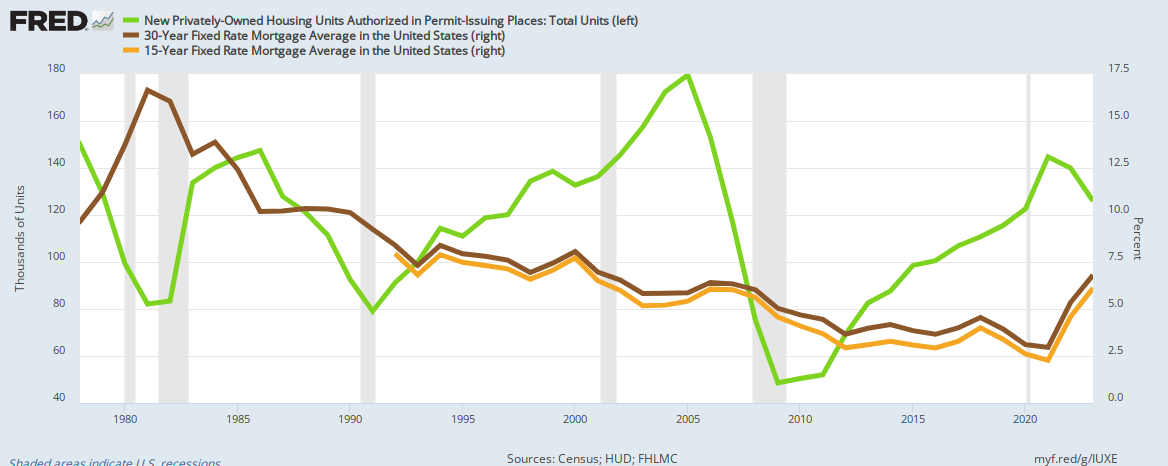
New housing construction (green) does not correlate with reductions in 30-year (brown) or 15-year (gold) mortgage rates.
New housing construction does not correlate with reduced mortgage rates. Both 30-year and 15-year mortgage rates have drifted downward since 1982, yet new housing construction (green) has changed wildly. One reason for the lack of correlation may be that interest rates are not the deciding factor for home buyers.
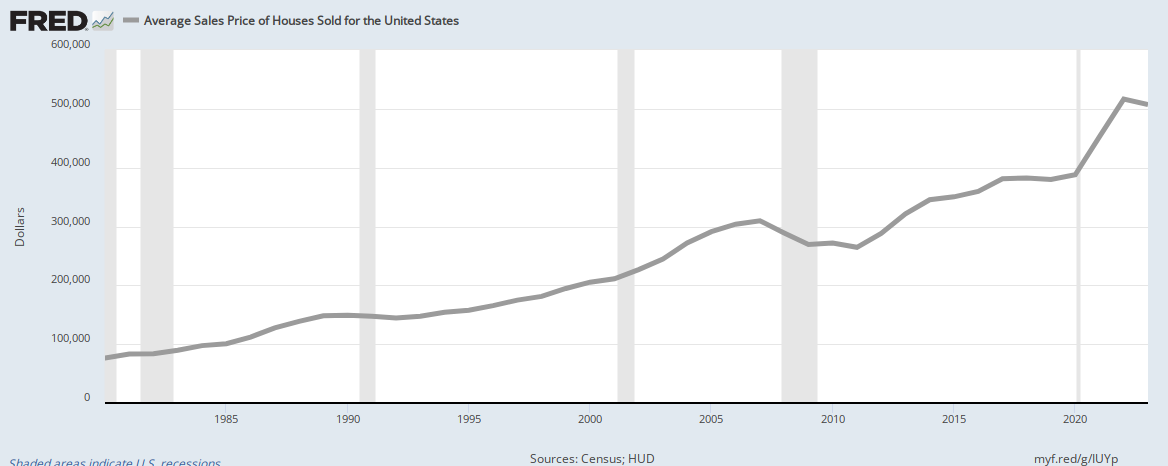
Since 1980, the average sales price of a house has increased from $80,000 to $450,000. A 1% drop in mortgage rates for a $450,000 house (less 20% down) comes to $3,600 per year or $300 per month, not nearly enough to encourage or discourage the purchase of a $450,000 house.
Thus, contrary to common knowledge and Federal Reserve dogma, reducing interest rates is not stimulative, and in fact, the argument could be made that rate reductions are recessive. Interest rates should be raised and home construction, especially the construction of modestly priced homes, should be federally aided. Raising interest rates also would mitigate against inflation, by increasing the value of the U.S. dollar.
If price increases continue, the Federal Reserve may raise interest rates, which would not only slow the pace of inflation, but also the pace of job and economic growth.
Yes and no. Yes, it would slow the pace of inflation, and no, it would not slow economic growth, as the above graphs indicate. SUMMARY The single greatest asset of the U.S. federal government is its Monetary Sovereignty. Yet myths and politics both have prevented the efficient use of this asset. The federal government has the infinite ability to create U.S. dollars, and the addition of dollars is economically stimulative. Further, there is no evidence that federal deficit spending causes inflation, and massive evidence that it does not. In short, there scarcely is an economic problem facing America that cannot be addressed by the wise addition of federal dollars, and there are no economic problems that can be solved by reductions in federal spending. Rodger Malcolm Mitchell Monetary Sovereignty Twitter: @rodgermitchell Search #monetarysovereignty Facebook: Rodger Malcolm Mitchell

……………………………………………………………………..

THE SOLE PURPOSE OF GOVERNMENT IS TO IMPROVE AND PROTECT THE LIVES OF THE PEOPLE.

The most important problems in economics involve:
  1. Monetary Sovereignty describes money creation and destruction.
  2. Gap Psychology describes the common desire to distance oneself from those “below” in any socio-economic ranking, and to come nearer those “above.” The socio-economic distance is referred to as “The Gap.”
Wide Gaps negatively affect poverty, health and longevity, education, housing, law and crime, war, leadership, ownership, bigotry, supply and demand, taxation, GDP, international relations, scientific advancement, the environment, human motivation and well-being, and virtually every other issue in economics. Implementation of Monetary Sovereignty and The Ten Steps To Prosperity can grow the economy and narrow the Gaps: Ten Steps To Prosperity:
  1. Eliminate FICA
  2. Federally funded Medicare — parts A, B & D, plus long-term care — for everyone
  3. Social Security for all
  4. Free education (including post-grad) for everyone
  5. Salary for attending school
  6. Eliminate federal taxes on business
  7. Increase the standard income tax deduction, annually. 
  8. Tax the very rich (the “.1%”) more, with higher progressive tax rates on all forms of income.
  9. Federal ownership of all banks
  10. Increase federal spending on the myriad initiatives that benefit America’s 99.9% 
The Ten Steps will grow the economy and narrow the income/wealth/power Gap between the rich and the rest.

MONETARY SOVEREIGNTY

Why is Medicare the way it is?

The purpose of government is to improve and protect the lives of the governed.

Is the Medicare Advantage plan an admission that Medicare itself is unnecessarily incomplete?

Rolls-Royce Phantom Prices, Reviews and New Model Information
Free, but with strings.

A story: You receive a call from the wealthiest man on earth. He owns an infinite amount of money.

He tells you he’s in the mood to do a good deed.

He has picked your name randomly, not based on anything but the luck of the draw, and he is giving you a free, no-strings-attached, Rolls Royce automobile.

Well, actually, there are two small strings. You must choose between two Rolls.

One has no heater. The other has no air conditioning.

And you must wait until you are 65 years old before you pick your car.

This puzzles you, so you ask him, “Why would someone having infinite money decide that when does his good deed, he gifts you a car that is missing either a heater or air conditioner?”

And why must you wait until you’re 65?

What’s his purpose?

While you ponder that question, consider this: The federal government, being uniquely Monetarily Sovereign, has infinite dollars. It never can run short of its own sovereign currency.

The government provides you with Medicare, which comes in two basic “models,” Original Medicare and Medicare Advantage.

And you typically must wait until you are 65 to join (with certain exceptions).

But Medicare and Medicare Advantage have different options depending on many of your personal factors.

WHY? Why doesn’t Original Medicare simply cover all medical conditions for everyone?

The American Association of Retired People (AARP) published “8 Reasons to Change Medicare:

1. My prescription costs have jumped.
That happens usually due to one of two scenarios: You’ve been prescribed a new drug your Plan D policy doesn’t cover, or your current medicines have fallen off your Plan D’s formulary (list of covered medicines), Neuman says.

Each September, Part D prescription plans will send out a list of changes to drug coverage, giving you time to make sure your medicines are still covered.

If not, you can shop around for another plan or ask your doctor to apply for an exception in covering your favored medicine.

WHY? Why must a person pay extra for Part D, and why must that person shop around for a plan that covers all his medicines?

2. I’ve decided to spend my winters (or summers) in a different state.
Advantage plans typically charge more to go to doctors outside of their networks; in some cases they won’t cover any charges if it’s not an emergency.

So a Midwesterner might have to pay more to see out-of-network doctors while in Florida.

You need to read the details of your plan, or talk with a representative, to know where you stand. If you’ll be living a dual-residence existence for years to come, you might consider a switch to original Medicare, with the usual caveats.

WHY? Why the “in-network, out-of-network” rigamarole?

3. I need surgery and prefer a specific doctor.
Original Medicare allows patients to choose any doctor or hospital that accepts Medicare.

But if you’re in a Medicare Advantage plan and its surgeons don’t meet your needs, you may need a different MA plan or to switch to OM.

The people who really need to focus on whether doctors are in network are those who’ve suffered major problems like cancer and heart attack, says Joseph Antos, health care expert at the American Enterprise Institute.

“A specialist may be key to their treatment,” he says.

WHY? Why does one Medicare plan cover any doctors or hospitals that accept Medicare and the other plan doesn’t?

4. I’m super healthy and rarely need a doctor.
If you’re in original Medicare, all should be well: As a “pay-for-service” arrangement, not seeing the doctor isn’t costing you anything extra beyond your mandatory parts B and D monthly insurance premiums.

If you’re in an MA plan in which you’re paying a monthly premium on top of your standard Part B premium, that may be for a plan that offers lots of extras , such as gym memberships.

Consider switching to a lower-cost MA plan that doesn’t offer services you don’t plan to use in the coming year.

WHY? Why are there any premiums, and why does one plan not cover the “extras?

5. I’ve been diagnosed with a chronic condition.
A serious medical change should trigger a full review of your Medicare coverage. Make sure your Plan D policy pays for new prescriptions.

Consider the care you’ll need . If you want disease-specific programs, find an MA plan that offers them.

But if you will need lots of specialists, there’s an argument for OM. Making critical changes early can “really affect your pocketbook and save you money,” says Gretchen Jacobson, a vice president with the Commonwealth Fund.

WHY? Why the difference in plans? Why doesn’t one plan cover everything?

6. My income has dropped sharply.
If you are in original Medicare, your Part B monthly premium is locked in, but your Part D drug plan isn’t.

And there’s a chance you can find a lower-cost policy that covers the medicines you are on.

If you’re in an Advantage plan, consider a switch to a plan in which there is no extra payment on top of the mandatory Part B premium.

And you might qualify for help. Ask your state Medicaid office about Medicare Savings Programs. Find the state offices here or call 800-MEDICARE (800-633-4227).

WHY? Why is there a monthly premium? Why does one plan not even lock in premiums? Why the difference in costs?

7. My former employer is changing its retiree health benefits.
Some companies provide retirees with Medigap supplemental insurance, which covers many health costs not covered by OM.

If you have changes to your retiree benefit coverage, or for some reason that coverage no longer is offered, contact Medicare’s Benefits Coordination & Recovery Center (855-798-2627).

Someone can tell you whether you fall in the window in which Medigap insurers cannot deny you coverage based on preexisting conditions.

WHY? Why are some retirees not covered by Medigap supplemental? Why is there even a need for supplemental?

8. My regular doctor is no longer in network for my plan.
If you deeply want to stay with a doctor, ask directly whether he or she is moving to a different MA plan, accepting OM patients or dropping out of Medicare completely.

If you decide to make a change, make sure a short-term decision won’t affect your long-term coverage (for example, switching to original Medicare to temporarily stay with one doctor but sacrificing Medigap coveragefor the long term).

It might be safer to ask your doctor to recommend a colleague in your current plan.

I’m in need of serious dental care. Original Medicare doesn’t cover routine dental care costs, but many Medicare Advantage plans do.

If you don’t have your own dental insurance and can’t afford dentistry costs out of pocket, consider finding an MA plan that will cover a portion of the costs of your needed work.

Antos warns that figuring out what portion of your dental bills an MA plan will cover is complicated, so it helps to know what services you will use in the coming year.

WHY? Why does a person need to consult a crystal ball to guess what medical coverage will be needed at some unknown time in the future?

WHY?


HERE IS WHY: Our Monetarily Sovereign government has infinite funds. It can afford any expense, even without collecting a single dollar in taxes. It has ultimate control over the value of the dollar, i.e. inflation.

Thus, the federal government has the unlimited ability to fund comprehensive, no-deductible Medicare for every man, woman, and child in America. There is no financial reason why you, your family and everyone you know does not have free, total healthcare protection.

But . . . 

At the behest of the very rich, who run America, our information leaders promulgate the Big Lie that taxpayers fund federal spending, and that the federal government is in danger of running short of dollars if spending increases without tax increases.

You have been sold the bill of goods that “there is no such thing as a free lunch,” and that federal spending causes inflation, and that the phony Medicare “trust fund” is running short of money.

The rich do this to widen the Gap between the rich and the rest, for it is the Gap that makes them rich. The wider the Gap, the richer they are.

Better “Medicare for All” plans have been proposed, but they have been rejected supposedly because tax dollars are needed to pay for it. 

They aren’t. It’s the Big Lie, the sole purpose of which is to make the rich richer.

There is no other purpose.

Rodger Malcolm Mitchell Monetary Sovereignty Twitter: @rodgermitchell Search #monetarysovereignty Facebook: Rodger Malcolm Mitchell

……………………………………………………………………..

THE SOLE PURPOSE OF GOVERNMENT IS TO IMPROVE AND PROTECT THE LIVES OF THE PEOPLE.

The most important problems in economics involve:

  1. Monetary Sovereignty describes money creation and destruction.
  2. Gap Psychology describes the common desire to distance oneself from those “below” in any socio-economic ranking, and to come nearer those “above.” The socio-economic distance is referred to as “The Gap.”

Wide Gaps negatively affect poverty, health and longevity, education, housing, law and crime, war, leadership, ownership, bigotry, supply and demand, taxation, GDP, international relations, scientific advancement, the environment, human motivation and well-being, and virtually every other issue in economics. Implementation of Monetary Sovereignty and The Ten Steps To Prosperity can grow the economy and narrow the Gaps: Ten Steps To Prosperity:

  1. Eliminate FICA
  2. Federally funded Medicare — parts A, B & D, plus long-term care — for everyone
  3. Social Security for all
  4. Free education (including post-grad) for everyone
  5. Salary for attending school
  6. Eliminate federal taxes on business
  7. Increase the standard income tax deduction, annually. 
  8. Tax the very rich (the “.1%”) more, with higher progressive tax rates on all forms of income.
  9. Federal ownership of all banks
  10. Increase federal spending on the myriad initiatives that benefit America’s 99.9% 

The Ten Steps will grow the economy and narrow the income/wealth/power Gap between the rich and the rest.

MONETARY SOVEREIGNTY