The cure for all (OK, many) of your problems.

Recently, I read an article about one of my less favorite subjects, sewage, and it had me thinking about one of my most favorite subjects, federal spending. Brief background:
  1. The U.S. federal government, being Monetarily Sovereign, has the infinite ability to spend U.S. dollars. It is not limited by tax collections, so-called “debt,” or anything but government whim. It could pay a $100 trillion invoice tomorrow simply by pressing a computer key.
  2. Federal spending never causes inflation. Scarcities lead to all price increases. The cure for inflation is to cure scarcities, which the government can accomplish by funding and distributing the scarcities causing inflation.
Here are excerpts from the article that stoked my thinking:

We need rapid political intervention to end sewage pollution crise

THE UK has a very mucky problem. News feeds overflow with videos of raw sewage gushing into rivers during heavy rain.

Thames Tideway Pr Image
The Thames Tideway is a “super sewer” running under central London

In our report (see Sewage crisis: The truth about British rivers and how to clean them up), we explore why the country still dumps untreated waste into waterways and how to fix this.

The solution, it turns out, includes thinking about the water system as a whole: tackling sewage pollution is also about fixing flooding and drought problems. Tougher governance is essential, too.

The UK isn’t alone. Australia and the US have similar issues. 

In the UK, much of the blame has been leveled at privatized water companies. They have run up enormous debts while giving away billions to shareholders. They have also failed on many metrics, including poorly-maintained pipes.

However, the real culprit is the government, which has failed to give water companies stringent enough targets or enforce those that have been set.

It is a pattern we have seen over and over, from banking crashes to nuclear power accidents.

Hmmm. Question: What do banking crashes, nuclear power accidents, and sewage pollution have in common? Answer: The same thing global warming, health care, retirement care, food and housing scarcities, water shortages, and a myriad of other problems that bedevil us: Money. We intellectually know how to address, if not solve, many of our most important problems, but in many cases, ignorance limits funding. Read the “The truth about British rivers and how to clean them up” article, and you’ll see solutions: Stop using combined (water and sewage) systems, send rainwater to storage and treatment plants, construct artificial wetlands, etc. The problem: Money. The article says, “Hundreds of billions of pounds.” But, like the U.S. government, the British government doesn’t seem to realize it is Monetarily Sovereign. It already has those “hundreds of billions of pounds” at its fingertips — the fingertips that can tap a computer key and instantly pay any bill without resorting to taxation. Let’s visualize some of the other problems we can address or even solve: Problem: Sickness. Address the problem via federal funding of:
  1. Comprehensive, no-deductible Medicare for every man, woman, and child in America, regardless of age, income, or health
  2. All forms of medical research, mainly research unlikely to be addressed by the private sector because of limited profitability potential.
  3. Healthcare facilities like hospitals and long-term care facilities.
  4. Doctors, nurses, and other health workers.
  5. R&D into the causes and cures for all human, animal, and plant illnesses.
Problem: Global warmingAddress the problem via federal funding of:
  1. Non-carbon energy creation — solar, geothermal, wind, water, nuclear (fission and fusion), hydrogen, and fuel cells.
  2. Electric cars, trains, trucks, and planes
  3. Roadways specifically designed to accommodate electric vehicles
  4. Home and business heating and cooling structural improvements, including insulation and reflective materials
  5. R&D methods of climate control.
Problem: Poverty and crime. Address the problems via federal funding of:
  1. Social Security and retirement benefits for every man, woman, and child in America, regardless of age and income/wealth.
  2. Free education, through postgraduate, for everyone who wants it.
  3. Reduce employeres’ costs associated with paying employees. Eliminate the FICA tax and business-funded health care and retirement programs.
  4. Greatly reduce or eliminate the federal taxes paid by all but the wealthiest Americans. Alternative methods: Tax deductions for rent paid and for home-owning costs.
  5. R&D methods of control.
Problems: Inflation, hunger, degradation of the environment. Address the problems via federal funding of:
  1. (Short term) Oil drilling and refining, plus biofuels.
  2. All aspects of farming, including education and efficient land use, R&D of more efficient farming tools and methods
  3. Current construction materials and methods plus R&D of new materials.
  4. Current storage and distribution systems plus R&D of new systems.
  5. Current and new computers, including quantum computers, chips, and algorithms.
  6. R&D  of maintenance of the environment plus support for all the sciences.
The potential for federal spending is limitless, but fortunately, the federal government’s ability to spend is unlimited. Our collective imagination is the only thing that limits our ability to address and cure all our ills. Think of any problem facing humanity, and you soon will imagine how federal spending could address or even cure that problem. Monetary Sovereignty shows that we humans were given the tools to create a paradise on Earth. Our brains open the universe to us, and our invention of money provides us with motivation. Most Americans, even in “red” states, even die-hard MAGAs recognize the above-mentioned problems and want solutions. But whether via ignorance or intent, the false claims that federal spending is “unaffordable,” “unsustainable,” “socialism,” “inflationary,” or requires tax increases, have held us back. Federal spending is none of those. Federal spending by our Monetarily Sovereign government is infinitely affordable and sustainable. We never can run short of dollars. Federal spending is not socialism, which is government ownership and control, not financial support. And, of course, the federal government neither needs nor uses tax dollars. It created new dollars to pay all bills. We need only to understand that we have the necessary tools, money and brains, then to use those tools and stop fighting each other. Sadly, we also have been given hatred, greed, and ignorance, so our Janus personalities have held us down, and I fear, eventually will destroy us. Rodger Malcolm Mitchell Monetary Sovereignty Twitter: @rodgermitchell Search #monetarysovereignty Facebook: Rodger Malcolm Mitchell

……………………………………………………………………..

The Sole Purpose of Government Is to Improve and Protect the Lives of the People.

MONETARY SOVEREIGNTY

How to be a climate and COVID denier by calling warnings, “panicked fearmongering.”

If you were in a burning building and people yelled at you, “Get out, the building is on fire,” I assume Bjorn Lomborg and Jordan B. Peterson would call that “panicked fearmongering.”

It is the only conclusion I can draw from the ridiculous Trumpian article published under their names.

Stop the panicked fearmongering if we want to make the world better By Bjorn Lomborg and Jordan B. Peterson August 4, 2023, 6:31pm Updated

The meaningful exchange of truly diverse ideas and perspectives has withered over recent decades.

Unorthodox thinking is increasingly trashed or disregarded, even as the chattering class’s fear- and force-predicated approaches repeatedly prove inadequate to cope with the true complexities and crises of the modern world.

We need instead to foster and promote critical thinking and constructive discussion.

Here is an example of the “unorthodox thinking, ” “critical thinking,” and “constructive discussion” the authors seem to promote: Unorthodox, yes. Critical, huh? Constructive, no. Thinking. Absolutely no.

We are making every effort to ensure that our new Alliance for Responsible Citizenship (ARC), an international coalition of politicians, business leaders, public intellectuals and cultural commentators, will help ensure that a broader range of perspectives can be heard globally.

It’s not the “range of perspectives” that is the problem. It’s the unscientific perspectives that killed hundreds of thousands of Americans.

Consider the world’s response to the pandemic.

A panic-stricken lockdown orthodoxy far too soon took hold, and those whose policy proposals deviated quickly were labeled “COVID deniers.”

Governments that went the farthest were feted by public intellectuals and in newspaper opinion pages.

Thus, we saw increases of inequality in income distribution and wealth, widespread loss of employment, substantive declines in spending and general deterioration in economic conditions; serious declines in mental health and wellbeing, delayed and diminished access to healthcare, and record high levels of domestic violence.

The problems mentioned in the previous paragraph were due to people sickening and dying from COVID, not to “panicked fearmongering.”

There seems to have been insufficient “fearmongering.”

Too many people, especially Republicans, agreed with Lomborg and Peterson and did not take “orthodox” vaccine, mask, and crowd avoidance information seriously.

Lomborg’s and Peterson’s “unorthodox,” “broader ranges of perspectives” killed thousands of Americans.

“Many experiments and facts have proven that masks are lifesavers for confined spaces with high population density and less ventilation.

The education of children was particularly affected: School closures, on average, robbed children of more than seven months of education.

The huge impact on kids’ knowledge could end up costing $17 trillion in lifetime earnings, per research by the World Bank, UNESCO, and UNICEF.

Poor children, girls, and children with disabilities suffered the largest losses.

Sadly, school classrooms are the “confined spaces with high population density and less ventilation that have proved to cost lives.

The question became, Would you risk your children’s lives for seven months of education?

We need to have a serious conversation about our manner of response before the next crisis (pandemic or otherwise) to ensure that the cure is not much worse than the disease.

Consider, too, the alarmist treatment of climate change.

Campaigners and news organizations play up fear in the form of floods, storms, and droughts while neglecting to mention that reductions in poverty and increases in resiliency mean that climate-related disasters kill ever fewer people: Over the past century, such deaths have dropped 97%.

Heatwaves capture the headlines. Globally, however, cold kills nine times more people.

The higher temperatures arguably characterizing this century have resulted in 166,000 fewer temperature-related deaths.

Fear-mongering and the suppression of truly inconvenient truths are pushing us dangerously toward the wrong solutions: Politicians and pundits call en masse for net-zero policies that will cost far beyond $100 trillion while producing benefits a fraction as large.

We need to be able to have an honest discussion of costs and benefits — a true reckoning with the facts to find the best solutions.

The “honest discussion” already has been, and is being, held, and the consensus is that global warming can be an extinction event for millions of species, including ours.

The disingenuous, highly misleading comment that more people die from cold than heat does not recognize what is happening to the world.

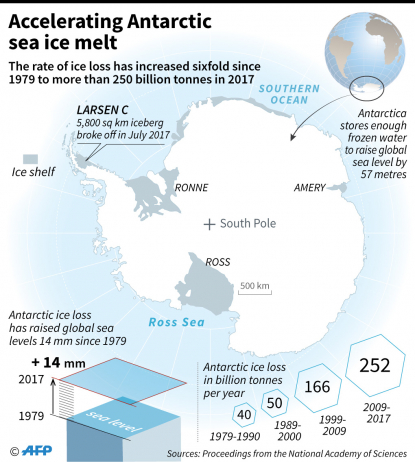
Consider just one effect, the melting of Antarctic ice: The chart shows that if all the ice in the Antarctic were to melt, sea levels would rise by 187 feet (57 meters).

Do you live 187 feet above sea level?

Well, you may say not ALL the ice will melt. Maybe only 10% will melt, raising sea levels by “only” 18 feet.

Then again, we haven’t considered Arctic and Greenland ice.

Melting from the Arctic — and the Greenland ice sheet in particular — is the largest contributor to global sea level rise. 

“If you look at where humanity lives, a great proportion of humanity lives at the coastlines worldwide.
“The megacities are along coastlines: New York, Los Angeles, San Francisco.”

And that’s just sea-level rise. What about other problems?

The environmental conditions in the Arctic affect weather systems across the world.

The North and South poles act as the “freezers of the global system,” helping to circulate ocean waters around the planet in a way that helps to maintain the climates felt on land, Moon said.

“What happens in the Arctic doesn’t stay in the Arctic.”

The jet stream, a band of strong winds moving west to the east created by cold air meeting warmer air, helps regulate global weather.

In the continental U.S., the jet stream forms where generally colder and drier Arctic air meets warmer and more humid air from the Gulf.

But as temperatures in the Arctic warm, the jet stream, fueled by the temperature differences, weakens.

Rather than a steady stream of winds, the jet stream has become more “wavy,” allowing hot temperatures to extend usually far into the Arctic and frigid temperatures further south than usual.

The variability in the climate in the Arctic, specifically the weakening of the polar vortex, keeps cold air closer to the poles,

It likely led to the Texas freeze in February that led to millions without power and hundreds of deaths.

The study cited an “increasingly frequent number of episodes of extremely cold winter weather over the past four decades” in the U.S., despite temperatures rising overall.

As though sea level rise, species extinction, and more extreme weather aren’t bad enough, we also should look at disease:

Mosquitoes and other biting insects transmit many of the most important, devastating, and neglected human infectious diseases, including malaria, dengue fever, chikungunya, and West Nile virus.
Economic development and cooler temperatures have kept mosquito-borne diseases out of wealthier Northern Hemisphere countries, but climate change promises to tip the scales in the other direction.

As temperatures rise, malaria could be coming to your neighborhood.

And then there’s food:

Recent research suggests that adverse weather has canceled up to 30% of the expected increase in European crop growth.

But it is worrying that the most pronounced changes tend to be in countries, such as those in sub-Saharan Africa, including South Africa, that are at high risk of climate impacts on food availability and affordability.

This is particularly clear in the case of barley, maize, millet, pulses, rice, and wheat.

The countries most at risk of food shortages are also worst affected by rising temperatures.

This seems to bear out the finding from the world’s premier climate science advisers, the Intergovernmental Panel on Climate Change (IPCC), that the higher average global temperatures and more extreme weather events associated with climate change will reduce the reliability of food production.

No, Messrs. Lomborg and Peterson, the warnings about COVID and global warming should not be written off as simply “panicked fearmongering.”

When you disseminate false information from such right-wing sources as Fox News, Breitbart, QAnon, Donald Trump, and the GOP, you not only stain whatever reputations you may have, but you endanger lives.

If you prefer to follow the anti-science, right-wing, unorthodox voices,, you have my permission to inject yourself with ivermectin, bleach, and hydroxychloroquine, and by all means, avoid vaccination.

But please stop writing harmful nonsense.

Rodger Malcolm Mitchell Monetary Sovereignty

Twitter: @rodgermitchell Search #monetarysovereignty

Facebook: Rodger Malcolm Mitchell

……………………………………………………………………..

The Sole Purpose of Government Is to Improve and Protect the Lives of the People.

MONETARY SOVEREIGNTY

The five ignorant reasons why the U.S. should not try to reduce global warming

Here are the five ignorant reasons why we should do nothing to reduce global warming:

I. Why should we do it if some other countries don’t do it?

Here's Why Cage Divers Don't Become Shark Bait
If you don’t close the door, why should I?


II. Human-caused global warming is not happening, no matter what 98% of scientists say

Fire? What fire? I see no fire.


III. Even if global warming is happening, it would cost too much to fix

We don’t want to pay for a baby sitter


IV. It would hurt businesses and cost jobs.

UPDATED! Pandemic Diary, November 24th, 2020: The Dam Bursts – Ryan Schultz
Don’t tell anyone. It’ll be bad for business.


V. Donald Trump

===========================================================

The Wall Street Journal.
Biden to Propose Cutting U.S. Emissions in Half by 2030 Andrew Restuccia, Timothy Puko, Sha Hua “Unless China stops its uninhibited growth of emissions, anything we do will be offset fourfold by the Chinese,” said Rep. Garret Graves (R., La.), the top Republican on the House Select Committee on the Climate Crisis.
Mr. Biden’s emissions target is certain to face criticism from GOP lawmakers and some in the business community who worry that the administration’s climate policies could harm the economy. Rep. Michael McCaul (R., Texas) criticized the Paris agreement this week, arguing it “disproportionately penalizes American workers.”
The New York Times Amid Biden Climate Push, a Question Looms: Is America’s Word Good?
The question is dogging Biden as he tries to reassert the American role in other parts of the world stage after four years of Donald Trump’s America First isolationism.
Biden was vice president when the world applauded the Obama administration for resuming climate talks after his predecessor, George W. Bush, rejected the 1997 Kyoto Protocol climate treaty.
Now he’s trying to lead another comeback as the U.S. returns to the Paris Agreement that Trump deserted in a flashy show of defiance.
Sen. Mitch McConnell of Kentucky, the Republican leader, has already said his party will oppose Biden’s $2 trillion infrastructure plan, which is the cornerstone of the administration’s efforts to meet current and future climate goals.
A group of Republican House leaders last week also introduced legislation calling for a wholesale renegotiation of the Paris Agreement and denounced Biden’s plans for global re-engagement.
Adam S. Posen, president of the Peterson Institute for International Economics, said “Obviously, Trump made it worse because of incompetence and overt nationalism.”
These are the 130 current members of Congress who have doubted or denied climate change
Ellen Cranley Apr 29, 2019 Collin Peterson is notably the only Democrat to appear on this list.
Politico reported in January 2019 that though House Agriculture Committee Chairman Peterson was feeling “some” pressure to pursue action on climate policy, but said climate change policy poses a threat to agricultural workers and he believes that activists “would like us to quit farming.”

Click the above link to see the names of the Congressional climate change deniers. 

Actual Twitter message from Mitch McConnell:

“This Administration’s zeal for costly climate policy at home is not matched by our biggest competitors.

China’s share of emissions is nearly double ours. The Paris Agreement is largely toothless. Democrats can kill U.S. jobs & industries with no real impact on global emissions.”

So there you have it. The Republicans have ignorant reasons for not wanting to help control global warming.

The destruction of the earth and the future for our children and grandchildren is not as important as those five ignorant reasons.

…………………………………………………………………………

Rodger Malcolm Mitchell [ Monetary Sovereignty, Twitter: @rodgermitchell, Search: #monetarysovereignty Facebook: Rodger Malcolm Mitchell ]

THE SOLE PURPOSE OF GOVERNMENT IS TO IMPROVE AND PROTECT THE LIVES OF THE PEOPLE. The most important problems in economics involve:

  • Monetary Sovereignty describes money creation and destruction.
  • Gap Psychology describes the common desire to distance oneself from those “below” in any socio-economic ranking, and to come nearer those “above.” The socio-economic distance is referred to as “The Gap.”

Wide Gaps negatively affect poverty, health and longevity, education, housing, law and crime, war, leadership, ownership, bigotry, supply and demand, taxation, GDP, international relations, scientific advancement, the environment, human motivation and well-being, and virtually every other issue in economics. Implementation of Monetary Sovereignty and The Ten Steps To Prosperity can grow the economy and narrow the Gaps: Ten Steps To Prosperity:

  1. Eliminate FICA
  2. Federally funded Medicare — parts A, B & D, plus long-term care — for everyone
  3. Social Security for all
  4. Free education (including post-grad) for everyone
  5. Salary for attending school
  6. Eliminate federal taxes on business
  7. Increase the standard income tax deduction, annually.
  8. Tax the very rich (the “.1%”) more, with higher progressive tax rates on all forms of income.
  9. Federal ownership of all banks
  10. Increase federal spending on the myriad initiatives that benefit America’s 99.9% 


The Ten Steps will grow the economy and narrow the income/wealth/power Gap between the rich and the rest.

MONETARY SOVEREIGNTY


COVID-19 is the most important event in 80 years, but this is far more important yet.

COVID-19 may kill at least a half-million Americans and five-million worldwide, just in the next two or three years, unless we are able to develop a vaccine and unless people will be encouraged to take it.

That is an awful lot of deaths, but it pales in comparison to the people who will suffer and die because of global warming.

More Than 250,000 People May Die Each Year Due to Climate Change
By Rachael Rettner January 17, 2019

In the coming decades, more than a quarter-million people may die each year as a result of climate change, according to a new review study.

In 2014, the World Health Organization (WHO) estimated that climate change would lead to about 250,000 additional deaths each year between 2030 and 2050, from factors such as malnutrition, heat stress and malaria.

But the new review, published Jan. 17 in The New England Journal of Medicine, said this is a “conservative estimate.” That’s because it fails to take into account other climate-related factors that could affect death rates — such as population displacement and reductions in labor productivity from farmers due to increased heat, study co-author Dr. Andrew Haines, epidemiologist and former director of the London School of Hygiene & Tropical Medicine, told CNN.

In addition, the WHO estimate didn’t take into account illnesses and deaths tied to disruptions in health services caused by extreme weather and climate events, the review said.

Climate change is the single, most important, species-survival event to take place since humans began to walk the earth. Yet it doesn’t receive the media attention of COVID-19, or police brutality, or the stock markets, or sports.

While an entire, multi-page section of your daily newspaper is devoted to sports, the looming extinction of our species garners only the occasional article.

Yet, climate change is actively denied by Donald Trump and his science-illiterate followers.

One might hope that the potential suffering and eradication of a substantial portion of our children and grandchildren, and their children and grandchildren, would merit a bit more seriousness. Sadly, we must endure “present bias,” in which future lives are discounted vs. current comfort.

Even those who wish to address the threat to the survival of the human species are blocked by ignorance and myths.

Joe Biden sets out aggressive plan to tackle climate change
By Evan Halper, Staff, writer, July 14, 2020

WASHINGTON — Joe Biden unveiled a proposal for rebuilding the economy Tuesday that focuses heavily on restoring American leadership in the fight against global warming, directing government recovery efforts toward expanding clean energy and rapidly reversing the Trump administration’s abandonment of climate efforts.

In a speech in Wilmington, Del., the former vice president called for a massive green jobs and environmental justice program that would invest $2 trillion in his first term on building new renewable energy infrastructure.

“Climate change is a challenge that’s going to define our American future,” Biden said. “I know meeting the challenge will be a once in a lifetime opportunity to jolt new life into our economy, strengthen our global leadership, protect our planet … We’re not just going to tinker around the edges. We’re going to make historic investments that will seize the opportunity to meet this moment in history.”

The spending would go toward expansion of high-speed rail, building electric cars and greatly increasing the use of wind, solar and other renewable technologies to generate power, among other goals. Under Biden’s plan, the U.S. would fully end the use of oil, coal and other fossil fuels to generate electricity by 2035. He would bring the nation to net zero emissions of greenhouse gases no later than 2050.

The plan is notably more aggressive than the one Biden campaigned on during his party’s primaries, part of an overall move in which he has embraced some of the proposals of his more progressive rivals in an effort to unify the party for the general election.

This is the “aggressive” plan — 30 more years of global warming?? Thirty more years of increasing death rates as the world gets warmer and warmer?

We won’t get into the non-science or pseudo-science of global warming deniers. If you want to see the claims, go here. I’ll go along with the scientific majority on this.

If the scientific majority is wrong, and we take action, we’ll only have devoted a lot of time and money to controlling CO2, while creating millions of jobs. If the scientific majority is right, and we take action, we’ll save humanity. 

Compared with Biden’s earlier proposals, the current one would spend more, do it faster and aim more investment toward disadvantaged communities.

“The science tells us there is no time for delay on climate change,” the plan says. “Biden will make a $2 trillion accelerated investment, with a plan to deploy those resources over his first term, setting us on an irreversible course to meet the ambitious climate progress that science demands.”

Why only $2 trillion? That’s less than the U.S is spending to remediate COVID 19 — i.e. to deal not only with the disease itself, but also dealing with its current and future effects on people and the economy.

Consider the current an future effects of global warming:

Arctic ‘transitioning’ to a new climate
Extremes are becoming routine, study suggests.

The Arctic has started to transition from predominantly frozen to an entirely different climate, according to a new report.

Writing in the journal Nature Climate Change, scientists from the US National Centre for Atmospheric Research (NCAR) say the planet’s north has warmed so significantly that its year-to-year variability is moving outside the bounds of any past fluctuations, signalling the move to a new normal.

Sea ice has melted to the extent that even an unusually cold year will no longer have the amount of summer sea ice that existed as recently as the mid-20th century.

“The rate of change is remarkable,” says lead author Laura Landrum. “It’s a period of such rapid change that observations of past weather patterns no longer show what you can expect next year.”

And this:

CAUSES AND EFFECTS OF CLIMATE CHANGE

  • Ice is melting worldwide, especially at the Earth’s poles. Global sea levels are rising 0.13 inches (3.2 millimeters) a year, and the rise is occurring at a faster rate in recent years.

  • Vanishing ice has challenged species such as the Adélie penguin in Antarctica, where some populations on the western peninsula have collapsed by 90 percent or more.

  • Precipitation (rain and snowfall) with severe floods has increased across the globe, on average.

  • Yet, some regions are experiencing more severe drought, increasing the risk of wildfires, lost crops, and drinking water shortages.

  • Ticks, jellyfish, and crop pests—are thriving. Booming populations of bark beetles that feed on spruce and pine trees, for example, have devastated millions of forested acres in the U.S.

  • Hurricanes and other storms are likely to become stronger.

  • Large parts of the U.S., for example, face a higher risk of decades-long “megadroughts” by 2100.

  • Less freshwater will be available, since glaciers store about three-quarters of the world’s freshwater.

  • Some diseases will spread, such as mosquito-borne malaria (and the 2016 resurgence of the Zika virus).

  • Ecosystems will continue to change: Some species will move farther north or become more successful; others, such as polar bears, won’t be able to adapt and could become extinct.

And we as a species, may not be able to tolerate the heat in many parts of the globe. Much of the world will become unlivable:

Unsuitable for ‘human life to flourish’: Up to 3B will live in extreme heat by 2070, study warns
Doyle Rice, USA TODAY

Temperatures over the next few decades are projected to increase rapidly as a result of human greenhouse gas emissions. 

Without climate mitigation or migration, by 2070 a substantial part of humanity will be exposed to average annual temperatures warmer than nearly anywhere today, the study said. These brutally hot climate conditions are currently experienced by just 0.8% of the global land surface, mostly in the hottest parts of the Sahara Desert, but by 2070 the conditions could spread to 19% of the Earth’s land area.

These are projections. They may be high or low. Yes, the situation could even be much worse than projected. Are we willing to take that chance with the future of our grandchildren and their grandchildren? Is this the legacy we wish to leave for future generations?

But it gets even worse:

Climate change will reduce food production which is predicted to lead to a net increase of 529,000 adult deaths worldwide by 2050, according to a 2016 study.

Climate change could also force more than 100 million people into extreme poverty by 2030, according to World Bank estimates, which in turn, would make them more vulnerable to the health effects of the changing climate.

This planet is our only home, and will be our only home for the foreseeable future. We are like a tiny lifeboat in a giant ocean. The lifeboat is leaking but still, we argue about whether to fix the leaks. It’s madness.

Republicans warned the plan would further sink the economy and trigger the loss of millions more jobs.

“Today, Joe Biden gave a speech in which he said the core of his economic agenda is a hard-left crusade against American energy,” President Trump said during an hourlong Rose Garden polemic against Biden.

“He wants to kill American energy. This would do nothing for the environment but would cripple the American economy.”

Trump doesn’t want you to know that Biden wants to add stimulus dollars to the economy. This will create far more jobs than did Trump’s tax cuts for the rich.

Some key details, however, were absent from (Biden’s) proposal. Most notably, it does not specify how it would be paid for.

Senior campaign officials said a rollback of the Trump tax cuts, as well an increase in corporate taxes would be part of the payment plan, which the campaign vowed to release in the coming months.

The best part of Biden’s plan is that it would add $2 trillion to the economy. A rollback of tax cuts and an increase in corporate taxes would be unnecessary and counter-productive.

The U.S. federal government is Monetarily Sovereign., Unlike state and local governments, and unlike euro nation governments, the U.S. federal government neither needs nor uses tax dollars. It creates new dollars, ad hoc, to pay for all its spending.

The whole question of “How will this be paid for” is obsolete. The federal government pays for everything by creating new dollars. Anyone who asks how a federal program will be paid for demonstrates abject ignorance about federal financing. The federal government never can run short of dollars.

Think of those tax dollars you work so hard to earn and then are forced to send to the U.S. Treasury. Those dollars are destroyed upon receipt, never to be used or seen again.  Rolling back tax cuts and/or increasing corporate taxes would take growth dollars from the economy and not help pay for anything.

Biden has also said he supports a carbon tax — a policy many environmental economists say is crucial to effectively curbing climate change — but there is no mention of that in the current proposal.

The only purpose of a carbon tax would not be to raise funds for the government, but rather to penalize and discourage the use of carbon-based fuel and products.

Far better, however, would be to reward and encourage the use of alternative eco-friendly, non-carbon-based products, just as the government now does to encourage the use of solar panels. The carrot is better than the stick, especially when the carrot will stimulate jobs and economic growth.

The audacity of the spending plan reflects the increased appetite among voters for taking action to curb global warming, as scientists warn time is running short and Trump administration rollbacks have left America isolated from the global effort.

“When Donald Trump thinks about climate change, the only word he can muster is ‘hoax,’” Biden said. “The word I think of is ‘jobs.’”

He aims to create 1 million new auto industry jobs by pushing the industry to take the lead in electric-vehicle manufacturing. High-speed rail is a focal point of the plan, as is a big investment in zero-emission public transit.

“Pushing” these industries should not mean “forcing” these industries; it should mean “rewarding” these industries. The federal government should use its unlimited power-of-the-purse to encourage carbon-zero business activities.

The goal for quickly decarbonizing the power sector would require new subsidies such as tax credits and grants to accelerate production of solar and wind energy technologies.

The federal government would also help subsidize the retrofitting of 4 million buildings to make them more energy efficient and aim to create 250,000 jobs “plugging abandoned oil and natural gas wells and reclaiming abandoned coal, hardrock, and uranium mines.”

And far better than more tax cuts for the rich or eliminating consumer protection laws would be this:

Much of the money would be aimed at disadvantaged communities.

“We have to make sure that the first people who benefit from this are the people who were most hurt historically,“ Biden said.

His plan sets a goal that low-income communities that have traditionally suffered disproportionately from pollution would receive 40% of “overall benefits of spending” by the federal government in areas such as clean energy and energy efficiency, green transportation and sustainable housing.

Trump has crippled our consumer protection agencies, not only by cutting regulations but also by removing experienced and competent leaders and installing incompetent, crooked, and/or inexperienced lackeys to run these agencies: Health and Human Services Secretary Tom Price, EPA Administrator Scott Pruitt, HUD Secretary Ben Carson are but a few examples.

Underpinning the plan is a restructuring of key agencies in the federal government, restoring the climate-forward focus put in place by the Obama administration but then abandoned by Trump.

The Justice Department, for example, would launch a new Environmental and Climate Justice Division “to hold polluters accountable.”

“We’re going to hold accountable those CEOs of corporations that benefit from decades of subsidies that just walked away from their responsibilities to these communities, leaving the wells to leak,” Biden said.

Such an agency was championed by Gov. Jay Inslee of Washington, an early rival of Biden’s in the presidential primary who ran on a platform dominated by confronting climate change. Biden adopted several of the ideas pushed by Inslee in his plan.

This article summarizes it best:

Climate change is causing injuries, illnesses and deaths, with the risks projected to increase substantially with additional climate change, threatening the health of many millions of people,” the report said. “The pervasive threats to health posed by climate change demand decisive actions from health professionals and governments to protect the health of current and future generations.”

The world is dying right before our eyes. Donald Trump is lying, denying, hampering, and hindering. The sand is running down the hourglass. The time to save the planet for our species rapidly is disappearing.

While Biden’s recommended $2 trillion is a notable start in saving the world, it is far too little and may be too late. How much is the future of humankind worth, especially when the money is free?

Efforts to save the planet not only will help assure our grandchildren’s futures, but money spent today will grow our economy today, providing jobs and money to those who need it, while narrowing the Gap between the rich and the rest.

Act now, or too soon there will come a tipping point, when having squandered all our opportunities, we watch helplessly as our little lifeboat in this vast ocean, sinks.

Rodger Malcolm Mitchell

Monetary Sovereignty Twitter: @rodgermitchell Search #monetarysovereignty Facebook: Rodger Malcolm Mitchell …………………………………………………………………………………………………………………………………………………………………………………………………………………………………………………………………………………………..

THE SOLE PURPOSE OF GOVERNMENT IS TO IMPROVE AND PROTECT THE LIVES OF THE PEOPLE.

The most important problems in economics involve:

Ten Steps To Prosperity:

  1. Eliminate FICA
  2. Federally funded Medicare — parts A, B & D, plus long-term care — for everyone
  3. Social Security for all or a reverse income tax
  4. Free education (including post-grad) for everyone
  5. Salary for attending school
  6. Eliminate federal taxes on business
  7. Increase the standard income tax deduction, annually. 
  8. Tax the very rich (the “.1%”) more, with higher progressive tax rates on all forms of income.
  9. Federal ownership of all banks
  10. Increase federal spending on the myriad initiatives that benefit America’s 99.9% 

The Ten Steps will grow the economy and narrow the income/wealth/power Gap between the rich and the rest.

MONETARY SOVEREIGNTY