Democrats’ political suicide

There were times when I thought Donald Trump was politically suicidal with his public philandering, his easily disproved lies, his blatant ignorance, his financial profiting from the Presidency, his nepotism, his sucking up to communists, and on and on.

But apparently, his “religious” followers admire philandering, lying, ignorance, criminal profiting, nepotism, communism, etc. So Trump survives.

Lately, I have realized that it is the Democrats who are politically suicidal. The Democrats have the marvelous ability to take a good idea, a popular idea — health care for everyone — and muck it up into a barely recognizable mess, until they now are on the defensive about something that should be a lay-down winner for them.

As readers of this blog well know: The federal government’s finances are not like state and local governments’ finances. 

Image result for bernanke and greenspan
It’s our little secret. Don’t tell the people we don’t use their tax dollars.

Ben Bernanke: “The U.S. government (can) produce as many U.S. dollars as it wishes at essentially no cost.”

Alan Greenspan: “A government cannot become insolvent with respect to obligations in its own currency.”

St. Louis Federal Reserve: “As the sole manufacturer of dollars, whose debt is denominated in dollars, the U.S. government can never become insolvent, i.e.,unable to pay its bills. In this sense, the government is not dependent on (borrowing) to remain operational.”

Unlike state and local governments: 

  1. The federal government has a sovereign currency, the U.S. dollar, over which it has total control.
  2. The federal government cannot unintentionally run short of its own sovereign currency.
  3. The federal government neither needs nor uses tax dollars.
  4. The federal government does not borrow.

Those four, simple truths are absolutely basic to economics. Yet they seem not to be understood by the vast majority of Americans, even including media writers and university economists — and especially not understood by the legions of Democrats chasing glory via the Presidency.

The following article demonstrates the Democrats’ suicidal ignorance:

Sanders admits he would raise taxes on the middle class to pay for programs
Kadia TubmanReporter,Yahoo News•June 27, 2019

Sen. Bernie Sanders, challenged at Thursday night’s Democratic presidential debate on how he would pay for universal health care and his other proposed programs, admitted income taxes on the middle class would have to go up — but maintained that the savings in medical expenses would more than offset the tax hike.

Sanders, who took the first question from NBC correspondent Savannah Guthrie, talked about his Medicare for All proposal for his allotted minute.

But when Guthrie followed up and pressed him about taxes on the middle class, he conceded, “Yes, they will pay more in taxes.”

If Sanders’s version (or any other candidate’s version) of Medicare for All were proposed by a state governor or a city mayor, the above answer would be correct. Additional taxes would be needed to pay the cost of the medical services.

But apparently, neither Sanders nor any other candidate (nor any Republican, for that matter) knows or admits to knowing that federal finances are completely, totally, 180 degrees different from state and city finances.

The federal government uniquely has total control over the U.S. dollar, cannot unintentionally run short of dollars, neither needs nor uses tax dollars, and does not borrow.

The U.S. federal government could finance even the most liberal, generous version of Medicare for All, at the tap of a computer key. No tax dollars involved.

Sanders said, “Health care in my view is a human right and we have got to pass a Medicare for All single-payer system. “Under that system, [the] vast majority of the people in this country will be paying significantly less for health care than they are right now.”

Not only is health care a “human right,” but it is an economic imperative for any nation hoping to compete and grow — certainly as much an imperative as military defense and effective government.

Yet there is Sanders, essentially hat in hand, pleading for universal health care on the basis of cost savings, when in reality cost is not a real issue. It is a fake issue put forth either in ignorance or in malicious intent, depending on one’s politics.

Quite simply, there is no financial reason why any American should be forced to pay one cent for health care insurance — either via taxes or via premium payments.

And if after all these months of researching and developing his Medicare for All plans, Sanders still has not learned this, he is mentally unfit to be left alone with a sharp object.

But it continues. Sanders also said:

“I believe that education is the future for this country and that is why I believe we must make public colleges and universities tuition-free and eliminate student debt, and we do that by placing a tax on Wall Street.”

“Every proposal that I have brought forth is fully paid for.”

Sanders believes (!) education is the future for this county?  He believes so? What a relief that he believes something so obvious, that American states, counties, and cities have been funding elementary, high school, and even some college education, for centuries.

Unfortunately, states, counties, and cities are not Monetarily Sovereign, so they must have some form of income (taxes, fees, tourism, borrowing, etc.) in order to spend.

The federal government, being unique, is not similarly constrained. Yet Sanders, a federal politician, doesn’t recognize this difference. Tragic.

Sanders babbled on:

“People who have health care under Medicare for All will have no premiums, no deductibles, no copayments, no out of pocket expenses. Yes, they will pay more in taxes, but less in health care for what they get.”

Then the Yahoo News reporter added her dollop of economic ignorance by quoting the Associated Press:

Still, taxes would significantly increase as “the government takes on trillions of dollars in health care costs now covered by employers and individuals, the Associated Press fact-checked.

“Independent studies estimate the government would be spending an additional $28 trillion to $36 trillion over 10 years, although Medicare for All supporters say that’s overstating it.

How those tax increases would be divvied up remains to be seen, as Sanders has not released a blueprint for how to finance his plan.

Note how the media automatically and wrongly translate “spending an additional $28 trillion to $36 trillion” into “tax increases.”

(Does that also mean federal tax cuts require federal spending cuts?)

There is zero relationship between federal spending and taxes. Again, the pretense is that federal finances are like state and local finances, where spending is funded by taxes.

Sen. Michael Bennet, who was the last candidate to earn a spot on the debate stage, took a shot at Sanders on taxes.

Bennet said he believed in getting to universal health care. “I believe the way to do that is by finishing the work we started with Obamacare and creating a public option that every family and every person in America can make a choice for their family about whether they want a public option which for them would be like having Medicare for All or whether they want to keep their private insurance. I believe we will get there much more quickly if we do that.”

“Bernie mentioned the taxes that we would have to pay, because of those taxes, Vermont rejected Medicare for All,” he added. Sanders shook his head in response.

If by “public option” Bennet means people should be given the choice between free, comprehensive, no deductible Medicare and long-term care vs. paying for private insurance, sure. Why not? That is exactly the choice people should be given.

Of course, the result is a given. Perhaps a dozen people in America would choose to pay for private insurance.

But then, the Democrats’ stupidity continues:

When asked which candidates would abolish private health insurance in favor of a government-run plan, only Sanders and Harris raised their hands.

Since the words “abolish private health care insurance” instantly click the insanity button in America, two Democrats dive right in and say, “Yes, that is what we would do.”

OMG! Why?

“Everybody who says Medicare for All, every person in politics who allows that phrase to escape their lips has a responsibility to explain how you’re actually supposed to get from here to there,” said South Bend, Ind., Mayor Pete Buttigieg.

“I would call it Medicare for All Who Want It.”

Buttigieg said he would take parts of Medicare and give people an option to buy into it, providing “a very natural glide path to the single-payer environment.”

“Parts of Medicare”? Which parts would you leave out? Even Medicare itself is insufficient.

It has deductibles and partial payments, which are why many people pay for Medicare Supplement insurance. And it doesn’t cover pharmaceuticals, which is why people pay for Part D coverage.

And don’t even mention long-term care coverage, which Medicare doesn’t provide, and which even frightfully expensive private insurance covers only partially.

So add Buttigieg to the list of politicians who either don’t know what they are talking about or don’t want to give you the facts.

Bottom line, the federal government has the unlimited power to pay for comprehensive, no deductible health care insurance, including pharmaceuticals and long term care — and it can do so by pressing a computer key.

This whole charade results from the mean-spirited, selfishness of Gap Psychology  (see: https://mythfighter.com/2018/04/06/how-does-gap-psychology-affect-you/) combined with flat-out ignorance of federal finances, and you, the public, are the patsies.

Cost is not the issue. Coverage is the issue — the only issue.

Even if you have no background in economics you should realize that federal spending is not funded by taxes. Didn’t the GOP massively cut taxes on the rich while increasing federal spending. That alone should have given you a clue.

Sorry folks, but ignorance has its penalties. Pay up.

Rodger Malcolm Mitchell
Monetary Sovereignty
Twitter: @rodgermitchell
Search #monetarysovereigntyFacebook: Rodger Malcolm Mitchell

…………………………………………………………………………………………………………………………………………………………………………………………………………………………………………………………………………………………..

The most important problems in economics involve the excessive income/wealth/power Gaps between the richer and the poorer.

Wide Gaps negatively affect poverty, health and longevity, education, housing, law and crime, war, leadership, ownership, bigotry, supply and demand, taxation, GDP, international relations, scientific advancement, the environment, human motivation and well-being, and virtually every other issue in economics.

Implementation of The Ten Steps To Prosperity can narrow the Gaps:

Ten Steps To Prosperity:

1. Eliminate FICA

2. Federally funded Medicare — parts a, b & d, plus long-term care — for everyone

3. Provide a monthly economic bonus to every man, woman and child in America (similar to social security for all)

4. Free education (including post-grad) for everyone

5. Salary for attending school

6. Eliminate federal taxes on business

7. Increase the standard income tax deduction, annually. 

8. Tax the very rich (the “.1%”) more, with higher progressive tax rates on all forms of income.

9. Federal ownership of all banks

10. Increase federal spending on the myriad initiatives that benefit America’s 99.9% 

The Ten Steps will grow the economy, and narrow the income/wealth/power Gap between the rich and you.

MONETARY SOVEREIGNTY
Which America are we, and how did we get here?

Are we this America?

“Give me your tired, your poor,
Your huddled masses yearning to breathe free,
The wretched refuse of your teeming shore.
Send these, the homeless, tempest-tost to me,
I lift my lamp beside the golden door!”

Or are we the America described by the commenters to this article: Mexico-US tariff deal: Questions, concerns for migration”?

Here are typical comments.

lacy: “concerns over what it could mean for people fleeing poverty and violence in Central America.” what about concerns for the American people?

Northfaced: It’s not that you want to work and have a future for your children. It’s that Americans want that same thing. And it’s an issue of numbers. 5 people can’t have the same job. Thus, we do not need any more people in this country at all. Our own birth rates cover what is needed.

Tim: “Bring us your tired masses” was before there was any public assistance. That term should no longer be valid. But some–millions a year–are taking advantage of that further loophole, to the tune of $77k or more per illegal landing here. Per year. Times millions. Just sat in line at the grocery store where the person in front of me paid for sushi and other non essential items with a combo of WIC card and Lone Star public assistance card. Then she got into her $40k jacked up F-150 truck. See the problem here????

Warren: Question. Why would we ever let in a million foreigners every year who most likely will never obtain legal status and probably don’t care one way or the other?

James: Guatemala, Honduras, El Salvador and other Central American countries have a population that is improperly educated if at all, unwilling to work, untrained and unskilled, who are depending on their respective Governments for food, medical care and even the most basic of goods and services. THE MORE WHO LEAVE THEIR COUNTRIES IS THE PLAN. THIS IS THE BUSINESS MODEL FOR THEIR LEADERSHIP. It is working.

SR: i find it appalling that any American would welcome mass illegal immigration into the US. for any reason. it’s not the responsibility of the US to help every impoverished nation when most of the problem resides within those nations.

no libs: The root cause of the migration? Easy. Thoughts of sanctuary cities and FREE everything. In other words, the democrat paradise.

gene: The root cause is the media all day everyday stating “Claim asylum and you stay with free housing healthcare and food“. If your homeland is that bad stay and fix it.

Larry C: We have plenty of what they claim to be fleeing here and they would be faced with the same … if they were to get … here so they may as well stay … where they at least know and speak the language (spanish) …!

DanI; there is a bad housing shortage here. rents are commonly over 4 figures. and lesser places are horrible. new homes start at 200k for a cheap townhouse, and single fam homes are a third of a mil. we can’t manage influx of lots of new broke uneducated people. we have plenty of that already. add to that the over the top debt this country has, and we are not able in any way to handle it. THAT should be in the news for them to see.

lisa: It will only be a victory for the U.S. when we quit having hundreds piling up at our border demanding to be let in. Until then, keep those tariffs handy.

Shawn: Just get em out and keep em out.. Plain and simple come in the legal way.

The comments go on and on, all in the same vein.

On the surface, you might think the objections to immigration involve the need for the U.S. government, and taxpayers, to pay for immigrants’ benefits.

Or immigrants taking jobs away from Americans. Or immigrants supposedly not contributing to the economy, but only taking from the economy.

But those are mere excuses for a deeper concern: Gap Psychology.

Regular readers know that Gap Psychology describes the desire to distance oneself from those below in any income/wealth/power measure, and to come closer to those above.

It is Gap Psychology that gives us the seemingly ridiculous situation in which many of us resent the relatively few dollars received from the federal government by a poor person, yet have no concern about the astounding $150 billion that has been blessed upon Jeff Bezos, the head of Amazon.

Some might defend the Jeff Bezos, Bill Gates, Warren Buffetts of the world as deserving their wealth because they created it. But did they?

Did Bezos create the Amazon wealth, or did the 600 thousand Amazon employees have a hand in it? And what about the lenders who carried Amazon’s famous debt for all those unprofitable years? And then there are America’s generous (to the rich) tax laws.

Is Bezos more important to the future of America than are the estimated 11 million undocumented immigrants living here? If we spread Bezos’s $150 billion around to the 11 million undocumented immigrants, each would have almost $14,000.

Is Bezos really more important to the future of America than those 11 million people? Thousands of those people will become entrepreneurs, scientists, teachers, architects, doctors, judges, artists, in total contributing more to America than any Jeff Bezos.

Yet, because of Gap Psychology, the aforementioned “lisa,” “Northfaced,” “Tim,” “Warren,” et al are outraged about an “influx of new broke uneducated people” who, like America’s immigrants through the years, will build this nation far beyond what a dozen Warren Buffetts can accomplish.

The outrage stems not from the question of what is best for America, but rather from the fear that the lower levels might close in on the next levels.

In short, Gap Psychology creates the ironic situation in which we don’t resent the vast privileges of the rich as much as we resent the meager benefits to the poor.

We accept the rich and famous being given preference everywhere, but heaven forbid a poor person cutting ahead in line, and the fight will begin.

No facts can overcome Gap Psychology. You can offer proof that the undocumented immigrants are less criminal, more productive, less taking, more giving, and even more patriotic than native-born Americans, and it will make no difference to lisa, et al.

You can demonstrate why taxpayers do not pay even one penny toward federal aid to immigrants, and you can show that immigrants are no burden on the federal government. It will make no difference.

The issue is not in the facts. The issue is the fear that “they” will climb past us, and in doing so, push us further down some measurement ladder.

So if facts alone will not solve the immigration “problem,” what will?

I suggest that just as Gap Psychology is a reflection of “What am I?”,  the solution must involve the same reflections.

Am I and my America brave or fearful? Heroic or cowardly? Generous or selfish? Cruel or compassionate? Wise or ignorant? Admired or disdained? Loved or loathed?

Image result for shining city on the hill
. . . conceived in Liberty, and dedicated to the proposition that all men are created equal” vs. “America first.”

And this is where our leadership can take us. It sets the tone.

Sadly, today’s America has a “me-first,” “America-first,” selfish, “I’ve-got-mine, to-hell-with-you,” cowardly, lying, anti-science leadership.

Draft-dodging, cheating, bullying and destroying the underdog are seen as clever and strong.

Compassion is thought to be a sign of weakness.

That is today’s America, as given to you by our leaders.

It is not the America of the Declaration of Independence. It is not the America of the Bill of Rights.  It is not the America described on the Statue of Liberty. It is not the America of the Gettysburg Address or of the “I have a dream” speech. America is not Reagan’s “shining city upon a hill whose beacon light guides freedom-loving people everywhere.”

We have become the harsh, selfish, Fox News, Breitbart, Tea Party, Trump/McConnell, despised America, populated by claims of “fake news,” enemies, “stone-cold losers,” and grade-school insults on Twitter.

We have enabled this America, and only we can change it.

If we will.

Rodger Malcolm Mitchell
Monetary Sovereignty
Twitter: @rodgermitchell
Search #monetarysovereigntyFacebook: Rodger Malcolm Mitchell

…………………………………………………………………………………………………………………………………………………………………………………………………………………………………………………………………………………………..

The most important problems in economics involve the excessive income/wealth/power Gaps between the richer and the poorer.

Wide Gaps negatively affect poverty, health and longevity, education, housing, law and crime, war, leadership, ownership, bigotry, supply and demand, taxation, GDP, international relations, scientific advancement, the environment, human motivation and well-being, and virtually every other issue in economics.

Implementation of The Ten Steps To Prosperity can narrow the Gaps:

Ten Steps To Prosperity:

1. Eliminate FICA

2. Federally funded Medicare — parts a, b & d, plus long-term care — for everyone

3. Provide a monthly economic bonus to every man, woman and child in America (similar to social security for all)

4. Free education (including post-grad) for everyone

5. Salary for attending school

6. Eliminate federal taxes on business

7. Increase the standard income tax deduction, annually. 

8. Tax the very rich (the “.1%”) more, with higher progressive tax rates on all forms of income.

9. Federal ownership of all banks

10. Increase federal spending on the myriad initiatives that benefit America’s 99.9% 

The Ten Steps will grow the economy, and narrow the income/wealth/power Gap between the rich and you.

MONETARY SOVEREIGNTY
 

Excerpts from Maya MacGuineas completely wrong testimony to Congress

Today, Maya MacGuineas, president of the Committee for a Responsible Federal Budget and head of the Campaign to Fix the Debt, told Congress dozens of lies — O.K., “incorrect non-facts.”.

The primary purpose of these “incorrect non-facts” is to support the myth that somehow our Monetarily Sovereign federal government will run short of dollars to pay its bills, and therefore, spending (especially social benefit spending) must be cut.

This myth is exactly what the rich want you to believe, so they can reduce your Social Security, cut your Medicare, eliminate poverty prevention and cure, worsen education for your children, and destroy many of the other benefits to the middle-income and the poor.

The motive has to do with Gap Psychology, which we previously have discussed many times, including here,  here and here. It is the human desire to distance oneself from those below on any scale, and to near those above

The following represent just a few excerpts from her MacGuineas’s speech.

Testimony of Maya MacGuineas
Committee for a Responsible Federal Budget
Hearing before the House Financial Services Committee: The Peril of an Ignored National Debt

I will touch on several points today:

1.The national debt is on an unsustainable path.

2.There are many reasons to care about the debt, ranging from detrimental effects on the economy, to interest payments crowding out the rest of the budget, to the economic, political, and security vulnerabilities of such a large debt.

3.There are many approaches Congress can take to fix the debt, but we must stop denying the problem, stop making it worse, and begin to address it.

The so-called national “debt” actually is the total of everyone’s (yours, mine, China’s) deposits into all our Treasury security accounts.

As these deposit accounts mature, the federal government pays them off by returning to our checking accounts the dollars that are in the accounts.

(The dollars remain in our T-security accounts until maturity. The federal government, being Monetarily Sovereign, neither borrows nor uses these dollars. It creates new dollars every time it pays a creditor).

Thus, paying off the so-called debt is no burden on the federal government or on taxpayers. It simply is a money transfer from one (T-security) of our accounts to another (checking) of our accounts. Tax dollars are not involved.

The federal “debt” (deposits) totaled $40 Billion in 1940. Today, the “debt” is $16 Trillion, a 40,000% increase. Every year since then, pundits have claimed the debt is “unsustainable,” “a ticking time bomb,” and/or in some other way, “detrimental to our economy.” See: “From ticking time bomb to looming collapse.”

But, in that same 1940 – 2018 period, the Gross Domestic Product has grown from $102 Billion to more than $20 Trillion. Yet still, we hear the obviously wrong incessant claim that the federal “debt” (deposits) is unsustainable.

To make matters worse, debt is expected to grow drastically in the coming decades. According to the Congressional Budget Office (CBO), debt under current law will grow from 78% of GDP this year to exceed the size of the economy in just 13 years and reach an unprecedented 152% of GDP in 30 years. Our estimates suggest debt under current law will reach 358% of GDP in 75 years.

The federal “debt” / GDP ratio is meaningless. The “debt” is not paid off with GDP. The two are unrelated.  Japan, a wealthy nation, had a debt / GDP ratio of 253% in 2017, yet its debt remains “sustainable.

Putting debt on a sustainable path will require significant deficit reduction.

•Simply holding debt at today’s near-record as a share of GDP (78%) would require savings of $4.8 trillion of spending cuts and/or tax hikes over the next decade.

•Balancing the budget in 2028 would require about $7 trillion in savings over ten years.

•Reducing debt to its historical average of 41% of GDP in 30 years would require $7.6 trillion in deficit reduction over ten years.

•And waiting just ten years increases the size of the adjustments by half.

MacGuineas neglected to tell Congress that every depression in U.S. history was caused by a reduction in U.S. debt:

1804-1812: U. S. Federal Debt reduced 48%. Depression began 1807.
1817-1821: U. S. Federal Debt reduced 29%. Depression began 1819.
1823-1836: U. S. Federal Debt reduced 99%. Depression began 1837.
1852-1857: U. S. Federal Debt reduced 59%. Depression began 1857.
1867-1873: U. S. Federal Debt reduced 27%. Depression began 1873.
1880-1893: U. S. Federal Debt reduced 57%. Depression began 1893.
1920-1930: U. S. Federal Debt reduced 36%. Depression began 1929.
1997-2001: U. S. Federal Debt reduced 15%. Recession began 2001.

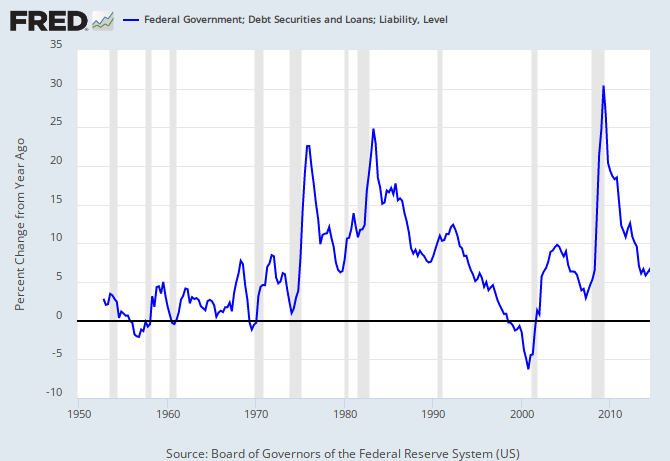
And recessions begin with reductions in deficit growth.

Reductions in federal debt growth lead to inflation
Blue line = deficit growth. Vertical gray bars = recessions. Recessions are cured by increases in deficit growth.

The reason for this effect is simple: Deficits add dollars to the economy, and these added dollars are necessary for economic growth.

Macguineas’s article continues:

The risks and consequences of high and rising debt include:

•Slower economic and income growth due to debt crowding out private sector investment. As the government issues more debt, investors buy these bonds in place of private investment. Over time, this results in a smaller stock of buildings, machines, and equipment; fewer new ventures and new technologies; and slower wage growth. CBO estimates average income will be $6,000 ( 6%) lower in 2048 if we allow debt to rise rather than reduce it to historical levels.

Completely false. There is no crowding out. Higher debt results from federal deficit spending which adds investment dollars to the economy.

That is why massive debt growth has paralleled massive economic growth.

MacGuineas ignores these obvious facts.

•Higher interest rates on loans for households and businesses. Rising federal debt tends to put upward pressure on interest rates throughout the economy. This increase trickles into business and consumer loans, making it more expensive for Americans to take out mortgages, car loans, and credit card debt – not to mention small business loans and other borrowing that helps grow the economy.

Interest rates have remained low in past years despite growing debt due to Federal Reserve accommodation and a slow recovery, but there is a very strong risk those conditions will and have started to change as the economy has gotten stronger, the Federal Reserve tightens monetary policy, and we come closer to full employment.

Federal “debt” does not put pressure on interest rates. The Fed sets rates to combat inflation, not to sell federal “debt.”

Further, federal debt does not cause inflation, which instead is caused by shortages. Historically, they have been shortages of food, but more recently, they have been shortages of oil. See: Federal deficit spending doesn’t cause inflation; oil does.

•Higher government interest payments that displace other government priorities. Due to rising interest rates and an increasing stock of debt, interest payments are projected to be the fastest growing part of the federal budget.

Under current law, interest costs will tripleover the next decade. As a result, interest costs will exceed Medicaid spending by 2020, defense spending by 2023, and total discretionary spending by 2045.

We estimate that before 2050, net interest will be the single largest line item in the budget.

In the above comment about “displacing other government priorities,” MacGuineas makes the tacit and false assumption that the federal government can run short of its own sovereign currency, the U.S. dollar.

Because our Monetarily Sovereign federal government has the infinite ability to create dollars, the notion of “displacing” makes no sense.

Clearly, MacGuineas either does not understand Monetary Sovereignty, or she doesn’t want you to understand Monetary Sovereignty.

Reduced fiscal space for the government to react to wars, recessions, or other emergencies. It is impossible to predict the timing of the next recession. However, the fact that one has not occurred in the last nine years suggests another may be on the horizon.

Unless there is a dramatic reduction in debt, we will enter the next recession with the highest debt in nearly 70 years (and higher than any time prior to World War II). This leads to legitimate concerns about the available “fiscal space” in the U.S., or the federal government’s financial capacity and willingness to respond to emergencies.

While it is impossible to know the precise amount available, the U.S. almost certainly has less fiscal space today than it did a decade ago, and it is projected to have even less in the coming years. The U.S. is less equipped to handle the next recession than it was in handling the Great Recession.

The “precise amount available” is infinite. That is why it’s impossible to know.

The “fiscal space” argument is identical with the “displace other priorities” argument. Again, MacGuineas wants you to believe the federal government can run short of its own sovereign currency.

While you and I, and the cities and states, and even the euro nations can run short of money, the U.S federal government cannot unintentionally run short of dollars.

•Lost opportunities to make thoughtful investments or reforms. Rising debt hinders our ability to enact good public policy. Whether you care about strengthening the military, developing clean energy, reducing burdensome taxes, or investing in education and infrastructure, rising debt will crowd it out.

Thanks to the increasing debt burden, next year the country will spend more on interest than on children, which means we will be spending more on financing our past than investing in our future.

And there are many new issues on the horizon, from the effects of technology to the future of work to new types of global threats that we are only just developing the capacity to withstand. As time goes on, we will increasingly lose the capability to address our debt situation through thoughtful, gradual, and targeted tax and spending reforms. At some point in the near future, our debt will be so high we will have to forgo new ideas and impose blunt spending cuts and tax hikes.

Hinders our ability” is another statement of “crowding out,” and “reducing fiscal space.” MacGuineas keeps repeating the same false premise, just using different words

•Risk of an eventual fiscal crisis if changes are not made. The combination of our strong economy, steady monetary policy, and longstanding commitment to pay our debts has allowed us to amass significant debt without severe consequences. This will not last forever. Unsustainable debt may eventually lead some investors to demand higher interest rates, which could set off a chain of events that begins with a small selloff of existing federal bonds and ends with a global financial crisis.

No one knows what level of debt or combination of events would set off such a crisis ; I hope we will never have to find out.

The Fed, not investors, sets interest rates. Unlike with private bonds, demand is not an issue for federal bonds. If no one wished to buy federal bonds, the Federal Reserve could buy them, which is often has. (This is known as “Quantitative Easing.”)

In any event, the Treasury does not need to sell bonds to obtain dollars. It has an infinite supply of dollars.

Instead, the two most important reasons why the Treasury issues T-securities are:

  1. To provide a safe place to “park” unused dollars. This safety helps stabilize the dollar.
  2. To assist the Fed in controlling interest rates, which helps fight inflation.

Thus, the reasons for issuing of federal debt (aka “borrowing”) are quite unlike the reasons why you and I borrow.

Our Monetarily Sovereign federal government could stop issuing debt today — even stop collecting taxes today — and still retain the unlimited ability to pay for goods and services, forever.

Those unconcerned about our rising debt have sometimes pointed to the built- up debt in recent years as evidence that the United States can borrow with little consequence. That’s a mistake.

China owns $1.1 trillion of U.S. debt. Trade and other tensions with them can certainly affect their lending decisions. Moreover, given our unstable political relationship with China, it is less than ideal to be as dependent on them as we are for funds.

Japan, which holds another $1 trillion of our debt, has also halted net purchases – possibly due to its aging population.

As the population continues to age, this nation of savers is likely to draw down its savings to finance retirement and therefore have fewer assets available to purchase U.S. debt.

Currently, foreign investors and governments own about 40% of the publicly traded debt, a percentage that has decreased in recent years as China and Japan have pulled back and forced domestic investors to finance our debt instead.

As we’ve said, the federal government does not need to sell debt to anyone — not to China, not to Japan, not to you or me, not to anyone.

Further, “domestic investors” are not forced to do anything. I know of no “forcing” device the federal government uses to sell T-bonds. It’s all nonsense.

And now we come to the real reason why MacGuineas spreads the Big Lie that the federal government is running short of dollars:

The primary drivers of long-term debt are growing mandatory spending and the lack of revenue to pay for it. Over the next ten years, 82% of spending growth will be due to Social Security, health programs, and interest payments.

Mandatory spending, specifically the costs stemming from an aging population, remains the largest long-term problem to address. Congress should have offset the increased discretionary funding with mandatory cuts and revenues that led to growing deficit reduction over time.

The fastest growing parts of the budget are Social Security, health programs like Medicare and Medicaid, and interest payments on the debt – each of which does not go through the annual appropriations process and is growing faster than the economy.

Mandatory spending and interest have already grown from 61% of the budget in 2010 to 69% today, and they are projected to be at 77% in 2028.

Get it? Her pay comes from the wealthy. So, on behalf of the wealthy, she wants the government to cut Social Security, Medicare, and Medicaid, programs that are vital for the middle classes and the poor, but mean little to the rich.

In short, the rich want to widen the Gap between the rich and the rest, and MacGuineas acts as their mouthpiece.

One of the many reasons this concerns me is the extent to which it has squeezed productive investments.

The best first step our leaders could make is to pledge to not make the debt situation worse(unless there is a smart reason to borrow such as a recession).

Squeezed productive investments” is yet another synonym for “hinders our ability,”  “crowding out,” and “reducing fiscal space.” It’s completely phony when referring to a Monetarily Sovereign government.

And notice she acknowledges that deficit spending is good during a recession (because deficit spending grows the economy), but she doesn’t want to grow the economy unless we have a recession. That’s totally illogical.

Lawmakers should focus on making changes to two of the largest drivers of our long-term debt problem: health care spending and Social Security. Reforms in these areas have the most potential for significant savings, and it would be between difficult and impossible to control our debt problem without making changes to these programs.

The largest driver of future costs is health care. The other major area needing attention is Social Security. The program’s trust fund is on track to exhaust its reserves by 2034, at which point benefits will be cut by 20% to 25% without legislative action to stop it.

Starting this year, the Social Security trust fund is being drawn down to pay benefits, meaning that the government must borrow from elsewhere so that Social Security can redeem its trust fund reserves.

In other words, Social Security is increasing the current deficit and will continue to do so dramatically in the future if the program is not reformed.

We can fix this program by adjusting benefits, raising revenues, or both.

First, there is no Social Security Trust Fund. It’s an accounting fiction. See: “The End of Social Security.” Being Monetarily Sovereign, the federal government has no need for Trust Funds. See: “Fake federal trust funds and fake concerns.”

In fact, get this:

The Supplemental Medical Insurance fund, which pays for Medicare Part B and Part D benefits, is funded by Congress. It doesn’t rely on a “trust fund.” Congress directly authorizes what funds are needed.

So, while Medicare and Social Security supposedly are paid through trust funds, in reality, half of Medicare doesn’t even pretend to go through a “trust fund.”

Second, “raising revenues: means increasing FICA, which is deducted from salaries. The rich, who do not receive most of their income via salaries, don’t care about FICA, and in any event, the salary from which FICA is deducted is a comparatively piddling $100K.

This all demonstrates that the federal government has the unlimited ability to fund Social Security and Medicare forever, with no trust funds and not even a FICA tax.

In Summary:

The rich, who run America, want to widen the Gap between them and the rest of the populace.

It is the Gap that makes them rich. Without the Gap, we all would be the same, and the wider the Gap, the richer they are.

The rich don’t want you to understand that:
1. A growing economy requires a growing supply of money
2. Deficits increase the supply of money
3. Therefore, deficits grow the economy
4. The federal government, being Monetarily Sovereign, never can run short of dollars with which to pay its creditors

They just don’t want you to know it.
They want you to believe the government can’t afford to pay for benefits like Medicare for All, free college for all, and anti-poverty initiatives.

They certainly don’t want you to ask for the Ten Steps to Prosperity (below).

Rodger Malcolm Mitchell
Monetary Sovereignty
Twitter: @rodgermitchell; Search #monetarysovereignty
Facebook: Rodger Malcolm Mitchell

…………………………………………………………………………………………………………………………………………………………………………………………………………………………………………………………………………………………..

The single most important problems in economics involve the excessive income/wealth/power Gaps between the have-mores and the have-less.

Wide Gaps negatively affect poverty, health and longevity, education, housing, law and crime, war, leadership, ownership, bigotry, supply and demand, taxation, GDP, international relations, scientific advancement, the environment, human motivation and well-being, and virtually every other issue in economics.

Implementation of The Ten Steps To Prosperity can narrow the Gaps:

Ten Steps To Prosperity:
1. Eliminate FICA

2. Federally funded medicare — parts a, b & d, plus long-term care — for everyone

3. Provide a monthly economic bonus to every man, woman and child in America (similar to social security for all)

4. Free education (including post-grad) for everyone

5. Salary for attending school

6. Eliminate federal taxes on business

7. Increase the standard income tax deduction, annually. 

8. Tax the very rich (the “.1%) more, with higher progressive tax rates on all forms of income.

9. Federal ownership of all banks

10. Increase federal spending on the myriad initiatives that benefit America’s 99.9% 

The Ten Steps will grow the economy, and narrow the income/wealth/power Gap between the rich and you.

MONETARY SOVEREIGNTY

AARP spreads the usual Social Security myths

Federal finances are different from your personal finances. They also are different from city, county, and state finances. And they are different from business finances.

How different?

  1. The U.S. federal government cannot unintentionally run short of its own sovereign currency, the U.S. dollar.
  2. The federal government does not use or need tax income, in order to pay its bills.
  3. The federal government cannot become insolvent, no matter how high its financial responsibilities.

Who says so?

Ben Bernanke: “The U.S. government has a technology, called a printing press (or, today, its electronic equivalent), that allows it to produce as many U.S. dollars as it wishes at essentially no cost.”

Alan Greenspan: “Central banks can issue currency, a non-interest-bearing claim on the government, effectively without limit. A government cannot become insolvent with respect to obligations in its own currency.”

St. Louis Federal Reserve: “As the sole manufacturer of dollars, whose debt is denominated in dollars, the U.S. government can never become insolvent, i.e.,unable to pay its bills. In this sense, the government is not dependent on credit markets to remain operational.

In short, even if all federal tax collections were $0, the federal government could continue paying its bills, forever.

Yet the AARP, repeatedly spreads the false idea that federal finances are like personal finances and so, Social Security can run short of dollars.

Here are excerpts from their latest “informational article” with regard to Social Security:

12 Top Things to Know About Social Security
Understanding the program that helps secure your future
by Kenneth Terrell, AARP Bulletin, November 2018

1. Social Security is not going bankrupt

At the moment, you could say the opposite; the Social Security trust funds are near an all-time high. “The program really is in good shape right now,” says David Certner, AARP’s legislative policy director. “But we know it has a long-term financial challenge.”

Here’s why: For decades, Social Security collected more money than it paid out in benefits. The surplus money collected from payroll taxes each year got invested in Treasury securities; today, the trust fund reserves are worth about $2.89 trillion.

But as the birth rate has fallen and more boomers retire, the ratio of workers to Social Security recipients is changing. This year is a tipping point: The program will need to dip into its reserves to pay full benefits from this point forward, absent any change to the program.

It’s now forecast that the trust fund reserves could be exhausted in 2034. “The longer we wait to fix Social Security funding, the more the cost will be paid by the younger generations, either on the tax side or the benefits side,” says Kathleen Romig, a Social Security analyst at the nonpartisan Center on Budget and Policy Priorities.

The above is the classic “Social Security finances are like your finances” myth. But, the federal government does not pay its bills out of “trust funds” as the term ordinarily is used:

From the Bureau of the Fiscal Service, U.S. Department of the Treasury: The Federal Government uses the term “trust fund” differently than the way in which it is commonly used.

In common usage, the term is used to refer to a private fund that has a beneficiary who owns the trust’s income and may also own the trust’s assets.

A custodian or trustee manages the assets on behalf of the beneficiary according to the terms of the trust agreement, as established by a trustor.

Neither the trustee nor the beneficiary can change the terms of the trust agreement; only the trustor can change the terms of the agreement.

In contrast, the Federal Government owns and manages the assets and the earnings of most Federal trust funds and can unilaterally change the law to raise or lower future trust fund collections and payments or change the purpose for which the collections are used.

Although AARP speaks about the Social Security “trust fund” having a “financial challenge” and reserves “could be exhausted,” the truth is that the federal government has 100% control over the “fund.”

It has the unlimited power to add dollars, deduct dollars, or do anything else it wishes. It could eliminate the “trust fund” and the FICA tax completely, and still continue to pay Social Security benefits.

2. Congress probably will not take up Social Security reform anytime soon

Several members of Congress have proposed legislation to address the program’s long-term funding issues.

But given the deep political divides on Capitol Hill, it’s unlikely that Congress will make any effort to reform Social Security until there’s the possibility of bipartisan support.

There are concerns that the tax-cut legislation passed in late 2017 could lead some lawmakers to look for places where they might cut spending. “The stage has been set by the tax bill to take another run at Social Security, Medicare and Medicaid,” says Max Richtman, CEO of the National Committee to Preserve Social Security and Medicare.

Here, the myth is that taxes, especially FICA, pay for Social Security benefits. Though state and local taxes do fund state and local spending, federal taxes pay for nothing.

In fact, federal taxes are destroyed upon receipt at the U.S. Treasury. and all payments are made with new dollars created ad hoc.

3. Some ideas to reform funding are starting to take shape

One proposal is to either raise or eliminate the wage cap on how much income is subject to the Social Security payroll tax. In 2019, that cap will be $132,900, which means that any amount a worker earns beyond that is not taxed.

Remove that cap, and higher-income earners would contribute far more to the system.

Other options lawmakers might consider include either raising the percentage rate of the payroll tax or raising the age for full retirement benefits.

All of the above options are completely unnecessary. None of them would add even one cent to the federal government’s ability to fund Social Security benefits.

4. Lawmakers do not raid the trust fund

Another common myth about Social Security is that Congress and the president use trust fund assets to pay for other federal expenses, such as education, defense or economic programs.

That’s not accurate. The money remaining after the Social Security Administration (SSA) has paid benefits and other expenses is invested directly into U.S. Treasury securities.

The government can use the money from those securities, but it has to pay the money back with interest.

Via fictional bookkeeping, the government arbitrarily increases and decreases balances in “trust fund” accounts and Treasury Security accounts.

None of this affects, even to the slightest, the federal government’s ability to fund Social Security benefits.

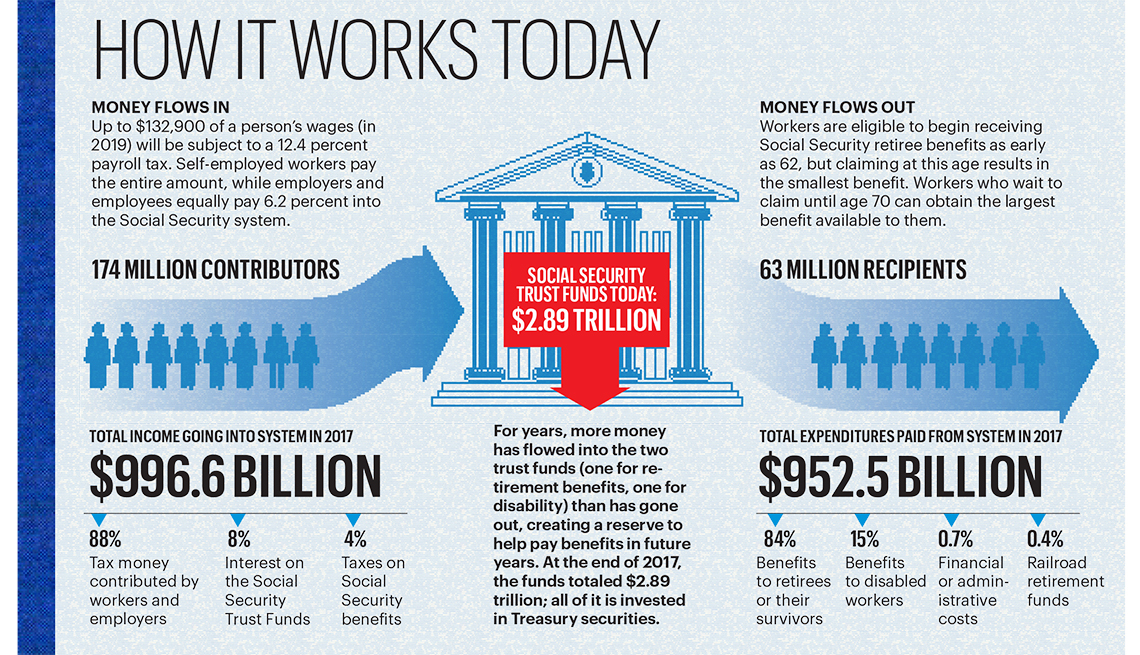
Then, we are treated to the following graph, which would apply to a personal trust fund, but is entirely fictional when describing federal finances.

Illustration of how Social Security works

The dollars “flowing in” are tax dollars destroyed upon receipt. The dollars flowing out are brand, new dollars, created ad hoc by the government. There is no connection between what “flows in” and what “flows out.”

The remainder of the “Twelve things to know” deal with specific rules, not the health of the “trust fund.”

In Summary, Social Security is a federal agency. Because the U.S. government is Monetarily Sovereign, and so cannot run short of its own sovereign currency, the U.S. dollar, no agency of the federal government can run short of dollars unless Congress and the President will it to.

The federal government does not need to “raise or eliminate the FICA wage cap.”  Nor does it need to “raise the percentage rate of the payroll tax .” Nor does it need to “raise the age for full retirement benefits.”

None of these acts will improve Social Security’s solvency, which is infinite .

The federal government doesn’t want you to understand the above, lest you demand more benefits.  Why doesn’t the government want you to have more benefits?

Because of Gap Psychology. You can read more about that, here.

Rodger Malcolm Mitchell
Monetary Sovereignty
Twitter: @rodgermitchell; Search #monetarysovereignty
Facebook: Rodger Malcolm Mitchell

…………………………………………………………………………………………………………………………………………………………………………………………………………………………………………………………………………………………..

The single most important problems in economics involve the excessive income/wealth/power Gaps between the have-mores and the have-less.

Wide Gaps negatively affect poverty, health and longevity, education, housing, law and crime, war, leadership, ownership, bigotry, supply and demand, taxation, GDP, international relations, scientific advancement, the environment, human motivation and well-being, and virtually every other issue in economics.

Implementation of The Ten Steps To Prosperity can narrow the Gaps:

Ten Steps To Prosperity:
1. Eliminate FICA

2. Federally funded medicare — parts a, b & d, plus long-term care — for everyone

3. Provide a monthly economic bonus to every man, woman and child in America (similar to social security for all)

4. Free education (including post-grad) for everyone

5. Salary for attending school

6. Eliminate federal taxes on business

7. Increase the standard income tax deduction, annually. 

8. Tax the very rich (the “.1%) more, with higher progressive tax rates on all forms of income.

9. Federal ownership of all banks

10. Increase federal spending on the myriad initiatives that benefit America’s 99.9% 

The Ten Steps will grow the economy, and narrow the income/wealth/power Gap between the rich and you.

MONETARY SOVEREIGNTY